Bush v Gore
context: see Brooks Bros, voter disenfranchise
no merri
primary 1 24 --> Gulf War, kill kyoto:
ailes hired dubya cuz makes fla call
:{---}
===
an 5 24
alternet-no lnx
The supreme scheme: How Alito and Thomas are fueling the ongoing Trump coup
Associate Supreme Court Justice Clarence Thomas sits with his wife and conservative activist Virginia Thomas while he waits to speak at the Heritage Foundation on October 21, 2021 in Washington, DC. (Photo by Drew Angerer/Getty Images)
Thom Hartmann May 20, 2024
Senator Dick Durbin, chairman of the Judiciary Committee, needs to act.
Supreme Court Associate Justice Sam Alito was just caught red-handed promoting Trump’s fascist “stop the steal” campaign to overthrow the 2020 election and end democracy in America by flying the upside-down flag at his home. He then went on Fox “News” and lied that it was his wife’s fault and that she did it because schoolchildren at a nearby bus stop saw a neighbor’s “F*ck Trump” yard sign.
In fact, as the Lincoln Project’s Steve Schmidt pointed out this past weekend:
“Mrs. Alito was so alarmed by the degradations and profane, yet protected speech that she went immediately home, and inverted the American flag signaling distress. Here’s the problem: there were no school buses and no school children on them in January 2021 in Alexandria, Virginia. Schools in the city were closed for a full year as a result of the pandemic and didn’t re-open until March 2021.”
READ: America in the final stage of a 40-year transition
But Alito’s fingers were apparently far deeper in the January 6th coup attempt than most Americans realize. Trump lawyer Sydney Powell pointed out on Stew Peters’ rightwing YouTube channel that she, Louie Gohmert, and Kari Lake (among others) had filed a lawsuit against Vice President Mike Pence to prevent him from certifying the Electoral College vote on January 6th.
It was a legal attempt to try to do what Trump sent a mob to do when the legal strategy failed:
“We were filing a 12th Amendment constitutional challenge to the process that the Congress was about to use per the Electoral Act provisions that simply don’t jibe with the 12th Amendment to the United States Constitution, and Justice Alito was our circuit court justice for that. Louie Gohmert was the plaintiff in our lawsuit and we were suing the Vice President to follow the 12th Amendment as opposed to the Electoral Count Act.” (emphasis mine)
The 12th Amendment, ratified in 1804, is the provision under which a contested election for president gets thrown to Congress, as happened in the 1876 election where Democrat Sam Tilden got more electoral and popular votes than Republican Rutherford B. Hayes by the first count.
That election ended up thrown to the House because three states had submitted two sets of Electoral College votes (just like Trump’s are fake electors), so Congress cut a deal to end Reconstruction in exchange for making Hayes president, even though he arguably lost the election.
The lawsuit, filed by Gohmert, Kari Lake, and a handful of Republican operatives, demanded the delay so Republicans on the Supreme Court could decide who’d be president, just like they did in the 2000 election. It called for:
“[R]espondent Vice President of the United States to refrain from invoking the dispute-resolution provisions of the Electoral Count Act of 1887 … for the duration of this Court’s consideration of a timely filed petition for a writ of certiorari. As set forth in the argument below, the ECA violates the Electors’ Clause, the Twelfth Amendment, and the Constitution’s structural protections of liberty.”
If Alito would rule that Pence must defer to Congress per the 12th Amendment, the election of 2020 would be thrown to the House with each state having one vote. There, the presidency would have gone to Trump 27-23, because 27 states’ congressional delegations were then controlled by Republicans.
This was not a brand-new or hastily organized plan. I wrote on March 13, 2020 — eight months before the election — that Republicans I knew in Washington DC had informed me that the Trump folks were planning this exact strategy.
And, sure enough, here it was, with Sam Alito as the inside man.
The invasion of the House chamber by the “stop the steal” traitors was, by the theory of this plan, supposed to delay the counting of electoral college votes at least for a day, to give Alito time to act on the next day, January 7th. He and the courts would then rule that the 12th amendment took precedent to law made since then, Congress would declare Trump the winner, and that would be the end of the discussion.
But Nancy Pelosi got wind of the plot and blew it up by re-convening Congress at 8 pm to count the votes, just two hours after the last of the rioters had left the building and before Alito could rule. As Trump‘s senior attorney Powell told Peters:
“Nancy Pelosi had finagled to file an amicus brief in it — there had been inside goings on in Congress where I believe it was Steve Scalise and [Speaker Kevin] McCarthy [who] kept her from being an actual party; she wanted to work herself inside the case as a party but somehow that didn’t happen — so she got notice when we made our filing because she’d filed an amicus brief. And then everything broke loose and she really speeded up reconvening Congress to get the vote [count] going, or [Bill Barr’s] Justice [Department] might have issued an injunction to stop it all, which is what should have happened.”
In the end, Alito had to turn down the lawsuit on the morning of January 7th because Congress had already voted to certify the election for Biden.
As a result, we’ll never know how close we came to having a single corrupt Supreme Court justice overturn the election, but that flag flying outside his house gives us a pretty good clue as to what he may well have done the morning of January 7th had Pelosi not quickly acted the previous evening.
But Alito’s attempts to overturn our democracy weren’t limited to his support for Trump’s treasonous acts on January 6th. Were it not for Alito, Clarence Thomas, and at least two other Republicans on the Court, Donald Trump would by now have almost certainly been convicted in federal Judge Tanya Chutkan’s courtroom of seditiously trying to overthrow our government.
That federal criminal case was rapidly moving along when Trump’s lawyers made the absurd assertion that he was immune from prosecution for his attempted sedition because of a brand new, previously unheard of, and totally bizarre, made-up doctrine of presidential immunity. Even Richard Nixon didn’t have the cojones to try that one: he simply admitted his guilt and accepted a pardon to avoid going to prison.
It only takes four members of the Court to grant certiorari, allowing the Court to hear a case: four or more Republicans on the Court went out of their way to give Trump the delay he desperately needed. On February 28th, they granted cert and scheduled oral arguments for the very last day of their 2023-2024 session, the week of April 22nd.
To add insult to the injury to our republic, in oral arguments Alito dropped this little bomb on America, turning the case against Trump inside-out and claiming Trump should get a free pass to crime all he wanted:
“I’m sure you would agree with me that a stable democratic society requires that a candidate who loses an election, even a close one, even a hotly contested one, leave office peacefully, if that candidate is an incumbent?
“All right. Now if an incumbent who loses a very close, hotly contested election knows that a real possibility after leaving office is not that the president is going to be able to go off into a peaceful retirement, but that the president may be criminally prosecuted by a bitter political opponent, will that not lead us into a cycle that destabilizes the functioning of our country as a democracy?
“And we can look around the world and find countries where we have seen this process, where the loser gets thrown in jail.”
Thankfully, at least for the historical record, the Attorney representing Jack Smith’s Justice Department, Michael Dreeben, immediately replied:
“I think it’s exactly the opposite, Justice Alito.”
But Alito, not Dreeben, is on the Court and is the decision-maker. Alito thus gave — and continues to give — Trump a desperately needed further delay by slow-walking his own part of the Court’s decision in the Trump immunity case.
Even if they rule against Trump, which everybody assumed would happen before Alito dropped that rhetorical turd into the proceeding, by giving Donny the delay he wanted, the Republicans on the Court reduced the chance that Trump will ever be held to account for his crimes.
While the Court typically releases their decisions during the summer, they have the option of waiting as long as they want — even until well past the November election date. So, if Trump is elected, he can fire Jack Smith and end the prosecution himself.
And it’s not like Alito and Thomas don’t have a stake in this fight. If Biden is re-elected, by the 2028 election Alito will be 78 and Thomas 80. Insiders have speculated that both would like to retire soon and have their replacements appointed by a Republican president.
And it won’t be the first time a corrupt Republican on the Court threw an election just to insure that body remained in Republican hands. You’ll recall, in 2000 Sandra Day O’Connor’s husband told friends that the reason she voted to stop the Florida Supreme Court-ordered recount and make George W. Bush president was simply because she didn’t want Al Gore to choose her replacement.
Arguably the most galling part of this entire pathetic drama is the response of Democrats with subpoena power in the US Senate. Judiciary Committee Chairman Dick Durbin, for example, issued a miserably weak request for Alito to recuse himself from cases having to do with January 6th, rather than demand the man resign and calling a hearing to make it happen.
We all know what would have happened if the shoe was on the other foot.
A Republican-controlled Senate confronting a Democratic Supreme Court appointee accused of corruption would be holding nationally televised public hearings, dragging that justice and his family and intimates before Congress for a grilling, and demanding both prosecution and impeachment.
That’s exactly what happened in the spring of 1969, when Republicans on the Senate Judiciary committee — along with a coordinated effort by President Nixon and Republicans in the media — accused the most liberal member of the Court, Abe Fortas, of being corrupt.
This was Nixon’s chance to flip the balance of the Supreme Court, while conservatives across the nation were still angry about the Brown v Board decision.
Fortas had taken a $20,000 payment from a man he’d defended years earlier; the man hadn’t been able to pay at the time, and finally came up with the money a year or so after LBJ put Fortas on the Court. Not exactly a crime, by any measure.
Fortas was also paid a $15,000 advance for a book he wrote, and Republicans alleged his wife had evidence of tax evasion, although it later turned out that charge was entirely manufactured out of thin air. No crimes here, either.
Nonetheless, the complaints about “Supreme Court corruption” and accompanying threats and pressure from Congressional Republicans against Fortas and his wife — and the firestorm in the media stirred up by Republican commentators — was so intense that Fortas resigned on May 14, 1969 just to get the torture to stop.
Consider that when you think about Alito’s wife hanging the upside-down flag, or her close association with hard-core rightwing causes including her alleged involvement in “Operation Higher Court.” Or Ginni Thomas’ involvement with the January 6th coup attempt itself, texting Trump Chief of Staff Mark Meadows:
“Watermarked ballots in over 12 states have been part of a huge Trump & military white hat sting operation in 12 key battleground states,” and “Biden crime family & ballot fraud co-conspirators (elected officials, bureaucrats, social media censorship mongers, fake stream media reporters, etc.) are being arrested & detained for ballot fraud right now & over coming days, & will be living in barges off GITMO to face military tribunals for sedition.”
Keep in mind that in the 2016 election, the singular thing that caused millions of Republicans — who otherwise considered Trump a fraud, con man, and sexual pervert — to vote for him was that Mitch McConnell was holding Merrick Garland’s seat on the Supreme Court open.
As Vox reported:
“One in five [2016] voters told CNN in an exit poll that the Supreme Court was one reason they had cast a ballot. Of the voters who said it was the ‘most important factor’ in their decision, 56 percent voted for Trump. According to the Washington Post, 26 percent of all Trump voters polled said that the Supreme Court was the basis of their decision.”
This fall, the corruption of the Supreme Court by corporate, billionaire, and fossil fuel interests should be at the top of Biden’s re-election campaign: polls show a majority of Americans are horrified by it.
Both Thomas — whose bribe-taking in exchange for his votes on Citizens United and other cases is well documented — and his rightwing buddy Sam Alito must resign or face impeachment. If Republicans could pull it off against a totally innocent Abe Fortas back in the day, Democrats should be able to do it now against two guys whose corruption is obvious to everybody.
Democrats in Congress — particularly on the Senate Judiciary Committee — need to grow a damn spine and make it happen.
NOW READ: The Supreme Court's wealth-driven corruption crisis
---
:---
no lnx pix cnn
https://www.cnn.com/2020/10/17/politics/bush-v-gore-barrett-kavanaugh-roberts-supreme-court/index.html
Supreme Court is about to have 3 Bush v. Gore alumni sitting on the bench
Joan Biskupic
By Joan Biskupic, CNN legal analyst & Supreme Court biographer
Published 8:07 AM EDT, Sat October 17, 2020
Kavanaugh talks Bush v. Gore case (2000)
CNN
Judge Amy Coney Barrett, once confirmed, will be one of three current Supreme Court justices who assisted the legal team of then-Texas Gov. George W. Bush in the Florida ballot-recount battle that came down to a single vote at the Supreme Court.
The court’s December 12, 2000, decision cutting off Florida recounts tore apart the justices and the nation, and the case hovers in the air today as America approaches the November 3 presidential election.
Other current justices benefited from the decision giving Bush the White House over Vice President Al Gore, as they eventually became Bush appointees to the bench. Conversely, a pending judgeship for one of the current members was derailed by Bush v. Gore – temporarily.
WASHINGTON, DC - OCTOBER 14: Supreme Court nominee Judge Amy Coney Barrett testifies before the Senate Judiciary Committee on the third day of her Supreme Court confirmation hearing on Capitol Hill on October 14, 2020 in Washington, DC. With less than a month until the presidential election, President Donald Trump tapped Amy Coney Barrett to be his third Supreme Court nominee in just four years. If confirmed, Barrett would replace the late
RELATED ARTICLE
Amy Coney Barrett's answers were murky but her conservative philosophy is clear
Of the original nine who decided the case two decades ago, only two remain, Justices Clarence Thomas and Stephen Breyer. And they were on opposite sides.
Following are descriptions of the justices’ associations – some predictable, some serendipitous – with the milestone that would haunt any litigation reaching the justices in the race between President Donald Trump and former Vice President Joe Biden.
Three who assisted Bush
Chief Justice John Roberts
Roberts flew to Florida in November 2000 to assist Bush’s legal team. He helped prepare the lawyer who presented Bush’s case to the Florida state Supreme Court and offered advice throughout.
Roberts also faced a singular personal challenge during the 36-day ordeal that extended from the November 7 Election Day to the court’s late-hour December 12 ruling. Then in private practice, Roberts was preparing to argue before the justices in a separate business case on November 29, and within days in December, the baby boy he and his wife had planned to adopt was born.
VIDEO
RELATED VIDEO
Justice Scalia on Bush vs. Gore
After Bush became president, he nominated Roberts to the US Court of Appeals for the DC Circuit (the Senate confirmed him in 2003); Bush then elevated Roberts to the chief justice position in 2005, to succeed William Rehnquist. During his Senate confirmation hearing, Roberts declined to reveal his view of the justices’ 2000 decision, saying a disputed election could come to the court again.
“Obviously, the particular parameters in that case won’t” return to the court, he said, “but it is a very recent precedent, and that type of decision is one where I thought it inappropriate to comment on whether I think they were correct or not.”
Justice Brett Kavanaugh
He was also in private practice in 2000 and helped the Bush legal team. He wrote on a 2018 Senate questionnaire that his work related to recounts in Volusia County, Florida.
In an interview with CNN in Washington after the justices had heard oral arguments but before they ruled, Kavanaugh said the justices were concerned about “the arbitrary, standardless nature of the recount process in Florida.” He dismissed a question about political differences, saying, “I don’t think the justices care if it’s Bush v. Gore, or if it were Gore v. Bush. What they care about is how to interpret the Constitution and what are the enduring values that are going to stand a generation from now.”
WASHINGTON, DC - SEPTEMBER 26: (L-R) President Donald Trump, first lady Melania Trump and 7th U.S. Circuit Court Judge Amy Coney Barrett, 48, walk into the Rose Garden before Trump announces Barrett as his nominee to the Supreme Court at the White House September 26, 2020 in Washington, DC. With 38 days until the election, Trump tapped Barrett to be his third Supreme Court nominee in just four years and to replace the late Associate Justice Ruth Bader Ginsburg, who will be buried at Arlington National Cemetery on Tuesday.
RELATED ARTICLE
Barrett declines to commit to recusing herself from a Trump election case
After the election, Bush hired Kavanaugh to be a counsel and then staff secretary. In the West Wing, Kavanaugh met his future wife, Ashley, who was Bush’s personal secretary. Bush appointed Kavanaugh to the US Court of Appeals for the DC Circuit, where Roberts had first served. In 2018, Trump elevated Kavanaugh to the Supreme Court.
During Kavanaugh’s Senate confirmation hearings, Democratic senators referred to his involvement in the Bush v. Gore litigation, but they did not ask him about the case.
Judge Amy Coney Barrett
Barrett wrote on the questionnaire she submitted to the Senate for her Supreme Court confirmation review, “One significant case on which I provided research and briefing assistance was Bush v. Gore.” She said the law firm where she was working at the time represented Bush and that she had gone down to Florida “for about a week at the outset of the litigation” when the dispute was in the Florida courts. She said she had not continued on the case after she returned to Washington.
During her hearings this week, she told senators she could not recall specifics of her involvement.
“I did work on Bush v. Gore,” she said on Wednesday. “I did work on behalf of the Republican side. To be totally honest, I can’t remember exactly what piece of the case it was. There were a number of challenges.”
Separately, under questioning from Democratic senators, Barrett declined to commit to recusing herself from any Trump election case. Trump has speculated that the Supreme Court could face another major lawsuit over the November presidential contest. “I think this will end up at the Supreme Court,” he said last month. “And I think it’s very important that we have nine justices.”
Bush v. Gore: The final hours
12:27 - Source: CNN
On the bench
Justice Clarence Thomas
He is the only remaining member of the five-justice majority that resolved Bush v. Gore. Thomas joined the unsigned opinion that said Florida had run out of time to recount disputed ballots without violating the constitutional guarantee of equal protection. The decision cemented the state’s late November certification of a 537-vote margin for Bush over Gore (from nearly 6 million ballots cast) and gave Bush Florida’s decisive electoral votes.
Thomas, a 1991 appointee of Bush’s father, President George H.W. Bush, also joined a concurring opinion with Rehnquist and Justice Antonin Scalia, finding additional constitutional flaws in a Florida state Supreme Court decision that had allowed the recounts to continue.
The day after Bush v. Gore was handed down, Thomas kept a previously scheduled meeting with high school students at the court. He told them the weeks preceding the decision had been “exhausting” but that he believed the process showed “the strength of our system of government.” He said politics had not been involved in the decision.
US President George W. Bush (R) shakes hands with his brother Florida Governor Jeb Bush during a fund-raising event at the PGA National Resort & Spa in Palm Beach Gardens, Florida, 08 January 2004.
VIDEO
RELATED VIDEO
Jeb's role in 2000 Florida recount
It was at this session that Thomas happened to reveal for the first time a “personal reason” for his habit of not asking questions at oral arguments. Born in rural Pin Point, Georgia, Thomas said he spoke with a Geechee dialect and was self-conscious as a child: “I just started developing the habit of listening,” he told the students.
Thomas is the only justice in the past 20 years who has cited Bush v. Gore as precedent in any subsequent case, with a footnote in a 2013 solo dissent. The court in 2000 had deemed its decision “limited to the present circumstances, for the problem of equal protection in election processes generally presents many complexities.”
Justice Stephen Breyer
He was one of the four dissenters and, with the September 18 death of Justice Ruth Bader Ginsburg, is the only one left on the bench. Each of the dissenting justices wrote separate opinions, although they signed on to parts of their colleagues’ views. In Breyer’s opinion, he declared that the majority seemed to abandon its “self-restraint” and traditional check on its exercise of power.
“(W)e do risk a self-inflicted wound – a wound that may harm not just the Court, but the Nation,” he wrote.
U.S. Supreme Court Associate Justice Stephen Breyer is seen during a group portrait session for the new full court at the Supreme Court in Washington, U.S., November 30, 2018. REUTERS/Jim Young
RELATED ARTICLE
Justice Breyer reminisces about RBG, ducks questions about Barrett
Breyer, a 1994 appointee of President Bill Clinton, for years afterward recalled his disappointment but referred to the upside of an ordered democracy. “Bush v. Gore’s mandate was followed without paratroopers being dispatched, without bullets being fired, without rocks being hurled, and even without punches being thrown,” he said in a 2009 appearance in Boston.
“To be sure,” he added, “people were angry with the decision and they continue to disagree with it. But they have also agreed to follow the decision because that is what occurs in countries that have judicial independence and are ruled according to law.”
The late Ginsburg criticized the majority in her separate opinion for abandoning its usual federalism and deference to state courts on state law. “Rarely has this Court rejected outright an interpretation of state law by a state high court,” she said. As she closed her opinion, she highlighted the stakes for the country: “In sum, the Court’s conclusion that a constitutionally adequate recount is impractical is a prophecy the Court’s own judgment will not allow to be tested. Such an untested prophecy should not decide the Presidency of the United States.”
WASHINGTON, DC - FEBRUARY 14: Supreme Court Justice Ruth Bader Ginsburg is seen as she presents the Justice Ruth Bader Ginsburg Inaugural Woman of Leadership Award to Agnes Gund at The Library of Congress on February 14, 2020 in Washington, DC. (Photo by Shannon Finney/Getty Images)
RELATED ARTICLE
20 years of closed-door conversations with Ruth Bader Ginsburg
Over the years, the 1993 Clinton appointee expressed her despair that December 12 evening and her delay in leaving the building, until Scalia telephoned and said, “Ruth, why are you still at the court? Go home and take a hot bath.” Ginsburg’s response: “Good advice I promptly followed.”
Other conservative justices
Justice Samuel Alito
He had been appointed in 1990 to the 3rd US Circuit Court of Appeals by President George H.W. Bush. At the time of Bush v. Gore, Alito was a decade into the job, writing opinions in his Newark, New Jersey, chambers and widely regarded as a possibility for the younger Bush’s “short list” of Supreme Court candidates.
The opportunity came in late 2005, when Bush tapped him to replace retiring Justice Sandra Day O’Connor. During Alito’s confirmation hearing in January 2006, senators asked his views about Bush v. Gore. “I hope … that sort of issue does not come before the Supreme Court again,” Alito said, observing that controversy swirled not only around what the justices had decided but also whether they should even have taken up the case.
Pressed on what he thought of the outcome, Alito begged off, saying, “I have not studied it in the way I would study the issue if it were to come before me as a judge and that would require putting out of my mind any personal thoughts that I had on the matter.”
Justice Neil Gorsuch
Like Kavanaugh, he worked in the George W. Bush administration and was appointed by Bush to a federal appeals court. But Gorsuch remained in private practice through the early 2000s. He joined the Bush administration in the second term, serving 2005-2006 in the Department of Justice. Bush selected the Colorado native in 2006 for the Denver-based 10th US Circuit Court of Appeals. Gorsuch was then elevated to the Supreme Court by Trump in 2017.
When then-Senate Judiciary Chairman Chuck Grassley, an Iowa Republican, asked Gorsuch about Bush v. Gore, he responded, “I know some people in this room have some opinions on that, I am sure, Senator. But as a judge, it is precedent of the US Supreme Court, and it deserves the same respect as other precedents of the US Supreme Court when you are coming to it as a judge.”
Obama’s nominees
Justice Elena Kagan
She was nominated to the federal appeals court for the DC Circuit by Clinton in 1999, after serving his administration in senior domestic-policy positions. Later that year, Kagan become a visiting professor at the Harvard Law School.
The Republican-controlled Senate never acted on her appeals court nomination, and the ruling in Bush v. Gore ensured that she would not be renominated by Clinton’s successor. Kagan continued to teach and in 2003 was appointed dean of the Harvard Law School.
When Democrat Barack Obama succeeded Bush in 2009, he named Kagan US solicitor general and then in 2010 appointed her to the Supreme Court. During her Senate confirmation hearing, Kagan declined to give her view of Bush v. Gore. “The question of when the court should get involved in … disputed elections is, I think, one of some magnitude that might well come before the court again.”
Added Kagan: “It’s hard to think of a more important question in a Democratic system.”
Al Gore concedes presidential election of 2000
07:18 - Source: CNN
Justice Sonia Sotomayor
In 2000, Sotomayor was a US appellate judge for the 2nd Circuit. Hearing cases in New York, she was removed from the election fallout in Florida and Washington. She had first been tapped to be a US district judge in 1992 by George H.W. Bush, then elevated to the appeals court by Clinton in 1998. When Obama came to office in 2009, he chose Sotomayor for his first appointment to the high court.
During her confirmation hearing, she said her reaction as a judge to Bush v. Gore “was not to criticize it or to challenge it.”
Of the Supreme Court’s down-to-the-wire involvement, she said, “It’s only happened once in the lifetime of our country” and added that since 2000, “enormous electoral process changes” have occurred.
Sotomayor concluded by telling senators: “That is a tribute to the greatness of our American system, which is whether you agree or disagree with a Supreme Court decision, that all of the branches become involved in the conversation of how to improve things.”
----
---
an 1 24 no lnx
The 56-year-long crisis of treasonous & illegitimate GOP presidents is happening again
Thom Hartmann
January 27, 2024
Once again, America and the world are watching with horror as a Republican candidate for president — just to win an election — manipulates world affairs in a way that will cause widespread death and destruction while damaging the interests and reputation of America.
There’s a long tradition of Republicans running for president committing what can best called treason, or at least criminal manipulation of international affairs, to advantage themselves and hurt incumbent Democratic presidents.
Yesterday, Mitch McConnell let the proverbial cat out of the bag. A bipartisan group of senators had been working on a bill to provide funding to Ukraine and Israel, with money for the southern border, and when it looked like they were going to produce something that would actually pass the House and Senate, Donald Trump inserted himself, telling the Republicans they should kill the bill.
Trump apparently wants to run on chaos at the border, and solving the problem as this legislation is intended to do would take that issue away from him. But he’s also explicitly opposed to any further US aid to Ukraine. This is a treasonous twofer, putting Trump’s election above the interests of the United States and world peace.
Trump, of course, knows that if it weren’t for Putin’s intervention in the 2016 election, he never would have been president. And he desperately needs a repeat to hold onto his fortune and stay out of jail: he’s in a far greater bind now than when he first ran for president as a hustle to get GE to pay him more for his TV show.
His 2016 Campaign Manager Paul Manafort, after all, admitted that during that election he was handing secret internal campaign polling and strategy information off to Russian intelligence, so they could successfully use it to micro-target vulnerable voters via Facebook, an effort that reached 26 million targeted Americans in 6 swing states.
Now, Trump wants Putin’s help again for 2024. He knows that Putin can do things from overseas, including using deepfakes and posing as Americans to spread explicit lies on social media, that would send people to prison for election interference if done here in the US.
Putin’s number one goal, of course, is to seize control of Ukraine while destabilizing western democracies. So, Trump, wanting Putin’s help, is now trying to deliver Ukraine to Putin by killing US aid.
This pattern of Republican presidential candidates criminally intervening in foreign policy just to win elections started in 1968 and has been a feature — not a bug — of every Republican president who succeeded in taking the White House since: it’s time to seriously discuss the five-decade-long problem we have with treasonous and illegitimate GOP presidents.
It started in 1968, when President Lyndon Johnson was desperately trying to end the Vietnam war. It had turned into both a personal and political nightmare for him, and his vice president, Hubert Humphrey, who was running for President in the election that year against a “reinvented” Richard Nixon.
Johnson spent most of late 1967 and early 1968 working back-channels to North and South Vietnam, and by the summer of 1968 had a tentative agreement from both for what promised to be a lasting peace deal they’d both sign that that fall.
But Richard Nixon knew that if he could block that peace deal, it would kill VP Hubert Humphrey’s chances of winning the 1968 election. So, Nixon sent envoys from his campaign to talk to South Vietnamese leaders to encourage them not to attend upcoming peace talks in Paris.
Nixon promised South Vietnam’s corrupt politicians that he’d give them a personally richer deal when he was President than LBJ could give them then.
The FBI had been wiretapping South Vietnam’s US agents and told LBJ about Nixon’s effort to prolong the Vietnam War. Thus, just three days before the 1968 election, President Johnson phoned the Republican Senate leader, Everett Dirksen, (you can listen to the entire conversation here):
President Johnson: Some of our folks, including some of the old China lobby, are going to the Vietnamese embassy and saying please notify the [South Vietnamese] president that if he’ll hold out ’til November 2nd they could get a better deal. Now, I’m reading their hand. I don’t want to get this in the campaign. And they oughtn’t to be doin’ this, Everett. This is treason.
Sen. Dirksen: I know.
Those tapes were only released by the LBJ library in the past decade, and that’s Richard Nixon who Lyndon Johnson was accusing of treason.
At that point, for President Johnson, it was no longer about getting Humphrey elected. By then Nixon’s plan had already worked and Humphrey was being wiped out in the polls because the war was ongoing.
Instead, Johnson was desperately trying to salvage the peace talks to stop the death and carnage as soon as possible. He literally couldn’t sleep.
In a phone call to Nixon himself just before the election, LBJ begged him to stop sabotaging the peace process, noting that he was almost certainly going to win the election and inherit the war anyway. Instead, Nixon publicly said LBJ’s efforts were “in shambles.”
But South Vietnam had taken Nixon’s deal and boycotted the peace talks, the war continued, and Nixon won the White House thanks to it.
An additional twenty-two thousand American soldiers, and an additional million-plus Vietnamese died because of Nixon’s 1968 treason, and he left it to Jerry Ford to end the war and evacuate American soldiers.
Nixon was never held to account for that treason, and when the LBJ library released the tapes and documentation long after his and LBJ’s deaths it was barely noticed by the American press.
Gerald Ford, who succeeded Nixon, was never elected to the White House (he was appointed to replace VP Spiro Agnew, after Agnew was indicted for decades of taking bribes), and thus would never have been President had it not been for Richard Nixon’s treason. He pardoned Nixon.
Next up was Ronald Reagan.
During the Carter/Reagan election battle of 1980, then-President Carter had reached a deal with newly-elected Iranian President Abdolhassan Bani-Sadr to release the fifty-two hostages held by students at the American Embassy in Tehran.
Bani-Sadr was a moderate and, as he explained in an editorial for The Christian Science Monitor, successfully ran for President of Iran that summer on the popular position of releasing the hostages:
“I openly opposed the hostage-taking throughout the election campaign…. I won the election with over 76 percent of the vote…. Other candidates also were openly against hostage-taking, and overall, 96 percent of votes in that election were given to candidates who were against it [hostage-taking].”
Carter was confident that with Bani-Sadr’s help, he could end the embarrassing hostage crisis that had been a thorn in his political side ever since it began in November of 1979.
But behind Carter’s back, the Reagan campaign worked out a deal with the leader of Iran’s radical faction — Supreme Leader Ayatollah Khomeini — to keep the hostages in captivity until after the 1980 Presidential election. Khomeini needed spare parts for American weapons systems the Shah had purchased for Iran, and Reagan was happy to promise them.
This is the story that was finally confirmed just last year with The New York Times’ reporting that we now know how the deal was conveyed to the Ayatollah and by whom, including the lieutenant governor of Texas.
This was the second modern-day act of treason by a Republican wanting to become president.
The Reagan campaign’s secret negotiations with Khomeini — the so-called “Iran/Contra October Surprise” — sabotaged President Carter’s and Iranian President Bani-Sadr’s attempts to free the hostages.
As President Bani-Sadr told The Christian Science Monitor in March of 2013:
“After arriving in France [in 1981], I told a BBC reporter that I had left Iran to expose the symbiotic relationship between Khomeinism and Reaganism.
“Ayatollah Khomeini and Ronald Reagan had organized a clandestine negotiation, later known as the ‘October Surprise,’ which prevented the attempts by myself and then-US President Jimmy Carter to free the hostages before the 1980 US presidential election took place. The fact that they were not released tipped the results of the election in favor of Reagan.”
And Reagan’s treason — just like Nixon’s treason — worked perfectly.
The Iran hostage crisis continued and torpedoed Jimmy Carter’s re-election hopes. And the same day Reagan took the oath of office — to the minute, as Reagan put his hand on the bible, by way of Iran’s acknowledging the deal — the American hostages in Iran were released.
Keeping his side of the deal, Reagan began selling the Iranians weapons and spare parts in 1981, and continued until he was busted for it in 1986, producing the so-called “Iran/Contra” scandal.
But, like Nixon, Reagan was never held to account for the criminal and treasonous actions that brought him to office. Which is one reason Bush Jr. and Trump believed they could get away with anything.
After Reagan — Bush senior was elected — but like Jerry Ford — Bush was really only President because he served as Vice President under Reagan. And, of course, the naked racism of his Willie Horton ads helped boost him into office.
The criminal investigation into Iran/Contra came to a head with independent prosecutor Lawrence Walsh subpoenaing President George HW Bush after having already obtained convictions for Weinberger, Ollie North and others.
And Walsh was now looking into actual criminal activity by Bush himself in support of the Iran/Contra October Surprise.
Bush’s attorney general, Bill Barr, suggested he pardon them all to kill the investigation and protect himself, which Bush did.
The screaming headline across the New York Times front page on December 25, 1992, said it all: “BUSH PARDONS 6 IN IRAN AFFAIR, AVERTING A WEINBERGER TRIAL; PROSECUTOR ASSAILS ‘COVER-UP’”
And if the October Surprise hadn’t hoodwinked voters in 1980, you can bet Bush senior would never have been elected in 1988. That’s four illegitimate Republican presidents.
Which brings us to George W. Bush, the man who was given the White House by five right-wing justices on the Supreme Court.
In the Bush v. Gore Supreme Court decision in 2000 that stopped the Florida recount — and thus handed George W. Bush the presidency — Justice Antonin Scalia wrote in his opinion:
“The counting of votes … does in my view threaten irreparable harm to petitioner [George W. Bush], and to the country, by casting a cloud upon what he [Bush] claims to be the legitimacy of his election.”
Apparently, denying the presidency to Al Gore, the guy who actually won the most votes in Florida and won the popular vote nationwide by over a half-million, did not constitute “irreparable harm” to Scalia or the media.
And apparently it wasn’t important that Scalia’s son worked for a law firm that was defending George W. Bush before the high court (with no Scalia recusal).
Just like it wasn’t important to mention that Justice Clarence Thomas’s wife worked on the Bush transition team — before the Supreme Court shut down the recount in Florida — and was busily accepting resumes from people who would serve in the Bush White House if her husband stopped the recount in Florida…which he did. (No Thomas recusal, either.)
More than a year after the election a consortium of newspapers including The Washington Post, The New York Times, and USA Today did their own recount of the vote in Florida — manually counting every vote in a process that took almost a year — and concluded that Al Gore did indeed win the presidency in 2000.
As the November 12th, 2001 article in The New York Times read:
“If all the ballots had been reviewed under any of seven single standards and combined with the results of an examination of overvotes, Mr. Gore would have won.”
That little bit of info was slipped into the seventeenth paragraph of the Times story so that it would attract as little attention as possible because the 9/11 attacks had happened just weeks earlier and journalists feared that burdening Americans with the plain truth that George W. Bush actually lost the election would further hurt a nation already in crisis.
To compound the crime, Bush could only have gotten as close to Gore in the election as he did because his brother, Florida Governor Jeb Bush, had ordered his Secretary of State, Kathrine Harris, to purge at least 57,000 mostly-Black voters from the state’s voter rolls just before the election. Thousands of African Americans showed up to vote and were turned away from the polls in that election in Florida that Bush “won” by fewer than 600 votes.
The simple reality is that Al Gore won Florida in 2000, won the national popular vote by a half-million, and five Republicans on the Supreme Court denied him the presidency.
Florida Governor and George W. Bush’s brother Jeb had his Secretary of State, Kathryn Harris, throw thousands of African Americans off the voting rolls just before the election but then — when the votes had come in and it was clear former Vice President Al Gore had still won — she invented a brand new category of ballots for the 2000 election: “Spoiled.”
As The New York Times reported a year after the 2000 election when the consortium of newspapers they were part of finally recounted all the ballots:
“While 35,176 voters wrote in Bush’s name after punching the hole for him, 80,775 wrote in Gore’s name while punching the hole for Gore. [Florida Secretary of State] Katherine Harris decided that these were ‘spoiled’ ballots because they were both punched and written upon and ordered that none of them should be counted.
“Many were from African American districts, where older and often broken machines were distributed, causing voters to write onto their ballots so their intent would be unambiguous.”
George W. Bush “won” the election by 537 votes in Florida, because the statewide recount — which would have revealed Harris’s crime and counted the “spoiled” ballots, handing the election to Gore (who’d won the popular vote by over a half-million nationwide) — was stopped when George HW Bush appointee Clarence Thomas became the deciding vote on the Supreme Court to block the recount order from the Florida Supreme Court.
Harris’ decision to not count the 45,599 more votes for Gore than Bush was completely arbitrary: there was no legal category and no legal precedent, outside of the old Confederate states simply refusing to count the votes of Black people, to justify it.
The intent of the voters was unambiguous. And the 5 Republicans on the Supreme Court jumped in to block the recount ordered by the Florida Supreme Court (in violation of the 10th Amendment) just in time to prevent those “spoiled” votes from being counted, cementing Bush’s illegitimate presidency.
So, for the third time in 4 decades, Republicans took the White House under illegitimate electoral circumstances. Even President Carter was shocked by the brazenness of that one. And Jeb Bush and the GOP were never held to account for that crime against democracy.
To get re-elected in 2004, Bush used an old trick: become a “wartime president.” In 1999, when George W. Bush decided he was going to run for president in the 2000 election, his parents hired Mickey Herskowitz to write the first draft of Bush’s autobiography, A Charge To Keep.
Although Bush had gone AWOL for about a year during the Vietnam war and was thus apparently no fan of combat, he’d concluded (from watching his father’s “little 3-day war” with Iraq) that being a “wartime president” was the most consistently surefire way to get reelected and have a two-term presidency.
“I'll tell you, he was thinking about invading Iraq in 1999,” Herskowitz told reporter Russ Baker in 2004.
“One of the things [Bush] said to me,” Herskowitz said, “is: ‘One of the keys to being seen as a great leader is to be seen as a commander-in-chief. My father had all this political capital built up when he drove the Iraqis out of (Kuwait) and he wasted it.
“[Bush] said, ‘If I have a chance to invade Iraq, if I had that much capital, I'm not going to waste it. I’m going to get everything passed I want to get passed and I'm going to have a successful presidency.’”
Bush lying us into that war was an act of treason against America that cost 900,000 Iraqi lives, over 7,000 American lives (on the battlefield: veterans are still committing suicide daily), and over $8 trillion added to the national debt.
But it did what it was supposed to do: it got Bush re-elected in 2004.
Which brings us to this year’s election.
In 2016, Trump ally Kris Kobach and Republican Secretaries of State across the nation used Interstate Crosscheck to purge millions of legitimate voters — most people of color — from the voting rolls just in time for the Clinton/Trump election.
Meanwhile, Russian oligarchs and the Russian state, and possibly pro-Trump groups or nations in the Middle East, are alleged to have funded a widespread program to flood social media with pro-Trump, anti-Clinton messages from accounts posing as Americans, as documented by Robert Mueller’s investigation.
It was so blatant that it provoked the U.S. Intelligence Community’s assessment of their similar actions during the 2020 election (done while Trump was still president but released in March, 2021) pretty much declaring Trump a “Russian asset.”
It was a repeat, in many ways (albeit unsuccessful this time) of the Russian efforts in 2016. Then, as mentioned, Republican campaign data on the 2016 election, including which states needed a little help via phony influencers on Facebook and other social media, was not only given to Konstantin Kilimnik by Paul Manafort, but Kilimnik transferred it to Russian intelligence.
And now Trump is trying to exacerbate a crisis on our southern border and screw Ukraine in a way that will lead to mass causalities and disrupt the international order — all to give Putin what he wants — the same way Nixon used Vietnam, Reagan used Iran, and Bush used Iraq, just to win a damn election.
While we can’t rewrite history, at least we can try to prevent it from being repeated. Call your members of Congress — your representative and both your senators — and let them know if you agree that Ukraine aid and resolving the issue at the southern border shouldn’t be held hostage to Trump’s need for Putin’s help and approval.
The number for the congressional switchboard is: 202-224-3121.
It’s way past time that America ceased to be the dog wagged by the tail of corrupt Republicans who want to be president.
no lnx
https://yyy.theguardian.com/world/2000/dec/13/uselections2000.usa}:
florida's legislature last night began the process of trying to force the presidential selection in favour of the Republicans by approving a list of 25 electors pledged to select George W Bush.
The resolution was designed to hand all the state's votes in the electoral college to the Texas governor and assure him of victory whether or not a recount was approved by the US Supreme Court. It was fiercely opposed by Democrats who accused the Bush camp of trying to hijack the election and creating a dangerous constitutional precedent.
The vote took place in the lower house and the resolution will pass to the state senate - with an inbuilt Republican majority of 25-15 - today. It is not clear whether the senate will wait for a US supreme court verdict on whether Florida recounts can continue before it ratifies the pro-Bush list.
if the court finds in favour of Mr Gore but the legislature goes for Mr Bush, then the US could find itself in the midst of a constitutional crisis.
Yesterday it was revealed that the wife of one of the nine US supreme court justices whose decision could hand the White House to Mr Bush is helping to recruit political staff to a Bush administration.
Ginni Thomas, whose husband Clarence Thomas is one of the conservative group of judges that has supported Mr Bush in two actions in the past month, is working at a prominent conservative think-tank in Washington where she is coordinating rightwing recruitment for the Republican leader.
Mrs Thomas works for the Heritage Foundation and is actively approaching Republicans to come and work for Mr Bush if he becomes president. Earlier this month, she sent an email to Republican political staff members on Capitol Hill inviting them to submit their CVs "for transition purposes".
Justice Thomas has played a low-key role in the Bush v Gore case in which the supreme court heard oral arguments in Washington on Monday.
Alone among the nine justices, Justice Thomas did not ask a single question on Monday. But Judge Gilbert Merritt, a federal judge in Tennessee with personal ties to the Gore family, said in an interview yesterday that Justice Thomas faced a conflict of interest due to his wife's involvement and should stand down from the case.
If he were to step down, the court could be split 4-4 on the Bush v Gore case. In the event of a tie, the original ruling by the Florida supreme court allowing counts of Florida's "undervotes" would stand.
"The spouse has obviously got a substantial interest that could be affected by the outcome," Judge Merritt said. "You should disqualify yourself. I think he'd be subject to some kind of investigation in the Senate."
Judge Merritt cited section 455 of Title 28 of the United States Code in support of his call. The provision requires court officers to excuse themselves from a case if their spouse has "an interest that could be substantially affected by the outcome of the proceeding".
"There is no conflict here," Mrs Thomas told the New York Times yesterday. She said she rarely discusses court matters with her husband.
Kathy Arberg, a spokeswoman for the supreme court, said she had no comment on the claims. She also refused to comment on a separate revelation thatEugene Scalia, the son of a second conservative member of the court, Justice Antonin Scalia, is a law partner of Ted Olson, who acted for Mr Bush in the two cases he brought to the court in the past two weeks.
As the Thomas row flared yesterday, America had no option but to submit itself to a nerve-wracking national ordeal by tension.
But the country could be waiting for some time for a ruling. Lawyers pointed out that the supreme court's record fastest time for handing down a judgment following oral argument is three days after the hearing.
The two men at the centre of the storm continued to watch and wait along with everyone else. Mr Gore, whose mood was described by his aides as "determined and resolute", spent another day at his official residence in Washington.
Meanwhile, Mr Bush planned another business-as-usual day in Austin, saying that after talking to his lawyers he was "cautiously optimistic" about the outcome of the court's decision.
---
https://www.thenation.com/article/how-the-2000-election-in-florida-led-to-a-new-wave-of-voter-disenfranchisement/
no lnx
AUGUST 17-24, 2015 ISSUE
How the 2000 Election in Florida Led to a New Wave of Voter Disenfranchisement
A botched voter purge prevented thousands from voting—and empowered a new generation of voting-rights critics.
By Ari Berman JULY 28, 2015
On November 7, 2000, Willie Steen, a Navy vet who had served in the Persian Gulf during Desert Storm, went to cast his ballot for president at the St. Francis Episcopal Church in Tampa, Florida.
He brought his 10-year-old son, Willie Jr., to the polls for the first time. They waited a half hour to reach a poll worker. When Steen gave the poll worker his name, she searched a list of registered voters in the precinct and told him, “You can’t vote. You’re a convicted felon.”
“You must be mistaken,” a shocked Steen replied. “I’ve never been arrested in my life.” He worked at a hospital, a Tampa orthopedics center, that wouldn’t employ anyone with a felony conviction.
This article is adapted from Give Us the Ballot: The Modern Struggle for Voting Rights in America, published by Farrar, Straus and Giroux. Copyright © 2015 by Ari Berman. All rights reserved.
The poll worker gave him a number to call at the board of elections, but no one picked up. The 75 people behind him in line grew antsy. Few would look him in the eye.
He left in embarrassment, struggling to explain to his son what had just happened. After fighting for his country abroad, he wasn’t able to exercise his most fundamental right at home. “I felt I was shafted,” Steen said. “I think there were a lot of things that weren’t done properly. My name was dragged through the mud.”
He later found out from journalist Greg Palast that he’d been confused with a convict named Willie O’Steen, who had committed a felony between 1991 and 1993, when Steen was in the Persian Gulf. Little did Steen know that the same thing was happening to voters across the state of Florida—and disproportionately to voters like him, who were African-American.
Before the election, Florida sent its county election supervisors a list of 58,000 alleged felons to purge from the voting rolls. Florida was one of eight states that prevented ex-felons from voting. The felon-disenfranchisement law dated back to 1868, when the state banned anyone with a felony conviction from voting unless the governor issued a pardon. The law targeted newly emancipated African-Americans, who during slavery were far more likely to be arrested than whites, including for such offenses as looking at a white woman. This racially discriminatory policy was still on the books in 2000. Blacks made up only 11 percent of registered voters in the state, but 44 percent of those on the purge list, which turned out to be littered with errors.
Hanging chads, butterfly ballots, the antics of Florida Secretary of State Katherine Harris, and thousands of Jews accidentally voting for Pat Buchanan in Palm Beach were among the stories that captured the headlines during the chaotic 36-day Florida recount between Al Gore and George W. Bush. The widespread and wrongful purging of registered voters was the most consequential—and least discussed—aspect of the Florida election.
“The parties and the candidates did not want to focus on the racial impact of decisions that were made in Florida,” said civil-rights lawyer Judith Browne Dianis. “It was one of those moments when race was being swept under the rug.”
The NAACP sued Florida after the election for violating the Voting Rights Act (VRA). As a result of the settlement, the company that the Florida legislature entrusted with the purge—the Boca Raton–based Database Technologies (DBT)—ran the names on its 2000 purge list using stricter criteria. The exercise turned up 12,000 voters who shouldn’t have been labeled felons. That was22 times Bush’s 537-vote margin of victory.
No one could ever determine precisely how many voters who were incorrectly labeled felons were turned away from the polls. But the US Civil Rights Commission launched a major investigation into the 2000 election fiasco, and its acting general counsel, Edward Hailes, did the math the best that he could. If 12,000 voters were wrongly purged from the rolls, and 44 percent of them were African-American, and 90 percent of African-Americans voted for Gore, that meant 4,752 black Gore voters—almost nine times Bush’s margin of victory—could have been prevented from voting. It’s not a stretch to conclude that the purge cost Gore the election. “We did think it was outcome-determinative,” Hailes said.
The 2000 election in Florida forever changed American politics and kicked off a new wave of GOP-led voter disenfranchisement efforts. “Other people began to see that in very competitive elections, you could make a difference by keeping certain voters from participating,” Hailes said. Bush’s election empowered a new generation of voting-rights critics, who hyped the threat of voter fraud in order to restrict access to the ballot, and remade a Supreme Court that would eventually gut the centerpiece of the VRA.
* * *
On election night in Florida, Bush led Gore by 1,784 votes. Because of the closeness of the election, an automatic recount began two days later in every county. Hundreds of lawyers flocked to Florida. Ben Ginsberg, national counsel for the Bush campaign, called it “Woodstock for constitutional lawyers.”
Ted Cruz, a 29-year-old domestic-policy adviser on the Bush campaign at the time and a former law clerk for Chief Justice William Rehnquist, put together Bush’s legal team. One of his first calls was to John Roberts, whom Cruz knew from the close-knit network of former Rehnquist clerks,nicknamed the Cabal.
“We started to assemble a team of the best lawyers and in particular the best Supreme Court lawyers in the country, and John’s name naturally came near the top of the list,” Cruz told The New York Times in 2005. Roberts, who had clerked for Rehnquist in 1980 and was now in private practice, caught the next flight to Tallahassee.
Ted Cruz, then 29, put together George W. Bush’s legal team in the 2000 election fight.
Roberts had a long history of opposition to voting rights. As a young lawyer in Ronald Reagan’s Justice Department, Roberts led the charge against the 1982 reauthorization of the VRA, writing more than two dozen memos criticizing the landmark civil-rights law. Voting-rights violations “should not be made too easy to prove,” he wrote, and would lead to “a quota system in electoral politics.” Now he was helping the Bush team prevent eligible votes from being counted.
Roberts edited legal briefs, including the Bush campaign’s 50-page submission to the Supreme Court, and prepared Theodore Olson, a former assistant attorney general under Reagan, for oral arguments. He also advised Florida’s governor, Jeb Bush, on how the state legislature could assign its presidential electors to George W. Bush before the recount was finished. “I really appreciate your input on my role in this unique and historic situation,” Bush wrote to Roberts.
Roberts’s name appeared on no briefs, but his influence was unmistakable. “He is one of the finest legal writers of his generation,” Cruz said. “His editing pen was invaluable.”
The Bush campaign, which led by 327 votes after the automatic recount, wanted as few disputed ballots accepted as possible. When the Florida Supreme Court ordered a statewide manual recount, which favored Gore, Bush appealed to the Supreme Court. The Supreme Court halted Florida’s recount four days later, on December 12, thereby declaring Bush the winner of the election. No justice put his name on the unsigned 5–4 opinion.
The Court asserted that the recount violated the equal-protection clause of the14th Amendment— established in 1868 to secure the rights of African-Americans—because there was no uniform statewide standard for counting disputed ballots in each county. In a draft of her dissent, Justice Ruth Bader Ginsburg observed in a footnote that if there was any equal- protection violation in Florida, it was because black voters encountered a disproportionate number of problems voting. Justice Antonin Scalia, her closest friend on the Court, objected to Ginsburg’s “Al Sharpton” footnote, according to The New Yorker’s Jeffrey Toobin, and she took it out. When one read the Bush v. Gore decision, it was as if the disenfranchisement of black voters had never occurred.
Fifteen years later, Cruz and Jeb Bush are run- ning for the GOP’s nomination for president, and Roberts is celebrating his 10th year as chief justice of the United States.
* * *
On January 11, 2001, Jeb Bush testified before the Civil Rights Commission during its investigation into the election problems in Florida. “What, if anything, did you do to ensure the election laws were faithfully executed?” general counsel Hailes asked the Florida governor. Bush said that he wasn’t responsible for the problems in Florida, including the voter purge.He blamed Katherine Harris. “It is the responsibility of the secretary of state as part of our Constitution,” Bush answered.
“You had no authority, no responsibilities, and took no actions with regard to the election?” Hailes pressed.
“No, the secretary of state and the 67 supervisors of election were responsible for that,” Bush said.
But blatant warning signs were ignored by Bush and the state well in advance of the election. On the orders of state officials, names were added to the purge list if there was only a 70 percent matchbetween a name on the voter rolls and a name in the state’s felon database. This meant that voters could be tagged as felons even when middle initials, suffixes, nicknames, and even race and sex data didn’t match perfectly. Hence the confusion of Willie Steen with felon O’Steen.
DBT warned the state that it was compiling “false positives.” Bucky Mitchell, a senior attorney for the Division of Elections, told the company, “Obviously, we want to capture more names that possibly aren’t matches and let the supervisors make a final determination rather than exclude certain matches altogether.” Voters were deemed guilty until proven innocent. The election supervisors became responsible for Florida’s intentionally lax record-keeping.
In May 2000, after the first supposedly corrected batch of names was released, the election supervisor in Madison County found herself on the purge list. Ion Sancho, the election supervisor for Tallahassee’s Leon County, was the only election official to go through the list one by one. “We went for a five-for-five match,” he told Vanity Fair. “Those were criteria such as name, birth date, race, sex, Social Security number. When we applied that to this list of 697 that we got in 2000, I could verify only 33.”
Nonetheless, the highest-ranking officials in Florida did not urge the election supervisors to disregard a list that many knew was deeply flawed. “Once the problems emerged, Governor Bush could have made it clear that it wasn’t acceptable to wrongly take voters off the rolls,” says Matthew Corrigan, professor of political science at the University of North Florida and author of Conservative Hurricane: How Jeb Bush Remade Florida.
In January and February 2001, the Civil Rights Commission listened to 30 hours of testimony from more than 100 witnesses during three field hearings in Tallahassee and Miami—including Bush, Harris, the state attorney general, and numerous county election supervisors. The commission’s final report found evidence of “widespread voter disenfranchisement”—which likely violated the VRA—and concluded that an “overall lack of leadership in protecting voting rights was largely responsible for the broad array of problems in Florida during the 2000 election.”
A strenuous dissenting statement was filed by the conservative intellectual Abigail Thernstrom, whom Bush had appointed to the Civil Rights Commission at the beginning of his presidency, and Russell Redenbaugh, a Philadelphia businessman appointed by Bush’s father. Thernstrom had been the leading critic of the VRA since the 1980s, arguing that the law represented “an instrument for affirmative action in the electoral sphere.”
The civil-rights panel had focused on the wrong set of voting problems in Florida, the two commissioners asserted in their dissent: “The Commission should have looked into allegations of voter fraud, not only with respect to ineligible felons, but allegations involving fraudulent absentee ballots in nursing homes, unregistered voters, and so forth. Across the country in a variety of jurisdictions, serious questions about voter fraud have been raised.”
Despite this dissenting statement, a majority of the commission called on the Justice Department to immediately prepare litigation against Florida and its governor for violating the VRA. By then, however, it was too late: The Bush administration followed Thernstrom’s lead and prioritized prosecutions of voter fraud over investigations into voter disenfranchisement.
* * *
A thousand miles north of Florida, a similar electoral calamity, with equally profound ramifications, unfolded in St. Louis.
On Election Day 2000, Mahina Nightsage, a 41-year-old community organizer, went to her polling place of 20 years. But this time, she found that her name was not on the registration rolls. Her local alderman told her to visit the board of elections downtown to find out what had happened.
When she did, Nightsage saw a scene that resembled an election in a Third World country. Hundreds of voters were lined up around the block and packed inside, standing on tables to get the board’s attention. Nightsage waited two and a half hours before the board processed her paperwork and she was able to return to her polling place to vote for Gore.
Not everyone was as lucky. “There were many people who had been waiting for hours, and they just left,” Nightsage said. The line of jilted voters in the heavily Democratic city was predominantly African-American.
The problems started before the 2000 election, when the St. Louis Board of Election Commissioners sent voter registration cards to all eligible voters. Those whose mail was returned as “Attempted—Not Known,” “Not Deliverable as Addressed,” or “Forwarding Order Expired” were labeled “inactive” and removed from the rolls. More than 50,000 voters in St. Louis were placed on inactive status between November 1996 and November 2000. None were notified about the change in their status. Thus, thousands of voters like Nightsage arrived at the polls on Election Day only to learn that they were no longer on the rolls.
The Gore campaign filed an emergency suit late that afternoon asking a court to keep the polls open an extra three hours so that everyone could vote. When a circuit court ordered the polls open until 10 pm in St. Louis, the Bush campaign filed an immediate appeal. Forty-five minutes later, the Missouri Court of Appeals rescinded the order and closed the polls. Only 100 additional voters had been able to cast ballots during the brief additional time. “As of 10:00 pm on election day,” a Justice Department lawsuit later stated, “individuals were still standing in line at the downtown headquarters of the Board of Elections.”
The brief extension of polling hours infuriated Missouri Republicans, who had gathered at an election-night party at the St. Louis Marriott West Hotel. Missouri Senator John Ashcroft watched in disbelief as the election returns showed him losing to a dead man.
Ashcroft’s opponent in the closely watched Senate race, Missouri Governor Mel Carnahan, had been killed in a plane crash three weeks before the election. His name remained on the ballot, and his wife, Jean, ran in his stead.
Republicans viewed the extended poll hours as a last-ditch attempt to illegitimately oust Ashcroft from office. “I know there are very serious allegations of fraud and corruption as it related to the conduct of the election in the city of St. Louis,” Ashcroft said.
Missouri’s senior senator, Republican Kit Bond, was far more blunt. “Democrats in the city of St. Louis are trying to steal this election,” he screamed into the microphone at the Marriott, slamming his right fist on the podium in anger.
How else could a sitting senator lose to a dead man? For Missouri Republicans, St. Louis became the contemporary version of the 1960 election in Chicago, when ballots from dead voters allegedly elected John F. Kennedy president.
Ashcroft lost by 49,000 votes—a result that would not have been determined by 100 extra people voting from 7 to 7:45 pm. Nevertheless, Bond sent the FBI and the US Attorney’s office a 250-page report alleging “a major criminal enterprise designed to defraud voters.” Less than two months later, Bush nominated Ashcroft as attorney general, and a new right-wing voter-fraud movement was born.
Soon after Bush’s inauguration, his administration embarked on a dramatic effort to restrict voting rights. With Ashcroft in charge, longtime civil-rights lawyers were fired from the Justice Department’s Civil Rights Division, which enforced the VRA, and replaced by ultraconservative zealots like voting-section chief Brad Schlozman, who vowed to “gerrymander all of those crazy libs right out of the section.” US Attorneys in states like New Mexico, Washington, and Missouri were fired for refusing to prosecute trumped-up cases of voter fraud.
Georgia’s strict voter-ID law, the first of its kind, was approved by the Justice Department under the VRA, despite objections from state lawyers and clear evidence that the law would disproportionately burden black voters. According to the Justice Department’s report, Representative Sue Burmeister of Augusta, the lead Republican sponsor of the bill, told department lawyers that “if there are fewer black voters because of this bill, it will only be because there is less opportunity for fraud. [Burmeister] said that when black voters in her black precincts are not paid to vote, they do not go to the polls.”
Most significantly, these new reactionaries soon found crucial allies in John Roberts and Samuel Alito, the two Supreme Court justices appointed by the Bush administration. In April 2008, the Court approved Indiana’s voter-ID law in the first major voting-rights case heard under Roberts. The Court backed the measure even though Indiana presented no instances of voter impersonation that the law would stop, which signaled that states could implement new voting restrictions merely by invoking the specter of voter fraud, even if such fraud had not actually occurred. (The author of the decision, John Paul Stevens, has since admitted that “the impact of the statute is much more serious” on poor, minority, disabled, and elderly voters than he’d initially recognized.)
Five years later, in a decision written byRoberts, the Supreme Court invalidated the centerpiece of the VRA: the formula that required states with the worst histories of voter discrimination to approve changes to their voting systems with the federal government.That decision has led to new voter-suppression efforts in states like North Carolina and Texas, and has set a chilling precedent for voting rights in the Obama era.
The result has been the most significant effort to restrict voting rights since the Jim Crow era. From 2011 to 2015, 468 voting restrictions have been introduced in 49 states. Half the states in the country have passed new laws making it harder to vote. None of this would have been possible if it wasn’t for the 2000 election in Florida.
Ari BermanTWITTERAri Berman is a former senior contributing writer for The Nation.
==
==
http://www.salon.com/2000/12/04/voter_file/
:{:{Monday, Dec 4, 2000 }:
Florida’s flawed “voter-cleansing” program
Secretary of State Katherine Harris hired a firm to vet the rolls for felons, but that may have wrongly kept thousands, particularly blacks, from casting ballots.
If Vice President Al Gore is wondering where his Florida votes went, rather than sift through a pile of chad, he might want to look at a “scrub list” of 173,000 names targeted to be knocked off the Florida voter registry by a division of the office of Florida Secretary of State Katherine Harris. A close examination suggests thousands of voters may have lost their right to vote based on a flaw-ridden list that included purported “felons” provided by a private firm with tight Republican ties.
Early in the year, the company, ChoicePoint, gave Florida officials a list with the names of 8,000 ex-felons to “scrub” from their list of voters. But it turns out none on the list were guilty of felonies, only misdemeanors. The company acknowledged the error, and blamed it on the original source of the list — the state of Texas.
Florida officials moved to put those falsely accused by Texas back on voter rolls before the election. Nevertheless, the large number of errors uncovered in individual counties suggests that thousands of eligible voters may have been turned away at the polls.
Florida is the only state that pays a private company that promises to “cleanse” voter rolls.The state signed in 1998 a $4 million contract with DBT Online, since merged into ChoicePoint, of Atlanta. The creation of the scrub list, called the central voter file, was mandated by a 1998 state voter fraud law, which followed a tumultuous year that saw Miami’s mayor removed after voter fraud in the election, with dead people discovered to have cast ballots. The voter fraud law required all 67 counties to purge voter registries of duplicate registrations, deceased voters and felons, many of whom, but not all, are barred from voting in Florida.
In the process, however, the list invariably targets a minority population in Florida, where 31 percent of all black men cannot vote because of a ban on felons. In compiling a list by looking at felons from other states, Florida could, in the process, single out citizens who committed felons in other states but, after serving their time or successfully petitioning the courts, had their voting rights returned to them. According to Florida law, felons can vote once their voting rights have been reinstated.
And if this unfairly singled out minorities, it unfairly handicapped Gore: In Florida, 93 percent of African-Americans voted for the vice president....
==
Supreme Court is about to have 3 Bush v. Gore alumni ...

CNN.com
https://www.cnn.com › 2020/10/17 › politics › bush-v-g...](https://www.cnn.com/2020/10/17/politics/bush-v-gore-barrett-kavanaugh-roberts-supreme-court/index.html)
Oct 17, 2020 — Judge Amy Coney Barrett, once confirmed, will be one of three current Supreme Court justices who assisted the legal team of then-Texas Gov.
==
http://en.wikipedia.org/wiki/Bush_v._Gore
Bush v. Gore, 531 U.S. 98 (2000), is the landmark United States Supreme Court decision that effectively resolved the 2000 presidential election in favor of George W. Bush. Only eight days earlier, the United States Supreme Court had unanimously decided the closely related case of Bush v. Palm Beach County Canvassing Board, 531 U.S. 70 (2000), and only three days earlier, had preliminarily halted the recount that was occurring in Florida.
In a *per curiam* decision, the Court ruled that the Florida Supreme Court's method for recounting ballots was a violation of the Equal Protection Clause of the Fourteenth Amendment. The Court also ruled that no alternative method could be established within the time limits set by the State of Florida. Three concurring justices also asserted that the Florida Supreme Court had violated Article II, § 1, cl. 2 of the Constitution, by misinterpreting Florida election law that had been enacted by the Florida Legislature.
The decision allowed Florida Secretary of State Katherine Harris's previous certification of George W. Bush as the winner of Florida's 25 electoral votes to stand. Florida's votes gave Bush, the Republican candidate, 271 electoral votes, one more than the required 270 electoral votes to win the Electoral College and defeat Democratic candidate Al Gore, who ended up with 266 electoral votes. (One elector from the District of Columbia abstained).
Decision
In brief, the breakdown of the decisions was:
- Seven justices (the five Justice majority plus Breyer and Souter) agreed that there was an Equal Protection Clause violation in using different standards of counting in different counties.[28]
- Five justices agreed that December 12 (the date of the decision) was the deadline Florida had established for recounts (Kennedy, O'Connor, Rehnquist,[29] Scalia and Thomas in support; Breyer,[30] Ginsburg, Souter[31] and Stevens opposed). Justices Breyer and Souter wanted to remand the case to the Florida Supreme Court to permit that court to establish uniform standards of what constituted a legal vote and then manually recount all ballots using those standards.
- Three justices (Rehnquist, Scalia and Thomas) argued that the Florida Supreme Court had acted contrary to the intent of the Florida legislature. However, four justices (Breyer, Souter, Ginsburg, and Stevens) specifically disputed this in their dissenting opinions, and the remaining two Justices (Kennedy and O'Connor) declined to join Rehnquist's concurrence on the matter.
Dred Scott comparison
In his dissent, Justice Stephen Breyer wrote "We do risk a self-inflicted wound—a wound that may harm not just the court, but the nation." Morton Horwitz comments that Justice Breyer "chose those words—self-inflicted wound—precisely. They were used by Chief Justice Charles Evans Hughes in 1928 to describe the damage the court had done itself and the country when it ruled in the 1857 Dred Scott* case that black people could not be US citizens."[61] Bill Clinton, who was President of the United States when the decision was made, wrote in his autobiography *My Life:
If Gore had been ahead in the vote count and Bush behind, there's not a doubt in my mind that the same Supreme Court would have voted 9 to 0 to [re]count the vote and I would have supported the decision... Bush v. Gore will go down in history as one of the worst decisions the Supreme Court ever made, along with the Dred Scott case.[62]
Reverend Jesse Jackson also compared Bush v. Gore to Dred Scott.[63] However, Congress of Racial Equality chairman Roy Innis responded that “Dred Scott should not be hustled and prostituted by Jesse Jackson” and former Senator Alan K. Simpson called the comparison of Bush v. Gore to Dred Scott “hysterical babble”.[63]
---
MAY 7, 2013
JUSTICE O’CONNOR REGRETS
POSTED BY JEFFREY TOOBIN
---
:{The Bush-Gore Florida Recount: An Oral History - The Atlantic
twenty years ago this fall, the United States was plunged into 36 days of turmoil as lawyers, judges, political operatives, and election workers grappled with the uncertain result of the presidential contest in Florida. Whoever won the state would win the presidency. In the end, after start-and-stop recounts and the intervention of courts at every level, Texas Governor George W. Bush, the Republican candidate, was declared the victor, edging out Vice President Al Gore, the Democrat.
The story of the 2000 Florida recount offers a reminder of just how chaotic the electoral process can become—and of how disarray in a single state can undermine faith in the democratic process nationwide. The U.S. Constitution gives individual states the responsibility for conducting elections. Rules and procedures vary widely. Today, at a time far more polarized than two decades ago, not just one but every state faces potential challenges to the integrity of its electoral process. In many states, the balloting technology is antiquated. And in many states, registering to vote has deliberately been made harder, especially for the poor and people of color. A continuing shift toward widespread voting by mail—accelerated by the COVID-19 pandemic—seems likely to provoke lawsuits based on discredited claims that the practice spurs voting fraud.
A cause for truly legitimate concern is something else entirely: whether the U.S. Postal Service can handle the expected volume and return marked ballots to election officials in time for them to be counted in November’s national elections. On August 13, in an interview on Fox News, President Donald Trump declared his opposition to providing the financially troubled USPS with additional funding, giving as an explicit reason a desire to hamper mail-in voting, which he had previously said “doesn’t work out well for Republicans.” The USPS has already announced plans for cutbacks in service across the board. On August 14, The Washington Post reported that the Postal Service had informed 46 states and the District of Columbia that it could not guarantee that mailed-in ballots could be delivered in time to be counted....
---
democ labs Capitol Insurrection Traces Back to Bush V. Gore & Brooks Brothers Riot
Trying to make sense of events? Trace the history of the decision makers and see how they got their positions.
Jan 6th attack 2021 attack on our democracy. Manufactured outrage to change the results of an election. Overturning Roe v Wade. Take this quiz to check your understanding. (Answers below).
- Which of the current three Supreme Court Justices worked to stop the Florida recount that got Bush Jr. to the White House?
- Which Supreme Court Justice voted to stop the recount?
- Which current Republican Senator worked on the Bush campaign's legal team and helped stopped the recount?
- Who was involved with the riots both at the Florida recount in 2000 and on the Jan 6th insurrection in 2021?
- Which current Republican Senator has strong ties to the Bush family and voted to confirm Kavanaugh to the Supreme Court?
- Who promised to only appoint Supreme Court Justices that would overturn Roe v Wade?
Follow the political payback
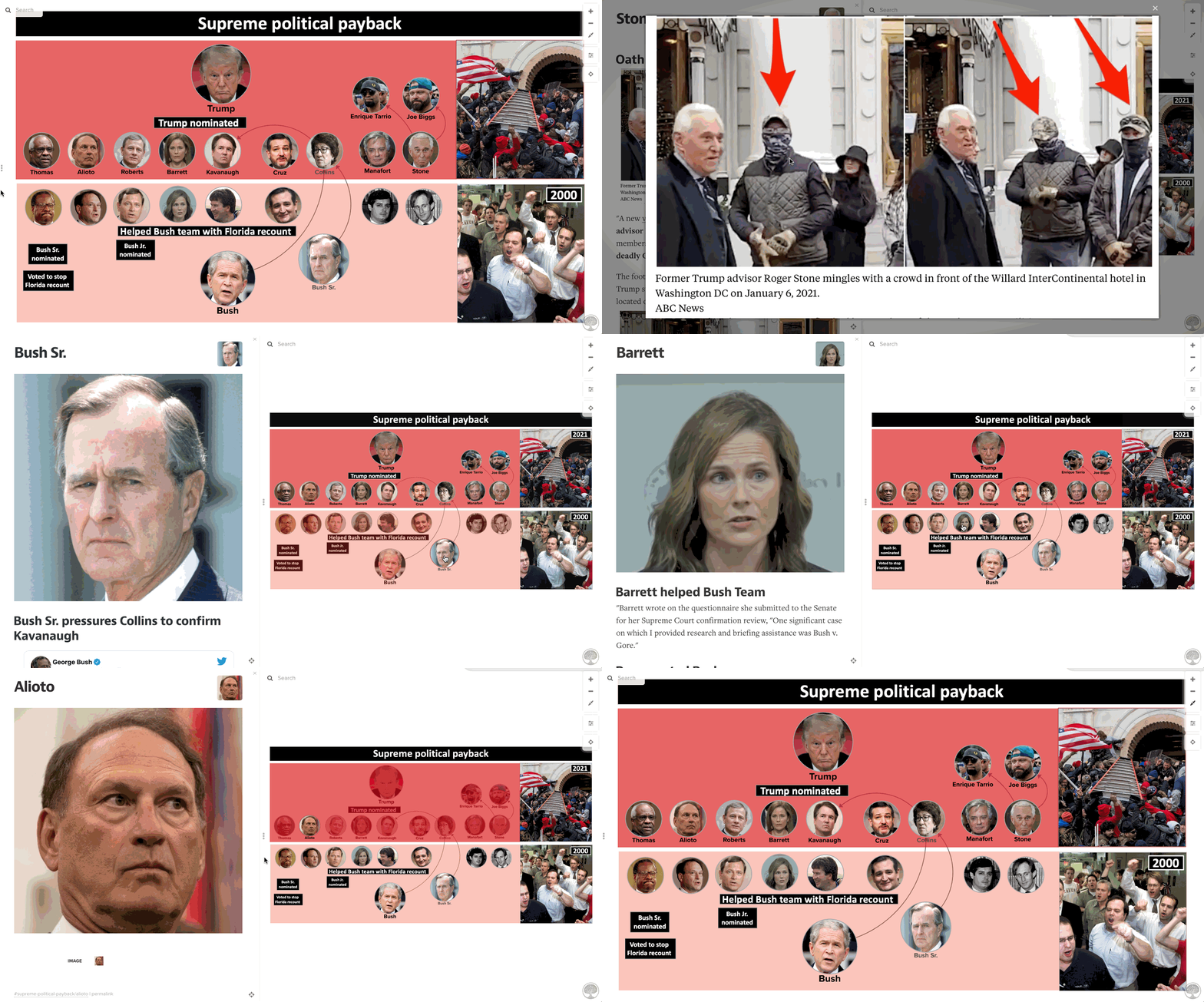 Share this map freely with this link or as a GIF

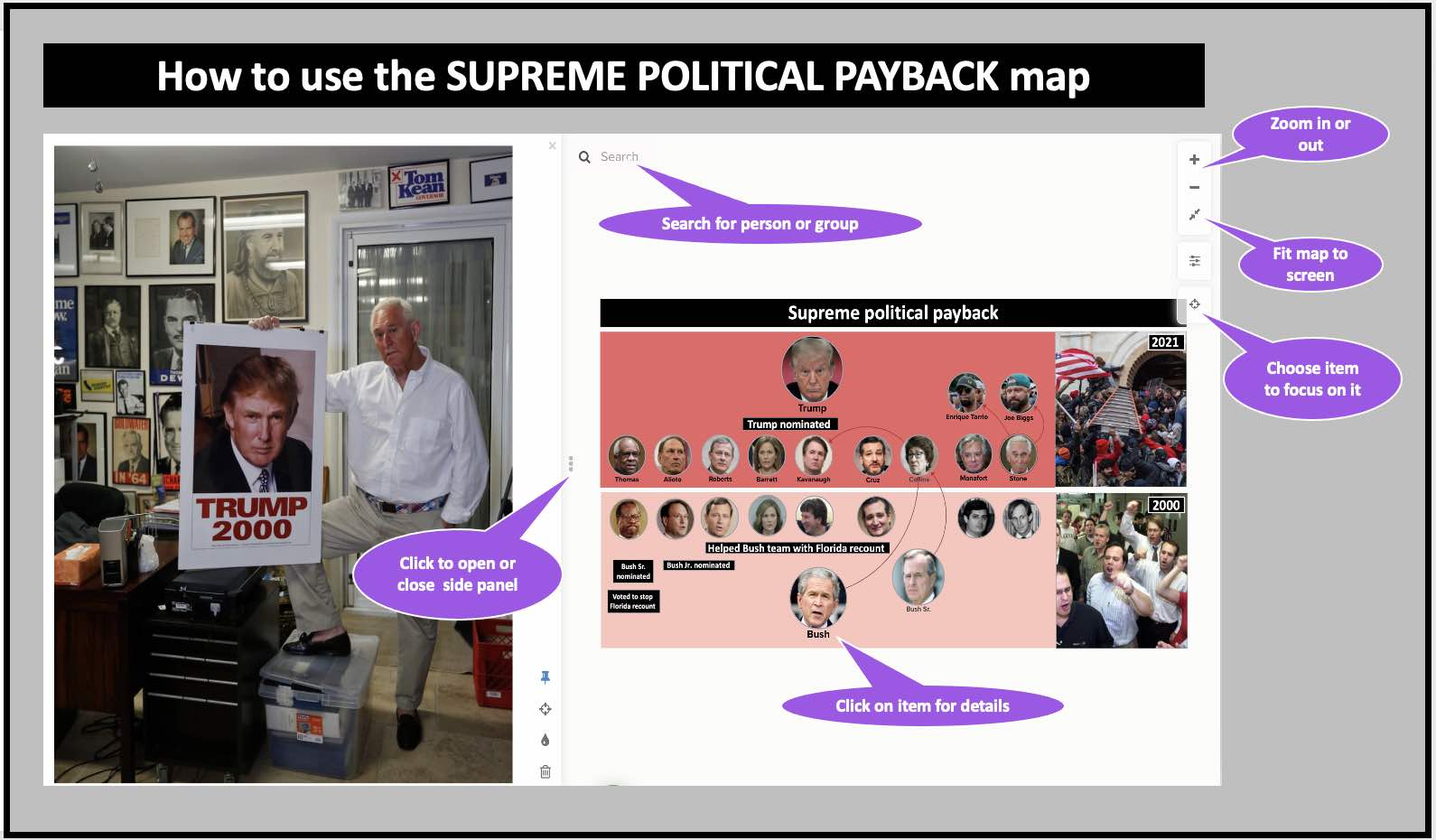
Political payback?
Judge for yourself.
- A President nominates a lawyer who helped him get elected to the Supreme Court
- A former President lobbies to get a lawyer from the legal team that got him re-elected confirmed to the Supreme Court
- A Senator organizes resistance to a recount and then resists confirming duly elected President
- A President who pardons someone accused of organizing a criminal conspiracy to let him stay in power
- Justices rule with partisan bias in favor of the President who nominated them
Supreme Court has three lawyers who worked on Bush v. Gore
Justices Clarence Thomas voted to suspend the vote count in Florida that ended up with George Bush Jr. as president. Three other justices worked on the Bush team including John Roberts, Brett Kavanaugh and Amy Comey Barrett. All three were later appointed to the Supreme Court! Roberts was appointed by Bush. Kavanaugh and Barrett by Trump.
- John Roberts flew to Florida in November 2000 to assist Bush's legal team. He helped prepare the lawyer who presented Bush's case to the Florida state Supreme Court and offered advice throughout.
- Brett Kavanaugh was in private practice in 2000 and helped the Bush legal team. He wrote on a 2018 Senate questionnaire that his work related to recounts in Volusia County, Florida.
- Amy Coney Barrett wrote on the questionnaire she submitted to the Senate for her Supreme Court confirmation review, "One significant case on which I provided research and briefing assistance was Bush v. Gore." She said the law firm where she was working at the time represented Bush and that she had gone down to Florida "for about a week at the outset of the litigation" when the dispute was in the Florida courts. - CNN
Brooks Brothers riot
In the 2000 presidential election, Stone played a key role in the recount of ballots in Florida. On November 22, 2000, as ballots were being recounted for the second time in Florida, "a Stone-led squad of pro-Bush protestors stormed the Miami-Dade County election board, stopping the recount and advancing then-Governor George W. Bush one step closer to the White House." - Ballotpedia. Stone claimed he had been recruited by James Baker III, the former secretary of state leading the Bush recount team, and that it was his idea to court protesters via Cuban radio. Stone claimed he ran the Brooks Brothers riot from a Winnebago parked near the election office." - New Yorker
"When New York Congressman John Sweeney, who was working for the Bush campaign, learned that the recount had been moved to another room, he ordered, the troops to "shut it down. The protesters yelled and screamed, accusing the canvassers of trying to steal the election. The chants became fiercer and the demonstration increasingly raucous as they directly confronted the county officials. "Stop the count. Stop the fraud," they chanted.
Brooks Brothers riot. He found the lobby and elections office filled with several dozen protesters — many of them in suit jackets and button-down shirts. Geller had walked into the “Brooks Brothers riot,” a protest organized by Republican campaign operatives, congressional staffers and lawyers. Working with about 20 paid GOP staffers or congressional aides and a small fleet of Republican lawyers — including Ted Cruz." - CNN
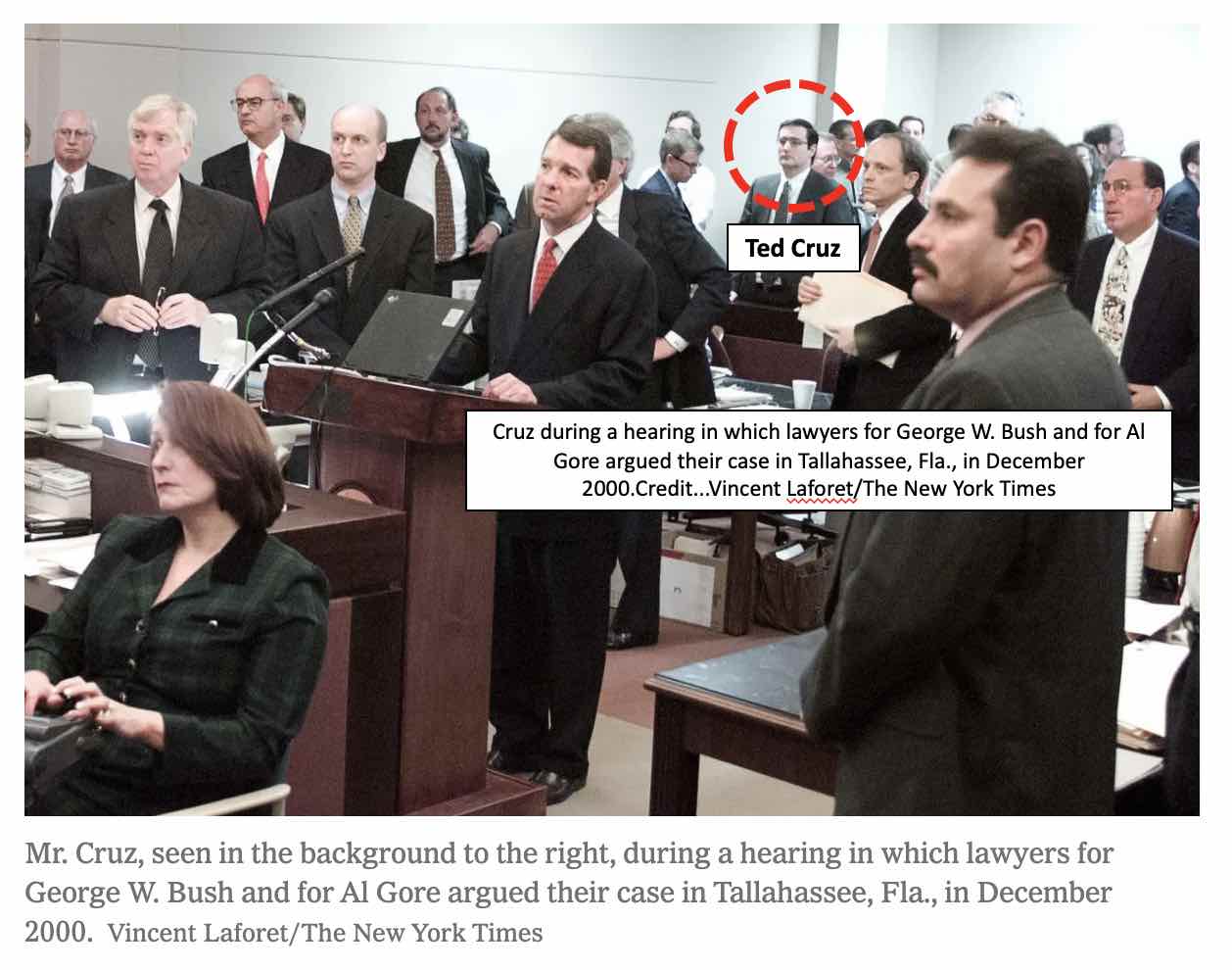
Roger Stone and Oath Keepers at Jan 6th Insurrection
"A new video released by ABC News shows longtime Trump advisor Roger Stone standing outside a DC hotel surrounded by members of the Oath Keepers militia group just hours before the deadly Capitol riots on January 6. The footage shows Stone taking pictures and shaking hands with Trump supporters outside the Willard InterContinental hotel, located only a few blocks from the White House. As Stone walks around greeting people, a group of Oath Keepers can be seen following him closely. The men are wearing military-style clothing and other accessories that appear to have Oath Keepers logos on them. At one point in the video, Stone can be seen exchanging a few words with them." - Business Insider
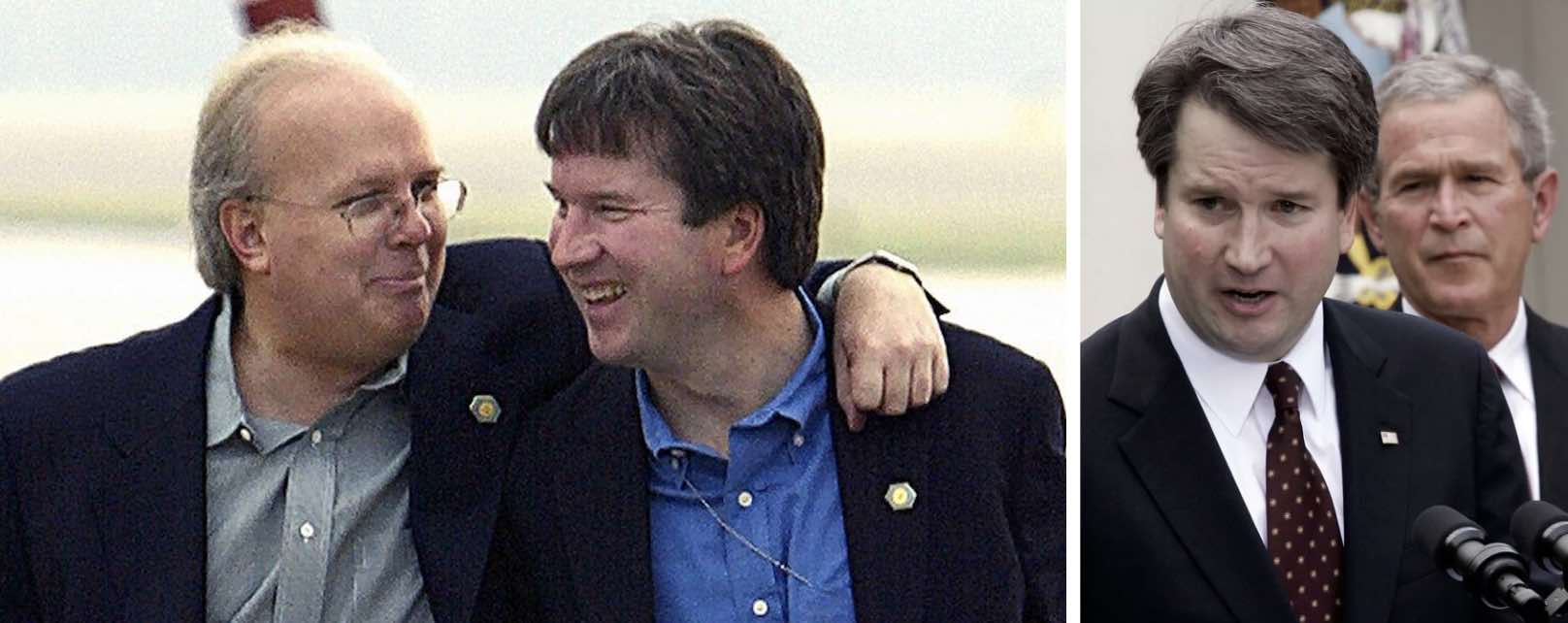
Kavanaugh. Presidential protector.
"Kavanaugh is a former Bush lieutenant who was not only a lawyer in the Florida recount of 2000, but inherited the pivotal job of staff secretary to the president. Legal experts see Kavanaugh as a presidential protector: He has radical views of executive power and privilege and has repeatedly raised doubts about whether presidents are accountable to other branches of government. This deference to presidential power is also a key reason Kavanaugh won the backing of President Trump. In his confirmation hearings, Kavanaugh pointedly refused to comment on whether a sitting president must respond to a subpoena or has the power to pardon himself." - Rolling Stone
Rewarded by George Bush. George Bush nominated Kavanaugh in 2003 for the United States Court of Appeals for the District of Columbia Circuit...
---