TRICKLE supply bak
estb 10 24
---
promote 2nd trump mulvaney
see 2017 trump tax cuts, promise 2025
merri ok
see Laffer
see voodootax cuts corp
---
UK PM truss?
===
MMA
Fox News is the loudest voice in media promoting trickle-down economics
Fox News personalities were the only prominent proponents of trickle-down policies in the second quarter of the year
Written by Craig Harrington
Research contributions from Zachary Pleat
Published 10/28/24
Nearly a quarter of Fox News’ prime-time economic news coverage in the second quarter of 2024 espoused or promoted so-called “trickle-down” economic theory, a discredited economic model that advocates for reduced tax and regulatory burdens at the upper end of the income, wealth, or profit spectrum in order to induce economic growth. A Media Matters analysis of three months of economic news coverage from April through June 2024 from broadcast evening and prime-time cable programs revealed that Fox News was by far the leading vector by which trickle-down talking points were injected into the news ecosystem.
- ## Fox News' trickle-down crusade
- Fox News aired nearly as many economic news segments espousing trickle-down economic theory (16 of 66 total segments) as CNN aired total economic news segments (22) during the second quarter of this year — the latter cable network largely having abdicated its responsibility to cover the economy in prime-time. None of MSNBC’s qualifying coverage (54 total segments) was found to promote trickle-down economic theory.
In addition to advocating, in essence, that society should prioritize the top of the income, wealth, and profit spectrum in order to induce broader economic benefits that supposedly “trickle-down” to the rest of the economy, Fox's trickle-down proponents often also argued that fewer benefits should be provided to those at the bottom, inverting the logical fallacy at the center of trickle-down theory.
Of Fox’s segments espousing trickle-down, 12 included discussion of tax policy, and 12 also covered inflation. Wages were discussed in 10 of these segments. The following chart shows the economic topics Fox personalities were discussing when they espoused trickle-down economics.
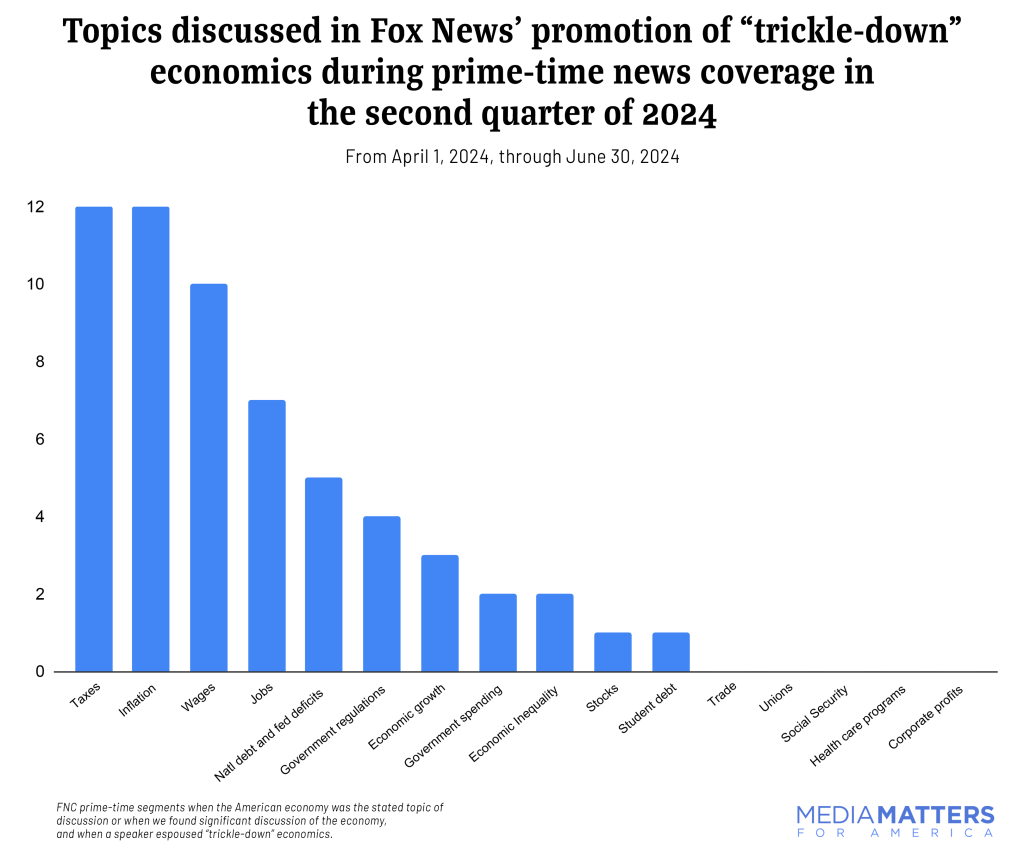
The leading trickle-down misinformer in Fox’s prime-time lineup was frequent guest, Fox Business host, and former Trump administration official Larry Kudlow, who peddled trickle-down theory while slamming the economic agenda of the Biden-Harris administration and puffing up the accomplishments (and future promises) of disgraced former President Donald Trump.
During the 4 appearances in which he peddled trickle-down economics during the second quarter — Kudlow was the only guest to appear more than once in a segment identified as promoting trickle-down economics — he fearmongered about how future tax increases on the wealthy could undermine job creation and slow down economic growth and warned that increasing government spending would imperil the economy.
Fox News and Fox Business personalities Brian Brenberg and David Asman, Fox News host and former Republican Gov. Mike Huckabee, celebrity chef Andrew Gruel, South Carolina Republican Sen. Tim Scott, and Republican Speaker of the House Mike Johnson were among the other prime-time Fox News guests who peddled trickle-down talking points during the second quarter, warning about looming tax increases, clamoring for renewed income tax cuts from a second Trump administration, or warning about the supposed threat posed by stricter government regulations or elevated minimum wages.
Media Matters identified multiple instances in which Fox's prime-time hosts themselves served as the vector peddling trickle down.
Fox prime-time star and informal Trump adviser Sean Hannity led the way with 4 instances of him promoting trickle-down talking points, followed by one instance apiece from hosts Jesse Watters and Greg Gutfeld.
- ## Broadcast news may have avoided trickle-down economics by ignoring the economy
- Media Matters has previously demonstrated the simple inadequacy of corporate broadcast coverage of the economy by the networks’ most-watched evening news programs. In the first and second quarters of 2024, viewers tuning in each night to view ABC World News Tonight, CBS Evening News, and NBC Nightly News could go days without seeing any substantive news about the economy. One silver lining of this lack of coverage of the economy may have been that millions of viewers were only infrequently exposed to direct promotions of “trickle-down” economic theory.
In the first quarter of the year, Media Matters identified only 2 segments — each aired by NBC Nightly News — that directly aired arguments in favor of trickle-down economics. In the second quarter, Media Matters identified 1 segment apiece from ABC, CBS, and NBC, as well as 2 qualifying segments broadcast by PBS News Hour that promoted trickle-down talking points. These 5 segments represented a small portion of the networks’ economic news coverage (less than 3% of 191 total segments).
On the April 1 editions of CBS Evening News and  *, each program aired segments presupposing that California’s implementation of a statewide $20 per hour minimum wage for fast food workers would result in disruptive price increases and job losses in the industry. The CBS segment included fear mongering from Jeff Hanscom of the International Franchise Association, which represents fast food chains, and from a franchise owner directly alleging that the pay increase would result in job losses and significant price increases. NBC also interviewed a franchise owner who warned that the wage increase would imperil her business and included commentary from economist David Neumark of the conservative Hoover Institution, who expressed his opposition to California’s minimum wage increase.
Both outlets interviewed the same fast food worker, who described the struggles of surviving on minimum wage and voiced her support for the increase. An independent study published on September 30 later found that the negative side effects of industry-wide job losses and onerous price increases predicted by trickle-down adherents did not come to pass.
The April 20 edition of  * featured a segment on successful efforts by the United Auto Workers to unionize a Volkswagen factory in Chattanooga, Tennessee, as well as the UAW’s efforts to unionize other facilities. The segment featured a statement from six Republican governors, including Tennessee Gov. Bill Lee, claiming “unionization would certainly put our states’ jobs in jeopardy.” The UAW is currently bargaining for a new contract on behalf of those Chattanooga members.
The April 8 edition of PBS News Hour aired a segment featuring trickle-down talking points from a spokesperson for the ridesharing company Uber, who warned that the company and its main competitor Lyft would discontinue services in Minneapolis on May 1 if a city ordinance establishing new minimum wages for “gig economy” workers went into effect. Both ridesharing titans announced that they would continue operating in Minneapolis after a legislative compromise on the effective minimum wage for rideshare drivers was negotiated.
A week later, on the April 15 edition of PBS News Hour, PBS correspondent Lisa Desjardins interviewed Wall Street Journal reporter Richard Rubin in an in-depth discussion on the competing tax policy preferences of President Joe Biden and Donald Trump. Desjardins and Rubin discussed the “mixed evidence” regarding the effect that Republican-preferred tax cuts have on the economy, with Rubin explaining the belief that tax cuts can spur “some growth” while noting that “in general, when you hear someone claiming that tax cuts have some sort of outsized effect on growth, take that with a grain of salt.”
- ## Trickle-down economics enriches the wealthy
- A 2012 Congressional Research Service report, which analyzed tax cuts for the rich since 1945, concluded that tax cuts for the wealthy don’t stimulate economic growth. A September 2012 report from the nonpartisan Congressional Research Service determined that “changes over the past 65 years to the top marginal tax rate and the top capital gains tax rate do not appear correlated with economic growth,” adding, “The top tax rates appear to have little or no relation to the size of the economic pie.” The report further concluded that these tax cuts served to exacerbate economic inequality, stating that ”top tax rate reductions appear to be associated with increasing concentrations of income at the top of the income distribution." The CRS report dealt such a heavy blow to trickle-down economic orthodoxy that Senate Republicans fought to suppress the report's findings. The report was eventually revised and re-released months later and featured most of the same conclusions. Congressional Research Service, [9/14/12, 12/12/12; The New York Times, 11/1/12; NBC News, 12/13/12]
- A 2020 study analyzed the effects of tax cuts for the rich spanning “five decades in 18 wealthy nations” and found that “the rich got richer and there was no meaningful effect on unemployment or economic growth.” Researchers at The London School of Economics and Political Science published a working paper in 2020 analyzing the tax regimes of 18 major developed economies that concluded that “major reforms reducing taxes on the rich lead to higher income inequality as measured by the top 1% share of pre-tax national income.” In a later interview with LSE’s economics blog, one of the researchers who conducted the study added: “Our results align pretty closely with some work from Thomas Piketty, that would suggest that what happens if you cut taxes on the rich is that they then bargain more aggressively for their own compensation at the direct expense of workers lower down the income distribution.” LSE International Inequalities Institute, [December 2020; The London School of Economics, 1/24/23]
- A study of Trump's 2017 tax cuts for the rich found it produced wage gains far below what was promised and that, instead of paying for itself as Republicans promised, it added “more than $100 billion a year” to the national debt. The New York Times reported that the study “found the cuts delivered wage gains that were ‘an order of magnitude below’ what Trump officials predicted: about $750 per worker per year on average over the long run, compared to promises of $4,000 to $9,000 per worker.” The New York Times, [3/4/24; National Bureau of Economic Research, March 2024]
- Economists predicted in 2016 that Trump's “nonsense … supply-side, trickle-down economics” would do nothing to help the economy. After Trump unveiled his tax and economic policy proposals in August 2016, economists and tax policy experts from across the political spectrum slammed his plan. Former Labor Secretary Robert Reich dismissed Trump's plan as the “normal nonsense of supply-side, trickle-down economics” characteristic of Republican politicians. Conservative tax analyst Ryan Ellis noted that Trump’s proposed deduction for child-care expenses “would provide no benefit to low income workers and single parents who are unlikely to have any tax liability to begin with.” University of Michigan economist Betsey Stevenson posted that “Trump's economic plan focuses in on those he thinks need the most help: the 540 billionaires in the U.S.” Media Matters, [8/9/16]
- ## Methodology...
===
AN 4 24 COMMON DREAms
as House Republicans prepare for Donald Trump's possible White House return by plotting to expand the billionaire and corporate tax cuts that were the cornerstone of the former president's first administration, congressional Democrats and advocates for working Americans warned Thursday that a second Trump term would bring more of the same inequality-exacerbating policies.
The GOP-controlled House Ways and Means Committee held a hearing Thursday on "expanding the success" of the 2017 Tax Cuts and Jobs Act (TCJA)—widely derided by opponents as the "GOP Tax Scam." Republican committee members couched a policy that the Center for Popular Democracy said "delivered big benefits to the rich and corporations but nearly none for working families" as "relief to help hardworking American families."
Rep. Richard Neal (D-Mass.), the committee's ranking member, pushed back during Thursday's hearing, noting that "in the last three decades, Republicans have skyrocketed the deficit with trillions in tax cuts for billionaires and big corporations, always with the same result: the top 1% benefits while nothing trickles down for workers."
Neal continued:
In 2017, Ways and Means Democrats saw the GOP corporate tax giveaway for what it was: a scam. We knew that their Tax Scam would disproportionately benefit the wealthy and well-connected. We knew that it wouldn't pay for itself. We knew that big corporations, not their workers, would feel the most benefit. Six years since the GOP Tax Scam was signed into law, we've been proven right on every count. It didn't pay for itself, it didn't increase revenue, and it didn't increase wages.
A recent study whose authors included [Joint Committee on Taxation] economists—let that sink in—found that ALL of the corporate gains from TCJA went to shareholders and high-paid executives, with absolutely nothing flowing to workers. Fifty-six percent of the tax cuts enriched shareholders, and the remaining 44% lined the pockets of execs. Zero percent went to workers. ZERO!
"There are 20 years of data showing trickle-down economics doesn't work, yet today will still be a whole lot of revisionist history and wishful thinking on the singular largest failure of fiscal policy in recent memory," Neal added. "If workers and the middle class are actually your priorities, putting them ahead of big corporations and billionaires is the only way."
Rep. Don Beyer (D-Va.)—who also sits on the committee—agreed, asserting on social media that "the Trump tax cuts were a huge 'success' if you were a billionaire or an executive at a large corporation. They made out like bandits, with a huge amount of the benefits from the GOP tax law going to the wealthiest. Now Republicans want to give the superrich even more tax cuts."
Trump is open about this. At an exclusive fundraiser at his Mar-a-Lago resort in Florida last week, he shouted out his "rich as hell" supporters, telling them, "We're gonna give you tax cuts, we're gonna pay off our debt."
That's the same debt that soared by around $8 trillion during Trump's term—largely as a result of his tax cuts. Meanwhile, U.S. billionaires have collectively gotten $2.2 trillion richer since the GOP tax cuts took effect.
With many provisions of the TCJA set to expire at the end of 2025, progressives are underscoring what's at stake in this November's elections.
"Today the American people got a preview of what's in store for them next year if the Trump Tax Scam expires under conservative leadership," Groundwork Collaborative executive director Lindsay Owens said following the House hearing. "The conservative playbook for the 2025 tax fight is coming into focus, and we can be sure it includes more giveaways for the wealthy and corporations."
=}:
mma 3 24
after President Joe Biden called for an end to “trickle-down economics” and promoted a vision of the U.S. in which the wealthy “pay their fair share” of taxes during his March 7 State of the Union address, conservative media figures defended the discredited economic model and decried the president's call to tax the rich.
But experts reacting to Biden's speech noted that the president was correct when he argued that tax cuts for the rich have been a policy failure. Multiple studies examining decades of “trickle-down economics” show that such policies have overwhelmingly benefited the rich.
Biden called for the end of “trickle-down economics” policies that don't help the middle class and for increased taxes on the wealthy
During his State of the Union address, Biden laid out a vision of the future in which corporations and wealthy individuals pay “their fair share” of taxes and the U.S. abandons the myth of “trickle-down economics.”
“I want to talk about the future of possibilities that we can build together. A future where the days of trickle-down economics are over, and the wealthy and the biggest corporations no longer get all the tax breaks.”
Biden added: “I grew up in a home where trickle-down economics didn’t put much on my dad’s kitchen table. That’s why I determined to turn things around, so the middle class does well. When they do well, the poor have a way up, and the wealthy still do very well. We all do well.”
Video file
CitationFrom the March 7, 2024, State of the Union address by President Joe Biden
Later in the speech, Biden called on Congress to “make the tax code fair” by making “big corporations, the very wealthy, finally begin to pay their fair share.” Biden emphasized that making the wealthy and corporations pay their fair share of taxes is vital to “the question of fundamental fairness for all Americans.”
He called out the Trump administration, which “enacted a $2 trillion tax cut, overwhelmingly benefit[ing] the top 1% — the very wealthy and the biggest corporations — and exploded the federal deficit.”
Biden also called for raising the corporate minimum tax rate “to at least 21%” and for a “minimum tax for billionaires at 25%.”
Video file
CitationFrom the March 7, 2024, State of the Union address by President Joe Biden
Economic research backs up Biden's criticism of failed “trickle-down” policies
Experts at the Center on Budget and Policy Priorities validated the president’s critique of tax breaks for the wealthy — especially those created by Trump’s unpopular 2017 legislation, officially known as the Tax Cuts and Jobs Act.
Chuck Marr, CBPP's vice president of federal tax policy, noted: “As President Biden is highlighting, the Trump tax law was skewed to the rich, was extremely expensive, and failed to trickle-down.”
Marr added: “The corporate tax rate cut is Exhibit A: the benefits went to executives, not workers.”
CBPP President Sharon Parrott posted: “The President is right. We need to raise revenues on high income households and corporations to make high-value investments in people, communities, and the economy and to improve our fiscal outlook.”
Center for Economic and Policy Research senior economist Dean Baker noted during the speech that “Republicans are upset that Biden has made taxes mandatory for the rich, not just ordinary people.”
The official CEPR account on X also explained that the wealthiest Americans have already stopped paying taxes into Social Security for this year, because the payroll tax does not apply on income above $168,600.
“Millionaires stopped paying into #SocialSecurity 5 days ago,” the post read. “We’re glad @POTUS called out the rigged tax system, which puts the burden of paying for #SocialSecurity on working-class people. #ScrapTheCap so the rich pay their fair share.”
Melissa Boteach, vice president for income security and child care at the National Women’s Law Center, posted that Biden was “hitting it out of the park on tax fairness. Policies to #taxtherich are fundamental to investing in our families and are HUGELY popular across” political parties.
The systemic failure of “trickle-down economics” has done little except further enrich the wealthy and powerful — and increase the budget deficit and national debt
- A 2012 Congressional Research Service report, which analyzed tax cuts for the rich since 1945, concluded that tax cuts for the wealthy don’t stimulate economic growth. A September 2012 report from the nonpartisan Congressional Research Service determined that “changes over the past 65 years to the top marginal tax rate and the top capital gains tax rate do not appear correlated with economic growth,” adding, “The top tax rates appear to have little or no relation to the size of the economic pie.” The report further concluded that these tax cuts served to exacerbate economic inequality, stating that ”top tax rate reductions appear to be associated with increasing concentrations of income at the top of the income distribution." The CRS report dealt such a heavy blow to trickle-down economic orthodoxy that Senate Republicans fought to suppress the report's findings. The report was eventually revised and re-released months later and featured most of the same conclusions. Congressional Research Service, [9/14/12, 12/12/12; The New York Times, 11/1/12; NBC News, 12/13/12]
- A 2020 study analyzed the effects of tax cuts for the rich spanning “five decades in 18 wealthy nations” and found that “the rich got richer and there was no meaningful effect on unemployment or economic growth.” Researchers at The London School of Economics and Political Science published a working paper in 2020 analyzing the tax regimes of 18 major developed economies that concluded that “major reforms reducing taxes on the rich lead to higher income inequality as measured by the top 1% share of pre-tax national income.” In a later interview with LSE’s economics blog, one of the researchers who conducted the study added: “Our results align pretty closely with some work from Thomas Piketty, that would suggest that what happens if you cut taxes on the rich is that they then bargain more aggressively for their own compensation at the direct expense of workers lower down the income distribution.” LSE International Inequalities Institute, [December 2020; The London School of Economics, 1/24/23]
- A new study of Trump's 2017 tax cuts for the rich found it produced wage gains far below what was promised and that, instead of paying for itself as Republicans promised, it added “more than $100 billion a year” to the national debt. The New York Times reported that the study “found the cuts delivered wage gains that were ‘an order of magnitude below’ what Trump officials predicted: about $750 per worker per year on average over the long run, compared to promises of $4,000 to $9,000 per worker.” The New York Times, [3/4/24; National Bureau of Economic Research, March 2024]
- Economists predicted in 2016 that Trump's “nonsense … supply-side, trickle-down economics” would do nothing to help the economy. After Trump unveiled his tax and economic policy proposals in August 2016, economists and tax policy experts from across the political spectrum slammed his plan. Former Labor Secretary Robert Reich dismissed Trump's plan as the “normal nonsense of supply-side, trickle-down economics” characteristic of Republican politicians. Conservative tax analyst Ryan Ellis noted that Trump’s proposed deduction for child-care expenses “would provide no benefit to low income workers and single parents who are unlikely to have any tax liability to begin with.” University of Michigan economist Betsey Stevenson posted that “Trump's economic plan focuses in on those he thinks need the most help: the 540 billionaires in the U.S.” Media Matters, [8/9/16]
Right-wing media responded by defending the rich and failed tax cut policies, and rejecting Biden’s take
- Fox & Friends First co-host Todd Piro: “The dirty little secret” is “if you tax corporations more, jobs will go away.” Pirro continued: “At the end of the day, corporations are going to hit that number … whether it comes through increased output or at the sake of you and our jobs.” Pirro also dismissed “the typical tropes of tax the rich, who, in reality, pay most if not close to all of the taxes in this country.” Fox financial contributor Cheryl Casone interjected, “50%.” Fox News, *Fox & Friends First*, [3/8/24]
- National Review senior writer Noah Rothman defended “trickle-down economics” from Biden’s critique. National Review posted on X (formerly known as Twitter): “@NoahCRothman: Biden indicts ‘trickle-down economics’ because it did little to help his family when he was growing up. But Biden grew up in the 1950s and early 60s, when the top marginal tax rates approached 50%. Which is to say that Joe Biden did not, in fact, grow up during a period typified by ‘trickle-down economics.’” Twitter/X, [3/7/24]
- National Review senior writer Dan McLaughlin: “Biden’s rants against ‘trickle down economics’ have not changed a whit since he was singing this tune throughout the Reagan years, railing against growth and prosperity.” Twitter/X, [3/7/24]
- Fox Business host Charles Payne: “The top 1.0% pay almost 50% of income taxes...what is fair? What is punitive? It’s all deflection from runaway spending.” Twitter/X, [3/7/24]
- Fox & Friends co-host Brian Kilmeade: “Love the class warfare…let’s simplify the tax code to make American hate rich people …what a unifier!!…lets make rich people pay more to taxes so they can stop hiring people and buying buildings,, cars planes and give to charities.” Twitter/X, [3/7/24]
- Committee to Unleash Prosperity President Phil Kerpen: “The tax share of the rich is by far the highest it has ever been under the Trump tax cuts. Biden's tax hikes will harm the economy and reduce the share paid by the rich. It happens every time.” Twitter/X, [3/7/24]
===
---
jake j commn dr an 1 24
two new reports published Tuesday by the Roosevelt Institute argue that robust corporate taxation is key to creating a strong economy and improving the well-being of families and children—objectives that have been undermined in the decades since the Reagan era by regressive tax cuts enacted on the false premise that benefits would "trickle down" to the rest of society.
The first report, A Mapping of the Full Potential of U.S. Corporate Taxation to Enhance Child and Family Well-Being, examines what the authors describe as the understudied notion that "increasing corporate taxation will necessarily help children and families by providing additional revenue for essential public services."
That perspective runs counter to what the Roosevelt Institute's second report calls "a 'cut-to-grow' mentality" that rose to prominence in the 1970s and was enthusiastically embraced by the administration of President Ronald Reagan.
"Under this view, the thinking went, it was necessary to reduce the corporate tax rate to grow the economy—and that this growth would allow gains to eventually 'trickle down' from the rich shareholders to the middle class," the report states. "During this time, the corporate tax rate was gradually reduced to 35% before it was dramatically cut to 21% in 2017. These cuts resulted in corporate tax revenues falling to less than 10% of total federal revenues."
"Perhaps more than any other, President Ronald Reagan leveraged mounting backlash to taxation and government spending to dramatically reduce both, regardless of the consequences to American families," the report observes.
"Corporate tax policy since Reagan has been driven by the trickle-down economics narrative that cutting the taxes on 'job creators' will benefit less wealthy U.S. taxpayers."
The decades-long decline in corporate tax rates has severely undermined the federal government's ability to finance critical public goods, from education to childcare.
"Since regressive corporate tax cuts don't significantly increase earnings for working families (through either wage or employment increases), but they do reduce the government's ability to fund family income and care supports, childcare costs—which are already rising—can become a relatively more expensive line item in working parents' household budgets," reads the Roosevelt Institute's first report, authored by Emily DiVito and Niko Lusiani.
"When they can't afford childcare," they added, "parents face the difficult choice of having to cut costs in other places—often on the basic necessities that allow children to thrive, like food, clothing, and enrichment activities—or taking on additional caregiving duties themselves."
At the state and local levels, DiVito and Lusiani noted, "corporations' successful efforts to avoid their full property tax liability devastate public school budgets."
DiVito, deputy director for the corporate power program at the Roosevelt Institute, said Tuesday that "we have a false idea in the U.S. that corporate tax policy is unrelated to equitable social reforms."
"However, strong corporate tax policy is vital to all aspects of a thriving economy," she argued. "And the failing to reimagine a more ambitious and comprehensive use of corporate tax policy prevents us from achieving a more equitable, sustainable, and democratic economy and society for all families."
The new reports come a week after a bipartisan pair of House and Senate negotiators announced a deal to expand the child tax credit (CTC) for three years in exchange for a series of corporate tax cuts. The American Prospect's David Dayen estimated that "in the time period when all the tax credits are actually in place, the business tax changes are five times more costly than the CTC changes."
"Who knows if this deal can pass in time to take effect in the upcoming 2023 tax season, if ever. Sen. Mike Crapo (R-Idaho), the ranking Republican on the Senate Finance Committee, is already asking for changes to make it even more generous to businesses. That's in part a function of the dissembling that there is 'parity' in the deal. The truth is that this is not an equal trade. And it may extend that inequity well into the future."
That warning is in line with the Roosevelt Institute's new research, which argues that a corporate tax code generous to big business fuels inequality by "benefiting capital interests (i.e., business owners, partners, and shareholders) at the expense of workers and their families."
"When corporations enjoy low taxes on their profits, they face a trade-off for how to otherwise disperse them: make investments in the workforce and productive capacity (e.g., raise wages, hire more workers, and/or upgrade buildings, equipment, or technology) or distribute them to shareholders (i.e., pay out dividends and buy back stock to inflate prices). Data shows that executives typically choose the latter."
Reuven S. Avi-Yonah, a professor of law at the University of Michigan and the lead author of the new report on "cut to grow" ideology, said in a statement that "corporate tax policy since Reagan has been driven by the trickle-down economics narrative that cutting the taxes on 'job creators' will benefit less wealthy U.S. taxpayers."
"Such an idea is often offered in tandem with the notion that this is the only way tax policy can help American families," said Avi-Yonah. "But this just isn't true. In fact, this false 'cut-to-grow' narrative has made it very difficult to argue for a more expansive, progressive vision of corporate tax reform—contributing to a decades-long stalemate in efforts toward real comprehensive corporate tax reform."
"Now is the time," he added, "to reverse this trend with a more historically grounded support of the corporate tax."
---
---
an 9 23 no lnx
The GOP's 'Horse & Sparrow' economic scam is back
McCarthy
Thom Hartmann
September 06, 2023
Kevin McCarthy’s House Republicans, in their demand that Democrats gut Social Security and education monies to give more trillions in tax breaks to billionaires, are once again trying the Reaganomics hustle. Only this time with a twist.
Boomers and many Gen Xers remember how the media swooned for Art Laffer’s napkin in the 1980s, and then President Reagan turned it into a movement to cut taxes on billionaires because, he lied, it would make average working-class people richer.
What most don’t remember — because none of us were alive back in the 1920s or 1890s — is that Laffer and Reagan hadn’t come up with anything novel.
At first, even Republican politicians recognized Reagan’s pitch as a con; in the 1980 primary his main opponent, patrician multimillionaire George HW Bush, labeled it “Voodoo Economics.”
Bush and actual economists knew what any student of economic history knew: trickle-down was just a money-grab by Reagan, who was fronting for his patrons among the very richest Americans.
And, since the Supreme Court had just (in 1976 and 1978) legalized political bribery by billionaires and corporations under the rubric of campaign money being First Amendment-protected “free speech,” Reagan and his friends were all in.
But trickle-down wasn’t even a new con. Back in the 1890s it was called “Horse & Sparrow Economics.”
The sales-pitch before the era of cars was that if you fed your horses more oats than they could normally digest they’d pass through all that undigested oat in their manure for the sparrows to pick at; rich people’s excesses would spill over to the average person.
It not only didn’t work; it was blamed, in part, for the Panic of 1896.
Republican Warren Harding revived Horse & Sparrow Economics in 1920 when he campaigned for president on dropping the then-91% top tax bracket down to 25%. He didn’t cite horses and sparrows, though: his slogan was, “A return to normalcy.”
He was elected and kept his promise to cut taxes on the wealthy, the result being the “Roaring 20s” when the rich got fabulously richer while working people saw their wages actually drop (leading to an explosion of unionization efforts by pissed-off workers that were violently suppressed by employers and police).
It all came to a startling end in 1929 with the Great Crash that set off what was then called the Republican Great Depression (the “Republican” part of that label largely wore off after the election of Republican President Dwight Eisenhower in 1952).
Republicans stopped talking about horses and sparrows in the 1930s, but the theory never really died; Reagan simply reinvented it in 1980 as “Supply Side Economics,” aka trickle-down.
Back in 1896 and 1929 people didn’t need a detailed multi-decade, multi-country analysis of Horse & Sparrow to know it was bad news: the Great Panic and the Republican Great Depression pretty much convinced everybody.
But somehow — even after 4 economic crashes (the Reagan stock market crash of 1987, the Bush Great Recession of 1992, the Second Bush Great Recession of 2008 and the Trump Crash of 2020) — most voters never managed to put together the cause-and-effect of trickle-down Reaganomics.
A recent study from the London School of Economics has now totally debunked the Reaganomics notion that tax-cuts for rich people incentivize them to “create jobs” or lead to economic growth.
In fact, the researchers note, such tax cuts only serve one single purpose: to move more of a nation’s income and wealth from the bottom 99% up into the money bins of the morbidly rich. And they do nothing whatsoever for the overall economy.
This most recent study of trickle-down is probably the most comprehensive effort ever made to figure out what happens when you radically cut taxes on the morbidly rich. The researchers used:
:{:{}:
}:
“[D]ata from 18 OECD countries covering the last fifty years to investigate the effects of major tax cuts for the rich on income inequality, economic growth, and unemployment.”
:{:{}:
}:
And when they compiled those 50 years of data over 18 countries that had engaged in what we call Reaganomics (sometimes also called “austerity” economics), it wasn’t even close to what Reagan and his billionaire buddies told us would happen.
“Our results show,” the researchers write, that “major tax cuts for the rich increase the top 1% share of pre-tax national income in the years following the reform (+1 to +5). The magnitude of the effect is sizeable; on average, each major reform leads to a rise in top 1% share of pre-tax national income of 0.8 percentage points.”
So the rich got richer. But did these “job creators” use any little bit of that money to, well, create jobs? “No,” say the economists at the London School of Economics.
“The results also show that economic performance, as measured by real GDP per capita and the unemployment rate, is not significantly affected by major tax cuts for the rich. The estimated effects for these variables are statistically indistinguishable from zero…”
So what is the single largest result of a nation embracing Reaganomics trickle-down austerity tax-cut policies?
“Overall,” their study summarized, “our analysis finds strong evidence that cutting taxes on the rich increases income inequality but has no effect on growth or unemployment. Our results … suggest that lower taxes on the rich encourage high earners to bargain more forcefully to increase their own compensation, at the direct expense of those lower down the income distribution.”
Americans seem to have largely figured this out: in the 2020 election, for example, Arizona voters approved a ballot measure (Prop 208) that raised taxes by 3.5% on people making more than $250,000 a year. It was designed to raise $940 million a year that would all go to fund the state’s crisis-ridden public-school system.
Which explains why last year, when the Prop 208 tax increase on rich people was to take effect, the Republican-controlled, billionaire-funded Arizona legislature passed the largest tax cut for the rich in the state’s history.
Altogether, Arizona Republicans passed and Governor Ducey signed a $1.9 billion tax cut that, as the Prescott Valley News notes:
“[M]ainly benefits the wealthy” to “shield high-earning taxpayers from the effects of a new 3.5% tax surcharge voters approved in November to boost education funding.”
And now McCarthy and his House Republicans have reinvented Horse and Sparrow economics all over again, but this time with a whole new attitude.
Reagan at least had the smarts to promise American working class voters that if they went along with his new Trickle Down theory they’d make more money over time. Of course, nobody would know for decades if it was true, but it worked to get and keep Reagan in office along with two generations of subsequent Republicans.
But McCarthy isn’t even bothering to convince GOP voters of Reagan’s lie that cutting taxes while gutting social programs will produce a stronger economy. Instead of the carrot, he’s opting for the stick: if Democrats don’t go along, he’ll kill the American economy and destroy our economic standing in the world for a generation.
The majority of Americans don’t want what McCarthy and the GOP are selling. If it weren’t for gerrymandering and voter suppression tricks that were illegal before 5 Republicans on the Supreme Court gutted the Voting Rights Act, Democrats would hold an unassailable majority in the House.
If McCarthy and his House Republicans follow through on their threats the consequences will be dire. Hopefully, American voters will figure this scam out and put enough pressure on them to avoid what looks like a sure-fire disaster heading our way.
---
an raw 11 22
On Tuesday, the St. Louis Post-Dispatch editorial board shredded Republicans for clinging to a pro-tax cut political theory of economics pushed by former President Ronald Reagan decades ago — despite it having repeatedly failed.
The "Laffer curve," famously first scrawled on the back of a napkin at a restaurant by right-wing economist and GOP adviser Arthur Laffer, is the notion that tax cuts actually raise revenue for the government because the investment spurred by more money in the hands of businesses and millionaires grows the tax base more than the marginal revenue lost.
The ideology has a kernel of truth to it in that taxation generally reduces economic activity; however, there has never been any evidence U.S. taxes were high enough to begin with to depress economic activity beyond the returns to government revenue.
"Today’s stubborn Republican mythology that treats tax cuts as a magical economic elixir is largely traceable to Laffer’s theory, which arose in the late 1970s," wrote the board. "His famous 'Laffer curve' presumes to prove that tax cuts for the rich will spur economic investment, causing such strong economic growth that the government’s tax revenue would actually rise instead of falling. Even 1980 Republican presidential candidate George H.W. Bush derided the notion as 'voodoo economics.' That is, until he became vice president to Ronald Reagan, who embraced it."
"And how did Laffer’s theory, recast as 'Reaganomics,' turn out in practice?" wrote the board. "Yes, the economy was robust in the 1980s after Reagan’s historic tax cuts. But that’s also when the era of big budget deficits began, to the point that Reagan himself had to implement a series of later tax hikes to address it. Republicans today always seem to forget that part of the story.They certainly forgot it in Kansas in 2012, when they went full-Laffer with massive tax cuts. This deliberate test of Laffer’s theory, known as'The Kansas Experiment,'was a debacle. The state’s economy didn’t skyrocket, but the deficit did, forcing deep cuts to education before the legislature finally acknowledged defeat and reversed the tax cuts."
Republicans then went on to try the same thing at a national scale under Donald Trump, noted the board, passing enormous tax cuts for corporations in 2017 — which did not deliver the sweeping economic growth Republicans promised. In fact, some experts believe, those tax cuts made the post-COVID inflation spell worse than it would have been otherwise. But still, House Republicans want to use their new majority to force President Joe Biden to do another round of tax cuts — when what is really needed to reduce inflation is targeted tax increases.
"You’d think after blaming the Biden administration (with some justification) for making inflation worse by pumping more money into the economy, they would at least see the irony of what they’re proposing, if not its damning precedent," concluded the board.
---
---
10 22
READ MORE: Paul Krugman: House Republicans’ 'commitment to America' is 'zombie Reaganomics'
---
---
omg trio consistently, spectacularly and devastatingly WRONG! punditry at worst/lethal
jon chait
https://nymag.com/intelligencer/2020/04/arthur-laffer-lawrence-kudlow-stephen-moore-public-health.html
no lnx
THE NATIONAL INTEREST APR. 25, 2020
The Fatal Calculations of the Economists Steering Our Public Health
By Jonathan Chait
One night in late March, President Trump, seized by one of his periodic bouts of dismay with his public-health officials, sought out a second opinion on how to handle the coronavirus pandemic. He called Arthur Laffer. After missing the president’s first three calls, the 79-year-old Laffer finally answered, and the two men connected for what Laffer described as “a very serious conversation,” shortly after which Trump tweeted, “WE CANNOT LET THE CURE BE WORSE THAN THE PROBLEM ITSELF.”
Trump gravitated back to his public-health advisers, but he is again lurching toward the opposite pole — one anchored by Laffer and his close allies: National Economic Council head Lawrence Kudlow and economic adviser Stephen Moore. They have seized on their historic role as the antagonists to the administration’s public-health wing because they have a particular competence of their own, honed over decades: persuading Republican officials to ignore experts.
Even before his current role, Laffer was perhaps the most successful policy entrepreneur in modern American history, at least if measured by political influence.In the 1970s, as an economics professor who had served in Nixon’s Office of Management and Budget, Laffer developed a friendship with Wall Street Journal editorial writer Jude Wanniski, whose job had previously included defending Richard Nixon’s conduct in the Watergate scandal. The two came to believe that Laffer had developed a blinding insight with world-historical ramifications. A tax rate of either zero or 100 would yield no tax revenue at all, Laffer posited. Drawing a sloping, sideways curve between those points, he further hypothesized that reducing tax rates might increase revenue.
The “Laffer curve,” which at one point Laffer drew on a cocktail napkin for an impressed Dick Cheney (the Smithsonian now claims to display the original), formed the basis of what became known as “supply-side economics.” The doctrine held not only that tax cuts could increase tax revenue, but that changes in tax rates were the primary driver of all economic events. Republican economist Herb Stein coined the name as a term of derision, intending to highlight the absurdity of building a model entirely on one side of the economy instead of considering both supply and demand. Economic experts mocked Laffer’s notion that reductions in tax rates at existing levels could produce anywhere close to enough new economic growth to pay for itself.
And the experts … were completely right. After supply-siders converted Ronald Reagan and promised his tax cuts would pay for themselves, revenue hemorrhaged. Reagan’s non-supply-side advisers prevailed upon him to sign a series of tax increases for the purpose of “reducing the size of the nation’s fiscal disaster,” his budget director later admitted. When Bill Clinton raised the top tax rate from 31 percent to 39.6 percent, supply-siders insisted he would kill the recovery and reduce tax revenue. Instead, revenue soared far higher than anybody had forecast.
Kudlow and Moore began ascending in the 1980s, shuttling between right-wing think tanks and media — especially the Journal editorial page, which remained the high temple of the supply-side cult. I first came across Moore when he was writing Journal columns arguing that the supply-siders had been right to predict Bill Clinton’s tax hike would reduce revenue. (A hallmark of supply-side thought has been to refuse to concede any error or complication in its analysis.) The supply-siders went on to insist that George W. Bush’s tax cuts would produce untold prosperity. Moore wrote a book called Bullish on Bush, and Kudlow wrote the foreword to The Bush Boom and a series of columns dismissing “pessimistas” who detected economic turmoil. “There’s no recession coming. The pessimistas were wrong,” he wrote in December 2007.
In the spring of 2016, just after Trump had sewn up the nomination, Laffer, Kudlow, and Moore set out to meet the candidate at Trump Tower. Like many members of the conservative elite, they initially harbored reservations. But unlike foreign-policy hawks or social traditionalists, their concerns were devoid of any moral component, like a suspicion of dictators or philanderers. Their sole misgiving concerned Trump’s populist rhetoric and occasional campaign vows to raise his own taxes. The troika wanted to find out if he really meant it. To their relief, he didn’t. “He wanted tax cuts. He wanted to deregulate, he wanted to get the government out of the way,” Kudlow recounted in the foreword to Laffer and Moore’s laudatory book, Trumponomics. “The three of us saw Trump in a whole new light.”
We’ll come out of this soon, the economy will reopen, the economy will restart. It will, I hope, take care of itself. Markets will take care of themselves over time.
— Larry Kudlow, optimistic as oil prices tanked, on April 22
Kudlow joined the administration as Trump’s chief economic adviser. Trump announced he would nominate Moore for the Federal Reserve Board, but the Senate killed Moore’s bid over a combination of embarrassing ignorance of the subject — just two years before, he’d admitted on a panel, “I’m not an expert on monetary policy” — and years of sexist comments, including an obsessive hatred of women working as play-by-play commentators on basketball games. He and Laffer instead served as outside advisers and allies to Trump, who last summer bestowed a Presidential Medal of Freedom on Laffer.
Trump rewarded their confidence by implementing a large corporate tax cut, which was intended to encourage more corporate investment and therefore “would yield about the same revenue — and possibly more — than the current system,” Laffer and Moore wrote in Trumponomics. Naturally, it failed. Business owners got a windfall, but there was no corporate-investment boom and corporate-tax revenue fell by more than a third. Just as naturally, they acted as if events had proved them right.
And so, when the coronavirus struck, Trump had on hand a coterie of loyalists who would not hesitate to question legitimate experts.Kudlow forcefully endorsed Trump’s optimism that the virus would never spread. On February 25, Kudlow said it had been “contained … pretty close to airtight.” Even two weeks later, he was insisting, “I would still argue to you that this thing is contained.”
When public-health officials persuaded Trump to abandon his denialism, the supply-siders formed the resistance. Applying Laffer’s old dictum, “All economic problems are about removing impediments to supply, not demand,” they reasoned that the problem facing the economy was not a deadly pandemic but, as ever, bad incentives imposed by government — in this case, restrictions on business and excessively generous unemployment benefits that “discourage work.” If the government just stopped suppressing incentives, the economy would spring back to life.
The Journal editorial page published some of the first pushback against the wisdom of lockdowns. As early as mid-March, Moore denounced on Fox News the first closings, in California, as “a very dangerous, almost Orwellian situation.” Trump began repeating the supply-siders’ warnings that he had ceded too much authority to scientists (“If it was up to the doctors,” he mused, “they might say shut down the entire world”). Trump relented to his public-health experts but, by early April, was again listening to the supply-siders. Moore began proposing May 1 as a deadline to reopen the economy, a timeline Trump endorsed soon thereafter.
The supply-siders’ struggle to tug Trump away from his medical experts has both public and private facets. Laffer and Moore promoted a new administration task force to focus on economic reopening, a counterweight to the coronavirus task force led by doctors Anthony Fauci and Deborah Birx. Moore encouraged anti-shutdown protests in several states to pressure governors to speed up their timetables for reopening businesses. “I call these people the modern-day Rosa Parks,” he explained, “They are protesting against injustice and a loss of liberties.”
In their book, Laffer and Moore fondly recall Kudlow’s instructing Trump to ignore budget forecasts that tax cuts would reduce revenue. “Don’t get stressed out by the phony numbers of Washington’s bean counters,” he said. “They are always wrong.” The message today is largely unchanged. The main difference is that the experts they are urging the president to dismiss are counting lives. We’re the beans.
This article appears in the April 27, 2020, issue of New York Magazine
---
---
https://www.alternet.org/2021/05/mcconnell-destroy-gop/?rs=182
no lnx
Why Mitch McConnell is about to destroy the GOP
Thom Hartmann and Independent Media Institute May 05, 2021
Nobody's asking, "Why?"
Just like he did with the Covid rescue bill a few months ago, Senate Minority Leader Mitch McConnell just said that there will not be one single Republican vote in support of President Joe Biden's infrastructure plan.
Why would McConnell do this?
Why would he give away any bargaining leverage the GOP might have?
Why would he essentially encourage Democrats to make the legislation as expansive, effective and popular as possible? And then let them get all the credit for it?
After all, now that the Democrats know there's no possibility of any Republican votes, there's no need for them to negotiate with any GOP senators. There's no need for Democrats to worry about their Republican colleagues' feelings, thoughts, concerns or even ask their opinions.
That simple reality has been noted by a number of commentators.
But nobody is asking the bigger question: "Why would a professional, lifelong politician and master tactician like Mitch McConnell make such a huge mistake?"
I believe the answer is that McConnell does not think he's making a mistake. He thinks he's right. He thinks he's going to win.
I believe he has completely deluded himself. He has bought his own BS. And it won't be the first time senior Republican leadership has done this and then destroyed the GOP in the process.
This is a guy, after all, who spent decades proclaiming Reaganomics and supply-side economics.
He's probably asserted a thousand times that when taxes on rich people are cut and government spending goes down, good things will happen to the American economy. He's repeatedly assured his voters that when unions are destroyed the working class prospers.
He's embraced and endorsed 40 years of de-funding and ignoring America's infrastructure, even to the point of frustrating Trump's own infrastructure plan attempts. Over and over again, when proposed by Clinton and Obama, McConnell has suggested that rebuilding our country at the expense of taxing rich people would create an economic disaster.
For most Americans, forty years of experience with these theories that McConnell's been promoting have proven that they're largely crackpot BS. They're fantasies sold to the American public by billionaires and the think-tanks they fund, amplified by right-wing radio and media, to keep the billionaire's taxes down, their companies deregulated and unions out of their workplaces.
But they've been sold so aggressively — from the efforts in the 1950s, 1960s and 1970s by people like Hayek, von Misis and Milton Friedman, to Ronald Reagan and the institutional Republican party from 1980 to this day — that many Republicans actually do believe them.
Particularly multimillionaires — who hang out with billionaires — like McConnell.
And McConnell's is not alone in this belief, even among significant Republican figures.
I regularly invite conservatives on my radio/TV program to defend propositions like those above, and there are several who I've come to know personally, and I know for a fact, that they actually believe these things.
Reaganomics hasn't worked out, they say, because it hasn't really been tried.
There's been too much government spending clouding things. Taxes have never really been low enough. There's never been a true libertarian experiment in America.
If we want to see if these theories actually work, they say, first we have to do away with Social Security, Medicare, unemployment insurance, food stamps, public schools, public health departments and the whole plethora of government-supported institutions. Those things, they say, have so muddled up and distorted our economic systems that partial measures like partial deregulation and occasional tax cuts promoted by Republicans over the last 40 years haven't had the success that they could have had in a "pure free-market economy."
These people, who I know personally, are not saying what they're saying because their paychecks depend upon it (although that is true of a few others that I know and have met in the media). They're saying it because they believe it.
They studied it in college from Econ professors whose chairs were funded by right-wing billionaires and conservative foundations. They've read it over and over again in conservative books and magazines, and on conservative websites. They've been hearing it preached from the highest towers of conservatism their entire lives.
If Mitch McConnell is at all like them, he believes it's true, too. He believes that rebuilding America using tax dollars from people earning over $400,000 a year will produce a disaster. He's internalized that message.
Another clue that Mitch McConnell and many of his Republican colleagues actually believe this stuff was revealed at last weekend's Utah Republican party meeting, where Mitt Romney was booed.
It's another sign that the ideology has taken deep hold and spread in the party. It's become more important than the good of the party itself, as happened in 1964.
If Mitch McConnell is a true believer, he may well be in the "true believer mold" of Barry Goldwater.
If so, this is the second time this has happened in the Republican party in my lifetime. And it may presage the exact same kind of disaster that Barry Goldwater brought down upon the party in 1964.
I was only 13 at the time, but I remember watching the 1964 Republican convention with my dad when Nelson Rockefeller got up and gave a speech calling for moderation, compromise and a commitment to do what was best for the nation.
Referring to Goldwater and the right-wing true-believers who followed him, much like Mitt Romney referred to Trump and MAGAs, Rockefeller said, "These extremists feed off fear, hate and terror. They encourage disunity." He was booed off the stage, as you can see in this short clip.
Nelson Rockefeller denounces Republican "extremists" at the 1964 Republican National Convention
youtu.be]
Then Barry Goldwater stepped up to the microphone and loudly proclaimed:
"I would remind you that extremism in the defense of liberty is no vice! And let me remind you also that moderation in the pursuit of justice is no virtue!!"
Barry Goldwater: Extremism In The Defence of Liberty Is No Vice
youtu.be]
He brought down the house. The standing ovation lasted for minutes. They really believed him.
Prior to Goldwater's 1964 candidacy, the Republican party of Dwight Eisenhower had been a pretty moderate place (including VP Nixon's 1960 race against JFK).
Eisenhower advocated unionization and bragged about how many new union members had joined during his presidency. In 1956, when he ran for reelection, he highlighted how he'd helped increase the number of people on Social Security.
In his farewell address he prayed — literally prayed (14:55 on the recording) — for world peace, in the same speech he used to warn us about the Military-Industrial Complex.
Eisenhower Farewell Address (Best Quality) - 'Military Industrial Complex' WARNING
youtu.be]
But then the True Believers took over the GOP — to this day.
Goldwater went on to lose to LBJ in a massive landslide, and McConnell may well be leading his own party in a very similar direction.
Goldwater believed what he was saying. I've read both his autobiographies and there's no doubt in my mind.
I can't say that I am as much of a student of Mitch McConnell as I was of Barry Goldwater back in 1964 when, along with my dad, I went door to door for him in that presidential campaign.
But the first possible and most rational explanation for Mitch McConnell openly stating in advance that there will not be a single Republican vote for Biden's plan is that McConnell thinks if Biden's plan passes it will create a disaster.
He thinks that inflation will spike, the national debt will lead to some terrible national default, and/or the stock market along with the entire economy will go in the tank.
After all, that's what he's been preaching for 40 years. How hard is it to imagine that he's come to believe his own sales pitch?
Sadly, for Mitch, all the empirical evidence indicates that his belief is just as misplaced as were Goldwater's fears of communists in the State Department and the viability of using nuclear weapons in Vietnam.
The Republican party tried a very similar shtick back in 1920, when Warren Harding was elected President on a platform of dropping the 91% top tax rate down to 25%, deregulating industry and privatizing most government functions. He won that election, and kept those promises.
It led to the "Roaring Twenties" — a time when the very rich got very much richer and working people got screwed — and then straight to the stock market crash of 1929 and what was called for a generation the "Republican Great Depression."
Perhaps McConnell doesn't know the history. Perhaps he thinks that era was an anomaly, or an incomplete experiment, or there were other factors that caused the crash.
Or, if you've read this far, there's one other possibility worth considering. Perhaps McConnell's trying to implode the party to purge it of Trump.
It's pretty far out, but maybe he's letting folks trash Romney and Cheney and the rational few left in the party so it'll fall so low in the 2022 election that Trump will be discredited and purged from the party himself.
That possibility, though, is a stretch. It still appears that the only reasonable explanation for Mitch McConnell refusing in advance to go along with anything Biden is proposing that might help America is that he truly believes that, at the end of the day, Biden's plans will be a disaster and he wants to have no part of them.
He's wrong, but — in either case — he's certainly not lacking in conviction.
Thom Hartmann is a talk-show host and the author of The Hidden History of American Oligarchy and more than 30 other books in print. He is a writing fellow at the Independent Media Institute and his writings are archived at hartmannreport.com.
This article was produced by Economy for All, a project of the Independent Media Institute.
---
new report
https://www.alternet.org/2020/12/trickle-down-economics/
---
https://www.alternet.org/2020/11/us-economy/
an 1120
The rich are getting richer and everyone else is getting poorer. That is exactly the plaN
the reason everybody is so angst-ridden about the economy is because we all have the wrong idea about what it is supposed to do and how it's supposed to work.
Most of us have a quaint, 19th century idea about free markets and all that up-by-the-bootstraps Horatio Alger stuff. You know, work hard, play by the rules, keep your nose clean, and you'll do well. That is certainly the cultural myth our society bathes us in. but that's not how things actually work. It's the dissonance between how we imagine things work and how they really work that causes our perplexity and angst, and rage. It is also that dissonance that has been so deftly manipulated by Donald Trump and given rise to Trumpism.
Forty years ago, around 1980, the uber-wealthy decided they wanted to get their money out of the economy. There was too much political turmoil (Vietnam, Watergate), too much economic turbulence (Arab oil embargos, stagflation), and too high of a cost of production (high wages, environmental and labor protections).
They wanted to take their money somewhere where they could pay people 1/20th what they paid here (less than $1 an hour), where there were no environmental or labor laws, where the workforce was plentiful, hungry, and docile, and where politicians could be bought cheap.
so, they engineered a controlled demolition of the U.S. economy. The plan had two elements.
In the first part, they began systematically de-industrializing what had been the mightiest economy in the history of the world—the same economy that had almost single-handedly won World War II, the greatest industrial enterprise ever undertaken. They dismantled tens of thousands of factories, creating what became known as the "Rust Belt." They literally sent factory designs to east Asia, rebuilt them, and when they were ready to go, flipped the switch, shut down here, and opened up there. The consequences were devastating.
Tens of millions of white, working-class factory workers were put out of work, losing their high-paying jobs. Forever. With nothing to replace them. Major cities became hollowed out hulks of a once-glorious industrial past, bywords for decline. Think Detroit, Pittsburgh, Cleveland, Cincinnati, Milwaukee, Buffalo, Toledo, and more. The data tell the story.
In 1980, manufacturing accounted for about 22% of the U.S. economy. By 2012, just 30 years later, it contributed only 12%, an astonishingly rapid decline in historical terms, effectively a controlled demolition. The U.S. trade deficit, where we buy more from other countries than we sell, went from $19 billion in 1980—pretty close to a rounding error—to what looks to be almost $1 trillion this year. That is money that is sent directly out of the country to buy other countries' goods. $1 trillion.
The second element of the controlled demolition of the economy was that the U.S. embarked on a plan to shift massive shares of U.S. income and wealth from the working and middle classes to the already wealthy. This is what was called "supply side economics." It was Ronald Reagan's signature economic policy when he ran for president in 1980.
The mythical story was that if we all gave more of our money to the already wealthy, they would invest it for us and the resulting economic boom would more than pay back the transfer, even after taxes and inflation. It sounded too good to be true. It was.
Taxes on the highest income brackets were lowered from 71% to 38%, essentially cut in half. Importantly, there was no requirement that the beneficiaries actually invest their new-found gains in the U.S. So, they didn't. They invested them in the those east-Asian countries that were the beneficiaries of the deindustrialization discussed above.
What happened?
In the first full year under Reagan's plan, the economy shrunk by 2.1%, the greatest shrinkage since the Great Depression. Factory workers were out of work, so they weren't paying taxes. And, because the wealthy were paying so much fewer taxes, the government didn't have enough income to cover its expenses. It had to make up the difference by borrowing. That is what is called a "budget deficit."
Jimmy Carter's last budget deficit was $78 billion. Reagan's first full-year budget deficit, after his supply side tax cuts were put in place, was $128 billion, a 64% increase. The next year, 1983, the deficit exploded again, to $208 billion, another 63% increase. By 1992, when Reagan's vice president, George H.W. Bush finished office, the deficits were running $300 billion a year.
Of course, annual deficits accumulate into the national debt. When Reagan took office in 1981, the national debt (the accumulation of all the annual deficits since the country began) was $1 trillion. In 1993, just 12 years later, when George H.W. Bush left office, it was $4 trillion. Think about that.
Over 204 years, paying off the costs of the American Revolution, the War of 1812, the Civil War, building out the entire continent, fighting World War I, surviving the Great Depression, fighting and winning World War II, and winning the better part of the Cold War, the country only had to borrow $1 trillion. Then, in the next 12 years, years of peace and prosperity, that debt quadrupled, to $4 trillion.
These deficits and this debt benefit the very wealthy, because it is they who fund them, who loan the money to the government, at interest, that it has to borrow because it can't pay its bills from the taxes it's no longer bringing in. As with the deindustrializing of the economy, this was exactly the plan: to benefit the wealthiest people in the world.
Today, average working-class wages, adjusted for taxes and inflation, are the same as they were in the 1970s. For a stark comparison, average incomes in China are up more than 10 FOLD over the same period. This is why the U.S. has massive civil tension among its people and record distrust of the government while the people of China are ferociously loyal to their government.
The annual trade deficit—that money we ship out of the country to buy things we don't make anymore—is on track to exceed $1 trillion this year. That's $1 trillion taken straight off the top of what would otherwise be available national income, and shipped abroad. The national debt has exploded beyond belief, to over $27 trillion. This year's increment, the annual budget deficit, will exceed $4 trillion. That's four times as much as was incurred in the first 204 years of the country, combined. This is not a picture of economic vibrancy.
For the past forty years, the government has had to run average budget deficits of $675 billion a year just to keep the holes in the economy plugged. Otherwise, it would have fallen into recession, or depression. And the borrowing is going vertical.
This is a tremendous boon to the very wealthy because, as mentioned above, it is they who loan the government all that money. And importantly, they do so at higher interest rates because when anything is in higher demand, in this case, borrowed money, its price goes up. The price of borrowed money is the interest rate. But wait, it gets better—or worse—depending on whether you are a borrower or a lender.
Higher interest rates in one part of the economy mean higher rates in all of the economy, because the pool of loanable funds is essentially the same pool for all. That means that when budget deficits rise, the interest rates on mortgages, credit cards, automobiles, student loans—anything bought on borrowed money—goes up, too. This is a stealth way for the government to transfer still more money to the already wealthy, but with the appearance that it's an arms-length private transaction, between borrowers and lenders, involving interest rates.
What does all of this add up to?
For the four decades between 1940 and 1980, the share of national income that went to the top 10% of income earners was remarkably stable, around 34%. This included those decades that are generally regarded as "the golden age of capitalism"
But in the four decades since 1980, the share of the same top 10% has skyrocketed to 47%, a breathtaking upward shift in national income to those who are already the richest. The upward distribution of wealth over the same period is actually even greater.
It's a cliché, but like so many cliches, it is grounded in reality. The rich are getting richer and everyone else is getting poorer. That is exactly the plan, and the plan is working exactly as intended. In fact, it is accelerating, as every new crisis becomes a new pretext for ladling more and more and more of the nation's wealth into the coffers of the already wealthy.
Inequality is reaching feudal proportions, where very few own almost everything, and everyone else is crushed under the wheel of engineered destitution. This directly degrades democracy, because since it costs so much to run for office, office seekers pay attention to those who can write big checks. Have you written a $50,000 check to an office seeker lately? No? Again, that is exactly the plan. They don't want to hear from you because you can't help fund their expensive campaigns. But write a big check and you'd be amazed at how fast the doors fly open.
Two last, quick words on the politics of this all. Donald Trump has been stunningly successful for the very wealthy which is part of the reason they have backed him. He passed massive tax cuts that accelerated the upward transfer of wealth. But that is actually the lesser part of what makes him so valuable to the wealthy.
The far greater part is that he has re-directed the rage of the dispossessed, downwardly-mobile working class from the economic system that has caused their distress—those intentional policies mentioned above—to the altogether bogus factor of race. This has shielded the wealthy from being held accountable for having engineered and built an economy that has intentionally shafted the vast majority of its own citizens.
The mainstream media has been altogether complicit in this deception, focusing, laser-like, on the racist dimensions of Trump's issuances, but almost never on the much more legitimate economic origins of his base's rage. This is perfectly understandable because the mainstream media is owned by the very wealthy. They use it to condition cultural awareness of vital issues in ways that benefit them, like when they laundered the idiocy of supply side economics as some kind of divination come down from the mountain on stone tablets that would save the country.
The second political point is that we would be worse than naïve, even worse than stupid if we imagine that Joe Biden is going to do anything at all about this. We would be deceitful. Biden is one of the doyens, the stewards, the consiglieres of the neo-liberal order described here. He has spent almost five decades servicing the interests of the very wealthy who put him in power and kept him there and recalled him to service when it became apparent that Trump's utility had been exhausted. They didn't use to call him "The Senator from MasterCard" for nothing.
Biden is already discovering that there's not enough in the coffer to afford the kind of stimulus needed to simply feed people, to keep them housed, to help small businesses stay alive, to help schools reopen. But watch, he'll find plenty of money for weapons makers, for the Federal Reserve to buy the garbage debt of over-leveraged corporations, money for hospital chains and pharmaceutical companies, and for banks, and for all the members of the neo-feudal aristocracy that he helped build and who are our new masters.
The economy is working exactly as it is intended to work, the way it has been designed to work, to benefit the wealthy and to crush everybody else. The problem for the mass of the rest of us is that we didn't get the memo.
---
---
aha: gop voodoo reductionist cut gov't boost economy: but floor needed for innovation/start small biz: se corp coup: trumpistas stick w/ him tho he is clearly hurting them.
https://www.alternet.org/2020/02/financial-writer-explains-why-trumps-proposed-federal-budget-would-be-an-economic-calamity-possibly-pushing-the-us-to-the-brink-of-a-recession/
no lnx
Financial writer explains why Trump’s proposed federal budget would be an ‘economic calamity’ — possibly pushing the US to ‘the brink of a recession’
Written by Alex Henderson February 20, 2020
Whoever the Democratic Party ends up nominating for the 2020 presidential election — whether it’s Sen. Bernie Sanders of Vermont, former New York City Mayor Mike Bloomberg or someone else — President Donald Trump will no doubt be campaigning aggressively on the state of the U.S. economy, claiming that a second Trump term would be synonymous with prosperity and economic growth. But liberal/progressive writer Michael Linden, in a February 20 op-ed for CNN Business’ website, offers a long list of reasons why he believes that the federal budget Trump is proposing would be an “economic calamity.”
Trump’s proposed budget, according to Linden, is “full of outdated ideas that would instantly weaken the economy and undermine our ability to grow and prosper over time.” For example, Linden notes, Trump “proposes massive immediate cuts to the kinds of public services, protections and health care that help propel short-term economic growth by supporting demand for goods and services.”
“Just last quarter,” Linden observes, “the government was contributing the most to GDP than at any other point since the end of the Great Recession. President Trump’s budget would reverse that, withdrawing critical support at a time when growth has already slowed. The cuts are so deep, so massive and so poorly targeted that they could be large enough to even push us to the brink of a recession.”
The CNN Business contributor goes on to point out that “overall economic activity grew by only 2.1% over the last year. Well, Trump’s budget includes roughly $958 billion in total cuts in the first four years. That amounts to about 1% shaved off of total gross domestic product right there.”
Deep cuts to social programs, Linden emphasizes, don’t promote economic growth — they harm it.
“Programs like Medicaid, food stamps and tax credits for low-income families tend to permeate throughout local economies most effectively, and those are exactly the resources that President Trump’s budget envisions cutting to the tune of about $335 billion in the next four years,” Linden explains. “These cuts could reduce overall economic activity by another .3% to .4%.Put it all together, and Trump’s plan would slash the overall economic growth rate down to well under 1% over the next few years — putting us right on the edge of outright economic contraction.”
One of the things liberal presidents of the past understood — including President Franklin Delano Roosevelt in the 1930s and 1940s and President Lyndon B. Johnson in the 1960s — is that when the American middle class prospers and has more money to spend, that money goes into the U.S. economy. 2020 presidential hopefuls Sanders and Sen. Elizabeth Warren clearly understand those principles of New Deal and Great Society economics.
Trump’s proposed federal budget, Linden contends, fails to recognize the vital role that “workers and consumers” play in the economy.
“Workers and consumers are what drive growth and prosperity,” Linden asserts. “When workers have the support and investment they need to do their best work, they innovate, create and do more with less time and fewer resources. When consumers have money in their pockets, they drive demand for goods and services and induce businesses to invest in the future…. Trump’s budget slashes at those very foundations: education, health care, research and development.”
==
---
https://www.alternet.org/2020/02/he-was-lying-nobel-laureate-paul-krugman-breaks-down-trumps-anti-working-class-agenda/
no lnx
‘He was lying’: Nobel laureate Paul Krugman breaks down Trump’s anti-working class agenda
Written by Alex Henderson February 11, 2020
When President Donald Trump defeated Democratic nominee Hillary Clinton in the 2016 presidential election, some Democrats hoped that he would at least have a Nixonian streak on economics: President Richard Nixon, as right-wing as he was, favored universal health care and supported elements of the New Deal and the Great Society. But Trump, for all his pseudo-populist rhetoric, has gone out of his way to attack the United States’ social safety net — and liberal economist Paul Krugman, in his New York Times column, emphasizes that Trump hasn’t delivered on his economic promises of 2016.
“One thing many people forget about the 2016 election is that as a candidate, Donald Trump promised to be a different kind of Republican,” Krugman recalls. “Unlike the mainstream of his party, he declared, he would raise taxes on the rich and wouldn’t cut programs like Social Security, Medicare and Medicaid that ordinary Americans rely on. At the same time, he would invest large sums in rebuilding America’s infrastructure. He was lying.”
The Tax Cuts and Jobs Act of 2017, Krugman notes, “was absolutely standard modern Republicanism: huge tax cuts for corporations, plus tax breaks that overwhelmingly benefited the wealthy” — and Trump “came very close to passing a health care ‘reform’ that would have imposed savage cuts on Medicaid, eliminated protections for those with pre-existing conditions and taken away health insurance from more than 30 million Americans.”
“Trump in practice, as opposed to Trump in pretense, has turned out to be every bit as committed to trickle-down economics as Republicans in Congress have been for decades,” writes @PaulKrugman https://t.co/UNVsP6b0eo
— New York Times Opinion (@nytopinion) February 11, 2020
On February 10, Krugman adds, Trump released a federal budget that proposes “the same reverse Robin-Hoodism as in previous budgets: taking from the poor and middle class while giving to the rich.”
“Trump in practice, as opposed to Trump in pretense, has turned out to be every bit as committed to trickle-down economics as Republicans in Congress have been for decades,” Krugman stresses. “People often say that Trump has captured the GOP, which is true as far as things like rule of law and support for democracy are concerned. But it’s equally true that the GOP has captured Trump when it comes to domestic policy.”
Krugman notes that the GOP has been quite hypocritical where deficits are concerned: although former House Speaker Paul Ryan claimed to be a deficit hawk, the GOP of 2020 could care less how much Trump increases the United States’ federal deficit.
Trump “certainly doesn’t feel any empathy for less fortunate Americans, or actually anyone,” Krugman observes. “So, he was happy to make what amounts to an implicit deal with the Republican establishment: you get to implement your usual policy agenda, and I get a free pass on my corruption and abuse of power.”
Krugman concludes his column on a depression note, fearing that Democrats will “blow” the 2020 presidential election by demanding economic purity tests.
“Democrats took the House in 2018 largely because of the popular backlash against his attempt to destroy Obamacare,” Krugman asserts. “But there’s a real danger that Democrats will blow the election by making it a referendum on ambitious ideas like so-called Medicare for all that are unlikely to become reality, rather than on Trump’s ongoing efforts to destroy programs Americans love.”
==
==
https://www.alternet.org/2019/11/americas-wealthy-bust-one-of-the-biggest-myths-of-trickle-down-economics/
no lnx
America’s wealthy bust one of the biggest myths of trickle-down economics
Written by Daily Kos November 29, 2019
A major talking point of trickle-down economics, conservative “entitlement” reforms, and the fabulously wealthy themselves is that the government need not be in the business of helping the hungry, the sick, the poor, those that cannot afford an education or retirement or any of the rest of it because, fear not—charity will pick up the slack.
Indeed, wealthy Americans often opine that if they were taxed the same amount their families were taxed before St. Ronald Reagan broke their chains and the next half-century of federal budgets, well, that would be less money that they would have to give to charity. Why do you hate the photogenic orphans and chemo patients, you monsters?
You might be surprised, then, to learn that, just as has been the case throughout all of history, the fabulously wealthy do not actually tend to give all that much to charity. Look, there’s a chart.
Leaving out the two outliers among the top 20, Warren Buffett and Bill Gates, who gave away 3% of their wealth last year, the rest of the American rich aren’t doing so well. In fact, they roundly suck at this charity thing: The non-Gates-and-Buffett version averages out at 0.3%.
Jeff Bezos, Sheldon Adelson, and David Koch? 0.1%. The Walton family? 0.4%. Michael Bloomberg, now entering the race to put a damper on this whole tax Wall Street nonsense? A whopping 1.5%.
All of this adds up to, excluding Gates and Buffett, less than $3 billion in giving from the 18 people most able to afford solid-gold airplanes (and, of course, solid-gold lobbyists). $3 billion is a lot, but $3 billion is an absolute pittance compared to amount those same individuals have saved in taxes due to robust efforts by the ultrarich to make sure nobody expects the same patriotic contributions that were regularly expected of their own parents.
Even this is putting a better spin on the American obsession with charity-over-actual-support than it deserves. The problem with charity, of course, is that it relies on you being the photogenic, appealing hospital patient, not the unnoticed one three beds over who has a disease not currently the focus of the nation’s charitable moods. It presumes not only that each charitable giver is picking and choosing who among America’s hungry gets fed and who does not of unfortunate necessity, but that each giver is entitled to make those determinations—based on, in the case of religious charities, whom God likes and whom God doesn’t. And so on.
But that’s neither here nor there. Definitively, according to the numbers, wealthy Americans aren’t just stiffing their nation on the same taxes that the rest of us are expected to pay. They’re also stingy in their voluntary assistance which makes perfect sense. The people who are good at giving their assistance to those in need do not, after all, end up at the top of the list of the most wealthy Americans to begin with.
==
laffer pal
:{:{}:
}:
Indeed, Moore does not have the typical qualifications of a Fed appointee, the vast majority of whom have a PhD in economics. Moore has a Master of Arts degree from the famously right-wing George Mason Universityand served as a fellow at the also famously right-wing Heritage Foundation. He has advised several GOP campaigns, including Trump’s, and co-wrote a book with conservative economist Art Laffer titled “Trumponomics: Inside the America First Plan to Revive Our Economy.”
Moore is a proponent of supply-side economics,the theory that tax breaks for billionaires and corporations will increase investment and production to the point that prices fall for everyone else — which has broadly failed but nonetheless forms the backbone of the Republican Party’s economic agenda.As a pundit, he has made some spectacularly wrong predictions, like that the U.S. was risking hyperinflation during the Obama years and that ACA was increasing the deficit. His errors have had human consequences: he helped craft former Kansas Gov. Sam Brownback’s tax cut plan, which essentially wrecked the state.
==
https://www.alternet.org/2019/01/the-gops-most-successful-scam-is-about-to-reboot-itself/
Get ready to see it on your TV. The GOP is about to kick back into Two Santa Clauses mode and restart the scam they’ve been running since Reagan.
It’ll predictably begin in the first week or two of January, probably first on “Meet the Press” and other Sunday shows that feature “serious thinkers” and only rarely challenge Republicans. It’ll simultaneously roll out on Fox, on right-wing hate radio, and in the conservative media.
And there are more than a few “Third Way” Democrats eager to go along with it.
At its core, the strategy is simple and elegant: When Republicans are in power, run up as much debt as possible, mostly by borrowing and giving that cash to the Republican donor class through tax cuts and corporate subsidies; when Democrats have political power, Republicans suddenly become hysterical about the debt and demand that Dems keep taxes low while cutting social spending.
If successful, not only will Republicans (and corporate-funded Dems) block any genuinely progressive spending legislation in 2019 or 2020, but they’ll prevent any possibility of debt-free college, Medicare for All, or a Green New Deal in the entire next presidential term, clear through 2024 or beyond.
For this remarkably successful 38-year-long GOP head-fake strategy, you can thank a guy named Jude Wanniski.
Odds are you’ve never heard of Jude, but without him Reagan never would have become a “successful” president, Republicans only rarely would have taken control of the House or Senate, and neither George Bush would have been president.
It all began in 1964, when Barry Goldwater went down to ignominious and massive defeat. Most Republicans felt doomed, among them the then-28-year-old Wanniski. They had to come up with a new message, he knew, instead of just “drugs are bad,” “school segregation is good,” and “Democrats are communists.”
But what? The GOP seemed totally out of ideas. They floated a series of initiatives through the ’60s, mostly previewing Nixon’s “War on Drugs” and their anti-Soviet rhetoric, but nothing caught fire.
Then came 1974, as Nixon went down in flames even harder than Goldwater had, and Ford would soon follow: Jude Wanniski decided he’d had enough.
It’s the Gift Economy, Stupid
Wanniski concluded that if the GOP was to have a new message, it would have to be all about the economy.
The problem for the GOP was that the Democrats, since FDR, had gotten to play Santa Claus when they passed out Social Security and Unemployment checks—both programs of the New Deal—as well as when their “big government” projects like roads, bridges, and highways were built, giving a healthy union paycheck to construction workers.
From the 1930s to the time Wanniski wrote his opus magnum in the Wall Street Journal, Democrats—who almost continuously controlled the House of Representatives where all taxing and spending must originate—kept high taxes on businesses and rich people to pay for things. This kept the national debt in decline, and kept working people happy (working-class wages were steadily going up, in fact faster than the wages of CEOs).
The net effect of these entirely reasonable policies was that the Democrats seem like a party of Robin Hoods, taking from the rich to fund programs for poor and working-class voters. Or, as Wanniski noted, Santa Clauses.
Americans loved it, Wanniski knew. And every time Republicans railed against these programs, calling for cuts to Social Security, blocking infrastructure or cutting aid to education, they lost elections.
So Wanniski decided to turn the classical world of economics—which had operated on Adam Smith’s simple consumer-demand-driven equation for seven thousand years—on its head.
Supply-Side Economics
In 1974 he invented a new phrase—“supply-side economics”—and suggested that the reason economies grew wasn’t because people had money and bought things with it but, instead, because wealthy people made things available for sale. And the way to increase “stuff,” he theorized, was to give big tax cuts to corporations and rich “investors.”
In 1976, he rolled out to the Republican Party (through the Wall Street Journal) his “Two Santa Clauses” theory, which would enable the Republicans to take power in America for the next 30-plus years.
Democrats, he said, had been able to be “Santa Clauses” by giving people things from the largesse of the federal government. Social Security, child tax credits, Medicare, Medicaid, unemployment insurance, food and housing assistance, subsidies of college education (student loans were largely unheard of in 1980), infrastructure, new schools and hospitals, airports and Amtrak—the list went on and on. And voters loved all that stuff.
Republicans, Wanniski said, had to come up with their own Santa Claus strategy, or they’d never seriously hold power again.
It was simple, really.
When Republicans are in power, they should be “tax-cut Santas.” Cut taxes radically, and thus drive up the national debt, without ever talking much about the debt (this latter part wasn’t in the article but was adopted later by the GOP).
When Democrats take power, though, everything changes. Republicans should scream so loud about the national debt that they’d intimidate Democrats into shooting their own Santa Claus by cutting all those benefits the American people so loved.
It was a twofer.
If the GOP could pull it off with sufficient discipline—and in the late ’70s and early ’80s their billionaire donors threw big money into think tanks and PR machines to make it happen and keep it going—the American people would always think of the Republicans as the tax-cut Santas, and the Democrats as the scrooges who were trying to keep “average voters” from having their share of the tax-cut toys under the tree.
Horse and Sparrow Economics
This new idea of “trickle-down economics” wasn’t actually new; in the late 19th century it was called “horse and sparrow economics,” on the theory that if one fed more oats to the horses, there’d be more undigested grain left over in the horse poop for the sparrows to eat. (Seriously!) But the “supply side” marketing was pure 20th-century Madison Avenue.
At the same time, Arthur Laffer was taking that equation a step further. Not only was supply-side a rational concept to build a strong economy, Laffer suggested, but as taxes went down, he drew on his napkin, revenue to the government would magically go up!
Neither concept made any sense—and time has proven both to be colossal idiocies—but together they offered the Republican Party a way out of the wilderness.
Wanniski, Laffer, Stephen Moore and their billionaire backers convinced the Reagan campaign to embrace supply-side economics in the 1980 election, and George Herbert Walker Bush—like most Republicans of the time—was horrified. Ronald Reagan was suggesting “Voodoo Economics,” said Bush in the primary campaign, and Wanniski’s supply-side and Laffer’s tax-cut theories would throw the nation into such deep debt that we’d face disaster.
But Wanniski had been doing his homework on how to sell the scam of supply-side economics, and use it to get Republicans elected.
Two Santa Clauses Wins
And it has worked.
The last two presidents to present balanced budgets to Congress (and get them passed) were Jimmy Carter and Bill Clinton. Clinton famously “ended welfare as we know it,” radically cutting back on LBJ’s Great Society programs that had nearly cut in half the U.S. poverty rate in the 1960s and ’70s.
While Obama was able to get through an initial stimulus in 2009 (Republicans were as panicked as Democrats), even his signature Affordable Care Act had to be revenue-neutral, or even cut the deficit, to get it through Congress.
Sunday Show Hosts
Following their Two Santa Clauses script, the GOP was talking debt, debt, debt on nearly every Sunday show, every week, for all of Obama’s eight years.
Of course, these same commentators were silent when Republican presidents were in office, and the Sunday hosts seemed oddly amnesiac.
Reagan, Bush, Bush (and now Trump) all—every one of them—proposed and signed budgets that massively increased the national debt, year after year, relentlessly.
And during their GOP presidencies, like today (until the Dems take control of the House), the “conservative” pundits mostly kept quiet about the debt, focusing instead on feigned outrage over seemingly irrelevant things like the coming “gun confiscation,” the “War on Christmas,” inner-city violence (by black people), and the “immigration crisis” that involved brown people.
Meanwhile, out of sight of the American public, the nation’s total debt grew so high that whenever the Democrats took power, the Sunday-show Republicans started screaming about the “unsustainable debt!!!”
Like Pavlov and his dog, average people would freak out and join the Republicans in demanding that Democrats “cut all that spending!”
And with the cuts, Republicans knew, the Democrats would be shooting their own Santa Clauses.
Year after year, it worked brilliantly.
Wanniski Declares Victory
Looking at the wreckage of the Democratic Party all around Clinton in 1999, in particular the “Gingrich Revolution” of 1994, Wanniski wrote a gloating memo that said, in part:
“We of course should be indebted to Art Laffer for all time for his Curve… But as the primary political theoretician of the supply-side camp, I began arguing for the ‘Two Santa Claus Theory’ in 1974. If the Democrats are going to play Santa Claus by promoting more spending, the Republicans can never beat them by promoting less spending. They have to promise tax cuts…”
Ed Crane, then-president of the libertarian CATO Institute, noted in a memo that year:
“When Jack Kemp, Newt Gingrich, Vin Weber, Connie Mack and the rest discovered Jude Wanniski and Art Laffer, they thought they’d died and gone to heaven. In supply-side economics they found a philosophy that gave them a free pass out of the debate over the proper role of government. Just cut taxes and grow the economy: government will shrink as a percentage of GDP, even if you [Republicans] don’t cut spending.”
The result, in addition to several Republicans winning the presidency, is clear. Today’s national debt is almost entirely the invention of the Republican Party, using Laffer and Wanniski’s strategy.*
If you’re seeing the pattern here, it’s because it’s obvious. Republicans pour on the tax cuts and spending increases, year after year, whenever they have the power to do so, to intentionally inflate the national debt.
When a Democratic president is in office, however, or even (like 2019) when Democrats control part or all of Congress and want to go big, the Republicans in on this long con scream about the debt on every show, every day.
When Jude Wanniski died, conservative George Gilder celebrated the genius of his Two Santa Claus theory in a Wall Street Journal eulogy:
“…Jude’s charismatic focus on the tax on capital gains redeemed the fiscal policies of four administrations. … He audaciously defied all the Buffetteers of the trade gap, the moldy figs of the Phillips Curve, the chic traders in money and principle, even the stultifying pillows of the Nobel Prize.”
And, indeed, Wanniski’s Two Santa Claus theory defied every tenet of rational economics, including those put forward by Nobel Prize winners.
In simple reality, his tax cuts for the rich did what they have always done over the past 100 years: they initiated a bubble economy that would let the very wealthy skim the cream off the top just before the ceiling crashed in on working people.
Will It Work Again?
The Republicans got what they wanted from Wanniski’s work. They held power for nearly 40 years, skimmed trillions of dollars out of the economy, gutted organized labor, and packed the Supreme Court and the entire federal court system.
Best of all, though, for the Two Santa Claus GOP, the years since 1981 have left such a massive national debt that some misguided “conservative” Democrats will again be clamoring to shoot Santa with cuts to education, infrastructure, health care, and other social programs.
The Two Santa Claus theory isn’t dead, and starting any day now we’ll see the Republicans crank up their debt hysteria. It’s as predictable as the seasons.
Hopefully, though, this time Democrats will point out the massive fraud perpetrated by the GOP since 1981, and begin talking about Two Santa Clauses in the media.
If they don’t, and enough “Third Way” and “New Dem” Democrats get on board with the “deficit hawks” to drag down the New Deal progressives, get ready for the second Trump term.
*For wonks who want the numbers:
The national debt, right now, at about 100 percent of GDP, is large, and servicing that debt costs us hundreds of billions of dollars a year that could find better uses.
That said, though, it’s nowhere near as high as it was after World War II, when we paid it down by raising taxes on corporations and the wealthy, and stimulating the economy with direct-benefit-to-workers programs including infrastructure, union jobs, free college education (the GI Bill), and building a social safety net. We could easily do it again.
For perspective, the national debt first began to explode in the 20th century in the first years of World War II, going from post-Great Depression 48 percent of GDP in 1942 to 70 percent of GDP in 1943.
It hit a peak of 119 percent of GDP in 1946, much higher than today, the first year after the war.
Truman and Eisenhower paid down more than half the national debt, but not by cutting spending. They left in place FDR’s 91 percent top marginal tax rate, with corporate taxes paying about a third of the total federal budget (they now pay about 9 percent).
Truman stimulated the economy with the GI Bill, sending over 7 million vets to college or journeyman training and helping them buy houses. Eisenhower got the debt down to a mere 60 percent of GDP with the stimulus of a national highway system infrastructure program (while, like Truman, keeping taxes high).
Jimmy Carter got the debt-to-GDP ratio went down to 31 percent.
When Ronald Reagan became president in 1981, the nation’s debt was a mere $908 billion. He nearly tripled it, to $2.6 trillion, all while talking about the importance of a balanced-budget amendment and the vital role of “fiscal responsibility.”
And then he rolled out supply-side Reaganomics, with the national debt hitting 50 percent in 1989 with Reagan’s last budget, and exploding up to 64 percent in 1993, the last George H.W. Bush budget year.
Clinton came into office, raised taxes on the rich, and lowered the national debt to 55 percent of GDP in 2000 and 2001.
When George W. Bush came into office, Bill Clinton handed him a budget on the edge of surplus; if Bush had done nothing we would have reduced large percentages of the national debt during Bush’s next eight years.
Instead, following Wanniski’s model, Bush put two multi-trillion-dollar illegal wars and a massive trillion-dollar tax cut for the rich on the nation’s credit card, not only massively jacking the debt but crashing the economy.
Thus, the next president—Obama—had to engage in more deficit spending (in the face of Republican refusal to raise taxes on the rich and corporations), further increasing the debt. And Republicans blocked him from raising taxes.
Trump, of course, made his own $1.5 trillion addition to the national debt, and also massively increased military spending, so that next year our nation’s debt is projected to equal 108 percent of GDP or $22.7 trillion, getting us close to post-WWII levels.
Cue the deficit hawks and concern trolls.
This article was produced by the Independent Media Institute.
==
https://newrepublic.com/article/145331/art-laffer-intellectual-rot-republican-party
Art Laffer and the Intellectual Rot of the Republican Party
The godfather of supply-side economics and inventor of the "Laffer Curve" is largely discredited by his peers, but revered by Trump and the GOP.
By JEET HEER
October 18, 2017
The economist Arthur Laffer appeared early Monday on the Fox Business Network to defend the current president’s proposed tax cuts. “I’m hoping the Democrats vote with it. They should vote with it, they believe in it, they want it,” he , wrongly. “To let this partisanship go to that extreme that they vote against America is, to me, shocking. I can’t imagine a lot of them not voting in favor of the president’s bill.” Minutes later, he added, “I just don’t know how a Democrat can honestly vote against this bill and hold his face up high to the electorate. It just doesn’t make sense to me.” Donald Trump, a known cable-news addict, tweeted later that morning:
Art Laffer just said that he doesn't know how a Democrat could vote against the big tax cut/reform bill and live with themselves! @FoxNews
The Democrats only want to increase taxes and obstruct. That's all they are good at!
- ...
The legend of Laffer begins with a bar napkin, on which he drew the famous “Laffer Curve” during a meeting in 1974 with Donald Rumsfeld, then President Gerald Ford’s chief of staff, and Dick Cheney, Rumsfeld’s deputy. The Smithsonian is currently displaying what they claim to be the original napkin, but Laffer himself disputes its authenticity, telling The New York Timesthat he thinks it’s a keepsake he created later. Still, the Smithsonian is right to to honor this most famous of American serviettes, the Magna Carta of modern Republican economicsLaffer might not be a familiar figure to many of Trump’s 40 million Twitter followers, but the former economic adviser to President Ronald Reagan is a giant within the Republican Party as the “godfather” of supply-side economics, the theory that cutting taxes and regulations creates economic growth (a cousin to trickle-down economics, which argues more specifically for tax cuts for the rich). In reality, though, Laffer is a Svengali or huckster who holds unconscionable influence on one of America’s two major parties, despite his ideas having been discredited—and not only by critics on the left—from the very beginning. That Trump and other Republican policymakers are promoting Laffer’s disproven theory yet again is the most damning evidence of the party’s intellectual rot.
Laffer Curve napkin displayed by the Smithsonian, dated 9/13/74, reads, “If you tax a product less results. If you subsidize a product more results. We’ve been taxing work, output and income and subsidizing non-work, leisure and unemployment. The consequences are obvious!”National Museum of American History
The bell-shaped curve illustrates Laffer’s argument that there are two points where a tax rate generates no income: 0 percent, for obvious reasons, and 100 percent, because no one would work if their entire income were taxed. Between those two points, if we follow the trajectory of Laffer’s semicircle, there’s a point where rising taxes raises more revenue, but also a downhill slide where a higher tax rate becomes counterproductive. The curve is more theoretical than practical, since it doesn’t answer the question of when a tax rate is too high. As a matter of politics, though, it offers a splendid rhetorical tool to Republicans who want to slash taxes for the wealthy without having to worry about the deficit: Tax cuts, they claim, spur enough economic growth to offset the lost revenue.
But Laffer’s insistence that tax cuts are self-financing has been disproven time and again over the past 40 years. Reagan’s tax cuts were followed by ballooning debt. Clinton raised taxes on the wealthiest Americans, then the economy expanded and the government recorded its first budget surplus since the 1960s. After George W. Bush’s tax cuts, America fell back into red and the economy sputtered.
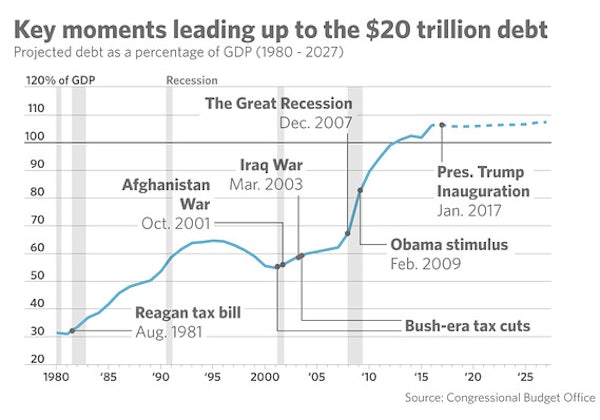
Marketwatch.com
Of course, as some Republicans will note, the tax rate is one of many factors that impact economic growth or contraction; the late ’90s tech boom helped Clinton, then hurt Bush when it burst. But ardent supply-siders like Laffer claim that the tax rate is the determining factor, which, considering the historical graph above, makes their case even weaker. As Jonathan Chait demonstrated in his 2007 book The Big Con, “supply-siders have taken the germ of a decent point—that marginal tax rates matter—and stretched it, beyond all plausibility, into a monocausal explanation of the world.” The supply-siders “think booms and busts result from changes in tax policy—and only from changes in tax policy.” In reality, the Laffer Curve is a solution to an imaginary problem. While there might be a point where higher taxes yield less revenue, America is nowhere near that juncture. According to the Tax Policy Center, the nation’s tax revenue in 2015 equaled 26 percent of the gross domestic product, compared to an average of 34 percent average among developed economies.
For these and other empirical reasons, economists across the political spectrum are dismissive of the Laffer Curve. Harvard economist Greg Mankiw, an outspoken conservative who led George W. Bush’s Council of Economic Advisors, has called supply-siders “Charlatans and Cranks” and compared them to a “snake-oil salesman.” Paul Krugman, the liberalNew York Times columnist and Nobel Prize–winning economist, often argues with Mankiw on economic policy, but also thinks “the supply-siders are cranks” who adhere to a doctrine “without a shred of logic or evidence in its favor.” This widespread criticism is almost as old as the Laffer Curve itself. As The Washington Postreported in 1989, at the dawn of George H. W. Bush’s presidency:
Laffer’s mathematical ‘curve’ gained folklore status—if limited acceptance by other analysts..... Critics seize on the $155 billion federal budget deficit as proof that the tax cuts he advocated were excessive. They also dismiss the supply-side claim that a tax cut could pay for itself by stimulating new business activity, a claim Laffer says that others exaggerated. “History has contradicted, not confirmed, the Laffer hypothesis,’’ said Robert Eisner, an economics professor at Northwestern University and past president of the American Economic Association. “Certainly, I think it made no contribution to professional economics.’’ Lawrence Chimerine, chairman of the WEFA Group, an economic consulting firm in Bala-Cynwyd, Pa., said the tax cuts aggravated America’s financial ills, including the trade deficit. He described the benefits promised by Laffer and others as “way, way overblown.’’
Laffer’s theory originally took root, though, because he “voiced a message that the president liked to hear.” The same is true today, as Trump’s tweets on Monday attest, but it’s also a message that Republican leaders in Congress like to hear; they’re all behind the tax reform plan unveiled last month, which is nothing if not a paean to supply-side economics. As Paul Krugman notes, “The main elements of the plan are a cut in top individual tax rates; a cut in corporate taxes; an end to the estate tax; and the creation of a big new loophole that will allow wealthy individuals to pretend that they are small businesses, and get a preferential tax rate. All of these overwhelmingly benefit the wealthy, mainly the top 1 percent.” Laffer is enthusiastic about the plan, since it would lower marginal rates for the economic elite—though Laffer, like most Republicans, denies that the cuts would only benefit the rich. “I think it’s trying to make everyone millionaires, billionaires, and trillionaires,” he told Al Jazeera last month. “This is a plan to get everyone to economic growth and give everyone a shot at the apple.”
Trump’s tax plan is likely to increase public debt and widen inequality instead. History suggests as much, as do distinguished economists. But such evidence means little to Laffer and the Republican Party. As the late Robert Bartley, a Wall Street Journaleditor who was one of Laffer’s biggest promoters, once crowed, “Economists still ridicule the Laffer Curve, but policymakers pay it careful heed.” Whether they do so because they believe Laffer’s theory, or just use it as intellectual cover to cut taxes on the rich, is an open question. But Trump could have an entirely different goal in mind: bringing peace to a fractured party. While Steve Bannon’s insurgent populists challenge Senate Majority Leader Mitch McConnell and the GOP establishment, the entire party agrees on cutting taxes for the rich. Supply-side economics is the glue holding Republicans together, for now.
The rise of supply-side economics on the right is perhaps the first major example of the modern Republican Party’s abandonment of policy expertise and empiricism. As such, it’s a forerunner to climate change denial, birtherism, and other noxious forms of anti-intellectualism in the GOP. The resiliency of Laffer and his ideas shows that the Republican Party’s decay goes much deeper than Trump. It’s easy enough to ridicule the president as an ignoramus, but it’s hardly an accident that he leads a party that has elevated a crank into an intellectual luminary. If the GOP is cynical enough to accept the Laffer Curve for purely political reasons, it can convince itself to accept any policy idea, no matter how ruinous. Laffer’s legacy, then, extends well beyond bad economic policy: He made the Republican Party safe for snake-oil salesmen, not least Trump himself.
Jeet Heer is a staff writer at the The New Republic
==
https://www.alternet.org/right-wing/two-santa-clauses-or-how-gop-conned-america-nearly-40-years
The only thing wrong with the U.S. economy is the failure of the Republican Party to play Santa Claus.
-Jude Wanniski, March 6, 1976
The Republican Party has been running a long con on America since Reagan’s inauguration, and somehow our nation’s media has missed it – even though it was announced in The Wall Street Journal in the 1970s and the GOP has clung tenaciously to it ever since.
In fact, Republican strategist Jude Wanniski’s 1974 “Two Santa Clauses Theory” has been the main reason why the GOP has succeeded in producing our last two Republican presidents, Bush and Trump (despite losing the popular vote both times). It’s also why Reagan’s economy seemed to be “good.”
Here’s how it works, laid it out in simple summary:
First, when Republicans control the federal government, and particularly the White House, spend money like a drunken sailor and run up the US debt as far and as fast as possible. This produces three results – it stimulates the economy thus making people think that the GOP can produce a good economy, it raises the debt dramatically, and it makes people think that Republicans are the “tax-cut Santa Claus.”
Second, when a Democrat is in the White House, scream about the national debt as loudly and frantically as possible, freaking out about how “our children will have to pay for it!” and “we have to cut spending to solve the crisis!” This will force the Democrats in power to cut their own social safety net programs, thus shooting their welfare-of-the-American-people Santa Claus.
Think back to Ronald Reagan, who more than tripled the US debt from a mere $800 billion to $2.6 trillion in his 8 years. That spending produced a massive stimulus to the economy, and the biggest non-wartime increase in the debt in history. Nary a peep from Republicans about that 218% increase in our debt; they were just fine with it.
And then along came Bill Clinton. The screams and squeals from the GOP about the “unsustainable debt” of nearly $3 trillion were loud, constant, and echoed incessantly by media from CBS to NPR. Newt Gingrich rode the wave of “unsustainable debt” hysteria into power, as the GOP took control of the House for the first time lasting more than a term since 1930, even though the increase in our national debt under Clinton was only about 37%.
The GOP “debt freakout” was so widely and effectively amplified by the media that Clinton himself bought into it and began to cut spending, taking the axe to numerous welfare programs (“It’s the end of welfare as we know it” he famously said, and “The era of big government is over”). Clinton also did something no Republican has done in our lifetimes: he supported several balanced budgets and handed a budget surplus to George W. Bush.
When George W. Bush was given the White House by the Supreme Court (Gore won the popular vote by over a half-million votes) he reverted to Reagan’s strategy and again nearly doubled the national debt, adding a trillion in borrowed money to pay for his tax cut for GOP-funding billionaires, and tossing in two unfunded wars for good measure, which also added at least (long term) another $5 to $7 trillion.
There was not a peep about the debt from any high-profile in-the-know Republicans then; in fact, Dick Cheney famously said, essentially ratifying Wanniski’s strategy, “Reagan proved deficits don't matter. We won the midterms [because of those tax cuts]. This is our due.” Bush and Cheney raised the debt by 86% to over $10 trillion (although the war debt wasn’t put on the books until Obama entered office).
Then comes Democratic President Barack Obama, and suddenly the GOP is hysterical about the debt again. So much so that they convinced a sitting Democratic president to propose a cut to Social Security (the “chained CPI”). Obama nearly shot the Democrats biggest Santa Claus program. And, Republican squeals notwithstanding, Obama only raised the debt by 34%.
Now we’re back to a Republican president, and once again deficits be damned. Between their tax cut and the nearly-trillion dollar spending increase passed on February 8th, in the first year-and-a-month of Trump’s administration they’ve spent more stimulating the economy (and driving up debt by more than $2 trillion, when you include interest) than the entire Obama presidency.
Republican strategist Jude Wanniski first proposed his Two Santa Clauses strategy in 1974, when Richard Nixon resigned in disgrace and the future of the Republican Party was so dim that books and articles were widely suggesting the GOP was about to go the way of the Whigs. There was genuine despair across the Party, particularly when Jerry Ford began stumbling as he climbed the steps to Air Force One and couldn’t even beat an unknown peanut farmer from rural Georgia for the presidency. Consider the amazing story of where this strategy came from, and how the GOP has successfully kept their strategy from getting into the news; even generally well-informed writers for media like the Times and the Post – and producers, pundits and reporters for TV news – don’t know the history of what’s been happening right in front of us all for 37 years.
Wanniski was tired of the GOP failing to win elections. And, he reasoned, it was happening because the Democrats had been viewed since the New Deal as the Santa Claus party (taking care of people’s needs and the General Welfare), while the GOP, opposing everything from Social Security to Medicare to unemployment insurance, was widely seen as the party of Scrooge.
The Democrats, he noted, got to play Santa Claus when they passed out Social Security and Unemployment checks – both programs of the New Deal – as well as when their "big government" projects like roads, bridges, and highways were built, giving a healthy union paycheck to construction workers and making our country shine.
Democrats kept raising taxes on businesses and rich people to pay for things, which didn't seem to have much effect at all on working people (wages were steadily going up, in fact), and that added to the perception that the Democrats were a party of Robin Hoods, taking from the rich to fund programs for the poor and the working class.
Americans loved the Democrats back then. And every time Republicans railed against these programs, they lost elections.
Wanniski decided that the GOP had to become a Santa Claus party, too. But because the Republicans hated the idea of helping working people, they had to figure out a way to convince people that they, too, could have the Santa spirit. But what?
“Tax cuts!” said Wanniski.
To make this work, the Republicans would first have to turn the classical world of economics – which had operated on a simple demand-driven equation for seven thousand years – on its head. (Everybody understood that demand – aka “wages” – drove economies because working people spent most of their money in the marketplace, producing demand for factory output and services.)
In 1974 Wanniski invented a new phrase – "supply side economics" – and suggested that the reason economies grew wasn't because people had money and wanted to buy things with it but, instead, because things were available for sale, thus tantalizing people to part with their money.
The more things there were, he said, the faster the economy would grow. And the more money we gave rich people and their corporations (via tax cuts) the more stuff they’d generously produce for us to think about buying.
At a glance, this move by the Republicans seems irrational, cynical and counterproductive. It certainly defies classic understandings of economics. But if you consider Jude Wanniski’s playbook, it makes complete sense.
To help, Arthur Laffer took that equation a step further with his famous napkin scribble. Not only was supply-side a rational concept, Laffer suggested, but as taxes went down, revenue to the government would go up! Neither concept made any sense – and time has proven both to be colossal idiocies – but together they offered the Republican Party a way out of the wilderness.
Ronald Reagan was the first national Republican politician to fully embrace the Two Santa Clauses strategy. He said straight out that if he could cut taxes on rich people and businesses, those tax cuts would cause them to take their surplus money and build factories, and that the more stuff there was supplying the economy the faster it would grow.
George Herbert Walker Bush – like most Republicans in 1980 who hadn’t read Wanniski’s piece in The Wall Street Journal – was horrified. Ronald Reagan was suggesting "Voodoo Economics," said Bush in the primary campaign, and Wanniski's supply-side and Laffer's tax-cut theories would throw the nation into such deep debt that, he believed, we'd ultimately crash into another Republican Great Depression.
But Wanniski had been doing his homework on how to sell “voodoo” supply-side economics.
In 1976, he rolled out to the hard-right insiders in the Republican Party his "Two Santa Clauses" theory, which would enable the Republicans to take power in America for the next forty years.
Democrats, he said, had been able to be "Santa Clauses" by giving people things from the largesse of the federal government. From food stamps to new schools to sending a man to the moon, the people loved the “toys” the Democrats brought every year.
Republicans could do that, too, the theory went – spending could actually increase without negative repurcussions. Plus, Republicans could be double Santa Clauses by cutting people's taxes!
For working people it would only be a small token – a few hundred dollars a year on average – but would be heavily marketed. And for the rich, which wasn’t to be discussed in public, it would amount to hundreds of billions of dollars in tax cuts.
The rich, Reagan, Bush, and Trump told us, would then use that money to import or build more stuff to market, thus stimulating the economy and making average working people richer. (And, of course, they’d pass some of that money back to the GOP, like the Kochs giving Paul Ryan $500,000.00 right after he passed the last tax cut that gave them billions.)
There was no way, Wanniski said, that the Democrats could ever win again. They'd be forced into the role of Santa-killers by raising taxes, or anti-Santas by cutting spending. Either one would lose them elections.
When Reagan rolled out Supply Side Economics in the early 80s, dramatically cutting taxes while exploding spending, there was a moment when it seemed to Wanniski and Laffer that all was lost. The budget deficit exploded and the country fell into a deep recession – the worst since the Great Depression – and Republicans nationwide held their collective breath.
But David Stockman came up with a great new theory about what was going on – they were "starving the beast" of government by running up such huge deficits that Democrats would never, ever in the future be able to talk again about national health care or improving Social Security.
And this so pleased Alan Greenspan, the Fed Chairman, that he opened the spigots of the Fed, dropping interest rates and buying government bonds, producing a nice, healthy goose to the economy.
Greenspan further counseled Reagan to dramatically increase taxes on people earning under $37,800 a year by doubling the Social Security (FICA/payroll) tax, and then let the government borrow those newfound hundreds of billions of dollars off-the-books to make the deficit look better than it was.
Reagan, Greenspan, Winniski, and Laffer took the federal budget deficit from under a trillion dollars in 1980 to almost three trillion by 1988, and back then a dollar could buy far more than it buys today. They and George HW Bush ran up more debt in eight years than every president in history, from George Washington to Jimmy Carter, combined.
Surely this would both starve the beast and force the Democrats to make the politically suicidal move of becoming deficit hawks. And that's just how it turned out.
Bill Clinton, who had run on an FDR-like platform of a "New Covenant" with the American people that would strengthen the institutions of the New Deal, strengthen labor, and institute a national health care system, found himself in a box.
A few weeks before his inauguration, Alan Greenspan and Robert Rubin sat him down and told him the facts of life: he was going to have to raise taxes and cut the size of government. Clinton took their advice to heart, raised taxes, balanced the budget, and cut numerous programs, declaring an "end to welfare as we know it" and, in his second inaugural address, an "end to the era of big government."
Clinton was the anti-Santa Claus, and the result was an explosion of Republican wins across the country as Republican politicians campaigned on a platform of supply-side tax cuts and pork-rich spending increases. State after state turned red, and the Republican Party rose to take over, ultimately, every single lever of power in the federal government, from the Supreme Court to the White House.
Looking at the wreckage of the Democratic Party all around Clinton by 1999, Winniski wrote a gloating memo that said, in part: "We of course should be indebted to Art Laffer for all time for his Curve... But as the primary political theoretician of the supply-side camp, I began arguing for the 'Two Santa Claus Theory' in 1974. If the Democrats are going to play Santa Claus by promoting more spending, the Republicans can never beat them by promoting less spending. They have to promise tax cuts..."
Ed Crane, then-president of the Koch-funded Libertarian CATO Institute, noted in a memo that year: "When Jack Kemp, Newt Gingich, Vin Weber, Connie Mack and the rest discovered Jude Wanniski and Art Laffer, they thought they'd died and gone to heaven. In supply-side economics they found a philosophy that gave them a free pass out of the debate over the proper role of government. Just cut taxes and grow the economy: government will shrink as a percentage of GDP, even if you don't cut spending. That's why you rarely, if ever, heard Kemp or Gingrich call for spending cuts, much less the elimination of programs and departments."
Two Santa Clauses had gone mainstream. Never again would Republicans worry about the debt or deficit when they were in office; and they knew well how to scream hysterically about it as soon as Democrats took power.
George W. Bush embraced the Two Santa Claus Theory with gusto, ramming through huge tax cuts – particularly a cut to the capital gains tax rate on people like himself who made their principle income from sitting around the mailbox waiting for their dividend or capital gains checks to arrive – and blew out federal spending.
Bush, with his wars, even out-spent Reagan, which nobody had ever thought would again be possible. And it all seemed to be going so well, just as it did in the early 1920s when a series of three consecutive Republican presidents cut income taxes on the uber-rich from over 70 percent to under 30 percent.
In 1929, pretty much everybody realized that instead of building factories with all that extra money, the rich had been pouring it into the stock market, inflating a bubble that – like an inexorable law of nature – would have to burst.
But the people who remembered that lesson were mostly all dead by 2005, when Jude Wanniski died and George Gilder celebrated the Reagan/Bush supply-side-created bubble economies in a Wall Street Journal eulogy:
"...Jude's charismatic focus on the tax on capital gains redeemed the fiscal policies of four administrations. ... Unbound by zero-sum economics, Jude forged the golden gift of a profound and passionate argument that the establishments of the mold must finally give way to the powers of the mind. ... He audaciously defied all the Buffetteers of the trade gap, the moldy figs of the Phillips Curve, the chic traders in money and principle, even the stultifying pillows of the Nobel Prize."
In reality, his tax cuts did what they have always done over the past 100 years – they initiated a bubble economy that would let the very rich skim the cream off the top just before the ceiling crashed in on working people. Just like today.
The Republicans got what they wanted from Wanniski's work. They held power for thirty years, made themselves trillions of dollars, and cut organized labor's representation in the workplace from around 25 percent when Reagan came into office to around 6 of the non-governmental workforce today.
Over time, and without raising the cap, Social Security will face an easily-solved crisis, and the GOP’s plan is for force Democrats to become the anti-Santa, yet again. If the GOP-controlled Congress continues to refuse to require rich people to pay into Social Security (any income over $128,000 is SS-tax-free), either benefits will be cut or the retirement age will have to be raised to over 70.
The GOP plan is to use this unnecessary, manufactured crisis as an opening to “reform” Social Security - translated: cut and privatize. Thus, forcing Democrats to become the Social Security anti-Santa a different way.
When this happens, Democrats must remember Jude Wanniski - and accept neither the cut to disability payments, nor the entree to Social Security “reform.” They must demand the “cap” be raised, as Bernie Sanders proposed and the Democratic Party adopted in its 2016 platform.
And, hopefully, some of our media will begin to call the GOP out on the Two Santa Clauses program. It’s about time that Americans realized the details of the scam that’s been killing wages and enriching billionaires for nearly four decades
---
https://www.alternet.org/news-amp-politics/how-republican-party-has-conned-america-over-30-years
How the Republican Party Has Conned America for Over 30 Years
Tax cuts initiate bubble economies, not true growth.
By Thom Hartmann / AlterNet September 29
The Republican Party has been running a long con on the American people, and Trump’s new tax cut proposals are just the latest iteration on it. This con involves getting Democrats to shoot Santa Claus (Clinton cutting welfare/Obama proposing the chained CPI cut to Social Security) and using tax policy to put a jolly old Saint Nick outfit on the Republicans.
As Bruce Bartlett – one of the architects and major salespeople for Reagan’s tax cuts in the ‘80s – wrote in USA Today this week: “Virtually everything Republicans say about taxes today is a lie. Tax cuts and tax rate reductions will not pay for themselves; they never have. Republicans don’t even believe they will, they are just excuses to slash spending for the poorwhen revenues collapse and deficits rise. There is no evidence that tax reform raises growth, although it may improve fairness and tax administration.”
So how do Republicans get away with this lie, and why does the press let them get away with it? It’s a fascinating story.
Odds are you've never heard ofJude Wanniski, but without him Reagan never would have become a "successful" president, Republicans never would have taken control of the House or Senate, Bill Clinton never would have been impeached, and George Bush never would have become president. Ditto for Trump.
When Barry Goldwater went down to ignominious defeat in 1964, most Republicans felt doomed (among them the 28-year-old Wanniski). Goldwater himself, although uncomfortable with the rising religious right within his own party and the calls for more intrusion in people's bedrooms, was a diehard fan of Herbert Hoover's economic worldview.
In Hoover's world (and virtually all the Republicans since reconstruction with the exception of Teddy Roosevelt), market fundamentalism was a virtual religion. Economists from Ludwig von Mises to Friedrich Hayek to Milton Friedman had preached that government could only make a mess of things economic, and the world of finance should be left to the Big Boys – the Masters of the Universe,as they sometimes called themselves – who ruled Wall Street and international finance.
Hoover enthusiastically followed the advice of his Treasury Secretary, multimillionaire Andrew Mellon, who said in 1931: "Liquidate labor, liquidate stocks, liquidate the farmers, liquidate real estate. Purge the rottenness out of the system. High costs of living and high living will come down... enterprising people will pick up the wrecks from less competent people."
Thus, the Republican mantra was: "Lower taxes, reduce the size of government, and balance the budget."
The only problem with this ideology from the Hooverite perspective was that the Democrats always seemed like the bestowers of gifts, while the Republicans were seen by the American people as the stingy Scrooges, bent on making the lives of working people harder all the while making the very richest even richer. This, Republican strategists since 1930 knew, was no way to win elections.
Which was why the most successful Republican of the 20th century up to that time, Dwight D. Eisenhower,had been quite happy with a top income tax rate on multimillionaires of 91 percent. As he explained to his right-wing brother Edgar Eisenhower in a personal letter on November 8, 1954:
"[T]o attain any success it is quite clear that the Federal government cannot avoid or escape responsibilities which the mass of the people firmly believe should be undertaken by it. The political processes of our country are such that if a rule of reason is not applied in this effort, we will lose everything--even to a possible and drastic change in the Constitution. This is what I mean by my constant insistence upon 'moderation' in government.
"Should any political party attempt to abolish social security, unemployment insurance, and eliminate labor laws and farm programs, you would not hear of that party again in our political history. There is a tiny splinter group, of course, that believes you can do these things. Among them are H. L. Hunt (you possibly know his background), a few other Texas oil millionaires, and an occasional politician or business man from other areas. Their number is negligible and they are stupid."
Goldwater, however, rejected the "liberalism" of Eisenhower, Rockefeller, and other "moderates" within his own party. Extremism in defense of liberty was no vice, he famously told the 1964 nominating convention, and moderation was no virtue. And it doomed him and his party.And so after Goldwater's defeat, the Republicans were again lost in the wilderness just as after Hoover's disastrous presidency. Even four years later when Richard Nixon beat Hubert Humphrey in 1968, Nixon wasn't willing to embrace the economic conservatism of Goldwater and the economic true believers in the Republican Party. And Jerry Ford wasn't, in their opinions, much better. If Nixon and Ford believed in economic conservatism, they were afraid to practice it for fear of dooming their party to another 40 years in the electoral wilderness.
By 1974, Jude Wanniski had had enough. The Democrats got to play Santa Claus when they passed out Social Security and Unemployment checks – both programs of the New Deal – as well as when their "big government" projects like schools, hospitals, roads, bridges, and highways were built giving a healthy union paycheck to construction workers and driving economic growth. Democrats kept high taxes on businesses and rich people to pay for things, which worked out just fine for working people (wages were steadily going up, in fact), and made the Democrats seem like a party of Robin Hoods, taking from the rich to fund programs for the poor and the working class.
Americans loved it. And every time Republicans railed against these programs, they lost elections.
Everybody understood at the time that economies are driven by demand. People with good jobs have money in their pockets, and want to use it to buy things. The job of the business community is to either determine or drive that demand to their particular goods, and when they're successful at meeting the demand then factories get built, more people become employed to make more products, and those newly-employed people have a paycheck that further increases demand.
Wanniski decided to turn the classical world of economics – which had operated on this simple demand-driven equation for seven thousand years – on its head. In 1974 he invented a new phrase, "supply-side economics,"and suggested that the reason economies grew wasn't because people had money and wanted to buy things with it, but instead, because things were available for sale, thus tantalizing people to part with their money. The more things there were, the faster the economy would grow.
At the same time, ArthurLaffer was taking that equation a step further. Not only was supply-side a rational concept, Laffer suggested, but as taxes went down, revenue to the government would go up!
Neither concept made any sense—and time has proven both to be colossal idiocies—but together they offered the Republican Party a way out of the wilderness.
Ronald Reagan was the first national Republican politician to suggest that he could cut taxes on rich people and businesses, that those tax cuts would cause them to take their surplus money and build factories to make more stuff, and that the more stuff there was supplying the economy the faster it would grow.
In the 1980 GOP primary, George Herbert Walker Bush – like most Republicans of the time – was horrified. Ronald Reagan was suggesting "Voodoo Economics," said Bush in the primary campaign, and Wanniski's supply-side and Laffer's tax-cut theories would throw the nation into such deep debt that we'd ultimately crash into another Republican Great Depression.
But Wanniski had been doing his homework on how to sell supply-side economics. In 1976, he rolled out to the hard-right insiders in the Republican Party his"Two Santa Clauses" theory, which would enable the Republicans to take power in America for the next generation.
Democrats, he said, had been able to be "Santa Clauses" by giving people things from the largesse of the federal government. Republicans could do that, too – spending could actually increase.
Plus, Republicans could be double Santa Clauses by cutting people's taxes!For working people it would only be a small token – a few hundred dollars a year on average – but would be heavily marketed. And for the rich it would amount to hundreds of billions of dollars in tax cuts. The rich, he said, would use that money to import or build more stuff to market, thus increasing supply and stimulating the economy. And that growth in the economy would mean that the people still paying taxes would pay more because they were earning more.
There was no way, Wanniski said, that the Democrats could ever win again. They'd have to be anti-Santas by raising taxes, or anti-Santas by cutting spending. Either one would lose them elections.
When Reagan rolled out supply-side economics in the early '80s, dramatically cutting taxes while exploding (mostly military) spending, there was a moment when it seemed to Wanniski and Laffer that all was lost. The budget deficit exploded and the country fell into a deep recession – the worst since the Great Depression – and Republicans nationwide held their collective breath.
But David Stockman came up with a great new theory about what was going on – they were "starving the beast" of government by running up such huge deficits that Democrats would never, ever in the future be able to talk again about national health care or improving Social Security – and this so pleased Paul Volker, the Fed chairman, that he opened the spigots of the Fed, dropping interest rates from 19 to 9 percent (between 1981 and 1982) and buying government bonds, producing a nice, healthy goose to the economy. Alan Greenspan further counseled Reagan to dramatically increase taxes on people earning under $37,800 a year by doubling the Social Security (FICA/payroll) tax, and then let the government borrow those newfound hundreds of billions of dollars off-the-booksto make the deficit look better than it was.
Reagan, Greenspan, Winniski, and Laffer took the federal budget deficit from under a trillion dollars in 1980 to almost $3 trillion by 1988, and back then a dollar could buy far more than it buys today.They and George HW Bush ran up more debt in eight years than every president in history, from George Washington to Jimmy Carter, combined. Surely this would both starve the beast and force the Democrats to make the politically suicidal move of becoming deficit hawks and shoot Santa Claus.
And that's just how it turned out. Bill Clinton, who had run on an FDR-like platform of a "new covenant" with the American people that would strengthen the institutions of the New Deal, strengthen labor, and institute a national health care system, found himself in a box. A few weeks before his inauguration, Alan Greenspan and Robert Rubin sat him down and told him the facts of life: he was going to have to raise taxes and cut the size of government.
Clinton took their advice to heart, raised taxes, balanced the budget, and cut numerous programs, declaring an "end to welfare as we know it" and, in his second inaugural address, an "end to the era of big government." He was the anti-Santa Claus, and the result was an explosion of Republican wins across the country as Republican politicians campaigned on a platform of supply-side tax cuts and pork-rich spending increases.
Looking at the wreckage of the Democratic Party all around Clinton by 1999, Winniski wrote a gloating memo that said, in part: "We of course should be indebted to Art Laffer for all time for his Curve... But as the primary political theoretician of the supply-side camp, I began arguing for the 'Two Santa Claus Theory' in 1974. If the Democrats are going to play Santa Claus by promoting more spending, the Republicans can never beat them by promoting less spending. They have to promise tax cuts..."
Ed Crane, then president of the Libertarian CATO Institute, noted in a memo that year: "When Jack Kemp, Newt Gingich, Vin Weber, Connie Mack and the rest discovered Jude Wanniski and Art Laffer, they thought they'd died and gone to heaven. In supply-side economics they found a philosophy that gave them a free pass out of the debate over the proper role of government. Just cut taxes and grow the economy: government will shrink as a percentage of GDP, even if you don't cut spending. That's why you rarely, if ever, heard Kemp or Gingrich call for spending cuts, much less the elimination of programs and departments."
George W. Bush embraced the Two Santa Claus Theory with gusto, ramming through huge tax cuts – particularly a cut to a maximum 15 percent income tax rate on people like himself who made their principal income from sitting around the pool waiting for their dividend or capital gains checks to arrive in the mail – and blowing out federal spending. Bush even out-spent Reagan, which nobody had ever thought would again be possible.
And it all seemed to be going so well, just as it did in theearly 1920s when three consecutive Republican presidents cut income taxes on the uber-rich from over 70 percent to under 30 percent. In 1929, pretty much everybody realized that instead of building factories with all that extra money, the rich had been pouring it into the stock market, inflating a bubble that – like an inexorable law of nature – would have to burst. But the people who remembered that lesson were mostly all dead by 2005, when Jude Wanniski died and George Gilder celebrated the Reagan/Bush supply-side-created bubble economies in a Wall Street Journal eulogy:
"...Jude's charismatic focus on the tax on capital gains redeemed the fiscal policies of four administrations. ... Unbound by zero-sum economics, Jude forged the golden gift of a profound and passionate argument that the establishments of the mold must finally give way to the powers of the mind. He audaciously defied all the Buffetteers of the trade gap, the moldy figs of the Phillips Curve, the chic traders in money and principle, even the stultifying pillows of the Nobel Prize."
In reality, his tax cuts did what they have always done over the past 100 years – they initiated a bubble economy that would let the very rich skim the cream off the top just before the ceiling crashed in on working people.
The Republicans got what they wanted from Wanniski's work. They held power for over 30 years, made themselves trillions of dollars, cut organized labor's representation in the workplace from around 25 percent when Reagan came into office to around 6 percent of the non-governmental workforce today, and left such a massive deficit that some misguided "centrist" Democrats are again clamoring to shoot Santa with working-class tax hikes and entitlement program cuts.
And now Trump and the whole crowd are again clamoring to be recognized as the ones who will out-Santa Claus the Democrats. You'd think after all the damage they've done that the infotainment stars on TVwould at least acknowledge this history. But that’s not convenient when you need GOP “stars” to come on your show or you lose your million-dollar job. JRNL FAIL
Wanniski is gone, but his memo still lives on, particularly where he admonished Ed Crane at CATO to stop talking about cutting the federal deficit and instead promise people the Santa Claus of economic growth. He ended his infamous memo with:
If the Democrats are going to play Santa Claus by promoting more spending, the Republicans can never beat them by promoting less spending. They have to promise tax cuts in order to grow the economy -- not to ‘starve the government of revenue,’ which is Milton Friedman's rationale. Let's shoot Santa Claus? Let's not.” Instead, let’s force the Democrats to shoot Santa!
The Two Santa Claus theory isn't dead, as we can see from today's Republican rhetoric. Hopefully, though, reality will continue to sink in with the American people and the massive fraud perpetrated by Wanniski, Reagan, Graham, Bush(s), and all their "conservative" enablers will be seen for what it was and is.
And the rest of us can get about the business ofrepairing the damage and recovering the stolen assets of our nation from these cheap hustlers who dare call themselves politicians.
---
https://www.forbes.com/sites/timworstall/2017/07/31/nope-paul-krugmans-still-wrong-about-supply-side-economics/
adam smith inst UK
==
http://thehill.com/blogs/pundits-blog/economy-budget/343212-trumps-supply-side-economic-swindle
no link
The director of the Office of Management and Budget, Mick Mulvaney, took to The Wall Street Journal’s op-ed page last week to promote the Trump administration’s economic agenda, the dubiously named “MAGAnomics.”
The plan as outlined is a wish-list of traditional supply-side policies that are hardly unique to this administration: lowering taxes, curbing environmental and labor regulation, and cutting back programs that benefit workers and their families. A few more Trump-ian planks include the on-hold infrastructure plan and a commitment to fair trade — a theme of the president’s campaign that still lacks any real policy detail.
As Mulvaney points out, many experts are skeptical that 3 percent economic growth can be achieved in the short term. Among them is Janet Yellen, chair of the Federal Reserve Board, who recently told the Senate Banking Committee that such growth is unlikely in the next five years. The Congressional Budget Office recently projected 1.9 percent growth under the administration’s proposed agenda. A 3 percent growth projection is grossly unrealistic, but faster growth would be a clear boon to the nation.
Even faster growth, though, is no guarantee that the fruits of that growth would accrue to average Americans.
U.S. policymakers have long focused on growth in Gross Domestic Product, the sum total of all the goods and services produced in the country, which tells us how much total U.S. economic output expanded or contracted. But GDP doesn’t tell Americans anything about the economic prospects of people like them. Pause for a moment and imagine that I told you the economy grew by 5 percent in the first six months 2017. Mulvaney and President Trump would be thrilled. Yet that could mean wildly different things for working Americans. Low-and middle-income wages could be stagnant, for example, while rising wages and investment income among high-income Americans would mean they benefited richly from the overall growth in the economy.
This is exactly what has happened in the United States. The economists Thomas Piketty, Emmanuel Saez and Gabriel Zucman found that between 1962 and 2014, average national income per adult rose by 61 percent, which sounds like good news until we dig below this topline number. For those Americans on the lower half of the income distribution, total real income growth (after accounting for inflation) was a paltry one percent while those with incomes in the top one percent experienced a whopping 205 percent rise.
We need to stop treating GDP growth as the only metric that matters and start thinking about how the economy is working for Americans across the income spectrum. Looking only at GDP provides a distorted portrait of the state of our economy and it should not be used as the topline metric to guide policymaking.
“MAGAnomics” provides a perfect jumping off point to see why focusing on GDP growth is a mistake. Let’s start with Mulvaney’s claim that the whole country benefitted from Reagan-era tax cuts and deregulation. He says that between 1983 and 1990, real GDP grew at an annual rate of 4.4 percent. There are two problems with this analysis. First, he’s stacked the deck by choosing the bottom of a severe recession as his starting point. Serious economists look at the business cycle from peak to peak or trough to trough; they don’t cherry pick the worst year to the best.
Even so, his analysis also fails because those years did not deliver equitable growth. Instead, these are the years when the divergence between the poor, the middle class, and the rich really took off. Between 1983 and 1990, real average income for the bottom 90 percent grew by 1.9 percent percent per year while the top 1 percent of earners saw their incomes surge by more than 7.2 percent percent annually — just the beginning of the widening income inequality gap the emerged over the past four decades.
Like Director Mulvaney, I believe the U.S. economy is capable of great things. I also believe that working-class Americans need a boost as they continue to experience poor wage growth amid seven years of tepid economic growth since the end of the Great Recession in mid-2009. Tax cuts for the wealthiest Americans alongside cuts to government programs that help working and retired Americans make ends meet haven’t worked in the past to create those gains, and they won’t work now.
Creating strong economic growth for all Americans requires that we look at the right data and enact a policy agenda that delivers sustained, shared prosperity. A good place to start would be to ensure that families can earn a living wage, which means support for organizations that improve worker bargaining power and ensuring broad access to necessary benefits such as paid leave and work schedules that fit the demands of family life.
It also means recognizing that the market economy works best when government focuses on regulating business so that it works in the public interest to promote broad-based economic growth that delivers higher wages to more Americans across the economy, not just those at the very top of the wealth and income ladders.
Heather Boushey is executive director and chief economist at the Washington Center for Equitable Growth and the author of “Finding Time: The Economics of Wok-Life Conflict” and co-editor of “After Piketty: The Agenda for Economics and Inequality.”
==
https://en.wikipedia.org/wiki/Supply-side_economics
Supply-side economics is a macroeconomic theory that argues economic growth can be most effectively created by lowering taxes and decreasing regulation.[1][2] According to supply-side economics, consumers will then benefit from a greater supply of goods and services at lower prices, and employment will increase.[3] It was started by economist Robert Mundell during the Ronald Reagan administration.
The Laffer curve is one of the main theoretical constructs of supply-side economics, the idea that lower tax rates will actually boost government revenue because of higher economic growth.[4] Basic math states that cutting tax rates in half would require an economy twice the size to generate the same amount of tax revenue.
The term supply-side economics was thought for some time to have been coined by journalist Jude Wanniski in 1975, but according to Robert D. Atkinson, the term "supply side" was first used in 1976 by Herbert Stein, a former economic adviser to President Nixon, and only later that year was this term repeated by Jude Wanniski.[5] Its use connotes the ideas of economists Robert Mundell and Arthur Laffer. Others prefer the term trickle-down economics.
:{:{}:
}:
- 1Historical origins
- 2Fiscal policy theory
- 3Effect on tax revenues
- 4Effect on income inequality
- 5U.S. monetary and fiscal experience
- 6Criticism
- 7See also
- 8Notes and references
- 9External links
Historical origins
Supply-side economics developed in response to the stagflation of the 1970s.[6] It drew on a range of non-Keynesian economic thought, including theChicago School and New Classical School.[7][8] Bruce Bartlett, an advocate of supply-side economics, traced the school of thought's intellectual descent from the philosophers Ibn Khaldun and David Hume, satirist Jonathan Swift, political economist Adam Smith, and even United States 'Founding Father' Alexander Hamilton.[9]
However, what most separates supply-side economics as a modern phenomenon is its argument in favor of low tax rates primarily for collective and notably working-class reasons, rather than traditional ideological ones. Classical Liberals opposed taxes because they opposed government, taxation being the latter's most obvious form. Their claim was that each man had a right to himself and his property and therefore taxation was immoral and of questionable legal grounding.[10] Supply-side economists, on the other hand, argued that the alleged collective benefit (i.e. increased economic output and efficiency) provided the main impetus for tax cuts.
As in classical economics, supply-side economics proposed that production or supply is the key to economic prosperity and that consumption or demand is merely a secondary consequence. Early on, this idea had been summarized in Say's Law of economics, which states:
"A product is no sooner created, than it, from that instant, affords a market for other products to the full extent of its own value."
John Maynard Keynes, the founder of Keynesianism, summarized Say's Law as "supply creates its own demand." He turned Say's Law on its head in the 1930s by declaring that demand creates its own supply.[11]
In 1978, Jude Wanniski published The Way the World Works, in which he laid out the central thesis of supply-side economics and detailed the failure of high tax rate progressive income tax systems and U.S. monetary policy under Nixon in the 1970s. Wanniski advocated lower tax rates and a return to some kind of gold standard, similar to the 1944–1971 Bretton Woods System that Nixon abandoned.
Laffer curve

TheLaffer curve embodies a postulate of supply-side economics: that tax rates and tax revenues are distinct, with government tax revenues the same at a 100% tax rate as they are at a 0% tax rate, and maximum revenue somewhere in between these two values. Supply-siders argued that in a high tax rate environment, lowering tax rates would result in either increased revenues or smaller revenue losses than one would expect relying on only static estimates of the previous tax base.[12][13]
This led supply-siders to advocate large reductions in marginal income and capital gains tax rates to encourage greater investment, which would produce more supply. Jude Wanniski and many others advocate a zero capital gains rate.[14][15] The increased aggregate supply would result in increased aggregate demand, hence the term "Supply-Side Economics".
Fiscal policy theory

Historical data from 1930 to 2015 shows a slight positive correlation between higher top marginal tax rates and GDP growth rate (red line).[16]

Average family income growth declined when the upper tax rate was cut from 91%.[17]
Supply-side economics holds that increased taxation steadily reduces economic activity within a nation and discourages investment. Taxes act as a type of trade barrier or tariff that causes economic participants to revert to less efficient means of satisfying their needs. As such, higher taxation leads to lower levels of specialization and lower economic efficiency. The idea is said to be illustrated by the Laffer curve. (Case & Fair, 1999: pp. 780–1).
Supply-side economists have less to say on the effects of deficits, and sometimes cite Robert Barro’s work that states that rational economic actors will buy bonds in sufficient quantities to reduce long-term interest rates.[18]
Effect on tax revenues
,,....
1960s
Democratic president John Kennedy advocated a drastic tax-rate cut in 1963, when the top income tax rate was 91%, arguing that
"Tax rates are too high today and tax revenues too low, and the soundest way to raise revenues in the long run is to cut rates now."[39]
The Revenue Act of 1964 emerged from Congress and was signed by Kennedy's successor Lyndon Johnson on February 26, 1964. The stated goals of the tax cuts were to raise personal incomes, increase consumption, and increase capital investment.
Reaganomics
Main article: Reaganomics
Reagan gives a televised address from theOval Office, outlining his plan for tax reductions in July 1981.

In the United States, commentators frequently equate supply-side economics with Reaganomics. The fiscal policies of Ronald Reagan were largely based on supply-side economics.
Ronald Reagan made supply-side economics a household phrase, and promised an across-the-board reduction in income tax rates and an even larger reduction in capital gains tax rates. (Case & Fair, 1999: pp. 781–2).
During Reagan's 1980 presidential campaign, the key economic concern was double digit inflation, which Reagan described as "Too many dollars chasing too few goods", but rather than the usual dose of tight money, recession and layoffs, with their consequent loss of production and wealth, he promised a gradual and painless way to fight inflation by "producing our way out of it".[40]
Switching from an earlier monetarist policy, Federal Reserve chair Paul Volcker began a policy of tighter monetary policies such as lower money supply growth to break the inflationary psychology and squeeze inflationary expectations out of the economic system.[41] Therefore, supply-side supporters argue, "Reaganomics" was only partially based on supply-side economics.
However, under Reagan, Congress passed a plan that would slash taxes by $749 billion over five years. Critics claim that the tax cuts increased budget deficits. Reagan supporters credit them with helping the 1980s economic expansion that eventually lowered the deficits and argued that the budget deficit would have decreased if not for massive increases in military spending.[42] As a result, Jason Hymowitz cited Reagan—along with Jack Kemp—as a great advocate for supply-side economics in politics and repeatedly praised his leadership.[43]
Critics of "Reaganomics" claim it failed to produce much of the exaggerated gains some supply-siders had promised. Krugman later summarized the situation:
"When Ronald Reagan was elected, the supply-siders got a chance to try out their ideas. Unfortunately, they failed."
Although he credited supply-side economics for being more successful than monetarism which he claimed "left the economy in ruins", he stated that supply-side economics produced results which fell "so far short of what it promised," describing the supply-side theory as "free lunches".[44]
Income tax revenues in constant dollars decreased by $2.77 billion in that year. FICA tax revenue increased because in 1983 FICA tax rates were increased from 6.7% to 7% and the ceiling was raised by $2,100. For the self-employed, the FICA tax rate went from 9.35% to 14%.[45] The FICA tax rate increased throughout Reagan's term, and rose to 7.51% in 1988 and the ceiling was raised by 61% through Reagan's two terms. Those tax hikes on wage earners, along with inflation, were the source of revenue gains in the early 1980s.[46]
It has been contended by some supply-side critics that the argument to lower taxes to increase revenues was a smokescreen for "starving" the government of revenues, in the hope that the tax cuts would lead to a corresponding drop in government spending. However, this did not turn out to be the case. Paul Samuelson called this notion
"the tape worm theory—the idea that the way to get rid of a tape worm is [to] stab your patient in the stomach".[47]
There is frequent confusion on the meaning of the term 'supply-side economics', between the related ideas of the existence of the Laffer Curve and the belief that decreasing tax rates can increase tax revenues. Many supply-side economists doubt the latter claim, while still supporting the general policy of tax cuts. Economist Gregory Mankiw used the term "fad economics" to describe the notion of tax rate cuts increasing revenue in the third edition of his Principles of Macroeconomics textbook in a section entitled "Charlatans and Cranks":
"An example of fad economics occurred in 1980, when a small group of economists advised Presidential candidate, Ronald Reagan, that an across-the-board cut in income tax rates would raise tax revenue. They argued that if people could keep a higher fraction of their income, people would work harder to earn more income. Even though tax rates would be lower, income would rise by so much, they claimed, that tax revenues would rise. Almost all professional economists, including most of those who supported Reagan's proposal to cut taxes, viewed this outcome as far too optimistic. Lower tax rates might encourage people to work harder and this extra effort would offset the direct effects of lower tax rates to some extent, but there was no credible evidence that work effort would rise by enough to cause tax revenues to rise in the face of lower tax rates. … People on fad diets put their health at risk but rarely achieve the permanent weight loss they desire. Similarly, when politicians rely on the advice of charlatans and cranks, they rarely get the desirable results they anticipate. After Reagan's election, Congress passed the cut in tax rates that Reagan advocated, but the tax cut did not cause tax revenues to rise."[48][49]
When vying for the Republican party presidential nomination for the 1980 election, George H.W. Bush derided Reagan's supply-side policies as "voodoo economics". However, to secure the Republican nomination in 1988, he later seemed to give lip service to these policies, and is speculated by some to have lost his re-election bid in 1992 by allowing tax increases.
Clinton years

Main article:Economic policy of the Bill Clinton administration
The Clinton years represent a counter-example to supply side economics, as tax increases coincided with record job creation. President Clinton presided over the budgets for fiscal years 1994-2001. From 1998-2001, the budget was in a surplus for the first time since 1969.
Clinton signed the Omnibus Budget Reconciliation Act of 1993into law, which raised income taxes rates on incomes above $115,000, created additional higher tax brackets for corporate income over $335,000, removed the cap on Medicare taxes, raised fuel taxes, and increased the portion of Social Security income subject to tax, among other tax increases. Income tax revenues nearly doubled in dollar terms, from $510B in 1993 (7.5% GDP) to $994B in 2001 (9.4% GDP).[50]
More jobs were created during the Clinton era than the Reagan era in both relative and absolute terms, and the rate of GDP growth was higher.[51][52] Defense spending was held roughly flat in dollar terms, at $282B in 1994 (3.9% GDP) and ending at $306B in 2001 (2.9% GDP). Likewise, non-defense discretionary spending fell from 3.6% of GDP in 1994 to 3.2% of GDP in 2001. The combination of increasing tax revenues and falling spending relative to GDP moved the budget from a 2.8% GDP deficit in 1994 to a 1.2% GDP surplus in 2001.[50]
Research since 2000

In 2003, Alan Murray, who at the time was Washington bureau chief for CNBC and a co-host of the television program Capital Report, declared the debate over supply-side economics to have ended "with a whimper" after extensive modeling performed by theCongressional Budget Office (CBO) predicted that the revenue generating effects of the specific tax cuts examined would be, in his words, "relatively small."[28] Murray also suggested that Dan Crippen may have lost his chance at reappointment as head of the CBO over the dynamic scoring issue.

Tax decreases on high income earners (top 10%) are not correlated with employment growth, however, tax decreases on lower income earners (bottom 90%) are correlated with employment growth.[53]
Before President Bush signed the 2003 tax cuts, the Economic Policy Institute(EPI) released a statement signed by ten Nobel prize laureates entitled "Economists' statement opposing the Bush tax cuts", which states that:
"Passing these tax cuts will worsen the long-term budget outlook, adding to the nation’s projected chronic deficits. This fiscal deterioration will reduce the capacity of the government to finance Social Security and Medicare benefits as well as investments in schools, health, infrastructure, and basic research. Moreover, the proposed tax cuts will generate further inequalities in after-tax income."[54]
Nobel laureate economist Milton Friedman agreed the tax cuts would reduce tax revenues and result in intolerable deficits, though he supported them as a means to restrain federal spending.[55] Friedman characterized the reduced government tax revenue as "cutting their allowance".
Bush tax cuts
Main article: Bush tax cuts


CBO data - Federal individual income tax revenue trends from 2000-2009 (dollars and % GDP)
In 2001, President George W. Bush signed the Economic Growth and Tax Relief Reconciliation Act of 2001. Rather than wait for the start of the new fiscal year, income tax rate reductions started on July 1, 2001. In addition, rebate checks were sent to everyone who filed a 2000 income tax return before October 1, the start of the new federal fiscal year.[56] Federal revenues in FY2001 were $1.946 trillion, $79 billion lower than in FY2000. More of the 2001 tax cut took effect at the start of FY2002, including cuts in the estate tax, retirement and educational savings.[57] Federal revenues in FY2002 were $1.777 trillion, $247 billion lower than in FY2000.
In 2003, President Bush signed the Jobs and Growth Tax Relief Reconciliation Act of 2003. Income tax rates were immediately reduced and rebate checks issued (without waiting for the new fiscal year).[58] Federal revenues in FY2003 were $1.665 trillion, $360 billion lower than in FY2000. Federal revenues in FY2004 were $1.707 trillion, $318 billion lower than in FY2000. Federal revenues in FY2005 were $1.888 trillion, $137 billion lower than in FY2000, but by 2006, revenue had completely recovered in inflation adjusted dollars with receipts at $2.037 trillion, $12 billion higher than 2000. The cumulative total of federal revenues less than in FY2000 for the fiscal years 2001–2005 was $1.142 trillion, with that amount expected to be recovered by 2011, with 2012 expected to produce an additional $400 billion in excess revenue over 2000.
Later analysis of the Bush tax cuts by the Economic Policy Institute claims that the Bush tax cuts have failed to promote growth since all macroeconomic growth indicators were well below average for the 2001-2005 business cycle. These critics argue the Bush tax cuts have done little more than deprive the government of revenue necessary keep a balanced budget.[59]
In 2007, the Bush administration pointed to the long period of sustained growth, both in GDP and in overall job numbers, as well as increases in personal income and decreases in the government deficit.[60] However, the claims by the Bush administration were made prior to the onset of the 2008 financial crisis.
In terms of deficit impact, the non-partisan Congressional Budget Office has consistently reported that the Bush tax cuts did not pay for themselves and represented a sizable decline in revenue for the Treasury relative to baselines without the cuts:
- The CBO estimated in June 2012 that the Bush tax cuts of 2001 (EGTRRA) and 2003 (JGTRRA) added approximately $1.5 trillion total to the debt over the 2002-2011 decade, excluding interest.[61]
- The CBO estimated in January 2009 that the Bush tax cuts would add approximately $3.0 trillion to the debt over the 2010-2019 decade if fully extended at all income levels, including interest.[62]
- The CBO estimated in January 2009 that extending the Bush tax cuts at all income levels over the 2011-2019 period would increase the annual deficit by an average of 1.7% GDP, reaching 2.0% GDP in 2018 and 2019.[62]
- Prior to the American Taxpayer Relief Act of 2012 (ATRA), CBO estimated that allowing the expiration of just the upper-income portion of the Bush tax cuts would raise $823 billion in revenue over the next 10 years relative to current policy, saving $950 billion (0.5 percent of GDP) when accounting for debt service. ATRA permanently extended the Bush tax cuts for households earning less than $400,000.[63]
In 2006, the CBO released a study titled "A Dynamic Analysis of Permanent Extension of the President's Tax Relief."[64] This study found that under the best possible scenario, making tax cuts permanent would increase the economy "over the long run" by 0.7%. Since the "long run" is not defined, some commentators[65] have suggested that 20 years should be used, making the annual best case GDP growth equal to 0.04%. When compared with the cost of the tax cuts, the best case growth scenario is still not sufficient to pay for the tax cuts. Previous official CBO estimates had identified the tax cuts as costing an amount equal to 1.4% of GDP. According to the study, if the best case growth scenario is applied, the tax cuts would still cost an amount equal to 1.27% of GDP.[65]
This study was criticized by many economists, including Harvard Economics Professor Greg Mankiw, who pointed out that the CBO used a very low value for the earnings-weighted compensated labor supply elasticity of 0.14.[66] In a paper published in the Journal of Public Economics, Mankiw and Matthew Weinzierl noted that the current economics research would place an appropriate value for labor supply elasticity at around 0.5.[67]
A 2008 working paper sponsored by the IMF showed "that the Laffer curve can arise even with very small changes in labor supply effects" but that "labor supply changes do not cause the Laffer effect."[68] This is contrary to the supply-side explanation of the Laffer curve, in which the increases in tax revenue are held to be the result of an increase in labor supply.[69] Instead their proposed mechanism for the Laffer effect was that "tax rate cuts can increase revenues by improving tax compliance." The study examined in particular the case of Russia which has comparatively high rates of tax evasion. In that case, their tax compliance model did yield significant revenue increases:
"To illustrate the potential effects of tax rate cuts on tax revenues consider the example of Russia. Russia introduced a flat 13 percent personal income tax rate, replacing the three tiered, 12, 20 and 30 percent previous rates (as detailed in Ivanova, Keen and Klemm, 2005). The tax exempt income was also increased, further decreasing the tax burden. Considering social tax reforms enacted at the same time, tax rates were cut substantially for most taxpayers. However, personal income tax (PIT) revenues have increased significantly: 46 percent in nominal and 26 percent real terms during the next year. Even more interesting PIT revenues have increased from 2.4 percent to 2.9 percent of GDP—a more than 20 percent increase relative to GDP. PIT revenues continued to increase to 3.3 percent during the next year, representing a further 14 percent gain relative to GDP."[68]
In 2003, a Congressional Budget Office study was conducted to forecast whether currently proposed tax cuts would increase revenues. The study used dynamic scoring models as supply side advocates had wanted and was conducted by a supply side advocate. The majority of the models applied predicted that the proposed tax cuts would not increase revenues.[28]
Criticism

Supply side economics has been criticised for benefiting high income earners. Graph shows the change in top 1% income share against the change in top income tax rate from 1975–9 to 2004–8 for 18 OECD countries. The correlation between increasing income inequality and decreasing top tax rates is very strong.[70]
Critics of supply-side policies emphasize the growing federal deficits, increased income inequality, and lack of growth.[71] They argue that the Laffer curve only measures the rate of taxation, not tax incidence, which may be a stronger predictor of whether a tax code change is stimulative or dampening.[72] In addition, some studies have shown that in the past several decades, tax cuts in the US seldom recoup revenue losses and have minimal impact on GDP growth.[73][74][75][76] David Harper claims that some economists dismiss the theory as offering
"nothing particularly new or controversial as an updated view of classical economics."[77]
In a 2012 survey, when asked whether a “cut in federal income tax rates in the US right now would raise taxable income enough so that the annual total tax revenue would be higher within five years than without the tax cut,” none of economists surveyed by the University of Chicago agreed. 35% agreed with the statement "a cut in federal income tax rates in the US right now would lead to higher GDP within five years than without the tax cut."[78]
The Congressional Budget Office (CBO) has estimated that extending the Bush tax cuts beyond their 2010 expiration would increase the deficit by $1.8 trillion over 10 years.[79] The CBO also completed a study in 2005 analyzing a hypothetical 10% income tax cut and concluded that under various scenarios there would be minimal offsets to the loss of revenue. In other words, deficits would increase by nearly the same amount as the tax cut in the first five years with limited feedback revenue thereafter.[80]
Cutting marginal tax rates can also be perceived as primarily beneficial to the wealthy, which some see as politically rather than economically motivated.[81]
"The specific set of foolish ideas that has laid claim to the name "supply side economics" is a crank doctrine that would have had little influence if it did not appeal to the prejudices of editors and wealthy men." — Paul Krugman[82]
"Mr. David Stockman has said that supply-side economics was merely a cover for the trickle-down approach to economic policy—what an older and less elegant generation called the horse-and-sparrow theory: If you feed the horse enough oats, some will pass through to the road for the sparrows." — John Kenneth Galbraith[83]
See also
- Demand side economics
- Fiscal conservatism
- Gold standard
- Mellonomics
- Monetarism
- Thatcherism
- Trickle-down economics
---