larry kudlow bak
lag on main? 3 23
SEE HASSET
SEE MOORE
https://webbrain.com/brainpage/brain/E212D5AA-EEF5-535C-9D0D-27920B094E45#-2946
will not load after log in again
---
===
Column: Britain's prime minister followed the GOP's economic plan. She lost her job in record time.

Business Columnist Follow
Oct. 24, 2022
Fox Business talking head Larry Kudlow was over the moon on Sept. 23.
“The new U.K. Prime Minister Liz Truss has laid out a terrific supply-side economic growth plan, which looks a lot like the basic thrust of Kevin McCarthy’s ‘Commitment to America’ plan,” he told viewers of his daily program that day.
What got Kudlow vibrating was Truss’ release of a budget plan that included cutting corporate taxes and slashing the top tax rate on the wealthiest Britons to 40% from 45%.
It’s just very exciting that we finally got Thatcher back in Britain under the name of Liz Truss.
— Economist Arthur Laffer, shortly before Truss was ousted as Prime Minister
Kudlow, a former economic advisor to former President Trump, was correct that the Truss plan closely resembled Republican economic orthodoxy, which begins and ends with tax cuts for the rich.
What prompted him to mention House Minority Leader Kevin McCarthy (R-Bakersfield), was a bit of a mystery, however, since the published version of McCarthy’s program is devoid of the details needed to make the comparison.
Get the latest from Michael Hiltzik
Commentary on economics and more from a Pulitzer Prize winner.
No matter, no matter. The point is that far from being “terrific,” the Truss economic plan was a disaster from the start. The United Kingdom bond market plummeted, sending officials at the Bank of England scurrying to try to rectify the damage.
Britain’s entire political establishment, from right to left, was aghast at Truss’ proposal to pare the country’s tax revenues by about $3.4 billion a year without offering any clue to how she would make up the deficit. The idea that the largest tax cut since 1972 would inspire a wave of entrepreneur-driven growth was widely derided.
Truss and her then-Chancellor (or treasury chief) Kwasi Kwarteng reversed course on the tax cut plan on Oct. 3, nine days after they proposed it. Truss fired Kwarteng 11 days after that. And on Oct. 20, a mere 44 days after taking office, Truss herself was forced to resign, marking the shortest tenure of a prime minister in British history.
If there’s a lesson in all this, Kudlow hasn’t voiced it. Whether he has commented at all on the fall of Liz Truss isn’t clear — no clip of him doing so turns up in a search of the Fox Business channel website. (Fox Business did not immediately respond to a request for comment.)
Voices
Hiltzik: A billionaires tax is a necessity. Even the White House knows it
March 28, 2022
But the Fox Business archives are chockablock with praise for Truss by other right-wing economic pundits, all aired in the first days of her premiership.
Here’s economist Art Laffer on Kudlow’s show on Sept. 28: “Now you’re going to watch Britain perform — outperform — the rest of the world year-in, year-out going forward,” Laffer exulted. “It’s just very exciting that we finally got Thatcher back in Britain under the name of Liz Truss.”
On Kudlow’s Sept. 26 show, Stephen Moore, senior economist at the right-wing think tank FreedomWorks and another former member of the Trump economic brain trust, anointed Truss as a “hero” and a “superstar.” Moore said, “It’s hard to find anything not to like about what she has done so far.”
All this cocksure commentary was accompanied by smirking sideswipes at what Kudlow called “business lefties” who were sounding the alarm about Truss at the outset.
We’ve reported before on the unerring talent of Laffer and Moore for being wrong about economic policy. The burst of praise for Truss and the rapidity with which her program collapsed is something new, however.
To paraphrase the late Joan Didion, they were offering analysis in which “measurable cerebral activity is virtually absent.” The great press critic A.J. Liebling might have described it as “the futility of flapdoodle.”
Didion was taking a swipe at Bob Woodward’s vacuous books, Liebling at the lengthy period of uninformed speculation about the health of Joseph Stalin while he lay on his deathbed in 1953.
The wrong calls on the Truss program reflected a knee-jerk impulse of supply-siders to react to anything even remotely resembling the policies of Margaret Thatcher and Ronald Reagan with sedulous adoration.
Voices
Hiltzik: GOP promises to gut your Social Security, Medicare if it takes power
Oct. 19, 2022
This is a habit that only the most rock-ribbed conservatives in Britain itself continued to display, until “a new generation” of Conservative Party members of parliament, including Truss and Kwarteng, “called for a return to the free-market Thatcherite principles of low tax and supply-side reforms,” observed the Financial Times, which no one would mistake for a liberal newspaper.
Their thesis, as it was under Thatcher and Reagan, was that “tax cuts would pay for themselves if they enabled the economy to grow.”
The truth is that the Thatcher and Reagan revolutions did not allow the British and U.S. economies to grow in a way that benefited everyone. Their policies benefited only the rich. Moreover, today is not the 1980s and Truss is not Thatcher, whose nearly 12 years in office made her the longest-serving prime minister since 1885.
Among British economic observers, there were widespread doubts that the Truss tax cuts would have any measurable effect on growth, especially given the self-imposed head winds facing the British economy. Comparing the impact of Thatcher’s tax cuts to Truss’ was sheer folly.
“Under Thatcher, the top rate was slashed from 80 percent to 40 percent,” recalled Martin Wolf, the chief economics commentator of the Financial Times. “It is debatable whether even that improved performance significantly. This mouse of a change surely cannot do so.... For economic performance, these changes are totemic, not real. For income distribution, however, they will be perfectly real, not totemic.”
Added Paul Johnson, head of the London-based Institute for Fiscal Studies, “It is a lack of productivity growth that has led to the stalling of earnings and living standards.... To a large extent, that lack of growth has been a choice. We have chosen not to invest in education, liberalise the planning system or stay in the European single market. The combined cost of this is huge.”
Voices
Hiltzik: Proof the IRS targets the poor for tax audits while leaving millionaires alone
March 14, 2022
Truss and Kwarteng surely knew that their policy would be ineffective and ruinously expensive. Days before announcing their plan, they fired Tom Scholar, the top civil servant at the Treasury, presumably because they knew he would speak out against the tax cuts. They refused to allow the Office for Budget Responsibility, an independent government fiscal watchdog akin to our Congressional Budget Office, to examine the plan.
As a result of these maneuvers and its basic structure, the Truss plan almost produced an immediate political pushback. The reduction of the top tax rate would directly affect only about 600,000 Britons with annual incomes over about $170,000 — almost exactly the top 1%.
As Johnson calculated, the very richest households, the 0.1% with incomes over about $680,000, would get a tax cut of about $22,500 each. Everyone else would see their basic tax rates cut only to 19% from 20%.
Meanwhile, most Britons would face cuts in government services as the government struggled to cover its increased deficit.
There are lessons in all this for the U.S., particularly for Republican policymakers. One is that clinging to Reagan-style economic policymaking won’t help create growth. It didn’t do so in the past and won’t do so now. Another is that continuing to feed fat cats with tax cuts while impoverishing the rest of America has limited appeal, and eventually the public will get wise.
A third is that serious political leaders admit their mistakes. Truss did so, telling the BBC, “We went too far and too fast.” (Not that her confession was enough to save her job.)
Kudlow, Laffer and Moore were spectacularly wrong about Truss and her policies. If they were honest analysts, they’d admit it. Supply-side economics has been a failure for most Americans. They and their GOP followers should stop clinging to the wreckage.
---
REF
Column: Stephen Moore's ranking of states’ economies has been wrong for 12 straight years

Business Columnist Follow
April 24, 2019
If you happened to check out the latest ranking of states for their “economic outlook” published last week by the right-wing political group ALEC, you would be excused for concluding that California is deep in an economic hole and digging itself deeper.
ALEC, the American Legislative Exchange Council, has updated these rankings every year or so since 2008. They’re prepared by economist Arthur Laffer, Heritage Foundation fellow Stephen Moore and Jonathan Williams, ALEC’s chief economist, under the title “Rich States, Poor States.”
We’ve examined “Rich States, Poor States” in the past and found its ability to actually predict states’ economic growth prospects to be essentially nil. But this year’s edition is especially notable because of Moore’s role, since he’s been nominated by President Trump for a seat on the Federal Reserve Board, one of the nation’s premier economic policy bodies. “Rich States, Poor States” probably shouldn’t be seen as a feather in his policymaking cap.
The ALEC economic outlook ranking is, in my assessment, a manifestation of faith-based economics.
— Menzie Chinn, University of Wisconsin
The rankings are based on 15 “policy variables” such as tax rates, anti-union policies and the minimum wage. In the latest edition, the 12th, California ranks 47th overall in its economic outlook.
Among the components of this figure are the state’s top marginal income tax rate of 13.30%, tops in the nation (rank: 50th), its steep tax progressivity (rank: 50th) and its high minimum wage of $12 an hour (rank: 48th). California also gets a black mark for not being a right-to-work — that is, anti-union — state. On the plus side, it doesn’t levy an estate tax. But that’s the only silver lining Laffer, Moore and Williams could find in a jungle of negatives.
Indeed, California has been ALEC’s whipping boy since the rankings first appeared in 2008. In all but one of the 12 editions of “Rich States, Poor States,” California has ranked 43rd or below — including 47th six times, and 46th twice. The state’s high point came in 2012, when it ranked 38th.
Under the circumstances, then, one has to wonder why in recent years California has turned in the most consistently glittering economic performance in the nation. Its growth in real (inflation-adjusted) gross domestic product since the 2009 recession has handily outstripped that of several states with top-flight ALEC rankings, such as Utah (ALEC’s No. 1), Nevada (4), Indiana (5), North Carolina (6), Tennessee (7), Florida (8) and that veritable laboratory of tea party tax-cutting, Kansas (27).
One might almost think that the ALEC rankings are based not on actual economic potential, but on adherence to right-wing shibboleths such as favoring the wealthy and suppressing the income of rank-and-file workers.
Moore told me by email, “I’m not at all optimistic about the economic future of California, but I hope I’m wrong.” He didn’t address my questions about the mismatch between the ALEC rankings he co-authored and the facts on the ground, but noted that “California has lost almost one million net residents to the rest of the nation over the last decade,” adding, “People don’t leave places that are prosperous.”
Yet that’s just another example of beside-the-point reasoning that permeates the ALEC rankings, since California manifestly is prosperous, even if its wealth is not evenly distributed. Moore’s figures derive from a Census analysis for the period 2007 to 2016, not the last decade. In any event the net loss of 1 million residents over a decade is minuscule, considering that California’s population is 39 million. The bulk of the out-migration is among residents without bachelor’s degrees. California has experienced net gains in population among people with graduate degrees and income of more than $110,000.
Laffer, the rankings’ chief author, says he isn’t discouraged by the empirical figures on growth. “California is so magical,” he told me (he should know—he got his economics doctorate from Stanford and taught at USC for eight years before hanging out his shingle as an economic consultant in Nashville). “It’s got so much going for it that can’t be measured in terms of policy variables. I think California grows in spite of its policies.”
An original promoter of Proposition 13, Laffer asserts that the tax-cutting initiative spurred the state’s growth for years, and that even now it would be growing faster if it didn’t saddle itself with high taxes and tolerance for unions.
Yet there’s still reason to ask why the “pro-growth” policies that are advocated by the ALEC team don’t reliably translate into growth. And the evidence is strong that they don’t. That was the conclusion of economist Menzie Chinn of the University of Wisconsin, who in 2015 went hunting for some correlation between states’ economic growth and their rankings in “Rich States, Poor States,” and found none.
If anything, Chinn wrote, there was a negative correlation. As his home state of Wisconsin rose in the ALEC rankings — from 33rd in 2008 to 17th in 2014 (a period that overlapped the election of tea party favorite Scott Walker as governor) — Chinn noticed that the state’s growth rate fell relative to the rest of the country.
“This is not the direction that ALEC-Laffer-Moore-Williams posit,” Chinn observed. “Hence, the ALEC economic outlook ranking is, in my assessment, a manifestation of faith-based economics.”
That’s true of many, if not most, business climate rankings purveyed by business lobbies. They tend to give states demerits for regulations, for the “cost of doing business” (generally taxes and wages and government generosity) and for their cost of living.
Yet many of these categories aren’t drags on a state’s business climate, but reflections of its appeal. Sure, California is an expensive place to live, but that’s because it’s a desirable place to live. The state with the lowest cost of living is Mississippi, but who wants to live there? Yes, there are lots of regulations in California, but that’s because some of the features that draw people in, such as its natural beauty and its climate, need safeguarding.
Some factors measured by ALEC and other business groups have a narrow allure to executives and the rich, but no relationship with broader measures of the quality of life. Laffer and Moore, in their 2014 book “The Wealth of States,” reported on research findings that “industry is strongly attracted to states with … relatively little union activity.”
No kidding? CEOs naturally gravitate toward states where their employees have no voice in workplace policies or the ability to bargain collectively for higher wages. Is this necessarily an unalloyed blessing for anyone but management? Does it ensure a well-financed public sphere, including good schools, clean air and clean water? Hardly.
The most confounding case is Kansas, which for a time was a beacon of ALEC-friendly policymaking. That was during the tenure of Republican Gov. Sam Brownback, who came into office in 2011 intent on creating a low-tax nirvana that would turbocharge economic growth.
It didn’t happen. Laffer maintains that the reason was partially a pushback by an anti-Brownback cabal in the state Legislature that obstructed his tax plan. But in reality, Brownback’s policies blew such a hole in the state budget that the courts had to order higher spending on schools and other expenses. The state, moreover, was left without adequate resources to manage a rural recession. By 2017, the state’s growth rate was down to 0.2%; the U.S. average that year was 2.2%.
None of this guarantees that California will continue to outpace the nation in economic growth. The state faces not a few headwinds, including a lack of affordable housing and an excessive reliance on capital gains taxes. But these aren’t factors in the ALEC rankings, which are focused almost exclusively on policies that enable the rich to get richer while the working class struggles. Is that a formula for growth? Judging from California’s record, the answer is no.
Keep up to date with Michael Hiltzik. Follow @hiltzikm on Twitter, see his Facebook page, or email michael.hiltzik@latimes.com.
Return to Michael Hiltzik’s blog.
--}:
Column: Britain's prime minister followed the GOP's economic plan. She lost her job in record time.
Kudlow, Laffer and Moore were spectacularly wrong about Truss and her policies. If they were honest analysts, they’d admit it. Supply-side economics has been a failure for most Americans. They and their GOP followers should stop clinging to the wreckage.
---
GGL 6 26
AI Overview
Larry Kudlow is an American supply-side economist and media commentator known for his staunch support of tax cuts, deregulation, and free-market capitalism. While he champions similar laissez-faire policies, Kudlow is fundamentally a Reagan supply-sider, diverging from the pure theoretical frameworks of the Austrian School of Economics established by Ludwig von Mises and Friedrich Hayek. [1, 2, 3, 4, 5]
Key Comparisons
- Policy Approach: Kudlow relies heavily on tax cuts to stimulate economic growth and incentivizes capital investment, operating within mainstream macroeconomic indicators like GDP and business spending. Conversely, Mises and Hayek strongly opposed state intervention, central banking, and credit expansion, advocating instead for the free market's natural self-correcting mechanisms without government interference. [1,
 , 3, 4, 5]
- Socialism and Planning: Hayek, notably through his classic book The Road to Serfdom, and Mises, through works like Human Action, argued that central planning and socialism are epistemic impossibilities because true market prices are absent. Kudlow shares the general view that capitalism is superior to central planning, but his focus remains on growth-oriented fiscal policy rather than the strict methodology of the Austrian School. [1, 2, 3, 4]
- Economic Cycles: Austrian theorists emphasize the boom-and-bust cycle, often blaming central banks for interest rate distortions. Kudlow generally views economic growth through the lens of supply-side economics, focusing on incentives rather than strictly adhering to Austrian business cycle theory. [1, 2, 3, 4, 5]
For deeper academic dives into Austrian theory and its original founders, explore the Mises Institute or read the Austrian Family Album to understand the school's historical development and its foundational opposition to Keynesianism. [1]
---
MMA
01/15/26
---
---
mma
November 12, 2025, edition of Fox News' America Reports
SANDRA SMITH (HOST): What does that mean for the economy?
LARRY KUDLOW (GUEST): It's fabulous, okay? 135 million some-odd people in the market through brokerage accounts, 401(k)s, IRAs, even union pension funds. Notice, by the way, the Democratic unions who are against the shutdown, okay, how's that? That's the guts of the Democratic Party.
SMITH: So what's the market cheering on right now?
KUDLOW: So, the market is telling you that there is an economic boom brewing. Profits are soaring.
SMITH: But that's not the messaging right now. The messaging that you're hearing in the mainstream media is that Trump said -- he'd bring prices down and prices are not down across the board. To those critics you say what?
KUDLOW: Prices aren't doing bad. I mean, listen, did we forget prices went up 20% under Biden? And real wages declined by about four or five thousand dollars under Biden, okay? That was Biden economy, okay. Trump's been in office, what, nine months? 10 months now? So, take a look. The stock market is booming, the inflation rate under Trump is 2.5 percent annually on the CPI, okay?
SMITH: Which is half what it was under Biden.
KUDLOW: Biden -- yes. Biden's was averaging about 5.5, that's true. And we hit nine percent. No such thing is happening. Gasoline prices, I mean, Trump was right about this. There's a two handle on over half the country. I'm not saying $2 a gallon, but $2.50, $2.75. Take a look at the AAA map, put your cursor on it, and you'll see exactly how many states are experiencing $2 plus gasoline, not even $3 anymore.
SMITH: Okay.
KUDLOW: This is -- look, all this is an attack on the Trump boom. The stock market is telling you that there is a boom going on, okay? And this -- people ignore the stock market in politics, I understand that. But, the reality is all these people, their 401(k)s are exploding upward and creating a lot of wealth.
...
SMITH: When we had a stock market roaring to record highs and headlines were that there's, you know, a bust happening and that the bubble's going to burst. So, to those folks, you say what?
KUDLOW: I don't -- I don't talk to those folks.
SMITH: It's the prices.
KUDLOW: I think that is a made up issue. Again, it's an attack on Trump's economic success that he's had in just a few months.
---
MMA 10 25
Frequent Fox appearances are central to the Trump administration's climate and energy misinformation strategy
Special ProgramsClimate & Energy
Written by Evlondo Cooper
Research contributions from Harrison Ray
Published 09/29/25
Fox News and Fox Business have not simply covered President Donald Trump’s destructive climate and environmental agenda — they have served as the administration’s preferred vehicles for selling it to the public.
Since late July, Environmental Protection Agency Administrator Lee Zeldin, Energy Secretary Chris Wright, and Interior Secretary Doug Burgum have made dozens of appearances across Fox News and Fox Business programs to defend the proposed repeal of the EPA’s endangerment finding, shift blame for soaring electricity bills away from fossil fuel volatility, and portray offshore wind projects as both unreliable and dangerous.
By turning to Fox networks, senior Trump officials gain a platform where destructive environmental deregulation is framed as common sense and basic policy questions are never asked. What emerges from these appearances is not legitimate debate or accountability journalism, but a symbiotic relationship that allows the Trump administration to launder harmful misinformation through Fox’s news and opinion programming — leaving viewers with a distorted picture of climate science, energy policy, and the real stakes of the administration’s environmental rollbacks.
Topline findings
- Doug Burgum, Chris Wright, and Lee Zeldin have appeared a combined 36 times on Fox networks from July 29 through September 21. Zeldin and Burgum are tied for the most appearances during this period, with 13 apiece, followed by Wright with 10.
- Fox Business’Mornings with Maria Bartiromofeatured the three Trump administration officials the most, with 8 total appearances, followed by the network’sVarney & Co.(7 combined appearances) and Fox News’America Reports(5 appearances). Kudlow, The Ingraham Angle, and Fox & Friends each hosted the Trump officials twice during the studied period.
- ## Trump officials used Fox appearances to push misinformation after the administration proposed repealing the EPA’s landmark endangerment finding
- While Fox networks have spread misleading claims about climate and energy for years, the appearances by administration officials in the weeks following the proposed repeal of the endangerment finding released on July 29 offer a snapshot of how they work hand-in-hand with the Trump White House to downplay the scientific basis for greenhouse gas regulation, distort the causes of rising electricity prices, and attack renewable energy.
EPA Administrator Lee Zeldin
Zeldin has leaned on Fox’s coverage to launder claims that climate regulations are illegitimate and that reliance on renewable energy is driving economic pain.
During the August 13 episode of Fox Business’ Kudlow, Zeldin argued that the endangerment finding — a 2009 scientific determination that provided the legal framework for the EPA to regulate greenhouse gas emissions — rested on “a lot of mental leaps” and claimed that “the Clean Air Act doesn’t make any reference to the greenhouse gases.” (In reality, the Supreme Court’s Massachusetts v. EPA ruling explicitly found that greenhouse gases qualify as air pollutants under the Act.) He paired that dismissal with charges that Obama-era scientific findings were exaggerated and “pessimistic,” and closed the segment by promoting natural gas pipelines as the only path to affordable energy and job growth.
- Video file
Video
Citation
From the August 13, 2025, episode of Fox Business' Kudlow
- During the September 1 episode of Fox News’ One Nation with Brian Kilmeade, Zeldin presented Trump’s deregulatory agenda as the backbone of U.S. “energy dominance,” dismissing offshore wind projects as inefficient and unreliable for consumers. In contrast, he again portrayed fossil fuel expansion — particularly natural gas — as both environmentally superior and essential for national security.
Energy Secretary Chris Wright
Wright has similarly leaned on Fox to attack renewable energy as too costly, unreliable, and an obstacle to America’s economic and technological ambitions. He also used his appearances to make sweeping claims that fossil fuel expansion is the only realistic path forward and to blame renewable energy for electricity price increases.
During a segment about the “importance of unleashing U.S. energy” to meet growing demand from artificial intelligence on the September 4 episode of Fox & Friends, Wright told viewers that artificial intelligence represents “perhaps the highest use of electricity.” Later that day on Fox News’ The Ingraham Angle, Wright described offshore wind projects as a “guaranteed” driver of higher electricity costs, telling host Laura Ingraham that wind and solar are “variable, parasitic sources” that make the power grid less reliable and more expensive. He also claimed that by adopting offshore wind, the United States would be “competing for the most expensive electricity in the world.” Ingraham did raise the issue of higher electricity costs during the Trump administration but allowed Wright to spin, evade, and double down on falsely blaming renewable energy.
- Video file
Video
Citation
From the September 4, 2025, edition of Fox News’ The Ingraham Angle
- On the September 19 episode of Fox Business’ Mornings with Maria Bartiromo, Wright labeled global investment and uptake of renewables such as wind and solar as a “complete trainwreck” and insisted that climate change is a “slow-moving, gradual phenomenon, nowhere near a crisis or a disaster.”
Interior Secretary Doug Burgum
Burgum has also used Fox appearances to promote the administration’s fossil fuel expansion agenda while attacking renewables as unreliable and costly.
During the August 2 episode of Fox Business' Maria Bartiromo’s Wall Street, Burgum defended the administration’s proposed rollback of the endangerment finding, agreeing with Zeldin and Wright that the EPA had overstepped its authority. He also blamed increased energy costs on Obama- and Biden-era climate regulations, pushed deregulation as a way to unleash economic growth, and attacked offshore wind.
- Video file
Video
Citation
From the August 2, 2025, episode of Fox Business' Maria Bartiromo’s Wall Street
- On the August 20 episode of Mornings with Maria Bartiromo, Burgum announced a sweeping offshore oil and gas leasing plan while continuing to attack offshore wind. He tied fossil fuel production to U.S. dominance in the race for artificial intelligence, claiming that only coal and gas could deliver the electricity needed for growth, and contrasted this with “blue state” reliance on renewables, which he described as intermittent, subsidized, and responsible for high electricity costs.
- ## The climate and energy realities Fox keeps from its audience
- Fox networks have repeatedly provided Zeldin, Wright, and Burgum with a platform to repeat administration talking points and propaganda without pressing them on the evidence that undercuts their claims. As a result, Fox viewers have been left with a curated narrative that omits the most important facts.
For example, on Kudlow, after Zeldin dismissed the endangerment finding as “a lot of mental leaps,” Fox host and former Trump economic adviser Larry Kudlow never pointed out that it was grounded in the Supreme Court’s 2007 Massachusetts v. EPA decision and decades of scientific consensus. Nor did viewers hear that it has prevented hundreds of thousands of premature deaths and delivered billions in net economic benefits.
And when Wright insisted that renewables drive up electricity prices on The Ingraham Angle, the Fox host did not mention that analysts instead point to fossil fuel volatility, surging demand from AI data centers, and Trump’s own decision to roll back and cancel renewable energy projects as the primary drivers of increased electricity costs.
On Mornings with Maria Bartiromo, as Burgum railed against offshore wind energy and celebrated coal and gas as the foundation of energy dominance, Bartiromo never noted that solar energy combined with battery storage is now the cheapest and fastest-to-build source of new power, or that clinging to coal plants saddles consumers with higher bills while increasing pollution. Instead, the segment cast fossil fuels as the only reliable option, ignoring the economic and health benefits of renewables.
The Trump administration’s reliance on Fox News and Fox Business is not incidental; it is a core communications strategy. By prioritizing their appearances on Fox networks, officials like Zeldin, Wright, and Burgum gain access to a powerful megaphone while shielding themselves from scrutiny or accountability. Fox’s “straight news” programs give their talking points the appearance of neutrality, and its opinion hosts repeat and amplify those same claims until they harden into conventional wisdom.
The result is the laundering of misleading talking points: Administration officials feed misinformation into Fox, the network recycles and legitimizes it, and audiences are left with a propagandistic narrative that obscures the public health costs of climate change and environmental deregulation and dismisses the economic benefits of clean energy.
- ## Methodology...
---
===
MMA
Fox News is the loudest voice in media promoting trickle-down economics
Fox News personalities were the only prominent proponents of trickle-down policies in the second quarter of the year
Written by Craig Harrington
Research contributions from Zachary Pleat
Published 10/28/24
Nearly a quarter of Fox News’ prime-time economic news coverage in the second quarter of 2024 espoused or promoted so-called “trickle-down” economic theory, a discredited economic model that advocates for reduced tax and regulatory burdens at the upper end of the income, wealth, or profit spectrum in order to induce economic growth. A Media Matters analysis of three months of economic news coverage from April through June 2024 from broadcast evening and prime-time cable programs revealed that Fox News was by far the leading vector by which trickle-down talking points were injected into the news ecosystem.
- ## Fox News' trickle-down crusade
- Fox News aired nearly as many economic news segments espousing trickle-down economic theory (16 of 66 total segments) as CNN aired total economic news segments (22) during the second quarter of this year — the latter cable network largely having abdicated its responsibility to cover the economy in prime-time. None of MSNBC’s qualifying coverage (54 total segments) was found to promote trickle-down economic theory.
In addition to advocating, in essence, that society should prioritize the top of the income, wealth, and profit spectrum in order to induce broader economic benefits that supposedly “trickle-down” to the rest of the economy, Fox's trickle-down proponents often also argued that fewer benefits should be provided to those at the bottom, inverting the logical fallacy at the center of trickle-down theory.
Of Fox’s segments espousing trickle-down, 12 included discussion of tax policy, and 12 also covered inflation. Wages were discussed in 10 of these segments. The following chart shows the economic topics Fox personalities were discussing when they espoused trickle-down economics.
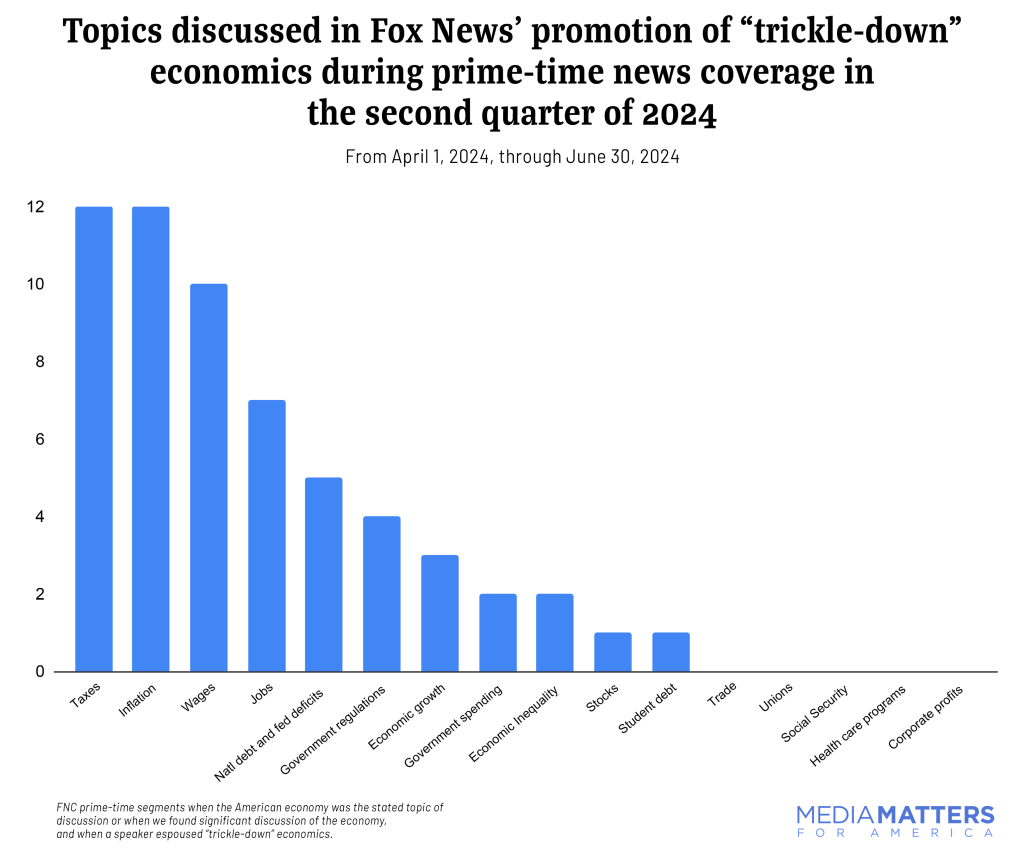
The leading trickle-down misinformer in Fox’s prime-time lineup was frequent guest, Fox Business host, and former Trump administration official Larry Kudlow, who peddled trickle-down theory while slamming the economic agenda of the Biden-Harris administration and puffing up the accomplishments (and future promises) of disgraced former President Donald Trump.
During the 4 appearances in which he peddled trickle-down economics during the second quarter — Kudlow was the only guest to appear more than once in a segment identified as promoting trickle-down economics — he fearmongered about how future tax increases on the wealthy could undermine job creation and slow down economic growth and warned that increasing government spending would imperil the economy.
Fox News and Fox Business personalities Brian Brenberg and David Asman, Fox News host and former Republican Gov. Mike Huckabee, celebrity chef Andrew Gruel, South Carolina Republican Sen. Tim Scott, and Republican Speaker of the House Mike Johnson were among the other prime-time Fox News guests who peddled trickle-down talking points during the second quarter, warning about looming tax increases, clamoring for renewed income tax cuts from a second Trump administration, or warning about the supposed threat posed by stricter government regulations or elevated minimum wages.
Media Matters identified multiple instances in which Fox's prime-time hosts themselves served as the vector peddling trickle down.
Fox prime-time star and informal Trump adviser Sean Hannity led the way with 4 instances of him promoting trickle-down talking points, followed by one instance apiece from hosts Jesse Watters and Greg Gutfeld.....
mma
Fox falsely linked Harris and Walz to socialism or communism over 460 times in just 50 days
Fox News and Fox Business figures have repeatedly and falsely linked VP Harris and Minnesota Gov. Walz to socialism and outright communism
Written by Harrison Ray
Research contributions from Tyler Monroe
Published 09/12/24 mma
- Fox News and Fox Business have falsely linked Vice President Kamala Harris, Gov. Tim Walz, their campaign, or their policies to socialism, communism, or Marxism at least 466 times since July 23, the day after Harris became the Democratic Party’s presumptive nominee.
The obvious smears have been repeatedly debunked.
The attacks extended to Walz when Harris selected him as her running mate, with Fox connecting him to China to claim he’s a communist candidate. And the attacks ramped up significantly following an economic policy speech from Harris, with Fox repeatedly mischaracterizing her proposals.
- Fox News accounted for 263 of the claims while Fox Business accounted for 203.
Fox networks' hosts and anchors most often pushed the claims of socialism, led by Maria Bartiromo (32 claims), Sean Hannity (31), Elizabeth MacDonald (20), Larry Kudlow (19), Jesse Watters (17), and Stuart Varney (15).
Mornings with Maria Bartiromo (63) had the most claims of any individual program over the period, with Hannity (49), Kudlow (44), and The Evening Edit (40) close behind. Many of Fox News' so-called “news” programs also repeated the ginned up attack, with at least 52 claims over the period.
Fox News and Fox Business parroted the narrative on 49 of the 50 days reviewed by Media Matters.
- Fox's smears of Harris and her campaign ran the gamut, from comparing her to Fidel Castro and the Sandinistas to calling her a “dangerous Marxist,” and even absurdly proclaiming that “these two economically frankly illiterate radicals with a penchant for literal communism are promising to drive our economy right off the cliff.”
Former President Donald Trump repeated Fox's fabricated narrative during the September 10 presidential debate, falsely insisting, “She's a Marxist. Everybody knows she's a Marxist.”
- ## Methodology....
===
===
mma
Trump sycophants are trying to bully the Federal Reserve away from expected interest rate cuts
Fox Business host Larry Kudlow has been leading the right-wing charge to attack the Federal Reserve this year
Written by Zachary Pleat
Published 08/28/24
Former president and current Republican presidential nominee Donald Trump and his media allies have already begun laying the groundwork to intimidate the Federal Reserve away from expected interest rate cuts this September. Trump and one of his long-time advisers and allies in particular, Fox Business host Larry Kudlow, have specifically demanded that the Fed take no action before the election in November, accusing it of purposefully boosting the economy in the short-term in order to benefit Democrats.
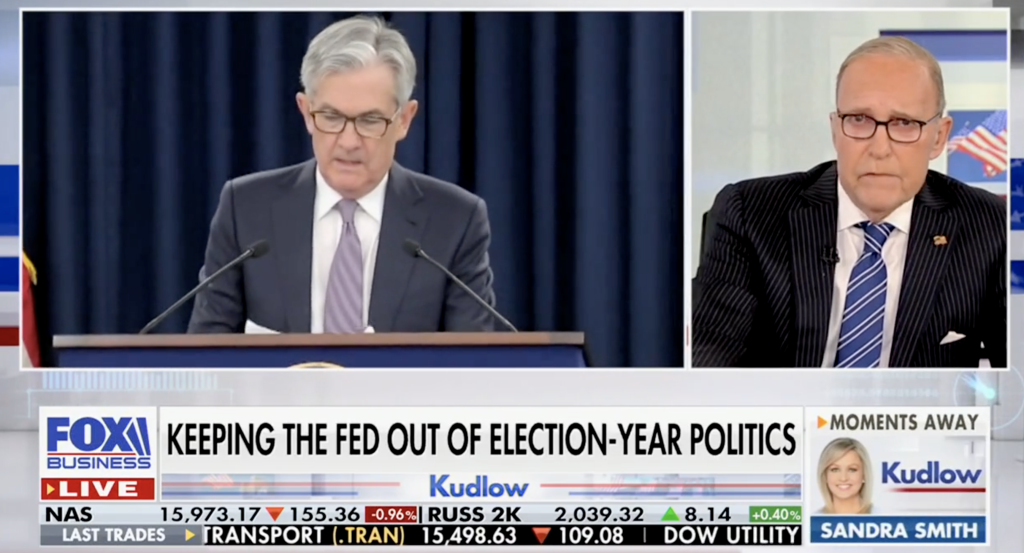
After employment statistics came in below expectations, including downward revisions for job creation in the previous year, and in light of increasingly stable inflation data, Federal Reserve Chairman Jerome Powell announced on August 23 that “the time has come” for interest rate cuts. Many economists had already been clamoring for the Fed to relieve pressure on the economy by lowering interest rates, with some citing an underwhelming July 2024 jobs report as evidence the Fed should have acted sooner.
The Fed is an independent agency and presidents traditionally do not interfere with its interest rate decisions. Trump broke with that tradition during his presidency as he appeared to sour on the independence of his own appointed chairman, Powell. As The Wall Street Journal reported, “beginning in the 1990s, presidents avoided publicly complaining about the Fed,” but as Trump’s “trade war unsettled markets, he steadily berated the Fed chair and called for lower rates.”
The Journal also reported that “Biden has mostly avoided discussing Fed policy, reverting to pre-Trump tradition.” (Biden re-appointed Powell to run the nonpartisan central bank for a second term in late 2021.) Additionally, Forbes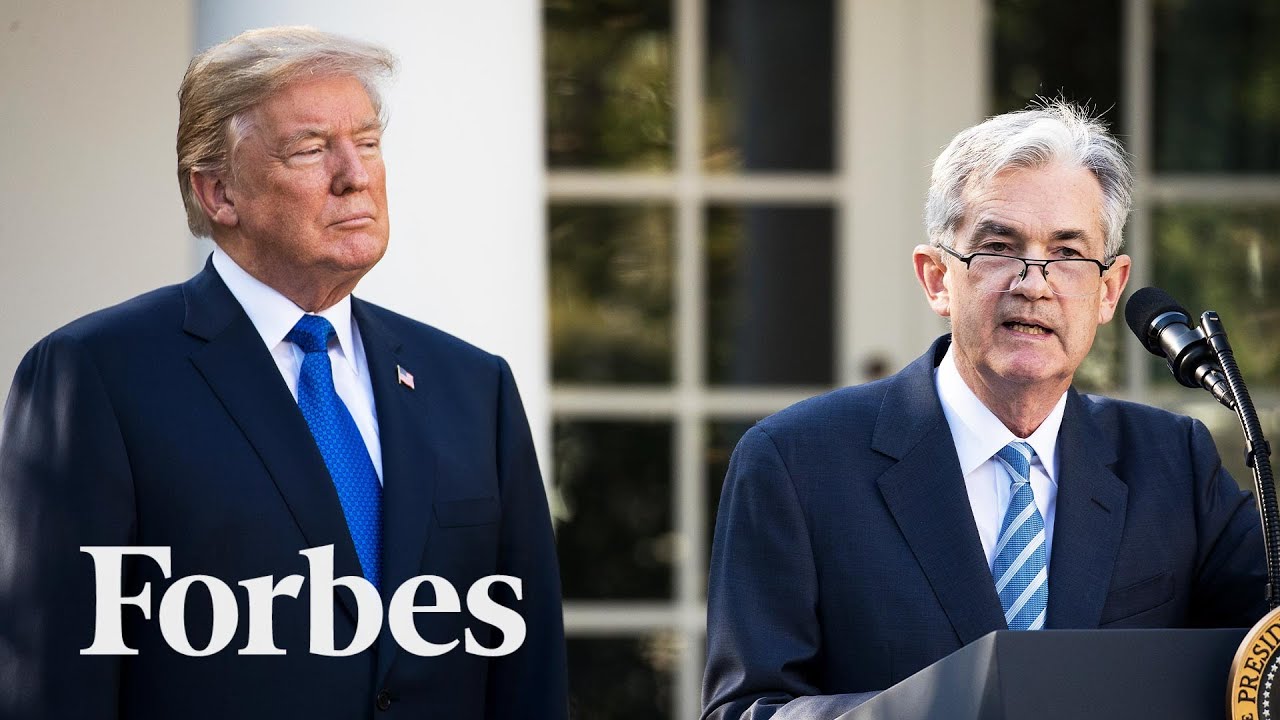 that according to former Trump Cabinet official Wilbur Ross’ upcoming memoir, in 2018, “Trump demanded his Commerce Secretary, Wilbur Ross, call the chair of the Federal Reserve … and demand that he cut interest rates.”
The Journal explained that it’s not unusual for the Fed to change interest rates during election years; it has previously done so in 2004, 2012, and 2020. Yet right-wing media began projecting politicization onto the upcoming rate cuts following recent economic reports, joining Fox Business host and former Trump economic adviser Larry Kudlow, who as far back as January began trying to bully the Fed out of cutting rates prior to the election.
Earlier this year, Trump and his allies preemptively attempted to bully the Federal Reserve away from cutting interest rates prior to the presidential election
- Trump and his allies warned the Fed against cutting interest rates prior to the election. The Wall Street Journal reported that in a June Bloomberg Businessweek interview, Trump said cutting interest rates before the election is something that Fed officials “know they shouldn’t be doing.” The story also quoted Michael Faulkender, chief economist at the Trump-aligned America First Policy Institute, who “said starting a rate-reduction campaign before the election would tarnish the Fed’s credibility.” The Wall Street Journal, [7/31/24]
- Fox Business host Larry Kudlow said the only reason for Powell to cut interest rates would be if the Fed “wants to completely politicize monetary policy, and slash interest rates in order to juice the economy and re-elect Biden.” Instead, Kudlow suggested that Powell “is an honorable man” who would not seek another term as Fed Chair regardless of the election result, and instead “establish his historical reputation” for getting inflation back to the target level. Fox Business, *Kudlow*, [1/17/24]
- Kudlow claimed that Biden’s prediction of lower interest rates meant, “The big guy wants a little juice from the Fed to get re-elected.” Kudlow then countered that “for all the cynical talk about how the Fed somehow must bend to the political whims of the president and his little minions, I actually think Powell is immune from that kind of thinking.” Fox Business, *Kudlow*, [3/15/24]
- Kudlow said the Fed would “just be creamed, reamed, destroyed,” and that Trump and Republicans would “correctly go after” it if there is an interest rate cut — unless it happened after the election. “Well, they could cut two times after the election, OK,” Kudlow said with a laugh. Fox News, *America Reports*, [4/5/24]
- Kudlow later imagined that Biden would be the one to attack the Fed for not cutting rates. During a panel discussion on his Fox Business show, Kudlow said: “Joe Biden forecasted rate cuts. He did it at least twice, maybe three times. He’s going to be very disappointed. Do you think he’ll attack the Fed?” Fox Business, *Kudlow*, [5/1/4]
- Kudlow declared, “The Fed can’t cut interest rates, because if they do, it’ll be so political.”Fox Business, The Big Money Show, [5/15/24]
- Right-wing legal activist Paul Ingrassia wrote that “the Federal Reserve needs to raise interest rates now” to prove that it’s independent. Ingrassia added: “But unfortunately we’re in the midst of a presidential election cycle, so they won’t raise rates because it’s not politically advantageous for Kamala Harris.” Twitter/X, [8/5/24]
Some conservatives fabricated a conspiracy theory that a routine revision of jobs reports was done specifically to push the Fed into cutting rates
- The Daily Wire’s Ben Shapiro pushed a conspiracy theory that the annual Bureau of Labor Statistics revision to jobs reports was deliberately timed “to jog the Federal Reserve to lower interest rates” in time for the election. Shapiro said: “You have to understand the game that's being played here. For the entirety of this year, the federal government has been radically overestimating the number of jobs created under the Biden administration so that he can go around bragging about jobs that he didn't create. OK, that revision is likely to be in the range of at least 600,000 jobs they say exist that do not exist in the Biden economy. Now why is that coming out right now?
- Because the goal is to jog the Federal Reserve to lower the interest rates and thus to blow more money into the economy, recapitulating inflation, and to do that off the basis of weak job growth. So that is the game. The game is: you hide the job failures until now. Then you let that news out of the bag just early enough that the Federal Reserve can lower the interest rate and then artificially boost spending in the economy.” (In fact, these revisions are scheduled at the same time every year as more accurate jobs data become available, and one previously showed a revision of -501,000 jobs in 2019 under Trump.) The Daily Wire, *The Ben Shapiro Show*, [8/21/24; Media Matters, 8/21/24]
- Shapiro also spread the conspiracy theory on X. On X, formerly known as Twitter, Shapiro wrote: “This is amazing for two reasons.1. They've been lying for a year about Biden job creation. 2. They're dumping this data just in time to justify a Federal Reserve interest rate decrease for the election.”Twitter/X, [8/21/24]
- Right-wing commentator Bill Mitchell pushed a similar conspiracy theory: “WE GOT PLAYED” on the BLS jobs report revision; “That was just cover to let the Feds cut interest rates before the election.” Twitter/X, [8/23/24]
Conservatives are increasingly accusing the Fed of cutting rates to help Democrats, or framing the cuts as political
- Fox host Sean Hannity: “Watch the Fed. Mark my words: September, they’re going to lower rates to help Kamala and Tim Walz.” Premiere Radio Networks, The Sean Hannity Show, [8/14/24]
- Shapiro: “They’re going to shove a Fed rate cut through as fast as humanly possible,” and “the idea that politics comes into their considerations not at all is ridiculous.” Shapiro added, “The notion of Federal Reserve independence is complete hogwash.” The Daily Wire, The Ben Shapiro Show, [8/15/24]
- Shapiro: “There is one sort of last hope for Joe Biden, and that is maybe Jerome Powell will save him” with interest rate cuts “just in time for the election, almost as if it’s on cue.” Shapiro continued: “It’s just so convenient. … We got to cut those interest rates just in time for the election and hopefully jog Joe Biden to victory. But don’t worry, it’s all apolitical.” The Daily Wire, The Ben Shapiro Show, [7/12/24]
- Right-wing X account End Wokeness posted: “If the Biden-Harris economy is so strong, why cut rates before the election? 🤔This announcement either means: 1. The economy is about to tank. 2. The federal reserve wants to artificially boost the economy before the election. 3. All of the above.” Twitter/X, [8/23/24]
- Conservative Substack author amuse: “ELECTION INTERFERENCE? Powell confirmed the Fed would be cutting rates between 25bps to 50bps in September depending on the August payroll report.” Twitter/X, [8/23/24]
- Gateway Pundit: “Fed Chair Announces Incoming Rate Cut… Just in Time to Boost Kamala Harris.” The Gateway Pundit, [8/23/24]
---
an 2 24
Larry Kudlow, who served as director of the National Economic Council (NEC) in then-President Donald Trump's administration, recently acknowledged that President Joe Biden is overseeing a strong economy.
In a Fox Business appearance on Thursday, Kudlow pointed to the news that the US economy grew by 3.3% in the 4th quarter of 2023 as evidence of the strength of the economy heading into an election year. That increase is much higher than the projected 2% growth forecasted by the Bureau of Economic Analysis. While that level of growth could be partially attributed to higher than average spending in a holiday season, the fact that expectations were shattered is a byproduct of other positive factors, like higher wages, lower costs and a decrease in the rate of inflation.
"Yes, I'm an honest broker, he got a good 3.3% for the fourth quarter, following a good 4.9% in the third quarter, OK?" Kudlow said. "If I were he, I would be bragging about it too. And inflation has come down. All's fair in love, war and politics. Brag when you can. I get it. I've been there."
While his term began with a rocky start given the mass layoffs and broken global supply chains as a result of the Covid-19 pandemic, Biden has presided over a massive turnaround after his first three years in office. As NEC director Lael Brainerd stated in December, the US unemployment rate has remained under 4% for the longest stretch in more than five decades, and wage growth is outpacing inflation, meaning more workers have more money in their pockets.
Costs are also coming down for many Americans. Bloomberg reported on Monday that median rents — typically the biggest monthly expense for millions across the country — have declined for eight consecutive months. A gallon of gas costs roughly 34 cents less today than it did at this time last year. And while food prices have gone up, the rate at which they've increased is far lower. Nerdwallet found that while groceries went up in price by more than 2% between December of 2022 and December of 2023, that pales in comparison to the 10% increase that happened during that same window between 2021 and 2022.
The stock market has also fared well under Biden's leadership, in spite of Trump's October 2020 prediction that markets would crash. In fact, the S&P 500 closed at an all time high of over 4,839 last week. The Dow Jones Industrial Average closed above 38,000 this week for the first time in history. Biden's economic performance has also been touted by his fellow Democrats in the House of Representatives, who will be sharing a ballot line with him this November. Rep. Brendan Boyle (D-Pennsylvania) pointed out that a side-by-side comparison of the Trump and Biden economies shows Biden's has been more prosperous.
"The 3.3 percent GDP increase in [the fourth quarter] of 2023 caps off a year of exceptional growth for our economy," Boyle stated. "With last year’s numbers, average annual GDP growth for the first three years of the Biden administration comes in at 3.4 percent, far outpacing the 2.6 percent during the first three years of the Trump administration."
READ MORE:'Longest stretch in 50 years': Unemployment historically low despite experts' predictions
Watch the video of Kudlow's comments below, or byclicking this link.
---
2 24
larry Kudlow, the Trump White House’s Director of the National Economic Council, on Thursday admitted on Fox News he was wrong about the Biden economy and all the predictions of an economic slowdown and impending recession that turned out to be false.
“Mea culpa,” said Kudlow, who has an extensive financial background including being the chief economist and senior managing director for Bear Sterns, the once powerful but now-defunct investment bank.
“I was wrong about the slowdown and the recession,” Kudlow continued. “So was the entire forecasting fraternity.”
“I don’t think you were wrong,” a Fox News on-air host responded.
“The Fed, everyone was wrong,” Kudlow insisted.
READ MORE: ‘You Bend the Knee to the Orange Jesus’: Democrat Blasts House Republicans in Fiery Takedown
For nearly two years many economists predicted a recession was imminent, and when it never came some continued the warnings.
But the United States never entered a recession under President Biden, and now economic experts have praised the U.S. economy as having performed the best post-COVID.
“The United States economy grew faster than any other large advanced economy last year — by a wide margin — and is on track to do so again in 2024,” Axios reported Wednesday. “America’s outperformance is rooted in its distinctive structural strengths, policy choices, and some luck. It reflects a fundamental resilience in the world’s largest economy that is easy to overlook amid the nation’s problems.”
“All countries were dealing with the same problems of post-pandemic inflation and high interest rates meant to combat it. But the U.S. managed to achieve solid growth in spite of those headwinds,” the report adds.
READ MORE: ‘Slave Trade’: House Republican Makes Wild Allegations Accusing Biden of ‘Traitorous’ Acts
Axios also notes that “White House economic adviser Lael Brainard, speaking to reporters last week, cited ‘strong policy actions that were designed to lead to a strong and broad-based recovery faster than we have seen previously in the U.S. — and faster than we saw in other countries.'”
Watch Kudlow’s remarks below or at this link.
---
Fox Business host Larry Kudlow claims climate change is a hoax | Media Matters for America
mma1123
argentine President-elect Javier Milei is becoming a right-wing media darling in the U.S. due to his austere proposed economic policies and conservative ideology. Right-wing media figures have reacted to Milei’s electoral success by praising him, comparing him to former President Donald Trump, and attacking mainstream media for their critical reporting.}:
- ## Argentina's new far-right president has aligned himself with U.S. right-wing politics
- Milei, a self-described “anarcho-capitalist libertarian,” has aggressively pushed conservative positions on issues such as abortion while also promising to gut government ministries relating to issues like education, diversity, and science. Milei also proposed holding a referendum aimed at overturning Argentina’s right to abortion. Rolling Stone, [11/20/23]
- One of Milei’s defining political positions is “dollarisation,” a form of economic shock treatment, to combat Argentina’s rising inflation and ongoing financial woes.Dollarisation involves getting rid of the Argentine peso and replacing it with the U.S. dollar. Mark Weisbrot, the co-director of the Center for Economic and Policy Research, has labeled this as a “crazed, economically suicidal approach” which could majorly backfire for Argentine people. The Guardian, [11/20/23]
- Milei’s mirroring of Trump’s right-wing populist messaging — down to “Make Argentina Great Again” hats and preemptive voter fraud conspiracy theories — has led to direct praise from the former president.After Milei’s victory, Trump personally congratulated him on Truth Social, posting, “The whole world was watching! I am very proud of you. You will turn your Country around and truly Make Argentina Great Again!" The Guardian, [11/17/23; Rolling Stone, 11/20/23]
- Milei has also been linked to infamous anti-tax lobbyist Grover Norquist. In 2021, Milei promised the Argentine Taxpayers Association, sister organization to Norquist’s Americans for Tax Reform, that he would “cut off [his] own arm” if he raised taxes. Norquist has also gotten many Republican politicians to make similar promises by getting them to sign his organization’s “Taxpayer Protection Pledge.” The Nation, [7/21/2011; Semafor, 11/21/23; ABC News, 11/26/12]
- Mainstream media have responded to Milei’s election by pointing out his similarities to Trump and the implications his victory could have in neighboring countries.The New York Times referred to his election as “Argentina’s Donald Trump moment.” The Washington Post, [11/19/23; The New York Times, 11/20/23]
- ## Right-wing media reacted to Milei’s victory by praising him, comparing him to Trump, spreading voter fraud conspiracy theories, and attacking mainstream media for their coverage of him
- Conspiracy theorist Alex Jones called Milei “an anti-globalist through and through” and claimed he was an Infowars listener. Jones also praised Milei as “a follower” of former Fox host Tucker Carlson and argued his election was evidence that “people are seeing through the globalist lies at every front.” Infowars, *The Alex Jones Show*, [11/20/23]
- Newsmax host Rob Schmitt celebrated Milei, praising him for “fighting an ideology that is destroying the world one country at a time.”Schmitt argued Milei was “fighting the same disease that our nation is fighting” and “isn’t afraid to eviscerate the cancerous tumor that is the socialist politician.” Newsmax, *Rob Schmitt Tonight,* [11/20/23]
- Turning Point USA founder Charlie Kirk claimed that Milei’s victory was a “stimulus of hope” for the chances of Trump winning the presidency in 2024. Kirk portrayed the election as evidence that “the Western world is starting to push back against forced globalism” supposedly orchestrated by “a smaller and smaller radical group of people.” Kirk argued, “If Javier Milei can win by 11 points … Donald Trump can win next November.” Salem Media Group, *The Charlie Kirk Show*, [11/20/23]
- Fox News contributor Sara Carter posted that she “love[s] Javier Milei.” Carter posted in response to a video of Milei ripping tags off a whiteboard with the names of various governmental departments, including the Ministry of Education and Ministry of Health. Twitter/X, [11/20/23]
- Right-wing YouTuber Steven Crowder referred to Milei as “the madman geopolitics deserves.” He also called on Milei to “make Argentina great again.” Twitter/X, [11/20/23]
- Fox Business host Charles Payne called Milei’s election “huge and super encouraging on several fronts.” Payne also alleged that “powerful global forces'' tried to prevent Milei’s victory from “happening.” Twitter/X, [11/20/23]
- Right-wing economist Art Laffer argued Milei was “not a kook” or “far-right winger” and bet he would make Argentina “the outstanding, pro-growth economy of Central and South America” as president. Fox host Larry Kudlow concurred, adding that “the socialism they’ve been flirting with almost all over the continent hasn’t worked. … This guy might turn that around.” Fox Business, *Kudlow*, [11/20/23]
- Right-wing X account End Wokeness complained that “Argentina hand-counted all of their ballots in a few hours, but the big blue areas in our swing states take several days with machines?” Twitter/X, [11/20/23]
- Neo-Nazi collaborator Jack Posobiec claimed that the reason Argentina knew “the election result so fast” was because it “banned electronic voting machines.” Posobiec failed to mention that only Buenos Aires City residents were required to use paper ballots, and that was due to “significant delays” during the primary elections because of technical issues with the machines. Twitter/X, [11/20/23; Buenos Aires Herald, 10/21/23]
- Right-wing political operative Roger Stone praised Argentina for voting “with 100% paper ballots unlike, say, Brazil.” Twitter/X, [11/19/23]
- The Daily Wire’s Ben Shapiro bemoaned the “garbage press” for their coverage of Milei, calling them “international Leftist trash.” Shapiro also touted Milei’s economic policies, claiming Milei is planning to “slash spending and restore fiscal responsibility.” Twitter/X, [11/20/23]
- Conservative blog Red State also decried the press “freak-out” over Milei, claiming mainstream media “love it when far-left socialists take power."The “fairly Libertarian” Milei, the author claimed, could not be compared to Trump, and “the press attempt to tie the two together” was therefore “transparent.” Red State, [11/19/23]
- Stone also posted that it was “really enjoyable watching the elitist pukes at the Washington Post and the New York Times melt down over the election of pro-Freedom Anti-Globalist Javier Milei.” Twitter/X, [11/20/23]
---
mma 3 23
the right-wing media echo chamber pushed a completely fictional talking point that Silicon Valley Bank had supposedly donated $73 million to Black Lives Matter, based on distortions from a far-right think tank. And in Fox News’ rush to amplify the falsehoods, which fit the network’s preposterous political narrative that SVB was a “woke bank,” purported “news” personnel behaved no differently from the network’s opinion hosts.
As a prime example of Fox’s “news” personalities pushing blatantly partisan falsehoods, on the morning of March 15, Fox News White House correspondent Peter Doocy claimed: “Roughly $73 million went to Black Lives Matter-related causes” from the bank. [vid]
and later that night, Fox host Sean Hannity said that Silicon Valley Bank “diverted a massive amount of money to left-wing causes. Now, get this, this is what we have discovered, that includes a whopping $73 million to BLM-related groups."[vid]
this is the same network that, as recently unearthed text messages and emails have shown, will actively reprimand and penalize its alleged “straight news” reporters for debunking misinformation pushed by its opinion hosts and their guests. As such, nobody in the network would have any incentive to even try to unearth the facts, because Fox News is not in any sense a real news organization.
Actual SVB donations to Black Lives Matter: $0.00
The charge itself that SVB contributed over $70 million to Black Lives Matter or closely aligned organizations is based on a supposed “BLM-funding database” maintained by the Claremont Institute, a right-wing and openly anti-democracy organization that is also closely tied to disgraced former law professor John Eastman, who was closely involved in former President Donald Trump’s efforts to overturn the 2020 election results.
The Associated Press confirmed that the database does not show any spending to Black Lives Matter, and obtained a comment in which Claremont explained it was including “reparative initiatives,” which it called “race-based, discriminatory hiring programs; race-based, sub-prime lending; partisan voter initiatives; and DEI efforts.” The AP also obtained a comment from the Black Lives Matter Global Network Foundation, which confirmed it did not receive $70 million from the bank, and added: “Even if we did, the idea that this type of contribution would be controversial is rooted in a pathology that Black organizations don’t deserve to be funded.”
In addition, professor Rodney Ramcharan at the University of Southern California’s Marshall School of Business explained to the AP what actual evidence of bank failure due to “woke” business practices might look like, if such a thing existed. “The bank would have suffered loan losses—writing down bad loans made to ‘woke’ firms,” he explained. “So this is not a matter of opinion, but actual data. Instead, there are no unusual loan losses or loan loss provisioning.” (Claremont had cited “sub-prime lending” as a component of such alleged “woke” practices.)
The database labels any donations that support Black people as “BLM”
Writing for the newsletter Popular Information, Judd Legum, Rebecca Crosby, and Tesnim Zekeria reported that the Claremont Institute’s own database shows a total of $0 in donations to any officially branded Black Lives Matter organization. Instead, the organization’s database also includes spending that it describes as being for “organizations and initiatives that advance one or more aspects of BLM’s agenda.”
Under this amorphous criteria, Popular Information found that Claremont had included a pledge that SVB made in 2021 to spend $50 million over the course of five years for the company’s internal initiative to connect women, Black people and Latinos with startup funding and leadership connections in venture capital. Nearly all the rest came from a $20 million pledge to “support additional COVID-19 relief” and establish a “full-ride, needs-based University Scholarship program to students at Arizona State University, Florida A&M University, Tulane University, and Xavier University.” Both Florida A&M and Xavier University of Louisiana are prominent historically black colleges and universities. (It’s unclear why Claremont lumped in funding for Arizona State and Tulane.)
Talking Points Memo editor-in-chief Josh Marshall also examined the rest of the database on supposed BLM-related corporate spending, and found that Claremont’s appraisal of corporate spending throughout the business world essentially boiled down to “it seems adjacent to Black people, so that’s ‘BLM.’” These included any corporate donations to such longstanding organizations as the United Negro College Fund and the NAACP, or minority-focused business groups such as the Executive Leadership Council or the Forum to Advance Minorities in Engineering, the latter of which was founded in 1976 by DuPont. (Also tagged as “BLM” spending in the Claremont’s database were corporate grants to the American Heart Association and U.S. Vaccine Adoption Grants.)
Keep in mind, Popular Information had also pointed out that the database defines the BLM agenda as allegedly being to “undermine capitalism, the nation state, and Western civilization.” By extension, Claremont is essentially accusing any corporate spending on Black education, health outcomes, or business development to be part of a plot to destroy Western civilization. This is the fabulist message that Fox’s reporters and the rest of the right-wing media ecosystem were so eager to spread.
Fox News drove the right-wing echo chamber’s amplification of false SVB claims
Fox’s alarmist coverage of the supposed link between SVB’s corporate giving and the BLM movement clearly spanned both its purported “straight news” side and opinion hosts, with the two camps voicing the exact same line over and over on Fox News, Fox Business, and the network’s digital properties.
- Fox host Jesse Watters asserted that Silicon Valley Bank (SVB) “donated $74 million to Black Lives Matter." Fox News, :{Jesse Watters Primetime:(style="box-sizing:border-box"):}:, [3/14/23]
- Fox host Tucker Carlson: “Silicon Valley Bank, brace yourself, spent more than $73 million on donations to BLM and related organizations.” Fox News, :{Tucker Carlson Tonight:(style="box-sizing:border-box"):}:, [3/14/23]
- Fox & Friends co-host Ainsley Earhardt: SVB donated “more than $73 million to Black Lives Matter.” Fox News, :{Fox & Friends:(style="box-sizing:border-box"):}:, [3/15/23]
- Fox Business: “Silicon Valley Bank donated millions to Black Lives Matter-related groups, social justice causes, records show.” FoxBusiness.com, [3/14/23]
- Fox White House correspondent Peter Doocy also pushed this, which Fox anchor Dana Perino failed to contradict. Fox News, :{America’s Newsroom:(style="box-sizing:border-box"):}:, [3/15/23]
- Fox host Sean Hannity: “Now, SVB was California's woke trendy bank. So, naturally, instead of safeguarding every penny deposited, SVB diverted a massive amount of money to left-wing causes. Now, get this, this is what we have discovered: That includes a whopping $73 million to BLM-related groups, five billion dollars in commitments to climate change.” Fox News, :{Hannity:(style="box-sizing:border-box"):}:, [3/15/23]
- Fox Business host Maria Bartiromo: “Silicon Valley Bank donated more than $73 million to groups tied to Black Lives Matter.” Fox Business, :{Mornings with Maria Bartiromo:(style="box-sizing:border-box"):}:, [3/15/23]
- Fox Business host Larry Kudlow: “Apparently some more bad, there is such a slew of crazy left-wing stuff surrounding this Silicon Valley Bank. I mean this is some weird bank. First of all, they gave $73 million to the Marxist BLM, Black Lives Matter movement at the height of COVID and the race riots in 2020.” Fox Business, :{Kudlow:(style="box-sizing:border-box"):}:, [3/15/23]
- Fox Business guest Vivek Ramaswamy: “We’re now seeing reports about the amount of money they committed to BLM and related movements.” Fox Business, :{The Bottom Line:(style="box-sizing:border-box"):}:, [3/14/23]
- Fox Business guest Stephen L. Miller: “We had to bail this bank out. They’ve given millions of dollars in BLM initiatives and DEI initiatives.” Fox Business, :{Kennedy:(style="box-sizing:border-box"):}:, [3/15/23]
- Fox Business guest Mark Tepper: SVB “had pledged $74 million to left-leaning organizations and charities, including BLM.” Fox Business, :{Mornings with Maria Bartiromo:(style="box-sizing:border-box"):}:, [3/16/23]
- Fox Business host Stuart Varney expressed shock at the number, while correspondent Lauren Simonetti said “the question is were they distracted. Were executives too concerned about diversity, gender, climate that they missed the financial problem.” Fox Business, :{Varney & Co.:(style="box-sizing:border-box"):}:, [3/16/23]
- Fox Business host Larry Kudlow: “This bank in Silicon Valley was a rogue bank. They did insane things. The board was full of Hillary Clinton donors, they had one person there with banking experience, they gave $75 million to Black Lives Matter two years ago, $5 billion apparently to climate causes and diversity causes, that’s just nonsense. … This is a rogue bank.” Fox News, :{America Reports:(style="box-sizing:border-box"):}:, [3/16/23]
- Fox Business host Larry Kudlow: “It’s a rogue bank, there is no question about that. The mistakes they made were fundamental mistakes also, you know. The duration was wrong. The asset-liability matchbook was all wrong. But you don't give $75 million to Black Lives Matter at the height of racial tensions in the middle of the pandemic. You don't commit $5 billion to all kinds of climate change, diversity, equity, and things of that sort, you don't do that.” Fox Business, :{The Bottom Line:(style="box-sizing:border-box"):}:, [3/16/23]
Fox was not alone in spreading this falsehood; many right-wing media outlets pushed the same lies. A New York Post headline read: “SVB donated $73M to Black Lives Matter movement, social justice causes.” An article from The Federalist was headlined: “Silicon Valley Bank Pledged Nearly $74 Million To Black Lives Matter Causes.” The Washington Times, citing The Federalist, wrote: “SVB donated more than $73 million to the Black Lives Matter movement and other social justice causes.” A Washington Examiner headline read: “SVB collapse: Bank donated over $70 million to Black Lives Matter groups before closure.” Gateway Pundit declared in its headline: “Woke Silicon Valley Bank Gave Over $73 Million to Black Lives Matter Movement.” A Daily Caller headline stated: “Silicon Valley Bank Committed Over $73 Million To BLM And Social Justice Causes Before It Collapsed.” And it went on and on and on.
In an amazing turn of events, Breitbart actually issued a correction, noting that “the Claremont Institute’s definition of ‘Black Lives Matter’ included a far wider range of organizations,” and giving credit that “left-wing writer Judd Legum appropriately flagged these issues.”
So as of now, Breitbart has exhibited more journalistic responsibility than the entire roster of Fox News, including one of the network’s White House correspondents.