dfrl digital forensics lab solutions
evil b/c pervert class action
https://www.rawstory.com/jim-jordan-2661556363/
no lnx raw 6 23
Jim Jordan leads GOP push to cripple 'fight against disinformation': report
Matthew Chapman
June 19, 2023,
Republican lawmakers are joining forces with far-right activists to attack universities and even private businesses that are investigating the spread of disinformation online — claiming that this amounts to an effort to silence conservatives on the internet, according to a report.
The New York Times posted a details of the actions they are taking on Monday.
"The effort has encumbered its targets with expansive requests for information and, in some cases, subpoenas — demanding notes, emails and other information related to social media companies and the government dating back to 2015. Complying has consumed time and resources and already affected the groups’ ability to do research and raise money, according to several people involved," reported Steven Lee Myers and Sheera Frenkel.
"They and others warned that the campaign undermined the fight against disinformation in American society when the problem is, by most accounts, on the rise — and when another presidential election is around the corner. Many of those behind the Republican effort had also joined former President Donald J. Trump in falsely challenging the outcome of the 2020 presidential election."
The House Judiciary Committee, under Rep. Jim Jordan (R-OH), has been leading the charge. Meanwhile, a group founded by far-right former Trump adviser Stephen Miller has filed a class-action lawsuit in federal court going after the same entities.
"Targets include Stanford, Clemson and New York Universities and the University of Washington; the Atlantic Council, the German Marshall Fund and the National Conference on Citizenship, all nonpartisan, nongovernmental organizations in Washington; the Wikimedia Foundation in San Francisco; and Graphika, a company that researches disinformation online," said the report.
"In a related line of inquiry, the committee has also issued a subpoena to the World Federation of Advertisers, a trade association, and the Global Alliance for Responsible Media it created. The committee’s Republican leaders have accused the groups of violating antitrust laws by conspiring to cut off advertising revenue for content researchers and tech companies found to be harmful."
The new push is part of a broader, years-long conspiracy theory among right-wing activists that the government and "big tech" companies are colluding to silence conservative speech on the internet. There is no evidence of any such conspiracy; in fact, research shows conservative content actually spreads more easily on Facebook and Twitter.
LNX
There is no evidence of any such conspiracy; in fact, research shows conservative content actually spreads more easily on Facebook and Twitter.
https://www.propublica.org/article/jim-jordan-disinformation-subpoena-universities
3 23
house Republicans have sent letters to at least three universities and a think tank requesting a broad range of documents related to what it says are the institutions' contributions to the Biden administration’s “censorship regime.”
The letters are the latest effort by a House subcommittee set up in January to investigate how the federal government, working with social media companies, has allegedly been “weaponized” to silence conservative and right-wing voices. So far, the committee’s investigations have amplified a variety of dubious, outright false and highly misleading Republican grievances with law enforcement, many of them espoused by former President Donald Trump. Committee members have cited supposed abuses that include the FBI’s search of Mar-a-Lago, its investigations of Jan. 6 rioters and the Biden administration’s purported use of executive powers to shut down conservative viewpoints on social media.
now, universities and their researchers are coming under the spotlight of the committee, which the Republicans have labeled the House Judiciary Select Subcommittee on the Weaponization of the Federal Government. The letters, signed by Rep. Jim Jordan, R-Ohio, who is chair of both the House Judiciary Committee and the subcommittee, were sent in early March.
They cover an investigation into how “certain third parties, including organizations like yours, may have played a role in this censorship regime by advising on so-called ‘misinformation,’” according to a copy of one of the letters obtained by ProPublica.
The committee requested documents and information dating back to January 2015 between any “employee, contractor, or agent of your organization” and the federal government or social media organizations pertaining to the moderation of social media content. ProPublica confirmed the requests went to Stanford University, the University of Washington, Clemson University and the German Marshall Fund of the United States.
The letters have prompted a wave of alarm among those in the field that the congressional inquiry itself, no matter what it finds, will lead universities to pull back on this research just as the 2024 election gets underway. “Recent efforts definitely have a chilling effect on the community of experts across academia, civil society and government built up to understand broader online harms like harassment, foreign influence and — yes — disinformation,” Graham Brookie, who leads studies in this area at the Atlantic Council, told ProPublica.
“The ‘weaponization’ committee is being weaponized against us,” another researcher told ProPublica. Like half a dozen others interviewed for this story, this person asked not to be identified because of the ongoing congressional probe.
Democrats have called the committee a modern-day House Un-American Activities Committee, akin to the congressional committee that pursued alleged communists during the McCarthy era.
Since Rep. Jordan took over the gavel of the judiciary committee in January, he has issued more than 80 subpoenas and requests for documents. Recipients have included the CEOs of social media companies, intelligence officials who signed on to a statement about Hunter Biden’s laptop during the 2020 campaign and members of the National School Boards Association who asked the Justice Department to investigate threats of violence against school board officials. Jordan himself refused a subpoena to testify before the Democratic-led House Select Committee on the January 6 Attack, prompting that committee to refer the matter to the House Ethics Committee.
Jordan’s missives were sent a day after a committee hearing on the “Twitter files,” leaked internal communications from the company that purported to show how right-wing accounts were sidelined and silenced. In written testimony, a panelist accused a broad swath of organizations and individuals of being members of the “Censorship Industrial Complex,” including, he implied, the FBI, Department of Homeland Security, CIA, Department of Defense and universities. The witness wrote disinformation researchers, working with the government, are “creating blacklists of disfavored people and then pressuring, cajoling, and demanding that social media platforms censor, deamplify, and even ban the people on these blacklists.”
A New York Universitystudyconcluded in 2021 that social media had not silenced those on the right. “The claim of anti-conservative animus” by social media companies, the study said, “is itself a form of disinformation: a falsehood with no reliable evidence to support it."
A spokesperson for Rep. Jordan did not respond to requests for comment.
Since the 2016 elections, Stanford, UW, Clemson and others have engaged in research, sometimes in partnership with social media platforms, government officials and each other, into ways that disinformation can pose tZreats to democracy and how such efforts can be meaningfully countered. The role of lies and disinformation leading to the Jan. 6 attack on the Capitol gave increased prominence to their work.
As ProPublica has previously reported, sustained accusations by congressional Republicans and right-wing influencers that the Biden administration is stifling dissent have caused the administration to back away from its efforts countering disinformation, including canceling research contracts and sending messages inside the administration that disinformation work is too hot to handle.
Those moves followed a bungled rollout of a clumsily named “Disinformation Governance Board” to coordinate efforts to counter what the administration had called “dangerous conspiracy theories that can provide a gateway to terrorist violence.” Following criticism, the administration disbanded the board and accepted the resignation of its executive director, Nina Jankowicz.
Jordan has subpoenaed Jankowicz, too. She is scheduled to testify April 10 and said she will happily testify under oath.
“This sort of inquiry isn’t something that belongs in the United States Congress,” said Jankowicz. “But given that this method of bullying has caused other institutions to fold to Republican pressure in the past, I fear we may see the blunt force of congressional committees continue to be used in ways that are in direct opposition to the safety, security and free expression of the American people."
**deSantis Privately Called for Google to Be “Broken Up”**
Stanford did not answer a question about whether it stood by its research or make its researchers, the Stanford Internet Observatory’s Alex Stamos or Renee DiResta, available for comment. The university referred ProPublica to an online fact sheet addressing “inaccurate and misleading claims” made in the congressional testimony about Stanford’s “projects to analyze rumors and narratives on social media relating to U.S. elections and the coronavirus.” The German Marshall fund said it was working to address the request and Clemson University’s media relations department did not respond to requests for comment.
The University of Washington’s Center for an Informed Public issued a statement that said “We’re incredibly proud of our work,” adding that “some of the projects CIP researchers have contributed to have become the subject of false claims and criticism that mischaracterizes our work, a tactic that peer researchers in this space are also experiencing.” The statement did not specifically address the House requests.
A university spokesperson, Victor Balta, said in an email, “The UW stands behind this important research aiming to resist strategic misinformation and strengthen our discourse. We have received a request for documents and information, and a response is in progress.”
https://www.alternet.org/2021/10/oath-keepers/
pro pub
North Carolina state representative Mike Clampittswore an oath to uphold the Constitution after his election in 2016 and again in 2020. But there's another pledge that Clampitt said he's upholding: to the Oath Keepers, a right-wing militant organization.
Dozens of Oath Keepers have been arrested in connection to the Jan. 6 riot at the U.S. Capitol, some of them looking like a paramilitary group, wearing camo helmets and flak vests. But a list of more than 35,000 members of the Oath Keepers — obtained by an anonymous hacker and shared with ProPublica by the whistleblower group Distributed Denial of Secrets — underscores how the organization is evolving into a force within the Republican Party.
ProPublica identified Clampitt and 47 more state and local government officials on the list, all Republicans: 10 sitting state lawmakers; two former state representatives; one current state assembly candidate; a state legislative aide; a city council assistant; county commissioners in Indiana, Arizona and North Carolina; two town aldermen; sheriffsor constables in Montana, Texas and Kentucky; state investigators in Texas and Louisiana; and a New Jersey town's public works director.
ProPublica's analysis also found more than 400 people who signed up for membership or newsletters using government, military or political campaign email addresses, including candidates for Congress and sheriff, a retired assistant school superintendent in Alabama, and an award-winning elementary school teacher in California.
Three of the state lawmakers on the list had already been publicly identified with the Oath Keepers. Other outlets have also scoured the list, finding police officers and military veterans.
People with law enforcement and military backgrounds — like Clampitt, a retired fire captain in Charlotte, North Carolina — have been the focus of the Oath Keepers' recruiting efforts since the group started in 2009. According to researchers who monitor the group's activities, Oath Keepers pledge to resist if the federal government imposes martial law, invades a state or takes people's guns, ideas that show up in a dark swirl of right-wing conspiracy theories.The group is loosely organized and its leaders do not centrally issue commands. The organization's roster has ballooned in recent years, from less than 10,000 members at the start of 2011 to more than 35,000 by 2020, membership records show.
The hacked list marks participants as annual ($50) or lifetime ($1,000) members, so not everyone on the list is currently active, though some said they viewed it as a lifelong commitment even if they only paid for one year. Many members said they had little contact with the group after sending in their dues but still supported the cause. Others drifted away and disavowed the group, even before Jan. 6.
The list also includes at least three people who were arrested in connection with the Jan. 6 Capitol riot and who federal prosecutors did not identify as Oath Keepers in charging documents: Andrew Alan Hernandez of Riverside, California; Dawn Frankowski of Naperville, Illinois; and Sean David Watson of Alpine, Texas. They pleaded not guilty. These defendants, their attorneys and family members didn't respond to requests for comment. The Justice Department also declined to comment.
According to experts who monitor violent extremism, the Oath Keepers' broadening membership provides the group with two crucial resources: money and, particularly when government officials get involved, legitimacy.
Clampitt said he went to a few Oath Keepers meetings when he joined back in 2014, but the way he participates now is by being a state legislator. He has co-sponsored a bill to allow elected officials to carry concealed guns in courthouses, schools and government buildings, and he supported legislation stiffening penalties for violent demonstrations in response to last year's protests in Raleigh over George Floyd's murder. Clampitt said he opposes violence but stood by his Oath Keepers affiliation, despite the dozens of members charged in the Capitol riot.
“Five or six years ago, politicians wouldn't be caught dead hanging out with Oath Keepers, you'd have to go pretty fringe," said Jared Holt, who monitors the group for the Atlantic Council's Digital Forensic Research Lab. “When groups like that become emboldened, it makes them significantly more dangerous."
The State Lawmakers
Then-state Delegate Don Dwyer from Maryland was the only elected official at the Oath Keepers' first rally, back in April 2009. Dwyer was, by his own account, a pariah in Annapolis, but he was building a national profile as a conservative firebrand.He claimed to take direction from his own interpretation of the U.S. Constitution and a personal library of 230 books about U.S. history pre-1900.
The Oath Keepers' founder, a former Army paratrooper and Yale Law School graduate named Stewart Rhodes, invited Dwyer to speak at the group's kickoff rally — they called it a “muster" — in Lexington, Massachusetts, the site of the “shot heard round the world" that started the Revolutionary War in 1775.....
https://www.alternet.org/2021/01/insurrection
ME
The disturbing violence that ensued on Capitol Hill on Wednesday, Jan. 6 was a pinnacle of far-right rhetoric and several weeks of premeditated online planning clearly publicized on right-wing media websites, according to a new report published by NPR.
Jared Holt, a visiting research fellow at the Atlantic Council's Digital Forensic Research Lab (DFRLab) in Washington, D.C., offered details about his own findings after investigating right-wing extremist activity online. Since President Donald Trump lost the presidential election,Holt has noted an uptick on various sites including "Parler, Gab, TheDonald, and MeWe."
According to Holt, those sites have been inundated with "conspiracy theories, disinformation and outright lies about the results of the election." He also noted that many of the lies circulated on those sites "often came from the top arbiters of power in the Republican Party, notably President Donald Trump himself."
Holt also noted that the vast majority of the posts published by TheDonald ahead of the Electoral College certification highlighted "calls for violence."
More than 80% of the top posts on TheDonald on Wednesday about the Electoral College certification featured calls for violence in the top five responses, according to research from Advance Democracy, Inc., an independent, non-partisan organization.
On social media platforms, including Twitter and TikTok there were other posts inciting violence on Jan. 6 several days before the event took place. The publication reports "ADI found more than 1,480 posts from QAnon-related accounts about Jan. 6 that contained terms of violence since Jan. 1."
A substantial number of TikTok videos inciting violence had also gone viral with "hundreds of thousands of views." While it is no secret that President Donald Trump's post-election rhetoric over the last two months contributed to his base's hostile response, his promotion of the "Save America" rally and his remarks during the event subsequently served as gasoline being poured on a blazing dumpster fire.
"Then it really, really went nuts," Holt says. After Trump promoteda Jan. 6 protest in D.C., "a lot of his extremist supporters interpreted this as a call to action for them."
While Holt claims he was "closely monitoring" the dialogue and discussions taking place on right-wing platforms, he admits he was taken aback by the rapid escalation in violence that erupted on Capitol Hill.
"I was surprised," Holt admitted. "One of the challenges of doing the line of work that I do is these are extremist communities and the rhetoric is extreme just all the time. It got really, really intense running up to the protest, but oftentimes the ratio of extreme rhetoric to extreme action — there is a little bit of difference there."
https://www.drillednews.com/post/why-is-news-coverage-leaving-out-the-fossil-fuel-funding-of-the-anti-greta
[pix]
Journalists are creating a false equivalence between environmental activist Greta Thunberg and a 19-year-old German Youtuber named Naomi Seibt, without including information about the fossil fuel ties of the group funding her.
Seibt _{recently joined}_ the Heartland Institute, a think tank with documented fossil fuel industry funding, and is scheduled to speak at the annual Conservative Political Action Conference in Washington, D.C., this week.
The coverage of Seibt, which has appeared in outlets including The Washington Post and The Independent, has focused on her “skepticism” while failing to note her fossil fuel ties, which are not limited to the funding connection. Several of her talking points are demonstrably false, decades-old talking points cooked up by the fossil fuel industry itself.
When mainstream media outlets generally considered to be credible leave out such details, subsequent pieces in smaller outlets tend to follow their framing, which can allow disinformation to_{ propagate more quickly}_.
The Washington Post, which was the first American media outlet to cover Seibt, described her as “like Greta...blond, eloquent and European.” Thunberg is a brunette, but the more important difference between her and Seibt is that she cites scientific studies, while many of Seibt’s points on climate come from industry, not science.
The Post's story stated that the Heartland Institute is “funded largely by anonymous donors” without mentioning any of the known donors, some of which are fossil fuel companies or trade groups that represent the industry.
When the Post story came out, Seibt had about 50,000 YouTube followers, a relatively small audience for the platform. In the days since, she has _{gained more than 10,000 more.}_
During a recentinvestigation by German outlets CORRECTIV and Frontal21, Heartland director James Taylor told undercover journalists that much of the organization's money is _{funneled through the dark money}_ group Donors Trust, which has _{ties to Charles Koch}_.
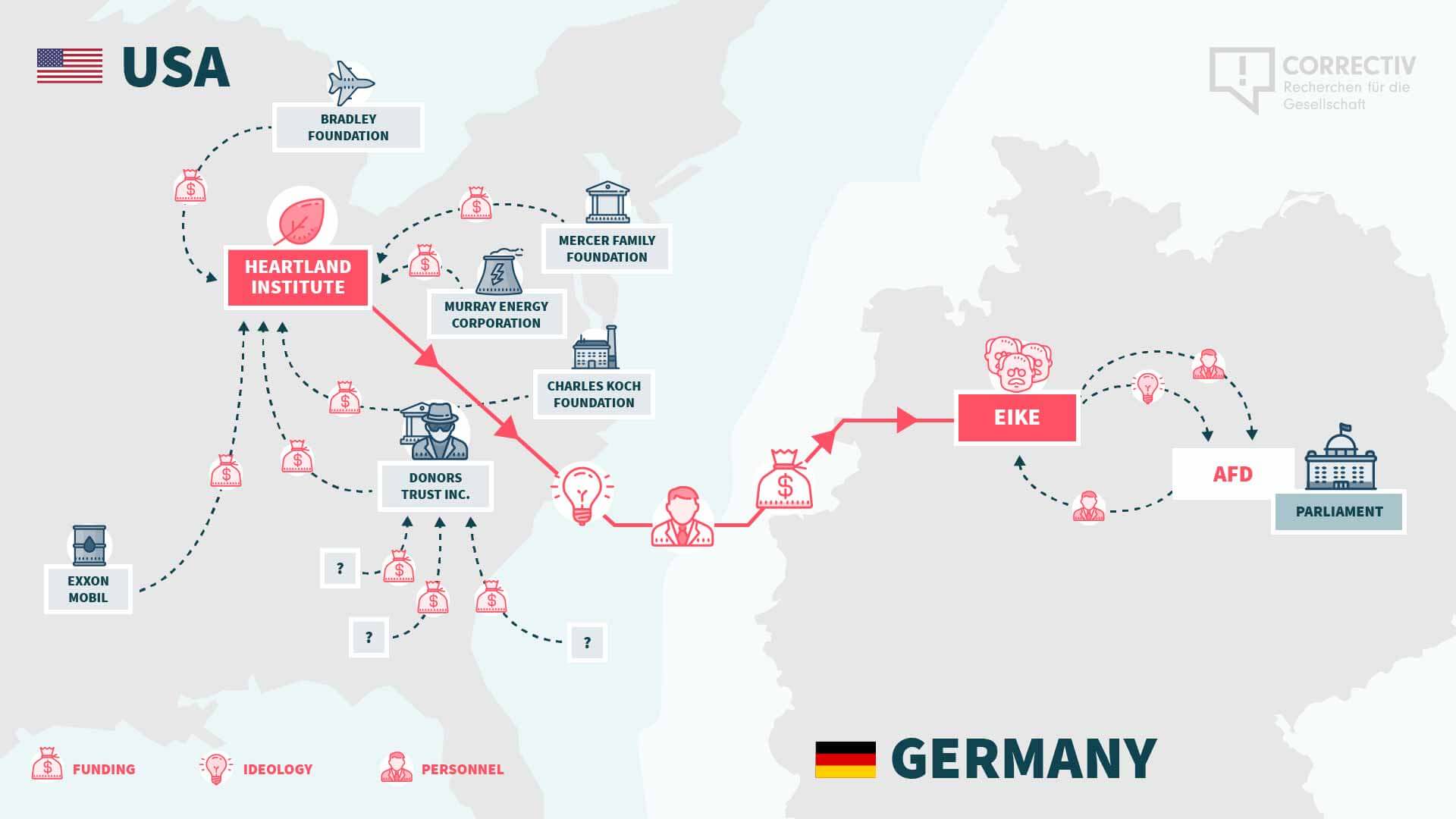
“Donors Trust is now directing between two-thirds and three-quarters of its budget to Heartland to support its climate-skeptical positions," Taylor told the undercover reporters.
The American Fuel and Petrochemical Manufacturers, an industry trade group whose members include ExxonMobil, Chevron and BP, also _{gave $75,000}_ to the Heartland Institute in 2017.
The Post story also quoted Graham Brookie, who directs the Digital Forensic Research Lab, an arm of the nonprofit Atlantic Council. Brookie said the ideology Seibt presents “is not outright disinformation," but that it does "bear resemblance to a model we use called the 4d’s — dismiss the message, distort the facts, distract the audience, and express dismay at the whole thing.”
The Post's story did not mention that the Atlantic Council _{ is funded by}_ ExxonMobil, ConocoPhillips, the Abu Dhabi National Oil Company, Chevron, Shell, and BP.
In response to a request for comment, The Washington Post’s Molly Gannon said only, “Our story speaks for itself.”
Other news outlets seem to have copied the omission. _{The Guardian}_, _{The Independent}_, _{France24}_, _{the Daily Mail}_, _{Mediaite}_, _{Mic}_, and _{MassLive}_ all published follow-on stories that did not mention the Heartland Institute’s financial backing from the fossil fuel industry.
The Heartland Institute seems to be trying to look like it has the youth on its side. So it has found a Gen Z surrogate who can parrot decades-old fossil fuel talking points, and earned major press coverage that frames her as a figure who compares to Thunberg, while completely leaving out the group's obvious, and documented, oil and gas industry connections.
2. Think Tank Partnerships Establish Facebook as Tool of US ...
https://www.projectcensored.org › 2-think-tank-partnerships-establish-face...
1.
Facebook Partners with US Government Surrogates to Fight ...
https://www.projectcensored.org › Validated Independent News
1.
Walter Lippmann in Wonderland: Project Censored's Top 10 ...
https://www.northcoastjournal.com › humboldt › Content
1.
#2 Most Censored Story of 2019: Think... - Project Censored ...
https://www.facebook.com › ProjectCensored › photos › 2-most-censored-...
1.
https://www.motherjones.com/politics/2018/05/facebook-is-enlisting-these-disinformation-detection-pros-to-fight-fake-news/
vicens
Facebook has taken another step to reassure users and regulators in the wake of its central roles in Russia’s 2016 election disinformation campaign and the Cambridge Analytica data privacy scandal. On Thursday, the social media behemoth announced a partnership with the Atlantic Council’s Digital Forensic Research Lab (DFRLab) to help provide “real-time insights…on emerging threats and disinformation campaigns from around the world.”
“This will help increase the number of ‘eyes and ears’ we have working to spot potential abuse on our service,” Katie Harbath, Facebook’s global politics and government outreach director, wrote in a statement posted to the company’s website, “enabling us to more effectively identify gaps in our systems, preempt obstacles, and ensure that Facebook plays a positive role during elections all around the world.”
Past DFRLab investigations have focused on disinformation spread on Facebook. The lab’s host, the Atlantic Council, is funded by various donors that include large international and domestic corporations, foreign governments, government agencies, foundations, and individuals. The organization’s donor policy “stipulates that the Atlantic Council is accepting such contribution on the condition that the Atlantic Council retains intellectual independence.” Still, the sheer size, reach, and makeup of its donors has drawn criticism, with some worrying that the money from foreign governments and corporations inevitably influences the final research product.
The DFRLab is a division of the Atlantic Council, a Washington, D.C.-based international affairs think tank. The lab documents disinformation efforts around the world—including Syria, Europe, and the US—as they happen. It was on the leading edge of exposing the American alt-right’s disinformation efforts ahead of the French presidential elections in 2017. Its researchers also documented doctored photos designed to sway 2017 parliamentary elections in Germany, and Twitter botnet activity ahead of elections in Italy in March.
The partnership is just the latest effort Facebook has announced to better police its platform for electoral disinformation. In April, the day beforeFacebook CEO Mark Zuckerberg sat for two days of Congressional questioning, the company announced it was partnering with several big-name foundations to form a commission to “provide independent, credible research about the role of social media in elections.” This commission will facilitate scholarship and research with the help of “privacy-protected datasets from Facebook,” which the company has promised not to review prior to publication. Facebook has also partnered with dozens of news organizations, civil society groups, and governmental organizations in Mexico to fight the spread of “fake news” ahead of that country’s July 1 election in a project called “Verificado 2018.”
The company has worked to burnish its image via a large television advertising campaign that laments the platform’s promotion of “fake news and data misuse” and promises to do better. Meanwhile, Zuckerberg has so far rebuffed calls from British lawmakers to come and answer questions. Facebook has also tightened public access to data across its platforms (it also owns Instagram and WhatsApp) through its Application Programming Interfaces (APIs), the process by which third parties, including researchers, get data from the company for review. That prompted at least 20 academics from around the world to write Facebook an open letter demanding more access for research.
“Facebook is under immense pressure from lawmakers and civil society organizations to stop enabling malicious actors through willful negligence,” Miranda Bogen, a policy analyst at Upturn, a nonprofit research organization that examines technology and public policy, tells Mother Jones. “While the election interference, predatory advertising, human rights abuses and rampant harassment that has spread across the platform in recent years doesn’t seem to have made a dent in the company’s profits, the platform is skating on thin ice with regulators and the public.”
Bogen recently co-authored a paper arguing that Facebook has made progress on offering users transparency about advertising on the site, but has not gone far enough. She says Facebook is “right to recognize that it won’t be able to spot emerging threats alone, but the specific terms of this partnership and the company’s other research initiatives are far from clear.”
Bogen suggests the public would benefit from additional ways to independently monitor Facebook’s behavior. “Think tanks have taken heat,” she says, “for close association with companies that have an interest in the policy matters those organizations study,” adding that some might question whether organizations like the DFRLab “who rely on a friendly relationship with Facebook will find it difficult to stay neutral” when publishing conclusions that might threaten their access.
Graham Brookie, the managing editor and acting director of the DFRLab, told Mother Jones that he is well aware of Facebook’s record and its critics. But he sees a role for the DFRLab, and it’s mission to document and expose disinformation, to play inside of Facebook. “The whole point of it is that if we’re going to be more connected than at any point in human history then we need to be more resilient” to disinformation efforts, he says.
According to a blog post Brookie wrote on Thursday, the partnership will allow the lab to “focus more closely on the challenge of defending democratic debate in elections around the world.” He wrote that the lab’s researchers will still “cast an independent and critical eye on all platforms, including Facebook itself,” stressing it will not be monitoring elections forFacebook, but rather monitoring election disinformation activity across all online platforms.
“The research community is, for good reason, highly skeptical,” he tells Mother Jones, adding that that’s what he’d expect. “We’re looking forward to seeing what we can do and hopefully we can have an impact.”
off bs
https://www.dfrsolutions.com/about-us/dfr-solutions-team
EXECUTIVE TEAM
Craig Hillman, PhD
CEO and Managing Partner
chillman@dfrsolutions.com
As CEO and Managing Partner, Dr. Hillman guides DfR Solutions with his broad-based expertise in Design for Reliability (DfR) best practices, Pb-free transition strategies, commodity and engineered products supplier qualification, passive component technology (capacitors, resistors, etc.) and printed board failure mechanisms.
Previous Experience
- Director of Laboratory Services, University of Maryland
Education
- Post-doctoral fellowship, Cambridge University
- Ph.D., Materials, University of California – Santa Barbara
- B.S., Metallurgical Engineering and Material Science, Carnegie Mellon
Nathan Blattau, PhD
Senior Vice President
nblattau@dfrsolutions.com
Dr. Blattau brings nearly a decade of experience in failure analysis, accelerated testing methods, electronic equipment packaging and reliability to DfR Solutions, bolstered by extensive, focused research in design for reliability (DfR) in electronic packaging, nonlinear finite element analysis, solder joint reliability, fracture and fatigue mechanics of materials.
Previous Experience
- Chief Scientist, DfR Solutions
- Researcher, University of Maryland
Education
- Ph.D., Mechanical Engineering, University of Maryland
- M.S., Mechanical Engineering, University of Maryland
- B.S., Civil Engineering, University of Maryland
Chris Montgomery
Senior Vice President of Sales and Marketing
cmontgomery@dfrsolutions.com
Chris is a proven leader with over 30 years of experience spanning strategic business development, marketing, inside and outside sales team building and senior-level management. Chris captures and services key accounts by consistently innovating and executing marketing strategies to enter new markets, develop products, drive sales growth, architect turnarounds and create new service lines.
Previous Experience
- Chief Sales and Marketing Officer, eCoast Sales Solutions, Inc.
- President/CEO, Intermedia Software, Inc.
- Executive VP of Business Development, Sylvan Ventures, Inc.
Education
- B.S., Finance, University of Wisconsin – Madison
- B.S., Marketing, University of Wisconsin – Madison
Michael HowardVice President of Operations
mhoward@dfrsolutions.com
Michael brings a unique combination of engineering, program management, leadership and instructional skills to DfR Solutions. His 25-plus years of experience gives him the depth of knowledge and insight required to manage processes that assure product quality, facility security and personnel safety. Michael serves as the management representative for the ISO 9001:2009 certified quality management system and oversees project cost, technical needs and schedule performance on all projects. He also lends his expertise to proposal development and project execution as a senior engineering resource, and directs internal audit and training programs to ensure compliance with contract requirements and maintain employee awareness of security and safety best practices.
Previous Experience
- Internal Auditor, DfR Solutions
- Technician, ARINC Engineering Services
- U.S. Air Force, Hill Air Force Base, Utah
- High School Educator in Aerospace Engineering
Education
- MEng., Mechanical Engineering, University of Maryland
- B.S., Aerospace Engineering, Penn State University
- ISO 9001:2000, Lead Auditor certification
-=-=
MMA 8 26
Lindell operates two web sites under Mike Lindell Media Corporation: LindellTV.com, formerly Frank or FrankSpeech), focused on video streaming, and the social network Vocl.com, formerly FrankSocial.
Lindell detailed plans for Vocl, an alt-tech social media platform that he had been developing for several months, in March 2021. He described the site as a cross between YouTube and Twitter that would be different from Gab and Parler. A dispute from a company that owned a web site called Vocal led Lindell to rename his site Frank.[30] Frank launched on the domain frankspeech.com on April 19, 2021, experiencing many technical issues, which Lindell ascribed to a "massive attack".[31] Frank has no social networking features[32] and primarily offers embedded video streams, including Absolute Interference, a two-hour video promoting conspiracy theories about the 2020 presidential election.[33][34][35]
Lindell has said he has spent millions of dollars developing Frank.[36] According to invoices published by a Salon writer, obtained from a leaked video conference with Lindell's IT team, Lindell spent about $936,000 on hardware, labor, and services to launch Frank.[37] Jared Holt, an extremism and far-right media researcher at the Atlantic Council's Digital Forensic Research Lab, opined that Lindell was "being had by the people around him. ... All the various products and ventures Lindell has going on, whether it's a pseudo-documentary film or a social media platform, are very expensive endeavors. Someone is taking Lindell's money from him to produce this stuff."[38] Lindell told Insider in March 2022 that he was spending over $1 million per month on Frank.[39] FrankSpeech went public through a merger with a holding company two years later.[40]
FrankSocial, a social networking site hosted on a different domain, became available in April 2022. A reporter for Insider described FrankSocial as reminiscent of Facebook's design in 2012, with a basic news feed and no messaging function. Lindell had 308 followers there as of April 21, 2022, more than any other user.[41]
Effective April 23, 2025, Lindell's media company changed its name from FrankSpeech Network, Inc., to Mike Lindell Media Corp., and it changed its OTC Pink stock ticker symbol from FSBN to MLMC.[42]
-=-=