FACEBOOK 2
2/17
see FACEBOOK 3 919 FOR NEWER bak
10/18 new tag fbk
see zuck (prep school) for older
see big data, online privacy, dark posts
==
https://www.alternet.org/2019/08/exclusive-disinformation-is-catalyzing-the-global-spread-of-authoritarianism/
no lnx
Disinformation is catalyzing the spread of authoritarianism worldwide
This article was paid for with reader donations to Alternet 2020.
Written by Joshua Holland August 31, 2019
There’s a segment of the American left that believes we’re in no position to be outraged over Russia’s multifaceted campaign to swing the 2016 election to Trump because the U.S. has meddled in its share of elections in other countries. Setting aside the fact that this is a prime example of thetu quoque fallacy, it ignores the specific context of that intervention. The Kremlin didn’t help elect a generic Republican who is sympathetic to their interests–they worked on behalf of a clownish and corrupt narcissist who has no clue whatsoever about how to govern and has emboldened an ethno-nationalist movement that’s ripping the country apart.
But that argument also fails to grasp that this isn’t just about us. As I wrote for The Nation in 2017, long before Trump descended on that gaudy golden escalator to announce his candidacy with a rant about Mexico sending us their rapists, Russia had honed its tactics in Estonia, followed soon after by attempts, with varying degrees of success, to disrupt the domestic politics of Georgia, Kyrgyzstan, Kazakhstan, Finland, Bosnia and Macedonia.
While those efforts were on behalf of politicians and parties that were seen as advancing the Kremlin’s interests, and weren’t strictly ideological, in most cases they resulted in support for far-right ethno-nationalists.
More recently, Russia appears to have assisted the Yes campaign leading up to the UK’s Brexit referendum and is alleged to have offered financial and other assistance to a whole string of far-right, anti-immigrant parties across Western Europe.
But just as this isn’t about the U.S. alone, it also isn’t about Russia. As The New York Times reported earlier this year, researchers have “discovered numerous copycats, particularly on the far right. Those groups often echo Kremlin talking points, making it difficult to discern the lines between Russian propaganda, far-right disinformation and genuine political debate.”
Last month, The Washington Post reported that, “as reporters, propaganda experts, and government officials ponder where the next plot to manipulate an election using social media will emerge, one country on the map appears to be blinking red: the Philippines.”
If that comes as a surprise, consider that Filipinos spend on average 10 hours a day online, that almost everyone older than 13 uses social media, and that Facebook is accessible on smartphones without paying data charges. The Philippines is a place where troll armies duke it out across the country and where an increasingly sophisticated web of public relations firms and social media contractors is emerging.
The disinformation industry in the country got a jump start when President Rodrigo Duterte employed a so-called keyboard army of paid trolls and supportive volunteers to help pave his way to an election victory in 2016.
In Brazil, another clownish demagogue whom nobody thought would win, Jair Bolsonaro, has given his countrymen tacit permission to torch the Amazon. He, too, can probably thank disinformation campaigns on social media for his unlikely victory.
As Zack Beauchamp wrote for Vox shortly after Brazil’s election:
At the inauguration of Brazil’s new far-right president, Jair Bolsonaro, in early January, a crowd of his supporters began a surprising chant. They weren’t cheering for Bolsonaro or his running mate or their party; instead, they were reciting the names of social media platforms.
“Facebook, Facebook, Facebook!” the crowd yelled. “WhatsApp, WhatsApp, WhatsApp!”
They were crediting the platforms with their man’s victory, and they aren’t entirely wrong. During the campaign, a conservative pro-business interest groupfunded a massive disinformation campaign on WhatsApp (the popular messaging app owned by Facebook). False and damaging information about Bolsonaro’s left-wing opponent, including fake news mocked up to look like neutral fact-checks, spread like wildfire in the runup to the October 8 vote. This deluge, according to one Brazilian expert, played a role in Bolsonaro’s victory.
The glee Bolsonaro’s supporters exhibited points to a troubling development, one familiar to many Americans: Social media, once seen as a profoundly democratic technology, is increasingly serving the needs of authoritarians and their allies.
The reality is that the true agendas of far-right “populists” tend to be quite unpopular. Around the world, they seem to have grasped that in order to claim and then hold onto power, they have to not only demonize their political opponents, but also discredit democratic institutions–especially the independent press–and their best tool for doing so is with coordinated disinformation campaigns disseminated largely through social media.
In this, they have a structural advantage over those who remain invested in pluralistic democracy. It is anathema to most of them to fight fire with fire–to stoop to using similar tactics–and as we know, a lie travels halfway around the world before the truth can put on its boots.
Unless this asymmetry is addressed in some fashion–and it’s not an easy nut to crack–historians may look back at the early 21st century and conclude that this was the time when it became apparent that liberal democracy is fundamentally incompatible with the internet and it’s free-wheeling information infrastructure.
==
AN 819
...He isn’t interested in having us accept that there were airports in this country 130 years before the Wright Brothers’ first flight, nor that a man born over two hundred years ago is currently advocating for civil rights. He’s interested in having us give up on the idea that details, accuracy, and history are of any consequence at all. For without these to check against, to hold up as a mirror, no one — least of all he — is accountable.
:{
}:
“His words are so often at odds with the truth that they can appear ignorant,” Former Secretary of State, Madeleine Albright, says of the president, “yet are in fact calculated to exacerbate religious, social and racial divisions.”
Trump’s words are indeed at odds with the truth. Just as often they are at odds with meaning. Are the incoherent tangles that come out of his mouth in lieu of sentences the best he can do? I used to think so, but I’ve come to agree with writer Lindy West that this too is purposeful, that “Trump has weaponized nonsense.” By turning language into something jumbled and befuddling, he’s commandeered the very tool we use to think
...
==
| Facebook's "right-wing bias" report is gaslighting all of us |
This week, Facebook released a report in relation to claims of anti-conservative bias on the platform. Both the report and a subsequent WSJ op-ed were authored by for former Republican Sen. Jon Kyl. There was no real evidence of conservative bias on the platform, because it doesn’t exist. The majority of complaints from conservatives derive from specific instances of content restrictions that can often be explained away by technical limitations, algorithm changes, or terms and conditions of the platform. We have looked into this in great detail with a series of studies on hundreds of Facebook pages dating back to 2018, and there is no evidence to suggest there is bias or censorship on the platform. In fact, some data suggests that right-wing media outlets outperform mainstream and left-leaning outlets on topics like abortion and immigration. However, as we have noted, eliminating anti-conservative bias on Facebook is not the true objective here. It is simply another effort to work the refs. For decades, conservatives have used the same tactic with national newspapers and broadcast networks, all to push a narrative about conservatives that is not actually true; that conservatives are the victims. Facebook’s capitulation to right-wing figures not only allows them to be overrepresented on the platform, but also trivializes the real issues that exist in the tech industry. As Media Matters President Angelo Carusone said, “Facebook’s impulse to appease right-wing cries of bias, despite all evidence to the contrary, is yet again putting Facebook in a position where it'll be amplifying lies and enabling extremists, white supremacists, and Proud Boys at the expense of American democracy and with great risk to our safety.” |
==
https://www.mediamatters.org/facebook/despite-bias-claims-facebook-not-censoring-conservatives
aha fang extracts from press
https://www.alternet.org/2019/08/a-leading-democrat-has-a-plan-to-save-journalism-from-the-tech-giants/
no lnx
A leading Democrat has a plan to save journalism from the tech giants
Written by Grace Gedye / Washington Monthly August 9, 2019
This was a bad week for journalism, in a depressingly familiar way.
On Monday, the investment firm that controls the newspaper publisher GateHouse Media bought Gannett, another publishing giant, which runs the USA Today network. Both companies own hundreds of newspapers around the country, and had already instituted layoffs this year. Meanwhile, public filings indicate that cost cutting will continue to be a priority, according to the Washington Post.
Then, on Wednesday, Pacific Standard, an online magazine focusing on social and environmental justice, announced abruptly that it would be shutting down. The same day, Governing, which covers state and local policy, said in a statement that it would be closing because it had proven “unsustainable as a business in today’s media environment.”
It’s part of a much larger trend: with Facebook and Google sucking up ever-increasing shares of ad revenue, publications are finding it harder and harder to stay financially viable.
One member of Congress thinks he has a solution. This spring, Rhode Island Congressman David Cicilline proposed the Journalism Competition and Preservation Act, a bill that would allow news publishers to collectively bargain with giant tech companies and negotiate the terms under which their content is republished.
It’s part of Cicilline’s broader effort to counter the negative effects of market consolidation. As chair of the House’s antitrust subcommittee, he has emerged as one of the most prominent critics in Washington of tech giants and monopoly power. This year, he’s leading a congressional investigation into Big Tech, summoning executives to Capitol Hill and grilling them on whether they squash competitors. I spoke with him this week about local journalism, the increasing popularity of reviving antitrust, and whether he thinks President Trump will be an ally—or an obstacle—in the effort.
This conversation has been shortened and edited for clarity
GG: I’d like to start by talking about the topic of yourfirst hearing in the antitrust investigations, which was the impact on local journalism. Why did you choose to start with that subject?
DC: I think this is one of the areas where the market dominance of these large technology platforms is having a really serious and negative impact on our democracy. This is not just about their market dominance resulting in some impact on the sale of widgets, but this is really about the ability of citizens of this country to access trustworthy, reliable, local news, and a free and diverse press—particularly a local press—is really essential to the proper functioning of our democracy.[ANOTHER KIND OF DE FACTO PRESS SUPPRESSION?!]
GG: You proposed a bill in the spring that would allow news publications to collectively bargain with online platforms like Facebook and Google that republish their content. What motivated you to write that bill?
DC: When you look at what’s happening in the marketplace, you see that the vast majority of American people access their news through two large platforms, Facebook and Google. And Facebook and Google have amassed enormous revenue from online advertising—$60 billion last year, the majority of all online revenue. At the very same time, despite [publications’] record levels of online readership, there’s been a steep decline in revenues as a result of the rise of these two large technology giants. And you’re seeing all across the country the impact on newsrooms where people are being laid off, newspapers are closing, and in a lot of ways, local journalism is on life support. So, the legislation I’ve proposed, the Journalism Competition and Preservation Act, provides an interim step to stabilize the marketplace by allowing producers of content online and small newspapers to collectively negotiate with the two large technology platforms.
GG: So, were this bill to pass, what are some specific measures that you could see news organizations pushing for in their negotiations?
DC: Well, I’ll leave it up to them to negotiate, but I think there’s no doubt they will attempt to negotiate terms that ensure that the branding and attribution—that is, when a newspaper has invested significantly in their brand because of high-quality and accurate journalism, then I think they want to be sure that that brand is protected. So, my guess is they would negotiate about attribution and branding, that they would negotiate about making certain that these platforms are not engaged in discriminatory conduct which favors their own publications.
GG: Antitrust seems to be having a resurgence of popularity in the past year or couple of years. It’s now a much more frequent topic of debate in national politics, but we obviously had huge companies before these past couple of years. Why do you think this subject is gaining traction now?
DC: I think we’re beginning to see the consequences of this enormous market concentration: in significant data breaches, in the widespread use of false information on the internet, the consequences of the interference in the American presidential election, the work by Cambridge Analytica. At least in the Democratic Party, we’ve very much focused on developing an economic agenda that really speaks to the anxieties of the American people, the economic anxieties, and focuses on getting the economy to work for everyone, raising family incomes, and being sure that we’re reducing the cost of people’s lives. The kind of mega-mergers and market concentration that we’re seeing is part of the reason that the economy isn’t working for everyone. I think people have just really begun to understand that our failure to be aggressive in antitrust enforcement has contributed to very substantial market concentration and some of the worst income inequality in our country’s history.
GG: For about the past 40 years, much of the discussion about why monopolies are bad—including antitrust legal decisions—has focused on consumer prices, the logic being that monopoly power is bad because it results in higher prices for consumers. But during the antitrust committee hearing that you had a couple of weeks ago, with lawyers from Google, Facebook, Amazon, and Apple, I noticed that very few of your questions had to do with impact on consumer prices. Is that a deliberate pivot?
DC: In the age in which attention is a commodity, and where your attention is monetized for ad revenue, the idea that focusing on, “Well, Facebook and Google are free”—but they’re not actually free. You’re giving them your attention, which is really the coin of the realm. Even in the context where it feels like the service is free, antitrust principles are important. In some ways even more important, because it may feel like “Oh, what’s the big deal, this is all free,” but if in fact they are crushing competitors by excluding them or acquiring them so that there’s no real competition, that has a very adverse impact on innovation. We want to make sure that the next Facebook, or the next Amazon, or the next Google has the ability to be successful.
So, this idea of really seriously impacting innovation is significant. If they are favoring their own products and services while giving you the impression that the search is done in some kind of neutral way, that’s also harmful to the consumer. I think the reason that you probably didn’t hear a lot about consumer prices is that there’s a recognition that that factor alone is insufficient to appreciate the dangers of monopolies and a lack of competition in the 21st century.
GG: Do you think your Republican colleagues agree that we have a monopoly problem?
DC: Yes. I don’t know if they’ll agree with every solution, but I think this is a bipartisan investigation, and I think my Republican colleagues have at least expressed a willingness to be part of the investigation, and help identify some solutions.
GG: So, two weeks or so ago, President Trump said that the government “should be suing Google and Facebook” and then said, “perhaps we will.” The Justice Department also recently opened an antitrust review of tech companies. Do you think President Trump will be an ally in the committee’s work?
DC: Unclear. You know, I don’t take the President at his word, to be very honest. I think this administration has not been effective at all in taking on the question of the technology giants and the deep concentration of market power in the technology platforms, or in monopolies generally. It’s an administration that seems to favor the very wealthy and big corporate interests, so I haven’t seen a lot of evidence that the president is going to be on the side of consumers and workers in the antitrust work and the work for our committee, but we’ll see.
GG: Have you at all been in touch with the president about the committee’s work?
DC: No.
==
https://www.desmogblog.com/2019/07/30/youtube-video-suggestion-algorithm-climate-science-denial-study
FB OWNS
no lnx vid
Back in 2015, if you’d searched YouTube for information about climate change, the videos offered up might have left you with a warped sense of the state of climate science and the degree of scientific certainty that people are heating the world’s climate, a new study published in the journal Frontiers in Communication suggests.
That year was, at the time, the worst year on record for U.S. wildfires, including California’s Butte fire, which burned 900 buildings. It was the year when Pope Francis issued an encyclical urging rich countries to ward off climate change. And, for the first time in over 800,000 years, carbon dioxide levels in the atmosphere crossed 400 parts per million on average in 2015.
It was also a year when YouTube’s video recommendation algorithm — which has become central to controversies over the rise of white supremacism and far-right extremism online — served up an unusually high number of videos in response to climate-related keywords that fell outside of the scientific consensus on climate, the new study concludes.
“Searching YouTube for climate-science and climate-engineering-related terms finds fewer than half of the videos represent mainstream scientific views,” study author Dr. Joachim Allgaier, senior researcher at the RWTH Aachen University in Germany said in a statement about his findings.
“It’s alarming to find that the majority of videos propagate conspiracy theories about climate science and technology,” he added.
Misinformation researcher John Cook developed the Fact-Myth-Fallacy framework for battling myths about climate science and other topics.
Letting Nonsense Flourish
That pattern developed as YouTube rose to new heights of popularity, both in the U.S. and worldwide. Nearly three-quarters of U.S. adults, and 94 percent of 18 to 24 year-olds, report watching YouTube — and one-fifth of Americans described YouTube as “very important” for “understanding things happening in the world,” according to a November 2018 Pew Research Center study.
YouTube, where videos are generally less than 15 minutes long, relies heavily on keeping viewers watching longer with its “Up Next” sidebar — a feature responsible for over 70 percent of the time people spend on the site. That makes the selection of recommended videos, chosen by a proprietary algorithm, both important and — when it comes to factual information — very politically charged.
“The massive ‘library,’ generated by users with little editorial oversight, is bound to have untrue nonsense,” Bloomberg’s Mark Bergen explained in an April investigation into YouTube’s internal decision-making. “Instead, YouTube’s problem is that it allows the nonsense to flourish. And, in some cases, through its powerful artificial intelligence system, it even provides the fuel that lets it spread.”
YouTube’s recommendations, created by that algorithm, have had profound cultural impacts and have been cited as factors in the rise of the anti-vax movement opposing childhood vaccination, the spreading of white supremacist ideology, andeven a surge in the number of flat Earthers.
When it comes to climate change, YouTube has also amplified views that fall outside of the scientific consensus, the new research shows.
'Straightforward Conspiracy Theories'
The study examined a group of 200 YouTube videos and compared them against the scientific consensus on climate change, using the United Nations Intergovernmental Panel on Climate Change’s (IPCC) stance as a benchmark.
The 200 videos reflected the results of searching for 10 different keywords related to climate change, using the online anonymization service Tor to prevent prior views from influencing the search results. Most of the searches were conducted in 2015.
“Unexpectedly, the majority of the videos in the sample (107 videos) supports worldviews that are opposing scientific consensus views: 16 videos deny anthropogenic climate change and 91 videos in the sample propagate straightforward conspiracy theories about climate engineering and climate change,” the study concluded.
Those outside-of-the-mainstream videos attracted virtually the same number of views as the videos presenting information that was scientifically grounded, the study adds, noting that out of the roughly 34 million views attributed to those 200 videos, those supporting mainstream climate science positions racked up just 2,294 more views than those opposed.
[Screen shots of climate science denial videos on YouTube.
“The way YouTube search algorithms work is not very transparent,” Allgaier continued. “We should be aware this powerful artificial intelligence is already making decisions for us, for example, if you choose to use ‘auto-play.'”
The search terms used in the study included not only “climate,” “climate change,” and “global warming,” but also “chemtrails” and “climate hacking,” which the study described as “terms that are often used by opponents of mainstream science.”
In some cases, conspiracy theorists advised their followers to adopt scientific language to make it harder for listeners to identify them as representing fringe views, the study said.
“From their point of view this strategy also has the advantage that ‘chemtrailers’ can now jump on the bandwagon when there are actual scientific discussions and events addressing technical options of artificial climate modification or manipulation,” Allgaier wrote.
DeSmog has previously covered the ways that YouTube and its algorithm have benefitted climate science denial.
“Despite the clear errors, the video has gathered more views than any other climate science denial clip on YouTube,” Graham Readfearn reported in February, describing a PragerU video by Canadian lobbyist and fossil fuels advocate Patrick Moore that claims there has been “no significant warming trend” in this century. “A search on YouTube for the most viewed “climate change” videos has Moore’s effort ranked 13th — searching for “global warming” has it ranked 19th. But where the problems really start, are when YouTube’s 'up next' algorithm takes a guess at what you might want to watch next after seeing Moore’s video.”
Noted climate science denier Steven Goddard (a pseudonym for Tony Heller) was not pleased with YouTube's changes to fight misinformation on climate change.
YouTube has defended itself in numerous controversies surrounding its video recommendations by citing the principle of freedom of speech. It also recently said that it will also make some effort to promote more credible videos.
“Over the last year we’ve worked to better surface credible news sources across our site for people searching for news-related topics,” a YouTube spokesperson told The Guardian, “begun reducing recommendations of borderline content and videos that could misinform users in harmful ways, and introduced information panels to help give users more sources where they can fact-check information for themselves.”
==
==
https://www.alternet.org/2019/07/facebook-algorithm-changes-suppressed-journalism-and-meddled-with-democracy/
no lnx many graf
Facebook algorithm changes suppressed journalism and meddled with democracy
July 24, 2019 7.07am EDT
Jennifer Grygiel
Assistant Professor of Communications (Social Media) & Magazine, News and Digital Journalism, Syracuse University
[Disclosure statement
Jennifer Grygiel owns a small number of shares in the following social media companies: Facebook, Google, Twitter, Alibaba, LinkedIn, YY and Snap. Grygiel also owns nominal amounts of the following cryptocurrencies: Bitcoin, Litecoin and Ethereum.]
Facebook’s News Feed algorithm determines what users see on its platform – from funny memes to comments from friends. The company regularly updates this algorithm, which can dramatically change what information people consume.
As the 2020 election approaches, there is much public concern that what was dubbed “Russian meddling” in the 2016 presidential election could happen again. But what’s not getting enough attention is the role Facebook’s algorithm changes play, intentionally or not, in that kind of meddling.
A key counterpoint to the Russian misinformation campaign was factual journalism from reputable sources – which reached many of their readers on Facebook and other social media platforms. As a social media researcher and educator, I see evidence that changes to Facebook’s News Feed algorithm suppressed users’ access to credible journalism in the run-up to Trump’s election.
Political operatives know Facebook serves as a gatekeeper of the information diets of more than 200 million Americans and 2 billion users worldwide. Actions and abuse by others on the platforms have generated much concern and public discussion, including about how much disinformation and propaganda Americans saw before the election. What has not been talked about enough is the effect that Facebook’s algorithmic shifts have had on access to news and democracy.
Changing the system
In mid-2015, Facebook introduced a major algorithm change that pivoted readers away from journalism and news, to deliver more updates from their friends and family. The change was couched in friendly language suggesting Facebook was trying to make sure users didn’t miss stories from friends. But social media data shows that one effect of the change was to reduce the number of interactions Facebook users had with credible journalism outlets.
A few months before the 2016 election, an even bigger algorithm change toward friends and family posts took a second toll on publisher traffic. A wide range of news publishers found that their content was significantly less visible to Facebook users.
Examining the numbers
In my research, I looked at Facebook engagement for mainstream news outlets surrounding the 2016 election. My findings support others’ conclusions that Facebook’s algorithm greatly suppressed public engagement with these publishers.
Data from CrowdTangle, a social media monitoring company, shows that Facebook traffic dropped noticeably at CNN, ABC, NBC, CBS, Fox News, The New York Times and The Washington Post after the company updated its algorithms to favor friends and family in June 2016.
That proves the algorithm worked the way it was designed to work, but I am concerned that major U.S. publishers were suppressed in this way. Voter interest in the presidential election was higher in 2016 than in the previous two decades, and misinformation was rampant. Facebook’s changes meant that key news organizations across the political spectrum had a harder time getting the word out about credible election news and reporting.
Alarm bells
Facebook was aware of concerns about its algorithm even before the election happened. One of Facebook’s own engineers flagged these potential effects of Facebook’s algorithm changes in July 2015. Three months later, Zuckerberg’s mentor, Roger McNamee, also attempted to alert Zuckerberg and Facebook executives that the platform was being used to manipulate information about the election.
Just after the election, reporter Craig Silverman’s research at BuzzFeed showed that fake election news had outperformed “real news.” In late 2018, Facebook’s own company statement revealed issues with how its algorithm rewarded “borderline content” that was sensational and provocative, like much of the hyperpartisan news that trended in advance of the election.
More recent research by Harvard’s Shorenstein Center shows that Facebook traffic continued to decrease significantly for publishers after a further Facebook algorithm change in January 2018.
Prof. Grygiel calls for algorithmic transparency on MSNBC.
Algorithmic transparency
To date, research on how Facebook’s algorithm works has been limited by the lack of access to its proprietary inner workings. It’s not enough to investigate the effects of the changes in Facebook’s News Feed. I believe it’s important to understand why they happened, too, and consider Facebook’s business decisions more directly and how they affect democracy.
Recent insight into the company’s internal processes suggest that Facebook is beginning to understand its power. In July 2019, Bloomberg News revealed that the company haddeployed software on its own platform to look out for posts that portrayed Facebook itself in potentially misleading ways, reducing their visibility to safeguard the company’s reputation.
Some international legal scholars have begun to call for laws to protect democracies against the possibility that algorithmic manipulation could deliver electoral gain. There’s no proof that Facebook’s changes had political intentions, but it’s not hard to imagine that the company could tweak its algorithms in the future, if it wanted to.
To guard against that potential, new laws could bar changes to the algorithm in the run-up periods before elections. In the financial industry, for instance, “quiet periods” in advance of major corporate announcements seek to prevent marketing and public-relations efforts from artificially influencing stock prices.
Similar protections for algorithms against corporate manipulation could help ensure that politically active, power-seeking Facebook executives – or any other company with significant control over users’ access to information – can’t use their systems to shape public opinion or voting behavior.
tags: Facebook
Mark Zuckerberg
2016 US Presidential Election
Peter Thiel
2020 US Presidential Election
Social media and democracy
Algorithm transparency
==
libra crytpo sherrod brown says FB dangerous toddler with matches
==
https://onezero.medium.com/the-libra-masterplan-dc9560e41c87
crypto curr
https://www.democracynow.org/2019/6/19/big_techs_war_for_your_wallet
In a move that could reshape the world’s financial system, Facebook has unveiled plans to launch a new global digital currency called Libra. Facebook announced its plans on Tuesday after secretly working on the cryptocurrency for more than a year. It will launch Libra next year in partnership with other large companies including Visa, Mastercard, PayPal and Uber. Facebook said it wants to create “a simple global currency and infrastructure that empowers billions of people.” The plan has already come under fierce criticism from financial regulators and lawmakers. Democratic Senator Sherrod Brown tweeted, “Facebook is already too big and too powerful, and it has used that power to exploit users’ data without protecting their privacy. We cannot allow Facebook to run a risky new cryptocurrency out of a Swiss bank account without oversight.” We speak with David Dayen, the executive editor of The American Prospect. He recently wrote a piece for The New Republic headlined “The Final Battle in Big Tech’s War to Dominate Your World.”
:{
}:
GONZÁLEZ: In a move that could reshape the world’s financial system, Facebook has unveiled plans to launch a new global digital currency called Libra. Facebook announced its plans Tuesday after secretly working on the cryptocurrency for more than a year. It plans to launch Libra next year in partnership with other large companies—among them, Visa, Mastercard, PayPal and Uber. Facebook said it wants to create, quote, “a simple global currency and infrastructure that empowers billions of people.” David Marcus, Facebook’s cryptocurrency chief, appeared on CNBC on Tuesday.
DAVID MARCUS: If you want to compare Libra with traditional cryptocurrencies, the first thing and the first big difference is that typically cryptocurrencies are investment vehicles or, you know, investment assets rather than being great medium of exchange. And this is really designed, from the ground up, to be a great medium of exchange, a very high-quality form of digital money that you can use for everyday payments and cross-border payments, microtransactions and all kinds of different things.
AMY GOODMAN: Facebook’s plan has already come under fierce criticism from financial regulators and lawmakers. French Finance Minister Bruno Le Maire said Libra must not become a sovereign currency. In Washington, the chair of the House Financial Services Committee, Congressmember Maxine Waters, called on Facebook to pause its development of Libra until lawmakers and regulators have an opportunity to examine these issues and take action. Democratic Senator Sherrod Brown tweeted, quote, “Facebook is already too big and too powerful, and it has used that power to exploit users’ data without protecting their privacy. We cannot allow Facebook to run a risky new cryptocurrency out of a Swiss bank account without oversight,” Brown said.
To talk more about Facebook’s plans for a new digital currency, we’re joined by David Dayen. He is executive editor of The American Prospect, recently wrote a piece for The New Republic headlined “The Final Battle in Big Tech’s War to Dominate Your World.”
Welcome to Democracy Now! Talk about these major developments, David Dayen. Explain exactly what Libra is and what Facebook is trying to do.
DAVID DAYEN: So, Libra, as Facebook describes it, is a currency, a cryptocurrency. When you talk about that, you kind of think of something like bitcoin. But this would actually have reserves, so they call it sort of a stable coin. It is backed by actual money that is various international currencies and also government securities. And so, that should prevent volatility from the unit of exchange, Libra, going up or down very much. It will fluctuate a little, but not in the ways that, you know, we think of when we think of bitcoin. So, according to Facebook, that is the way that this can be used to purchase goods on the Facebook app or on any other app or website that offers payment in Libra. It’s a way to transfer money to other people on the Facebook app. Obviously, you know, we have, what, over 2 billion people that use Facebook. It’s a way to transfer something of value between those users. And because it’s backed by international currencies and can be used across borders, it’s really supplanting the need to exchange money. You don’t have to go from dollars to euros, necessarily; you can just pay in Libra. So, that’s sort of the pitch that Facebook would make.
The other side of this is that there’s no real regulatory setup. It’s displacing global currencies in some ways. There are serious monetary policy concerns, serious regulatory concerns. Could this be used to facilitate money laundering or tax evasion? There are a whole host of unanswered questions around this.
JUAN GONZÁLEZ: Well, David Dayen, this whole issue of a bunch of private companies, because we’re not talking just about Facebook. They initiated it, but they’ve gotten a buy-in from credit card companies, from PayPal, from Uber, from a variety of very powerful companies, mostly American companies. And you’re, in essence, creating a private organization to run a money system that would stretch across borders. I spent a couple of hours going on their website yesterday, trying to understand even the governance situation of this, and it’s very detailed. They’ve been working on this, obviously, for quite some time in secret. And they talk about creating a Libra Association Council, where if you were going to be a founding member, you have to invest at least $10 million, and supposedly no one company could control this council, because you’d be limited to a 1% voting share, no matter how much money you invested. But if you invest a lot of money, you can designate universities or nonprofits to vote for you on this council. So, in effect, the more money you invest, even though you may not have direct power over how the association functions, you can still have enormous influence on the voting blocs of what would in essence be a new international currency. I’m wondering what—
DAVID DAYEN: Yeah, I mean—
JUAN GONZÁLEZ: What are regulators going to say about this?
DAVID DAYEN: Yeah, there are serious governance questions around it. There are also, you know, financial questions. I mean, the way that this works, as I understand it, is there’s this investment of $10 million from up to a hundred companies, so you’re talking about a billion dollars. And also, all the money—so, if somebody buys Libra, they’re paying that money into this reserve, and they get Libra back. That money can be used to be invested, these reserves, Facebook says, in very low-risk securities, but that money is not returned to the individual. So, if you think about a bank, you get interest on your money that you deposit with the bank, that the bank can use for any purpose that they wish. In this case, the interest stays with these companies. So, you know, there’s a financial incentive for these companies to get involved in this.
And if you think about the scale, the potential scale of something like this, where you’re talking about 2 billion users, any—this is almost an operating system for money. Any other organization can build something to create payment services in this fashion. The possibilities are really endless, and so, you know, the financial possibilities are also endless. And as you correctly cite, Juan, I mean, the governance questions of how this currency will be managed, how capital flows will be understood and facilitated, if you have a country that is experiencing an economic downturn and—Libra is an excellent way for capital flight, which is something we don’t really want when a country is in financial trouble. How is that going to be mitigated or managed? There are just, as I said, just way too many unanswered questions with this.
JUAN GONZÁLEZ: And what about the issue, for instance, of countries that may be in conflict with each other—the United States and Iran right now or the United States and Venezuela? The impact of this kind of a currency on the geopolitical conflicts and the ability of nations to control their own currencies?
DAVID DAYEN: Yeah, I mean, it’s hard to know how sanctions would work under this setup. It’s hard to know how any kind of anti-money-laundering—usually a bank would have to create some suspicious activity report. Will Libra be able to do that? You know, you could use this for ways to harm other countries through removing that currency into Libra. I mean, that would obviously be done at the individual level. But, you know, usually, as you say, countries are in control of their own fiat currency. And if they have this sort of safety valve, this global currency that would displace them in some ways, which an individual could use to make all the purchases that it needs to make, and not use the currency denominated in that particular country, it’s almost unknown. I mean, we’d have no precedent for this. So, it’s hard to say what some of the implications would be. And I think that’s why regulators and politicians are asking to really slow down, so this can sort of be studied.
...
==
https://thinkprogress.org/facebook-misinformation-pelosi-climate-science-8bc80493ac7c/
romm
“When it comes to efforts to avert catastrophic climate change, Facebook is no ally. They are an enemy.”
Those are the sobering words of leading climatologist Michael Mann in the wake of Facebook’s astonishing admission that it isn’t concerned with whether or not the information people post on the social media site is actually true.
The latest instance of Facebook doubling down on its failure to avert the spread of misinformation came after an altered video of House Speaker Nancy Pelosi (D-CA) went viral on the social media platform last week. Facebook was widely criticized for refusing to take down the video — even after admitting that it had been doctored to make her look like she was slurring her words or drunk.
Facebook defends its refusal to delete altered video of Nancy Pelosi (Updated)
What was particularly shocking is that in defending this move, Facebook told the Washington Post, “We don’t have a policy that stipulates that the information you post on Facebook must be true.”
Equally stunning is what Monika Bickert, the company’s head of global policy management, told CNN’s Anderson Cooper on Friday. “We think it’s important for people to make their own informed choice about what to believe,” Bickert said. “Our job is to make sure that we are getting them accurate information. And that’s why we work with over 50 fact-checking organizations around the world.”
But this is just double-talk, since, as the Post reported, two of the major fact-checking organizations Facebook uses, Lead Stories and PolitiFact, have determined the video was “false.”
Facebook said that it would “heavily reduce” how often the fake video is seen in people’s newsfeeds. Also, those who click on the video now see a box labeled “Additional Reporting on This” with links to those two fact-checking sites.
But this means the doctored video can still be spread by anyone who had previously seen it. “Any user could still like, comment, view and share the video as often as they liked,” the Post noted.
This new fiasco comes just weeks after Facebook hired an arm of the conservative, anti-science media site The Daily Caller, funded in part by Charles and David Koch, to serve as the company’s newest “fact checkers.” (The Kochs, who made their fortune largely on fossil fuels and petrochemicals, have long funneled money to groups who spread misinformation on climate change.)
So, ThinkProgress asked some experts what Facebook’s latest actions mean for the national conversation on climate change.
Facebook’s newest ‘fact checkers’ are Koch-funded climate deniers
The fatal flaw in Zuckerberg’s effort to deal with fake news.
“Facebook is complicit in spreading outright falsehoods and misinforming the public about matters of public concern,” environmental sociologist Robert Brulle wrote in an email. The company’s “refusal to take down this blatant distortion of Speaker Pelosi shows that they are an irresponsible actor, and contributing to the decline of public discourse.”
Brulle explained that Facebook’s actions are particularly disastrous since there are so many issues critical to public well-being that require an accurately informed public, such as vaccinations and climate change.
Mann, who is director of Penn State’s Earth System Science Center, was equally blunt. “This shows that Facebook is in fact complicit with bad actors seeking to spread disinformation throughout the internet,” he said. “We must view them now as another tool in the toolbox used by fossil fuel interests and plutocrats to confuse the public and policymakers.”
Because Facebook refuses to be a responsible actor, Brulle concluded, “Senator Elizabeth Warren is right — it is time to break up Facebook.”
==
zuck admits FB cannot solve problems of social media, asks for regs?!
==
Facebook has chosen London as the center to expand the operations of its WhatsApp messaging service, as the company seeks to establish new methods of monetizing its operations, especially as existing revenue sources increasingly come under political and regulatory attack. The timing of the announcement is as interesting as the choice of venue. Perhaps Facebook is taking a view on the likely outcome of the longstanding Brexit divorce between the UK and European Union, as well as pointing to the kind of economy to which Britain will evolve once the separation is finalized. If the latter points to a country that may become known as a “European Singapore,” effectively embracing a widespread form of regulatory arbitrage, what does that mean for other sectors, notably financial services?
Since the Cambridge Analytica scandal broke, Facebook has been under sustained attack. That the company has not yet encountered a direct legislative/regulatory threat to its overall business model stems largely from the fact that there has been no overriding consensus as to how best to deal with it. Certainly, in hearings with the Facebook CEO last year, Congress displayed complete cluelessness in terms of understanding the main business, let alone having any concept of constructing adequate regulation for the company.[co fdr calls for breakup // Liz W, sez zuck has yes men]
As viscerally appealing as “break it up” might be, how does Facebook co-founder Chris Hughes’ proposal to break up Facebook into smaller entities help deal with the company’s abuse of private data, given Hughes’ point that Mark Zuckerberg alone “can decide how to configure Facebook’s algorithms to determine what people see in their News Feeds, what privacy settings they can use and even which messages get delivered”? And do early 20th-century regulatory structures truly address the issues raised by a 21st-century business unlike anything ever contemplated by John Sherman and his fellow trust-busters? Hughes himself concedes that “[c]ompetition alone wouldn’t necessarily spur privacy protection” because even if Facebook were broken up and consumers had the option of moving to alternative platforms, the underlying problem of potential privacy abuse remains.
Equally interesting is to probe Facebook’s decision to expand its UK operations for WhatsAppat a time when the flow of business is going in the opposite direction as Brexit has gone from idle concept to a realistic probability. Of particular interest from Facebook’s perspective is the European Union’s General Data Protection Regulation, a law specifically designed to prevent the unauthorized dissemination and sale of individuals’ private data. The legislation “requires a higher standard of consent for using some types of data, and broadens the rights individuals have for accessing and transferring their data.”
How “Brexit-y” will the United Kingdom become if and when the divorce from the EU is finalized? Certainly, a significant proportion of the governing Conservative Party in Britain is viscerally opposed to the establishment of a permanent Customs Union with the EU, as it would effectively lock the UK into the EU’s regulatory ambit (in order to comply with the rules governing the Customs Union), without giving the UK any inputs into rule formulation. “A rule-taker, not a rule-maker” is the common criticism leveled against this form of “soft Brexit.” Many leading Brexiters, notably perpetual Conservative Party leadership aspirant, Boris Johnson, argue that Britain should aim to become “the Singapore of Europe,” a low tax regime, shorn of many of the so-called “burdensome regulations” that allegedly characterize the sclerotic EU, goes the argument.
However much Mark Zuckerberg appears to have become a born-again privacy advocate, it would certainly be convenient from his company’s perspective if one byproduct of Facebook’s expansion into the UK was to help aspects of its growing business empire avoid being subject to onerous fines in the event of non-compliance with the EU’s newly promulgated privacy laws. Those fines could be quite significant, as Facebook itself already recognizes: “up to 4% of global annual revenue for certain violations.”
Facebook innocently states that the rationale for the selection of London is that the city “attracts a multicultural workforce from many of the countries where the app is widely used, such as India.” But if the EU’s efforts to devise a robust regulatory response to the abuse of privacy data are effectively circumvented by expansion into a post-Brexit UK (which in turn becomes an economy with a much lower regulatory threshold), how convenient that would be for the company.
The issue certainly extends well beyond Facebook and privacy concerns. There are already ample signs that the UK’s huge financial services industry is securing carve outs from the general provisions of any future EU-UK trade deal. UK financial services companies have already secured continued access to European markets after Brexit, the rationale being that the financial companies will be governed by provisions featuring “regulatory equivalence,” a happily vague term giving ample scope for regulatory discretion. This ambiguity stands in stark contrast to the hard line that the EU is embracing when it comes to enforcing the existing rules of its trading club in regard to other facets of the Brexit negotiations. That big finance has been able to secure these carve outs is a testament to its ongoing power to ride roughshod over any serious attempts to regulate it, which is sadly ironic, considering the extent of its socially polluting activities (which became vividly clear post-2008).
So a seemingly innocuous expansion announcement might actually tell us much more, in terms of both signaling Facebook’s future plans, and also the future of the UK itself in a post-Brexit world. It is indeed ironic for a once great imperial power that the highest aspiration for many of its leading political figures today seems to be to replicate a small city-state, embracing the lowest common regulatory denominator as a potential future growth strategy, all the while ignoring all of the attendant risks in the process.
Marshall Auerback is a market analyst and commentator.
This article was produced by Economy for All, a project of the Independent Media Institute.
==
In India, WhatsApp is a weapon of antisocial hatred
Rohit Chopra, Santa Clara University
India's parliamentary elections, now underway, will show how social media is affecting Indian society and government.
==
https://theintercept.com/2019/04/03/facebook-ad-algorithm-race-gender/
HOW EXACTLY FACEBOOK decides who sees what is one of the great pieces of forbidden knowledge in the information age, hidden away behind nondisclosure agreements, trade secrecy law, and a general culture of opacity. New research from experts at Northeastern University, the University of Southern California, and the public-interest advocacy group Upturn doesn’t reveal how Facebook’s targeting algorithms work, but does show an alarming outcome: They appear to deliver certain ads, including for housing and employment, in a way that aligns with race and gender stereotypes — even when advertisers ask for the ads to be exposed a broad, inclusive audience.
There are two basic steps to advertising on Facebook. The first is taken by advertisers when they choose certain segments of the Facebook population to target: Canadian women who enjoy badminton and Weezer, lacrosse dads over 40 with an interest in white genocide, and so forth. The second is taken by Facebook, when it makes an ad show up on certain peoples’ screens, reconciling the advertiser’s targeting preferences with the flow of people through Facebook’s apps and webpages in a given period of time. Advertisers can see which audiences ended up viewing the ad, but are never permitted to know the underlying logic of how those precise audiences were selected.
The new research focuses on the second step of advertising on Facebook, the process of ad delivery, rather than on ad targeting.Essentially, the researchers created ads without any demographic target at all and watched where Facebook placed them. The results, said the researchers, were disturbing:
Critically, we observe significant skew in delivery along gender and racial lines for “real” ads for employment and housing opportunities despite neutral targeting parameters. Our results demonstrate previously unknown mechanisms that can lead to potentially discriminatory ad delivery, even when advertisers set their targeting parameters to be highly inclusive.
Rather than targeting a demographic niche, the researchers requested only that their ads reach Facebook users in the United States, leaving matters of ethnicity and gender entirely up to Facebook’s black box. As Facebook itself tells potential advertisers, “We try to show people the ads that are most pertinent to them.” What exactly does the company’s ad-targeting black box, left to its own devices, consider pertinent? Are Facebook’s ad-serving algorithms as prone to bias like so many others? The answer will not surprise you.
For one portion of the study, researchers ran ads for a wide variety of job listings in North Carolina, from janitors to nurses to lawyers, without any further demographic targeting options. With all other things being equal, the study found that “Facebook delivered our ads for jobs in the lumber industry to an audience that was 72% white and 90% men, supermarket cashier positions to an audience of 85% women, and jobs with taxi companies to a 75% black audience even though the target audience we specified was identical for all ads.” Ad displays for “artificial intelligence developer” listings also skewed white, while listings for secretarial work overwhelmingly found their way to female Facebook users.
Although Facebook doesn’t permit advertisers to view the racial composition of an ad’s viewers, the researchers said they were able to confidently infer these numbers by cross-referencing the indicators Facebook does provide, particularly regions where users live, which in some states can be cross-referenced with race data held in voter registration records.
In the case of housing ads — an area Facebook has already shown in the past has potential for discriminatory abuse — the results were also heavily skewed along racial lines. “In our experiments,” the researchers wrote, “Facebook delivered our broadly targeted ads for houses for sale to audiences of 75% white users, when ads for rentals were shown to a more demographically balanced audience.” In other cases, the study found that “Facebook delivered some of our housing ads to audiences of over 85% white users while they delivered other ads to over 65% Black users (depending on the content of the ad) even though the ads were targeted identically.”
Facebook appeared to algorithmically reinforce stereotypes even in the case of simple, rather boring stock photos, indicating that not only does Facebook automatically scan and classify images on the site as being more “relevant” to men or women, but changes who sees the ad based on whether it includes a picture of, say, a football or a flower. The research took a selection of stereotypically gendered images — a military scene and an MMA fight on the stereotypically male side, a rose as stereotypically female — and altered them so that they would be invisible to the human eye (marking the images as transparent “alpha” channels, in technical terms). They then used these invisible pictures in ads run without any gender-based targeting, yet found Facebook, presumably after analyzing the images with software, made retrograde, gender-based decisions on how to deliver them: Ads with stereotypical macho images were shown mostly to men, even though the men had no idea what they were looking at. The study concluded that “Facebook has an automated image classification mechanism in place that is used to steer different ads towards different subsets of the user population.” In other words, the bias was on Facebook’s end, not in the eye of the beholder.
The report comes at an inconvenient time for Facebook, now facing charges from the Department of Housing and Urban Development over its potential to enable advertisers to illegally exclude certain groups. And although the study is careful to note that “our results only speak to how our particular ads are delivered (i.e., we cannot say how housing or employment ads in general are delivered),” it still concludes that “the significant skew we observe even on a small set of ads suggests that real-world housing and employment ads are likely to experience the same fate.” In other words, even in the absence of bigoted landlords, the advertising platform itself appears inherently prejudiced.
A Facebook spokesperson provided the following comment:
We stand against discrimination in any form. We’ve made important changes to our ad targeting tools and know that this is only a first step. We’ve been looking at our ad delivery system and have engaged industry leaders, academics, and civil rights experts on this very topic – and we’re exploring more changes.
It’s a familiar refrain at this point, and one that will likely do little to reassure those who just want to know that they’ll be provided with the same opportunities as everyone else, even in the context of ubiquitous advertising. The old apologia for targeted advertising is generally that it’s a favor to the consumer, sparing them “irrelevant” ads and instead providing them with opportunities to browse goods and services that are “pertinent” to them. What this shallow reasoning misses is that decisions about pertinence can become self-reinforcing; it’s foolish at best to think that women are more interested in secretarial work because they keep clicking the secretary ads, rather than that they click secretarial ads because it’s all Facebook will show them.
==
==
https://arstechnica.com/information-technology/2019/04/in-new-gaffe-facebook-improperly-collects-email-contacts-for-1-5-million/
Facebook's privacy gaffes keep coming. On Wednesday, the social media company said it collected the stored email address lists of as many as 1.5 million users without permission. On Thursday, the company said the number of Instagram users affected by a previously reported password storage error was in the "millions," not the "tens of thousands" as previously estimated. Facebook said the email contact collection was the result of a highly flawed verification technique that instructed some users to supply the password for the email address associated with their account if they wanted to continue using Facebook. Security experts almost unanimously criticized the practice, and Facebook dropped it as soon as it was reported.
==
https://www.alternet.org/2019/04/handmaidens-to-authoritarianism-watch-this-heroic-guardian-report-call-out-the-gods-of-silicon-valley-for-destroying-democracy
brexit
ff spent 2m$ soc net ads 2o18? election see graf
https://www.desmog.co.uk/2019/03/22/paris-oil-exxon-chevron-bp-total-shell-billion-climate-lobbying-advertising-influencemap
Social Influencers
InfluenceMap also dives deep into how companies used social media to influence Americans during the mid-term elections last year.
“During this time ExxonMobil was by far the most prolific spender, racking up over $400K in four weeks on over 360 individual political ads,” InfluenceMap wrote. “The ads urge rejecting specific ballot initiatives whilst promoting the benefits of increased fossil fuel production. Facebook’s data indicates that ExxonMobil’s ads made over 10 million ‘impressions’ in this time with users in Colorado, Texas, and Louisiana.”
greenwash
==
https://www.motherjones.com/politics/2019/03/facebook-just-announced-plans-to-ban-white-nationalists-and-separatists/
meh
==
Facebook’s ‘pivot’ is less about privacy and more about profits
Bhaskar Chakravorti, Tufts University
CEO Mark Zuckerberg's claimed intent to focus on privacy will be hard to execute, will not happen soon and does not address major concerns about the company's role in society.
:{
}:
:{
}:
==
https://www.wired.com/story/memo-to-facebook-how-to-tell-if-youre-a-media-company/
10/17
FACEBOOK COO Sheryl Sandberg repeated a Facebook talking point that’s beginning to wear thin. Asked if Facebook is a media company, she resisted the characterization. “At our heart we're a tech company; we hire engineers. We don’t hire reporters, no one’s a journalist, we don’t cover the news," she said.
Facebook does not want to be viewed as a media company, which would bring a responsibility to the truth and potential accusations of bias. (Being a mere tech platform that surfaces content via algorithm does not.) Admitting Facebook is a media company would require Facebook to take responsibility for its role in the spread of fake news, propaganda, and illegal Russian meddling in the US election.
To help Facebook executives who may be confused, we compiled this helpful guide:
Are you the country’s largest source of news?
Nearly half of all US adults get news from Facebook, according to Pew. Facebook is the top source of political news for millennials.
Do you sell ads against content?
Facebook users spend an average of 50 minutes on its suite of products each day. Last year the company showed those users $26 billion worth of ads.
####
Do you commission publishers and content providers to make original content for you to distribute?
“Facebook’s head of global creative strategy—and CollegeHumor cofounder—Ricky Van Veen, has been making the rounds among publishers and other content producers to source, develop, and fund original shows for Facebook,” Digiday reportedearlier this year. Facebook also pays publishers, including WIRED, to create videos using Facebook Live.
Do you have a massive workforce of content moderators?
Facebook plans to add 3,000 people to its current workforce of 4,500 people who review videos and remove the ones they deem inappropriate.
Do you censor content?
Facebook has elaborate policies for the types of content allowed on its site, some of which have come under criticism. “Facebook’s rules stand in sharp contrast to the United States’ First Amendment protections of free speech, which courts have interpreted to allow exactly the sort of speech and writing censored by the company’s hate speech algorithm,” ProPublica reported.
Do you work with fact checkers to suppress false news and hoaxes?
“When anything is flagged as false, a third party—I don’t think anyone would want us to do this—is checking, and when they go to share that article, we’ll give you a warning—hey our fact-checkers have marked this as false, and it will dramatically decrease distribution of this article,” Sandberg said Thursday.
Does your founder and CEO more or less admit it?
"In his interview, Zuckerberg said Facebook 'is not a traditional media company,' since it doesn’t write the news that appears on the platform. But he admitted that the network 'does a lot more than just distribute news, and we’re an important part of the public discourse,'" Fortune reported.
Have you partnered with a media company to attract viewers to your own livestreaming platform?
Sandberg’s interview with Axios was part of a series called “News Shapers.” It was streamed on Facebook Live.
==
https://theconversation.com/how-facebook-went-from-friend-to-frenemy-110130
==
convenient 180 on being publisher vs platform
https://YYY.theguardian.com/technology/2018/jul/02/facebook-mark-zuckerberg-platform-publisher-lawsuit
no lnx
Is Facebook a publisher? In public it says no, but in court it says yes
In its defense against a former app startup, Facebook is contradicting its long-held claim to be simply a neutral platform
Sam Levin in Redwood City
...
:{
}:
Facebook has long had the same public response when questioned about its disruption of the news industry: it is a tech platform, not a publisher or a media company.
:{
}:
But in a small courtroom in California’s Redwood City on Monday, attorneys for the social media company presented a different message from the one executives have made to Congress, in interviews and in speeches: Facebook, they repeatedly argued, is a publisher, and a company that makes editorial decisions, which are protected by the first amendment.
The contradictory claim is Facebook’s latest tactic against a high-profile lawsuit, exposing a growing tension for the Silicon Valley corporation, which has long presented itself as neutral platform that does not have traditional journalistic responsibilities.
Zuckerberg set up fraudulent scheme to 'weaponise' data, court case alleges
Read more]
The suit, filed by an app startup, alleges that Mark Zuckerberg developed a “malicious and fraudulent scheme” to exploit users’ personal data and force rival companies out of business. Facebook, meanwhile, is arguing that its decisions about “what not to publish” should be protected because it is a “publisher”.
In court, Sonal Mehta, a lawyer for Facebook, even drew comparison with traditional media: “The publisher discretion is a free speech right irrespective of what technological means is used. A newspaper has a publisher function whether they are doing it on their website, in a printed copy or through the news alerts.”
The plaintiff, a former startup called Six4Three, first filed the suit in 2015 after Facebook removed app developers’ access to friends’ data. The company had built a controversial and ultimately failed app called Pikinis, which allowed people to filter photos to find ones with people in bikinis and other swimwear.
Six4Three attorneys have alleged that Facebook enticed developers to create apps for its platform by implying creators would have long-term access to the site’s huge amounts of valuable personal data and then later cut off access, effectively defrauding them. The case delves into some of the privacy concerns sparked by the Cambridge Analytica scandal.
For years, Facebook has been saying publicly ... that it's not a media company. ?This is a complete 180
Facebook has rejected all claims. Mehta argued in court Monday that Facebook’s decisions about data access were a “quintessential publisher function” and constituted “protected” activity, adding that this “includes both the decision of what to publish and the decision of what not to publish”.
David Godkin, an attorney for Six4Three, later responded: “For years, Facebook has been saying publicly that it’s not a media company. This is a complete 180.”
Questions about Facebook’s moral and legal responsibilities as a publisher have escalated surrounding its role in spreading false news and propaganda, along with questionable censorship decisions.
Eric Goldman, a Santa Clara University law professor, said it was frustrating to see Facebook publicly deny that it was a publisher in some contexts but then claim it as a defense in court.
“It’s politically expedient to deflect responsibility for making editorial judgements by claiming to be a platform,” he said, adding, “But it makes editorial decisions all the time, and it’s making them more frequently.”
Facebook may be resistant to embrace its role as a publisher due to stricter laws and regulations outside of the US that could cause the company trouble, Goldman said.
Still, he argued, Facebook should have the right to make these kinds of decisions about data access and predicted that the company would prevail in court: “Facebook should have the power to stop apps like Pikinis … Facebook was far too loose with its data, and now it’s having to clean it up.”
...
==
sumofus
Last year Jamal, a 16-year-old Syrian refugee living in the UK, was filmed being thrown to the floor and doused in water at his school.
Hours later, the UK’s loudest professional racist, Tommy Robinson took to Facebook to live stream vicious lies about Jamal to his 970,000 followers. Facebook ignored its own rules and left the post up. Why?Because far-right pages like that one make Facebook a hell of a lot of money.
So Pat, Jamal is about to do something no one has ever had the guts to do. This brave schoolboy wants to sue Tommy Robinson for dragging his name through the mud *and* take on Facebook for letting him flout its own rules.
===
video
https://www.alternet.org/2018/12/noam-chomsky-social-media-outlets-have-become-major-forces-undermining-democracy/
"The Internet does allow us to….overcome the impact of the concentration of media—and in fact, can be done pretty effectively.”
###
One of the most ludicrous—and debunked—claims of the far right is that the mainstream media in the United States has an inherent liberal/progressive bias. But Noam Chomsky tore that claim apart in his 1988 book, “Manufacturing Consent: The Political Economy of the Mass Media” (which he co-wrote with the late economist/media scholar Edward S. Herman). The real media bias, Chomsky stressed, was a corporate bias dictated by advertising and soundbites. And 30 years later, the 90-year-old Chomsky revisited his book during a with Al Jazeera English.
“The myth is that the media are independent, adversarial, courageous, struggling against power,” Chomsky told Al Jazeera, stressing what while the United States often has “very fine reporters, correspondents” who do “an honest, courageous job,” they “must operate within a framework that determines what to discuss, what not to discuss. What we try to demonstrate in the book is that if you simply look at the institutional structure of the media within a state capitalist society like ours, they are performing pretty much the way you would expect.”
Soundbites, Chomsky told Al Jazeera, are an effective propaganda tool because propagandists “can say anything they want in two minutes, but they can’t be exposed in two minutes.”
Much has changed technologically since the release of “Manufacturing Consent” 30 years ago, including the rise of the Internet. Chomsky told Al Jazeera that having so much of the mainstream media owned by giant corporations “cheapens and reduces the access to information.” But he quickly added, “There is a way to compensate for that. The Internet does allow us to….overcome the impact of the concentration of media—and in fact, can be done pretty effectively.”
Chomsky described social media outlets like Facebook as “double-edged,” noting, “Sometimes, they are used for constructive purposes. But they have also become major forces for undermining democracy.” Chomsky cited Brazil as an example, noting how effectively the far-right Jair Bolsonaro used social media to win Brazil’s presidential election this year.
In addition to interviewing Chomsky, Al Jazeera spoke to some contemporary journalists who were influenced by “Manufacturing Consent”—include Israeli journalist Amira Hass and Rolling Stone’s Matt Taibbi, who recalled that the book “had a big influence on me as a young reporter. I had always thought that we lived in a completely free society where the reporting was outstanding and the free press model worked exactly the way it should. And when I read that book, I realized there were significant problems.”
Hass told Al Jazeera that Chomsky’s book “unveiled America of the myth of being such a splendid democracy.”
Al Jazeera concluded its interview with Chomsky by asking him where, in 2018, he usually gets his news. Chomsky responded that he consumes everything from the Washington Post to “the foreign press” to Democracy Now. And he praised the New York Times, saying that “with all of its flaws….it still has the broadest and most comprehensive coverage of, I think, any newspaper in the world.”
==
==
As of Thursday evening, an internet fundraiser for the president’s border wall received more than $7 million from over 131,000 donors. The man behind the fundraiser, Brian Kolfage, has been using Facebook pages tied to fake news sites to amplify the campaign.
Kolfage has previously been connected to a network of Facebook pages linking to fake news websites. Facebook determined that Kolfage, among others, “coordinated inauthentic behavior” on the social media service and banned the network of pages.
More recently, Kolfage seems to have coordinated with several verified right-wing Facebook pages, Conservative Post and American Joe, to promote his misinforming website and fundraiser.
Media Matters’ Natalie Martinez perfectly exhibited how Facebook’s inability to curb right-wing networks allows fake news sites to thrive: “Right-wing media figures and far-right trolls including Milo Yiannopoulos, Raheem Kassam, Jim Hoft and Ryan Fournier picked up Kolfage’s campaign and began promoting the GoFundMe link, which has thus far earned over 1.3 million interactions on Facebook. And right-wing news outlets Fox News and Daily Mail have earned tens to hundreds of thousands of Facebook interactions by posting content about the campaign -- as have far-right clickbait sites Chicks on the Right, Update America, and Kolfage’s Right Wing News. These statistics demonstrate that amplification networks of Facebook pages continue to be a staple in helping make right-wing content go viral.”
==
https://www.alternet.org/news-amp-politics/zuckerberg-must-resign-outrage-surges-after-report-reveals-facebook-let-corporate
zuck must resign
Just hours after civil rights groups called on Facebook's top executives to step down from the company's board for allowing "viral propaganda" and "bigoted campaigns" to spread on the platform, demands for CEO Mark Zuckerberg to resign intensified after a bombshell New York Timesreportlate Tuesday detailed a "special arrangement" the social media behemoth had with tech corporations that gave them access to users' data and private messages without consent.
"An incredibly damning indictment of Facebook, every single paragraph," Trevor Timm, executive director of the Freedom of the Press Foundation, wroteof the Times report, which is the latest in a long line of recent revelations about Facebook's intrusive—and possibly illegal—data practices.
Citing hundreds of pages of internal company records and interviews with dozens of former employees, the Times reported that "Facebook allowed Microsoft's Bing search engine to see the names of virtually all Facebook users' friends without consent" and "gave Netflix and Spotify the ability to read Facebook users' private messages."
Additionally, the Times found, Facebook "permitted Amazon to obtain users' names and contact information through their friends, and it let Yahoo view streams of friends' posts as recently as this summer, despite public statements that it had stopped that type of sharing years earlier."
"Facebook is a public trust that has broken our trust," wrote author and NBCpolitical analyst Anand Giridharadas in response to the Times report. "Mark Zuckerberg must resign now."
The New Republic's Jeet Heer added, "Facebook is evil, folks."
It’s worse than you thought.
Facebook gave:
-Microsoft names of users’ friends without consent
-Netflix and Spotify got to read users’ private messages
-Amazon got user contact info via friends.
Big story from @gabrieldance @laforgia_@nickconfessorehttps://t.co/GLF60DYaEf
— Edmund Lee (@edmundlee) December 19, 2018
This seems like the most explosive revelation here. People use Facebook messenger for all kinds of things they probably shouldn't, but the reality is that this likely exposed tons of people's super sensitive information. Info that could get people arrested, deported, stalked, etc https://t.co/wYxdW4Opbu
— Evan Greer (@evan_greer) December 19, 2018
In addition to being invasive, former Federal Trade Commission (FTC) officials to the Times that Facebook's data-sharing "partnerships" with other corporate giants may also violate federal law.
"This is just giving third parties permission to harvest data without you being informed of it or giving consent to it," said David Vladeck, former head of the FTC's consumer protection bureau. "I don't understand how this unconsented-to data harvesting can at all be justified under the consent decree."
Roger McNamee, an early investor in Facebook, wholeheartedly agreed, declaring, "I don't believe it is legitimate to enter into data-sharing partnerships where there is not prior informed consent from the user."
"No one should trust Facebook until they change their business model," McNamee concluded.
==
Collins chairs the UK Parliament's Digital, Culture, Media and Sport select committee; it was he who ordered the Parliamentary Serjeant at Arms to drag a visiting US tech executive named Ted Kramer out of his hotel to surrender his laptop to Parliament so they could see the internal Facebook documents that a US federal judge had ordered sealed. Read the rest
==
long nyt overview
...The candidate favored by the Russians alternated between denying their help and seeming to welcome it. On June 15, the day after the D.N.C. hack was disclosed, the Trump campaign pitched in with a novel idea to deflect blame from the Russians: The D.N.C. had somehow hacked itself.
“We believe it was the D.N.C. that did the ‘hacking’ as a way to distract from the many issues facing their deeply flawed candidate,” the statement said. Later, Mr. Trump tried out other alternative theories: Perhaps the hack had been carried out by “somebody sitting on their bed that weighs 400 pounds,” or a “some guy in his home in New Jersey,” or the Chinese, or almost anyone.
But at other times, he appeared to accept that Russia was responsible.
“The new joke in town,” Mr. Trump tweeted on July 25, “is that Russia leaked the disastrous DNC emails, which should have never been written (stupid), because Putin likes me.”
And two days later, he famously invited the Russians to try to retrieve 30,000 emails that Mrs. Clinton had deleted from her computer server on the basis that they involved personal matters and not State Department business.
“Russia, if you’re listening, I hope you’re able to find the 30,000 emails that are missing,” Mr. Trump said during a Florida news conference. The Mueller investigation discovered that the Russians were evidently listening: The same day as the news conference, the G.R.U. hackers began sending so-called spearphishing emails to accounts associated with Mrs. Clinton’s personal office.
Video
The Associated PressPublished OnSept. 17, 2018]
Mr. Trump’s pronouncements stood in striking contrast to the responses of past presidential candidates who had been offered assistance by foreign powers. In 1960, both Adlai E. Stevenson and John F. Kennedy refused quiet offers of help from Khrushchev.
“Because we know the ideas of Mr. Stevenson, we in our hearts all favor him,” Khrushchev said in a message passed on by the Soviet ambassador. “Could the Soviet press assist Mr. Stevenson’s personal success? How?”
Mr. Stevenson declined the offer, in language that reflected the broad American political consensus about foreign election interference. “I believe I made it clear to him,” Mr. Stevenson wrote, “that I considered the offer of such assistance highly improper, indiscreet and dangerous to all concerned.”
Russia did not deliver on Mr. Trump’s request for Mrs. Clinton’s deleted emails. But it had obtained something just as useful: 50,000 emails of John Podesta, Mrs. Clinton’s campaign chairman, stolen via a phishing attack by the G.R.U. Roger Stone, a political operative and longtime Trump friend, seemed to have advance word. “Trust me,” he wrote on Twitter on Aug. 25, it would soon be “Podesta’s time in the barrel.”
But WikiLeaks withheld the Podesta emails for months after receiving them from “Guccifer” in June, evidently waiting for the right moment to have the biggest impact on the race. The time came on Oct. 7, amid two blows to the Trump campaign.
See the timeline of events that surround the release of the emails.
That day, American intelligence agencies made their first official statement that the Russian government, with the approval of its “senior-most officials,” was behind the hacking and leaking of the Democratic emails.
:{
}:
And then came a potentially lethal disclosure for the Trump campaign: the shocking “Access Hollywood” recording in which Mr. Trump bragged of groping and sexually assaulting women. The candidate desperately needed to change the subject — and that was the moment WikiLeaks posted the first of thousands of Mr. Podesta’s emails.
They were invaluable for political journalists, offering embarrassing comments from staffers about Mrs. Clinton’s shortcomings and the full texts of her highly paid speeches to banks and corporations, which she had refused to release. WikiLeaks assisted by highlighting interesting tidbits in yellow.
Soon, Mr. Trump was delighting his supporters by reading from the stolen emails on the campaign trail. “Now, this just came out,” he told a fired-up crowd in Wilkes-Barre, Pa., in October, brandishing a page of highlights. “WikiLeaks! I love WikiLeaks!”
:{
}:
“Crooked Hillary” had said “behind closed doors,” Mr. Trump declared, that terrorism was “not a threat”; that she had “a great relationship with the financial industry”; that ISIS might infiltrate groups of refugees coming to the United States; that a politician needed to have “both a public and private position” on policies; and on and on.
The quotes were taken out of context, of course, and subjected to the most damaging interpretation. But they seemed to offer a glimpse of Mrs. Clinton’s hidden views.
For the last month of the campaign, in daily releases that kept the Clinton team on the defensive, WikiLeaks delivered the Russians’ gift. If the July D.N.C. dump had been an explosion, the October series was more like unrelenting sniper fire. Whether the timing was decided by the Russians or by Mr. Assange, it proved devastatingly effective.
Imaginary Americans
Russian trolls, using fake accounts on social media, reached nearly as many Americans as would vote in the election.
:{
}:
David Michael Smith, a Houston political scientist and activist, spotted the alarming call on Facebook. A group called Heart of Texas was suddenly urging Texans to come at noon on May 21, 2016, to protest a 14-year-old Islamic center in downtown Houston.
:{
}:
“Stop Islamization of Texas,” the post declared, with a photo of the Islamic Da’wah Center, which it called a “shrine of hatred.” It invited protesters to prepare for battle: “Feel free to bring along your firearms, concealed or not!”
:{
}:
“We immediately asked, ‘What the blank is the Heart of Texas’?’” recalled Mr. Smith, who started calling friends to organize a counterprotest.
Months later, he would find out.
Heart of Texas, which garnered a quarter-million followers on Facebook, was one of 470 Facebook pages created 5,000 miles from Houston at the Internet Research Agency, the oddly named St. Petersburg company that would become the world’s most famous manipulator of social media. The two Russian employees who had visited Texas during that 2014 American tour, Ms. Bogacheva and Ms. Krylova, evidently had returned home with big ideas about how to exploit the emotional chasms in American politics and culture.
Just as the Russians’ Guccifer character had reached out to American activists, journalists and WikiLeaks, the Russian online trolls understood that their real political power would come from mobilizing Americans. The Russian company’s formula was simple: tap into a simmering strain of opinion in the United States and pour on the fuel.
Consider the Texas protest. After the Russians put up the “Stop Islamization” Facebook post, several dozen like-minded Texans added their own incendiary comments. “Allah Sucks,” wrote one, adding a threat to kill any Muslim who tried to visit him. Another wrote of the Islamic center, “Need to Blow this place up.”
A dozen yelling white supremacists turned out for the protest, at least two of them with assault rifles and a third with a pistol. Others held Confederate flags and a “White Lives Matter” banner.
Houston police managed to keep them away from a much larger crowd of counterprotesters — some of whom had responded to a second Russian Facebook call. In a blatant attempt to create a confrontation, another Internet Research Agency page, this one called United Muslims of America, had asked people to rally at exactly the same time and place to “Save Islamic Knowledge.”
The event had no lasting consequences, though clearly it could have ended in tragedy. Still, it demonstrated that young Russians tapping on keyboards in 12-hour shifts could act as puppet masters for unsuspecting Americans many time zones away.
:{
}:
When Facebook first acknowledged last year the Russian intrusion on its platform, it seemed modest in scale. The $100,000 spent on ads was a trivial sum compared with the tens of millions spent on Facebook by both the Trump and Clinton campaigns.
See the timeline of events that shows Russia’s social media campaign.
But it quickly became clear that the Russians had used a different model for their influence campaign: posting inflammatory messages and relying on free, viral spread. Even by the vertiginous standards of social media, the reach of their effort was impressive: 2,700 fake Facebook accounts, 80,000 posts, many of them elaborate images with catchy slogans, and an eventual audience of 126 million Americans on Facebook alone. That was not far short of the 137 million people who would vote in the 2016 presidential election.
Tweets from Russian Trolls, by Day
Oct. 6
18,634 tweets
Tweets spike on Oct. 6, the day before the Obama administration formally accuses the Russian government of hacking.
Bars show the number of tweets per day from Russian troll accounts associated with the Internet Research Agency.
Election Day
5,000
tweets
Feb.
2016
March
April
May
June
July
Aug.
Sept.
Oct.
Nov.
Source: Darren Linvill and Patrick Warren, Clemson University
Oct. 6
18,634 tweets
Election Day
Bars show the number of tweets per day from Russian troll accounts associated with the Internet Research Agency.
Tweets spike on Oct. 6, the day before the Obama administration formally accuses the Russian government of hacking.
5,000
tweets
Feb.
2016
March
April
May
June
July
Aug.
Sept.
Oct.
Nov.
Source: Darren Linvill and Patrick Warren, Clemson University
Feb.
2016
Bars show the number of tweets per day from Russian troll accounts associated with the Internet Research Agency.
March
April
May
Tweets spike on Oct. 6, the day before the Obama administration formally accuses the Russian government of hacking.
June
July
Aug.
Sept.
Oct. 6
18,634 tweets
Oct.
Election
Day
Nov.
Source: Darren Linvill and Patrick Warren, Clemson University
By The New York Times
And Facebook was only the biggest of the engines powering the Russian messages.
:{
}:
On Instagram, there were 170 ersatz Russian accounts that posted 120,000 times and reached about 20 million people. Twitter reported that in the 10 weeks before the election some 3,814 Internet Research Agency accounts interacted with 1.4 million people — and that another 50,258 automated “bot” accounts that the company judged to be Russia-linked tweeted about the election. The trolls created at least two podcasts, posted Vine videos, blogged on Tumblr, sought donations via PayPal and even exploited the Pokémon Go craze.
Without American social media companies, the Russian influence campaign could not have operated. The St. Petersburg trolls tapped the power of Silicon Valley for their stealth intervention in American democracy.
Darren Linvill, a professor at Clemson University who has studied three million Internet Research Agency tweets, said he was “impressed with both their level of absurdist creativity and keen understanding of American psychology.” They knew “exactly what buttons to press” and operated with “industrial efficiency,” he said.
The Russian troll operation had gotten its start two years before, focusing at first on government targets closer to home.
In 2014, Vitaly Bespalov, then 23, finished a journalism degree in the Siberian city of Tyumen and signed on as a “content manager” at the Internet Research Agency, which looked vaguely like a digital marketing firm and offered a relatively generous salary of $1,000 a month.
Mr. Bespalov was surprised to discover that his job was to write or swipe stories to post on counterfeit Ukrainian websites, spinning the conflict there to fit the Russian government’s view. He had to be sure always to use the word “terrorists” for the Ukrainian fighters opposed to the Russian invasion that was tearing the country apart.
“My first days on the job I was in shock — I had no idea what kind of an operation this was,” Mr. Bespalov said in a recent interview while vacationing in Ukraine: his first visit to the country about which he had written so many bogus stories.
He was put off by the company’s work but said he chose to stick around for several months, in part to study its operations. “It was very monotonous and boring,” Mr. Bespalov said. “It seemed that almost no one liked this work. But almost nobody quit, because everyone needed the money.”
Soon he began hearing about a new, secretive department inside the St. Petersburg company that was recruiting English speakers to focus on the United States.
Like Peter the Great, the Internet Research Agency borrowed Western technology while shunning Western notions of democracy. As Mr. Bespalov quickly realized, the company was not a normal business but a well-compensated tool of the Russian state. It was owned by Yevgeny V. Prigozhin, who overcame an early prison sentence for robbery to create a thriving catering business. He then built a fortune as a loyal contractor willing to provide internet trolls, mercenary soldiers or anything else required by his patron, Mr. Putin.
In the company’s new department, some 80 young English speakers worked in shifts to feed Facebook pages and Twitter accounts imitating the snark and fury of outraged Americans. They stole photos, favoring attractive young women, for their Twitter profiles. They copied or created sharp poster-like commentaries on American life and politics, only occasionally slipping up with grammatical mistakes.They focused their efforts on pages that touched American nerves, with names like “Guns4Life,” “Pray for Police,” “Stop All Invaders,” “South United” and — mimicking Mr. Trump — “America First.”
[eg pix]
If Mr. Trump was borrowing the hacked emails from the Russians for his stump speeches, the online trolls in St. Petersburg returned the favor, picking up the candidate’s populist rhetoric. Even pages that seemed nominally hostile to him often worked in his favor: “Woke Blacks” critiqued Mrs. Clinton for alleged hostility to African-Americans; “United Muslims of America” showed her with a woman in a head scarf and a slogan — “Support Hillary, Save American Muslims” — that seemed aimed at generating a backlash.
The Russians managed to call a dozen or more rallies like the one in Houston, sometimes paying unwitting American activists for their help via money transfer. The same method may have been used to get the bridge banners of Mr. Putin and Mr. Obama hung.
An Internet Research Agency Twitter account, @cassishere, posted a photo of the Putin banner on the Manhattan Bridge, winning a credit from The New York Daily News.In Washington, the Russian account @LeroyLovesUSA tweeted about suspending the Obama banner, then added more tweets with critiques of Mr. Obama’s foreign policy in stilted English.
Facebook,reluctant to step into the divisive politics of the Trump presidency, did not acknowledge the Russian intrusion until nearly a year after the election, asserting that Russia had chiefly aimed at sowing division. A closer look suggested a more focused goal: damaging Mrs. Clinton and promoting Mr. Trump.
Many of the Facebook memes portrayed Mrs. Clinton as angry, corrupt or crazed. Mr. Trump was depicted as his campaign preferred: strong, decisive, courageous, willing to shun political correctness to tell hard truths. The Russian operation also boosted Jill Stein, the Green Party candidate who had dined with Mr. Putin in Moscow, to draw votes from Mrs. Clinton. It encouraged supporters of Mr. Sanders to withhold their votes from Mrs. Clinton even after he endorsed her.
The impact is impossible to gauge; the Internet Research Agency was a Kremlin fire hose of influence wielded amid a hurricane of a presidential election. Christopher Painter, who had served under President George W. Bush at the Justice Department and as the State Department’s coordinator for cyberissues from 2011 to 2017, said the propaganda flood and the leaked emails certainly affected the vote. But no one can say whether it made the difference in an election decided by the tiniest of margins, fewer than 100,000 votes in three states.
“It’s impossible to know how much voter suppression it caused, discouraging people from coming out,” Mr. Painter said. “It’s impossible to know how many votes it changed.”
He added that “people don’t like to admit they’ve been fooled” — hence the strenuous efforts from Mr. Trump and his supporters to deny or dismiss the significance of the Russian interference.
A case in point would be Harry Miller, a devoted Trump supporter in Florida who was paid to organize a rally in which a woman portraying Mrs. Clinton sat behind bars on the back of his pickup truck. It turned out that the people who had ordered up the rally, “Matt Skiber” and “Joshua Milton,” were pseudonyms for Russians at the Internet Research Agency, according to the Mueller indictment.
But don’t tell that to Mr. Miller. Contacted via Twitter, he insisted that he had not been manipulated by Russian trolls.
“They were not Russians, and you know it,” Mr. Miller wrote, adding, “If you don’t then you are the one snookered.”
‘It’s a Hoax, O.K.?’
The president has created doubts about the investigation and an affinity for Russia among his supporters.
....
==
A two-page document that Definers distributed about Freedom From Facebook noted that “at least four of the groups in the coalition receive funding or are aligned with George Soros, who has publicly criticized Facebook.” The four groups named in the document do appear to have received funding from Mr. Soros’s Open Society Foundations.
A second, 12-page document sought to link Freedom From Facebook to Mr. Soros and to David Brock, a Democratic operative who is widely portrayed in conservative circles as a master of political dirty tricks. While pushing the connection to Mr. Soros, the document highlighted that protesters from Freedom From Facebook held up signs with images reminiscent of old, anti-Semitic propaganda.
Definers said in a statement that the document was “entirely factual and based on public records.”
Eddie Vale, a Freedom From Facebook spokesman, said the coalition’s primary funder was the computer scientist David Magerman but he declined to disclose other funders. Mr. Vale said the coalition did not receive money from corporations. Open Society Foundations said it did not fund the coalition.
Laura Silber, a spokeswoman for Open Society Foundations, said the philanthropy’s president spoke with Ms. Sandberg on Thursday and requested that Facebook commission an independent review of the company’s relationship with Definers, with results made public within three months.
:{
}:
The recent work by Definers was not the first time Facebook has tried to smear its rivals. In 2011, Facebook hired the public-relations firm Burson-Marsteller to urge reporters to investigate Google for invading people’s privacy. The move backfired when reporters revealed the plan.
==
AN
Amazon may have been expecting lots of public attention when it announced where it would establish its new headquarters – but like many technology companies recently, it probably didn’t anticipate how negative the response would be. In Amazon’s chosen territories of New York and Virginia, local politicians balked at taxpayer-funded enticements promised to the company. Journalists across the political spectrum panned the deals – and social media filled up with the voices of New Yorkers and Virginians pledging resistance.
:{
}:
Similarly, revelations that Facebook exploited anti-Semitic conspiracy theories to undermine its critics’ legitimacy indicate that instead of changing, Facebook would rather go on the offensive. Even as Amazon and Apple saw their stock-market values briefly top US$1 trillion, technology executives were dragged before Congress, struggled to coherently take a stance on hate speech, got caught covering up sexual misconduct and saw their own employees protesting business deals.
In some circles this is being seen as a loss of public trust in the technology firms that promised to remake the world – socially, environmentally and politically – or at least as frustration with the way these companies have changed the world.But the technology companies need to do much more than regain the public’s trust; they need to prove that they deserved it in the first place – which, when placed in the context of the history of technology criticism and skepticism, they didn’t.
Looking away from the problems
Big technology companies used to frame their projects in vaguely utopian, positive-sounding lingo that obscures politics and public policy, transcending partisanship and – conveniently – avoiding scrutiny. Google used to remind its workers “Don’t be evil.” Facebook worked to “make the world more open and connected.” Who could object to those ideals?
Scholars warned about the dangers of platforms like these, long before many of their founders were even born. In 1970, social critic and historian of technology Lewis Mumfordpredicted that the goal of what he termed “computerdom” would be “to furnish and process an endless quantity of data, in order to expand the role and ensure the domination of the power system.” That same year a seminal essay by feminist thinker Jo Freeman warned about the inherent power imbalances that remained in systems that appeared to make everyone equal.
Similarly, in 1976, the computer scientist Joseph Weizenbaum predicted that in the decades ahead people would find themselves in a state of distress as they became increasingly reliant on opaque technical systems. Countless similar warnings have been issued ever since, including important recent scholarship such as information scholar Safiya Noble’s exploration of how Google searches replicate racial and gender biases and media scholar Siva Vaidhyanthan’s declaration that “the problem with Facebook is Facebook.”
The technology companies are powerful and wealthy, but their days of avoiding scrutiny may be ending. The American public seems to be starting to suspect that the technology giants were unprepared, and perhaps unwilling, to assume responsibility for the tools they unleashed upon the world.
In the aftermath of the 2016 U.S. presidential election, concern remains high that Russian and other foreign governments are using any available social media platform to sow discord and discontent in societies around the globe.
Facebook has still not solved the problems in data privacy and transparency that caused the Cambridge Analytica scandal. Twitter is the preferred megaphone for President Donald Trump and home to disturbing quantities of violent hate speech. The future of Amazon’s corporate offices is shaping up to be a multi-sided brawl among elected officials and the people they supposedly represent.
Is it ignorance or naivete?
Viewing the present situation with the history of critiques of technology in mind, it’s hard not to conclude that the technology companies deserve the crises they are facing. These companies ask people to entrust them with their emails, personal data, online search histories and financial information, to the point that many of these companies proudly tout that they know individuals better than they know themselves. They promote their latest systems, including “smart speakers” and “smart cameras,” seeking to ensure that users’ every waking moment – and sleeping moments too – can be monitored, feeding more data into their money-making algorithms.
Yet seemingly inevitably these companies go on to demonstrate how unworthy of trust they actually are, leaking data, sharing personal information and failing to prevent hacking, as they slowly fill the world with a disturbing techno-paranoia worthy of an episode of “Black Mirror.”
Selected ‘Black Mirror’ highlights.
Technology firms’ responses to each new revelation fit a standard pattern: After a scandal emerges, the company involved expresses alarm that anything went wrong, promises to investigate, and pledges to do better in the future. Some time – days, weeks or even months – later, the company reveals that the scandal was a direct result of how the system was designed, and trots out a dismayed executive to express outrage at the destructive uses bad people found for their system, without admitting that the problem is the system itself.
Zuckerberg himself told the U.S. Senate in April 2018 that the Cambridge Analytica scandal had taught him “we have a responsibility to not just give people tools, but to make sure that those tools are used for good.” That’s a pretty fundamental lesson to have missed out on while creating a multi-billion-dollar company.
Rebuilding from what’s left
Using any technology – from a knife to a computer – carries risks, but as technological systems increase in size and complexity the scale of these risks tends to increase as well. A technology is only useful if people can use it safely, in ways where the benefits outweigh the dangers, and if they can feel confident that they understand, and accept, the potential risks. A couple of years ago, Facebook, Twitter and Google may have appeared to most people as benign communication methods that brought more to society than they took away. But with every new scandal, and bungled response, more and more people are seeing that these companies pose serious dangers to society.
As tempting as it may be to point to the “off” button, there’s not an easy solution. Technology giants have made themselves part of the fabric of daily life for hundreds of millions of people. Suggesting that people just quit is simple, but fails to recognize how reliant many people have become on these platforms – and how trapped they may feel in an increasingly intolerable situation.
As a result, people buy books about how bad Amazon is – by ordering them on Amazon. They conduct Google searches for articles about how much information Google knows about each individual user. They tweet about how much they hate Twitter and post on Facebook articles about Facebook’s latest scandal.
The technology companies may find themselves ruling over an increasingly aggravated user base, as their platforms spread the discontent farther and wider than possible in the past. Or they might choose to change themselves dramatically, breaking themselves up, turning some controls over to the democratic decisions of their users and taking responsibility for the harm their platforms and products have done to the world. So far, though, it seems the industry hasn’t gone beyond offering half-baked apologies while continuing to go about business as usual. Hopefully that will change. But if the past is any guide, it probably won’t.
Zachary Loeb, Ph.D. Student in History and Sociology of Science, University of Pennsylvania
This article is republished from The Conversation under a Creative Commons license. Read the original article.
==
see SAN org
The company sought to influence a variety of issues ranging from potential changes to government oversight programs to corporate tax issues. One of the team's newest members, Sandra Luff, was a national security adviser to Attorney General Jeff Sessions when he served in the Senate.
https://www.nytimes.com/2018/11/14/technology/facebook-data-russia-election-racism.html
Delay, Deny and Deflect: How Facebook’s Leaders Fought Through Crisis
Facebook has gone on the attack as one scandal after another — Russian meddling, data sharing, hate speech — has led to a congressional and consumer backlash.
Credit
Tom Brenner for The New York Times
Image
Facebook has gone on the attack as one scandal after another — Russian meddling, data sharing, hate speech — has led to a congressional and consumer backlash.CreditCreditTom Brenner for The New York Times
By Sheera Frenkel, Nicholas Confessore, Cecilia Kang, Matthew Rosenberg and Jack Nicas
Nov. 14, 2018
Sheryl Sandberg was seething.
Inside Facebook’s Menlo Park, Calif., headquarters, top executives gathered in the glass-walled conference room of its founder, Mark Zuckerberg. It was September 2017, more than a year after Facebook engineers discovered suspicious Russia-linked activity on its site, an early warning of the Kremlin campaign to disrupt the 2016 American election. Congressional and federal investigators were closing in on evidence that would implicate the company.
But it wasn’t the looming disaster at Facebook that angered Ms. Sandberg. It was the social network’s security chief, Alex Stamos, who had informed company board members the day before that Facebook had yet to contain the Russian infestation. Mr. Stamos’s briefing had prompted a humiliating boardroom interrogation of Ms. Sandberg, Facebook’s chief operating officer, and her billionaire boss. She appeared to regard the admission as a betrayal.
“You threw us under the bus!” she yelled at Mr. Stamos, according to people who were present.
The clash that day would set off a reckoning — for Mr. Zuckerberg, for Ms. Sandberg and for the business they had built together. In just over a decade, Facebook has connected more than 2.2 billion people, a global nation unto itself that reshaped political campaigns, the advertising business and daily life around the world. Along the way, Facebook accumulated one of the largest-ever repositories of personal data, a treasure trove of photos, messages and likes that propelled the company into the Fortune 500.
[Here’s how Facebook failed to police how its partners handled user data.]
But as evidence accumulated that Facebook’s power could also be exploited to disrupt elections, broadcast viral propaganda and inspire deadly campaigns of hate around the globe, Mr. Zuckerberg and Ms. Sandberg stumbled. Bent on growth, the pair ignored warning signs and then sought to conceal them from public view. At critical moments over the last three years, they were distracted by personal projects, and passed off security and policy decisions to subordinates, according to current and former executives.
Sheryl Sandberg, Facebook’s chief operating officer, has overseen an aggressive campaign to fight critics and ward off regulation.
Credit
Joshua Roberts/Reuters
Image
Sheryl Sandberg, Facebook’s chief operating officer, has overseen an aggressive campaign to fight critics and ward off regulation.
CreditJoshua Roberts/Reuters
When Facebook users learned last spring that the company had compromised their privacy in its rush to expand, allowing access to the personal information of tens of millions of people to a political data firm linked to President Trump, Facebook sought to deflect blame and mask the extent of the problem.
And when that failed — as the company’s stock price plummeted and it faced a consumer backlash — Facebook went on the attack.
While Mr. Zuckerberg has conducted a public apology tour in the last year, Ms. Sandberg has overseen an aggressive lobbying campaign to combat Facebook’s critics, shift public anger toward rival companies and ward off damaging regulation. Facebook employed a Republican opposition-research firm to discredit activist protesters, in part by linking them to the liberal financier George Soros. It also tapped its business relationships, lobbying a Jewish civil rights group to cast some criticism of the company as anti-Semitic.
In Washington, allies of Facebook, including Senator Chuck Schumer, the Democratic Senate leader, intervened on its behalf. And Ms. Sandberg wooed or cajoled hostile lawmakers, while trying to dispel Facebook’s reputation as a bastion of Bay Area liberalism.
This account of how Mr. Zuckerberg and Ms. Sandberg navigated Facebook’s cascading crises, much of which has not been previously reported, is based on interviews with more than 50 people. They include current and former Facebook executives and other employees, lawmakers and government officials, lobbyists and congressional staff members. Most spoke on the condition of anonymity because they had signed confidentiality agreements, were not authorized to speak to reporters or feared retaliation.
Facebook declined to make Mr. Zuckerberg and Ms. Sandberg available for comment. In a statement, a spokesman acknowledged that Facebook had been slow to address its challenges but had since made progress fixing the platform.
“This has been a tough time at Facebook and our entire management team has been focused on tackling the issues we face,” the statement said. “While these are hard problems we are working hard to ensure that people find our products useful and that we protect our community from bad actors.”
:{
}:
Even so, trust in the social network has sunk, while its pell-mell growth has slowed. Regulators and law enforcement officials in the United States and Europe are investigating Facebook’s conduct with Cambridge Analytica, a political data firm that worked with Mr. Trump’s 2016 campaign, opening up the company to fines and other liability. Both the Trump administration and lawmakers have begun crafting proposals for a national privacy law, setting up a yearslong struggle over the future of Facebook’s data-hungry business model.
[Despite a turbulent two years, here’s why almost no one in tech thinks Mark Zuckerberg should step down from the company he built.]
“We failed to look and try to imagine what was hiding behind corners,” Elliot Schrage, former vice president for global communications, marketing and public policy at Facebook, said in an interview.
Mr. Zuckerberg, 34, and Ms. Sandberg, 49, remain at the company’s helm, while Mr. Stamos and other high-profile executives have left after disputes over Facebook’s priorities. Mr. Zuckerberg, who controls the social network with 60 percent of the voting shares and who approved many of its directors, has been asked repeatedly in the last year whether he should step down as chief executive.
His answer each time: a resounding “No.”
‘Don’t Poke the Bear’
Joel Kaplan, right, Facebook’s vice president for corporate public policy, attended an April Senate hearing where a coached Mark Zuckerberg, the company’s chief executive, largely eluded tough questions.
Credit
Tom Brenner/The New York Times
Image
Joel Kaplan, right, Facebook’s vice president for corporate public policy, attended an April Senate hearing where a coached Mark Zuckerberg, the company’s chief executive, largely eluded tough questions.CreditTom Brenner/The New York Times
Three years ago, Mr. Zuckerberg, who founded Facebook in 2004 while attending Harvard, was celebrated for the company’s extraordinary success. Ms. Sandberg, a former Clinton administration official and Google veteran, had become a feminist icon with the publication of her empowerment manifesto, “Lean In,” in 2013.
Like other technology executives, Mr. Zuckerberg and Ms. Sandberg cast their company as a force for social good. Facebook’s lofty aims were emblazoned even on securities filings: “Our mission is to make the world more open and connected.”
But as Facebook grew, so did the hate speech, bullying and other toxic content on the platform. When researchers and activists in Myanmar, India, Germany and elsewhere warned that Facebook had become an instrument of government propaganda and ethnic cleansing, the company largely ignored them. Facebook had positioned itself as a platform, not a publisher. Taking responsibility for what users posted, or acting to censor it, was expensive and complicated. Many Facebook executives worried that any such efforts would backfire.
Then Donald J. Trump ran for president. He described Muslim immigrants and refugees as a danger to America, and in December 2015 posted a statement on Facebook calling for a “total and complete shutdown” on Muslims entering the United States. Mr. Trump’s call to arms — widely condemned by Democrats and some prominent Republicans — was shared more than 15,000 times on Facebook, an illustration of the site’s power to spread racist sentiment.
:{
}:
Mr. Zuckerberg, who had helped found a nonprofit dedicated to immigration reform, was appalled, said employees who spoke to him or were familiar with the conversation. He asked Ms. Sandberg and other executives if Mr. Trump had violated Facebook’s terms of service.
The question was unusual. Mr. Zuckerberg typically focused on broader technology issues; politics was Ms. Sandberg’s domain. In 2010, Ms. Sandberg, a Democrat, had recruited a friend and fellow Clinton alum, Marne Levine, as Facebook’s chief Washington representative. A year later, after Republicans seized control of the House, Ms. Sandberg installed another friend, a well-connected Republican: Joel Kaplan, who had attended Harvard with Ms. Sandberg and later served in the George W. Bush administration.
Some at Facebook viewed Mr. Trump’s 2015 attack on Muslims as an opportunity to finally take a stand against the hate speech coursing through its platform. But Ms. Sandberg, who was edging back to work after the death of her husband several months earlier, delegated the matter to Mr. Schrage and Monika Bickert, a former prosecutor whom Ms. Sandberg had recruited as the company’s head of global policy management. Ms. Sandberg also turned to the Washington office — particularly to Mr. Kaplan, said people who participated in or were briefed on the discussions.
In video conference calls between the Silicon Valley headquarters and Washington, the three officials construed their task narrowly. They parsed the company’s terms of service to see if the post, or Mr. Trump’s account, violated Facebook’s rules.
Mr. Kaplan argued that Mr. Trump was an important public figure and that shutting down his account or removing the statement could be seen as obstructing free speech, said three employees who knew of the discussions. He said it could also stoke a conservative backlash.
“Don’t poke the bear,” Mr. Kaplan warned.
Mr. Zuckerberg did not participate in the debate. Ms. Sandberg attended some of the video meetings but rarely spoke.
Mr. Schrage concluded that Mr. Trump’s language had not violated Facebook’s rules and that the candidate’s views had public value. “We were trying to make a decision based on all the legal and technical evidence before us,” he said in an interview.
In the end, Mr. Trump’s statement and account remained on the site. When Mr. Trump won election the next fall, giving Republicans control of the White House as well as Congress, Mr. Kaplan was empowered to plan accordingly.The company hired a former aide to Mr. Trump’s new attorney general, Jeff Sessions, along with lobbying firms linked to Republican lawmakers who had jurisdiction over internet companies.
But inside Facebook, new troubles were brewing.
Minimizing Russia’s Role
At a Senate Intelligence Committee hearing in November 2017, Facebook and other tech giants were asked about Russia’s election meddling.
Credit
Eric Thayer for The New York Times]
In the final months of Mr. Trump’s presidential campaign, Russian agents escalated a yearlong effort to hack and harass his Democratic opponents, culminating in the release of thousands of emails stolen from prominent Democrats and party officials.
Facebook had said nothing publicly about any problems on its own platform. But in the spring of 2016, a company expert on Russian cyberwarfare spotted something worrisome. He reached out to his boss, Mr. Stamos.
Mr. Stamos’s team discovered that Russian hackers appeared to be probing Facebook accounts for people connected to the presidential campaigns, said two employees. Months later, as Mr. Trump battled Hillary Clinton in the general election, the team also found Facebook accounts linked to Russian hackers who were messaging journalists to share information from the stolen emails.
Mr. Stamos, 39, told Colin Stretch, Facebook’s general counsel, about the findings, said two people involved in the conversations. At the time, Facebook had no policy on disinformation or any resources dedicated to searching for it.
Mr. Stamos, acting on his own, then directed a team to scrutinize the extent of Russian activity on Facebook. In December 2016, after Mr. Zuckerberg publicly scoffed at the idea that fake news on Facebook had helped elect Mr. Trump, Mr. Stamos — alarmed that the company’s chief executive seemed unaware of his team’s findings — met with Mr. Zuckerberg, Ms. Sandberg and other top Facebook leaders.
Ms. Sandberg was angry. Looking into the Russian activity without approval, she said, had left the company exposed legally. Other executives asked Mr. Stamos why they had not been told sooner.
Still, Ms. Sandberg and Mr. Zuckerberg decided to expand on Mr. Stamos’s work, creating a group called Project P, for “propaganda,” to study false news on the site, according to people involved in the discussions. By January 2017, the group knew that Mr. Stamos’s original team had only scratched the surface of Russian activity on Facebook, and pressed to issue a public paper about their findings.
Alex Stamos, Facebook’s former security chief, met with criticism as he investigated Russian activity on the platform.
Credit
Steve Marcus/Reuters
Image
Alex Stamos, Facebook’s former security chief, met with criticism as he investigated Russian activity on the platform.
CreditSteve Marcus/Reuters
But Mr. Kaplan and other Facebook executives objected. Washington was already reeling from an official finding by American intelligence agencies that Vladimir V. Putin, the Russian president, had personally ordered an influence campaign aimed at helping elect Mr. Trump.
If Facebook implicated Russia further, Mr. Kaplan said, Republicans would accuse the company of siding with Democrats. And if Facebook pulled down the Russians’ fake pages, regular Facebook users might also react with outrage at having been deceived: His own mother-in-law, Mr. Kaplan said, had followed a Facebook page created by Russian trolls.
Ms. Sandberg sided with Mr. Kaplan, recalled four people involved. Mr. Zuckerberg — who spent much of 2017 on a national “listening tour,” feeding cows in Wisconsin and eating dinner with Somali refugees in Minnesota — did not participate in the conversations about the public paper. When it was published that April, the word “Russia” never appeared.
Ms. Sandberg’s subordinates took a similar approach in Washington, where the Senate had begun pursuing its own investigation, led by Richard Burr, the North Carolina Republican, and Mark Warner, the Virginia Democrat. Throughout the spring and summer of 2017, Facebook officials repeatedly played down Senate investigators’ concerns about the company, while publicly claiming there had been no Russian effort of any significance on Facebook.
:{
}:
But inside the company, employees were tracing more ads, pages and groups back to Russia. That June, a Times reporter provided Facebook a list of accounts with suspected ties to Russia, seeking more information on their provenance. By August 2017, Facebook executives concluded that the situation had become what one called a “five-alarm fire,” said a person familiar with the discussions.
Mr. Zuckerberg and Ms. Sandberg agreed to go public with some findings, and laid plans to release a blog post on Sept. 6, 2017, the day of the company’s quarterly board meeting.
After Mr. Stamos and his team drafted the post, however, Ms. Sandberg and her deputies insisted it be less specific. She and Mr. Zuckerberg also asked Mr. Stamos and Mr. Stretch to brief the board’s audit committee, chaired by Erskine Bowles, the patrician investor and White House veteran.
Colin Stretch, Facebook’s general counsel, learned in 2016 that suspicious Russian activity on the social network had been detected internally.
Credit
Eric Thayer for The New York Times
Image
Colin Stretch, Facebook’s general counsel, learned in 2016 that suspicious Russian activity on the social network had been detected internally.
CreditEric Thayer for The New York Times
Mr. Stretch and Mr. Stamos went into more detail with the audit committee than planned, warning that Facebook was likely to find even more evidence of Russian interference.
The disclosures set off Mr. Bowles, who after years in Washington could anticipate how lawmakers might react. He grilled the two men, occasionally cursing, on how Facebook had allowed itself to become a tool for Russian interference. He demanded to know why it had taken so long to uncover the activity, and why Facebook directors were only now being told.
When the full board gathered later that day at a room at the company’s headquarters reserved for sensitive meetings, Mr. Bowles pelted questions at Facebook’s founder and second-in-command. Ms. Sandberg, visibly unsettled, apologized. Mr. Zuckerberg, stone-faced, whirred through technical fixes, said three people who attended or were briefed on the proceedings.
Later that day, the company’s abbreviated blog post went up. It said little about fake accounts or the organic posts created by Russian trolls that had gone viral on Facebook, disclosing only that Russian agents had spent roughly $100,000 — a relatively tiny sum — on approximately 3,000 ads.
Just one day after the company’s carefully sculpted admission, The Times published an investigation of further Russian activity on Facebook, showing how Russian intelligence had used fake accounts to promote emails stolen from the Democratic Party and prominent Washington figures.
A Political Playbook
Senators Amy Klobuchar and Mark Warner introduced legislation last fall to force Facebook and other tech companies to disclose who bought political ads on their sites.
Credit
Al Drago for The New York TimesTimes
Image
Senators Amy Klobuchar and Mark Warner introduced legislation last fall to force Facebook and other tech companies to disclose who bought political ads on their sites.CreditAl Drago for The New York TimesTimes
The combined revelations infuriated Democrats, finally fracturing the political consensus that had protected Facebook and other big tech companies from Beltway interference. Republicans, already concerned that the platform was censoring conservative views, accused Facebook of fueling what they claimed were meritless conspiracy charges against Mr. Trump and Russia. Democrats, long allied with Silicon Valley on issues including immigration and gay rights, now blamed Mr. Trump’s win partly on Facebook’s tolerance for fraud and disinformation.
After stalling for weeks, Facebook eventually agreed to hand over the Russian posts to Congress. Twice in October 2017, Facebook was forced to revise its public statements, finally acknowledging that close to 126 million people had seen the Russian posts.
The same month, Mr. Warner and Senator Amy Klobuchar, the Minnesota Democrat, introduced legislation to compel Facebook and other internet firms to disclose who bought political ads on their sites — a significant expansion of federal regulation over tech companies.
“It’s time for Facebook to let all of us see the ads bought by Russians *and paid for in Rubles* during the last election,” Ms. Klobuchar wrote on her own Facebook page.
Facebook girded for battle. Days after the bill was unveiled, Facebook hired Mr. Warner’s former chief of staff, Luke Albee, to lobby on it. Mr. Kaplan’s team took a larger role in managing the company’s Washington response, routinely reviewing Facebook news releases for words or phrases that might rile conservatives.
Ms. Sandberg also reached out to Ms. Klobuchar.She had been friendly with the senator, who is featured on the website for Lean In, Ms. Sandberg’s empowerment initiative. Ms. Sandberg had contributed a blurb to Ms. Klobuchar’s 2015 memoir, and the senator’s chief of staff had previously worked at Ms. Sandberg’s charitable foundation.
But in a tense conversation shortly after the ad legislation was introduced, Ms. Sandberg complained about Ms. Klobuchar’s attacks on the company, said a person who was briefed on the call. Ms. Klobuchar did not back down on her legislation. But she dialed down her criticism in at least one venue important to the company: After blasting Facebook repeatedly that fall on her own Facebook page, Ms. Klobuchar hardly mentioned the company in posts between November and February.
A spokesman for Ms. Klobuchar said in a statement that Facebook’s lobbying had not lessened her commitment to holding the company accountable. “Facebook was pushing to exclude issue ads from the Honest Ads Act, and Senator Klobuchar strenuously disagreed and refused to change the bill,” he said.
In October 2017, Facebook also expanded its work with a Washington-based consultant, Definers Public Affairs, that had originally been hired to monitor press coverage of the company. Founded by veterans of Republican presidential politics, Definers specialized in applying political campaign tactics to corporate public relations — an approach long employed in Washington by big telecommunications firms and activist hedge fund managers, but less common in tech.
:{
}:
Definers had established a Silicon Valley outpost earlier that year, led by Tim Miller, a former spokesman for Jeb Bush who preached the virtues of campaign-style opposition research. For tech firms, he argued in one interview, a goal should be to “have positive content pushed out about your company and negative content that’s being pushed out about your competitor.”
:{
}:
Facebook quickly adopted that strategy. In November 2017, the social network came out in favor of a bill called the Stop Enabling Sex Traffickers Act, which made internet companies responsible for sex trafficking ads on their sites.
Google and others had fought the bill for months, worrying it would set a cumbersome precedent. But the sex trafficking bill was championed by Senator John Thune, a Republican of South Dakota who had pummeled Facebook over accusations that it censored conservative content, and Senator Richard Blumenthal, a Connecticut Democrat and senior commerce committee member who was a frequent critic of Facebook.
Facebook broke ranks with other tech companies, hoping the move would help repair relations on both sides of the aisle, said two congressional staffers and three tech industry officials.
When the bill came to a vote in the House in February, Ms. Sandberg offered public support online, urging Congress to “make sure we pass meaningful and strong legislation to stop sex trafficking.”
Opposition Research
In March, The Times, The Observer of London and The Guardian prepared to publish a joint investigation into how Facebook user data had been appropriated by Cambridge Analytica to profile American voters. A few days before publication, The Times presented Facebook with evidence that copies of improperly acquired Facebook data still existed, despite earlier promises by Cambridge executives and others to delete it.
Mr. Zuckerberg and Ms. Sandberg met with their lieutenants to determine a response. They decided to pre-empt the stories, saying in a statement published late on a Friday night that Facebook had suspended Cambridge Analytica from its platform. The executives figured that getting ahead of the news would soften its blow, according to people in the discussions.
:{
}:
They were wrong. The story drew worldwide outrage, prompting lawsuits and official investigations in Washington, London and Brussels. For days, Mr. Zuckerberg and Ms. Sandberg remained out of sight, mulling how to respond. While the Russia investigation had devolved into an increasingly partisan battle, the Cambridge scandal set off Democrats and Republicans alike. And in Silicon Valley, other tech firms began exploiting the outcry to burnish their own brands.
“We’re not going to traffic in your personal life,” Tim Cook, Apple’s chief executive, said in an MSNBC interview. “Privacy to us is a human right. It’s a civil liberty.” (Mr. Cook’s criticisms infuriated Mr. Zuckerberg, who later ordered his management team to use only Android phones — arguing that the operating system had far more users than Apple’s.)
Facebook scrambled anew. Executives quietly shelved an internal communications campaign, called “We Get It,” meant to assure employees that the company was committed to getting back on track in 2018.
Then Facebook went on the offensive. Mr. Kaplan prevailed on Ms. Sandberg to promote Kevin Martin, a former Federal Communications Commission chairman and fellow Bush administration veteran, to lead the company’s American lobbying efforts. Facebook also expanded its work with Definers.
On a conservative news site called the NTK Network, dozens of articles blasted Google and Apple for unsavory business practices. One story called Mr. Cook hypocritical for chiding Facebook over privacy, noting that Apple also collects reams of data from users. Another played down the impact of the Russians’ use of Facebook.
The rash of news coverage was no accident: NTK is an affiliate of Definers, sharing offices and staff with the public relations firm in Arlington, Va. Many NTK Network stories are written by staff members at Definers or America Rising, the company’s political opposition-research arm, to attack their clients’ enemies. While the NTK Network does not have a large audience of its own, its content is frequently picked up by popular conservative outlets, including Breitbart.
Mr. Miller acknowledged that Facebook and Apple do not directly compete. Definers’ work on Apple is funded by a third technology company, he said, but Facebook has pushed back against Apple because Mr. Cook’s criticism upset Facebook.
If the privacy issue comes up, Facebook is happy to “muddy the waters,” Mr. Miller said over drinks at an Oakland, Calif., bar last month.
On Thursday, after this article was published, Facebook said that it had ended its relationship with Definers, without citing a reason.
In public, Facebook was more conciliatory. Mr. Zuckerberg agreed to testify on Capitol Hill. The company unveiled a gauzy advertising campaign, titled “Here Together,” to apologize to its users. Days before Mr. Zuckerberg’s appearance in Congress in April, Facebook announced that it was endorsing Ms. Klobuchar’s Honest Ads bill and would pre-emptively begin disclosing political ad buyers. It also informed users whose data had been improperly harvested by Cambridge Analytica.
But Mr. Zuckerberg’s good-will tour was bumpy. Thanks to intensive coaching and preparation, the company’s communications team believed, he had effectively parried tough questions at the April hearing. But they worried he had come off as robotic — a suspicion confirmed by Facebook’s pollsters.
Mr. Zuckerberg spoke with Representative Greg Walden during a break in an April hearing, telling him he was surprised at the tough line of questioning.
]
Mr. Zuckerberg’s political instincts were no more well-tuned. During a break in one hearing, he buttonholed Greg Walden, an Oregon Republican who leads the House Energy and Commerce Committee, to express his surprise at how tough on Facebook Democrats had been.
Mr. Walden was taken aback, said people who knew of the remark. Facebook’s leader, Mr. Walden realized, did not understand the breadth of the anger now aimed at his creation.
Personal Appeals in Washington
Some colleagues believed that Ms. Sandberg — whose ambitions to return to public life were much discussed at the company — was protecting her own brand at Facebook’s expense. At one company gathering, said two people who knew of the event, friends told Ms. Sandberg that if Facebook did not address the scandals effectively, its role in spreading hate and fear would define her legacy, too.
So Ms. Sandberg began taking a more personal role in the company’s Washington campaign, drawing on all the polish that Mr. Zuckerberg sometimes lacked. She not only relied on her old Democratic ties, but also sought to assuage skeptical Republicans, who grumbled that Facebook was more sensitive to the political opinions of its work force than to those of powerful committee leaders. Trailing an entourage of as many as 10 people on trips to the capital, Ms. Sandberg made a point of sending personal thank-you notes to lawmakers and others she met.
Her top Republican target was Mr. Burr, whose Senate committee’s Russia investigation had chugged along. The two spoke by phone, according to a congressional staff member and a Facebook executive, and met in person this fall. While critics cast Facebook as a serial offender that had ignored repeated warning signs about the dangers posed by its product, Ms. Sandberg argued that the company was grappling earnestly with the consequences of its extraordinary growth.
She made the same case in June at a conference of the National Association of Attorneys General in Portland, Ore. At the time, several attorneys general had opened or joined investigations into the company. Facebook was eager to head off further trouble.
The company organized several private receptions, including what was billed as a conversation with Ms. Sandberg about “corporate citizenship in the digital age” and a briefing on Cambridge Analytica.
While Facebook had publicly declared itself ready for new federal regulations, Ms. Sandberg privately contended that the social network was already adopting the best reforms and policies available. Heavy-handed regulation, she warned, would only disadvantage smaller competitors.
Some of the officials were skeptical. But Ms. Sandberg’s presence — companies typically send lower-ranking executives to such gatherings — persuaded others that Facebook was serious about addressing its problems, according to two who attended the conference.
Facebook also continued to look for ways to deflect criticism to rivals. In June, after The Times reported on Facebook’s previously undisclosed deals to share user data with device makers — partnerships Facebook had failed to disclose to lawmakers — executives ordered up focus groups in Washington.
In separate sessions with liberals and conservatives, about a dozen at a time, Facebook previewed messages to lawmakers. Among the approaches it tested was bringing YouTube and other social media platforms into the controversy, while arguing that Google struck similar data-sharing deals.
Deflecting Criticism
Monika Bickert, Facebook’s head of global policy management, testifying before Congress in July. Demonstrators held up signs with octopus imagery that a company official flagged as anti-Semitic.]
By then, some of the harshest criticism of Facebook was coming from the political left, where activists and policy experts had begun calling for the company to be broken up.
In July, organizers with a coalition called Freedom from Facebook crashed a hearing of the House Judiciary Committee, where a company executive was testifying about its policies. As the executive spoke, the organizers held aloft signs depicting Ms. Sandberg and Mr. Zuckerberg, who are both Jewish, as two heads of an octopus stretching around the globe.
Eddie Vale, a Democratic public relations strategist who led the protest, later said the image was meant to evoke old cartoons of Standard Oil, the Gilded Age monopoly. But a Facebook official quickly called theAnti-Defamation League, a leading Jewish civil rights organization, to flag the sign. Facebook and other tech companies had partnered with the civil rights group since late 2017 on an initiative to combat anti-Semitism and hate speech online.
That afternoon, the A.D.L. issued a warning from its Twitter account.
“Depicting Jews as an octopus encircling the globe is a classic anti-Semitic trope,” the organization wrote. “Protest Facebook — or anyone — all you want, but pick a different image.” The criticism was soon echoed in conservative outlets including The Washington Free Beacon, which has sought to tie Freedom from Facebook to what the publication calls “extreme anti-Israel groups.”
An A.D.L. spokeswoman, Betsaida Alcantara, said the group routinely fielded reports of anti-Semitic slurs from journalists, synagogues and others. “Our experts evaluate each one based on our years of experience, and we respond appropriately,” Ms. Alcantara said. (The group has at times sharply criticized Facebook, including when Mr. Zuckerberg suggested that his company should not censor Holocaust deniers.)
Facebook also used Definers to take on bigger opponents, such as Mr. Soros,a longtime boogeyman to mainstream conservatives and the target of intense anti-Semitic smears on the far right. A research document circulated by Definers to reporters this summer, just a month after the House hearing, cast Mr. Soros as the unacknowledged force behind what appeared to be a broad anti-Facebook movement.
He was a natural target. In a speech at the World Economic Forum in January, he had attacked Facebook and Google, describing them as a monopolist “menace” with “neither the will nor the inclination to protect society against the consequences of their actions.”
Definers pressed reporters to explore the financial connections between Mr. Soros’s family or philanthropies and groups that were members of Freedom from Facebook, such as Color of Change, an online racial justice organization, as well as a progressive group founded by Mr. Soros’s son. (An official at Mr. Soros’s Open Society Foundations said the philanthropy had supported both member groups, but not Freedom from Facebook, and had made no grants to support campaigns against Facebook.)
Definers also circulated research about other critics of Facebook, such as Diamond and Silk, the pro-Trump social media stars who had claimed they were treated unfairly by Facebook.
In at least one instance, the company also relied on Mr. Schumer, the New York senator and Senate Democratic leader. He has long worked to advance Silicon Valley’s interests on issues such as commercial drone regulations and patent reform. During the 2016 election cycle, he raised more money from Facebook employees than any other member of Congress, according to the Center for Responsive Politics.
Mr. Schumer also has a personal connection to Facebook: His daughter Alison joined the firm out of college and is now a marketing manager in Facebook’s New York office, according to her LinkedIn profile.
In July, as Facebook’s troubles threatened to cost the company billions of dollars in market value, Mr. Schumer confronted Mr. Warner, by then Facebook’s most insistent inquisitor in Congress.
Back off, he told Mr. Warner, according to a Facebook employee briefed on Mr. Schumer’s intervention. Mr. Warner should be looking for ways to work with Facebook, Mr. Schumer advised, not harm it. Facebook lobbyists were kept abreast of Mr. Schumer’s efforts to protect the company, according to the employee.
A Senate aide briefed on the exchange said that Mr. Schumer had not wanted Mr. Warner to lose sight of the need for Facebook to tackle problems with right-wing disinformation and election interference, as well as consumer privacy and other issues.
The War Room
Image
Ms. Sandberg with Jack Dorsey, Twitter’s chief executive, testifying before the Senate Intelligence Committee in September.CreditTom Brenner for The New York Times]
:{
}:
One morning in late summer, workers layered opaque contact paper onto the windows of a conference room in Facebook’s Washington office. Not long after, a security guard was posted outside the door. It was an unusual sight: Facebook prided itself on open office plans and transparent, glass-walled conference rooms.
:{
}:
But Ms. Sandberg was set to testify before the Senate Intelligence Committee — a pivotal encounter for her embattled company — and her aides were taking no chances.
Inside the room, they labored to prepare her for the hearing. They had assembled a binder-size briefing book, covering virtually every issue she might be questioned about, and had hired a former White House lawyer who specialized in training corporate executives.
Facebook lobbyists had already worked the Intelligence Committee hard, asking that lawmakers refrain from questioning Ms. Sandberg about privacy issues, Cambridge Analytica and censorship. The argument was persuasive with Mr. Burr, who was determined to avoid a circuslike atmosphere. A day before the hearing, he issued a stern warning to all committee members to stick to the topic of election interference.
In the committee room the next day was an empty chair behind a placard labeled “Google.” Facebook had lobbied for the hearing to include a Google emissary of similar rank to Ms. Sandberg. The company won a partial victory when Mr. Burr announced that Larry Page, a Google co-founder, had been invited, along with Jack Dorsey, Twitter’s chief executive.
Mr. Dorsey showed up. Mr. Page did not.
As the hearing unfolded, senators excoriated Google for its absence, earning a wave of negative news coverage for Facebook’s rival.
Ms. Sandberg’s notes from the September hearing. Facebook lobbyists had worked hard to limit the range of questions Ms. Sandberg would face.
]
Ms. Sandberg spread neatly handwritten notes on the table before her: the names of each senator on the committee, their pet questions and concerns, a reminder to say thank you.
In large letters were her stage directions: “Slow, Pause, Determined.”
A version of this article appears in print on Nov. 14, 2018, on Page A1 of the New York edition with the headline: Delay, Deny, Deflect: How Facebook Leaders Leaned Out in Crisis. Order Reprints | Today’s Paper | Subscribe
Related Coverage
Damage Control at Facebook: 6 Takeaways From The Times’s Investigation
Nov. 14, 2018
Image
Facebook Failed to Police How Its Partners Handled User Data
Nov. 12, 2018
Image
Facebook ‘Better Prepared’ to Fight Election Interference, Mark Zuckerberg Says
Sept. 13, 2018
https://kpfa.org/episode/letters-and-politics-october-24-2018/
soc med use well by bernie, but djt raised more small $ via FB
steven rosenfeld indep media inst bk democ bretrayed
microtarget [dark post] ;say do niot sell data but they do sell their interpretation of the data: retired contractor lies roads, even color of button tracked?!]
==
parscale fbk embed key 2016 [palantir?]
Facebook Admits at Least 50 Million Users Were Vulnerable to Massive Security Breach
==
see danah data & soc ***
...Proselytizing Conspiracy Theories
It's not clear who first asked whether or not themassacre at Sandy Hook was a hoax,but that notion was circulating on talk radio among well-established conspiracy theorists within days of the mass shooting. The conspiracy connected multiple well-trodden frames, most notably the presence of a deep state that wanted to limit access to guns and the idea that the news media was operating on behalf of the Obama administration. As conspiratorial thinkers and other digital actors obsessed over the story, they devised a term to dismiss the people who appeared on TV. They called these people "crisis actors."
This concept is linked to an earlier phenomenon that Whitney Phillips documented: RIP trolling. In various message boards, people lamented what they called "grief tourism," referring to the tendency of well-meaning people to post messages on someone's page after they died even when they didn't know that person. In response, trolls used cruel commentary, sick jokes, and harassment to attack anyone who added to the media spectacle surrounding a person's death. RIP trolling was a form of harassment, but it was also a way of mocking how social media and news media created spectacle around death.
By labeling those who had witnessed terroristic gun violence "crisis actors," conspiracy theorists didn't simply seek to undermine those who were sharing their stories. They wanted to troll the news media. Some had a political agenda; others simply wanted to mock the media for its "grief tourism."But collectively, they wanted to seed doubt in the public about the honesty of the media's reporting.
Phrases like "crisis actor" don't spread naturally through word-of-mouth networks, even on social media. To get them into the public lexicon, media manipulators must convince major media amplifiers to work on their behalf.Over the last six years, networks of online antagonists have jumped on every mass tragedy to manipulate the media and propel this term into the mainstream. They use fake accounts on social media to talk with journalists, to ask journalists if there is any truth to the idea that witnesses are really crisis actors. They deface Wikipedia entries.They try to manipulate trending topics and autocomplete on search.But algorithmic systems aren't their target. Journalists are the real target of their digital shenanigans.
Manipulators aren't trying to get journalists to say that witnesses to gun violence and terrorism are actually crisis actors. Their goal is to get the news media to negate that frame?-?and negate the conspirators who are propagating that frame. This may be counter-intuitive, but when news media negates a conspiratorial frame, the people who are most open to such a conspiracy will want to self-investigate precisely because they don't trust the news media. As a result, negation enables a boomerang effect.
Algorithmic systems aren't their target. Journalists are the real target of their digital shenanigans.
Propelling the term into public lexicon is only the first step. Sure, it's fun to celebrate an effort to manipulate major newscasters. But a secondary goal is to get people to search for a term that they've never considered before. Once news media starts negating the concept of a crisis actor, searches for that term spiked. What did they find when they did that search? For example, in the first days after Parkland, they found blog posts and online conversations staged to mock the news media and gaslight the public.
For example, a video from the aforementioned conspiracy theorist focused on crisis actors opens with: "Are we saying the shooting didn't happen? Are we saying they're all actors and that they're faking that something happened? No. The media is saying that. What we're saying is [that] 'School Shooting Survivor Turned Activist dad, Hogg's Father in FBI appears to have been coached.'" This particular video then continues on to imply Anderson Cooper is a well-known CIA operative and describes how CNN fakes things… all to build the case that David Hogg is fundamentally a Democratic Party operative. Viewers may not believe everything, but they are initiated into frames that they've never considered. And that's the point of triggering people to search.
Using search to your advantage relies on what Michael Golebiewski at Bing calls a "data void." When people search for a phrase that does not have natural informative results, it's easy for manipulators to control the results. Take, for example, "did the Holocaust exist?" If no one produces content to combat that frame, what people get when they search for that phrase is conspiratorial. Media manipulators design and exploit data voids. They galvanize around phrases, create digital content around that phrase, and then work to push those phrases into the mainstream lexicon by using news media's instinct to cover something new. When it came to "crisis actors," they knew what search results would appear at the top, especially on YouTube.
Google and Bing rely heavily on legitimate news content to cover up data voids about breaking topics. But YouTube is a disaster. First, there's a lot less content on YouTube, which means that problematic content surfaces to the top faster. Second, YouTube isn't simply a search engine; it's also a recommendation engine that encourages people to view more videos and go on a journey. This is great for music discovery, but not so great when manipulators game the recommendation system to create pathways to extremist content. Third, while newsrooms and text creators have gotten smart about SEO on Google and Bing, they're weak withYouTube, even though it's the primary search engine for the under-25s.
My colleague Becca Lewis is about to release a report that shows how media manipulators have leveraged data voids, recommendation processes of YouTube, and potential recruits' interest in self-investigation to walk people from quasi-mainstream debates to extremism. Through the use of comments, linking, and strategic cross-participation, those who are curious to self-investigate follow breadcrumbs that were designed to promote conspiracy and hate. Unfortunately,most media making organizations don't think about the networked nature of videoor the importance of creating high quality, easily findable content on YouTube.
...
==
https://www.alternet.org/news-amp-politics/facebooks-pathetic-attempts-appease-conservatives-backfiring-spectacularly-and
no lnx
When Facebook selected the right-wing, Iraq War-boosting magazine *The Weekly Standard* as an official fact-checking partner last year as part of its effort to combat "misinformation," progressives warned that the conservative publication would use its power to suppress accurate articles published by center-left and left-wing outlets.
That's precisely what happened.
After ThinkProgress published an article by Ian Millhiser last week arguing that Supreme Court pick Brett Kavanaugh's comments during his Senate confirmation hearings combined with a speech he gave in 2017 eliminates "any doubt" that the judge opposes the Supreme Court's decision in Roe v. Wade, the Weekly Standard deemed the article "false"—a designation that, given Facebook's rules and the platform's enormous power, cuts off 80 percent of the piece's future traffic and penalizes other pages that dare to post the article.
Expressing opposition to Facebook's decision to hand the factually-challenged Weekly Standard the power to decide what is and isn't fact-based news, The Interceptrepublished Millhiser's piece on Friday with a statement from The Intercept's editor-in-chief Betsy Reed, who condemned the social media giant's decision to tank "a fairly straightforward legal analysis" at the behest of a right-wing magazine.
"That legal analysis, the article noted, matched comments Kavanaugh had made in a speech in 2017," Reed writes. "Facebook, meanwhile, had empowered the right-wing outlet the Weekly Standard to 'fact check' articles. The Weekly Standard,invested in Kavanaugh’s confirmation, deemed the ThinkProgress article 'false.' The story was effectively nuked from Facebook, with other outlets threatened with traffic and monetary consequences if they shared it."
"The story is republished below with permission from ThinkProgress," Reed concluded, "though not from Facebook or the Weekly Standard."
...
When Facebook selected the right-wing, Iraq War-boosting magazine The Weekly Standard as an official fact-checking partner last year as part of its effort to combat "misinformation," progressives warned that the conservative publication would use its power to suppress accurate articles published by center-left and left-wing outlets.
That's precisely what happened.
After ThinkProgress published an article by Ian Millhiser last week arguing that Supreme Court pick Brett Kavanaugh's comments during his Senate confirmation hearings combined with a speech he gave in 2017 eliminates "any doubt" that the judge opposes the Supreme Court's decision in Roe v. Wade, the Weekly Standard deemed the article "false"—a designation that, given Facebook's rules and the platform's enormous power, cuts off 80 percent of the piece's future traffic and penalizes other pages that dare to post the article.
Expressing opposition to Facebook's decision to hand the factually-challenged Weekly Standard the power to decide what is and isn't fact-based news, The Intercept republished Millhiser's piece on Friday with a statement from The Intercept's editor-in-chief Betsy Reed, who condemned the social media giant's decision to tank "a fairly straightforward legal analysis" at the behest of a right-wing magazine.
"That legal analysis, the article noted, matched comments Kavanaugh had made in a speech in 2017," Reed writes. "Facebook, meanwhile, had empowered the right-wing outlet the Weekly Standard to 'fact check' articles. The Weekly Standard, invested in Kavanaugh’s confirmation, deemed the ThinkProgress article 'false.' The story was effectively nuked from Facebook, with other outlets threatened with traffic and monetary consequences if they shared it."
"The story is republished below with permission from ThinkProgress," Reed concluded, "though not from Facebook or the Weekly Standard."
Brian Beutler
?
@brianbeutler
.@imillhiser’s critical analysis of Brett Kavanaugh’s comments was completely accurate. @weeklystandard naturally wanted to censor it, because @weeklystandard is unscrupulous, and Facebook naturally let it happen because Facebook is pathetic. https://thinkprogress.org/facebook-weekly-standard-fact-check-thinkprogress-6176df1d5749/ …
10:51 AM - Sep 11, 2018
447
287 people are talking about this
Twitter Ads info and privacy
Dan Froomkin
?
@froomkin
This is what happens when you let non-reality-based organizations into the fact-checking community to achieve "balance." You achieve bullshit. https://thinkprogress.org/facebook-weekly-standard-fact-check-thinkprogress-6176df1d5749/ …
10:38 AM - Sep 11, 2018
127
74 people are talking about this
Twitter Ads info and privacy
Ryan Grim
?
@ryangrim
So Facebook has given the Weekly Standard the power to drive liberal news outlets into the ground and the Weekly Standard is now wielding it https://thinkprogress.org/facebook-weekly-standard-fact-check-thinkprogress-6176df1d5749/ …
10:40 AM - Sep 11, 2018
1,154
970 people are talking about this
Twitter Ads info and privacy
Progressive outlets and commentators have been warning since Facebook launched its latest news feed algorithm that allowing such a powerful corporation to become the arbiter of "trustworthy" sources would threaten non-corporate and left-wing outlets that publish information.
These warnings took on a new sense of urgency after Facebook began giving a ton of airtime to Fox News and making publications like the Weekly Standard the gatekeepers of legitimate news.
Demonstrating that Facebook has no plans to apply critical scrutiny to articles published by the very outlet it has empowered as an official fact-checker, The Intercept's Jon Schwartz found three basic falsehoods in a single paragraph of an article published on the Weekly Standard's website on Friday.
As of this writing, the Weekly Standard has not yet deemed its article "false."
Jon Schwarz
?
@schwarz
More evidence that it was a great idea for Facebook to put these guys in charge of fact-checking https://twitter.com/stephenfhayes/status/1040569925734150145 …
Stephen Hayes
?
@stephenfhayes
Barack Obama, 2009: "When you hear the naysayers claim that I’m trying to bring about government-run health care, know this: They’re not telling the truth."
Obama, now: "Medicare-for-all" is a good idea.https://www.weeklystandard.com/the-scrapbook/he-was-honest-eventually …
5:38 AM - Sep 14, 2018
69
22 people are talking about this
Twitter Ads info and privacy
View image on Twitter
View image on Twitter
Jon Schwarz
?
@schwarz
Replying to @schwarz
This claim by the Weekly Standard is of course false, Medicare for All nationalizes the insurance industry, not the healthcare industry. Fortunately, we can be sure the Weekly Standard's fact-checker will report it to Facebook. https://www.weeklystandard.com/the-scrapbook/he-was-honest-eventually …
7:06 AM - Sep 14, 2018
81
42 people are talking about this
Twitter Ads info and privacy
Jon Schwarz
?
@schwarz
Replying to @schwarz
The Weekly Standard's claim that Medicare is America's "most expensive and worst-run health-care program" is obviously also false. So there are two things for the Weekly Standard's fact-checker to report to Facebook. https://www.weeklystandard.com/the-scrapbook/he-was-honest-eventually … pic.twitter.com/UrykQzy1Yd
7:08 AM - Sep 14, 2018
51
29 people are talking about this
==
PVT FB PAGE: mma
atalie Martinez reported that two Republican Party officials are administrators of the private conspiracy theory Facebook group Florida Republicans United. Lou Marin and Kathy Gibson are the vice chair and state committeewoman, respectively, for the Orange County Republican Executive Committee. Gibson recently came under fire for posting a racist meme targeting Florida Democratic gubernatorial candidate Andrew Gillum, which she claims was posted by someone who had hacked into her Facebook account.
Numerous far-right conspiracy theories have been pushed in the group:
- Administrators shared posts about the 'QAnon' conspiracy theory, which claims that there is a secret pro-Trump effort fighting against widespread sex trafficking.
- Marin alleged that the mass shooting in Parkland, FL, may have been "Just Another FALSE FLAG Designed to Take YOUR Guns."
- Another administrator alleged that the white nationalist rally in Charlottesville, VA, was a false flag. Another post defended the neo-Nazi who killed counterprotester Heather Heyer when he drove his car into the crowd.
- Marin and others shared conspiracy theories about murdered DNC staffer Seth Rich.
Numerous Florida Republicans are listed as members of this Facebook group, including state Attorney General Pam Bondi, who recently spent a week as a guest host on Fox News.
Martinez has previously reported about top Republicans who were administrators for a racist Facebook group.
Also: Eric Hananoki reports that Dale Mensing, a congressional candidate who’s backed by the California Republican Party, wrote that the chemtrails conspiracy theory "is one of the three primary issues” of his campaign and used a video from conspiracy theorist Alex Jones as evidence.
==
RW anti- hillary and immigrant rallies in texas
https://www.businessinsider.com/facebook-group-russia-texas-anti-immigrant-rallies-2017-9
==
pro pub
...ut political advertising, like the ads you probably scroll past in your Facebook feed, has changed drastically over the past couple of decades. Unlike TV ads, which reach voters with undifferentiated mass messages, when it comes to online political ads, campaigns actually know a TON about you. They can target you based on your age, sex, income, where you live — even if you’re a Beyoncé fan. And they can tailor their messaging to how they think you, specifically, will respond.
How do they do that?
Political advertising online is more like Spotify’s Discover Weekly playlist than a traditional television ad: It uses lots of information about what you’ve done in the past to match you to the ads that you see today. Political campaigns and advocacy groups don’t have this data themselves; they enlist the help of so-called data brokers.
Data brokers gather public information about mortgages, car ownership and marital status, as well as consumer data like your income, education and which magazines you subscribe to. With this information, they make informed guesses about your political beliefs and assign you to a profile, which they sell to political advertisers. Campaigns then show you ads they think will persuade someone like you to vote for their candidate (or against the other one).
These ads appear lots of places online. You see them on search engines like Google, social networks like Twitter and, thanks to the services of online advertising networks that connect advertisers to digital promo opportunities, nearly any website that hosts ad space.
But Facebook (chef kiss) is the crème de la crème of political ad targeting. Everything you do on Facebook is being tracked — by Facebook.
Every time you …
- Like a post
- Tag a photo
- Update your favorite movies
- Post a comment
- Visit a page with a FB share button
- Use Instagram or WhatsApp (both owned by Facebook)
… Facebook uses all this data to guess your political leanings and interests, offering you up to candidates who want to target super specific groups of people.
So, the problem is …
Online ads are are hard to track. They appear on some people’s screens (sometimes for just a few hours), while never being shown to others. There’s also no way to monitor if political campaigns are changing their messaging based on the groups they are targeting — or whether they’re sending out ads that are misleading, contradictory or false.
The Federal Election Commission has strict rules about political ads broadcast on television and radio, but those rules haven’t kept up with the new power of online targeting. They tried recently — and failed.
Basically, in online political advertising, nearly anything goes.
Perhaps you’ll recall:
- During the 2016 presidential campaign, President Donald Trump’s operatives bragged to the press that they tried to dissuade African Americans from voting by targeting them with anti-Clinton Facebook posts.
- Last spring, a year and a half after Trump was elected, Democrats on the House Intelligence Committee released thousands of Facebook and Instagram ads placed by Russian operatives to influence the 2016 election.
We don’t know the full impact of this, but with no accountability, they open the door for disinformation.
Homework: Find Out How You’re Being Targeted.
To learn more about how candidates target you on Facebook, check out how the site has categorized you. Does Facebook think you’re very liberal, very conservative or somewhere in between?
- Go to https://facebook.com/ads/preferences on your browser. (You may have to log in to Facebook first.)
- That will bring you to a page with your ad preferences. Under the “Your Information” header, click the “Your categories” tab.
- Then look for a box titled “US Politics.” In parentheses, it will show what Facebook says it knows about you (and how it sells you to advertisers), with a description like liberal, moderate or conservative. Does it match up with how you actually identify yourself?
- See what else Facebook thinks you’re interested in on this page under the “Your interests” section at the top (it has a heart icon). Political advertisers sometimes use this information to reach potential voters, too.
- In your newsfeed, click the dots at the top right corner of any Facebook ad and select “Why am I seeing this?” It will give a brief explanation about some of the choices the advertiser made in showing it to you. It may be because of the state you live in, or your age, or because Facebook thinks you’re interested in a specific political party.
Homework: See the Ads You’re NOT Seeing.
Because Facebook thinks they have you all figured out, it’s important to remember there are a lot of ads that they won’t ever show you. To learn more about what other people see, there are a few steps you can take.
- Visit the Facebook Political Ad Collector, our searchable database designed to create more transparency in targeted online ads. It lets you step into someone else’s shoes and see the Facebook ads that they see.
- Browse Google’s library of political ads. This summer Google published a searchable archive of political ads that have run on the platform, searchable by candidate or advertiser.
Extra Credit
While ProPublica has collected almost 53,000 political ads from more than 11,000 users for our Facebook Political Ad Collector, we want to monitor more. If you use Chrome or Firefox, you can help by downloading our browser extension, which lets us collect the ads you see.
So far the add-on has found political ads that were actually scams and malware, ads that ignored FEC rules by failing to disclose who paid for and approved them, and Ohio’s Democratic gubernatorial candidate Richard Cordray’s made-up news pages.
Important privacy note: The extension doesn’t collect any personal information about its users; we just collect the ads you see, automatically. We don’t see any of your or your friends’ posts. Learn more here.
...
==
https://www.mediamatters.org/blog/2018/09/04/facebook-fueling-far-right-extremism-and-profiting-it/221187
no lnx
Facebook is fueling far-right extremism -- and profiting off of it
Blog ››› September 4, 2018 5:13 PM EDT ››› NATALIE MARTINEZ
Melissa Joskow / Media Matters
Over the past month, Facebook has drawn international attention for its slow response to hate speech and fake news that helped fuel the genocide of the ethno-religious Rohingya minority in Myanmar; for the correlation found in Germany between Facebook usage and hate crimes against refugees; and for the fake news that has gone viral on the Facebook subsidiary WhatsApp and led to deadly attacks in India.
But, in the U.S., the criticisms of the social media giant that have dominated media coverage have dealt with baseless claims of censorship targeting conservatives. In a July study, Media Matters showed that the highest performing political content actually comes from right-leaning pages. And a sample of pages we identified as regularly pushing right-wing memes had the highest engagement numbers overall, boasting more than twice the weekly interactions of nonpartisan political news pages.
In another recent study, Media Matters tracked narratives pushed by these right-wing meme pages and found that they often use false news and extremist rhetoric to push smears against immigrants and advocate for laws that negatively affect minorities.Facebook users who subscribe to these pages are being fed recycled -- and bigoted-- talking points, including that immigrants are taking government dollars from children and veterans; President Donald Trump’s inhumane immigration policies are part of an anti-Trump conspiracy; and racist voter ID laws are the solution to supposed mass voter fraud. The collective followership of these pages is in the hundreds of millions, and based on top comments to their right-wing meme posts, there appears to be a feedback loop in which commenters echo the language they see in the posts.
Every now and then, Facebook will take down a particularly detestable piece of right-wing content, like a meme that says Muslims shouldn’t be allowed in Congress, or one with a no symbol over the word “Islam.” But Facebook’s content policies fail to address the way individual posts contribute to a larger, violent narrative. In a study tackling content posted by right-wing meme pages, Media Matters found a subset of anti-immigrant memes that were especially vicious. These memes go viral about once a month on some of the most popular right-wing meme pages; they ask their followers if they support militarizing the border and shooting unarmed undocumented immigrants who are trying to cross. The top reponses on these types of anti-immigrant posts supported shooting undocumented immigrants, and most referenced a cultural “invasion” and tied undocumented people to “welfare” programs. These commenters were borrowing language frequently used by right-wing meme pages and using that wording to justify the cold-blooded murder of undocumented immigrants out of fear they would use government benefits.
Facebook sometimes removes bad actors following specific backlash over a specific page or individual. But the tech platform does nothing to address extremist pages operating as coordinated networks, acting in tandem to amplify their reach. In our recent meme page study, Media Matters mapped out some networks of meme pages and groups run by fake news outlets and far-right clickbait sites. These sites depend on Facebook for online traffic, and they rely on viral meme content to boost their page visibility. Back in January,Facebook took down the official page of the racist fake news site Freedom Daily but left all the other pages in Freedom Daily’s network untouched. The people behind Freedom Daily (freedomdaily.com) seemingly made two clone sites, freedom-daily.com (which is no longer active) and mpolitical.com, which they continued linking to on the Facebook pages they used to promote Freedom Daily before. By April, the Facebook pages that were channeling traffic to freedomdaily.com by linking to it in 2017 were now linking to a new racist fake news site, rwnoffcial.com. What this example shows is that even when a page was banned from Facebook, its allied network of pages was able to direct traffic to an entirely new website in a matter of months.
It isn’t a coincidence that Facebook’s content moderation process is ineffective when it comes to moderating these extremist narratives. Most of Facebook’s responses to the spread of hate and violent fake news focus on individual posts encouraging violence, rather than on coordinated networks of bad actors driving long-term propaganda narratives. Even when Facebook takes down an individual post, the removal usually doesn’t affect the status or visibility of the page that posted it. Facebook doesn’t have a financial incentive to take down popular extremist networks pushing anti-immigrant, racist content. These pages aren’t a problem for Facebook; they’re a revenue stream. These pages and groups keep a large online community of President Donald Trump supporters engaged on the tech platform, where they consume and spread extremist content on their timelines (while clicking on ads and viewing content that Facebook gets paid to show). Simultaneously, Facebook is crucial to the business models of right-wing meme pages, as they push monetized content via racist clickbait, fake news sites, and online stores. Facebook isn’t just giving the far-right a soapbox to reach conservative communities; it’s also directly profiting from hate speech and extremist conspiracies.
links
ver the past month, Facebook has drawn international attention for its slow response to hate speech and fake news that helped fuel the genocide of the ethno-religious Rohingya minority in Myanmar; for the correlation found in Germany between Facebook usage and hate crimes against refugees; and for the fake news that has gone viral on the Facebook subsidiary WhatsApp and led todeadly attacks in India.
But, in the U.S., the criticisms of the social media giant that have dominated media coverage have dealt with baseless claims of censorship targeting conservatives. In a July study, Media Mattersshowed that the highest performing political content actually comes from right-leaning pages. And a sample of pages we identified as regularly pushing right-wing memes had the highest engagement numbers overall, boasting more than twice the weekly interactions of nonpartisan political news pages.
In anotherrecent study, Media Matters tracked narratives pushed by these right-wing meme pages and found that they often use false news and extremist rhetoric to push smears against immigrants and advocate for laws that negatively affect minorities. Facebook users who subscribe to these pages are being fed recycled -- and bigoted-- talking points, including that immigrants are taking government dollars from children and veterans; President Donald Trump’s inhumane immigration policies are part of an anti-Trump conspiracy; and racist voter ID laws are the solution to supposed mass voter fraud. The collective followership of these pages is in the hundreds of millions, and based on top comments to their right-wing meme posts, there appears to be a feedback loop in which commenters echo the language they see in the posts.
Every now and then, Facebook will take down a particularly detestable piece of right-wing content, like a meme that says Muslims shouldn’t be allowed in Congress, or one with a no symbol over the word “Islam.” But Facebook’s content policies fail to address the way individual posts contribute to a larger, violent narrative. In a study tackling content posted by right-wing meme pages, Media Matters found a subset of anti-immigrant memes that were especially vicious. These memes go viral about once a month on some of the most popular right-wing meme pages; they ask their followers if they support militarizing the border and shooting unarmed undocumented immigrants who are trying to cross. The top reponses on these types of anti-immigrant posts supported shooting undocumented immigrants, and most referenced a cultural “invasion” and tied undocumented people to “welfare” programs. These commenters were borrowing language frequently used by right-wing meme pages and using that wording to justify the cold-blooded murder of undocumented immigrants out of fear they would use government benefits.


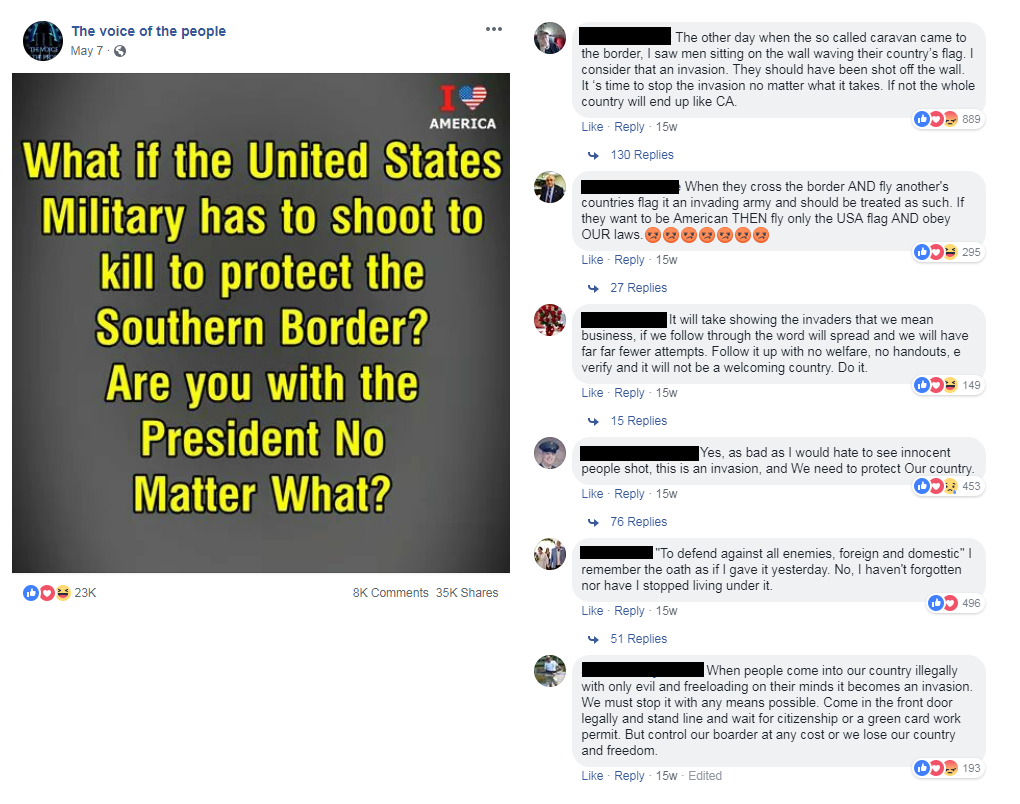
...
==
mma
Also: YouTube recently removed Alex Jones. But white supremacist content is thriving on the platform. One channel that serves as a gateway into white supremacy is flourishing.
Finally: Extremist networks are also prospering on Facebook. Far-right networks with a collective following in the hundreds of millions push false news and bigoted talking points. Facebook, in turn, barely moderates these networks, even as there are implicit calls to violence that regularly go viral. The reason behind Facebook's blind eye is simple: These posts keep a large group of people engaged on the platform, where Facebook can sell them ads.
==
==
greenwash distraction?
Facebook Joins 100% Renewable Energy Revolution
Facebook announced Tuesday it will slash greenhouse gas emissions by 75 percent and transition global operations to 100 percent renewable energy by the end of 2020 in efforts to "help fight climate change."
Similarly, Tesla CEO Elon Musk tweeted over the weekend that his company's enormous Gigafactory in Sparks, Nevada will run entirely on Tesla Solar by the end of 2019.
==
pjt censor jones deplatform: napalm girl, blm ? met with bibi; nat am dapl pix?
calls himself performance artist [rodeo clown?] joe roggin show drunk?
https://kpfa.org/episode/project-censored-august-24-2018/
https://www.alternet.org/news-amp-politics/german-towns-where-facebook-use-higher-average-reliably-experience-more-attacks
A sobering new study found that looked at anti-immigrant violence in Germany over a two-year period found a startling link between the violence: Facebook.
The New York Times reports:
Towns where Facebook use was higher than average, like Altena, reliably experienced more attacks on refugees. That held true in virtually any sort of community — big city or small town; affluent or struggling; liberal haven or far-right stronghold — suggesting that the link applies universally.
Their reams of data converged on a breathtaking statistic: Wherever per-person Facebook use rose to one standard deviation above the national average, attacks on refugees increased by about 50 percent.
The researchers whose study included "3,000-plus data points" believe "this effect drove one-tenth of all anti-refugee violence" in the nation. The Timesnotes that this finding of a link to violence is specific to Facebook, not internet use overall.
Experts who reviewed the findings from the study "called them credible, rigorous — and disturbing."
Facebook refused to comment on the study.
https://www.telesurtv.net/english/news/TeleSUR-English-Removed-From-Facebook-for-the-Second-Time-20180813-0009.html
no lnx img]
TeleSUR English Removed From Facebook for Second Time
Published 14 August 2018
Comments
Follow us
OPINION
Palestinians ride a boat as they take part in a rally to show solidarity with Gaza-bound flotilla Oct. 5, 2016..
Why Aid Boats to Gaza Succeed Despite Failing to Break Si...
by Ramzy Baroud
Indigenous people march in Acapulco, Mexico, on International Day of the World's Indigenous People, August 9, 2018.
International Day of the Indigenous Peoples and Folkloris...
by Itzamna Ollantay
Venezuela's President Nicolas Maduro holds a bank note of the new national currency,the 'Bolivar Soberano' (Sovereign Bolivar).
Venezuela's Monetary Revolution Vis-a-Vis Economic Sancti...
by Nino Pagliccia
A villager tends to his cattle in Moruleng, a small mining community in Rustenburg, South Africa, August 2018.
Africa: Revolutionary Intellectuals 'Inspired By Latin Am...
by Andre Vitchek]
This is the second time the teleSUR English page has been taken down by Facebook moderators.
teleSUR English's page has been removed from Facebook for the second time this year without any specific reason being provided. It should be noted that the first time this occurred back in January 2018, Facebook did NOT provide any explanation in spite of our best efforts to understand their rationale. This is an alarming development in light of the recent shutting down of pages that don't fit a mainstream narrative.
This is currently the only communication we have received from Facebook:
"Hello,
Your Page "teleSUR English" has been removed for violating our Terms of Use. A Facebook Page is a distinct presence used solely for business or promotional purposes. Among other things, Pages that are hateful, threatening or obscene are not allowed. We also take down Pages that attack an individual or group, or that are set up by an unauthorised individual. If your Page was removed for any of the above reasons, it will not be reinstated. Continued misuse of Facebook's features could result in the permanent loss of your account.
The Facebook Team"
Shortly after the news, the administrator of Revolution News informed from his personal Facebook page that he had received a warning from Facebook seconds after he had scheduled this very article to go on the Facebook page of Revolution News.
Meanwhile, followers and supporters of teleSUR English sent out tweets and posts on Facebook and Twitters and other social media websites denouncing the unexplained action by Facebook and arguing that such move is rooted into Facebook's own bias against outlets and news organizations that do not fit within the mainstream media landscape.
View image on Twitter
Max Blumenthal
?
@MaxBlumenthal
Facebook has just deleted the page of @telesurenglish. A network source tells me FB justified eliminating the page on the vague basis of "violation of terms." The NATO-backed @DFRLab is currently assisting FB's purge.This is deeply disturbing.
3:35 PM - Aug 13, 2018
1,074
1,239 people are talking about this
Twitter Ads info and privacy
Also, several news outlets such as RT and Venezuelanalysis, which its own Facebook page was removed briefly last week, Democracy Now! and others reported on the news and expressed concern over the removal of teleSUR English page.
RT
?
@RT_com
.@telesurenglish Facebook page gone without explanation https://on.rt.com/9cbs
6:22 PM - Aug 13, 2018
Facebook vanishes Venezuela-based left-leaning news network again — RT World News
Telesur English, a multi-state funded Latin American news network, says that Facebook has removed its page for the second time this year “without any specific reason being provided.”
rt.com
44
68 people are talking about this
==
AN
During a closed-door and off-the-record meeting last week, top Facebook executive Campbell Brown reportedly warned news publishers that refusal to cooperate with the tech behemoth's efforts to "revitalize journalism" will leave media outlets dying "like in a hospice."
Reported first by The Australianunder a headline which read "Work With Facebook or Die: Zuckerberg," the social media giant has insisted the comments were taken out of context, even as five individuals who attended the four-hour meeting corroborated what Brown had stated.
"Mark doesn't care about publishers but is giving me a lot of leeway and concessions to make these changes," Brown reportedly said, referring to Facebook CEO Mark Zuckerberg. "We will help you revitalize journalism... in a few years the reverse looks like I'll be holding hands with your dying business like in a hospice."
...
https://boingboing.net/2018/08/02/shut-it-down-dc.html
..., Facebook has been scouring its political organizing pages for really sincere protesters, and loudly and performatively purging any activity it deems to be "inauthentic."
:{
One of the casualties of this purge is the countermarch for Unite the Right organizer Jason Kessler's planned "white civil rights rally" in Washington DC.
The counterdemonstration, organized under the banner of "Hate Not Welcome: No Unite The Right 2" was removed by Facebook, who loudly accused the organizers of being paid Russian trolls hoping to stoke American divisions. Except these organizers are actually well-known, American activists, posting from within the USA, about an issue they care deeply about.
Among these genuine, American organizers is Chelsea Manning, the US military veteran and heroic whistleblower, who explained that the protest was "real and organic," adding "We started organizing several months ago. Folks from D.C. and Charlottesville have been talking about this since at least February."
It really hasn't been that long since every progressive cause and event was accused of being a front for Russian fifth columnists and Senator Joe McCarthy was hauling anyone who advocated for a better life for all Americans in front of his House Un-American Activities Committee. Not much has changed. I guess the Democratic establishment finds talking about Russian hackers easier than campaigning on a $15 minimum wage, Medicare for All, and breaking up the big banks and bringing them to heel.
Earlier today, Facebook deleted numerous Facebook pages, including one event aimed at promoting a protest against Jason Kessler’s Unite The Right 2, the sequel no one asked for.
The Shut It Down DC Coaliton has been meeting for weeks. We took over the Facebook event created by outside groups, in a desire to keep it accountable to local organizers…We did not promote anyone’s views except our own.
White nationalism and supremacy is not a Russian ploy, it’s a systemic problem. Jason Kessler is not a Russian bot, he’s the foot soldier of the Trump agenda…
Black Lives Matter D.C. and numerous other groups are central to organizing against a real threat to D.C. We do not organize because of a FaceBook account purportedly run by Russia, we do this to make sure our loved ones, communities, and neighborhoods stay safe from fascists in, and out of, uniforms.
Facebook Makes A Huge Mistake: Removes Genuine #ShutItDownDC Counter Protest Event Page [Lisa Rein/Aaron Swartz Day]
==
https://www.c-span.org/video/?447404-2/antisocial-media
JUNE 22, 2018
Antisocial Media
Professor Siva Vaidhyanathanargued that Facebook is undermining democracy.
UVa
FACEBOOK HAS MESSED WITH POLITICS AROUND THE WORLD. HOW FACEBOOK IS A SOURCE OF TREMENDOUS DISSENSION, HATRED AND OTHER SORTS OF PROBLEMS. HOW RUSSIA USE FACEBOOK TO TRY TO MIX WITH ESTONIA. A VERY STABLE DEMOCRACY. HOW THEY HAD, IN CONCERT WITH THEIR INVASION WITH CRIMEA FLOODED UKRAINE WITH PROPAGANDA. SO IT HAD THE STATE APPOINTS THAT I HAVE BEEN ACCUMULATED. I WAS JUST GOING TO PUT THEM IN ELECTRONIC FOLDERS. I HAVE MATERIAL ON WHAT FACEBOOK DOES WITH THEIR DATA AND I THOUGHT WE COULD STRING THIS TOGETHER I HAD A PROPOSAL AND SENT IT OUT AND GOT A STRONG RESPONSE. EVERYBODY ELSE IS COMING AROUND TO THE IDEA THAT FACEBOOK ACTUALLY PLAYED A CRUCIAL ROLE, NOT JUST IN AMERICAN POLITICS BUT IN HOW POLITICS WORK AROUND THE WORLD. WHAT HAVE WE SEEN SINCE?
WE HAVE SEEN CLEAR EVIDENCE THAT THE VERY NATURE OF FACEBOOK CONTRIBUTES TO THE DISTRIBUTION OF THE WORST KINDS OF HATE SPEECH AND CALLS FOR GENOCIDE IN PLACE LIKE SRI LANKA AND ME AND MORE. THAT IT HAS CONTRIBUTED TO THE ELECTION, A MAJOR DRIVER OF THE ELECTION IN THE PHILIPPINES. THAT, IT IS A PHENOMENON THAT LACKS GOVERNMENTS INTO POWER IN PLACES LIKE CAMBODIA. THAT IT PLAYS A HUGE ROLE IN THE ELECTIONS IN KENYA LAST YEAR. THAT IT PLAYED A HUGE ROLE IN THE BREXIT REFERENDUM BEFORE OUR ELECTIONS. THE OTHER THING IS THE EFFECT OF THE -- PARTY IN INDIA IN THE WAYS IT HAS USE FACEBOOK. TO DISTRIBUTE PROPAGANDA, TO CUT DOWN CRITICS AND'S SPREAD LIES. TO HARASS CRITICS AND INSTIGATE WIDESPREAD THREATS AGAINST ACADEMICS, LEADERS OF ORGANIZATIONS, JOURNALISTS AND OPPOSITION PARTY LEADERS. THAT'S BEEN GOING ON FOR ABOUT THREE YEARS AND THAT'S A FRIGHTENING SITUATION. PUTTING THAT TOGETHER HAVE TO CONCLUDE, THE U.S. GOT OFF PRETTY EASY, NOT ALL AMERICANS HAVE GOTTEN OFF EASY, THINGS ARE WORSE IN OTHER PLACES AND IN PLACES WHERE FACEBOOK MATTERS MORE. THEY HAPPEN TO BE THE PLACES WHERE FACEBOOK INSTIGATED A PHILANTHROPIC EFFORT TO SPREAD HEIST THE DATA CONNECTIONS TO THE POOREST PEOPLE IN THE WORLD.
IT CREATED A SYSTEM CALLED INTERNET.ORG. THROUGH THAT THEY CREATED APPLICATIONS THAT THEY CALL FREE BASICS. IF YOU ARE IN ONE OF THESE COUNTRIES AND GET INTO A CONTRACT WITH THE TELECOMMUNICATION PROVIDER THAT HAS AGREED TO CARRY THIS. WHEN YOU USE IT DOESN'T COUNT AGAINST YOUR DATA. YOU DON'T GET CHARGED. IN COUNTRY WHERE DATA IS EXPENSIVE AND YOU PAY MONTH-TO-MONTH, IT MAKES SENSE. WHILE THIS SUITE OF APPLICATIONS INCLUDES FACEBOOK AND OTHER APPLICATIONS SCREENED AND APPROVED BY FACEBOOK. PLACES LIKE CAMBODIA AND THE PHILIPPINES IN THE MR, FACEBOOK IS THE INTERNET. MAN MAR WHO JUST RECENTLY GOT PHONES WERE JUST RECENTLY GOT AN A CONNECTIVITY'S ESSENTIALLY THE ENTIRE MEDIA ECOSYSTEM. NOT COINCIDENTALLY, IT'S THE SIGHT OF HER HORRENDOUS GENOCIDE. WE HAVE SEEN THIS AROUND THE WORLD. MOST ACUTELY AND BRUTALLY A MAN MAR. HOW DOES THIS HAPPEN? REMEMBER 2.2 BILLION. THE MOST IMPORTANT THING YOU HAVE TO REMEMBER ABOUT FACEBOOK. AS OF FEBRUARY 2018 THEY HAD 2.2 BILLION USERS AROUND THE WORLD. THERE IS NOTHING THAT COMES CLOSE. THE BBC DOESN'T HAVE THAT MANY LISTENERS AROUND THE WORLD. CNN DOESN'T HAVE THAT MANY VIEWERS. THAT'S A STUNNING NUMBER. THAT ALSO MEANS AT THAT SCALE THERE'S ALMOST NOTHING FACEBOOK CAN DO TO ALLEVIATE THE VERY PROBLEMS I'VE DESCRIBED.
IT'S ALMOST IMPOSSIBLE TO EFFECTIVELY FILTER OUT ALL OF THE GARBAGE OUT OF THE SYSTEM THAT HAS 2.2 BILLION HUMANS CONTRIBUTING GARBAGE AND SOME PUPPIES TO IT. IT'S NOT MANAGEABLE SYSTEM AT THAT SCALE. SO TO OTHER ASPECTS ARE IMPORTANT. THE ADVERTISING SYSTEM THAT SO ACCURATELY AND INEXPENSIVELY TARGETS ANY CONTENT TO JUST THE RIGHT AUDIENCE, AND NOBODY BEYOND IT. THAT LASER POINTING OF ADVERTISING IT HAS TREMENDOUS POSSIBILITIES IN THE WORLD OF PROPAGANDA. IT'S GREAT FOR SELLING SHOES, IT'S TERRIBLE FOR DEMOCRACY. THE THIRD ASPECT IS THE ALGORITHM OF THE NEWSFEED. THE THINGS THAT POP UP IN YOUR NEWSFEED MOST OFTEN ON THE HIGHEST ARE THINGS THAT FACEBOOK HAS JUDGED OR PREDICTED TO GENERATE ENGAGEMENT. BECAUSE YOU'VE TOLD FACEBOOK THE THINGS YOU LIKE. AND THE SORT OF PEOPLE THAT YOU MUST INTERACT WITH. SO IT STRUCTURES YOUR EXPERIENCE TO REFLECT WHAT YOU TOLD FACEBOOK YOU CARE ABOUT. ADDITIONALLY, CERTAIN SUBJECTS WILL CREATE ATTENTION. WHEN THEY DO THEY ROCKET AROUND FACEBOOK. THOSE ARE THE POSTS THAT GENERATE THE STRONGEST EMOTION. THE LARGEST LEVEL OF ENGAGEMENT. WHAT IS ENGAGEMENT, THE COMBINATION OF CLICKS, LIKES, COMMENTS AND SHARES. AND THOSE LITTLE SMILEY FACE THINGS, THOSE ARE ALL LEVELS OF ENGAGEMENT. OF THOSE, COMMENTS MATTER THE MOST. SO IF YOU POST SOMETHING THAT GENERATES A HUNDRED COMMENTS, CHANCES ARE EVERYONE OF YOUR FRIENDS WILL SEE THAT POST. NOT A LOT OF THINGS TO DO. BUT PICTURES OF MY DOG BUTTER WHICH TEND TO ROCKET AROUND THE INTERNET LARGELY BECAUSE PEOPLE LIKE BUTTER AND SAY I LIKE BUTTER AND I SAY BUTTER LIKES YOU BACK. BUT THE SAME APPLIES TO CONSPIRACY THEORIES.
SO IF I WERE HOST AN ARTICLE FROM THE ECONOMIST ABOUT HOW THE CURRENT MELTDOWN OF THE ITALIAN POLITICAL SYSTEM IS GOING TO SHAKE MONETARY POLICY AND THE UNION, I KNOW SOME OF YOU ARE READY TO READ THAT. AND THOSE WHO ARE READY MY GO TO MY FACEBOOK PAGE AND LIKE IT. THANKS FOR SHARING IT. IT WOULD BE A WELL REPORTED ARTICLE. BUT IT WOULD NOT GENERATE VITRIOL UNLESS YOUR MEMBER OF A PARTICULAR PARTY. THAT ARTICLE WOULD SINK LIKE A ROCK ON FACEBOOK. IT'S TOO REASONABLE.
==
authoritarian playbook anti-social media
https://www.democracynow.org/2018/8/1/a_threat_to_global_democracy_how
http://accesswdun.com/article/2018/3/650767
new YORK (AP) — The Latest on the alleged use of Facebook data to influence the U.S. presidential election (all times local):
3 p.m.
Kenya's opposition says lawyers are poring through a British broadcaster's investigation to see whether legal action is possible against data analytics firm Cambridge Analytica over its role in the country's disputed presidential election last year.
Cambridge Analytica already is being investigated by British and U.S. authorities over allegations the firm stole data from 50 million Facebook users and used it to manipulate elections.
National Super Alliance Chief Executive Norman Magaya says a legal team will look into whether Cambridge Analytica was involved in what Kenya's opposition claims is a hack of the electoral commission and manipulation of results in favor of President Uhuru Kenyatta.
In the Channel 4 report this week based on undercover video, Cambridge Analytica took credit for stage-managing Kenyatta's campaign. It denied any involvement in inflammatory videos targeting Kenyatta's opponents. There was no discussion of mining Facebook data.
1:05 p.m.
Facebook CEO Mark Zuckerberg plans to speak sometime in the next day with a "focus on rebuilding trust."
That's according to a person familiar with the matter who was not authorized to speak publicly.
The person gave no further details on timing or where Zuckerberg will speak. But the person said the CEO's plan was "always to speak publicly" about Facebook's latest privacy scandal, which involves Trump campaign consultants who allegedly stole data on tens of millions of Facebook users in order to influence elections.
Criticism has been brewing as Zuckerberg and his No. 2 executive, Sheryl Sandberg, have been mum since the Cambridge Analytica story broke last Friday. Twitter users have been asking, using the "WhereIsZuck" hashtag.
__ Barbara Ortutay, New York
(previously from LONDON)
4:35 p.m.
The chairman of Romania's ruling partysays his Social Democratic Party did not hire Cambridge Analytica for its successful 2016 electoral campaign. And Cambridge Analytica itself reportedly said it did not work on the campaign, despite being interested.
Liviu Dragnea told The Associated Press on Wednesday that he "categorically" did not hire Cambridge Analytica or its parent company SCL Group, a British strategic communications company.
His comment came after a British consultant, Rupert Wolfe Murray, who was based in Romania at the time, said he was contacted by Mark Turnbull, a senior official at Cambridge Analytica, in August 2016.
He said Turnbull had "offered to embed a two-person team" into the Social Democrats' campaign team. Wolfe Murray said he declined the offer because he does not work for political parties.
He says Turnbull later told him Cambridge Analytica did not work on the 2016 Romanian election.
The Social Democrats won about 46 percent of the vote and the Liberals came second with 20 percent.
Separately, investigative platform RISE project reported SCL Group set up an office in Romania in 2011, though it is not clear who they worked for.
3:15 p.m.
The co-founder of WhatsApp, which was acquired by Facebook four years ago for $19 billion, has joined the movement to delete Facebook.
Brian Acton tweeted: "It's time. #deletefacebook."
That hashtag has been trending since reports surfaced in recent days regarding the improper use of personal information on Facebook by Cambridge Analytica, a political research firm used by the Trump campaign before the election.
Facebook CEO Mark Zuckerberg has remained silent as nearly $50 billion in market capitalization of his company has been wiped out with investors fearing new oversight by government regulators.
1:10 p.m.
British Prime Minister Theresa May says allegations that Facebook users' data was improperly used by political campaigns are "very concerning."
May says she expects Facebook and data analytics firm Cambridge Analytica to "comply fully" with British authorities investigating how personal information was obtained and used.
May told lawmakers in the House of Commons that "people need to have confidence in how their personal data is used."
Authorities in Britain and the United States are investigating the alleged improper use of data harvested from tens of millions of Facebook users by Cambridge Analytica, which worked on U.S. President Donald Trump's 2016 campaign.
May said that "as far as I'm aware" the British government has no contracts with Cambridge Analytica or its parent company, SCL.
12:30 p.m.
A British consultant says Cambridge Analytica approached him before Romania's 2016 parliamentary elections to work for the Social Democratic Party.
Rupert Wolfe Murray told The Associated Press on Wednesday that Mark Turnbull, a senior official at Cambridge Analytica, contacted him in August 2016.
He cited an email where Turnbull wrote: "What we have offered is to embed a two-person team into the current campaign team... to provide ongoing strategic advice and assistance across the campaign.... over the next 2-3 months."
Wolfe Murray said he declined the offer because he does not work for political parties. It was unclear whether Cambridge Analytica played a role in the Dec. 2016 elections, where the Social Democrats won about 46 percent of the vote. The Liberals came second with 20 percent.
Separately, investigative platform RISE project reported that SCL Group, a British strategic communication company affiliated to Cambridge Analytica, set up an office in Romania in 2011.
12:20 p.m.
A sell-off in Facebook shares is heading into the third consecutive day, with almost $50 billion in market capitalization evaporating since the start of the week.
The stock fell 1.5 percent before the opening bell Wednesday and, after falling 9 percent, it's one of the worst weeks in company history.
Governments on both sides of the Atlantic are calling for CEO Mark Zuckerberg to testify on the issue, but he has been silent since a story broke Friday about how a firm tied to the campaign of Donald Trump improperly lifted data on 50 million Facebook users.
That firm, Cambridge Analytica, suspended CEO Alexander Nix pending an investigation.
...
==
==
***
authoritarian playbook anti-social media; modi, duterte
https://www.democracynow.org/2018/8/1/a_threat_to_global_democracy_how
“Black Elevation.” “Mindful Being.” “Resisters.” “Aztlan Warriors.” Those are the names of some of the accounts removed from Facebook and Instagram Tuesday after Facebook uncovered a plot to covertly influence the midterm elections. The tech giant said 32 fake accounts and Facebook pages were involved in “coordinated inauthentic behavior.”
:{
}:
This announcement comes just days after the company suffered the biggest loss in stock market history: about $119 billion in a single day. This is just the latest in a string of controversies surrounding Facebook’s unprecedented influence on democracy in the United States and around the world, from its pivotal role in an explosion of hate speech inciting violence against Rohingya Muslims in Burma to its use by leaders such as Philippines President Rodrigo Duterte in suppressing dissent. Facebook has 2.2 billion users worldwide, and that number is growing. We speak with Siva Vaidhyanathan, author of “Antisocial Media: How Facebook Disconnects Us and Undermines Democracy.” He is a professor of media studies and director of the Center for Media and Citizenship at the University of Virginia.
:{
}:
solution: face to face forum engagment in depth at public libraries etc
https://www.alternet.org/facebook-takes-down-suspected-russian-network-pages-attempting-influence-2018-elections
no lnx
Facebook has removed a network of accounts and pages it suspects were run by a Russian group, the company told lawmakers Tuesday.
As CNN reports, Facebook said more that 30 pages were removed, including at least one promoting a fake “Unite the Right” counter protest. “There was also an effort to amplify the ‘Abolish ICE’ message pushed by liberals,” CNN reports.
Facebook said the site "found evidence of some connections between these accounts” and those that created content to influence the 2016 presidential elections.
“We know that Russians and other bad actors are going to continue to try to abuse our platform — before the midterms, probably during the midterms, after the midterms, and around other events and elections,” Facebook’s head of cybersecurity policy Nathaniel Gleicher said earlier this month. “We are continually looking for that type of activity, and as and when we find things, which we think is inevitable, we’ll notify law enforcement, and where we can, the public.”
In what amounted to a slap on the wrist, YouTube and Facebook deleted some videos by Alex Jones. In fact, Facebook suspended Jones, but not Infowars. Facebook and YouTube are under increasedpressure for letting the conspiracy theorist use their platforms to push not just conspiracy theories, but harassment of people who have already endured tragedies.
This became relevant after Jones pantomimed shooting Robert Mueller in a video posted to YouTube and Facebook, saying "You're going to get it, or I'm going to die trying, bitch. Get ready." Facebook said in response that Jones' threat does not violate its rules.
There is a small group of people coming to Jones' defense. Lou Dobbs defended Jones against accusations of harassment. Ted Cruz said that Jones has a constitutional right to say these things -- a total non-sequitur, since the question at hand is whether Facebook and YouTube are required to give him a platform. Finally, Tucker Carlson, a former guest on Jones' show multiple times, defended Jones, saying that Jones is not more radical than Rosie O'Donnell, Michelle Wolf, or Bill Maher.
Also: Jones has a meaningful presence on Facebook, but under Facebook's new algorithm, conservative meme pages are the ones actually outperforming all political news pages. A CNN commentator shared a meme with a fake CNN chyron and a fake quote from Rep. Maxine Waters (R-CA).
Lastly: Fox & Friends guests Diamond and Silk said that their debunked claims of censorship are "the new Jim Crow." Jim Crow laws violently enforced American apartheid via mandated segregation while also tolerating lynching; meanwhile, conservative claims of tech censorship have repeatedly been debunked.
==
facebook is an ad co; mitch j kpfa) $that used to go to newspapers to hire reproters (fake news grows vis fb feed)
MMA
Conservatives have been claiming that they have been secretly suppressed on Facebook. Well, we ran the numbers for hundreds of Facebook pages and found that it's a complete lie. The average right-leaning Facebook page has very slightly more engagement than the average left-leaning page. In addition, there are far more right-leaning pages, so right-leaning pages in total have a bigger presence on Facebook. For instance, right-wing images are the most viral content on Facebook. These memes frequently contain false and bigoted information.
But conservatives, like Trump's campaign manager for instance, don't make these claims in good faith. They make these claims to game the refs and get more favorable treatment. We saw that play out this week when tech companies again testified before Congress. They refused to stand up to right-wing lies.
To the contrary, Facebook keeps rolling out the red carpet to conservatives. In 2016, the company met with conservatives complaining about content being suppressed on the site, and even though an internal review found no bias, Facebook fired its human editors anyways, flooding the site with fake news. In 2017, when conservatives starting baselessly complaining about new fact-checking partners working with the site, Facebook added right-wing site The Weekly Standard as the only partisan fact-checker. This year, when conservatives started baselessly complaining about content being suppressed again, they hired plugged-in Republican lobbyist Jon Kyl, a former Arizona senator, who is also working with Trump on the side to get his Supreme Court nominee, Brett Kavanaugh, confirmed. In June, Facebook executives also reportedly met with House Majority Leader Kevin McCarthy (R-CA), RNC chair Ronna McDaniel, and Trump campaign manager Brad Parscale to discuss "bias against conservative content." A new report showed that Facebook invited far-right outlets to a meeting, prompting backlash from others who attended.
Here's the thing: They are the only ones who get that treatment. There is no similar track record for liberals. And it's not even about politics: Sandy Hook families have faced harassment for years on the platform and are trying to get a meeting with them about what to do about it. So far, they've heard nothing.
==
Zuckerberg, CEO of the ever-beleaguered social media behemoth Facebook, has some peculiar ideas about what free speech means. In an interview with ReCode’s Kara Swisher, Zuckerberg was asked how he felt about people who share Holocaust-denialist ideas on his platform, to which he responded that though he found Holocaust denialism “deeply offensive," he felt that “at the end of the day, I don't believe that our platform should take that down because I think there are things that different people get wrong.”
Those remarks specifically raised eyebrows among mainstream media outlets, and led to widespread condemnation of Zuck on social media. In response to the furor, Zuckerberg sent an email to Swisher at Recode to clarify. It reads in part:
I enjoyed our conversation yesterday, but there’s one thing I want to clear up. I personally find Holocaust denial deeply offensive, and I absolutely didn’t intend to defend the intent of people who deny that. Our goal with fake news is not to prevent anyone from saying something untrue — but to stop fake news and misinformation spreading across our services.
More peculiar than Zuck's remark about Holocaust denialism is the way that he describes Facebook's function, and the function of free speech. In Zuckerberg's universe, Holocaust denialism is merely something that "different people get wrong"; and he clarifies that while he finds it offensive, there's nothing innately wrong with people saying things that are "untrue."
“Wrong” is a key word here, and hints that Zuckerberg doesn’t even understand what Facebook — or postmodernity, largely — has done to the idea of truth. “Wrong” implies that there is a right and there is a wrong that is knowable. It implies an objective reality. Yet a layperson confronted with a Facebook feed spewing out 20 visions of what’s true and what’s false won't be able to discern the difference. Indeed, they may even deny that a higher “truth” exists, as an unnamed Bush aide famously did in 2002, presaging the post-truth world. From the New York Times:
The [Bush] aide said that [journalists] like me were "in what we call the reality-based community," which he defined as people who "believe that solutions emerge from your judicious study of discernible reality." I nodded and murmured something about enlightenment principles and empiricism. He cut me off. "That's not the way the world really works anymore," he continued. "We're an empire now, and when we act, we create our own reality. And while you're studying that reality -- judiciously, as you will -- we'll act again, creating other new realities, which you can study too, and that's how things will sort out. We're history's actors . . . and you, all of you, will be left to just study what we do."
This Bush aide — possibly Karl Rove, but never confirmed — understood something in 2002 that liberals like Zuckerberg still don't today: namely, that liberals and conservatives aren't fighting the culture wars with the same weapons. The former is on the ideological battlefield with a clipboard, the latter with a bazooka.
Obama's insistence on adhering to these banal liberal platitudes meant that the GOP was able to dominate most state governments along with the House and the Senate on his watch; and that his premier policy achievement, the Affordable Care Act, was watered-down — a failed attempt to get votes across the aisle — and spawned from a far-right think tank. Meanwhile, during the Obama years, the GOP itself drifted further and further right, and the door was opened for white supremacists and authoritarians, who were ennobled by the right's racialized attacks on Obama — which, I must emphasize, GOP leaders did little to deflect. And we all know what happened next.We've seen the harm of Zuckerberg's brand of rosy, pluralistic thinking before. President Obama epitomized it, in fact. Obama's Republican adversaries were overjoyed to smear and destroy Obama's legacy in any way possible, even if it meant fabricating narratives about him being a Muslim, a homosexual, or a terrorist. All the while, Obama insisted on giving his opponents the benefit of the doubt, a luxury they would never think to afford him.
There's an old saying about American politics that goes like this: the right is interested in power, while the left is interested in fairness. This is why in a fight, the right will always win: they're not playing by the same rules as the rest of us. The Republicans want to gerrymander the hell out of the country, while the liberals want to just make the districts fair. The Republicans want to disenfranchise poor and non-white voters, while the Democrats merely want to keep voting as it is. There's a reason that Democrats keep winning the popular vote and losing the election. If U.S. politics are a see-saw, the Democrats have situated themselves in the center, while the Republicans situate themselves as far to the right as possible. Which way is it tilting, then?
This is also why the wide-open media landscape of Facebook does not resemble a fair fight. Zuckerberg is deeply invested in fairness, in his platform being perceived as ideologically open-ended. The fringe figures — anti-Semites, white supremacists, literal Nazis — they don't play by his rules, and they never will. They want power, not fairness. Facebook wants to mediate truth, but doesn't fully understand we live in a post-truth world. Zuckerberg will fail like Obama failed.
So, what is to be done? It's a big question, but to root out evil, you have to be able to first identify it as such. Nazis and anti-Semites are not merely people with "wrong" ideas, as Zuckerberg says; they stand to destroy the fundament of democratic society. You can't bat off fascists by leaving their falsehood-filled screeds intact, yet slightly less visible, as Zuckerberg proposes.
Meanwhile, mainstream liberals are little better: Obama, Zuckerberg and Hillary Clinton all believe in some version of the idea that there isn't anything structural that needed to change, but merely the Titanic's deck chairs just need to be rearranged. You can see this in both the structure of Facebook and the structure of the Democratic Party platforms — A few tweaks here or there will just keep the boat running smoothly, they seem to think.Second, liberals have to learn to be honest about why xenophobia and right-wing nationalism are on the rise — namely, it's the economy, stupid. Neoliberal economics and unprecedented income inequality have led to masses of underemployed and disenfranchised people looking for people to blame and solutions to their problems. The right offers a false scapegoat: immigrants, perhaps, or liberals, are the reason for our crises, they say.
Yet there are political figures further to the left who have correctly identified our political problems as being rooted in the super-rich, who directly and indirectly orchestrated this crisis. Those same figures — people like Bernie Sanders, Kshama Sawant and Alexandria Ocasio-Cortes — offer an egalitarian, anti-racist vision of the future that ties together the political, cultural and economic, and offer a non-oppressive politics more compelling than the centrist Dems' or the far-right's.
==
https://www.alternet.org/news-amp-politics/facebook-ceo-congratulated-trump-secret-call-after-2016-election-and-company
As the fallout from Facebook CEO Mark Zuckerberg’s controversial remarks defending Holocaust deniers continues, BuzzFeed News reports that the billionaire secretly called President Donald Trump after his election.
According to BuzzFeed,Zuckerberg “congratulated the Trump team on its victory and successful campaign, which spent millions of dollars on advertising with Facebook.”
BuzzFeed says it “obtained company presentations and memos that show the social media giant viewed Trump’s campaign as an ‘innovator’ of a fast-moving, test-oriented approach to marketing on Facebook.' Facebook disseminated Russian propaganda during the 2016 election through its platform, which did not successfully identify and reject the content from our foreign foe.
By Facebok's own estimates, 126 million people saw Russia-linked content during the 2016 election cycle.
Neither Facebook or the White House would offer comment to BuzzFeed on the report.
==
https://www.alternet.org/news-amp-politics/mark-zuckerberg-defends-holocaust-deniers-during-discussion-about-allowing-fake
no lnx
Facebook CEO Mark Zuckerberg defended Holocaust deniers during a Recode podcast published on Wednesday.
The comments came during a discussion of Facebook's policy around banning content, or rather, not banning content.
“Let’s take this a little closer to home. So I’m Jewish, and there’s a set of people who deny that the Holocaust happened. I find that deeply offensive," Zuckerberg said to Recode. "But at the end of the day, I don’t believe that our platform should take that down because I think there are things that different people get wrong — I don’t think that they’re intentionally getting it wrong."
He continued by comparing his own missteps when speaking to those of Holocaust deniers.
"It’s hard to impugn intent and to understand the intent. I just think as important as some of those examples are, I think the reality is also that I get things wrong when I speak publicly," Zuckerberg said. "I’m sure you do. I’m sure a lot of leaders and public leaders who we respect do, too. I just don’t think that it is the right thing to say we are going to take someone off the platform if they get things wrong, even multiple times.”
Facebook continues to be embroiled in controversy as the platform remains the subject of congressional hearings for its propagation of fake news.
Zuckerberg claims he feels a "deep sense of responsibility to try to fix the problem.”
But his continued defense of outright fake news draws skepticism about his commitment to reforming his platform.
==
bloomberg
.... the final weeks of the 2016 election campaign, voters in swing states including Nevada and North Carolina saw ads appear in their Facebook feeds and on Google websites touting a pair of controversial faux-tourism videos, showing France and Germany overrun by Sharia law. French schoolchildren were being trained to fight for the caliphate, jihadi fighters were celebrated at the Arc de Triomphe, and the “Mona Lisa” was covered in a burka.
“Under Sharia law, you can enjoy everything the Islamic State of France has to offer, as long as you follow the rules,” the narrator of one ad. [vid] Unlike Russian efforts to secretly influence the 2016 election via social media, this American-led campaign was aided by direct collaboration with employees of Facebook and Google. They helped target the ads to more efficiently reach the intended audiences, according to internal reports from the ad agency that ran the campaign, as well as five people involved with the efforts.
Facebook advertising salespeople, creative advisers and technical experts competed with sales staff from Alphabet Inc.’s Google for millions in ad dollars from Secure America Now, the conservative, nonprofit advocacy group whose campaign included a mix of anti-Hillary Clinton and anti-Islam messages, the people said.
The content of some ads left some employees of Harris Media—the Austin-based digital advertising firm that runs campaigns for Secure America Now—feeling uneasy. “It was designed to strike fear in people’s hearts,” said one former Harris employee who requested anonymity.
The extent to which Facebook and Google work with political campaigns and groups hasn’t been widely understood. On Oct. 8, 60 Minutes aired an interview with the Trump campaign’s digital director saying he had Facebook employees work as “embeds” in the campaign who were selected for being Republicans. Facebook said its services for Trump were standard for any advertiser during an important event.
Google also works with political groups on their advertising strategies, helping them hone their copy and figure out how to best target their desired audiences, says Wendy Moe, professor of marketing at the University of Maryland’s Robert H. Smith School of Business. “It’s a tricky issue,” she says, because once the companies decide they’ll do hands-on work for political groups, “it’s hard for them to say we’ll help these groups, but not others.”
The issue gets thornier when it comes to working with groups on the fringes of the political spectrum. Earlier this year, for instance, Facebook worked closely with Germany’s far-right, anti-immigrant Alternative for Germany (AfD) party, which was also represented by Harris Media. In meetings at Facebook’s Berlin office, executives encouraged the AfD and Harris Media to use Facebook Live in addition to its ad spending to better target German voters, Bloomberg Businessweek reported last month.
Google and Facebook, similarly, worked closely with Secure America Now as it spent several million dollars on election-season ads, according to the people who worked on the campaign. On June 16 of last year, for instance, sales managers from Google’s elections team hunkered down in its New York offices with officials from Secure America Now and Harris Media to talk about how to improve their digital ad campaigns.
In the months that followed, Secure America Now targeted swing-state voters not only with its faux-tourism videos, but also ads that linked Democratic Senate candidates with Syrian refugees and terrorists. “STOP SUPPORT OF TERRORISM. VOTE AGAINST CATHERINE CORTEZ MASTO,” stated one ad targeting the Nevada Democratic Senate candidate who eventually won the race. “YOU SAW THE THREAT. NOW VOTE TO PROTECT NEVADA,” declared another ad.

A screenshot from a Secure America Now video.
Source: Secure America Now
In some cases, the ads were highly targeted on social media and aimed at groups of people, such as Hispanic voters in Nevada, that they felt could be swayed by the anti-refugee message, according to two people who worked on the campaign. The ads were viewed millions of times on Facebook and Google, according to the internal reports about the campaign.
Facebook’s collaboration with Secure America Now went beyond optimizing its ad reach, and included efforts to test new technology. In one instance, Facebook used the Secure America Now campaign to try out a vertical video format, which the Facebook reps were eager to see used on a large scale.
Working with Harris Media, Facebook devised a case study last year to compare the popularity of the new format to others. The video they used was “Are We Safe?”, which contrasts colorful scenes of Main Street America with black-and-white pictures of Muslims who have carried out attacks in the U.S. Facebook tested 12 different versions of the video. It then followed up with a survey of users who had viewed the video to see which format was most popular. (Square videos, it turned out.)
Officials for Facebook and Harris Media declined to comment. Secure America Now didn’t respond to several requests for an interview.
Google also declined an interview request. But a spokesperson for the company says Google eventually blocked several ads from Secure America Now for violating its policies, including ads for the faux-tourism videos. The company wouldn’t say when it blocked the ads, but in a written statement it said that if ads violate its vigorously enforced policies, “we immediately disapprove them and stop showing them.”
...
==
FACEBOOK FINED OVER CAMBRIDGE ANALYTICA Facebook was slapped with a 500,000-pound fine (about $660,000) from a British data watchdog for allowing Cambridge Analytica to improperly access user data. The agency said Tuesday that the social media giant “contravened the law by failing to safeguard people’s information.” [HuffPost]
==
https://www.propublica.org/article/facebook-new-screening-system-flags-the-wrong-ads-as-political
==
FB echo/escalator, amplify video, which rt dominates:
https://www.vice.com/en_us/article/3dy7vb/why-the-right-is-dominating-youtube
no lnx
Why the Right Is Dominating YouTube
And why the left needs to own the future of online video.
Tom Whyman
Mar 18 2017, 3:16pm
"Twitter is a tiny echo chamber. I'm not sure the left understand the monumental ass-whupping being dished out to them on YouTube."
Thus reads a tweet posted this Tuesday by InfoWars editor Paul Joseph Watson, who you may remember best as the right-wing vlogger who inadvertently promised every journalist in the world a free holiday to Sweden.
As with most things PJW does nowadays, the tweet was immediately and widely mocked. But however fun mocking Watson might be, there was a curious hollowness to the whole affair. Because on this issue – breaking the habit of a lifetime – Paul Joseph Watson is right.
PJW's tweet offers a sketch of the social media terrain that seems spot-on. Twitter isn't wholly dominated by the left, but – Donald Trump and anyone with an egg avatar aside – left-wing views are certainly better-represented there than on any other major social network. However, left-wing Twitter has failed to translate into real-world influence. Twitter conversations aren't very accessible to outsiders. The "echo chamber" trope is lazy and inaccurate – I've personally learnt a huge amount from people on Twitter, and often this has led to my political views changing as well. Nevertheless, Twitter lends itself best to the refinement of people's views in conversation with people they already share some sympathy with. It's an effective tool for dragging young Labour voters further left, perhaps, but not turning Trump voters into Black Lives Matter activists.
On YouTube, by contrast, left-wing voices are seemingly non-existent – apart from that communist child – while right-wing voices dominate. PJW himself is one, standing in front of his little world map shouting at the internet from his room; his mentor Alex Jones, the conspiracy theorist who likes to whip himself up into a frenzy by thinking about secret documents, is another. But it's not just InfoWars – there is a whole ecosystem of right-wing YouTubers out there at least as sophisticated as the society of woodlice you might find scurrying under a loose paving slab, a vast horde of unloved grown-up boys droning on and on about why we need to halt immigration; why we need to ban toilets; why we need to kill all girl-children at birth.
The videos these people produce are a lot of things – "amateurish" and "mind-numblingly tedious" are among the main descriptors I'd use. But somehow, they're incredibly effective. Let's face it: anyone who can get hundreds of thousands of views for a one-hour rant about Owen Jones is worthy of at least our anthropological interest, if not quite our respect.
The most famous instance of far-right views being disseminated on YouTube is PewDiePie – the site's biggest star, commanding an audience of literally millions of impressionable teenage boys, who for some reason want to watch him play computer games. He was dropped by Disney after it emerged that his videos included antisemitic jokes and Nazi imagery. PewDiePie wrote a blog post declaring: "I am in no way supporting any kind of hateful attitudes... Though this was not my intention, I understand that these jokes were ultimately offensive."
What PewDiePie does is very different from the likes of PJW, but this ironic racism can offer us a good example of what happens when these views, prominent in YouTube's ecosystem as they are, become normalised. Such videos are – at least anecdotally – having a measurable effect on how these kids talk about Jews, or the Nazis.
Here's my hypothesis: Twitter is the natural home of the left because Twitter – participatory; open; capable of presenting multiple viewpoints to the reader simultaneously – is well-suited to the expression of left-wing views, which are (to draw however loose a family resemblance between often disparate warring factions) typically somehow egalitarian.
Contemporary right-wing politics, by contrast, is driven largely by the unexamined prejudices and anxieties of (primarily) white men. Any white man who wants to hold on to their prejudices and anxieties is going to have a tough time of it on Twitter – but they're going to have a grand old time standing in front of their wall, alone, ranting.
So the left have the tweet, and the right have the solo rant to camera. This would, in a way, be fine – except that it turns out the solo rant to camera is a vastly better way of converting people than the tweet is. There are, I think, a number of reasons for this. In contrast to the tweet, the video rant allows the speaker to set themselves up as an authority, never really having to deal with the questioning, sarcastic audience that any tweeter does (YouTube has below-the-line comments, of course, but that's a very odd ecosystem, and easy to ignore). Moreover, the fact that the vlog is an oral medium gives it a greater immediacy, so the audience can, for instance, feel the speaker's anger. On both counts, it's easy to see how the solo rant to camera might turn out to be more persuasive.
This is compounded by technological factors. The way in which YouTube is set up makes it very easy for newcomers to discover the world of right-wing rants to camera – all you need to do is find one rant, and then keep scrolling through the sidebar. It's also generally true that tech companies are increasingly prioritising video over words. Recently, a Professor of Technology speculated in the Guardian thatSnapchat might be ushering in a "post-literary" age, while Facebook has recently changed its algorithm to promote video in anticipation of a future which is "all video".
So what can the left do? Calls for, say, a "Paul Joseph Watson of the left" are bound to be misguided. The left can never appropriate the solo rant to camera – it's an inherently authoritarian method of communication. But if the future is video then the left desperately need to find a way to use it. The question is whether the medium can be used in an open, diverse, participatory w...
==
https://www.exposedbycmd.org/2018/04/24/under-new-rules-zuckerberg-americas-biggest-propaganda-cop
Wi
ll Facebook’s new political advertising rules tame extremists in American campaigns and elections, accomplishing something that neither Congress, federal regulators nor the judiciary have done?
Facebook’s new rules may be intended to take itself out of the crossfire sparked by Russian interference in the 2016 election via propaganda on its platform and a GOP-connected political firm stealing 87 million user profiles.
But as more details emerge about its transparency rules, a striking realization is emerging that turns widely held notions of American democracy upside down: that a corporation, not the government, may be only force in America that is both powerful enough and willing to restrain the darker elements of human nature from deploying online propaganda in campaigns and elections.
That a private corporation, not the government, may be the best hope from saving American democracy from itself sounds like a libertarian fantasy—government cannot act, so corporations must. But top legal minds have warned that this day is coming.
“The [Supreme] Court’s reluctance to allow the government to regulate false speech in the political arena could limit laws aimed at requiring social media sites to curb false political advertising,” Rick Hasen, an election scholar at University of California, Irvine School of Law, wrote last summer for a law journal.
“Non-governmental actors, rather than the courts and government, are in the best position to ameliorate some of the darker effects of cheap speech.”
Hasen, who curates the nation’s highest-profile election law blog, was predicting that downward spiral of American political discourse might only be curbed by private referees of the proverbial public square—because the current judiciary won’t let Congress do it.
“Yes, you are reading me correctly: the First Amendment, as interpreted by the Supreme Court, may block the kind of legislation which would be effective to staunch foreign influence over our elections,” he said in an email. “And so ironically we may have to rely on the beneficence of large private corporations like Facebook to save American democracy.”
What is Facebook trying to do? It wants to bar anonymous people or groups from posting political ads on its platform, which became the most-used online platform for 2016’s political messaging. That rapid development is at the heart of numerous political upheavals, from Russian interference to a British political consulting firm allied with the GOP that stole personal profiling data of 87 million Americans.
Facebook’s response, unveiled in announcements this winter and spring, is based on a simple observation and remedy. It now knows, via internal and external research, that the most extreme messaging came from people, groups, campaigns and foreigners who did not reveal or verify their true identities. Thus, its solution is to do what Republicans in Congress and libertarians on the Supreme Court have been averse to: force disclosure of who is behind political messaging, whether it is mild, muddy, torrid, vile or worse.
Facebook’s latest statements say it will verify and reveal who is paying for political ads—whether candidate- or issue-oriented—or it will not display them. It will not accept political ads from foreigners. It will show the sums spent on the ads, describe intended audiences, report how often ads were seen, and display and archive all of the ads that a person, group pr page has posted on its platform. The timetable to implement these steps, some of which have been pioneered in Canadian and European elections, is by summer.
“To get authorized by Facebook, advertisers will need to confirm their identity and location,” announced Rob Goldman, VP, Ads, and Alex Himel, VP, Local & Pages. “Advertisers will be prohibited from running political ads — electoral or issue-based — until they are authorized. In addition, these ads will be clearly labeled in the top left corner as ‘Political Ad.’ Next to it we will show ‘paid for by’ information. We started testing the authorization process this week, and people will begin seeing the label and additional information in the US later this spring.”
“We’re also investing in artificial intelligence and adding more people to help find advertisers that should have gone through the authorization process but did not,” the executives continued. “We realize we won’t catch every ad that should be labeled, and we encourage anyone who sees an unlabeled political ad to report it. People can do this by tapping the three dots at the top right corner of the ad and selecting ‘Report Ad.'”
These steps, which political reformers have long called for, are a paradigm shift for the world of campaigns and election law.
Facebook is requiring people to identify themselves and stand by their word and messages, which is not a universal requirement under current law. They also are saying that the political police will be Facebook users, not government regulators, crowd-sourcing enforcement. They are creating political speech standards for the Internet, which the last major federal campaign reform—2002’s McCain-Feingold law—intentionally did not choose to regulate. Facebook will regulate issue ads at any time, whereas the McCain-Feingold law regulates those ads within 60 days of an election.
Facebooks’ steps may temper some of the underlying trends that have made politics more extreme in recent years, as campaigns and the public have increasingly used social media platforms—whose nature accelerates and magnifies rash communication. However, academics and voting rights advocates have many questions and concerns. Indeed, anyone who has spent time in the campaign reform sphere knows well-intended efforts are routinely evaded.
“The first big loophole is if we just allow Facebook to do this as a self-regulating process, we’re leaving wide open all other social media platforms, because even though Google and others are thinking about it, they’re not coming out with anything specific,” said Craig Holman, Public Citizen’s government affairs lobbyist. “It is just Facebook that’s proposed some sort of specific regulatory actions. We need to have a legislative framework or regulatory framework so we capture all the social media platforms.”
Holman said Facebook was the dominant player in today’s online political advertising. But that might change over time. He said recent congressional testimony by CEO Mark Zuckerberg and the new ad disclosure rules has prompted Congress to sideline legislation that would regulate online political advertising. The Honest Ads Act is a Senate bill that has not yet emerged from committees.
“Even though Facebook has endorsed the Honest Ads Act, they have this huge lobby presence—out of the blue,’ Holman said. “They used to be non-existent a few years ago. And now they are spending a fortune lobbying Congress. And I know full well that they are going behind closed doors and saying, ‘Hey, we don’t need the Honest Ads Act, because we’ll do this ourselves.’ So I really believe it [self-regulation] is designed to undercut legislation.”
Holman said the content of Facebook’s proposals was “fairly good.” Facebook didn’t respond to a request to comment on whether they were lobbying against the Senate bill. But Holman’s concerns about self-regulation were not unique.
“Self regulation is not the answer,” said Young Mie Kim, a University of Wisconsin-Madison professor and scholar-in-residence at the Washington-based Campaign Legal Center. Her research team, Project DATA, just released an analysis of Facebook’s paid ads in the final six weeks of the 2016 campaign.
Kim’s team tracked all paid advertising on nearly 10,000 volunteers devices in the six weeks before the 2016 election. It found a third of the paid advertising was political. Of the most divisive ads—content referring to abortion, LGBT, racial conflict, the alt-right, nationalism, terrorism, guns, etc.—that 80 percent were by “suspicious” groups, meaning they did not clearly or honestly identify themselves.
“The suspicious groups are groups that are by definition untrackable beyond a certain point,” Kim said. “Some groups use very generic and benign names, and are very similar to existing non-profits and known groups. There’s America First. The America First the political action committee, which is not the [previous] group we identified. There’s groups with no information, no public footprint.”
Facebook said that it will use artificial intelligence—computers that are programmed to mimic the brain—and hire thousands of people to review political ads. But Kim is skeptical that they know what to look for and will not be duped by sophisticated imposters, such as groups that she has seen steal logos from legitimate nonprofits and falsify identities in other ways. (Facebook’s response is they know they will make mistakes, hence they are asking users to report ads for internal review and assessment.)
“Facebook is making a significant step, but still lacks a precise understanding of how these unknown, unidentifiable actors took advantage of their platform in the first place,” Kim said. “For example, Facebook announced their plans to verify ‘top pagers.’ First of all, we don’t know what that means. But more importantly, my research shows these anonymous groups, with few exceptions, are not popular pagers. In other words, there were a number of suspicious groups or niche groups around a similar campaign. That means if Facebook verifies top pagers only, we might not be able to effectively combat foreign interference, for example.”
Irvine School of Law’s Hasen also was skeptical that Facebook could solve a serious problem facing American political life—the way partisans deliberately hide their identities when throwing mud.
“I remain skeptical that Facebook can actually design effective regulation of political ads which will let us know who is ultimately behind them,” he said in an email. “I’m even more skeptical that without government regulation, it will be possible for Facebook to self-police foreign interference in our elections via the site, or even if Facebook is serious about limiting such activity.”
While Hasen was referring to the fine-print details of subversive campaign tactics and disclosure requirements, Kim’s most striking comments concerned the big picture question of can democracy reforms be privatized? Put another way, if government cannot or won’t restore checks and balances, should private corporations controlling widely used media platforms step in?
“If we think about where we are heading toward, broadcast media viewership is declining. We see more and more new platforms,” she said. “The way these ads work is not just applied to Facebook. It’s just how the Internet works, and how algorithms work, and how digital ads work. The dark posts are not just a Facebook problem. Google search only serves ads to those who search the terms the advertisers bought… What if we have new platforms that have more sophisticated algorithms, and those algorithms will be determined by big money donors or Russians or foreign entities?”
“Self regulation is not the solution,” Kim said. “Do we want to hand over our political system? Information is currency. And which information I will get, which information I will be I informed about, will it be determined by a tech platform? For example, Facebook is going to determine what political ads mean—because we don’t have a clear definition of a political ad. Academics have debated what constitutes a political ad for decades.”
Facebook said it would be partnering with third parties to determine what issues would fall under its political ad umbrella. While it did not respond to requests for comment, those parties appear to be media organizations that Facebook already work with to verify the accuracy and trustworthiness of news content.
But back to the big picture: has American democracy and the arms of constitutional government become so disabled that only actions by private corporations can reverse today’s outbreak of extremist online propaganda? The answer appears to be yes.
Facebook’s political ad transparency rules may elevate political discourse because the platform is indispensable for candidates, campaigns and voters. Whether other technology platforms and telecommunications giants follow remains to be seen.
But Facebook’s actions are sending an unmistakable larger message. Until today’s political culture and judiciary change, it looks like privatized custodians of democracy are best positioned to save it—or try to prevent human nature’s darker forces from rising again.
Steven Rosenfeld is a senior correspondent of the Independent Media Institute. He is the author of five books, including profiles of campaigns, voter suppression, voting rights guides and a WWII survival story currently being made into a film. His latest book is Democracy Betrayed: How Superdelegates, Redistricting, Party Insiders, and the Electoral College Rigged the 2016 Election (Hot Books, March 2018).
==
congress testimony shuck and jive
https://lawandcrime.com/high-profile/charles-koch-funding-facebooks-new-electoral-interference-commission/
inevitable tyask force funded by koch and
uckerberg wrote, “The goal is both to get the ideas of leading academics on how to address these issues as well as to hold us accountable for making sure we protect the integrity of these elections on Facebook.”
A press release also issued Monday by Facebook’s Vice President of Communications and Public Policy, Elliot Schrage, and the company’s Director of Research, David Ginsberg, identified how this soon-to-be committee will conduct their work. Their statement reads, in relevant part:
At the heart of this initiative will be a group of scholars who will:
- Define the research agenda;
- Solicit proposals for independent research on a range of different topics; and
- Manage a peer review process to select scholars who will receive funding for their research, as well as access to privacy-protected datasets from Facebook which they can analyze.
Facebook will not have any right to review or approve their research findings prior to publication.
A Monday *New York Times* story on the new development claimed that “Zuckerberg addressed how the social network was misused by Russians in the 2016 presidential election,” however, neither Zuckerberg’s post nor Facebook’s official statement made any explicit reference to Russia or Russians.
Zuckerberg did describe the new commission’s methodology in his own words. He said:
To do this, we’re working with foundations across the US to set up a committee of academic experts who will come up with research topics and select — through a peer review process — independent researchers to study them. We’ll give those researchers access to our resources so they can draw unbiased conclusions about Facebook’s role in elections, including how we’re handling the risks on our platform and what steps we need to take before future elections.
As noted, one of those foundations is the Charles G. Koch Charitable Foundation–a 501(c)(3) non-profit founded in 1980 and dedicated to advancing the conservative-libertarian politics of the organization’s founder. For a thorough but non-exhaustive list of Charles Koch’s contributions and priorities in recent years, see here.
Other foundations involved in Facebook’s new elections initiative include the Laura and John Arnold Foundation, a philanthropic organization “strongly criticized for its aggressive, behind-the-scenes funding of efforts to dismantle public pensions and limit patients’ access to prescription drugs,” according to the Center for Media and Democracy, a non-partisan public interest watchdog.
Another funder of the new initiative is the William and Flora Hewlett Foundation, a general purpose philanthropy organization with a focus on educational, environmental and global development issues.
Facebook’s new venture will also be funded by the John S. and James L. Knight Foundation, an organization originally founded to provided college scholarships to low-income students and which now focuses on supporting journalism, advancing local civic engagement and the arts.
The Alfred P. Sloan Foundation will provide funds as well. This foundation is another general purpose philanthropy organization dedicated to supporting a broad range of issues including including science, technology, engineering, math and economics.
Two additional foundations will also contribute. They are the Democracy Fund and the Omidyar Network, both of which were founded by eBay co-founder Pierre Omidyar. Omidyar provided the seed funds for investigative reporting outlet The Intercept but largely shies away from making direct political contributions in the United States–with at least one notable exception: in 2016, Omidyar donated $100,000 to a GOP-linked #NeverTrump Super PAC.
Law&Crime reached out to Facebook with a detailed series of questions and for comment on this story, but no response was forthcoming at the time of publication.
==
Facebook CEO and founder Mark Zuckerberg went before both houses of Congress this week, and generally the takeaway was that lawmakers were, for the most part, incredibly unprepared for the opportunity. Few questions were asked about Facebook having a monopoly, its issues with civil rights, or its role in the ongoing genocide in Myanmar. No questions whatsoever were asked about Facebook's role as a recruitment tool for white supremacists. In fact, it was not until after the hearing that Richard Spencer's Facebook account was removed.
Instead, thanks to Republican lawmakers running with the outrage of the day in right-wing media, the hearing focused on a hoax: allegations of censorship against far-right video bloggers Diamond & Silk. During the 2016 election, the pro-Trump duo pushed wild conspiracy theories and smears, even participating in an interview with a neo-Nazi Holocaust denier to promote Trump’s candidacy. In recent days, the pair took to Fox News to repeatedly claim that they were being suppressed by Facebook. It was only after multiple Republicans confronted Zuckerberg about it that the story totally collapsed. One, Facebook data shows that that the pair had constant reach over the period they were supposedly being suppressed. Two, emails showed that Facebook reached out to the pair on multiple occasions before they went on Fox News to accuse Facebook of never reaching out.
And the lies didn't stop even when the truth was exposed. They continued going on Fox News to complain about Facebook. While the pair got plenty of attention, almost no notice has gone to the liberal pages that have been suppressed by Facebook.
Also: Pro-Trump media were furious that Mark Zuckerberg was asked about diversity at Facebook in the hearings. The fact of the matter is that diversity in tech companies is crucial to understand how platforms will be used, particularly when it comes to online harassment.
==
https://www.opensecrets.org/news/2018/04/fbook-lobbyists-gave-600k-zuckerbergs-congressional
Facebook lobbyists have donated nearly $600,000 since 2013 to the lawmakers who questioned company CEO Mark Zuckerberg this week, a Center for Responsive Politics analysis shows.
In 2017, Facebook hired 30 outside lobbyists who alone gave $148,000 last year to the Senate and House committee members who heard Zuckerberg’s testimony. Another 11 in-house lobbyists donated $11,800 during the company’s year in crisis.
Only nine of the 91 committee members have not received contributions to their campaigns or leadership PACs from those lobbyists since the 2014 cycle, data shows.
Facebook employees have also donated over $640,000 to various committee members over the same period, The Verge reported.
Lobbyists donating to lawmakers’ reelection campaigns while simultaneously meeting with them to influence public policy is legal – and growing in popularity.
Going back to 2007, current Facebook lobbyists have been responsible for over $5.5 million in political donations to federal candidates, leadership PACs, and party committees. That includes $3.1 million from the lobbying firm Subject Matter, one of 10 firms hired by Facebook last year.
Zuckerberg faced questioning this week from the Senate Judiciary and Commerce committees as well as the House Energy and Commerce in the wake of Russian ad buys and the scraping of user data by the political consulting firm Cambridge Analytica.
Since 2013, the chair and ranking minority members on the committees have received roughly $80,000 from current Facebook lobbyists, according to an OpenSecrets analysis, including $20,250 to Greg Walden (R-Ore.), House Energy and Commerce chair.
Democrat Bill Nelson of Florida, the Senate Commerce’s ranking minority member, has received $17,500, including $15,000 since January 2017. Senate Democrat Dianne Feinstein, the only ranking member from Facebook’s home state of California, has received only $500. Senate Judiciary Chair Chuck Grassley (R-Iowa) has collected $15,250, but none in the 2018 cycle.
Facebook Lobbyist Contributions to House/Senate Committee Leadership
Member Committee Role Party 2014 Cycle 2016 Cycle 2018 Cycle 2013-2018
Greg Walden (R-Ore) Energy & Commerce Chairman R $4,750 $7,000 $8,500 $20,250
Bill Nelson (D-Fla) Commerce Ranking Member D $0 $2,500 $15,000 $17,500
Chuck Grassley (R-Iowa) Judiciary Chairman R $2,750 $12,500 $0 $15,250
Frank Pallone Jr. (D-NJ) Energy & Commerce Ranking Member D $9,000 $4,250 $1,000 $14,250
Joe Barton (R-Texas) Energy &Commerce Vice Chair R $1,500 $2,000 $1,531 $5,031
Dianne Feinstein (D-Calif) Judiciary Ranking Member D $0 xxxx
==
==
https://theintercept.com/2018/03/14/facebook-election-meddling/
https://www.nytimes.com/2018/03/17/us/politics/cambridge-analytica-trump-campaign.html
no link
no link
How Trump Consultants Exploited the Facebook Data of Millions
By MATTHEW ROSENBERG, NICHOLAS CONFESSORE and CAROLE CADWALLADRMARCH 17, 2018
Christopher Wylie, who helped found the data firm Cambridge Analytica and worked there until 2014, has described the company as an “arsenal of weapons” in a culture war. Credit Andrew Testa for The New York Times
(After this story was published, Facebook came under harsh criticism from lawmakers in the United States and Britain. Read the latest.)
LONDON — As the upstart voter-profiling company Cambridge Analytica prepared to wade into the 2014 American midterm elections, it had a problem.
The firm had secured a $15 million investment from Robert Mercer, the wealthy Republican donor, and wooed his political adviser, Stephen K. Bannon, with the promise of tools that could identify the personalities of American voters and influence their behavior. But it did not have the data to make its new products work.
So the firm harvested private information from the Facebook profiles of more than 50 million users without their permission, according to former Cambridge employees, associates and documents, making it one of the largest data leaks in the social network’s history. The breach allowed the company to exploit the private social media activity of a huge swath of the American electorate, developing techniques that underpinned its work on President Trump’s campaign in 2016.
An examination by The New York Times and The Observer of London reveals how Cambridge Analytica’s drive to bring to market a potentially powerful new weapon put the firm — and wealthy conservative investors seeking to reshape politics — under scrutiny from investigators and lawmakers on both sides of the Atlantic.
Photo
Both Congress and the British Parliament have questioned Alexander Nix, chief executive of Cambridge Analytica, about the firm’s activities. Credit Bryan Bedder/Getty Images
Christopher Wylie, who helped found Cambridge and worked there until late 2014, said of its leaders: “Rules don’t matter for them. For them, this is a war, and it’s all fair.”
RELATED COVERAGE
Data Firm Tied to Trump Campaign Talked Business With Russians MARCH 17, 2018
Opinion Opinion
Cambridge Analytica and the Secret Agenda of a Facebook Quiz NOV. 19, 2016
“They want to fight a culture war in America,” he added. “Cambridge Analytica was supposed to be the arsenal of weapons to fight that culture war.”
Details of Cambridge’s acquisition and use of Facebook data have surfaced in several accounts since the business began working on the 2016 campaign, setting off a furious debate about the merits of the firm’s so-called psychographic modeling techniques.
But the full scale of the data leak involving Americans has not been previously disclosed — and Facebook, until now, has not acknowledged it. Interviews with a half-dozen former employees and contractors, and a review of the firm’s emails and documents, have revealed that Cambridge not only relied on the private Facebook data but still possesses most or all of the trove.
Cambridge paid to acquire the personal information through an outside researcher who, Facebook says, claimed to be collecting it for academic purposes.
During a week of inquiries from The Times, Facebook downplayed the scope of the leak and questioned whether any of the data still remained out of its control. But on Friday, the company posted a statement expressing alarm and promising to take action.
“This was a scam — and a fraud,” Paul Grewal, a vice president and deputy general counsel at the social network, said in a statement to The Times earlier on Friday. He added that the company was suspending Cambridge Analytica, Mr. Wylie and the researcher, Aleksandr Kogan, a Russian-American academic, from Facebook. “We will take whatever steps are required to see that the data in question is deleted once and for all — and take action against all offending parties,” Mr. Grewal said.
Alexander Nix, the chief executive of Cambridge Analytica, and other officials had repeatedly denied obtaining or using Facebook data, most recently during a parliamentary hearing last month. But in a statement to The Times, the company acknowledged that it had acquired the data, though it blamed Mr. Kogan for violating Facebook’s rules and said it had deleted the information as soon as it learned of the problem two years ago.
In Britain, Cambridge Analytica is facing intertwined investigations by Parliament and government regulators into allegations that it performed illegal work on the “Brexit” campaign. The country has strict privacy laws, and its information commissioner announced on Saturday that she was looking into whether the Facebook data was “illegally acquired and used.”
In the United States, Mr. Mercer’s daughter, Rebekah, a board member, Mr. Bannon and Mr. Nix received warnings from their lawyer that it was illegal to employ foreigners in political campaigns, according to company documents and former employees.
Photo
The conservative donor Robert Mercer invested $15 million in Cambridge Analytica, where his daughter Rebekah is a board member. Credit Patrick McMullan, via Getty Images
Congressional investigators have questioned Mr. Nix about the company’s role in the Trump campaign. And the Justice Department’s special counsel, Robert S. Mueller III, has demanded the emails of Cambridge Analytica employees who worked for the Trump team as part of his investigation into Russian interference in the election.
While the substance of Mr. Mueller’s interest is a closely guarded secret, documents viewed by The Times indicate that the firm’s British affiliate claims to have worked in Russia and Ukraine. And the WikiLeaks founder, Julian Assange, disclosed in October that Mr. Nix had reached out to him during the campaign in hopes of obtaining private emails belonging to Mr. Trump’s Democratic opponent, Hillary Clinton.
The documents also raise new questions about Facebook, which is already grappling with intense criticism over the spread of Russian propaganda and fake news. The data Cambridge collected from profiles, a portion of which was viewed by The Times, included details on users’ identities, friend networks and “likes.” Only a tiny fraction of the users had agreed to release their information to a third party.
“Protecting people’s information is at the heart of everything we do,” Mr. Grewal said. “No systems were infiltrated, and no passwords or sensitive pieces of information were stolen or hacked.”
Still, he added, “it’s a serious abuse of our rules.”
Reading Voters’ Minds
The Bordeaux flowed freely as Mr. Nix and several colleagues sat down for dinner at the Palace Hotel in Manhattan in late 2013, Mr. Wylie recalled in an interview. They had much to celebrate.
Mr. Nix, a brash salesman, led the small elections division at SCL Group, a political and defense contractor. He had spent much of the year trying to break into the lucrative new world of political data, recruiting Mr. Wylie, then a 24-year-old political operative with ties to veterans of President Obama’s campaigns. Mr. Wylie was interested in using inherent psychological traits to affect voters’ behavior and had assembled a team of psychologists and data scientists, some of them affiliated with Cambridge University.
The group experimented abroad, including in the Caribbean and Africa, where privacy rules were lax or nonexistent and politicians employing SCL were happy to provide government-held data, former employees said.
Then a chance meeting brought Mr. Nix into contact with Mr. Bannon, the Breitbart News firebrand who would later become a Trump campaign and White House adviser, and with Mr. Mercer, one of the richest men on earth.
Mr. Nix and his colleagues courted Mr. Mercer, who believed a sophisticated data company could make him a kingmaker in Republican politics, and his daughter Rebekah, who shared his conservative views. Mr. Bannon was intrigued by the possibility of using personality profiling to shift America’s culture and rewire its politics, recalled Mr. Wylie and other former employees, who spoke on the condition of anonymity because they had signed nondisclosure agreements. Mr. Bannon and the Mercers declined to comment.
Mr. Mercer agreed to help finance a $1.5 million pilot project to poll voters and test psychographic messaging in Virginia’s gubernatorial race in November 2013, where the Republican attorney general, Ken Cuccinelli, ran against Terry McAuliffe, the Democratic fund-raiser. Though Mr. Cuccinelli lost, Mr. Mercer committed to moving forward.
The Mercers wanted results quickly, and more business beckoned. In early 2014, the investor Toby Neugebauer and other wealthy conservatives were preparing to put tens of millions of dollars behind a presidential campaign for Senator Ted Cruz of Texas, work that Mr. Nix was eager to win.
When Mr. Wylie’s colleagues failed to produce a memo explaining their work to Mr. Neugebauer, Mr. Nix castigated them over email.
“ITS 2 PAGES!! 4 hours work max (or an hour each). What have you all been doing??” he wrote.
Mr. Wylie’s team had a bigger problem. Building psychographic profiles on a national scale required data the company could not gather without huge expense. Traditional analytics firms used voting records and consumer purchase histories to try to predict political beliefs and voting behavior.
But those kinds of records were useless for figuring out whether a particular voter was, say, a neurotic introvert, a religious extrovert, a fair-minded liberal or a fan of the occult. Those were among the psychological traits the firm claimed would provide a uniquely powerful means of designing political messages.
Photo
Aleksandr Kogan, a Russian-American academic, built an app that helped the firm harvest Facebook data.
Mr. Wylie found a solution at Cambridge University’s Psychometrics Centre. Researchers there had developed a technique to map personality traits based on what people had liked on Facebook. The researchers paid users small sums to take a personality quiz and download an app, which would scrape some private information from their profiles and those of their friends, activity that Facebook permitted at the time. The approach, the scientists said, could reveal more about a person than their parents or romantic partners knew — a claim that has been disputed.
When the Psychometrics Centre declined to work with the firm, Mr. Wylie found someone who would: Dr. Kogan, who was then a psychology professor at the university and knew of the techniques. Dr. Kogan built his own app and in June 2014 began harvesting data for Cambridge Analytica. The business covered the costs — more than $800,000 — and allowed him to keep a copy for his own research, according to company emails and financial records.
All he divulged to Facebook, and to users in fine print, was that he was collecting information for academic purposes, the social network said. It did not verify his claim. Dr. Kogan declined to provide details of what happened, citing nondisclosure agreements with Facebook and Cambridge Analytica, though he maintained that his program was “a very standard vanilla Facebook app.”
He ultimately provided over 50 million raw profiles to the firm, Mr. Wylie said, a number confirmed by a company email and a former colleague. Of those, roughly 30 million — a number previously reported by The Intercept — contained enough information, including places of residence, that the company could match users to other records and build psychographic profiles. Only about 270,000 users — those who participated in the survey — had consented to having their data harvested.
Photo
An email from Dr. Kogan to Mr. Wylie describing traits that could be predicted.
Mr. Wylie said the Facebook data was “the saving grace” that let his team deliver the models it had promised the Mercers.
“We wanted as much as we could get,” he acknowledged. “Where it came from, who said we could have it — we weren’t really asking.”
Mr. Nix tells a different story. Appearing before a parliamentary committee last month, he described Dr. Kogan’s contributions as “fruitless.”
An International Effort
Just as Dr. Kogan’s efforts were getting underway, Mr. Mercer agreed to invest $15 million in a joint venture with SCL’s elections division. The partners devised a convoluted corporate structure, forming a new American company, owned almost entirely by Mr. Mercer, with a license to the psychographics platform developed by Mr. Wylie’s team, according to company documents. Mr. Bannon, who became a board member and investor, chose the name: Cambridge Analytica.
The firm was effectively a shell. According to the documents and former employees, any contracts won by Cambridge, originally incorporated in Delaware, would be serviced by London-based SCL and overseen by Mr. Nix, a British citizen who held dual appointments at Cambridge Analytica and SCL. Most SCL employees and contractors were Canadian, like Mr. Wylie, or European.
But in July 2014, an American election lawyer advising the company, Laurence Levy, warned that the arrangement could violate laws limiting the involvement of foreign nationals in American elections.
In a memo to Mr. Bannon, Ms. Mercer and Mr. Nix, the lawyer, then at the firm Bracewell & Giuliani, warned that Mr. Nix would have to recuse himself “from substantive management” of any clients involved in United States elections. The data firm would also have to find American citizens or green card holders, Mr. Levy wrote, “to manage the work and decision making functions, relative to campaign messaging and expenditures.”
In summer and fall 2014, Cambridge Analytica dived into the American midterm elections, mobilizing SCL contractors and employees around the country. Few Americans were involved in the work, which included polling, focus groups and message development for the John Bolton Super PAC, conservative groups in Colorado and the campaign of Senator Thom Tillis, the North Carolina Republican.
Cambridge Analytica, in its statement to The Times, said that all “personnel in strategic roles were U.S. nationals or green card holders.” Mr. Nix “never had any strategic or operational role” in an American election campaign, the company said.
Whether the company’s American ventures violated election laws would depend on foreign employees’ roles in each campaign, and on whether their work counted as strategic advice under Federal Election Commission rules.
Cambridge Analytica appears to have exhibited a similar pattern in the 2016 election cycle, when the company worked for the campaigns of Mr. Cruz and then Mr. Trump. While Cambridge hired more Americans to work on the races that year, most of its data scientists were citizens of the United Kingdom or other European countries, according to two former employees.
Under the guidance of Brad Parscale, Mr. Trump’s digital director in 2016 and now the campaign manager for his 2020 re-election effort, Cambridge performed a variety of services, former campaign officials said. That included designing target audiences for digital ads and fund-raising appeals, modeling voter turnout, buying $5 million in television ads and determining where Mr. Trump should travel to best drum up support.
The White House advisers Stephen K. Bannon and Kellyanne Conway with Ms. Mercer at the 2017 inauguration. The firm helped the Trump campaign target voters.
Cambridge executives have offered conflicting accounts about the use of psychographic data on the campaign. Mr. Nix has said that the firm’s profiles helped shape Mr. Trump’s strategy — statements disputed by other campaign officials — but also that Cambridge did not have enough time to comprehensively model Trump voters.
In a BBC interview last December, Mr. Nix said that the Trump efforts drew on “legacy psychographics” built for the Cruz campaign.
After the Leak
By early 2015, Mr. Wylie and more than half his original team of about a dozen people had left the company. Most were liberal-leaning, and had grown disenchanted with working on behalf of the hard-right candidates the Mercer family favored.
Cambridge Analytica, in its statement, said that Mr. Wylie had left to start a rival firm, and that it later took legal action against him to enforce intellectual property claims. It characterized Mr. Wylie and other former “contractors” as engaging in “what is clearly a malicious attempt to hurt the company.”
Near the end of that year, a report in The Guardian revealed that Cambridge Analytica was using private Facebook data on the Cruz campaign, sending Facebook scrambling. In a statement at the time, Facebook promised that it was “carefully investigating this situation” and would require any company misusing its data to destroy it.
Facebook verified the leak and — without publicly acknowledging it — sought to secure the information, efforts that continued as recently as August 2016. That month, lawyers for the social network reached out to Cambridge Analytica contractors. “This data was obtained and used without permission,” said a letter that was obtained by the Times. “It cannot be used legitimately in the future and must be deleted immediately.”
Mr. Grewal, the Facebook deputy general counsel, said in a statement that both Dr. Kogan and “SCL Group and Cambridge Analytica certified to us that they destroyed the data in question.”
Cambridge Analytica harvested over 50 million Facebook users’ data, one of the largest data leaks in the social network’s history. Credit Justin Sullivan/Getty Images
But copies of the data still remain beyond Facebook’s control. The Times viewed a set of raw data from the profiles Cambridge Analytica obtained.
While Mr. Nix has told lawmakers that the company does not have Facebook data, a former employee said that he had recently seen hundreds of gigabytes on Cambridge servers, and that the files were not encrypted.
Today, as Cambridge Analytica seeks to expand its business in the United States and overseas, Mr. Nix has mentioned some questionable practices. This January, in undercover footage filmed by Channel 4 News in Britain and viewed by The Times, he boasted of employing front companies and former spies on behalf of political clients around the world, and even suggested ways to entrap politicians in compromising situations.
All the scrutiny appears to have damaged Cambridge Analytica’s political business. No American campaigns or “super PACs” have yet reported paying the company for work in the 2018 midterms, and it is unclear whether Cambridge will be asked to join Mr. Trump’s re-election campaign.
In the meantime, Mr. Nix is seeking to take psychographics to the commercial advertising market. He has repositioned himself as a guru for the digital ad age — a “Math Man,” he puts it. In the United States last year, a former employee said, Cambridge pitched Mercedes-Benz, MetLife and the brewer AB InBev, but has not signed them on.
Matthew Rosenberg, Nicholas Confessore and Carole Cadwalladr reported from London.
==
...
Parscale do for Trump in 2016 that is setting the standard for 2018?
“If I had to characterize what the Trump campaign did, theyautomated Facebook’s best [advertising] practices at a very large scale. I think that statewide campaigns will try to do the same kind of thing in 2018,” said Colin Delany, founder of Epolitics. “I’m wondering if any new technology is going to come out of the resistance. It’s possible. I think a lot of what you are seeing is training and capacity building.”
In other words, Democrats are playing catchup to Republicans, compared to 2016, when their presidential candidate, Hillary Clinton, and the Democratic National Committee—under a series of chairwomen—were more focused on older media platforms like TV, rather than new platforms like social media.
To begin to understand how Parscale, an online advertising specialist, went from building websites for Trump products, to running Trump’s online messaging and fundraising in 2016, to assisting the RNC with small donor outreach in 2018, to being named Trump’s 2020 campaign manager, you have to examine how Parscale used Facebook.
Consultants like Delany are quick to say they can’t tell you how the Trump campaign’s messaging specifically affected voters when they cast ballots. But they can say how Parscale used Facebook, which revolutionized how national campaigns targeted and messaged likely voters.
The Trump campaign took voter files from the Republican Party, which had people’s electoral histories—age, gender, address, party registration and voting histories. They took more personalized data by Cambridge Analytica, the data-mining firm run by hedge fund billionaire Robert Mercer, which boasted it had psychological profiles of every voter. (On Friday, Facebook suspended Cambridge Analytica for not deleting data taken from the social network in 2016 to create its voter profiles. The Guardian reported Cambridge Analytica's data was culled from 50 million to 60 million Facebook user profiles it had stolen before it joined the Trump campaign.)If you roll back the clock to before the internet, a baseline emerges showing how much has changed. When I was press secretary on the 1990 campaign that first elected Bernie Sanders to the House of Representatives, I remember picking up a half-dozen TV ads for the campaign’s final stretch. Bernie looked at the stack of 30-second videos and said his future rested on those tapes. That was a statewide race in a rural state with small media markets, but compare its scale to what Parscale and Facebook did for Trump.
It’s no secret. An October 2016 in-depth report by Joshua Green and Sasha Issenberg for Bloomberg.com laid out the basics. It started with indentifying persuadable voters in swing states, and then sending messaging poking at their biases and personality types. More recent reports, such as this weekend's Guardian report featuring a Trump campaign whistleblower, added more detail showing how powerful Facebook's user profiles were in 2016.
The campaign put all that voter profiling data into Facebook’s advertising supercomputers, which had its own deep profiles of users based on their pages, communications and networks. Facebook provided staffers to every major campaign in 2016 to facilitate this process. From that data merging and data mining, Parscale oversaw an operation that identified 13.5 million Facebook users in 16 states that it deemed were persuadable. It targeted those individuals with the kind of personality-driven content that social media emphasizes—more opinion, belief and bias than facts.
The Trump campaign didn’t just send out original content, noted Melissa Ryan, who writes the Ctrl Alt Right Delete newsletter. “The Trump campaign put out relatively few ideas of their own,” she explained on Medium.com. “Instead they chose to validateand amplify the conversation happening online. They didn’t need to confirm or deny anything, they simply gave Trump’s army their megaphone… [It] put their supporters one content front and center, taking a backseat in their own campaign.”
“They were banking that people are more likely to believe something from an unofficial source that seems true rather than to believe something from an official source that actually is true,” Ryan explained. “Once they realized there was no line to cross, they went all in using social media to bully and intimidate others, spread misinformation, and mainstream the language of hate. Those who spoke out were met with a flood of abuse, and that abuse was organized. Their targets had few places to turn as tech companies turned a blind eye, and law enforcement was of little help.”
By late October, days before former FBI director James Comey announced the FBI was reopening its investigation into Clinton’s handling of classified emails, the Bloomberg reporting team said Parscale’s crew of subcontractors had determined “which social media ads [messages, memes, shares, etc.] were most effective. Those companies test ad variations against one another—the campaign ultimately generated 100,000 distinct pieces of creative content—and then roll out the strongest performers to broader audiences.”
Facebook allowed Parscale to build and target what it calls “custom audiences,” as ex-Facebook executive Antonio Garcia-Martinez explained in a Wired piece, “How Trump Conquered Facebook—Without Russian Ads.” Its custom audience consisted of all the impressionable voters—Trump enthusiasts on one hand, Democrats dubious about Clinton on the other—who could be encouraged to vote or encouraged not to.
Then the campaign used another Facebook advertising feature built atop that preliminary customization called “Lookalike Audiences.” It targeted another wider circle of Facebook usersin the swing constituencies in swing states. Some of this was to keep Trump’s base engaged. Some was to discourage three key columns of Clinton supporters from voting. As Bloomberg noted, “idealistic white liberal, young women and African Americans” were the targets of Trump’s three voter suppression campaigns.
Garcia-Martinez, the original product manager for "Custom Audiences,” explained how the Trump campaign targeted audiences and then fed it content, often propaganda from other online sources. This explains how Breitbart.com temporarily had more traffic than Fox News in the campaign’s final weeks. But Garcia-Martinez’s explanation also alludes to platform features that are designed to be psychologically engaging and provoke emotional responses. It starts with creating political echo chambers filled with like-minded associates.
“We’ve all contributed to this political balkanization by self-sorting (or being sorted by Facebook) into online tribes that get morphed into filter bubbles, which are then studiously colonized by commercial memes planted and spread there by a combination of Custom and Lookalike Audiences,” he wrote. “One of the ways the Trump campaign leveraged Lookalike Audiences was through its voter suppression campaigns among likely Clinton voters. They seeded the Audiences assembly line with content about Clinton that was engaging but dispiriting. This is one of the ways that Trump won the election, by the very tools that were originally built to help companies like Bed Bath & Beyond sell you towels.”
Colin Delany, the online media consultant and author on the topic, is quick to point out that it’s impossible to trace how all this messaging affected voters’ behavior when they cast their 2016 ballots. That’s because the thread Parscale could observe—whether messaging recipients liked, commented on or shared his handiwork—was broken as voters put down their devices and picked up ballots.
But Delany said there was another metric that confirmed how powerful and engaging Facebook was before 2016’s Election Day. It helped raise a fortune for Trump.
“Now one of the main things with Facebook is this is one of the few operations that I’ve heard of that’s been able to raise a significant amount of money by targeting people on Facebook,” he said. “Now my suspicion is that almost all the money actually got raised by email. But they would identify and recruit the people via Facebook.”
“If you can get them to respond to the first fundraising pitch and give you $5, then you are in their email program. Or you get them to sign a petition. You get them to do whatever it is that gets them the email address,” Delany said. “The small donor lists that the RNC is using to pretty good effect right now comes out of the work that Parscale did for Trump. If you want to look for results, I think you can look to social media fundraising.”
Seen from that metric, there’s no denying the political power of social media. With 10 days to go before Election Day, Bloomberg reported that Parscale’s operation raised $275 million from 2.5 million small donors. That’s more than the nearly $238 million raised by the Sanders presidential campaign from his grassroots base. Think about that: Parscale’s operation outraised Bernie’s operation—but Parscale isn’t bragging about it.
The Clinton campaign, as many political insiders and former Facebook executives have said, didn’t use Facebook as aggressively. In one intriguing series of recent tweets, these tech and political insiders said that Democrats in general rely more on TV ads than online messaging, partly because political consultants can earn more that way. They also said her campaign was relying on dated internal assessments by Facebook (from 2010) about its affects on voter participation, and that overall, its campaigns discounted—and didn’t sufficiently study—“observational political science,” or how voters responded to social media provocations in focus groups.
These cringe-worthy observations are part and parcel of political campaigns, which are like startups that rapidly pop up and then mostly disappear after Election Day. Political campaigns are perpetually in search of messaging and fundraising infrastructure they can use; just as institutions like Facebook, YouTube and Twitter have created infrastructure seeking new users. Garcia-Martinez, reached by email, said he was stunned by how little political professionals—and academics who study politics—know about advertising.
“My recent [Wired] piece tossed me into a few threads with political/election/academic Twitter, and I found it a very strange world,” he wrote. “Very punctiliously following strict experimental protocols and the scientific method, and also not knowing the first f**king thing about how to advertise on Facebook (their studies measure what they can as outsiders, which isn't much). It is a leap of faith to just assume Facebook ads work for politics.... but without question, they work for more commercial direct-response advertisers.”
His takeaway: “Parscale is hailed as this genius, but all he did is what any reasonably savvy ecommerce operation would have done, and that set him way beyond Hillary and the supposedly ‘best and brightest.’ Which is why, as Delany and Graves, campaign media consultants and columnists, said, social media will be at the center of 2018’s elections for control of Congress and constitutional offices in swing states.
Steven Rosenfeld
==
==
https://economictimes.indiatimes.com/news/international/world-news/inside-facebooks-political-unit-that-enables-the-dark-art-of-digital-propaganda/articleshow/62222158.cms
Under fire for Facebook’s role as a platform for political propaganda, co-founder Mark Zuckerberg has punched back, saying his mission is above partisanship. "We hope to give all people a voice and create a platform for all ideas," Zuckerberg wrote in September after President Donald Trump accused Facebook of bias.
Zuckerberg’s social network is a politically agnostic tool for its more than 2 billion users, he has said. But Facebook, it turns out, is no bystander in global politics. What ..
Read more at:
//economictimes.indiatimes.com/articleshow/62222158.cms
https://www.bloomberg.com/news/features/2017-12-21/inside-the-facebook-team-helping-regimes-that-reach-out-and-crack-down
no link
Zuckerberg’s social network is a politically agnostic tool for its more than 2 billion users, he has said. But Facebook, it turns out, is no bystander in global politics. What he hasn’t said is that his company actively works with political parties and leaders including those who use the platform to stifle opposition—sometimes with the aid of “troll armies” that spread misinformation and extremist ideologies.
The initiative is run by a little-known Facebook global government and politics ..
uckerberg’s social network is a politically agnostic tool for its more than 2 billion users, he has said. But Facebook, it turns out, is no bystander in global politics. What he hasn’t said is that his company actively works with political parties and leaders including those who use the platform to stifle opposition—sometimes with the aid of “troll armies” that spread misinformation and extremist ideologies.
The initiative is run by a little-known Facebook global government and politics team that’s neutral in that it works with nearly anyone seeking or securing power. The unit is led from Washington by Katie Harbath, a former Republican digital strategist who worked on former New York Mayor Rudy Giuliani’s 2008 presidential campaign. Since Facebook hired Harbath three years later, her team has traveled the globe helping political clients use the company’s powerful digital tools.
:{
}:
In some of the world’s biggest democracies—from India and Brazil to Germany and the U.K.—the unit’s employees have become de facto campaign workers. And once a candidate is elected, the company in some instances goes on to train government employees or provide technical assistance for live streams at official state events.
Even before Facebook was forced to explain its role in U.S. election meddling—portrayed by its executives as a largely passive affair involving Russian-funded ads—the company’s direct and growing role catering to political campaigns raised concerns inside the social media giant.
“It’s not Facebook’s job, in my opinion, to be so close to any election campaign,” said Elizabeth Linder, who started and ran the Facebook politics unit’s Europe, Middle East and Africa efforts until 2016. Linder had originally been excited about the company’s potential to be “extraordinarily useful for the world’s leaders—but also the global citizenry.” She said she decided to leave the company in part because she grew uncomfortable with what she saw as increased emphasis on electioneering and campaigns.
In the U.S., the unit embedded employees in Trump’s campaign. (Hillary Clinton’s camp declined a similar offer.) In India, the company helped develop the online presence of Prime Minister Narendra Modi, who now has more Facebook followers than any other world leader. In the Philippines, it trained the campaign of Rodrigo Duterte, known for encouraging extrajudicial killings, in how to most effectively use the platform. And in Germany it helped the anti-immigrant Alternative for Germany party (AfD) win its first Bundestag seats, according to campaign staff.
Supporters of the Alternative for Germany (AfD) party dressed in blue tights attend a campaign rally ahead of European parliamentary elections on May 23, 2014, in Berlin.
By all accounts, Facebook has been an indispensable tool of civic engagement, with candidates and elected officials from mayor to prime minister using the platform to communicate directly with their constituents, and with grassroots groups like Black Lives Matter relying on it to organize. The company says it offers the same tools and services to all candidates and governments regardless of political affiliation, and even to civil society groups that may have a lesser voice. Facebook says it provides advice on how best to use its tools, not strategic advice about what to say.
“We’re proud to work with the thousands of elected officials around the world who use Facebook as a way to communicate directly with their constituents, interact with voters, and hear about the issues important in their community,” Harbath said in an emailed statement.
She said the company is investing in artificial intelligence and other ways to better police hate speech and threats. “We take our responsibility to prevent abuse of our platform extremely seriously,” Harbath said. “We know there are ways we can do better, and are constantly working to improve.”
Power and social media converge by design at Facebook. The company has long worked to crush its smaller rival, Twitter, in a race to be the platform of choice for the world’s so-called influencers, whether politicians, cricket stars or Kardashians. Their posts will, in theory, draw followers to Facebook more frequently, resulting in higher traffic for advertisers and better data about what attracts users.
:{
}:
Politicians running for office can be lucrative ad buyers. For those who spend enough, Facebook offers customized services to help them build effective campaigns, the same way it would Unilever NV or Coca-Cola Co. ahead of a product launch.
While Facebook declined to give the size of its politics unit, one executive said it can expand to include hundreds during the peak of an election, drawing in people from the company’s legal, information security and policy teams.
At meetings with political campaigns, members of Harbath’s team sit alongside Facebook advertising sales staff who help monetize the often viral attention stirred up by elections and politics. They train politicians and leaders how to set up a campaign page and get it authenticated with a blue verification check mark, how to best use video to engage viewers and how to target ads to critical voting blocs.
Once those candidates are elected, their relationship with Facebook can help extend the company’s reach into government in meaningful ways, such as being well positioned to push against regulations.
At the very least, the optics of directly aiding campaigns or those in power may create the impression among users that Facebook is taking sides. Its effort effectively helping the Scottish National Party to victory in 2015 is recounted as a “success story” on Facebook’s corporate website that lists business case studies, even though those who favor staying in the U.K. might see it otherwise. In April, Vietnamese officials bragged that Facebook would build a dedicated channel to prioritize takedown requests for content that offended authorities. The company generally routes requests from governments through a separate channel, and takes the content down if it violates community standards. If it violates local law, it’ll only be unavailable in the relevant country.
“They’re too cozy with power,” said Mark Crispin Miller, a media and culture professor at New York University.
:{
}:
That problem is exacerbated when Facebook’s engine of democracy is deployed in an undemocratic fashion. A November report by Freedom House, a U.S.-based nonprofit that advocates for political and human rights, found that a growing number of countries are “manipulating social media to undermine democracy.” One aspect of that involves “patriotic trolling,” or the use of government-backed harassment and propaganda meant to control the narrative, silence dissidents and consolidate power.
Internally, Facebook executives are grappling with how to distinguish between what constitutes trolling harassment and protected political speech. Zuckerberg has long maintained the company doesn’t want to play censor, but Facebook has drawn some lines—banning Greece’s Golden Dawn, the ultranationalist party, for example. The company also often removes the most extreme content, from white nationalists in the U.S. and from the Islamic State, as well as content it catches violating its “community standards” on hate speech and violence. Not all such content gets caught.
:{
}:
In retrospect, the nexus of power and data at Facebook seems inevitable. In 2007, Facebook opened its first office in Washington. The presidential election the following year saw the rise of the world’s first “Facebook President” in Barack Obama, who with the platform’s help was able to reach millions of voters in the weeks before the election. The number of Facebook users surged around the Arab Spring uprisings in the Middle East around 2010 and 2011, demonstrating the broad power of the platform to influence democracy.
By the time Facebook named Harbath, the former Giuliani aide,to lead its global politics and government unit, elections were becoming major social-media attractions. They now rank alongside the Super Bowl and the Olympics in terms of events that draw blockbuster ad dollars and boost engagement.
Facebook began getting involved in electoral hotspots around the world. They went toArgentina in 2015, where now-President Mauricio Macristreamed campaign rallies live on Facebook and, once elected, announced his entire cabinet on the site, complete with emojis. The same year, Poland’s nationalist president, Andrzej Duda, became one of the first world leaders to livestream his inauguration on the social network. Even as Duda has overseen a crackdown on press freedom in the country, Facebook’s corporate website says the company was “integral” to his electoral success and that his page is “one of his office’s main communication channels.”
:{
}:
Facebook has embedded itself in some of the globe’s most controversial political movements while resisting transparency. Since 2011, it has asked the U.S. Federal Election Commission for blanket exemptions from political advertising disclosure rules that could have helped it avoid the current crisis over Russian ad spending ahead of the 2016 election,Bloomberg reported in October. After a Congressional inquiry into Russian election meddling, Facebook has pledged to be more transparent about ad buyers and said it’s open to regulation.
The company’s relationship with governments remains complicated. Facebook has come under fire in the European Union, including for the spread of Islamic extremism on its network. The company just issued its annual transparency report explaining that it will only provide user data to governments if that request is legally sufficient, and will push back in court if it’s not. Despite Facebook’s desire to eventually operate in China and Zuckerberg’s flirtation with the country’s leaders, it’s still unwilling to compromise as much as the government wants it to in order to enter.
India is arguably Facebook’s most important market, with the nation recently edging out the U.S. as the company’s biggest.The number of users there is growing twice as fast as in the U.S. And that doesn’t even count the 200 million people who use the company’s WhatsApp messaging service in India, more than anywhere else on the globe.
By the time of India’s 2014 elections, Facebook had for months been working with several campaigns. Modi, who belongs to the nationalist Bharatiya Janata Party, relied heavily on Facebook and WhatsApp to recruit volunteers who in turn spread his message on social media. Since his election, Modi’s Facebook followers have risen to 43 million, almost twice Trump’s count.
Within weeks of Modi’s election, Zuckerberg and Chief Operating Officer Sheryl Sandberg both visited the nation as it was rolling out a critical free internet service that the government later curbed. Harbath and her team have also traveled there, offering a series of workshops and sessions that have trained more than 6,000 government officials.
As Modi’s social media reach grew, his followers increasingly turned to Facebook and WhatsApp to target harassment campaigns against his political rivals. India has become a hotbed for fake news, with one hoax story this year that circulated on WhatsApp leading to two separate mob beatings resulting in seven deaths. The nation has also become an increasingly dangerous place for opposition parties and reporters. In the past year, several journalists critical of the ruling party have been killed. Hindu extremists who back Modi’s party have used social media to issue death threats against Muslims or critics of the government.
On the night of Sept. 5, a Honda motorcycle pulled in front of the Bengaluru home of Gauri Lankesh, an outspoken critic of Modi who had been targeted by patriotic trolls on Facebook and other social media. As the Indian journalist was unlocking her gate, three bullets struck her in the head and chest, killing her. No arrests have been made.
The final editorial Lankesh had written for her newspaper was titled “In the Age of False News.” In it, she lamented how misinformation and propaganda on social media were poisoning the political environment.
==
upfront 3/15/18
https://events.ucsc.edu/event/4756
Read all about The Trust Protocol and The Trust Project and its partners (the The Economist, The Globe and Mail, the Independent Journal Review, Mic, Italy’s La Repubblica and La Stampa, and The Washington Post) at the following links:
The Verge: Facebook adds trust indicators to news articles in an effort to identify real journalism
https://www.theverge.com/2017/11/16/16658538/facebook-trust-indicators-fake-news-trust-project
CNN Tech: Facebook, Google, Twitter to fight fake news with ‘trust indicators’
http://money.cnn.com/2017/11/16/technology/tech-trust-indicators/index.html
==
https://www.alternet.org/media/glenn-greenwald-facebook-operating-arm-israeli-state-removing-palestinian-posts
Facebook is being accused of censoring Palestinian activists who protest the Israeli occupation. This comes as Israeli Justice Minister Ayelet Shaked reportedly said in December that Tel Aviv had submitted 158 requests to Facebook over the previous four months asking it to remove content it deemed “incitement,” and said Facebook had granted 95 percent of the requests. We speak with Pulitzer Prize winner Glenn Greenwald about his new report for The Intercept headlined “Facebook Says It Is Deleting Accounts at the Direction of the U.S. and Israeli Governments.”
...
==
Facebook (Still) Letting Housing Advertisers Exclude Users by Race
by Julia Angwin , Ariana Tobin and Madeleine Varner
After ProPublica revealed last year that Facebook advertisers could target housing ads to whites only, the company announced it had built a system to spot and reject discriminatory ads. We retested and found major omissions.
==
https://www.alternet.org/investigations/investigative-report-instagram-spread-political-propaganda-spread-multi-millions
Maybe you saw it, too. On Thursday, I read a post from Facebook executivestouting their determination to reel in the propaganda monster their platform had enabled in 2016’s election.
“We are committed to protecting legitimate political discussion within our community,” Facebook said, citing its “action plan against foreign interference,” which includes “hiring 10,000 people including ad reviewers, engineers and security experts and combining their skills with advances in AI [artificial intelligence] and machine learning to identify and remove content violations and fake accounts.”
Facebook’s moves come as congressional hearings continue on how Russians, with (as we now know) a more sophisticated understanding of social media than Hillary Clinton’s 2016 campaign, planted thousands of propagandistic memes on dominant online platforms including Facebook. These moves come as the Federal Election Commission is mulling new disclosure requirements for the election platforms. (Unless anticipated upcoming FEC vacancies stall this action.)
But what’s most important, amid the recent news surrounding Facebook’s role as one of 2016’s top political propaganda platforms, is what is missing from Facebook’s statements. It's also missing from the few media accounts about possible federal regulation of Facebook. What's missing is the role of another communication platform owned by Facebook: Instagram. This is what Jonathan Albright, a Columbia University Journalism School professor and researcher recently told the Senate Intelligence Committee, and detailed in a long article on Medium.com.
The “most important development about the ongoing Facebook investigation isn’t the tenfold increase in the company’s updated estimate of the organic reach of ‘ads’ on its platform," Albright wrote. "While the estimate increasing the reach of IRA content from 10 million people to 126 million people is surely a leap, after last week’s [Senate] testimony, the real question we should be asking is: how did we suddenly arrive at 150 million? The answer is Instagram.”
“My following analysis shows that Facebook’s sibling property, Instagram—a service larger than Twitter and Snapchat combined—should be seen as a major influence, targeting and engagement hub for the spread of political propaganda,” Albright continued. “How do I know? Because I amassed a huge trove of content, analytics numbers, and did the analysis to prove it. To show the reach and use of Instagram for political propaganda the last two years, I’ve collected the following evidence: First, the full profile analytics, post 'like' history and comment statistics, and the complete content—including text, dates and original URLs—for a sample of Instagram posts from 28 of the 170 removed accounts. These posts accounted for 2.5 million recorded interactions (not estimated 'shares') and 145 million projected total interactions based on Socialblade, Klear, and Keyhole influencer data.”
Albright is one of the foremost investigative reporters, dealing with millions of real recorded social media posts and interactions, including tracing how content spreads. His latest conclusion is that Instragram, which Facebook owns, has been overlooked in the congressional scrutiny of its parent company and Google and Twitter in understanding how social media fanned and exploited propagandistic divisions among the electorate in 2016. More important, what Albright highlights remains online today—including what he labels the thousands of “zombie” memes and other posts from 2016.
Instagram More Influential Than Twitter
“I argue here that Instagram is more pervasive than Twitter for political meme-spreading as well as viral outrage video-based behavioral re-targeting,” he said. “Part of the reason for this is because it uses the same range of Facebook’s universe of sophisticated ad targeting infrastructure—including Lookalike and Custom Audiences. The Instagram platform can even link even video views to direct response and campaign objectives.”
Albright goes further, explaining that Silicon Valley top coders built the communications network that not only spreads viral content, but leaves it lingering online, and mines user interactions and compiles psychological profiles to further this provocative dynamic.
Let’s take these step by step.
“Instagram is also a major re-distributor of IRA [Internet Research Agency, a Russian company] memes: Two unofficial third-party 're-sharing' apps on Instagram have circulated and pushed IRA content far beyond the realm of Instagram and Facebook, and embedded it all over the internet. This includes cross-posting of memes and posts from removed accounts from Instagram back into Facebook, Instagram, and also into Twitter. These apps also helped the memes get over to Pinterest.”
This recycling has led to a stunning observation—one that partly accounts for the deepening poisonous nature of arch-partisan politics—which is the observation that much of 2016’s political propaganda is still circulating, despite Facebook and other sites taking steps to close these accounts.
...
==
https://www.alternet.org/media/google-boosting-all-manner-fake-news-about-texas-church-massacre
Google is continuing to allow the monetization of fake news via its advertising network AdSense, this time surrounding the November 5 mass shooting in Sutherland Springs, TX. Advertising networks Revcontent and content.ad are also featuring advertisements on fake news stories about the attack.
On November 5, a gunman opened fire and killed at least 26 people at a church in Sutherland Springs, TX. The alleged gunman, Devin Patrick Kelly, was court martialed while in the Air Force in 2012 on charges of “assaulting his wife and child” and has been accused of stalking ex-girlfriends. Law enforcement officers are now saying that the shooting was related to “a domestic situation.”
A Media Matters search found that Google’s AdSense supplied advertisements for many websites pushing the fake news that Kelly was a member of the antifascist group antifa, with many seeming to base their pieces on a fake news article from prominent fake news website YourNewsWire. Those websites included Real Farmacy, USN Politics, myinfonews.net, Clear Politics, SBVNews, RedStateWatcher, and TruthFeed.
Some of these websites that were using AdSense, such as Clear Politics and SBVNews, also carried advertisements from content.ad, while TruthFeed also featured advertisements from Revcontent. Other websites not using AdSense that pushed the baseless claim, such as Conservative Fighters, The Conservative Truth, and borntoberight.com, featured advertisements from Revcontent or content.ad instead, including the YourNewsWire piece (that article went viral, drawing at least 235,000 Facebook engagements within almost 24 hours of the attack, according to social media analytics website BuzzSumo, and was shared on gun parts manufacturer Molon Labe Industries’ Facebook page).

Another false claim about the shooting came from Freedum Junkshun, a “satire” website run by a man whose made-up stories have been used by fake news websites to misinform. It claimed that the shooter “was an atheist” on the payroll of the Democratic National Committee. That article was funded via advertisements from both AdSense and content.ad. And fake news website Freedom Daily, which has repeatedly violatedAdSense’s rules against race-based incitement of hatred, published the false claim that the shooter was a Muslim convert named Samir Al-Hajeed. AdSense advertisements funded that article.
It isn't just Google's advertising service that is struggling with how to handle fake news; among the top Google search results of Kelly’s name following the attack were tweets and a video that also baselessly claimed he was a member of antifa. YouTube, which Google owns, also prominently featured a video pushing the false claim as one of the top results for the alleged shooter’s name.
In early November, a Google senior executive testified before Congress that the company had “taken steps” to demonetize misrepresentative websites. Yet the fact that multiple websites are using AdSense to monetize misinformation about the Texas mass shooting via AdSense signals otherwise. Indeed, AdSense, along with Revcontent and content.ad, have generally become the advertising networks of choice for those who push fake news. And this comes amid continuing criticism of Google’s inability to not feature misinformation during or after crisis events. These companies clearly have a long way to go to fix their misinformation problem.
==
guard uk
NO LINK
showdown is looming in Washington between Congress and the powerful social media companies that have helped define the current unsettled age in western democracies.
The immediate issue before the Senate and the House intelligence committees, which have summoned representatives from Facebook, Twitter and Google to appear on 1 November, is to determine the extent the companies were used in a multi-pronged Russian operation to influence the 2016 presidential election.
All three companies have admitted that Russian entities bought ads on their sites in an effort to skew the vote. In Facebook’s case, ads pushing divisive messages were bought by fake American accounts and focused on swing states. On Twitter, vast armies of automated user accounts – “bots” – and fake users helped promote fake news stories, damaging to Hillary Clinton and favourable to Donald Trump. Russian-funded accounts spread bogus stories across the Google search engine and its subsidiary YouTube.
The wider question hovering over the committee hearings on 1 November is whether these organisations, which once seemed to encapsulate the spirit of free speech and communication in the 21st century, have become Trojan horses used by foreign autocracies and domestic extremists to subvert democracies from the inside, exploiting openness, blurring fact and fiction and fuelling civil conflict.
'Our pain for their gain': the American activists manipulated by Russian trolls
Read more
“What should alarm the American people is the brazen exploitation and distortion of popular opinion by a hostile foreign power amounting really to an attack on our democracy,” Richard Blumenthal, Democratic senator for Connecticut, told the Guardian.
“This attempt to disrupt our elections by surreptitiously targeting voters in certain places with certain backgrounds and views is a clear threat to our democratic process, so Americans should be as alarmed about it as they would by an act of war.”
What should alarm the American people is the brazen exploitation and distortion of popular opinion by a foreign power
Senator Richard Blumenthal
Facebook, Twitter and Google will send their general counsels to testify before the congressional panels. They will face unprecedented questions about how the companies plan to police themselves.
With those hearings looming, Trump sought on Saturday to downplay the importance of Russian ads and fake news during the election. “Keep hearing about “tiny” amount of money spent on Facebook ads,” the president tweeted. “What about the billions of dollars of Fake News on CNN, ABC, NBC & CBS?”
“Crooked Hillary Clinton spent hundreds of millions of dollars more on Presidential Election than I did,” the president wrote in another tweet. “Facebook was on her side, not mine!”
Nonetheless, momentum is building in Congress to start regulating and patrolling the open plains of social media. On Thursday, a bipartisan bid was launched in the Senate to exercise some control over online political advertising. “The Honest Ads Act”, sponsored by Democrats Amy Klobuchar and Mark Warner and Republican John McCain, is aimed at preventing foreign influence on elections by subjecting political ads sold online to the same rules and transparency that applies to TV and radio.
“Unfortunately, US laws requiring transparency in political campaigns have not kept pace with rapid advances in technology, allowing our adversaries to take advantage of these loopholes to deceive millions of American voters with impunity,” McCain said on the bill’s launch.
Donald Trump in the Oval Office. ‘The Honest Ads Act’ is aimed at preventing foreign influence on elections by subjecting online political ads to the same transparency that applies to TV and radio.
Social media companies have fought off such attempts at regulation for years, but a tech company employee who requested anonymity to speak about candidly about internal industry discussions suggested Silicon Valley might now be open to narrowly tailored regulation on political ads.
“In 2011, when political advertising on social media were more of a fledgling industry, companies were more concerned that a disclaimer would be problematic and hurt the industry,” the employee said. “The social and political ad space is so established now that it’s hard to see campaigns pulling out of the market based on that.”
However, it is not clear how much support the bill will attract from the Republican leadership, which has resisted efforts to restrict anything it sees as related to campaign finance.
‘Totally divisive material’
The climate in which the legislation is debated will be determined to a great extent by the outcome of the 1 November hearings. Social media executives are going to be asked what they knew about Russian subversion of their platforms and when they knew it.
How Russia used social media to divide Americans
There will be also be sharp questioning over whether the precise targeting of divisive ads and fake news in areas that proved critical to Trump’s victory showed any evidence of collusion.
CNN has reported that Russian-purchased ads were targeted in sophisticated ways on key demographic groups in Wisconsin and Michigan. In central Pennsylvania, another state won narrowly by Trump, there is evidence of outside tampering designed to depress the Clinton vote.
John Mattes, a former Senate investigator who helped run the online campaign in San Diego for Bernie Sanders, Clinton’s challenger for the Democratic nomination, has found Sanders supporters sites riddled with eastern Europeans posting fake news under false names.
More recently he has come across the same phenomenon in a Facebook supporters group in central Pennsylvania. One troll, calling himself Stephen Woods, shared a series of fake news stories targeting Clinton, Muslim refugees and African Americans.
I don’t want anyone to use our tools to undermine democracy. That’s not what we stand for
Mark Zuckerberg, Facebook
Woods’s profile claimed he was from Los Angeles, but his details were thin and he had not bothered to delete posts before February 2015 that were all in Macedonian. Mattes suspects, as do US intelligence agencies, that many Macedonian trolls, who were responsible for a substantial amount of the fake news circulated during the election, are funded by and fed material from Moscow.
“Obviously he was not doing this for economic reasons,” Mattes said. “This was totally divisive material intended to depress turnout for Hillary among Sanders supporters in a critical swing area.”
As the evidence of social media manipulation has grown, Facebook has mounted a campaign to address its vulnerabilities and repair the damage to its reputation.
“I don’t want anyone to use our tools to undermine democracy. That’s not what we stand for,” chief executive Mark Zuckerberg wrote in a 21 September post, on returning from parental leave.
He listed nine remedial actions the company was going to take, including measures that would disclose who paid for a political ad and allow their Facebook page to be visited to see what ads they were posting to other audiences.
Sheryl Sandberg at the US Capitol. She has said of the thousands of political ads paid for by a Russian entity: ‘We’re going to be fully transparent.”
Facebook has handed to the special counsel and congressional investigators looking into the Kremlin’s interference the content of 3,000 political ads paid for by a shadowy Russian entity called the Internet Research Agency (IRA). The company’s chief operating officer, Sheryl Sandberg, said Facebook owed the nation “not just an apology but determination” to defeat attempts to subvert US democracy.
In an interview with the Axios media site, Sandberg did not address whether Russian trolls were targeting the same users as the Trump campaign, which would point towards collusion. But she did promise: “When the ads get released we will also be releasing the targeting for those ads. We’re going to be fully transparent.”
'Our minds can be hijacked': the tech insiders who fear a smartphone dystopia
Read more
However, she was vague on the question of when Facebook’s management became aware of large-scale Russian manipulation, saying only: “We started to hear the rumours around the election itself of a different kind of attack.”
Facebook will be asked to be more specific regarding questions about when red flags were raised inside the company and when an internal examination was launched. It will also be asked for a better sense of the true scale of its Russian infiltration, of which the IRA ads may only the tip of the iceberg.
Facebook has said it has taken down 470 accounts linked to the IRA but Senator Warner has pointed out that it took down 50,000 accounts in France.
“It just still seems scale-wise, I think there’s more to do,” he said.
‘The perfect disinformation platform’
Twitter has taken a less forthcoming approach, not revealing numbers regarding the proportion of suspected bots among its users. Some analysts believe fake activity could account for more than half Twitter’s traffic
Buzzfeed reported that the company took 11 months to take down a Russian troll account impersonating the Tennessee Republican party which had more than 130,000 followers, despite the complaints of the real GOP in the state.
Furthermore, in the course of the election Twitter changed its privacy policy in a way that has made it harder to investigate the Russian influence campaign, according to Thomas Rid, a strategic studies professor and cybersecurity expert at Johns Hopkins University in Washington. Before the change in policy, tweets deleted by users would remain in archives maintained by the handful of data companies who subscribe to full “firehose” access to the complete Twitter feed.
The fact that we are in a democracy and we don’t know the answers to these questions is unacceptable
Thomas Rid, cybersecurity expert
After the policy change, which some evidence suggests was made in September 2016, tweets deleted by their authors also have to be deleted in the archives, making it impossible to carry out a forensic analysis of campaigns to promote certain links, stories and hashtags by anyone seeking to cover their tracks.
Rid, who has been analysing the Twitter privacy policy change, said this “made it easier to destroy a lot of forensic evidence that would have been useful for an investigation”.
“The fact that we are in a democracy and we don’t know the answers to these questions is unacceptable,” he said. “Were the KGB to hire a contractor to build the perfect disinformation platform, they could not have done a better job than Twitter.”
Senator Warner has called Twitter’s response ‘inadequate on every level’.
In a statement on 28 September, Twitter said it was implementing policies aimed at weeding out bots and had found a total of 201 accounts that appeared to be linked to the Russian propaganda campaign. The company is reported by the Daily Beast to have handed over details of tweets promoted by the Kremlin’s English-language TV network, RT.
That was a tiny figure compared with the scale of intrusion suggested by outside researchers. Warner called Twitter’s response on the issue “inadequate on every level”.
Google said last month it had found no evidence of a Russian propaganda campaign. But the Washington Post reported on 9 October that an internal investigation had in fact found Russian operatives spread disinformation across Google’s many products, which include YouTube, as well as advertising associated with Google search and Gmail.
Franklin Foer: 'Big tech has been rattled. The conversation has changed'
Read more
The congressional hearings will represent an opening skirmish in a struggle over the limits of internet freedom. The Silicon Valley giants will be protecting a worldview as well as their profit margin.
“There is a Californian libertarian mentalitythat assumes everyone is good at heart and that if you create an open platform, great things happen,” said one investigator looking into Russian manipulation of social media platforms. “But there are bad people out there who want to do bad things.
“The question about all this freedom is – what is a cost worth paying?”
==
https://www.alternet.org/video/south-park-franchise-prequel-zuckerberg-facebook-professor-chaos
Even if you don't normally watch "South Park," you might want to check out week's episode, "Franchise Prequel." (Yes, you can jump into it even if you're unfamiliar with the show's characters and story arcs.) For the Facebook-addicted, it brings up some timely reasons to reconsider using the platform.
In the episode, concerned about the 'news' that masked vigilantes are performing disgraceful acts, the South Park community's parents discuss how to prevent their impressionable children from being targeted by disturbing Facebook stories. Unbeknownst to the parents, their children--the show's main characters--actuallyarethose vigilantes—and the news is fake.
"We all know there's a lot of mixing of truth and fiction that's been on Facebook lately," the parents agree.
The solution they propose? "Let's invite Mark Zuckerberg here and hear what he has to say. I'm sure he's a reasonable person."
Cue ominous music.
[pix]
The moral of the story is if you have opted into giving Zuckerberg (a metonym for Facebook) your personal data in exchange for access to his social media empire, don't be surprised when it's used, over and over again, for evil purposes. And once he gets past that first gate, you may never be able to block him (and the targeted advertisers and fake news dealers) again.
The other valid point the episode makes is just how easy it is to use Facebook's cache of personal information for any purposes. As Vulture's Charles Bramesco writes,"The sharpest jab of the half-hour comes in the suggestion that the money advertising clients pay Facebook, a whopping sum of $17.23, is all the incentive the company needs to turn a blind eye to deliberate fakery." A child (moonlighting as supervillain Professor Chaos) is able to use Facebook to spread fake news that harms others. When the show's heroes confront Mark Zuckerberg about why he is protecting Chaos, he responds, "Simple. He paid me $17.23," alluding to Facebook's troubling policy toward advertisers under the guise of free speech.
The episode's image of an abandoned Circuit City filled with a supervillain and his tinfoil-hat-wearing minions bent on creating chaos, with Mark Zuckerberg protecting them like some awkward "Street Fighter" video game character, is almost enough to make viewers consider giving up this Facebook culture gone awry. Not to mention, it delivers a chill to think we are living in a post-truth world, where people seek news only to confirm their own opinions and "fake" can become a synonym for "doesn't align with my worldview."
Outside of fiction, it's perfect timing for talking about the possibility of deactivation—life without Facebook. Early Facebook employees "regret the monster they created," a Vanity Fair headline points out. And in the episode, Zuckerberg shutters the site when the heroes catch him in a Facebook Live video recording—very problematically, in what could be twisted by the alt-right as a conspiracy-fueling staged alt-left framing of—Zuckerberg beating up disabled, black, and Jewish children. Uncannily, here in the real world, the morning before the episode ran, Facebook was down for an hour or so for many users.
The bizarre animated series is well equipped to serve up cold truths about a good chunk of our culture that's addicted to Facebook. But mixed reviews agree it's not Matt Stone and Trey Parker's most comically genius work. One basic criticism not yet raised, perhaps because the "Coon and Friends" franchise is absurd to begin with (and, unrelated but significantly, playing with racist themes), is the timeline: If this is a prequel to the 2010 "Coon and Friends" trilogy, what are the grounds for commenting on the Russian meddling in the 2016 presidential election, mentioning Instagram casually (Instagram only began a month before the trilogy was released), and using Facebook Live (which came out last year)? Not to mention the blink-and-you-miss-it but sharp dig at Harvey Weinstein, only publicly outed this week. Admittedly, thinking back to seemingly innocuous times of Facebook and the news in 2010 does help to make you think how very different our digital lives were just a handful of years ago.
Bramesco neatly sums up the episode's appeal despite its limited satiric power:
Watch the full episode at Comedy Central."Parker and Stone take all the expected Facebook potshots, dutifully pointing out that spreading fake news is technically not illegal, and then parrying with the fact that what’s legal can still be, and often is, highly unethical. It’s a pretty broadly supported stance — nobody really supports fake news, though the more deluded deny its existence — that lacks the usual 'did they really just say that?' quality that South Parkfans crave."
==
==
https://www.alternet.org/6-ways-we-can-begin-rein-facebooks-immense-power-over-media-and-our-society
Zuckerberg is really, really sorry.
Last year he dismissed as "crazy" the critics who said “fake news” delivered by Facebook might have given the election to Donald Trump. Last week he said he regretted it.
On Yom Kippur, the Jewish Day of Atonement, he apologized for what Facebook has wrought.
On Monday, a senior Facebook executive repented some more, reporting that $100,000 from Russian-sponsored troll farms bought 4.4 million page viewsbefore the 2016 election. "We understand more about how our service was abused and we will continue to investigate to learn all we can," said vice president Elliot Schrage.
The Facebook leadership, like the U.S. government and the rest of us, is belatedly facing up to what Zuckerberg once denied: the social harms that can be inflicted by digital platform monopolies. The contrition and the voluntary remedies, notes Quartz, are “designed to head off looming regulations."
What Is To Be Done
Facebook came to dominate social media with an ingenious interface that enables users to escape the Wild West of the open internet and join a sentimental community of family and friends, knitted together by likes, links, timelines, photos and videos.
Along the way, the company employed a scalable and amoral business model: use alogorithms of people' personal data to mix messges of "promoted posts" with family messages and friendly momentos. Its an automated system that is profitable because it requires relatively little human intervention and can be used by anyone who wants to influence the behavior of Facebook users.
When the Russia government wanted to use the platform to confused and demoralize Democratic voters and promote favorite son Donald Trump, Facebook was ready, willing and able to monetize the opportunity. As sociologist Zeynep Tufekci has explained, "Facebook's Ad Scandal Isn't a 'Fail,' It's a Feature."
The question is, what can government and civil society do to protect the public interest from a $300 billion monopoly with 2 billion users? "Facebook is so gargantuan," says Siva Vaidhyanathan, director of the Center for Media and Citizenship at the University of Virginia, “it’s exceeded our capability to manage it.”
One tool is traditional antitrust laws, created in the late 19th century and early 20th century to control railroads, the oil industry and electrical utilities. The reformers, in the Progressive era and the New Deal, passed legislation like the Sherman Anti-Trust Act and the Glass-Steagall Act to prevent and break up concentrations of economic power.
The problem is that since the 1970s, antitrust law has been interpreted through the lens of University of Chicago “free-market” economics. In this view, the test of a monopoly is the short-term harm it does to consumers; i.e., does it raise prices?
If a monopoly doesn’t raise prices, the Chicago School claims, it's not doing any harm. As a result, most of the legal precedents in antitrust law, developed over the last 40 years, are ideologically hostile to the notion of a “public interest.”
To deal with 21st-century platform monopolies, antitrust law needs to be revitalized or reinvented. A host of new monopoly critics, including economist Barry Lynn, journalist Matt Stoller, law professors Jonathan Zittrain and , and elected officials such as Sen. Elizabeth Warren (D-Mass.), propose to do just that.
As Pasquale, a law professor at the University of Maryland, said, “We need to have institutions that guarantee algorithmic accountability.”
Six Remedies
1. FCC regulation
Jeff John Roberts of Fortune compares Facebook to the highly regulated TV broadcast networks, "at a time when Facebook has become the equivalent of a single TV channel showing a slew of violence and propaganda, the time may have come to treat Facebook as the broadcaster it is."
In the immediate aftermath of the Las Vegas shooting, a Facebook search yielded a page created by a chronic hoaxer who calls himself an investigative journalist for Alex Jones' Infowars. “To Facebook’s algorithms, it’s just a fast-growing group with an engaged community,” notes Alex Madrigal of the Atlantic.
Roberts:
"Just imagine if CBS inadvertently sold secret political ads to the Chinese or broadcast a gang rape—the FCC, which punished the network over a Super Bowl nipple incident, would come down like a ton of bricks."
This would require rewriting the Federal Communications Act to include platform monopolies. Not impossible, but not likely, and probably not the right regulator regime to diminish Facebook's monopoly power over information.
2. Mandatory FEC Disclosure
One solution is to use existing institutions to force full disclosure of buyers of political ads, a requirement Facebook successfully resisted in 2011.
Last week, Democrats in the House and Senate sent a letter to the Federal Election Commission urging it to "develop new guidance" on how to prevent illicit foreign spending in U.S. elections.” The letter was signed by all of the possible 2020 Democratic presidential aspirants in the Senate, including Warren, Sherrod Brown (Ohio), Cory Booker (N.J.), and Kamala Harris (Calif.).
Another Democratic proposal floated in Congress would require digital platforms with more than 1 million users to publicly log any “electioneering communications” purchased by anyone who spends more than $10,000 in political ads online. The FEC defines electioneering communications as ads “that refer to a federal candidate, are targeted to voters and appear within 30 days of a primary or 60 days of a general election.”
But such measures probably would not have prevented—or called attention to—the Russian intervention in 2016, because the Russian-sponsored ads usually played on social divisions without referencing a federal candidate, and buyers could have evaded the reporting requirement with smaller payments.
Such measures address the symptoms of Facebook’s dominance, not the causes.
3. Empower Users
Luigi Zingales and Guy Rolnik, professors at the University of Chicago Booth School of Business, have a market solution: empower Facebook users to take their friends and their “likes” elsewhere. They propose giving Facebook users something they do not now possess: “ownership of all the digital connections" that they create, or a "social graph."
Right now Facebook owns your social graph, but that is not inevitable.
“If we owned our own social graph, we could sign into a Facebook competitor — call it MyBook — and, through that network, instantly reroute all our Facebook friends’ messages to MyBook, as we reroute a phone call."
The idea is to foster the emergence of new social networks and diminish the power of Facebook’s monopoly.
Such a reform alone isn’t going to undermine Facebook. In conjunction with other measures to create competition, it could be helpful.
4. Make Data Ephemeral
Facebook’s data collection is a form of surveillance that endangers dissent, says internet entrepreneuer Maciej Ceglowski.
Last January, opponents of President Trump organized the Women’s March on Facebook, and several million people participated.
"The list of those who RSVP’d is now stored on Facebook servers and will be until the end of time, or until Facebook goes bankrupt, or gets hacked, or bought by a hedge fund, or some rogue sysadmin decides that list needs to be made public."
To ensure privacy and protect dissent, Ceglowski says, “There should be a user-configurable time horizon after which messages and membership lists in these places evaporate.”
Again, this is a small but worthwhile step. If Facebook won’t implement it voluntarily, it could be compelled to do so.
5. Break up Facebook
But Ceglowski has a more audacious idea: break up Facebook into different companies for social interaction and news consumption.
The problem, he said in an April 2017 talk, is the algorithms Facebook deploys to maximize engagement and thus ad revenue.
“The algorithms have learned that users interested in politics respond more if they’re provoked more, so they provoke. Nobody programmed the behavior into the algorithm; it made a correct observation about human nature and acted on it.”
When a monopoly controls the algorithms of engagement, commercial power is converted into political power.
“Decisions like what is promoted to the top of a news feed can swing elections. Small changes in UI can drive big changes in user behavior. There are no democratic checks or controls on this power, and the people who exercise it are trying to pretend it doesn’t exist.”
So government has to step in, he says.
“Just like banks have a regulatory ‘Chinese wall’ between investment and brokerage, and newspapers have a wall between news and editorial, there must be a separation between social network features and news delivery.”
Just as the government broke up the Standard Oil monopoly in the early 20th century and the Bell telephone monopoly in the 1970s and 1980s, splitting up a monopoly firm to reduce its power is a time-tested remedy.
6. Think Big
Most important is political imagination. The ascendancy of free-market thinking since the heyday of Ronald Reagan and Margaret Thatcher has transformed citizens into consumers and failed civil society in the process. The rise of income inequality is one result. The emergence of unaccountable platform monopolies is another.
Facebook, the website, is the creation of Zuckerberg and clever programmers. But their enormous power is the result of a selfish and short-sighted ideology that privatizes public space at the expense of most people.
With the Democrats incorporating anti-monopoly ideas into their "Better Deal" platform and right-wing nationalists such as Steve Bannon talking about regulating internet giants "like utilities,” the free-market ideology has lost credibility and there is a growing demand for action. As the Roosevelt Institute puts it, "Let’s Reimagine the Rules."
The urgency of reining in Facebook is that if the public does not control its surveillance and engagement technologies, those techniques will be used to secretly manipulate, if not control, the public sphere, as they were in the 2016 election.
“Either we work with government to regulate algorithmic systems,” says Pasquale of the University of Maryland, “or we will see partnerships with governments and those running algorithmic systems to regulate and control us.”
Controlling Facebook, in other words, is a matter of self-protection.
http://www.thedailybeast.com/russians-appear-to-use-facebook-to-push-pro-trump-flash-mobs-in-florida
no link img
http://www.thedailybeast.com/russians-appear-to-use-facebook-to-push-pro-trump-flash-mobs-in-florida
xclusive: Russians Appear to Use Facebook to Push Trump Rallies in 17 U.S. Cities
‘Being Patriotic,’ a Facebook group uncovered by The Daily Beast, is the first evidence of suspected Russian provocateurs explicitly mobilizing Trump supporters in real life.
BEN COLLINS
GIDEON RESNICK
KEVIN POULSEN
SPENCER ACKERMAN
09.20.17 11:39 AM ET
Suspected Russia propagandists on Facebook tried to organize more than a dozen pro-Trump rallies in Florida during last year’s election, The Daily Beast has learned.
The demonstrations—at least one of which was promoted online by local pro-Trump activists— brought dozens of supporters together in real life. They appear to be the first case of Russian provocateurs successfully mobilizing Americans over Facebook in direct support of Donald Trump.
The Aug. 20, 2016, events were collectively called “Florida Goes Trump!” and they were billed as a “patriotic state-wide flash mob,” unfolding simultaneously in 17 different cities and towns in the battleground state. It’s difficult to determine how many of those locations actually witnessed any turnout, in part because Facebook’s recent deletion of hundreds of Russian accounts hid much of the evidence. But videos and photos from two of the locations—Fort Lauderdale and Coral Springs—were reposted to a Facebook page run by the local Trump campaign chair, where they remain to this day.
“On August 20, we want to gather patriots on the streets of Floridian towns and cities and march to unite America and support Donald Trump!” read the Facebook event page for the demonstrations. “Our flash mob will occur in several places at the same time; more details about locations will be added later. Go Donald!”
The Florida flash mob was one of at least four pro-Trump or anti-Hillary Clinton demonstrations conceived and organized over a Facebook page called “Being Patriotic,” and a related Twitter account called “march_for_trump.” (The Daily Beast identified the accounts in a software-assisted review of politically themed social-media profiles.)
:{
}:
Being Patriotic had 200,000 followers and the strongest activist bent of any of the suspected Russian Facebook election pages that have so far emerged. Events promoted by the page last year included a July “Down With Hillary!” protest outside Clinton’s New York campaign headquarters, a September 11 pro-Trump demonstration in Manhattan, simultaneous “Miners for Trump” demonstrations in Philadelphia and Pittsburgh in October, and a pro-Trump rally outside Trump Tower last November, after his election victory.
The ‘Next Level’ of Election Interference
RELATED IN POLITICS
Trump Campaign Turns Over Documents to Mueller
Someone’s Lying About the Money for Trump Tower Moscow
The Characters Who Tried to Make ‘Trump Tower Moscow’ a Reality
The Characters Who Tried to Make ‘Trump Tower Moscow’ Happen
The Being Patriotic Facebook page was closed in August 2017—right when Facebook purged accounts secretly operated by a notorious St. Petersburg troll factory called Internet Research Agency. According to a public report by U.S. intelligence agencies (PDF), Internet Research Agency is financed by “a close Putin ally with ties to Russian intelligence.” Being Patriotic’s posts included scores of pro-Trump or anti-Clinton memes framed and watermarked in the same style as those found on the Heart of Texas and Secured Borders Facebook pages previously identified as Russian operations.
The Being Patriotic Twitter account was suspended at around the same time.
A Facebook spokesman told The Daily Beast the company was “not able to confirm any of the details here,” in response to a question about the Russian origin of Being Patriotic, but did not challenge The Daily Beast’s reporting.
On Sept. 6, Facebook acknowledged for the first time that inauthentic accounts from 2015 to 2017 promoted what the company’s chief security officer, Alex Stamos, characterized as “divisive social and political messages across the ideological spectrum.” But Stamos said that most of the fraudulent activity it found—some 3,000 ads connected to 470 now-shuttered accounts linked to Russian troll farms—“didn’t specifically reference the U.S. presidential election, voting, or a particular candidate.”
After The Daily Beast found known Russian accounts that used Facebook’s Events tool to promote rallies inside the United States, the company said that it was not well positioned to determine “if something like coordination occurred” between the Trump campaign and Russia—something investigators and security researchers doubt because of the social network’s massive trove of information on its customers.
But the discovery of the Being Patriotic rallies suggests that the fraudulent activity on Facebook did indeed involve messaging on behalf of Trump, did prompt at least some Americans to rally on Trump’s behalf, and did result in the Trump campaign volunteers subsequently sharing material from those events.
The pro-Trump events represent “the next level” of suspected Russian influence operations, said Clint Watts, a former FBI agent who has testified about those operations to a Senate committee investigating them.
“This would be a direct effort that they attempted that’s more than online promotion,” Watts told The Daily Beast. “‘Let’s organize and try to get people to move to events in a proactive way around a candidate. Again, if it traces back to Russia, you can’t deny that’s foreign influence in an election.”
Railing Against #BLM, Too
The extent of Being Patriotic’s impact is not clear. In June of last year, for example, the Being Patriotic Facebook page asked participants to “gather in front of Trump Tower, N.Y.” The event received call-outs on Facebook and Twitter, and 138 people marked themselves as “attending” on Facebook. Over 400 marked themselves as interested.
March_For_Trump specifically reached out to Nick Toma, a local news anchor in Scranton, Pennsylvania, for coverage of a “Miners for Trump” rally it promoted last October, only a month before the election.
“@NickTomaWBRE Hi, Nick! We're holding a ‘Miners for Trump’ rally tomorrow. If you're interested in covering it, please let us know,” March_for_Trump wrote on October 1st.
When Toma was emailed the link to the tweet, he told The Daily Beast: “Don’t recall ever seeing it before.”
Facebook has turned over some of the illicit ads to special prosecutor Robert Mueller after a federal judge issued a search warrant for the material, according to CNN. Facebook also showed congressional investigators that material but did not leave it with them. Legislators investigating Russian involvement in the 2016 election have expressed frustration over what they describe as insufficient disclosures to Congress, and have indicated that they will seek public testimony from Facebook and other social-media companies.
Watts, the former FBI agent and a senior fellow at the Foreign Policy Research Institute, noted that “plausible deniability is built into any Russian active-measures strategy,” such as using troll farms in St. Petersburg or Macedonia to conceal influence campaigns. But compelling unsuspecting Americans to gather in the streets on behalf of Trump shows the reach and efficacy of those efforts.
The page earned such a large following, a known Macedonian fake news distributor, Nikola Tanevski, purchased BeingPatriotic.com this year, but the page is currently dormant. Tanevski runs popular, pro-Trump fake news factories USATwentyFour.com and TheAmericanBacon.com. Attempts to reach Tanevski did not receive a response.
The layers of deception went beyond Facebook posts and manufactured rallies. When it wasn’t organizing events, Being Patriotic encouraged violence against minorities in incendiary posts. “Arrest and shoot every sh*thead taking part in burning our flag! #BLM vs #USA,” Being Patriotic’s Twitter account posted in April 2016, using the hashtag for the Black Lives Matter protest movement.
The account also advertised a toll-free “Being Patriotic Hotline” to report instances of voter fraud on Election Day.
“Detected a voter fraud? Tell us about it! Call 888-486-8102 or take photo/video and send it to us,” the account wrote on Nov. 8. Being Patriotic’s sister account, @March_for_Trump, plugged the same phone number, as well as a hotline for the “Trump Lawyer Team.” The number is now disconnected.
‘Broward’s Most Famous Trump Fan’
When asked for comment, the White House referred The Daily Beast to the Trump campaign, which, in turn, did not respond to emailed questions. But Susie Wiles, who served as Trump’s campaign manager in Florida, told The Daily Beast that the Broward County portion of the flash mob “was not an official campaign event.”
That’s despite the fact that the event was promoted on “Official Donald J. Trump for President Campaign Facebook Page for Broward County, Florida.” Photos and videos of the demonstration were posted there afterward.
When emailed the link to the Facebook posting, Wiles told The Daily Beast: “There are groups such as this across the state—and maybe other places, too. Groups of people get together and establish a presence such as this but it is unaffiliated with the campaign, per se. The photos ring no bells with me.”
Wiles also said that the Trump campaign’s purported Broward County Facebook page, which markets itself as being “official,” was not set up by the campaign.
“The Donald Trump campaign did not set these Facebook pages up,” she told The Daily Beast. “Rather, supporters (like the lady registered as the contact) set them up to support the campaign and subsequently the president.”
The “lady” registered as the contact is Dolly Trevino Rump, the Trump campaign’s chairwoman for Broward County who, until this April, was also the secretary of the local Republican Party. The Miami Herald described her as “perhaps Broward’s most famous Donald Trump fan.” Rump did not immediately respond to a request for comment from The Daily Beast. Neither did the chairman of the Broward County Republican Party.
View image on TwitterView image on Twitter
Follow
Dolly Trevino Rump @dollytrump
Huge, enthusiastic crowd greeted the Trump RV at Wings Plus in Coral Springs Fl
5:29 AM - Sep 1, 2016
The Being Patriotic event listings for its Florida flashmobs included the names and phone numbers of people listed as local volunteer coordinators. When contacted by The Daily Beast, two of those coordinators vaguely recalled the events taking place, but not much else.
Betty Triguera, who was listed as a coordinator for a gathering in Sarasota, Florida, told The Daily Beast that she recalled but didn’t attend the event.
“We got the information from it on Twitter but I didn’t go,” Triguera said unable to remember other details.
Jim Frische, who was listed as a coordinator for an event in Clearwater, Florida, told The Daily Beast that he was called about organizing an event and put one together.
He said he was unsure if it was organized by the campaign.
“I don’t recall the group’s name,” Frische said. “I know somebody called and said would you organize something so I put together a group. “I remember doing it and I think we had a dozen or so people out on the street corner. I remember afterward hearing it had happened all over the state."
==
9/17 busted on russian collusion adsense Idaho Alt r rally
On Capitol Hill, representatives of Facebook told lawmakers Wednesday the company unwittingly sold $100,000 worth of advertisements to a Russian company that aimed to polarize the U.S. electorate on issues of gun rights, immigration, LGBTQ rights and racism. The company was described as a Russian "troll farm" with a history of pushing pro-Kremlin propaganda. Democratic Congressmember Adam Schiff cited the move as evidence that Russia interfered in the 2016 election.
==
kqed forum ethics ggl
==
no link
https://www.propublica.org/article/facebook-hate-speech-censorship-internal-documents-algorithms
In the wake of a terrorist attack in London earlier this month, a U.S. congressman wrote a Facebook post in which he called for the slaughter of “radicalized” Muslims. “Hunt them, identify them, and kill them,” declared U.S. Rep. Clay Higgins, a Louisiana Republican. “Kill them all. For the sake of all that is good and righteous. Kill them all.”
Higgins’ plea for violent revenge went untouched by Facebook workers who scour the social network deleting offensive speech.
But a May posting on Facebook by Boston poet and Black Lives Matter activist Didi Delgado drew a different response.
“All white people are racist. Start from this reference point, or you’ve already failed,” Delgado wrote. The post was removed and her Facebook account was disabled for seven days.
A trove of internal documents reviewed by ProPublica sheds new light on the secret guidelines that Facebook’s censors use to distinguish between hate speech and legitimate political expression. The documents reveal the rationale behind seemingly inconsistent decisions. For instance, Higgins’ incitement to violence passed muster because it targeted a specific sub-group of Muslims — those that are “radicalized” — while Delgado’s post was deleted for attacking whites in general.
Over the past decade, the company has developed hundreds of rules, drawing elaborate distinctions between what should and shouldn’t be allowed, in an effort to make the site a safe place for its nearly 2 billion users. The issue of how Facebook monitors this content has become increasingly prominent in recent months, with the rise of “fake news” — fabricated stories that circulated on Facebook like “Pope Francis Shocks the World, Endorses Donald Trump For President, Releases Statement” — and growing concern that terrorists are using social media for recruitment.
While Facebook was credited during the 2010-2011 “Arab Spring” with facilitating uprisings against authoritarian regimes, the documents suggest that, at least in some instances, the company’s hate-speech rules tend to favor elites and governments over grassroots activists and racial minorities. In so doing, they serve the business interests of the global company, which relies on national governments not to block its service to their citizens.
Facebook trains its censors to delete hate speech against “protected categories,” including white males, but to allow attacks on “subsets” such as female drivers and black children.
One Facebook rule, which is cited in the documents but that the company said is no longer in effect, banned posts that praise the use of “violence to resist occupation of an internationally recognized state.” The company’s workforce of human censors, known as content reviewers, has deleted posts by activists and journalists in disputed territories such as Palestine, Kashmir, Crimea and Western Sahara.
One document trains content reviewers on how to apply the company’s global hate speech algorithm. The slide identifies three groups: female drivers, black children and white men. It asks: Which group is protected from hate speech? The correct answer: white men.
The reason is that Facebook deletes curses, slurs, calls for violence and several other types of attacks only when they are directed at “protected categories”—based on race, sex, gender identity, religious affiliation, national origin, ethnicity, sexual orientation and serious disability/disease. It gives users broader latitude when they write about “subsets” of protected categories. White men are considered a group because both traits are protected, while female drivers and black children, like radicalized Muslims, are subsets, because one of their characteristics is not protected. (The exact rules are in the slide show below.)
...
===
Meanwhile, the algorithm Facebook uses to curate news feeds seems to prioritize engagement more than truth.
Fake News propagated by social networks) (interactive graphic, in-depth article.
arikan
The year 2016 marked the post-truth era, what now?
Tactical disinformation, while definitely not a new phenomenon, has never before been this calculated, algorithmic, or organized in the history of mass communication. Today’s media environment is severely impaired by the strategic dissemination of fake news, by trolls herding masses on social media platforms, and by filter bubbles reinforcing already present homogenous zones of consensus.
The liberal promise of the Internet as a distributed mass communication tool thinning the line between the producer and the audience has for once and for all turned out to be just so much hot air. After all, the Internet, especially in the last years, has rather been prone to the broadcast effect in an atmosphere where the line between fact and fiction has been critically blurred. The televisionization of the Internet as such laid the groundwork for the Putins, Erdogans, and Trumps of the world to effectively exhaust our attention spans. What’s more, with central powers having managed to decentralize their reach in the manufactured noise, we now live in an era of “post-truth,” in which objective facts are less influential in shaping public opinion than are appeals to emotion and personal belief.
This is because facts are continuously degraded by manufactured doubt through propaganda and misleading information. Who benefits from such doubt? asks Ethan Zuckerman of the MIT Center for Civic Media:
"A small amount of “fake news” is better described as disinformatzya. Its goal is not to persuade readers of its truth so much as it attempts to raise doubt in the reader that anything is true. We’re not used to disinformatzya in the US, but it’s been quite common not only in Russia but in Turkey, where Erdogan has manufactured fake news designed to reduce Turkish trust in Twitter, trying to disable it as a vehicle for organized opposition to his leadership. The long-term effect of disinformatzya is reduced faith in institutions of all sorts: the press in particular, but government, banks, NGOs, etc. Who benefits from this doubt? People who already have power benefit from a population that’s disempowered, frustrated, confused. And highly charismatic leaders who promise guidance away from failed institutions benefit personally from this mistrust."
Disinformation provides things that are not necessarily fake, but contain biased or incomplete views of events in order to have a persuasive effect on the reader. When systematically produced, disinformation causes continuous doubt about facts, and over time, such feelings grow into mistrust of institutions. Zuckerman explains the larger effects of propaganda:
"The medium term effect of propaganda is polarization, as we stop seeing our political opponents as reasonable people we disagree with, but as people who are so wrong and misguided that we couldn’t possibly find common ground with them. In the long term, propaganda destroys democracy, because it silences dissent and calcifies the parties currently in power."
Fact checking as a countermeasure to disinformation is practiced by both mainstream and alternative media outlets. Hundreds of fact-checks were published during the Brexit referendum and in the US elections this year. However, none of those checks seemed to matter significantly. As discussed broadly, one reason might be that our polarized social networks increasingly constrain us to live in our own constructed realities, which are reinforced by recommender systems and news feeds curated by black-box algorithms. Filter bubbles on social media are more real than ever, as demonstrated by Gilad Lotan’s meticulous analysis of how bubbles are being developed on Twitter, and MIT Media Lab’s Lab for Social Machines’ mapping of how Trump and Clinton supporters live in their own Twitter worlds. Moreover, even if the facts are aroused enough to leave an echo chamber, moving from one isolated social cluster to another, they evaporate rapidly as a result of organized trolling.
Tim O'Reilly’s article “Media in the Age of Algorithms” clarifies the problems of curating in a world of infinite information and limited attention, arguing that the “truth signal” is in the metadata, not the data. It explains how Google filters disinformation not by looking at the content of the web pages, but by utilizing meta-data signals, which are harvested from links between pages (via PageRank) and behaviors of users, including the ones who are trying to game the system. Meanwhile, the algorithm Facebook uses to curate news feeds seems to prioritize engagement more than truth.The challenge, O’Reilly concludes, is how to build algorithms that take into account “truth” as well as popularity. Indeed, Facebook and increasingly Twitter prefer algorithmically curated feeds over timelines in order to filter the information out of noise. This allows them to save space in a user’s attention span, which makes room for new advertising real estate. And this is only half the problem. Social media platforms are public spaces as much as shopping malls are. Thus, there have been many cases reported of censoring unpleasant facts and shutting down accounts of activists and journalists, especially when the platform is in compliance with oppressive governments.
Reg Chua of Thomson Reuters reminds us of Google’s new feature to promote fact checking in search results by labeling fact-check articles. Google asks fact-checkers to use Schema.org’s “ClaimReview” markup in their article pages so that their sites can be reviewed and promoted accordingly. Asking publishers to use markup is a good direction to take, because it would allow other media platforms to also harvest such markup, getting fact checks in front of even more people.
However, Chua rightly argues that it would barely make a dent in the torrent of misleading or highly partisan news that isn’t susceptible to classic fact checking. Certainly, we have broader problems than just platform biases or fact checkability. How can self-censorship be detected by an algorithm or be treated by a platform policy? How does the curation algorithm judge an established news channel that acts as the voice of the state when the parent company has a large contract with the government? How does an algorithm curate facts that cannot even be published because the journalists are jailed, the media office shut down? These are extreme cases that we see today, for example, in Turkey and in other oppressive states of the world, to such a degree that the daily news agenda is forcefully monopolized by top-down disinformation. In fact, such extreme conditions are starting to emerge elsewhere; Jay Rosen of NYU just wrote winter is coming for journalism under Trump.
==
...
Jestin Coler: Essentially a tracking device. So as part of signing up for Obamacare you had to be implanted, essentially, with this tracking device.
“It’s kind of almost an addiction, right? You kinda see something really take off, and then as it’s coming down you’re kinda lookin’ for that next high, I guess.”
That story was read 1.6 million times. Coler wrote another fake story about an FBI agent investigating Clinton emails, who was killed in a murder-suicide. And then there was a fake army quarantine of a Texas town infected with Ebola got 8 million page views.
Jestin Coler: It’s kind of almost an addiction, right? You kinda see something really take off, and then as it’s coming down you’re kinda lookin’ for that next high, I guess.
His highs were profitable. With each click, he made money on ads—over $10,000 a month he told us, writing fiction posing as fact.
Jestin Coler: Facebook really was key to what we did.
Scott Pelley: How?
Jestin Coler: Well, we would basically join whatever group it is that you’re trying to target on Facebook and once they kind of took the bait so to speak they would spread this stuff around, they would be the ones that would essentially be our bots.
Scott Pelley: What did you discover about the audience?
Jestin Coler: You know, people in general are quick to believe anything that is-- not anything, but-- well, yeah, basically anything that’s put in front of ‘em in a format that is news-ish.
Scott Pelley: Did the environment in this world change during the presidential election?
Jestin Coler: It did. Sure. A lot more players joined the game
Fake news flooded social media during the presidential campaign. This story said “Donald Trump was caught snorting cocaine in a hotel.” Another said: “After colonoscopy reveals brain tumor, Donald Trump drops from race.”
Phil Howard: Part of political campaigning these days involves a very widespread strategy that involved manipulating public opinion over social media. Twitter and Facebook are part of the advertising strategy.
Phil Howard leads the Internet Institute at the University of Oxford which examines misinformation on social media. They’ve analyzed web traffic in the days before the election in the swing state of Michigan.
Scott Pelley: How much of this news on Twitter in Michigan was, as you call it, junk news and how much of it legitimate?
Phil Howard: Well, in the case of Michigan, we found that the proportions were about equal. The junk news with stories that had not been fact-checked and that came from organizations that were not professional journalism organizations, was about as much as the amount of content coming from the professional news organizations.
Scott Pelley: There was as much fake news as there was actual news?
Phil Howard: There was.
To get an idea of who reads fake news we turned to the Trade Desk. The Internet advertising firm that helps companies steer clear of fraudulent sites. Jeff Green is the CEO.
Jeff Green: So the first thing that we found out is that it is definitely a phenomenon that affects both sides.
Scott Pelley: Liberals and Conservatives.
Jeff Green: There is no question they’re both affected.
One fake story, Green examined claimed that the Congress was plotting to overthrow President Trump. He was surprised to learn that right-leaning fake news overwhelmingly attracted readers in their 40s and 50s. And he also found fake-news readers on the left were more likely to be affluent and college-educated.
Jeff Green: That shocked me.
==
Facebook Brags About Its New 'Clean Energy' Server Farm, but It Will Actually Increase Greenhouse Emissions
Stan Cox and Paul Cox / AlterNet
==
}: