high speed rail
funding:
cagw exxon, marlo lewis ~ Waxman Markey
---
---
---
AN 9 25 GRIST
Seventeen years ago, Californians bet on a grand vision of the future. They narrowly approved a $10 billion bond issue to build a high-speed rail line that would zip between San Francisco and Los Angeles in under three hours. This technological marvel would slash emissions, revitalize the state’s Central Valley, and, with some financial help from the feds and private sector, provide the fast, efficient, and convenient travel Asia and Europe have long enjoyed.
State officials promised to deliver this transit utopia by 2020. Instead, costs have more thandoubled, little track has been laid, and service isn’t expected to begin before 2030 — and only between Bakersfield and Merced, two cities far from the line’s ultimate destinations.
It’s little wonder the project finds itself in a precarious financial position, fighting political headwinds, and deemed a boondoggle by everyone from federal Transportation Secretary Sean Duffy to Abundance authors Ezra Klein and Derek Thompson. “In the time California has spent failing to complete its 500-mile high-speed rail system,” they wrote, “China has built more than 23,000 miles of high speed rail.”
The reasons for this vary with who’s being asked, but people with expertise often cite three fundamental missteps: creating a new agency to lead the effort, failing to secure adequate funding from the start, and choosing a route through California’s agricultural heartland. The state’s strict environmental review process hasn’t helped, either.
Such struggles are not unique to the Golden State, where support for the project remains strong. Although the private sector venture Brightline has seen some success, publicly funded high-speed rail efforts in Texas, Ohio, Washington, D.C., and beyond have stalled. Regulatory complexity, a political environment that favors cars and highways, and constant funding challenges stymie America’s aspirations even as other countries have spent big on tens of thousands of miles of track. Governor Gavin Newsom promises to see the nation’s most ambitious rail project through despite recently losing all federal support, but its troubled path underscores the systemic challenges of building big in America.
California has always been a car-crazy place, and by the early 1990s, transportation studies made clear that its highways would not keep pace with the growth to come. Policymakers saw an answer in bullet trains. The Legislature established the California High-Speed Rail Authority in 1996 and gave it the tough job of planning, designing, building, and running the system.
Some consider that a mistake because the agency lacked experience managing so big a project and navigating complex bureaucracy. Even some rail supporters concede it would have been better to let the authority provide oversight and leave the heavy lifting to the state Department of Transportation, or CalTrans. “It’s building a lot of overpasses and right-of-way, which Caltrans does all the time,” said Ethan Elkind, director of the University of California, Berkeley climate program in its Center for Law, Energy, and the Environment.
Without that experience, the authority’s 10 employees relied heavily on consultants like engineering firm WSP, running up expenses. “We paid WSP and their predecessor more than $800 million in consulting fees,” said Lou Thompson. He chaired the High Speed Rail Peer Review Group, established in 2008 to provide project oversight, from 2012 until 2024. The authority has in recent years eased its reliance on consultants, who reportedly have gone from 70 percent of its workforce to 45 percent over the past seven years.
Once the High-Speed Rail Authority set up shop, work proceeded in fits and starts. Even as it considered routes and started the myriad bureaucratic tasks the project required, political interest waxed and waned with the state’s fiscal health. Skeptics lamented the cost and questioned whether bullet trains would attract enough riders to be worthwhile. But rail advocates, environmentalists, unions, and others kept pushing forward and in 2008 convinced voters to approve Proposition 1A, securing $10 billion to finance construction.
It was never going to be enough — at the time, the cost was pegged at $45 billion, a figure that did not account for inflation — and funding has been a challenge from the start.
Still, the Obama administration saw an opportunity to show that the economy was bouncing back from the Great Recession. The federal American Reinvestment Recovery Act provided $3.5 billion to help get things started. The authority, which had already mapped a route through the Central Valley, soon began grading land, moving utilities, and taking other steps toward construction of the first leg, a 119-mile stretch from Bakersfield to Madera.
Things chugged along until 2013, when a state judge blocked the use of Prop 1A funds, ruling that some of the work did not meet the rules for bond expenditures. With federal support contingent upon the state’s cash, the federal grants had to be renegotiated — before they expired in 2017. “We were literally sitting there saying, ‘Well, if we don’t start going, we could lose $700 or $800 million of the federal money,” said Dan Richard, who was the High-Speed Rail Authority’s board chair from 2011 until 2019. That prompted the agency to do something no one wanted to do: Move forward without having acquired all of the necessary land. So it did.
Then President Donald Trump took office. He seemed interested in what California was attempting to build, having lamented that China and Japan “have fast trains all over the place” while the U.S. relies upon “obsolete technology.” His opinion soured when Gavin Newsom became governor in 2019 and the two sparred over the president’s policies. Trump later canceled nearly $1 billion in federal funds for the rail project.
The Biden administration restored it and provided another $3.1 billion from the Infrastructure Investment and Jobs Act. The infusion was to help build a station in Fresno and acquire trains for testing. Even with the windfall California remained at least $7 billion short of what it needed for the first short run through the Valley. The situation grew worse in July when Trump rescinded the entire amount after the Federal Railroad Administration said it saw no way of covering that shortfall and no path to completion by 2033.
Newsom said the move “reeks of politics” and the state is suing. But the impact goes beyond California by establishing a precedent to cancel projects at will. “How do you go to your voters and say, ‘Put up the money. We expect 50 percent federal share,’ without knowing that the next administration could turn around and say, ‘I don’t like that project,’” Richard said.
The High-Speed Rail Authority initially planned to rely upon state, federal, and private sector funding in equal measure, but California has provided 75 percent of the $14.6 billion spent so far. The authority wrote in a letter to the Railroad Administration that Newsom’s plan to allocate $1 billion, pulled from the state’s cap-and-trade program, toward the project each year for 20 years will be enough to finish the Central Valley segment. The governor also recently signed a bill requiring the authority to update its estimate on the funding gap for that leg of the journey.
With California seemingly on its own, Thompson said the project needs an income stream approaching $5 billion per year to build everything. That is one reason the authority in June asked the private sector and financial institutions to weigh in on the chance of public-private partnerships. Its CEO Ian Choudri private investors have shown “extreme interest.” VID]
Thompson isn’t buying it. “My opinion is that that is hot air,” he said. The way he sees it, no one’s going to invest until they can see that there is demand for the rail line.
One of the reasons Brightline is held up as an example of how to bring high-speed rail to the United States is its strategy includes building on public land. Part of its 235-mile line between Miami and Orlando stands on land owned by Florida East Coast Railway. The company’s planned run between Las Vegas and L.A. will largely follow Interstate 15.
California could have done the same and built along I-5, which bisects the Central Valley, but chose to go through major population centers 20 to 50 miles to the east. That pivotal decision increased the project’s cost and complexity. Following the freeway would have been straighter and flatter, without the elevated track, tunnels, and other infrastructure needed to traverse cities. The route also turned a state effort into a regional development project beset by local politics.
The High-Speed Rail Authority had good intentions, however. It hopes that bringing rail to places like Merced and Bakersfield might entice Silicon Valley and Los Angeles firms to open offices in the Central Valley, which would be a 90-minute ride from their headquarters. It also would boost local economies left behind by the state’s boom — and it has, to some extent. The project has added 11,000 construction jobs to the region. But that exacted its own toll.
“Those economic benefits have been really substantial, so that sort of worked, but it came at potentially the cost of not being able to build the system at all, because by starting it in the Central Valley they’ve basically blown all the money there,” said Elkind of the UC Berkeley Climate Program. Should the state once again ask voters for money, it would have had a stronger case if initial construction had occurred in major population centers, he said.
The route also created additional hurdles as the project navigated California’s environmental oversight rules. Going through several cities and all that farmland increased the number of stakeholders who had to be consulted, ballooning the environmental review process.
To be fair, the California Environmental Quality Act, or CEQA, has long protected the state’s rich biodiversity. But some rail proponents argue it has been used to stymie progress. High-Speed Rail Authority data shows it has spent more than $765 million on environmental review. Lawsuits stemming from CEQA can be particularly expensive. “If you have a $100 billion project, and let’s say that interest rates are 3% a year, every year’s delay costs you $3 billion,” Thompson said. “A $50,000 lawsuit can delay you for a year, and so there’s an enormous pressure on you to try to bargain your way out of these kinds of situations.”
California recently loosened CEQA requirements for the rail system’s maintenance facilities and stations, a move Newsom cheered. “These are very targeted exemptions that will help cut red tape and deliver on California’s vision of high-speed rail without compromising environmental protections,” gubernatorial spokesperson Daniel Villaseñor wrote in an email.
Whether that reform has an impact remains to be seen, because most of the environmental review is already completed. And regulation was never the project’s biggest problem. “It just seems like the easy, obvious answer,” said Hana Creger, associate director of climate equity at The Greenlining Institute. “But I think these things are a lot more complex.”
Given all of this, it can be easy to lose sight of what progress has been made. The authority is quick to note that 463 miles of the 494-mile system has cleared the environmental review process and is “construction ready.” It also boasts of having laid 70 miles of guideway — meaning track, elevated structures, or other riding surface — and erected 57 structures. All told, the project has created more than 15,500 jobs since its inception.
Despite the challenges, Newsom remains steadfast in his determination to see Californians one day riding the trains they were promised so many years ago.  ,” he said in May. “That’s our commitment.” That will surely resonate with his constituents; recent polling shows 62 percent of voters believe the state should continue financing the project, though opinions split sharply along partisan lines. Still, experts caution that support isn’t enough. Tangible progress and credible funding streams are essential to maintain momentum.
The High-Speed Rail Authority seems to understand this and is pressing ahead to connect Bakersfield to either Merced or Gilroy. There’s a lot to do before crews start laying track, but the goal is to finish that run by 2032 and the authority recently opened the bidding process to begin installing track next year. Looking further ahead, its latest plan, released late last month, calls for extending the line south to Palmdale by 2038, putting it within 80 miles of San Francisco and 40 miles of L.A. at a cost of $87 billion. “While challenges remain, so too does the potential to deliver a modern transportation system worthy of the state’s ambitions — one that reflects the scale, complexity, and promise of California itself,” Choudri wrote in the plan. “Let’s go build it.”
Assuming the project retains its $4 billion federal grants, the project has $29 billion available, with an additional $15 billion from Newsom’s proposal, according to the CHSRA. Thompson said the governor’s proposal, which would set aside $1 billion every year for the project, should keep it alive for the next four years. Beyond that, it will need an infusion of cash, likely from voters but possibly from a future presidential administration. “I think the path forward is that they could show some first segment success and then go back to the voters,” Elkind said. “You just got to get through this first era here, and get something built that they can show to the voters.”
Ultimately, California’s high-speed rail is more than a train line; it is a test of the nation’s ability to deliver transformative infrastructure. Its path forward remains uncertain, but every mile of track laid could lead to a turning point — not just for the state, but for the broader goal of building the kind of transportation network other countries take for granted.
This article originally appeared in Grist at https://grist.org/transportation/billions-spent-miles-to-go-the-story-of-californias-failure-to-build-high-speed-rail/.
Grist is a nonprofit, independent media organization dedicated to telling stories of climate solutions and a just future. Learn more at Grist.org
---
TRUMP CA FATWAH WATER TRUMP BUILT NOTHING IN 4 YRS INFRA WEEK
**Trump recently suggested he was preparing to investigate California's high speed rail project between Los Angeles and San Francisco, but the entity behind it is unfazed.
While signing an executive order in the Oval Office on Tuesday, Trump pivoted to the mass transit project being built in the Central Valley, calling it waste of "hundreds of billions of dollars." But the San Francisco Chronicle reported that the California High Speed Rail Authority's (CAHSRA) X account responded to Trump's threat with a shrug, and promised to continue its work.
"Ignore the noise," the @CASHSRA account tweeted. "We're busy building."
READ MORE:**'First of many': internet erupts after judge blocks Trump's 'blatantly unconstitutional' order**
The CAHSRA noted that so far, it has completed construction of 50 major structures, 60 miles of guideway, obtained full environmental clearance the entire length of the track from San Francisco to Los Angeles and created more than 14,600 jobs. Rep. Jim Costa (D-Calif.), who represents the Fresno area, also forcefully responded to Trump's attacks on the project, and reminded him that "big things are hard to do."
"Unwarranted investigations threaten job security — let’s focus on infrastructure and water investment to strengthen our communities," Costa tweeted.
During Trump's remarks on Tuesday, he rejected the idea of taking a train between California's two most prominent cities, encouraging Californians to either drive or "take an airplane." And while he said he would lead the investigation, he offered no details on how he would carry it out.
“[The project] wasn’t even necessary,” Trump said. “I would have said, ‘You don’t buy it. You take an airplane. It costs you $2, it costs you nothing.’”
READ MORE:**'Where did he get this idea?' MAGA think tank behind 'reckless and ruthless' Trump policy**
Click here to read the Chronicle's full report (subscription required).
---
local CoC support?
California high-speed rail project looks to build Central Valley train fleet
---
BS
California’s High Speed Swindle
High speed rail has been bilking the taxpayers since 2008, and we still don’t have a train
By Katy Grimes, July 25, 2023 2:50 am
“If it is built, California’s High-Speed Rail would be the largest public works project in state history. That fact alone appears to be intoxicating to state officials, in a perpetual quest to have California be the first state to do anything,” I reported in 2011. That’s how long California’s High Speed Rail has served only as a jobs program and a really bad joke on California voters and taxpayers.
“Even though high-speed rail has become nothing more than a pipeline project for grabbing big money and a big lie, Gov. Jerry Brown signed the rail bill Wednesday, sealing California’s economic fate. Because of the illegitimacy of the project’s intent, California taxpayers will be left holding the bill.”
I wrote that in 2012. Since then, the only thing that has changed is California Governor Gavin Newsom is now responsible for this High Speed Swindle.
The bill Brown signed in 2012 authorized $5.8 billion to start construction of only one high-speed rail line in the Central Valley, and included $2.6 billion in state rail bond funds, along with $3.2 billion in federal funds.
“But California will have to borrow every dime of that state money to build the high-speed boondoggle.”
“And that’s the only federal funding the state will receive for the entire $68-$135 billion project. The newest revised business plan claims to have reduced the cost of the project to $68 billion from $98.6 billion by expanding the 130-mile line from Fresno to Bakersfield, to Merced to San Fernando Valley, for a 300-mile segment. But many economists and rail experts project that the project could cost as much as $135 billion.”
This could have been written today but it wasn’t – this also is from 2012.
“Voters were deceived by the original ballot summary and language in Proposition 1Afrom 2008, but the state’s lawmakers seem to find that fact inconvenient. And, the entire project is lacking in private, public and debt funding to complete even the most minor operating segment.”
And in 2012, only 4 years after passage of Proposition 1A which authorized HSR, polls showed that voters wanted a re-do, and would have voted to kill high-speed rail if given the chance.
As I explained in 2012, the governor, legislators and the High Speed Rail Authority were (and still are) violating the law:
Prop. 1A states, “The high-speed train system shall be planned and constructed in a manner that minimizes urban sprawl and impacts on the natural environment.” But the impact of the rail system may actually create suburban communities around train stations within reasonable distances from urban areas and higher employment areas.
The train system will dissect both urban and rural communities which will be problematic, as well as a serious violation of the “natural environment.” The trains will travel through densely populated cities, but also through sensitive agricultural and natural areas in the state.
Other areas of the high-speed rail law are being violated as well:
* The California High-Speed Rail Authority must have all of the the funding ahead of time, before any construction starts on a new segment.
* The high-speed train system must operate on its own entirely, and in the black. That means operating profitably, and includes caveats of no government subsidy. The plan relies heavily on a projection of 100 million users by 2030, a notion that was created with manipulated data, and is absurd.
* Prop. 1A stipulates 11 requirements that must be met before funds can be released for the construction of a “corridor” or “usable segment.” Specifically, some of these requirements include actual high-speed train service, ridership, revenue projections and planned passenger service.
* The success of any legitimate transportation system must be based on connectivity. “For each corridor described in subdivision (b), passengers shall have the capability of traveling from any station on that corridor to any other station on that corridor without being required to change trains,” the law states. “Stations shall be located in areas with good access to local mass transit or other modes of transportation.” This means that, unless there are extensive connecting rail systems already in place in the high-speed rail destinations, cab companies, limo services and car rental companies should be lining up to rent space in the train stations. Commuters will not have the necessary train and bus systems to transfer to with the existing plan.
The law also calls for certified EIR’s for each segment of the system. Instead of dealing with the environmental issues, Brown tried to suspend the California Environmental Quality Act guidelines for the project. But that move brought about several lawsuits, which have held up important parts of the entire project.
In 2013, I reported U.S. Sen. Diane Feinstein’s husband Richard Blum, won the first phase construction contract for California’s high-speed rail.
In February 2019, President Trump called for California to return all federal rail funding, following Gov. Gavin Newsom’s state of the state address where the Governor vowed to kill High Speed Rail saying, “there simply isn’t a path to get from Sacramento to San Diego, let alone from San Francisco to LA.” However, Newsom flipped on his promise within the week, announcing he was allowing one odd segment of the rail project to be built in the Central Valley, which I call “the conjugal express,” going from prison to prison, Madera to Bakersfield. The goal for the strange and unnecessary rail line was so California would not have to return $3.5 billion to the federal government.
Globe contributor Thomas Buckley tells us “the California High Speed Rail Authority now has a sustainability consultant” with Arup. “Arup announced a three-year, $11.7 million contract earlier this month (it is also working on Central Valley station construction) and is tasked with handling ‘renewable energy modeling and procurement, climate change adaptation and resilience, setting sustainable design criteria, managing greenhouse gas and air quality emissions, carbon offsetting, and sustainability reporting.’”
If you thought the high speed rail swindle was going nowhere after 15 years of taxpayer funding without an operational train, this latest boondoggle contract must be payola – it really serves no other purpose other than to provide jobs and salaries to green totalitarians, courtesy of the California taxpayers.
What a swindle.
In “California’s Electric High Speed Rail: No Power, No Money, No ‘High Speed,’” we speculated if the high-speed trains will be powered by windmills, solar panels, cooking oil and algae since California’s electricity grid can’t even power the state on a hot day reliably without asking electric car owners to please refrain from plugging in.
*******
What Voters Approved in 2008
California voters approved Proposition 1A in 2008, the “Safe, Reliable High-Speed Passenger Train Bond Act for the 21st Century.” Here are some details:
* $33.5 billion cost. They approved a total cost of $33.5 billion for a high-speed rail system. The $33.5 billion was to be made up of a combination of 1/3 federal funds, 1/3 state funds and 1/3 private funds. Importantly, the investment from California taxpayers was limited to a $9.95 billion bond.
* S.F. to L.A. Voters approved a system connecting San Francisco to Los Angeles, with a trip time of two hours and 40 minutes, at a cost of $55 per ticket. But the plan has veered sharply inland from San Francisco to Los Angeles, over to the Central Valley, with a leg from Fresno to Bakersfield. And the cost of the trip jumped to $105.
*Ridership: 95 million. Even ridership numbers have been toyed with. Voters were told that there would be a ridership of 95 million passengers by 2030. Ridership estimates have decreased nearly three times since 2008, and they are still absurdly inflated. In the new report, they’re estimated to be as high as 36 million passengers by 2060 (page 5-17). That’s about a third of the Prop. 1A promise.
* Bond repayment. Repaying high-speed rail bonds will cost the state’s General Fund $647 million per year for 30 years, or approximately $20 billion for the $9.95 billion bond.

Katy Grimes, the Editor in Chief of the California Globe, is a long-time Investigative Journalist covering the California State Capitol, and the co-author of California's War Against Donald Trump: Who Wins? Who Loses?
California Globe is an independent, professional news website obsessively chronicling everything political throughout the state of California. We are pro-growth and pro-business, non-partisan and objective; we report what we see and hear without fear or favor.
Edward Abbey wrote, “There is science, logic, reason; there is thought verified by experience. And then there is California.” This site takes pride in delivering authoritative, comprehensive coverage of the people, policies and pageantry of the most magnificent state in the country.
Follow us on twitter @CaliforniaGlobe.
Katy Grimes – Editor in Chief
Katy Grimes is Editor in Chief of California Globe. A long time investigative and political journalist, analyst, and author, Grimes reports on the California Legislature and politics from the State Capitol in Sacramento, providing readers independent, thoughtful coverage, important news often overlooked, and the unvarnished truth of what’s going on in the biggest state in the nation. Grimes co-authored California’s War Against Donald Trump: Who Wins? Who Loses? with James Lacy, published September 2017, and contributed the chapter on Crime in California to James Lacy’s Taxifornia 2016.
Evan Symon – Senior Editor
Evan V. Symon is the Senior Editor for the California Globe. A graduate of the University of Akron, Evan began his career as a journalist working for the Cleveland Plain Dealer on the west side suburbs beat. From there he moved on to being a reporter, and later, lead reporter for Cracked’s personal experience section where he covered everything from the 2016 Republican and Democratic National Conventions to helping track down some of the last war criminals in Germany. After a short stint with the Pasadena Independent, Evan joined the California Globe in 2019 and has since covered stories and events across the state with a focus on Southern California. Originally from the Cleveland, Ohio area, Evan currently lives in Pasadena, California where he enjoys hiking, travel, and going to Dodgers and Guardians games.
---
California High-Speed Rail - Wikipedia
...By 2022, there had been some significant concern about the slow pace of the project and its increasing costs. In June 2022, Governor Gavin Newsom pushed for the release of the last of the Proposition 1A bond funds in order to get an operating system working in the Central Valley.[11] In concert with this, he signed SB 198 into law. It requires the California High-Speed Rail Authority to make the Interim IOS (Merced to Bakersfield) its top priority.[12] Per the 2023 Project Update Report,[13] the Authority indicated the Interim IOS will go into service before December 31, 2030, with a 65% probability "risk factor" of three years (which runs until the end of 2033)
...
Public opposition
In 2008 the Reason Foundation, the Howard Jarvis Taxpayers Association, and Citizens Against Government Waste, published a study which they named the "Due Diligence Report" critiquing the project.[103] In 2013, the Reason Foundation published an "Updated Due Diligence Report".[104] The Reason Foundation is libertarian, the Howard Jarvis Taxpayers Association is officially non-partisan but lobbies against raising taxes, and Citizens Against Government Waste functions as a 'government watchdog' and advocacy group for fiscally conservative causes. Key elements of the updated critique include:
- operating train speed higher than any existing HSR system at the time
- unrealistic ridership projections
- increasing costs
- no clear funding plan
- incorrect assumptions regarding HSR alternatives
- increasing fare projections
This 2013 critique was based on the 2012 Business Plan. Although the 2012 Business Plan has been superseded by subsequent business plans, the critique does include the Blended System approach sharing commuter tracks in SF and LA which has officially been adopted by the Authority. (The blended system is commonly used in Europe for its advantages of substantial cost savings, reduced land requirements, and better passenger convenience.)
James Fallows in The Atlantic magazine summarized public criticism thus, "It will cost too much, take too long, use up too much land, go to the wrong places, and in the end won't be fast or convenient enough to do that much good anyway."[105]
In 2013, a different type of criticism was leveled at the proposed HSR system when the idea of using a "blended" system with Caltrain was promoted. It was felt that this idea did not meet the original Proposition 1A plan due to the resulting lower operating speeds, fewer trips, and fewer riders.[106]
:{:{Public opinion}:
Public approval for CAHSR has remained steady over the years:
In April 2022, UC Berkeley's Institute of Government Studies released a survey of registered voters that found 56% supported continuing the high-speed rail project even if "its operations only extend from Bakersfield to Merced in the Central Valley by the year 2030 and to the Bay Area by the year 2033."[107] Approval varies by political affiliation with 73% of Democrats backing the project versus 25% of Republicans.
An older statewide survey, in March 2016, by the Public Policy Institute of California (PPIC) indicated that 52% of Californians support the project, while 63% of Californians think the project is either "very important" or "somewhat important" for California's economy and quality of life. Support varies by location (with the San Francisco Bay Area the highest at 63%, and lowest in Orange/San Diego at 47%), by race (Asians 66%, Latinos 58%, Whites 44%, and Blacks 42%), by age (declining sharply with increasing age), and by political orientation (Democrats 59%, independents 47%, and Republicans 29%).[108] Dan Richard, then-chair of the authority, said in an interview with James Fallows that he believes approval levels will increase when people can start seeing progress, and trains start running.[97]
In 2008, voters approved Proposition 1A with 52.6%.
...
---
It’s no secret the United States lags behind other developed nations in high-speed rail. More than 20 countries, mostly in Europe and Asia, have such railways, while the U.S. has yet to build its first.
Faster trains to begin carrying passengers as Amtrak’s monopoly falls
Proposals have come and gone, and projects have stalled for decades. The ambitions have ranged from traditional high-speed systems connecting mega-regions to a magnetic-levitation train to a hyperloop service with a train whisked through a tube.
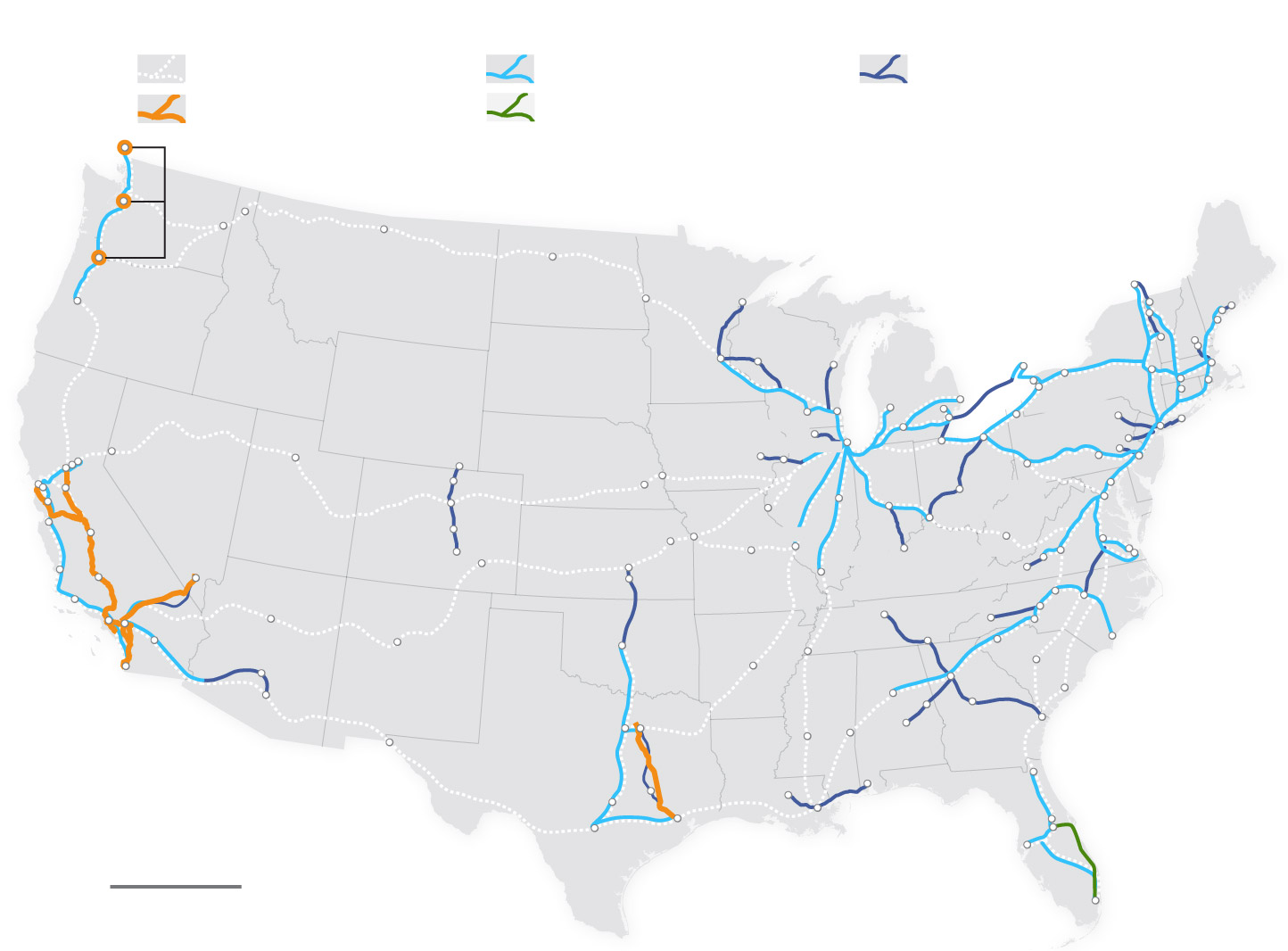
Amtrak service and high-speed rail proposals
Existing Amtrak service
Expanded Amtrak service
New Amtrak service
Brightline Florida
High-speed proposals
Vancouver
Proposed stations for high-speed Cascadia line
Seattle
Portland
Montreal
Duluth
Rockland
Eugene
Green
Bay
Boston
Toronto
St. Paul
Grand
Rapids
Scranton
Rockford
Reading
New York
Auburn
Iowa City
Cheyenne
Chicago
Columbus
D.C.
Denver
Cincinnati
St. Louis
Newport News
Las
Vegas
Roanoke
Pueblo
Newton
Louisville
Norfolk
Carbondale
Wichita
Asheville
Nashville
Los Angeles
Oklahoma
City
Wilmington
Phoenix
Atlanta
Birmingham
San Diego
Tucson
Dallas
Fort Worth
Savannah
Montgomery
Jacksonville
Baton
Rouge
Mobile
Austin
New
Orleans
Orlando
Houston
San Antonio
Tampa
300 MILES
Miami
The nation’s fastest train is Amtrak’s Acela, which tops 150 mph. New Acela trains are expected to reach 160 mph when they debut next year — still below the 186 mph considered high-speed in systems across the world.
Here are five U.S. projects that have boosted prospects for a high-speed rail system.
Amtrak’s Acela high(er)-speed trains
An Amtrak Acela power car and trainset on a test track at the Alstom production facility in Hornell, N.Y. (Heather Ainsworth for The Washington Post)
Proposed in 2011 | 28 train sets along 457 miles| $2.5 billion program
New higher-speed Acela trains will roll through the nation’s busiest rail stations beginning next year, representing a significant step toward America’s aspirations for modern, faster and more reliable intercity train service. The trains will overhaul passenger service in the busy Northeast Corridor, aiming to improve safety, rider comfort and capacity.
Notable: The new Acela fleet will reach speeds up to 160 mph at various stretches of the Washington-to-Boston route. Although not considered true high-speed, the Amtrak program will be faster than its current trains and include track improvements to reduce travel time.
The challenge: Despite capabilities for higher speeds,the 28 Avelia Liberty trains from French manufacturer Alstom will run slower than trains in other proposed projects across the country because Acela runs on conventional tracks shared with other intercity, commuter and freight trains.
Funding: The program is fully funded. Amtrak is using money from a $2.45-billion federal loan awarded in 2016 to help pay for the trains and infrastructure improvements.
Timeline: Originally expected to debut in 2021, the new trains have been delayed until 2024.
Brightline West
The Brightline West project calls for trains traveling up to 186 mph in the median of Interstate 15 between Las Vegas and Southern California. (Brightline)
Proposed in 2005 | 265 miles| $12 billion estimated cost
The electrified rail line would take travelers along the median of Interstate 15 between Las Vegas and Rancho Cucamonga, Calif., in 2 hours and 10 minutes. Trains would travel at 186 mph. Supporters say the system would remove about 3 million vehicles from the road and increase tourism between Nevada and California.
Notable: Brightline is the only private intercity passenger railroad in the United States. It is expanding its Florida service to Orlando, providing a rare intercity train connection at a major airport terminal and making the trip from Miami in three hours.
The challenge:The price tag for the Las Vegas-to-Southern California line keeps climbing. In the past year, the cost estimate went up by $3 billion, an increase that project officials partly attribute to inflation.
Funding:Brightline says it invested $600 million to bring the project to construction, and it’s seeking $3.75 billion in federal infrastructure funding to help cover about one-third of the project cost. A $25-million federal grant awarded in June will help to cover the design and construction of two stations in California. Project officials say the rest will be privately funded.
Timeline:Groundbreaking is possible before the end of 2023, followed by four years of construction and possible passenger operations in time for the 2028 Summer Olympics in Los Angeles.
California High-Speed Rail
Ironworkers construct the Conejo Viaduct, a 2,000-foot viaduct that will carry high-speed trains over an existing BNSF rail line and Conejo Avenue near Fresno, Calif. (Melina Mara/The Washington Post)
Proposed in 1994 | 500 miles | $128 billion estimated cost
Electrified trains traveling at 220 mph would take passengers between San Francisco and Los Angeles in less than three hours if California’s ambitious rail project comes to fruition. Eventually, the system could extend 800 miles to link to Sacramento and San Diego. Supporters say it would cut greenhouse gas emissions equivalent to taking 400,000 cars off the road every year.
Notable: This was the first high-speed rail system under construction in the United States. It’s the biggest investment in passenger rail since Amtrak’s creation more than half a century ago.
Share this articleShare
The challenge: Voters approved the project in 2008, but general support has waned as the price tag — originally estimated at $33 billion — continues to climb and the timeline keeps extending.
Funding: The project has $25 billion secured, including $3.6 billion in federal grants so far, with California paying 85 percent of the cost. The California High-Speed Rail Authority is seeking $8 billion in federal funding through the infrastructure law.
Timeline:The $35.3-billion Merced-to-Bakersfield stretch under construction is projected to be ready for passenger service between 2030 and 2033. Opening for the entire line will be dependent on funding availability, project officials say. The project originally envisioned trains operating between Los Angeles and San Francisco by 2030.
The Texas high-speed train
Rendering of the Dallas station. (Texas Central)
Proposed in 2013 | 240 miles | $30 billion estimated cost
Travelers would be whisked at speeds up to 200 mph from Dallas to Houston in 90 minutes. Proponents say the system would carry more than 6 million passengers by 2029 and save travelers in the booming corridor between an hour and 90 minutes in travel time, compared to driving.
Notable: The Texas project is eyed as a potential gamechanger for the industry. Advocates say it could change the political dynamic in Washington for high-speed rail if a Republican-led state delivers a project. Some conservatives — including in Texas — have been fighting high-speed rail projects, even turning down federal funding.
The challenge: Although the Texas Supreme Court cleared the way for Texas Central to use eminent domain, the company continues to face opposition and legal action from property owners in the path of the track. The company has been through management changes amid recent challenges, including little progress financing the project and acquiring property.
Funding: The project’s original $10 billion price tag climbed to $30 billion in recent years. Texas Central has sought $12 billion in federal loans to help fund the project. The company recently partnered with Amtrak to seek federal funding and develop the line.
Timeline:Outdated projections put construction beginning in 2020 and trains carrying passengers in 2026, but no recent estimates have been released.
Cascadia
Downtown Seattle. (Valentinaa Zhukova/Getty Images/iStock)
Proposed in 2017 | 413 miles | $24 billion to $42 billion preliminary cost
A system of trains traveling at speeds up to 250 mph would connect the metro areas of Vancouver, Seattle and Portland. Although it’s in the early phase of planning, backers say the rail line could spark $355 billion of economic activity over two decades within the region.
Notable: The Federal Railroad Administration has designated the corridor as among those with the highest potential for high-speed rail. A new rail line would provide complementary service to Amtrak’s Cascades route, which travels at top speeds of 79 mph.
The challenge: As planning advances, a governance structure that spans two states and two countries would need to be created to carry the project to construction. It would need to identify funding sources and acquire right of way for a route that would traverse urban areas, uneven terrain, major rivers and an international border.
Funding: The proposed line in the Pacific Northwest, which has support from Microsoft, is being envisioned as a possible public-private partnership. Microsoft has donated more than $500,000 for feasibility studies, and Washington state recently approved funding for additional analysis and development. Efforts are underway to apply for federal grants.
Timeline: A feasibility study five years ago projected an opening by 2035, although a federal environmental review could take years. Officials say “construction will not begin for quite some time.”
---
CA CoC ~ court loss
http://www.triplepundit.com/2017/04/californias-legislature-trying-extend-life-cap-trade-program/
==
april 2011
CNU
the time has come to candidly examine why President Obama’s high-speed rail proposal is in such terrible shape — and to figure out how passenger rail service could be expanded despite the serious recent setbacks. One leader well worth listening to is Bruce Babbitt — a thoughtful politician who was President Clinton’s Interior Secretary and, before that, governor of Arizona for nine years.
Babbitt let loose his frustrations last week, identifying himself as “an advocate of high-speed rail” who views what’s happened over the past year as “a complete catastrophe.”
“Ugh,” the 72-year-old Democrat groaned during an urban forum for journalists at the Lincoln Institute of Land Policy in Cambridge, Massachusetts. Said Babbitt: “It has, to put it mildly, been a total disaster.” Three libertarian or conservative organizations — the Heritage Foundation, the Cato Institute, and the Reason Foundation — have mounted what Petra Todorovich of the Regional Plan Association calls “a concerted attack on high-speed rail.”
With segments of the rail plan now cancelled in Florida, Ohio, and Wisconsin, and with some federal funding revoked by Congressional Republicans this month, Babbitt thinks we must approach rail planning much more strategically than the Obama administration did.
Of the president’s stated aim — provision of high-speed rail service to 80 percent of the American population in 25 years — Babbitt declared, “It’s fantasy.”
In his view, the Obama plan suffers from these critical flaws:
• Routes were poorly chosen. The Orlando-to-Tampa line — 84 miles mostly in an Interstate highway corridor — would have run from one city that’s “not a model of transit” to another city with the same transit deficiency. Said Babbitt: “Frankly, it’s not surprising that the governor of Florida [when offered 90 percent of the funds to construct the line] turned it down.”
• Goals were defined vaguely. They were not hammered out through extensive discussion and political brokering — activities essential, in Babbitt’s judgment, to the program’s success.
• “The president didn’t help his visionary statement by holding up the transcontinental railroad as a model.” One-hundred-forty million acres were distributed to railroads through that post-Civil War enterprise, which led to the Crédit Mobilier scandal — “one of the largest government-sponsored fraudulent ventures of all time.”
A better way
Rail proponents should emulate not the transcontinental railroad but rather the Interstate Highway Act of 1956, Babbitt believes. Like today’s high-speed rail initiative, the interstate highway proposal initially received a hostile reception in influential quarters. “The governors were largely opposed,” Babbitt said. Most came out against a raise in the gasoline tax or in excise taxes.
Ultimately, the highway act owed its passage to “a lot of discussion, brokering, setting goals,” according to Babbitt. Negotiation over where the highways would be built “took place ahead of the act.” The same should hold true for any far-reaching rail program, he thinks.
“Let’s start with something realistic, where the payoffs will be most real,” Babbitt urged. The nation’s biggest megaregion, the dense corridor from Boston to Washington, already “carries one-third of Amtrak’s traffic,” making it, in his view, a logical place to demonstrate that high-speed rail can work.
The biggest difficulty, he indicated, is that high-speed rail requires a dedicated form of financing. Would the country as a whole be willing to pay for a system serving seven or so states? That’s highly unlikely, said Babbitt. “There are 43 states that will say no to an earmarked tax.”
The way to overcome that obstacle is by establishing a gasoline tax that would be paid by residents of the Northeast corridor states, he argued. “That’s the lesson of the Interstate Highway Act. We need to get back to dedicated user fees. It should be focused on regional users.”
Jerold Kayden, a Harvard professor of urban planning and design, asked why the governors of those states couldn’t get together and work out a deal themselves. “I was a governor,” Babbitt reminded Kayden. “This rail corridor is not going to work with seven governors [actually, probably eight or nine, plus the District of Columbia] going their own way.”
In the case of interstate highways, “Babbitt maintained, the only way we got clarity was through federal legislation,” and that’s the only way to nail down a high-speed program for the Eastern seaboard.
“It’s not going to happen this year,” he acknowledged, but it can be done, he thinks, if there is “a clear purpose,” if the leaders “strip the discretion out” of the legislation, and if they “do it through the political process.”
(California has one advantage on high-speed rail, he noted. Its line would be within a single state, and thus not in need of federal legislation. However, he added, California “should link its program with a revenue source.”)
Megaregions would benefit
Babbitt spoke on Friday in the two-day forum sponsored by the Lincoln Institute, the Nieman Foundation for Journalism at Harvard, and the Harvard Graduate School of Urban Design. The next day, Petra Todorovich, director of America 2050, the New York-based Regional Plan Association’s initiative to develop a national infrastructure and growth strategy, argued that high-speed rail does in fact make sense in America’s largest megaregion.
“We do approach European densities in megaregions” such as the Boston-to-Washington corridor, said Todorovich. Megaregions — there are about 10 of them around the country, including the Great Lakes, the Texas Triangle (Houston-Dallas-Austin-San Antonio), the Front Range of the Rocky Mountains, and Cascadia (Portland-Tacoma-Seattle) — contain 75 percent of the nation’s population and are key to America’s economic growth, she emphasized.
“China is greasing the wheels for its national economy” by building an extensive high-speed rail system, she said. The US should pursue better rail service for three reasons, she argued:
• “It boosts the productivity of service and knowledge-sector workers.”
• “It deepens labor markets for businesses, and broadens the employment pool for workers (more worker housing options)."
• “It fosters economic synergies among specialized industries (agglomeration economies)” such as health care, database management, pharmaceuticals, and research and development/biotech.
Like Babbitt and like Rep. John Mica, the Florida Republican who chairs the House Transportation and Infrastructure Committee, Todorovich thinks “we ought to invest first in the places with the greatest ridership ... the greatest chance of success.”
That strategy favors the Northeast Corridor, which has been the subject of three recent studies — a Northeast Corridor Infrastructure Master Plan prepared in May 2010 by representatives of 12 states, Amtrak, and other entities; a separate Amtrak design report; and a University of Pennsylvania study that was presented to no less than Vice President Joseph Biden.
The Northeast, Todorovich thinks, needs to come to a consensus on whether it wants a dedicated high-speed route and where it should be. New rights-of-way will probably have to be acquired. There isn’t enough room for high-speed rail in parts of the existing Amtrak corridor.
The existing corridor has a backlog of $8.8 billion in needed repairs. By 2030, investment to meet growing demand should total $52 billion — and that’s just in the existing corridor, without any dedicated high-speed tracks, Todorovich said.
She suggested three potential revenue sources for high-speed rail — a penny on the gasoline tax, a passenger rail surcharge of $1, and a 1 percent foreign oil import tax — which together could generate approximately $5.4 billion a year across the country. The revenue would be lower if those charges were imposed only in the Northeast.
On the bright side, she noted that Rep. Mica has been bringing members of his committee — some of whom represent rural areas — to urban locales to improve their understanding of passenger rail networks and the places they serve. Babbitt’s proposal for a Northeast-focused federal rail act is “a great idea,” she said, adding that it “would have to be matched by federal funding.”
Where the stations go
There are now one to two trains an hour between New York and Washington. That could rise to 8 to 10 per hour, Todorovich said. Some cities could gain tremendously from faster access to major centers. “Hartford would suddenly be 45 minutes to New York City,” she said.
Certain stations would have to move or be supplemented by additional locations. Baltimore’s main service would move from Penn Station, well north of downtown, to the Charles Center, she suggested. Philadelphia would add service at Market East, which is closer to Center City destinations than is the existing 30th Street Station.
To obtain the maximum benefits from better rail service, “there needs to be a concerted strategy around stations,” Todorovich said. “It works best in center cities.”
Resistance from the Right
Ambitious rail plans have been subjected to a fierce campaign of disparagement in recent months. The Heritage Foundation, the Cato Institute, and the Reason Foundation have worked particularly hard to defeat the Obama rail plan, Todorovich told the gathering of about 30 journalists from around the country.
For companies that profit from the highway system and automobile-reliant means of transportation, the libertarian or conservative foundations have proven to be useful torch-bearers. SourceWatch, part of the Center for Media and Democracy, reports that Ford Motor, General Motors, DaimlerChrysler, ExxonMobil, Chevron, Shell Oil, and theWestern States Petroleum Association have been among the donors to the Reason Foundation. David H. Koch of Koch Industries, once described by the Center for Public Integrity as "the biggest oil company you have never heard of," is a Reason trustee.
SourceWatch says Chevron, ExxonMobil, and the auto-maker Honda have been among Heritage’s contributors, though corporate donations to Heritage are small when compared than those made by individuals and foundations. Over the years, Heritages backers in the foundation world have included the Charles G. Koch Charitable Foundation, the Walton Family Foundation, and three Scaife foundations.
Cato, founded by Edward H. Crane and Charles Koch, has over the years received donations from corporate supporters including the American Petroleum Institute, ExxonMobil,General Motors, Honda North America, Toyota, Volkswagen of America, and Wal-Mart Stores, according to SourceWatch.
Nonetheless, Todorovich thinks rail projects can gain considerable support from the populace and some of it from Republicans who hold elective office. After the new governor of Florida, Rick Scott, rejected $2.4 billion in federal funds for the Orlando-Tampa rail route, 24 states, including 11 with Republican governors, applied for portions of the money that Florida gave up.
Debunking high-speed rail myths
It can be hard for most people to get a handle on the pros and cons of high-speed rail. Consequently, on April 13, CNN.com asked lawmakers and rail experts to answer CNN users' questions about high-speed rail. Among the questions, comments, and expert replies were these:
A CNN user:"There are NO high speed rail projects in the world that are profitable. None. They are all taxpayer/government subsidized."
Expert response: "Not necessarily true."
Robert Puentes** at the Brookings Institution: "The Acela Express, Amtrak's high speed rail service along the Northeast corridor, has shown a positive return from its New York-to-D.C. route. ... And it's not fair to just point the finger at high speed rail. Highways and other modes of transportation, like the airlines, are heavily subsidized, too."
Reps. John Mica and Rep. Bill Shuster, R-Pennsylvania, chairman of the Subcommittee on Railroads, Pipelines and Hazardous Materials: "While many high-speed rail systems in the world rely on a government subsidy, this in no way means that rail operations cannot be profitable. ... Private rail operators in Great Britain, such as South West Transport and Virgin Rail, compete for franchise intercity rail service contracts and regularly generate a profit. Rail routes in Japan and France turn a profit. ... Rather than relying on the federal government and Amtrak to operate profitable passenger rail, we must put the focus on the private sector to develop and operate self-sustaining, profitable passenger rail in parts of the country where it makes sense."
CNN user: "The cost to build highways actually exceed rail costs."
Expert response: It depends.
Philip Longman, senior research fellow, New America Foundation: "... in hilly or mountainous areas, building a rail line may require more earthmoving, including tunneling, than building a highway. But this consideration doesn't apply on flatter terrain, and in almost all instances, a rail line can move as many or more people than a highway using a much narrower right-of-way. Because of this, building a rail usually involves far less condemnation of private property than building an Interstate. ... Also, advances in the use of computers to control train movements are now allowing us to run many more trains on the same track than in the past. This is further adding to the cost advantage [of] rail."
CNN user: "History shows that investment in infrastructure results in economic growth in the future."
Expert response: "That’s true."
Longman: "One of the biggest and often overlooked advantages of high speed rail, and even of not-so-high-speed rail, is its ability to restore the economic promise of many mid-sized cities where airline service is no longer available or prohibitively expensive.”
CNN user: “You know that these projects (like high-speed rail) never end at or under budget."
Expert response: “Not true.”
Puentes: "It's not true to say these projects are always over budget since we have no high speed rail in the country currently. ... This kind of transparency [in the federal stimulus package] is very helpful to prevent enormous overruns...."
Expert response: “The reader is correct.”
Reps. Mica and Shuster: "In the past, many of America's transportation projects have run over cost and over budget. ... The reason for this can largely be found in the cumbersome manner in which federal transportation projects are advanced. The Transportation and Infrastructure Committee has received testimony that simply adding one federal dollar to a transportation project adds 14 years to the delivery time. This is unacceptable and it inflates project costs unnecessarily."
Expert response: Proper spending ensured.
Undersecretary Roy Kienitz, US Department of Transportation: “These projects help build the economy. According to a study by the U.S. Conference of Mayors, a high-speed rail line to Los Angeles would create as much as $7.6 billion a year in new business sales, producing up to 55,000 new jobs and $3 billion in new wages. In Chicago, high-speed rail would produce up to $6.1 billion in yearly sales, 42,000 new jobs, and $2.5 billion in new wages for workers."
From Reps. Mica and Shuster, some encouraging final words: “Today, businesses and commuters lose $115 million each year in wasted time and fuel and spend four billion hours per year stuck in traffic. 60 percent of the urban road miles of Interstate 95 are heavily congested. 70 percent of our nation's chronically delayed flights originate in the New York-New Jersey airspace. There is simply no more effective way to alleviate congestion of our roads and airways and get people to their destinations than rail."
===
Hearing
When Unlimited Potential Meets Limited Resources: The Benefits and Challenges of High-Speed Rail and Emerging Rail Technologies
2167 Rayburn House Office Building and online via videoconferencing
f t # e
0 Thursday, May 06, 2021 @ 11:00 | Contact: Justin Harclerode 202-225-9446
This is a hearing of the Subcommittee on Railroads, Pipelines, and Hazardous Materials.
Official Transcript
Witnesses:
Panel I
The Honorable John Porcari, Former Deputy Secretary, United States Department of Transportation | Written Testimony
Ms. Rachel Smith, President and Chief Executive Officer, Seattle Metropolitan Chamber of Commerce | Written Testimony
Mr. Phillip Washington, Chief Executive Officer, Los Angeles County Metropolitan Transportation Authority | Written Testimony
Ms. Danielle Eckert, International Representative, International Brotherhood of Electrical Workers | Written Testimony
The Honorable Carbett “Trey” Duhon III, Judge, Waller County, Texas | Written Testimony | Appendix - Texas Central's High-Speed Rail Project at a Glance
Mr. Andy Kunz, President and Chief Executive Officer, U.S. High Speed Rail Association | Written Testimony
Panel II
Mr. Carlos Aguilar, President and Chief Executive Officer, Texas Central High Speed Rail | Written Testimony
Mr. William Flynn, Chief Executive Officer, Amtrak | Written Testimony
Mr. Josh Giegel, Chief Executive Officer and Co-Founder, Virgin Hyperloop | Written Testimony
Mr. Andres de Leon, Chief Executive Officer, Hyperloop Transportation Technologies | Written Testimony
Mr. Michael Reininger, Chief Executive Officer, Brightline Trains | Written Testimony
Mr. Wayne Rogers, Chairman and Chief Executive Officer, Northeast Maglev | Written Testimony
Opening remarks, as prepared, of Subcommittee on Railroads, Pipelines, and Hazardous Materials Ranking Member Rick Crawford (R-AR):
Thank you, Chair Payne, for holding this hearing, and thank you to our witnesses for participating today. Today’s hearing will discuss the state of high-speed rail and other emerging technologies in our U.S. passenger rail networks.
Investments and innovation in our rail infrastructure are essential to building a robust and competitive American transportation system. However, we must ensure that any federal policies and funding are balanced with a realistic analysis of the needs, consumer demand, and best use of taxpayer dollars.
There is no better example of these important factors not being properly considered than the California High-Speed Rail project that was originally proposed to run between Los Angeles and San Francisco.
The venture, once estimated to cost $33 billion and be completed in 2020, is now projected to cost over $100 billion, with an estimated completion date still over a decade away.
The project has been plagued by a failure to account for actual costs and work associated with obtaining land to build the track, eminent domain, environmental concerns, and whether low consumer demand will require permanent government subsidies to support the line.
While the California High-Speed Rail project shows the failures of poor planning, there are promising opportunities for the federal government to foster new rail technologies that are fiscally responsible and respond to the needs of consumers.
The federal government should look to leverage successful existing programs that support our rail system, such as funding the CRISI and Section 130 grant programs.
The private sector also plays an important role in growing our rail network, and we will hear from witnesses about those promising efforts.
I look forward to discussing both the challenges and the opportunities of new rail transportation and technology, as well as how Congress can provide robust oversight and safeguard taxpayer dollars that support these projects.
---
---