Mass Transit
wow appears to be orphan category
MERRI OK
me vs we? car is manly icon/totem/fetish necessity like red meat?
SEE HIGH SPEED RAIL CA
any examples where auto or energy lobbyists killed it?
---
---
---
AN 9 25 GRIST
Seventeen years ago, Californians bet on a grand vision of the future. They narrowly approved a $10 billion bond issue to build a high-speed rail line that would zip between San Francisco and Los Angeles in under three hours. This technological marvel would slash emissions, revitalize the state’s Central Valley, and, with some financial help from the feds and private sector, provide the fast, efficient, and convenient travel Asia and Europe have long enjoyed.
State officials promised to deliver this transit utopia by 2020. Instead, costs have more thandoubled, little track has been laid, and service isn’t expected to begin before 2030 — and only between Bakersfield and Merced, two cities far from the line’s ultimate destinations.
It’s little wonder the project finds itself in a precarious financial position, fighting political headwinds, and deemed a boondoggle by everyone from federal Transportation Secretary Sean Duffy to Abundance authors Ezra Klein and Derek Thompson. “In the time California has spent failing to complete its 500-mile high-speed rail system,” they wrote, “China has built more than 23,000 miles of high speed rail.”
The reasons for this vary with who’s being asked, but people with expertise often cite three fundamental missteps: creating a new agency to lead the effort, failing to secure adequate funding from the start, and choosing a route through California’s agricultural heartland. The state’s strict environmental review process hasn’t helped, either.
Such struggles are not unique to the Golden State, where support for the project remains strong. Although the private sector venture Brightline has seen some success, publicly funded high-speed rail efforts in Texas, Ohio, Washington, D.C., and beyond have stalled. Regulatory complexity, a political environment that favors cars and highways, and constant funding challenges stymie America’s aspirations even as other countries have spent big on tens of thousands of miles of track. Governor Gavin Newsom promises to see the nation’s most ambitious rail project through despite recently losing all federal support, but its troubled path underscores the systemic challenges of building big in America.
California has always been a car-crazy place, and by the early 1990s, transportation studies made clear that its highways would not keep pace with the growth to come. Policymakers saw an answer in bullet trains. The Legislature established the California High-Speed Rail Authority in 1996 and gave it the tough job of planning, designing, building, and running the system.
Some consider that a mistake because the agency lacked experience managing so big a project and navigating complex bureaucracy. Even some rail supporters concede it would have been better to let the authority provide oversight and leave the heavy lifting to the state Department of Transportation, or CalTrans. “It’s building a lot of overpasses and right-of-way, which Caltrans does all the time,” said Ethan Elkind, director of the University of California, Berkeley climate program in its Center for Law, Energy, and the Environment.
Without that experience, the authority’s 10 employees relied heavily on consultants like engineering firm WSP, running up expenses. “We paid WSP and their predecessor more than $800 million in consulting fees,” said Lou Thompson. He chaired the High Speed Rail Peer Review Group, established in 2008 to provide project oversight, from 2012 until 2024. The authority has in recent years eased its reliance on consultants, who reportedly have gone from 70 percent of its workforce to 45 percent over the past seven years.
Once the High-Speed Rail Authority set up shop, work proceeded in fits and starts. Even as it considered routes and started the myriad bureaucratic tasks the project required, political interest waxed and waned with the state’s fiscal health. Skeptics lamented the cost and questioned whether bullet trains would attract enough riders to be worthwhile. But rail advocates, environmentalists, unions, and others kept pushing forward and in 2008 convinced voters to approve Proposition 1A, securing $10 billion to finance construction.
It was never going to be enough — at the time, the cost was pegged at $45 billion, a figure that did not account for inflation — and funding has been a challenge from the start.
Still, the Obama administration saw an opportunity to show that the economy was bouncing back from the Great Recession. The federal American Reinvestment Recovery Act provided $3.5 billion to help get things started. The authority, which had already mapped a route through the Central Valley, soon began grading land, moving utilities, and taking other steps toward construction of the first leg, a 119-mile stretch from Bakersfield to Madera.
Things chugged along until 2013, when a state judge blocked the use of Prop 1A funds, ruling that some of the work did not meet the rules for bond expenditures. With federal support contingent upon the state’s cash, the federal grants had to be renegotiated — before they expired in 2017. “We were literally sitting there saying, ‘Well, if we don’t start going, we could lose $700 or $800 million of the federal money,” said Dan Richard, who was the High-Speed Rail Authority’s board chair from 2011 until 2019. That prompted the agency to do something no one wanted to do: Move forward without having acquired all of the necessary land. So it did.
Then President Donald Trump took office. He seemed interested in what California was attempting to build, having lamented that China and Japan “have fast trains all over the place” while the U.S. relies upon “obsolete technology.” His opinion soured when Gavin Newsom became governor in 2019 and the two sparred over the president’s policies. Trump later canceled nearly $1 billion in federal funds for the rail project.
The Biden administration restored it and provided another $3.1 billion from the Infrastructure Investment and Jobs Act. The infusion was to help build a station in Fresno and acquire trains for testing. Even with the windfall California remained at least $7 billion short of what it needed for the first short run through the Valley. The situation grew worse in July when Trump rescinded the entire amount after the Federal Railroad Administration said it saw no way of covering that shortfall and no path to completion by 2033.
Newsom said the move “reeks of politics” and the state is suing. But the impact goes beyond California by establishing a precedent to cancel projects at will. “How do you go to your voters and say, ‘Put up the money. We expect 50 percent federal share,’ without knowing that the next administration could turn around and say, ‘I don’t like that project,’” Richard said.
The High-Speed Rail Authority initially planned to rely upon state, federal, and private sector funding in equal measure, but California has provided 75 percent of the $14.6 billion spent so far. The authority wrote in a letter to the Railroad Administration that Newsom’s plan to allocate $1 billion, pulled from the state’s cap-and-trade program, toward the project each year for 20 years will be enough to finish the Central Valley segment. The governor also recently signed a bill requiring the authority to update its estimate on the funding gap for that leg of the journey.
With California seemingly on its own, Thompson said the project needs an income stream approaching $5 billion per year to build everything. That is one reason the authority in June asked the private sector and financial institutions to weigh in on the chance of public-private partnerships. Its CEO Ian Choudri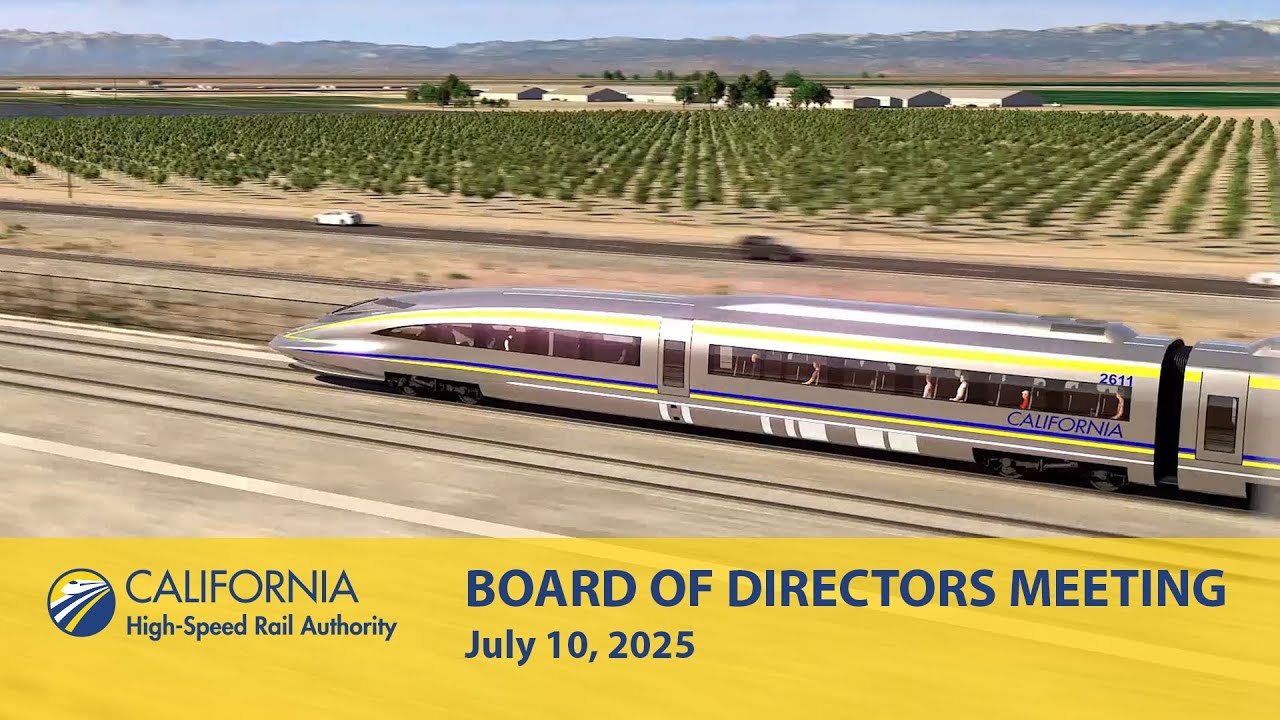 private investors have shown “extreme interest.” VID]
Thompson isn’t buying it. “My opinion is that that is hot air,” he said. The way he sees it, no one’s going to invest until they can see that there is demand for the rail line.
One of the reasons Brightline is held up as an example of how to bring high-speed rail to the United States is its strategy includes building on public land. Part of its 235-mile line between Miami and Orlando stands on land owned by Florida East Coast Railway. The company’s planned run between Las Vegas and L.A. will largely follow Interstate 15.
California could have done the same and built along I-5, which bisects the Central Valley, but chose to go through major population centers 20 to 50 miles to the east. That pivotal decision increased the project’s cost and complexity. Following the freeway would have been straighter and flatter, without the elevated track, tunnels, and other infrastructure needed to traverse cities. The route also turned a state effort into a regional development project beset by local politics.
The High-Speed Rail Authority had good intentions, however. It hopes that bringing rail to places like Merced and Bakersfield might entice Silicon Valley and Los Angeles firms to open offices in the Central Valley, which would be a 90-minute ride from their headquarters. It also would boost local economies left behind by the state’s boom — and it has, to some extent. The project has added 11,000 construction jobs to the region. But that exacted its own toll.
“Those economic benefits have been really substantial, so that sort of worked, but it came at potentially the cost of not being able to build the system at all, because by starting it in the Central Valley they’ve basically blown all the money there,” said Elkind of the UC Berkeley Climate Program. Should the state once again ask voters for money, it would have had a stronger case if initial construction had occurred in major population centers, he said.
The route also created additional hurdles as the project navigated California’s environmental oversight rules. Going through several cities and all that farmland increased the number of stakeholders who had to be consulted, ballooning the environmental review process.
To be fair, the California Environmental Quality Act, or CEQA, has long protected the state’s rich biodiversity. But some rail proponents argue it has been used to stymie progress. High-Speed Rail Authority data shows it has spent more than $765 million on environmental review. Lawsuits stemming from CEQA can be particularly expensive. “If you have a $100 billion project, and let’s say that interest rates are 3% a year, every year’s delay costs you $3 billion,” Thompson said. “A $50,000 lawsuit can delay you for a year, and so there’s an enormous pressure on you to try to bargain your way out of these kinds of situations.”
California recently loosened CEQA requirements for the rail system’s maintenance facilities and stations, a move Newsom cheered. “These are very targeted exemptions that will help cut red tape and deliver on California’s vision of high-speed rail without compromising environmental protections,” gubernatorial spokesperson Daniel Villaseñor wrote in an email.
Whether that reform has an impact remains to be seen, because most of the environmental review is already completed. And regulation was never the project’s biggest problem. “It just seems like the easy, obvious answer,” said Hana Creger, associate director of climate equity at The Greenlining Institute. “But I think these things are a lot more complex.”
Given all of this, it can be easy to lose sight of what progress has been made. The authority is quick to note that 463 miles of the 494-mile system has cleared the environmental review process and is “construction ready.” It also boasts of having laid 70 miles of guideway — meaning track, elevated structures, or other riding surface — and erected 57 structures. All told, the project has created more than 15,500 jobs since its inception.
Despite the challenges, Newsom remains steadfast in his determination to see Californians one day riding the trains they were promised so many years ago.  ,” he said in May. “That’s our commitment.” That will surely resonate with his constituents; recent polling shows 62 percent of voters believe the state should continue financing the project, though opinions split sharply along partisan lines. Still, experts caution that support isn’t enough. Tangible progress and credible funding streams are essential to maintain momentum.
The High-Speed Rail Authority seems to understand this and is pressing ahead to connect Bakersfield to either Merced or Gilroy. There’s a lot to do before crews start laying track, but the goal is to finish that run by 2032 and the authority recently opened the bidding process to begin installing track next year. Looking further ahead, its latest plan, released late last month, calls for extending the line south to Palmdale by 2038, putting it within 80 miles of San Francisco and 40 miles of L.A. at a cost of $87 billion. “While challenges remain, so too does the potential to deliver a modern transportation system worthy of the state’s ambitions — one that reflects the scale, complexity, and promise of California itself,” Choudri wrote in the plan. “Let’s go build it.”
Assuming the project retains its $4 billion federal grants, the project has $29 billion available, with an additional $15 billion from Newsom’s proposal, according to the CHSRA. Thompson said the governor’s proposal, which would set aside $1 billion every year for the project, should keep it alive for the next four years. Beyond that, it will need an infusion of cash, likely from voters but possibly from a future presidential administration. “I think the path forward is that they could show some first segment success and then go back to the voters,” Elkind said. “You just got to get through this first era here, and get something built that they can show to the voters.”
Ultimately, California’s high-speed rail is more than a train line; it is a test of the nation’s ability to deliver transformative infrastructure. Its path forward remains uncertain, but every mile of track laid could lead to a turning point — not just for the state, but for the broader goal of building the kind of transportation network other countries take for granted.
This article originally appeared in Grist at https://grist.org/transportation/billions-spent-miles-to-go-the-story-of-californias-failure-to-build-high-speed-rail/.
Grist is a nonprofit, independent media organization dedicated to telling stories of climate solutions and a just future. Learn more at Grist.org
---
pro mass transit
The speech reflected the president’s broader approach. Carter had been committed to alternative energy(at least, alternatives to oil and gas; he supported nuclear and coal) right from the start. At his inauguration in 1977, the reviewing stand was heated by approximately 1,000 square meters of solar thermal panels. Later, he became the first president to install solar panels on the White House (these first ones provided hot water for the cafeteria, the laundry, and the family quarters).
His administration vastly increased the budget for energy technology research and development to levels not equaled for another 30 years, until Barack Obama’s stimulus bill. He instituted the first tax credits for installing wind turbines and solar power, and set the goal of deriving 20 percent of U.S. energy needs from renewables by the millennium (so far we’ve made it to 9.4 percent).
---
Now let’s do this everywhere’: Kansas City, Missouri approves free public transit for all
Lawmakers in Kansas City, Missouri took a “visionary step” on Thursday by unanimously voting to make public transportation in the city free of charge, setting the stage for it to…
==
---
win
August 28, 2019
---
==
Germany launches world’s first hydrogen-powered train
==
==
red state govs gave back stimulus $
b/c it's collective- ism? or just bought off by FF?
---
---
https://www.ecowatch.com/koch-fueled-attack-on-electric-buses-2598163369.html
Koch-Fueled Attack on Electric Buses Picks Up Speed
By Dana Drugmand
Electric buses are replacing existing diesel-fueled fleets at an accelerating rate, and the transition to battery-powered buses is outpacing even the most optimistic projections. In this light, it should come as little surprise that commentators and organizations with ties to the Koch network and the oil industry are attacking a transportation option that yields fewer fossil fuel profits and cleaner, healthier air for people and planet.
A string of recent commentaries published in the conservative Washington Examiner have relied on a handful of critical reports about the rollout of electric buses in individual municipalities, which the commentators use to portray electric buses, as a class, as uneconomical and unreliable.
Despite these efforts by Koch affiliates and oil industry consultants, the electrification of bus transit is firmly underway. These high tech buses are already being widely deployed throughoutChina, which, according to Bloomberg New Energy Finance (BNEF), is adding about 9,500 electric buses every five weeks. As China leads the way and North American and European municipalities follow suit, analysts expect this momentum to accelerate and predict 80 percent of the global municipal bus fleet to be electric by 2040.
That is bad news for the oil industry. Bloomberg New Energy Finance forecasts that switching from internal combustion engine transport to electric vehicles will displace 7.3 million barrels of oil a day.
According to Bloomberg, this year electric buses already will lower diesel consumption by 233,000 barrels a day.
Who's Behind a Series of Drive-by Attacks on Electric Buses in the Washington Examiner?
As more cities and states move toward this electrified mass transit option, it cuts into the demand for conventional diesel fuel—and into fossil fuel industry profits. A Washington Examiner article from Dec. 12, 2017 explores the rise of electric vehicles with a particularly telling headline: "Rise of electric vehicles threatens oil industry."
More recently, the Washington Examiner has run a series of opinion pieces criticizing electric buses. The main arguments are that they are expensive and unreliable, prone to breaking down. These pieces share arguments, and their authors share affiliations, with the Koch brothers and other oil industry funders.
For example, one commentaryby Philip Wegmann looks at a new electric bus fleet on Martha's Vineyard, pointing to the cost of the vehicles and the fact that they experienced technical problems early on. The piece neglects to mention any benefits of these buses to the environment or public health, nor does it reference the fact that the Vineyard Transit Authority's slow rollout of the buses was expected and that they plan on doubling the size of the electric fleet by next summer.
Wegmann has been closely tied to the Koch network since the beginning of his career. He started his writing career as a fellow of the Koch's America's Future Foundation writing program. Wegmann is currently a fellow at the Steamboat Institute, a right-wing think tank affiliated with the Koch-backed State Policy Network. This year, he was awarded the Steamboat Institute's Tony Blankley fellowship, which came with a $10,000 stipend and a host of other benefits.
Prior to joining the Examiner as a staff writer, Wegmann worked for conservative media outlet The Daily Signal, which is published by the Koch network-funded Heritage Foundation and which also features work by fellow America's Future Foundation alumnus Michael Bastasch.
Another Examiner piece by Wegmann slams electric buses in Los Angeles. "They don't run, they are expensive, and they're Chinese," Wegmann wrote. LA's neighbor Santa Monica is also converting its buses to electric, and Wegmann again attacks that move in another commentary. He again played the cost card, and claims, without statistical evidence, that "basically no one" rides the new buses.
Wegmann continues to rail against the electric bus in the Examiner, as recently as last week commenting on Atlanta, Georgia's purchase of a fleet from the Chinese company Build Your Dreams (BYD). "One expects cities like Albuquerque and Los Angeles to drop millions on the novelty environmental fleets, not a deep red state in the South that traditionally votes Republican and cares more for business than green pipe dreams," he writes.
Ross Marchand echoes this criticism in another Examiner opinion piece. Marchand is director of policy for the Taxpayers Protection Alliance, which is basically a front group funded in part through Koch-connected channels. Previously Marchand interned for the Texas Public Policy Foundation and the American Legislative Exchange Council (ALEC), both part of the Koch network.
Marchand's argument is primarily based on expense, but he even claims that electric buses could "prove dirtier than conventional fleet depending on which energy sources America relies on in the future." He backs that statement with a link to a piece by Jonathan Lesser, president of the consulting firm Continental Economics. Lesser has an antagonistic record towards clean energy policies, and he has "submitted expert testimony and reports on behalf of major utility and fossil fuel interests like Exelon, Occidental, Duke Energy, and FirstEnergy," according to the Energy and Policy Institute.
Lesser is also frequently contracted by the Manhattan Institute, a think tank that has received millions of dollars in funding from foundations in the Koch donor network.
Electric Bus Myths, Debunked
The claims laid out by electric bus antagonists use limited views and dog whistles of "communism" and "environmental zealotry" to attack the electric vehicles, especially when compared to "cleaner natural gas-burning buses." The unreliability argument is backed, for instance, by an investigative story in the LA Times from May that looks at problems with range and quality encountered by the Chinese e-bus manufacturing company BYD.
The Times article raises legitimate concerns about the products delivered by BYD, and the company responded with a statement saying that glitches are to be expected with "any groundbreaking technology." However, the article referred only to BYD buses, and not the electric bus industry as a whole.
"That was an article about a company, but the headline was about a category," Ryan Popple, CEO of electric bus maker Proterra, told GTM. "I hope that people don't paint a broad brush over the whole category." While the BYD buses struggled on hills—a major focus of the LA Times article—competitor Proterra's electric buses have been tested, for instance, in the mountains around Park City, Utah, to the satisfaction of local municipal transit planners, who ordered six units to serve the local bus routes.
Had he wanted, Wegmann could have looked even closer to find a counterpoint to the problematic BYD buses in Los Angeles. Foothill Transit, which serves 22 cities from downtown LA to the east, first tested Proterra buses in 2010 and is still using them.
"The technology is very robust," Doran Barnes, Foothill's executive director, told the Seattle Times. "We've had very few problems." Foothill Transit now operates 17 Proterra electric buses, and recently ordered 13 more, including a new set of all-electric double decker buses. Foothill Transit has pledged to serve its hilly region with an exclusively electric fleet by 2030.
So despite the early performance and mechanical issues from at least one manufacturer, as these issues are resolved and technology continues to improve, municipal transit authorities across the U.S. continue to order more of the buses from BYDand other major electric bus manufacturers like Proterra and New Flyer.
As for the cost argument, it is true that electric buses cost more up front than their diesel-powered counterparts. However, those costs are falling, and when considering the entire life cycle of the vehicle—purchase price, fuels, operational and maintenance expenses—electric buses prove to be cheaper than their diesel counterparts.
Moreover, according to BNEF, the projected decline in battery costs likely make electric buses cost-competitive with diesel at the point of purchase by 2026. By then, the number of electric buses on the road is expected to more than triple and make up nearly half of the worldwide city bus fleets.
There are solid reasons behind this trend.Electric buses are better for public health (reducing local air pollution from burning diesel), better for the climate (increasing efficiency and reducing reliance on fossil fuels), and make economic sense in terms of their full cost of moving passengers, when factoring in maintenance and fuel cost-savings. These various benefits are explained in a May 2018 report from U.S. PIRG and Environment America.
In terms of public health, there is no question that electric is better. Diesel exhaust is classified by the U.S. Environmental Protection Agency (EPA) as a likely carcinogen, and it is internationally recognized as a cancer-causing agent that is also responsible for respiratory and other illnesses. Chicago estimates that its electric buses will result in $55,000 in healthcare savings annually per bus, while a Columbia University analysis for New York City pegs it at $150,000 per bus.
Another obvious benefit of shifting from diesel to electric buses is the reduction of greenhouse gas emissions in the transportation sector. In the U.S. alone, converting transit buses to electric could save over 2 million tons of emissions each year, a clear win for the climate.
Electric buses also have lower operating and maintenance costs. As with other electric vehicles, there is no fuel cost. Chicago Transit Authority estimates it saves $25,000 annually in net fuel costs for each bus.
Furthermore, the U.S. PIRG report states that:
"According to studies of electric buses currently in operation, electric buses save at least $0.19 per mile in lower maintenance costs. Over the lifetime of the bus, an electric transit bus can avoid hundreds of thousands of dollars in operating costs over an equivalent diesel or natural gas bus, from lower fuel and maintenance costs."
While the e-bus costs more upfront, the fuel and maintenance cost-savings make up the difference, usually within 10 years.
Improved models and better battery technology are moving toward solving reliability issues, too. The newer electric bus models apparently can travel up to 200 miles or more on a single charge. Proterra makes e-buses designed to go 200 to 350 miles, for example. Electric buses also have fewer parts than diesel buses, which would theoretically require less maintenance.
Given these considerations, many cities are now announcing transitions to electric bus fleets. New York City announced in April its plans to electrify its fleet by 2040. Los Angeles is committed to an entirely zero-emissions fleet by 2030. Seattle is purchasing 120 e-buses by 2020 and has committed to electrifying its entire fleet by 2040.
Electric buses are moving toward the mainstream, despite attacks from oil industry apologists.
==
==
https://www.ecowatch.com/koch-brothers-public-transit-2579462053.html
Koch brothers are pouring money into grassroots state efforts to defeat public transit proposals, The New York Times reported.
Local chapters of Koch advocacy group Americans for Prosperity have worked in at least seven states since 2015 to sway voters against public transit proposals, with some notable successes: the group was partially responsible for the defeat of a popular light rail and bus improvement plan in traffic-choked Nashville this May, after making more than 42,000 phone calls and knocking on 6,000 doors.
Koch Industries is deeply embedded in the automobile industry, and the group has also launched attacks on electric vehicles in recent years. "Stopping higher taxes is their rallying cry," Ashley Robbins of Virginia Tech told The New York Times. "But at the end of the day, fuel consumption helps them."
As reported by The New York Times:
"Supporters of transit investments point to research that shows that they reduce traffic, spur economic development and fight global warming by reducing emissions. Americans for Prosperity counters that public transit plans waste taxpayer money on unpopular, outdated technology like trains and buses just as the world is moving toward cleaner, driverless vehicles.
...
The paucity of federal funding for transit projects means that local ballots are critical in shaping how Americans travel, with decades-long repercussions for the economy and the environment. Highway funding has historically been built into state and federal budgets, but transit funding usually requires a vote to raise taxes, creating what experts call a systemic bias toward cars over trains and buses. The United States transportation sector emits more earth-warming carbon dioxide than any other part of the nation's economy.
The Trump administration had initially raised hopes of more funding for transit by advocating a trillion-dollar infrastructure push. However, when that proposed plan was made public it reduced funding for transit-related grants."
RELATED ARTICLES AROUND THE WEB
- These Corporations Have the Biggest Influence on Climate Policy ›
- Network backed by Koch brothers is going "all in" for 2018 midterms ... ›
- Koch Brothers and Dark Money Gang Up on Nashville Transit ... ›
- The Increasingly Ugly Battle Over Transit in Nashville - CityLab ›
==
http://www.alternet.org/environment/prepare-breathe-dirtier-air-public-transit-becomes-ubers-next-casualty
==
==
http://www.atlasobscura.com/articles/cincinnati-built-a-subway-system-100-years-ago-but-never-used-it
==
==
Through their companies, the Kochs are the largest U.S. leaseholder in the Alberta oilsands. They’ve provided funding to Canada’s pro-oil Fraser Institute and are known to fuel the Agenda 21 conspiracy theory, which claims a 1992 UN non-binding sustainable development proposal is a plot to remove property rights and other freedoms.
Researchers reveal they’re also behind many anti-transit initiatives in the U.S., in cities and states including Nashville, Indianapolis, Boston, Virginia, Florida and Los Angeles. They spend large amounts of money on campaigns to discredit climate science and the need to reduce greenhouse gases, and they fund sympathetic politicians.
In late January, 50 U.S. anti-government and pro-oil groups—including some tied to the Kochs and the pro-oil, pro-tobacco Heartland Institute—sent Congress a letter opposing a gas tax increase that would help fund public transit, in part because “Washington continues to spend federal dollars on projects that have nothing to do with roads like bike paths and transit.”
The letter says “transportation infrastructure has a spending problem, not a revenue problem,” an argument similar to one used by opponents of the transportation plan Metro Vancouver residents are currently voting on. Vancouver’s anti-transit campaign is led by the Canadian Taxpayers Federation—a group that doesn’t reveal its funding sources and is on record as denying the existence of human-caused climate change—along with Hamish Marshall, a conservative strategist with ties to Ethical Oil.
American and Canadian transit opponents paint themselves as populist supporters of the common people, a tactic also used against carbon pricing. Marshall told Business in Vancouver, “I love the idea of working on a campaign where we can stand up for the little guy.” The U.S. letter claims the gas tax increase “would disproportionately hurt lower income Americans already hurt by trying times in our economy.” Both fail to note that poor and middle class families will benefit most from public transit and other sustainable transportation options.
Although many organizations that promote the fossil fuel industry and reject the need to address climate change—including the Heartland Institute, International Climate Science Coalition, Ethical Oil and Friends of Science—are secretive about their funding sources, a bit of digging often turns up oil, gas and coal money, often from the Kochs in the U.S. And most of their claims are easily debunked. In the case of the U.S. Heartland Institute, arguments stray into the absurd, like comparing climate researchers and those who accept the science to terrorists and murderers like the Unabomber and Charles Manson!
In some ways, it’s understandable why fossil fuel advocates would reject clean energy, conservation and sustainable transportation. Business people protect their interests—which isn’t necessarily bad. But anything that encourages people to drive less and conserve energy cuts into the fossil fuel industry’s massive profits. It’s unfortunate that greed trumps the ethical need to reduce pollution, limit climate change and conserve non-renewable resources.
It’s also poor economic strategy on a societal level. Besides contributing to pollution and global warming, fossil fuels are becoming increasingly difficult, dangerous and expensive to exploit as easily accessible sources are depleted—and markets are volatile, as we’ve recently seen. It’s crazy to go on wastefully burning these precious resources when they can be used more wisely, and when we have better options. Clean energy technology, transit improvements and conservation also create more jobs and economic activity and contribute to greater well-being and a more stable economy than fossil fuel industries.
To reduce pollution and address global warming, we must do everything we can, from conserving energy to shifting to cleaner energy sources. Improving transportation and transit infrastructure is one of the easiest ways to do so while providing more options for people to get around.
Those who profit from our continued reliance on fossil fuels will do what they can to convince us to stay on their expensive, destructive road. It’s up to all of us to help change course.
---
Gov Jerry Brown inaugurated for an unprecedented 4th term, pledges major efforts to reduce our dependence on fossil fuels (while on the same day, the new GOP majority Congress doubles down on the XL Keystone pipeline which US #1 climate expert James Hanson says spells "Game Over" for the planet, with no reset button, despite the metaphor). Brown broke ground on CA bullet train. Brown was first governor in mid-70's, which is why CA uses half the electricity per person despite having a strong economy. His dad was also governor, and built our water canal system, probably also our roads, and oh yeah, the UC system. 1/15.
raw political power in a deceitful way kqed forum 1/15 patterson jim fresnotulare cty
---
cmd 11/14
On November 4, Wisconsin voters decided if the state constitution should be amended to require that “revenues generated by use of the state transportation system be deposited into a transportation fund administered by a department of transportation for the exclusive purpose of funding Wisconsin's transportation systems and to prohibit any transfers or lapses from this fund." The ballot measure reflects model legislation pushed by the American Legislative Exchange Council (ALEC) that is intended to prioritize road funding over all other types of transportation spending.
==
afp, not alec named, but block local regs/transit http://grist.org/cities/states-try-to-block-cities-transit-plans/
http://www.salon.com/2014/04/01/why_are_the_kochs_trying_to_stop_a_transit_project_in_nashville/
---
http://www.salon.com/2013/12/02/why_mass_transit_is_doomed_in_america_politicians_dont_know_people_who_use_it/
==
bs? weyrich outlier?
http://www.politicsdaily.com/2009/10/14/conservatives-and-mass-transit-all-aboard/