Pseudo-pop Bak
bak 6 24
---
prolly neglected but
see authoritarian
see trump
merri ok
see elites, coastal, global (even corp, esp if woke) // gubmint
see inequality
see grievance/trumpism ROLL DICE BURN IT ALL FILL IN POOL?
SEE RACISM
see populism grange
working class hero cowboy cosplay
see east palestine bomb train
// authoritarian, ~ inequality (recall occupy and TP opposite reaction to same crisis/ inequality
outlaw robin hood hero emerge in time of change
---
good old boy network: [links to?]
omfg parasite = cockroaches = exterminate vermin carry disease dirty
-=-=
===
AN 8 26
In the UK, the MAGA movement has been allying itself with the far-right/populist Reform Party — which is vehemently disdainful of Britain's Conservative Party in much the same way that MAGA disdains traditional conservatives in the United States. Former White House Press Secretary Karine Jean-Pierre examines this MAGA/Reform alliance in an article for the UK-based i Paper, arguing that it is a dire "warning" on far-right movement's ability to exploit widespread "frustration" and discontent.
Liberal Jean-Pierre, who served in the Biden administration after Jen Psaki (now an MS NOW host) left her White House press secretary position, explains, "Since leaving the White House in 2025 with Donald Trump returning to power, I have spent the past two years listening to people who feel politically unanchored.
Voters in the United States and the United Kingdom are turning to movements that promise simple answers to complicated problems because they no longer believe the major parties see what they see or feel what they feel. The appeal of Reform, Restore and fringe MAGA figures grows out of that frustration, and the links between Nigel Farage and American political voices show how these narratives travel across borders and feed the same fears."
Although Jean-Pierre, in her i Paper article, is highly critical of MAGA and Reform, she emphasizes that the "frustration" that they are trying to use to their advantage is quite real.
"After more than 15 years working in U.S. politics, including service to two presidents and most recently as White House press secretary," Jean-Pierre warns, "I have watched how quickly trust erodes when institutions fall behind the pressures people face. I sat in senior-level briefings where immigration, border security and crime were not abstractions but daily operational challenges."
Far-right MAGA Republican and "War Room" host Steve Bannon often describes himself as a "Leninist" — not because he favors communism, but because he embraces Soviet Union leader Vladimir Lenin's view that it is necessary to destroy in order to create. Jean-Pierre notes Bannon's alliance with Farage, describing "disruption rather than governance" as a key goal of MAGA and its UK counterparts.
"Movements like Reform UK and Rupert Lowe's breakaway party, Restore Britain, have stepped into that space with messages that feel direct and uncomplicated," Jean-Pierre observes. "They speak to voters who believe the country has lost control of its borders and who worry that national identity is slipping away. In the U.S., fringe MAGA voices push a similar story. They argue that institutions have failed and that only disruption can restore order. These groups do not operate in isolation. They borrow from one another, repeat one another and amplify one another…. The major parties do not need better slogans. They need to rebuild trust by addressing the underlying issues that have pushed voters away."
Jean-Pierre continues, "They need to modernize immigration systems, strengthen border management and speak honestly about crime and public safety. They need to reconnect with the realities people face and show they understand the pressures shaping daily life. If they do not, the political landscape on both sides of the Atlantic will continue to shift toward movements that thrive on fear rather than on solutions. And voters will continue to look for answers in places the major parties never expected."
-=-=
---
PSEUDO- POP?
an 6 26
Speaking for his podcast Can’t Be Censored, conservative commentator Tucker Carlson said he is leaving the Republican Party — and he blames President Donald Trump’s ostensible support for Israel.
“I would not support the Republican party, there's no chance I would support the Republican party,” Carlson declared in his Thursday episode, with him reposting the clip on X on Monday. “How could I support a political party that is not loyal to the United States. I voted Republican my entire life, I have been a consistent defender for 35 years of the Republican party, but there is no defending this. I'm out.”
Carlson argued that, by starting a war against Iran in February, he prioritized Israel’s interests over those of the United States. Despite Trump’s claims to the contrary, Carlson asserted that the president was unduly influenced by Israeli Prime Minister Benjamin Netanyahu to enter a war that America has “effectively lost already.” He added that he believes Trump’s 2024 presidential campaign was funded by individuals whose “loyalty to Israel” does not align with American foreign policy priorities.
The right-wing podcaster’s split with Trump over Israel is part of a broader pattern on both sides of the aisle. A February poll taken by Gallup found support for Israel has dropped among Democrats, Republicans and independents alike. Independents support Palestinians over Israel by 41 to 30 percent and Democrats do so by 65 percent to 17 percent. Republicans still overwhelmingly support Israel, by 70 percent to 13 percent, but this still counts as a 10-point drop since 2024. Overall American support for Israel has fallen from 46 percent to 33 percent in favor of Israel in 2025 to 41 percent to 36 percent against Israel in 2026.
Speaking exclusively to AlterNet, former Harvard law professor, former lawyer for Trump and Zionist activist Alan Dershowitz argued that rising anti-Semitism on both sides of the aisle will compel Israel and the Jewish community to become “stronger” and more cautious about the future.
“The alternative is to be strong,” Dershowitz told AlterNet. “The alternative is to prepare for the worst. The alternative is for Israel to be completely self-reliant, for Jews not to expect help from other people, but to do it on their own, the way they did it when they were the best musicians, the best chess players, the best inventors, the best entrepreneurs.”
He added, "I think Jews have to realize that they're not going to get, they can't count on the kindness of strangers, and they shouldn't give up any of their security in the name of public relations.”
When asked about the rise of anti-Israel sentiment from both the right and left, Dershowitz characterized it as anti-Semitic and compared the current historical moment to the World War II era.
“The antisemite to the right, antisemite to the left have more in common than they are different,” Dershowitz said, then comparing the current movements to those of the Soviet Union and Nazi Germany. “And that goes back to [Joseph] Stalin and [Adolf] Hitler. Stalin and Hitler had only one thing in common, that they both hated Jews.”
Since Hamas attacked Israel on Oct. 7, 2023, Israel’s war against Gaza has led to 72,835 fatalities as of May, according to the World Health Organization. The initial Hamas attack on Israel on Oct. 7th led to 1,195 Israeli deaths, including 815 civilians, as well as 251 additional civilians who were taken hostage, according to Human Rights Watch.
Speaking with AlterNet in March about the tendency to blame Israel for America’s war against Iran, Brandeis University historian Jonathan Sarna said that one can criticize Israeli government officials without being anti-Semitic just as one can criticize American government officials without hating America. The challenge, he added, is discerning when those criticisms are used to denounce all Israelis, delegitimize Israel’s right to exist or hold Israel to a double standard compared to its predominantly Muslim neighbors.
“I can be critical of President Trump without being un-American,” Sarna told AlterNet. “Most people who criticize President Trump or the Republicans would assure you how much they love America and hold a fundamentally positive view of it. It seems to me that it's deeply important for us to do the same with Israel — that is, to make clear that there is a huge difference between disliking the policies of the Prime Minister of Israel and hating Israel itself.”
He continued, “If you wouldn't equate criticism of the President with hating America, there is no reason — and indeed it is wrong and wicked — to do so with regard to Israel.”
Ironically, Israel itself is starting to turn on Trump, with many Israelis believing that his tentative settlement with Iran will leave the nation as powerful as before and just as capable of attacking Israel directly or through proxies like Lebanon’s Hezbollah. As restaurateur Daniel Dorfmann, an Israeli in the town of Metulla which is close to the Lebanon border, angrily told The Guardian, “Everyone was very pleased with the war [against Iran] but the US agreement is really not good for Israel … It’s a big mistake.”
While Carlson is officially leaving the Republican Party over Israel, this is not his first deviation from the GOP on policy matters. Speaking with this journalist for Salon in 2019, Carlson challenged Republicans for seeming to prioritize capital over labor.
“My intention in writing it was to remind the Republican Party that these are now issues of concern for you, because for a hundred years you represented capital over and against labor,” Carlson told Salon at the time regarding an editorial he composed on the need for the party to be more pro-labor. “I mean that’s kind of the purpose of the Republican Party. They used to represent the investor class, right? So the conventional criticisms of the Republicans as the party of management were 100 percent true, obviously.”
He added, “What I wanted to remind Republican lawmakers was that it’s no longer true, that’s not your constituency anymore. You have a new constituency and it’s people who are primarily wage earners and primarily — not low income, but lower income.”
===
---
AN KTY LANTERN 5 26
Columnist Chris Clayton noticed something odd in the Trump Administration’s budget for the Department of Agriculture.
Since the USDA is the federal government’s primary contact with rural America, Clayton expected to see the word “rural” in the document. And it was there – 12 times in 92 pages.
But there were other words that seemed to crop up in USDA’s budget more often than rural. Clayton counted. He found that “woke” appears 34 times, “New Green Scam” 21 times, “DEI” (diversity, equity and inclusion) 26 times, and “transgender” is mentioned 16 times. Yes, “transgender” appears in the Trump USDA budget more than “rural.”
Clayton concluded that the USDA’s budget “focuses as much on what the Trump administration opposes rather than what the administration supports.”
Bingo. What Chris Clayton found is the perfect example of how our political system has changed. Yes, the budget is more about what Trump opposes than what his administration is for. That isn’t a mistake. It is precisely the point.
Two European political scientists describe our current state as “grievance politics.” Grievance politics is not based on parties or issues or solving problems. It is a “new species” of politics that “revolves around the fueling, funneling, and flaming of negative emotions such as fear or anger.” Matthew Flinders and Markus Hinterleitner wrote their paper in 2022and it describes the politics that now seems to consume much of the world.
The authors contend that traditional politics helped bring about its own demise. Instead of the government acting on the issues confronting society, this responsibility was increasingly loaded onto individuals. Your life, your problem, became a governing principle. Problems festered, which fueled resentment and that helped spawn the new breed of politician.
Some call it “populism,” but that gives grievance politics too much credit. Instead of a movement of people, grievance politics is all about individual politicians. The authors use Donald Trump and Britain’s Boris Johnson as examples of politicians who found success without parties or issues. Instead, they won by generating blame and giving “citizens a target for their negative emotions.”
We’ve all seen it at work. Grievance politics thrives on chaos and confusion. It promotes fear – of stolen elections, immigrants, NATO, Jimmy Kimmel. And this new politics accentuates tribal affiliations.
Flinders and Hinterleitner created a handy chart showing the differences between the old politics of party and issues compared to the new politics of individuals, performance and grievance.
Traditional politics sought to aggregate voters’ preferences through debate and policies. The new politics fuels grievances, generates blame and stokes fear. The old made rules; the new delights in breaking rules. The old was based on hope, belief and realism; the new is shaped by fear, anger and victimhood. The old talked about the responsibilities of citizens while the new turns citizens into an audience watching a game played by celebrities. In the old, politicians followed the norms. In the new politics, norms are there to be shattered.
New form politicians don’t want to change policies. The authors say that grievance politicians “do not have strong policy orientations.” They take positions, sure, but “they also frequently change them, are not particularly interested in their realization, and primarily use them to communicate values.”
In the new politics, actions that would once end a political career – lying, cursing, creating facts out of delusions – are now used to reinforce the idea that the world is divided between “us” and “them.” Grievance politicians actually seek to be blamed as a strategy for building their movements and establishing their authenticity. HUH?
The grievance political strategy is easy to see in the daily machinations of the President, but Democrats are getting in on the fun, too. Democratic pols increasingly invoke the Eff -wordto describe their opponents.
Remember the “F— Trump” adin the Illinois Senate race? When House Minority Leader Hakeem Jeffries was criticized for using “maximum warfare”to describe the Democrats’ redistricting strategy, he barked in his best blame-seeking voice, “You can continue to criticize me for it. I don’t give a damn about the criticism … get lost.” Go ahead and blame me, Jeffries is saying. It only makes me stronger.
Of course, grievance has always been a motivation in politics. But grievance was normally paired with a solution. When the solution was reached, the grievance subsided.
Abolitionists fought slavery, until slavery ended. People protested the Vietnam War, but when the war was over, so was the movement. In Kentucky people organized to control strip mining and compensate miners with black lung. They marched to stop a dam on the Red River. But those movements calmed when federal laws were passed and the dam was cancelled.
Politics today is grievance without a solution and without an end.
Where do we go from here? Are we destined to remain, as Julie Ardery (my wife) describes, a country chock full of Rodney Dangerfields, the comedian who would end , “I don’t get no respect.”?
Our European authors don’t have much of a crystal ball. Who does, really? They say it is “plausible” that voters will weary of a political system that provides outrage and confusion, but few solutions. It would help, of course, if there was a grievance-free alternative, but it seems now Democrats want their own candidates of negativity, politicians who tirelessly profess their willingness to “fight.”
That leaves the country in a grievance filled lurch – and with a government that tells us that “woke” is the most important issue in rural America.
===}:
---}:
BIG PIX 4 26 PSEUDO POPULISM
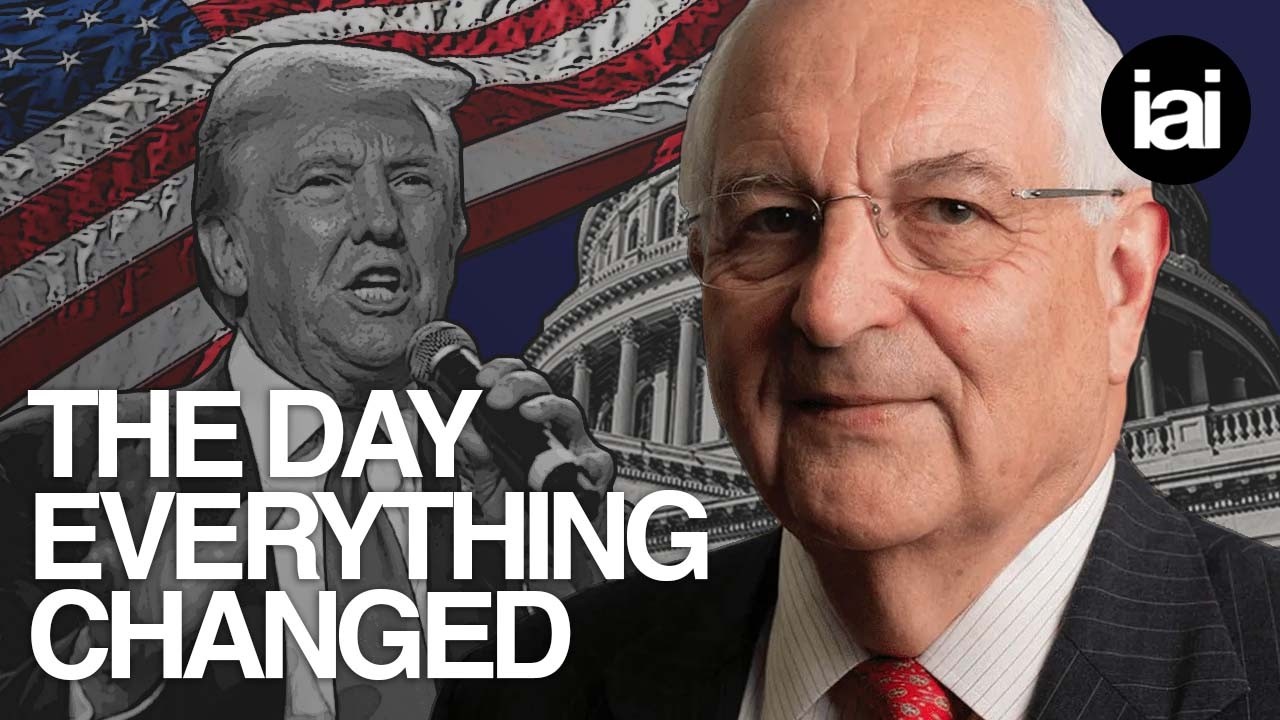
Why the Right swapped economics for culture wars | Martin Wolf

The Institute of Art and Ideas
15,427 views Apr 7, 2026 #capitalism #trump #politics
Martin Wolf analyses the rise of far right, populist parties, and their origins in the ruins left behind by neoliberalism. Was the 2008 financial crisis the defining moment of the postmodern era? With a free trial, you can watch the full talk NOW at https://iai.tv/video/democratic-capit...Capitalism as we know it is in crisis. Slow growth, inflation and widening inequality makes for a worrying potion. But how do we fix this? Join chief economics commentator of the FT, Martin Wolf, as he offers his cure for this crisis. Hosted by Sergei Guriev, Provost of Science Po.
---
---
AN 11 25
A controversial theory that states an “aristocracy” is needed to move the country forward is being pushed as the playbook for a post-President Donald Trump MAGA with tech-elites at the center of power, according to the Washington Post.
At the center of this theory is a lesser known "tech elite," Arizona insurance entrepreneur and conservative media Chris Buskirk, who according to the Post, "helms the Rockbridge Network, a secretive organization ... that has established itself as one of the most influential forces in GOP politics."
"With significant funding from tech leaders, Rockbridge aims to equip MAGA to outlive Trump," the Post explains.
The group is gearing up for the midterms and the 2028 presidential election, in which members "hope" Vice President JD Vance — a close ally of tech billionaire Peter Thiel — will be the Republican nominee.
Although Buskirk is much more low-key than Thiel and his more known billionaire buddies, his ties to the Trump world run deep, the Postexplains.
1789 Capital, the venture capital firm Buskirk co-founded with investor Omeed Malik, focuses on what the partners call “patriotic capitalism” and now counts Donald Trump Jr. as a partner, the Post says, adding "the pair — along with administration officials and friends — recently launched Executive Branch, a $500,000-a-head membership club for Trump-supporting business leaders to hobnob in D.C."
While some see a direct contradiction to the notion of MAGA elite at the helm a populist movement, Buskirk, the Post says, argues they're "not in defiance of MAGA’s populism."
"Buskirk says the MAGA movement has energized a new generation of stewards for the country," the Post writes.
"His various projects echo what some on the right call 'aristopopulism' and aim to build a bridge between wealthy capitalists and the working-class people they intend to represent, according to interviews with Buskirk and nine other people in his inner circle, profitably reindustrializing the country and tying their interests to that of their base," the Post explains.
Buskirk explains it, saying, "You either have an extractive elite — an oligarchy — or you have a productive elite — an aristocracy — in every society."
And while Buskirk says he was initially skeptical of Trump as he emerged from reality television host to the presidency, "He’s actually been saying the same thing for 40 years! And that’s when I realized, okay, he’s for real. And the people that are saying he is not serious are lying.”
In his book "America and the Art of the Possible," Buskirk argues for "a proper elite that takes care of the country and governs it well so that everyone prospers.”
Oren Cass, chief economist of the conservative think tank American Compass, says that while some still view Trump’s support as “a cult of personality,” Buskirk helms a "powerful ecosystem" that now backs the MAGA movement.
“Chris is the convener of that ecosystem,” he tells the Post.
Malik agrees, telling the Post that Buskirk was “the first mover” to recognize that there were going to be thousands of well-off people who “no longer felt at home in the Democratic Party."
Vance, who became fast friends with Buskirk after being introduced by Thiel, also gave a rousing endorsement in a statement to the Post saying, he's an "original thinker” who saw “before almost anyone” how the “right combination of ideas, organizing and funding can ensure lasting political success for the Republican Party.”
Malik hosted a small fundraiser for Vance at a Palm Beach restaurant during his "long-shot bid" for public office in 2022. Following that, they went to Mar-a-Lago, where Buskirk was having a Rockbridge conference.
"The men spent the week bonding over their rage about what they viewed as online censorship and a feeling that innovation was being stymied in favor of liberal priorities such as sustainability and diversity initiatives," the Postwrites.
Critics, however, see Buskirk's movement as "the rise of a group of unelected American oligarchs who are undermining Trump’s promises to benefit working people," the Post writes.
Michael Strain, director of economic policy studies at the right-leaning American Enterprise Institute, says "the government’s job is to advance the prosperity of the nation and not the prosperity of wealthy individuals, founders, and executives.”
However, thePost says that interest in Buskirk's group has surged and "the vibe is euphoric."
"Several of the group’s members are billionaires; prominent investors Marc Andreessenand David Sacks are already members," they explain.
Richard Painter, a corporate law professor at the University of Minnesota who served as chief ethics lawyer in the George W. Bush White House, "said this influx of interest in Rockbridge, 1789 and Executive Branch, creates the appearance of a 'pay-to-play' network, of people who are paying to get access to administration officials or the Trump family."
Buskirk insists he knows what will make America actually great, telling the Postthat American greatness will only be accomplished “by the intentional cultivation of talented, high-agency people working together in high-trust environments.”
SOUNDS LIKE THE Mafia?
---
// SADO-POPULISM?
an 7 25
the normalization of political violence is taking root in public life in the United States. Once shocking near-assassinations are now becoming grimly accepted chapters in political campaigns. Experts warn this signals a dangerous shift in societal norms — and the consequences are already unfolding, The Hill reported Sunday.
The report notes that in the year following the first assassination attempt on President Donald Trump, public threats toward officials have not only persisted — they have escalated.
From the tragic killing of a Minnesota state legislator to last week’s firefight at a U.S. Border Patrol station in Texas, high-profile incidents are mounting.
READ MORE:There's far more to Trump and Epstein's relationship: Trump biographer
Jon Lewis, a research fellow at George Washington University’s Program on Extremism, told The Hill: “We continue to see a normalizing of political violence, a very casual acceptance that some elected officials may be legitimate targets for violence—based on conspiracies, based on disinformation—and unfortunately and tragically, we’ve seen that that has real-world consequences."
He added: “When there is so much rhetoric…it’s only a matter of time before someone with a grievance and a gun finds that justification.”
This reflects a broader trend — federal arrests for threats against officials hit a 12-year high in 2024, according to Seamus Hughes of the University of Nebraska Omaha’s NCITE program, whose comments were also highlighted in the report.
Hughes pointed out that many cases now invigilated at the federal level would previously have been dropped or handled locally. “It’s clear law enforcement and prosecutors want to put their finger on the scale on such threats,” he said.
READ MORE:'A scandal that's being covered up': Trump ripped after claiming Dems 'created' Epstein files
Last month, Robert Pape, a political scientist at the University of Chicago, told the Guardian: “We are in a historically high period of American political violence."
He added: “I call it our ‘era of violent populism’. It’s been about 50 years since we’ve seen something like this. And the situation is getting worse.”
---
---
vox
Meet two of the hot speakers at this year’s Conservative Political Action Conference (CPAC): Presidents Nayib Bukele of El Salvador and Javier Milei of Argentina, two of Latin America’s most flamboyant right-wing populists.
CPAC started in 1974 as an annual gathering of conservatives; over the years it has turned into a days-long, livestreamed far-right spectacle. Policy is discussed and refined while movement luminaries like former President Donald Trump and House GOP Chair Elise Stefanik are given the opportunity to share their ideas with a receptive audience.
It might be a little sleepier than usual this year, but the conference still reveals where American conservatism is headed. And the two Latin American leaders’ presence underscores the right’s continued affinity for populist and even illiberal leadership — particularly when combined with modern personal brands built online.
They aren’t the first extremist leaders to speak at CPAC: Viktor Orbán of Hungary and Jair Bolsonaro of Brazil have featured in past years. Like Orbán and Bolsonaro, Bukele and Milei are staunch populists who have proposed radical solutions to serious problems in their countries.
The American right finds those radical proposals attractive, even if the policies likely couldn’t — or shouldn’t — be instituted in the US. Bukele has, seemingly, mitigated El Salvador’s serious gang violence problem through mass arrests and incarceration, while Milei’s economic policies are supposed to right Argentina’s inflation-plagued economy.
Trump, the presumptive Republican nominee for president, has praised both men; though he has yet to meet Milei, the former president enjoyed a friendly relationship with Bukele. Other conservative figures, including Rep. Chip Roy (R-TX) of the Freedom Caucus, have praised Milei’s push for “limited” government.
The two leaders are important voices at CPAC as conservatives work to draw in Latin American voters before the election in November; Bukele in particular is popular among Salvadorans living in the US. But their presence at the conference is about more than trying to win votes, Erica Frantz, a professor of political science at Michigan State University, told Vox — it’s about creating a particular type of international far-right ideology.
“Linking Milei and Bukele with the Trump movement is advantageous for all parties involved,” she said. “For Milei and Bukele, it gives them the opportunity to strengthen an alliance with the potential presidential candidate most likely to be sympathetic to their authoritarian ambitions.” For Trump and his supporters, “it is a chance to send a message to supporters that its style of politics is gaining steam outside US borders.”
Bukele and Milei were elected to tackle big issues
Bukele has had a long relationship with the pro-Trump right since his first presidential election in 2019. That relationship started online, among cryptocurrency enthusiasts. The ideology underlying cryptocurrency is decidedly libertarian, with many adherents calling for the abolition of treasuries and central banks.
Bukele’s profile rose when El Salvador began accepting bitcoin as legal tender, and he’s remained popular despite the damage it’s done to the country’s economy following the cryptocurrency crash of 2022. But the leader’s crypto fixation — which is affecting the country’s ability to secure international financing — is almost quaint in the face of his authoritarian turn, ostensibly to address the country’s serious crime problem.
Gangs controlled most aspects of life in the country, which was once known for having the highest murder rate in the world. With a campaign of mass arrests, Bukele has indeed tackled El Salvador’s crime problem. But that has come at a steep cost, as I explained last year:
Successive presidential administrations have taken different approaches — many have adopted the mano dura, or “iron hand” tack, instituting harsh crackdowns to mitigate the violence. But Bukele is on an entirely different level; his administration has imprisoned tens of thousands, many arbitrarily, repeatedly extended a state of emergency severely curtailing the rights of ordinary citizens, and attacked and even detained his critics in the press.
The country now instead boasts the highest incarceration rate in the world.
Despite the human rights violations, Bukele’s policies have been popular in El Salvador. Given the astounding level of violence that ordinary people have suffered under the gangs’ power — and the rapidity with which the violence decreased — it’s not ultimately that surprising that Bukele won a second term in office, despite the fact that he has dismantled parts of El Salvador’s democracy, manipulating institutions from the country’s Constitutional Courtto its legislature, to do so.
Though the policy appears to be working in the immediate term, critics argue it isn’t sustainable for two major reasons. The first is that Bukele has made no effort to build a long-term social or economic infrastructure as an alternative to gang violence. The second is that the sense of security people currently feel requires sacrificing other forms of security, such as the rule of law. “[Bukele’s] popularity is built on illegality and undemocratic actions,” Noah Bullock, the executive director of the human rights organization Cristosal, told Vox. “There is no historic precedent where the use of state violence has produced lasting peace.”
That didn’t stop Bukele from suggesting the US ought to learn from his policies during his CPAC speech on Thursday. “We can clearly see the signs of a declining society because our own hit rock bottom decades ago,” he told the cheering audience. He urged Americans to look at “big cities in decline like Baltimore, Portland, New York, just to name a few places where crime and drugs have become the daily norm.”
Milei has only been in office for a couple of months, so he’s had less time to implement his libertarian economic policies. And he might not be able to do that much; already in his brief tenure, the congress voted down his party’s omnibus bill, which included fiscal measures aimed at managing inflation as well as an attempt to secure emergency legislative powers for, potentially, his entire four-year term. Along with deregulation and privatization efforts, the omnibus bill hinted at Milei’s social agenda: It would have reduced prenatal parental leave for women and slashed environmental protections in favor of business interests.
Milei will speak at the conference Saturday, most likely about his efforts to privatize state enterprises and cut down on regulations — both topics with great appeal to CPAC’s audience.
US conservatives benefit from Bukele and Milei’s illiberal policies
Bukele and Milei were each granted a mandate by presenting extreme solutions to serious problems in their countries that have long frustrated citizens. But they have clear ideologies and proclivities toward illiberalism that emerge within those contexts, too.
“They are able to articulate a real problem in society and propose solutions,” Daniel Rothschild, executive director of the Mercatus Center at George Mason University, told Vox. When people are truly struggling, they respond to those policies, “even if they are illiberal.”
In his speech on Thursday evening, Bukele warned that the US was headed for the same kind of violent, gang-plagued system that defined El Salvador. But he, like Trump and other conservatives, exaggerates the problem the US faces. Trump and his allies have argued that cities (especially those in Democratic-controlled states) are full of violence, and they have also made a bogeyman out of the gang Mara Salvatrucha, or MS13, which has terrorized El Salvador along with Barrio 18.
It is true that MS13 actually started in the US and has had a presence here. It is also true that violent crime, including homicide, increased during the social upheaval of the pandemic, and that certain kinds of property crimes have increased. But violent crime is now at pre-pandemic levels and has trended downward overall since the 1990s. In other words, there’s simply no parallel to the violence and terror wrought by gang violence in El Salvador.
It’s not hard to see why Trump and others at CPAC would want to champion someone like Bukele. He exemplifies “tough on crime” rhetoric and, to their minds, proves that the only way to avoid the “American carnage” Trump warned of in his 2017 inauguration speech is to restrict human and civil rights and undo democratic norms and institutions.
Milei, despite having struggled to pass his policies, similarly embodies conservative ideals. His efforts to curb government spending and significantly reduce the size of the government echo the Republican party’s rhetoric of limited government and tighter belts — but the US isn’t dealing with 140 percent inflation or a57 percent poverty rate.
It’s still early in Milei’s tenure, but it is important to note that he and Bukele — like Trump — exemplifies what Frantz and others call a “personalist” leader. “The party that supports them is intricately linked to their persona rather than a clear policy platform,” Frantz explained.
Social media is an important tool in the personalist leader’s playbook that Milei, Bukele, and Trump have all used to their advantage — they don’t have to go through establishment channels that might soften their policies or their rhetoric.
That social media following has created a wave of “millennial authoritarianism,” as researcher Manuel Meléndez-Sánchez termed the phenomenon, which brands these leaders as iconoclasts who reject the “establishment.”
“With personalist parties,” Frantz said, “leaders pretty much have a free rein to behave as they please, and — particularly when their party gains majority legislative representation — the door is wide open for democracy to deteriorate.”
Even if Milei is struggling to pass his policies in Argentina, he’s still able to paint himself as a warrior in the fight against socialism, as he apparently will do in his CPAC speech. That will solidify his ideological link to US conservatives and show “a very clear picture” of how far-right politicians “learn from each other, how they are connected with each other, and they are sharing an agenda that, far from being local, is a global network,” Paula Avila-Guillen, a human rights lawyer and executive director of the Women’s Equality Center, told Vox.
Ultimately, US conservatives like Bukele and Milei because they are hardliners who are using extreme tactics to deal with society’s problems — and are willing to thumb their noses at institutions to get there. As Frantz told Vox, their presence at CPAC is “an effort to cue the conservative base to see authoritarian rhetoric as ‘normal’ and strongman rule as the only solution to society’s problems.” In other words, the message is that not only is there nothing to fear from Trump’s more anti-democratic tendencies, but there’s much to gain from them.
See More:
---
---
AHA DOH MODERATION BUFFER
MUSK IS IRON MAN DIRTY HARRY MEL GIBSON LETHAL WEAPON ROGUE COP NOT BY THE BOOK BUT GETS RESULTS/JUSTICE EFFECTIVE VIA FORCE?
AN 2 25
According to the Washington Post, as many as 200,000 federal workers may be fired because of efforts by the Trump Administration and the Elon Musk-led Department of Government Efficiency (DOGE) to greatly downsize the United States' federal government. And the criticism of their efforts is coming not only from Democrats, but also, from voices on the right.
Former Rep. Charlie Dent (R-Pennsylvania), during a February 17 appearance on MSNBC, slammed Trump and DOGE for carrying out mass government layoffs in a "haphazard" way. And the next morning, MSNBC's Joe Scarborough (a Never Trump conservative and ex-GOP congressman) argued that while government "waste" needs to be reduced and the U.S. needs to balance its federal budget, the Trump Administration and DOGE are recklessly jeopardizing "food safety" and "air safety."
The Guardian's George Monbiot also fears that Trump's second term could trigger some type of major crisis.
READ MORE:George Conway: Trump’s 'pathological narcissism' is fueling 'full-scale' DOJ 'revolt'
In a February 18 opinion column, Monbiot lays out a variety of frightening scenarios and offers some tips for surviving a worst-case scenario.
"Though we might find it hard to imagine," Monbiot warns, "we cannot now rule it out: the possibility of systemic collapse in the United States. The degradation of federal government by Donald Trump and Elon Musk could trigger a series of converging and compounding crises, leading to social, financial and industrial failure…. A financial crisis in the U.S. would immediately become a global crisis."
Monbiot continues, "But the hazards extend much further. Musk, calling for a 'wholesale removal of regulations,' sends his child soldiers to attack government departments stabilizing the entire U.S. system. Regulations, though endlessly maligned by corporate and oligarchic propaganda, are all that protect us from multiple disasters. In its initial impacts, deregulation is class war, hitting the poorest and the middle classes at the behest of the rich. As the effects proliferate, it becomes an assault on everyone's wellbeing."
The columnist warns that undermining regulatory government agencies could make everything from a pandemic to "future climate disasters" worse.
READ MORE:'Brutal': Ex-federal prosecutor reveals why Trump DOJ’s 'illegal order' was 'so corrupt'
"As Trump rips down environmental protections and trashes federal responsiveness," Monbiot explains, "the impacts will spiral. They could include non-linear shocks to either the insurance sector or homeowners, escalating into U.S.-wide economic and social crisis. If, or when, another pandemic strikes, which could involve a pathogen more transmissible and even more deadly than COVID-19 — which has so far killed 1.2 million people in the U.S. — it will hit a nation whose defenses have been stood down."
Monbiot urges Americans — as well as residents of the U.K., where The Guardian is published — by doing a lot of networking.
"So, though there is no substitute for effective government, we must seek to create our own backup systems," the Guardian columnist advises. "Start with this principle: don't face your fears alone. Make friends, meet your neighbors, set up support networks, help those who are struggling. Since the dawn of humankind, those with robust social networks have been more resilient than those without. Yes, we also — and urgently — need national and global action, brokered by governments. But it's beginning to look as if no one has our backs. Prepare for the worst."
READ MORE:John Roberts is to blame for Trump challenge of federal courts: analysis
*George Monbiot's full Guardian column is available at this link.
---
How populist leaders like Trump use 'common sense' as an ...
The Conversation
https://theconversation.com › how-populist-leaders-like...
Feb 6, 2025 — How populist leaders like Trump use 'common sense' as an ideological weapon to undermine facts. Published: February 6, 2025 8:23am EST.
it’s “the revolution of common sense,” President Donald Trump announced in his second inaugural address. [vid]
And so it is. The latest installment of that assertion came in his about the Potomac plane crash. When asked how he had concluded that diversity policies were responsible for a crash that was still under investigation, Trump responded, “Because I have common sense, OK?”
“Common sense” is what’s known to scholars as a “lay epistemology,” or how regular people make sense of the world. We don’t rely on statistical evidence or expert research while we’re buying lettuce or driving in traffic. Instead, we’re guided by direct experience, emotions and intuition.
Because it comes from regular people and not institutions that some people deem to be “corrupt,” champions of common sense suggest it leads to a purer form of truth.
President Donald Trump is asked how he could conclude that DEI policies caused the Potomac plane crash.
Yet it is precisely because it comes from personal observations and intuition that research shows common sense is steeped in bias and often leads us astray.
Populist leaders like Trump commonly celebrate common sense and attack expertise and evidence. Populism is less about being liberal or conservative than it is a way of appealing to the public. These appeals are based on a moral separation between the corrupt, bad people with cultural power and the good, pure people who hold the right values – like faith in common sense over expertise and evidence.
And with the new Trump administration, the elevation of common sense as a virtue has been quick and broad.
Dusty boots vs. elite credentials
In his confirmation hearing for the position of secretary of defense, Pete Hegseth pointed to “dust on his boots” as evidence of his qualifications, in contrast to the elite credentials of past defense secretaries, who have often been Washington insiders.
Hegseth couldn’t name members of the Association of Southeast Asian Nations, an alliance of countries playing a crucial role in global security. But he did show that he knew the diameter of the rounds that fit in the magazine of an M4 rifle.
That was evidence that he was, in his words, “a change agent. Someone with no vested interest in certain companies or specific programs or approved narratives.”
Even Meta’s announcement that it would roll back expert fact-checking on its U.S. social media platforms reflects a “lay epistemic” shift.
Meta explained that fact-checkers, “like everyone else, have their own biases and perspectives” and that these biases had made fact-checking “a tool to censor.”
Instead, the company would embrace a community notes model where users could provide additional information on posts, which Meta argued would be “less prone to bias.”
“We’ve seen this approach work on X,” wrote Meta’s Chief Global Affairs Officer Joel Kaplan, “where they empower their community to decide when posts are potentially misleading and need more context, and people across a diverse range of perspectives decide what sort of context is helpful for other users to see.”
This policy change is probably less of a shift in Facebook founder and CEO Mark Zuckerberg’s principles than a change made out of necessity. Given Trump’s penchant for falsehoods, I imagine Meta’s previous policy would soon have proved financially and politically inconvenient.
Regardless, the result is a populist’s dream: the demotion of formal expertise in favor of “common sense.”
When asked whether he knew the members of a regional security alliance, defense secretary nominee Pete Hegseth was stumped.
Common sense is ideological
For the past two decades, the rise in social media, combined with declining trust in formal news organizations, has democratized knowledge: the sense that no one person or institution has special access to truth – not scholars with many degrees, not experts armed with scientific evidence or data, and definitely not journalists.
In a 2020 study of public sentiment across 20 countries, Pew Research Center found that the overwhelming majority of those surveyed, 66%, reported trusting people with “practical experience” to solve problems over experts. Only 28% trusted the experts to solve problems.
If institutions and experts are perceived as corrupt and ideological, the only truth that we can trust is what comes from our own eyes and our own minds.
But does common sense bring us to truth? Sometimes, yes. It’s also appealing: Since our observations of the world are informed by our values and beliefs, we often see what we want – such as diversity-hiring initiatives known as “DEI” causing a plane crash, for example.
And our intuition rarely tells us we’re wrong. This helps account for the existence of confirmation bias, which is our tendency to see and remember things that tell us we’re right. This is also why, even in those rare instances when facts change minds, they rarely change hearts. If we do update our knowledge with correct information, research has shown that our gut will still tell us our overall view of the world was right.
Ironically, studies also show that the more a person trusts common sense, the more likely they are to be wrong.
My research has shown that the people most likely to believe misinformation about COVID-19 and the 2020 election were those who placed more trust in intuition and emotion, and less trust in evidence and data. In addition, the more people liked Donald Trump, the more they valued intuition and emotion – and rejected evidence and data.
So, common sense is ideological.
When our pathway to knowledge is limited by our experiences and intuition, we’re not actually looking for truth. We’re happy with whatever answers are available, including conspiracy theories or explanations that make us feel good and right.
We blame individuals – especially people we don’t like or identify with – for their own misfortune. We tend to think “those people should be better and try harder” instead of looking for public policy solutions to problems such as poverty or drug addiction. Without evidence and data summarizing large trends – such as cancer rates tracked through National Institutes of Health funding or ocean temperatures tracked by National Science Foundation funding – we are limited to what we can see through our own eyes and biases.
And our limited observations merely reinforce our underlying beliefs: “My neighbor probably has breast cancer from taking that medicine I don’t like” or “Today is probably just a randomly hot day.” We’ll either overgeneralize from or downplay these limited examples depending on what our “common sense” says.
So, when populists elevate common sense as a virtue, it’s not just to celebrate how regular people understand the world. It’s to promote a worldview that rejects verifiable facts, exaggerates our biases, and paves the way for even more propaganda to come.
- Corruption
- Trust
- Bias
- Fact-checking
- Donald Trump
- Populism
- Expertise
- Elites
- Common sense
- Trust in government
- Pete Hegseth
- Meta
How The Conversation is different
Every article you read here is written by university scholars and researchers with deep expertise in their subjects, sharing their knowledge in their own words. We don’t oversimplify complicated issues, but we do explain and clarify. We believe bringing the voices of experts into the public discourse is good for democracy.
Find out more
Beth Daley
Editor and General Manager
===
===
asn 1 25
The many controversial people appointed to the Trump administration, from Elon Musk to Robert F. Kennedy Jr., have at least one thing in common: They dislike and distrust experts.
While anti-intellectualism and populism are nothing new in American life, there has hardly been an administration as seemingly committed to these worldviews.
Take President Donald Trump’s decision to nominate Kennedy, a well-known vaccine skeptic, to lead the Department of Health and Human Services. Kennedy, whose Senate confirmation hearing is Jan. 29, 2025, epitomizes the new American political ethos of populism and anti-intellectualism, or the idea that people hold negative feelings toward not just scientific research but those who produce it.
Anti-intellectual attacks on the scientific community have been increasing, and have become more partisan, in recent years.
For instance, Trump denigrated scientific experts on the campaign trail and in his first term in office. He called climate science a “hoax” and public health officials in his administration “idiots.”
Skepticism, false assertions
This rhetoric filtered into public discussion, as seen in viral social media posts mocking and attacking scientists like Dr. Anthony Fauci, or anti-mask protesters confronting health officials at public meetings and elsewhere.
Trump and Kennedy have cast doubt on vaccine safety and the medical scientific establishment. As far back as the Republican primary debates in 2016, Trump falsely asserted that childhood vaccines cause autism, in defiance of scientific consensus on the issue.
Kennedy’s long-term vaccine skepticism has also been well documented, though he himself denies it. More recently, he has been presenting himself as “pro-vaccine safety,” as one Republican senator put it, on the eve of Kennedy’s confirmation hearing.
Kennedy has mirrored Trump’s anti-intellectual rhetoric by referring to government health agency culture as “corrupt” and the agencies themselves as “sock puppets.”
If confirmed, Kennedy has vowed to turn this anti-intellectual rhetoric into action. He wants to replace over 600 employees in the National Institutes of Health with his own hires. He has also suggested cutting entire departments.
During one interview, Kennedy said, “In some categories, there are entire departments, like the nutrition department at the FDA, that are – that have to go.”
Populism across political spectrum
In lockstep with this anti-intellectual movement is a version of populism that people like RFK Jr. and Trump both espouse.
Populism is a worldview that pits average citizens against “the elites.” Who the elites are varies depending on the context, but in the contemporary political climate in the U.S., establishment politicians, scientists and organizations like pharmaceutical companies or the Centers for Disease Control and Prevention are frequently portrayed as such.
For instance, right-wing populists often portray government health agencies as colluding with multinational pharmaceutical companies to impose excessive regulations, mandate medical interventions and restrict personal freedoms.
Left-wing populists expose how Big Pharma manipulates the health care system, using their immense wealth and political influence to put profits over people, deliberately keeping lifesaving medications overpriced and out of reach – all of which has been said by politicians like Bernie Sanders.
The goal of a populist is to portray these elites as the enemy of the people and to root out the perceived “corruption” of the elites.
This worldview doesn’t just appeal to the far right. Historically in the United States, populism has been more of a force on the political left. To this day, it is present on the left through Sanders and similar politicians who rail against wealth inequality and the interests of the “millionaire class.”
In short, the Trump administration’s populist and anti-intellectual worldview does not map cleanly onto the liberal-conservative ideological divide in the U.S. That is why Kennedy, a lifelong Democrat and nephew of a Democratic president, might become a Cabinet member for a Republican president.
The cross-ideological appeal of populism and anti-intellectualism also partly explains why praise for Trump’s selection of Kennedy to head the Department of Health and Human Services came from all corners of society. Republican senators Ron Johnson and Josh Hawley lauded the move, as did basketball star Rudy Gobert and Colorado’s Democratic governor, Jared Polis.
Even former President Barack Obama once considered Kennedy for a Cabinet post in 2008.

Republican presidential nominee Donald Trump is greeted by Robert F. Kennedy Jr. on stage during a campaign event on Aug. 23, 2024, in Glendale, Ariz. Tom Brenner for The Washington Post via Getty Images
Anger at elites
Why, then, is disdain for scientific experts appealing to so many Americans?
Much of the public supports this worldview because of perceived ineffectiveness and moral wrongs made by the elites. Factors such as the opioid crisis encouraged by predatory pharmaceutical companies, public confusion and dissatisfaction with changing health guidance in the early stages of the COVID-19 pandemic, and the frequently prohibitive cost of health care and medicine have given some Americans reason to question their trust in science and medicine.
Populists have embraced popular and science-backed policies that align with an anti-elite stance. Kennedy, for example, supports decreasing the amount of ultra-processed foods in public school lunches and reducing toxic chemicals in the food supply and natural environment. These stances are backed by scientific evidence about how to improve public health. At the same time, they point to the harmful actions of a perceived corrupt elite – the profit-driven food industry.
It is, of course, reasonable to want to hold accountable both public officials for their policy decisions and scientists and pharmaceutical companies who engage in unethical behavior. Scientists should by no means be immune from scrutiny.
Examining, for example, what public health experts got wrong during the COVID-19 pandemic would be tremendously helpful from the standpoint of preparing for future public health crises, but also from the standpoint of rebuilding public trust in science, experts and institutions.
However, the Trump administration does not appear to be interested in pursuing good faith assessments. And Trump’s victory means he gets to implement his vision and appoint people he wants to carry it out. But words have consequences, and we have seen the impact of anti-vaccine rhetoric during the COVID-19 pandemic, where “red” counties and states had significantly lower vaccine intent and uptake compared with the “blue” counterparts.
Therefore, despite sounding appealing, Kennedy’s signature slogan, “Make America Healthy Again,” could – in discouraging policies and behaviors that have been proven effective against diseases and their crippling or deadly outcomes – bring about a true public health crisis.
Dominik Stecuła, Assistant Professor of Communication and Political Science, The Ohio State University; Kristin Lunz Trujillo, Assistant Professor of Political Science, University of South Carolina, and Matt Motta, Assistant Professor of Political Science, *Boston University
This article is republished from The Conversation under a Creative Commons license. Read the original article.
===
MMA 1 25
...January 16, 2025, edition of MSNBC's *Deadline: White House
NICOLLE WALLACE (HOST): Angelo, to follow up on Carol's point, I mean, Trump isn't the variable, right, in demanding loyalty and money. The tech giants are. Let me just put up again Amazon in 2017, $57,000 in donations in 2021, $276,000. In 2025, a million. Google in '17, $285,000 Google in '21, $337,000 -- seems to be the going price for Trump in 2025, $1 million. Meta or Facebook, Mark Zuckerberg's company in 2017, $0 in 2021, $0. But Mark has had a change of heart. Along with abandoning fact checking. He's parting with 1 million buckaroos. Microsoft has also doubled their contributions to presidential inaugurations from '17 and 2021, forking over $1 million to the Trump inauguration in 2025.
ANGELO CARUSONE (MEDIA MATTERS PRESIDENT): Yeah, I mean, look, this is just the cost of entry, right? I mean, and one of the things that Trump made very clear is that, you know, it cut both ways. On the one hand, he'd be willing to leverage government power to make people's lives and companies lives more difficult to punish, to retaliate. On the other hand, he's open for business. It's transactional. I mean, this was something he said during the campaign when he sort of shouted out into the void that if, you know, the fossil fuel industry, put a bunch of money into some super PACS to help him, that the second he got into office, he would deregulate and eliminate a bunch of provisions that were undermining their financial bottom line. And he's always made it very clear that he's transactional.
And that's the part where when you overlay that with what President Biden said, the warning becomes very stark. Because where here, they're not just giving some money to go along, to get along, to avoid, you know, any kind of retaliation. It's much more insidious than that. And scary. What they each want is something out of it. And what they're going to get out of it isn't just more money, it's going to be more power. Part of the way these oligarchical systems work is that once the oligarchs sort of have power, you know, the people in power, they extract -- they use that power to prop up the government or the individual in power. And as a result, they get more power and more money as a result. It's a feedback loop that feeds on to it.
So, Mark Zuckerberg isn't just going to avoid the worst consequences. In addition to giving Trump money, what we are now going to see as a landscape not just where he is laissez-faire, but where he starts to slowly tip the scales in favor of the dominant narrative, in favor of Trump's narrative. The same way that Trump works the refs in newsrooms is the way now that he's going to work it in these technology companies, which increasingly have enormous amount of influence over the story that we tell ourselves every single day. So on the one hand, they'll get richer and more powerful. They'll use that power to prop up the government in place, and at the same time, they'll be polluting the very conversation that individuals get day to day, which is the one thing we need to inoculate ourselves to both preserve, strengthen and enhance our democracy moving forward.
...
WALLACE: Let me apologize in advance, Angelo, for the little dotted lines in my brain. But that refrain brought me straight back to the all out war between Elon Musk and Steve Bannon. For the heart and soul of the MAGA movement, because it seems that what Steve Bannon's political antenna detects is -- goes beyond personal hatred for Elon Musk and the issue they're fighting about, which is the H-1B visas. But the words he uses to attack Elon Musk are about pure evil. And they seem to include some sort of threat or warning to Trump that this handing over of the entire movement, which I find dark and sinister and, and brutal and anti-democratic and autocratic, I appreciate why the country moves in terms of the pendulum. I don't agree with any of it, but I have tried to understand it and study it. And as a student of it, my sense is that Bannon views himself of the keeper of the concerns and pain and grievances of the working class, and that perhaps there's some warning he's trying to offer the whole movement in his very public fight with Elon Musk. And it and it doesn't seem too far distance from this warning from President Biden about what a complete capitulation of the government and the power and the benefits of our society to the ultra wealthy, what has happened in terms of pendulum swings in the past.
CARUSONE: I think that's a good point. And, you know, Steve Bannon is a bona fide populist. He's not someone, you know, when you look at populist movements, currently and historically, you know, you sort of have these bona fide populist movements, whether they come from the right or the left, they are genuinely about giving power back to people in some way and upending the status quo. But then a lot of times, you also have these moments where sort of the right-wing, or the extreme, sort of co-opts populism for its own self-interest. And it's not really a populist movement. It just has the veneer of that. And that's what it uses to sort of catapult itself into power. And then they don't end up following through on any of their real populist sort of ideals.
And that's what Bannon is picking up on, is that he -- that, you know, from his perspective, Musk's interests are about Musk's power, that it's not actually a populist movement, that he's not sort of sincere in his efforts for free speech, as reflected in the fact that he's censored a whole bunch of conservatives that criticized him, took away their ability to monetize their platform, and also that Bannon is deeply concerned about America's posture vis a vis the CCP, and is concerned about the entanglements that Musk has there.
And I think your point about sort of that contrast is significant because that battle is playing out right now. And in a weird way, there's strange bedfellows here. I think that Bannon, you know, I don't agree with him on just about anything. But the two things I do agree with him on are one, that we are involved in a massive information war. He knows that. And that's what he considers himself a part of. And that the second part of this is that there's a bunch of really rich, entrenched interests, you know, burgeoning wannabe oligarchs or current oligarchs that are going to use Trump's sort of instincts to be transactional, to make deals and to sort of just go along here with those power bases, to sort of enrich themselves in a way that you can never come back from. And so for somebody like Bannon, who's been working as a transformative figure himself, this is a moment of transformation. And he's about to lose it to the very powers that he's been fighting all this time for. But instead of them coming from the left, they're going to be from the right now.
an 1 25
During the United States' 2024 presidential race, Democratic nominee and Vice President Kamala Harris laid out a variety of reasons why she believed that Republican Donald Trump's policies would be terrible for working-class Americans if he won — from health care to tax policy to tariffs. But right-wing media outlets repeatedly attacked Harris as an "elitist," praising Trump as the "populist" in the race — which, in the end, President-elect Trump narrowly won.
Salon's Amanda Marcotte examines the MAGA movement's "populism" in a scathing article published on January 16, arguing that Trump and MAGA's alliance with billionaire tech bros exposes their "populism" as an "illusion."
"Trump's Diet Coke addiction has long been used by the grifter-in-chief to sell his fans on the big lie of his career: that, beneath all the private jets and over-the-top gilded decor, he's a 'regular' guy just like them," Marcotte observes. "He, too, houses the sugar-free caffeinated beverages as a vague gesture towards 'health' in between housing vegetable-free greasy meals of cheap hamburgers and sugary desserts. He must be an ordinary, salt-of-the-earth man! After all, he drinks a product found at every common supermarket."
READ MORE: Torture? Shoot protesters? Greenland? Questions Hegseth refused to answer
Marcotte adds, "Never mind that Trump would never sully himself by entering a grocery store. He pays people to do that for him.
Trump, the Salon journalist laments, is able to "trick" MAGA voters "into thinking the rich former reality TV star is one of them."
"On Tuesday, (January 14)," Marcotte observes, "NBC News reported that tech billionaires Elon Musk, Jeff Bezos, and Mark Zuckerberg will all have prominent seats on the platform at Trump's inauguration. The symbolism is unmistakable."
Marcotte continues, "Those seats are usually reserved for family members, former presidents, and prominent politicians. Giving those seats to billionaires signals loudly that this is a new era of oligarchy, without even an attempt to feign allegiance to pre-Trump notions of government for and by the people. President Joe Biden was alarmed enough to make this issue the focal point of his final speech in office."
READ MORE:Why this Trump nominee is 'a pleasant surprise' for Dems
During a recent appearance on the New Republic's "Daily Blast" podcast, economist and former New York Times columnist Paul Krugman was vehemently critical of Trump's "extremely regressive economic program" — warning that "working-class voters are going to face higher prices and upper-income voters are going to benefit from tax cuts."
"Sure, you may never be able to retire or own a home," Marcotte laments, " but it seems the r-word is coming back into fashion! I'd call that a bad trade-off."
READ MORE:Economist Paul Krugman explains why Trump voters are being 'brutally scammed'
===
an 12 24 no pix twt
it was too laughable not to share it: On his Twitter knockoff site Truth Social, Donald Trump posted on Wednesday about a "MAJOR ANNOUNCEMENT tomorrow," which included a video of him dressed as a superhero shooting lasers out of his eyes.
It's what the kids online call "cringe" — and oh man, it couldn't have been more perfect for the online churn of public mockery. I'm on a Twitter diet, but I totally sent this dumb image to my friends, so we could join in the hilarity. So many questions! Is Trump really so delusional about his physical form that he thinks he looks like Superman? How can his fans not perceive that he does not, in fact, look like that? The lasers-out-of-the-eyes thing is directly out of the "Dark Brandon" meme liberals use to celebrate Joe Biden's accomplishments. Does Trump not know how desperate he looks, trying to bite Dark Brandon's style? How dumb is he anyway?
Trump has not returned to Twitter, even though Elon Musk reinstated his account and publicly begged him to come back. But he managed to dominate Twitter on Wednesday anyway, as one liberal hater after another retweeted screenshots of the superhero meme, making sure that every Beltway journalist was well aware of Thursday's "MAJOR ANNOUNCEMENT." The silliness of it guaranteed much more coverage than if Trump had tweeted out a vaguely normal picture of himself.
Unsurprisingly, the actual announcement was not just underwhelming but an even higher degree of self-pantsing:
But here's the part we cannot ignore: Trump is going to sell a lot of those dopey digital trading cards. As viral marketing campaigns go, this one was a solid win. Not only did all that liberal dunking garner news coverage and dramatic social media spread, but he also conveyed an important message to his supporters: Those liberal elites are laughing at you. And the way to strike back, proving that you're in on the joke and making the liberals cry, is to buy this worthless crap and send Donald Trump more of your money.
Since my book "Troll Nation: How the Right Became Trump-Worshipping Monsters Set on Rat-F*cking Liberals, America, and Truth Itself" was published in 2018, its central thesis — that the modern right is motivated by an obsessive desire to troll the left — has become a lot more widely accepted.
Just this week, Washington Post columnist Greg Sargent pointed out that Musk has gotten into the troll business because he understands that "for large swaths of the right-wing media ecosystem, the Triggering of the Libs has become an end in itself." By tweeting repulsive things and drawing liberal outrage and condemnation, Musk can get more engagement while sucking in more fans who love how angry he makes their perceived enemies.
But what is too often overlooked in these discussions is how much this empire of trolling relies on the right's inferiority complex. At the root of the trolling mindset is defensiveness. Conservatives perceive, not always incorrectly, that liberals are laughing at them for being a bunch of tasteless rubes with boring sex lives and expanding beer guts. This perception does not motivate a desire toward self-improvement, but instead a longing for revenge, mostly in the form of imposing their grossness on the supposedly more refined existence of those they despise.
This inferiority complex is why the term "elite" has become common currency on Fox News. They don't use it accurately — say, to describe those who hold excessive wealth and power, but as a swipe at the perceived progressive values of college-educate cultural tastemakers in coastal cities. It explains how Musk, who until very recently was ranked as the richest man in the world, can get away with styling himself as a populist hero. Childish as it may be, Musk and his fanboys are still agitatedabout their perceived rejection by the Cool Kids.
The slavish fandom that people like Musk and Trump attract is generally confusing to folks on the left, because those two guys are such embarrassing losers. Trump's superhero meme has its brother in Musk's recent bout of social media thirst:
It was already pathetic enough that Musk has been reduced to begging right-wing douchebags to like him. The items in that image make it worse, creating a virtual bingo card of terminal dweebness: Caffeine-Free Diet Coke. A painting of George Washington that was uncool when our grandparents were kids. A fake gun. In order to get the women of Tinder to swipe left faster, all you'd need would be a pet iguana and a decorative sword. (Arguably, the vajra on the table of a non-Buddhist counts for the latter.)
But it's a mistake to conclude that Musk's fans simply fail to understand how uncool the Tesla CEO has revealed himself to be. He's created a cult of dork solidarity around him, one committed to a "Revenge of the Nerds"-style fantasy of ruining Twitter for all those blue-checked people who make them feel bad about themselves.
That doesn't just appeal to those who already identify as conservative, either. Musk's cult is part of a larger ecosystem that seeks to redirect angry young men toward fascist politics. Musk may be running Twitter into the ground financially, but as a right-wing political project, his takeover of the company is going great: He's adding 200,000 new followers a day.
In his recent book "Weapons of Mass Delusion: When the Republican Party Lost Its Mind," journalist Robert Draper explains that, in his many conversations with Trump voters, it became clear that they were not confused about the actual nature of Donald Trump's personality. In fact, he writes, "the MAGA faithful adored their emperor without clothes." As he told Salon, "everything that we would ordinarily view as a vice they found to be to be virtuous," often precisely because it pisses off liberals so much.
you see this all the time on social media, when conservatives make jokes about how liberals hate the "bad orange man." In making that joke, they're indicating that they know Trump is a weird-looking guy who wears orange makeup every day and also that, by any reasonable standard, he sucks. But none of that detracts from his allure in the slightest. He's basically a human pile of dog poop they get to rub liberal noses in, an animated and endlessly whiny punishment they can inflict on those who make them feel insecure.
Shame is an odd emotion. It can sometimes motivate a person to slow down or stop behaviors that cause it. Just as often, however, it can backfire, creating a defensive reaction that causes the person to double down. Trump's dumb superhero meme is a good example of the latter tendency in action. Liberals have mocked conservatives for years for their hero worship of Trump. But rather backing down, they just go at it harder — admittedly, with a bit of ironic distance — by churning out cartoonish images that reimagine Trump as Superman or Elvis or Rocky or some other masculine icon.
Of course these folks are still suckers. They may think they're sticking it to the liberals, but as usual Trump is just squeezing them for cash. But as long as they keep nursing their grievance over real or imagined liberal mockery, Trump fans will never quite be able to see how much the bad orange man has been using them all along.
===
BIG PICTURE
'Quickly rot from within': Expert reveals 3 traits the US shares with declining empires
https://www.alternet.org/us-empire-decline/)
an 12 24
The United States is currently displaying several characteristics that have historically been seen by empires in decline, according to one social scientist.
Peter Turchin is one of the pioneers of "cliodynamics," which is the field of study concerning statistical analysis of historical dynamics of societies around the world. In a recent essay for the Guardian, Turchin wrote that he and his fellow researchers have noticed the U.S. having three key traits in common with past global hegemons just before a period of decline. Those three factors are "popular immiseration, elite overproduction and state breakdown."
Turchin explained that "popular immiseration" describes a breakdown of the social contract between workers, the private sector and the public sector, which he said began after the Republican assault in the New Deal that happened around the time former President Ronald Reagan took power. He noted that as "the power of unions was undermined," taxes on the richest Americans were "cut back," which was followed by stagnating wages and a decline in life expectancy.
READ MORE:['Not good enough anymore': Union leader explains why Dems lost economic argument to Trump
"With the incomes of workers effectively stuck, the fruits of economic growth were reaped by the elites instead. A perverse 'wealth pump' came into being, siphoning money from the poor and channelling it to the rich," he wrote. "In many ways, the last four decades call to mind what happened in the United States between 1870 and 1900 – the time of railroad fortunes and robber barons. If the postwar period was a golden age of broad-based prosperity, after 1980 we could be said to have entered a Second Gilded Age."
The second trait, which Turchin called "elite overproduction," involves a growing population of the "uber-rich," (which he defined as "those with fortunes greater than $10 million") and their influence in the public sphere. He noted that when adjusting for inflation, this population grew by tenfold over the last four decades. This has led to rich elites either running for office, like President-elect Donald Trump, or funding candidates for office, like many billionaires have done in recent cycles. He also pointed out that "counter-elites" will emerge who oppose the existing political establishment.
"The more members of this elite class there are, the more aspirants for political power a society contains," he wrote. "By the 2010s the social pyramid in the US had grown exceptionally top-heavy: there were too many wannabe leaders and moguls competing for a fixed number of positions in the upper echelons of politics and business."
"As battles between the ruling elites and counter-elites heat up, the norms governing public discourse unravel and trust in institutions declines," he continued. "The result is a loss of civic cohesiveness and sense of national cooperation – without which states quickly rot from within."
READ MORE:[Watch: JD Vance booed by room full of firefighters as he calls himself 'pro-worker'
Finally, Turchin opined that "state breakdown" will inevitably follow popular immiseration and elite overproduction. He argued that Democrats' loss in the November election "represents one battle in an ongoing revolutionary war," but that the goal of the new order is "far from assured" given that "opponents are pretty well entrenched in the bureaucracy and can effectively resist change."
"Popular discontent in the US has been building up for more than four decades. Many years of real prosperity would be needed to persuade the public that the country is back on the right track," he wrote. "So, for now, we can expect a lasting age of discord. Let’s hope that it won’t spill over into a hot civil war."
Click here to read Turchin's full essay in the Guardian.
READ MORE:['A corporate CEO's dream': Labor unions blast Trump-Vance ticket
---
GOP presidential nominee Donald Trump's running mate, Sen. JD Vance (R-Ohio), often rails against "elites." Yet in July, Forbes estimated the "Hillbilly Elegy" author's net worth to be around $10 million.
In a think piece article published on September 16, Politico's Ian Ward examines the "tension" between Vance's anti-elite rhetoric and the fact that he is a multi-millionaire who graduated from Yale University's law school and became a venture capitalist in Silicon Valley.
Vance, according to Ward, "has become a vociferous conservative critic of that same elite on behalf of disaffected Middle Americans, a role he can claim by virtue of his upbringing in post-industrial Ohio and his family's roots in eastern Appalachia."
READ MORE: Trump has 'reached his final destination' and 'he knows he's going down': George Conway
"At various points throughout his career," Ward explains, "Vance has acknowledged this tension — without really trying to resolve it.… Now that Vance is accompanying Trump on the top of the Republican ticket, this paradox has opened Republicans up to fresh criticisms. How populist can Vance really be while cozying up to billionaires in Silicon Valley?"
Ward continues, "What does a Yale-educated attorney and ex-venture capitalist understand about the lives of Trump's blue-collar voters? Is a guy who owns not one but two million-dollar houses a credible mouthpiece for the GOP's fledgling economic populism? But the deeper I've dug into the conservative world Vance comes from — often referred to as the 'New Right' — the more I've come to see Vance's split identity as a feature rather than a bug for his ideological supporters."
Back in 1980, the term "New Right" referred to Ronald Reagan's conservative coalition. The late political R&B singer Gil Scott-Heron, a major supporter of progressive and left-wing causes, was fond of saying that "the New Right is the same old wrong."
But in 2024, the term "New Right" has a decidedly MAGA connotation and vehemently rejects the Reagan, Goldwater, Bush and McCain conservatism of the 1980s and 1990s.
READ MORE:['Smallest man who ever lived': Trump slammed over 'dangerous' Taylor Swift post
"In fact, Vance embodies an archetype that has been theorized about at length in New Right-adjacent books and podcasts, many of which Vance has read and listened to," Ward explains. "By forging an alliance between the elite 'New Right' and the MAGA masses, Vance, according to this reading, could serve as the leader of a new movement to institute an illiberal and explicitly reactionary political order."
Ward adds, "Though adopting the rhetoric of conservatism populism, this new order would be a fundamentally elitist one: It would expel America's current ruling elite in order to replace it with a new, more conservative one, drawn from the ranks of the New Right."
READ MORE:[Trump's hate is no joke
*Read the full Politico article at this link.
---
an ah 6 24
Long before urbanites were blaming hipsters for high rents, gentrification and displacement, yuppies were being attacked as anti-working class. Yuppie culture was the target of countless articles from liberals and progressive writers during the 1980s, and "die yummie scum" t-shirts were a hot commodity among punk and hip-hop fans.
In a lengthy essay/think piece published by Politico on June 4, Philadelphia-based author Tom McGrath argues that 1980s yuppies helped pave the way for Donald Trump's presidency and the MAGA movement.
Trump has painted himself as a staunch defender of the working class, famously saying, in 2016, that he "loves the poorly educated." But according to McGrath, the Trump of the 1980s and 1990s symbolized urban yuppie "excess."
READ MORE: [Ex-federal prosecutor slams Mar-a-Lago docs judge’s 'dangerous and disingenuous' claims
"A wealthy New York real estate mogul may not have seemed particularly well-suited for the role of populist hero," McGrath explains, "but Donald Trump's historic realignment of white working-class voters not only delivered him the presidency in 2016, but changed the GOP as we know it. A recent Gallup survey indicates that more Republicans now identify as working or lower class than Democrats. And white voters without a college education, once a core Democratic constituency, remain a key element of Trump's reelection bid heading into November."
McGrath continues, "But for all the ink spilled over Trump's connection to the white-working class, it's actually a very different demographic that explains his ascension: yuppies."
McGrath, author of the new book "Triumph of the Yuppies: America, the Eighties, and the Creation of an Unequal Nation," notes that "eye rolling" over yuppies during the mid-1980s subsequently "hardened into a deeper resentment of what became known as 'the elites.'"
"By 2016, families at the top of the economic pyramid controlled 79 percent of all wealth in America, up from 60 percent in the 1980s," McGrath explains. "The percentage of wealth owned by the middle class dropped from 32 percent to 17 percent. Ironically, it was Donald Trump — if not a yuppie himself, then at least a walking symbol of 1980s glitz and excess — who spotted the political opportunity, persuading many working‐class Americans that he was on their side."
READ MORE:['All she has to do is shut up': Ex-GOP rep skewers RNC chair for risking Senate over Trump 'vanities'
McGrath adds, "In office, Trump's only significant legislative accomplishment was a massive tax cut for wealthy Americans, though he also imposed significant trade tariffs on China — a curious mix of Ronald Reagan and Walter Mondale."
READ MORE: ['Just not true': Reporter delivers rapid-fire fact-check of GOP Trump defenders]
*Read Tom McGrath's full article for Politico at this link.
an 4 24
jeff Gunter, the Californian businessman hoping to unseat Sen. Jacky Rosen (D-Nevada), was recently caught using the largesse of his donors to establish his Western bona fides in an arguably cartoonish way.
The Daily Beast recently combed through Gunter's campaign finance filings and found that he spent nearly $800 in donor funds at retail chain store Boot Barn to purchase cowboy-themed attire that he then donned in a campaign ad from last August. shows Gunter driving a Ford F-150 pickup truck, and sporting a burgundy button-down shirt, cowboy boots and a large belt buckle with "NEVADA" written on it. The buckle also shows a cowboy riding a bucking bronco, a royal flush and the Nevada state seal. The Beast found that both the shirt and the belt buckle can be purchased at Boot Barn for $29.99 and $45, respectively.
"Nevadans deserve a senator who will put America first," Gunter said in the ad. "Now I'm bringing that same fighting spirit to stand up for every Nevadan."
READ MORE:Michigan US Senate GOP candidate running on local roots is a registered voter in Florida
While he's spending significant sums to bolster his Nevada credentials, Gunter's personal history tells a different story. The Beast reported that just last year, Gunter — who was former President Donald Trump's ambassador to Iceland — was registered as a Republican in Nevada and as a Democrat in California. In 2022, he requested a California absentee ballot to vote in the midterm election. And even though he's owned property in Nevada since 2007, Gunter launched his dermatology practice in California and raised his family in the Golden State. He also maintains several residences in Nevada's deep-blue neighboring state.
01:57
03:37
"Jeff Gunter is a California Democrat who used campaign funds at a California-based store to play dress-up as a Nevada cowboy," an unnamed national Republican strategist for GOP Senate campaigns told the Beast. "You can't make this stuff up."
An unnamed Trump ally also cast doubt on Gunter's attempts to portray himself as an authentic Nevadan, describing Gunter to the Beast as "a fake cowboy, fake Trump supporter, but a real California Democrat."
Gunter disputed the claim that he was merely donning a costume and insisted that he was a proud resident of the Silver State.
READ MORE:Busted: GOP Senate candidate running on rural roots grew up 'three miles from a Trader Joe's'
“I have no idea what ‘fake cowboy’ means,” Gunter told the Beast. “This ad was filmed in rural Nevada, in fact where I have farms, farmland, and where I have treated patients for over 25 years. I guess my opponents truly have nothing substantive to attack me and instead are debating whether or not I satisfy some sort of Yellowstone cowboy fantasy aesthetic. Pretty weird! I am a proud Boot Barn customer.”
Gunter's campaign recently announced plans for a $3.3 million ad buy in Nevada television markets for a 30-second campaign commercial that shows the footage of him in the Boot Barn cowboy clothes. Gunter says in the ad that he is "110 percent pro-Trump."
The wealthy dermatologist is running against roughly a dozen other candidates for the Republican nomination in Nevada's U.S. Senate race, including former U.S. Army Captain Sam Brown (hand-picked by the GOP establishment) and former state representative Jim Marchant. And while Trump has not yet made his endorsement, Gunter's MAGA-focused campaign has garnered the endorsement of Rep. Matt Gaetz (R-Florida).
Click here to read the Beast's full report (subscription required).
READ MORE: PA GOP Senate candidate who says he 'started with nothing' actually grew up in a mansion
---
an 2 24
before Donald Trump likened himself to Russian dissident Alexei Navalny, the former president frequently compared himself with a completely opposite personality – Chicago organized crime boss Al Capone.
During a speech in Nevada in December 2023, Trump painted himself as the victim of overzealous prosecutors who have treated him worse than one of the nation’s most notorious criminals.
“He got indicted once,” . “I got indicted four times. Over bullshit, I got indicted.”
In his never-ending attempt to politicize his substantial legal troubles, Trump’s exaggerated claims of victimhood are part of the appeal to his die-hard MAGA followers, who believe what Trump tells them: He is being persecuted by deep state bureaucrats because he is fighting for them.
“Never forget,” Trump said. “Our enemies want to take away my freedom because I will never let them take away your freedom … they are not after me. They’re after you. And I just happened to be standing in their way.”
The message that Trump is serving as a protector against unexplained foes is part of the myth of an outlaw hero. Belief in such characters may explain his unwavering support and commanding lead in the 2024 race for the GOP presidential nomination.
American Robin Hoods?
In moments of high drama, the outlaw hero is a recurring figure throughout history.
Wherever they appear, outlaw heroes symbolize resistance to perceived changes to a way of life. Most often, these heroes emerge locally from humble roots and gather visibility and celebrity as a result of their daring, audacious acts that become the stuff of legends.
The common theme in all these outlaw hero legends is that they claim to be engaged in campaigns to restore justice by taking from the powerful and giving to the powerless at great personal risk.
The model for American outlaw heroes is England’s Robin Hood. As the legend goes, he stood against the corruption and tyranny of the Sheriff of Nottingham by robbing from the rich and giving to the poor.
In America, during the 19th and early 20th centuries, there was a series of outlaw heroes, from Jesse James and William “Billy the Kid” Bonney to John Dillinger and Al Capone, around whom similar legends developed – that they stood up to unjust authorities in ways that were daring, captivating the imagination of many Americans.
Photographs of Al Capone taken by Chicago police on Jan. 25, 1947.
But the reality of their lives was completely different than the myths.
They were constantly on the run from law enforcement authorities. While their daring jail escapes and bank robberies drew cheers from supporters, their lives were filled with dangerous shootouts, often ending in sudden deaths. In Capone’s case, it ended after years fighting dementia and other complications from syphilis.
John Dillinger, for instance, the notorious bank robber who gained fame during the roaring 1920s, was shot to death by FBI agents on July 22, 1934, after one such shootout.
Though these outlaw heroes may have targeted the rich and powerful, there is scant evidence that the riches they accumulated were ever redistributed to the poor. But the banks they robbed held the savings of ordinary people, and the violence they fomented took place in their local communities.
Capone is one example.
By the late 1920s, he had cultivated an image of a well-intentioned businessman who cared only about the welfare of his fellow Chicagoans.
In reality, Capone was the nation’s most visible mobster who violently protected his criminal enterprise of gambling and selling alcohol during the Prohibition era. Among the best examples of Capone’s ruthlessness was the St. Valentine’s Day Massacre on Feb. 14, 1929. Posing as policemen, members of Capone’s gang lined up seven rivals against a wall and machine-gunned them to death.
Throughout his life, Capone was indicted and convicted of several crimes, including tax evasion, contempt of court, carrying concealed weapons and bootlegging alcohol. He ultimately died on Jan. 25, 1947, at the age of 48.
Trump’s outlaw behavior
This disparity between life and legend exists because outlaw heroes were both celebrated by supporters and condemned by authorities. The result, then and now, is that each side has been baffled by the other’s inability to see the truth.
The key to understanding outlaw heroes, then, is that they flourish not in spite of but rather because of their rebelliousness. The more daring and rebellious the outlaw hero, the more commanding the figure becomes.
Such is the case with Trump.
Despite his personal and family wealth, Trump has been able to convince his blue-collar supporters that he is one of them. He presents himself as a persecuted figure who stands between them and politically motivated “witch hunts.”
As their champion, Trump has been excused for the kinds of behaviors that have brought down other political figures.
Those behaviors include marital infidelity and sexual abuse, evading taxes and avoiding military service, disparaging celebrated and wounded military veterans and threatening his political opponents with lawsuits, imprisonment or execution.
In addition, Trump faces four criminal indictments that range from his efforts to remain in power following the 2020 presidential election to his alleged willful retention of classified documents.
What most distinguishes Trump from earlier outlaw heroes is that he has actually captured the nation’s most powerful position and is now campaigning to reclaim it.
Though the final chapter of the Trump saga has yet to be written, there is the very real possibility that Trump, like outlaw heroes before him, will become larger in legend after death than he was in life.
David G. Bromley, Professor Emeritus of World Studies, Virginia Commonwealth University
This article is republished from The Conversation under a Creative Commons license. Read the original article.
---
aha doh pseudo-pop
AN 2 24 JOE CONASAN
Supporters of Donald Trump often complain about the "liberal elites" who have disrespected them. It is a feeling of cultural grievance that their idol constantly exploits, both to enrich himself with their donations and to defend himself against his critics.
Whenever Trump finds himself under pressure -- in a courtroom, an impeachment or an election -- he tells those credulous followers that it is not he but they who are the true targets of the Democrats, the "deep state," the media, the Republicans in Name
Only, the Biden White House or whomever. That was how he responded to the first impeachment brought against him in 2019 and that is how he answered the huge $83 million jury verdict delivered against him this week in the E. Jean Carroll defamation case.
Trump makes this demagogic argument in full confidence that the MAGA cult will believe him -- and with certainty that they will never realize how deeply he is insulting them.
"In reality they're not after me, they're after you. I'm just in the way," he tweeted when Congress first voted to impeach him. But did that make any sense? It wasn't the MAGA voters who attempted to extort the president of Ukraine, attempting to trade American weaponry for his own political gain (and to frame a political opponent with a phony prosecution).
Surely most of Trump's fans would never consider such a brazen blackmail scheme. Unlike him, they don't have to worry about being impeached or prosecuted; they have neither the motive nor the opportunity to perpetrate the offenses that Trump repeatedly commits.
In the wake of the Carroll jury award, the former president's most devoted associates have adopted the same argument, adding their own frantic spin. Steve Bannon, the convicted fraudster pardoned by Trump in order to keep his mouth shut, and Matt Schlapp, the right-wing activist repeatedly accused of homosexual assault, declared that the verdict foreshadows "the end of America."
On the "War Room" online broadcast hosed by Bannon, Schlapp echoed Trump's baseless insistence that the Carroll lawsuit is a "very coordinated thing" and the product of a "weaponized government" -- when in fact it is simply a civil lawsuit brought by an aggrieved citizen. But Schlapp went still further, warning the MAGA audience that the judgment against Trump in favor of the woman he assaulted would portend their own ruin.
What the verdict proves, according to Schlapp and Bannon, is that the government "doesn't just intend to destroy your career and cancel you on social media, they mean to impoverish you and destroy any opportunity you have in the future. ... If these things continue to stand, all of this unconstitutional illegal activity, we've got nothing left, Steve. I mean it's run to the mountains, run to the catacombs time. ... This $83 million -- this is just the beginning. All of us will be paraded down this gangplank. We won't have our resources, we won't have our homes, we won't have our livelihood."
Why would a sane person put any credence in that hysterical rant? There was nothing "illegal" or "unconstitutional" in Carroll's courageous effort to hold Trump accountable for assault, which resulted in a flood of personal abuse against her that included hundreds of death threats. More to the point, only an infinitesimal fraction of Americans has any reason to worry about being held responsible for an aggravated sexual assault - because unlike Trump, few have ever been accused of rape or assault, let alone by dozens of women.
It is remarkable indeed how many of our fellow citizens are willing to be implicated in the sociopathic conduct of the former president, who tells them every day that they are just like him.
---
MTG sez her ppl wd have called biden sotu worse than liar
---
~
badash 1 24 an
noted conservative author and former professor of national security affairs is laying waste to the media narrative that Donald Trump’s MAGA followers are America’s “forgotten” people, concluding instead that they, just like their leader, are in it for revenge.
“Trump wants payback,” writes The Atlantic’s Tom Nichols, “so do millions of voters who have no one to blame for their sense of humiliation but themselves.”
“Trump and his right-wing media courtiers—who tend to the anger of the older, white middle class the way florists lovingly raise orchids—fed the GOP base a continual stream of rage, especially as Trump started to pile up electoral defeats,” writes Nichols, who has a PhD from Georgetown and taught for 25 years at the U.S. Naval War College. “These voters now want to get even with their fellow citizens not for what’s been done to Trump but for what they feel has been done to them. They were certain that 2016 would finally bring them the recognition and respect they craved. Instead, Trump set them up for a steady diet of ego-bruising rebukes from other voters.”
Nichols also points to a piece by another writer at The Atlantic, McKay Coppins, who “attended a Trump rally in Iowa earlier this month, where he spoke with a nice lady named Kris.”
READ MORE: Trump Complains It Was ‘Ridiculous’ He Had ‘Follow the Laws’ and Leave Office
Kris is “a 71-year-old retired nurse in orthopedic sneakers,” Coppins wrote. She “was smiley and spoke in a sweet, grandmotherly voice as she told me how she’d watched dozens of Trump rallies, streaming them on Rumble or FrankSpeech, a platform launched by the right-wing MyPillow founder Mike Lindell.”
Asked if Trump should still be president, Kris told Coppins, “By all means.”
“And I think behind the scenes he maybe is doing a little more than what we know about,” Kris said.
Asked, “What do you mean?” Kris said, “Military-wise.”
“The military is supposed to be for the people, against tyrannical governments,” she explained. “I hope he’s guiding the military to be able to step in and do what they need to do. Because right now, I’d say government’s very tyrannical.”
Coppins added: “If the Democrats try to steal the election again in 2024, she told me, the Trump-sympathetic elements of the military might need to seize control.”
Nichols asks, “What can turn an ordinary person—a father, the pleasant older lady who lives down the street—into the family powder keg, or even a deluded seditionist who hopes the U.S. military will seize control of the country?”
He says, the “usual answer, when Trump ran the first time, was that these were ‘forgotten’ voters, people ‘left behind’ by globalization and a leftist political culture, who were hurling out a giant primal yawp of opposition.”
Nichols blames the media and politicians for that false narrative that has driven so much of American politics since Trump came down the escalator in June of 2015.
“These were never empirically sustainable explanations, but empathetic reporters and deeply concerned politicians went on listening tours to diners and gas stations anyway. When ordinary Americans would say shocking, indecent, and un-American things, their flummoxed interlocutors remained steadfast in the belief that more listening and more empathetic nodding would put things right in a few years.”
READ MORE: Brown Bags and Ballots: Viral Videos Capture Chaotic Iowa Caucus System
He also chastises MAGA voters for the “alternate reality” they’ve constructed to explain the strings of losses they’ve had to endure, “including the 2018 Democratic-wave election, Joe Biden’s 2020 election victory, and the ‘red wave’ that never happened in 2022.”
Antiracism educator Tim Wise responded to Nichol’s piece, writing: “Exactly correct. The media refuses to admit it but the MAGA faithful are mean, vengeful people. Not decent, misunderstood, and ‘left behind’ people, but folks who are not decent.”
Condé Nast Legal Affairs Editor Luke Zaleski, unrelated to Nichol’s piece in The Atlantic, on Wednesday delivered a (possibly tongue-in-cheek) take on MAGA’s alternate reality.
“This is the actual story republicans are going with,” Zaleski wrote. “Trump built the wall and gave us world peace and then Democrats and China (Trump’s pal Xi) made up a phony virus that doesn’t make you sick—and trump caught it and made a beautiful vaccine that kills you and he saved us—before Joe stole the election and trump had to start an insurrection that didn’t happen that Nancy did just so they could make it look like trump did it even though he told the attackers he loved them and would pardon them and Obama secretly runs everything and the CIA and FBI do too and George soros and they started the war Putin started and are behind the Hamas attack as well and trump will stop it all in 24 hours.”
Read Nichols’ entire piece here.
READ MORE: DeSantis Frames Same-Sex Marriage Supporters as Threat ‘Against Our Religious Institutions’
---
---
RACISM DEI ~ AA
---
---
aha pseudo populism good ol boy?
an ah 1123
mAGA Sen. Josh Hawley (R-Missouri) has been railing against the U.S. Supreme Court's ruling in Citizens United v. FEC and has been pushing a measure attacking the controversial 2010 decision — which, he argues, conservatives never should have defended. Hawley's measure is a rare example of a pro-Donald Trump Republican attacking a High Court ruling that has drawn more criticism from the left than from the right.
But journalist Jason Linkins, in an article published by the liberal-leaning New Republic on November 4, slams the Missouri Republican's campaign to "overturn Citizens United" is a "complete joke."
"There are many — mainly on the left — who'd like to somehow overturn Citizens United v. FEC, the execrable 2010 decision that unleashed a tidal wave of funny money into our politics and demonstrated that the Supreme Court didn't need to have a 6–3 conservative tilt to cock up the entire country," Linkins argues. "It would be great if we could pass a law and set things right, but here's the rub: Congress can't fix it, sorry!"
Linkins adds, "As MSNBC's Jordan Rubin explained, overturning the decision would require one of two unlikely events: the Supreme Court choosing to reverse itself or the successful enactment of a constitutional amendment…. The fact that Hawley, even with the assent of Congress and the president, literally cannot 'overturn' Citizens United makes this matter done and dusted."
The journalist stresses that despite all of Hawley's "posturing," his Citizens United proposals "would leave unchecked the flood of dark money" in U.S. politics.
"If you're authentically aggrieved by the Citizens United decision," Linkins explains, "this is where the profound misrule lies: Political nonprofits — mainly 501(c)(4)s — can accept unlimited donations and don't have to disclose their donors, even when the nonprofit then sends the money to super PACs, which do have to disclose donors."
READ MORE:Why Josh Hawley's current 'faux populist stunt' is bound to flop: analysis
:{*:{Read Jason Linkins' full article for The New Republic at this link.}:
'Despicable': DHS secretary decimates GOP Senator Josh Hawley ›
- 'Incoming': McConnell warns Senate Republicans not to support Josh Hawley’s campaign donations bill ›
- Republicans are 'increasingly optimistic' about a lawsuit that could 'blow up campaign finance laws': report ›
RELATED ARTICLES AROUND THE WEB
- Hawley sparks McConnell battle over push to gut Citizens United ... ›
- Josh Hawley's 'Citizens United' stunt isn't what it seems ›
- GOP senator Josh Hawley joins Democrats in opposing Citizens ... ›
---
---
https://www.mediamatters.org/social-security/right-wing-media-provides-safe-space-house-republicans-call-cuts-social-security
right-wing media figures and activists continue to call for cuts to Social Security and Medicare, even as leaders of the Republican Party deny that slashing benefits for seniors is a goal. Conservative pundits are making these demands against the backdrop of ongoing debt ceiling negotiations between the White House and the Republican-controlled House, perpetuating the myth that federal spending is out of control as an excuse to push austerity policies.
Conservative orthodoxy has long held that Social Security and Medicare need to be “reformed,” a euphemism for cutting benefits or the raising eligibility age for future enrollees of either program. Nearly 90% of people over 65 were receiving Social Security checks as of the end of last year, representing about 30% of their income, according to official figures. As of last September, more than 65 million people were on Medicare. Slashing federal spending for either of those programs is politically unpopular, and some conservatives have changed their messaging — if not their underlying ideology — as a result.
Former President Donald Trump, for example, recently released an ad attacking Florida Governor Ron DeSantis – who is expected to announce his candidacy shortly – for backing cuts to the programs. Speaker of the House Kevin McCarthy (R-CA) has also promised not to include the programs in the massive spending reductions his party is seeking.
But old habits die hard, and there is no shortage of recent examples of conservative media figures, activists, and politicians who have made it clear that their goal is to weaken and undermine these programs, often under the pretext of protecting them in the long term.
Townhall editor Katie Pavlich illustrated this dynamic last week on Fox News, when she referenced the national debt as a justification for cutting benefits to seniors.“The bottom line is that for either party in Washington, if they want to actually address this $32 trillion problem, someone is going to have to propose spending -- legislation that takes on reforming social security and Medicare,” Pavlich said. “Those are the things that are driving the debt." vid]
fox News anchor John Roberts showed how the Republican talking point infiltrates the network’s so-called straight news coverage.
“There’s all this talk about how to get spending under control, and I think people on both sides rationally know there is no way to get spending under control unless you start to implement reforms to things like Social Security, Medicare, Medicaid, but neither side wants to come forward unilaterally and say, ‘Here’s our plan to do it,’” Roberts said. “There needs to be cooperation, they need to reach out across the aisle and until they do that, that debt ceiling is just going to keep bumping up and bumping up and bumping up — look at where it is now, more than $31 trillion, it's stunning.”
Roberts’ argument rests on the unstated and incorrect assumption that the US budget is analogous to a household budget, a fallacy that has been repeatedly debunked.
Earlier this month, Fox News host Mark Levin called for cuts on his radio show, even as he denied he was doing so. “Now, this isn't about cutting them,” Levin said. “This is about changing certain variables in these programs for future generations.”
“One of the proposals that was made several years ago, and I think what DeSantis voted for, and I would have voted for it too, was to raise the retirement age to 70,to grandfather in all current beneficiaries and those who will bebeneficiaries within the next 10 years, so anybody 55 and older, because it's not gonna exist,” he continued.
Turning Point USA founder Charlie Kirk similarly advocated for reducing benefits to seniors in the future, also positioning himself as telling a harsh but necessary truth. “Current beneficiaries, I don't think anything should be touched, but yes, there need to be some adjustments for future retirees,” Kirk said. “And if you even say that, it's like the third rail.”
The right-wing outlet The Epoch Times positively covered presidential candidate Nikki Haley’s calls to gut Social Security and Medicare as well, with the headline: “Haley Promises Supporters She Will Address the Nation’s Huge Deficit.”
Speaking in a barn in the legislative district where she got her political start, Nikki Haley, former UN ambassador and South Carolina governor, said the nation needs to get its fiscal house in order.
…
And that work, she said, will include reforming entitlements.
“Social Security will be bankrupt in 10 years. Medicare will be bankrupt in five,” she said.
Fellow Republican presidential primary candidate Mike Pence also advocated for reductions to Social Security and Medicare, saying “we’ve got to put them on the table in the long term.”
On former Trump adviser Steve Bannon’s War Room podcast, Rep. Matt Gaetz (R-FL) broke from the official leadership line to consider reducing seniors’ benefits. “I believe that we have to have a discussion about raising the age of Social Security,” Gaetz said.
Right-wing site The Daily Caller was more honest than most in a story from earlier this month headlined: “Despite The Establishment’s Best Efforts, Some Republicans Want To Reform Entitlements.”
National Review, which has long positioned itself as the intellectual vanguard of the conservative movement, has also been open about their desire to weaken Social Security and Medicare.
In a blog post pegged to Trump’s attack ad, senior writer Noah Rothman defended DeSantis on the grounds that “the longtime Republican lawmaker once evinced support for longtime Republican positions: specifically, the urgent and undeniable national imperative for reforming America’s unfunded entitlement programs before they collapse.”
In another, contributor Jack Salmon called for “raising the retirement age to at least 68, indexing retirement age to life expectancy, and adopting chained Consumer Price Index [CPI] as the preferred metric for measuring annual cost-of-living adjustments.” Research shows that moving to chained CPI would reduce benefits for seniors.
Russ Vought, a Christian nationalist sympathizer and the founder of the right-wing think tank the Center for Renewing America, has been at the center of the debt ceiling debate, including pushing for massive cuts to social welfare programs. Like McCarthy, Vought’s official line is that his organization isn’t targeting Social Security or Medicare, but diverges from the House leader in acknowledging that those programs are only off the table for the short term.
“The House Republicans are not making Social Security and Medicare a fight on this debt limit,” Vought said on Fox News last month. He added that his organization’s budget targeted Medicaid, while also admitting that when it came to Social Security and Medicare, “We have to reform those programs over time.”
While Social Security and Medicare are universal programs that benefit seniors, and are incredibly politically durable as a result, Medicaid is a targeted anti-poverty program whose recipients conservatives are happy to demonize. There is no small irony that the faux-populist wing of the Republican Party — which includes Bannon and Vought — are doing their best to deny health care to the working class.
Vought frequently expresses his eagerness to slash Medicaid coverage by implementing work requirements. Public health experts call that a “terrible idea,” but it is nonetheless one that conservatives keep proposing. “You’ve been talking about the work requirements,” Bannon said to Vought on an April 24 edition of War Room.
Vought responded, arguing to get significant fiscal reductions in spending “you have to really begin to reform Medicaid, as I’ve proposed, andget people who are adults without children off of the Medicaid program.”
Bannon has repeatedly advocated for reducing the federal budget by cutting Medicaid. On April 18, he reiterated that “Medicare and Social Security are off the table,” but “you can get there” by “getting into Medicaid.” He similarly called for “massive cuts” to Medicaid earlier this year at the Conservative Political Action Conference, citing Vought’s work.
The Center for Budget and Policy Priorities estimates that the House GOP plan to add work requirements to Medicaid would result in 10 million people losing their coverage.
The through-line from all of these statements are clear. Conservatives in government and right-wing media are laying the foundation to eviscerate the limited but important social programs for seniors and the working class. Their denials are paper-thin, when they’re even offered at all.
---
---
https://www.alternet.org/Bank/trump-alvin-bragg/
no lnx an 3 23
Jon Stewart: Here’s why Trump was elected president in the first place
Alex Henderson March 28, 2023
Former President Donald Trump predicted that on Tuesday, March 21, he would be arrested in connection with Manhattan District Attorney Alvin Bragg, Jr.'s investigation of alleged hush money payments to porn star Stormy Daniels. But a week later, on Tuesday morning, March 28, such an arrest had yet to materialize. Trump had not been indicted.
Nonetheless, Bragg's investigation continues. And the former president is also facing two separate criminal probes from the U.S. Department of Justice (DOJ) and special counsel Jack Smith as well as a criminal probe from Fulton County, Georgia District Attorney Fani Willis.
Comedian Jon Stewart, who formerly hosted "The Daily Show" on Comedy Central and now hosts "The Problem With Jon Stewart" on Apple TV+, weighed in on Trump's legal problems during a late March appearance on CNN.
READ MORE:Why the threat of 'Trumpist violence' must not 'be discounted': political science professor
CNN host Fareed Zakaria, interviewing the 60-year-old Stewart, noted fears that reports of a possible Trump indictment are "going to turn him into a martyr."
:{:{Stewart sarcastically responded, "The idea that someone may face accountability who's that rich and powerful is outrageous. This country shouldn't stand for it."}:
Stewart's tone became serious, however, when he added, "Fareed, we either have the rule of law, or we have no rule of law. The rule of law does not take into account if that might make you a martyr to somebody. I'd much rather the conservation be: What is the law? What exactly are we saying that he did? His lawyer went to jail for the same situation for a couple of years."
The former Trump attorney that Stewart is referring to is Michael Cohen, who has testified that he made hush money payments to Daniels on Trump's behalf. Cohen was sentenced to three years in federal prison after pleading guilty to tax evasion and campaign finance violations, but he did not serve the entire sentence.}:
READ MORE:Trump's MAGA apologists show their 'demagoguery' with bogus attacks on DA Bragg: ex-federal prosecutor
Stewart told Zakaria, "The reason why Donald Trump became popular in the first place and the reason (for) these populist movements is that the citizenry have become fed up with the lack of accountability for those in power. We have no accountability in our financial systems; we have no accountability for the bankers…. And instead of bringing accountability to the rampant corruption that surrounds our government and our financial systems, the Supreme Court just changed the definition of corruption rather than prosecuting it…. You can influence-peddle as long as you don't explicitly say, 'By the way, this money, is so that I may influence this law specifically.'"
READ MORE:Why the threat of 'Trumpist violence' must not 'be discounted': political science professor
Watch the full video below or at this link.
Jon Stewart: This is why Trump became popular in the first place
www.youtube.com
FROM YOUR SITE ARTICLES
Donald Trump attacks 'racist' Alvin Bragg and 'horseface' Stormy Daniels in social media rant ›
'Going full fascist': Morning Joe blasts Trump’s latest 'dehumanizing' attack on Manhattan DA Alvin Bragg ›
Alvin Bragg smacks down Jim Jordan: No 'legitimate basis for ... ›
RELATED ARTICLES AROUND THE WEB
New York DA Alvin Bragg responds to requests on Trump ... ›
Alvin Bragg: Manhattan DA tells CNN that his office's investigation of ... ›
Manhattan DA Bragg privately warns of intimidation after Trump calls ... ›
---
---
aha trump claims to be their instrument of punishment
white grievance an extreme flavor of pseudo-populism? // qanon storm punishes
- Kelly McClure @ Salon: “I am your retribution,” says Trump in his CPAC speech.
---
---
an 323 maya
no lnx
'Populist and belligerent': Republican Party 'sad' state of division on full display at CPAC
Maya Boddie March 06, 2023
The 2023 Conservative Political Action Conference revealed the Republican party's undeniable current state of division, Axios reports.
Per Axios, the GOP was formerly "defined by its general ideological unity on three core conservative principles: free markets, a muscular foreign policy and traditional social values," but now the party's vocal MAGA members have "moved the GOP's center of gravity toward a more protectionist, populist and belligerent outlook."
The Daily Beast columnist, Matt Lewis, recently wrote:
It's easy to highlight how unstable the GOP has become in the last decade. But the most obvious changes involve tone, attitude, temperament, and sanity. Policy preferences have largely taken a back seat to nihilism, showmanship, and culture war battles that don't easily track with our recent past experience.
READ MORE: 'A professional grassroots huckster wing': GOP strategist torches CPAC 'scam'
According to Axios, former President Donald Trump invoked an extreme sense of division in the room during his speech, declaring, "We will expel the warmongers, we will drive out the globalists, we will cast out the communists, we will throw off thepolitical class that hates our country."
He continued, "The Republican Party was ruled by freaks, neocons, open-border zealots and fools. We're never going back to the party of Paul Ryan, Karl Rove, and Jeb Bush" — before he lambasted Senator Rick Scott's (R-FL) attempt to cut Social Security.
The potential 2024 GOP presidential candidate also surpassed Florida Governor Ron DeSantis — who missed the conference for his book tour – by more than 40 percent in a straw poll.
In addition to disagreements over the existence of federal programs, Republicans' starkly different opinions on the war on Ukraine also emerged on stage.
---
an kos 2 23
The GOP continues to sling whatever trash they’ve got at President Joe Biden in the wake of his historic trip to Kyiv, Ukraine, and his total dunking on them about the debt ceiling, Social Security, and Medicare. They’re taking their talking points fromTucker Carlson, keeping up the narrative Biden is responsible for the toxic train derailment in East Palestine, Ohio, because he hates white people.
Here’s the repugnant Sen. Josh Hawley doubling down on that, and throwing in some antisemitism for the heck of it: “My message to congressional Republican: you can either be the party of Ukraine & globalists or you can be the party of East Palestine & the working people of American.”
[twt w tukr]
Let’s talk about the working Americans of East Palestine, Ohio, and who is really helping them. The population of the town is 4,761 as of the 2020 census. It’s in Columbiana County, population 101,877 in 2020. In 2021, the last year statistics are available from, there were 32,077 people in the county who were enrolled in Medicaid, the joint federal/state funded health insurance program for low-income individuals and families.
So, yeah, that’s about a third of the population of the county—the smallest geographical area for which Medicaid data is available. Ohio as a whole saw a nearly 28% hike in Medicaid and CHIP enrollments during the pandemic. (CHIP is the program for children’s health.)
More than 7,500 households in Columbiana County were receiving Supplemental Nutrition Assistance, or food stamps, in November 2022. That’s 14,407 people, including 5,421 children.
This is not a prosperous place. The median household income for the county was $49,265 in 2021, the latest figures available. That’s $12,997 lower than the median Ohio household income and $20,452 less than the U.S. median household income. The minimum wage in Ohio is $10.10/hour, $5.05 for tipped employees.
At the same time, though, the unemployment rate for the county is just 4.3%, all of which means that there are a lot of working people in this place who are living in or very nearly in poverty. And yes, you hardly need to ask: Those people voted for Trump in 2020, 72% to 27% for Biden. They’re probably now lining up in diners all through the county to be interviewed by New York Times reporters.
These are the very programs the GOP always wants to destroy, the programs that truly help working people. Medicaid, food assistance—they’re all on the chopping block as far as the GOP is concerned, and always have been.
This isn’t about Ukraine, and it sure as hell isn’t about the working people of East Palestine, Ohio—where were any of them when Trump was deregulating the rails and making this kind of disaster almost inevitable? Oh, that’s right, supporting an insurrection against the government.
---
---
[[ an 2 23
ahead of former President Donald Trump's Wednesday visit to East Palestine, Ohio—where a Norfolk Southern-owned train transporting carcinogenic chemicals derailed on February 3, prompting a mass evacuation and release of pollutants—progressive critics highlighted the key role his administration played in making the fiery crash and its toxic aftermath more likely.
During his speech, Trump—considered a leading GOP presidential candidate for 2024 despite spearheading a deadly coup attempt following his 2020 loss—criticized how President Joe Biden's administration has responded to the environmental and public health disaster unfolding in East Palestine, a poor rural town of about 4,700 people located a few miles west of the Pennsylvania border.
But as critics noted beforehand, the Trump administration's gutting of train safety rules at the behest of railroad industry lobbyists was instrumental in creating the conditions for the derailment and ensuing chemical spill and burnoff, which has provoked fears of groundwater contamination and air pollution.
"He should be apologizing to that community for his administration rolling back rail regulations," progressive stalwart Nina Turner, a former Ohio state senator, tweeted prior to Trump's address.
philadelphia Inquirer columnist Will Bunch made a similar point in an opinion piece published earlier this week.
"If residents of East Palestine—a modern news desertof downsized or disappeared news sources, which allows misinformation to fester—truly knew the reality, a delegation of townsfolk would likely greet Trump with tiki torches and pitchforks," Bunch wrote, comparing the former president's visit to "the tendency of a criminal to return to the scene of his crime."
Bunch noted that "Trump acted specifically to sabotage a nascent government effortto protect citizens from the growing threat posed by derailments of outdated, poorly equipped, and undermanned freight trains that were increasingly shipping both highly flammable crude oil from the U.S. fracking boom as well as toxic chemicals like the ones that would derail in East Palestine."
"Trump had been in office for less than a year when he moved to killthe 2015 rule change initiated by the Obama administration that would have required freight trains to upgrade the current braking technologythat was developed in the 19th century for state-of-the-art electronic systems," wrote Bunch, who pointed out that this came after Norfolk Southern and other rail carriers donated more than $6 million to Republican candidates in 2016 and spent millions more on lobbying.
"With the investigation into the East Palestine wreck still in its early phases, it's not clear if the modern brakes—originally required for installation by 2021—could have prevented the toxic derailment or whether the specific Obama rule would have applied," Bunch continued. "But experts do believe the new brakes could have mitigated the wreckage—and thus the release of so many hazardous chemicals."
"The rule reversal wasn't the only time that Team Trump sided with Big Rail over the forgotten Americans who live on the wrong side of their tracks," he added. "In 2019, for example, the Trump administration moved to not strengthen but relax regulations on shipping fracked natural gas through communities like East Palestine. The same year, Trump's White House also killed an Obama-era proposal that would have required two crew members in freight-train locomotives."
Ahead of Trump's visit,More Perfect Union also argued on social media that the ex-president's "attempt to portray himself as a friend of the town and as someone who would have stood up to Norfolk Southern... couldn't be further from the truth."
As the progressive media outlet observed, the Trump administration "withdrew multiple rail safety recommendations and moved toward a 'self-regulatory approach' where rail companies could do as they pleased."
"It's no surprise that the Trump years were filled with dangerous deregulation," More Perfect Union asserted, describing his decision to nominate top rail industry executives to lead the Federal Railroad Administration and the Pipeline and Hazardous Materials Safety Administration as "a prime example of the revolving door between business and government."
"The Trump approach to the rail industry was to let the companies do what they wanted, which was to avoid regulations, slash jobs, and extract profit," the outlet continued. "This approach, and rail companies' greed, has led to over 1,000 derailments each year. Some are massive catastrophes like East Palestine. But every single one is harmful. And if the industry isn't regulated and forced to change, we'll soon be seeing more disasters."
When Trump "pretends to care about rail workers, or the people of East Palestine, we can't believe him," More Perfect Union added. "His record tells a very different story, the story of his own role in creating this problem in the first place."
Even some conservative critics of Trump have questioned the sincerity of his visit.
"It's clear that it's a political stunt," Ray LaHood, a Republican ex-member of Congress who led the U.S. Department of Transportation (DOT) during former President Barack Obama's first term, told Politico on Wednesday. "If he wants to visit, he's a citizen. But clearly his regulations and the elimination of them, and no emphasis on safety, is going to be pointed out."
Sen. Chris Murphy (D-Conn.) wasted little time in doing exactly that, calling the GOP's indignation "fake" soon after Trump announced his travel plans.
Bunch acknowledged that "it's beyond hypocritical for Trump to bring his Harold Hill-huckster shtick to East Palestine when residents are still experiencing headaches and breathing foul air from the kind of catastrophe he didn't lift a finger to stop from the Resolute Desk."
"But also it's a bit baffling why Biden or his Transportation Secretary Pete Buttigieg—who seems to be channelinghis inner McKinsey & Co**. these days—haven't gone to Ohio," he argued. "Especially when Trump and any other Republicans hoping to make political hay off of East Palestine's misery are coming to town empty-handed."
"None of the anti-Biden critics on this issue have offered a solution, because they can't," wrote Bunch. "The only fix for the kind of runaway abuses of modern capitalism that cause these environmental catastrophes isgovernment regulation, aided by empowering worker safety with strong unions—two things that the Trump-led GOP has opposed at every turn."
Even in the wake of the disaster, Republican lawmakers have refused to demand stronger regulations, as HuffPost reported:
:{:{Rep. Bill Johnson (R-Ohio), a vocal Biden critic who represents East Palestine, on Tuesday dismissed immediate calls for stricter rail regulations, saying actions toward accountability will hinge on the findings of a National Transportation Safety Board [NTSB] investigation into the derailment}::{.}:
'That will dictate whether there are laws, regulations that need to be changed, whether there were rules that were violated,' he said during a news conference in East Palestine. 'We don't know any of that yet, and we won't know that until NTSB releases its report.'}:
Hours before Trump spoke, Buttigieg announced that he plans to travel to East Palestine on Thursday. His visit is expected to coincide with the publication of the NTSB's preliminary report about its ongoing probe into the crash.
On Tuesday, Buttigieg unveiled DOT's recommendations for improving the safety of the nation's rail system, though an inter-union alliance of rail workers immediately criticized the plan as inadequate.
Given the scale of the problems—and in light of the transportation secretary's ongoing refusal to exercise his authority to reinstate previously gutted rules along with his consideration of an industry-backed proposal to further weaken the regulation of train braking systems—union leaders have called for nationalizing the railways and implementing their proposed solutions.
Turner, for her part, emphasized that she has "been outspoken about the two years the Biden administration had [to] fix these problems."
"The Trump administration is at fault, as is the Obama administration," Turner contended, referring to the fact that the latter's regulations were also watered down in response to industry pressure.
"The Ohio GOP is to blame as well," she added, echoing recent reporting on Norfolk Southern's campaign to influence state-level lawmakers and officials. "Failure at every level of government and multiple administrations led to this."
:{:{}:
}:
ref dayton
https://www.daytondailynews.com/ideas-voices/marcano-the-importance-of-local-media-following-the-east-palestine-derailment/7ORSBKCMPZGLLPR6NAX3EWXNPA/
:{:{}:
}:
the Norfolk Southern train wreck near East Palestine has received its share of national news coverage.
The Washington Post covered a raucous town hall that the train company inexplicitly skipped. NPR’s “what to know about the derailment” provided an excellent primer on the wreck. CBS, CNN, NBC, and even Al Jazeera have covered the incident.
The train, pulling 150 cars, derailed on Feb. 3. Three dozen cars went off the tracks, and 11 contained hazardous materials — including five with the man-made, cancer-causing substance vinyl chloride. For the roughly 4,800 residents of East Palestine, on the Pennsylvania border some 40 miles west of Pittsburgh, the current short-term angst will soon turn to long-term worry.
But what happens when the story subsides and the big boys go home?
The Lisbon Morning Journal is the closest newspaper to East Palestine, about 13 miles away. The Salem News has covered the story, and they’re 30 miles away. Particle Media’s online site, Newsbreak, aggregates news content, so that’s useful.
But the train derailment highlights a problem that has affected small communities and areas from Tarboro, North Carolina, to Tucson, Arizona.
Some 360 newspapers closed from the start of the pandemic, according to a report published in the New York Times. The problem is so acute thatone in five Americans live in a news desert with limited access to local news, the Times reported.
Ohio has fared particularly poorly. Since 2004, the state has lost 32% of its newspapers, according to a study by Policy Matters. Most of those companies were run by small operators who cared about the communities they covered.
In years past, the Youngstown Vindicator would have unleashed its army of journalists to travel the 30 minutes to East Palestine. The Vindicator once had the staff and resources to support its 160,000 Sunday circulation product. But the newspaper collapsed under the weight of circulation declines and financial losses and closed in 2019, with a Sunday circulation of just 32,000.
The East Palestine train derailment lays bare what happens when the community loses its news sources.
Newsgathering goes far beyond the daily reporting of who said what at a press conference or who spoke to a crowd at a community gathering. That’s fairly simply blocking and tackling.
I wonder who will go more in-depth.
Who will tell the stories of the townspeople who will be scared for years by the wreck?Who will monitor whether residents start leaving, which would have a cascading effect on property tax revenue and the city’s school district? Who will chronicle the families and children who stay behind and worry about their health?
Who will monitor health department reports to see if residents start getting sick?
Who will act as a watchdog to monitor state officials, who will be charged with ensuring that Norfolk Southern makes restitution, in whatever form that takes? Who will file public records requests to examine the records of any settlements? If there are lawsuits, who will go to the courthouse and report on the findings?
Without reporters and news sources, the people of East Palestine don’t have an independent news source that keeps officials on their toes.
When people say that local media doesn’t matter, take a look at what’s happening a four-hour drive east of the Dayton area. The big boys will go home because they have so many other issues to tackle. Eventually, the citizens of East Palestine will feel the frustration of living in a news desert.
Somehow, we need to strengthen local news, not continue to watch it wither.
Dying newspapers mean there are fewer independent avenues to help communities, fewer ways to cover tragedy, and fewer ways to hold companies and agencies accountable through reporting.
Local news matters. Let’s do a better job supporting it.
Ray Marcano’s column appears on these pages each Sunday. He can be reached at raymarcanoddn@gmail.com ]]
---
---
aha note alt fact earth2 conspiracy
trump cato libtard GOP say dereg will revive rural blue collar economy but // EJ, poor white ppl hurt; poor white and POC endangered in covid, corps given immunity, and public health officials not allowed to report rates
see working class heroes
palestine OH neglected
an 2 23
Donald Trump Juniorconjured up a new conspiracy theory over the weekend regarding train derailments. His hypothesis is thathackers working on behalf of the Russian government were responsible for the February 3rd East Palestine, Ohio Norfolk Southern disaster as well as, perhaps, other incidents involving railcars disconnecting from their tracks.
Shortly after the crash that spilled toxic substances like vinyl chloride and forced thousands of residents to evacuate, many began to recall that Junior's father, former President Donald Trump, loosened regulations on braking mechanisms and safety features during his term.
But that is not the narrative that Junior was presenting.
READ MORE: 'This is why God made pipelines': GOP senator gives nonsensical explanation of Ohio train derailment
"No MSDS for the chemicals on train. Yeah, I don't know what that, I don't know what the acronym is. I'm sorry. Um, but yeah, there, it's just gonna keep going. And I read about a spill in Houston and another one in Detroit," Junior said. "And again, it feels like a lot. Hey, maybe there's a train derailment every day. I, I don't know, but like, it seems like we're having an awful lot of train derailments that we're finally hearing about, uh, in the last few days."
Statistically, these are common occurrences, with around three per day on average according to the United States Department of Transportation Federal Railroad Administration. Junior also was unaware that MSDS stands for Material Safety Data Sheet, which is used to catalog hazardous materials and the potential harm that they can cause.
Nevertheless, Junior pressed on, positing that Moscow could be retaliating for the destruction of the Nord Stream 2 pipeline last September:
And all of that happens to come, after, you know, an alleged US attack on a Russian pipeline. And, you know, we know they have very sophisticated, uh, hackers working in the systems and like, does anyone even ask the question? I'm not saying it is. I'll say I'm a conspiracy theorist. Like, uh, I, I don't know, seems like a question we'd wanna ask even if it's refuted with actual evidence. That would be nice. Like, I'd love that for it to not be the case, but maybe it's just a whole sh*t ton of coincidence. Uh, but, I don't believe in that much coincidence anymore.
MSDS material safety data sheet. Ah, yeah. I don't, they have 'em, but they have 'em, but they burned them up. Yeah. That wouldn't surprise me. It seems like the evidence always magically disappears, right? It, it always goes away. Or it, it's discovered conveniently after the other side gets what they want. Uh, again, if you still believe in this much coincidence, folks, I got some, uh, oceanfront property in Colorado to sell you.
Watch below or at this link.
---
---
an 2 23
President Joe Biden has yet to say whether or not he plans to seek reelection in 2024. But during his 2023 State of the Union address on Tuesday night, February 7, Biden focused heavily on his economic record, bragging that unemployment in the United States is lower than it has been in more than half a century and calling out Republicans who want to "sunset" Social Security and Medicare.
Biden’s speech was followed by a GOP rebuttal from Arkansas Gov. Sarah Huckabee Sanders, who was the Trump Administration’s second of four White House press secretaries (Sanders came after Sean Spicer and before Stephanie Grisham). While the economy dominated Biden’s speech, Sanders’ rebuttal was clearly aimed at MAGA culture warriors. And liberal economist Paul Krugman, in his February 9 column for the New York Times, argues that the dramatic contrast between Democrat Biden’s speech and Republican Sanders’ response speaks volumes about the priorities of the United States’ two main political parties.
"President Biden was evidently feeling feisty on Tuesday," Krugman writes. "In particular, he kept baiting Republicans with the suggestion that a number of them are threatening Medicare and Social Security — which they are. Delivering the Republican response, Sarah Huckabee Sanders claimed that the United States is divided between two parties, one of which is mainly focused on bread-and-butter issues that matter to regular people, while the other is obsessed with waging culture war. This is also true. But she got her parties mixed up — Republicans, not Democrats, are the culture warriors who’ve lost touch with ordinary Americans' concerns."
Sanders’ speech, according to **Krugman, was quite "revealing" — and not in a way that made the Republican Party look good.
"Sanders’ speech was a diatribe against wokeness," the New York Times columnist observes. “This is standard GOP fare these days and exactly what you’d expect in, say, an address at the Conservative Political Action Conference. But this wasn’t a CPAC speech; it was meant to address the nation as a whole and rebut the president of the United States…. Focus groups suggest that most people don’t know what 'wokeness' means, or why they should fear it.”
Krugman continues, "But wait, it gets worse. Sanders seemed to say — although her syntax was a bit garbled — that woke policy was responsible for 'high gas prices' and 'empty grocery shelves.' So, first of all, how does that work? How did critical race theory cause a global spike in crude oil prices, which raised prices at the pump all around the world? How did it snarl supply chains and cause a worldwide shortage of shipping containers?"
Comparing Biden and Sanders’ February 7 speeches, Krugman stresses, one saw a contrast between a Democratic president who got into concrete specifics on the U.S. economy and a Republican who didn’t.
"Just to be clear, there are culture warriors on the left, and some of them can be annoying even to social liberals," Krugman notes. "But few have significant power, and they certainly don’t rule the Democratic Party, which isn’t locked into a closed mental universe, impervious to inconvenient facts, whose denizens communicate in buzzwords nobody else recognizes. Republicans, however, do live in such a universe — and what Sarah Huckabee Sanders showed us was that they can’t step outside that universe even when they should have strong political incentives to sound like normal people and pretend to care about regular Americans’ concerns."
READ MORE: 'Insulting': Right-wingers torch Sarah Huckabee Sanders' State of the Union response
Read Paul Krugman’s full New York Times column at this link (subscription required)
---
---
an me 2 23
The official Twitter account for the Republican Party is being trolled for a flawed tweet that was shared on Monday, February 6.
According to SFGate, the tweet featured an image of an aerial view of farmland that included the caption, "Wait until the coastal elites find out that this is where their food comes from!"
The news outlet highlighted the main issue which the tweet, which was meant to be a political jab at high-earning Democrats.
"The tweet was clearly meant to be a jab at hypothetical wealthy Democrats who look down on rural farmers, despite the fact that those farmers produce a majority of the nation's food," the outlet reported. "There's only one problem with the tweet: The land in the picture appears to be in California, the home of many so-called 'coastal elites.' Moreover, it appears to be an area that elected a Democratic congressman."
Rep. Josh Harder (D-Calif.), the lawmaker who represents the area featured in the image, quickly slammed the tweet and pointed out the main issue with it. Retweeting the image, he tossed the party's caption back at them tweeting, "Wait until the @GOP find out this is my district."
It didn't take long for Twitter users to chime in with critical remarks. Historian Kevin Kruse tweeted, "All you had to do was find a picture of farmland in the Midwest and you somehow screwed that up. Amazing."
Clara Jones, the editor-in-chief of Mother Jones magazine also offered blistering remarks tweeting, "Bow down to CA's food production. With 4% of nation's farms, we produce 13% of all ag products, 1/3 of all veggies, 2/3 of nation's fruit and nuts, 81% of wine..."
READ MORE: 'Groomers,' Paul Pelosi and so much more: The most unhinged GOP conspiracy theories of 2022
Since the post remained despite the barrage of critical responses it received, the news outlet speculates that it likely will not be removed.
---
---
an ah 2 23
When Patrick Buchanan ran against President George H.W. Bush in the 1992 GOP presidential primary, he campaigned on a pseudo-populistmixture of economic angst, social conservatism and white male resentment. It was a message that most Republican strategists and organizers rejected at the time, arguing that instead of resenting the rich, Americans should learn from them and try to be more like them.
But Buchanan’s ideas eventually found a home in former President Donald Trump’s MAGA movement, and Trump-inspired Republicans like Sen. Josh Hawley of Missouri and Sen. J.D. Vance of Ohio have a lot more in common with Buchanan than they do with President Ronald Reagan or the late Sen. Barry Goldwater (R-Arizona).
In an article published by The Nation on February 3, journalist Jeet Heer examines GOP efforts to brand itself as a “working-class party” — and lays out some reasons why MAGA Republicans are not practicing what they often preach.
“Trump’s success in 2016 and his near-victory in 2020 — Joe Biden’s narrow triumph resting on fewer than 44,000 votes in three states — was due to the former reality-show star’s strong appeal to white non-college-educated voters,” Heer writes. “To be sure, the white working class was trending toward the GOP before Trump arrived on the scene. But in 2016, he solidified and intensified this trend through a shrewd message of economic populism: Trump eschewed traditional Republican calls for cuts to Medicare and Social Security, hinted that he’d replace Obamacare with his own better version of health care, criticized globalism in the form of trade agreements that led to the loss of manufacturing jobs, and called for immigration restrictions as a way to bolster wages.”
Heer adds, “There’s evidence that Trump’s populism in 2020 helped him to gain traction not just with the white working class, but also, with blue-collar people of color, especially Latinos.”
The journalist goes on to stress, however, that many MAGA economic policies haven’t been pro-working class.
“Notably, the tax cuts (Trump’s) party pushed through skewed heavily toward the wealthy,” Heer observes. “Trump’s failed bid to repeal Obamacare didn’t offer any replacement.Nor has Trump ever fulfilled his promise to deliver an alternative plan. But in the wake of Trump’s electoral strength and partial policy success, a new faction within the political right emerged that claimed to take the agenda of economic populism seriously. This group often calls themselves national conservatives or NatCons.”
READ MORE:'Rotten' and 'grossly regressive' GOP tax proposals are a major 'gift' for Democrats: conservative
Heer cites Hawley, Vance and billionaire donor Peter Thiel as examples of Republicans with a “national conservative” message, arguing that in reality, the GOP “shows little interest in economic populism.”
“For the Republicans, stoking the culture wars remains the easiest way to keep white working-class support without alienating the wealthy,” Heer explains. “It’s hardly a surprise that the two frontrunners for the 2024 Republican presidential nomination are Donald Trump and Ron DeSantis: both masters of pouring fuel into the fire of transphobia, xenophobia and racism. Rather than Hawley’s meager gestures at pro-worker economic policy, they represent the future of the GOP.”
READ MORE: Ex-White House official: Joe Biden made 'a good case' about Donald Trump's MAGA movement threats
Read The Nation’s full article at this link.
===
:{:{}:
}:
12 22 an
:{:{}:
}:
omg 10% up for DoD, many x more $
:{:{}:
}:
Joe Biden and the Democrats are desperately trying to salvage the Child Tax Credit expansion, which pulled millions of children out of poverty.
Reducing child poverty is especially beneficial to families in red states, where poverty is most entrenched. Yet opposition to the expansion has come from Republicans and from red-state Democratic Senator Joe Manchin of West Virginia.
Pundits and Republicans often claim that Democrats are out of touch with the working class and need to cater more to rural red-state voters. Yet it is red state politicians who are working tirelessly to impoverish children in their own states. In this, as in many things, the GOP is not the party fighting for red states. It’s the party fighting to immiserate them.
READ MORE: 'Absurd but also dangerous': WaPo Editorial Board torches Ron DeSantis' war on COVID-19 vaccines
A most hopeful policy
As I’ve said before in the Editorial Board, the Child Tax Credit — or Social Security for children — was one of Biden’s most successful and hopeful policies.
The Child Tax Credit (CTC) was instituted in 1997 in limited form. But the American Rescue Plan Act of 2021 turned the program into what was essentially a sweeping basic-income provision for poor families with children.
Annual payments increased from $2,000 to $3,600 per child under 6 and $3,000 per child ages 6-17. A loophole excluding parents with the lowest incomes was closed. And checks were sent monthly, rather than at the end of the year in a lump sum.
READ MORE: Trans rights, anti-trans laws, and the American imagination
The program only lasted for six months. But in that brief time, child poverty cratered. Food insufficiency went down by a quarter. Three million children were kept out of poverty for each month the program continued.
Then the CTC ran out and could not be renewed because of opposition from Manchin and the GOP. Quickly, 3.7 million children fell back into poverty.
Manchin’s opposition is especially painful because West Virginia has the fourth-highest child poverty rate in the nation; 23.1 percent of children live below the poverty line.
Mississippi has the worst poverty rate for children at 27.6 percent. Louisiana is second with 26.3 percent. Others in the top 10 are Alabama, Kentucky, Arkansas, South Carolina and Tennessee. The only blue state on the list is New Mexico, in third place at 25.6 percent.
Reducing child poverty is obviously good in itself. But there is reason to believe that the policy had strong additional benefits, especially in red states where child poverty is most entrenched.
The libertarian Niskanen Center projected that the expanded credit could increase consumer spending by $27 billion since families who received the money were not in a position to save it, but would quickly spend it on necessities. They estimated state and local tax revenues would rise by $1.9 billion.
The consumer spending boost would be greatest overall in large states like Texas, Florida and California. But the states that would benefit most proportionally were those with the lowest average incomes like Mississippi, Arkansas, and Idaho.
More like excuses
Despite the fact that red states would likely see disproportionate benefits, Republicans are still opposing the CTC while Democrats are attempting to find some way to renew it.
House Appropriations Chair Rosa DeLauro, a Connecticut Democrat, said that Democrats were trying to include the CTC in a bill intended to make it easier for businesses to get a tax write-off for research and development expenses.
Meanwhile, Biden has indicated a willingness to negotiate with Manchin, who has insisted he would block the CTC program unless it has work and income requirements.
Manchin says he’s worried the CTC will lead people to stop working and will encourage laziness. But it’s not clear why we should punish children because of the behavior of their parents. And in any case, there’s no evidence that the CTC reduced employment among those who received it.
On the contrary, employment declined after the CTC was withdrawn, possibly because parents could no longer afford to pay for childcare or lost access to transportation.
Manchin and Republicans have also expressed concerns about the possible inflationary effects of CTC. This is a case, though, where we know that the neediest people — children in poverty — are substantially helped by the policy. An increase in inflation seems like a small price to pay for pulling children out of poverty.
And if spending is a concern, we could couple the CTC with a tax on the wealthy in order to ensure revenue neutrality.
Republican objections sound less like reasons backed by evidence or strong moral principle, and more like excuses.
The politics of cruelty
We have a program that is proven to quickly lift millions of children out of poverty with virtually no downside. Why are people from states with the worst child poverty problems determined to kill that program?
The question answers itself.
Republican politicians have long devoted themselves to entrenching poverty and crushing those in need in their own states.
They oppose the CTC for the same reason that they have fought to prevent Medicaid expansion under the ACA, contributing to rural hospital closures and exacerbating the covid health crisis.
They oppose it for the same reason that they have repealed abortion rights, even though denying women abortion access impoverishes them and their children.
Manchin’s determination to keep children of West Virginia in poverty is in line with the longstanding and successful Republican effort to keep the people of Mississippi, Louisiana, West Virginia and other red states poor, ill and desperate.
Republicans claim to speak for authentic rural America. But the policies they promote very deliberately keep rural people and their children in desperate circumstances.
The people in power in red states keep hold of it by enforcing a brutal hierarchy. Poor people, women and Black people must be constantly crushed and humiliated to keep Manchin and his GOP cronies in office.
The politics of cruelty have a stronghold, and Republicans are not likely to lose power in Mississippi anytime soon.
But we should be clear that their politics are not based on some sort of true understanding of the needs of working people. They’re built on refusing to help those who need help in their state, and on forcing children into poverty.
===
---
aha myth of pinko prof and liberal media // coastal elite, pseudo-populism, enemy of the ppl thus musk targets, tho free sp absolutists
// gop now party of work class [// kindr gentler compassionate conserv 1k pts of light b41]
https://www.mediamatters.org/ben-shapiro/ben-shapiro-elon-musk-suspending-journalists-you-will-get-no-sympathy-me
https://www.mediamatters.org/newsmax/newsmaxs-benny-johnson-people-suspended-twitter-claim-be-reporters-they-are-not
---
---
attack elite, but confused
// alt rt
https://www.alternet.org/musk-trump/
an 12 22
no lnx twt pix
It was too laughable not to share it: On his Twitter knockoff site Truth Social, Donald Trump posted on Wednesday about a "MAJOR ANNOUNCEMENT tomorrow," which included a video of him dressed as a superhero shooting lasers out of his eyes.
It's what the kids online call "cringe" — and oh man, it couldn't have been more perfect for the online churn of public mockery. I'm on a Twitter diet, but I totally sent this dumb image to my friends, so we could join in the hilarity. So many questions! Is Trump really so delusional about his physical form that he thinks he looks like Superman? How can his fans not perceive that he does not, in fact, look like that? The lasers-out-of-the-eyes thing is directly out of the "Dark Brandon" meme liberals use to celebrate Joe Biden's accomplishments. Does Trump not know how desperate he looks, trying to bite Dark Brandon's style? How dumb is he anyway?
Trump has not returned to Twitter, even though Elon Musk reinstated his account and publicly begged him to come back.But he managed to dominate Twitter on Wednesday anyway, as one liberal hater after another retweeted screenshots of the superhero meme, making sure that every Beltway journalist was well aware of Thursday's "MAJOR ANNOUNCEMENT." The silliness of it guaranteed much more coverage than if Trump had tweeted out a vaguely normal picture of himself.
Unsurprisingly, the actual announcement was not just underwhelming but an even higher degree of self-pantsing:
But here's the part we cannot ignore: Trump is going to sell a lot of those dopey digital trading cards. As viral marketing campaigns go, this one was a solid win. Not only did all that liberal dunking garner news coverage and dramatic social media spread, but he also conveyed an important message to his supporters: Those liberal elites are laughing at you. And the way to strike back, proving that you're in on the joke and making the liberals cry, is to buy this worthless crap and send Donald Trump more of your money.
Since my book "Troll Nation: How the Right Became Trump-Worshipping Monsters Set on Rat-F*cking Liberals, America, and Truth Itself" was published in 2018, its central thesis — that the modern right is motivated by an obsessive desire to troll the left — has become a lot more widely accepted. Just this week, Washington Post columnist Greg Sargent pointed out that Musk has gotten into the troll business because he understands that "for large swaths of the right-wing media ecosystem, the Triggering of the Libs has become an end in itself." By tweeting repulsive things and drawing liberal outrage and condemnation, Musk can get more engagement while sucking in more fans who love how angry he makes their perceived enemies.
But what is too often overlooked in these discussions is how much this empire of trolling relies on the right's inferiority complex. At the root of the trolling mindset is defensiveness. Conservatives perceive, not always incorrectly, that liberals are laughing at them for being a bunch of tasteless rubes with boring sex lives and expanding beer guts. This perception does not motivate a desire toward self-improvement, but instead a longing for revenge, mostly in the form of imposing their grossness on the supposedly more refined existence of those they despise.
This inferiority complex is why the term "elite" has become common currency on Fox News. They don't use it accurately — say, to describe those who hold excessive wealth and power, but as a swipe at the perceived progressive values of college-educate cultural tastemakers in coastal cities. It explains how Musk, who until very recently was ranked as the richest man in the world, can get away with styling himself as a populist hero. Childish as it may be, Musk and his fanboys are still agitated about their perceived rejection by the Cool Kids.
The slavish fandom that people like Musk and Trump attract is generally confusing to folks on the left, because those two guys are such embarrassing losers. Trump's superhero meme has its brother in Musk's recent bout of social media thirst:
It was already pathetic enough that Musk has been reduced to begging right-wing douchebags to like him. The items in that image make it worse, creating a virtual bingo card of terminal dweebness: Caffeine-Free Diet Coke. A painting of George Washington that was uncool when our grandparents were kids. A fake gun. In order to get the women of Tinder to swipe left faster, all you'd need would be a pet iguana and a decorative sword. (Arguably, the vajra on the table of a non-Buddhist counts for the latter.)
But it's a mistake to conclude that Musk's fans simply fail to understand how uncool the Tesla CEO has revealed himself to be. He's created a cult of dork solidarity around him, one committed to a "Revenge of the Nerds"-style fantasy of ruining Twitter for all those blue-checked people who make them feel bad about themselves. That doesn't just appeal to those who already identify as conservative, either. Musk's cult is part of a larger ecosystem that seeks to redirect angry young men toward fascist politics. Musk may be running Twitter into the ground financially, but as a right-wing political project, his takeover of the company is going great: He's adding 200,000 new followers a day.
In his recent book "Weapons of Mass Delusion: When the Republican Party Lost Its Mind," journalist Robert Draper explains that, in his many conversations with Trump voters, it became clear that they were not confused about the actual nature of Donald Trump's personality. In fact, he writes,"the MAGA faithful adored their emperor without clothes." As he told Salon, "everything that we would ordinarily view as a vice they found to be to be virtuous," often precisely because it pisses off liberals so much.
you see this all the time on social media, when conservatives make jokes about how liberals hate the "bad orange man." In making that joke, they're indicating that they know Trump is a weird-looking guy who wears orange makeup every day and also that, by any reasonable standard, he sucks. But none of that detracts from his allure in the slightest. He's basically a human pile of dog poop they get to rub liberal noses in, an animated and endlessly whiny punishment they can inflict on those who make them feel insecure.
Shame is an odd emotion. It can sometimes motivate a person to slow down or stop behaviors that cause it. Just as often, however, it can backfire, creating a defensive reaction that causes the person to double down. Trump's dumb superhero meme is a good example of the latter tendency in action. Liberals have mocked conservatives for years for their hero worship of Trump. But rather backing down, they just go at it harder — admittedly, with a bit of ironic distance — by churning out cartoonish images that reimagine Trump as Superman or Elvis or Rocky or some other masculine icon.
Of course these folks are still suckers. They may think they're sticking it to the liberals, but as usual Trump is just squeezing them for cash. But as long as they keep nursing their grievanceover real or imagined liberal mockery, Trump fans will never quite be able to see how much the bad orange man has been using them all along.
---
---
A new analysis is dispelling the Republican Party's claims to justify the mediocre small-dollar donations it received during the latest election cycle.
The Daily Beast's Roger Sollenberger noted that Republicans have been quick to insist inflation is to blame for the problem. “It’s gas or this donation; its vacation with our children or this donation,” Zac Moffatt, CEO of top GOP fundraising firm Targeted Victory, insisted back in July.
But, digging a bit deeper, Sollenberger has managed to uncover other complications that are likely contributing to the political party's small-dollar challenges.
The Daily Beast's new analysis of data on the party's donors indicates "the Republican fundraising base this year actually skews a bit wealthier than that of Democrats."
As part of a collaborative effort with the Sterling Data Company —artificial intelligence analytics firm— the news outlet found: "The results give Republican small-dollar donors a slightly higher average (mean) annual household income—$50,849—about $1,000 more than their Democratic counterparts, who clocked in at $49,747."
According to Sollenberger, the findings contradict the Republican Party's attempt to rebrand itself as the political party that identifies with working and middle-class Americans.
He noted, "Not only does that finding undercut the fundraising excuse, it also complicates the GOP’s attempt to rebrand as the party of the working and middle class—and to cast Democrats as the party of the wealthy elite of cities and suburbs."
Sollenberger also explained how the latest findings obscure the party's desired public projections. He wrote, "The fact that Republican small-dollar donors on average make a little more money than their Democratic counterparts suggests that, when it comes to funding party politics, the GOP does not have the working class dominance it likes to project."
---
---
https://www.alternet.org/2022/10/right-wing-zombie-populists-power/
After former U.K. Prime Minister Liz Truss announced her resignation, there was much talk in the British media about the Conservative Party making Boris Johnson prime minister again. It didn’t happen: the Tories ultimately went with 42-year-old Rishi Sunak, former chancellor of the Exchequer.Sunak took office on Tuesday, October 25.
Some journalists in the United States have put a positive spin on all the chaos at 10 Downing Street, arguing that the political downfalls of Johnson and later, Truss, show that at least the British right — chaos and all — still believes in democracy. According to that argument, the right-wing Tories who were shouting that Johnson had to go only to say the same thing about his successor Truss not long after that are quite a contrast to Republicans in the United States who are terrified to say one word against former President Donald Trump even after the violent January 6, 2021 insurrection.
For The Atlantic’s Yascha Mounk, however, one of the biggest takeaways of Truss’ political downfall is the fact that some Tories were even talking about putting Johnson in 10 Downing Street again — which, Mounk argues, shows how resilient a right-wing “zombie populist” can be despite scandals and a record of “failure.”
READ MORE: [Boris Johnson couldn’t escape accountability – unlike Donald Trump: journalists
“After the extended chaos of the Johnson years and the short-lived debacle of Liz Truss’ premiership, Sunak was virtually the last remaining Conservative of any public standing who could credibly promise a modicum of competence and stability,” Mounk explains in a think piece published by The Atlantic on October 26. “Harder to parse is why Johnson was in contention at all. How could Johnson have come so close to returning from the political wilderness less than four months after disgrace forced the announcement of his departure from office?”
Mounk continues, “The story of Johnson’s near resurrection, though remarkable, is less peculiar than it might seem. Charismatic populists have a knack for making unlikely comebacks, even if their own friends and allies have long given them up for dead. And irresponsible politicians can do very well when they have a good feel for the pulse of public opinion. For this type of demagogue, Johnson’s enduring appeal is the norm, not the exception.”
When Mounk describes Johnson as a right-wing populist, he isn’t calling the former British prime minister an authoritarian — which is how he views Trump and Hungarian Prime Minister Viktor Orbán. But he brings Johnson up to show the “staying power” that “populist leaders” can have.
“The plausible, if short-lived, prospect of Johnson’s return to Downing Street should be a warning sign of what is to come in other countries,” Mounk stresses. “For it illustrates three underlying truths about populist leaders that will continue to shape the politics of the United Kingdom and other democracies, including the United States, for years to come.”
Mounk continues, “First, populists have extraordinary staying power, showing virtual immunity from the sort of scandal, disgrace or failure that can finish a conventional politician’s career. Second, policy counts nearly as much as style:The degree to which a populist’s program is actually popular really matters. Third, because most of the politicians who are attacking democratic institutions at the moment come from the right, conservative parties have a crucial part to play in preserving democracy.”
Mounk adds, however, that the word populist “has never been a perfect fit for Johnson” even though it has often been used to describe him.
“While he has, at times, been willing to play dangerously fast and loose with democratic rules, he never attempted to concentrate power in his own hands or to impede its peaceful transfer,” Mounk argues. “A second term for Trump would presage a genuine democratic emergency; a return of Johnson would have been more likely to turn into a depressing farce.”
Mounk observes that “populists around the world” have “proved to have remarkable staying power, even after they were hounded from office in ignominy.”
“Italy’s Silvio Berlusconi left office in disgrace after being sentenced to a term in prison and ruining his country’s finances,” Mounk notes. “He later successfully appealed the criminal conviction. Now, he is a crucial partner in the country’s new government…. In the United States, Trump seemed to lose his hold over the Republican Party after the January 6 assault on the Capitol. Now, he appears poised to claim the party’s nomination for the 2024 presidential election. Orbán in Hungary, Jarosław Kaczyński in Poland, and the Marcos family in the Philippines have all shown similar durability.”
The ability of “zombie populists” to make a comeback, Mounk warns, “should worry American readers.”
“Like other populists who have left power under ignoble circumstances, Trump retains significant public support,” Mounk writes. “If he runs in 2024, he can count on the passionate supporters who make up a large portion of the Republican Party’s primary electorate. And unlike some right-wing parties, the GOP seems to have neither the will nor the capacity to stand up to its most radical members. Before Trump has even declared his candidacy, most senior members of his party are scared to criticize him.”
READ MORE: How bankrupt liberalism is empowering fascist movements in Europe and the US
---
---
mma post club Q
https://www.mediamatters.org/fox-news/tucker-carlson-responds-co-shooting-lgbtq-nightclub-launching-vicious-attack-gender
11/22/22
11/22/22
11/22/22
- TUCKER CARLSON (HOST): It is a stable ofso-called conspiracy theoriesthat at the highest levels of politics and finance, there is a shadowy cabal of pedophiles who use their power to hide the crimes they commit against children -- that people think that. Sounds pretty far out to us, too dark and strange to be true. And of course, we are not obviously endorsing that idea.
On the other hand, you can kind of see why people might believe it. Jeffrey Epstein, for example. Epstein continued to dine with business moguls and heads of state [pix of giselle, not trump] long after he was arrested for having sex with minors. How did he do that? Why did nobody say anything? Why did people keep eating with him?
Well, at the very least, we can conclude, based on the evidence, that there is a tolerance for pedophilia among some, among the most powerful in our society, a tolerance that you would not find in, say, your average middle-class American family. Some of the rich [says TV dinner trust fund baby]really are different that way. That's clearly true.
---
---
an 9 22 kirk swear
Bestselling author Malcolm Gladwell recently posted some thoughts on the subject of high school sports, of all things. High schools do a good job at elevating elite athletes, he wrote, to the detriment of students of more average ability, or who lack parents who could afford to pay for soccer or baseball camps starting at age six.
Gladwell, who is a lifelong, serious runner — and can run a mile at age 55 nearly as fast as I did when I was 15 and winning races on the track team — came up with a law he named after himself: In any sporting endeavor, elite achievement comes at the cost of mass participation.
We can easily expand Gladwell's Law to the whole of society. Don't many of us view life in America as a dispiriting continuation of the ruthless, often shallow competitions of high school? And our thinking about how we relate to so-called elites can be complicated by our culturally driven feelings of envy and shame.
At least arguably, America's national sport is not played with a ball. It's electoral politics, which has always had elements of ruthless competition but used to be a lot more "sporting" than it is now. At its best, politics is about knowledge, hard work, compromise, mutual respect and some acknowledgment of shared goals, even alongside vigorous disagreement. None of those qualities are evident in the churlish zero-sum game that the Republican Party, with its backs against the demographic wall, has played in recent years.
This sea-change goes back at least as far as 1994, when Newt Gingrich invited Rush Limbaugh to train the incoming Republican House majority on how best to despise your political opponents and push disinformation and conspiracy theories. It was either un-American or, sadly, quintessentially American at the time, and has since metastasized into the right's embrace of false narratives, ever-wilder conspiracy theories, and authoritarianism — which is epitomized by a certain orange-hued former president, but certainly not limited to him.
We see prissy, stuck-up, wholly self-interested Ivy Leaguers like Ted Cruz (Princeton; Harvard Law), Josh Hawley (Stanford; Yale Law), Ron DeSantis (Yale; Harvard Law) andmuch of Trump's inner circle playing good ol' boys, affecting down-home dialects, and decrying the "elites" on the left who supposedly dominate American business, politics and culture. This would be merely laughable if they weren't also insisting that religious liberty means that everyone must live by the retrograde religious dogma they pretend to believe.
The Trumpist cult and other far-right political organizations around the globe continue to profitably press their pseudo-populist game planof going after elites (often the "educated elites") to inflame and enrage the mind of the common citizen.
If we know something about the role of actual elites throughout history, we know that they have understood the power of anger and contempt in motivating the masses; while a helping hand may be quickly forgotten (or even resented), an insult, real or imagined, locks itself in memory.
When the phony Wharton grad who reluctantly departed from the White House in January 2021 said they were happy not to take that as an obvious insult. How, exactly, did he intend it? Both as contempt and affection. Any con man keeps a special place in his black-hole heart for people who cannot, or will not, see how he is hoodwinking them. None of us finds it easy to deal with the cognitive dissonance of realizing we may be wrong.
While Republican politicians have for decades praised and catered to the needs of oligarchs (as well as the merely wealthy who merely dream of being oligarchs), creating the greatest income disparity since the Roaring '20s, they have simultaneously encouraged working- and middle-class Americans to resent people who went to college and quite likely graduate school and have become specialists in various fields: historians, scientists, journalists, civil servants, elementary school teachers. Somehow, in this demented narrative, those professions are part of an administrative system that thwarts ordinary people's quest for freedom, liberty and the pursuit of happiness. (And some of them asked you and your kids to wear a mask during a global health crisis.)
The "elites" despised by the actual Republican elites like Cruz, Hawley and DeSantis are, of course, the people able to expose their grifting, their disinformation campaigns, their flouting of the rules, their contempt for the rule of law (at least as it applies to them) and their determination to retain power at any cost. They and their compatriots in propagandaTV andsocial media are bringing authoritarianism to America under a marketing label borrowed from Hungary: "illiberal democracy."
Today's Christian fascists don't ask what Jesus would do; they ask what Viktor Orbán would do. Anti-immigrant "Christians" get a kick out of seeing red-state governors troll the libs by using real human beings as pawns in a deliberately cruel media spectacle.
As these beliefs begin to spread in cult-like fashion, then teachers, judges, health experts, academics and even members of law enforcement — whom Republicans have always claimed to venerate — become objects of derision, even death threats.
In this classic divide-and-conquer move, the right has worked hard to get Americans to believe the worst possible things about elites, those conspiratorial, secular liberals who read books, believe that science and history should be based in research rather than political agendas and maintain a naive faith in democracy and the rule of law.
Such has been the power of this slow brainwashing that the right has gleefully separated brothers from sisters, children from parents, and friends from friends. The MSNBC–New York Times side regrets the loss of political comity; theFox–Wall Street Journal side [murdoch] cries for insurrection or civil war, or just shrugs at such threats.
All of this (or at least a lot of it) has been in service of aphony,shameless,sexually predatory,pathologically insecure,malignant narcissist who somehow (surprising even himself) was elected president, impeached twice and refused to concede defeat after losing by more than 7 million votes, inciting a violent, if amateurish, insurrection.
Meanwhile, there really are elites in America — you know, the people who went to school with Hawley and Cruz and DeSantis and can afford multiple residences, exotic vacations, well-tended stock portfolios and Washington lobbyists. Those elites are still pushing discredited Reagan-era "trickle-down" economics, working to destroy the last threadbare remnants of the social safety net and gleefully eroding democracy — all while laughing at how easy it was to convince the "people" to look somewhere else.
---
---
an 8 22
During 2008’s Republican presidential primary debates, the candidates were mocked for constantly mentioning President Ronald Reagan — who, at 93, had died four years earlier in 2004. The word “overkill” was used by pundits to describe the ways in which those candidates found a way to work Reagan’s name into the conservation whether they were discussing national defense, terrorism, the federal deficit or infrastructure. But times have changed; in the 2022 midterms, the person who countless Republican candidates are wrapping themselves around isn’t Reagan, but former President Donald Trump — whose “dark” outlook and obsession with “fear, grievances and hate,” according to Never Trump conservative Peter Wehner, now motivates most of the Republican Party.
In an article published by The Atlantic on August 2, Wehner argues, “For all the defects Donald Trump has as a politician, he does possess certain skills, among them an almost preternatural ability to tap into the sensibilities — the id — of the American right. More than any other Republican candidate in 2016, Trump was in sync with the base of the party. He still is, as he prepares for what looks like another run for the presidency.”
Wehner continues, “Returning to Washington, D.C. for the first time since he left the White House in the aftermath of the violent assault on the Capitol, Trump gave a speech last Tuesday to the America First Policy Institute (AFPI). It was billed as a policy address on public safety. But everyone knows that policy doesn’t interest Trump in the least. What he cares about is the performative part of politics, inflaming people’s passions, creating chaos and conflict. Politics is a stage on which his disordered personality plays itself out.”
READ MORE:Democrats are 'playing with fire' by pushing MAGA extremists in Republican primaries: conservative
Many polls have been showing Republican primary voters moving away from Trump where the 2024 presidential election is concerned. They are coming to the conclusion that Florida Gov. Ron DeSantis would be better able to take on a Democratic presidential nominee, be it President Joe Biden or someone else. But here’s the caveat: Those voters haven’t abandoned Trump’s ideas or the MAGA movement. The decidedly MAGA DeSantis, a far-right culture warrior, is often described as a younger, more focused and disciplined version of Trump.
Wehner stresses that regardless of whether or not Trump runs for president in 2024, his “undisciplined” AFPI speech in Washington, D.C. vividly illustrates the mindset of today’s GOP.
“Despite the speech’s unruliness,” Wehner explains, “certain themes in it are worth examining, because they signal what a Trump campaign might look like. And even if he doesn’t run, they reveal the mindset of the American right. These are the pillars of the GOP.”
The Republican “pillars” that Wehner is referring to are “fear, grievances and hate.”
READ MORE:Maryland GOP governor accuses Donald Trump of 'colluding' with Democrats to block successor
“If the hallmarks of Ronald Reagan’s speeches were optimism, hope, and a sense of limitless possibilities, Trump’s speeches are the antithesis,” Wehner warns. “Trump is a genius at tapping into fear. In his AFPI speech, for example, he portrayed America not as a great nation facing significant challenges, but as a dystopia, hellish and desolate — a ‘cesspool of crime’ on the edge of extinction. Trump spoke about streets ‘riddled with needles and soaked with the blood of innocent victims,’ a nation being terrorized by ‘drugged out lunatics’ and ‘sadists who prey on children.’ He invoked violent gangs ‘laughing as they bludgeoned the life from their helpless victims’ and described a woman being repeatedly stabbed and ‘bleeding to death in her own bathtub.’ He claimed that America’s largest cities are ‘literal war zones.’”
The “American carnage” theme that Trump used during his inaugural speech on January 20, 2017, according to Wehner, was present during his AFPI speech — only this speech was “bleaker, its portrait of America more terrifying.”
Trump told the crowd, “We have blood, death, and suffering on a scale once unthinkable, because of the Democrat Party’s effort to destroy and dismantle law enforcement all throughout America. Our country is going to hell.”
“In the world according to Trump,” Wehner writes, “the choice is a stark one: Support him, and you defend civilization — oppose him, and you invite savagery…. Whether Trump wins or not (in 2024), he has left an imprint on the Republican Party. In 2016, Trump was the outlier, a political freak. Today, his inclinations, his enmities, his style of politics define the GOP.”
Wehner continues, “Even the person widely seen right now as the most formidable challenger to Trump, Florida Gov.Ron DeSantis, is ‘diet Trump:{,’ in the words of one } :{. }::{Whoever leads the Republican Party in the years ahead,the fear, grievances and hate Trump poured into the cauldron won’t dissipate anytime soon.”}:
READ MORE:How Trump made Arizona’s gubernatorial race a vendetta against Doug Ducey
---
---
lack of info helps pseudo-pop? conspir reductionistic silver bullet strong man?
rural sm town hit 1st and worst [// EJ POC] in terns of systemic trend eg health care/hospitals and
[doh i had seen as escalator/echo source of hype fear]
an 7 22
The internet and the digital revolution have changed journalism dramatically in the United States and other countries. What were once strictly weeklies (Time, Newsweek) now function as dailies on their websites, and daily newspapers like the New York Times, the Washington Post and the Chicago Tribune aim for a national audience. Moreover, something that would have been treated like strictly local news 25 or 30 years ago — for example, two people getting into an angry political argument in a local convenience store in Nevada — can easily become a national story in online journalism.
In the high-tech journalism landscape of 2022, according to Axios reporter Sara Fischer, one of the things that is suffering the most is local journalism. And Fischer, in an article published by Axios on July 4, points out that this “local news crisis” is aggravating the United States’ political divisions.
Discussing a new report from Northwestern University in the Chicago area, Fischer explains, “Around two newspapers in the U.S. are closing every week, according to a new report, suggesting the local news crisis spurred by the pandemic will worsen in coming years. Why it matters: Hyperlocal communities are being disproportionately impacted by the fall of local newspapers compared to bigger cities.”
Penelope Muse Abernathy, a visiting professor at Northwestern’s Medill School of Journalism, Media and Integrated Marketing Communications and the report’s primary author, described theshortage of local journalism as “a crisis for our democracy and our society” in an official statement on the report. And she elaborated during an interview with Axios.
Abernathy told Axios, “While the economic decline in many communities was occurring prior to the rise of news deserts, the loss of a local news organization will leave local residents without the critical information to begin to address those problems. At a minimum, the loss of local news worsens the political, cultural and economic divisions in this country."
Fischer notes that “news deserts” in the U.S. tend to have more poverty and less education than areas that aren’t news deserts.
“The average median annual income of a home in a news desert is $15,000 less than the average U.S. household,” Fischer observes. “Only 20% of adults living in news deserts have bachelor’s degrees compared to 38% in the U.S. The lack of reliable local news compounds governance issues that make communities less efficient and prosperous.”
Fischer describes the “local newspaper sector” as being “in in a state of terminal decline.”
“More than 360 newspapers shuttered between late 2019 and May 2022, according to the report,” Fischer explains. “The vast majority of those papers were printed weekly. At this rate, the country is on track to lose more than one-third of its total newspapers by 2025. It's already lost more than a quarter, 2500, since 2005.”
---
---
we always feared a competent trump 2.0
an 6 22
An expert on fascism and authoritarianism is offering a brutal assessment of Florida Gov. Ron DeSantis (R), labeling him one of the most dangerous men in the Republican Party.
According to Business Insider, Ruth Ben-Ghiat —a New York University historian who authored the book, "Strongmen: Mussolini to the Present"— explained why DeSantis stands to rise in popularity and how he differs from former President Donald Trump.
Speaking to Insider, Ben-Ghiat noted that while Trump may need to face prosecution for the purpose of accountability and saving the United States' democracy, DeSantis could take his place to push the radicalized Republican agenda as a "populist nominee."
"What we do find in history is prosecution, in the longer term, is one of the only things that deflates these guys' personality cults, because those cults are founded on the idea that they are invincible, they are infallible," Ben-Ghiat said. "Now, if that does happen to Trump — DeSantis has already absorbed all the lessons of Trump."
Ben-Ghiat has also penned a number of other pieces to lay out her arguments.
"He's clearly readying himself for a national run, whether it's in 2024 or later. And he's a very dangerous individual," Ben Ghiat said. "He's dangerous because he is equally repressive, but doesn't have the baggage of Trump. It's hard to have the baggage of Trump."
DeSantis' latest initiatives also support Ben-Ghiat's theory. Over the last several months, the Republican governor has backed some of the most controversial pieces of legislation, attacking the rights of members of the LGBTQ community. DeSantis has also waged war on Critical Race Theory (CRT).
Per Business Insider: "DeSantis has recently signed controversial bills like Florida's 'Don't Say Gay' bill — which limits teachers' curriculum around sexual orientation and gender identity in grades Kindergarten through third — and the Stop WOKE Act, which restricts how race is discussed in workplaces, schools, and colleges. He also implemented an Office of Election Crimes and Security, rankling voting rights advocates."
Although DeSantis remains coy about a presidential run in 2024, many political experts do believe he is laying the groundwork for a national run.
---
---
irony/paradox:
freedumb lovers fear left biden green tyranny which does not exist, but boost RW authoritarian tyranny which absolutely does and is rising/winning eg orban/trump/bolsonaro putin:
in so doing they amplify division/ polarizatin, alienation chaos which degrades trust our resilience to deal with chaos/crisis which further fuels distrust /desperation chaos --> fascism
see civil virtue/ responsibility
aha2 bowling alone (globalization/ outsourcing, corporatization walmarting of rural rust belt] led to kids leaving, all sorts of other problems, rw talk radio proposed enemy/scapegoat solution ol time religion --> echo/escalator polarization that just made problems worse which called for trump i lone can fix it --> nazis on florida overpass /cda truckers....
aha: echo is isolation from Earth1, legit press info (ie ideas/info you do not want b/c does not fit your POV) and escalator= AMPLIFY/ BOOST/ PROPAGATE TO MORE PPL AND MORE INFLUENTIAL/INFECTIOUS PPL/ SOURCES; boost is boosted by algorithm and hype hate anger fear is monetized which is both an incentive and an extra further boost --> runaway mode
an 2 22 edit bd
On February 15, Bloomberg ran a story about the “freedom convoy” that seemed to illustrate Dietrich Bonhoeffer’s theory of stupidity.
Bonhoeffer was a Lutheran minister who was part of the German resistance to the Nazi Party and to Adolf Hitler’s rise. His book, The Cost of Discipleship, is a meditation on “The Sermon on the Mount” in which Bonhoeffer splits the Christian concept of grace in two.
On the one hand is “cheap grace,” which is “without discipleship, grace without the cross, grace without Jesus Christ, living and incarnate.”
On the other hand, Bonhoeffer said, is “costly grace.” It “confronts us as a gracious call to follow Jesus, it comes as a word of forgiveness to the broken spirit and the contrite heart. It is costly because it compels a man to submit to the yoke of Christ and follow him.”
Indeed, resisting fascism by submitting “to the yoke of Christ” and following him cost him dearly. At age 39, the Nazis hanged him.
His theory of stupidity is featured in a letter written to friends a few years earlier. The letter, which is now known as “After Ten Years,” argues that evil like the Nazis isn’t the worst thing. Stupidity is.
“One may protest against evil; it can be exposed and, if need be, prevented by use of force,” he wrote. “Evil always carries within itself the germ of its own subversion in that it leaves behind in human beings at least a sense of unease. Against stupidity we are defenseless.”
Neither protests nor the use of force accomplish anything here; reasons fall on deaf ears; facts that contradict one’s prejudgment simply need not be believed – in such moments the stupid person even becomes critical – and when facts are irrefutable they are just pushed aside as inconsequential, as incidental. In all this the stupid person, in contrast to the malicious one, is utterly self satisfied and, being easily irritated, becomes dangerous by going on the attack.
Bloomberg reporters Jen Skerritt and Robert Tuttle were covering protests of the Canadian government’s requirement that truck drivers delivering freight across the US-Canadian border must be vaccinated.
Protests in Alberta and Manitoba, dubbed the “freedom convoy,” took the form of blockades of bridges and trucking routes, at odds with Prime Minister Justin Trudeau’s declaration of emergency powers.
Skerritt and Tuttle interviewed one trucker. His name is Jake Klassen. His two campers and semi were in the blockade. He said Trudeau’s emergency powers were an attempt to “take everything from us.”
Then there is this part:
Klassen said he hasn’t been able to visit his nine-year-old daughter in months. She is receiving palliative care at St. Amant, a care residence in Winnipeg, but due to restrictions that require visitors to be fully vaccinated, Klassen and his wife can’t see her.
“Yes, that's absolutely stunning and sad,” said Victoria Barnett.
Barnett was director of programs on ethics, religion and the Holocaust at the National Holocaust Museum. She’s the author of many books on interfaith history. She edited a 2017 translation of “After Ten Years.” I asked if Jake Klassen exemplifies Bonhoeffer’s theory of stupidity.
Maybe, but as part of a bigger phenomenon. “After Ten Years” was his attempt to understand the first 10 years of National Socialism and what had happened to his compatriots, his church, his country.
He's trying to figure out why most Germans caved to Nazi ideology and why they became integral to what happened. The historian Klemens von Klemperer (himself a refugee) called the Third Reich a "consensual dictatorship" -- which is a pretty good description.
Go into that a bit more please. How was it consensual?
His main point is that stupidity is a moral failure, not an intellectual one. He's reflecting on the process by which people willfully become part of a larger movement or political group, etc. As they become increasingly involved, two things tend to happen:
- They become isolated(or they isolate themselves) from those who disagree with them or challenge them (and I would say also from news sources that would challenge their worldview) and
- They get a lot of reinforcement. One of the things that happened in 1933 after Hitler came to power was that Nazi Party organizations were founded for every demographic group – teachers, housewives, kids, etc. Everyone suddenly had a badge, a uniform, meetings to go to, new friends to meet etc. — and that was a big factor in creating a new sense of a larger German community serving a "grander" purpose (in the Nazi mindset).
A big part of that, of course, was identifying enemies and those who needed to be excluded -- Jewish citizens, political opponents, critical journalists, etc. But that early formation of consensus made life much harder, even by the end of 1933, for people who didn't agree with it.
What you're describing is collectivism, no?
The self-understanding of the German Volk was a collective concept personified by the "Fuhrer.” That's a big part of authoritarian or fascist regimes. Authoritarian leaders can do things without parliamentary approval, because they represent the "true" will of "the people."
But that also created a dynamic in Nazi Germany in which there was this mass adoration – almost a mass hysteria – for the person of Adolf Hitler. There are paintings portraying him as a messianic figure.
Bonhoeffer said there is no defense against stupidity. But if it's a moral failing, wouldn't a defense be private and public morality?
Ideally, yes.
Bonhoeffer's essay is an exploration of why that didn't happen. (Elsewhere, he explores the lack of civil courage) But Nazi Germany is a disturbing case study in the failure of leaders, institutions (such as the church), etc., to stand up in an effective way to National Socialism.
The best and bravest people were either arrested early on or got out. But he's pondering (and I think this is autobiographical) the failure of good decent people critical of the regime to be more effective.
That didn't happen. (Along the way, one must acknowledge that many of them became complicit). But by staying in and working from inside the regime, they also failed to offer a clearer example of resistance.
That's why by 1942 Bonhoeffer believes (as he writes here) that "only an act of liberation, not instruction, can overcome stupidity."
The trucker above says he's seeking liberation, too. Liberation from responsibility. How would Bonhoeffer persuade a man that he has agency and can visit his dying daughter by making the right choice?
One thing DB ignores is the psychology of all this. (He describes stupidity as a sociological problem). In Nazi Germany, we're also looking at the pressures and dynamics within a fascist police state.
In other circumstances, however (eg, the truckers' protests), this gets back to the peer pressures within a group that’s getting its information only from certain sources, in which there is a lot of pressure to conform to the will of the group (and a reward for doing so).
I've studied this in terms of the psychology of group behavior in Nazi Germany, but the literature on personality cults, mob behavior, etc., shows that the longer and more deeply a person gets involved in something like this, the less individual agency they perceive they have.
For Bonhoeffer personally -- he wrote as a theologian and person of deep faith -- that faith has the capacity to make someone see more clearly. But “After Ten Years” is a rather bleak assessment.
I'm reminded of something Michael Josephson said in 1989:
Success can be defined so many different ways but right now it is defined in a kind of how high is your position, how many people work for you, how high is your salary. When you get into that kind of yuppie version of success,you’re going to sacrifice things along the way.There’s not enough commitment to the ground rules of civil virtue.
A society focused on "success" (greed, selfishness) is a society in which a man won't do the right thing to see his dying daughter and as a consequence, will make sacrifices he can’t reverse along the way.
He's making an important point about what we value publicly and how that affects the individual's ethics and sense of responsibility.
I've been very disturbed by some of the very callous reactions during the pandemic – eg, the minimization of the deaths in nursing homes, the rush to get back to normal when thousands of people are still getting sick and dying (and when large sectors of the population -- children under the age of 6 -- can't yet be vaccinated).
But as I saw somewhere, the scale of the callousness has been on display for some time now in how we've dealt with school shootings, the high level of violence in our society and the much higher levels of violence experienced by people of color and the poor.
A society is measured in part by what we are willing to live with and by whether we are willing to change to make life better. Bonhoeffer, in his text, addresses this when he writes about the responsibility we are willing to take upon ourselves for the sake of a different future.
Prime Minister Justin Trudeau seems to be doing what Bonhoeffer wished more Germans had done. He called out conservatives in the Parliament for standing with the Swastika and the Confederate flag.
I interviewed a number of Germans back in the 1980s when I was working on my first book (a collection of oral histories from people who had been in the Confessing Church) and I recall Kurt Scharf (a very brave pastor, who would later became a bishop) saying thatif Germans had held mass demonstrations and marched in 1933 in solidarity with German Jews, they might have changed things.
Impossible to know in retrospect, that’s what’s important here (and for understanding Bonhoeffer as well) -- taking a public position not only draws a line for what can be tolerated, but it also serves as a model to others that it is possible to speak out. That's what he was writing about in the section on the lack of civil courage among Germans.
---
---
an 2 22 bill blum
...The political scientist Robert Paxton, one of the world’s leading authorities on fascism, has identified five stages of fascism:
- The initial creation of movements;
- The rooting of the movements in a political system;
- The acquisition of power;
- The exercise of power; and
- Radicalization or entropy, the stage at which movements reach their most extreme heights, or exhaust themselves and fizzle.
We are well beyond the first two phases. We flirted with the third and fourth during Trump’s first term, but our democratic institutions—weak and tattered as they are—were able to resist.
The election of Joe Biden offered only a temporary reprieve. Now, with Biden’s coalition fraying, the GOP and Trump have another opportunity to impose their will and vision, and deal a death blow to what remains of our diminished democracy.
As I have written before, fascism is a loaded term, but if used correctly, it aptly applies to Trumpism.
In his seminal study, “The Anatomy of Fascism” (Harvard University Press, 2004), Paxton offers an instructive definition:
“Fascism may be defined as a form of political behavior marked by obsessive preoccupation with community decline, humiliation, or victimhood and by compensatory cults of unity, energy, and purity, in which a mass-based party of committed nationalist militants, working in uneasy but effective collaboration with traditional elites, abandons democratic liberties and pursues with redemptive violence and without ethical or legal restraints goals of internal cleansing and external expansion.”
Trump and Trumpism similarly embody the 14 common factors of fascism identified by the great Italian writer Umberto Eco in his 1995 essay, Ur Fascism:
- A cult of traditionalism.
- A rejection of modernism (cultural, rather than technological).
- Acult of action for its own sake and a distrust of intellectualism.
- A framing of disagreement or opposition as treasonous.
- A fear of difference.… Fascism is racist by definition.
- An appeal to a frustrated middle class—either due to economic or political pressures from both above and below.
- Anobsession with the plots and machinations of the movement’s identified enemies.
- A requirement that said enemies be simultaneously seen as omnipotent and weak, conniving and cowardly.
- A rejection of pacifism. Life is permanent warfare.
- Contempt for weakness.
- A cult of heroism.
- Hypermasculinity.
- A selective populism,relying on chauvinist definitions of “the people” that it claims to speak for.
- A heavy usage of Newspeak—impoverished vocabulary, elementary syntax and a resistance to complex and critical reasoning.
As the current situation demonstrates, fascism is by no means a foreign phenomenon restricted to South American banana republics or failed European states. As University of London professor Sarah Churchwell explained in a June 22, 2020 essay published in the New York Review of Books, fascism has deep roots in the United States, spanning the decades from the resurgence of the Ku Klux Klan in the 1920s to the rise of the German-American Bund in the 1930s,the ascendance of Depression-era demagogues like Huey Long, and the election of Trump in 2016.
Churchwell’s article is aptly titled, “American Fascism: It Has Happened Here.” In it, she offers another working definition of fascism, noting that while fascist movements differ from nation to nation, they are united by “conspicuous features [that] are recognizably shared.” These include:
...
---
---
https://www.alternet.org/2021/12/gop-populism/
Some analyses of Trumpism and Republican populism have claimed to detect a strain of anti-corporate sentiment. It is true that today’s right-wingers are willing to criticize big tech companies for supposedly treating them unfairly. But most of the time the GOP continues to serve the interests of big business.
That was clear during an important hearing held by the House Judiciary Committee’s subcommittee on antitrust, commercial and administrative law. Subcommittee chair David Cicilline (D-R.I.), vice-chair Pramila Jayapal (D-Wash.), other Democratic members and the witnesses all raised serious questions about the current regulatory system, focusing on issues such as disclosure and social equity.
The Republicans, on the other hand, did their best to change the subject or spoke in favor of less rather than more oversight. Ranking member Ken Buck (R-Colo.) used his opening remarks to attack executive overreach and praise the Trump administration’s wholesale attack on regulation.
Jim Jordan (R-Ohio) spent his time attacking what he claimed was a plan by the Justice Department to treat parents critical of school boards as domestic terrorists. One of the witnesses, NAACP climate justice director Jacqueline Patterson, was asked by Dan Bishop (R-N.C.) whether she was a revolutionary. She was also chastised for a facetious tweet about vaccines. The comments of GOP members on regulation were mainly limited to attacks on so-called woke bureaucrats.
Despite these antics, there was a serious exchange between the Democrats and the witnesses on the failures of the current regulatory system. These issues are also addressed in theStop Corporate Capture Act introduced by Jayapal.
The legislation would create more transparency in rulemaking, reduce corporate influence over the process and create a framework for considering social equity. It would fine companies that lie about the impact of public interest rules. It would also create a public Advocate to provide for more robust public participation.
It turns the usual discussion on its head. Rejecting the idea of executive overreach, the bill correctly diagnoses the problem as a situation of what one might call regulatory anemia. Agencies are not aggressive enough in tackling serious problems relating to the environment, the workplace and the marketplace. The parties meant to be targeted instead are playing an outsized role in creating the rules. Hence the reference in the bill’s title to regulatory capture.
Jayapal’s proposal is what one might call a populist approach to reforming the regulatory system—one that is not likely to receive support from corporate lobbyists. When they are not simply kicking up dust, Republicans, by contrast, are doing the bidding of big business by continuing the Trump Administration’s drumbeat against regulation.
This is one of those areas in which the conventional labels of U.S. politics continue to baffle me. Why are those working to benefit giant corporations called populists, while those who are seeking to rein in that power are called elitists?
==
1/6 analysis // TP redux
ref oath and proud
https://www.alternet.org/2021/12/trump-captiol-riot/
12 21 raw an
The Jan. 6 rioters’ composite profile reveals an insurrectionary base willing to resort to political violence to resist challenges to the dominant position of white Christendom and patriarchy in the United States.At about 8 a.m. on a Thursday morning in late June, FBI agents in tactical vests appeared at the front door of Casey Cusick, a 36-year-old Christian evangelical pastor, in Palm Bay, Fla.
Dressed in a T-shirt and shorts, Cusick met the agents in his front yard, and they placed him in handcuffs. His 4-year-old child asked Cusick’s wife: “Mommy, why are they locking Daddy’s hands?”
Cusick, vice president of Global Outreach Ministries church, was charged with violent entry and disorderly conduct on Capitol grounds and other violations in connection with the Jan. 6 assault on the US Capitol. His father, Jim, the founder of the church, along with David Lesperance, a member of the church, have also been charged.
Months later, recording a podcast while awaiting trial, Casey Cusick reflected on how his father had noted before Donald Trump was elected that 1 Corinthians 15:52 says, “In a moment, in the twinkling of an eye,at the last trump: the trumpet shall sound.”
To Casey Cusick and his father, the word “trump” couldn’t be a fluke of translation.
“Now, you can’t tell me that it’s coincidence that the last president was Donald Trump,” Cusick insisted. “And here we go reading the scripture right here where it says, ‘The last trump for the trumpet shall sound, and the dead shall be raised incorruptible, and we shall be changed.’”
The Cusicks had traveled with Lesperance to Washington DC on Jan. 6 to support Trump.
“We went up to DC to attend the rally because we believed what Trump said, and we believed that he won the election,” Casey Cusick told the far-right news outlet Newsmax. There, Trump told his supporters: “Our country has been under siege for a long time, far longer than this four-year period. You’re the real people that built this nation.” He added, “And we fight. We fight like hell. And if you don’t fight like hell, you’re not going to have a country anymore.”
Now, 10 months later, Casey Cusick was telling his podcast listeners: “We’re in a situation right now of combating this stuff in our country. We need to throw away all these love messages and faith messages, and start teaching our people and letting ’em know what is going on in our country. And if you don’t fight — fight back against this tyranny that’s happening — they’ll shut our churches down. We already saw what happened with COVID-19. We saw them literally shut our churches down.”
Since Jan. 6, the FBI has arrested more than 675 people in connection with the assault on the US Capitol; they are spread across 340 counties. Almost a third of them face charges of assaulting or impeding law enforcement, according to Department of Justice. The rioters came to hear President Trump proclaim his false assertion that the election was stolen, and some, outfitted in tactical gear and weaponry, surged towards the Capitol before he had finished speaking, intent on preventing Congress from certifying Joe Biden as the winner. They condemned the US government as “tyranny,” called members of Congress “traitors” and chanted, “Hang Mike Pence,” while casting themselves as the spiritual successors of the patriots of 1776. They falsely asserted that the incoming Biden administration was captured by theCommunist Party of China.
“We won’t let you steal this country,” Oliver Sarko of Columbus, Ohio said on his Snapchat as he roamed the halls of the Capitol on Jan. 6. “Fight for Trump!” he yelled. And then, “Beijing Biden will never be president, we reject communism.”
Underneath the professions of patriotism and conspiracy-minded beliefs that the Biden administration and the Democratic Party are under the control of a sinister global cabal, the rioters’ composite profile reveals an insurrectionary base willing to resort to political violence to resist challenges to the dominant position of white Christendom and patriarchy in the United States.
“It’s not just being a Trump loyalist,” Amy Cooter, a sociologist at Vanderbilt University, told Raw Story. “A good majority of them feel like their version of America is under threat in a variety of ways. They’ve had those fears exacerbated by the pandemic. They were genuinely afraid of the protests after George Floyd’s killing. Whereas people of color, especially Black people, grow in size population-wise and grow in terms of political power, white people lash out through a variety of means, including gerrymandering. Some white people, to use a technical term, are freaked out. Trump becomes a symbol of resistance to all of these problems they perceive.”
The counties that sent insurrectionists to Washington DC on Jan. 6 defy easy categorization, from Los Angeles County, with 13 (roughly one defendant for every 1 million residents) to a handful or rural Kentucky counties with populations ranging from 15,000 to 45,000 that host one defendant apiece. Among the counties with the highest levels of participation, where at least one person for every 100,000 is facing charges related to the assault on the Capitol, some like Brevard and Marion in central Florida are booming, while others, like Putnam and Dutchess in New York’s Hudson Valley, lost population over the last decade. They include Democratic strongholds like Nashville, Tenn. and Columbus, Ohio and counties that Trump carried in the 2020 election like Macomb, in Michigan, and Brevard, in Florida.
Research by the University of Chicago Project on Security and Threats, or CPOST, has pinpointed one correlation between the insurrectionists and the demographic trends of the counties where they live. As reported by Barton Gellman in the Atlantic: “Other things being equal, insurgents were much more likely to come from a county where the white share of the population was in decline. For every one-point drop in a county’s percentage of non-Hispanic whites from 2015 to 2019, the likelihood of an insurgent hailing from that county increased by 25 percent. This was a strong link, and it held up in every state.”
CPOSTsurveyed 1,070 Americans and found that 9 percent believed that use of force was justified to restore Trump to the presidency, and that a fourth of adults agreed, in varying degrees, that “the 2020 election was stolen, and Joe Biden is an illegitimate president.” The survey found that 8 percent of Americans, equivalent to 21 million adults, held both of those radical beliefs.
“Today’s 21 million adamant supporters of insurrection also have the dangerous potential for violent mobilization,” wrote Robert Pape, CPOST’s director.
CPOST’s research also found that63 percent of “adamant insurrectionists” believe in the Great Replacement theory based on their agreement with the statement: “African American people or Hispanic people in our country will eventually have more rights than whites.”
Rooted in white-power extremist thinking, Great Replacement is typically expressed in more apocalyptic terms as a false belief that white people are facing imminent genocide due to a combination of immigration and declining white birth rates. White power extremists like Brenton Tarrant and Patrick Crusius, respectively responsible for massacres of Muslim worshipers at two mosques in New Zealand and of Latinx shoppers at Walmart in El Paso, Texas, both in 2019, used Great Replacement theory as justification for their mass murders. White nationalists chanted, “Jews will not replace us” during the Unite the Right rally in Charlottesville, Va. in 2017, and Fox News anchor Tucker Carlson has recently embraced Great Replacement theory.
Amy Cooter, the sociologist at Vanderbilt University, told Raw Story she thinks the Great Replacement theory is not exactly the right framework for understanding the motivations of the Jan. 6 insurrectionists.
“I think Replacement theory is an overt neo-Nazi perspective where they are consciously concerned about being outnumbered by Black people,” Cooter said. “From folks I have observed for a long time, they don’t have that conscious belief. Many of them are genuinely oblivious to racism and oblivious to how much harder it is to obtain the American Dream if you’re a person of color."
Cooter conducted ethnographic research with Michigan militia activists about 10 years ago, and sees a strong crossover with the insurrectionists who mobilized on Jan. 6.
“Their ideology is shared across a broad swath of conservatism,” Cooter said of the militia activists. “The real power is trying to get at the cause of the insurrection. If you just think the insurrectionists are white supremacists, then we’ll miss some important insights about how to stop the next insurrection.”
Analysis by Raw Story suggests that racial anxiety over declining white population tells some but not all the story about the underlying motivation for the Jan. 6 insurrection. Raw Story identified a dozen “hotspot” counties where at least four people are facing federal charges related to the assault on the Capitol, excluding counties where all defendants were part of the same family or traveled to DC together. The counties were also selected based on a criterion that at least one of every 200,000 residents face charges in connection with the Jan. 6 assault.
All 12 counties saw some decline in their white non-Hispanic populations between 2015 and 2019. By far, the sharpest decline was seen in Collin County, in the suburbs north of Dallas (4.2 percent). Other counties that experienced a significant drop in the non-Hispanic white population were Franklin County (Columbus), Ohio (2.7 percent); Marion County, Fla. (2.3 percent); Macomb County, Mich. (2.1 percent); Camden County, NJ (1.8 percent); and Brevard County, Fla. (1.7 percent).
The remaining six counties saw their non-Hispanic white populations decline at rates equivalent or less than the national average of 1.5 percent: Bucks County, in the suburbs north of Philadelphia (1.5 percent); Dutchess County, NY (1.3 percent); Jefferson County (Birmingham), Ala. (1.0 percent); Allegheny (Pittsburgh), Pa. (1.0 percent); Erie (Buffalo), NY (0.8 percent); and Davidson (Nashville), Tenn. (0.5 percent).
Beyond the decline in white population across the United States, there’s a much more dramatic shift afoot. A 2019 survey by the Pew Research Center found that the share of Americans who describe themselves as Christians dropped by 12 percentage points over the past decade. And a Gallup poll released in March 2021 found that the share of Americans who attend a church, synagogue or mosque dropped below 50 percent in 2020, down from 70 percent around the turn of the 21st century. The share of Americans of Americans who call themselves Christian has declined among all racial and ethnic groups, but none more so than white non-Hispanics....
1/6 analysis, sm sample here
12 21 raw an relationship coach kind // life coach?
...Both men overtly invoke the apocalypse, and self-consciously makeQAnonreferences in their respective podcasts.
“What is going on here in America?” Cusick said in the Oct. 19 episode of his podcast. “They have us — we’re enslaved…. When the pilgrims came to America in 1620 — four hundred years from then goes to 2020 — when did this awakening start in the United States? Everyone started realizing what was going on with our elections, with Hollywood, with all these elites. It started in 2020, thanks to our president, Donald Trump.”
Cusick offered an allegory, comparing Americans from the settling of the colonies in the 1600s to the Israelites who, according to the Old Testament, were enslaved in Egypt under the pharaoh. By way of explaining how the United States, which after all, was supposedly “founded on Judeo-Christian principles,” had been “enslaved” since before its founding, Cusick claimed that “it was infiltrated and it became Satanic.”
For Cusick, Trump is to be credited for awakening a sense of nationalism in Americans and helping them define an enemy, which happens to be their fellow citizens.
“Trump’s the one who made people all of a sudden realize we have a country, and we have an opposition, whether you were on the left side or the right side,” Cusick said.
While concerned with something entirely different — helping men have more sex, as opposed to saving souls for Jesus — Stedman offered a similar chronology in his Dec. 9 blog post entitled “Why Your Woman Stops Wanting Sex.”
“We have been experiencing a gradual dark night of soul these past 100 years; as I write this in December 2021 we are near the culmination of it,” he wrote. Then, he went straight to the apocalypse: “In this collapse all that has been hidden is becoming seen. We are living through the apocalypse— the great revealing. The great awakening.”
After invoking apocalypse as a force for a transformation in gender relations, Stedman advised young men that they should strive for “consensual polarity” while making it clear that he was not advocating for equality: In his view, the men are protagonists; women are material to be “forged.”
“Such a relationship is well within your grasp,” Stedman advised. “In spite of all the programming, suitable women are all around; though many do need guidance — you will need to help forge them. But the limiting factor is you. Because you can only take a woman as far as you yourself have gone.”...
---
---
huh?
https://www.alternet.org/2021/10/scientists-explore-the-psychology-behind-qanon-support/
ME
The "anti-establishment" ideology is a major contributor to the belief systems that catapulted former President Donald Trump to power and the formation of the QAnon movement, according to findings published by the American Journal of Political Science and The Forum.
Speaking to PsyPost, Adam M. Enders — an assistant political science professor at the University of Louisville and co-author of the study — discussed how they compiled the information.
"While we discuss primarily historical and theoretical literature arguing that anti-establishment viewpoints are hardly new, no one has been empirically tracking them over time," Enders explained. "Our study is a first cut at taking this ignored dimension of public opinion more seriously. We need to track anti-establishment orientations over time to better understand how they ebb and flow. We also need to track them across social and political contexts to see what role these ideas play in other countries with different political systems, economic systems, etc."
Enders also explained why the project piqued his interest.
"I was interested in this project because it increasingly seemed to me that polarization and political identities were increasingly bearing the brunt of the blame –– perhaps erroneously –– for socially undesirable beliefs and actions that were probably the product of other orientations, like conspiracy thinking and a tendency to view politics as a struggle between good and evil," said Enders.
Enders noted how Trump's influence has contributed to the widening gap between red and blue political supporters. "Especially with the ascendance of Donald Trump, we witnessed a blending of left-right political concerns (e.g., partisanship, liberal-conservative ideology) with antagonistic orientations toward the political establishment," Enders said. "I wanted to try and disentangle these dimensions of opinion in order to better understand both how they are related to each other and how they differentially promote the beliefs and behaviors that have so concerned social scientists in recent years."
University of Miami's Joseph E. Uscinski, who also served as a co-author,explained how the evolution of politics and societal issues have contributed to extremism and polarization in American.
"American politics seems to be different than in previous decades and we wanted to know why," Uscinski added. "Many people blame current political problems — conspiracy theories, fake news, political violence — on polarization. But, we were not convinced that our current problems are the fault of people becoming too ideological or too partisan."
Uscinski went on to note how dangerous cancel culture has become as polarization becomes more prominent among party lines. 'We believe that efforts to 'squish' all opinions, people, and groups onto a uni-dimensional space is unwise," Uscinski explained.
He added, "Many people's opinions aren't solely 'left' or 'right,' but rather a mix. Further, many people have antagonisms toward the political system writ large and this has been vastly understudied. It may not be the case that populism is new in the United States; it may instead be the case that in recent years, more politicians are willing to use populist anti-system rhetoric to build coalitions by activating a set of opinions that are already there waiting to be activated."
==
---
aha: trumpism is about greivance (mostly all he talks about is who has betrayed him and how he will get revenge; 2024 run is about that only? but trumpistas also grievance about how their country has been stolen from those other bad ppl: ppl of color, secular socialist extremists. = pseudo-populism.
those ppl are jumping in line ahead of me so outcry about immigrants/illegals getting health care?
real populism is solidarity of workers vs powerful greedy rich (psychopaths?)
https://www.alternet.org/2021/10/white-christianity/
cdv
since at least the 1980s, the conservative movement has increasingly been governed by faith, which can be described as a belief in things that cannot be proved by empirical means. In practice, this means that the Republican Party and the larger right-wing movement's policies and ideology across a range of issues — the economy, the environment, science, health care, democracy and the rule of law — have little if any basis in fact.
In the Age of Trump, movement conservatism has metastasized or devolved into its purest form: American fascism, a form of religious politics taken to its most illogical extreme. Facts, truth and even the conception of reality itself are being replaced with lies, fictions, and fantasies that serve the American fascist movement and its leader.
As public opinion polls and other research have repeatedly shown, white right-wing Christians, especially Protestant evangelicals, have pledged their loyalty to Donald Trump and his movement. Many view him as a literal prophet or savior: His evident immorality has been rationalized as somehow necessary to his prophetic role.
Violence is a key feature of the new American fascism, as dramatically illustrated on Jan. 6 but also at many other moments. Trumpists and other Republican fascists, many or most of whom identify as Christian, have widely embraced political violence, including outright terrorism, as a necessary measure to "protect" their "traditional way of life" against "radical socialist Democrats, Black and brown people, Muslims, LGBTQ people and pretty much all Americans who still believe in the constitutional separation of church and state and the rule of law.
Together, these forces exist in a state of collective narcissism and shared malignant reality. In that relationship, white right-wing Christianity is a nexus or type of glue.
To discuss this profoundly disturbing phenomenon, I recently spoke with Anthea Butler, professor of religious studies and Africana studies at the University of Pennsylvania. She has been a guest on MSNBC, CNN, PBS and the BBC, and her essays have been featured in the Washington Post, the New York Times, the Guardian, the Religion News Service and MSNBC. Butler's new book is "White Evangelical Racism: The Politics of Morality in America".
In this conversation, she discusses the phenomenon of "white Christianity" and its role in the Age of Trump and America's current crisis of democracy. She also explores the specific role this phenomenon played in the events of Jan. 6 and the ascendant fascist movement, and its crucial role in legitimating and normalizing the society-wide moral crisis catalyzed and empowered by the Age of Trump.
Toward the end of this conversation, Butler warns that too many white people have erroneously convinced themselves that racial privilege will protect them from escalating right-wing Christian terrorism and related political violence....
---
1021
tom b raw an
his column for the Daily Beast, conservative commentator Matt Lewis made a case that Donald Trump's rise was the inevitable result of a country that has become filled with lonely people who have lost any connection to their community and just want to feel like they belong.
As the conservative columnist notes that, at the heart of "Trumpism," is an appeal to those suffering from social isolation which, in turn, makes them susceptible to appeals such as "Make America Great Again" as promised by the former president.
Explaining, "lack of communal ties may be killing us at the micro level, on the macro level this phenomenon has contributed to numerous societal ills, including the rise of Trumpism," Lewis added that the new book by the Wall Street Journal's Michael Bender ("Frankly, We Did Win This Election")makes clear Trump's early appeal.
Writing that Trump's fans "followed his rallies like they were on tour with The Grateful Dead," he added, "Instead of tie-dyed shirts, they donned red 'MAGA' hats. Instead of being young adventurers running away from their parents, these 'front-row Joes' (as he calls them) tended to be people who were 'retired or close to it' and 'estranged from their families or otherwise without children'; they also had 'plenty of time on their hands.' What they found was that 'Trump had, in a surprising way, made their lives richer.' His rallies gave them a 'reason to travel the country, staying at one another's homes, sharing hotel rooms and carpooling. Two had married—and later divorced—by Trump's second year in office.'"
To illustrate his point he notes the Manson family and those who followed cult leader Jim Jones to their deaths.
"If you are surrounded by friends and family or are otherwise well-adjusted, this probably won't resonate. But if you are lonely and marginalized (or think you are, like so many of today's MAGA fans), it will resonate," he wrote. "There's a reason vulnerable people are drawn to street gangs. There's a reason Charles Manson preyed upon teenage runaways, and there's a reason why so many poor Black women died in Jonestown. When you are down-and-out and lonely, you cling to the people who care enough to give you hope."
He concluded, "Make no mistake. What Trump did was amazing, and it should serve as a warning for us to address these societal problems before a more competent demagogue comes along and fully leverages this opportunity. Trump grew a cult following by casting himself as an outsider (like you!) and saying that those in power were trying to take him down (like you!). He became their fighter and savior, and these mega-fans pilgrimaged to his concert-like rallies. He created a nationwide fandom that is unprecedented in American history.
You can read more here (subscription required).
---
Demagogic fakery' is alive and well as Republicans compete for the evangelical vote in Ohio Senate race: journalist
The late conservative Arizona Sen. Barry Goldwater was spot on when he warned, in the early 1980s, that if the Republican Party pandered to the Christian Right, it would never break...
---
---
https://www.alternet.org/2021/06/trump-base/
How do we know anything at all about the 74 million people who voted for Trump in 2020? Are they mostly racist? Sexist, homophobic, xenophobic? Are they white working-class males who suffer from status anxiety as the U.S. population grows more diverse? Are Trump supporters wealthier voters or poorer? Are they anti-elites, or elites themselves? Are working people becoming the core of the Republican Party, as Senator Josh Hawley proclaimed on election night? Or did Joe Biden bring them back into the Democratic fold?
Answers to these questions traditionally come from exit polls supplemented by what we hear from political commentators, labor union officials, and community leaders. An NBC poll (February 21, 2021) reported that the news is not good for labor progressives:
The GOP is rapidly becoming the blue-collar party.
In the last decade, the percentage of blue-collar voters who call themselves Republicans has grown by 12 points. At the same time, the number in that group identifying as Democrats has declined by 8 points.
Are working people really flocking to the party of their bosses? Or are the polls really screwed up? Given the massive polling errors during the Trump elections, there is reason to be skeptical. Just recall the pre-election polling of the critical "Blue Wall" states. On the morning of November 3, 2020, Nate Silver's FiveThirtyEight poll-of-polls had Biden up by 8.4 percent in Wisconsin, 7.9 percent in Michigan and 4.7 percent in Pennsylvania. That forecast was off by 3.5 percentage points in Pennsylvania, 5.1 points in Michigan and a whopping 7.8 points in Wisconsin, thereby underestimating the Trump vote by 16.4 points in these three key states alone. And in the Senate race in Maine, the poll-of-polls had Susan Collins losing by 8 percent the day before the election. She won by 10.6 percent. Exit polls, which analyze who voted for whom demographically, are even less accurate.
This is why we have been searching for another way to determine whether or not the political inclinations of white working-class voters are radically different from their Black and Brown brothers and sisters. Is it possible that the polls are missing critical features that bind working-class people together rather than divide them by racial and ethnic identities?
Asked another way: Is there an alternative to polls?
Yes. Political polling can be avoided by examining the actual election results, precinct by precinct, and then linking those precincts to the census tracts that contain those precincts. This approach doesn't rely on any political questions and therefore is not subject to misleading subjective responses to hot-button issues. It also doesn't depend on whether someone tells the pollster the truth, or doesn't recall their vote correctly, or if the poll sample is skewed. The Census doesn't ask people their political preferences or their stances on various issues, or even their religion. It just gathers information on hundreds of demographic features like race, ethnicity, age, gender, income, occupation, housing, and the like.
Since we know the actual results in each election district and since we know the demographic information of the neighborhoods connected to each voting district, we are able to determine (to a high degree of certainty) if neighborhoods with more white working-class people disproportionately support Trump. To do this, we use a statistical method called multiple regression.
A Few Notes on Methodology
How multiple regression works: Imagine an average neighborhood in Pennsylvania with a given percentage of old, young, Black, white, Hispanic, working class folks and a certain median income. Now what would happen to the Trump vote if we moved to a new neighborhood with exactly the same demographics except that the percentage of white people increased? Our guess is that the Trump vote would go up and in fact it does. A multiple regression does that with each characteristic at the same time. So we can say what happens to the Trump vote if we increase the percentage of white working class men in the neighborhood and change nothing else.
There are limitations using this approach to be sure. Polling, while imperfect, does have the benefit of tying individuals and their characteristics to their individual behaviors (how they say they voted). This provides a more fine-grained analysis assuming that the responses and polling samples are reasonably accurate. Using census data is constrained by the fact that we are looking at how groups (neighborhoods), not individuals, are voting, and therefore there will be more uncertainty since neighborhoods are not demographically coherent. So pick your poison: Use polls that may be skewed due to the passions Trump engenders, or focus on neighborhood census data which is less precise, but free from the Trump phenomena. We're going with the neighborhood approach.
Lastly, the independent variables are income or education or working class occupations plus gender, Black, Hispanic, Asian and size of the precinct vote. The dependent variable is the percentage of the Trump vote in the precinct. The model explains 70 to 80 percent of the variation in the Trump vote depending on which definition of working class is used. All the independent variables are highly significant (all p values smaller than 0.000).
What the Study Found
Our study focuses on 3,058 voting precincts and their surrounding neighborhoods in the all-important swing state of Pennsylvania.
Finding #1: The Pennsylvania white working class in general shows significant Trump support.
We didn't want this answer, but there it is: White working-class neighborhoods strongly support Trump. This is the case no matter how working-class is defined: by education (high school or lower); by income (below the median); or by occupation (non-management service and blue-collar occupations). Pennsylvania neighborhoods with a preponderance of these white working-class groups lean significantly towards Trump.
Finding #2: The Pennsylvania white working-class neighborhoods do not form a coherent political entity. They are divided politically by higher and lower paying occupations.
Our findings show significant splits among white working-class neighborhoods, including among white working-class men.
Overall, white neighborhoods strongly support Trump while Black neighborhoods do not. But that homogeneity breaks down when white working people are defined by different types of working-class occupations. To see this clearly, we focused on neighborhoods with lower-paying service jobs (Low Service Neighborhoods), and higher-paying blue-collar construction and production neighborhoods (Blue-collar Neighborhoods). Low Service jobs, which make up approximately 16.4 percent of all Pennsylvania occupations, consist of four census-defined occupations (with May 2019 median Pennsylvania wage estimates noted in parenthesis):
- Healthcare support occupations ($13.53/hr.)
- Food preparation and serving related ($10.72)
- Personal care and service ($11.58)
- Building and grounds cleaning and maintenance ($13.60)
Blue-collar job categories (23.3 percent of the state's occupations) include:
- Natural resources (($15.21)
- Construction ($23.91)
- Maintenance ($22.60)
- Production ($18.17)
- Transportation and moving, ($15.61)
Our statistical method allows us to focus in on the white workers in these occupations.
The Results:

Read the above chart as follows: For every one standard deviation increase in the neighborhood variable in the demographic column, what is the percentage increase or decrease in the Trump vote, holding all the other variables constant? For example, if the percentage of Black residents in an average neighborhood goes up by one standard deviation (about 21%), the Trump vote would go down 11.5% holding constant all the other independent demographic variables.
And to be clear:
- At the neighborhood level, we find that an increase in white blue-collar males has about seven times the positive impact on the Trump vote as the same increase in white blue-collar women. [Note: The regression shows that if the percent of white blue-collar men and women is increased by one standard deviation, the rise in the Trump vote would be 9.2% for these men and only 1.4% for these women.]
- At the neighborhood level, an increase in Low Service white women correlates with an increase in the Trump vote. But there was no impact at all from a similar increase in Low Service white men. (That an increase of women in any occupation would have bigger impact than a similar increase of white men is a counter-intuitive surprise that deserves more careful study.) [Added note: With the gracious assistance of Oberlin politics professor Michael Parkin, we tested and retested this result. The finding remained: Women in lower paid service occupations had a small but positive impact on the Trump vote whereas the men in those same occupations did not.]
- Overall, the neighborhood increase in the percentage of white blue-collar workers has a much larger impact on the Trump vote than a similar increase in white Low Service workers.
The blue-collar occupations in our study earn wages that are near or above the median hourly wage for the state, which is $18.99 per hour. While Trump has modest support from Low Service and Blue-Collar white women, the guts of his white working-class support seems to be centered with more middle-income blue-collar white men.
This suggests that millions of white male working people in low-paying service industry jobs—from waiting tables to cleaning building—did not support Trump. And there is only weak support for Trump among white women in the same occupations.
Finding #3: Pennsylvania neighborhoods with increased percentages of Hispanic residents between 2010 and 2019, increased their support for Trump between 2016 and 2020.
This is a shocker.
We compared 2016 and 2020 election precincts in Pennsylvania: 1280 precincts showed percentage increases in the Trump vote, and 1760 precincts showed percentage decreases. Next we calculated the change in demographic factors between the last census in 2010 and the latest data for 2019 in the "more-for" and "less-for" Trump precincts. As we would expect, the "more-for-Trump" neighborhoods, showed, on average, increased percentages of blue-collar workers, of those with lower educational levels, and of those with lower incomes. Also, there were fewer Black and Asian residents. But much to our surprise, the percentage change in the Hispanic population in the last decade was significantly higher in the "more-for-Trump" neighborhoods than in the "less-for-Trump" neighborhoods.
Why?...
---
der volk is pseudo-populism? mask for corporatism?
https://www.alternet.org/2021/05/maga-nazi
hnn
William A. **Galston's recent essay "The Bitter Heartland" begins, "We are living in an age of resentment .. . [that] shapes today's politics." The more I read of it (and more about it later), the more the great resentments of Hitler's followers came to mind. They resented rich Jews, the victorious Allies who in 1919 had imposed the "unfair" postwar Versailles Treaty [TPP clinton trade deal mex cda] upon them, civilian German politicians who had signed the treaty, communists, who had taken over in Russia and were a rising force in Germany, and the "decadent" godless ways of Berlin, as hinted at in the play and film Cabaret.
The Versailles Treaty forced Germany to give up land to their west and east and also their overseas empire. It also imposed strict limits on its armed forces and weapons. But perhaps most bothersome of all to the average German was the imposition of war reparations, which many Germans believed contributed to their great financial agonies. This was especially true during the great inflation of 1923 – by then a loaf of bread could cost billions of Reichsmarks – and the Great Depression. Historian Peter Fritzsche notes that "between 1929 and 1932, one in three Germans lost their livelihoods. At the same time, young people had no prospect of entering the labor force . . . German farmers suffered terribly as commodity prices slumped."
Fritzsche also relates some of Hitler's early tactics like boycotts that "relied on entrenched resentments against allegedly wealthy, rapacious, or tricky Jews," and he writes that "the Nazi leader appealed to popular fears and resentments and transformed them into final judgments and the promise of direct remedial action." Moreover, Hitler used a we-versus-they approach, "pitting patriotic Germans against subversive Communists, Aryans against Jews, the healthy against the sick, the Third Reich against the rest of the world."
Almost a century after Hitler came to power in 1933, some of Donald Trump's followers remind us of Hitler's crowds. On at least one occasion, after Hitler ranted about the "November criminals" (German politicians who negotiated the war-ending armistice of 1918), the audience cried out, "Hang them up! Bust their ass!" In both the 2016 and 2020 campaigns, Trump crowds (in response to their hero's words about Hillary Clinton) shouted "lock her up."
Already during the 2016 campaigning, writer George Saunders observed some of the resentments of Trump supporters. Many believed "they'd been let down by their government . . . and [were] sensitive to "any infringement whatsoever on their freedom." Many suffered from what Saunders labeled "usurpation anxiety syndrome," which he defined as "the feeling that one is, or is about to be, scooped, overrun, or taken advantage of by some Other with questionable intentions."
In Galston's 2021 essay "The Bitter Heartland" he cites a 2016 poll that indicated that 65 percent of whites without college degrees "believed that America's culture and way of life had changed for the worse since the 1950s." But more than that poll, his essay dissects the continuing Trumpites' resentments much more thoroughly.
Like some before him, he indicates or hints at where the Trump resentful are mostly found: in small towns and rural areas, and among older people, non-college graduates, groups once dependent on manufacturing and mining jobs, and "social conservatives and white Christians." The resentful are more provincial and traditional and many of them "lack access to high-speed broadband."
"They have a sense of displacement in a country they once dominated. Immigrants, minorities, non-Christians, even atheists have taken center stage, forcing them to the margins of American life." They believe that the big-city elites, the professionals, and the government—before Trump came along—all failed to help them achieve their share of the American Dream. They resent professionals and liberals telling them how to live, calling them racists, or limiting their freedoms—e.g. to buy multiple guns or go about maskless during our present pandemic. "President Trump was at his best, they say, when he ignored the experts and went his own way."
Like Saunders earlier, Galston thinks that many of the resentful feel they are "being treated unjustly, unfairly, or disrespectfully." The appearance of Trump and discovery of like-minded people—via the Internet and the person-to-person contacts of smaller towns—help overcome feelings of powerlessness. Feeling more powerful, some "people merely want a remedy for the injustice they have experienced. But others—typically those who experience disrespect—want more than redress; they want revenge."
Galston closes his essay with some suggestions for dealing with Trumpite resentments, but they are less compelling than his analysis of them. Partly this is because, while some are legitimate, others—like the reluctance of many white Christians to grant equal rights to all ethnic and religious minorities—are not. As we learned from examining the supporters of Hitler, understanding the difficulties of people and even sympathizing with their plight (e.g., being jobless) does not mean condoning resentments that lead to hateful behavior like victimizing Jews.
The preceding comparison between two phenomena of group resentment, separated by almost a century, in two different countries and political cultures, omits many contrasts and nuances. In addition, we know how Hitler and German Nazism ended. The ending of the Trumpite culture of resentment is still unknown. Will it gradually decline? Will the Biden administration successfully address many of the Trumpite grievances? Will Republicans continue to stoke them? Will Trump run again in 2024? None of us know for sure. But thanks to the writings of Galston and others--he mentions Katherine Cramer and Arlie Hochschild--we better understand the resentments, and that's a start.
Walter G. Moss is a professor emeritus of history at Eastern Michigan University, a Contributing Editor of HNN, and author of A History of Russia. 2 Vols.For a list of his recent books and online publications click here.
FROM YOUR SITE ARTICLES
- Reagan Foundation demands 'Trump Train' bus remove image of ... ›
- Fascism expert details the alarming similarities between Trump ... ›
- The disturbing reason Confederate flags have been popping up ... ›
RELATED ARTICLES AROUND THE WEB
- Neo-Nazi who posed in Maga hat convicted of terror offences | The ... ›
- Nazi armband, T-shirt worn by pair in Providence - News ... ›
- 'MAGA' demonstrator rips Nazi flag; BLM demonstrators march in ... ›
---
---
trump is anti-govt ( i am a rich self made white real american, but i bribed those crooked pols, so i know how to outwit/control them/ drain the swamp and get rid of regulation that will unleash american economy/ genius/ entre and we will beat world win again, you'll get tired of winning; instead klepto- kakhistacy, pandemic cratered world economy;
ppl need help b/c of globalization defund soc safety net, but are abandoned by neighbors? church? am indiv macho i only need a gun to protect what's mine from brn horde? nb weyrich wedge issue answer how to brk working class solidarity and vote ~ own interest (plus magical thinking entrepreneur [art brooks magic mantra]lotto dream)
aha fundamental/systemic: putnam bowl alone esp rural wht ppl marginalized by globalization, digital divide, outsourcing by corps, some hype fear historical trend to blame immigrant other coming to steaL YOur jobs, daughters (rapists) and culture/country, so fill in public swim pool and make it harder for THEM to vote [plus gerrymander so can minority rule anyway; inequality (tax dodge/brk subisdy for rich/coprs b/c buy election w/ dark money so defund public school, health care, pvtize everything which makes it harder and more expensive to be poor, then demonize govt RR /koch libtard GOP TP so not ask them for help/justice/equity GI Bill VA homes mort) but build that wall
sparked by
https://www.alternet.org/2021/05/noam-chomsky-republican-party/
alexh
The United States has had 17 different presidents during Noam Chomsky's lifetime, from Calvin Coolidge to Joe Biden — and the left-wing author, now 92, has lived through major historical events including the Great Depression, Watergate, 9/11, and the COVID-19 pandemic. Chomsky discussed the challenges of the Biden era during a recent interview with author/journalist David Masciotra for the Los Angeles Review of Books.
Chomsky discussed his most recent book, "Consequences of Capitalism: Manufacturing Discontent and Resistance," in the interview with Masciotra, warning that people who are hurting economically can be manipulated by far-right extremists. Chomsky has been a blistering critic of neoliberal economics, which he said continues to fail millions of people in the United States.
"I've seen it over and over," Chomsky told Masciotra. "During the Kennedy and Johnson years, the technocratic and meritocratic elite, my colleagues from Harvard and MIT, were flocking down to Washington to show how the world should be run. Well, in Vietnam, we saw what came of that. It was not unpredictable. Those of us in the streets were warning of it all along. Now, it is the same. Neoliberalism, whatever is in the minds of people who advocate for it — maybe they don't even think about it — is an explicit effort…. to hand power to private institutions, which are dedicated to self-enrichment."
Neoliberalism, Chomsky added, only worsens the divide between the haves and the have-nots in the United States.
"The majority of the population gets by paycheck to paycheck," Chomsky told Masciotra. "Real wages have stagnated for 40 years. The gains of productivity growth concentrate in very few pockets. This leads to…. unfocused anger. Is it surprising? People aren't told what is really robbing them. Instead, they are told that it is immigrants, Blacks, some pedophiles from outer space, if you believe QAnon — anything but what is actually happening."
When economic conditions are unfavorable to the working class, Chomsky noted, Republicans try to distract their voters with "cultural issues."
"The Republicans, who are the party of the superrich, understood in the 1970s that you can't get votes by coming to people and saying, 'I want to rob you, and hand everything you have over to the rich and corporate sector,'" Chomsky explained. "Somehow, that doesn't work. You have to turn to what are called 'cultural issues,' meaning everything but what matters for your life. So, Paul Weyrich, one of the main Republican strategists, by the mid-1970s got a flash of insight and realized that if the Republicans pretend — stress 'pretend'— to be opposed to abortion, they'll pick up the evangelical vote and the northern Catholic vote."
Noting that the Republican Party is becoming "increasingly dangerous and brazenly antidemocratic," Masciotra asked Chomsky to discuss the political climate of 2021. And Chomsky agreed with his description of the modern GOP.
Chomsky said of the Republican Party, "They can mobilize the people they've turned into raging monsters, and get them to attack these communist rats who want the country flooded with rapists and murderers so that the White race suffers genocide. You know the whole story. That's the Republican Party. It's not a political party anymore. It's very dangerous."
The 92-year-old author added that scapegoating is an effective tool of the far right in 2021 just as it was when he was a kid during the 1930s and Jews were targeted by Nazis. He explained:
There are other parts of it that are just as dangerous. For example, just recently, Pew Research Center came out with one of its regular polls on major issues facing the country. They had a choice of 15 major issues, and people were asked to rank them. It was divided between Republicans and Democrats. Take a look at Republicans. At the very bottom — 13 percent — the most important question that has ever arisen in human history:global warming. They don't call it that. They call it "climate change," which is more neutral. But only 13 percent think that is a major problem.It is only the most important problem that's ever arisen — the question of survival. Then you go to the problems they are most concerned about — illegal immigration, the deficit. This is the result of very effective propaganda. Imposing common sense, manufacturing consent, year after year — turning people into the kind of people that supported the Nazis. Going back to my childhood, I remember them right here in the United States. These were the people who wanted to get rid of the Jews, because "the Jews are destroying civilization."
"If people are isolated, atomized, with no support groups, no involvement in constructive activities, they are prey to this attack on their moral and intellectual integrity," Chomsky continued. "Go back to what I said, the Republican leadership is overjoyed at the moves toward some humane behavior on the part of Democrats. They know, especially with (former President Donald) Trump — who is a genius at this —that they can organize and mobilize crazed groups who really believe they need their guns to save the White race from genocide. You can drive people to that."
---
---
rural ppl want CORP to come to town to bring back jobs [factory got outsourced where HS guy could take care of family, and a walmart will bring cheap chinese goods but hire a few unskilled ppl while it kills rest of indep local biz/ entre so lionized by gop; crop/coloniaLISM/rACISM in shithole countries forces them to immigrate here caravan, so we need to build wall/militarize border, already criminalized immigration.
aha: concept of control = freedom, loss of control = slavery
commies want to control your mind, your actions, your energy use (as a way of controlling your behavior); COVID MASK, gnd OUTLAW BURGERS;
commie squad biden wants to redistribute wealth from hardworking white who built this country [sic] to undeserving lazy /criminal POC, 2 stories
control is also law and order, which the strict father must impose/ punish transgression because children / POC do not have discipline (or intelligence) to control their own actions/base impulses
order is enforcement of hierarchy; the job of the strict father is to instill discipline in sons who can handle it and marry off daughter, outsource/delegate the job of control/disc of women
eg
https://www.alternet.org/2020/08/rnc-review-speakers-described-an-alternate-reality-in-which-chaos-and-violence-of-the-trump-era-is-joe-bidens-fault/
no lnx twt
RNC review: Speakers described an alternate reality in which chaos and violence of the Trump era is Joe Biden’s fault
---
---
aside from gerry and voter suppress, pseudo-pop only hope of gop?
"cancun" cruz
ivy Leaguer Ted Cruz attended Kentucky Derby — then told Fox News the GOP is a 'blue collar party'
---
---
recall kerry french windsurfer hienz
hannity continues his obsession with private jets
On the April 22 edition of his program, host Sean Hannity leaned into one of Fox’s oldest chestnuts -- -- and targeted one of the network’s favorite climate villains, John Kerry. In the segment, Fox News correspondent Trace Gallagher detailed the travel habits and calculated the carbon output of both Kerry and billionaire Michael Bloomberg’s private jet use. vid]
the segment calls back to a scandal Fox manufactured in February around Kerry’s private jet travel and falls in line with the network’s history of using private jet travel to pivot any discussion on the climate crisis to the “hypocrisy” of “elites” and “liberals” who advocate climate solutions. While attempting to falsely portray politicians and wealthy celebrities as the face of the climate movement, the attack ignores the millions of people around the world harmed by climate change and environmental injustice.
To be clear, use of private jets by those advocating for climate action should be critiqued. But whether or not using private transportation is hypocrisy by climate advocates is not the point. In reality, individual action is wholly inadequate for addressing the scale of the climate crisis when 100 companies are responsible for 71% of global emissions. The crisis requires, above all, systemic policy responses that can be implemented only by governments.
---
==
boost from woke corp
---
https://www.alternet.org/2021/04/marco-rubio-2652807547/?rs=182
alex h
after decades of bowing down to large corporations, prominent Republicans like Sen. Marco Rubio of Florida, Sen. Ted Cruz of Texas and Rep. Jim Jordan of Ohio are now attacking corporate America for coming out against the suppression bills that have come from state legislatures in Georgia, Texas, Arizona and many other states. Rubio angrily attacked "woke" corporations in an op-ed published by the New York Post on April 25. And liberal New York Times columnist Michelle Goldberg slams the Florida senator's empty posturing in her April 27 column.
In his op-ed, Rubio wrote that large corporations need to be called out for "bending a knee to woke progressive craziness." According to Rubio, "Corporate America eagerly dumps woke, toxic nonsense into our culture, and it's only gotten more destructive with time."
Goldberg, in response, writes, "This analogy is slightly confusing, because usually, corporate polluters should expect no pushback whatsoever from Republicans. But Rubio wants us to assume that his party thinks dumping toxic waste is bad."[good one]
The Times columnist goes on to say that Rubio's posturing is meaningless in light of how much Republicans have kowtowed to Corporate America.
Goldberg explains, "If Republicans actually wanted to scare corporations into quiescence on social issues, they have a bunch of policy options. They could, for example, support President Joe Biden's plan to increase the corporate tax rate to 28% from 21% to help fund infrastructure. It was 35% before Donald Trump's tax cuts. But Rubio's not going to do that: He described Biden's corporate tax proposal as part of 'a radical agenda full of left-wing priorities.'When Senate Republicans unveiled their counterproposal on infrastructure, it called for 'protecting against any corporate or international tax increases.'"
During the 2016 GOP presidential primary, Rubio was a blistering critic of Donald Trump. But after Trump won the primary and the general election, Rubio — not unlike Cruz and Sen. Lindsey Graham of South Carolina — flip-flopped and became much more Trumpian rhetorically. And the empty anti-corporate rhetoric in his Post op-ed is full of Trump-like pseudo-populism.
According to Goldberg, "Rubio is following a model pioneered by Trump: rail against big corporations, occasionally bully those that defy you, but ultimately, put their profits and influence first."
Goldberg points out that Rubio has no problem with corporations until they embrace "cultural liberalism" in some respect.
"Last month," Goldberg observes, "Rubio did support the union drive by some Amazon workers in Bessemer, Alabama, framing it explicitly as payback for Amazon's cultural liberalism. 'If Amazon thinks that conservatives will automatically rally to do its bidding after proving itself to be such enthusiastic culture warriors, it is sorely mistaken,' he wrote in a USA Today essay. But the union drive, which Amazon opposed ferociously, failed, and Rubio isn't willing to back the kind of legislation that would make unionization easier…. The most Rubio is willing to do is to make a temporary rhetorical alliance with workers driven by spite."
Goldberg discussed her column during an April 28 appearance on slamming Rubio once again for being hypocritical in his "sudden" disdain for Corporate America and described his rhetoric as "toothless."
The Times columnist told hosts Joe Scarborough and Mika Brzezinski and guest Willie Geist, "I think it's prompted by Georgia and other instances where corporations have criticized right-wing legislation…. He's not talking about esoteric language policing. He's not talking about human resources fads that some people object to; when he talks about wokeness, he's talking about voting rights. And he is really, really angry that companies, after all the deference that they've been given by the Republican Party, would intervene in political issues on the side of Democrats."
...
- Rubio mocked for bizarre claim about identifying UFOs flying ... ›
- Here's how Marco Rubio turned the Senate Intelligence Committee ... ›
- 'Sniveling suck-up' Marco Rubio faces furious backlash for ... ›
RELATED ARTICLES AROUND THE WEB
- Endorsement: Marco Rubio can chart new direction for GOP ›
- Marco Rubio's compelling family story embellishes facts, documents ... ›
- Corporations that undermine American values don't deserve GOP ... ›
---
---
suspect link to pseudo-pop
https://www.alternet.org/2020/12/trump-right-wing/
"We're all victims," Donald Trump claimed at his first rally after the presidential election, on Dec. 5 in Georgia "We're all victims. Everybody here. All these thousands of people here tonight. They're all victims. Every one of you." That was quite a change from his 2016 election campaign, when he promised "So much winning you'll get bored." Liberals were supposed to be the "snowflakes," right? What happened? How did the once-proud party of masculine self-reliance and "personal responsibility" become such a bunch of whiny snowflakes?
There are lots of reasons one could point to, but in truth it's pretty much a blind-men-and-the-elephant situation. We have an abundance of particular insights, with different bits and pieces of the answer. But surprisingly little is known about the role of victimhood in politics in any organized sense, even though particular examples are well-known, some of them quite broad. A passage on white Southern victimhood in the conclusion of "The Long Southern Strategy" (author interview here) is a case in point, drawing together some of the major themes developed earlier in the book. But there is no shared empirical framework for comparing levels of Southern victimhood with victimhood levels elsewhere — unlike with other measures, such as modern sexism, which is used to great effect in that book. All kinds of political attitudes have been measured and studied over the years—enough to fill a whole volume, more than 20 years ago, but no one's ever studied victimhood with the same kind of rigorous scrutiny.
Until now, that is — in a new paper by Miles Armaly and Adam Enders, "'Why Me?' The Role of Perceived Victimhood in American Politics" (forthcoming in the journal Political Behavior.) Given how much of a role victimhood plays in politics, it's remarkable that this appears to be the first attempt ever to develop a way to measure it, and thereby open up a whole new realm of inquiry. By measuring perceived victimhood, the authors show that it's "largely unrelated to political predispositions or sociodemographic characteristics," but is related to, but various views of government, society and the world (especially with regard to perceived corruption and conspiratorial thinking) and personality traits such as narcissism and a sense of entitlement.
While the authors didn't set out to explain how Republicans became the victim party, Armaly told me in a recent interview, that makes a lot of sense in terms of what they did find. "The idea of many Trump supporters being 'victims' is borne out in our work," he said. "Inasmuch as cueing from political elites is responsible for some of these feelings, victimhood is currently manifesting in Trump supporters in large part because of 'we are the victims' messages," such as Trump's speech in Georgia.
The combination of two processes — top-down elite cues and bottom-up pre-existing attitudes — is one of three major distinctions drawn in this paper that clarify our understanding of victimhood, and how it helps shape the political landscape. "It's bottom-up in the sense that many psychological traits are. It's top-down in that elites can cue feelings of victimhood," Armaly put it.Neither of those things by itself can explain how victimhood functions in politics; both need to involved.But even to begin we need the help of another distinction — between objectively-defined victimhood and a subjective sense of victimhood — in order to focus on the common psychological factors shared by differently situated political individuals and groups.
Finally, "Why Me" develops a highly-clarifying twofold construct of subjective victimhood: It is egocentric, involving a tendency to agree with statements like "I am the victim because I deserve more than I get," and it involves a sense of systemic unfairness, reflected in sentiments like, "I am the victim because the system is rigged against me." The two are strongly correlated but distinct, with egocentric victims more likely to be Trump supporters, for example, while systemic victims are less likely to be.
In an added wrinkle, the paper's conclusion suggests the existence of a third form of victimhood, "an other-oriented, or accusatory one," and goes on to note:
Modern right-wing rhetoric, for instance, decries liberal "snowflakes," "safe spaces," and political correctness culture. In each of these instances, victimhood is projected onto others. This mobilizes the projectors because the "victims" are illegitimate — they are not deserving of victim status in the eyes of those doing the projecting.
If every accusation is a confession, this third form of victimhood offers a very big clue as to how Trump's base has turned snowflake.
Each of these distinctions is worth considering in turn. But first let's note three key points from the paper's conclusion. First, the centrality of victimhood:
Victimhood is central to politics. If politics is, as Lasswell (1936) famously described, about "who gets what, when, how," there are going to be victims.Some will be perceived as victims when they are not, others just the opposite. Political communication is, in no trivial sense, tasked with making some feel like victims, and others look like victims.
Second, victimhood in politics isn't necessarily pernicious:
That victimhood plays such a central role in politics is not necessarily troubling.
It is intuitive that politicians would make their case to constituents in such a way that victimhood is cued. Indeed, we want representatives that work to realize our values, fill our pockets, and facilitate a happy and healthy life.
Third, what's troubling is when a sense of victimhood fuels extremism:
Rather than the mere appeal to victimhood, it is the lengths one is willing to go in order to mobilize victimhood that poses the greatest potential normative threat to a civilized democratic political system. Speaking historically, it is precisely a feeling of hypervictimization that has caused people to turn to authoritarian regimes for relief.
Subjective vs. objective
Let's turn to the three distinctions described above: The objective/subjective distinction comes first. One reason perceived victimhood hasn't been systematically studied, Armaly told me, is because "there are actual political victims." In the course of getting the paper published, he said, "People were talking about 'How are Black people different from white people? How are women different from men?' Because people were stuck in the idea of genuine victims of the political process. I think that's one of the reasons that we haven't had this direct focus on perceived victimhood in political science or similar fields."
In fact, the paper itself notes: "Men seem to be slightly higher in perceived victimhood across the board. … Such an observation underscores our claim that victimhood — as a self-perception — does not require relative disempowerment or subjection to injustices."
In conversation, Armaly was more blunt. "It doesn't matter what's true," he said. "It matters what people think and what they feel."
A broader public understanding of this could be helpful, he said: "If people understand that these are perceptions, that they can be made to feel this way — and that's a powerful source for political elites." Indeed, promoting this kind of awareness was the underlying insight behind the race-class narrative project developed by Ian Haney López, Anat Shenker-Osorio, and Demos, which I wrote about here in June 2018. I described it as a suite of narratives "that call out scapegoating by greedy, wealthy special interests, and that call on people to unify across racial lines for the common good."
Armaly expressed the promise he sees in more general terms. "If an individual can recognize that perhaps they are being told they're victims when indeed they're not, maybe there's something there that people can learn from: 'Hold on, I'm not really the victim here.''"
The race-class narratives didn't specifically discuss victimhood, but they did confront the dynamic. For example:
California's strength comes from our ability to work together – to knit together a landscape of people from different places and of different races into a whole. For this to be a place of freedom for all, we cannot let the greedy few and the politicians they pay for divide us against each other based on what someone looks like, where they come from or how much money they have. It's time to stand up for each other and come together. It is time for us to vote for leaders who see all of us as equal, whether we are white, black, or brown, who respect all of our families, and who will govern for all of us.
Armaly's work suggests that other elite manipulations of victimhood could be countered with similar kinds of messages. Recognizing victimhood as a subjective state is the first step toward breaking its spell.
Egocentric vs. systemic
This distinction is the most fully elaborated of the three. What both poles have in common is that victimhood is "attractive," Armaly explained, "because it's placing the blame for one's lot in life on somebody else: 'It's not my fault.' It's a psychologically pleasing thing. I don't have to be blamed, because somebody else is doing this." From there, the two types diverge. "With the systemic, people are placing the blame with specific higher entities if you will, and with egocentric, people feel this way, they have the internal feelings of victimhood, but again, it's not their fault. It's always nice to lay blame somewhere else. That's the way to eliminate psychological pressure on oneself."
The difference between the two might seem subtle, and only emerged gradually over time. "We were discussing how to measure victimhood, and we have these ideas central to what we thought victimhood entailed," Armaly explained. "At a certain point we realized these are kind of tapping different things. So if you look at the items we use, four of them refer to the self, or 'me' or 'I' or something like that, and the other four are referring to outward sources."
The paper itself puts it this way: "The major distinction between egocentric and systemic victimhood is blame attribution. Systemic victimhood is a manifestation of perceived victimhood whereby the self defined victim specifically attributes blame for their victim status on systemic issues and entities." By contrast, "Egocentric victimhood ... is less outwardly focused. Egocentric victims feel that they never get what they deserve in life, never get an extra break, and are always settling for less. Neither the 'oppressor,' nor the attribution of blame, are very specific."
Indeed, the difference is striking: As mentioned above, egocentric victims are more supportive of Trump, while systemic victims are less likely to be. This makes intuitive sense, in terms of Trump's vague, self-centered language way — about victimization and pretty much everything else. The lack of evidence of voter fraud or any irregularities in the 50-plus election-related lawsuits Trump and his allies have filed does not matter nearly as much to egocentric victims as it potentially would to systemic victims. But the differential support could also reflect the fact that Trump was president when the study was done, Armaly noted. On top of that, "Trump is the establishment, he's wealthy, he's been around forever. So people who see wealth and maybe other systemic issues as victimizing don't support Trump."
There was a similar difference with regard to a set of racial issues, including affirmative action. "Somebody who thinks that they're the victim, an egocentric victim [is] going to view something like affirmative action as taking away possibilities that they think they rightfully deserve," Armaly explained. "Whereas a systemic victim seemingly recognizes that there are systemic forces that need to be corrected, and affirmative action is a correction for that type of systemic racial issue."
A similar logic applies with respect to anti-political-correctness attitudes, Armaly said. "The egocentric victim sees it like, 'I'm being told what I can and can't say. This is an infringement of My First Amendment rights.' Of course it's not. It's not coming from the government. But they perceive society as censoring them."
By contrast, people with a high sense of systemic victimhood "would think you really shouldn't speak to each other the way we do sometimes. Maybe some of this political correctness language is a good thing, because it's more inclusive, It helps people not feel so bad about how other people speak about them," Armaly explained.
With this more detailed understanding of systemic and egocentric victimhood in hand, we are better able to appreciate the significance of the third distinction, between the top-down and bottom-up aspects of victimhood. The primary focus of the paper (and the discussion above) is on the latter: Bottom-up aspects provide the primary data. But top-down elite messaging is central to the political process. There's no way to understand victimhood's political significance (not just potential) without it.
Subjects were presented with identical victimhood narratives attributed to Trump or Joe Biden, according to their partisan identification. "One thing we know from decades of political science research is people only respond to cues from sources they trust," Armaly noted. "Republicans are going to support Trump, Democrats are going to support Biden. Let's see if they can cue victimhood in their followers." The message was simple:
You, the middle class and working people, have been the victims of so much. You never seem to catch a break, and always seem to pay the steepest price. It's sad, it really is. And I'm going to keep fighting for you no matter what.
The result, the paper noted, was that "both egocentric and systemic victimhood increase as a result of hearing Trump or Biden describe the average people's inability to catch a break." In short, Armaly said, "This is not a Trump phenomenon. This is not a Republican or conservative phenomenon. It cuts across ideological lines and partisan lines. But Trump is very effective at it. And it seems like he's weaponizing this victimhood to adhere people to him, to the party, to certain policies. This is a powerful force and it's a powerful feeling.If people feel like victims, it's unlikely that they're going to see the other party as a way to fix victimhood.
"So Republicans who agree with Trump that 'Hey, we are the victims,' they're never going to turn to Joe Biden for the remedy. They're only going to turn to Republicans in the future, maybe even continuing to support Trump. So one consequence of this, we think, is entrenching polarization, furthering extremity in beliefs about politics, and making people set up more in their existing camps."
Of course, Trump election loss and his subsequent behavior has further intensified feelings of victimhood: "That's precisely what the 'Stop the Steal' thing is about," Armaly said. "'We're the victims of fraudulent elections,' even though there's no evidence pointing there and they keep losing in court. But that is definitely a victimhood-cueing rallying cry."
In a way, this helps makes sense of the decades-long thrust of "The Long Southern Strategy." Threatened identities — first around race, and then gender and religion — were key to the whole enterprise. As co-author Angie Maxwell told me, "They didn't have infrastructure in a lot of places for the Republican Party. So they had to create this sense of urgency, and you do that by tapping into things that people feel are fragile and are being threatened." In short, they had to promote feelings of victimhood.
I asked Maxwell to comment on the theme of victimhood for this story. She responded:
In an effort to cut an electoral map path to victory, starting in the 1960s, Republican strategists pushed individualism against the collective — againstcollective bargaining, protest, organizing. Individualism creates blinders that can deny systemic racism, sexism and privilege. Simultaneously, these GOP strategists, in order to shake Southern whites lose from their long-term connection to the Democratic Party, manufactured a sense of urgency about everything from the "war on Christmas" to the welfare queen bankrupting the taxpayer. That combination creates a self-focused, faux victimhood, reminiscent of the Lost Cause in the South but with a national appeal.
This is how, under the "Stop the Steal" banner, we get a majority of House Republicans supporting an utterly frivolous lawsuit before the Supreme Court that flies in the face of decades of GOP "states' rights" rhetoric. Surprise! The Southern strategy was never about states' rights, any more than the Civil War was. (The Dred Scott decision and the Fugitive Slave Act had already made a mockery of those Southern claims.)
On the role of narcissism
It's worth highlighting how significant Trump's narcissism is in this dynamic. He is utterly incapable of ever admitting he's been wrong. When finally forced to recant his support for birtherism, he double-falsely claimed, "Hillary Clinton started birtherism, and I ended it." Now, having lost an election by more than 7 million votes he claims the election is being stolen from him.
So even though narcissism is only related to victimhood statistically, it's still important to consider the role it plays. For this, I reached out to therapist Elizabeth Mika, whose chapter in "The Dangerous Case of Donald Trump" on "Tyranny as a Triumph of Narcissism" explained how tyranny is a "three-legged beast," encompassing the tyrant, his supporters and the society as a whole.
"A sense of victimhood — as opposed to real victimhood — is always based in narcissism: the erroneous, corrosive and inherently destructive belief that we are special — somehow better than others — and thus we deserve special treatment, perks and privileges," Mika said.
There's a logical connection, she continued. "Narcissists are eternal victims, as perpetual victimhood is the other side of the narcissistic coin. It can't be otherwise, because if you believe yourself to be special and the world does not reflect this back to you, as is always the case sooner or later, you are going to feel victimized by the lack of special treatment."
A similar logic applies to groups as well. "You can expect the members of historically privileged classes and groups to have a sense of specialness ingrained in them by the virtue of being part of that class," Mika said. "When their sense of privilege is threatened and/or eroded, by, for example, expanding the privilege to others, members of previously disenfranchised and thus 'inferior' groups, they react with anger and rage that seek suitable scapegoats, more often than not from among those who are seen as 'stealing' their privilege or otherwise responsible for its loss. For narcissists, the loss of privilege feels like oppression."
This description is a near-perfect fit for Trump's white, Christian nationalist base. That base easily delivered landslide re-election victories for Richard Nixon in the 70s and Ronald Reagan in the 80s, but has only managed one popular-vote victory since 1988. Its privileged position has been eroding for at least 30 years now, and has only survived this long because of multiple anti-democratic features of our politics: the Electoral College, gerrymandering, voter suppression, the Senate filibuster and ideologically-stacked courts. The longer that power has been sustained on such a fragile, illegitimate foundation, the more crushing its loss would seem. Hello, snowflakes!
A third kind of victimhood
As mentioned before, a third form of victimhood is proposed in the paper, an other-oriented or accusatory one typified by right-wing attacks on liberal "snowflakes" and political correctness in which victimhood is projected onto others. "This mobilizes the projectors because the 'victims' are illegitimate — they are not deserving of victim status in the eyes of those doing the projecting."
This is clearly more complicated than egocentric or systemic victimhood. But more than projection is likely going on. It may be a process known as "projective identification," discovered by British psychoanalyst Melanie Klein, which I wrote about here in late 2015. It involves "introjection (imagining another — or aspects of another — inside oneself) as well as projection—or even both, simultaneously." The first example Klein gave was a specific form known as "envious reversal," in which the projector's unwanted inner states (thoughts, feelings, etc.) are projected (into what Klein called the "container") while the projector steals some desirable state of the "container."
If one is not a victim but claims to be, that's very likely an example of envious reversal. But if one is a snowflake and has spent years attacking others as snowflakes, that's also an example of envious reversal. So, too, if you believe that others are unfairly claiming victim status, when in fact that's been your go-to move ever since Brown v. Board of Education. So there's a potential for this kind of victimhood to lead into a hall-of-mirrors fantasy situation. But remember: This is still subjective victimhood. Questions about how subjective and objective realities align are incredibly important, but to fully address them we need to understand the subjective side as well as can.
The first step in studying "other-oriented victimhood," Armaly said, would be to examine whether the "correlates" are "similar to egocentric or systemic victimhood, or whether we are talking about a third, totally unique type?" His intuition is that such people "would reject the idea that they're victims, most of the time," but might also "reject the idea that others are victims. Other-oriented victimhood doesn't ever seem to be saying, 'Oh yeah, those people are victims of the political process,' It's usually used as a way to say they're not."
The notion of other-oriented victimhood can also have significance for the public as citizens in a democracy, helping us to see things more clearly. "The bleeding heart in me wants to talk about empathy," Armaly said. "Maybe let's not think about victimhood in terms of who is and isn't a victim. Maybe there's another way to approach it. Also, I think victimhood is not zero-sum. Multiple people can be victims — it's not mutually exclusive and not dichotomous in that way."
As a big-picture thought about victimhood as whole, Armaly raised a fundamental question. "We should be asking ourselves, 'Are we comfortable giving victims increased status to make social and political claims?'" he said. "And then, similarly, 'Are we comfortable judging the veracity of different claims?' We don't have a way to do this. Society isn't cohesive. We don't have the same mores and the same norms, necessarily, across all facets of society." He went on to note that, "Elevating some claims over others incentivizes these feelings of victimhood, and that's one of the reasons people are attracted to them. I think we have to consider whether incentivizing that feeling is a good thing."
Recalling the three points from the conclusion of "Why Me?" cited above, the answer may be that victimhood is inevitably central to politics and isn't necessarily pernicious, but that our capacity to deal with it without falling prey to hyper-victimization may be at a historically low ebb. That recognition could help orient us toward civic repair. Eliminating both actual victimhood and a sense of victimhood is not within our power. But continuing to be a victim of victimhood just might be. If, as Armaly argues, victimhood is not zero-sum, the best way to help any professed victims might be to help them all. Yes, even the snowflakes-in-denial who can't let go of their damaged and defeated president.
FROM YOUR SITE ARTICLES
---
aha-ish: DC contamination old newt trope but populist spin here (varsity blues? hunter biden?] but no hint of irony that trump is desperate kraken stop the styeal BS is epitome; not too trumpian lots of ppl are sdaying, here he invokes bloggers are that democratic vs elite experts? ditto-heads --> followers like-ers and retweeters? boost signal? // Fox SOP staple is demonize dems, not nec support gop? also scramble to pick up fox defectors vs oan newsmax.
https://www.alternet.org/2020/12/rush-limbaugh-the-us-is-trending-toward-secession-and-a-peaceful-coexistence-between-red-america-and-blue-america-is-impossible/
during his long career in talk radio, Rush Limbaugh has thrived on us-versus-them rhetoric — claiming that that liberals and progressives have a viewpoint that is diametrically opposed to true Americanism. And during his December 9 broadcast, the far-right radio host argued that the divisions between Red America and Blue America are so huge that "secession" might be inevitable.
The 69-year-old Limbaugh told listeners, "I actually think — and I've referenced this, I've alluded to this a couple of times because I've seen others allude to this — I actually think that we're trending toward secession. I see more and more people asking what in the world do we have in common with the people who live in, say, New York? What is there that makes us believe that there is enough of us there to even have a chance at winning New York? Especially if you're talking about votes." [twt]
limbaugh went on to say that Red America and Blue America might have reached the point where agreeing to disagree is no longer possible.
"A lot of bloggers have written extensively about how distant and separated and how much more separated our culture is becoming politically and that it can't go on this way," Limbaugh argued. "There cannot be a peaceful coexistence of two completely different theories of life, theories of government, theories of how we manage our affairs. We can't be in this dire a conflict without something giving somewhere along the way."
Although President-elect Joe Biden enjoyed a decisive win in the 2020 presidential election — winning 306 electoral votes and defeating President Donald Trump by more than 7 million in the popular vote — most Republicans in Congress have been afraid to publicly acknowledge that Biden won. They are afraid of being attacked by Trump on Twitter or slammed by Limbaugh or another far-right pundits. Yet Limbaugh claimed that "RINOs" — Republicans in Name Only — are doing a lot to prevent conservatism from prevailing in the U.S.
"I know that there's a sizable and growing sentiment for people who believe that (secession) is where we're headed, whether we want to or not — whether we want to go there or not," Limbaugh told listeners. "I myself haven't made up my mind. I still haven't given up the idea that we are the majority and that all we have to do is find a way to unite and win. And our problem is the fact that there are just so many RINOs, so many Republicans in the Washington establishment who will do anything to maintain their membership in the establishment because of the perks and the opportunities that are presented for their kids and so forth."
FROM YOUR SITE ARTICLES
- Rush Limbaugh's cancer diagnosis shouldn't be used to deify him ... ›
- Rush Limbaugh has done more to permanently damage America ... ›
- Limbaugh slams Trump's lawyers: They promised 'blockbuster ... ›
RELATED ARTICLES AROUND THE WEB
- Rush Limbaugh awarded Medal of Freedom in surprise State of the ... ›
- Rush Limbaugh Is Just Getting Warmed Up - The New York Times ›
- Rush Limbaugh in His Own Words - The New York Times ›
---
---
aha2: bannon (and tucker? def trump) is a pseudo-populist; i recently noted that conspiracy theory is a stew of recycled and remixed memes; trump stole bernie's accurate systemic analysis, but twist it to support gop grifters and corps; beck and rush do it too?
aha: projection: we are not trying to enslave you by making you indep contractor in gig economy whose life will be ruled by an app [tho you're your own boss/entre?! AI constantly tweaks to extract max work thus profit] and you have to keep working even if sick to feed your kids and mebbe keep their health care in a pandemic, it's THEM
bannon new newt futurist? // soc med bias?
https://www.mediamatters.org/steve-bannon/steve-bannons-deranged-election-conspiracy-theories-ranked
no lnx vid
Steve Bannon's deranged election conspiracy theories, ranked
Bannon is light on details, heavy on apocalyptic innuendo
WRITTEN BY MADELINE PELTZ
PUBLISHED 11/25/20 12:07 PM EST
I listen to Steve Bannon’s podcast for four hours a day, every day. While it's purported focus is the pandemic, at this point the show has devolved into a pro-beheading cesspool of election related conspiracy theories.
On the show, Bannon frequently brags about the size and diversity of his audience (the show is at the time of publication ranked 55th in Apple Podcast’s rankings). But though he considers himself a leader and a patriot, Bannon has failed his audience by deliberately squandering the opportunity to tell them the truth about urgent matters related to the election and the coronavirus pandemic. Instead, he services them lies and conspiracy theories about voter fraud and other vague, random Breitbart-style brain worms. In these sputtering sunset hours of the Trump legal defense, he’s live on YouTube for four hours every day repeating some combination of the following rabbit holes and falsehoods.
As such, Media Matters has compiled a non-exhaustive list of his various deranged election conspiracy theories and has ranked them from “extraordinarily” to “completely.”
1. “The Great Reset” conspiracy theory
Derangement rating: Extraordinarily
Bannon has embraced a conspiracy theory about The Great Reset initiative led by the World Economic Forum, the organization focusing on public-private partnership that hosts the world leaders, billionaires, and business leaders at an annual gathering in Davos, Switzerland. Of all his falsehoods, this one is perhaps the most vague and unhinged.
The World Economic Forum (WEF) describes the Great Reset initiative as a collaborative effort among the organization’s sponsors “to build a new social contract that honours the dignity of every human being” in rebuilding a post-COVID world. The language may be vague and slightly creepy, but the initiative has no governance or enforcement mechanism -- its scope doesn’t extend beyond discourse. The Great Reset is also the title of a book written by Klaus Schwab, the founder and executive director of the World Economic Forum.
In Bannon-land, the great reset is an opportunity for the elite cabal to “depopulate” the earth to 500 million, then genetically engineer humankind using “the convergence of artificial intelligence, advances in chip design and bioengineering.” He explains that the Democrats are attempting to “steal this election” because “if they can thwart the will of the people in this country,” they’ll be able to achieve the great reset by taking down populist movements in other countries as well.
Video file
CitationFrom the November 16, 2020, edition of War Room: Pandemic
STEVE BANNON (HOST): You’ve got [Canadian Prime Minister Justin] Trudeau up there talking about the great reset. This is what the whole deal is. This is what they’re going to try to do. this is globalization on steroids. A system -- I think it’s actually a combination of state capitalism and authoritarian rule that lets your [UNINTELLIGIBLE] betters -- as they depopulate.
…
:{:{}:
}:
These oligarchs, and I call them the AI aliens, right, because they’re all on the spectrum, right. They have no human compassion or empathy. They look at thedeplorables as just cogs in the machine. They look at lao bai xing as units of production and consumption, and they would like the earth not to have 6 billion people or 7 billion people. They’d like the earth to have 500 million people, which would be all them. And -- I said one time in Italy that the purpose of populism is to make sure that the guys that make the decisions on the world economic system today were not the same people -- that’s why we had to confront it now -- were not the same people making the decisions on the singularity, that convergence -- and that’s what the fourth industrial revolution really is is the convergence of artificial intelligence, advances in chip design and bioengineering. They never want to talk about the bioengineering piece, right. The singularity is on one side homo sapiens, on the other side is something that’s post-homo sapien.
…
That singularity is going to be within the lifetime of our children. Maybe in the next 20, 25, 30, years. They don’t want to talk about that. That’s not conspiracy theory. I don’t have my -- it’s just a Harvard Business School case, right, to be deconstructed. And it’s obvious the direction they’re taking this, the great reset. Listen, we’re winning. But victory begets victory so Jack, I love the speech but hey, if they steal this election, it’s not about Trump. It’s not about Donald Trump as a person. If they steal this election they have basically thwarted the will of the people in the greatest republic in mankind’s history. If they can thwart the will of the people in this country, that’s how they try to break Brazil. That’s how they try to break Italy. That’s how they try to break the lao bai xing, the diaspora of the Chinese.
On November 20, Bannon returned to the conspiracy theory, saying “the deplorables understand” that Democrats are “trying to steal” the election in order to implement the great reset, which will involve “the convergence of advanced chip design, robotics, artificial intelligence with biotechnology.”
Video file....[many more
---
---
https://yyy.theguardian.com/news/2018/nov/29/why-we-stopped-trusting-elites-the-new-populism
no lnx pix
Why we stopped trusting elites
The credibility of establishment figures has been demolished by technological change and political upheavals. But it’s too late to turn back the clock. By William Davies
More from this series: The new populism
by William Davies
Published on Thu 29 Nov 2018 01.00 EST
For hundreds of years, modern societies have depended on something that is so ubiquitous, so ordinary, that we scarcely ever stop to notice it: trust. The fact that millions of people are able to believe the same things about reality is a remarkable achievement, but one that is more fragile than is often recognised.
At times when public institutions – including the media, government departments and professions – command widespread trust, we rarely question how they achieve this. And yet at the heart of successful liberal democracies lies a remarkable collective leap of faith: that when public officials, reporters, experts and politicians share a piece of information, they are presumed to be doing so in an honest fashion.
[Why we stopped trusting elites – podcast
Read more]
The notion that public figures and professionals are basically trustworthy has been integral to the health of representative democracies. After all, the very core of liberal democracy is the idea that a small group of people – politicians – can represent millions of others. If this system is to work, there must be a basic modicum of trust that the small group will act on behalf of the much larger one, at least some of the time. As the past decade has made clear, nothing turns voters against liberalism more rapidly than the appearance of corruption: the suspicion, valid or otherwise, that politicians are exploiting their power for their own private interest.
This isn’t just about politics. In fact, much of what we believe to be true about the world is actually taken on trust, via newspapers, experts, officials and broadcasters. While each of us sometimes witnesses events with our own eyes, there are plenty of apparently reasonable truths that we all accept without seeing. In order to believe that the economy has grown by 1%, or to find out about latest medical advances, we take various things on trust; we don’t automatically doubt the moral character of the researchers or reporters involved.
Much of the time, the edifice that we refer to as “truth” is really an investment of trust. Consider how we come to know the facts about climate change: scientists carefully collect and analyse data, before drafting a paper for anonymous review by other scientists, who assume that the data is authentic. If published, the findings are shared with journalists in press releases, drafted by university press offices. We expect that these findings are then reported honestly and without distortion by broadcasters and newspapers. Civil servants draft ministerial speeches that respond to these facts, including details on what the government has achieved to date.
A modern liberal society is a complex web of trust relations, held together by reports, accounts, records and testimonies. Such systems have always faced political risks and threats. The template of modern expertise can be traced back to the second half of the 17th century, when scientists and merchants first established techniques for recording and sharing facts and figures. These were soon adopted by governments, for purposes of tax collection and rudimentary public finance. But from the start, strict codes of conduct had to be established to ensure that officials and experts were not seeking personal gain or glory (for instance through exaggerating their scientific discoveries), and were bound by strict norms of honesty.
But regardless of how honest parties may be in their dealings with one another, the cultural homogeneity and social intimacy of these gentlemanly networks and clubs has always been grounds for suspicion. Right back to the mid-17th century, the bodies tasked with handling public knowledge have always privileged white male graduates, living in global cities and university towns. This does not discredit the knowledge they produce – but where things get trickier is when that homogeneity starts to appear to be a political identity, with a shared set of political goals.This is what is implied by the concept of “elites”: that purportedly separate domains of power – media, business, politics, law, academia – are acting in unison.
A further threat comes from individuals taking advantage of their authority for personal gain. Systems that rely on trust are always open to abuse by those seeking to exploit them. It is a key feature of modern administrations that they use written documents to verify things – but there will always be scope for records to be manipulated, suppressed or fabricated. There is no escaping that possibility altogether. This applies to many fields: at a certain point, the willingness to trust that a newspaper is honestly reporting what a police officer claims to have been told by a credible witness, for example, relies on a leap of faith.
A trend of declining trust has been underway across the western world for many years, even decades, as copious survey evidence attests.Trust, and its absence, became a preoccupation for policymakers and business leaders during the 1990s and early 2000s. They feared that shrinking trust led to higher rates of crime and less cohesive communities, producing costs that would be picked up by the state.
What nobody foresaw was that, when trust sinks beneath a certain point, many people may come to view the entire spectacle of politics and public life as a sham. This happens not because trust in general declines, but because key public figures – notably politicians and journalists – are perceived as untrustworthy. It is those figures specifically tasked with representing society, either as elected representatives or as professional reporters, who have lost credibility.
To understand the crisis liberal democracy faces today – whether we identify this primarily in terms of “populism” or “post-truth” – it’s not enough to simply bemoan the rising cynicism of the public. We need also to consider some of the reasons why trust has been withdrawn. The infrastructure of fact has been undermined in part by a combination of technology and market forces – but we must seriously reckon with the underlying truth of the populists’ charge against the establishment today. Too often, the rise of insurgent political parties and demagogues is viewed as the source of liberalism’s problems, rather than as a symptom. But by focusing on trust, and the failure of liberal institutions to sustain it, we get a clearer sense of why this is happening now.
The problem today is that, across a number of crucial areas of public life, the basic intuitions of populists have been repeatedly verified. One of the main contributors to this has been the spread of digital technology, creating vast data trails with the latent potential to contradict public statements, and even undermine entire public institutions. Whereas it is impossible to conclusively prove that a politician is morally innocent or that a news report is undistorted, it is far easier to demonstrate the opposite. Scandals, leaks, whistleblowing and revelations of fraud all serve to confirm our worst suspicions. While trust relies on a leap of faith, distrust is supported by ever-mounting piles of evidence. And in Britain, this pile has been expanding much faster than many of us have been prepared to admit.
Confronted by the rise of populist parties and leaders, some commentators have described the crisis facing liberalism in largely economic terms – as a revolt among those “left behind” by inequality and globalisation. Another camp sees it primarily as the expression of cultural anxieties surrounding identity and immigration. There is some truth in both, of course – but neither gets to the heart of the trust crisis that populists exploit so ruthlessly. A crucial reason liberalism is in danger right now is that the basic honesty of mainstream politicians, journalists and senior officials is no longer taken for granted.
There are copious explanations for Trump, Brexit and so on, but insufficient attention to what populists are actually saying, which focuses relentlessly on the idea of self-serving “elites” maintaining a status quo that primarily benefits them. On the right, Nigel Farage has accused individual civil servants of seeking to sabotage Brexit for their own private ends. On the left, Jeremy Corbyn repeatedly refers to Britain’s “rigged” economic system. The promise to crack down on corruption and private lobbying is integral to the pitch made by figures such as Donald Trump, Jair Bolsonaro or Viktor Orbán.
One of the great political riddles of recent years is that declining trust in “elites” is often encouraged and exploited by figures of far more dubious moral character – not to mention far greater wealth – than the technocrats and politicians being ousted. On the face of it, it would seem odd that a sense of “elite” corruption would play into the hands of hucksters and blaggards such as Donald Trump or Arron Banks. But the authority of these figures owes nothing to their moral character, and everything to their perceived willingness to blow the whistle on corrupt “insiders” dominating the state and media.
Liberals – including those who occupy “elite” positions – may comfort themselves with the belief that these charges are ill-founded or exaggerated, or else that the populists offer no solutions to the failures they identify. After all, Trump has not “drained the swamp” of Washington lobbying. But this is to miss the point of how such rhetoric works, which is to chip away at the core faith on which liberalism depends, namely that power is being used in ways that represent the public interest, and that the facts published by the mainstream media are valid representations of reality.
Populists target various centres of power, including dominant political parties, mainstream media, big business and the institutions of the state, including the judiciary. The chilling phrase “enemies of the people” has recently been employed by Donald Trump to describe those broadcasters and newspapers he dislikes (such as CNN and the New York Times), and by the Daily Mail to describe high court judges,following their 2016 ruling that Brexit would require parliamentary consent. But on a deeper level, whether it is the judiciary, the media or the independent civil service that is being attacked is secondary to a more important allegation: that public life in general has become fraudulent.
Nigel Farage campaigning with Donald Trump in 2016.
Nigel Farage campaigning with Donald Trump in 2016. Photograph: Jonathan Bachman/Getty Images]
How does this allegation work? One aspect of it is to dispute the very possibility that a judge, reporter or expert might act in a disinterested, objective fashion. For those whose authority depends on separating their public duties from their personal feelings, having their private views or identities publicised serves as an attack on their credibility. But another aspect is to gradually blur the distinctions between different varieties of expertise and authority, with the implication that politicians, journalists, judges, regulators and officials are effectively all working together.
It is easy for rival professions to argue that they have little in common with each other, and are often antagonistic to each other. Ostensibly, these disparate centres of expertise and power hold each other in check in various ways, producing a pluralist system of checks and balances. Twentieth-century defenders of liberalism, such as the American political scientist Robert Dahl, often argued that it didn’t matter how much power was concentrated in the hands of individual authorities, as long as no single political entity was able to monopolise power. The famous liberal ideal of a “separation of powers” (distinguishing executive, legislative and judicial branches of government), so influential in the framing of the US constitution, could persist so long as different domains of society hold one another up to critical scrutiny.
But one thing that these diverse professions and authorities do have in common is that they trade primarily in words and symbols. By lumping together journalists, judges, experts and politicians as a single homogeneous “liberal elite”, it is possible to treat them all as indulging in a babble of jargon, political correctness and, ultimately, lies. Their status as public servants is demolished once their claim to speak honestly is thrown into doubt. One way in which this is done is by bringing their private opinions and tastes before the public, something that social media and email render far easier. Tensions and contradictions between the public face of, say, a BBC reporter, and their private opinions and feelings, are much easier to discover in the age of Twitter.
Whether in the media, politics or academia, liberal professions suffer a vulnerability that a figure such as Trump doesn’t, in that their authority hangs on their claim to speak the truth. A recent sociological paper called The Authentic Appeal of the Lying Demagogue, by US academics Oliver Hahl, Minjae Kim and Ezra Zuckerman Sivan, draws a distinction between two types of lies. The first, “special access lies”, may be better termed “insider lies”. This is dishonesty from those trusted to truthfully report facts, who abuse that trust by failing to state what they privately know to be true. (The authors give the example of Bill Clinton’s infamous claim that he “did not have sexual relations with that woman”.)
The second, which they refer to as “common knowledge lies”, are the kinds of lies told by Donald Trump about the size of his election victory or the crowds at his inauguration, or the Vote Leave campaign’s false claims about sending “£350m a week to the EU”. These lies do not pretend to be bound by the norm of honesty in the first place, and the listener can make up their own mind what to make of them.
What the paper shows is that, where politics comes to be viewed as the domain of “insider” liars, there is a seductive authenticity, even a strange kind of honesty, about the “common knowledge” liar. The rise of highly polished, professional politicians such as Tony Blair and Bill Clinton exacerbated the sense that politics is all about strategic concealment of the truth, something that the Iraq war seemed to confirm as much as anything. Trump or Farage may have a reputation for fabricating things, but they don’t (rightly or wrongly) have a reputation for concealing things, which grants them a form of credibility not available to technocrats or professional politicians.
At the same time, and even more corrosively, when elected representatives come to be viewed as “insider liars”, it turns out that other professions whose job it is to report the truth – journalists, experts, officials – also suffer a slump in trust.Indeed, the distinctions between all these fact-peddlers start to look irrelevant in the eyes of those who’ve given up on the establishment altogether. It is this type of all-encompassing disbelief that creates the opportunity for rightwing populism in particular. Trump voters are more than twice as likely to distrust the media as those who voted for Clinton in 2016, according to the annual Edelman Trust Barometer, which adds that the four countries currently suffering the most “extreme trust losses” are Italy, Brazil, South Africa and the US.
It’s one thing to measure public attitudes, but quite another to understand what shapes them. Alienation and disillusionment develop slowly, and without any single provocation. No doubt economic stagnation and soaring inequality have played a role – but we should not discount the growing significance of scandals that appear to discredit the honesty and objectivity of “liberal elites”. The misbehaviour of elites did not “cause” Brexit, but it is striking, in hindsight, how little attention was paid to the accumulation of scandal and its consequences for trust in the establishment.
The 2010 edition of the annual British Social Attitudes survey included an ominous finding. Trust in politicians, already low, had suffered a fresh slump, with a majority of people saying politicians never tell the truth. But at the same time, interest in politics had mysteriously risen.
To whom would this newly engaged section of the electorate turn if they had lost trust in “politicians”? One answer was clearly Ukip, who experienced their greatest electoral gains in the years that followed, to the point of winning the most seats in the 2014 elections for the European parliament. Ukip’s surge, which initially appeared to threaten the Conservative party, was integral to David Cameron’s decision to hold a referendum on EU membership. One of the decisive (and unexpected) factors in the referendum result was the number of voters who went to the polls for the first time, specifically to vote leave.
What might have prompted the combination of angry disillusionment and intensifying interest that was visible in the 2010 survey? It clearly predated the toughest years of austerity. But there was clearly one event that did more than any other to weaken trust in politicians: the MPs’ expenses scandal, which blew up in May 2009 thanks to a drip-feed of revelations published by the Daily Telegraph.
Following as it did so soon after a disaster of world-historic proportions – the financial crisis – the full significance of the expenses scandal may have been forgotten. But its ramifications were vast. For one thing, it engulfed many of the highest reaches of power in Westminster: the Speaker of the House of Commons, the home secretary, the secretary of state for communities and local government and the chief secretary to the treasury all resigned. Not only that, but the rot appeared to have infected all parties equally, validating the feeling that politicians had more in common with each other (regardless of party loyalties) than they did with decent, ordinary people.
Many of the issues that “elites” deal with are complex, concerning law, regulation and economic analysis. We can all see the fallout of the financial crisis, for instance, but the precise causes are disputed and hard to fathom. By contrast, everybody understands expense claims, and everybody knows lying and exaggerating are among the most basic moral failings; even a child understands they are wrong. This may be unfair to the hundreds of honest MPs and to the dozens whose misdemeanours fell into a murky area around the “spirit” of the rules. But the sense of a mass stitch-up was deeply – and understandably – entrenched.
The other significant thing about the expenses scandal was the way it set a template for a decade of elite scandals – most of which also involved lies, leaks and dishonest denials. One year later, there was another leak from a vast archive of government data: in 2010, WikiLeaks released hundreds of thousands of US military field reports from Iraq and Afghanistan. With the assistance of newspapers including the New York Times, Der Spiegel, the Guardian and Le Monde, these “war logs” disclosed horrifying details about the conduct of US forces and revealed the Pentagon had falsely denied knowledge of various abuses. While some politicians expressed moral revulsion with what had been exposed, the US and British governments blamed WikiLeaks for endangering their troops, and the leaker, Chelsea Manning, was jailed for espionage.
Rupert Murdoch on his way to give evidence to the Leveson inquiry in 2012.
Rupert Murdoch on his way to give evidence to the Leveson inquiry in 2012. Photograph: Ben Stansall/AFP/Getty Images]
In 2011, the phone-hacking scandal put the press itself under the spotlight. It was revealed that senior figures in News International and the Metropolitan police had long been aware of the extent of phone-hacking practices – and they had lied about how much they knew. Among those implicated was the prime minister’s communications director, former News of the World editor Andy Coulson, who was forced to resign his post and later jailed. By the end of 2011, the News of the World had been closed down, the Leveson inquiry was underway, and the entire Murdoch empire was shaking.
The biggest scandal of 2012 was a different beast altogether, involving unknown men manipulating a number that very few people had even heard of. The number in question, the London interbank offered rate, or Libor, is meant to represent the rate at which banks are willing to loan to each other. What was surreal, in an age of complex derivatives and high-frequency trading algorithms, was that this number was calculated on the basis of estimates declared by each bank on a daily basis, and accepted purely on trust. The revelation that a handful of brokers had conspired to alter Libor for private gain (with possible costs to around 250,000 UK mortgage-holders, among others) may have been difficult to fully comprehend, but it gave the not unreasonable impression of an industry enriching itself in a criminal fashion at the public’s expense. Bob Diamond, the CEO of Barclays, the bank at the centre of the conspiracy, resigned in July 2012.
Towards the end of that year, the media was caught in another prolonged crisis, this time at the BBC. Horror greeted the broadcast of the ITV documentary The Other Side of Jimmy Savile in October 2012. How many people had known about his predatory sexual behaviour, and for how long? Why had the police abandoned earlier investigations? And why had BBC Newsnight dropped its own film about Savile, due to be broadcast shortly after his death in 2011? The police swiftly established Operation Yewtree to investigate historic sexual abuse allegations, while the BBC established independent commissions into what had gone wrong. But a sense lingered that neither the BBC nor the police had really wanted to know the truth of these matters for the previous 40 years.
It wasn’t long before it was the turn of the corporate world. In September 2014, a whistleblower revealed that Tesco had exaggerated its half-yearly profits by £250m, increasing the figure by around a third. An accounting fiddle on this scale clearly had roots at a senior managerial level. Sure enough, four senior executives were suspended the same month and three were charged with fraud two years later. A year later, it emerged that Volkswagen had systematically and deliberately tinkered with emissions controls in their vehicles, so as to dupe regulators in tests, but then pollute liberally the rest of the time. The CEO, Martin Winterkorn, resigned.
“We didn’t really learn anything from WikiLeaks we didn’t already presume to be true,” the philosopher Slavoj Žižek observed in 2014. “But it is one thing to know it in general and another to get concrete data.” The nature of all these scandals suggests the emergence of a new form of “facts”, in the shape of a leaked archive – one that, crucially, does not depend on trusting the secondhand report of a journalist or official. These revelations are powerful and consequential precisely because they appear to directly confirm our fears and suspicions. Resentment towards “liberal elites” would no doubt brew even in the absence of supporting evidence. But when that evidence arises, things become far angrier, even when the data – such as Hillary Clinton’s emails – isn’t actually very shocking.
This is by no means an exhaustive list of the scandals of the past decade, nor are they all of equal significance. But viewing them together provides a better sense of how the suspicions of populists cut through. Whether or not we continue to trust in politicians, journalists or officials, we have grown increasingly used to this pattern in which a curtain is dramatically pulled back, to reveal those who have been lying to or defrauding the public.
Another pattern also begins to emerge. It’s not just that isolated individuals are unmasked as corrupt or self-interested (something that is as old as politics), but that the establishment itself starts to appear deceitful and dubious. The distinctive scandals of the 21st century are a combination of some very basic and timeless moral failings (greed and dishonesty) with technologies of exposure that expose malpractice on an unprecedented scale, and with far more dramatic results.
Perhaps the most important feature of all these revelations was that they were definitely scandals, and not merely failures: they involved deliberate efforts to defraud or mislead. Several involved sustained cover-ups, delaying the moment of truth for as long as possible.
Several of the scandals ended with high profile figures behind bars. Jail terms satisfy some of the public demand that the “elites” pay for their dishonesty, but they don’t repair the trust that has been damaged. On the contrary, there’s a risk that they affirm the cry for retribution, after which the quest for punishment is only ramped up further. Chants of “lock her up” continue to reverberate around Trump rallies.
In addition to their conscious and deliberate nature, a second striking feature of these scandals was the ambiguous role played by the media. On the one hand, the reputation of the media has taken a pummelling over the past decade, egged on by populists and conspiracy theorists who accuse the “mainstream media” of being allied to professional political leaders, and who now have the benefit of social media through which to spread this message.
The moral authority of newspapers may never have been high, but the grisly revelations that journalists hacked the phone of murdered schoolgirl Milly Dowler represented a new low in the public standing of the press. The Leveson inquiry, followed soon after by the Savile revelations and Operation Yewtree, generated a sense of a media class who were adept at exposing others, but equally expert at concealing the truth of their own behaviours.
On the other hand, it was newspapers and broadcasters that enabled all of this to come to light at all. The extent of phone hacking was eventually exposed by the Guardian, the MPs’ expenses by the Telegraph, Jimmy Savile by ITV, and the “war logs” reported with the aid of several newspapers around the world simultaneously.
But the media was playing a different kind of role from the one traditionally played by journalists and newspapers, with very different implications for the status of truth in society. A backlog of data and allegations had built up in secret, until eventually a whistle was blown. An archive existed that the authorities refused to acknowledge, until they couldn’t resist the pressure to do so any longer. Journalists and whistleblowers were instrumental in removing the pressure valve, but from that point on, truth poured out unpredictably. While such torrents are underway, there is no way of knowing how far they may spread or how long they may last.
Tony Blair and Bill Clinton in Belfast in April 2018
Tony Blair and Bill Clinton in Belfast in April. Photograph: Charles McQuillan/Getty Images]
The era of “big data” is also the era of “leaks”. Where traditional “sleaze” could topple a minister, several of the defining scandals of the past decade have been on a scale so vast that they exceed any individual’s responsibility. The Edward Snowden revelations of 2013, the Panama Papers leak of 2015 and the HSBC files (revealing organised tax evasion) all involved the release of tens of thousands or even millions of documents. Paper-based bureaucracies never faced threats to their legitimacy on this scale.
The power of commissions and inquiries to make sense of so much data is not to be understated, nor is the integrity of those newspapers and whistleblowers that helped bring misdemeanours to light. In cases such as MPs’ expenses, some newspapers even invited their readers to help search these vast archives for treasure troves, like human algorithms sorting through data. But it is hard to imagine that the net effect of so many revelations was to build trust in any publicly visible institutions. On the contrary, the discovery that “elites” have been blocking access to a mine of incriminating data is perfect fodder for conspiracy theories. In his 2010 memoir, A Journey, Tony Blair confessed that legislating for freedom of information was one of his biggest regrets, which gave a glimpse of how transparency is viewed from the centre of power.
Following the release of the war logs by WikiLeaks, nobody in any position of power claimed that the data wasn’t accurate (it was, after all, the data, and not a journalistic report). Nor did they offer any moral justification for what was revealed. Defence departments were left making the flimsiest of arguments – that it was better for everyone if they didn’t know how war was conducted. It may well be that the House of Commons was not fairly represented by the MPs’ expenses scandal, that most City brokers are honest, or that the VW emissions scam was a one-off within the car industry. But scandals don’t work through producing fair or representative pictures of the world; they do so by blowing the lid on hidden truths and lies. Where whistleblowing and leaking become the dominant form of truth-telling, the authority of professional truth-tellers – reporters, experts, professionals, broadcasters – is thrown into question.
The term “illiberal democracy” is now frequently invoked to describe states such as Hungary under Viktor Orbán or Turkey under Recep Tayyip Erdogan. In contrast to liberal democracy, this model of authoritarian populism targets the independence of the judiciary and the media, ostensibly on behalf of “the people”.
Brexit has been caused partly by distrust in “liberal elites”, but the anxiety is that it is also accelerating a drift towards “illiberalism”. There is a feeling at large, albeit among outspoken remainers, that the BBC has treated the leave campaign and Brexit itself with kid gloves, for fear of provoking animosity. More worrying was the discovery by openDemocracy in October that the Metropolitan police were delaying their investigation into alleged breaches of electoral law by the leave campaign due to what a Met spokesperson called “political sensitivities”. The risk at the present juncture is that key civic institutions will seek to avoid exercising scrutiny and due process, for fear of upsetting their opponents.
Britain is not an “illiberal democracy”, but the credibility of our elites is still in trouble, and efforts to placate their populist opponents may only make matters worse. At the more extreme end of the spectrum, the far-right activist Stephen Yaxley-Lennon, also known as Tommy Robinson, has used his celebrity and social media reach to cast doubt on the judiciary and the BBC at once.
Yaxley-Lennon has positioned himself as a freedom fighter, revealing “the truth” about Muslim men accused of grooming underage girls by violating legal rules that restrict reporting details of ongoing trials. Yaxley-Lennon was found guilty of contempt of court and jailed (he was later released after the court of appeal ordered a retrial, and the case has been referred to the attorney general), but this only deepened his appeal for those who believed the establishment was complicit in a cover-up, and ordinary people were being deliberately duped.
The political concern right now is that suspicions of this nature – that the truth is being deliberately hidden by an alliance of “elites” – are no longer the preserve of conspiracy theorists, but becoming increasingly common. Our current crisis has too many causes to enumerate here, and it is impossible to apportion blame for a collective collapse of trust – which is as much a symptom of changes in media technologies as it is of any moral failings on the part of elites.
But what is emerging now is what the social theorist Michel Foucault would have called a new “regime of truth” – a different way of organising knowledge and trust in society. The advent of experts and government administrators in the 17th century created the platform for a distinctive liberal solution to this problem, which rested on the assumption that knowledge would reside in public records, newspapers, government files and journals. But once the integrity of these people and these instruments is cast into doubt, an opportunity arises for a new class of political figures and technologies to demand trust instead.
The project that was launched over three centuries ago, of trusting elite individuals to know, report and judge things on our behalf, may not be viable in the long term, at least not in its existing form. It is tempting to indulge the fantasy that we can reverse the forces that have undermined it, or else batter them into retreat with an even bigger arsenal of facts. But this is to ignore the more fundamental ways in which the nature of trust is changing.
The main feature of the emerging regime is that truth is now assumed to reside in hidden archives of data, rather than in publicly available facts. This is what is affirmed by scandals such as MPs’ expenses and the leak of the Iraq war logs – and more recently in the #MeToo movement, which also occurred through a sudden and voluminous series of revelations, generating a crisis of trust. The truth was out there, just not in the public domain. In the age of email, social media and cameraphones, it is now common sense to assume that virtually all social activity is generating raw data, which exists out there somewhere. Truth becomes like the lava below the earth’s crust, which periodically bursts through as a volcano.
What role does this leave for the traditional, analogue purveyors of facts and figures? What does it mean to “report” the news in an age of reflexive disbelief? Newspapers have been grappling with this question for some time now; some have decided to refashion themselves as portals to the raw data, or curators of other people’s content. But it is no longer intuitively obvious to the public why they should be prepared to take a journalist’s word for something, when they can witness the thing itself in digital form. There may be good answers to these questions, but they are not obvious ones.
Instead, a new type of heroic truth-teller has emerged in tandem with these trends. This is the individual who appears brave enough to call bullshit on the rest of the establishment – whether that be government agencies, newspapers, business, political parties or anything else. Some are whistleblowers, others are political leaders, and others are more like conspiracy theorists or trolls. The problem is that everyone has a different heroic truth-teller, because we’re all preoccupied by different bullshit. There is no political alignment between figures such as Chelsea Manning and Nigel Farage; what they share is only a willingness to defy the establishment and break consensus.
If a world where everyone has their own truth-tellers sounds dangerously like relativism, that’s because it is. But the roots of this new and often unsettling “regime of truth” don’t only lie with the rise of populism or the age of big data. Elites have largely failed to understand that this crisis is about trust rather than facts – which may be why they did not detect the rapid erosion of their own credibility.
[Tommy Robinson and the far right’s new playbook
Read more]
Unless liberal institutions and their defenders are willing to reckon with their own inability to sustain trust, the events of the past decade will remain opaque to them. And unless those institutions can rediscover aspects of the original liberal impulse – to keep different domains of power separate, and put the disinterested pursuit of knowledge before the pursuit of profit – then the present trends will only intensify, and no quantity of facts will be sufficient to resist. Power and authority will accrue to a combination of decreasingly liberal states and digital platforms – interrupted only by the occasional outcry as whistles are blown and outrages exposed.
• William Davies is a sociologist and political economist at Goldsmiths. His latest book is Nervous States: How Feeling Took Over the World
---
https://www.alternet.org/2020/04/msnbcs-chris-hayes-rages-at-tucker-carlsons-faux-populist-ire-and-bogus-claims-about-covid-19/
MSNBC host Chris Hayes lashed out Tuesday night at Fox News’ Tucker Carlson, slamming the right-wing pundit’s recent efforts to downplay the impact of the coronavirus.
Carlson argued that, despite a still-rising death rate approaching 60,000 in the United States, COVID-19 just isn’t really as deadly we were told. To buttress these dubious claims, Carlson cited the work of doctors whose views have been widely rejected by the medical and public health establishment.
In a clever rant in his Tuesday night show, Hayes flipped the script of Carlson’s usual populist shtick. Since the rise of Trump, Carlson has tried to present himself as a voice of the working class standing up to elitist liberals. But Hayes made the case that it’s Carlson’s current stance about the coronavirus that is appallingly elitist.
“Tucker Carlson, who has been broadcasting in safe isolation, is telling you it’s safe to go out,” Hayes said. “That’s his message to you, bus drivers. And you, people who work in meat-processing facilities. And you, who are providing elder care in a senior home or assisted living facility — or a cashier at a grocery store, or working in an Amazon warehouse. The cable news pundit wants you to get back out there because ‘it’s just not that deadly.'”
He continued: “But for all the faux-populist ire being mounted by the conservative politics legacy case from La Jolla, polling shows that most Americans continue to believe that shelter-in-place is the right policy. In fact, more than three in four Americans who have lost work, lost work or lost pay from the virus, still support stay-at-home measures.”
Watch the clip below:...
==
---
320 bktv
:{charlie Kirk, "The MAGA Doctrine":{Turning Point founder Charlie Kirk offered his thoughts on what he calls…}::{}:
harpercollins broadside bk
djt hug flag cover
: the only idea that will win the future"
---https://www.axios.com/charlie-kirk-trump-book-maga-doctrine-d33d1dad-9047-4421-b062-57e45e833b4b.html}:
:{:{}:
Charlie Kirk, 26, a favorite of President Trump's, is out today with "The MAGA Doctrine," a manifesto for the young "Make America Great Again" crowd.
Why it matters: Kirk is founder and president of Turning Point USA, a conservative youth activist group on over 2,000 high school and college campuses.
- The book became an Amazon #1 bestseller after Trump tweeted Sunday night that a Kirk interview on Fox News was "Amazing!!! ... This is a really GREAT book. Support Charlie Kirk!"
What they're saying: Kirk said his favorite page is Page 8: "Trump has swept aside an astonishing number of conservative taboos, once-dominant institutions, and once-unbreakable rules ..."
- "[T]heRepublican Party is in some sense no longer a conservative party, no longer the party of Reagan, but instead a Trump-remade populist party."
}:
==
---
not vetted
https://www.c-span.org/video/?468443-2/pitchfork-populism
JANUARY 23, 2020
PitchforkPopulism
Political analyst Bradford Kane offered his thoughts on the future of America’s political landscape following the Trump presidency.
==
==
120 aha: jeez beck and fox have been fuelling fake populism from at least the TP; cf ailes loudest voice based on gab sherman: anti-govt wacko?
---
aha-let: trump says usa is broken and the system is rigged (ripped off bernie?) then offers hims self as the only strong man who can fix it (to those who feel economically and politically dis-em POWERED, this might seem like a good bet, esp if BS braINWASHED by govt is bad, free mkt will fix all bs? he then breaks system more, undermines norms/moderation, makes a mess tha makes ppl more desperate and disillusioned? death spiral?
https://theconversation.com/trump-the-transgressor-the-psychological-appeal-of-leaders-who-break-the-rules-130247
Many of today’s politicians appear to appeal to the basic human need for safety, presenting their versions of strong leadership as the best hope for order and safety in a fearful world of growing instability and risk. Much evidence confirms that this appeal is certainly an important factor in the political landscape.
But alongside this, other psychological dynamics are currently influential in a number of Western democracies – particularly in attracting people to support populist leaders and their agendas.
One of these – which is of particular relevance to the impeachment trial of the US president, Donald Trump – concerns the pleasure and excitement that some citizens appear to find in a leader who breaks rules and ignores taboos. These transgressions can come in various forms, such as controversial statements, unconventional lifestyles or disrespectful approaches to the political process. But they can also extend to improper activities and abuse of power – such as those detailed in the impeachment charges against Trump – or anti-democratic activity and violence.
Rule breakers
I suggest that support for this kind of leader can be understood as “identification with the transgressor”. This is an idea modelled on the concept of “identification with the aggressor”, a term coined by the psychoanalyst Anna Freud in 1936. Since then, psychologists have used the concept to understand a range of behaviours, including our tolerance of or collusion with bullies.
Different types of transgressive leader can appeal to transgressive parts of ourselves. Like others before him, the psychoanalyst Sigmund Freud, Anna’s father, observed that some measure of resentment towards authority and of a longing to cast aside the rules, is a universal feature of the human psyche. In its development since Freud, the psychoanalytic tradition has examined how this longing is a legacy of the painful process of emotional development we each undergo very early in life as we come to accept the limits placed on us as requirements for membership of human society.
Where there are good reasons to think that normal political processes are failing, many people can feel a surge of gratitude towards a leader who breaks with some conventions with the aim of bringing more integrity and legitimacy to political life.Lech Wałęsa in Poland and Vaclav Havel in Czechoslovakia, and others who led the way out of totalitarianism for countries in the Communist bloc, were certainly transgressors within the political worlds they confronted. They could be identified as a force for good in a corrupt or sclerotic system.
But given our built-in ambivalence towards authority and rules, we can also identify with political leaders whose transgressions are driven at least in part by more destructive impulses. While promising their supporters a better world, these leaders use rhetoric that focuses on the urgent need to attack existing authorities and destroy existing arrangements, with little real attention paid to how to replace them.
One example is a coup leader who, once in power, has little plan for bettering their country. At worst is the leader free of most if not all moral constraint, who is contemptuous of international standards of conduct, and unconcerned by the human costs of his or her own conduct.
Impact on voters
Therefore, one psychological question hanging over the US impeachment proceedings is the extent to which Trump’s support base will judge him negatively over the events at the centre of the impeachment trial. When Americans head to the polls in November 2020, how many will be inclined to enjoy Trump’s truculent dismissal of any criticism, and his capacity to brazen it out?
Remember, evidence of Trump’s questionable moral conduct was available to the US electorate in 2016. Following the release before the election of a videotape in which he boasted about groping women without their consent, 91% of those likely to vote for Trump said in a CBS/YouGov poll that the tape didn’t change their view of him. And Trump was elected.
The refusal by many voters to censure Trump for his transgressions has a powerful psychological basis to it in the wish to break free of authority. This can also be enjoyed without the guilt that would, for most people, usually accompany an assault on widely held values.
That’s because a leader like Trump offers an opportunity to combine transgressive pleasure with the moral high ground.This emotional package is offered to those who identify with Trump’s (somewhat erratic) self-presentation as a fusion of pleasure-seeking rebel and visionary saviour, leading an insurrection against the corrupt authorities – “the swamp”.
The eulogistic book on Trump by Conservative commentator Ann Coulter is one of many demonstrations of how much his supporters are energised by the wish to attack the “establishment” for their own alleged transgressions. Of course, not all Trump supporters feel this way, or support him for the same reasons.
This populist attack on the established elite can enable the supporters of the transgressive leader to feel that they are on a moral crusade, as well there for a pleasure kick. This could be a powerful aid to Trump in the coming election. We should expect such a transgressor figure to continue attracting strong identification and support, unless challenged by a leader who can somehow disrupt the transgressor’s psychological relationship with their support base
==
---
many good refs, see crit think
https://theconversation.com/as-democratic-primaries-near-educators-can-teach-hope-to-a-polarized-citizenry-130742
With the Iowa caucus and New Hampshire primary approaching many Americans are making their choice, although there are those who are still struggling with who to vote for.
Elections often inspire hope, but that hope can quickly turn to political despair when candidates fall short of voters’ expectations.
As a philosopher who specializes in citizenship education and political theory, I believe that political hope can be taught in schools and colleges. As I argue in my new open-access book, hope can lay a pathway to help citizens make good choices at the ballot box and sustain political engagement well after the polls close.
Despair in democracy
A recent study published in the Journal of Democracy found that across the globe citizens have “become more cynical” about the value of a democratic system and “less hopeful” of their ability to influence public policy.
In the United States, people are disenchanted with democracy for many reasons. Some felt former President Barack Obama fell short of meeting his bold promises, from offering more retirement account options for the poor to providing universal health care. Similarly, while Trump was regarded as a “savior” figure in some communities, some of his supporters now find their expectations were not met.
A much larger reason for being frustrated is that, as scholar Wendy Brown points out, economic ideologies have made many Americans less inclined to pursue what is in the common good. A shift toward self-interest also moves people away from democratic behavior. It contributes to distrust of fellow citizens, and it could bring cynicism about the effectiveness of democratic government....
==
tom d
https://www.tomdispatch.com/blog/176618/tomgram%3A_john_feffer%2C_the_far_right%27s_war_on_culture
==
https://www.alternet.org/news-amp-politics/thomas-piketty-sees-only-one-way-defeat-rise-radical-right
In a new paper, French political economist Thomas Piketty, author of the bestselling 2013 book "Capital in the Twenty-First Century," argues that Western political parties on the right and left have both become parties of the "elites."
Yet the 65-page paper from the notoriously punctilious economist — titled "Brahmin Left vs. Merchant Right: Rising Inequality & the Changing Structure of Political Conflict" — is more surprising for the lessons it has for the political left in the Western world. Indeed, the left-populist wing of Western political parties, including the American progressive movement restarted by Bernie Sanders, has reason to celebrate: Piketty's paper aligns with their somewhat counterintuitive strategy that shifting the Democratic Party platform more to the left is actually a winning electoral strategy that can help bring back disenfranchised working-class voters and less educated voters who currently may not vote at all or identify with right-wing populism.
"Using post-electoral surveys from France, Britain and the US, this paper documents a striking long-run evolution in the structure of political cleavages," Piketty writes in the abstract. He goes on to explain the political changes that have happened since the 1950s and 1960s, when "the vote for left-wing (socialist-labour-democratic) parties was associated with lower education and lower income voters" — in other words, the Labour Party of the United Kingdom, the Socialist Party of France and the Democratic Party of the United States were considered parties that supported and helped destitute and less-well-educated voters.
Yet over time, those parties, Piketty explains, "gradually become associated with higher education voters," which he describes as creating a system of "multiple-elite" parties where "high-education elites now vote for the 'left,' while high-income/high-wealth elites still vote for the 'right' (though less and less so)."In other words, both sides of the spectrum became parties of the elite, with no party for less educated folks or the working class.
Piketty argues that this situation "contributes to rising inequality and lack of democratic response to it," as well as the rise of populists like Trump, Marine Le Pen in France and Nigel Farage in Britain. "Without a strong egalitarian-internationalist platform, it is difficult to unite low- education, low-income voters from all origins within the same party," he writes.
If the Democratic Party were wise, it might see Piketty's paper as a chance to improve its electoral strategy. Indeed, the Democrats seem to be locked in a battle for their soul, a fight long-presaged that erupted during the 2016 presidential primary. In one corner sits the Clintonite corporate wing of the party, who believe that the key to Democratic Party strategy is to move to the center in order to pick up moderate conservatives voters who feel left behind by the Republican Party's far-right shift.
This was Clinton's strategy to a T: in her election campaign, she bragged about her connections to Henry Kissinger and her support from billionaire Republicans like former eBay CEO Meg Whitman, while being famously dismissive of social democratic policies like single-payer health care.
In the other corner there are those who argue that the Democratic Party will win more voters if it appeals explicitly to class interests and concerns. As Steve Phillips wrote in a Times op-ed last year:
This "go left" strategy hints at what Piketty calls the "class-based party system" that dominated Western democracies in the 1950s and 1960s. In those decades, "lower class voters from the different dimensions (lower education voters, lower income voters, etc.) tend[ed] to vote for the same party or coalition, while upper and middle class voters from the different dimensions tend[ed] to vote for the other party or coalition."If Democrats had stemmed the defections of white voters to the Libertarian or Green Parties, they would have won Michigan and Wisconsin, and had they also inspired African-Americans in Pennsylvania, Mrs. Clinton would be president.
If progressive whites are defecting because they are uninspired by Democrats, moving further to the right will only deepen their disillusionment.
Similar as the Democratic factions may seem to the right, which seems unable to distinguish a liberal billionaire like Warren Buffett from a "communist," they represent radically different positions, and have different constituencies. The Clintonite coalition tended to rely on pandering to identity groups and a sort of vague multiculturalism that posited that billionaires, corporations and the poor could live in some kind of perfect harmony, even though the former rely on the exploitation of the latter to exist....
---
desmog uk
https://www.desmog.co.uk/2019/09/18/populism-climate-science-denial-european-union
no lnx many grafs
How the Rise of Populism is Fuelling Climate Science Denial Across Europe
Read time: 10 mins
By Mat Hope • Wednesday, September 18, 2019 - 08:01
In Europe, populism points one way, climate science the other
By Mat Hope, DeSmog, and Eduardo Robaina, La Marea/Climática. Lee en español en Climática.
This story is part of Covering Climate Now, a global collaboration of more than 250 news outlets to strengthen coverage of the climate story.
In December 2015, European Commission President Jean-Claude Junker stood at a podium to hail the world’s first comprehensive agreement to take action on climate change, and told the world, “the Paris Agreement now reflects our ambition worldwide.” While the European Union’s leaders stand by that sentiment, a lot has changed since then.
The Union is facing a credibility crisis, threatened by Brexit and the rise of populism across the continent. Its leadership is facing calls to simultaneously increase its ambition to tackle climate change and cut the very regulations that would deliver reductions in globe-warming pollution.
Climate policy — a seemingly unlikely candidate for controversy back in 2015 — is suddenly at the heart of a European power struggle.
Boris Johnson’s Cabinet of Climate Science Deniers
Donald Trump and Boris Johnson at G7
President Donald Trump and British Prime Minister Boris Johnson continue to talk August 25, 2019, during the G7 Summit. Credit: White House, public domain
The EU’s struggles are mirrored, somewhat ironically, in the UK. Boris Johnson used his first address as the UK’s new Prime Minister to tell parliament that his government would “place the climate change agenda at the absolute core of what we are doing.”
This came as something of a surprise, given Johnson’s previous statements on climate change.
In December 2015, following the signing of the landmark Paris Agreement, Johnson wrote a column for one of the UK’s top broadsheet newspapers, the Daily Telegraph, in which he said that mainstream climate science was “without foundation”. In the same column, he praised the work of notorious climate science denier Piers Corbyn (who happens to be the brother of the now leader-of-the-opposition, Jeremy Corbyn).
This general disdain for the idea that climate change is a problem was in evidence during Johnson’s time as Foreign Secretary, where he presided over a 60 percent cut in the UK’s “climate attaches”. And despite early words reaffirming his commitment to climate action, Johnson’s behavior as Prime Minister has been more in keeping with this latter version of himself.
On taking office, he quickly surrounded himself with key allies from his days leading the UK’s pro-Brexit campaign, both in his cabinet and his close staff. All the appointees are part of a network of trans-Atlantic thinktanks and campaign groups pushing for environmental deregulation post-Brexit, based in and around offices at the now notorious address of 55 Tufton Street.
Matthew Elliott — formerly Chief Executive of Vote Leave, founder of the Taxpayers’ Alliance, and husband of a former Koch brothers employee and current chief of Republicans Overseas UK — is reportedly advising Johnson’s newly appointed Chancellor of the Exchequer, Sajid Javid. One of Elliott’s former employees at the Taxpayers’ Alliance, Chloe Westley, is now working in the Prime Minister’s Office at Number 10. And several other staffers from the network are now advising cabinet members including Secretary of State for International Trade, Liz Truss.
Johnson’s prime ministerial campaign was also funded by two donors with close ties to the Global Warming Policy Foundation — the UK’s premier climate science denial campaign group, which is based in 55 Tufton Street — hedgefund manager Michael Hintze and Bristol Port owner Terence Mordaunt.
Johnson’s loyalty to this network is partly born from the necessity of keeping the electoral threat of Nigel Farage’s Brexit Party at bay. At the last European Union parliament election in May 2019, Farage’s new outfit emerged victorious, sending 29 MEPs to the European Parliament. Of those, the UK public elected 10 Brexit Party candidates who have denied or downplayed the climate crisis or who have well-publicised ties to climate science denial groups.
To counter that threat, the Prime Minister is now largely aping the populist party’s positions, including its antipathy towards climate action.
Spain’s Climate Science Denial Revival
Vox president Santiago Abascal
VOX president Santiago Abascal greets supporters after voting in the April elections. Credit: Eduardo Robaina/La Marea
The Brexit Party MEPs are far from the only climate science deniers to find themselves in Brussel’s corridors of power. Spain’s far-right party, VOX, which has three MEPs in the European Parliament and a similar disdain for climate policy, will be joining forces with the Brexit Party representatives to form an anti-climate action bloc.
Like the Brexit Party (and by extension, Johnson’s Conservative Party), VOX’s representatives are quick to argue that climate policy is an expensive solution to a problem that doesn’t really exist.
“Are you aware of climate change?”, “What do you do every day to fight against climate change?”. Earlier this summer, a television journalist asked these questions to Santiago Abascal, founder and leader of VOX. His brief response was: “I don't know the scientific issues and I have to admit that I'm not in that debate. (…) The debate on climate change, if it is a natural change, if it is a change that obeys the human being, then it is something that I really don't know”.
The answer, though predictable, perfectly reflects how climate issues for the far-right Spanish party are still a debate, despite the fact that 97 percent of climate scientists, and virtually all scientific literature, confirm the idea that humans are causing climate change.
This rejection of the issue was also evident in the '100 measures for Live España’, the electoral programme that VOX presented for the elections held last April. The document made no mention of the effects of climate change or its causes, let alone mitigation and adaptation measures. However, this did not prevent the party from entering the Spanish Congress for the first time with 24 deputies and more than 10 percent of the votes.
Before the election, an internal document used to establish party positions on various issues called it “very arrogant” to believe that “man” is responsible for changes in the climate, but that “it is even more so” to believe that it can be changed through strong laws and taxes. That is why, the text states, they do not intend to “waste more money on this scam”.
To support these claims, VOX refers to former Greenpeace Canada employee Patrick Moore, known in recent years for making public statements minimizing the dangers of climate change while posing as co-founder of the environmental organization. Moore is now a director of a public relations firm. Greenpeace calls him a “paid representative for polluting corporations.”
Jorge Buxadé, Rocío Monasterio, and Santiago Abascal of Vox
Jorge Buxadé, Rocío Monasterio and Santiago Abascal during a VOX campaign event. Credit: VOX, public domain
Other VOX party personalities have also made disparaging statements about the need for climate action. Rocío Monasterio, president of the party in her branch in Madrid, described in an interview climate change as the “climate hoax”, while MEP Jorge Buxadé said in a recent debate that “the rest of the countries must fulfill the same commitments as Europeans in the fight against climate change. The current situation is an injustice”.
One of this party’s latest attempts to discredit climate science occurred at the end of August. The Spanish Senate had planned to approve a declaration showing support after three fires burned nearly 10,000 hectares (25,000 acres) on the small Spanish island of Gran Canaria. However, this initiative was frustrated after the only VOX representative there, Francisco José Alcaraz, voted against it because, he said, “its content was being used to justify progressive ideological postulates” and because of its reference to the effects of global warming, which has contributed to more intense wildfires.
An even more recent effort came this past Tuesday when the Spanish Congress approved a proposal to declare a state of climate emergency. The motion went ahead with all parties voting in favor, except for the bloc led by VOX's Santiago Abascal.*
While VOX is a political newcomer, these ideas have long been installed in Spain. VOX was born from the hand of politicians who abandoned the Partido Popular (PP), the hegemonic formation of the right wing in Spain that has governed for much of democracy. José María Aznar, former president of the PP government for eight years, founded the FAES foundation after abandoning politics. One of the many economic activities of this Spanish ultraconservative thinktank is to publish books such as those by Nigel Lawson and Vaclav Klaus, two of the most prominent European voices in denying the climate crisis.
Czech Republic president Vaclav Klaus welcomes former Spanish prime minister Jose Maria Aznar
Czech Republic's President Vaclav Klaus, left, welcomes former Spanish prime minister Jose Maria Aznar, right, in Prague October 24, 2011. Credit: REUTERS/David W Cerny
More Examples in Europe
Spain and the UK are not the only countries in Europe to see a populist revival, leading to a re-emergence of climate science denial.
Extreme right party representation in the European Parliament
Extreme right party representation in the European Parliament
Since entering Germany’s parliament two years ago on an anti-Muslim and anti-immigration manifesto, the far-right party Alternative for Germany (AfD) has embraced climate science denial as a campaign strategy. Its election manifesto denies human-induced climate change and erroneously claims that rising levels of carbon dioxide in the atmosphere has meant “world food harvests have increased significantly”.
Likewise, Belgium’s People’s Party rejects climate action as a “collective hysteria”. Netherlands’ Party for Freedom argues that there is no independent evidence that humans cause climate change and slams the work of the UN’s Intergovernmental Panel on Climate Change (IPCC) as unable to prove that relationship. And Austria’s far-right Freedom Party sees climate change as a globalist threat.
Power Struggle
European Parliament
Outside the European Commission. Credit: Thijs ter Haar, CC BY 2.0
While dragging national debates into an anti-scientific mire, these populist parties are expected to have a limited impact on the European Union’s climate policies, however — partly thanks to a strong showing for Europe’s green parties in May’s election.
Overall, the Greens/European Free Alliance (Greens/EFA) won a total of 69 seats, 19 more than in the last election in 2014. Germany’s alliance of environmental parties were the biggest winners, getting 22 seats. The UK elected nine Green Party MEPs, two more than in 2014. Spain elected three green party candidates. Now, after some changes, Greens/EFA have 74 MEPs, representing nearly 10 percent of the European Parliament.
The influence of this bloc of green representatives is already being felt. In July 2019, the European Commission’s new president, Ursula Von Leyden, was forced to commit to increasing the Union’s climate ambition in order to secure the support from the green bloc which she needed to win her post.
Number of seats held by the extreme right in parliaments of countries in the European Union.
Number of seats held by the extreme right in parliaments of countries in the European Union.
The rapid growth of the green movement across Europe, both in terms of its electoral success and public support thanks to new campaigns inspired by Swedish student Greta Thunberg, has helped curb the extreme right, which aspired to become the second most powerful force in the European Parliament. And the success of greens also has been enough to seriously worry opponents of climate action.
A coalition of Europe’s fringe climate science denial groups had been planning a media blitz for mid-September, according to recently leaked documents. These plans include press conferences in multiple European capitals and a letter supposedly signed by “400 independent climate scientists and professionals” to be sent to European Union leaders, the UN’s Secretary-General, and the head of the UN Framework Convention on Climate Change.
While that action is unlikely to have any real impact on the continent’s climate policy, it is symbolic of a new politics confronting EU leaders — one in which fringe voices increasingly have a platform, which they are using to try and deconstruct the European Union’s long-held leadership on climate change.
Updated 9/19/2019: This story has been updated to include the VOX party voting against a climate emergency declaration.
, we took a look at the rise of populism across Europe, and how climate policy suddenly found itself at the heart of a power struggle across the Union.
---
==
https://www.alternet.org/2019/08/deep-and-boiling-anger-towards-political-establishment-still-widespread-poll/
no lx
‘Deep and boiling anger’ towards political establishment still widespread: poll
Written by Andrea Germanos / Common Dreams August 26, 2019
If you’re feeling anger the political system being rigged to benefit those at the top, a new poll reveals you’re far from alone.
Released Sunday, the NBC News/Wall Street Journal poll shows that 70 percent of Americans said they felt “angry because our political system seems to only be working for the insiders with money and power.” That figure, based on polling conducted Aug. 10-14, is barely different from the 69 percent who said they felt that way in an October 2015 poll.
“Four years ago, we uncovered a deep and boiling anger across the country engulfing our political system,” said Democratic pollster Jeff Horwitt of Hart Research Associates, which conducted the survey with the Republican firm Public Opinion Strategies. “Four years later, with a very different political leader in place,” said Horwitt, “that anger remains at the same level.”
Other questions asked by the pollsters reveal more pessimism.
Sixty-seven percent said they do not feel confident that our children’s generation will face a better life than ours; that’s up from the 61 percent who felt that way in 2017.
Respondents’ views of race relations were grim as well.
The poll finds that 60 percent believe race relations are bad in the nation. That view was expressed by 56 percent of whites, 81 percent of African Americans, and 61 percent of Hispanics.
Since President Donald Trump took office, 56 percent said race relations have gotten worse. While 47 percent of whites felt that way, 86 percent of African Americans and 74 percent of Hispanics said race relations worsened under Trump.
Views on the issue were markedly different under Trump’s predecessor.
In November 2011, 19 percent said race relations had gotten worse under then-President Barack Obama; 13 percent expressed that view in January 2009.
Some of the new poll’s other findings indicate less gloom.
It also shows that 57 percent of Americans expressed satisfaction with the state of the U.S. economy. Sixty-nine percent also expressed satisfaction with their person financial situation. Despite those views, more than half—56 percent—said they felt “anxious and uncertain because the economy still feels rocky and unpredictable,” causing fears about being able to pay bills.
---
mebbe like trump sometimes pouts leftist or mebbe just (pseudo-) populist eg booktv interview?
https://www.alternet.org/2019/08/this-is-the-path-to-civil-war-fox-news-tucker-carlson-spouts-nonsensical-conspiracy-theory-about-why-hes-called-racist/
AN et all ID as key enabler/ of white supr, so mebbe desperate deflection defense?
no lnx
‘This is the path to civil war’: Fox News’ Tucker Carlson spouts nonsensical conspiracy theory about why he’s called racist
Written by Cody Fenwick August 8, 2019
Fox News’ resident white supremacist Tucker Carlson is outraged that anyone cares about white supremacy.
On Tuesday night, he issued the inflammatory declaration thatwhite supremacy is not a problem in the United States and is, he claimed, “a hoax.” He was, of course, maliciously lying.
But on Wednesday he dug in his heels, spinning a delusional conspiracy theory about why people are lobbing around accusations of white supremacy — including at him.
“Ever wonder why rich people seem most hysterical on this subject?” Carlson pondered, offering no evidence for this baseless claim. “Ever notice that it’s the highest-paid people on television who are the most determined to convince you that white supremacy is America’s biggest problem?” Again, he provided no evidence for this implied assertion and absurdly suggested that viewers know who is most highly paid on television.
He then argued that these rich people [the global elite?] talk about white supremacy so that Americans “aren’t thinking about class, which, of course, is the real divide in this country.”
He continued: “They whip you into a frenzy of racial fear so that it never enters your mind. It’s a diversion. Everyone else hates each other, they get to keep their money. Pretty tricky. Unfortunately, it’s also destroying the country. This is the path to civil war. Obviously.”
It was actually a Marxist argument, a rather simplistic one that has been made repeatedly on the far left. But that simple fact exposes the obvious falsity of Carlson’s version of the claim. Carlson, of course, hates the left. It’s the Bernie Sanders, Elizabeth Warrens, Kamala Harrises, Alexandria Ocasio-Cortezes of the world who talk about the problem of racism in politics, and they also argue for greatly redistributive policies in the United States. These policies would, in fact, address class disparities — and thus also reduce race inequality.
It’s Carlson, Trump, and their allies who actively oppose redistributive policies. They call a higher minimum wage, universal health care, and higher taxes “socialist” and “communist” and “class warfare.” And, indeed, they drum up fears about immigrants taking jobs and “welfare queens” on the government dole to scare voters out of supporting policies that would actually make the poor and middle class better off. While screaming about immigrants and the supposed horrors of Obamacare, Trump and his defenders worked to pass a massive tax cut for the rich and ensure that more low-income Americans go without health coverage.
And, for what it’s worth, even as he attacks other news anchors for being rich, it’s Carlson who called himself a “trust fund baby.”
“I’m like extraordinarily loaded, just like from money I inherited from my number of trust funds… I go out and beat some servants, I’ll wrap my Lamborghini around a tree, go pick up a kilo,” he said in 2008. “I never needed to work, the whole cable news thing was just a total pose, it was just like a phase I was going through.”
Indeed, the history of the conservative movement is wealthy, powerful people exploiting racism in the United States to prevent the federal government from adopting more left-wing policies. Tucker Carlson wants you to think the exact opposite — but his version of the theory makes no sense.
Watch the clip below:
Andrew Lawrence
@ndrew_lawrence
Jesus Christ, Tucker Carlson just said that calling out and criticizing white supremacy is leading us down "the path to civil war. Obviously"
Embedded video
==
---
https://www.alternet.org/2019/07/this-gop-rising-star-pretends-to-be-a-populist-but-he-represents-something-much-darker/
no lnx
This GOP rising star pretends to be a ‘populist’ — but he represents something much darker
Written by Nancy LeTourneau / Washington Monthly July 25, 2019
The junior senator from Missouri, Josh Hawley, can sound like he has a lot in common with progressives. His schtick is to advocate for “middle Americans” who have been dismissed by the political elite. For example, here is how he ended his commencement address at The King’s College in New York this summer.
We must rebuild a culture that affirms the dignity of the working man and woman, that protects their way of life and honors their central role in the life of this country. We must rebuild an economy that will offer opportunity for every American worker, whatever degree she may have, wherever he may live—an economy that rewards hard, productive work. For that, after all, is the work that built this country. We must rebuild a democracy run not by the elites, but by the great middle of America, a democracy that allows the working man and woman to realize their God-given ability to govern themselves and help manage the life of his nation.
That is the great task of the hour.
Hawley talks a lot about breaking up monopolies—especially big tech—and emphasizes that this country needs trade policies that benefit workers rather than line the pockets of multi-national corporations. He even hits a theme addressed by Daniel Block here at the Washington Monthly when he says that America must invest “in research and innovation in the heartland of this country, not just in San Francisco and New York.”
But scratch beneath the surface and you’ll find that Hawley is nothing more than a smarter, most strategic version of Donald Trump. Just as the president’s campaign fooled a lot of people into thinking he was some kind of economic populist, Hawley is the leading elected official of a movement that calls itself “post-liberal.” Alexander Zaitchick explains.
Behind this weltanschauung is an emergent conservative tendency dubbed “post-liberalism”—a stewing amalgam of long-marginalized ideas on the right that have found new life, like ancient spores released by an earthquake, in the aftermath of the 2016 election. While the lead thinkers of this movement might more accurately be dubbed “pre-liberals,” they claim Hawley as one of their own, and it is through the prism of their crabbed, reactionary political thought that Hawley’s tech crusade is best understood.
Following a speech he gave at the National Conservatism Conference last week, the senator garnered some renewed attention, including a spot with Tucker Carlson, where the man who once described himself as a “trust fund baby” talked with the son of a banker who attended Yale Law School about how liberals are the party of elites.
The reason for the renewed attention is that, in that speech, Hawley attempted to put a more positive face on nationalism.
For years the politics of both Left and Right have been informed by a political consensus that reflects the interests not of the American middle, but of a powerful upper class and their cosmopolitan priorities…
[T]hey subscribe to a set of values held by similarelitesin other places: things like the importance of global integration and the danger of national loyalties; the priority of social change over tradition, career over community, and achievement and merit and progress.
Call it the cosmopolitan consensus…
According to the cosmopolitan consensus, globalization is a moral imperative. That’s because our elites distrust patriotism and dislike the common culture left to us by our forbearers…The cosmopolitan elite look down on the common affections that once bound this nation together: things like place and national feeling and religious faith.
Hawley took some heat from the Jewish community in his home state for his constant references to the “cosmopolitan consensus,” the “cosmopolitan elite,” the “cosmopolitan class,” the “cosmopolitan economy,” and the “cosmopolitan agenda.”
Karen Aroesty, regional director of the Anti-Defamation League in St. Louis, said Hawley may not have intended to offend anyone with his speech. But terms like “cosmopolitan” and “globalist” have a sinister history as anti-Semitic dog whistles, and she said Hawley should apologize.
Hawley’s speech, “raised real concern for members of the Jewish community who are and should be acutely sensitive with increased incidents of antisemitism in the US and beyond,” Aroesty said….”For the Senator and all who have a public platform that comes with power, context matters. Words matter.”
In case you are not familiar with the history of the word “cosmopolitan,” Amulya Shankar provides us with some of its history.
It was an “anti-Semitic fighting term,” Volker Ullrich writes in his biography, Hitler: Ascent, “used against the Jews by Nazis and Bolsheviks alike.” Ullrich writes that the Jewish diaspora in Europe was “considered not only cosmopolitan, but also rootless, and in the late 1940s the term became a code word for Jews who insisted on their Jewish identity.”
James Fallows says that Hawley doesn’t get a pass on being ignorant of that history
1) Anyone w a Stanford BA in history and a JD from Yale (like Hawley) knows *exactly* the implications of “cosmopolitan.” https://www.pri.org/stories/2017-08-03/cosmopolitan-dog-whistle-word-once-used-nazi-germany-and-communist-russia …
Again, not “everyone” knows this. But Hawley must.
2) America is great precisely *because* its ideals and embrace are universal. https://twitter.com/BennettJonah/status/1151278921649987584 …
'Cosmopolitan' is a dog whistle word once used in Nazi Germany and Communist Russia
The word “cosmopolitan” has an anti-Semitic history.
pri.org
Jonah Bennett
Sen. Josh Hawley tonight: "It's time we ended this cosmopolitan experiment and recovered the promise of our republic. Let's start with this: America is not going to become the rest of the world, and the rest of the world is not going to become America."
Perhaps you can understand why Tucker Carlson, the favorite television personality of white supremacists, is so taken with Hawley. His emphasis on the word “cosmopolitan” also aligns him the man in the White House who is most responsible for Trump’s xenophobic immigration policies, Steven Miller.
When it comes to solutions offered by Hawley, Ian Millhiser suggests that they are less political than they are cultural.
“We must work to raise up a generation united in a common love for our distinctive achievements as a people,” the senator proclaims. “We must teach our children who we are, without apology.” and we must “honor the claims of kinship and the covenant of marriage.”
America’s enemies, in Hawley’s vision, are not external. They are a fifth column of “cosmopolitans”…who “dislike the common culture left to us by our forbearers.” To thrive, America must become more chauvinistic, more insular, less open to diversity, and more tightly bound by “place and national feeling and religious faith.”
At the very least, Hawley’s vision of the ideal society is inherently segregationist — though not necessarily along racial lines so much as along religious and cultural ones. It entails a world where people stick to their own kind. “America,” Hawley claims, “is not going to become the rest of the world. And the rest of the world is not going to become America.”
Hawley’s speech, in other words, is nothing less than a direct attack on our national motto — E Pluribus Unum, out of many, one. For Josh Hawley, America’s youngest senator, our nation’s original sin is its embrace of pluralism.
For Hawley and his colleagues in the post-liberalism movement, Zaitchick writes that they seek to “cage the furies loosed by Donald Trump and put them at the service of an intellectually coherent movement without the baggage of a leader accused by multiple women of rape.” While the president has a way of emotionally triggering the same audience Hawley is targeting, the senator does so with a contrived gravitas, along with the kind of face and voice that is made for television.
It is clear that this young man has big ambitions, and regardless of all of his talk about elitists, he also has the backing of big money donors like the Koch brothers. So keep an eye on this one. No matter how much he mimics the words of economic populists, he’s a nationalist and a theocrat at heart.
==
==
pity the poor billionaire
---
https://www.alternet.org/2019/06/award-winning-economist-explains-why-trumps-populism-is-a-cruel-joke-that-only-harms-those-hes-claiming-to-help/
---
https://www.alternet.org/2019/06/lazy-stupid-and-dangerous-this-ex-republican-explains-how-he-enabled-right-wing-populism-and-it-went-completely-off-the-the-rails/
...“I used to think right-wing anti-elitism against the intellectuals — in contrast to the left-wing anti-elitism against the rich — was innocuous and even well-warranted,” he wrote. “While warning of the dangers of populism, I sometimes indulged in this kind of posturing myself. Like a lot of conservative eggheads, I imagined that, even though I lived among the coastal elite, I was expressing the wisdom of the heartland.”
He added: “I now realize that these stereotypes are lazy, stupid and dangerous.”
It’s dangerous, of course, because anti-intellectual rhetoric is a common tool of authoritarians seeking to undermine anyone who could challenge them. Boot noted that Joseph Stalin, Pol Pot, and Mao Zedong all demonized and went after intellectuals they feared. These actions mirror Trump’s attacks on experts and the media, whom Trump calls “the enemy of the people,” echoing Stalin himself.
Of course, intellectuals and commentators aren’t without their faults. Boot himself, as a backer of the Iraq War, would be a prime example of their failings. But anti-intellectualism — denunciations of the “chattering class” — was itself a disturbing trait of the second Bush administration as it devised to bring the country to war, with horrifying consequences. Public intellectuals aren’t above criticism, but a political ideology that denounces them as illegitimate should be feared.
When someone like Trump wields anti-intellectualism and hostility to public figures who can challenge him, it’s a clear sign we’re on a perilous path.
“In the United States, to be sure, it will not lead to Stalinist show trials, a Cultural Revolution or the ‘killing fields,’ but it could conceivably lead to the kind of soft authoritarianism that Viktor Orban has imposed in Hungary,” wrote Boot. “President Trump shows his eagerness to imitate the dictators by calling the news media ‘the enemy of the people’ and denouncing his critics as traitors. The president’s hateful rhetoric encouraged one supporter to mail pipe bombs to prominent liberals and journalists, and could yet spark greater violence.”
He also speculated that Trump’s anger toward the media and others comes not just from cynical political motives but arises from his fragile ego.
“More than a political threat, the chattering classes are a psychological threat: They feed Trump’s insecurities because he knows they view him as a buffoonish ignoramus, not as the  that he so desperately wants to be,” said Boot.
...
==
==
maybe miscat? but wicked smart
https://www.alternet.org/2019/04/heres-the-real-reason-trump-supporters-are-not-fazed-by-his-brazen-lying-and-corruption/
There is nothing new in trying to figure out Trump. His appeal and his personality have been the subject of countless analyses and speculations since long before he ran for President. Yet the mysteries continue. Why do people like him? Why does he act so badly?
Charles Blow of the New York Times produced a thoughtful explanation of Trump’s popular appeal a couple of weeks ago in an opinion column entitled “Trumpism Extols Its Folk Hero”. Blow believes that Trump has become a “folk hero”, that rare person who “fights the establishment, often in devious, destructive and even deadly ways,” while “those outside that establishment cheer as the folk hero brings the beast to its knees.” Because the folk hero engages in the risky David vs. Goliath struggle against the awesomely powerful “establishment”, his personal sins are forgiven: “his lying, corruption, sexism and grift not only do no damage, they add to his legend.”
Thus the persistent belief among Trump’s critics that exposing his manifest dishonesty will finally awaken his base to reality is mistaken. His ability to get away with every possible form of cheating is part of his appeal, because he is cheating the establishment, the elite, the “deep state”, the “them” that is not “us”.
For his fans, the Mueller report is only the latest example of this extraordinary success. Despite years of investigation, Trump skates. It’s not important whether he was exonerated or not. What matters is that he can claim he was exonerated and go on being President, no matter what the report says, no matter what he actually did.
Wikipedia provides a list of folk heros, every one a familiar name, including Johnny Appleseed, Daniel Boone, Geronimo and Sitting Bull, Nathan Hale and Paul Revere, all people who really were heroic. The key early elements of the Robin Hood folklore, developed hundreds of years ago, are that he fought against the government, personified in the Sheriff of Nottingham, and that he was a commoner, who gave his ill-gotten gains to the poor.
That is one way to become a folk hero, but not the only one. Neither politics nor morality determine whether someone can become a folk hero. Wikipedia also tells us that the “sole salient characteristic” of the folk hero is “the imprinting of his or her name, personality and deeds in the popular consciousness of a people.” It would be hard to find anyone who has done a better job of doing just that for decades than Trump.
Villainy unalloyed by any goodness has also propelled many people, almost all men, into the ranks of folk heroes, like Jesse James, Butch Cassidy, and Bonnie and Clyde. These criminals captured the popular imagination, not despite being bad, but because of it. They were great in their villainy, outlaws in both the legal and social sense, stealing other people’s money for their own benefit, but that does not detract from their appeal.
Enough people love bad boys that they can achieve legendary status, or even more rarified, a TV series. The popularity of series with villains as heroes demonstrates the broad appeal of bad people. “Breaking Bad” attracted giant audiences and honored by Guinness World Records as the most critically acclaimed show of all time.
Since he first came into the public eye, Trump has reveled in being the bad boy. He grabbed women at beauty contests and bragged about it. He delights in his own running racist commentary on people who are not white. He lies when he knows he’ll get caught, and then keeps repeating it. He celebrates himself in his chosen role as the bad guy. Meanness was at the heart of his role in “The Apprentice”, where his greatest moments were saying “You’re fired!”
One writer recently asked, “Why does Trump fall in love with bad men?” Trump says nicer things about the world’s most notorious political thugs than would be normal for speaking about the leaders of our closest allies. After meeting North Korea’s Kim Jong Un, Trump told a rally ,“Then we fell in love, okay. No, really. He wrote me beautiful letters. And they’re great letters. We fell in love.” Trump met President Rodrigo Duterteof the Philippines in November. The White House said they had a “warm rapport” and a “very friendly conversation” on the phone. Trump said “We’ve had a great relationship.” Duterte sang the Philippine love ballad “Ikaw” to Trump at a gala dinner.
The prize goes to Trump’s open admiration for Vladimir Putin. During his campaign, Trump said he had met Putin and  ”. Then said, “I never met Putin. I don’t know who Putin is. He said one nice thing about me. He said I’m a genius.” Putin never said that, but for Trump that made Putin “smart”. He claimed a “chemistry” with Putin. Here’s what Trump cares about: “He says great things about me, I’m going to say great things about him.”
Trump’s attraction to this international rogues’ gallery is personal and emotional. He wants the exclusive club of dictators, macho men, tough guys, to love him and to accept him as one of them. Donald Trump’s foreign policy is his attempt to become the leader of the bad boys of the world.
But at the heart of connection between bad boy folk hero Trump and his adulating base is a fundamental misunderstanding. Trump is not fighting the establishment. Trump is not using his powers to help his angry supporters. Trump is screwing them.
He attacks their health by eliminating rules which reduce corporate air and water pollution. He hasn’t stopped his repeated attempts to cut their health insurance by Medicare, Medicaid, and Obamacare. He is dismantling the bank and lending regulations overseen by the Consumer Financial Protection Bureau. Nothing good will come to average Americans from the foreign members of Trump’s club. These are all assaults on the standard of living, present and future, of non-elite America.
The 2017 tax cuts are the best example of how Trump betrays his base. Poor and middle-income Americans got small tax cuts, but also inherit gigantic future deficits to pay for the enormous cuts in corporate and income taxes for the very wealthy.
Trump is good at what he does, but that is bad for everybody else, especially for those who cheer him on.
==
tom e
...In a sense, it may hardly be more out of the ordinary to face a failing experiment in what, earlier in this century, top officials in Washington called “nation building” than in our individual lives. In this case, the nation I’m thinking about, the one that seems in the process of being unbuilt, is my own. You know, the one that its leaders -- until Donald Trump hit the Oval Office -- were in the habit of eternally praising as the most exceptional, the most indispensable country on the planet, theglobal policeman, the last or sole superpower. Essentially, it. Who could forget that extravagant drumbeat of seemingly obligatory self-praise for what, admittedly, is still a country with wealth and financial clout beyond compare and more firepower than the next significant set of competitors combined?
Still, tell me you can’t feel it? Tell me you couldn’t sense it when those election results started coming in that November night in 2016? Tell me you can’t sense it in the venomous version of gridlock that now grips Washington? Tell me it's not there in the feeling in this country that we are somehow besieged (no matter our specific politics), demobilized, and no longer have any real say in a political system of, by, and for the billionaires, in a Washington in which the fourth branch of government, the national security state, gets all the dough, all the tender loving care (except, at this moment, from our president), all the attention for keeping us “safe” from not much (and certainly not itself)? In the meantime, most Americans get ever less and have ever less say about what they’re not getting. No wonder in the last election the country’s despairing heartland gave a hearty orange finger to the Washington elite.
States of Failure
“Populist” is the term of the moment for the growing crew of Donald Trumps around the planet. It may mean “popular,” but it doesn’t mean “population”; it doesn’t mean “We, the People.” No matter what that band of Trumps might say, it’s increasingly not “we” but “them,” or in the case of Donald J. Trump in particular, “him.”
No, the United States is not yet a failed or failing state, not by a long shot, not in the sense of countries like Afghanistan, Iraq, Libya, Syria, and Yemen that have been driven to near-collapse by America’s twenty-first-century wars and accompanying events. And yet, doesn’t it seem ever easier to think of this country as, in some sense at least, a failing (and flailing) experiment?
It’s hard to look back on the last decades and not think that democracy has been sinking under the imperial waves. I first noticed the term “the imperial presidency” in the long-gone age of Richard Nixon, when his White House began to fill with uniformed flunkies and started to look like something out of an American fantasy of royalty. The actual power of that presidency, no matter who was in office, has been growing ever since. Whatever the Constitution might say, war, for instance, is now a presidential, not a congressional, prerogative (as is, to take a recent example, the imposition of tariffs on the products of allies on “national security” grounds).And don’t just blame it on Donald Trump. That’s the easy path to an explanation. Something had to go terribly wrong to produce such a president and his tweet-stormed version of America. That should seem self-evident enough, even to -- though they would mean it in a different way -- The Donald’s much-discussed base. After all, if they hadn’t felt that, for them, the American experiment was failing, why would they have voted for an obvious all-American con man? Why would they have sent into the White House someone whose Apprentice-like urge is to fire us all?
As Chalmers Johnson used to point out, in the Cold War years the president gained his own private army. Johnson meant the CIA, but in this century you would have to add America’s ever vaster, still expanding Special Operations forces (SOF), now regularly sent on missions of every sort around the globe. He’s also gained his own private air force: the CIA’s Hellfire-missile armed drones that he can dispatch across much of the planet to kill those he’s personally deemed his country’s enemies. In that way, in this century -- despite a ban on presidential assassinations, now long ignored -- the president has become an actual judge, jury, and executioner. The term I’ve used in the past has been assassin-in-chief.
All of this preceded President Trump. In fact, if presidential wars hadn’t become the order of the day, I doubt his presidency would have been conceivable. Without the rise of the national security state to such a position of prominence; without much of government operations descending into a penumbra of secrecy on the grounds that “We, the People” needed to be “safe,” not knowledgeable; without the pouring of taxpayer dollars into America’s intelligence agencies and the U.S. military; without the creation of a war-time Washington engaged in conflicts without end; without the destabilizationof significant parts of the planet; without the war on terror -- it should really be called the war for terror -- spreading terrorism; without the displacement of vast populations (including something close to half of Syria’s by now) and the rise of the populist right on both sides of the Atlantic on the basis of the resulting anti-immigrant, anti-Muslim sentiments, it’s hard to imagine him. In other words, before he ever descended that Trump Tower escalator into the presidential race in 2015, empire had, politically speaking, trumped democracy and a flawed but noble experiment that began in 1776 was failing.
Had that imperial power not been exercised in such a wholesale way in this century, Donald Trump would have been unimaginable. Had President George W. Bush and his cronies not decided to invade Iraq, The Donald probably would have been inconceivable as anything but the proprietor of a series of failed casinos in Atlantic City, the owner of what he loves to call “property” (adorned with those giant golden letters), and a reality-TV host. And the American people would not today be his apprentices.
In other words, in the twenty-first century, Donald Trump is proof indeed that the American experiment in democracy may be coming to an unseemly end in a president with all the urges of an autocrat (and so many other urges as well). Or think of it this way: the contest -- from early on an essential part of American life -- between democracy and empire seems to be ending with empire the victor. However -- and here may be Donald Trump’s particular significance -- empire, too, looks to be heading toward some kind of ultimate failure. He himself is visibly a force for imperial demolition. He seems intent -- as in the recent abusive NATO meeting and the chaotic get-together with Russian President Vladimir Putin -- on dismantling the very world that imperial America built for itself in the wake of World War II. You know, the one in which it was to be the ultimate and eternal victor in a rivalry between imperial powers that had begun in perhaps the fifteenth century, reached its peak when only two “super” rivals were left to face each other in the Cold War, and ended with a single power seemingly triumphant and alone on planet Earth.When that “very stable genius” (as he reminded us again recently) inherited such powers long in the making, he also inherited the power to use them in ways that would have been unavailable to the president of a country that had genuine “checks and balances,” one in which the people knew what was going on and in some sense directed it. Consider it a sign of the times that he’s the second president to lose the popular vote in this 18-year-old century -- the first, of course, being George W. "Hanging Chad" Bush. So perhaps it’s only proper that President Trump has now nominated to the Supreme Court a judge who was once a Republican operative for the very legal team focused on stopping the recount of those contested Florida ballots in 2000 -- a recount the Supreme Court did indeed halt, throwing the election to Bush. Note that Brett Kavanaugh is also the perfect justice for America’s new imperial age of decline, one whogenuinely believes that the law should read: the president, while in office, is above it. Think of him as Caligula’s future enabler.
How quickly those historically unique dreams of global dominion fell apart in the “infinite wars” of this century. Think of Donald Trump as the overly ripe fruit of that failure, that endless imperial moment that never quite was. Think of him as the daemon in the (malfunctioning) global machinery of a world that is itself -- as in Brexiting “Europe” -- evidently beginning to come apart at the seams amid war, a flood of global refugees, and one factor never experienced before (on which more below). Think of America as being caught up in some only half-recognized United Stexit moment, though what exactly we are withdrawing from may be less than clear.
Still, bad as any moment might be, you can always hope for, dream about, and work for so much better, as so many have over the centuries. After all, everything I’ve described remains the norm of history. What empire hasn’t had its Caligulas, its Trumps? What empire hasn’t, in the end, gone down? What democratic experiment hasn’t sooner or later faltered? Even the best of experiments come up short as autocrats take power and hand their rule on to their sons, only to be overthrown by some revolt, some new attempt to make better sense of this world, which itself falters sooner or later. And so it goes.
Again, that, as they say, is history, a series of failed experiments, but ones that always end, in their own fashion, with hope still alive for a better, fairer, juster world. Yes, a particular failure might be terrible for you, your community, even several generations of yous, but it, too, will pass and you can expect our better angels to reappear someday, even if not in your lifetime -- or at least until recently you could do so.
The Ultimate Experiment
There is, however, another experiment, a planet-wide one that seems to be failing as well. You could think of it as humanity’s experiment with industrial civilization, which is disastrously altering the environment of this previously welcoming world of ours. I’m referring, of course, to what the greenhouse gases from the fossil fuels we’ve been burning in such profusion since the eighteenth century are doing to our planet.
Whether you call it climate change or global warming, the one thing it isn’t -- despite the fact that we’ve done it -- is history. Not human history anyway. After all, its effects will exist on a time scale that dwarfs our own. If allowed to play out to its fullest, it could destroy civilization. And ironically enough, unlike so many of our experiments, this was one we didn’t even know we were conducting for something like a century and a half. So consider it an irony that it’s the one likely to endanger every other imaginable experiment. If not somehow halted in a reasonably decisive fashion, it could not only inundate coastal cities, turn verdant lands into parched landscapes, and create weather extremes presently hard to imagine, but produce heat that will be devastating.
And yet don’t give us any kind of a free pass on this one. Despite those endless years of not knowing what we were doing, ignorance can’t be pled. Increasing numbers of us (including the giant oil companies who did everything humanly possible to keep the news from the rest of us) have known about this since at least the 1960s. In 1965, President Lyndon Johnson’s science advisory committee sent him a report that highlighted a human-caused warming of the planet from the carbon dioxide burned off by fossil fuels. It included remarkably accurate projections of the increased heat to come in the twenty-first century and of other effects of climate change, including sea level rise and the warming of sea waters. So don’t say that no one was warned. As time went on, we’ve been warned again and again.
And for this, too, Donald Trump can’t be blamed, but his presence in the White House is now a powerful symbol of a human failure to grasp the dangers involved. Talk about a symbolic act of self-destruction: the American people put a fierce climate denier in the White House. He, in turn, has brought his passionate 1950s-style fantasies of an even more oil-fueled global future with him. He has, among other things, appointed a remarkable set of Republican climate-change doubters and deniers to crucial positions throughout his administration. He’s moved to withdraw this country from the Paris climate accord, while powering up fossil-fuel and greenhouse-gas-producing projects of every sort and weakeningthe drive to develop alternative energy sources;he has, that is, done everything in his power to stoke global warming.
Along with the actions of the CEOs of the giant oil companies, this will surely prove to be the greatest criminal enterprise in history,since it takes the all-time largest greenhouse gas emitter out of the running (except at the state and local level) when it comes to impeding global warming. In other words, whatever else he may be, President Donald Trump seems singularly intent on being a one-man wrecking crew when it comes to human history.
Since Lucy walked upright by that African lake three million years ago, this has been a remarkably welcoming planet for the human experiment. If, in the coming century, climate change hits full force, it won’t just be a matter of refugees in the hundreds of millions or individual deaths in countless numbers, or some failing democracy that became an empire. It could mean the failure of the whole human experiment in ways that are still hard to grasp. It could mean no more chance for failure, The End.
That’s something worth working against. That’s a failure no one in any possible future can afford.
In the meantime, here I am, another year closer to my own moment of “failure,” living in a potentially failing country on a potentially failing planet. Happy birthday to me.
---
https://global.oup.com/academic/product/rich-peoples-movements-9780199928996?cc=us&lang=en&
Rich People's Movements
Grassroots Campaigns to Untax the One Percent
Isaac Martin
Studies in Postwar American Political Development
- Immediate relevance; connects Tea Party-like protest movements to their historical analogues
- Provocative new thesis that these movements draw many of their key features from movements on the left (i.e. Populism, Progressivism, feminism)
- Research from never-before-used archival sources on the history of the libertarian right
TOC
Preface
Introduction: The Riddle of Rich People's Movements
Chapter One: The Revolution of 1913
Chapter Two: Populism against the Income Tax
Chapter Three: The Sixteenth Amendment Repealers
Chapter Four: The Most Sinister Lobby
Chapter Five: The Power of Women
Chapter Six: The Radical Rich
Chapter Seven: Strange Bedfellows
Chapter Eight: The Temporary Triumph of Estate Tax Repeal
Conclusion: The Century of Rich People's Movements
---
Andrew Mellon, U.S. Secretary of the Treasury, laying the cornerstone of the Internal Revenue Building in Washington. Credit Universal History Archive/Getty Images
If anyone still believed that the Republican Party had become a party of economic populism, the tax bill that the party is set to pass in Congress will burst their bubble. This bill raises taxes on the poor and cuts taxes on the rich. Most of the American people disapprove.
Senate Republicans negotiated in secret at top speed, and then passed the bill at 1:50 a.m. on a Saturday, as if to minimize public scrutiny. The original American populists were the men and women of the Populist Party who demanded open government and income taxes on the rich; this tax bill is exactly the sort of thing that made them howl in outrage.
But the Republican tax strategy has roots in the American populist tradition, too. That strategy is to disregard experts and rile up the base with tax policy arguments that would not survive professional scrutiny.
Populistsdid this on behalf of the poor. But the man who first put this strategy to work for rich people was Andrew Mellon, the millionaire who became secretary of the Treasury after World War I. Poor veterans of the war were clamoring for expensive public benefits. Rich men wanted their income taxes rolled back.
Mellon squared the circle by inventing a supply-side argument: Cutting income tax rates would actually increase tax revenues. In particular, he said, cutting the top income tax rates would encourage rich people to pull their money out of tax shelters and invest in creating jobs. Or, as Treasury Secretary Steven Mnuchin has said of the current Republican tax plan, cutting income taxes “will pay for itself with growth.”
To sell his tax plan, Mellon copied the rhetoric and tactics of the original populist movement. He took the supply-side argument to the people with a mass-market book called “Taxation: The People’s Business.” The subtitle ripped off a Populist slogan — the Populist leader Charles Macune once said that government “is a business organization for carrying on the public business in a common-sense, businesslike manner” — and Mellon’s writing also mimicked the Populists’ lecture style.
Instead of an economic model, he gave his readers a folksy anecdote about an overtaxed farmer. He also raised money for a grass-roots campaign to mobilize support for income tax cuts in parts of the country where almost no one was rich enough to benefit personally from those tax cuts. These activists did not have to win a majority of the public. They just had to win enough grass-roots support to intimidate members of Congress in a few key districts.
The activists got a tax cut, but more important, they wrote a playbook. Veterans of the campaign for the Mellon plan kept campaigning for income tax cuts through World War II. When runaway inflation put tax reform back on the agenda in the 1970s, conservative activists dusted off those old policy proposals. They copied the old tactics, too, including the recruitment of organizers to run grass-roots campaigns far outside Washington. These conservative activists picked up Mellon’s book and they copied Mellon’s argument: Tax cuts for the rich will pay for themselves with economic growth.
Today’s Republican Party is the party that those activists made. Congressional Republicans who came up in the populist tax revolts of the 1970s abandoned the old party orthodoxy of balanced budgets and rebranded themselves as the tax-cutting party. They embraced the idea that deficits don’t matter as long as those deficits result from Republican tax cuts. They also stopped treating tax policy as a delicate matter for economists to discuss behind closed doors and started treating it as a set of punchy talking points for the public. They built organizations with names like Americans for Tax Reform and Americans for Prosperity that campaigned for income tax cuts with demonstrations and postcards from far outside the beltway. Those organizations eventually grew strong enough to threaten that Republicans would face primary challengers if they ever increased income taxes.
The essence of this strategy is to take tax policy out of the hands of experts and entrust it to activists. These campaigns do not usually have much credibility with card-carrying economists. But the Republicans in Congress do not seem to want that credibility.
Those of us who oppose the present tax bill have sometimes swung too far in the other direction. Some of our complaints make it sound as if we think tax policy should be made by an exclusive club of people with Ph.D.s. Secretary Mnuchin did not commission a thorough economic analysis! The Senate did not wait for a Joint Tax Committee analysis of the bill’s effects!
The idea behind complaints like these is that the bill is bad because it is amateurish. The unspoken afterthought: Tax policy should be left to the experts.
If the original populists were right about one thing, it is that tax policy is too important to be left to the experts alone. The process of drafting this tax bill was outrageous, but the outrage is not that the economists were shut out of the process. It is that almost everyone was shut out of the process.
Democracy does not demand that we defer to experts wielding scientific models that almost no one understands. What it demands is that we have a full and open discussion — in which the people, including experts among us, have access to accurate information about the policies under discussion. In a good process, we would all have an opportunity to educate ourselves and one another, and our elected officials would have access to the best wisdom of a well-informed public. Taxation really is the people’s business.
Opponents of this tax bill should embrace that vision of democracy and reclaim their own populist roots. It will not be hard. The tax bill pays for corporate tax cuts by increasing individual income taxes on poor and middle-class Americans in the long run. That tax increase will make people hopping mad. Another wave of economic populism is coming, and people who favor progressive taxation should not retreat to the seminar room.
Isaac Martin is a sociology professor at the University of California, San Diego, and the author of “Rich People’s Movements: Grassroots Campaigns to Untax the One Percent.”
==
---
the good fight podcast
https://kpfa.org/episode/letters-and-politics-april-23-2018/
A conversation on liberal and illiberal democracies and the rise of populism with Yascha Mounk. He is a Lecturer on Government at Harvard University and a Senior Fellow in the Political Reform Program at New America. He is the author several books including of The Age of Responsibility, Stranger inMyOwn Country and his latest The People vs. Democracy: Why Our Freedom Is in Danger and How to Save It.
==
==