INEQUALITY 4
17 TAGS 11 25
SEE TAX DODGE gubmint intuit BS VOODOO DOGE SOCIAL SAFE 3 GOP
2017 TAX CUT SEE TAX THE RICH WEALTH
see big beut bill
SEE PLUTO FOUR BROLIARCHY CU CASE DARK $
SEE POLAR
SEE MINORITY RULE
see hedge pvt equity /pvtization
ampli doom spiral
SEE EXTRACTION POOR PAY MORE PAYDAY LOAN
see ceo pay musk
SEE ROBT REICH ~ AND THOM
see happiness index
inequality222 CAPT
SEE 2 AM / SOUTH
see thom 3 UNION BUST REAGAN
recall: --> instability --> crisis
driver 2024 election
see tax dodge (just cut irs enforcement 4 25)CORP MIN ~ 11 25
SEE S AFRICA APARTHEID REFUGEE CRIME Rate 5 25
SEE ANTI-TRUST MONOP LINA KHAN FTC BEDOYA
SEE CAPITALISM WORD LUNTZ 11 25 GEN Z
===
aha doh DO NOT FORGET RACIAL ASPECT MILLER 14TH AMEND BS
KAREN HAO EMPIRE OF AI 6 26 I THINK SAID IT WD CREAT THE BIGGEST INEQ IN HISTORY
---
-=-=
Aug 20, 2026
Vanessa Williamson on Taxes and Democracy: What tax history teaches us about this dire moment This week, I’m talking to Vanessa Williamson, senior fellow at the Brookings Institution and author of a fantastic short history of taxation called “The Price of Democracy.” Because I’m so interested these days in tax policy, I thought I could talk to Vanessa to get a sense of a lot of these issues where I am very much an amateur and she’s done the homework. Subscribe to Paul Krugman on Substack here: https://paulkrugman.substack.com/subs...
// Vanessa Williamson on Taxes and Democracy
=-=-
8 26 MAJ REPT This Should Be Illegal
BLIND SPOT IRS INTEL UNIT "BRIEFCASE" TRACK $, ANDERSON APPT NIXON 86 WEALTH DEF INDUSTRY
IRS REQ TO REPORT DIFF BETWEEN OWED COLLECTED 1B$/YR > DOD
GILLENS PAGE PRINCETON STUDY
INEQ IS STRUCTURAL
57,426 views Aug 15, 2026 The Majority Report w/ Sam Seder
Live-streamed on July 6, 2026. Jeffrey Winters, professor of political science at Northwestern University, joins Sam in a pre-taped interview about his new book; “The Blind Spot: How Oligarchs Dominate Our Democracy.” Watch the Majority Report live Monday–Friday at 12pm EST on YouTube or http://www.Majority.fm Check out Jeffrey's book: https://www.simonandschuster.com/auth... To connect and organize with your local ICE rapid response team visit http://www.ICERRT.com
=-=-=
-=-=
NOTE PRO INEQUALITY?! // HIERACHY? // MERITOCRACY?
an 3 26
Joel Webbon Says Gender Equality Is A Jewish Plot To 'Eradicate White People'
03/25/2026
by
It is well established that Joel Webbon is a deeply misogynistic, antisemitic, white nationalist far-right pastor, so it was no surprise to see him put all of these qualities on display during a recent episode of his "Right Response" program, where he alleged that gender equality is a Jewish plot to eliminate white people and destroy the world.
The crux of Webbon's argument is that nefarious forces are at work providing women with various means and reasons to forgo motherhood in favor of having a career, and that these forces are intentionally doing so in order to "eradicate white people."
"The end game in pushing egalitarianism pertaining to the sexes almost exclusively in the West and nowhere else is because they want Western people, particularly those of European descent—AKA white people—to stop procreating," Webbon declared. "True equality for women with men can only be attained if women have all the same opportunities that men have and they never ever will so long as they bear children, so long as women can get pregnant."
"So how do you achieve then equality between men and women?" he continued. "There is only one way to do it: you have to cut off motherhood; you have to cut off procreation. So then what is the outcome? What is the real end game, the real driving incentive and motive of those who have pushed for an egalitarian system as it pertains to men and women, but done so almost exclusively in the West among those of European descent? I'll cut to the chase. Here it is. It's very simple: They want to eradicate white people."
"This is the destruction of the world," Webbon added. "Egalitarianism is not baked into the scripture. It is baked into the fabric of communism. It's baked into the fabric of Marxism. And it is baked into the fabric of Judaism, which I believe is the root of communism. It is the root of transgenderism. It is the root of Marxism. It is the root of all bitter, baseless envy that just seeks to destroy the world."
---
-=-=-=
an 7 26
While millions face cuts, superyacht sales are somehow exploding
While millions face cuts, superyacht sales are somehow exploding
While millions face cuts, superyacht sales are somehow exploding
Sabrina HaakeAugust 02, 2026
Heading into midterm season, voters are experiencing Trump’s economic illiteracy first hand, even as Trump, embarrassingly, keeps blaming Biden. If he hadn’t elevated personal loyalty over professional competence when choosing his cabinet, staff would advise him that blaming a long gone predecessor makes Trump look weak, but he did, so they don’t, and here we are.
Trump’s illegal tariffs and un-strategized war in Iran have caused prices to skyrocket globally. His tariffs on essential inputs like steel, aluminum, and clean energy components have driven up operational expenses across the power sector, raising costs that are then passed down to consumers. His war in Iran has also elevated the price of oil energy, travel, and consumer borrowing costs. As global oil markets face increased volatility, prices for gasoline, diesel, heating oil, airfares, and mortgage rates remain significantly higher than their pre-war baselines.
Americans are also just beginning to enjoy Republicans’ “Big Beautiful Bill” (BBB), signed into law in July 2025 with staggered effective dates. The bill delivered the largest cuts to food assistance, health care, education programs, and student loan services in U.S. history, in order to pay for tax breaks for the wealthy. Slashing taxes for the uber rich while cutting subsidies for healthcare and the poor, the law also hurt small businesses and farmers while benefitting large corporations. Can you say oligarchic coup?
The BBB also gave a major boost to the superyacht, private jet, and private luxury travel sectors. Massive tax and regulatory gifts freed cash at the top, allowing the top 1% to spend their money on toys for the uber rich, like superyachts. By restoring 100% first-year bonus depreciation for qualifying “business assets” like superyachts and jets, following the BBB’s passage, demand skyrocketed as affluent buyers and charter operators rushed to utilize the tax write-off, helping superyacht sales explode.
Trump’s Big Bill: Beautiful if you’re rich, downright ugly if you’re not
Despite clearly contracting economic indicators, Trump continues to call the affordability crisis a “hoax,” and a fake narrative manufactured by Democrats, much to the consternation of any Republican candidate not guaranteed re-election through gerrymandering. But numbers don’t lie, which may explain Trump’s aversion to them.
The law cut roughly $187 billion from SNAP food assistance, the largest cuts to SNAP in the history of the program, with reductions phasing in between 2026 and 2028, after the midterms. If Democrats regain control of one or both legislative houses, Republicans, by design, will be able to blame them for the cuts Republicans passed. On food assistance, expanded work requirements, more frequent recertification, and the defunding of SNAP-Ed nutrition programs are expected to lower SNAP enrollment by an average of 4.7 million people while reducing nutrition allotments for those who remain. Economists expect these cuts to increase poverty, food insecurity, and hunger among low-income communities.
On the healthcare side, over 11 million Americans are expected to lose their eligibility for Medicaid by 2034 due to increased work-reporting requirements, shorter certification periods, and new copays for poor adults who are living at or just above the poverty line. The law cut ACA marketplace open enrollment, and eliminated special enrollment periods for low-income people. Republicans claim the cuts will reduce waste, fraud, and abuse and encourage people to work, but the cuts fall almost entirely on low-income working households while the benefits accrue to higher earners.
The exploding national debt is another Trump disaster. The national debt rose by a staggering $7.8 trillion during the first Trump administration, ranking “as the third-biggest increase, relative to the size of the economy, of any U.S. presidential administration…” This year, the national debt jumped past $37 trillion, despite draconian program cuts nationwide, thanks to Republicans’ out of control spending on Iran, ICE, and building a police state, along with tax gifts to the rich. This debt is not sustainable.
So what are the GOP’s plans to address consumer prices, other than leaving the bill for our children?
Despite the obvious cause and effect of Trump’s tariffs, war in Iran, Big Beautiful Bill, and overall administrative incompetence, Trump continues to blame Biden for nearly every current economic ill. Earlier this week, Trump told supporters in Michigan that the affordability problems they were experiencing were “vestiges of the Biden administration,” then devoted most of his speech to lying about what the United States could look like if “Dumocrats” or “Dumbocrats” win this fall. “I’m one day in office,” he brayed, “and the fake news goes affordability, affordability!’” His audience roared in appreciative laughter.
Trump lacks the economic acumen to understand or care that Biden inherited a covid economic crisis in 2021, and spurred the strongest economic and labor market recovery in modern history. With limited bi-partisan support, Biden modeled the economic recovery package of FDR with his left hand, while galvanizing NATO’s response to Russia with his right. The resulting infrastructure, chips, and manufacturing initiatives had not been seen in the US in half a century. Trump can’t compete, at least not with anyone outside the Fox propaganda network.
So this year, instead of addressing costs, inflation, and a faltering economy, the GOP is relying on messaging instead, framing the Democratic Party as aligned with far-left radical agendas. Sadly, their anti-communist messaging that doesn’t seem to be landing, since most MAGA voters don’t really understand what the term means, but understand that hamburger and gas now cost more.
In every political debate of this midterm season so far, republicans have blamed democrats for problems they themselves have caused. Ultimately, if voters don’t educate themselves, ween themselves off State News, and turn out to vote, we will get the government we deserve.
But fear not, all is not lost. Superyacht sales in the US rose by over 40% following Trump’s first tax giveaway, and continue to rise under Trump 2.0. Surely- hopefully- eventually- someday, that staggering wealth will start to trickle down.
Sabrina Haake is a political analyst and 25+ year federal trial attorney specializing in 1st and 14th A defense. She writes the free Substack, The Haake Take.
---
AN COMMN DR
5 26
Multiple polls and surveys released in recent days have shown US consumer sentiment cratering—and all the while, the US stock market keeps hitting record highs.
The Kobeissi Letter, a financial newsletter, posted a graphic Saturday that matched consumer sentiment as measured by the University of Michigan’s Surveys of Consumers with the performance of the S&P 500 stock index over a 30-year span.
The graphic shows that, up until around 2020, consumer sentiment matched stock market performance closely, although there was a large divergence between the two leading up to the 2008 financial crisis, where stocks briefly outperformed consumer sentiment before crashing downward as the housing bubble burst.
But throughout the last six years, the graphic shows, the S&P 500 has produced an almost continuous upward surge even as consumer sentiment spirals downward.
“Absolutely incredible,” commented Kobeissi Letter. “Over the last six years, the S&P 500 has risen +130% while US Consumer Sentiment has collapsed by -55%, to its lowest since data began in 1952. We are witnessing the formation of the biggest wealth divide in modern history.”
Kobeissi Letter produced the graphic one day after the University of Michigan’s latest survey found consumer sentiment hitting the lowest level on record.
Joanne Hsu, director of the survey, observed that “the cost of living continues to be a first-order concern, with 57% of consumers spontaneously mentioning that high prices were eroding their personal finances, up from 50% last month.”
On the same day, Gallup published new data showing that Americans’ economic confidence has fallen to its lowest level since October 2022, with just 16% of Americans rating the economy as excellent or good, and nearly half describing it as poor.
Axios reported on Saturday that even Republicans have been growing sour on the US economy, citing a recent poll from The Associated Press showing GOP approval of President Donald Trump on the economy to be at around 60%, down from 80% just three months ago.
“The growing GOP gloom could hardly come at a worse time for Trump and the party,” Axios noted, “less than six months out from a midterm election that’s likely to turn on the economy.”
The gap between overall consumer sentiment and stock market performance also lines up with recent consumer spending trends. Data published by The Financial Times earlier this year showed that the top 10% of earners in the US now account for nearly half of all consumer spending, while the bottom 80% of earners now account for less than 40% of all consumer spending.
A February report from TD Economics economist Ksenia Bushmeneva noted that “the economic divide between America’s households at the top of the income spectrum and everyone else continued to widen last year,” as “upper-income households benefited from the still-robust wage growth, strong gains in equity markets, and better access to consumer credit.
---
---
NO LNX
When the wealthiest people on Earth finally get the world they’ve always wanted
Thom Hartmann May 24, 2026
The United States and the Republic of China (the official name for Taiwan) — one of the world’s most vibrant and functional democracies — have had a formal defense relationship since 1955. Last week, Donald Trump — who’s been withholding since last year two shipments totaling $25 billion worth of US military hardware Taiwan has purchased — said that relationship is now a “bargaining chip” to get what he, his oligarch friends, and his family want from China.
America was founded on the idea that democracy — a form of government that our Founders discovered functioning well among Native American societies, as I lay out in The Hidden History of American Democracy: Rediscovering Humanity’s Ancient Way of Living — was our north star, the core concept around which all our actions revolved.
We fought Great Britain to establish democracy, fought against the fascist Confederacy to preserve democracy here in America, and helped fight German, Italian, Spanish, and Japanese fascists to preserve and restore democracy in Europe and Asia.
After winning each battle, we became a little more democratic, enfranchising women, formerly enslaved people, and even 18-year-olds. We welcomed the diverse people of the world, groaning under oppression and poverty, to share our democracy and the free enterprise system it enabled.
Most of the countries in today’s world, however, have little use for democracy. Certainly, Putin, Xi, and the Middle Eastern sheiks view it as a threat to their wealth and power. Most of the smaller countries across the world are dominated by wealthy families (oligarchy) or violent warlords (autocracy); during the decades I did international relief work, I spent time in many of them.
And yet we always fought for democracy, even though we started out imperfectly. We helped create the United Nations, a democratic institution. We fought and died for European and Asian democracy. We encouraged democracy around the world through foreign aid programs like USAID and through pro-democracy advocacy operations like the Voice of America.
Until Trump.
Today, we have a president who holds democracy and democratic nations in disdain. He openly ridicules our democratic allies while sucking up to and praising autocrats and oligarchs. He gutted USAID, killed Voice of America, and even tried to overthrow our own democracy — and will probably try again.
His racist, homophobic, and “poorly educated” followers agree with his disdain for democracy, openly embracing his despotic proclamations because he hates the same people they hate. Republican politicians who once defended American democracy cower before his threats of revenge when, like Senator Bill Cassidy, they don’t join him in embracing Putin and fail to nakedly cheer Trump’s violations of international law.
Foreign billionaires like the Fox “News” Murdochs and the Middle Eastern sheiks who’ve poured billions into Trump’s family are apparently happy to see our democracy under assault. About a hundred domestic billionaire families are enthusiastically willing to trade democracy and the free press it requires for tax cuts and deregulation.
So, what happens if they win?
What happens if America finally, fully abandons the alliances we’ve built up over 250 years and instead embraces this autocratic new world order of Putin, Xi, and the corrupt billionaires who run most of the world’s autocracies?
If we formally pull out of NATO or, simply, quietly continue the process of abandoning the alliance? If we leave Taiwan, Japan, Australia, and South Korea to the tender mercies of the Chinese Communist Party? If we continue our embrace of “America’s coolest dictator,” Bukele in El Salvador and Rodriguez in Venezuela, and let their authoritarianism continue to metastasize across our hemisphere?
If the GOP and its billionaire owners manage to muzzle all but a token remnant of our once-vibrant free press, if ICE becomes Trump’s and Vance’s personal Schutzstaffel and throws open their “detention centers” to the “liberal” Americans they’ve already designated as “domestic terrorists”? If they continue to follow Putin’s system of tightly regulating who’s eligible to vote (while corrupting Democrats like Fetterman) so Republicans never lose?
What happens if they win?
Then the wealthiest people on Earth finally get the world they’ve always wanted, from the days they opposed the American Revolution, to fighting against Lincoln, to “America First” billionaires trying to hire Smedley Butler to assassinate FDR, to now supporting Trump:
A world where democracy is weak.
Labor is powerless.
The press is controlled.
Religion is weaponized.
Elections are managed.
Fear keeps people obedient.
And billionaires rule without accountability.
That’s the oligarch’s endgame and has been for millennia. It’s why they bought off Sinema, Manchin, Golden, and Fetterman and are inserting themselves in elections across the nation. It’s why they’re buying our media. It’s why Republicans in Congress keep sending more and more of our taxpayer money to ICE while ignoring Trump’s multiple impeachable offenses from war crimes to emoluments violations to the open betrayal of our democratic allies.
Not “making America great.”
Not patriotism.
Not Christianity.
Not freedom.
Power.
Raw power for a small handful of morbidly rich men, enforced by propaganda, corruption, and violence, both committed by agents of the state (against Comey, James, Schiff et al, and soon to be directed against you and me) as well as J6 freelancers Trump is trying to pre-pay with $1.7 billion just in time for this fall’s election.
Roughly every 80 years, it seems, the battle to preserve democracy comes back around and confronts the generation then living. And here it is again.
The generations that defeated fascism in the 1770s, 1860s, and 1940s understood something simple but profound: democracy survives only if ordinary people are willing to defend it.
Now it’s our turn.
---
---
AN 5 26
For years, scientists have researched whether there is any connection between genetic intelligence and political preference, yet the results were contradictory. By incorporating class into the research, however, one researcher has found a startling and consistent pattern: Intelligent people are inclined to be left-wing economically if they were born poor and right-wing economically if they were born wealthy.
“In this study, I argue that this puzzle can only be understood from a gene–environment interaction (GxE) perspective,” wrote Uppsala University's Department of Government researcher Rafael Ahlskog in the journal Political Psychology. “Drawing on traditional theories of political preference formation, I argue that genetics associated with cognitive performance should cause more left-wing economic preferences if you grow up in relative poverty, but more right-wing economic preferences if you grow up affluent. Utilizing variation in a polygenic index (PGI) of cognitive performance within dizygotic twin pairs, coupled with unique register data on economic conditions for the twins, their parents, and their childhood neighborhood, I show that the causal effect of the PGI on economic conservatism is zero on average, but indeed sizable and sign-discordant by class background.”
Ahlskog added, “The GxE perspective thus has wide-ranging implications for future research attempting to integrate genetic methods into political psychology.”
In short, while intelligence does impact a person’s political preferences, smart people will lean toward conclusions that are perceived as providing the most benefit to their specific class, regardless of its specific ideological content.
To learn this, Ahlskog decided to study a large sample of fraternal twins born between 1943 and 1958 and studied by the Swedish Twin Registry (Zagai et al., 2019).
“The twins have also been connected to rich registry sources for things like education and income, as well as to the intergenerational registry, allowing the addition of the same register variables for the parents of the twins,” Ahlskog added. “A separate full population register dataset has been used to obtain information about context/neighborhood [socioeconomic index].”
Despite its robust source base, the study is not without its limitations.
“he genetic predictor is a noisy measurement that only captures a fraction of the actual heritable traits for cognitive performance,” reported PsyPost's Karina Petrova on Wednesday. “Comparing genetic differences within local twin pairs amplifies this measurement noise even further. As a result, the reported effects are likely much smaller than the actual biological impact.”
Petrova added, “The geographical and historical realities of the respondent group also matter. The individuals in this sample grew up in Sweden during the middle of the twentieth century, a period defined by the rapid expansion of the modern welfare state. Class-based politics and labor movements were highly salient in their daily lives.”
This is not the first study to demonstrate a link between intelligence and political ideology. A February study in the journal Intelligence studied 7,000 third-grade students by determining their IQs, following up with the high IQ and non-high IQ students six years later to confirm their IQs and then do so again 35 years later to assess their political views. It found that non-gifted men were more likely to be conservative than gifted men, while for women there was no difference between IQ groups and their political views.
On a related note, an April study published in the journal Personality and Social Psychology Bulletin revealed that among 1,600 people dating online, liberals overwhelmingly and disproportionately were likely to rank men who supported right-wing conspiracy theories about vaccines and election denial to be less intelligent than those who did not. Liberals were also found to reject conservatives at much higher rates than conservatives rejected liberals.
“Disclosing conspiracy beliefs in online dating profiles undermines impressions of warmth, intelligence, and trustworthiness, which are important for online dating success,” the authors wrote in their conclusion. “Right-wing conspiracy beliefs were particularly stigmatized, with liberals being harsher in their judgments and conservatives showing greater leniency.”
---
5 26
Don't Cry for Jeff Bezos's Yacht

May 5, 2026
He's selling it to avoid attention. Good.https://paulkrugman.substack.com/p/do...
---
---
AN 2 26
Donald Trump is losing support from almost every voting bloc there is as his second term wears on, but according to a new analysis from Thomas Edsall, the richest Americans are sticking by him. These "superrich" donors are now fueling a "Republican financial juggernaut," and they want favors in return.
"Determined to get a piece of the action, the very wealthy are lining up in droves," Edsall wrote in his latest New York Times column. "Despite Trump’s having lost ground in almost every demographic during his second term, one group stands firmly in the president’s camp: the superrich who have their wallets open."
These superrich voters, Edsall explained, are standing by with Trump thanks to his economic policies, which "have reinforced and, in some cases, intensified trends toward the increasing concentration of wealth and income at the highest levels." Citing data from the Federal Reserve, he noted that by the third quarter of last year — months into Trump's second term and right around the time he signed the "One Big Beautiful Bill" — the richest 0.1 percent's share of all the wealth in the U.S. had grown to 14.4 percent, up from 8.6 percent in 1989, while the share for the rest of the richest 1 percent grew to 17.3 from 14.2 percent.
Edsall further broke down how these superrich voters made a striking shift towards overt support for Republicans in the 2024 election. In years prior, the split between donations they made to Republicans and Democrats was closer to even, though the GOP held the edge. Citing data from the Washington Post, Edsall demonstrated just how much they made a rightward shift in 2024.
"Then that pattern abruptly shifted," Edsalld wrote. "Contributions by the very rich to Republicans grew from roughly $300 million in 2022 to just under a billion in 2024, while donations to Democrats fell from roughly $300 million to less than $200 million."
The Post's original report noted that "more than 80 percent of the federal campaign spending by the 100 wealthiest Americans in 2024 went to Republicans." Reporting from OpenSecrets found that one-time Trump ally Elon Musk was the biggest contributor that year, donating nearly $300 million.
By way of contributions to Trump's MAGA Inc. super PAC, the wealthy have continued to flood Trump with more money. The committee currently boasts over $300 million in cash-on-hand, with 90 percent of that amount coming in donations over $1 million. Edsall cited another report from the New York Times earlier this month, which found that the GOP overall has "an unheard-of edge of more than $550 million" over Democrats.
"The wealthy have created what amounts to a Republican financial juggernaut," Edsall wrote.
That level of fundraising around a president like Trump, who has no legal path to running for a third term, seems odd on the surface. However, Edsall observed, these donors are backing Trump in exchange for preferential treatment, including regulatory changes and investments, and favors, such as pardons.
"Evidence of the pervasive corruption is endemic, in the presidential pardons to donors and the well connected, in the regulatory favoritism found at key agencies, in the flow of special interest and foreign investments into the Trump family’s cryptocurrencybusinesses."
===
---
AN 2 26
WSJ warns Trump’s billionaire tax cut is hurting the US economy
The Wall Street Journalhas a history of loving tax cuts, but in a new report, they're warning that President Donald Trump's billionaire tax cuts are hurting the U.S. economy.
As recently as Dec. 31, the Journal was singing the praisesof the nine states in which people would pay less in taxes. A little over a month later, Carol Ryan wrote that when billionaires don't pay their taxes, "look at who picks up the tab."
"Wealth concentration is affecting the wider economy," the report said, and it "shows why the issue isn’t going away."
California is proposing a wealth tax, which WSJ is concerned about, but only because for many rich households, their money is tied to the stock market.
"This could mean the entire economy pays a steep price in the next market correction," the report said.
"California has the highest concentration of billionaires in the U.S. with 255 individuals, or slightly more than a fifth of the country’s billionaire population," the report said, citing the wealth-intelligence firm Altrata.
A proposal for a ballot measure in November would levy an amount "calculated based on whichever is the higher of a billionaire’s voting interest or economic interest in a company." It would be a one-time levy on the wealth of any California resident worth over $1 billion. The solution is an idea to fix the Medicaid shortfall left by the GOP's significant cuts to the program in the "One Big Beautiful Bill" measure passed last year.
The right-wing Tax Foundation claims it will hurt tech leaders.
The ultrarich could simply leave California if they're unhappy, which is what Elon Musk did when he moved SpaceX and Tesla to Texas. However, Musk claims he did it because he was angry over gender identity laws. The ballot measure must still collect signatures before it can be up for a vote.
The Journal noted that Google co-founder Sergey Brin left California for Florida and Lake Tahoe, Nevada. He also moved several LLCs to Nevada.
Far-right Palantir co-founder Peter Thiel suggested he might do the same.
The Journal claims that such threats from billionaires might be enough to convince California voters not to tax the ultrawealthy.
The Investment Migration Council wrote on its websitethat "tax avoidance is the main reason actor Yul Brynner, entrepreneur Eduardo Saverin and inventor Earl Tupper abandoned U.S. citizenship."
One of the biggest arguments Democrats made in 2022 was for adding more workers to the Internal Revenue Service (IRS) to focus on tax evasion by the wealthiest Americans, which costs the U.S. approximately $150 billion each year, CNBC reported.
The Journal expects that billionaire tax evasion will likely become a more significant issue as the U.S. economy continues to slump and the wealth gap grows.
Since 1990, the WSJ has reported that the top 0.1 percent of wage earners now hold a much larger share of U.S. wealth. In the past 26 years, it has grown 14.4 percent for them.
"Meanwhile, the bottom half of American households have lost ground. Their 2.5 percent cut of the country’s wealth has slipped from 3.5 percent in 1990," the report said.
---
---
AN 1 26
An extensive new study from a team of Ivy League economists has uncovered just how much the Supreme Court has shifted towards favoring the wealthier side in any given case, with a New York Times report concludingreport concluding that you can "follow the money" to determine how it will in any given case.
The new study, dubbed "Ruling for the Rich," was published on Monday and hailed from the team of Yale's Fiona Scott Morton, Columbia's Andrea Prat and Columbia's Jacob Spitz. Adam Liptak, the leading Supreme Court correspondent for the Times, dug into its findings, noting that "the wealthy have the wind at their backs before the justices," and questioning whether or not they are living up to their oath to "do equal right to the poor and to the rich."
Per Liptak's analysis, the study found that Republican appointees, who have held a 6-3 majority on the Supreme Court since 2020 and an overall majority for much longer, are "far more likely than Democratic ones to side with the wealthy," and adding "that the Supreme Court has become deeply polarized in cases pitting the rich against the poor." This is now in sharp contrast to the court of the mid-20th Century, "when appointees of the two parties were statistically indistinguishable" in terms of favoring wealthier parties.
Specifically, the study found that Republican-appointed justices sided with wealthier parties in cases around 70 percent of the time. By comparison, in 1953, conservative justices sided with them only 45 percent of the time.
Speaking with Liptak about the findings, Adam Cohen, author of the book "Supreme Inequality," noted that the study essentially reiterated ideas about the court's conduct that "some of us have been observing for a long time."
“But it is great to see,” Cohen added. “Respected academics crunching the numbers and producing the data to show that this is exactly what has been going on.”
These findings come as leaders in both political parties are ramping up plans to radically alter their campaign finance plans ahead of an upcoming decision, in which the court is widely expected to lift the limits on how much party committees and campaigns are allowed to coordinate with each other. This, experts argue, would hand even more power to the wealthiest donors and further erode the power of small-dollar donors.
---
===
AN 12 25
One of the most notable characteristics of 2025 has been the shamelessness of the billionaire class and the conspicuousness of its corruption.
For many years, whenever I’ve warned that an increasing portion of the nation’s wealth is falling into the hands of an ever-smaller number of people, the moneyed interests have responded: “But that’s just the free market,” or “the free market has decided they deserve it.”
Rubbish. There’s no such thing as a “free market” to begin with. Today’s so-called “free market” is the outcome of political decisions over monopolization, labor organization, private property, finance, trade, taxes, and much more.
Who’s behind these political decisions? Increasingly, the same small number of ultra-rich who have gained disproportionate influence over our politics. They’ve created five ways for themselves to accumulate a billion dollars or more.
1. First, exploit a monopoly.
Does Jeff Bezos deserve his billions because he founded and built Amazon?
No. Amazon is a monopolist with nearly 40 percent of all e-commerce retail sales in America. In addition, Amazon is protected by a slew of patents granted by the U.S. government.
In 2023, the U.S. government — through the Federal Trade Commission and 17 states— charged Amazon with illegally maintaining a monopoly by crushing competition, inflating prices, and harming consumers through anticompetitive practices like punishing sellers who offer lower prices elsewhere. (The trial is currently scheduled to begin in 2027.)
If the government fully enforced anti-monopoly (antitrust) laws and didn’t give Amazon such broad patents, Bezos would be worth far less.
If anti-monopoly laws were enforced, other titans of high tech would be worth far less, too — among them, Elon Musk, Meta’s Mark Zuckerberg, Apple’s Tim Cook, and Oracle’s Larry Ellison.
2. A second way to make more than a billion is to get insider information that’s unavailable to other investors.
Billionaire Steven A. Cohen headed up a hedge fund firm in which, according to a criminal complaint filed by the Justice Department, insider trading was “substantial, pervasive, and on a scale without known precedent in the hedge fund industry.” Nine of Cohen’s present or former employees pleaded guilty or were convicted. Cohen got off with a fine, changed the name of his firm, and apparently is back at the game.
Former billionaire investor Bill Hwang was convicted in late 2024 and sentenced to 18 years for fraud related to the collapse of his Archegos Capital Management. The charges focused on his trading on insider information, market manipulation, and fraud.
The crypto market often experiences sharp volatility linked to policy announcements by the Trump regime. Moments after Trump announced new tariffs on China, one inside trader became $150 million richer from a leveraged short position.
Insider trading is endemic in C-suites. SEC researchers have found that corporate executives are twice as likely to sell their stock on the days following their own stock buyback announcements, when their stock prices soar, as they are in the days leading up to the announcements.
If government cracked down on insider trading, hedge fund mavens and top corporate executives wouldn’t be raking in nearly as much money.
3. A third way to make more than a billion is to buy off politicians who will change the rules of the “free market” in your favor.
The first Trump tax cut has saved Charles Koch and Koch Industries an estimated $1 to $1.4 billion a year, not even counting tax savings on profits stored offshore and a shrunken estate tax. The second Trump tax cut saved the Kochs even more. They and their affiliated groups spent some $20 million lobbying for the Trump tax cut and $550 million seeking to get Trump elected in 2024. Not a bad return on investment.
Elon Musk, the richest person in the world, sank a quarter of a billion dollars into getting Trump elected in 2024 and is on the way to spending as much if not more trying to keep the House and Senate under Republican control. What does Musk get out of it? Lower taxes on himself and his businesses, rollbacks of regulations that limit his profits, and federal contracts that make him even richer.
Trump and his own family have also reaped big rewards by changing the economy’s rules in their favor. By the end of 2025, they had cleared at least $1.2 billion through their crypto investments — whose value has ballooned in large part because of Trump’s decisions to deregulate crypto and encourage its use.
The value of their crypto investments also rose with Trump’s pardon of Changpeng “CZ” Zhao — the billionaire co-founder of the Binance crypto exchange who pleaded guilty to money laundering charges. Binance was closely tied to World Liberty Financial, actively managed by Eric Trump and Donald Trump Jr.
Earlier this year, a state-controlled United Arab Emirates firm bought $100 million of cryptocurrency issued by World Liberty Financial — essentially a huge deposit for World Liberty, which could then generate returns in the tens of millions of dollars each year.
Trump’s wealth soared again in mid-December on news that Trump Media & Technology Group, the publicly traded company whose biggest shareholder is Trump, is merging with TAE Technologies, a privately held fusion technology company. The additional wealth was the consequence of more self-dealing by Trump: His Department of Energy had created an Office of Fusion to support the commercialization of fusion.
The family company of billionaire Commerce Secretary Howard Lutnick has also been making a bundle off political influence. Lutnick’s company helped raise capital for Toby Neugebauer, a billionaire who’s building one of the giant data centers that will power the next generation of AI, banking millions in fees in the process. Lutnick has also been twisting the arms of American allies and dangling policy favors in exchange for investments in U.S. industrial projects that have given his family’s clients access to foreign capital.
If we had tough anti-corruption laws preventing such political payoffs and self-dealing, the Kochs, Musks, Trumps, Lutnicks, and other high-rollers wouldn’t get the spoils of their political influence: tax breaks, regulatory rollbacks, and government subsidies that have enlarged their fortunes.
4. The fourth way to make more than a billion is to extort big investors.
Adam Neumann conned J.P.Morgan, SoftBank, and other investors to sink hundreds of millions into WeWork, an office-sharing startup. Neumann used some of the money to buy buildings he leased back to WeWork and to enjoy a lifestyle that included a $60 million private jet. WeWork never made a nickel of profit.
After Neumann was forced to disclose his personal conflicts of interest, WeWork’s initial public offering fell apart, and the company’s estimated value plummeted. To salvage what they could, investors paid him over $1 billion to exit the board and give up his voting rights. Most other WeWork employees were left holding near-worthless stock options. Thousands were set to be laid off.
A few wealthy fraudsters have been found guilty and forced to disgorge their ill-gotten gains (in 2024, Sam Bankman-Fried, founder of the FTX cryptocurrency exchange, whose net worth reached an estimated $26 billion, was sentenced to 25 years in prison for defrauding customers and investors of nearly $10 billion).
But many have not. If we had tougher anti-fraud laws and better enforcement, Neumann and others like him wouldn’t be billionaires.
5. The fifth way to make more than a billion is to get the money from rich parents or relatives.
A new UBS report finds that a record number — 91 people — became billionaires in 2025 through inheritance. Their total bounty was almost $300 billion.
It’s the beginning of what’s expected to be the largest inter-generational wealth transfer in history, during which heirs will inherit at least $5.9 trillion over the next 15 years.
An estimated 45 percent of all wealth in America is inherited. That’s because, under U.S. tax law — which is itself largely a product of lobbying by the wealthy — the capital gains of one generation are wiped out when those assets are transferred to the next.
As Mitt Romney (remember him?) recently pointed out, had Elon Musk purchased his Tesla stock for, say, $1 billion and held it until his death, and if it were then worth $500 billion, he would never pay the 24 percent federal capital gains tax on the $499 billion profit. Under the current tax code, when Musk’s heirs inherit his stock, the assets will be treated as if the heirs purchased it for $500 billion. So no one will ever pay taxes on the $499 billion capital gain.
If unearned income were treated the same as earned income under the tax code, America’s non-working rich wouldn’t be billionaires. And if capital gains weren’t eliminated at death, many heirs wouldn’t be, either.
The good news is that Americans are becoming increasingly alarmed about the harms billionaires are inflicting on our system. A Harris poll released last month finds that over half of Americans (53 percent) believe that billionaires are threatening democracy.
In addition, a significant 71 percent of Americans believe there should be a wealth tax. And a majority believe there should be a cap on how much wealth a person can accumulate.
These schemes also threaten capitalism itself. The system doesn’t work when monopolies, insider trading, political payoffs, fraud, and large amounts of inherited wealth are rigging it. As the system loses public trust, it begins to unravel.
When and if sane and honest people ever again control the U.S. government, one of the first things they should do is enact a tax on large accumulations of wealth.
Also an end to the current rule that allows all capital gains to be erased when the owners of the capital die, thereby enabling heirs to inherit all the accumulated wealth tax-free.
Not the least, we must get big money out of politics — to end the bribes and corruption that have distorted capitalism for the benefit of a handful of people at the top. (Here’s a way to do it.)
*Robert Reich is a professor of public policy at Berkeley and former secretary of labor. His writings can be found at https://robertreich.substack.com/.*
REF NOV
Several of you responded to my “Sunday thought” yesterday by saying that the first step out of the mess we’re in is to get rid of the Supreme Court’s bonkers Citizens United v. Federal Election Commissiondecision of 2010, which held that corporations are people — entitled to the same First Amendment protection as the rest of us.
Corporate political spending was growing before Citizens United, but the decision opened the floodgates to the unlimited super PAC spending and undisclosed dark money we suffer from today.
Between 2008 and 2024, reported “independent” expenditures by outside groups exploded by more than 28-fold — from $144 million to $4.21 billion. Unreported money also skyrocketed, with dark money groups spending millions influencing the 2024 election.
Most people I talk with assume that the only way to stop corporate and dark money in American politics is either to wait for the Supreme Court to undo Citizens United(we could wait a very long time) or amend the U.S. Constitution (this is extraordinarily difficult).
But there’s another way! I want to tell you about it because there’s a good chance it will work.
It will be on the ballot next November in Montana. Maybe you can get it on the ballot in your state, too.
Here’s the thing: Individual states — either through their legislators or their citizens wielding ballot initiatives — have the authority to limit corporate political activity and dark money spending, because they determine what powers corporations have.
[](https://substackcdn.com/image/fetch/$s_!GaC4!,f_auto,q_auto:good,fl_progressive:steep/https%3A%2F%2Fsubstack-post-media.s3.amazonaws.com%2Fpublic%2Fimages%2F234b7ec1-65cb-470e-822f-132996d71577_3500x2567.jpeg)
In American law, corporations are creatures of state laws. For more than two centuries, the power to define their form, limits, and privilege has belonged only to the states.
In fact, corporations have no powers at all until a state government grants them some. In the 1819 Supreme Court case Trustees of Dartmouth College v. Woodward,Chief Justice John Marshall established that:
“A corporation is an artificial being, invisible, intangible, and existing only in contemplation of law. Being the mere creature of law, it possesses only those properties which the charter of its creation confers upon it, either expressly, or as incidental to its very existence….The objects for which a corporation is created are universally such as the government wishes to promote. They are deemed beneficial to the country; and this benefit constitutes the consideration, and, in most cases, the sole consideration of the grant.”
States don’thaveto grant corporations the power to spend in politics. In fact, they could decidenotto give corporations that power.
This isn’t about corporate rights, as the Supreme Court determined in Citizens United. It’s about corporate powers.
When a state exercises its authority to define corporations as entities without the power to spend in politics, it will no longer be relevant whether corporations have a right to spend in politics — because without the power to do so, the right to do so has no meaning.
Delaware’s corporation code already declines to grant private foundations the power to spend in elections.
Importantly, a state that no longer grants its corporations the power to spend in elections also denies that power to corporations chartered in the other 49 states, if they wish to do business in that state.
All a state would need to do is enact a law with a provision something like this:
“Every corporation operating under the laws of this state has all the corporate powers it held previously,exceptthat nothing in this statute grants or recognizes any power to engage in election activity or ballot-issue activity.”
Sound farfetched? Not at all.
In Montana, local organizers have drafted and submitted a constitutional initiative for voters to consider in 2026 — the first step in a movement built to spread nationwide. It would decline to grant to all corporations the power to spend in elections.
Called the Transparent Election Initiative, it wouldn’t overturn Citizens United — it would negate the consequences of Citizens United. (Click on the link and you’ll get the details.)
The argument is laid out in a paper that the Center for American Progress published several weeks ago. (Kudos to CAP and the paper’s author, Tom Moore, a senior fellow at CAP who previously served as counsel and chief of staff to a longtime member of the Federal Election Commission.)
Note to governors and state legislators: The Citizens United decision is enormously unpopular. Some 75 percent of Americans disapprove of it. But most of your governors and state legislators haven’t realized that you have the authority to make Citizens United irrelevant. My recommendation to you: Use that authority to rid the nation of Citizens United.
Hopefully, Montanans will lead the way.
---
===}:
https://chrishedges.substack.com/p/how-the-epstein-class-fails-to-the
How the 'Epstein Class' Fails to the Top | The Chris Hedges Report (w/ Anand Giridharadas)
Anand Giridharadas explains how the elite continuously find ways to screw you, with either good or cynical intentions.
Dec 23, 2025
*This interview is also available on podcast platforms and Rumble.
Noam Chomsky once said “The more privilege you have, the more opportunity you have. The more opportunity you have, the more responsibility you have.”
Today, this profound quote from an important figure is ensconced in irony, not only in light of Chomsky’s close ties with Jeffrey Epstein, but also regarding the entire ruling class structure’s facilitation of the pedophile’s rise to the top. Anand Giridharadas, in his book Winners Take All: The Elite Charade of Changing the World, talks about this privilege and the elite delusions that capitalism and capitalists can save the planet from the very problems that they create.
Giridharadas joins host Chris Hedges on this episode of The Chris Hedges Report and shares how the world today, one of vast inequality and stark class divide, is perpetuated by the self-serving and egotistic mentality of oligarchs who see themselves as humanity’s figureheads.
Many of the elite class, especially those in Silicon Valley, believe they are shaping the world for the better. They believe, according to Giridharadas, “the way to solve gender inequality is through Silicon Valley tech companies. The way to solve the environment is through Tesla. The way to solve poverty in Africa is MasterCard and Goldman Sachs figuring out credit cards for rural people in Kenya.”
Their belief that they are the agents of change, efficiency and good in the world leads them to gut government programs and proceed to point “to the failures of government, failures they helped engineer, as evidence for why government cannot be entrusted with the solution of public problems, thus leaving only them, the private sector, to step in,” Giridharadas explains.
As for the Jeffrey Epstein-aligned elite, they are different because they can still function as good capitalists but have no reservations about the morality of their work. After Epstein’s conviction in 2008, Giridharadas spells out that Epstein surrounded himself with these people, those who do their business and have no trouble looking away.
“[Epstein] picked a group of people who are expert, if at nothing else, in putting fingers in their ears when people begin to scream.”
---
AN COMMON DR 12 25
As workers face slowing wage growth, a worsening cost-of-living crisis, and rising unemployment, the chief executives of top corporate retailers in the United States are reaping huge gains from the tax cuts that US President Donald Trump and congressional Republicans extended over the summer.
An analysis released Friday by the progressive advocacy group Americans for Tax Fairness (ATF) estimates that the CEOs of Amazon, Best Buy, Costco, Home Depot, Lowe’s, Target, TJX, and Walmart have collectively saved close to $35 million on their individual tax returns in the seven years the Trump tax cuts have been in effect.
Thanks to the Trump-GOP tax law, which took effect in 2018, the companies examined in the analysis paid a tax rate of just 17.5% between 2018 and 2024—roughly half what they paid prior to the law’s enactment.
“While at the same time prices have soared for consumers and retail workers remain stuck in low-wage jobs, big-store CEOs and shareholders have reaped higher profits and lower taxes,” David Kass, ATF’s executive director, said in a statement. “If we want a system that alleviates economic stress on average Americans instead of exacerbating it during the holiday season, we need to raise taxes on corporations and the rich, invest in workers and families with expanded public services.”
Workers at the major retailers haven’t fared nearly as well. ATF noted that “the average worker at the eight stores was paid less than $32,000 in 2024.
“Amazon—the world’s largest retailer—refuses to even sit down with its employees who have formed a labor union for better pay, benefits, and working conditions,” the group observed. “If Lowe’s had used the nearly $50 billion it spent on stock buybacks over the seven-year period to instead raise employee wages, its workers would have each been paid almost $200,000 more.”
Across the US economy, workers are seeing wage growth stagnate amid elevated and still-rising prices, which are forcing many to skip meals and ration their medications to make ends meet.
The Labor Department said earlier this week that wage growth decelerated to 3.5% year over year—the slowest pace since before the Covid-19 pandemic. Unemployment, meanwhile, rose in November to the highest level in four years.
The ATF analysis came days after Trump delivered a lie-filled primetime speech defending his handling of the US economy as his approval ratings tanked, with American voters across party lines increasingly furious over the high costs of housing, groceries, healthcare, and other necessities.
During the speech, Trump vowed that Americans would soon “see the results of the largest tax cuts in American history.”
But the richest people in the country are set to reap disproportionate benefits from the tax cuts. As Bloomberg reported earlier this week, “Many filers—particularly those who could most use the financial boost—may soon be disappointed.”
“Wealthy taxpayers in high-tax states like California, New York, and New Jersey are the biggest winners,” the outlet noted.
---
Who is REALLY controlling the economy?

82,844 views Aug 21, 2025
Part 1 of the Neoliberalism Series:  • The Self-Improvement LieIn this video, I’m exploring how business elites and super-rich industrialists funded a narrative that would come to dominate the 20th century: the myth that free markets equal freedom, that government is the enemy, and that corporate success magically trickles down to benefit everyone else. From child labor and propaganda campaigns to the rise of powerful think tanks and well-funded academics like Ludwig von Mises, Friedrich Hayek, and Milton Friedman, this episode uncovers how the idea of “market fundamentalism” was carefully manufactured — and sold to all of us as common sense. Sources: https://docs.google.com/document/d/1l...Make sure to subscribe so you don’t miss Part 3 of this series, where we’ll look at Reagan, Thatcher and everything that happened from the 70s onwards shaping today’s economic reality and the ever-increasing wealth-inequality we’ve seen rise. Also if you’d like to support my work: Patreon: patreon.com/annabocca Instagram: instagram.com/annabocca_
oreskes big myth?
david harvey?
Chapters: –
 Intr
 –
 Industrial Capitalis
 –
 The National Association of Manufacturers (NAM
 –
 The Great Depressio
 –
 FDR’s New Dea
 –
 NAM’s propaganda machin
 –
 The infiltration of Hollywoo
 –
 The Tripod of Freedo
 –
 Lobbying Christianit
 –
 How we got electricit
 –
 NELA’s molding of young mind
 –
 Edward L. Bernays & Banana Profit
 –
 The American Liberty Leagu
 –
 Keynesianism & Embedded liberalis
 –
 The unraveling of the Post-War Consensu
 –
 The Volker Fun
 –
 Hayek’s The Road to Serfdo
 –
 Luhnow & The Chicago School of Economics / The Volker Spiri
 –
 Sponso
 –
 George Stigler’s butchering of Adam Smit
 –
 Milton Friedma
 –
 The Asymmetry of Propaganda & the Invisible Governmen
 –
 General Electric’s “Re-education” campaign of their workforc
 –
 Reagan's beginning
 – Outro
---
inequality
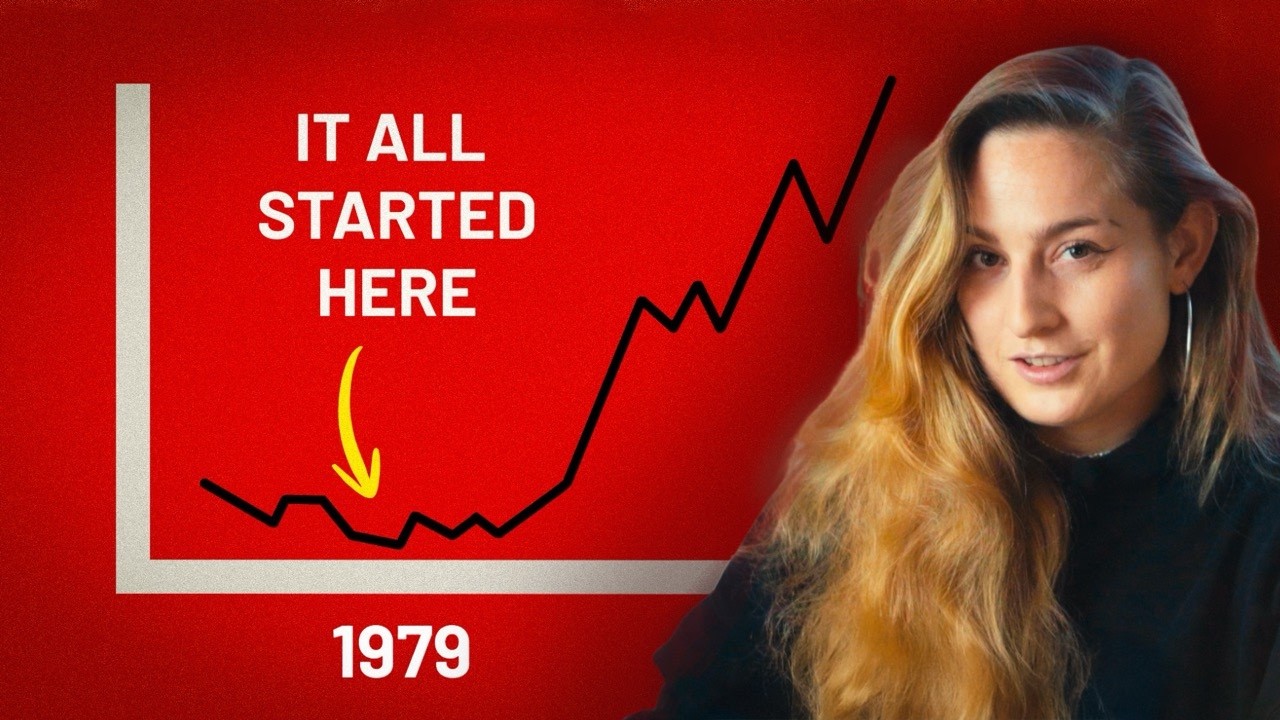
how the Rich Took Over the Economy

33.7K subscribers
31,866 views Nov 30, 2025
:{Get 60% off the incogni annual subscription: https://incogni.com/annabocca
Wealth inequality didn’t just “happen”, it was engineered. This video breaks down the economic decisions, geopolitical shifts, and global power structures that created today’s extreme concentration of wealth. From Bretton Woods to Volcker, Thatcher, Reagan, the IMF, and the rise of financialisation, this is the story of how the modern economy was rebuilt for the super rich and what it means for the rest of us.}:
---
---
AN 11 25 SEE TAX DODGE 4 ANNO
The Trump administration is quietly waging an all-out regulatory war on a Biden-era corporate tax that aimed to prevent large companies from dodging their tax liabilities while reporting huge profits.
The corporate alternative minimum tax (CAMT) was enacted as part of the Inflation Reduction Act, Democratic legislation that former President Joe Biden signed into law in 2022. The CAMT requires highly profitable US corporations to pay a tax of at least 15% on their so-called book profits, the figures reported to shareholders.
As the Institute on Taxation and Economic Policy has explained: “Many of the special breaks that corporations use to avoid taxes work by allowing companies to report profits to the IRS that are much smaller than their book profits. Corporate leaders prefer to report low profits to the IRS (to reduce taxes) and high profits to the public (to attract investors).”
But since President Donald Trump took office in January, his administration has issued guidance and regulatory proposals designed to gut the CAMT. The effort is a boon to corporate giants and rich private equity investors at a time when the Trump administration is relentlessly attacking programs for low-income Americans, including Medicaid and nutrition assistance.
TheNew York Times reported Saturday that “with its various tax relief provisions, the administration is now effectively adding hundreds of billions of dollars in new breaks for big businesses and investors” on top of the trillions of dollars in tax cuts included in the Trump-GOP budget law enacted over the summer.
“The Treasury is empowered to write rules to help the IRS carry out tax laws passed by Congress,” the newspaper added. “But the aggressive actions of the Trump administration raise questions about whether it is exceeding its legal authority.”
The administration’s assault on the CAMT has drawn scrutiny from members of Congress.
In a September 8 letter to US Treasury Secretary Scott Bessent, a group of Democratic lawmakers and Sen. Angus King (I-Maine) warned that the administration’s guidance notices “create new loopholes in the corporate alternative minimum tax for the largest and wealthiest corporations.”
“Most troubling, Notice 2025-27, issued this June, allows companies to avoid CAMT if their income—under a simplified accounting method—is below $800 million,” the lawmakers wrote. “The Biden administration previously set the safe harbor threshold precisely at $500 million in its proposed CAMT rule after calculating that a higher safe harbor threshold would risk exempting corporations that should be subject to CAMT under statute.”
“Now, less than nine months later and with zero justification, this new guidance summarily asserts that an $800 million safe harbor will not run that risk,” they continued. “We are seriously concerned that this cursory loosening of CAMT enforcement will simply allow more wealthy corporations to avoid paying their legally owed share.”
---
an 5 25an states
U.S. Rep. Jim Jordan of Ohio wanted to slip a sweeping measure into a spending bill that would gut the Federal Trade Commission. Critics say it’s no coincidence that the FTC is suing mammoth health care conglomerates and tech giants like Amazon.
Jordan is chairman of the powerful House Judiciary Committee. Last week, it released a version of a bill that included tax cuts, federal spending cuts and more spending at the border.
It also contained provisions that would give Trump sweeping new powers to gut government regulations. It would also transfer funds and personnel currently controlled by the FTC to the Antitrust Division of the Justice Department — without the FTC’s unique enforcement authority going with them.
The measure was abruptly nixed, but it would have effectively killed antitrust powers Congress created more than a century ago.
The FTC history
Amid abuses to consumers by big corporations, the Federal Trade Commission Act was passed in 1914. Antitrust enforcement by the Department of Justice dates back further, to 1903.
But the Justice Department is overseen by the attorney general, a presidential appointee. Attorneys general traditionally have had a high degree of independence, but Trump is said to be politicizing the Justice Department at a breakneck pace.
The FTC was created in part to be more independent. It’s governed by commissioners from both parties who are appointed to fixed terms that can be renewed.
Earlier this year, Trump tried to fire the two Democratic commissioners, but they say the move was illegal, and they’re fighting it in court. Antitrust advocates said Trump was doing that as a favor to his billionaire supporters such as Elon Musk.
The two Democratic commissioners, Alvaro Bedoya and Rebecca Slaughter, acted to block the Kroger-Albertson’s mega-merger, and they voted to sue Amazon, saying it is “illegally maintaining monopoly power.”
Under Jordan’s leadership, the Judiciary Committee in 2023 attacked the FTC on behalf of Musk. He’s the world’s richest man, whom Trump is allowing to make deep cuts to federal programs for the elderly, veterans, the poor, and agencies that promote science and health.
“THE WEAPONIZATION OF THE FEDERAL TRADE COMMISSION: AN AGENCY’S OVERREACH TO HARASS ELON MUSK’S TWITTER,” read the all-caps title of the Jordan-led committee’s report.
A year earlier, the FTC had charged Twitter with using deceptively gathered data from users to target ads at them. If true, it would be added to the fact that an unofficial, Musk-run entity is now collecting much more sensitive government data. It’s raised concerns among several federal judges who said such collections invite abuse and likely violate the law.
“One of Elon Musk’s Department of Government Efficiency lieutenants working in the Social Security Administration has been pushing dubious claims about noncitizens voting, apparently using access to data that court records suggest (the so-called Department of Government Efficiency) isn’t supposed to have,” NPR reported earlier this month.
The proposal from Jordan to gut the FTC could have halted major initiatives to regulate giant health conglomerates that own powerful pharmacy middlemen, said Bedoya, one of the commissioners Trump is trying to fire.
Jordan’s office didn’t respond to a request for comment on this story.
PBMs
Each of the three conglomerates — UnitedHealth Group, CVS Health and Cigna-Express Scripts — is among the 15 largest corporations in the United States. Each owns a top-ten health insurer and each owns a pharmacy middleman known as a pharmacy benefit manager, or PBM.
Combined, the PBMs control nearly 80% of the insured drug transactions in the United States. They decide which drugs are covered and use that power toextractrebates from drugmakers. They also determine varying reimbursements to pharmacies — including ones owned by their parent companies as well as the pharmacies with which they compete. Critics — including four-fifths of state attorneys general — say they have a conflict of interest under the arrangement, and that they abuse it.
Last October, the FTC sued the conglomerates, saying they used their dominance in multiple parts of the marketplace to illegally jack up the price of insulin — a drug millions of diabetics need to survive.
The lawsuit comes after the agency in 2022 undertook a major investigation of the health conglomerates. In January, it released an interim report accusing the PBMs of using their dominance to instigate wild price hikes and possibly steer business to affiliated pharmacies.
Politico recently reported that Jordan said his move to consolidate the FTC into the Justice Department was meant to “address the cost of over-regulation.”
“Part of our jurisdiction in Judiciary deals with regulatory concerns and so we are looking at … spending and costs associated with certain regulations. That’s why that language is written the way it was,” Politico reported him as saying.
Many businesses facing regulation — and their advocates in government — have long focused only on the costs. But government regulation can also protect health, safety, the environment, economic stability and competition. Some researchers have said regulation can always be smarter, but its benefits far outweigh the costs.
In a social media post last week, Bedoya, the FTC commissioner, said Jordan’s proposed changes to the agency served another agenda.
“This will gut the FTC,” Bedoya wrote. “FTC is trying to finish a study that already showed how pharmacy middlemen mark up cancer drugs by up to 4,000%. It’s also suing them for allegedly competing to raise insulin prices. If this passes I have no idea what’ll happen to that study and lawsuit.”
Bedoya added, “Take the lawsuit. The draft bill purports to transfer FTC lawyers and lawsuits to DOJ — but it doesn’t transfer the laws that FTC enforces, or authority to enforce those laws. Look (at) page 98 — employees, assets, funding — but no authorities.”
Bedoya also said that when it created the FTC, Congress meant to augment the government’s antitrust powers. Jordan’s changes would remove the government’s ability to police “unfair methods of competition,” Bedoya said, implying that Jordan was trying to slash the government’s power to police wealthy corporations in an era when the political influence of the mega-rich is exploding and the wealth gap is yawning.
“The purpose behind the FTC’s creation in 1914 was to supplement the existing enforcement mechanism (and enforcement gap created by) the Department of Justice,” Bedoya said on X. “When FTC was created in 1914, it alone was authorized to stop something called ‘unfair methods of competition.’ DOJ did not get this” under Jordan’s proposal.
YOU MAKE OUR WORK POSSIBLE. SUPPORT
Ohio Capital Journal is part of States Newsroom, a nonprofit news network supported by grants and a coalition of donors as a 501c(3) public charity. Ohio Capital Journal maintains editorial independence. Contact Editor David Dewitt for questions: info@ohiocapitaljournal.com.
---
---
AN 10 25 ALSO MSNBC
Former Federal Trade Commission member Alvaro Bedoya told the New Republic that he encountered extensive finagling of government systems and the free market before President Donald Trump fired him this year.
Bedoya, who was confirmed as an FTC member in 2022, says he remains “worried about the money at the top crushing everyone underneath.”
“That sounds grim because it is,” said Bedoya, who spent considerable time fighting to reverse the damage of corporate opportunists tweaking the U.S. health system to their advantage.
He’d worked with an independent pharmacy owner in Appalachia complaining of insurance companies using intermediaries to steer lucrative prescriptions to their ownmail-order pharmacies rather than local businesses. One insurance company had even tried to turn away a West Virginia family from a local pharmacy and force them to wait weeks for their own supplier to mail them life-saving medicine for their cancer-afflicted child.
Corporate middlemen could blow up any agreement at their whim by claiming pharmacists were at default for bogus noncompliance. Bedoya also did battle with corporations who had bought up every vendor for feed, fertilizer, pesticides and then began jacking up prices for local farmers amid the resulting monopoly.
“The companies weren’t focused on research and development,” farmers told Bedoya. “They’re using their wealth to buy their competitors.”
Meat processors had been scuttled down by buyouts to only one processor — who could then pay farmers however little he wanted to buy their cattle. Farmers who used to be able to repair their own tractors now discovered that John Deere had locked down their vehicles software, forcing farmers to take broken tractors to a company dealership.
“It’s like getting picked apart by a chicken,” one farmer complained to him.
During his career Bedoya also helped day laborers whose millionaire employers insisted they work as independent contractors with no benefits, and sometimes with no worksite amenities like drinkable water.
When Trump arrived, he designated as FTC chairman Andrew Ferguson, who announced the FTC would “usher in a new Golden Age for American businesses, workers, and consumers.”
“What has followed has been a Golden Age for the C-suite,” said Bedoya.
The FTC suddenly determined that a ban on noncompete clauses that lock people into dead-end positions were not worth defending in court. Another rule banning companies insisting you unsubscribe from a service over the phone was delayed. And an order barring an oil executive from the board of Exxon was dismantled. Trump’s revamped Consumer Financial Protection Bureau also suddenly didn’t care to fine banks that hit veterans with surprise overdraft fees.
“A lawsuit against a Berkshire Hathaway subsidiary that allegedly tricked people into taking out loans for mobile homes when they had $57.78 in discretionary income? Gone, said Bedoya.
All of this feeds an American misery that can breed new misery, said Bedoya.
“Many liberals remain baffled that America elected Donald Trump. They genuinely have no idea how he could have won the election. I don’t think that Trump won because of ‘wokeism’ or the ‘trans agenda,’ whatever that is,” Bedoya said. “I think he won by speaking to that despair and telling people that he alone could fix it.”
But those soothing words were just an open door, apparently.
Read the full New Republic report at this link.
---
---
AN 9 25
ROBT R
It’s too easy to accept the conventional view that the widening polarization of our society, and the decline of democracy, are due to the demagogue in the Oval Office.
That conventional view is way too simple. Follow the money. The underlying cause is the tsunami of legal bribes flowing from huge, wealthy corporations (and their oligarchic CEOs and major investors) into American politics.
That tsunami has grown dramatically over the last forty years. It underlies the crisis of democracy. It is fueling polarization. Democracy and social cohesion are impossible to sustain when big money is dictating political outcomes.
Over the last four decades, corporate political spending has more than quadrupled, adjusted for inflation.
Labor unions no longer provide a counterweight. Forty years ago, union PACs contributed about as much as corporate PACs. In the 2024 election, corporations outspent labor by more than 3 to 1.
According to a landmark study published in 2014 by Princeton professor Martin Gilens and Northwestern professor Benjamin Page, the preferences of the typical American have no influence at allon legislation emerging from Congress.
Gilens and Page analyzed 1,799 policy issues in detail, determining the relative influence of economic elites, business groups, mass-based interest groups, and average citizens. Their conclusion:
“The preferences of the average American appear to have only a minuscule, near-zero, statistically non-significant impact upon public policy.”
Gilens and Page found that lawmakers listen mainly to the policy demands of big business and wealthy individuals — those with the most lobbying prowess and deepest pockets to bankroll campaigns and promote their views.
It’s far worse now. Gilens and Page’s data came from the period 1981 to 2002 —before the Supreme Court opened the floodgates to big money in the Citizens United case, before Super PACs, before “dark money,” and before the Wall Street bailout.
Decades before Trump, corporations were already getting a high return on the money they invested in politics. I know. I was there. I had a front-row seat.
Over the last 40 years, corporate tax rates have plunged. Regulatory protections for consumers, workers, small investors, and the environment have been defanged. Antitrust has become so ineffectual that many big corporations face little or no competition.
Corporations have fought off safety nets and public investments that are common in other advanced nations, such as universal health care and paid family leave. They’ve attacked labor laws — reducing the portion of private-sector workers belonging to a union from a 35 percent forty years ago to just over 6 percent now.
They’ve collected hundreds of billions in federal subsidies, bailouts, loan guarantees and sole-source contracts. Corporate welfare for Big Pharma, Big Oil, Big Tech, Big Ag, Wall Street, and the largest military contractors now dwarfs welfare for people.
The profits of big corporations have reached record highs, and the ratio of CEO pay in large companies to average workers has ballooned from 20-to-1 in the 1960s, to nearly 300-to-1 now.
Most Americans, however, are going nowhere. The typical worker’s wage is only a bit higher today than it was forty years ago when adjusted for inflation.
The biggest casualty has been public trust in democracy.
In 1964, only 29 percent of voters thought government was “run by a few big interests looking out for themselves.” By 2013, 79 percent of Americans thought so.
A large portion of the American public has become so frustrated and cynical about democracy that they believe the blatant lies of a self-described strongman and support a political party that no longer stands for democracy.
Capitalism is compatible with democracy only if democracy is in the driver’s seat. But the absence of democracy doesn’t strengthen capitalism. It fuels despotism.
Ironically, the CEOs of many large American corporations are now finally confronting this reality. Despotism is bad for capitalism. Despots don’t respect property rights. They don’t honor the rule of law. They are arbitrary and unpredictable. All of this harms the owners of capital. Despotism also invites civil strife and conflict, which destabilize a society and an economy.
My message to every CEO in America: You need democracy but you’re actively undermining it by polluting it with big money and throwing much of your support behind a tyrant whose arbitrary and capricious decisions are threatening your businesses. It’s time for you to join the pro-democracy movement.
This is not only about economics. Widening inequality and a weakening democracy take a toll on the moral wellbeing of the nation, on the implicit social contract that binds us together, on the trust and cohesion we need to accomplish anything worthwhile.
In one of his first interviews, on September 14, Pope Leo XIV — history’s first U.S.-born pope — talked about the causes of the deep polarization he sees in America and elsewhere:
“Very significant is the continuously wider gap between the income levels of the working class and the money that the wealthiest receive. …Yesterday the news that Elon Musk is going to be the first trillionaire in the world. What does that mean and what’s that about? If that is the only thing that has value anymore, then we’re in big trouble.”
Trump is not the cause of the growing cynicism about democracy and the deepening polarization of our society. He’s the consequence and culmination of decades of neglect. We could not have remained on the road we were on toward ever-widening inequality and ever-greater political corruption.
If there’s a silver lining to this darkening cloud, it is that Trump may finally force us to confront this long-term crisis.
---
---
an 5 25
:{:{During the House’s marathon markup of President Donald Trump’s historic budget bill, the Chairwoman of the powerful Rules Committee lashed out at Democrats for plainly describing the legislation’s sweeping consequences. Officially dubbed the “One Big, Beautiful Bill Act,” the measure narrowly passed in the early hours of Thursday by a 215–214 vote. }:
It removes $800 billion in funding from Medicaid, would lead to $535 billion in cuts to Medicare, and is projected to cause an estimated 8.6 to 13.7 million Americans to lose their health care. It will also add $3 trillion to the federal deficit—fueled by tax breaks heavily tilted toward the wealthy and the nation’s first-ever $1 trillion defense budget.}:
“I am concerned about what has been said about this bill and what it’s going to do,” Chairwoman Virginia Foxx (R-NC) told the members of her committee Wednesday night. “The extreme comments that have been made about it, and how I believe that it is scaring people out there in the country unnecessarily.”
“The words I’ve heard, particularly today, are ‘cut,’ ‘rip,’ ‘gut,’ ‘kill,’ ‘cruel,’ ‘stealing food,’ ‘losing coverage,’ ‘jammed through,’ ‘biggest transfer of wealth from vulnerable to wealthy people,’ ‘irresponsible’.”
“That is not the way we ought to be talking about this bill.”
READ MORE: ‘Sovereignly Appointed’: Trump Praised in Pentagon Prayer Event Led by Hegseth and Pastor
Many appear to disagree.
MSNBC columnist Michael A. Cohen, just after the bill passed Thursday morning, wrote: “What we do know about the legislation the GOP is calling the ‘One Big Beautiful Bill Act’ is genuinely terrifying.”
“What makes this situation even worse is that Republicans, from the president on down, are consistently lying about what the bill would do,” Cohen charged.
“The House Republican budget plan would eviscerate Medicaid and food assistance and shift resources toward the wealthiest Americans,” the Center for American Progress (CAP) warned ten days ago, adding that it “would implement the largest cuts to both Medicaid and the Supplemental Nutrition Assistance Program (SNAP) in history—kicking millions of Americans off their health insurance and taking food away from hungry children.”
“It would raise household electricity costs while trapping most middle-class and poor students in greater student loan debt to afford a higher education,” CAP’s Bobby Kogan, Senior Director for Federal Budget Policy wrote. “And it would make all these changes as a means to partially offset tax breaks that disproportionately go to the richest Americans, giving households in the top 0.1 percent a multihundred-thousand-dollar tax break on average while increasing deficits by trillions of dollars. Taken as a whole, the bill would add trillions of dollars to structural deficits despite these enormous cuts to critical services.”
“If enacted,” Kogan warned, “this would be the largest transfer of wealth from the poor to the rich in a single law in U.S. history.”
READ MORE: ‘Get Out of Here’: Trump Erupts, Calls for NBC Probe After Reporter Asks About Qatari Jet
“Taken as a whole, this bill would harm Americans—particularly the most vulnerable people—and leave the country worse off. It would lead to preventable deaths by taking health care away from millions of people. It would worsen food insecurity by taking food away from the hungry, particularly kids.”
“Budgets showcase our morality because they force governments to decide how to prioritize limited resources. The House Republican budget plan would shift funding away from the sick and hungry and, instead, toward the wealthiest Americans.”
U.S. Rep. Veronica Escobar (D-TX) responded to Foxx, saying, “In other words, ‘please don’t call this bill what it is or say what it does’.”
Watch the video below or at this link.
---
---
NO LNX
Behind the 60-year Republican plot to destroy American democracy
Activist Phyllis Schafly wearing a "Stop ERA" badge, demonstrating with other women against the Equal Rights Amendment in front of the White House, Washington, D.C..
Thom Hartmann April 27, 2025
In a Daily Take here on Hartmann Report, I mentioned Russell Kirk and the origins of today’s hard right GOP. A few people replied with, “Who’s that?” and similar questions; others were incredulous that Republicans actually believed the middle class created by FDR’s New Deal was a bad thing. So, here’s the backstory to what I mentioned.
I was thirteen years old in 1964 when my dad, a Republican activist, gave me a copy of John Stormer’s book “None Dare Call It Treason.” The Goldwater campaign had sent it to him, and its claim that the State Department was filled with communists intent on handing America over to the USSR had his friends buzzing.
Ironically, Stormer’s book and the movement it ignited within the GOP is largely responsible for that party today standing on the precipice of fully endorsing fascism as an alternative to democracy in the US.
And it was started by morbidly rich men (it was all men back then) who wanted to use the threat of a “communist menace” to gut the union movement to increase their own corporate profits and CEO pay.
The founding premise of the modern conservative movement tracks back a generation before Stormer’s book to a Republican thought leader named Russell Kirk. He laid it out in his 1951 book The Conservative Mind: From Burke to Eliot, as I detail in The Hidden History of American Oligarchy.
Kirk argued that the middle class was becoming a threat to America; without clearly defined classes and power structures — essentially without the morbidly rich in complete control of everything — he worried that society would devolve into chaos.
The opening chapter of his book was about Edmund Burke, the Irish conservative who wrote, in 1790, that hairdressers and candlemakers should not be allowed to run for political office or even to vote:
“The occupation of a hairdresser or of a working tallow-chandler cannot be a matter of honor to any person — to say nothing of a number of other more servile employments. Such descriptions of men ought not to suffer oppression from the state; but the state suffers oppression if such as they, either individually or collectively, are permitted to rule. In this you think you are combating prejudice, but you are at war with nature...”
Kirk and his followers essentially predicted in 1951 that if today’s “hairdressers and working tallow-chandlers” — college students, women, working-class people, and people of color — ever got even close to social and political power at the same level as wealthy white men, there would essentially be a communist revolution in the US, handing us over to Stalin and his Politburo.
(Keep in mind, this was when racial segregation was legal and brutally enforced, the voting age was 21, campuses were almost entirely all-male, both abortion and birth control were illegal in most states, and women couldn’t open checking accounts or get credit cards without a husband’s, brother’s, or father’s signature.)
Throughout the 1950s, Kirk and his warnings of the dangers of an activist middle-class developed a small following; the most prominent of his proponents were William F. Buckley Jr. and Barry Goldwater. Most Republicans, though, considered him a crackpot.
But when the birth-control pill was legalized in 1961 and the Vietnam War heated up a few years later, those marginalized groups Kirk had warned his wealthy white male followers about began to rise up in protest.
Kids were burning draft cards, women were burning bras, and Martin Luther King Jr. was leading a movement for racial justice that the white power structure blamed for American cities burning. Gay liberation was also having a moment.
Meanwhile, the Arab Oil Embargoes of the 1970s had lit the flame of inflation, and unionized workers were striking all over America for wage increases to keep up with the rising cost of living.
Wealthy white conservatives freaked out as the morbidly rich promoted the idea that America was experiencing a “moral decline” that could only be fixed by ending the union movement and other “liberal” causes that shared the union movements’ populist goals.
They became convinced that they were seeing Kirk’s prophecy play out in real time on their television screens every night: the “communists” — those uppity racial minorities, women who’d forgotten their “rightful place in society,” students who objected to Vietnam, unionized workers, and gender minorities — were on the verge of “taking over” America.
These five movements all hitting America at the same time got the attention of conservatives and Republicans who had previously ignored or even ridiculed Kirk back in the 1950s. Suddenly, America’s most powerful and well-known conservative commentators (like William F. Buckley Jr.) were telling Republicans that Russell Kirk was, indeed, a prophet.
They’d finally found a politically acceptable “hook” to destroy the wealth of working-class people and transfer trillions into their own money bins: fear of communism and a prophesied social decay caused by an activist middle class.
The Republican/Conservative “solution” to the “crisis” these five movements represented was put into place in 1981 when Ronald Reagan was sworn into office: the explicit goal of the morbidly rich white men funding the so-called Reagan Revolution was to take the middle class down a peg to end the protests of the ’60s and ’70s, restore “social stability,” and increase corporate profitability.
Their plan was to declare war on labor unions so wages could slide back down again, end free college across the nation so students would live in fear rather than be willing to protest, and increase the penalties Nixon had already put on drugs so they could use those laws against their scapegoats, particularly the hippy antiwar protesters and Black people demanding an end to police killings. They also wanted to outlaw abortion, to put women “back in their place.”
Thus, Reagan massively cut taxes on rich people and raised taxes on working-class people 11 times. For example, he put income taxes on Social Security and unemployment payments, and put in a mechanism to track and tax tips income, all of which had previously been tax-free but were exclusively needed and used by middle-class people.
He ended the tax deductibility of credit-card, car-loan, and student-debt interest, overwhelmingly claimed by working-class people. At the same time, he cut the top tax bracket for millionaires and billionaires from 74% to 25%. (There were only a handful of billionaires in America then, in large part because of previous tax policies; today’s democracy-destroying explosion of billionaires followed Reagan’s, Bush’s, and Trump’s massive tax cuts on the rich.)
Reagan declared war on labor unions, crushed PATCO in less than a week, and over the next decade the result of his war on labor was that union membership went from about a third of the American workforce when he came into office to around 10% at the end of the Reagan/Bush presidencies. It’s just now beginning to recover from its low of 6% of the private workforce.
He and Bush also husbanded the moribund 1947 General Agreement on Tariffs and Trades (GATT, which let Clinton help create the WTO) and negotiated NAFTA, which Clinton signed and thus opened a floodgate for American companies to move manufacturing overseas, leaving American workers underemployed while radically cutting corporate labor costs and union membership.
And, sure enough, Reagan’s War on Labor cut average inflation-adjusted minimum and median wages by more, over a couple of decades, than anybody had seen since the Republican Great Depression of the 1920s and ’30s.
The billionaire’s investment in taking the middle-class down a peg was paying off by orders of magnitude.
Had Reagan not destroyed the nation’s unions, the median American income today would be well over $100,000 a year, minimum-wage households would have a family income of $86,000, and a single wage-earner would still be able to buy a house, a car, send the kids to college, and have a decent retirement (as my dad did, working a union job for 35 years in a tool-and-die shop).
Instead, CEOs today keep all that money for themselves and their investors.
And Reagan’s War on Colleges jacked up the cost of education so high that an entire generation is today saddled with more than $1.5 trillion in student debt: as predicted, many aren’t willing to jeopardize it all by “acting up” on campuses.
The key to selling this campaign of impoverishment to the American people to help out the billionaire class was the idea that the US shouldn’t protect the rights of workers, subsidize education, grant women equal rights, or enforce Civil Rights laws because, conservatives said, all of those things were aspects of “socialism.” And if America embraced socialism, we may as well be ruled by the Soviet Union.
As Reagan told us in his first inaugural, government “socialist” programs were not the solution to our problems, but instead were the problem itself.
He ridiculed the formerly-noble idea of service to one’s country and joked that there were really no good people left in government because if they were smart or competent they’d be working in the private sector for a lot more money.
He even told us that the nine most frightening words in the English language were, “I’m from the government, and I’m here to help.”
Following Lewis Powell’s 1971 memo, throughout the 1970s and 1980s Republican billionaires built a massive infrastructure of think tanks and media outlets to promote and amplify Reagan’s message that government supports of any sort for poor or working-class people were simply gateway drugs to socialism and, inevitably, communism.
It so completely swept America that by the 1990s even President Bill Clinton was saying things like, “The era of big government is over,” and “This is the end of welfare as we know it.” Limbaugh, Hannity and other right-wing radio talkers were getting millions a year in subsidies from billionaire-funded groups like the Heritage Foundation. Billionaire-owned Fox “News” today carries on the tradition.
It had been a pretty good scam for the billionaires who owned the GOP and wanted, back in the 1950s, to stop the union movement that was forcing them to share their profits with their workers.
First, they terrified Americans about communism and socialism, then convinced about half of us that those things came straight out of “liberal” social and economic movements.
Unions, feminism, acceptance of the queer community, civil rights, minimum wage increases, and even regulation of corporate behavior would, they told us, all lead to Soviet-style tyranny.
So, to save America from herself, Reagan gutted the American middle class, transferring over $50 trillion in wealth from working class people into the money bins of the morbidly rich.
By 2016, Americans were starting to figure out that they’d been screwed — and that Hillary Clinton’s husband had been in on it by continuing Reagan’s policies and doubling-down on free trade — and were loudly demanding change.
Into this maelstrom walked Donald Trump, proclaiming himself the savior of the country. In the GOP primary he pointed out how corrupt his opponents were, particularly Jeb Bush and Marco Rubio, and destroyed them, one after the other.
For the general election in 2016, he changed his tune and ran on what was traditionally a Democratic platform, saying he was going to bring jobs home, end so-called “free trade” policies [TPP], raise taxes on the rich so much that “my friends won’t talk to me anymore,” and make sure every American had free or low-cost healthcare and access to an affordable college education.
They were all lies — something Trump had become adept at during his business career — but they worked and sucked in disaffected workers who knew they’d been screwed but weren’t sure who did it to them or why.
So here we are.
We have an open fascist and apparent friend of authoritarian Russia as president after being convicted by a jury of his peers on 34 felony charges, having previously been adjudicated as responsible for sexual abuse (the judge called it “rape”) and fraud.
He’s putting into place people and policies that could turn America into an authoritarian nation like Russia or Hungary, and apparently wants to re-align the United States away from NATO and the EU and toward Russia, China, Iran, and North Korea.
We are literally facing the authoritarian future that John Stormer was warning us about back in 1964. Only instead of “communists” in the State Department, it’s a billionaire president with the avowed goal of ending union rights and locking up or using the Army with live ammunition against those who protest his policies.
And it all tracks back to wealthy conservatives funding a project in the 1960s to scare Americans about socialism and communism so they could stop the union-fueled growth of wages that were cutting into their profits.
Perhaps none dare call it treason. But I do.
NOW READ: The man-babies of MAGA never grew up because they never had to
---
===
ymail 4 25 patr million
...The gap between the wealthy and the rest of the country hasn’t been this wide since theGilded Age, when robber barons like Andrew Carnegie, John D. Rockefeller, and J.P. Morgan were around. According to the newForbes’ Billionaires List, America’s 902 billionaires wield a record $6.8 trillion in combined wealth, which is more than what theentire bottom half of the country holds. Over the last few decades, as inequality has skyrocketed,no less than $50 trillion has been redistributed from the bottom 90% to the top 1%.
---
---
an 4 25
Many of President Donald Trump's, from Fox News to Newsmax TV and One America News (OAN), are echoing his claim that Americans can expect "the biggest tax cut in history" during his second term. But Trump's detractors are countering that his economic plan will mainly benefit the richest of the rich — while causing considerable hardship to the middle class and the poor.
Some economists, in fact, are even worried that Trump's tariffs will cause "stagflation," a painful combination of inflation, unemployment and poor economic growth. Stagflation played a major role in President Jimmy Carter's landslide defeat in 1980 and persisted during President Ronald Reagan's first few years in office.
In an article published on April 12, Salon's Russell Payne offers some reasons why Trump's critics are worried about what lies ahead for the middle class and the poor.
READ MORE: 'Nothing to worry about': Brutal Fox News parody 'Foxsplains' Trump tariffs
One of those critics is Elizabeth Pancotti, managing director for the Groundwork Collective and a former adviser to progressive Sen. Bernie Sanders (I-Vermont).
Pancotti described the Trump/GOP economic plan as a "triple whammy of massive redistribution in a society that is already tilted toward the wealthy," telling Salon, "The end goal here is to redistribute trillions of dollars from the middle and working class at the bottom to the one percent and the wealthy folks. They're doing that in three different ways."
According to Pancotti, those three different ways are tariffs, tax cuts from the ultra-wealth, and major cuts to safety-net programs like Medicaid.
Payne explains, "Tariffs, Pancotti said, are a regressive tax that disproportionately impacts lower earners because, in essence, a tariff is a sales tax on imported goods. Because lower-income Americans spend a larger proportion of their income on goods, they will also spend a larger proportion of their income paying the tariffs on affected goods. At the same time, Pacotti said, the Trump tax cuts, which Republicans were planning to extend, were skewed to benefit the wealthiest Americans…. The Yale Budget Lab estimated that Trump's tariff plan will likely cost the average American household around $4689 a year — a sum that eclipses the tax cut that most households received in the GOP's budget plan while only being about 8 percent of the average tax cut the wealthiest households received"
READ MORE:'The Southern border is under attack': Trump orders US military to take over strip of land
According to Dean Baker, an economist at the Center for Economic and Policy Research, cuts to Internal Revenue Service (IRS) staff will make it easier for the ultra-rich to dodge taxes.
Baker told Salon, "Most of us have our tax deducted from our wages. We don't have much choice in the matter. So you both have, you know, the legislative changes that reduce their tax liability, but also, you know the fact of change is that if you don't have much by way of enforcement, you have a lot of people that don't pay their taxes."
---
===
AN 2 25
House Republicans advanced their budget plan out of committee Thursday night after a 12-hour markup session during which they rejected dozens of Democratic amendments, including proposed changes that would have protected Medicaid and federal nutrition benefits from the deep cuts the GOP hopes to impose to help finance trillions of dollars in tax breaks for the richest Americans.
The House Budget Committee advanced the Republican resolution, unveiled earlier this week, in a 21-16 vote along party lines. Prior to the vote, GOP members agreed to adopt an amendment offered by Rep. Lloyd Smucker (R-Pa.) that, according toPolitico, effectively caps "the cost of the tax cuts at $4 trillion, with a dollar-for-dollar increase in that ceiling if Republicans cut more spending, up to a total of $2 trillion in cuts."
Democrats on the panel offered more than 30 amendments to the budget resolution, all of which Republicans rejected.
"Each of our amendments was a direct effort to shield the American people from the reckless cuts embedded in this proposal, cuts that will hurt the most vulnerable while giving trillions of dollars of handouts to the ultra-rich," Rep. Brendan Boyle (D-Pa.), the top Democrat on the House Budget Committee, said in his closing remarks at Thursday's hearing. "We fought to protect Medicaid and Medicare, ensuring that seniors, low-income families, children, and people with disabilities don't see their healthcare stripped away."
"We proposed amendments to maintain funding for public education, ensuring that schools remain adequately resourced and that teachers don't bear the burden of budget shortfalls," Boyle continued. "And we stood up for veterans who risked their lives for this country and deserve more than empty rhetoric. They deserve fully funded healthcare, food assistance, and the benefits they earned through their service. Yet, despite the clear benefits of these proposals, Republicans oppose all of them."
"Instead of choosing to protect the American people," he added, "they chose to protect billionaires and corporations."
"This isn't government of, by, and for the people; it's government of, by, and for billionaires."
The Republican budget blueprint calls for more than a trillion dollars in cuts to Medicaid and the Supplemental Nutrition Assistance Program (SNAP), which provide healthcare and food aid to tens of millions of low-income Americans.
"These aren't just numbers," Sharon Parrott, president of the Center on Budget and Policy Priorities, stressed in response to the House GOP resolution. "The loss of Medicaid means, for example, a parent can't get cancer treatment, and a young adult can't get insulin to control their diabetes. Cuts to food assistance mean a parent skips meals so their children can eat or an older person who lost their job has no way to buy groceries."
In addition to advancing the GOP's far-right ideological project, such cuts would partly offset the costs of Republicans' proposed tax breaks—which would disproportionately benefit the wealthiest people in the country, including the billionaires in President Donald Trump's Cabinet.
"Republicans are cutting Medicaid and SNAP to pay for tax breaks for the richest 1% of Americans," the progressive advocacy group Americans for Tax Fairness wrote in a social media post on Thursday. "They are literally taking $1.1 TRILLION away from you, and giving it to the wealthiest people in the country."
Thursday's vote marks a first step toward passage of a sprawling, filibuster-proof budget reconciliation package that will include a slew of Republican priorities.
But the House GOP must resolve its differences with Senate Republicans, who are pushing for two bills instead of one. The Senate plan, which Republicans advanced out of committee earlier this week, also calls for major cuts to Medicaid and SNAP.
"This Republican budget opens the door to massive cuts for families," Sen. Jeff Merkley (D-Ore.), ranking member of the Senate Budget Committee, said Thursday. "Democrats on the committee offered amendment after amendment to protect healthcare, housing, and education—all of the foundations working families need to thrive—and Republicans blocked every single one of them, all to later divert those cuts into massive tax breaks for the richest Americans."
"This is the Great Betrayal," Merkley added. "Trump campaigned on protecting families, but President Trump and Senate Republicans are all about protecting their billionaire friends. This isn't government of, by, and for the people; it's government of, by, and for billionaires."
===
===
an 3 25
During the 2024 presidential race, Donald Trump and the Republican National Committee (RNC) claimed that then-Vice President Kamala Harris and other Democrats were obsessed with culture-war issues when they needed to be focusing on the economy, inflation and the working class. A GOP ad famously said, "Kamala is for they/them, President Trump is for you."
Harris' campaign pushed back, warning that Trump's economic policies — from aggressive tariffs to tax cuts for millionaires and billionaires — would be terrible for the working class. But Trump's messaging worked: Trump won the popular vote by roughly 1.5 percent.
When Trump was inaugurated on Monday, January 20, 2025, however, he was surrounded by tech billionaires — an image that, critics argued, was inconsistent with the message of economic populism he pushed during his campaign.
READ MORE:A**larm sounded as Trump’s recent moves threaten to upend the Constitution**
In an article published on March 2, Politico's Joshua Zeitz draws a parallel between "growing wealth inequality" in 2025 and the Gilded Age of the 19th Century — and lays out some reasons why conservatives should be worried about this disparity.
"At his second inauguration, as President Donald Trump promised to usher America into a new 'golden age,'" Zeitz observes, "he was surrounded in the Capitol Rotunda by a handful of tech billionaires whose companies account for roughly one-fifth of the market cap of U.S. public equities. It was a not-so-subtle sign that the second Trump Administration will be staffed, advised and led by titans of wealth. Which means that Trump's golden age looks an awful lot like a new Gilded Age."
:{:{Zeitz continues, "The Gilded Age was the era in the late 19th Century when business and industry dominated American life as never before or since. It was a period of unprecedented economic growth and technological progress, but also, of economic consolidation and growing wealth inequality. Titans of industry enjoyed enormous control over political institutions, while everyday Americans buckled under the strain of change. }:As the gap between the haves and the have-nots widened, political culture ultimately grew coarse — and violent. Then as now, growing income and wealth inequality opened a rift in American society, with a small group of elites amassing substantial power and influence."}:
The elites of the Gilded Age, Zeitz notes, included "industrial magnates like John D. Rockefeller and Andrew Carnegie" — whereas in 2025, they include Amazon's Jeff Bezos (who owns the Washington Post) and Tesla/SpaceX/X.com CEO Elon Musk.
READ MORE:**Scarborough slams Lindsey Graham for 'twisting and contorting once again' to 'benefit' Trump**
"Despite Trump's mass appeal among white working-class voters — and the fact that he performed better with working-class voters of other races than ever before — his coziness with billionaires like Musk and his pursuit of an economic agenda that focuses on tax breaks for the wealthiest Americans both suggest that his presidency will be more of a boon to modern-day tycoons than the average working person," Zeitz explains. "That could mean that the coming of America's second Gilded Age carries with it a warning for the GOP."
Zeitz adds, "By the 1890s, the pendulum had swung so hard in the direction of wealth and industry that America's brittle social compact threatened to come undone. In response to the extremes of the Gilded Age, a wave of progressive reform swept the nation from the 1890s to the 1910s, fundamentally reordering the social compact between citizens and their government."
READ MORE:**'Putin is on the inside now': Trump team doesn't consider Russia a cybersecurity threat**
*Joshua Zeitz's full article for Politico is available at this link.
===
===
AN 2 25
House Republicans advanced their budget plan out of committee Thursday night after a 12-hour markup session during which they rejected dozens of Democratic amendments, including proposed changes that would have protected Medicaid and federal nutrition benefits from the deep cuts the GOP hopes to impose to help finance trillions of dollars in tax breaks for the richest Americans.
The House Budget Committee advanced the Republican resolution, unveiled earlier this week, in a 21-16 vote along party lines. Prior to the vote, GOP members agreed to adopt an amendment offered by Rep. Lloyd Smucker (R-Pa.) that, according toPolitico, effectively caps "the cost of the tax cuts at $4 trillion, with a dollar-for-dollar increase in that ceiling if Republicans cut more spending, up to a total of $2 trillion in cuts."
Democrats on the panel offered more than 30 amendments to the budget resolution, all of which Republicans rejected.
"Each of our amendments was a direct effort to shield the American people from the reckless cuts embedded in this proposal, cuts that will hurt the most vulnerable while giving trillions of dollars of handouts to the ultra-rich," Rep. Brendan Boyle (D-Pa.), the top Democrat on the House Budget Committee, said in his closing remarks at Thursday's hearing. "We fought to protect Medicaid and Medicare, ensuring that seniors, low-income families, children, and people with disabilities don't see their healthcare stripped away."
"We proposed amendments to maintain funding for public education, ensuring that schools remain adequately resourced and that teachers don't bear the burden of budget shortfalls," Boyle continued. "And we stood up for veterans who risked their lives for this country and deserve more than empty rhetoric. They deserve fully funded healthcare, food assistance, and the benefits they earned through their service. Yet, despite the clear benefits of these proposals, Republicans oppose all of them."
"Instead of choosing to protect the American people," he added, "they chose to protect billionaires and corporations."
"This isn't government of, by, and for the people; it's government of, by, and for billionaires."
The Republican budget blueprint calls for more than a trillion dollars in cuts to Medicaid and the Supplemental Nutrition Assistance Program (SNAP), which provide healthcare and food aid to tens of millions of low-income Americans.
"These aren't just numbers," Sharon Parrott, president of the Center on Budget and Policy Priorities, stressed in response to the House GOP resolution. "The loss of Medicaid means, for example, a parent can't get cancer treatment, and a young adult can't get insulin to control their diabetes. Cuts to food assistance mean a parent skips meals so their children can eat or an older person who lost their job has no way to buy groceries."
In addition to advancing the GOP's far-right ideological project, such cuts would partly offset the costs of Republicans' proposed tax breaks—which would disproportionately benefit the wealthiest people in the country, including the billionaires in President Donald Trump's Cabinet.
"Republicans are cutting Medicaid and SNAP to pay for tax breaks for the richest 1% of Americans," the progressive advocacy group Americans for Tax Fairness wrote in a social media post on Thursday. "They are literally taking $1.1 TRILLION away from you, and giving it to the wealthiest people in the country."
Thursday's vote marks a first step toward passage of a sprawling, filibuster-proof budget reconciliation package that will include a slew of Republican priorities.
But the House GOP must resolve its differences with Senate Republicans, who are pushing for two bills instead of one. The Senate plan, which Republicans advanced out of committee earlier this week, also calls for major cuts to Medicaid and SNAP.
"This Republican budget opens the door to massive cuts for families," Sen. Jeff Merkley (D-Ore.), ranking member of the Senate Budget Committee, said Thursday. "Democrats on the committee offered amendment after amendment to protect healthcare, housing, and education—all of the foundations working families need to thrive—and Republicans blocked every single one of them, all to later divert those cuts into massive tax breaks for the richest Americans."
"This is the Great Betrayal," Merkley added. "Trump campaigned on protecting families, but President Trump and Senate Republicans are all about protecting their billionaire friends. This isn't government of, by, and for the people; it's government of, by, and for billionaires."
===
---
AN 1 25
In what was billed as his “farewell address,” President Biden yesterday warned America that the nation is succumbing to an “oligarchy” of the ultra-wealthy, and the “dangerous concentration of power” they pose to democratic ideals:
“Today, an oligarchy is taking shape in America of extreme wealth, power and influence that literally threatens our entire democracy, our basic rights and freedoms and a fair shot for everyone to get ahead.”
He’s right, of course.
Fascism startswith the Trump derriere-kissing we’re now witnessing by the wealthiest people in America, who own the biggest megaphones and thereby determine what information Americans get. What they get back from Trump is raw power to do whatever they want.
Elon Musk — the richest person in the world— controls X, which under his leadership has become a cesspool of lies and bigotry.
Musk has posted or replied to more than 80 posts about the Los Angeles fires, many of which downplayed the role of climate change — placing blame instead on individual female firefighters of color and lesbian firefighters, including posting their names and faces.
He boosted an hour-long propaganda video by right-wing conspiracy theorist Alex Jones that claimed the fires were “part of a larger globalist plot” to cause the collapse of the United States; Musk replied simply, “True.”
He repeatedly amplified claims that the Los Angeles Fire Department’s investments in diversity, equity, and inclusion (DEI) programs cost lives by wasting money that could have been spent on disaster response, suggesting that the destruction could have been mitigated if more white men had been retained.
Musk has made it clear that his platform’s main role during the upcoming Trump regime will be to back whatever Trump chooses to do and criticize Trump’s critics with more lies and bigotry.
Jeff Bezos — the second-richest person in America — owns Amazon. His Prime Video just announced it will spend a whopping $40 million for a documentary about Melania Trump, for which she is an executive producer, and stream it on Amazon Prime.
What else will Amazon promote or censor, to curry favor with Trump?
Bezos also owns The Washington Post. Just before the election, he killed a Post endorsement of Kamala Harris. Earlier this month, a Postcartoonist quit after the newspaper spiked a cartoon showing Bezos and Facebook’s Mark Zuckerberg kneeling before Trump.
Mark Zuckerberg — the third-richest person in America —owns Facebook, Instagram, and Threads. He’s sucking up to Trump by ridding his platforms of content moderation so that they, too, can amplify Trump’s lies and bigotry.
Announcing the end of fact-checking on his platforms, Zuckerberg says he thinks it will “take another ten years” of fact-free operation before Meta is “back to the place that it maybe could have been if I hadn’t messed that up in the first place.”
Zuckerberg says the deciding factor was the “cultural tipping point” of Trump’s election.
Not only will Zuckerberg fire most of the 40,000 fact-checkers who have screened his platforms’ posts for accuracy, but he will be moving the few who remain from California to Texas, “where there’s less concern about the bias of our teams.”
So Texas workers will be less “biased” than California workers? As Dan Evon of the nonprofit News Literacy Project notes, the move “provides an air of legitimacy to a popular disinformation narrative: that fact-checking is politically biased.”
Training materials for Meta’s remaining trust and safety workers include examples of speech that Zuckerberg now wants permitted:
“Immigrants are grubby, filthy pieces of shit.”
“Gays are freaks.”
“Look at that tranny (beneath photo of 17 year old girl).”
Trump praised the move, saying “I think they’ve come a long way.”
A reporter asked Trump if his threats to put Zuckerberg in prison caused the change in policy. “Probably,” Trump responded. Perhaps the Federal Trade Commission’s lawsuit against Meta played a role as well?
Zuckerberg has also promoted prominent Republican Joel Kaplan to be Meta’s chief global affairs officer and put Dana White, CEO of Ultimate Fighting Championship and a close friend of Trump, on its board.
My friends, none of this has anything to do with freedom of speech. It has everything to do with the power of money.
The three richest Americans want to decide what the rest of us will know about the coming Trump regime.
Concentrated wealth is the enemy of democracy. As the great jurist Louis Brandeis is reputed to have said, “America has a choice. We can either have great wealth in the hands of a few, or we can have a democracy. But we cannot have both.”
As we slouch into the darkness of Trump II, America needs people and institutions that speak truth to power, not align themselves with it.
When we the people regain power, three reforms are critically necessary to begin to tame the oligarchy:
- X, Amazon, Meta, and other giant tech media platforms must either be busted up or treated as public utilities, responsible to the public.
- Hugely wealthy individuals must not be permitted to own critical media.
- Large accumulations of individual wealth must be taxed.
My friends, we will prevail.
===
no lnx
alternet-
Americans are doubling down on the thing that hurts them the most
Thom Hartmann January 07, 2025
Yesterday, Congress certified the electoral vote count making a billionaire president again, starting after he’s sworn in on January 20th.
Yes, we chose a billionaire. Again. After other billionaires spent billions to convince us to make that choice.
As you’re reading these words, billionaires from America and around the world are making pilgrimages to his shabby golf motel to kiss our upcoming billionaire president’s ass and hand him envelopes with $1 million checks that represent a few hours (at most) of income for most of them or their companies.
Meanwhile, our billionaire president-in-waiting is packing his cabinet — the heads of all of the most important federal agencies — with even more billionaires. This is all being celebrated over on billionaire-owned Fox “News” and on billionaire-owned hate radio networks, as well as in the billionaire-owned Washington Post, LA Times, and the roughly half of American local newspapers owned by billionaire hedge funds.
Other countries enjoy benefits like free healthcare and college; modern mass transit; and affordable housing, food, and drugs.
They also have inexpensive internet and phone service without companies listening in and selling their information, schools that don’t even need to mention school shooters, and streets and parks filled with pedestrians and children instead of tents for the homeless.
Additionally, they benefit from renewable electricity that gets cheaper every year while cleaning their environment.
We, on the other hand, have the world‘s largest collection of billionaires.
Most Americans probably didn’t realize this was the choice they were making in the election of 1980 when Reagan and Bush promised “Morning In America.”
We’d been battered by that generation’s version of the Covid shock: when Arab nations got together to punish us for taking Israel’s side and cut off our oil supply in 1973, it threw us into a decade-long period of “stagflation” (high unemployment and inflation).
Nixon couldn’t handle it; odd/even days at the gas pumps merely infuriated drivers.
Jerry Ford couldn’t handle it; his “WIN” (Whip Inflation Now) buttons were a sad joke that guaranteed he’d become a one-term president.
Jimmy Carter made some good progress — particularly with his plan for a “national solar bank” that would provide 20% of the country’s energy by 2000 — but Reagan’s campaign cut a deal with Iran to hold the American hostages until after the 1980 election, ending Jimmy’s hopes for a second term.
By the time Reagan ran for office in 1980, inflation was still a problem; it was an echo of the 1973 oil embargo, amplified by a second oil shock resulting from the 1979 Iranian revolution, again exploding American gasoline prices and cutting economic growth.
By that time, as I detail in The Hidden History of the American Dream, we were desperate.
Reagan — an even more talented actor than Trump (who NBC spent millions training to act for TV cameras) — convinced us he had it all figured out. At first, his promises were vague; something about supply-side economics, “trickle down,” and Laffer Curves that nobody really understood (and George HW Bush initially called “Voodoo Economics”).
Once he took office, America watched with hope and some trepidation as Reagan turned our economy inside-out, massively cut taxes on the country’s thirteen billionaires, repeatedly raised taxes on millions of working-class people, cut and taxed Social Security, stopped enforcing our anti-monopoly laws, gutted federal funds for education, killed off two-thirds of the country’s unions, and, negotiating the GATT and NAFTA agreements, beginning the process of offshoring over 60,000 factories.
Reagan never got inflation below 4 percent and he almost tripled the national debt (from $800 billion to roughly $2.2 trillion), but throwing around those trillions in borrowed money made it seem like the economy was getting better even as wages were frozen by monopolists and a lack of union representation.
And that’s how we got the billionaires.
Back in 1980, nobody in America was rich enough to shoot himself into space on a penis-shaped rocket, and superyachts were a fantasy. The nation’s richest man was shipping magnate Daniel Ludwig, whose net worth — at just a bit below $2 billion — wouldn’t even qualify him for today’s Forbes 500 list; he lived a low-key life and, like most wealthy men of that era, didn’t much involve himself in politics (there were laws back then against rich people subsidizing federal judges or politicians).
But Reagan’s changes in the tax code and destruction of unions led to a 50,000 billion dollar ($50 trillion) transfer of wealth from the pensions, homes, incomes, and bank accounts of middle class Americans into the money bins of the morbidly rich between 1981 and today.
We had only 13 billionaires from 1980 to 1986 but — with Reagan’s final tax cut which took the rate on multimillion-dollar incomes from over 70% down to 28% — that number began to explode. By 1990, there were 99 billionaires in America; today there are over 800 of them, representing a more-than-50-fold increase in just four decades.
Not content with simply grabbing much of America’s wealth for themselves, a handful of our billionaires next reached out for control of our government.
They created media empires, think tanks, and policy centers, both writing and then pushing their own legislation that was dutifully carried into law by politicians they’d bought off. They outright purchased the entire GOP, along with a large handful of elected “problem solver” Democrats.
They set up institutions to seize control of our independent judiciary; five corrupt Republicans on the Supreme Court returned the favor by fully legalizing billionaires buying elections with their Citizens United decision in 2010.
Total spending on federal elections — for president, the House, and the Senate combined — was $92 million in 1980, $103 million in 1984, and $324 million in 1988. How quaint!
Just one billionaire — Elon Musk — spent over a quarter billion dollars putting Trump into office this past fall. Other billionaires jumped in, pushing total 2024 spending over $7 billion (and that doesn’t count dark money, which is almost certainly billions more).
Saudi billionaires jumped in to help billionaire Musk purchase Twitter for $44 billion, turning it, along with an alleged army of Russian-billionaire-funded trolls pretending to be Americans, into a massive megaphone to elect billionaire-friendly Republicans including billionaire Trump.
They’re now building “conservative” colleges and primary schools, funded with state tax money thanks to bought-off politicians, that will educate the generation coming up that billionaires are a necessary and benevolent force in the world.
And we don’t talk about our nation’s billionaire problem because billionaires own or control so many of the nation’s channels of news and discussion from social media to television networks to newspapers.
Even simple, traditional political endorsements get censored; G-d forbid somebody (who won a Pulitzer!) should draw a cartoon showing media billionaires bowing down to our new billionaire president. Or speak out on billionaire-owned social media.
Maybe one day America will join the other 37 OECD “rich” nations in offering to our average- and low-income people nearly-free college and healthcare, removing guns from our streets and schools, housing the homeless, and building modern mass transit.
Maybe our middle class will again become socially and economically mobile, we’ll rid ourselves of over $2 trillion in student debt, and we’ll never again be the only developed country in the world where people lose everything to bankruptcy because somebody in the family got sick.
For at least the next four years, however, we must content ourselves with the proud knowledge that we have more billionaires than any other country in the world. That they now run out government, with their top 1 percent owning fully 40.5 percent of our nation’s entire wealth ($43.45 trillion). As the Forbes “Capitalist Tool” headline gloats: “The 3 Richest Americans Hold More Wealth Than Bottom 50% Of The Country.”
Yep, sure enough: We’re number one! And Trump and the GOP promise to do everything they can to keep it that way.
NOW READ: The criminals will soon be in charge: How Joe Biden helps normalize evil
===
===
an 12 24
The Tax Cuts and Jobs Act, a set of tax cuts Donald Trump signed into law during his first term as president, will expire on Dec. 31, 2024. As Trump and Republicans prepare to negotiate new tax cuts in 2025, it’s worth gleaning lessons from the president-elect’s first set of cuts.
The 2017 cuts were the most extensive revision to the Internal Revenue Code since the Ronald Reagan administration. The changes it imposed range from the tax that corporations pay on their foreign income to limits on the deductions individuals can take for their state and local tax payments.
Trump promised middle-class benefits at the time, but in practice more than 80% of the cuts went to corporations, tax partnerships and high-net-worth individuals. The cost to the U.S. deficit was huge − a total increase of US$1.9 trillion from 2018 to 2028, according to estimates from the Congressional Budget Office. The tax advantage to the middle class was small.
Advantages for Black Americans were smaller still. As a scholar of race and U.S. income taxation, I have analyzed the impact of Trump’s tax cuts. I found that the law has disadvantaged middle-income, low-income and Black taxpayers in several ways.
Cuts worsened disparities
These results are not new. They were present nearly 30 years ago when my colleague William Whitford and I used U.S. Census Bureau data to show that Black taxpayers paid more federal taxes than white taxpayers with the same income. In large part that’s because the legacy of slavery, Jim Crow and structural racism keeps Black people from owning homes.
The federal income tax is full of advantages for home ownership that many Black taxpayers are unable to reach. These benefits include the ability to deduct home mortgage interest and local property taxes, and the right to avoid taxes on up to $500,000 of profit on the sale of a home.
It’s harder for middle-class Black people to get a mortgage than it is for low-income white people. This is true even when Black Americans with high credit scores are compared with white Americans with low credit scores.
When Black people do get mortgages, they are charged higher rates than their white counterparts.
It’s harder for middle-class Black people to get a mortgage than it is for low-income white people. MoMo Productions/Getty Images
Trump did not create these problems. But instead of closing these income and race disparities, his 2017 tax cuts made them worse.
Black taxpayers paid higher taxes than white taxpayers who matched them in income, employment, marriage and other significant factors.
Broken promises, broken trust
Fairness is an article of faith in American tax policy. A fair tax structure means that those earning similar incomes should pay similar taxes and stipulates that taxes should not increase income or wealth disparities.
Trump’s tax cuts contradict both principles.
Proponents of Trump’s cuts argued the corporate rate cut would trickle down to all Americans. This is a foundational belief of “supply side” economics, a philosophy that President Ronald Reagan made popular in the 1980s.
From the Reagan administration on, every tax cut for the rich has skewed to the wealthy.
Just like prior “trickle down” plans, Trump’s corporate tax cuts did not produce higher wages or increased household income. Instead, corporations used their extra cash to pay dividends to their shareholders and bonuses to their executives.
Over that same period, the bottom 90% of wage earners saw no gains in their real wages. Meanwhile, the AFL-CIO, a labor group, estimates that 51% of the corporate tax cuts went to business owners and 10% went to the top five highest-paid senior executives in each company. Fully 38% went to the top 10% of wage earners.
In other words, the income gap between wealthy Americans and everyone else has gotten much wider under Trump’s tax regime.
Stock market inequality
Trump’s tax cuts also increased income and wealth disparities by race because those corporate tax savings have gone primarily to wealthy shareholders rather than spreading throughout the population.
The reasons are simple. In the U.S., shareholders are mostly corporations, pension funds and wealthy individuals. And wealthy people in the U.S. are almost invariably white.
**Sixty-six percent of white families own stocks, while less than 40% of Black families and less than 30% of Hispanic families do. Even when comparing Black and white families with the same income, the race gap in stock ownership remains.
These disparities stem from the same historical disadvantages that result in lower Black homeownership rates. Until the Civil War, virtually no Black person could own property or enter into a contract. After the Civil War, Black codes – laws that specifically controlled and oppressed Black people – forced free Black Americans to work as farmers or servants.
State prohibitions on Black people owning property, and public and private theft of Black-owned land, kept Black Americans from accumulating wealth.

A woman protests outside Trump Tower over the Trump administration’s proposed tax cut on Nov. 30, 2017, in New York City. Spencer Platt/Getty Images
Health care hit
That said, the Trump tax cuts hurt low-income taxpayers of all races.
One way they did so was by abolishing the individual mandate requiring all Americans to have basic health insurance. The Affordable Care Act, passed under President Barack Obama, launched new, government-subsidized health plans and penalized people for not having health insurance.
Department of the Treasury data shows almost 50 million Americans were covered by the Affordable Care Act since 2014. After the individual mandate was revoked, between 3 million and 13 million fewer people purchased health insurance in 2020.
Ending the mandate triggered a large drop in health insurance coverage, and research shows it was primarily lower-income people who stopped buying subsidized insurance from the Obamacare exchanges. These are the same people who are the most vulnerable to financial disaster from unpaid medical bills.
Going without insurance hurt all low-income Americans. But studies suggest the drop in Black Americans’ coverage under Trump’s plan outpaced that of white Americans. The rate of uninsured Black Americans rose from 10.7% in 2016 to 11.5% in 2018, following the mandate’s repeal.
The consumer price index conundrum
The Trump tax cuts also altered how the Internal Revenue Service calculates inflation adjustments for over 60 different provisions. These include the earned income tax credit and the child tax credit – both of which provide cash to low-wage workers – and the wages that must pay Social Security taxes.
Previously, the IRS used the consumer price index for urban consumers, which tracks rising prices by comparing the cost of the same goods as they rise or fall, to calculate inflation. The government then used that inflation number to adjust Social Security payments and earned income tax credit eligibility. It used the same figure to set the amount of income that is taxed at a given rate.
The Trump tax cuts ordered the IRS to calculate inflation adjustments using the chained consumer price index for urban consumers instead.
The difference between these two indexes is that the second one assumes people substitute cheaper goods as prices rise. For example, the chained consumer price index assumes shoppers will buy pork instead of beef if beef prices go up, easing the impact of inflation on a family’s overall grocery prices.
The IRS makes smaller inflation adjustments based on that assumption. But low-income neighborhoods have less access to the kind of budget-friendly options envisioned by the chained consumer price index.
And since even middle-class Black people are more likely than poor white people to live in low-income neighborhoods, Black taxpayers have been hit harder by rising prices.
What cost $1 in 2018 now costs $1.26. That’s a painful hike that Black families are less able to avoid.
The imminent expiration of the Trump tax cuts gives the upcoming GOP-led Congress the opportunity to undertake a thorough reevaluation of their effects. By prioritizing policies that address the well-known disparities exacerbated by these recent tax changes, lawmakers can work toward a fairer tax system that helps all Americans.
Beverly Moran, Professor Emerita of Law, Vanderbilt University
---
===
an 12 24
At least 27 House Republicans are urging President-elect Donald Trump to end the Internal Revenue Service's Direct File program as soon as he returns to the White House and begins his second term. But Direct File also has plenty of supporters, including MSNBC's Hayes Brown.
In an opinion column published on December 15, Brown argues that House Republicans have a motivation for wanting to abolish Direct File: making it more "painful" for Americans to file their taxes.
"In the fall of 2023, the Internal Revenue Service announced a pilot program that would allow some Americans to file their taxes directly to the agency — for free," Brown explains. "The Direct File service managed to go against at least a half-dozen federal government stereotypes: it was new and novel in a system that loathes change, it allowed people to be more efficient with their time, and the people who used it this past tax season had plenty of good things to say about their experience."
READ MORE:[New Kristi Noem proposal would fund Christian ‘segregation academies’
Brown adds, "In May, the IRS said the program would be expanded and made permanent. But of course, there are Republicans who would like nothing more than to strangle a popular government initiative in its cradle."
According to Brown, House Republicans who oppose Direct File believe that abolishing the program will make it easier for their party to carry out tax cuts for wealthy Americans.
"The more friction in the system, the more visible of a target the IRS becomes for average Americans," Brown explains. "The more people who are frustrated with the IRS, the better their case for cutting even more taxes for the wealthy. It also doesn't hurt to be in the good graces of massive tax preparation companies like Intuit, which have spent years and millions of dollars to ensure that filing taxes is as painful a process as possible. Among the reforms they blocked was a plan to go further than Direct File, letting many taxpayers file pre-populated forms for free."
Brown continues, "The net effect is that there's no upside to murdering Direct File ahead of tax season beyond making the federal government less responsive and useful in the eyes of Americans. Republicans can falsely claim that they're trying to save taxpayers' money from the clutches of the IRS. It's clear what they're really trying to claw back is a massive refund of Americans’ time and energy in the name of making everything a little bit worse."
READ MORE:['Trump ’28': Bannon calls for third term
*Hayes Brown's full MSNBC opinion column is available at this link.
===
an 12 24
The children of the richest families in the U.S. are well-known for spending their vast wealth on frivolous luxuries—constructing a replica of a medieval church on their acres of property, in the case of banking heir Timothy Mellon, or starting a brand of T-shirts describedby one critic as "terrible beyond your wildest imagination," as Wyatt Koch, nephew of Republican megadonors Charles and David, did.
But a reportreleased by Americans for Tax Fairness (ATF) on Thursday shows how "billionaire nepo babies" don't just waste their families' fortunes. They also benefit from "a rigged system" that allows them to "pass that wealth down over generations without being properly taxed–often without being taxed at all."
In addition, the heirs of the country's biggest fortunes spend vast sums "to elect politicians who protect their unearned wealth and manipulate the country's economy in their favor," said ATF.
Along with Mellon and Koch, the report profiles Samuel Logan of the Scripps media dynasty; Nicola Peltz-Beckham, daughter of billionaire investor Nelson Peltz; Gabrielle Rubenstein, whose family has made its fortune in private equity; and President-elect Donald Trump's son, Eric Trump.
The nepo babies are part of a small group of billionaire families in the U.S. who benefit from tax loopholes that ensure little of their immense wealth ever goes to benefit the public good.
At least 90 billionaires have passed away over the last decade, leaving their beneficiaries $455 billion in collective wealth.
But according to ATF, "$255 billion (56%) of that amount was likely entirely exempt from the capital gains tax because of a special break called 'stepped up basis.'"
"Trump and his allies in Congress are doing their donors' bidding by rigging the system in their favor and pushing a $4 trillion giveaway to wealthy elites and giant corporations."
Without loopholes included the stepped up basis tax cut, the current estate tax on billionaires and centimillionaires would yield enough revenue to fund universal childcare, preschool, and paid family leave for U.S. workers, with hundreds of billions of dollars left over, according to ATF's report.
The wealthy heirs profiled in the report and their families are some of the Republican Party's top donors—contributing hundreds of millions of dollars to candidates including Trump in the hopes of securing even more tax cuts.
Mellon, for example, is Trump's "biggest supporter, giving $140 million to a pro-Trump PAC in 2024 alone," reads the report.
A previous analysis by ATF found that as of late October, just 150 billionaire families had spent $1.9 billion on the 2024 elections.
As the Center for American Progress found earlier this year, Trump's plan to extend the tax cuts that he pushed through in 2017 would cost $4 trillion over the next decade.
"The vast wealth inherited by centuries-old billionaire families is staggering. While these heirs and their billions go undertaxed, enormous sums are squandered on lavish mansions, private jets, and vanity projects instead of funding crucial public investments," said ATF executive director David Kass. "In 2024, these billionaire families used their enormous wealth to make record-breaking political contributions to secure a GOP trifecta. Now, Trump and his allies in Congress are doing their donors' bidding by rigging the system in their favor and pushing a $4 trillion giveaway to wealthy elites and giant corporations—all while advocating for cuts to vital programs that working and middle-class Americans depend on."
The report calls for Congress to pass "proven, pragmatic proposals to unrig the tax system that enjoy high levels of popular support," such as the Ultra Millionaire Tax Actthat was proposed by Sen. Elizabeth Warren (D-Mass.) and Reps. Pramila Jayapal (D-Wash.) and Brendan Boyle (D-Pa.) this year. The bill would tax fortunes between $50 million and $1 billion at 2% and wealth above $1 billion at $1 billion.
The small tax on enormous wealth would generate "a whopping $3 trillion over 10 years," said ATF.
The estate tax could also be "restored so that it can play a meaningful role in promoting fairness and equal opportunities" through the passage of theFor the 99.5% Act, which was introduced in 2023 by Sen. Bernie Sanders (I-Vt.) and Rep. Jimmy Gomez (D-Calif.).
Under the bill, the estate tax exemption would be lowered to $7 million per couple and the current 40% flat rate would be replaced with a sliding scale that would charge higher rates as a family's wealth grows.
"None of these tax reforms would impoverish the ultra wealthy, nor even inconvenience them in any meaningful way–but they would reduce the concentration of wealth that is so corrosive to society," reads the report. "At the same time, they would raise trillions of dollars that could be used to reduce inequality and improve the lives of families that can only dream of the kind of security and opportunity enjoyed by the nation’s richest clans."
"And if rich families ever did need to tighten their belts a bit to pay their taxes," the report continues, "the economizing might begin by reducing the flow of money funding the extravagant lifestyles of America's Billionaire Nepo Babies."
===
used AI to deny claims, highest rate
max profit = extraction sys out of balance
aha huge pay rationalized by capitalism gets biggest brain who will create effic that will benefit us all but actually gives motivation for crime, corruption inefficiency wealth redistrib up --> inequality --> chaos
12 24
no lnx
Alternet+ Login
When profits kill: The deadly cost of treating healthcare as a business
Thom Hartmann December 10, 2024
The recent assassination of the CEO of UnitedHealthcare — the health insurance company with, reportedly, the highest rate of claims rejections (and thus dead, wounded, and furious customers and their relations) — gives us a perfect window to understand the stupidity and danger of the Musk/Trump/Ramaswamy strategy of “cutting government” to “make it more efficient, run it like a corporation.”
Consider health care, which in almost every other developed country in the world is legally part of the commons — the infrastructure of the nation, like our roads, public schools, parks, police, military, libraries, and fire departments — owned by the people collectively and run for the sole purpose of meeting a basic human need.
The entire idea of government — dating all the way back to Gilgamesh and before — is to fulfill that singular purpose of meeting citizens’ needs and keeping the nation strong and healthy. That’s a very different mandate from that of a corporation, which is solely directed (some argue by law) to generate profits.
The Veterans’ Administration healthcare system, for example, is essentially socialist rather than capitalist. The VA owns the land and buildings, pays the salaries of everybody from the surgeons to the janitors, and makes most all decisions about care. Its primary purpose — just like that of the healthcare systems of every other democracy in the world — is to keep and make veterans healthy. Its operation is nearly identical to that of Britain’s beloved socialist National Health Service.
UnitedHealthcare similarly owns its own land and buildings, and its officers and employees behave in a way that’s aligned with the company’s primary purpose, but that purpose is to make a profit. Sure, it writes checks for healthcare that’s then delivered to people, but that’s just the way UnitedHealthcare makes money; writing checks and, most importantly, refusing to write checks.
Think about it. If UnitedHealthcare’s main goal was to keep people healthy, they wouldn’t be rejecting 32 percent of claims presented to them. Like the VA, when people needed help they’d make sure they got it.
Instead, they make damn sure their executives get millions of dollars every year (and investors get billions) because making a massive profit ($23 billion last year, and nearly every penny arguably came from saying “no” to somebody’s healthcare needs) is their real business.
On the other hand, if the VA’s goal was to make or save money by “being run efficiently like a company,” they’d be refusing service to a lot more veterans (which it appears is on the horizon).
This is the essential difference between government and business, between meeting human needs (social) and reaching capitalism’s goal (profit).
It’s why its deeply idiotic to say, as Republicans have been doing since the Reagan Revolution, that “government should be run like a business.” That’s nearly as crackbrained a suggestion as saying that fire departments should make a profit (a doltish notion promoted by some Libertarians). Government should be run like a government, and companies should be run like companies.
Given how obvious this is with even a little bit of thought, where did this imbecilic idea that government should run like a business come from?
Turns out, it’s been driven for most of the past century by morbidly rich businessmen (almost entirely men) who don’t want to pay their taxes. As Jeff Tiedrich notes:
“The scariest sentence in the English language is: ‘I’m a billionaire, and I’m here to help.’”
Rightwing billionaires who don’t want to pay their fair share of the costs of society set up think tanks, policy centers, and built media operations to promote their idea that the commons are really there for them to plunder under the rubric of privatization and efficiency.
They’ve had considerable success. Slightly more than half of Medicare is now privatized, multiple Republican-controlled states are in the process of privatizing their public school systems, and the billionaire-funded Project 2025 and the incoming Trump administration have big plans for privatizing other essential government services.
The area where their success is most visible, though, is the American healthcare system. Because the desire of rightwing billionaires not to pay taxes have prevailed ever since Harry Truman first proposed single-payer healthcare like most of the rest of the world has, Americans spend significantly more on healthcare than other developed countries.
In 2022, citizens of the United States spent an estimated $12,742 per person on healthcare, the highest among wealthy nations. This is nearly twice the average of $6,850 per person for other wealthy OECD countries.
Over the next decade, it is estimated that America will spend between $55 and $60 trillion on healthcare if nothing changes and we continue to cut giant corporations in for a large slice of our healthcare money.
On the other hand, Senator Bernie Sanders’ single-payer Medicare For All plan would only cost $32 trillion over the next 10 years. And it would cover everybody in America, every man woman and child, in every medical aspect including vision, dental, psychological, and hearing.
Currently 25 million Americans have no health insurance whatsoever.
If we keep our current system, the difference between it and the savings from a single-payer system will end up in the pockets, in large part, of massive insurance giants and their executives and investors. And as campaign contributions for bought off Republicans. This isn’t rocket science.
And you’d think that giving all those extra billions to companies like UnitedHealthcare would result in America having great health outcomes. But, no.
Despite insanely higher spending, the U.S. has a lower life expectancy at birth, higher rates of chronic diseases, higher rates of avoidable or treatable deaths, and higher maternal and infant mortality rates than any of our peer nations.
Compared to single-payer nations like Canada, the U.S. also has a higher incidence of chronic health conditions, Americans see doctors less often and have fewer hospital stays, and the U.S. has fewer hospital beds and physicians per person.
No other country in the world allows a predatory for-profit industry like this to exist as a primary way of providing healthcare. Every other advanced democracy considers healthcare a right of citizenship, rather than an opportunity for a handful of industry executives to hoard a fortune, buy Swiss chalets, and fly around on private jets.
This is one of the most widely shared graphics on social media over the past few days in posts having to do with Thompson’s murder…
Sure, there are lots of health insurance companies in other developed countries, but instead of offering basic healthcare (which is provided by the government) mostly wealthy people subscribe to them to pay for premium services like private hospital rooms, international air ambulance services, and cosmetic surgery.
Essentially, UnitedHealthcare’s CEO Brian Thompson made decisions that killed Americans for a living, in exchange for $10 million a year. He and his peers in the industry are probably paid as much as they are because there is an actual shortage of people with business training who are willing to oversee decisions that cause or allow others to die in exchange for millions in annual compensation.
That Americans are well aware of this obscenity explains the gleeful response to his murder that’s spread across social media, including the refusal of online sleuths to participate in finding his killer.
It shouldn’t need be said that vigilantism is no way to respond to toxic individuals and companies that cause Americans to die unnecessarily. Hopefully, Thompson’s murder will spark a conversation about the role of government and the commons — and the very real need to end the corrupt privatization of our healthcare system (including the Medicare Advantage scam) that has harmed so many of us and killed or injured so many of the people we love.
ALSO READ: CEO shooting suspect’s manifesto claims violence is answer to health care industry: report
===
an 12 24
According to **The World Happiness Report, the United States fell to #23 in terms of happiness earlier this year — way behind Norway, the Netherlands, Denmark, Iceland and other countries in Europe.
William S. Becker, a former U.S. Energy Department official who now serves as executive director for the Presidential Climate Action Project, lays out a variety of reasons for the United States' declining mental health in a biting op-ed published by The Hill on December 9.
Citing health care, education, inequality and other problems, Becker argues that the United States is failing its people miserably.
READ MORE:[Why Measles, Whooping Cough and worse could roar back under RFK's watch
"The U.S. is the among the wealthiest countries in the world per capita," Becker explains, "but the American people are not happy. The Constitution doesn't guarantee happiness, but the founding documents do say we all have an equal right to pursue it."
Becker points to data from the World Happiness Report, noting that "Nordic nations dominate the top 10 list" in terms of happiness.
"The happiest countries have capitalist economies and democratic governments," Becker argues, "but they provide their people with essential tools for success — tools that American conservatives brand as 'socialist.' Universal health care is one. The United States is the only high-income nation without it."
Becker continues, "Americans pay nearly four times as much for prescription drugs and higher costs for hospitalization and doctors than people in other developed countries. More than 27 million Americans still have no health insurance."
READ MORE:[Kansas Republican slams Louis DeJoy's USPS performance — to his face
The United States' health insurance crisis, Becker warns, will become even worse if the Affordable Care Act of 2010, a.k.a. Obamacare, is overturned during President-elect Donald Trump's second term.
"As of March," Becker observes, "over 45 million Americans were enrolled in Obamacare. Trump tried to kill that option during his first term and says he has 'concepts' to replace it now. According to the Congressional Budget Office, 3.4 million Americans would lose health insurance without Obamacare."
Access to "quality education," according to Becker, also plays a major role in a country's mental wellbeing — and the U.S., he says, falls way beyond Scandinavian countries in that area.
Inequality, Becker adds, is also harming Americans' mental health.
Becker observes, "Income and wealth are more equitably distributed in happy countries such as Iceland, Denmark and Norway.… In 2017, Trump's tax cuts widened the wealth gap by skewing tax policy toward the rich…. Trump has promised to lower corporate taxes even more next year…. Meanwhile, America's middle class is shrinking while its lower class expands. Nearly 38 million Americans live in poverty.
READ MORE:['America will not be made great again': McConnell received ovation after 'swipe' at Trump
*William S. Becker's full op-ed for The Hill is available at this link.
===
---
aha: tax dodge = amplifying feedback --> inequality/ polarization --> instability --> crisis
aha2 // billionaires hide $ in fam fdn, attack gubmint, degrade ability to work, trash more rinse repeat downward death spiral
an 11 24
A study published Tuesday estimates that tax dodging enabled by the United States, the United Kingdom, and other wealthy nations is costing countries around the world nearly half a trillion dollars in revenue each year, underscoring the urgent need for global reforms to prevent rich individuals and large corporations from shirking their obligations.
The new study, conducted by the Tax Justice Network (TJN), finds that "the combined costs of cross-border tax abuse by multinational companies and by individuals with undeclared assets offshore stands at an estimated $492 billion." Of that total in lost revenue, corporate tax dodging is responsible for more than $347 billion, according to TJN's calculations.
"For people everywhere, the losses translate into foregone public services, and weakened states at greater risk of falling prey to political extremism," the study reads. "And in the same way, there is scope for all to benefit from moving tax rule-setting out of the OECD and into a globally inclusive and fully transparent process at the United Nations."
The analysis estimates that just eight countries—the U.S., Canada, the U.K., Japan, Israel, South Korea, Australia, and New Zealand—are enabling large-scale tax avoidance by opposing popular global reform efforts. Late last year, those same eight countries were the lonely opponents of the United Nations General Assembly's vote to set in motion the process of establishing a U.N. tax convention.
According to the new TJN study, those eight countries are responsible for roughly half of the $492 billion lost per year globally to tax avoidance by the rich and large multinational corporations, despite being home to just 8% of the world's population.
"The hurtful eight voted for a world where we all keep losing half a trillion a year to tax-cheating multinational corporations and the super-rich," Alex Cobham, chief executive of the Tax Justice Network, said in a statement Tuesday. "The U.K. and the U.S. are both among the biggest enablers and the biggest losers of this lose-lose tax system, and their people consistently demand an end to tax abuse, so it's absurd that the U.S. and U.K. are seeking to preserve it."
"It's perhaps harder to understand why the other handful of blockers, like Australia, Canada, and Japan, who don't play anything like such a damaging role, would be willing to go along with this," Cobham added.
TJN released its study as G20 nations—a group that includes most of the "hurtful eight"—issued a communiqué pledging to "engage cooperatively to ensure that ultra-high-net-worth individuals are effectively taxed." Brazil, which hosted the G20 summit, led the push for language calling for taxation of the global super-rich.
The document drew praise from advocacy groups including the Fight Inequality Alliance, which stressed the need to "transform the rhetoric on taxing the rich into global reality."
The communiqué was released amid concerns that the election of far-right billionaire Donald Trump in the U.S. could derail progress toward a global solution to pervasive and costly tax avoidance.
The new TJN study cites Trump's pledge to cut the statutory U.S. corporate tax rate from 21% to 15% and warns such a move would accelerate the global "race to the bottom" on corporate taxation.
"People in countries around the world are calling in large majorities on their governments to tax multinational corporations properly," Liz Nelson, TJN's director of advocacy and research, said Tuesday. "But governments continue to exercise a policy of appeasement on corporate tax."
"We now have data from these governments showing that when they asked multinational corporations to pay less tax, the corporations cheated even more," Nelson added. "It's time governments found the spines their people deserve from their leaders."
===
ET VOILA!
BIG PICTURE
'Quickly rot from within': Expert reveals 3 traits the US shares with declining empires
https://www.alternet.org/us-empire-decline/)
an 12 24
The United States is currently displaying several characteristics that have historically been seen by empires in decline, according to one social scientist.
Peter Turchin is one of the pioneers of "cliodynamics," which is the field of study concerning statistical analysis of historical dynamics of societies around the world. In a recent essay for the Guardian, Turchin wrote that he and his fellow researchers have noticed the U.S. having three key traits in common with past global hegemons just before a period of decline. Those three factors are "popular immiseration, elite overproduction and state breakdown."
Turchin explained that "popular immiseration" describes a breakdown of the social contract between workers, the private sector and the public sector, which he said began after the Republican assault in the New Deal that happened around the time former President Ronald Reagan took power. He noted that as "the power of unions was undermined," taxes on the richest Americans were "cut back," which was followed by stagnating wages and a decline in life expectancy.
READ MORE:['Not good enough anymore': Union leader explains why Dems lost economic argument to Trump
"With the incomes of workers effectively stuck, the fruits of economic growth were reaped by the elites instead. A perverse 'wealth pump' came into being, siphoning money from the poor and channelling it to the rich," he wrote. "In many ways, the last four decades call to mind what happened in the United States between 1870 and 1900 – the time of railroad fortunes and robber barons. If the postwar period was a golden age of broad-based prosperity, after 1980 we could be said to have entered a Second Gilded Age."
The second trait, which Turchin called "elite overproduction," involves a growing population of the "uber-rich," (which he defined as "those with fortunes greater than $10 million") and their influence in the public sphere. He noted that when adjusting for inflation, this population grew by tenfold over the last four decades. This has led to rich elites either running for office, like President-elect Donald Trump, or funding candidates for office, like many billionaires have done in recent cycles. He also pointed out that "counter-elites" will emerge who oppose the existing political establishment.
"The more members of this elite class there are, the more aspirants for political power a society contains," he wrote. "By the 2010s the social pyramid in the US had grown exceptionally top-heavy: there were too many wannabe leaders and moguls competing for a fixed number of positions in the upper echelons of politics and business."
"As battles between the ruling elites and counter-elites heat up, the norms governing public discourse unravel and trust in institutions declines," he continued. "The result is a loss of civic cohesiveness and sense of national cooperation – without which states quickly rot from within."
READ MORE:[Watch: JD Vance booed by room full of firefighters as he calls himself 'pro-worker'
Finally, Turchin opined that "state breakdown" will inevitably follow popular immiseration and elite overproduction. He argued that Democrats' loss in the November election "represents one battle in an ongoing revolutionary war," but that the goal of the new order is "far from assured" given that "opponents are pretty well entrenched in the bureaucracy and can effectively resist change."
"Popular discontent in the US has been building up for more than four decades. Many years of real prosperity would be needed to persuade the public that the country is back on the right track," he wrote. "So, for now, we can expect a lasting age of discord. Let’s hope that it won’t spill over into a hot civil war."
Click here to read Turchin's full essay in the Guardian.
READ MORE:['A corporate CEO's dream': Labor unions blast Trump-Vance ticket
---
---
no lnx
:{alternet
US plutocrats $276 billion richer since Trump win—and the GOP wants to give them even more
Elon Musk attends the America First Policy Institute (AFPI) gala at Mar-A-Lago in Palm Beach, Florida, U.S., November 14, 2024. REUTERS/Carlos Barria
Jake Johnson and Common Dreams November 22, 2024
An analysis released Wednesday showed that the United States' 815 billionaires have seen their combined wealth surge by roughly $280 billion since Donald Trump's victory in the 2024 presidential election earlier this month, a finding that came as Republicans continued to lay the groundwork for another massive tax giveaway for the rich.
Citing Forbes data, Americans for Tax Fairness (ATF) noted that the collective net worth of the nation's billionaires jumped $276 billion between November 4—the day before Election Day—and November 12. Elon Musk, the world's wealthiest man and a Trump confidant, accounted for 20% of the total billionaire wealth surge, with his net worth growing by $57 billion in just a week.
ATF found that U.S. billionaire wealth is now at an all-time high of $6.7 trillion—a fact that hasn't deterred Republican lawmakers from pursuing additional tax cuts for the wealthiest Americans, which they want to pay for in part by slashing Medicaid and federal nutrition assistance.
"Among the tax handouts the GOP hopes to offer America's plutocrats is a weakening or elimination of the estate tax, the federal government's only curb on dynastic wealth," ATF noted. "As proof of the party's intent, the new Republican majority in the U.S. Senate has chosen as its next leader the chamber's main champion of estate-tax repeal, John Thune (R-S.D.)."
The group observed that scrapping the estate tax would save billionaire households an estimated $2.7 trillion while depriving "working Americans of the exact same amount of funding for vital public services like Medicare, childcare, education, and housing."
Since the highly regressive 2017 Trump-GOP tax cut that Republicans are looking to extend and expand, U.S. billionaire wealth has risen by $3.8 trillion—over 131%—according to ATF.
"Instead of addressing the nation's growing economic inequality and the growing shortfall in federal revenue, President Trump and congressional Republicans plan to make the situation even worse by enacting a new tax cut package that gives billionaires tax breaks on the backs of working people," the group said Wednesday. "This Republican tax plan will start with extending all the expiring provisions in the 2017 Trump law—which alone will balloon the federal debt by $5 trillion over the next decade—but will likely include new handouts to the very wealthy, such as elimination of the estate tax."
During a hearing on Wednesday, Sen. Elizabeth Warren (D-Mass.) voiced similar concerns about the Trump-GOP tax agenda, which also includes cutting the statutory corporate tax rate from 21% to 15%.
"President-elect Trump has proposed making every single 2017 tax cut for the wealthy permanent," Warren said during the Senate hearing. "In fact, he plans to go further by cutting the corporate tax rate even more, so that giant corporations making record profits off struggling Americans can shovel even more cash to their rich executives and shareholders."
"The tax fight is starting now, and every person in the United States, every person in the Senate, needs to show the American people what side we stand on," said Warren. "Will we sign our names to more giveaways to President-elect Trump's billionaire buddies, or will we fight for tax fairness for the American people?"
---
---
an 11 24
The results of last week's U.S. elections were cataclysmic for the Democratic Party, which lost control of the White House and Senate as the Republicans gained a trifecta, but economic justice advocates on Wednesday said that for many working people, the fight for a better standard of living and a political system that places people over Wall Street profits remains the same.
United Auto Workers (UAW) president Shawn Fain acknowledged in aletter to membersthat while the election outcome was not one that "our union advocated for, and it's not the outcome a majority of our members voted for, our mission remains the same."
"We must raise the standard of living for our members and the entire working class through unity, solidarity, and working-class power," said Fain. "No matter who is in the White House."
Noting that "in a democracy, the four most important words are: The People Have Spoken," Fain suggested that the Democratic Party did not convince a key constituency—working people, including an estimated78% of Americans who live paycheck-to-paycheck—that it represents their interests, and as a result handed the presidential victory to President-elect Donald Trump.
While the UAW endorsed Vice President Kamala Harris and Fain campaigned with her, he said, "for us, this was never about party or personality. As we have said consistently, both parties share blame for the one-sided class war that corporate America has waged on our union, and on working-class Americans for decades."
Trump ran an openly xenophobic campaign, but won the support of low-income voters from a range of ethnic backgrounds as he demonized undocumented immigrants and made outlandish, racist claims about Ohio residents from Haiti, sticking to his longtime narrative that immigration—not corporate greed—is to blame for the country's housing crisis, economic inequality, and stagnant wages.
"The task for the Democrats is what it should have been all along: remaking the party into the party of the bottom 90%... the party that rejects Elon Musk and the entire American oligarchy."
As numerous progressives have pointed outsince the election, the Biden administration has introduced a host of pro-worker policies and Harris unveiled numerous economic justice proposals during her brief campaign—but her decision to campaignwith billionaire businessman Mark Cuban and unveil a more Wall Street-friendly tax proposal have been criticized moves that highlighted the Democratic Party's close ties to rich donors and muddied her message to working families.
With the Democratic Party still taking part in the "one-sided class war" referenced by Fain, the UAW leader said that the union "stand[s] today where we stood last week."
"We stand for bringing back American jobs," said Fain. "We stand for taking on corporations that break their promises to American workers. And we stand against the same things we've always stood against. We will never support the destruction of the union movement. We will never support efforts to divide and conquer the working class by nationality, race, and gender. We will never support handouts to the ultra-wealthy or paying for it by cutting crucial federal investments."
"We are unafraid to confront any politician who takes actions that harm the working class, our communities, and our unions," he said.
Fain's comments came as progressive lawmakers including Sens. Bernie Sanders (I-Vt.) and Elizabeth Warren (D-Mass.) spoke at an event titled Delivering for the Working Class.
While the caucus is set to be in the minority in the House and Senate for at least the next two years, the senators used the event to rally Democratic leaders to "learn the right lessons" from Trump's victory.
As Democrats decide who they answer to, Warren asked, "Is it going to be a handful of billionaires? We know what kind of policy they want to set. Or are we going to show voters that Democrats are the ones who are willing to unrig this economy?"
Sanders suggested that Fain's rallying of the UAW's more than 400,000 members will also be a key to fighting Trump's agenda, including Republicans' plans to make cutsto Social Security and Medicare and hislikely reversalof Biden's pro-worker policies.
"The antidote to enormous economic and political power on the part of the few is mass organizing at the grassroots level among working people—to stand up and fight for an economy that works for all," said Sanders.
Just after the election last week, Sanders became one of the first members of the Democratic caucus to release a statementon the party's major losses, driving home the same message he has repeated during his decades in public service: "It should come as no great surprise that a Democratic Party which has abandoned working-class people would find that the working class has abandoned them."
On MSNBC on Wednesday, Rep. Pramila Jayapal (D-Wash.), the chair of the Congressional Progressive Caucus, said the election results in several red states proved that many of Trump's supporters prioritized working class issues.
"Voters actually want the populist, popular ideas that we have been pushing at the Progressive Caucus, certainly, for quite some time," said Jayapal. "They went to the ballot in three states that voted for Donald Trump... and they voted for a higher minimum wage, they voted for paid sick leave."
Voters in Alaska and Missouriapproved ballot measures requiring a higher minimum wage and demanding that employers provide paid sick leave; Nebraska voters also supported a measure allowing workers to earn paid sick leave.
Former Labor Secretary Robert Reich on Thursday also took a close look at voting figures, writing at his Substack newsletter that the election didn't deliver "a very big mandate" to Trump as the president-elect claimed, or even "a 'red shift' to Trump and the Republicans."
"It was a blue abandonment," he wrote. "We now know that 9 million fewer votes were cast nationwide in 2024 than in 2020. Trump got about a million more votes than he did in 2020 (700,000 of them in the seven battleground states). That's no big deal... The biggest takeaway is that Biden's 9 million votes disappeared... So what happened to the 9 million?"
Reich posited that 9 million potential voters refused to vote for Trump, but also didn't turn out for the Democratic Party because they were left thinking, "They don't give a damn about me."
"The task for the Democrats is what it should have been all along: remaking the party into the party of the bottom 90%—the party of people who don'tlive off stocks and bonds, of people who are not CEOs or billionaires like Mark Cuban, the party that rejects Elon Musk and the entire American oligarchy," he wrote. "Instead, the Democratic Party must be the party of average working people whose wages have gone nowhere and whose jobs are less secure."
He continued:
Blue-collar private-sector workers earned more on average in 1972, after adjusting for inflation, than they are earning now in 2024. This means today's blue-collar workers are on average earning lessin real dollars than their grandparents earned 52 years ago.
Yet the American economy is far larger than it was 52 years ago. Where did the additional money go? To the top. So what's the Democrats' task? To restructure the economy toward more widely shared prosperity.
In his statement on Wednesday, Fain said the lives and daily struggles of many working class voters are unchanged after the election.
"Today, our members clock in to the same jobs they clocked into last week," said Fain. "You face the same threats—corporate greed, Wall Street predators, and a political system that ignores us. And we are driven by the same force, as outlined in our UAW Constitution generations ago: 'The hope of the worker in advancing society toward the ultimate goal of social and economic justice.'"
Fain urged union members to get involved in "political action on every level of government, in every state, in every sector has an impact on every contract, every organizing drive, and every standard we win as a union," while Sanders implored the Democratic Party to urgently "determine which side it is on in the great economic struggle of our times."
"It needs to provide a clear vision as to what it stands for," wrote Sanders in a Boston Globe op-ed on Tuesday. "Either you stand with the powerful oligarchy of our country, or you stand with the working class. You can't represent both."
NOW READ:It's time for Democrats to declare class warfarethom FDR
---
---
AN 11 24
November 5, 2024 wasn't just a good day for President-elect Donald Trump — it was also a big win for the world's wealthiest men, according to a new report.
CNN reported Thursday that in the immediate aftermath of the election, the net worths of the 10 richest billionaires in the world skyrocketed. The Bloomberg Billionaire Index, which tracks the growth and contraction in net worth of the super-rich in real time, showed that there was a $64 billion jump in the collective wealth of centabillionaires at the top of the list.
The biggest financial boon of the night went to Tesla and SpaceX CEO Elon Musk — who also owns X (formerly Twitter) — with the Bloomberg Billionaires Index pegging the Trump megadonors net worth at $290 billion. That's a $26.5 billion jump from before the election. Amazon founder Jeff Bezos saw his total wealth climb by more than $7.1 billion following the decision. And Oracle co-founder Larry Ellison (who backed Trump) saw his net worth grow by more than $5.5 billion on Wednesday.
READ MORE:GOP rep complains its 'ridiculous' for Harris to ask billionaires to 'pay their fair share'
Other ultra-high net worth individuals who saw their fortunes increase include Microsoft CEOs Bill Gates and Steve Ballmer, who come in at #6 and #10 on the Billionaire Index, respectively. Gates saw his net worth jump nearly $2 billion to $159 billion, and Ballmer got $2.81 billion more after the election, pegging his net worth at $146 billion.
Meanwhile, CNN reported that Google executives Larry Page and Sergey Brin (ranking at #7 and #8 on the index, respectively) also saw a significant bump in their net worths along with Berkshire Hathaway CEO Warren Buffett. None of those men publicly endorsed a candidate in this election cycle.
The spike in net worths of the 10 richest men is likely due to the value of their stock portfolios jumping significantly after Trump's election victory on Tuesday night, with ultra-high net worth individuals holding most of their assets in the form of company stock. According to CNN, the Dow Jones Industrial Average, the Nasdaq Composite and the S&P 500 Index all hit new record highs after Trump was elected to a second term. Investors are likely bullish on a second Trump term bringing about a new round of tax cuts for corporations and the wealthy.
"There is this huge perception of business friendly, tax-friendly regime coming into place, especially with [Republicans] winning the Senate," AgentSmyth chief operating officer Michael block told the network.
READ MORE:Trump raged at billionaire donors during private dinner and called Harris a slur: report
Trump's signature accomplishment in his first term was the Tax Cuts and Jobs Act of 2017, which provided roughly $1.5 trillion in federal income tax cuts — primarily to the richest Americans. The Center on Budget and Policy Priorities (CBPP) wrote in a report earlier this year that the top one percent of income earners will see an average tax cut of approximately $60,000 in 2025.
"As a share of after-tax income, tax cuts at the top — for both households in the top 1 percent and the top 5 percent — are more than triple the total value of the tax cuts received for people with incomes in the bottom 60 percent," CBPP researchers wrote.
Click here to read CNN's report in full.
READ MORE:'Absurd!' US billionaires pay lower tax rate than working class for first time
===
===
BB
Why are Jeff Bezos, Mark Zuckerberg, and Elon Musk are so happy today?
Because with Trump in office, they can realize their dream of becoming trillionaires. Here's what they xitted and threaded today:
- Musk: $285 billion: "It is morning in America again."
- Zuckerberg: $206 billion: "Congratulations to President Trump on a decisive victory. We have great opportunities ahead of us as a country. Looking forward to working with you and your administration."
- Bezos: $222 billion: "Big congratulations to our 45th and now 47th President on an extraordinary political comeback and decisive victory. No nation has bigger opportunities. Wishing @realDonaldTrump all success in leading and uniting the America we all love."`
---
===
alternet-no lnx
Noblesse oblige is dead: Today’s wealthy elite just don’t give a damn
Scientists explain why the wealthy struggle with empathy
Thom Hartmann
October 30, 2024
Last Sunday the richest man in America — who owes most of his wealth to President Obama bailing out his electric car company and government contracts — endorsed a man for president who’s a naked racist, fascist, and xenophobe who famously said:
“My whole life I’ve been greedy, greedy, greedy. I’ve grabbed all the money I could get. I’m so greedy. … I want to grab all that money.”
Two days before, we learned that the billionaire owners of The LA Times and The Washington Post killed their own newspaper’s planned endorsements of the Harris presidential campaign, presumably to avoid angering Donald Trump so he wouldn’t mess with their business interests should he be elected.
“To hell with democracy,” they essentially said. “There’s money to be made!”
What ever happened to the sense of obligation that wealthy Americans used to feel to help out their country and her people in need?
Maybe it’s all the new money. Maybe it’s just good old-fashioned greed. Maybe it’s the nearly psychopathic drive to crush everything and everyone in your way to make that first billion dollars that twists people’s perspectives and their view of their fellow citizens.
Whatever it is, the concept of noblesse oblige — the obligation to give back to the society that helped make you rich — seems dead for today’s “conservatives” among the morbidly rich.
It wasn’t always this way.
— At 13, Andrew Carnegie came to this country from Scotland with his parents, his younger brother, and two dollars in their collective pocket; he became, within four decades, the richest man in the world. And he funded 2,509 libraries, ultimately giving away his entire fortune before the end of his life. “The man who dies thus rich dies disgraced,” he wrote in his book The Gospel of Wealth.
— Joe Kennedy was a bank president at 25 and a millionaire by 30; he and his wife Rose pounded into their children the idea that, because of their great wealth, they had an absolute obligation to serve their nation and its people, particularly those most in need. From that simple childhood instruction came Joe Jr., who died when his plane was shot down during WWII, and the political careers of John, Robert, and Ted Kennedy.
— Foundations established by the Ford, Mellon, and Rockefeller families have all done great good in America (until Timothy Mellon disgraced his family by giving millions to Trump), and self-made billionaires Bill Gates and Warren Buffett have made funding good works central to their lives by giving away most of their fortunes.
But that noble old concept is now lost on most among the current crop of billionaires and multimillionaires. Instead of devoting themselves and their fortunes to bettering our nation, so many are instead promoting climate change denial, funding politicians who promise them tax cuts, and spearheading efforts to strip America of its social safety net and public education system.
Changing attitudes toward wealth and success have been a hallmark of the post-Reagan “greed is good” era. When the Libertarian Party was started in the 1950s by the real estate lobby to provide a front to fight against rent control and low-income rent subsidies, it — along with Ayn Rand’s writings — provided the morbidly rich with a convenient excuse for greed.
If everybody acted with maximum greed at all times, they argued, all of that greed would power society toward a new utopian era. It was demonstrably a lie, but provided a great excuse for extremely wealthy individuals to back away from the philanthropy that helps America and its people, replacing those efforts by funding think tanks and politicians who champion more tax loopholes, deregulation, and voter suppression.
As John Kenneth Galbraith famously wrote:
“The modern conservative is engaged in one of man’s oldest exercises in moral philosophy; that is, the search for a superior moral justification for selfishness.”
These billionaires have also supported sycophantic scholars and media stars willing to promote the idea that they didn’t get rich because of luck or coming from wealthy families, but, rather because of their rare and extraordinary talent and brilliance.
To this bizarre end, at least one of today’s billionaires who came to America from South Africa seems committed to impregnating as many white women as possible to spread his good genes.
As the gap between the ultra-wealthy and everyone else has widened, we’ve experienced less social connection and empathy between economic classes.
America also now has the greatest income inequality in the developed world. The morbidly rich have largely separated themselves from the rest of us, traveling on private jets through private airports that don’t even check security, vacationing on their massive private yachts with Supreme Court justices, and living in gated compounds with round-the-clock security and live-in butlers, cooks, and nannies.
Another thing that may be causing so many of America’s billionaires to abandon philanthropic efforts to help the country that made them rich is the globalization of wealth.
Because many now run business empires that span the globe, they feel less tied to any particular local community or even to the United States. Others, wanting to continue to do business with authoritarian regimes, simply avoid doing anything here that might be seen as supportive of democracy or even of America.
Reagan’s massive income tax cuts, lowering the top bracket from 70 percent down into the twenties, give another strong incentive to obscenely wealthy individuals to hang onto every penny. When you’re no longer looking at high tax rates, you no longer need the tax breaks that come with charitable good works.
Finally, between the decline of social expectations of generosity and the fetishizing of capitalism, some billionaires are now embracing what they call “philanthrocapitalism.” Pushing everything from private prisons to private schools to privatizing Medicare and Social Security, they argue that the so-called “free market” will solve all social problems.
We thus need to create a cultural shift that reframes wealth not just as a privilege, but as a responsibility to contribute positively to society, bringing back the notion of noblesse oblige. This requires a multi-faceted approach involving education, incentives, and a redefinition of social norms.
We should teach the concept of noblesse oblige in our elementary schools, both to inculcate future individuals who may rise to great wealth and to give our people the ability to spot and shame those rich people who ignore their obligations to society.
Social recognition is another way to amplify noblesse oblige by publicly acknowledging and celebrating wealthy individuals and families whose generosity has had real and positive impact.
We also need to return to the tax incentives for philanthropy by returning to a top tax bracket well north of 50 percent which can be reduced through charitable contributions. Similarly, corporations should be both socially pushed and financially incentivized to consider their broader social impact.
Finally, let’s encourage and reward those filmmakers and television producers who embrace social issues like Frank Capra did with It’s a Wonderful Life.
We occasionally get a taste of this with movies like the Dark Knight series, where wealthy Bruce Wayne becomes Batman to help his city and its people, but more movies and TV shows with a message of social conscience and noblesse oblige could have a real impact on the generation coming up now.
The rich, as Jesus noted obliquely when speaking of the poor, will always be with us. But there are ways we as a society can encourage them to be less destructive of the public good. We should take them.
===
===
an 10 254 RR
Elon Musk (worth $271 billion) and Jeff Bezos (worth $262 billion) — the richest and second-richest people on the planet — are now showing America why it’s dangerous to have great wealth concentrated in so few hands.
In August 2013, Bezos purchased The Washington Postfor $250 million. On Friday, just as the Postwas preparing to endorse Vice President Kamala Harris for president, Bezos stopped the paper from doing so.
Partly as a result, the Post has already lost 250,000 subscribers, or 10 percent of its subscriber base.
In October 2022, Elon Musk purchased Twitter for $44 billon, turned it into X, and became its biggest user, with 202 million followers.
Musk has endorsed Trump — and weaponized the platform into a supporter of Trump, smeared Harris, and amplified rumors and conspiracy theories.
ALSO READ:[Experts sound alarm over Trump's promise to let RFK Jr. 'control' health agencies
Independent analysts such as Edison Research said in March that X’s usage in the United States dropped 30 percent since last year. Fidelity this month estimated that X’s value has plunged by about 80 percent since Musk’s takeover.
Why have these two oligarchs been willing to take actions that cause so many of their customers to jump ship? What’s the connection between Bezos’s preventing thePostfrom endorsing Harris and Musk’s weaponizing X for Trump?
Here’s a hint:
Just hours after Bezos stopped the Post from endorsing Harris, executives of Blue Origin, Bezos’s private rocket company, met with Trump in Austin.
Although Blue Origin is running far behind Musk’s SpaceX, Bezos is the most likely serious challenger to Musk’s dominance in space because of his personal fortune and his billions of dollars in government contracts with NASA and the Department of Defense.
For years, Bezos has focused on beating Musk for the multibillion-dollar contracts to launch payloads and rockets. “Elon’s real superpower is getting government money,” Bezos said in 2016, according to the Post. “From now on, we go after everything that SpaceX bids on.”
Musk’s company appears so far ahead in the competition that it won a contract to rescue astronauts stuck at the International Space Station.
But that could change. Boeing and Lockheed Martin have been looking to unload their own joint-venture rocket company, United Launch Alliance (ULA), which has billions of dollars in government contracts, extensive infrastructure, and an experienced team.
Bezos’s Blue Origin is reportedly the favorite to take over ULA. Even the head of the U.S. Space Force’s purchases seems to be pushing for the two rocket companies to merge, telling an industry audience that “they need to scale” in order to meet an aggressive launch schedule.
ULA is still a major force in the space industry, competing for dozens of launches over the next four years, which can bring in billions more revenue. Combining with Blue Origin would make a lot of sense. The Wall Street Journal reports that Blue Origin has already submitted a bid to buy ULA.
If that’s the goal, Bezos’s biggest obstacle would be Trump, should Trump get back in the White House.
Trump has been out to get Bezos since 2017, when Trump first started blaming Bezos for poor coverage in The Washington Post — a grievance that has hurt Blue Origin.
In April 2019, then-Vice President Mike Pence’s chief of staff alerted Blue Origin officials to Bezos’s poor reputation in the White House, telling them that they have a “Washington Post problem.”
Trump also said he wanted to “screw Amazon” out of a $10 billion deal to provide cloud computing to the Pentagon, according to a memoir by his Defense Secretary James Mattis. (It’s since been reported that Oracle, led by Larry Ellison — Trump donor, Musk mentor, and Oracle founder, who ranks just behind Musk and Bezos as the third-richest person in America with an estimated $211.2 billion in wealth — had sought to sabotage the deal.)
So Bezos has been courting Trump. After Trump’s ear was grazed by a bullet during an attempted assassination at a July campaign rally, prompting a Musk endorsement of the former president, Bezos called Trump to say how impressed he was that the candidate had raised his fist after coming under fire, according to a person familiar with that conversation.
Soon after Trump formally secured the Republican nomination, Amazon CEO Andy Jassy phoned Trump, introducing himself and outlining the company’s plans for the future. The call concluded with Trump suggesting that the company cut a large check for his presidential efforts, according to two people familiar with the conversation who spoke on the condition of anonymity to recount the private discussion. Trump told Jassy that he was going to win the election and that Amazon should help him because it would be in the company’s best interests.
In this sense, then, both Bezos’s refusal to allowThe Washington Postto endorse Harris and Musk’s weaponizing X for Trump can be seen as moves in a proxy war for dominance in government contracting of spaceflight, where the ultimate prize will be hundreds of billions if not trillions of dollars — thereby distending the fortunes of either Bezos or Musk.
But the casualty in this war is American democracy, for which neither Bezos nor Musk apparently has a scintilla of concern.
America is now in its second Gilded Age, in which a handful of supremely wealthy men are determining the nation’s future. We must not let them. Bezos should never have been able to purchase The Washington Post in the first place; his conflicting business interests should have prevented it.
Nor should Musk have been able to buy Twitter. Antitrust laws should have been used to break Twitter up, or the platform should be deemed a public utility.
Both Bezos and Musk are poster boys for the importance of a wealth tax, which must be enacted to prevent the grotesque accumulations of wealth that have allowed them to wield such extraordinary power.
When the smoke clears from this rancorous presidential campaign and Kamala Harris is president, she must rescue democracy from these and other oligarchs.
As the eminent jurist Louis Brandeis is reputed to have said near the end of America’s first Gilded Age, “America has a choice. We can have great wealth in the hands of a few, or we can have a democracy. But we cannot have both.”
NOW READ:[Legal expert predicts the 'little secret' between Donald Trump and Mike Johnson
*Robert Reich is a professor of public policy at Berkeley and former secretary of labor. His writings can be found at https://robertreich.substack.com/.
===
===
Once upon a time, here in the United States, we taxed the rich. Significantly. Today, by contrast, we’re actively enhancing their fortunes. Including the biggest personal fortune of them all, the quarter-trillion-dollar stash that belongs to Elon Musk, the current numero uno on the Forbes'real-time list of the world’s largest fortunes.
Musk owes a hefty chunk of his own personal fortune to the taxes average Americans pay. He just happens to be, notes a just-published Politico analysis, “the single biggest beneficiary of U.S. government contracts.”
Two of Musk’s commercial operations, Tesla and SpaceX, have received billions in American taxpayer support. The federal government, Politico points out, has essentially “outsourced its space program” to SpaceX, and Tesla, a shaky electric vehicle company when Musk bought it, only “took off after receiving $465 million in subsidies from the Obama administration in 2010.”
All the tax dollars that Musk has collected from the Defense Department, NASA, and the U.S. intelligence community — coupled with the “generous government subsidies and tax credits to the electric-vehicle industry” that have so boosted Musk’s Tesla — have Council on Foreign Relations senior fellow Max Boot fairly fuming.
Taxpayers like himself, Boot notes, are subsidizing the “fire hose of falsehoods” that now appear on X, the former Twitter, the social media app that Musk bought for $44 billion two years ago. Our tax dollars have essentially supersized our world’s single wealthiest individual.
Back in the middle of the 20th century, the United States took quite a different approach to the money pouring into rich people’s pockets. From the early 1940s through the mid-1960s, the incomes of America’s richest faced a tax bite that would be unimaginable today.
In 1942, then-president Franklin Roosevelt proposed a 100 percent tax rate on income over $25,000, the equivalent of about $484,000 today. Congress wouldn’t go along with that 100 percent top rate. But lawmakers did give the okay to a 94 percent top tax rate on 1944 income over $200,000.
In the 1950s, under the Republican president Dwight Eisenhower, the federal tax rate on top-bracket income never dipped below 91 percent.
Today’s top-bracket federal income tax rate? That stands, on paper, at 37 percent on income over $693,751 for a couple filing jointly. But assorted loopholes have left the tax rate the rich face on their actual annual gains enormously lower.
In 2021, a joint report from the Biden administration’s Office of Management and Budget and Council of Economic Advisers calculated that America’s wealthiest 400 billionaire families, between 2010 and 2018, “paid an average of just 8.2 percent of their income” — counting the gains in the value of their investments — in federal individual income taxes.
“That’s a lower rate,” the report noted, “than many ordinary Americans pay.”
Could we ever get back to anything close to Eisenhower-era tax rates on the richest among us? This past March, the Biden administration proposed a 25 percent minimum tax on the total income — including unrealized capital gains — of the nation’s top 0.01 percent, households worth at least $100 million.
About the same time, progressive lawmakers — led by U.S. senator Elizabeth Warren of Massachusetts and representatives Pramila Jayapal from Washington State and Brendan Boyle from Pennsylvania — introduced the Ultra-Millionaire Tax Act, legislation that would impose a wealth tax on America’s 100,000 wealthiest households, our richest 0.05 percent.
Under this proposed legislation, wealthy households worth up to $1 billion would face an annual tax of 2 percent on their wealth over $50 million. Richer households would face an additional 1 percent tax on wealth over $1 billion.
One of the Senate co-sponsors of that legislation, Vermont’s Bernie Sanders, has also gone a step further and called for a 100 percent tax on wealth over $1 billion.
“I think people can make it on $999 million,” Sanders told journalist Chris Wallace last year.
Sanders and one of America’s most famous deep pockets, Bill Gates, have actually had a friendly podcast discussion over whether our tax rates should allow billion-dollar fortunes to even exist. The Sanders proposal, noted Gates, would tax away over 99 percent of his personal fortune. Gates would be willing to let the IRS take 62 percent, about $100 billion.
For a better America, that certainly might make a good place to start.
===
---}:
an 10 24
One pillar of Vice President Kamala Harris' economic platform is to increase taxes on the wealthiest Americans, calling on billionaires to "pay their fair share" of federal taxes. Now, the chairman of the House of Representatives committee overseeing taxes is crying foul.
On Wednesday, Rep. Jason Smith (R-Missouri), who chairs the powerful House Ways and Means Committee, complained about Harris' plan to Fox Business host Maria Bartiromo. In the clip journalist Aaron Rupar posted to X (formerly Twitter), Smith defended the historically low tax rates of the richest Americans and called the vice president "ridiculous" for suggesting they should be increased.
"What's so ridiculous is for her statement to say that the rich should pay their fair share," Smith said. "It's just a talking point that she throws out there... Her policies are absolutely atrocious."
READ MORE:'Absurd!' US billionaires pay lower tax rate than working class for first time
However, Harris' argument that U.S. billionaires aren't paying historically low tax rates is backed up by hard data. Earlier this year, French economist Gabriel Zucman wrote in the New York Times that the wealthiest Americans paid just 23% of their income in taxes in 2018. Previously, the top 1% of Americans paid more than 56% of their income in taxes in 1960, and taxes still took up 52.7% of their incomes in 1970.
After Ronald Reagan's inauguration in 1981, the richest saw their tax rates drop precipitously, paying just over 35% of their incomes by the time Reagan left office in 1989. This trend continued after George W. Bush signed new tax cuts benefiting the rich into law in the early 2000s. Barack Obama extended those tax cuts in 2010, and Donald Trump signed even larger tax cuts into law in 2017. By 2018, the bottom half of U.S. income earners paid approximately 24% of their income in taxes, while billionaires paid an even lower rate. Zucman explained that the primary reason for this is that in the United States, work is taxed at a higher rate than assets.
"[W]hile most of us live off our salaries, tycoons like Jeff Bezos live off their wealth," Zucman wrote. "In 2019, when Mr. Bezos was still Amazon’s chief executive, he took home an annual salary of just $81,840. But he owns roughly 10percent of the company, which made a profit of $30 billion in 2023."
"If Amazon gave its profits back to shareholders as dividends, which are subject to income tax, Mr. [Jeff] Bezos would face a hefty tax bill. But Amazon does not pay dividends to its shareholders... Instead, the companies keep their profits and reinvest them, making their shareholders even wealthier," he continued. "Unless Mr. Bezos, Warren Buffett or Elon Musk sell their stock, their taxable income is relatively minuscule. But they can still make eye-popping purchases by borrowing against their assets. Mr. Musk, for example, used his shares in Tesla as collateral to rustle up around $13 billion in tax-free loans to put toward his acquisition of Twitter."
READ MORE:(Opinion) Behind the GOP's new plan to enrich the super-rich — again
This is where the tax plans of the two major parties' presidential nominees come into focus. While Harris is aiming for generating more revenue from assets held by the richest in her call for higher taxes on unrealized capital gains over $100 million, Trump is campaigning on renewing his tax cuts from 2017, which overwhelmingly benefited the rich.
If Trump were to succeed in renewing the tax cuts — which are due to sunset next year — it would amount to a cost of roughly $10 trillion over the next decade. CNN reports that Harris' plan to tax unrealized capital gains on the roughly 10,660 Americans who have net worths of nine figures or more "could be used to pay for social spending programs, like helping families pay for child care or down-payment help for first-time homebuyers."
---
kpfa
Mastering the Universe: The Obscene Wealth of the Ruling Class, What They Do with Their Money, and Why You Should Hate Them Even More by Rob Larson
---
08/21/24 mma
===
---
an 6 24
As the 2024 election draws closer, U.S. tax policy will be among the many issues debated by Republicans and Democrats.
On Monday, June 17, the U.S. Treasury Department and the Internal Revenue Service (IRS), CNBC reports, released a plan they say would "close a major tax loophole" and raise an estimated $50 million in tax revenue over the next ten years.
CNBC's Kate Dore reports that the plan targets "related party basis shifting," which Dore describes as a process in which "single businesses operating through different legal entities trade original purchase prices on assets to take more deductions or reduce future gains."
READ MORE: Experts raise doubts on Trump plan to end taxes on tips
IRS Commissioner Danny Werfel, on June 14, told reporters, "These tax shelters allow wealthy taxpayers to avoid paying what they owe."
According to Dore, the plan would ramp up IRS efforts to increase audits for the wealthiest Americans and large corporations.
In an official statement, U.S. Treasury Secretary Janet Yellen said of the plan, "Treasury and the IRS are focused on addressing high-end tax abuse from all angles, and the proposed rules released today will increase tax fairness and reduce the deficit."
Similarly, Lael Brainard, a White House National Economic Council advisor, said, "We should ensure ultra-wealthy taxpayers pay what they owe and play by the same rules by maintaining the president's investment in the IRS."
READ MORE:Trump’s newest policy proposal would be 'huge tax increase' for the middle class: analysis
*Read CNBC's full report at this link.
---
===
bully = macho dictator
an 6 24
elon Musk and convicted felon Donald Trump have been in contact several times a month since their private meeting in March at the home of billionaire investor Nelson Peltz, according to The Wall Street Journal.They’re discussing an advisory role for Musk if Trump wins back the White House in November — potentially giving Musk influence over economic policy.
Musk has already briefed Trump about his plans to invest in a data-driven project to prevent voter fraud (which, as I noted yesterday, is almost nonexistent).
And Musk has committed his social media platform, X, to host live video town halls with Trump ahead of the election.
Musk is also using X to spread conspiracy theories that Democrats are intentionally “importing” millions of undocumented immigrants to vote in elections.
READ:**Buckle up for Trump's 'October Surprise'**
Musk has accused Biden of “treason” and claimed that if Democrats win control of the White House and Congress in November, America “will become a permanent one-party deep socialist state.”
What’s Musk’s motive? Not simply more money. Hell, he’s the second-richest man on the planet. He wants more power. Unaccountablepower.One route to unaccountable power is to hitch his fortune to convicted felon Trump.
Musk has been emulating Trump for years.
Consider Trump’s MO of treating underlings like dung. In 2022, Musk fired half of Twitter’s 7,500 employees, including teams devoted to combating election misinformation — and did it so haphazardly and arbitrarily that most had no idea they were fired until their email accounts were shut off.
This was after Musk fired Twitter’s executives “with cause” to avoid paying them the golden parachutes they were owed. And after he taunted Twitter and the law firm it worked with in its lawsuit against him, suggesting he would sue all of them.
Musk’s concern about the dwindling number of people seeing his tweets prompted him to convene a group of engineers to discover why his engagement numbers were tanking. When one of the company’s two remaining principal engineers explained it was likely due to waning public interest in Musk’s antics, Musk fired the engineer.
A few weeks ago, Musk laid off 14,000 Tesla workers. They discovered they no longer had jobs only when their keys to the parking lot no longer worked. In order to receive severance, they had to agree not to participate in any lawsuit or mass arbitration against the company or publicly defame Tesla.
Musk has also been copying Trump’s bombastic ridicule of anyone who gets in his way. When the British diver Vernon Unsworth rejected his help rescuing youth football players trapped in a cave in Thailand, Musk described him as “pedo guy.”
When the Securities and Exchange Commission went after Musk, he tweeted that the “E” in the SEC stands for “Elon’s.” (You can guess what the “S” and “C” stand for.)
Musk has copied Trump’s disregard for the law. During the pandemic, when public health authorities refused Musk permission to reopen his Tesla factory, he did it anyway.
Musk has been just as shameless as Trump when it comes to padding his pockets. In 2018, Musk got the richest pay package in U.S. corporate history, then worth around $56 billion. Earlier this year, a Delaware court voided that pay package, finding that the process to decide on it was “deeply flawed” because Tesla’s board hadn’t properly disclosed it to investors and had “barely” negotiated it with Musk.
In response to the Delaware court’s finding, Tesla’s board (that is, Musk) said it would ask shareholders to vote again on that same pay package at its annual meeting on June 13. In a letter to shareholders, Robyn Denholm, Tesla’s chair, wrote that the Delaware Court’s decision was “fundamentally unfair, and inconsistent with the will of stockholders who voted for it.”
Fundamentally unfair that Musk hadn’t been paid the exorbitant pay package that a court found to be illegal?
In effect, Musk got the giant multibillion-dollar package by extorting Tesla — implying that if the board refused to sign off on it, he’d devote even more of his time to his other businesses, like SpaceX or his xAI startup. The Delaware judge cited a meeting at which the board planned to ask Musk to commit a minimum level of time to Tesla but chickened out because, according to one participant, “‘that would have been like saying goodbye to Elon.’”
Treating employees like dung. Taunting and ridiculing opponents. Refusing to be held accountable or be bound by norms or even laws. Bullying adversaries. Demeaning critics. Craving attention. Self-promoting. Making gobs of money. Impetuous. Unpredictable. Autocratic. Vindictive. Utterly lacking in empathy.
Musk and Trump are different generations, of course. They possess different skills and occupy different roles in the bizarre firmament of America’s billionaire class. But both represent the emergence of a particularly ruthless and dangerous American power monger: the wildly disruptive narcissist.
Their singular goal is to imprint their giant egos on everyone else — to exercise raw power over people. To make others grovel.
They disdain democracy. Their politics might be called, instead, thugocracy.
They demean America with their brazen assertions of untrammeled power to dominate and force others to submit.
We used to call such behavior shameless. Now it’s just what Trump, Musk, and a few other super-rich (Peter Thiel, Bill Ackman, Stephen A. Schwarzman) do. It’s the new norm of the brazenly wealthy.
Shame once reenforced the common good. Through most of human history, survival depended on extended families, clans, and tribes. To be ostracized often meant death.
Charles Darwin, in his book The Expression of the Emotions in Man and Animals, thought shame may have evolved as a way to maintain social trust necessary for the survival of a group and, therefore, of its members.
In a 2012 paper, psychologists Matthew Feinberg and Dacher Keltner and sociologist Robb Willer found evidence that shame and embarrassment function as a kind of “nonverbal apology” for having done something that violates social norms. A display of embarrassment shows others that the embarrassed person is still aware of the group’s expectations and is still committed to the group’s well-being.
“Ignominy is universally acknowledged to be a worse punishment than death,” wrote Benjamin Rush, a signer of the Declaration of Independence who also sought to put an end to public stocks and whipping posts.
But shamelessness has gained a certain elan. Audacity, insolence, and impudence are welcomed. Irreverence is celebrated. Many Americans love Musk’s and Trump’s loutishness.
***
Why are so many Americans enthralled with Musk and Trump? What’s attractive about their thugocracy? Why are billionaires who violate the common good treated like Wild West outlaw heroes?
The answer, I believe, has a lot to do with America’s shameful degree of inequality.
A large portion of the American public projects its needs and fantasies on these billionaire thugs. People who have been bullied their whole lives wantsuperbullies capable of bullying everyone who’s been bullying them.
Read:[Buckle up for Trump's 'October Surprise'
*Robert Reich is a professor at Berkeley and was secretary of labor under Bill Clinton. You can find his writing at https://robertreich.substack.com/.
===
an ah 6 24
Long before urbanites were blaming hipsters for high rents, gentrification and displacement, yuppies were being attacked as anti-working class. Yuppie culture was the target of countless articles from liberals and progressive writers during the 1980s, and "die yummie scum" t-shirts were a hot commodity among punk and hip-hop fans.
In a lengthy essay/think piece published by Politico on June 4, Philadelphia-based author Tom McGrath argues that 1980s yuppies helped pave the way for Donald Trump's presidency and the MAGA movement.
Trump has painted himself as a staunch defender of the working class, famously saying, in 2016, that he "loves the poorly educated." But according to McGrath, the Trump of the 1980s and 1990s symbolized urban yuppie "excess."
READ MORE: [Ex-federal prosecutor slams Mar-a-Lago docs judge’s 'dangerous and disingenuous' claims
"A wealthy New York real estate mogul may not have seemed particularly well-suited for the role of populist hero," McGrath explains, "but Donald Trump's historic realignment of white working-class voters not only delivered him the presidency in 2016, but changed the GOP as we know it. A recent Gallup survey indicates that more Republicans now identify as working or lower class than Democrats. And white voters without a college education, once a core Democratic constituency, remain a key element of Trump's reelection bid heading into November."
McGrath continues, "But for all the ink spilled over Trump's connection to the white-working class, it's actually a very different demographic that explains his ascension: yuppies."
McGrath, author of the new book "Triumph of the Yuppies: America, the Eighties, and the Creation of an Unequal Nation," notes that "eye rolling" over yuppies during the mid-1980s subsequently "hardened into a deeper resentment of what became known as 'the elites.'"
"By 2016, families at the top of the economic pyramid controlled 79 percent of all wealth in America, up from 60 percent in the 1980s," McGrath explains. "The percentage of wealth owned by the middle class dropped from 32 percent to 17 percent. Ironically, it was Donald Trump — if not a yuppie himself, then at least a walking symbol of 1980s glitz and excess — who spotted the political opportunity, persuading many working‐class Americans that he was on their side."
READ MORE:['All she has to do is shut up': Ex-GOP rep skewers RNC chair for risking Senate over Trump 'vanities'
McGrath adds, "In office, Trump's only significant legislative accomplishment was a massive tax cut for wealthy Americans, though he also imposed significant trade tariffs on China — a curious mix of Ronald Reagan and Walter Mondale."
READ MORE: ['Just not true': Reporter delivers rapid-fire fact-check of GOP Trump defenders]
*Read Tom McGrath's full article for Politico at this link.
an 5 24 axios
alternet-no lnx
'All-cash home purchases' are exploding — here's why
Alex HendersonMay 13, 2024
In the United States, home ownership has long been viewed as a symbol of financial health and upward mobility. But in recent years, being able to afford the down payment needed to obtain a mortgage has become increasingly difficult —especially in pricy urban areas such as New York City, Seattle, San Franciso, Los Angeles and Boston.
According to Axios reporter Brianna Crane, "all-cash home purchases" are "on the rise" in the U.S. — an environment that clearly favors the rich when it comes to home ownership.
Drawing on recent data from Redfin, Crane explains, "Rich people can adapt to this pricey market more easily than typical buyers needing a loan…. Those winning in this economy treat homes like savings accounts, Redfin chief economist Daryl Fairweather says."
READ MORE:Economist Paul Krugman busts Ron DeSantis' newest 'intellectually bankrupt' battle
Crane adds, "It's a relatively safe place to store your cash, and you can always borrow against the home if need to tap into it."
According to Fairweather, sellers appreciate all-cash offers — while those wealthy enough to afford to home without a mortgage like to avoid having to pay interest.
Jeff Clay, a North Carolina-based real estate agent, told Axios, "You have to be a high-income earner/dual household" to purchase a home in his area.
"Mortgaged home sales are down year over year, per (Refin)," Crane reports. "Lack of affordability has pushed would-be first-time buyers to the sidelines."
READ MORE: 'Oxymoron': Nobel Prize economist dismantles 'neoliberal theorists' and 'unrestrained capitalism'
Read Axios' full report at this link.
FROM YOUR SITE ARTICLES
Robert Reich: There are only 5 ways to become a billionaire — and none of them involve being successful in free market capitalism ›
Georgia is 'booming' economically under Biden like it 'never did' under Trump ›
Economist Paul Krugman: How Trump will make life worse for his own voters ›
RELATED ARTICLES AROUND THE WEB
Why aren't Americans happier about the economy? | Robert Reich ... ›
Why Robert Reich Cares so Passionately about Economic Inequality ... ›
Opinion | Why Are Americans Still Down on the Economy? - The ... ›
---
an 5 24
an analysis published Friday by the renowned economist Gabriel Zucman shows that in 2018, U.S. billionaires paid a lower effective tax rate than working-class Americans for the first time in the nation's history, a data point that sparked a new flurry of calls for bold levies on the ultra-rich.
Published in The New York Times with the headline "It's Time to Tax the Billionaires," Zucman's analysis notes that billionaires pay so little in taxes relative to their vast fortunes because they "live off their wealth"—mostly in the form of stock holdings—rather than wages and salaries.
Stock gains aren't currently taxed in the U.S. until the underlying asset is sold, leaving billionaires like Amazon founder Jeff Bezos and Tesla CEO Elon Musk—a pair frequently competing to be the single richest man on the planet—with very little taxable income.
"But they can still make eye-popping purchases by borrowing against their assets," Zucman noted. "Mr. Musk, for example, used his shares in Tesla as collateral to rustle up around $13 billion in tax-free loans to put toward his acquisition of Twitter."
To begin reversing the decades-long trend of surging inequality that has weakened democratic institutions and undermined critical programs such as Social Security, Zucman made the case for a minimum tax on billionaires in the U.S. and around the world.
"The idea that billionaires should pay a minimum amount of income tax is not a radical idea," Zucman wrote Friday. "What is radical is continuing to allow the wealthiest people in the world to pay a smaller percentage in income tax than nearly everybody else. In liberal democracies, a wave of political sentiment is building, focused on rooting out the inequality that corrodes societies. A coordinated minimum tax on the super-rich will not fix capitalism. But it is a necessary first step."
Responding to those who claim a minimum tax would be impractical because "wealth is difficult to value," Zucman wrote that "this fear is overblown."
"According to my research, about 60% of U.S. billionaires' wealth is in stocks of publicly traded companies," the economist observed. "The rest is mostly ownership stakes in private businesses, which can be assigned a monetary value by looking at how the market values similar firms."
Since 2018, the final year examined in Zucman's analysis, the wealth of global billionaires has continued to explode while worker pay has been largely stagnant. As of last month, there were a record 2,781 billionaires worldwide with combined assets of $14.2 trillion.
The U.S. has more billionaires than any other country, with 813 individuals worth a combined $5.7 trillion.
"The ultra-wealthy are paying less in taxes than the bottom half of income earners. That's absurd!" Rakeen Mabud, chief economist at the Groundwork Collaborative, wrote in response to Zucman's analysis. "We've got to raise taxes on the wealthy and large corporations. Enough with the wealth hoarding. It's past time for us to take back what's ours."
U.S. Sen. Sheldon Whitehouse (D-R.I.), chair of the Senate Budget Committee, called the figures assembled by Zucman "disgraceful" and said that "not only can we fix this, we can make Social Security and Medicare safe and sound as far as the eye can see."
---
an 5 24
top executives at dozens of major, profitable U.S. businesses received more in total compensation in recent years than their companies paid in federal taxes, underscoring the twin outrages of skyrocketing CEO pay and rampant corporate tax dodging.
A report published Wednesday by Americans for Tax Fairness (ATF) and the Institute for Policy Studies (IPS) identifies 35 profitable U.S. corporations that paid their top executives more than they paid the federal government in taxes between 2018 and 2022. The list of companies includes Ford, Netflix, NextEra Energy, and Tesla—whose CEO, Elon Musk, is the second richest man in the world.
ATF and IPS found 64 companies that paid their top five executives more than they paid in taxes in at least two of the five years examined.
Tesla, which has received hundreds of millions of dollars in federal subsidies and loans, paid nothing in federal taxes during the period examined by the new report, as the electric car company carried forward losses from previous years to offset the $4.4 billion in U.S. profits it made between 2018 and 2022—the first five years of the Trump-GOP tax law that slashed rates for the rich and corporations.
Additionally, the report points to Tesla's apparent use of "accounting schemes" such as "shifting American profits to offshore tax havens."
Meanwhile, in 2018, Tesla's board gave Musk a staggering $2.28 billion pay package, which was at the time "the largest compensation plan in public corporate history." (In 2021, the ratio of Musk's compensation and that of the median Tesla employee was roughly 18,000 to 1.)
"In the intervening years, with the rise in the price of Tesla shares, the value of those options has grown to an eye-watering $56 billion. It became so outlandish as compensation for a single individual that a court in corporate-friendly Delaware struck it down," the new report notes. "Even if that decision survives appeal, whatever Tesla winds up paying Musk will still be more than it pays Uncle Sam."
The other profitable companies that paid their top executives more than they paid in taxes during the five-year study period were T-Mobile, American International Group, Duke Energy, DISH Network, Principal Financial, Metlife, American Electric Power, Kinder Morgan, Dominion Energy, Oneok, Williams, Xcel Energy, FirstEnergy, NRG Energy, Salesforce, DTE Energy, Ameren, Sempra Energy, United States Steel, Entergy, AmerisourceBergen, PPL, CMS Energy, Evergy, Voya Financial, Darden Restaurants, Atmos Energy, Alliant Energy, Match Group, UGI, and Agilent Technologies.
"America's working families are cheated twice when major corporations pay too little to the federal government in taxes while paying too much to their top executives."
The new report argues it is "no coincidence" that companies notorious for paying little to nothing in federal taxes despite massive profits also grant their executives huge pay packages.
"Executives are rewarded for 'tax efficiency'—the euphemism for corporate tax dodging—which is often an easier way to raise profits than by creating goods and services more customers want to buy," the report notes. "And compliant corporate boards have more money to throw around the executive suite when their firms pay less in taxes."
CEOs are often able to make use of so-called "top hat" plans that allow them to set aside unlimited sums, tax-free, for retirement.
David Kass, ATF's executive director, said that "both kinds of corporate misbehavior—underpaying taxes and overpaying executives—ultimately make working families the victim through smaller paychecks and diminished public services."
Thanks to cuts to the corporate tax rate and persistent loopholes, the effective U.S. corporate tax rate has declined sharply in recent decades, falling from around 50% in the 1950s to 17% in 2022—depriving the government of revenue that could be used for key domestic priorities, from healthcare to housing to environmental protection.
"America's working families are cheated twice when major corporations pay too little to the federal government in taxes while paying too much to their top executives in lavish compensation packages," the study argues.
The report estimates that hiking the corporate tax rate from 21% to 28% would bring in $1.3 trillion in federal revenue over the next decade.
ATF and IPS also point to the "wealth of proposals" in Congress aimed at reining in out-of-control CEO pay. Earlier this year, progressive lawmakers in the House and Senate introduced legislation that would hike taxes on corporations that pay their top executives over 50 times more than their median workers.
The bill's supporters estimate that it could raise up to $150 billion over 10 years.
"For corporations to reward a handful of top executives more than they are contributing to the cost of all the public services needed for our economy to thrive reflects the deep flaws in our public regulation of corporations," said ATF and IPS. "Rather than more tax breaks, Congress should focus on addressing these deficiencies by cracking down on the use of tax havens, eliminating wasteful corporate subsidies, and closing loopholes that further enrich wealthy corporate executives."
---
===
an 4 24
nonprofit hospitals created largely to serve the poor are adding concierge physician practices, charging patients annual membership fees of $2,000 or more for easier access to their doctors.
It’s a trend that began decades ago with physician practices. Thousands of doctors have shifted to the concierge model, in which they can increase their income while decreasing their patient load.
Northwestern Medicine in Chicago, Penn Medicine in Philadelphia, University Hospitals in the Cleveland area, and Baptist Health in Miami are among the large hospital systems offering concierge physician services. The fees, which can exceed $4,000 a year, are in addition to copayments, deductibles, and other charges not paid by patients’ insurance plans.
Critics of concierge medicine say the practice exacerbates primary care shortages, ensuring access only for the affluent, while driving up health care costs. But for tax-exempt hospitals, the financial benefits can be twofold. Concierge fees provide new revenue directly and serve as a tool to help recruit and retain physicians. Those doctors then provide lucrative referrals of their well-heeled patients to the hospitals that employ them.
“Hospitals are attracted to physicians that offer concierge services because their patients do not come with bad debts or a need for charity care, and most of them have private insurance which pays the hospital very well,” said Gerard Anderson, a hospital finance expert at Johns Hopkins University.
“They are the ideal patient, from the hospitals’ perspective.”
Concierge physicians typically limit their practices to a few hundred patients, compared with a couple of thousand for a traditional primary care doctor, so they can promise immediate access and longer visits.
“Every time we see these models expand, we are contracting the availability of primary care doctors for the general population,” said Jewel Mullen, associate dean for health equity at the University of Texas-Austin’s Dell Medical School. The former Connecticut health commissioner said concierge doctors join large hospital systems because of the institutions’ reputations, while hospitals sign up concierge physicians to ensure referrals to specialists and inpatient care. “It helps hospitals secure a bigger piece of their market,” she said.
Concierge physicians typically promise same-day or next-day appointments. Many provide patients their mobile phone number.
Aaron Klein, who oversees the concierge physician practices at Baptist Health, said the program was initially intended to serve donors.
“High-end donors wanted to make sure they have doctors to care for them,” he said.
Baptist opened its concierge program in 2019 and now has three practices across South Florida, where patients pay $2,500 a year.
“My philosophy is: It’s better to give world-class care to a few hundred patients rather than provide inadequate care to a few thousand patients,” Klein said.
Concierge physician practices started more than 20 years ago, mainly in upscale areas such as Boca Raton, Florida, and La Jolla, California. They catered mostly to wealthy retirees willing to pay extra for better physician access. Some of the first physician practices to enter the business were backed by private equity firms.
One of the largest, Boca Raton-based MDVIP, has more than 1,100 physicians and more than 390,000 patients. It was started in 2000, and since 2014 private equity firms have owned a majority stake in the company.
Some concierge physicians say their more attentive care means healthier patients. A study published last year by researchers at the University of California-Berkeley and University of Pennsylvania found no impact on mortality rates. What the study did find: higher costs.
Using Medicare claims data, the researchers found that concierge medicine enrollment corresponded with a 30%-50% increase in total health care spending by patients.
For hospitals, “this is an extension of them consolidating the market,” said Adam Leive, a study co-author and an assistant professor of public policy at UC Berkeley. Inova Health Care Services in Fairfax, Virginia, one of the state’s largest tax-exempt hospital chains, employs 18 concierge doctors, who each handle no more than 400 patients. Those patients pay $2,200 a year for the privilege.
George Salem, 70, of McLean, Virginia, has been a patient in Inova’s concierge practice for several years along with his wife. Earlier this year he slammed his finger in a hotel door, he said. As soon as he got home, he called his physician, who saw him immediately and stitched up the wound. He said he sees his doctor about 10 to 12 times a year.
“I loved my internist before, but it was impossible to get to see him,” Salem said. Immediate access to his doctor “very much gives me peace of mind,” he said.
Craig Cheifetz, a vice president at Inova who oversees the concierge program, said the hospital system took interest in the model after MDVIP began moving aggressively into the Washington, D.C., suburbs about a decade ago. Today, Inova’s program has 6,000 patients.
Cheifetz disputes the charge that concierge physician programs exacerbate primary care shortages. The model keeps doctors who were considering retiring early in the business with a lighter caseload, he said. And the fees amount to no more than a few dollars a day — about what some people spend on coffee, he said.
“Inova has an incredible primary care network for those who can’t afford the concierge care,” he said. “We are still providing all that is necessary in primary care for those who need it.”
Some hospitals are starting concierge physician practices far from their home locations. For example, Tampa General Hospital in Florida last year opened a concierge practice in upper-middle-class Palm Beach Gardens, a roughly three-hour drive from Tampa. Mount Sinai Health System in New York runs a concierge physician practice in West Palm Beach.
NCH Healthcare System in Naples, Florida, employs 12 concierge physicians who treat about 3,000 patients total. “We found a need in this community for those who wanted a more personalized health care experience,” said James Brinkert, regional administrator for the system. Members pay an annual fee of at least $3,500.
NCH patients whose doctors convert to concierge and who don’t want to pay the membership fee are referred to other primary care practices or to urgent care, Brinkert said.
*KFF Health News is a national newsroom that produces in-depth journalism about health issues and is one of the core operating programs at KFF—an independent source of health policy research, polling, and journalism. Learn more about KFF.
===
an 3 24
data released by the Federal Reserve on Thursday shows the top 1% of Americans are the richest they've ever been.
The new data reveals that at the end of the fourth quarter last year they had a record $44.6 trillion in wealth. That's up from $30 trillion in 2020
The main driver of wealth gains last year was from the stock market hitting record highs. While wages are increasing for average Americans, the top 1% is gaining wealth at a much faster pace.
The wealth of U.S. billionaires is currently at $5.5 trillion, which is up 88% since the start of the Covid-19 pandemic. The nation's rich accruing so much wealth in recent years has renewed calls for a wealth tax.
Sen. Elizabeth Warren (D-Mass), Rep. Pramila Jayapal (D-Wash.), and others are pushing to pass the Ultra-Millionaire Tax Act, which would put a 2-cent tax on every dollar of wealth over $50 million. Warren referred to U.S. President Joe Biden calling for higher taxes on billionaires during his State of the Union when the bill was reintroduced earlier this month.
"As President Biden says: No one thinks it's fair that Jeff Bezos gets enough tax loopholes that he pays at a lower rate than a public school teacher," said Warren. "All my bill is asking is that when you make it big, bigger than $50 million dollars, then on that next dollar, you pitch in 2 cents, so everyone else can have a chance."
As progressives fight to pass a wealth tax at the federal level, legislators in many states are pursuing their own wealth taxes.:
---
The richest counties in the U.S. tended to be focused in the greater Washington, D.C., area; San Francisco Bay area; and greater New York City area.
The five richest counties in the U.S. (No. 1 being richest), based on our combination of factors, are:
- Falls Church, Virginia
- Loudoun County, Virginia
- San Mateo County, California
- Santa Clara County, California
- Marin County, California
And the five poorest counties in the U.S. (No. 1 being poorest):
- Todd County, South Dakota
- East Carroll Parish, Louisiana
- Jackson County, South Dakota
- Presidio County, Texas
- Mellette County, South Dakota
Read on for a deeper breakdown of the factors considered in our rankings and more details about these counties.
credit karma
---
{---}:
an 2 24
built in 1910, James Elementary is a three-story brick school in Kansas City, Missouri’s historic Northeast neighborhood, with a bright blue front door framed by a sand-colored stone arch adorned with a gargoyle. As bustling students and teachers negotiate a maze of gray stairs with worn wooden handrails, Marjorie Mayes, the school’s principal, escorts a visitor across uneven blue tile floors on the ground floor to a classroom with exposed brick walls and pipes. Bubbling paint mars some walls, evidence of the water leaks spreading inside the aging building.
“It’s living history,” said Mayes during a mid-September tour of the building. “Not the kind of living history we want.”
The district would like to tackle the US$400 million in deferred maintenance needed to create a 21st century learning environment at its 35 schools – including James Elementary – but it can’t. It doesn’t have the money.
Property tax redirect
The lack of funds is a direct result of the property tax breaks that Kansas City lavishes on companies and developers that do business there. The program is supposed to bring in new jobs and business but instead has ended up draining civic coffers and starving schools. Between 2017 and 2023, the Kansas City school district lost $237.3 million through tax abatements.
Kansas City is hardly an anomaly. An estimated 95% of U.S. cities provide economic development tax incentives to woo corporate investors. The upshot is that billions have been diverted from large urban school districts and from a growing number of small suburban and rural districts. The impact is seen in districts as diverse as Chicago and Cleveland, Hillsboro, Oregon, and Storey County, Nevada.
The result? A 2021 review of 2,498 financial statements from school districts across 27 states revealed that, in 2019 alone, at least $2.4 billion was diverted to fund tax incentives. Yet that substantial figure still downplays the magnitude of the problem, because three-quarters of the 10,370 districts analyzed did not provide any information on tax abatement agreements.
Tax abatement programs have long been controversial, pitting states and communities against one another in beggar-thy-neighbor contests. Their economic value is also, at best, unclear: Studies show most companies would have made the same location decision without taxpayer subsidies. Meanwhile, schools make up the largest cost item in these communities, meaning they suffer most when companies are granted breaks in property taxes.
A three-month investigation by The Conversation and three scholars with expertise in economic development, tax laws and education policy shows that the cash drain from these programs is not equally shared by schools in the same communities. At the local level, tax abatements and exemptions often come at the cost of critical funding for school districts that students from low-income households and who are racial minorities.
In Missouri, for example, in 2022 nearly $1,700 per student was redirected from Kansas City public and charter schools, while between $500 and $900 was redirected from wealthier, whiter Northland schools on the north side of the river in Kansas City and in the suburbs beyond. Other studies have found similar demographic trends elsewhere, including New York state, South Carolina and Columbus, Ohio.
The funding gaps produced by abated money often force schools to delay needed maintenance, increase class sizes, lay off teachers and support staff and even close outright. Schools also struggle to update or replace outdated technology, books and other educational resources. And, amid a nationwide teacher shortage, schools under financial pressures sometimes turn to inexperienced teachers who are not fully certified or rely too heavily on recruits from overseas who have been given special visa status.
Lost funding also prevents teachers and staff, who often feed, clothe and otherwise go above and beyond to help students in need, from earning a living wage. All told, tax abatements can end up harming a community’s value, with constant funding shortfalls creating a cycle of decline.
Incentives, payoffs and guarantees
Perversely, some of the largest beneficiaries of tax abatements are the politicians who publicly boast of handing out the breaks despite the harm to poorer communities. Incumbent governors have used the incentives as a means of taking credit for job creation, even when the jobs were coming anyway.
“We know that subsidies don’t work,” said Elizabeth Marcello, a doctoral lecturer at Hunter College who studies governmental planning and policy and the interactions between state and local governments. “But they are good political stories, and I think that’s why politicians love them so much.”
Academic research shows that economic development incentives are ineffective most of the time – and harm school systems.
While some voters may celebrate abatements, parents can recognize the disparities between school districts that are created by the tax breaks. Fairleigh Jackson pointed out that her daughter’s East Baton Rouge third grade class lacks access to playground equipment.
The class is attending school in a temporary building while their elementary school undergoes a two-year renovation.
The temporary site has some grass and a cement slab where kids can play, but no playground equipment, Jackson said. And parents needed to set up an Amazon wish list to purchase basic equipment such as balls, jump ropes and chalk for students to use. The district told parents there would be no playground equipment due to a lack of funds, then promised to install equipment, Jackson said, but months later, there is none.
The temporary site where Fairleigh Jackson’s daughter goes to school in East Baton Rouge Parish lacks playground equipment.
Fairleigh Jackson, CC BY-ND
Jackson said it’s hard to complain when other schools in the district don’t even have needed security measures in place. “When I think about playground equipment, I think that’s a necessary piece of child development,” Jackson said. “Do we even advocate for something that should be a daily part of our kids’ experience when kids’ safety isn’t being funded?”
Meanwhile, the challenges facing administrators 500-odd miles away at Atlanta Public Schools are nothing if not formidable: The district is dealing with chronic absenteeism among half of its Black students, many students are experiencing homelessness, and it’s facing a teacher shortage.
At the same time, Atlanta is showering corporations with tax breaks. The city has two bodies that dole them out: the Development Authority of Fulton County, or DAFC, and Invest Atlanta, the city’s economic development agency. The deals handed out by the two agencies have drained $103.8 million from schools from fiscal 2017 to 2022, according to Atlanta school system financial statements.
What exactly Atlanta and other cities and states are accomplishing with tax abatement programs is hard to discern. Fewer than a quarter of companies that receive breaks in the U.S. needed an incentive to invest, according to a 2018 study by the Upjohn Institute for Employment Research, a nonprofit research organization.
This means that at least 75% of companies received tax abatements when they’re not needed – with communities paying a heavy price for economic development that sometimes provides little benefit.
In Kansas City, for example, there’s no guarantee that the businesses that do set up shop after receiving a tax abatement will remain there long term. That’s significant considering the historic border war between the Missouri and Kansas sides of Kansas City – a competition to be the most generous to the businesses, said Jason Roberts, president of the Kansas City Federation of Teachers and School-Related Personnel. Kansas City, Missouri, has a 1% income tax on people who work in the city, so it competes for as many workers as possible to secure that earnings tax, Roberts said.
Under city and state tax abatement programs, companies that used to be in Kansas City have since relocated. The AMC Theaters headquarters, for example, moved from the city’s downtown to Leawood, Kansas, about a decade ago, garnering some $40 million in Promoting Employment Across Kansas tax incentives.
Roberts said that when one side’s financial largesse runs out, companies often move across the state line – until both states decided in 2019 that enough was enough and declared a cease-fire.
But tax breaks for other businesses continue. “Our mission is to grow the economy of Kansas City, and application of tools such as tax exemptions are vital to achieving that mission, said Jon Stephens, president and CEO of Port KC, the Kansas City Port Authority. The incentives speed development, and providing them "has resulted in growth choosing KC versus other markets,” he added.
In Atlanta, those tax breaks are not going to projects in neighborhoods that need help attracting development. They have largely been handed out to projects that are in high demand areas of the city, said Julian Bene, who served on Invest Atlanta’s board from 2010 to 2018. In 2019, for instance, the Fulton County development authority approved a 10-year, $16 million tax abatement for a 410-foot-tall, 27,000-square-foot tower in Atlanta’s vibrant Midtown business district. The project included hotel space, retail space and office space that is now occupied by Google and Invesco.
In 2021, a developer in Atlanta pulled its request for an $8 million tax break to expand its new massive, mixed-use Ponce City Market development in the trendy Beltline neighborhood with an office tower and apartment building. Because of community pushback, the developer knew it likely did not have enough votes from the commission for approval, Bene said. After a second try for $5 million in lower taxes was also rejected, the developer went ahead and built the project anyway.
Invest Atlanta has also turned down projects in the past, Bene said. Oftentimes, after getting rejected, the developer goes back to the landowner and asks for a better price to buy the property to make their numbers work, because it was overvalued at the start.
Trouble in Philadelphia
On Thursday, Oct. 26, 2023, an environmental team was preparing Southwark School in Philadelphia for the winter cold. While checking an attic fan, members of the team saw loose dust on top of flooring that contained asbestos. The dust that certainly was blowing into the floors below could contain the cancer-causing agent. Within a day, Southwark was closed – the seventh Philadelphia school temporarily shuttered since the previous academic year because of possible asbestos contamination.
A 2019 inspection of the John L Kinsey school in Philadelphia found asbestos in plaster walls, floor tiles, radiator insulation and electrical panels. Asbestos is a major problem for Philadelphia’s public schools. The district needs $430 million to clean up the asbestos, lead, and other environmental hazards that place the health of students, teachers and staff at risk. And that is on top of an additional $2.4 billion to fix failing and damaged buildings.
Yet the money is not available. Matthew Stem, a former district official, testified in a 2023 lawsuit about financing of Pennsylvania schools that the environmental health risks cannot be addressed until an emergency like at Southwark because “existing funding sources are not sufficient to remediate those types of issues.”
Meanwhile, the city keeps doling out abatements, draining money that could have gone toward making Philadelphia schools safer. In the fiscal year ending June 2022, such tax breaks cost the school district $118 million – more than 25% of the total amount needed to remove the asbestos and other health dangers. These abatements take 31 years to break even, according to the city’s own scenario impact analyses.
Huge subsets of the community – primarily Black, Brown, poor or a combination – are being “drastically impacted” by the exemptions and funding shortfalls for the school district, said Kendra Brooks, a Philadelphia City Council member. Schools and students are affected by mold, asbestos and lead, and crumbling infrastructure, as well as teacher and staffing shortages – including support staff, social workers and psychologists.
More than half the district’s schools that lacked adequate air conditioning – 87 schools – had to go to half days during the first week of the 2023 school year because of extreme heat. Poor heating systems also leave the schools cold in the winter. And some schools are overcrowded, resulting in large class sizes, she said.
Horace Furness High School in Philadelphia, where hot summers have temporarily closed schools that lack air conditioning.
Nick-philly/Wikimedia, CC BY-SA

Teachers and researchers agree that a lack of adequate funding undermines educational opportunities and outcomes. That’s especially true for children living in poverty. A 2016 study found that a 10% increase in per-pupil spending each year for all 12 years of public schooling results in nearly one-third of a year of more education, 7.7% higher wages and a 3.2% reduction in annual incidence of adult poverty. The study estimated that a 21.7% increase could eliminate the high school graduation gap faced by children from low-income families.
More money for schools leads to more education resources for students and their teachers. The same researchers found that spending increases were associated with reductions in student-to-teacher ratios, increases in teacher salaries and longer school years. Other studies yielded similar results: School funding matters, especially for children already suffering the harms of poverty.
While tax abatements themselves are generally linked to rising property values, the benefits are not evenly distributed. In fact, any expansion of the tax base due to new property construction tends to be outside of the county granting the tax abatement. For families in school districts with the lost tax revenues, their neighbors’ good fortune likely comes as little solace. Meanwhile, a poorly funded education system is less likely to yield a skilled and competitive workforce, creating longer-term economic costs that make the region less attractive for businesses and residents.
“There’s a head-on collision here between private gain and the future quality of America’s workforce,” said Greg LeRoy, executive director at Good Jobs First, a Washington, D.C., advocacy group that’s critical of tax abatement and tracks the use of economic development subsidies.
Roxborough High School in Philadelphia.
As funding dwindles and educational quality declines, additional families with means often opt for alternative educational avenues such as private schooling, home-schooling or moving to a different school district, further weakening the public school system.
Throughout the U.S., parents with the power to do so demand special arrangements, such as selective schools or high-track enclaves that hire experienced, fully prepared teachers. If demands aren’t met, they leave the district’s public schools for private schools or for the suburbs. Some parents even organize to splinter their more advantaged, and generally whiter, neighborhoods away from the larger urban school districts.
Those parental demands – known among scholars as “opportunity hoarding” – may seem unreasonable from the outside, but scarcity breeds very real fears about educational harms inflicted on one’s own children. Regardless of who’s to blame, the children who bear the heaviest burden of the nation’s concentrated poverty and racialized poverty again lose out.
Rethinking in Philadelphia and Riverhead
Americans also ask public schools to accomplish Herculean tasks that go far beyond the education basics, as many parents discovered at the onset of the pandemic when schools closed and their support for families largely disappeared.
A school serving students who endure housing and food insecurity must dedicate resources toward children’s basic needs and trauma. But districts serving more low-income students spend less per student on average, and almost half the states have regressive funding structures.
Facing dwindling resources for schools, several cities have begun to rethink their tax exemption programs.
The Philadelphia City Council recently passed a scale-back on a 10-year property tax abatement by decreasing the percentage of the subsidy over that time. But even with that change, millions will be lost to tax exemptions that could instead be invested in cash-depleted schools. “We could make major changes in our schools’ infrastructure, curriculum, staffing, staffing ratios, support staff, social workers, school psychologists – take your pick,” Brooks said.
Other cities looking to reform tax abatement programs are taking a different approach. In Riverhead, New York, on Long Island, developers or project owners can be granted exemptions on their property tax and allowed instead to shell out a far smaller “payment in lieu of taxes,” or PILOT. When the abatement ends, most commonly after 10 years, the businesses then will pay full property taxes.
At least, that’s the idea, but the system is far from perfect. Beneficiaries of the PILOT program have failed to pay on time, leaving the school board struggling to fill a budget hole. Also, the payments are not equal to the amount they would receive for property taxes, with millions of dollars in potential revenue over a decade being cut to as little as a few hundred thousand. On the back end, if a business that’s subsidized with tax breaks fails after 10 years, the projected benefits never emerge.
And when the time came to start paying taxes, developers have returned to the city’s Industrial Development Agency with hat in hand, asking for more tax breaks. A local for-profit aquarium, for example, was granted a 10-year PILOT program break by Riverhead in 1999; it has received so many extensions that it is not scheduled to start paying full taxes until 2031 – 22 years after originally planned.
Kansas City border politics
Like many cities, Kansas City has a long history of segregation, white flight and racial redlining, said Kathleen Pointer, senior policy strategist for Kansas City Public Schools.
James Elementary in Kansas City, Mo.
Troost Avenue, where the Kansas City Public Schools administrative office is located, serves as the city’s historic racial dividing line, with wealthier white families living in the west and more economically disadvantaged people of color in the east. Most of the district’s schools are located east of Troost, not west.
Students on the west side “pretty much automatically funnel into the college preparatory middle school and high schools,” said The Federation of Teachers’ Roberts. Those schools are considered signature schools that are selective and are better taken care of than the typical neighborhood schools, he added.
The school district’s tax levy was set by voters in 1969 at 3.75%. But successive attempts over the next few decades to increase the levy at the ballot box failed. During a decadeslong desegregation lawsuit that was eventually resolved through a settlement agreement in the 1990s, a court raised the district’s levy rate to 4.96% without voter approval. The levy has remained at the same 4.96% rate since.
Meanwhile, Kansas City is still distributing 20-year tax abatements to companies and developers for projects. The district calculated that about 92% of the money that was abated within the school district’s boundaries was for projects within the whiter west side of the city, Pointer said.
“Unfortunately, we can’t pick or choose where developers build,” said Meredith Hoenes, director of communications for Port KC. “We aren’t planning and zoning. Developers typically have plans in place when they knock on our door.”
In Kansas City, several agencies administer tax incentives, allowing developers to shop around to different bodies to receive one. Pointer said he believes the Port Authority is popular because they don’t do a third-party financial analysis to prove that the developers need the amount that they say they do.
With 20-year abatements, a child will start pre-K and graduate high school before seeing the benefits of a property being fully on the tax rolls, Pointer said. Developers, meanwhile, routinely threaten to build somewhere else if they don’t get the incentive, she said.
In 2020, BlueScope Construction, a company that had received tax incentives for nearly 20 years and was about to roll off its abatement, asked for another 13 years and threatened to move to another state if it didn’t get it. At the time, the U.S. was grappling with a racial reckoning following the murder of George Floyd, who was killed by a Minneapolis police officer.
“That was a moment for Kansas City Public Schools where we really drew a line in the sand and talked about incentives as an equity issue,” Pointer said.
After the district raised the issue – tying the incentives to systemic racism – the City Council rejected BlueScope’s bid and, three years later, it’s still in Kansas City, fully on the tax rolls, she said. BlueScope did not return multiple requests for comment.
Recently, a multifamily housing project was approved for a 20-year tax abatement by the Port Authority of Kansas City at Country Club Plaza, an outdoor shopping center in an affluent part of the city. The housing project included no affordable units. “This project was approved without any independent financial analysis proving that it needed that subsidy,” Pointer said.
All told, the Kansas City Public Schools district faces several shortfalls beyond the $400 million in deferred maintenance, Superintendent Jennifer Collier said. There are staffing shortages at all positions: teachers, paraprofessionals and support staff. As in much of the U.S., the cost of housing is surging. New developments that are being built do not include affordable housing, or when they do, the units are still out of reach for teachers.
That’s making it harder for a district that already loses about 1 in 5 of its teachers each year to keep or recruit new ones, who earn an average of only $46,150 their first year on the job, Collier said.
East Baton Rouge and the industrial corridor
It’s impossible to miss the tanks, towers, pipes and industrial structures that incongruously line Baton Rouge’s Scenic Highway landscape. They’re part of Exxon Mobil Corp.’s campus, home of the oil giant’s refinery in addition to chemical and plastics plants.
Exxon Mobil Corp.’s Baton Rouge campus occupies 3.28 square miles.
Sitting along the Mississippi River, the campus has been a staple of Louisiana’s capital for over 100 years. It’s where 6,000 employees and contractors who collectively earn over $400 million annually produce 522,000 barrels of crude oil per day when at full capacity, as well as the annual production and manufacture of 3 billion pounds of high-density polyethylene and polypropylene and 6.6 billion pounds of petrochemical products. The company posted a record-breaking $55.7 billion in profits in 2022 and $36 billion in 2023.
Across the street are empty fields and roads leading into neighborhoods that have been designated by the U.S. Department of Agriculture as a low-income food desert. A mile drive down the street to Route 67 is a Dollar General, fast-food restaurants, and tiny, rundown food stores. A Hi Nabor Supermarket is 4 miles away.
East Baton Rouge Parish’s McKinley High School, a 12-minute drive from the refinery, serves a student body that is about 80% Black and 85% poor. The school, which boasts famous alums such as rapper Kevin Gates, former NBA player Tyrus Thomas and Presidential Medal of Freedom recipient Gardner C. Taylor, holds a special place in the community, but it has been beset by violence and tragedy lately. Its football team quarterback, who was killed days before graduation in 2017, was among at least four of McKinley’s students who have been shot or murdered over the past six years.
The experience is starkly different at some of the district’s more advantaged schools, including its magnet programs open to high-performing students.

East Baton Rouge Parish, marked in red, includes an Exxon Mobil Corp. campus and the city of Baton Rouge.
Baton Rouge is a tale of two cities, with some of the worst outcomes in the state for education, income and mortality, and some of the best outcomes. “It was only separated by sometimes a few blocks,” said Edgar Cage, the lead organizer for the advocacy group Together Baton Rouge. Cage, who grew up in the city when it was segregated by Jim Crow laws, said the root cause of that disparity was racism.
“Underserved kids don’t have a path forward” in East Baton Rouge public schools, Cage said.
A 2019 report from the Urban League of Louisiana found that economically disadvantaged African American and Hispanic students are not provided equitable access to high-quality education opportunities. That has contributed to those students underperforming on standardized state assessments, such as the LEAP exam, being unprepared to advance to higher grades and being excluded from high-quality curricula and instruction, as well as the highest-performing schools and magnet schools.
“Baton Rouge is home to some of the highest performing schools in the state,” according to the report. “Yet the highest performing schools and schools that have selective admissions policies often exclude disadvantaged students and African American and Hispanic students.”
Dawn Collins, who served on the district’s school board from 2016 to 2022, said that with more funding, the district could provide more targeted interventions for students who were struggling academically or additional support to staff so they can better assist students with greater needs.
But for decades, Louisiana’s Industrial Ad Valorem Tax Exemption Program, or ITEP, allowed for 100% property tax exemptions for industrial manufacturing facilities, said Erin Hansen, the statewide policy analyst at Together Louisiana, a network of 250 religious and civic organizations across the state that advocates for grassroots issues, including tax fairness.
The ITEP program was created in the 1930s through a state constitutional amendment, allowing companies to bypass a public vote and get approval for the exemption through the governor-appointed Board of Commerce and Industry, Hansen said. For over 80 years, that board approved nearly all applications that it received, she said.
Since 2000, Louisiana has granted a total of $35 billion in corporate property tax breaks for 12,590 projects.
Louisiana’s executive order
A few efforts to reform the program over the years have largely failed. But in 2016, Gov. John Bel Edwards signed an executive order that slightly but importantly tweaked the system. On top of the state board vote, the order gave local taxing bodies – such as school boards, sheriffs and parish or city councils – the ability to vote on their own individual portions of the tax exemptions. And in 2019 the East Baton Rouge Parish School Board exercised its power to vote down an abatement.
Throughout the U.S., school boards’ power over the tax abatements that affect their budgets vary, and in some states, including Georgia, Kansas, Nevada, New Jersey and South Carolina, school boards lack any formal ability to vote or comment on tax abatement deals that affect them.
Edwards’ executive order also capped the maximum exemption at 80% and tightened the rules so routine capital investments and maintenance were no longer eligible, Hansen said. A requirement concerning job creation was also put in place.
Concerned residents and activists, led by Together Louisiana and sister group Together Baton Rouge, rallied around the new rules and pushed back against the billion-dollar corporation taking more tax money from the schools. In 2019, the campaign worked: the school board rejected a $2.9 million property tax break bid by Exxon Mobil.
After the decision, Exxon Mobil reportedly described the city as “unpredictable.”
However, members of the business community have continued to lobby for the tax breaks, and they have pushed back against further rejections. In fact, according to Hansen, loopholes were created during the rulemaking process around the governor’s executive order that allowed companies to weaken its effectiveness.
In total, 223 Exxon Mobil projects worth nearly $580 million in tax abatements have been granted in the state of Louisiana under the ITEP program since 2000.
“ITEP is needed to compete with other states – and, in ExxonMobil’s case, other countries,” according to Exxon Mobil spokesperson Lauren Kight.
She pointed out that Exxon Mobil is the largest property taxpayer for the EBR school system, paying more than $46 million in property taxes in EBR parish in 2022 and another $34 million in sales taxes.
A new ITEP contract won’t decrease this existing tax revenue, Kight added. “Losing out on future projects absolutely will.”
The East Baton Rouge Parish School Board has continued to approve Exxon Mobil abatements, passing $46.9 million between 2020 and 2022. Between 2017 and 2023, the school district has lost $96.3 million.
Taxes are highest when industrial buildings are first built. Industrial property comes onto the tax rolls at 40% to 50% of its original value in Louisiana after the initial 10-year exemption, according to the Ascension Economic Development Corp.
Exxon Mobil received its latest tax exemption, $8.6 million over 10 years – an 80% break – in October 2023 for $250 million to install facilities at the Baton Rouge complex that purify isopropyl alcohol for microchip production and that create a new advanced recycling facility, allowing the company to address plastic waste. The project created zero new jobs.
The school board[ ] vid]
(https://youtu.be/k-Ry-veRlM4) after a long and occasionally contentious board meeting.
“Does it make sense for Louisiana and other economically disadvantaged states to kind of compete with each other by providing tax incentives to mega corporations like Exxon Mobil?” said EBR School Board Vice President Patrick Martin, who voted for the abatement. “Probably, in a macro sense, it does not make a lot of sense. But it is the program that we have.”
Obviously, Exxon Mobil benefits, he said. “The company gets a benefit in reducing the property taxes that they would otherwise pay on their industrial activity that adds value to that property.” But the community benefits from the 20% of the property taxes that are not exempted, he said.
“I believe if we don’t pass it, over time the investments will not come and our district as a whole will have less money,” he added.
In 2022, a year when Exxon Mobil made a record $55.7 billion, the company asked for a 10-year, 80% property tax break from the cash-starved East Baton Rouge Parish school district. A lively debate ensued.
Meanwhile, the district’s budgetary woes are coming to a head. Bus drivers staged a sickout at the start of the school year, refusing to pick up students – in protest of low pay and not having buses equipped with air conditioning amid a heat wave. The district was forced to release students early, leaving kids stranded without a ride to school, before it acquiesced and provided the drivers and other staff one-time stipends and purchased new buses with air conditioning.
The district also agreed to reestablish transfer points as a temporary response to the shortages. But that transfer-point plan has historically resulted in students riding on the bus for hours and occasionally missing breakfast when the bus arrives late, according to Angela Reams-Brown, president of the East Baton Rouge Federation of Teachers. The district plans to purchase or lease over 160 buses and solve its bus driver shortage next year, but the plan could lead to a budget crisis.
A teacher shortage looms as well, because the district is paying teachers below the regional average. At the school board meeting, ,
vid]
an ELL specialist at East Baton Rouge’s Woodlawn Elementary, said she was informed that her job was not guaranteed next year since she’s being paid through federal COVID-19 relief funds. By receiving tax exemptions, Exxon Mobil was taking money from her salary to deepen their pockets, she said.
A young student in the district told the school board that the money could provide better internet access or be used to hire someone to pick up the glass and barbed wire in the playground. But at least they have a playground – Hayden Crockett, a seventh grader at Sherwood Middle Academic Magnet School, noted that his sister’s elementary school lacked one.
“If it wasn’t in the budget to fund playground equipment, how can it also be in the budget to give one of the most powerful corporations in the world a tax break?” Crockett said. “The math just ain’t mathing.”
Christine Wen, Assistant Professor of Landscape Architecture & Urban Planning, Texas A&M University; Danielle McLean, Freelance Reporter and Editor, The Conversation; Kevin Welner, Professor of Education Policy & Law; Director of the National Education Policy Center, University of Colorado Boulder, and Nathan Jensen, Professor of Government, *The University of Texas at Austin
This article is republished from The Conversation under a Creative Commons license. Read the original article.
---
---
alternet 2 24 NO LNX
Republicans don't even try to hide it anymore
February 06, 2024
Amazingly, the House managed to pass a piece of legislation Wednesday that both helps hungry kids and gives a boost to businesses that want to invest in future products. It was a compromise and neither side is ecstatic, but both Democrats and Republicans got something for their constituents.
Democrats got to lift 400,000 children and their families out of poverty, and the legislation will immediately carry an additional 3 million kids from “deep poverty” to mere poverty with an expanded child tax credit. Over the next year, reports the Center on Budget and Policy Priorities, the legislation will help over 16 million children growing up in low-income households.
That means those kids are more likely to grow up as healthy, well-adjusted, and productive members of society. Science tells us that reducing child poverty this way means there will be less child abuse, fewer divorces, and a healthier economy.
It could, in fact, save America as much as a trillion dollars a year or around 5.4 percent of GDP, which a groundbreaking 2018 study found was the cost to America of childhood poverty. Researchers at Washington University in St. Louise found that adults who experienced poverty during their childhood earned a total of $294 billion less in 2015 than their otherwise identical peers who did not experience poverty as kids.
Add that to the poverty-related costs associated with crime, child maltreatment, and homelessness and the researchers concluded that child poverty is costing the US an estimated $1.0298 trillion every year.
From the GOP’s viewpoint, the legislation’s corporate tax breaks would be a boon to American business. They encourage companies to invent new products with expanded research and development tax breaks, interest deductions, and tax credits for investing in new equipment.
Win-win, right? Sadly, no, according to some of the most powerful Republicans in the country.
The legislation is now heading to the US Senate, where Senator Mitt Romney, one of the richest legislators in the world, opposes it because, he suggests, helping out hungry kids will make them dependent on the government. The last thing Romney wants the government to do is take money from morbidly rich people like himself to lift poor kids out of misery.
The legislation’s help for the very poorest children in our country is, Romney says, “excessive,” and, he whines, creates “another entitlement program which is massively expensive.”
Romney, of course, should know all about entitlement programs: he’s worth hundreds of millions because, in no small part, of massive entitlement programs for morbidly rich people who run private equity operations.
They include “pass through” provisions that let them pay about half the normal income tax rate most Americans are hit with, zero-taxes on profits through Section 1202 of the tax code, and massive tax breaks through the QSBS provisions of the tax laws that billionaires’ lobbyists helped write.
“Massively expensive” doesn’t begin to quantify the largesse, the trillions of dollars, that regular taxpayers like you and me (and low income workers) shower on the morbidly rich like Romney. As the Peterson Foundation notes:
“In 2023, those breaks totaled about $1.8 trillion. To put that in perspective, that’s more than the government spends on Social Security, Medicare and Medicaid, or defense.”
But, still, Romney can’t stomach the idea that poor kids may make off with any of that government largess.
Neither, apparently, can the billionaires who fund Senator Chuck Grassley. As Democracy Labs pointed out yesterday, three of the wealthiest men in America fund the senator’s PAC and all benefited hugely from Trump’s tax cut for billionaires. And, as Democracy Labs noted:
“If only poor families could make big donations to Chuck Grassley, maybe he'd support the Child Tax Credit bill?”
Which perfectly captures the crisis of American capitalism and democracy we’re living through right now. After five corrupt Republicans on the Supreme Court took millions in gifts from billionaires and then legalized political bribery with Citizens United in 2010, most rational lawmaking has ground to a halt as special interest groups and rightwing billionaires pull the strings of Congress.
James Madison, the “Father of the Constitution,” warned us about this. Repeatedly.
When Alexander Hamilton finally talked him into co-writing the Federalist Papers with him (after 4 others turned Hamilton down or were ill), Madison focused his first contribution, what’s today known as Federalist 10, on how a group of rich people capturing government was the greatest threat to our republic.
“Among the numerous advantages promised by a well constructed Union,” he wrote in his first sentence, “none deserves to be more accurately developed than its tendency to break and control the violence of faction. The friend of popular governments never finds himself so much alarmed for their character and fate, as when he contemplates their propensity to this dangerous vice. …
“The instability, injustice, and confusion introduced into the public councils, have, in truth, been the mortal diseases under which popular governments have everywhere perished; as they continue to be the favorite and fruitful topics from which the adversaries to liberty derive their most specious declamations.”
So, what is a faction?
“By a faction,” Madison wrote, “I understand a number of citizens…who are united and actuated by some common impulse of passion, or of interest, adversed to the rights of other citizens, or to the permanent and aggregate interests of the community.” (emphasis mine)
“Adversed” being the word used back at that time to describe what we would mean today if we use the word “opposed.”
Factions, in other words, were groups of people who were openly and nakedly opposed to what was best for the nation because it might interfere with them getting richer and richer. And he saw them as the greatest danger this country faced.
Madison wasn’t talking about an abstraction or some highfalutin concept. He was talking about how some rich people will inevitably try to seize political power to screw everybody else. How, as he wrote, their own personal, selfish “interests” are opposed to the “permanent and aggregate interests of the community.”
“Property” today generally means land, but in 1788 it meant “wealth.” Madison came right out and said, in Federalist 10, that the interests of those with great wealth are typically very different from the interests of average Americans:
“But the most common and durable source of factions has been the various and unequal distribution of property. Those who hold and those who are without property have ever formed distinct interests in society.”
In fact, he said, one of the most important jobs of government is to prevent its own corruption by the very wealthy and powerful factions that today control the GOP:
“A landed interest, a manufacturing interest, a mercantile interest, a moneyed interest, with many lesser interests, grow up of necessity in civilized nations, and divide them into different classes, actuated by different sentiments and views. The regulation of these various and interfering interests forms the principal task of modern legislation....”
Madison said in a 1788 speech that there were “two cardinal objects of Government, the rights of persons, and the rights of property.” He added that if only the rights of property were written into the Constitution, the rich would ravage the few assets of the poor.
“Give all power to property,” Madison said, “and the indigent will be oppressed.”
In fact, Madison noted, all the former republics that he had studied in his five years of preparation for writing our Constitution had ended up corrupted by the political power of concentrated wealth.
“In all the Governments which were considered as beacons to republican patriots and lawgivers,” he added, “the rights of persons were subjected to those of property. The poor were sacrificed to the rich.”
Thus, wanting to establish a country where the rich didn’t end up running it as their own private kingdom or oligarchy, he proposed that the House of Representatives — the only branch elected directly by the people, and every two years at that — should solely have the power to raise taxes and spend federal funds.
And he didn’t want the ability to vote for members of Congress to be limited to those who owned property. When that had happened, in previous governments, as Madison pointed out, “the poor were sacrificed to the rich.”
“The time to guard against this danger is at the first forming of the Constitution,” he said in his speech. “Liberty not less than justice pleads for the policy here recommended. If all power be suffered to slide into hands [of the rich],” he warned, the American citizenry would “become the dupes and instruments of ambition, or their poverty and independence will render them the mercenary instruments of wealth.
“In either case liberty will be subverted; in the first by a despotism growing out of anarchy, in the second, by an oligarchy founded on corruption.”
And, indeed, the delegates assembled agreed. Only the House of Representatives, to this day, can initiate the process of raising taxes and spending money.
Madison’s mentor, Thomas Jefferson, agreed. In a 1787 letter to Edward Carrington, Jefferson wrote:
“It seems to be the law of our general nature, in spite of individual exceptions; and experience declares that man is the only animal which devours his own kind, for I can apply no milder term to the governments of Europe, and to the general prey of the rich on the poor.”
In an 1816 letter to Samuel Kercheval, Jefferson explained:
“I am not among those who fear the people. They, and not the rich, are our dependence for continued freedom.”
He added that if we ended up with an oligarchic government that was run, directly or indirectly, by the rich, America’s working people:
“[M]ust come to labor sixteen hours in the twenty-four ... and the sixteenth being insufficient to afford us bread, we must live, as they [poor Europeans] now do, on oatmeal and potatoes; have no time to think, no means of calling the mismanagers to account; but be glad to obtain subsistence by hiring ourselves to rivet their chains on the necks of our fellow sufferers.”
So here we have the author of the Declaration of Independence and the man who supervised the writing of the Constitution warning us that rich people would try to rise up and corrupt our government just to expand their own wealth.
They explicitly cautioned us that such a wealthy faction presents the greatest of all possible risks to a democratic republic.
Are we there yet? Mitt Romney and Chuck Grassley sure hope so…
---
---
jake j commn dr an 1 24
two new reports published Tuesday by the Roosevelt Institute argue that robust corporate taxation is key to creating a strong economy and improving the well-being of families and children—objectives that have been undermined in the decades since the Reagan era by regressive tax cuts enacted on the false premise that benefits would "trickle down" to the rest of society.
The first report, A Mapping of the Full Potential of U.S. Corporate Taxation to Enhance Child and Family Well-Being, examines what the authors describe as the understudied notion that "increasing corporate taxation will necessarily help children and families by providing additional revenue for essential public services."
That perspective runs counter to what the Roosevelt Institute's second report calls "a 'cut-to-grow' mentality" that rose to prominence in the 1970s and was enthusiastically embraced by the administration of President Ronald Reagan.
"Under this view, the thinking went, it was necessary to reduce the corporate tax rate to grow the economy—and that this growth would allow gains to eventually 'trickle down' from the rich shareholders to the middle class," the report states. "During this time, the corporate tax rate was gradually reduced to 35% before it was dramatically cut to 21% in 2017. These cuts resulted in corporate tax revenues falling to less than 10% of total federal revenues."
"Perhaps more than any other, President Ronald Reagan leveraged mounting backlash to taxation and government spending to dramatically reduce both, regardless of the consequences to American families," the report observes.
"Corporate tax policy since Reagan has been driven by the trickle-down economics narrative that cutting the taxes on 'job creators' will benefit less wealthy U.S. taxpayers."
The decades-long decline in corporate tax rates has severely undermined the federal government's ability to finance critical public goods, from education to childcare.
"Since regressive corporate tax cuts don't significantly increase earnings for working families (through either wage or employment increases), but they do reduce the government's ability to fund family income and care supports, childcare costs—which are already rising—can become a relatively more expensive line item in working parents' household budgets," reads the Roosevelt Institute's first report, authored by Emily DiVito and Niko Lusiani.
"When they can't afford childcare," they added, "parents face the difficult choice of having to cut costs in other places—often on the basic necessities that allow children to thrive, like food, clothing, and enrichment activities—or taking on additional caregiving duties themselves."
At the state and local levels, DiVito and Lusiani noted, "corporations' successful efforts to avoid their full property tax liability devastate public school budgets."
DiVito, deputy director for the corporate power program at the Roosevelt Institute, said Tuesday that "we have a false idea in the U.S. that corporate tax policy is unrelated to equitable social reforms."
"However, strong corporate tax policy is vital to all aspects of a thriving economy," she argued. "And the failing to reimagine a more ambitious and comprehensive use of corporate tax policy prevents us from achieving a more equitable, sustainable, and democratic economy and society for all families."
The new reports come a week after a bipartisan pair of House and Senate negotiators announced a deal to expand the child tax credit (CTC) for three years in exchange for a series of corporate tax cuts. The American Prospect's David Dayen estimated that "in the time period when all the tax credits are actually in place, the business tax changes are five times more costly than the CTC changes."
"Who knows if this deal can pass in time to take effect in the upcoming 2023 tax season, if ever. Sen. Mike Crapo (R-Idaho), the ranking Republican on the Senate Finance Committee, is already asking for changes to make it even more generous to businesses. That's in part a function of the dissembling that there is 'parity' in the deal. The truth is that this is not an equal trade. And it may extend that inequity well into the future."
That warning is in line with the Roosevelt Institute's new research, which argues that a corporate tax code generous to big business fuels inequality by "benefiting capital interests (i.e., business owners, partners, and shareholders) at the expense of workers and their families."
"When corporations enjoy low taxes on their profits, they face a trade-off for how to otherwise disperse them: make investments in the workforce and productive capacity (e.g., raise wages, hire more workers, and/or upgrade buildings, equipment, or technology) or distribute them to shareholders (i.e., pay out dividends and buy back stock to inflate prices). Data shows that executives typically choose the latter."
Reuven S. Avi-Yonah, a professor of law at the University of Michigan and the lead author of the new report on "cut to grow" ideology, said in a statement that "corporate tax policy since Reagan has been driven by the trickle-down economics narrative that cutting the taxes on 'job creators' will benefit less wealthy U.S. taxpayers."
"Such an idea is often offered in tandem with the notion that this is the only way tax policy can help American families," said Avi-Yonah. "But this just isn't true. In fact, this false 'cut-to-grow' narrative has made it very difficult to argue for a more expansive, progressive vision of corporate tax reform—contributing to a decades-long stalemate in efforts toward real comprehensive corporate tax reform."
"Now is the time," he added, "to reverse this trend with a more historically grounded support of the corporate tax."
---
an 1 24 thom
— Billionaires ask for higher income taxes and even a wealth tax: is anyone listening?A group of over 250 billionaires and multimillionaires presented an open letter to the attendees of the “Billionaire Woodstock” at Davos, Switzerland this week. Calling for higher taxes on the morbidly rich, these wealthy people wrote:
“Our request is simple: we ask you to tax us, the very richest in society. This will not fundamentally alter our standard of living, nor deprive our children, nor harm our nations’ economic growth. But it will turn extreme and unproductive private wealth into an investment for our common democratic future.”
Valerie Rockefeller and Abigail Disney led the charge, with a letter that was both blunt and concerned:
“We are also the people who benefit most from the status quo. But inequality has reached a tipping point, and its cost to our economic, societal and ecological stability risk is severe — and growing every day. In short, we need action now.”
The group Patriotic Millionaires published a new poll of rich people showing that fully 74% are in favor of higher taxes on their own class. An additional 58% supported a 2% wealth tax like Elizabeth Warren has supported for years, and 54% said straight out that extreme wealth is a threat to democracies around the world. Nonetheless, Republicans will go to the mat to protect or pass tax cuts for the morbidly rich, no matter how badly they damage our economy and the American middle class.
---
---
aha yikes
an 12 23
one of the few foreign correspondents to be granted personal access to Adolph Hitler and his inner circle in the dark winter of 1933 was Welsh journalist Garreth Jones. Assigned by his home paper, the Western Mail,to cover Hitler’s push to absolute power, Jones accompanied the newly appointed chancellor and his entourage to Frankfurt for a massive political rally that was held on March 2 of 1933.
*This article originally appeared on Truthdig.
Jones’ eyewitness account of the event is bone-chilling because it looks so much like what we are seeing today at Trump rallies.
“For eight hours, the biggest hall in Germany has been packed with 25,000 people for whom Hitler is the savior of his nation,” Jones began his story. “They are waiting, tense with national fervor…I have never seen such a mass of people; such a display of flags up to the top of the high roof, such deafening roars. It is primitive, mass worship.”
Then Hitler took the stage to a “roar of applause and the thumping and the blare of a military band and the thud of marching feet.” Hitler, Jones observed, “is … a master in repeating [his] leitmotiv in many varied forms, and the leitmotiv is: ‘The republican regime in Germany has betrayed you. Our day of retribution has come.’”
As a form of political behavior, discourse and ideology, Trump and the MAGA movement are clearly fascist.
The rally closed with Hitler’s pledge to “complete the work which I began fourteen years ago as an unknown soldier, for which I have struggled as leader of the party and for which I stand today as Chancellor of Germany. We shall do our duty.”
“Again,” Jones wrote, “the hall resounds.”
Three weeks later, Hitler secured passage of the Enabling Act, bringing the Weimar Republic effectively to an end.
Flash forward some 90 years and you can hear echoes of Hitler’s Frankfurt address in the persistent messaging of Donald Trump. Speaking at the ultra-right Faith and Freedom Coalition’s 14^th annual “Road to the Majority” conference in Washington, D.C. on June 24, the former president proclaimed:
In 2016, I declared: I am your voice. Today, I add: I am your warrior. I am your justice. And for those who have been wronged and betrayed, I am your retribution.
Trump delivered a similar message earlier in June, telling an audience of enraptured supporters in Columbus, Georgia, that he was being persecuted by federal and state prosecutors. He insisted that the “deep state” was also out to get those who followed him. “In the end,” Trump complained, “they’re not coming after me. They’re coming after you — and I’m just standing in their way.” This was the usual stuff of Trumpian spectacle. In a rambling tirade delivered on Veterans Day in New Hampshire, Trump vowed to “root out…the radical left thugs that live like vermin within the confines of our country.”
Trump’s fixation on Hitlerian imagery, memes and tropes is not an accident. The orange-haired demagogue has had a longstanding fascination with Hitler. According to a 1990 Vanity Fair article, Trump’s first wife Ivana, who died last year, told her divorce attorney that the former president kept a compilation of Hitler’s speeches in a cabinet by his bed. Wall Street Journal reporter Michael Bender remarked on Trump’s interest in Hitler in his book on the 2020 presidential campaign, “Finally We Did Win This Election.” Bender writes that Trump told his then-chief of staff Gen. John Kelly during a 2018 trip to Europe that “Hitler did a lot of good things,” particularly for the German economy. (Trump vehemently denied Bender’s account.)
The cult-like bond between the movement leader and his most ardent followers, a bond characterized by pledges of mutual aid, threats of revenge and shared delusions of victimization, is one of the bedrock features of fascism. This was graphically illustrated by the ascent to power of the two pillars of 20 ^th-century fascism, Hitler and Bennito Mussolini, whose personal style Trump is often said to emulate.
“Mussolini put his hands on his hips, thrust his chest, jutted his lower jaw,” Jonathan Blitzer wrote in a 2016 New Yorker article that profiled the work of New York University history professor Ruth Ben-Ghiat, one of the fore most authorities on fascism. “It’s all about showing that he cannot be contained,” Ben-Ghiat told Blitzer. “It was the same with Mussolini.”
“I’ve been studying cult leaders for a hundred years’ worth of them,” said Ben-Ghiat in an appearance on Democracy Now last June. Trump “has all the signs. He is not a conventional politician of either the Democratic or Republican [Party]… He is a cult leader. And the GOP has long been…submissive to him. He put them under an authoritarian discipline, and then he made them complicit. And this is what corrupt, violent authoritarians do. They make you part of their crimes.”
As I have written before in this column, fascism is an emotionally loaded and often misapplied term. But if understood correctly, it can never be dismissed as a vestige of the past. As a form of political behavior, discourse and ideology, Trump and the MAGA movement are clearly fascist. There is no longer room for debate.
Fascism has deep roots in the United States, from the resurgence of the Ku Klux Klan in the 1920s, to the rise of the German-American Bund in the 1930s, to the ascendance of Depression-era demagogues, and, fast-forward almost a century, the election of Trump in 2016.
There’s a long-running class factor in the current of American fascism. University of London professor Sarah Churchwell’s June 2020 essay in the New York Review of Books exactly nails it when she quotes rabbi Stephen Wise: “The America of power and wealth is an America which needs fascism.”KPFA? POD? 12 23 WHEN INEQUALITY GETS TERMINALLY SKEWED Fascism is last/only defense
Churchwell’s essay, fittingly titled, “American Fascism: It Has Happened Here,” offers a working definition of fascism. She notes that while fascist movements differ from nation to nation, they are united by “conspicuous features [that] are recognizably shared.” These include:
*“[N]ostalgia for a purer, mythic, often rural past; cults of tradition and cultural regeneration; paramilitary groups; the delegitimizing of political opponents and demonization of critics; the universalizing of some groups as authentically national, while dehumanizing all other groups; hostility to intellectualism and attacks on a free press; anti-modernism; fetishized patriarchal masculinity; and a distressed sense of victimhood and collective grievance. Fascist mythologies often incorporate a notion of cleansing, an exclusionary defense against racial or cultural contamination, and related eugenicist preferences for certain ‘bloodlines’ over others.”
If he is reelected next year, Trump could make the January 6 coup attempt look mild. The Washington Post and Politico have reported that Trump and his allies on the extreme right hope to transform the federal government into a virtual presidential dictatorship. Trump and his allies, states Politico, are “collecting the ingredients and refining the recipe for an authoritarian regime.”
The fear is that Trump will invoke the Insurrection Act on his first day in office to deploy the military. This vision of horror includes Trump in the Oval Office using his immense power to quash civil unrest and dismantle civil service protections for government workers in order to secure their loyalty. And all this while weaponizing the Justice Department to do his bidding.
The New York Times warns that a second Trump term will be especially dire for undocumented immigrants, with mass arrests and the construction of detention camps on a scale not seen since the racist “Operation Wetback” of the Eisenhower era. The Times also reported that Trump plans to cancel the visas of foreign students who participated in anti-Israel and pro-Palestinian demonstrations.
Fascism thrives in moments of widespread social anxiety and moral panic, when large segments of the population are persuaded that liberal democracy no longer serves their interests. We are living in such a moment now. The urgency we face cannot be understated.
---
---
5x
1 24 an robt reich
when I was a boy, my father sold dresses and blouses to the wives of factory workers. As the wages of those workers rose through the 1950s, my father earned enough to expand his business to a second shop in another factory town not far away. We were by no means rich, but he earned enough to put us in the middle class.
For three decades after World War II, the average hourly compensation of American workers rose in lockstep with the nation’s productivity gains. In other words, as workers produced more value, they got more pay.
It was a virtuous cycle, from which our family and tens of millions of others benefited: The economy grew, and the middle class expanded. Its purchasing power rose, causing the economy to grow faster. This fueled new investments and innovations that further enriched and enlarged the middle class.
But then, beginning in the late 1970s, the virtuous cycle came to a halt.
While productivity gains continued much as before and the economy continued to grow, wages began to flatten. Starting in the early 1980s, the median household’s income stopped growing altogether, when adjusted for inflation.
Today, the median household is earning just a bit more than it did in 1979, 45 years ago (adjusted for inflation).
If you’re a non-supervisory worker who relies on an hourly wage — still the vast majority of workers — you’re earning no more than you earned in 1969. Job security also declined.
So, despite an economy that’s far larger and more productive than it was 40 or 50 years ago, the typical American worker has gone nowhere.
The standard explanation attributes this to neutral “market forces,” especially globalization and technological innovations that have made many working Americans less competitive.
While surely important, the standard explanation can’t account for much of what’s happened. It doesn’t explain why the transformation occurred so suddenly, over a relatively small number of years. Nor why other advanced economies facing similar forces didn’t succumb to them. Nor why so much of the nation’s income and wealth have gone to the top.
America’s middle class has shrunk because of its declining bargaining power — orchestrated and directed by America’s oligarchy. The economic gains that would otherwise have gone to the middle class went instead to the moneyed interests at the top. Let me explain.
1. The financialization of the economy
Before the 1980s (as I noted in our discussion about the decline of the common good), large corporations were in effect owned by all their stakeholders, who were assumed to have legitimate claims on them.
As early as 1914, the popular columnist and public philosopher Walter Lippmann called on America’s corporate executives to be stewards of America. “The men connected with [the large corporation] cannot escape the fact that they are expected to act increasingly like public officials …. Big businessmen who are at all intelligent recognize this. They are talking more and more about their ‘responsibilities,’ and their ‘stewardship.’”
This vision of corporate governance came to be widely accepted by the end of World War II. Frank Abrams, chairman of Standard Oil of New Jersey, declared in a 1951 address that typified what other chief executives were saying at the time:
*“The job of management is to maintain an equitable and working balance among the claims of the various directly affected interest groups … stockholders, employees, customers, and the public at large. Business managers are gaining professional status partly because they see in their work the basic responsibilities [to the public] that other professional men have long recognized as theirs.”
Pulp and paper executive J.D. Zellerbach told Timemagazine that “[t]he majority of Americans support private enterprise, not as a God-given right but as the best practical means of conducting business in a free society … . They regard business management as a stewardship, and they expect it to operate the economy as a public trust for the benefit of all the people.”
But a radically different vision of corporate ownership emerged in the late 1970s and early 1980s. It came from corporate “raiders” who mounted hostile takeovers with high-yield junk bonds.
The raiders used leveraged buyouts and undertook proxy fights against the “industrial statesmen” who, in their view, were depriving shareholders of the wealth that properly belonged to them.
The raiders assumed shareholders were the only legitimate owners of the corporation and that the only valid purpose of the corporation was to maximize shareholder returns.
This transformation did not happen by accident. It was a product of changes in laws governing corporations and of financial markets — changes that were promoted by the monied interests, America’s oligarchs.
In 1974, at the urging of pension funds, insurance companies, and Wall Street, Congress enacted the Employee Retirement Income Security Act. Before then, the giant portfolios of pension funds and insurance companies could be invested in only high-grade corporate and government bonds. Legally, it was their fiduciary obligation.
The 1974 Act changed that, allowing pension funds and insurance companies to invest in the stock market — thereby making a huge pool of capital available to Wall Street.
In 1982, another large pool of capital became available when Congress allowed savings and loan banks — the bedrocks of local home mortgage markets — to invest their deposits in a wide range of financial products, including junk bonds and other risky ventures promising high returns.
The convenient fact that the government insured savings and loan deposits against losses made these investments all the more tempting (and ultimately cost taxpayers some $124 billion when many of the banks went bust).
Meanwhile, the Reagan administration loosened other banking and financial regulations and simultaneously cut the enforcement staff at the Securities and Exchange Commission.
All this made it possible for corporate raiders to get the capital and the regulatory approvals they needed to mount unfriendly takeovers.
During the whole of the 1970s, there had been only 13 hostile takeovers LBO of companies valued at $1 billion or more. During the 1980s, there were 150.
Even where raids did not occur, CEOs felt pressured to maximize shareholder returns for fear their firms might otherwise be targeted. Hence, they began to see their primary role as driving up share prices.
The easiest and most direct way for CEOs to accomplish this feat was to cut costs — especially payrolls, which constitute most firms’ largest single expense.
Accordingly, the corporate statesmen of the 1950s and 1960s were replaced by the corporate butchers of the 1980s and 1990s, whose nearly exclusive focus was to “cut out the fat” and “cut to the bone.”
When Jack Welch took the helm of GE in 1981, the company was valued by the stock market at less than $14 billion. When he retired in 2001, it was worth about $400 billion. Welch accomplished this largely by cutting payrolls.
Before his tenure, most GE employees had spent their entire careers with the company. But between 1981 and 1985, a quarter of them — 100,000 in all — lost their jobs, earning Welsh the moniker “neutron Jack.” Even when times were good, Welch encouraged his senior managers to replace 10 percent of their subordinates every year in order to keep GE competitive.
Other CEOs tried to outdo even Welch. As CEO of Scott Paper, “Chainsaw” Al Dunlap laid off 11,000 workers, including 71 percent of headquarters staff. Wall Street was impressed, and the company’s stock soared.
When Dunlap moved to Sunbeam in 1997, he promptly laid off half of Sunbeam’s 12,000 employees. (Unfortunately for Chainsaw Al, he was caught cooking Sunbeam’s books; the SEC sued him for fraud, and he settled for $500,000, agreeing never again to serve as an officer or director of any publicly held company.)
In consequence of this change in the purpose of the American corporation, share prices soared, as did the compensation packages of CEOs. The results have been touted as “efficient” because resources theoretically have been shifted to “higher and better uses.”
But the human costs of this transformation have been huge. Millions of workers have lost jobs and wages. Many communities have been abandoned.
Nor have the efficiency benefits been widely shared.
As corporations have steadily weakened their workers’ bargaining power, the link between productivity and workers’ income has been severed.
Almost all the gains from growth have gone to the top. As noted, the average worker today is no better off than his or her equivalent 40 years ago, adjusted for inflation. Most are less economically secure.
Not incidentally, few own any shares of stock.
The richest 1 percent of Americans now own 52 percent of all the shares of stock owned by Americans. The richest 10 percent, 93 percent. The nation’s economic gains, once distributed broadly to the working and middle class — have been siphoned to the top.
2. Globaloney
Wages have also been suppressed because workers who are worried about keeping their jobs have accepted lower pay, relative to the economy’s productivity gains, than they did 40 years ago.
Here again, political decisions steered by the nation’s oligarchy have played a significant role. Some of the prevailing job insecurity is the result of trade agreements that invited American companies to outsource jobs abroad.
The conventional view equating “free trade” with the “free market” — in contrast to government “protectionism” — is wrong.
Just as all nations’ markets reflect political decisions about how they should be organized, so-called “free trade” agreements entail complex negotiations about how different market systems are integrated.
Within these negotiations, the interests of large corporations and Wall Street, to fully protect the value of their intellectual property and financial assets, have repeatedly trumped the interests of average working Americans to protect the value of their labor.
3. The Fed and inflation
When the Federal Reserve raises interest rates and Congress opts for austerity to reduce federal budget deficits — two policies favored by the oligarchy — the resulting unemployment also undermines the bargaining power of average workers.
Higher unemployment keeps wages low. This means higher corporate profits, leading to higher returns for shareholders.
The high inflation after the pandemic was driven in part by supply shortages and a major government stimulus. But it was also driven by monopolistic corporations using the excuse of inflation to raise their prices.
The Fed, however, believed that a root cause of inflation was wage growth, and it set out to slow the economy and loosen the labor market by raising interest rates. Here, too, the strategy was consistent with the views of the moneyed interests and was pushed by them.
4. The risk-shift to workers
Public policies that emerged during the New Deal and World War II placed most of the risks of economic change on large corporations rather than workers — through Social Security, worker’s compensation, 40-hour workweeks with time-and-a-half for overtime, and employer-provided health benefits (wartime price controls encouraged such tax-free benefits as substitutes for wage increases).
By the 1950s and 1960s, a majority of the employees of large companies remained with the companies for life. Their paychecks rose steadily with seniority, productivity, the cost of living, and corporate profits. When they retired, they received generous corporate pensions.
But after the junk-bond and takeover mania of the 1980s, that relationship broke down.
Even full-time workers who have put in decades with a company can now find themselves without a job overnight — with no severance pay, no help finding another job, no health insurance, and little or no pension.
Nearly one out of every five working Americans is now in a part-time job. Many are temporary workers, freelancers, independent contractors, or consultants, whose incomes and work schedules vary from week to week or even day to day. Two-thirds of American workers are living paycheck to paycheck.
The risk of getting old without a pension is rising.
In 1980, more than 80 percent of large and medium-sized firms gave their workers “defined-benefit” pensions that guaranteed them a fixed amount of money every month after they retired.
Now, fewer than 10 percent of companies provide their workers defined-benefit pensions. Instead, they offer “defined contribution” plans whose risks have been shifted to the workers. When the stock market tanks, as it did in 2008 and then again in 2020, their 401(k) plans tank along with it.
A quarter of all workers with so-called “matching” defined-benefit plans get no match because they don’t earn enough to contribute to them.
Meanwhile, the risk of a sudden loss of income continues to rise. Even before the crash of 2008, the Panel Study of Income Dynamics at the University of Michigan found that over any given two-yearstretch, about halfof all families experienced some decline in income.
Those downturns have become progressively larger. In the 1970s, the typical drop was about 25 percent. By late 1990s, it was 40 percent. By the mid-2000s, family incomes rose and fell twice as much as they did in the mid-1970s, on average.
Workers who are economically insecure are not in a position to demand higher wages. They are driven more by fear than by opportunity.
This is another central reality of American capitalism as organized by those with the political power to make it so.
5. The demise of labor unions
Fifty years ago, when General Motors was the largest employer in America, the typical GM worker earned $35 an hour in today’s dollars.
Today, America’s largest employer is Walmart, and the typical entry-level Walmart worker earns about $11 an hour.
This doesn’t mean the typical GM employee a half-century ago was “worth” four times what the typical Walmart employee today is worth. The GM worker was not better educated or motivated than today’s Walmart worker.
The real difference is that GM workers a half-century ago had a strong union behind them that summoned the collective bargaining power of all autoworkers to get a substantial share of company revenues for its members.
Because more than a third of workers across America then belonged to a labor union, the bargains those unions struck with employers raised the wages and benefits of non-unionized workers as well. Non-union firms knew they would be unionized if they did not come close to matching the union contracts.
Today’s Walmart workers do not have a union to negotiate a better deal. They are on their own. Because only 6 percent of today’s private-sector workers are unionized, most employers across America have no incentive to match union contracts. This puts unionizedfirms at a competitive disadvantage.
The result has been a race to the bottom.
Some argue that the decline of American unions is simply the result of “market forces.” But other nations have been subject to many of the same “market forces” and continue to have strong unions. In Sweden, 90 percent of workers in the private sector are unionized. These unions continue to provide their middle classes sufficient bargaining power to command a significant share of economic growth — a much larger share than that received by the middle class in the United States.
Why the difference? Look to politics and the allocation of power.
***
The National Labor Relations Act of 1935 guaranteed American workers the right to organize into unions and imposed on employers the legal responsibility to bargain with them.
As unions gained economic power in the late 1930s and 1940s, they gained greater. political power and wielded it to further enlarge the bargaining clout of American workers. After the legendary Treaty of Detroit in 1950, when Big Business and Big Labor agreed to share productivity gains in exchange for labor peace, the rate of unionization increased dramatically, as did wages and benefits.
Which is why, by the mid-1950s, almost a third of all American employees in the private sector of the economy belonged to a union, and why the median wage increased in tandem with productivity growth.
But starting in the late 1970s, the process went into reverse. Union membership began to decline, as did the economic and political power of unions, along with the bargaining clout of most workers.
The reasons for the decline involved the changes I’ve already noted — globalization, labor-replacing technologies, and a shift in the purpose of the corporation to maximizing shareholder returns.
But the decline of labor unions was also the consequence of political and legal decisions demanded by the monied interests.
When the Taft-Hartley Act of 1947 allowed states to enact “right-to-work” laws, workers who did not pay dues got a free ride off of those who did, thereby undermining the incentive for anyone to join a union in the first place.
Until the 1980s, such laws had minimal effect because they were enacted in southern and western states. Most industries remained in the north.
But as corporations came under increasing pressure to show high returns and cut labor costs, many CEOs found “right-to-work” states more alluring. Even the old heartland industrial states of Indiana and Michigan have enacted “right-to-work” laws.
CEOs whose corporations had high percentages of unionized workers moved, or threatened to move, to “right-to-work” states.
Additionally, Reagan’s notorious firing of the nation’s air traffic controllers for going on strike (which he had a right to do because they had no right to strike) signaled to the nation’s large employers that America had embarked on a different era of labor relations.
Workers who inhabited the local service economy — retail, restaurants, custodial, hotels, elder and child care, hospitals, transportation — faced a different challenge. Their jobs were in less danger of disappearing, because they couldn’t be outsourced abroad and most would not be automated. In fact, the number of local service jobs in America has continued to grow.
But because so many workers expelled from the older industrialized economy had no choice but to seek local service jobs, service-sector employers easily found people willing to work for low wages, few benefits, and little chance of advancement.
Walmart and major fast-food chains, such as Starbucks, have been aggressively anti-union. They’ve blocked union votes, fired workers who tried to organize, refused to enter into contract negotiations, and intimidated others into rejecting the union — all in violation of the National Labor Relations Act.
A succession of Democratic presidents have promised legislation streamlining the process for forming unions and increasing penalties on employers who violate the law, but nothing has come of these promises. (President Biden has been the first to strengthen the National Labor Relations Board and encourage it to enforce the law.)
The result of all this has been a steady decline in the percentage of private-sector workers who are unionized. Despite the jolt of labor activism in 2023, that percentage continues to drop.
The decline parallels the declining share of total income going to the middle class.
Take a look:

6. Summary
The underlying problem is that average working Americans have steadily lost the bargaining power to receive as large a portion of the economy’s gains as they received in the first three decades after World War II. As a result, instead of the middle class growing, it has shrunk.
To attribute this to the impersonal workings of the “free market” is to ignore how the market has been reorganized since the 1980s. America’s oligarchs — the moneyed interests — have spearheaded this reorganization in order to receive a steadily larger share of the nation’s economic gains. As those gains have risen, so has the oligarchy’s power to accumulate even more.
But it doesn’t have to be this way. Next week we’ll look at whether — and how — countervailingpower can be restored so that more of America’s poor and working class can ascend into the middle class once again.
*Robert Reich is a professor at Berkeley and was secretary of labor under Bill Clinton. You can find his writing at https://robertreich.substack.com/.*
---
---
12 23 bb
If any of you reading this happens to be a family member of a multi-billion dollar dynasty, I have great news — you are much richer than you were last year! A new report from Bloomberg states that the wealth of global dynasties increased by 43% in the last year.
From Bloomberg [paywall]:
As a group, the world's richest families have gotten $1.5 trillion wealthier since the last ranking, and the new tallies from the Middle East weren't the only noteworthy shifts. Among the biggest gainers was a different kind of royal house: the sixth-generation dynasty behind luxury brand Hermès, who added $56 billion to become the world's third-richest by eschewing fads and cultivating loyalty.
Meanwhile,video, white households have 9 times as much wealth as Black households and 5 times the wealth of Hispanic households.
---
AN 11 23
For a brief moment in the summer of 2023, the surprise No. 1 song “Rich Men North of Richmond” focused the country’s attention on a region that often gets overlooked in discussions of the U.S. economy. Although the U.S. media sometimes pays attention to the rural South — often concentrating on guns, religion and opioid overdoses — it has too often neglected the broad scope and root causes of the region’s current problems.
As economic historians based in North Carolina and Tennessee, we want a fuller version of the story to be told. Various parts of the rural South are struggling, but here we want to focus on the forlorn areas that the U.S. Department of Agriculture refers to as “rural manufacturing counties” — places where manufacturing is, or traditionally was, the main economic activity.
You can find such counties in every Southern state, although they were historically clustered in Alabama, Georgia, North and South Carolina, and Tennessee. And they are suffering terribly.
Yes, the South is actually in crisis
First, let’s back up. One might be tempted to ask: Are things really that bad? Hasn’t the Sun Belt been booming? But in fact, by a range of economic indicators — personal income per capita and the proportion of the population living in poverty, for starters – large parts of the South, and particularly the rural South, are struggling.

Gross domestic product per capita in the region has been stuck at about 90% of the national average for decades, with average income even lower in rural areas. About 1 in 5 counties in the South is marked by “persistent poverty” — a poverty rate that has stayed above 20% for three decades running. Indeed, fully 80% of all persistently poor counties in the U.S. are in the South.
Persistent poverty is, of course, linked to a host of other problems. The South’s rural counties are marked by low levels of educational attainment, measured both by high school and college graduation rates. Meanwhile, labor-force participation rates in the South are far lower than in the nation as a whole.
Unsurprisingly, these issues stifle economic growth.
Meanwhile, financial institutions have fled the region: The South as a whole lost 62% of its banks between 1980 and 2020, with the decline sharpest in rural areas. At the same time, local hospitals and medical facilities have been shuttering, while funding for everything from emergency services to wellness programs has been cut.
Less wealth, less health
Relatedly, the rural South is ground zero for poor health in the U.S., with life expectancy far lower than the national average. So-called “deaths of despair” such as suicides and accidental overdoses are common, and rates of obesity, diabetes, hypertension, heart disease and stroke are high – much higher than in rural areas in other parts of the U.S. and in the U.S. as a whole.
Manufacturing counties in the rural South are particularly unhealthy. Residents there die about two and a half years younger than the average American, which to demographers is a staggeringly high differential.
These things, of course, didn’t happen in a vacuum. The Obama-era Affordable Care Act encouraged states to expand Medicaid coverage, but Southern states largely refused to do so. That left large portions of the low- and lower-middle-income population in the rural South uninsured. This has pushed many medical facilities in the region into a death spiral, as their business models — predicated on governmental insurance of one kind or another — became untenable.
REF
1 in 5 Americans live in rural areas
- 1 in 6 rural adults under 65 is enrolled in Medicaid
- 1 in 10 rural adults under 65 is enrolled in Marketplace
- 1 in 3 rural adults is enrolled in Medicare
- 1 in 6 rural adults ages 19-64 is uninsured
* Sources: Census Bureau, 2016; analysis of American Community Survey (ACS), 1-year estimates, 2019
Given all this, is it any wonder that rates of upward mobility in the rural South are among the lowest in the country? Alas, probably not — certainly not to residents of rural North Carolina, a state where more than half of its counties lost population between 2010 and 2020.
It wasn’t always this way
Although some people think that these areas have forever been in crisis, this isn’t the case. While the South’s agricultural sector had fallen into long-term decline in the decades following the Civil War — essentially collapsing by the Great Depression — the onset of World War II led to an impressive economic growth spurt.
War-related jobs opening up in urban areas pulled labor out of rural areas, leading to a long-delayed push to mechanize agriculture. Workers rendered redundant by such technology came to constitute a large pool of cheap labor that industrialists seized upon to deploy in low-wage processing and assembly operations, generally in rural areas and small towns.
Such operations surged between 1945 and the early 1980s, playing a huge role in the region’s economic rise. However humble they may have been, in the South — as in China since the late 1970s — the shift out of a backward agricultural sector into low-wage, low-skill manufacturing was an opportunity for significant productivity and efficiency gains.
This helped the South steadily catch up to national norms in terms of per-capita income: to 75% by 1950, 80% by the mid-1960s, over 85% by 1970, and to almost 90% by the early 1980s.
Although today the rise of the Sun Belt is often associated with, if not attributed to, climate, low housing costs and the growth of the South’s booming metropolitan areas, all those rural sweatshops and humble-looking processing sheds opening up in the early postwar era mattered a lot. They elevated the living standards of countless once-desperate and impoverished farmers.
The origins of the rural crisis
By the early 1980s, however, the gains made possible by the shift out of agriculture began to play themselves out. The growth of the rural manufacturing sector slowed, and the South’s convergence upon national per capita income norms stopped, remaining stuck at about 90% from then on.
Two factors were largely responsible: new technologies, which reduced the number of workers needed in manufacturing, and globalization, which greatly increased competition. This latter point became increasingly important, since the South, a low-cost manufacturing region in the U.S., is a high-cost manufacturing region when compared to, say, Mexico.
Like Mike Campbell’s bankruptcy in Hemingway’s “The Sun Also Rises,” the rural South’s collapse came gradually, then suddenly: gradually during the 1980s and 1990s, and suddenly after China’s entry into the World Trade Organization in December 2001.
Between 2000 and 2010, for example, manufacturing employment in North Carolina, one of the South’s leading manufacturing states, fell by about 44%. Starting a bit earlier — in 1998, when the Asian currency crisis squeezed Southern manufacturers — we find that the Tar Heel State lost 70% of its manufacturing jobs in textiles and 60% in furniture between then and 2010.
Other states in the South’s “manufacturing belt,” such as South Carolina and Tennessee, lost about 40% of their manufacturing jobs between 2000 and 2010. Although they have recouped some jobs since then, not one Southern state has as many manufacturing jobs as it did a generation ago. And most of the job growth in the southern manufacturing sector in recent decades has taken place in or near big cities.
The proportion of craftsmen and factory workers in the rural Southern labor force fell from 38% in 1980 to a little over 25% by 2020 — a trend that was particularly striking in rural manufacturing counties.
Factory jobs there increasingly gave way to low-level service-sector gigs, which generally paid less. As a result, median income per capita in rural manufacturing counties in the South has stagnated and is much lower than in rural manufacturing counties elsewhere in the U.S.
The first step is recognizing there’s a problem
Those parts of the rural and small-town South that were once heavily involved in manufacturing are in economic crisis today.
One might argue that the current mess is a legacy effect of the South’s historical dependence on a low-skill, low-cost growth “strategy” — beginning with slavery — that privileged short-term economic gains over patient investment in human capital and long-term development. That’s a big claim about a larger, more complex story.
For now, our aim is simply to call attention to the problem. One must first acknowledge it before there can be any hope of a remedy. Until then, the inhabitants of such areas will remain feeling, as the Southern writer Linda Flowers vividly put it, “throwed away.”
Peter A. Coclanis, Professor of History; Director of the Global Research Institute, University of North Carolina at Chapel Hill and Louis M. Kyriakoudes, Director, Albert Gore Research Center and Professor of History, Middle Tennessee State University
This article is republished from The Conversation under a Creative Commons license. Read the original article.
---
has reich used the c word before?
rr an 11 23
as an ever-greater portion of the nation’s total wealth goes to the top, it’s hardly surprising that ever more of that wealth is corrupting American politics.
In the 2020 presidential election cycle, more than $14 billion went to federal candidates, party committees, and Super PACs — double the $7 billion doled out in the 2016 cycle.
Total giving in 2024 is bound to be much higher.
Most of that money is not supporting American democracy. Increasingly, it is supporting Donald Trump and his anti-democracy allies.
There is a certain logic to this.
As more and more wealth accumulates at the top, the moneyed interests fear that democratic majorities will take it away through higher taxes, stricter regulations (on everything from trade to climate change), enforcement of anti-monopoly laws, pro-union initiatives, and price controls.
So they’re sinking ever more of their wealth into anti-democracy candidates.
Donald Trump is going full fascist these days, and gaining the backing of prominent billionaires.
On Veterans Day, Trump pledged to “root out the communists, Marxists, fascists and the radical left thugs that live like vermin within the confines of our country,” whom he accused of doing anything “to destroy America and to destroy the American dream.” (Notably, he read these words from a teleprompter, meaning that they were intentional rather than part of another impromptu Trump rant.)
Days before, Trump claimed that undocumented immigrants were “poisoning the blood of our country.” The New York Times reports that he’s planning to round up millions of undocumented immigrants and detain them in sprawling camps while they wait to be expelled.
Trump has publicly vowed to appoint a special prosecutor to “ go after” President Joe Biden and his family, and has told advisers and friends that he wants the Justice Department to investigate officials who have criticized his time in office.
This is, quite simply, full-throated neofascism.
Who’s bankrolling all this? While Trump’s base is making small contributions, the big money is coming from some of the richest people in America.
During the first half of the year, multiple billionaires donated to the Trump-aligned Make America Great Again Inc. Super PAC.
Phil Ruffin (net worth $3.4 billion), the 88-year-old casino and hotel mogul, has given multiple $1 million donations.
Charles Kushner (family net worth $1.8 billion), the real estate mogul and father of Jared, who received a late-term pardon from Trump in December 2020, contributed $1 million in June.
Robert “Woody” Johnson (net worth $3.7 billion), Trump’s former ambassador to the United Kingdom and co-owner of the New York Jets, donated $1 million to the MAGA PAC in April.
And so on.
But Trump is not the only extremist pulling in big dollars. Nikki Haley — who appears moderate only relative to Trump’s blatant neofascism — proclaimed in her campaign launch that President Biden is promoting a “socialist” agenda.
During her two years as U.N. ambassador under Trump, Haley was a strong proponent of his so-called “zero tolerance” policy, under which thousands of migrant children were separated from their parents and guardians. She supported Trump’s decision to pull out of the U.N. Human Rights Council and to withdraw from the Iran nuclear deal.
Though she briefly criticized Trump for inciting the mob that attacked the U.S. Capitol on January 6, 2021, Haley soon defended Trump and called on Democratic lawmakers to “give the man a break” when they impeached him for a second time.
Haley recently told Kristen Welker of NBC’s “Meet the Press” that while Trump’s floating the idea of executing retired General Mark Milley might be “ irresponsible,” it does not disqualify him from running for the White House again.
Haley’s billionaire supporters include Stanley Druckenmiller, Eric Levine, and Republican megadonor Ken Griffin.
Notably, Haley has also gained the support of JPMorgan Chase’s chief executive, Jamie Dimon, who’s about as close as anyone in America comes to being a spokesperson for the business establishment. Dimon admires Haley’s recognition of the role that “business and government can play in driving growth by working together.”
The moneyed interests have been placing big bets on other Trumpist Republicans.
Peter Thiel, the multibillionaire tech financier who once wrote that “I no longer believe that freedom and democracy are compatible,” contributed more than $35 million to 16 federal-level Republican candidates in the 2022 campaign cycle, making him the 10th largest individual donor to either party.
Twelve of Thiel’s candidates won, including Ohio’s now Senator J.D. Vance, who alleged that the 2020 election was stolen and that Biden’s immigration policy has meant “ more Democrat voters pouring into this country.”
Republican House Majority Leader Steve Scalise is creating a new fundraising committee that will be soliciting contributions of up to $586,200 a pop.
Elon Musk is not a major financial contributor to Trump nor other anti-democracy candidates, but his power over one of the most influential megaphones in America gives him inordinate clout — which he is using to further the neofascist cause.
Witness Musk’s solicitude of Trump, his endorsement of antisemitic posts, his embrace of Tucker Carlson and white replacement theory, and his avowed skepticism toward democracy.
Democracy is compatible with capitalism only if democracy is in the driver’s seat, so it can rein in capitalism’s excesses.
But if capitalism and its moneyed interests are in charge, those excesses grow to the point where they are able to extinguish democracy and ride roughshod over the common good.
Hence the reason Trump’s neofascism, and the complicity of today’s Republican Party with it, are attracting the backing of some of the richest people in America.
What’s the alternative? A loud pro-democracy movement that fights against concentrated wealth at the top, enormous CEO pay packages, a politically powerful financial sector, and tax cuts for the wealthy and large corporations.
And fights for higher taxes on the top (including a wealth tax) to finance Medicare for all, affordable housing, and accessible child care and elder care.
The willingness to make this a fight — to name the moneyed interests backing neofascism, explain why they’re doing this, and mobilize and energize America against their agenda and in favor of democracy — is critical to winning the 2024 election and preserving and rebuilding American democracy.
Biden and the Democrats must take this on, loudly and clearly. (Incidentally, Biden’s age — Happy 81st, Joe! — would be far less of an issue if he showed the grit and guts to do this.)
===
---
an 11 23
republican Congresswoman Nancy Mace, inflicted on us by the state of South Carolina, has been running a bold new online ad condemning Democratic plans to boost funding for the Internal Revenue Service. Why, you might ask?
"Biden's policy will double the size of the IRS at the cost of billions of dollars in unpaid taxes. We should stabilize our nation's economy first."
IFrame Content twt?
While @z3dster has done us the solid of parsing out what the hell Mace's word shrapnel was meant to actually mean, it's still worth stewing on that odd language. "At the cost of billions of dollars in unpaid taxes?" At the ... cost? But going after tax cheats is widely recognized as being a net federal win, because just a little money allocated to investigating the most prolific tax-dodgers results in much larger revenues when the dodged taxes actually get paid, so—ooh. Ooooooh.
Right.
What the House Republican is saying here is, of course, boosting IRS capabilities will "cost" the wealthiest tax dodgers in the country billions of dollars, and forcing rich tax cheats to pay what they owe will harm the economy so very much that we shouldn't even think about it until we've "stabilized" everything else first.
You've heard of trickle-down economics? This is trickle-down tax fraud. If we don't let rich Americans who have more offshore bank accounts than you have spoons get away with their current level of financial crimes it is all of you who will suffer, because that money being paid in taxes won't be going to buying new yacht chandeliers, or underwater television sets, or the spiffy new uniforms the upper classes want you to wear while hunting you for sport.
Instead, that money will be going to the government, and the government will probably waste it on stupid things like rebuilding roads in places you don't live, or saving coastlines you don’t visit, or giving you better childcare options after your name comes up in the to-be-hunted-for-sport lottery.
In any event, what Mace is suggesting is that American financial criminals have been hiding so very damn much money that attempting to collect it could destabilize our nation's very economy. Shouldn't be done! Too dangerous!
Oooookay?
See, our problem here is that we're taking a Republican message literally instead of treating as the propagandistic word salad it is intended as. It’s not meant to make sense. Mace may or may not distance herself from the premise of her own self-promoted statement after she's gotten sufficient mockery for it, but it was crafted not to make an actual argument but to burp scary-sounding words at Republican base members primed to react to them without thought. "At the cost of billions" is meant to invoke the notion that it will be costing the nation money, rather than bringing it in. "Stabilize" is meant to invoke the notion that the nation's economy is currently not stable, when all the facts and figures suggest that the economy is now actually in pretty darn good shape.
Things are so good, in fact, that ports are being clogged with the stuff Americans are now wanting to buy and (mostly anti-labor) economic grumps are warning that if we keep raising wages and recovering from pandemics then we'll summon the Inflation Monster, so central banks need to start taking a few good golf swings at worker knees before things get out of hand. And that’s all while the pandemic is still raging around us.
The "Biden's policy" bit is also rote party schtick: While nigh-on everybody who is not personally evading taxes or being lobbied by people who do all agree that returning IRS funding to something approaching normal is both necessary to curb now-rampant tax dodging by the wealthy and an enormous government gain, calling it "Biden's policy" is intended to portray the move as partisan rancor, or spreading socialism, or otherwise controversial.
It's all gimmick. Republicanism may no longer have policies of its own, but each new congresscreature is in tune with the larger movement's dictionary of cult phrases and contrarian phrasing. Going after tax dodgers will "cost" you money. Doing the "Biden policy" on anything will further "destabilize" the glorious f--king paradise of corpses and lines for toilet paper gifted to us by Dear Crabby-Ass Leader in his final year.
Rep. Nancy Mace may be new to town, but she and every other newly elected House Republican gained their current position by telling the ever-outraged base whatever they wanted to hear. She's in a bit of hot water over that at this precise moment, in fact, being roundly mocked for a particularly comical Sunday show circuit that saw her both undermining vaccination efforts on Fox News while claiming to support them on CNN.
It's all a game; there is little effort being put into attempting to discern what policies would best serve the nation here, and flopsweat-level effort being put into selling the base on the nation that whatever policies actual experts come up with are most certainly an effort at "socialism," an attempt to abridge your "freedoms," or a flat-out conspiracy to harm you because the "elites" will do nigh-on anything to oppress you, whether it be bamboo-laced ballots or firefly chemicals in your vaccines or arresting "patriots" whose only crime was attacking the U.S. Capitol during a joint session of Congress in a seditious attempt to cancel the results of a United States election.
All that said, we're not going to get anywhere if we ignore it all and let the Maces of new Republicanism fire off chaff meant to invoke primal reaction while breezily evading the part where nothing they said made any actual sense. So we're all ears, Rep. Nancy Mace.
You say going after tax cheats will "cost billions"—who ya aiming that statement at, representative?
Because the only people who will see a "cost" when going after prolific tax fraud are the folks doing the actual crimes. Is that who you're going to bat for here? Did they send someone to your office to make that case?
And you're saying American tax cheats are costing the rest of us so much money that making them actually pay it would threaten to destabilize the entire economy?
Oh, do tell. That one's worth a floor speech. We all really want to hear you explain that going after institutionalized tax evasion by people who can hire more lawyers than the IRS has available investigators would threaten our very way of life. There haven't been many Republicans with the guts to make that argument in public, but you made it a sponsored online ad.
Please explain, representative. Give it your best shot.
---
an 10 23
last night, United Auto Workers officials alerted local union leaders that the UAW has a tentative deal with Ford to end the strike against the automaker.
The UAW’s battle against the Big Three carmakers has centered on wages and the widening gap between the compensation of the automaker’s top executives and the wages of their average workers. Hopefully, the strike is about to lift the wages of autoworkers significantly.
But Shawn Fain, UAW president, has an even larger vision for where America should be heading. “Billionaires in my opinion don’t have a right to exist,” he says.
What Fain is getting at is that if American capitalism was working as it should, it wouldn’t be producing billionaires — especially when the typical worker’s wages have been nearly stagnant for three decades when adjusted for inflation.
He’s correct.

There are basically only five ways to accumulate a billion dollars and none of them has a legitimate role in free market capitalism.
The first is to exploit a monopoly.
Jamie Dimon is worth $1.6 billion. That’s not because he succeeded in the free market. In 2008, the government bailed out JPMorgan and other giant Wall Street banks because it considered them “too big to fail.”
That bailout created a hidden, government-provided insurance policy for the biggest banks, still in effect, with an estimated value to the banks of $34.1 billion a year. If JPMorgan weren’t so big and hadn’t received that hidden insurance, Dimon would be worth far less than $1.6 billion.
What about America’s much-vaunted entrepreneurs, such as Jeff Bezos, now worth $114 billion? You might say Bezos deserves this because he founded and built Amazon.
But Amazon is a monopolist. The federal government and 17 states have charged it with abusing its position in the marketplace to inflate prices, overcharge sellers, and stifle competition. To be sure, the case hasn’t yet been decided by the courts, but evidence of Amazon’s monopoly power is significant.
In addition, Amazon’s business is protected by a slew of patents granted by the U.S. government. They are very broad and have contributed to Amazon’s market power.
If the government enforced anti-monopoly laws, and didn’t give Amazon such broad patents, Bezos would be worth far less than $114 billion.
A second way to make a billion is to get insider information unavailable to other investors.
Hedge-fund maven Steven A. Cohen, worth $17.5 billion, headed up a hedge fund in which, according to a criminal complaint filed by the Justice Department, insider trading was “substantial, pervasive, and on a scale without known precedent in the hedge fund industry.” Nine of Cohen’s present or former employees pleaded guilty or were convicted. Cohen got off with a fine, changed the name of his firm, and apparently is back at the game.
Insider trading is endemic in C-suites, too. SEC researchers have found that corporate executives are twice as likely to sell their stock on the days following their own stock buyback announcements — the timing of which they determine — as they are in the days leading up to the announcements.
If government cracked down on insider trading, hedge-fund mavens and top corporate executives wouldn’t be raking in nearly as much.
A third way to make a billion is to buy off politicians.
The Trump tax cut was estimated to save Charles and the late David Koch and their Koch Industries an estimated $850 million to $1.4 billion a year, not even counting their tax savings on profits stored offshore and a shrunken estate tax. The Kochs and their affiliated groups spent some $20 million lobbying for the Trump tax cut, including political donations.
Not a bad return on their investment.If we had tough anti-corruption laws preventing political payoffs like this, the Kochs and other major political donors wouldn’t get the special tax breaks and other government subsidies that have enlarged their fortunes.
The fourth way to make a billion is to defraud investors.
Adam Neumann conned JPMorgan, SoftBank, and other investors to sink hundreds of millions into WeWork, an office-sharing startup. Neumann used some of the money to buy buildings he leased back to WeWork and to enjoy a lifestyle that included a $60 million private jet. WeWork never made a nickel of profit.
Elizabeth Holmes was convicted of fraud in connection with her blood-testing company, Theranos. Sam Bankman-Fried, former CEO of crypto-exchange FTX, is now facing federal fraud charges. Oh, and remember a guy named Donald Trump? He’s also now charged with fraud.
At least they were caught. Presumably, if we had tougher anti-fraud laws, more would be caught and we’d have fewer billionaires.
The fifth way to be a billionaire is to get the money from rich parents or relatives.
About 60 percent of all the wealth in America today is inherited, according to estimates by economist Thomas Piketty and his colleagues.
That’s because, under U.S. tax law — which is itself largely a product of lobbying by the wealthy — the capital gains of one generation are wiped out when those assets are transferred to the next, and the estate tax is so tiny that fewer than 0.2 percent of estates were subject to it last year.If unearned income were treated the same as earned income under the tax code, America’s non-working rich wouldn’t be billionaires. And if capital gains weren’t eliminated at death, many heirs wouldn’t be, either.
Now, don’t get me wrong. I’m not arguing against big rewards for entrepreneurs and inventors. The possibility of making a bundle has elicited innovations that benefit us all.
The question is one of scale. Do entrepreneurs and inventors need the incentive of billionsof dollars? Wouldn’t, say, a hundred million do?
The social costs of billionaires is substantial. Billionaires have purchased right-wing extremists on the Supreme Court, bought and either destroyed or subverted news organizations (such as the former Twitter), and turned their relationships with politicians into patronage troughs.
All of this has undermined the common good.
If capitalism were working as it should, billionaires wouldn’t exist. Shawn Fain is correct.
What do you think?
---
aha doh see inequality both 4
an no lnx orig
Thom Hartmann August 27, 2023
America is rapidly bifurcating — becoming two nations — and one of the main drivers of the process is a federal system that encourages Red states to mooch off Blue states, using essentially stolen tax money to reinvent the old Confederacy, “own the libs,” and wage “war on woke.”
Most Red states have become oligarchic white supremacist medieval-like fiefdoms with obscene levels of often multigenerational wealth at the top, extreme poverty at the bottom, and working people, women, and minorities kept in subordinate roles through explicit government and corporate policy.
:{:{}:
}:
In this, these Red states are following the once-classic European and later Southern US tradition of a patriarchal, hierarchical society run by male kings, nobles, plantation masters, and wealthy churchmen, with all the work done by serfs, slaves, women, or impoverished wage-slaves.
Frederick Douglass, who was born into Southern slavery, described the South as “a little nation by itself, having its own language, its own rules, regulations, and customs.”
Fewer than 2000 families — six-tenths of one percent of the Southern population — owned more than 50 enslaved people and ruled the oligarchy that we call the Confederacy with an iron fist. The 75 percent of white people in the South during that era who did not own any enslaved persons generally lived in deep poverty.
Women had no rights, queer people were routinely tortured and murdered, education for both enslaved Africans and poor whites was generally outlawed, religious attendance was often mandated, and hunger and disease stalked all but those in the families of the two thousand morbidly rich planter dynasties.
Modern-day Red states are doing their best to recreate that old Confederacy, right down to state Senator Kathy Chism’s new effort to return the Confederate battle flag to Mississippi's state flag. Ron DeSantis and Mike Pence have both emphasized their presidential pledges to restore the names of murderous Civil War traitors to American military bases, celebrating their armed defense of the “values” of the Old South.
Today’s version of yesteryear’s plantation owners are called CEOs, hedge and vulture fund managers, and the morbidly rich.
They use the power of political bribery given them by five corrupt Republicans on the Supreme Court — with Clarence Thomas’ tie-breaking Citizens United vote on behalf of his sugar daddy Harlan Crow — to lord over their Red states, regardless of the will of those states’ citizens.
Working people in Red states are kept in poverty by “Right to Work for Less” laws based on the GOP’s 1947 Taft-Hartley Act (passed over Harry Truman’s veto), deprived of healthcare by their governors’ refusal to expand Medicaid to cover all low-wage working people, and draconian cuts along with byzantine bureaucratic obstacles to getting state aid ranging from housing support to food stamps to subsidized daycare to unemployment insurance.
Women are returning to chattel status in Red states, the property of their fathers or husbands, their bondage enforced by bounty systems and the threat of imprisonment should they try to assert agency over their own bodies.
Multiple Red states have outlawed teaching the actual history of slavery, Jim Crow, and the ongoing violence and persecution suffered by racial, gender, and religious minorities. Many are using government tax revenues to subsidize typically-all-white “Christian” religious schools, a trend spreading across Republican-controlled states like an out-of-control fungus.
Almost a dozen GOP-controlled states have passed laws criminalizing protests against Republican policies, and, writes The Atlantic quoting the International Center for Non-for-Profit Law, “several of those states have simultaneously provided civil or criminal protection for drivers who hit [and kill] protesters…”
Others have banned books and fired teachers who dare discuss diversity or basic sex education. Many, as I wrote here yesterday, are withholding state funds from banking and investment institutions that consider the environment, social justice, or governance on behalf of the working class and the poor (ESG) when making business decisions.
Climate change, they’ll tell you as they take campaign funds from the fossil fuel industry and the billionaires it’s created, is a hoax perpetrated by liberal scientists who are somehow “getting rich” by warning the world of its consequences.
Robert E. Lee and Jefferson Davis no longer rule the South on behalf of the notorious “2000 families” but their spiritual heirs, today’s Red state governors, would make them proud with their restrictions on voting, encouragement of armed white supremacist vigilantism, and state tax subsidies for American oligarch billionaires and theircorporateempires.
Georgia Governor Brian Kemp — whose family, investigative reporter Greg Palast discovered, was the first to bring enslaved Africans to Georgia— famously signed a law codifying 10-hour voting lines in Black neighborhoods and giving his state the power to throw people off voting rolls without justification in a closed-door ceremony before a painting of one of the 2000 families’ Georgia slave plantations.
It’s said that Red states are trying to take us back to the 1950s. In fact, most are shooting for the 1870s, when women were the property of their husbands, poor children worked 12-hour days for pennies, queer people were invisible, and Black, Asian, Native American, and Hispanic people could be murdered with impunity.
On the other hand, Blue states have embraced 21st-century values of inclusiveness, tolerance, education, healthcare, a clean environment, worker’s rights, higher minimum wages and unionization, gun safety, paid sick leave, and are working to override the electoral college to bring democracy to the race for president.
Most have enacted gun control laws that often include assault weapon bans, outlawed forced “captive audience” union-busting meetings, expanded drug treatment programs, decriminalized marijuana, strengthened abortion rights protections, raised their minimum wages, and are moving quickly to green their economies to mitigate climate change.
They’re offering protections to asylum seekers, women seeking medical care, and transgender individuals fleeing overt persecution in Red states. They celebrate gay marriage and honor the holidays of religious minorities. Women and racial minorities make up large parts of their legislative bodies and occupy many of their governor’s offices.
In this, Blue states are following the vision and values laid out by several of America’s Founders who helped create the first nation in world history espousing the idea that nobody should have to live in poverty and an important role of government was to prevent people from falling through the cracks.
Thomas Paine, for example, laid out a proposal for what we today call Social Security in his pamphlet Agrarian Justice, and Thomas Jefferson created the nation’s first totally free university (the University of Virginia). Half the delegates to the Constitutional Convention spoke against slavery as a curse against our nation’s ideals, although it took a bloody war to end that “peculiar institution” held so tightly in the grip of the 2000 families.
Even in the first years of our republic, the founding generation understood that caring for the public good was an essential function of government, as referenced in the preamble to the Constitution. President George Washington signed the first legislation providing federal funds for poorhouses that including food, clothing, shelter, and medical care along with job training.
Three decades later, when the legislation was up for renewal, President James Madison (the “Father of the Constitution”) vetoed a provision proposed by Southern states that would have cycled those revenues through local churches, writing in his veto message that federal funding of churches — even for charitable antipoverty purposes the government supported — “would be a precedent for giving to religious societies as such a legal agency in carrying into effect a public and civil duty.”
So, how did we get here and what can we do about it?
Ironically, it turns out that Red states are able to carry out their campaign of reviving the old Confederacy and its values of patriarchy, hierarchy, and wage slavery in large part because Blue states are subsidizing them.
While Donald Trump carried 2,497 counties in the 2020 election compared to Joe Biden’s 477 counties, the Blue counties Biden carried generated a total of 71 percent of the nation’s economic activity.
:{:{}:
}:
The fiscal health of Blue states and counties — along with widespread Red state poverty exacerbated by Red State tax breaks for the morbidly rich — accounts for the bizarre reality that Blue states are subsidizing the brutal and retrograde policies of Red states.
A March 2023 report from the Rockefeller Institute lays out how glaring this appropriation of Blue state revenue is by the Red states. In just New York, for example, they write that over a five-year period:
“New York taxpayers have given $142.6 billion more to the federal government than New York residents have received back in federal spending.”
:{:{}:
}:
As the Associated Press summarized in an article titled AP FACT CHECK: Blue high-tax states fund red low-tax states:
:{:{}:
}:
“Mississippi received $2.13 for every tax dollar the state sent to Washington in 2015, according to the Rockefeller study. West Virginia received $2.07, Kentucky got $1.90 and South Carolina got $1.71.
:{:{}:
}:
“Meanwhile, New Jersey received 74 cents in federal spending for tax every dollar the state sent to Washington. New York received 81 cents, Connecticut received 82 cents and Massachusetts received 83 cents.
:{:{}:
}:
“California fared a bit better than other blue states. It received 96 cents for every dollar the state sent to Washington.”
When the Biden administration tried to just slightly slow down the Red state gravy train, specifying in the American Rescue Plan that the subsidies to the states for helping people who lost their jobs due to Covid could not be misappropriated and redirected to tax cuts for local billionaires, their politicians — dancing to the tune of their in-state oligarchs — went ballistic. As Forbes documented:
“So far, a total of 18 red states are plaintiffs in five separate lawsuits challenging a provision in the $1.9 trillion American Rescue Plan Biden signed into law last month which says that state governments cannot use any of the $350 billion in federal pandemic relief funds coming their way to ‘either directly or indirectly offset a reduction’ in their net tax revenue resulting from state tax cuts.
“In a letter to Treasury Secretary Janet Yellen, 21 Republican state attorneys general described it as ‘the greatest attempted invasion of state sovereignty by Congress in the history of our Republic.’”
Federal policy fails to equalize revenue flowing to Red states against the tax money they send Washington DC. This loophole in US tax law is driving this bizarre process where citizens in Blue states are forced by law to pay for all-white “Christian” academies, enforcement of abortion restrictions, persecution of asylum seekers and immigrants, and political attacks on queer people.
Red state “welfare queen” governors and legislatures are going to happily continue this grift as long as we let them get away with it. Congress should pass legislation mandating that Red state revenues to DC must at least match 90 percent of the money they get back; 100 percent would be better, and help hugely with our nation’s budget deficit.
It’s time to end Red state welfare!
FROM YOUR SITE ARTICLES
The strange truth about the pro-slavery origins of Christian nationalism in the United States ›
'You're unemployable': Matt Gaetz shamed for tying 'rigorous work requirements' to the debt ceiling ›
Republicans can’t stop won’t stop hating the poor ›
RELATED ARTICLES AROUND THE WEB
'Red State Socialism' graphic says GOP-leaning states ... - PolitiFact ›
AP FACT CHECK: Blue high-tax states fund red low-tax states | AP ... ›
Red States Feed at Federal Trough, Blue States Supply the Feed ›
---
qn 10 23
ultra-wealthy elites…Political corruption…Vast inequality…
These problems aren’t new — in the late 1800s they dominated the country during America’s first Gilded Age.
We overcame these abuses back then, and we can do it again.
Mark Twain coined the moniker “The Gilded Age”in his 1873 novel to describe the era in American history characterized by corruption and inequality that was masked by a thin layer of prosperity for a select few.
The end of the 19th century and start of the 20th marked a time of great invention — bustling railroads, telephones, motion pictures, electricity, automobiles — which changed American life forever.

But it was also an era of giant monopolies — oil, railroad, steel, finance — run by a small group of men who had grown rich beyond anything America had ever seen.
 From Robber Barons to Bezos: Is History Repeating Itself? | Robert Reic

They were known as “robber barons” because they ran competitors out of business, exploited workers, charged customers exorbitant prices, and lived like royalty as a result.
Money consumed politics. Robber barons and their lackeys donated bundles of cash to any lawmaker willing to do bidding on their behalf. And when lobbying wasn’t enough, the powerful turned to bribery — resulting in some of the mostinfamous political scandals in American history.
Thegap between the rich and poor in America reached astronomical levels. Large numbers of Americanslived in squalor.
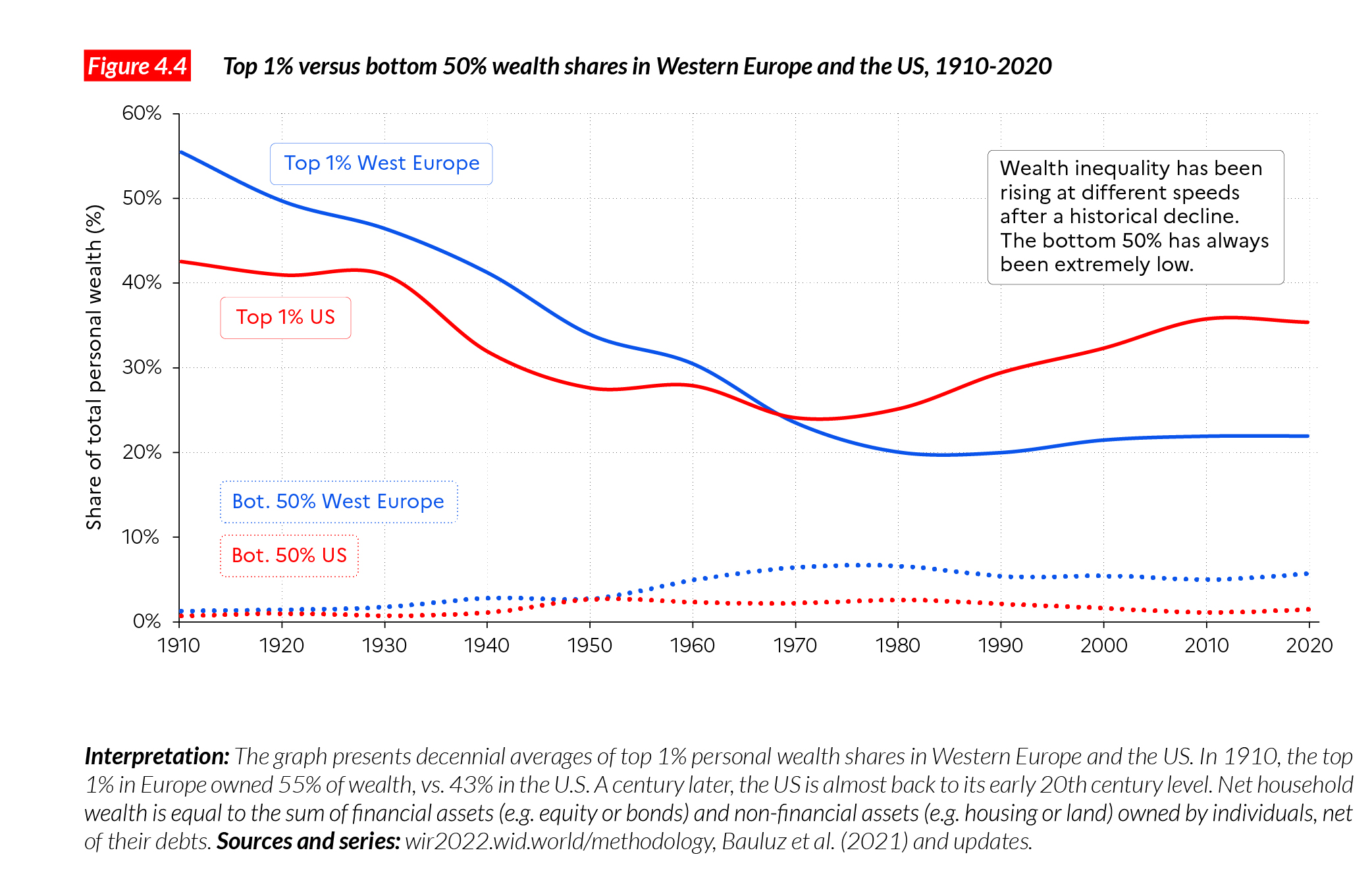
Anti-immigrant sentiment raged, leading to the enactment of racist laws to restrict immigration. And voter suppression, largely aimed at Black men who had recently won the right to vote, was rampant.
The era was also marked by dangerous working conditions. Children often as young as 10, but sometimes younger, worked brutal hours in sweatshops. Workers trying to organizelabor unions were attacked and killed.
It seemed as if American capitalism was out of control, and American democracy couldn’t do anything about it because it was bought and paid for by the rich.
But Americans were fed up, and they demanded reform. Many took to the streets in protest.
Investigative journalists, often called “muckrakers” then, helped amplify their cries by exposing what was occurring throughout the country.
And a new generation of political leaders rose to end the abuses.
Politicians like Teddy Roosevelt, who warned that, “a small class of enormously wealthy and economically powerful men, whose chief object is to hold and increase their power,” could destroy American democracy.
After becoming president in 1901, Roosevelt used the Sherman Antitrust Actto break up dozens of powerful corporations, including the giant Northern Securities Company which had come to dominate railroad transportation through a series of mergers.
Seeking to limit the vast fortunes that were creating a new American aristocracy, Congress enacted a progressive income tax through the 16th Amendment, as well as two wealth taxes.
The first wealth tax, in 1916, was the estate tax — a tax on the wealth someone accumulated during their lifetime, paid by the heirs who inherited it. The second tax on wealth, enacted in 1922, was a capital gains tax — a tax on the increased value of assets, paid when those assets were sold.
The reformers of the Gilded Age also stopped corporations from directly giving money to politicians or political candidates.
And then Teddy Roosevelt’s fifth cousin — you may have heard of him — continued the work through his New Deal programs — creating Social Security,unemployment insurance, a 40-hour workweek, and requiring that employers bargain in good faith with labor unions.
But following the death of FDR and the end of World War II, when America was building the largest middle class the world had ever seen — we seemed to forget about the abuses of the Gilded Age.
Now, more than a century later, America has entered a second Gilded Age.
It is also a time of extraordinary invention.
And a time when monopolies aretaking over vast swathes of the economy, so we must renew antitrust enforcement to bust up powerful companies.
Now, another generation of robber barons is accumulating unprecedented money and power. So once again, we must tax these exorbitant fortunes.
Wealthy individuals and big corporations are once again paying off lawmakers,sending them billions to conduct their political campaigns, even giving luxurious gifts to Supreme Court justices. So we need to protect our democracy from Big Money, just as we did before.
Voter suppression runs rampant in the states as during the first Gilded Age, making it harder for people of color to participate in what’s left of our democracy. So it’s once again critical to defend and expand voting rights.
Working people are once again being exploited and abused, child labor is returning, unions are busted, the poor are againliving in unhealthy conditions, homelessness is on the rise, and the gap between the ultra-rich and everyone else is nearly as large as in the first Gilded Age. So once again we need to protect the rights of workers to organize, invest in social safety nets, and revive guardrails to protect against the abuses of great wealth and power.
The question now is the same as it was at the start of the 20th century: Will we fight for an economy and a democracy that works for all rather than the few?
We’ve done it before. We can — and must — do it again.
---
aha ~ inequality. moderation
One of Washington’s wealthiest senators argues against rich paying fair share to ensure Social Security’s survival
https://www.alternet.org/economy/ron-johnson-2662274408/
---
---
no lnx an 5 23
Why Americans should fear the prospect of a first US trillionaire: 'Patriotic Millionaires' senior analyst
Bob Lordand Common Dreams May 29, 2023
It’s been a full decade now since I first predicted — warned, to be a bit more precise — that America would have its first trillionaire before 2040.
I stand by that warning today. Unfortunately, everything I said ten years ago has aged well. Too well. I explained back then how tax policy was supercharging the accumulation of obscene fortunes in America. Policymakers, I noted, had lifted the lid on wealth accumulation by decreasing taxes on inheritances and income from capital. That policy failure would go on to become substantially worse in 2017 with the passage of the Tax Cuts and Jobs Act.
Others would see this same ominous trend. In an interview with CNBC, several experts recognized the distinct possibility the world would have its first trillionaire by 2039, the year CNBC would turn 50. They offered various explanations for how that would happen, with most of them agreeing it would “take several Bill Gates-like successes from one individual to reach the trillion-dollar mark.”
I saw things differently, telling CNBC: “It might take the founder of five of today’s Microsofts to reach a trillion, but we’re going to see larger and larger Microsofts.”
More recently, the idea that a larger Microsoft would deliver our first billionaire has gained traction. Three years ago, USA Today reported on predictions that Amazon would raise Jeff Bezos’ wealth to trillionaire level as early as 2026.
Those predictions have turned out to be a bit aggressive — Bezos’ wealth climb has leveled off — but they may have been beneficial in an odd way. Historically, far too many Americans have looked at billionaire wealth the way they look at sports, as I noted in 2014:
The super-rich are setting new records, $10 billion, $50 billion, and soon enough $100 billion. Rather than objecting, our nation celebrates the increasingly obscene fortunes of the super-rich as we do athletes breaking sports records.
Reaching $1 trillion will be what hitting 73 home runs was before we knew Barry Bonds cheated to get there.
Will our first trillion-dollar fortune also be tainted by misdeeds of the achiever? Could that be what finally wakes us from our slumber?
In 2020, with Americans dying in large numbers from the pandemic, Bezos had become to billionaire wealth hoarding what Barry Bonds had become to home run records. As noted by USA Today, the reporting on Bezos becoming the first trillionaire occurred when Amazon workers were publicly protesting over safety issues.
Which caused the appropriate response to his predicted trillionaire status — anger — at least on Twitter. One tweet disdainfully noted: “Jeff Bezos will sometime in the near future have more money than the Netherlands. Totally normal. Nothing out of order here.” Another considered a headline announcing Bezos’ impending trillionaire status the most “disgusting and disturbing” he’d seen.
The reaction to trillionaire talk three years ago, unfortunately, may have been an anomaly, not the turning point I hoped it would be.
A case in point: The Motley Fool, a financial and investing advice company, has recently been promoting investment in a corporation it suggests could be as large as 17 Amazons, with a market capitalization of $17 trillion, an accumulation that would create the world’s first trillionaire. The promotional material doesn’t give the name of the corporation. To find it, you’d at least need to provide an email address, which would mean lots of unwanted promotional emails. Apparently, this corporation has technology that could supercharge artificial intelligence, or AI.
But the identity of that corporation — or the founder who stands to become the first trillionaire — isn’t the point here. After all, absent significant reform of America’s tax policy, we will see our first trillionaire, probably not much more than a decade from now.
Worse, too many folks may think that would be a good thing. In its promotional ad, Motley Fool gushes over how excited the prospect of a $17 trillion corporation headed by a trillionaire has investors, as if the super-rich becoming richer rates as a good thing in and of itself.
Most troubling: Motley Fool is using the prospect of someone achieving a net worth over $1 trillion as a selling point. This sort of advertising works because we have millions of investors out there who emulate the billionaire class.
Which brings us back to tax policy. Halting, then reversing, the obscene concentration of wealth in America will require Americans in overwhelming numbers demanding real tax reform. Without that tax reform, the concentration of wealth will worsen and, before we know it, we’ll see the arrival of our first trillionaire. And as our concentration of wealth worsens, the political power of billionaires will only continue to increase.
We’ll never have the collective mentality, as a nation, to take on the ultra-rich if millions of Americans identify with them and see the chase to become the first trillionaire the same way they see a football team’s pursuit of an undefeated season. We see this same identification in the response of everyday Americans to estate tax reform. In large numbers, many Americans oppose the estate tax because they think it will apply to them one day.
To be sure, many Americans do understand the perils of concentrated wealth. But to make real progress on tax reform, we need more than a bare majority of Americans opposing extreme wealth concentration and supporting higher taxation of the rich. We need to reach the point where for every average American citizen who sees billionaires as role models, another ten see them as the wealth hoarders they are.
Which means we should be fearing, not cheering, the prospect of an American trillionaire.
---
---
5 23 an random eg jake k
millions of people in the United States have little to nothing in retirement savings, a consequence of low-wage jobs that give workers minimal room to stash money away.
Meanwhile, at the end of 2021, the nation's top CEOs held an estimated $9 billion in rapidly growing special retirement accounts that aren't available to their employees—a double standard established by the U.S. tax code.
That double standard is the subject of A Tale of Two Retirements, a new report published Thursday by the Institute for Policy Studies (IPS) and Jobs With Justice. The report says that while "ordinary employees with access to 401(k) plans face strict limits on the amounts they can set aside, tax-free, for their golden years,"highly paid executives of major corporations "have unlimited tax-deferred compensation accounts" known as top hat plans.
"The sections of the U.S. tax code related to employer-provided, tax-deferred retirement accounts impose one set of strict rules on ordinary workers and another set of far more flexible rules for corporate top brass," the report notes. "Employees with 401(k) plans face hard caps on the amounts they can set aside in these accounts every year. By contrast, Section 409A of the tax code allows top corporate executives to place unlimited amounts in special 'non-qualified tax-deferred compensation' accounts."
The funds in such plans are only taxed when they are withdrawn, allowing executives to reap the benefits of years of investment returns tax-free.
The new analysis shows that "at more than 20 low-wage employers, executives have sufficient deferred compensation funds to generate monthly retirement checks larger than their workers' median annual pay," pointing specifically to Walmart CEO Doug McMillon (who held over $169 million in his deferred compensation account at the end of last year) and former Home Depot CEO and current board chair Craig Menear (who has nearly $15 million in a deferred compensation account).
Home Depot employees aren't nearly as well-positioned for retirement. According to the researchers behind the new report, 53% of those eligible to participate in Home Depot's 401(k) plan have zero balances. Menear's top hat account balance is "enough to generate a monthly retirement check three times larger than the company’s median worker pay of just $30,100," the report notes.
The executive with the largest top hat account among S&P 500 company heads is Paul Saville, CEO of the homebuilding giant NVR, Inc. At the end of 2022, Saville held $488 million in his deferred compensation account—which could yield $3 million a month in retirement checks for the rest of his life.
"That's 1,513 times as much as a typical American retiree could expect to receive in monthly Social Security and 401(k) benefits," IPS and Jobs With Justice note.
Sarah Anderson, global economy director at IPS and a co-author of the new report, said that "there's no rational argument for allowing wealthy executives to shelter unlimited amounts of compensation from taxes while ordinary workers have strict limits on their annual 401(k) contributions."
"Nothing but the power of corporate leaders to rig rules in their favor can explain this double standard," Anderson argued.
For workers under the age of 50, the annual 401(k) contribution limit is $22,500 in 2023—a ceiling that the overwhelming majority of workers with access to a 401(k) won't hit.
"Nationwide, just 35% of working-age adults have tax-deferred 401(k)-type defined contribution plans through their employer and another 13% have defined benefit or cash balance plans. Some 42% of Americans age 56-64 have zero retirement account savings, according to the U.S. Census Bureau," the new report observes. "Americans who are unable to save for retirement need to rely on Social Security, which pays an average monthly benefit of $1,784, as of March 2023."
The report adds that while companies "often match a portion of employee 401(k) contributions," that benefit is "meaningless for the many low-wage workers who cannot afford to set aside any of their wages."
Furthermore, roughly halfof U.S. workers in the private sector have no access to an employer-provided retirement plan.
"For decades now, large U.S. corporations have been making workers' retirement futures less secure by abandoning traditional pensions in favor of 401(k) plans," the report points out. "In 1984, more than 30 million Americans had defined benefit pensions through which employers bore the financial risks for their workers' retirement security. By 2020, that number had declined to just 12 million, and private sector workers were approximately 3.5 times as likely to have a defined contribution plan as a traditional pension."
IPS and Jobs With Justice highlight a number of potential policy changes that could help combat the stark and worsening retirement divide between ordinary workers—who are facing a full-fledged retirement income crisis—and executives, including changes to the tax provisions that let rich executives shelter their compensation.
"Perhaps most importantly, we need to expand Social Security, the key pillar for retirement security for most Americans, particularly low- and moderate-income families who receive little to no tax benefits," the report states. "Funding for expansion could come from lifting the wage cap on payroll taxes so that CEOs and other high earners pay roughly the same share of their total income into the Social Security fund as ordinary workers."
Scott Klinger, report co-author and senior equitable development specialist at Jobs With Justice, said that "rather than giving corporate CEOs unfair special retirement tax benefits not available to those they employ, Congress should eliminate the cap on payroll taxes paid by corporate executives so that Social Security benefits can be strengthened, especially for the 40% of American workers for whom Social Security is their sole retirement income."
FROM YOUR SITE ARTICLES
- How Howard Schultz turned Starbucks into the poster child of corporate abuse ›
- 'Triggering this GOP loser': Teamsters president praised after heated exchange with Republican senator ›
- 'Bank bailout': Robert Reich busts 3 myths the 'undeserving right' use to justify their wealth ›
- 9 Greedy CEOs Trying to Shred the Safety Net While Pigging Out on Corporate Welfare ›
RELATED ARTICLES AROUND THE WEB
- Meager Rewards for Workers, Exceptionally Rich Pay for C.E.O.s ›
- For rich CEOs, paychecks are chump change ›
- The 'Secret' That Gets CEOs Rich: Keep Workers Poor - Inequality.org ›
- Hospit
---
no lnx an 4 23
Economist Paul Krugman: America’s 'superyacht boom' underscores its 'extreme inequality'
Alex Henderson April 12, 2023
During the Joe Biden era, Paul Krugman has been quite bullish on the U.S. economy. The liberal economist and New York Times columnist has emphasized that under Biden, the United States has had some of its lowest unemployment rates in more than half a century.
But Krugman has also had a lot to say about U.S. inequality, complaining that the gap between America's haves and have-nots is still way too large. In his April 11 column, Krugman cites "superyachts" as a reminder of inequality.
"According to a 2022 article in The New Yorker," Krugman explains, "any yacht over 98 feet long is considered a superyacht within the yachting community. Which got me thinking about big yachts and what they tell us about the state of society. When rich people can afford to buy and operate big yachts, they do. Indeed, yachts are a highly visible indicator of inequality, the concentration of income and wealth in the hands of the few. The Gilded Age was marked by a proliferation of ever bigger, ever more elaborately furnished yachts; when J.P. Morgan built a large steam yacht, its 1898 launch was featured in The New York Times."
READ MORE: US inflation was even lower than expected in March: CPI
Krugman continues, "Conversely, the Great Compression of income disparities that took place during the 1940s and made America a relatively middle-class society for the next four decades put an end to the first golden era of superyachts. In 1955, Fortune published a remarkable essay, 'How Top Executives Live,' which stressed how modest their standard of living had become compared with pre-War norms. Among other things, large yachts had 'foundered in the sea of progressive taxation'…. Now, superyachts are back. Indeed, according to that New Yorker article, we're living through 'the greatest boom in the yacht business that has ever existed'…. If you had any doubts about whether we're living in an era of extreme wealth concentration, comparable to or even surpassing the Gilded Age, the superyacht boom should quell those doubts."
In his April 10 column, however, Krugman focuses on some good economic news: the U.S. Bureau of Labor Statistics (BLS) report on unemployment for March 2023. According to the BLS, the U.S. had 3.5 percent unemployment in March —a figure that, Krugman emphasizes, explodes the right-wing myth that big chunks of the U.S. population are lazy.
"Americans, they said, just don't want to work," Krugman writes. "Socialism has made them lazy. They'd rather play video games.… Remember all that talk about Americans dropping out of the labor force?…. The overall unemployment rate is only 3.5 percent; we haven't had that spirit here since 1969. Black unemployment is at a record low. There's good news everywhere you look. So, whaddya know: Provide enough job opportunities, and lazy video-game-playing Americans will take those jobs and, apparently, demonstrate enough skill that employers want to keep them."
BLS figures for March, Krugman adds, show that Biden's economic policies are still working.
READ MORE: US inflation was even lower than expected in March: CPI
"It is worth noting that Republicans keep insisting President Biden's policies have been an economic disaster, and that even the mainstream news media has tended to emphasize inflation — which has been a nasty shock, even though it may be subsiding — rather than job gains," the economist/columnist observes. "So, it does seem worth pointing out that at this point, Biden is presiding over the best job market America has seen in a generation — specifically since the boom of the late (Bill) Clinton years."
READ MORE: 'Bank bailout': Robert Reich busts 3 myths the 'undeserving right' use to justify their wealth
Read Paul Krugman’s full New York Times columns at this link and this link (subscription required).
FROM YOUR SITE ARTICLES
'Anyone who thinks this economy is in recession is bananas': Economists cheer 'hot' Biden jobs report ›
Economists stunned by 'breathtaking' job growth 'boom' as unemployment drops to level not seen since 1969 ›
History shows that Republicans are 'just plain bad at managing the economy': industry experts ›
RELATED ARTICLES AROUND THE WEB
Inflation Is Making Poverty in the U.S. Even More Difficult ›
Inflation inequality: Poorest Americans are hit hardest by soaring ... ›
'Inflation Inequality' Makes Life Harder for Workers - The Atlantic ›
---
---
an 3 23 no lnx thom
https://www.alternet.org/far-right-culture-wars/
Marjorie Taylor Greene is calling for an American “divorce.”
She apparently sees herself as a modern-day John C. Calhoun, a demagogue who serves the interests of the white oligarch class and, in turn, receives their support, and the power and wealth that come with it.
She's started a secession propaganda campaign much like Calhoun and his buddies did when he left the White House as VP in 1833, the same year England outlawed slavery on British-territory plantations and talk of abolition in the US kicked into high gear.
It took Calhoun and his fellow traitors about 25 years to convince enough people in the South to go to war against America and try to replace our democracy with a fascist, race-based oligarchy.
But today—with electronic media providing instant communication and AR15s being much more efficient killing machines than the Confederacy had available—the heirs to Calhoun's sedition apparently think they can pull it off in a much shorter time.
:{:{}:
}:
Kentucky Republican Congressman Thomas Massie recently suggested the tipping point, the second American Civil War, will come when:
:{:{}:
}:
“[T]hirty to forty percent could agree that [the American government] was legitimate tyranny and it needed to be thrown off."
He then openly argued that American fascists should be sufficiently well-armed to take on the US Marines. Finishing that sentence, Massey—who tweeted a Christmas picture of his family (including his young children) each cradling an assault weapon—added:
:{:{}:
}:
“They [those trying to bring down the American government] need to have sufficient [fire]power without asking for extra permission. It should be right there and completely available to them in their living room in order to effect the change [of our form of government].”
:{:{}:
}:
Make no mistake about it: this is sedition. It's anti-American. It's pro-fascist.
Yesterday on my radio/TV program, Congressman Mark Pocan said Greene's comments were “almost treasonous. "I'd drop the “almost.”
Greene even said out loud the part Republicans have been trying to not get caught saying for several decades now: she doesn't think Democrats should be allowed to vote if they live in Red states.
When a resolution came to the House floor last week condemning Putin's ally, Syrian dictator Assad, the only two “no" votes came from Greene and Massey.
Dictatorship good, democracy bad.
It's an old, old song for America that dates back to the 1840s.
Keep in mind that the Civil War wasn't just about slavery: it was primarily about preserving the wealth of the Southern oligarchs. While slavery was the source of their wealth, morbidly rich planters had so overtaken the political system of the South that it ceased to be anything close to a democracy—even for white people—by the 1840s.
That decade of the 1840s, in fact, was a key turning point for the effort to end democracy altogether in America. In just the ten years from 1840 to 1850, over 800,000 enslaved people were brought into the deep South.
Poor whites suddenly found themselves without work and pay generally collapsed across the region, while the plantation owner class became fabulously rich. It led to an internal abolition movement in the South, as white workers who didn't own slaves desperately tried to regain opportunities in the workplace.
As Southern abolitionist Hinton Helper wrote in his 1857 book The Impending Crisis of the South:
:{:{}:
}:
“The lords of the lash are not only absolute masters of the blacks, but they are also the oracle and arbiters of non-slaveholding whites, whose freedom is merely nominal, and whose unparalleled illiteracy and degradation is purposely and fiendishly perpetuated.”
The book became one of the biggest bestsellers in American history(even though you could go to prison for owning it in the South where it was banned), and sparked such a political crisis in 1860 that the House of Representatives was unable to elect a Speaker for almost two months. Sound familiar?
Abraham Lincoln didn't even advocate ending slavery until well into the Civil War: he was too busy fighting against Southern oligarchs who were hell-bent on ending democracy in America and replacing it with a white supremacist oligarchy. Lincoln's goal in responding militarily to Southern succession wasn't to free enslaved African Americans, it was to keep the country together and try to restore some semblance of democracy to the South.
On Aug. 22, 1862 (the Emancipation Proclamation would come exactly one month later), after more than a year of war, Lincoln wrote a letter to the New York Tribune pointing this out:
“If I could save the Union without freeing any slave, I would do it; and if I could save it by freeing all the slaves, I would do it; and if I could save it by freeing some and leaving others alone, I would also do that. What I do about slavery and the colored race, I do because I believe it helps to save the Union; and what I forbear, I forbear because I do not believe it would help to save the Union.”
Here we are again, and once more the issue that's got working-class white people riled up is the intersection of economics end race.
Republicans pass laws against Critical Race Theory, teaching Black history, and complain about “woke" and “BLM," but at its core it's all about distracting white people from their being ripped off by a white oligarchic class that promotes racial hatred to deflect anger from themselves.
As Marjorie Taylor Greene is essentially pointing out, just like in 1860.
The genesis of today's discontent began in the 1980s with the Reagan Revolution, as the Reagan/Bush administration opened America to “free trade" with the early stages of what became the World Trade Organization and negotiating the North American Free Trade Agreement (NAFTA) which Bill Clinton signed on January 1, 1994.
Like the middle-class working white people in the South—who'd been about a third of that region's population prior to the 1840s when all those slaves were imported—the four decades since Reaganism began here have also seen the collapse of white working-class income and wealth.
:{:{}:
}:
When Reagan came into office in 1980 about two-thirds of white Americans were solidly in the middle class: today that number is around 45 percent and it requires two people working full time to pull even that off.
Meanwhile, the rich have gotten fabulously richer. Several of America's billionaires are today richer than any person has ever been in history. Richer than the pharaohs.Richer than the ancient kings of Europe. Rich enough to shoot themselves into outer space with their pocket change.
And where did that money come from? Just like the plantation owners in 1850, it came from rigging the system.
:{:{}:
}:
The past 42 years have seen over $50 trillion in wealth stolen from the homes and pockets of working-class people and deposited into the money bins of the morbidly rich through GOP tax-cut and union-busting policies.
In the past 42 years over 60,000 factories and 15 million well-paying union jobs have been shipped to Mexico and China, leaving working class whites (among others) literally out in the cold.
Just like in the 1850s, that's an explosive transition. And just like in the 1850s, it has brought out oligarch-funded political demagogues to tell white working-class people that their problems are all caused by Black people and their “woke" allies, and therefore the nation must divide itself.
Greene, Massey, and the rest of the sedition caucus in Congress are playing with fire. The people they're trying to crank up on behalf of America's rightwing oligarchs have already tried to murder the Governor of Michigan, the Speaker of the House of Representatives, and the Vice President of the United States.
:{:{}:
}:
As The Washington Post's Philip Bump noted this week:
:{:{}:
}:
“Over the past decade, 96 percent of incidents in which extremists killed someone were committed by people motivated by right-wing ideologies.”
The number of people murdered for political purposes over the past 25 years by SDS or Antifa or other anti-fascist or “left wing" ideologues? Zero.
And in promoting bloodshed in 2023 America, the seditionists among us aren't even subtle. Last December 10th, Greene told a Young Republican group in New York:
“I want to tell you something, if Steve Bannon and I had organized that [January 6th insurrection and effort to murder Vice President Pence], we would have won. Not to mention, it would've been armed."
Pitting Americans against each other by race, geography, or even politics when simultaneously invoking bloodshed as a justified outcome is as anti-American as it gets.
It's why the 14th Amendment says:
“No person shall be a Senator or Representative in Congress, or elector of President and Vice President, or hold any office, civil or military, under the United States, or under any state, who, having previously taken an oath, as a member of Congress … to support the Constitution of the United States, shall have engaged in insurrection or rebellion against the same, or given aid or comfort to the enemies thereof.”
If the seditionists within today's Republican Party had any goal other than to tear America apart and create an apartheid state run by and for the oligarchs who fund their campaigns and lifestyles, they'd be telling us about it right now. But are they?
Do they have anything to offer the working class of America?....
---
---
an 2 23 boddie
Democratic strategists and top Wall Street giants hail President Joe Biden's billionaire tax proposal as "dead on arrival," CNBC reports.
The plan, which Biden announced during his 2023 State of the Union address,ensures "the ultra-wealthy would owe an annual tax of 20% on unrealized gains or losses in the value of those assets, whether or not they had actually pocketed that gain by selling them," according to CNBC.
Chairman of investment advisory firm Signum Global and 2020 Biden supporter, Charles Myers said Biden's plan is"dead on arrival."
READ MORE:Here are 10 ways billionaires avoid taxes on an epic scale
However, other billionaire investors are "skeptical" about its intention, worried that their wealth will be negatively impacted.
Because of this longtime skepticism, Democratic political strategist Jake Dilemani said, "I don’t think anyone realistically expects a billionaire’s tax, in its current proposed form, to come to fruition this year or next."
Dilemani added, "Within the Democratic party, there is dissention regarding how to move this forward, particularly with unrealized gains being part of the equation."
Contrary to fellow investors, billionaire banker Leon Cooperman, who voted for Biden in 2020, told CNBC Biden's proposal is "DOA and stupid to boot." Cooperman opted to "accuse Democrats of deliberately misleading people about how the billionaire tax proposal would work."
READ MORE:'Every billionaire is a policy failure': Oxfam blasts gathering of world's rich in Davos
He said Democrats "lie about the taxes billionaires pay, as they include unrealized gains as part of income."
Jared Bernstein, White House economist, argued this is not the case. He told “unrealized gains” will not be taxed as part of the plan.
"What it really is, or at least the way we see, it is a prepayment or withholding tax on future capital gains," he said.
Per CNBC, last month, lawmakers from California, New York, Washington, Connecticut, Illinois, Maryland, Minnesota and Hawaii established Fund our Future, "a national effort to move wealth tax measures across the country."
New York Democratic State Senator Gustavo Rivera said in the group's statement, "The ultra-rich benefit from our communities, from our public infrastructure and the labor of working families. And because of our backwards tax system, they can avoid paying the taxes that they owe."
He noted, "We must restructure our tax system for fairness."
Arizona Senator KyrstenSinema, who recently registered as Independent after identifying as a Democrat for years, could influence the success of the proposal "if she were to publicly endorse the plan," according to CNBC.
The senator asserted her openness to the possibility of a billionaire income tax, Bloomberg reports, in 2021 when Senator Ron Wyden (D-OH), proposed a similar plan.
READ MORE:'Rotten' and 'grossly regressive' GOP tax proposals are a major 'gift' for Democrats: conservative
Hannah Hurley, Sinema's spokeswoman said, "As always, Kyrsten welcomes the opportunity to review and discuss changes to the tax code, including this proposal from the President."
CNBC's full report is available to read at this link.
READ MORE:How Republicans are aiming to 'protect tax cheaters' with new bill: report
---
---
omg going on offense?! std/key API talking pt?
jj comm dr an 12 22
Fresh off posting the highest quarterly profit in its history, the U.S.-based fossil fuel giant ExxonMobil sued the European Union on Wednesday in an attempt to stop the bloc from imposing its recently approved windfall tax targeting major oil and gas companies.
The Financial Times, which first reported the new lawsuit, noted that the challenge takes aim at the European Council's "legal authority to impose the new tax—a power historically reserved for sovereign countries—and its use of emergency powers to secure member states' approval for the measure."
:{:{"The new tax is due to take effect from December 31 and will apply a levy of at least 33% on any taxable profits in 2022-23 that are 20% or more above average profits between 2018 and 2021," the newspaper explained.}:
}:
In a statement, Exxon spokesperson Casey Norton insisted the company recognizes that sky-high energy costs are "weighing heavily on families and businesses" but claimed the tax would "undermine investor confidence, discourage investment and increase reliance on imported energy."
Reuters reported Wednesday that Exxon's chief financial officer has estimated the E.U.'s windfall tax could cost the corporation around $2 billion through the end of next year—a fraction of the company's 2022 profits.
Approved in late September amid a mounting cost-of-living crisis across Europe, the windfall tax was presented as an effort to generate additional revenue to "provide financial support to households and companies" struggling with high energy costs.Oil and gas companies like Exxon have been accused of exploiting global energy market chaos spurred by Russia's war on Ukraine to hike prices and pad their bottom lines.
In late October, Exxon announced it brought in $19.7 billion in profits from July to September, its largest-ever quarterly haul. The company also announced it would raise its dividend and expand its share buyback program, rewarding wealthy investors as consumers continue to face elevated prices at the pump.
According to a recent filing, Exxon has also been rewarding its top executives,boosting the annual salary of CEO Darren Woods from $1.70 million to $1.88 million for the coming year.
---
---
an 1 23 maya
Amid the Republican battle over the next speaker of the House, Mother Jones Senior Editor Michael Mechanic shed light on another priority of the party — which is the possible enactment of the Family and Small Business Taxpayer Protection Act.
In his reporting, Mechanic asserted that the potential bill is a misnomer, because rather than protecting taxpayers — as the name implies — it would instead protect “tax cheaters” by rolling back IRS funding from the Inflation Reduction Act (IRA).
Americans for Tax Fairness founder Frank Clemente said in a recent press release, “The richest 1 percent avoid paying $160 billion a year that they owe in taxes due to inadequate tax enforcement. Republicans are voting to let them keep on cheating the rest of us.”
READ MORE:Trump’s newly released tax returns reveal cheating & years of paying zero taxes, reporter says
Mechanic reflected on his 2021 reporting around a similar IRS arrangement back in 2011. The agency’s budget was cut by over $2 billion at the time which resulted in a significant drop in non-filer investigations and an astronomical increase in outstanding tax debt by 2019.
In 2020, it was confirmed that almost 800,000 wealthy non-filers owed a hefty $46 billion collectively, and many of the cases were eventually dismissed without any accountability from the agency.
This is what the $80 billion allotted by the IRA was supposed to rectify. As of October 2022, the Congressional Research Service reported that over a span of 10 years, the funding would update the agency’s outdated systems and technologies, bolster operations support (such as rent, facility, security costs), expand and enhance taxpayer services (prefiling assistance and education), and “monitor and enforce taxes on digital assets such as cryptocurrency."
Then, GOP hardliners and allies of former President Donald Trump attempted to hijack that narrative across social media by claiming that the IRA would instead use the money to hire “87,000 new agents” who would track down “ordinary taxpayers."
READ MORE:'Taxpayers are losers in Trumpland': Juror in Trump Organization tax fraud case speaks out
Moreover, members of the party who are spewing that lie are not letting up on their desire to repeal 90 percent of the funding, which Americans for Tax Fairness said in its press release would take away plans to improve taxpayer services (for refunds, customer calls, etc.), fund US Tax Court to resolve cases between taxpayers and the agency, and also provide the IRS with enough resources to launch an easy and free, government e-filing system.
Mechanic noted that the GOP’s gesture of proposing anti-tax bills that benefit no one but the 1 percent is nothing new, and Tax Policy Center Senior Fellow Steve Rosenthal presumed that the issue of IRS funding will be “ongoing” in both Senate and House sessions for the foreseeable future.
---
---
https://www.alternet.org/2019/11/robert-reich-there-are-only-5-ways-to-become-a-billionaire-and-none-of-them-involve-being-successful-in-free-market-capitalism
Billionaires are wailing that Elizabeth Warren’s and Bernie Sanders’s wealth tax proposals are attacks on free market capitalism.
Warren “vilifies successful people,” says Jamie Dimon, CEO of JPMorgan Chase.
Rubbish. There are basically only five ways to accumulate a billion dollars, and none of them has to do with being successful in free market capitalism.
The first way is to exploit a monopoly.
Jamie Dimon is worth $1.6 billion. That’s not because he succeeded in the free market. In 2008 the government bailed out JPMorgan and four other giant Wall Street banks because it considered them “too big to fail.”
That bailout is a hidden insurance policy, still in effect, with an estimated value to the big banks of $83 billion a year. If JPMorgan weren’t so big and was therefore allowed to fail, Dimon would be worth far less than $1.6 billion.
What about America’s much-vaulted entrepreneurs, such as Jeff Bezos, now worth $110 billion? You might say Bezos deserves this because he founded and built Amazon.
But Amazon is a monopolist with nearly 50 percent of all e-commerce retail sales in America, and e-commerce is one of the biggest sectors of retail sales. In addition, Amazon’s business is protected by a slew of patents granted by the U.S. government.
If the government enforced anti-monopoly laws, and didn’t give Amazon such broad patents,Bezos would be worth far less than $110 billion.
A second way to make a billion is to get insider information unavailable to other investors.
Hedge-fund maven Steven A. Cohen, worth $12.8 billion, headed up a hedge fund firm in which, according to a criminal complaint filed by the Justice Department, insider trading was “substantial, pervasive, and on a scale without known precedent in the hedge fund industry.” Nine of Cohen’s present or former employees pleaded guilty or were convicted. Cohen got off with a fine, changed the name of his firm, and apparently is back at the game.
Insider trading is endemic in C-suites, too. SEC researchers have found that corporate executives are twice as likely to sell their stock on the days following their own stock buyback announcements as they are in the days leading up to the announcements.
If government cracked down on insider-trading, hedge-fund mavens and top corporate executives wouldn’t be raking in so much money.
A third way to make a billion is to buy off politicians.
The Trump tax cut is estimated to save Charles and the late David Koch and their Koch Industries an estimated $1 to $1.4 billion a year, not even counting their tax savings on profits stored offshore and a shrunken estate tax. The Kochs and their affiliated groups spent some $20 million lobbying for the Trump tax cut, including political donations. Not a bad return on investment.
If we had tough anti-corruption laws preventing political payoffs, the Kochs and other high-rollers wouldn’t get the special tax breaks and other subsidies that have enlarged their fortunes.
The fourth way to make a billion is to extort big investors.
Adam Neumann conned JP Morgan, SoftBank, and other investors to sink hundreds of millions into WeWork, an office-sharing startup. Neumann used some of the money to buy buildings he leased back to WeWork and to enjoy a lifestyle that included a $60 million private jet. WeWork never made a nickel of profit.
A few months ago, after Neumann was forced to disclose his personal conflicts of interest, WeWork’s initial public offering fell apart and the company’s estimated value plummeted. To salvage what they could, investors paid him over $1 billion to exit the board and give up his voting rights. Most other WeWork employees were left holding near-worthless stock options. Thousands were set to be laid off.
If we had tougher anti-fraud laws, Neumann and others like him wouldn’t be billionaires.
The fifth way to be a billionaire is to get the money from rich parents or relatives.
About 60 percent of all the wealth in America today is inherited, according to estimates by economist Thomas Piketty and his colleagues. That’s because, under U.S. tax law – which is itself largely a product of lobbying by the wealthy – the capital gains of one generation are wiped out when those assets are transferred to the next, and the estate tax is so tiny that fewer than 0.2 percent of estates were subject to it last year.
If unearned income were treated the same as earned income under the tax code, America’s non-working rich wouldn’t be billionaires. And if capital gains weren’t eliminated at death, many heirs wouldn’t be, either.
Capitalism doesn’t work well with monopolies, insider-trading, political payoffs, fraud, and large amounts of inherited wealth. Billionaires who don’t like Sanders’s and Warren’s wealth tax should at least support reforms that end these anti-capitalist advantages.
---
---
booktv
SEPTEMBER 12, 2022
LAST AIRED NOVEMBER 7, 2022
The Myth of American Inequality
Former Republican Senator Phil Gramm of Texas and co-author John Early took a critical look at economic inequality in the United States and how it is measured. This event was hosted by the…
---
---
an 12 22
The Congressional decision to prohibit railroad workers from going on strike and force them to accept a contract that meets few of their demands is part of the class war that has defined American politics for decades. The two ruling political parties differ only in rhetoric. They are bonded in their determination to reduce wages; dismantle social programs, which the Bill Clinton administration did with welfare; and thwart unions and prohibit strikes, the only tool workers have to pressure employers. This latest move against the railroad unions, where working conditions have descended into a special kind of hell with massive layoffs, the denial of even a single day of paid sick leave, and punishing work schedules that include being forced to “always be on call,” is one more blow to the working class and our anemic democracy.
The rage by workers towards the Democratic Party, which once defended their interests, is legitimate, even if, at times, it is expressed by embracing proto-fascists and Donald Trump-like demagogues. Dating back to the Clinton administration with NAFTA, the greatest betrayal of the working class since the 1947 Taft-Hartley Act, the Democratic Party has become a full partner in the corporate assault on workers. The cloying feel-your-pain rhetoric, a staple of the Joe Biden White House, is offset by a hypocritical subservience to the billionaire class.
In 1926, the havoc wreaked by rail strikes led to the federal government passing the Railway Labor Act to give itself the power to impose labor settlements on the rail industry. The Biden administration used this authority to broker a tentative labor agreement that would ensure a 24 percent pay increase by 2024, annual $1,000 bonuses and a freeze on rising health care costs. But workers would be permitted only one paid personal day and no paid sick leave. Of 12 unions voting on the deal, four of them — representing 56 percent of union membership in the industry — refused to ratify it. Biden signed the legislation into law on Friday.
The railroad barons refuse to permit sick days because they have stripped the railroads down to skeleton crews in a process known as precision scheduled railroading, or PSR. In essence, no spare labor is available, which is why the reduced labor force is subjected to such punishingly short periods of time off and onerous working conditions.
Class struggle defines human history. We are dominated by a seemingly omnipotent corporate elite. Hostile to our most basic rights, this elite is disemboweling the nation; destroying basic institutions that foster the common good, including public schools, the postal service and health care; and is incapable of reforming itself. The only weapon left to thwart this ongoing pillage is the strike. Workers have the collective power to slash profits and cripple industry, which is why the ruling class has gone to such lengths to defang unions and outlaw strikes. A rail freight strike, it is estimated, would cost the U.S. economy $2 billion a day, with daily losses increasing the longer a strike continued.
The few unions that remain — only 10.7 percent of the workforce is unionized — have been largely domesticated, demoted into obsequious junior partners in the capitalist system. As of January 2022, private-sector unionization stood at its lowest point since the passage of the National Labor Relations Act of 1935. And yet, 48 percent of U.S. workers say they would like to belong to a union.
Railroad workers have been especially hard hit. The workforce has shrunk from nearly 540,000 in 1980 to some 130,000 today. The consolidation of the rail industry means there are only seven Class I freight companies, with four of those companies controlling 83 percent of rail traffic. Service on the nation’s rail lines, along with working conditions and wages, has deteriorated as Wall Street squeezes the big railroad conglomerates for greater and greater profits. Indeed, the fragility of the rail system led to huge backlogs and delays during the pandemic.
The Democrats insist they are the party of the working class. Joe Biden calls himself “a proud pro-labor president.” But they pile up one empty promise after another. In 2020, they promised, for example, that with control of the White House and both branches of Congress, they would pass a law to strengthen collective bargaining. Instead, they revoked the collective bargaining power of one of the few unionized industries that retains it.
They promised to raise the minimum wage. They failed. They promised a national paid family and medical leave program allowing all employees to take up to 12 weeks of paid time off. It never happened. They promised to impose a federal tax rate on corporations ranging from 21 percent to 28 percent, so that “wealthy Americans and big corporations pay their fair share.” The proposed tax increase was scuttled. They promised to pass legislation to ensure that super PACs “are wholly independent of campaigns and political parties.” It went nowhere. They then mounted a midterm election campaign, which cost both parties a staggering $16.7 billion and was funded by massive infusions of PAC money.
The Democrats routinely say the right thing and do the wrong thing, and this is true for its tiny progressive minority, which dutifully votes to funnel billions to the war industry, including the war in Ukraine. Alexandria Ocasio-Cortez and most other progressive House members voted for the anti-union legislation while also voting for a separate resolution that would have given rail workers seven days of paid sick leave. The unions were demanding 14. The second resolution died in the Senate, as they knew it would, leaving workers with a woefully inadequate, pro-management deal that over half of them had already rejected. To his credit, Bernie Sanders voted against the bill when the sick leave amendment from the House, which he backed, was rejected in the Senate.
Why does any legislator believe railroad workers should be forced to use what few vacation days they may have if they fall sick and request permission to be absent days in advance, as if illnesses are scheduled events? Congress members and their staff do not work under these conditions.
“In a statement that perfectly captured the yawning gap between Democratic Party rhetoric and behavior,” Binyamin Appelbaum, the lead writer on economics and business for the New York Times editorial board, wrote in the newspaper, “House Speaker Nancy Pelosi denounced railroad companies as rapacious profiteers who ‘have been selling out to Wall Street to boost their bottom lines, making obscene profits while demanding more and more from railroad workers.’ Then, just one sentence later, she announced that House Democrats would stand with the profiteers.”
What are we to make of a Congress that refuses to support a single day of paid sick leave for 115,000 freight railroad workers, while the combined net income of the railroad industry is $27 billion — double what it was in 2013?
What are we to make of a Congress that in its latest military policy legislation sets the appropriation at $45 billion above the Pentagon’s request?
What are we to make of a Congress that refuses to pass gun control legislation despite 600 mass shootings this year, more than one per day?
What are we to make of a Congress that defunds the Internal Revenue Service, making it only practical to investigate those earning middle and lower incomes and near impossible to investigate tens of billions of dollars in tax evasion by corporations and the rich?
What are we to make of a Congress that rewrites the tax code on behalf of lobbyists so 55 of the largest corporations that collectively made over $40 billion in pre-tax income in 2020 – paid no federal income tax and received $3.5 billion in tax rebates.
What are we to make of a Congress, more than half of whose members are millionaires, who flagrantly use their committee assignments, inside knowledge of proposed legislation and classified intelligence reports to carry out insider trading to increase their wealth? House Speaker Nancy Pelosi’s husband invested millions of dollars in computer-chip stocks as the Democratic leadership was formulating a plan to subsidize the chip-manufacturing industry.
Most political theorists, including Aristotle, Niccolò Machiavelli, Alexis de Tocqueville, Adam Smith, Karl Marx, Karl Polanyi and Max Weber, started from the premise that there is a natural antagonism between owners and workers. They understood that if the oligarchs shook off all restraints to the accumulation of wealth, it would destroy the political order. The ruling class masks its greed behind ideologies — in our nation’s case, free market capitalism and neoliberal globalization. Neoliberalism never made any economic sense. But it was disseminated by compliant academics, the media and political theorists because, to quote Marx, it allowed “the dominant material relationships” to be “grasped as ideas.”
“We Americans are not usually thought to be a submissive people, but of course we are,”Wendell Berry wrote. “Why else would we allow our country to be destroyed? Why else would we be rewarding its destroyers? Why else would we all — by proxies we have given to greedy corporations and corrupt politicians — be participating in its destruction? Most of us are still too sane to piss in our own cistern, but we allow others to do so, and we reward them for it. We reward them so well, in fact, that those who piss in our cistern are wealthier than the rest of us. How do we submit? By not being radical enough. Or by not being thorough enough, which is the same thing.”
All the advances we made in the early 20th century through union strikes, government regulation, the New Deal, a fair tax code, the courts, an alternative press and mass movements have been reversed. The oligarchs are turning American workers — as they did in the 19th-century steel and textile factories — into serfs, kept in check by onerous anti-union laws, militarized police, the world’s largest prison system, an electoral system dominated by corporate money and the most pervasive security and surveillance apparatus in human history.
The rich, throughout history, have subjugated and re-subjugated the populations they control. And the public, throughout history, has awakened to the class war waged by the oligarchs and plutocrats and revolted. Let us hope that defying Congress, freight railroad workers carry out a strike. A strike will at least expose the fangs of the ruling class, the courts, law enforcement and the National Guard, much as they did during labor unrest in the 20th century, and broadcast a very public message about whose interests they serve. Besides, a strike might work. Nothing else will.
---
---
an 8 22 BBB IRA boosts IRS but
sinema gets carried interest loophole reform jettisoned;
https://www.alternet.org/2022/08/one-senator-wealthy-essentially-unaffected/
---
===
SEE AMICUS
...
The negative effects that these new amicus campaigns have on our democ-
racy are twofold. The wealthy few fund the campaigns, excluding the majority
of Americans from the process and exacerbating preexisting countermajoritarian
and inequality concerns. And without a mechanism for disclosure, the general
public currently does not, and cannot, know how judicial reasoning is influenced
by masked private actors.
...
Donors have reaped enormous returns on their investments. As I have doc-
umented, the Roberts Court has handed down over eighty partisan Republican
5-4 decisions87 that benefit an easily identifiable Republican Party-donor inter-
est.88
These include decisions that remove constraints on anonymous giving
(e.g., Citizens United v. FEC,89 Americans for Prosperity Foundation v. Bonta90), as
well as decisions that weaken the power of countervailing institutions like labor
unions (e.g., Janus v. American Federation of State, City & Municipal Employees,
158
Council 3191), regulatory agencies (e.g., Seila Law v. Consumer Financial Protection
Bureau92), and the civil jury (e.g., Epic Systems Corp. v. Lewis93).
The effects of this litigation strategy on our democracy are frightening: the
courts are becoming an arena for enacting policies by judicial decree that are too
unpopular to pass through democratically elected legislatures. These coordi-
nated efforts warp the judiciary toward anonymous, ultrawealthy donor inter-
ests, all without the public ever learning about the role of dark-money interests
in shaping the law. The Supreme Court was already, by its nature, an avenue for
countermajoritarian ideas and policies to prosper.
But as Barry Friedman ex-
plains, especially when the Court is acting during a period of judicial suprem-
acy—as it arguably is now—the countermajoritarian aspect of the institution will
flourish.94 Alongside those concerns, the emergence of the dark-money amicus
machine increases the probability that the Court’s rulings will run counter to the
will of the American people (i.e., counter to democracy), and instead for the
benefit of the hidden interests that had a secret hand in putting Justices on the
Court and then filed masked amicus briefs...
..https://www.yalelawjournal.org/pdf/F7.WhitehouseFinalDraftWeb_v4zwakx5.pdf
---
---
an 9 22
Sen. Bernie Sanders (I-Vt.) is concerned about an emerging class in the United States and how it could ultimately create more economic problems for the working class.
In a new op-ed published byThe Guardian, GUK Sanders offered a brief overview of the 2022 financial scope in America. "Three multibillionaires own more wealth than the bottom half of American society – 160 million Americans. This is unsustainable," Sanders wrote.
Sanders sounded off with concerns about the much-needed discussions that are not being had among lawmakers due to the actions of the ruling class. "We know how important these issues are because our ruling class works overtime to prevent them from being seriously discussed," he wrote.
"They are barely mentioned in the halls of Congress, where most members are dependent on the campaign contributions of the wealthy and their Super Pacs," Sanders added. "They are not much discussed in the corporate media, in which a handful of conglomerates determine what we see, hear and discuss."
The independent lawmaker also shed light on the growing income and wealth gap driving financial inequality across the United States.
"We now have more income and wealth inequality than at any time in the last hundred years. In the year 2022, three multi-billionaires own more wealth than the bottom half of American society – 160 million Americans. Today, 45% of all new income goes to the top 1%, and CEOs of large corporations make a record-breaking 350 times what their workers earn.
"Today, half of our people live paycheck to paycheck and millions struggle on starvation wages. Despite a lifetime of work, half of older Americans have no savings and no idea how they will ever be able to retire with dignity, while 55% of seniors are trying to survive on an income of less than $25,000 a year."
READ MORE: Watch: Bernie Sanders torches Lindsey Graham for backing supporters of Donald Trump's election lies
Sanders further highlighted the starkly different lifestyles average Americans have lived during the pandemic compared to ultra-rich billionaires."During this terrible pandemic, when thousands of essential workers died doing their jobs, some 700 billionaires in America became nearly $2tn richer."
Invoking the words of Dr. Martin Luther King, Jr., Sanders stressed the importance of fighting back against "corporate greed."
"Dr. Martin Luther King Jr was right when he said 'We must recognize that we can’t solve our problem now until there is a radical redistribution of economic and political power' in America. That statement is even more true today," he wrote.
"Let us have the courage to stand together and fight back against corporate greed. Let us fight back against massive income and wealth inequality. Let us fight back against a corrupt political system," Sanders added. "Let us stand together and finally create an economy and a government that works for all, not just the 1%."
---
an 3 22 richard wolff
The growing disconnect between the capitalist system and the economic realities plaguing the United States is now nearing completion. On the ground, the accumulated problems of U.S. capitalism undermine its empire and challenge its very future. Meanwhile, the ever-deepening inequalities of wealth and income conjure up images of ancient Egypt’s pharaohs. Three economic crashes opening the new century (2000, 2008, and 2020) have shaken the system; so have the two wars America lost against very poor countries in the Middle East: Afghanistan and Iraq. The worst public health crisis in a century during the COVID-19 pandemic has further exposed how unprepared U.S. capitalism was and is, thereby imposing massive new human and financial costs lasting into the future.
A government that serves U.S. capitalism first and foremost borrowed trillions and enabled trillions more of new debt (corporate and household) that was used to fight long, losing wars and shore up a faltering economy. Now, after two terrible years of COVID plus an economic crash, with 3 million fewer jobs in 2022 than before COVID hit, a sharp inflation looms.Meanwhile, aided partly by profit-driven U.S. capitalists who moved their operations to China, the Asian country is now in a position where it is challenging U.S. capitalism globally.
Above the troubled ground sit two old political parties, the GOP and the Democratic Party, which are formed by and are stuck in the old political economy before all these problems accumulated into crises. From 1820 to 1970, U.S. capitalism experienced cycles, but these cycles were securely anchored in a long-term upward trend. Real wages rose every decade, at least for white workers. Recessionary downturns only interrupted the long trend up (and even then not for long). The Republican Party and the Democratic Party rarely went beyond the routine rituals of orderly contests over who deserved the credit for economic growth and who deserved the blame for the interruptions during recessions.
The one big exception resulted from the one super big interruption: the 1930s Great Depression. This shook U.S. capitalism to its core. Mobilized and led by a coalition of militant unions (CIO), socialist parties, and a communist party, the U.S. working class shifted sharply to the left. This shift won a New Deal from the administration of President Franklin D. Roosevelt. That deal taxed corporations and the rich significantly more. It then poured much of those funds into the new Social Security system, unemployment compensation, and a massive federal jobs program. Because of the New Deal, Roosevelt was reelected three times, and was the most popular president in U.S. history. Correspondingly, U.S. corporations and those they enriched felt seriously threatened during this period.
The GOP reacted strongly. Once FDR died and World War II ended, the Republican Party took the lead to undo the New Deal. It did this by splitting the coalition (which included the CIO, socialists, and communists) from the Democratic Party and the coalition partners from one another. Anti-communism, McCarthyism, and the Cold War served as the weapons of choice for the Republican Party. The GOP succeeded partly because the Democrats offered mostly weak opposition or none at all. Postwar Democrats were largely complicit in destroying most of what the New Deal had achieved (with the help, ironically, of many of the Democratic Party’s own prewar efforts). After 1945, the White House, Congress, and state and local governments resumed orderly political contests between the GOP and the Democratic Party. Both endorsed a musical chairs type of rotation of public authority personnel between them (until this system was undone by former President Donald Trump in 2020).
The old, established leaders of both parties still do not grasp or accept that the orderly rotation of public authority personnel is now over. Unable or unwilling to critically evaluate U.S. capitalism, these leaders missed the signs leading up to the accumulation of capitalism’s problems that now overwhelms them. The Bushes, Clintons, President Joe Biden, and their ilk want the old political system to persist. After all, for them this old political system did well. But now their disconnect from the capitalist reality that ultimately controls them threatens to render them blatantly ineffective, sadly out of their element. Because they cannot or dare not criticize that reality, its increasing difficulties and resulting mass disaffection are beyond their reach with the old tools, arguments, and spins that used to work.
Given the disconnected mainstreams of U.S. politics, mass disaffection provokes escapism and scapegoating. The GOP eagerly validates many of them (anti-immigration, white supremacy, quasi-fascism, culture wars, and anti-leftism) to enlarge its voter base. The Democrats, meanwhile, try to fight the extreme forms of that escapism and scapegoating (as in “basket of deplorables”) without offering any real alternative to it. The socialism represented by politicians like Senator Bernie Sanders (I-VT) and Representative Alexandria Ocasio-Cortez (D-NY) is so soft-pedaled by them that, given mainstream media biases, it only marginally hovers at the edges of the national political conversation.
What people increasingly need is protection from a beleaguered capitalist system itself, from itsintrinsic instability(the accumulated crashes and their effects), intrinsic inequalities of wealth and income (and their effects), devastating ecological damages, and profit fetishism. But the GOP and the Democratic Party have long ago lost the ability to see or contend with any of that. They keep repeating neoliberal ideology (and its reframing of a U.S. empire as “globalization”) so often that they actually believe and are thereby imprisoned within the system.
Thus, a peculiar political theater of disconnectedness has emerged. The Republican and Democratic leaders cannot see what most of us can. They see “the big issues” as not being about capitalism. Yet what they do see and the solutions they propose will in fact be their response as capitalism’s crisis deepens. Thus, under Trump, the Republican Party has moved toward fascism. His GOP has used and will continue to use government to enforce capitalism as it totters by extinguishing what remains of unions, crushing the left, and militarizing media and culture, much as other dictators have, including Adolf Hitler in Germany after January 1933 and Benito Mussolini in Italy after October 1922. Like them, Trump has used hyperpatriotic nationalism mixed with racial superiority to justify all his actions. That is the real meaning behind Trump’s campaign slogans and his audiences’ cheers of “save America” and “Make America Great Again.” How far down the German and Italian fascist paths Trump and others like him will go depends on circumstances.
Capitalism’s crisis exists neither for Biden nor the Democratic establishment he leads, just as it does not for Trump and the GOP. The Democratic establishment defines itself over and against Trump. It is not about to go down the fascist road. It proposes instead to “protect democracy” from what Trump represents. That difference will frame many electoral campaigns in 2022 and 2024; it already does.The Democrats will “protect democracy” by “returning to the pre-pandemic normal.” The Democratic Party’s version of “Make America Great Again” is a resurrected post-World War II political economy, complete with U.S. global dominance based securely, they imagine, on a fast-growing U.S. capitalism.
Both the Republican and Democratic establishments warn their megadonors and the public that allowing the other to take political power will disrupt civil society and prevent America from becoming great again. The GOP screams that antifa and the Black Lives Matter movement will destroy white America and will result in a civil war. The Democrats counter that Trump and January 6 type “insurgents” will dissolve social peace inside the United States, provoke counteractions, and thereby lead to civil conflict. Social peace, each side insists, requires political war to defeat the other side. Neither side glimpses the absurd contradiction of its claims.
Which way U.S. politics will go depends less on the two parties or their disconnected rhetoric. What matters far more are the actualities of U.S. capitalism as the U.S. empire continues to decline and U.S. capitalism’s accumulated problems worsen. These latter factors will determine how the public views the parties’ disconnected policies. Today’s inflation offers an example of this. As a further slap in the face of the U.S. working class who have dealt with two years of economic crash plus the health catastrophe of COVID-19, inflation and the rising interest rates aimed to stop it will ultimately shake capitalism and shape politics.
How many angry working families will now sympathize with a politician who offers big changes versus a politician who offers “stay the course”? The business community wants inflation stopped. The responsive Fed will thus resort to quantitative tightening and raising interest rates. The responsive Biden will applaud the Fed. Those Fed actions can and likely will threaten jobs.So Biden must choose between the electoral risks of inflation versus those of job deterioration. That is the risky dead-end “choice” that the problems of capitalism will dump on Biden. And if 2022 proves to be the year when capitalism’s crisis breaks into the explicit open, will most Americans tilt toward Trump-type fascism or the “democracy protection” offered by the Democrats to protect themselves from capitalism’s crisis?
Hitler’s and Mussolini’s fascist solutions to crises in their nations’ capitalisms did not end well. Yet today’s leading U.S. capitalists seem not to know or care about historical precedents. They continue to perform their disconnected politics comfortably, oblivious to the imploding capitalism and the resulting damage to Americans. In that, they resemble the upper classes in Russia (up to 1917), in Germany (up to 1933), and in Italy (up to 1922). The most important questions thus become whether or not and how soon a new left can emerge that targets capitalism per se, proposes an alternative system, and charts a transition to this alternative system.
---
---
no lnx
Here are 10 ways billionaires avoid taxes on an epic scale
https://www.alternet.org/2022/06/billionaires/
Paul Kiel and ProPublica June 26, 2022
ProPublica is a Pulitzer Prize-winning investigative newsroom. Sign up for The Big Story newsletter to receive stories like this one in your inbox
Series: The Secret IRS Files
Inside the Tax Records of the .001%
Last June, drawing on the largest trove of confidential American tax data that’s ever been obtained, ProPublica launched a series of stories documenting the key ways the ultrawealthy avoid taxes, strategies that are largely unavailable to most taxpayers. To mark the first anniversary of the launch, we decided to assemble a quick summary of the techniques — all of which can generate tax savings on a massive scale — revealed in the series.
1. The Ultra Wealth Effect
Our first story unraveled how billionaires like Elon Musk, Warren Buffett and Jeff Bezos were able to amass some of the largest fortunes in history while paying remarkably little tax relative to their immense wealth. They did it in part by avoiding selling off their vast holdings of stock. The U.S. system taxes income. Selling stock generates income, so they avoid income as the system defines it. Meanwhile, billionaires can tap into their wealth by borrowing against it. And borrowing isn’t taxable. (Buffett said he followed the law and preferred that his wealth go to charity; the others didn’t comment beyond a “?” from Musk.)
- The $5 Billion IRA
Other billionaires used less conventional ways to avoid income, we found. Tech mogul Peter Thiel amassed a $5 billion Roth IRA, a type of account that shields income from taxes and is intended to help low- and middle-class savers prepare for retirement. Back in 1999, Thiel stuffed low-valued shares of the company that would become PayPal into the account, a maneuver tax lawyers said risked running afoul of IRS rules. (It’s not clear if the government ever challenged the move.) He set himself up to reap billions in untaxed gains. (Thiel did not respond to questions for the original article.)
- The $1 Billion Parlor Trick: Turning High-Tax-Rate Trading into Low-Tax-Rate Income
Even when tech billionaires do show income on their tax return, they tend to pay relatively low income tax rates. That’s because of the type of income they have: Gains from long-term investments, such as from stock sales, are taxed at a lower rate. But what do you do if you’re making over $1 billion every year, and it’s largely from short-term trading? Do you just accept that you’ll pay the higher rate on all that income? As we reported this week,Jeff Yass, head of one of the most profitable firms on Wall Street, did not meekly accept this fate. Instead, his firm, Susquehanna International Group,found creative ways to transform the wrong sort of income into the right kind, generating tax savings that exceeded $1 billion over just six years. (Susquehanna declined to comment but in a court case that centered on similar allegations, it maintained that it complies with the law.)
4: The Magic of Sports Ownership: Make Money While (Legally) Reporting Losses
The tax code offers business owners a slew of methods to erase income through deductions, none more awesome than buying a sports team, as former Microsoft CEO Steve Ballmer did with the Los Angeles Clippers. It doesn’t matter whether the team is actually profitable and growing in value. It can still be a write-off. (In some cases, we found, owners could effectively deduct a given player’s contract not once, but twice. They’re allowed to take deductions comparable to those for factory equipment that loses value as it ages, even as teams almost inevitably gain in value.) That’s one reason owners tend to pay far lower tax rates than the athletes they employ, or even the people serving beer in the team’s stadium. In our story, we found a Clippers arena worker who made $45,000 a year and paid a higher tax rate than the billionaire Ballmer. (Ballmer said he pays the taxes he owes.)
5. Build, Drill and Save: The Real Estate and Oil Businesses Can Both Be Tax Havens
In certain industries, like real estate or oil and gas, the tax breaks are so plentiful that billionaires can erase their income entirely even as they grow richer. That’s how real estate developer Stephen Ross (who also happens to own the Miami Dolphins)went 10 years without paying any income tax. Ross said that he followed the law. Another mogul, this one in the oil business, managed to tap a near bottomless well of write-offs via one of the biggest oil spills in history. (The mogul’s representatives did not respond to requests for comment.)
- Even a Billionaire’s Hobbies Can Pay Off at Tax Time
Deductions from hobbies and side projects, which the ultrawealthy can structure as businesses, are another fun option. For some billionaires, it’s race horses: We found that six owners of thoroughbreds at the 2021 Kentucky Derby had taken a combined $600 million in tax write-offs on their horse racing operations. For others, like Beanie Babies founder Ty Warner, it’sluxury hotels. The billionaire splurged on a couple of landmark Four Seasons locations and then went 12 years without paying any income tax. (Representatives for Warner did not respond to requests for comment.)
- Think Your Taxes are Too High? Change the Tax Laws
Sometimes, it pays to fight for a new tax break. For the billionaires who contributed millions to Republican politicians, the payoff came in the form of Trump’s “big, beautiful tax cut” for passthrough businesses. We found the change sent $1 billion in tax savings in a single year to just 82 ultrawealthy households.Some business owners also boosted their savings with a trick: They slashed their own salaries and categorized the money instead as passthrough income.
8. Why Tech Billionaires Pay Less Than Hedge-Fund Managers
With so many options to reduce taxes, the richest Americans often manage low income tax rates. We analyzed the incomes and taxes of the country’s top 400 earners, those averaging over $110 million in income per year. Overall, the group paid relatively low rates, but certain segments (tech billionaires, heirs, private equity executives) stood out even within this elite population because they were able to draw on the sorts of techniques detailed above. (Also drawing on these techniques were wealthy politicians, like the governors of Colorado and West Virginia.)
- Brother, Can You Spare a Stimulus Check?
But the real standouts were the billionaires who reported such low incomes that they qualified for government assistance. At least 18 billionaires received stimulus checks in 2020, because their tax returns placed them below the income cutoff ($150,000 for a married couple).
- Trust This: How Wealthy Families Pass Billions to Heirs While Avoiding Taxes
The holes in the estate tax, we found, are even more remarkable. There are well-worn ways to make sure Uncle Sam doesn’t get his cut of a fortune being passed on to heirs, and the most common is through a trust. How common no one can say, but we found evidence thatat least half of the nation’s 100 richest individuals had used estate-tax-dodging trusts.In another story, we followed three century-old dynasties down through the generations, showing how they used trusts to avoid taxes, so that a fortune could pass all the way from the original early 20th century tycoon to, for example, the great-great-granddaughter who recently collected $210 million before her 19th birthday.
FROM YOUR SITE ARTICLES
'We can pay for a better country': why do Americans 'tolerate the ... ›
'We need to change the rules': Billionaires at the World Economic ... ›
Millionaires and billionaires are bankrolling a 'radically anti ... ›
---
LNX
he Ultra Wealth Effect
Our first story unraveled how billionaires like Elon Musk, Warren Buffett and Jeff Bezos were able to amass some of the largest fortunes in history while payingremarkably little tax relative to their immense wealth. They did it in part by avoiding selling off their vast holdings of stock. The U.S. system taxes income. Selling stock generates income, so they avoid income as the system defines it. Meanwhile, billionaires can tap into their wealth by borrowing against it. And borrowing isn’t taxable. (Buffett said he followed the law and preferred that his wealth go to charity; the others didn’t comment beyond a “?” from Musk.)
2. The $5 Billion IRA
Other billionaires used less conventional ways to avoid income, we found. Tech mogul Peter Thiel amassed a $5 billion Roth IRA, a type of account that shields income from taxes and is intended to help low- and middle-class savers prepare for retirement. Back in 1999, Thiel stuffed low-valued shares of the company that would become PayPal into the account, a maneuver tax lawyers said risked running afoul of IRS rules. (It’s not clear if the government ever challenged the move.) He set himself up to reap billions in untaxed gains. (Thiel did not respond to questions for the original article.)
3. The $1 Billion Parlor Trick: Turning High-Tax-Rate Trading into Low-Tax-Rate Income
Even when tech billionaires do show income on their tax return, they tend to pay relatively low income tax rates. That’s because of the type of income they have: Gains from long-term investments, such as from stock sales, are taxed at a lower rate. But what do you do if you’re making over $1 billion every year, and it’s largely from short-term trading? Do you just accept that you’ll pay the higher rate on all that income? As we reported this week, Jeff Yass, head of one of the most profitable firms on Wall Street, did not meekly accept this fate. Instead, his firm, Susquehanna International Group, found creative ways to transform the wrong sort of income into the right kind, generating tax savings that exceeded $1 billion over just six years. (Susquehanna declined to comment but in a court case that centered on similar allegations, it maintained that it complies with the law.)
4: The Magic of Sports Ownership: Make Money While (Legally) Reporting Losses
The tax code offers business owners a slew of methods to erase income through deductions, none more awesome than buying a sports team, as former Microsoft CEO Steve Ballmer did with the Los Angeles Clippers. It doesn’t matter whether the team is actually profitable and growing in value. It can still be a write-off. (In some cases, we found, owners could effectively deduct a given player’s contract not once, but twice. They’re allowed to take deductions comparable to those for factory equipment that loses value as it ages, even as teams almost inevitably gain in value.) That’s one reason owners tend to pay far lower tax rates than the athletes they employ, or even the people serving beer in the team’s stadium. In our story, we found a Clippers arena worker who made $45,000 a year and paid a higher tax rate than the billionaire Ballmer. (Ballmer said he pays the taxes he owes.)
5. Build, Drill and Save: The Real Estate and Oil Businesses Can Both Be Tax Havens
In certain industries, like real estate or oil and gas, the tax breaks are so plentiful that billionairescan erase their income entirely even as they grow richer. That’s how real estate developer Stephen Ross (who also happens to own the Miami Dolphins) went 10 years without paying any income tax. Ross said that he followed the law. Another mogul, this one in the oil business, managed to tap a near bottomless well of write-offs via one of the biggest oil spills in history. (The mogul’s representatives did not respond to requests for comment.)
6. Even a Billionaire’s Hobbies Can Pay Off at Tax Time
Deductions from hobbies and side projects, which the ultrawealthy can structure as businesses, are another fun option. For some billionaires, it’s race horses: We found that six owners of thoroughbreds at the 2021 Kentucky Derby had taken a combined $600 million in tax write-offs on their horse racing operations. For others, like Beanie Babies founder Ty Warner, it’s luxury hotels. The billionaire splurged on a couple of landmark Four Seasons locations and then went 12 years without paying any income tax. (Representatives for Warner did not respond to requests for comment.)
7. Think Your Taxes are Too High? Change the Tax Laws
Sometimes, it pays to fight for a new tax break. For the billionaires who contributed millions to Republican politicians, the payoff came in the form of Trump’s “big, beautiful tax cut” for passthrough businesses. We found the change sent $1 billion in tax savings in a single year to just 82 ultrawealthy households. Some business owners also boosted their savings with a trick: They slashed their own salaries and categorized the money instead as passthrough income.
8. Why Tech Billionaires Pay Less Than Hedge-Fund Managers
With so many options to reduce taxes, the richest Americans often manage low income tax rates. We analyzed the incomes and taxes of the country’s top 400 earners, those averaging over $110 million in income per year. Overall, the group paid relatively low rates, but certain segments (tech billionaires, heirs, private equity executives) stood out even within this elite population because they were able to draw on the sorts of techniques detailed above. (Also drawing on these techniques were wealthy politicians, like the governors of Colorado and West Virginia.)
9. Brother, Can You Spare a Stimulus Check?
But the real standouts were the billionaires who reported such low incomes that they qualified for government assistance. At least 18 billionaires received stimulus checks in 2020, because their tax returns placed them below the income cutoff ($150,000 for a married couple).
10. Trust This: How Wealthy Families Pass Billions to Heirs While Avoiding Taxes
The holes in the estate tax, we found, are even more remarkable. There are well-worn ways to make sure Uncle Sam doesn’t get his cut of a fortune being passed on to heirs, and the most common is through a trust. How common no one can say, but we found evidence that at least half of the nation’s 100 richest individuals had used estate-tax-dodging trusts. In another story,we followed three century-old dynasties down through the generations, showing how they used trusts to avoid taxes, so that a fortune could pass all the way from the original early 20th century tycoon to, for example, the great-great-granddaughter who recently collected $210 million before her 19th birthda
---
---
many vids
left vs rt shift clinton triangulate: polar
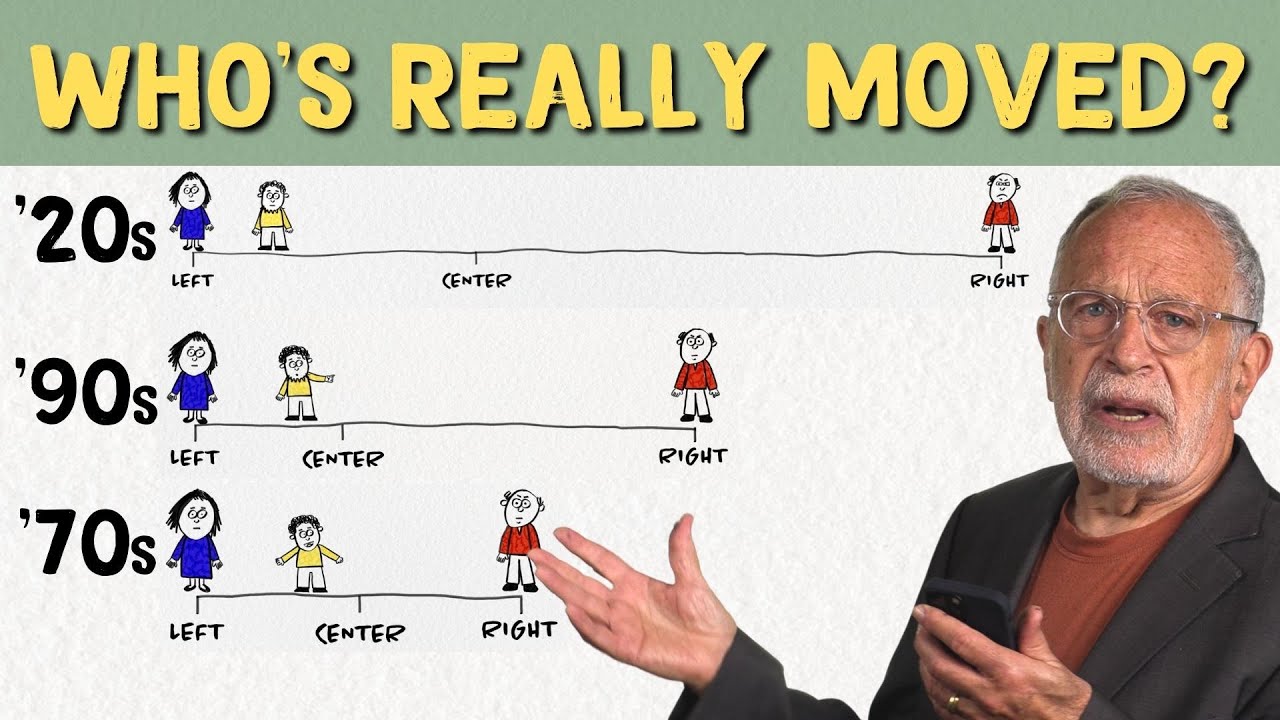
ineq expl 12 min rr primer; dynastic wealth // royal, ~ meritocracy
https://www.youtube.com/watch?v=wOI8RuhW7q0
---
422 an
...First, the middle class is shrinking in absolute terms.
The percentage of people who are middle class based on objective measures of income distribution has declined. The share of American adults who live in middle-income households has decreased from 61 percent in 1971 to 51 percent in 2019.
Americans are increasingly wealthy or increasingly struggling.
Unionized jobs and jobs that pay solid middle-class wages are being replaced by “gig” jobs and low-paid service jobs. Meanwhile, wages for jobs in finance, law, medicine and information technology are booming.
This is the much-talked-about “hollowing out” of the middle class.
Second, the distance – measured by income, between rich and poor – is widening. A report from the Congressional Research Service on this issue makes it clear: “In 1975, the average income of households in the top fifth of income distribution was 10.3 times as large as average household income in the bottom fifth of the distribution; in 2019, average top incomes were 16.6 times as large as those at the bottom.”
Being in an upper-income household in the United States today means you are living a different life than poorer households.
In some respects, the above quote underestimatesthe degree of distance between rich and poor, especially in terms of wealth.
According to data from the Federal Reserve, at the end of 2021,the top 10 percent of American households controlled $99.20 trillion. The restof the households had wealth amounting to $42.98 trillion dollars.
It actually gets worse. If we look atjust the bottom half of American households, their wealth amounts to $3.73 trillion dollars.
Ok, so why does it matter?
Income inequality produces oligarchy.
Politics
Few people are so naive as to assume everyone has an equal say in who is elected and what legislation they put forth. We all know that while the vote cast by a working-class Joe or Jane is equal to the vote cast by a millionaire, the millionaire’s money influences who is elected and what legislation the elected decides to support.
But the extent to which money impacts politics is astounding.
Consider the current Alabama senate race.
According to OpenSecrets.org, Super PAC Alabama Conservatives Fund has spent $1.8 millionin support of Katie Britt’s 2022 bid.
Britt is one of several Republican contenders to replace the outgoing Senator Richard Shelby. The Alabama Conservatives Fund has released several campaign spots touting Britt’s conservative principles.
Harbert Management, an investment management firm, is the super PACs biggest investor, donating $250,000. The company’s CEO is Raymond J. Harbert, who is one of the richest people in Alabama.
So what do you think your direct donation of $50 does?
To be sure, small donations do add up. But when a candidate gets a $250,000 boost from a local, well-known millionaire, that has to play into the political calculus of that candidate.
As a side note, Britt is in the vein of Marjorie Taylor Green and Madison Cawthorne. She is pro-Christian, pro-life and anti-immigration. Indeed, the person who would have been the favorite in a pre-Trump universe, current US Rep. Moe Brooks, was called “woke” by Donald Trump who then rescinded his endorsement.
Accordingly, her Trumpist Christian nationalist bona fides have gained the favor of the Alabama Christian Conservatives super PAC to the tune of $1.2 million.
This spending by super PACs is all above board and expected. In this regard, Katie Britt’s campaign is not unique. Nor is the state of Alabama.
Nor are conservatives. What is unique is the growing gap between the rich and everyone else, and the growing ability for wealthy people working alone or in concert to bend politics to their will.
I zeroed in on Alabama to show in a more concrete way how money impacts politics. But there is no solace in zooming out.
It gets worse.
According to Public Citizen, 25 people contributed half ($1.4 billion) of all individual super PAC contributions ($3 billion) since 2010.
The issue of the 2020s
Income inequality is a bacteria eating out the core of democracy.
Do we really have a political system by which everyone is treated equally and has an equal say in government? Let’s not be naive.
What we have is increasingly a nation of rich and poor.
The rich – and especially the mega-rich – are like oligarchs who influence law in their favor at the expense of workaday folks.
I hope income inequality is the defining issue of the 2020s.
Our identity as a nation hangs in the balance.
---
https://www.alternet.org/2022/04/ceos-raked-in-254-times/
---
---
an 4 22
Whenever progressive Democrats talk about billionaires, it’s in the soft tones of fairness. Men like Warren Buffet and Elon Musk, we are told, should pay proportionally what normal non-billionaire people pay. The debate is steeped in the inoffensive language of “their fair share.”
The debate is backwards.
Instead of starting with “their fair share,” we should start with a question fundamental to every democracy that’s existed, to wit:
Should billionaires exist?
Should their influence be legal?
Billionaires are not just very obscenely rich. With their wealth comes planetary power.Their decisions affect billions and billions of people, who in turn have no say on whether those decisions should be made.
Why should a democratic republic such as America, which claims to hold power to account – which must hold power to account to survive as a democratic republic – tolerate the existence of billionaires.
We should ask.
We should also awaken to the truth.
We are accountable to them.
Billionaires tolerate the American people and their belief that they are the ultimate sovereigns. It serves their interests for the American people to believe they are more powerful than they actually are.
Are we accountable to them?
Yes.
The American tax code has long been designed to ensure that unaccountable planetary power wins when it’s heads, wins when it’s tails. A democratic republic allowing the existence of such a powerful parasitic class is a democratic republic surviving rather than thriving.
That’s why the debate is backwards.
A debate among progressive Democrats over the question of whether the very obscenely rich should pay their fair share has been settled before it started. It’s a debate the very obscenely rich already win.
We should instead recognize the very real danger billionaires pose to our republic. We should assess how much risk we’re willing to tolerate. How much should be legal, how much illegal? Only then should “their fair share” come into play. It’s fairness as a hedge against systemic risk.
It’s fairness so the people may be free.
To learn more about our tax code, and how upside down, backwards and prolapsed it is, I talked to Amy Hanauer. She’s the director of the Institute on Taxation and Economic Policy. She said that, “We do not have to accept a false message of scarcity. Billionaires and big corporations grew much more profitable even in a pandemic.
“We can pay for a better country.”
What is it that normal people should understand about the United States tax code that most normal people do not?
Taxes are essential to providing us with things we need, as families, as communities and as a planet. We can use the tax code to make sure everyone has good schools, to make sure working-class kids can afford college, to have resources to construct affordable housing.
But we can also use the tax code to have the resources necessary for the transition to a clean energy economy, to address racial and economic inequity and to make sure public employees are well-paid.
There are ways to raise revenue that raise resources from rich people and corporations. But unfortunately, the US does far too little to make sure that wealthy people and corporations pay their fair share.
My colleagues at the Institute on Taxation and Economic Policy did a report last year. It found that 55 profitable Fortune 500 corporations paid absolutely nothing in federal corporate income tax in 2020.
Zero.
A whole bunch of other big profitable corporations paid more than zero but less than half the corporate rate (21 percent).
The big economic legislation that passed the House last year, the Build Back Better Act, addressed this by putting in place a 15 percent minimum corporate tax for the very largest and most profitable corporations. Unfortunately, that bill is stalled in the Senate.
Letting corporations or the very wealthy pay less than their fair share is a choice. It's not a choice that most people agree with. It's also not a choice that most other wealthy democracies make.
In 2019, the most recent year for which data are available, the US collected revenue equal to 25 percent of its gross domestic product(25 percent of its total economic output). Most OECD countries collect more than 34 percent. Only a handful of OECD countries collect less revenue as a share of their economies than the United States. They are all small: Costa Rica, Turkey, Ireland, Chile, Columbia and Mexico.
What can the Treasury do about tax avoidance on its own?
First, to address the enormous problems with our tax code, we need legislation. Things the administration can do without Congress are not a substitute for passing tax reform, which Senator Manchin has said he wants to pass, which Senator Schumer wants to pass, which the House has passed, and which President Biden wants to pass. And not incidentally, which is incredibly popular with the American people.
That said, there are things that the Biden administration will have to do whether the Congress passes something or not.
The Trump administration expanded tax breaks for corporations far beyond what the 2017 law allowed. These regulatory excesses gave corporations and the rich even larger tax breaks than the law did.
Many corporations have admitted they used the expansive interpretation from the Trump Treasury to get bigger breaks.
A second big thing is that when corporations publish their financial disclosures, they are required to list tax breaks they think the IRS is likely to deny. But we found that big companies keep billions in breaks that they had admitted would not withstand scrutiny, simply since the clock runs out before the underfunded IRS has time to investigate.
The IRS should direct more resources to dealing with that.
Another important option is that we don't always know exactly how corporations are avoiding taxes. The IRS could require companies to disclose that. This would help us identify how to make the law better able to address tax avoidance.
So much of the tax code burdens people who work. Shouldn't the tax code burden the people who own and collect rents?
Yes.
One of the big problems with our tax code is that we have a special,lower rate on income from capital gains (which you get when you sell an expensive asset, like stocks or a house, at a higher price than what you paid for it.)
It doesn't make sense to tax earnings from wealth at a lower rate than earnings from work.
But even worse is that the wealthiest people can accumulate wealth without selling their assets, and then can pass that wealth onto their heirs at the new value without anyone ever paying taxes on it.
This is called "stepped-up basis.”
The Biden administration included a fix to that in the BBB plan. But after a heavy lobbying effort led by moneyed interests, the provision was removed before the House committee sent the bill to the floor.
The reforms that did pass the House would raise a lot of revenue and raise them from the wealthiest people and corporations. But long term, we should also go back and revisit these good ideas.
Can you talk about the alleged link between low tax and high growth? That was a very potent argument in the past. Now?
The United States had its strongest decades of economic growth at a time when our tax rates were much higher than today.And that's not surprising. Things that led to high growth required public spending.
In the middle of the 20th century, we put a lot of national resources into helping people become much more educated.
Rates of high school and college completion rose in part because of more spending on K-12 schools, of Pell grants that help regular people pay for college and of state funding to public universities.
We also put resources into improving our national infrastructure, like the interstate. That helped companies get products out to market.
Both of these investments made us much more productive.
Today, we have different imperatives to make our economy more productive but we have nevertheless been underinvesting.
We need to put resources into greening our economy, which would reduce the pace of climate change but also make us more resilient in the face of climate disasters, which are going to be with us.
And we have let inequality – both economic and racial – skyrocket. The result is that many working-class people of all races are left behind.
Addressing both of those things will take public resources but will make us much more economically competitive in the long term.
Did all that growth cause inflation in the 1970s?
Inflation is complicated.
But a lot of rising costs as a result of current inflation could be managed by passing BBB, which would reduce the cost of childcare and health care, two of the biggest costs families face.
Explain please.
For most people, housing, childcare and healthcare are among their biggest costs. BBB has spending that would address all of those, making them more affordable. If we could hold down costs for those items, that would do a lot to keep inflation in check.
We are a very wealthy country.
We do not have to accept a false message of scarcity. Billionaires and big corporations grew much more profitable even in a pandemic.
We can pay for a better country. We have the resources.
We can afford to make college affordable. We can invest in our little kids so their parents can work. And we can and must invest to take on climate chaos. None of us will be protected from it if we don't.
---
---
2 22 bak no lnx
6/20 login missing field msg on save
html forestall
---
aha ultimate ineq is lack of access to feed shelter and medicine
driver profit maximization:
pharma CORPS claim need massive profits for innovation but trump voodoo windfall went to stock buyback ceo bonus?
https://www.alternet.org/2022/02/pfizer/
public R&D
profiteer, someone's mrna vacc reverse engr from open records? but still need license?!
---
---
https://www.alternet.org/2022/02/billionaire/
comm dr
over the next few decades, the richest American families could avoid paying about $8.4 trillion in taxes, or more than four times the cost of the stalled Build Back Better package, according to a report released Wednesday.
The Americans for Tax Fairness report—entitled Dynasty Trusts: Giant Tax Loopholes that Supercharge Wealth Accumulation—urges Congress to fix the federal tax code to address dynastic wealth.
The new analysis details how loopholes have made the payment of estate, gift, and generation-skipping taxes—collectively called wealth-transfer taxes—effectively optional for the "ultrawealthy" and thereby accelerate the "accumulation of dynastic wealth."
"Ultrarich families use dynasty trusts—the term for a variety of wealth-accumulating structures that remain in place for multiple generations—to ensure their fortunes cascade down to children, grandchildren, and beyond undiminished by wealth-transfer taxes," the report explains.
Some U.S. states, such as South Dakota, have even changed their laws on dynasty trusts to attract wealthy residents, as Chuck Collins of the Institute for Policy highlighted last year.
The new report notes that U.S. lawmakers aren't planning to address the issue, even if the Senate passes a version of a House-approved package:
The Build Back Better (BBB) legislation now before Congress—otherwise a vehicle for significant progressive tax reform—does nothing to directly reverse this toxic accumulation of dynastic wealth. Moreover, some dynasty trust reforms that were included in the bill passed by the House Ways and Means Committee in September 2021 were stripped out before the House voted on the measure in November.
The BBB bill needs full support from Senate Democrats to pass. Sen. Joe Manchin (D-W.Va.)—one of the primary reasons the legislation hasn't reached President Joe Biden's desk—said Tuesday that it is "dead."
However, Americans for Tax Fairness still uses the whittled-down BBB package to illustrate just how much money wealthy Americans can hoard for their families in the years ahead thanks to the U.S. tax system.
"The tax savings for the richest families could be about $8.4 trillion over the next 24 years or so if the current 40% estate tax rate remains in place," the report states. "That's the equivalent of more than four Build Back Better plans costing $1.75 trillion each over 10 years."
The report adds that "about half of the $8.4 trillion is equivalent to the cost of the expanded child tax credit, which was included in the House-passed BBB bill and is estimated to reduce childhood poverty by 40%, for 24 years at $160 billion a year." [twt]
"This hoarding of wealth is inexcusable," declared the report's principal author, Bob Lord, who practiced estate law for 30 years before joining Americans for Tax Fairness as tax counsel.
"The BBB legislation now before the U.S. Senate should be amended to close loopholes in the three components of America's wealth transfer tax system: the estate, gift, and generation-skipping tax," he asserted. "Effective reforms have already been developed—all that's needed is for Congress to recognize the urgency to act now."
The group's new analysis and call for action come after Americans for Tax Fairness estimated last month that the 10 wealthiest billionaires in the United States have become approximately $1 billion richer collectively every day of the Covid-19 pandemic.
Wednesday's report contains a warning about that group of ultra-billionaires, mentioning by name Amazon's Jeff Bezos, Facebook's Mark Zuckerberg, and Elon Musk of Telsa and SpaceX.
"As much as familiar fortunes have blossomed in the low-regulation, low-tax, wealth-worshiping environment of the previous 40 years," the report says, "the next 40 and beyond could see the rise of economic dynasties that will make the old money look small."
Along with closing dynasty-trust tax loopholes, Americans for Tax Fairness urges reforms that would "curb the year-to-year accumulation of wealth in existing trusts." Specifically, it calls for a new income-tax bracket "on undistributed trust income in excess of $250,000 that is five percentage points higher than the maximum income-tax bracket for individuals."
Noting a proposal from Sen. Elizabeth Warren (D-Mass.), the group also encourages U.S. lawmakers to "impose an annual 2% wealth tax on the portion of a dynasty trust's holdings that exceed $50 million, and an additional 1% on dynasty trust accumulations in excess of $1 billion."
"The choice is clear," according to the report. "We can fix our broken estate and gift tax system and stop the concentration of an ever-larger share of America's wealth inside enormous dynasty trusts, or we can trust our democracy to a handful of trillionaire trust fund babies."
"Fortunately, we know what needs to be done," the report concludes. "The sole remaining challenge is to summon the courage to stand up to the holders of dynastic wealth and their enablers."
---
---
an
how unchecked capitalism and massive inequality made America a bully nation
Charles Derber and Yale Magrass Charles Derber and Yale Magrass University Press of Kansas January 14, 2019
The following is an excerpt from the new book Bully Nation by Charles Derber & Yale R. Magrass (University Press of Kansas, 2016):
---
no lnx twit nice table
https://www.alternet.org/2022/01/us-billionaires/
Top 10 US billionaires got $1 billion richer every day of pandemic
Jake Johnson and Common Dreams January 20, 2022
The 10 wealthiest billionaires in the U.S. have added roughly $1 billion to their collective fortune every day—or around $12,600 per second—since the beginning of the coronavirus pandemic, which has killed millions of people across the globe and thrown countless lives into chaos.
The billionaire wealth update comes courtesy of the progressive advocacy group Americans for Tax Fairness (ATF), which released an analysis Wednesday estimating that the combined net worth of the 10 richest people in the U.S. has more than doubled since March 2020, reaching $1.35 trillion this week.
"The pandemic has been very good to American billionaires, especially the top 10," said ATF executive director Frank Clemente, who noted that billionaires' pandemic profits will likely not be taxed because they consist largely of unrealized capital gains.
Sen. Ron Wyden's (D-Ore.) proposal to subject the unrealized capital gains of the mega-wealthy to taxation has gone nowhere in Congress.
"Their obscene rise in wealth—all of it potentially untaxed—stands in stark contrast to the lot of America's working families, who've struggled through almost two years of a health crisis and economic uncertainty including most recently, rising prices," Clemente said. "Chairman Wyden's Billionaires Income Tax would better align the fortunes of America's richest of the rich with the needs of average Americans."
[nice table/stats]
ATF's analysis is the latest in a series of new studies highlighting the extent to which the coronavirus pandemic has accelerated the decades-long trend of soaring wealth inequality in the U.S. and worldwide.
Earlier this week, as Common Dreams reported, Oxfam International released an analysis showing that the 10 richest men in the world have doubled their combined wealth since the pandemic began. Meanwhile, the anti-poverty group noted, "the incomes of 99% of humanity are worse off because of Covid-19."
On Tuesday, a coalition of progressive organizations including the Fight Inequality Alliance and the Institute for Policy Studies estimated that a modest annual wealth tax on global millionaires and billionaires would raise $2.52 trillion dollars a year, enough money to lift 2.3 billion people out of poverty.
In an open letter published Wednesday morning, a group of more than 100 rich individuals voiced support for such a tax, warning that "history paints a pretty bleak picture of what the endgame of extremely unequal societies looks like."
"For all our well-being—rich and poor alike—it's time to confront inequality and choose to tax the rich," reads the letter, which was addressed to political and economic elites. "If you don't, then all the private talks won’t change what's coming—it's taxes or pitchforks. Let's listen to history and choose wisely."
---
---
https://www.alternet.org/2021/11/how-wealth-inequality-spiraled-out-of-control/
no lnx vid
How wealth inequality spiraled out of control
Robert Reich and Robert Reich's Blog November 04, 2021
Elon Musk's wealth has surpassed $200 billion. It would take the median U.S. worker over 4 million years to make that much.
Wealth inequality is eating this country alive. We're now in America's second Gilded Age, just like the late 19th century when a handful of robber barons monopolized the economy, kept wages down, and bribed lawmakers.
While today's robber barons take joy rides into space, the distance between their gargantuan wealth and the financial struggles of working Americans has never been clearer. During the first 19 months of the pandemic, U.S. billionaires added $2.1 trillion dollars to their collective wealth and that number continues to rise.
And the rich have enough political power to cut their taxes to almost nothing — sometimes literally nothing. In fact, Jeff Bezos paid no federal income taxes in 2007 or in 2011. By 2018, the 400 richest Americans paid a lower overall tax rate than almost anyone else.
But we can not solve this problem unless we know how it was created in the first place.
Let's start with the basics.
I. The Basics
Wealth inequality in America is far larger than income inequality.
Income is what you earn each week or month or year. Wealth refers to the sum total of your assets — your car, your stocks and bonds, your home, art — anything else you own that's valuable.Valuable not only because there's a market for it — a price other people are willing to pay to buy it — but because wealth itself grows.
As the population expands and the nation becomes more productive, the overall economy continues to expand. This expansion pushes up the values of stocks, bonds, rental property, homes, and most other assets. Of course recessions and occasional depressions can reduce the value of such assets. But over the long haul, the value of almost all wealth increases.
Lesson: Wealth compounds over time.
Next: personal wealth comes from two sources.The first source is the income you earn but don't spend. That's your savings. When you invest those savings in stocks, bonds, or real property or other assets, you create your personal wealth — which, as we've seen, grows over time.
The second source of personal wealth is whatever is handed down to you from your parents, grandparents, and maybe even generations before them — in other words, what you inherit.
Lesson: Personal wealth comes from your savings and/or your inheritance.
II. Why the wealth gap is exploding
The wealth gap between the richest Americans and everyone else is staggering.
In the 1970s, the wealthiest 1 percent owned about 20 percent of the nation's total household wealth. Now, they own over 35 percent.
Much of their gains over the last 40 years have come from a dramatic increase in the value of shares of stock.
For example, if someone invested $1,000 in 1978 in a broad index of stocks — say, the S&P 500 — they would have $31,823 today, adjusted for inflation.
Who has benefited from this surge? The richest 1 percent, who now own half of the entire stock market. But the typical worker's wages have barely grown.
Most Americans haven't earned enough to save anything. Before the pandemic, when the economy appeared to be doing well, almost 80 percent were living paycheck to paycheck.
Lesson: Most Americans don't make enough to save money and build wealth.
So as income inequality has widened, the amount that the few high-earning households save — their wealth — has continued to grow. Their growing wealth has allowed them to pass on more and more wealth to their heirs.
Take, for example, the Waltons — the family behind the Walmart empire — which has seven heirs on the Forbes billionaires list. Their children, and other rich millennials, will soon consolidate even more of the nation's wealth. America is now on the cusp of the largest intergenerational transfer of wealth in history. As wealthy boomers pass on, somewhere between $30 to $70 trillion will go to their children over the next three decades.
These children will be able to live off of this wealth, and then leave the bulk of it — which will continue growing — to their own children … tax-free. After a few generations of this, almost all of America's wealth could be in the hands of a few thousand families.
Lesson: Dynastic wealth continues to grow.
III. Why wealth concentration is a problem
Concentrated wealth is already endangering our democracy. Wealth doesn't just beget more wealth — it begets more power.
Dynastic wealth concentrates power into the hands of fewer and fewer people, who can choose what nonprofits and charities to support and which politicians to bankroll. This gives an unelected elite enormous sway over both our economy and our democracy.
If this keeps up, we'll come to resemble the kind of dynasties common to European aristocracies in the seventeenth, eighteenth, and nineteenth centuries.
Dynastic wealth makes a mockery of the idea that America is a meritocracy, where anyone can make it on the basis of their own efforts. It also runs counter to the basic economic ideas that people earn what they're worth in the market, and that economic gains should go to those who deserve them.
Finally, wealth concentration magnifies gender and race disparities because women and people of color tend to make less, save less, and inherit less.
The typical single woman owns only 32 cents of wealth for every dollar of wealth owned by a man. The pandemic likely increased this gap.
The racial wealth gap is even starker. The typical Black household owns just 13 cents of wealth for every dollar of wealth owned by the typical white household. The pandemic likely increased this gap, too.
In all these ways, dynastic wealth creates a self-perpetuating aristocracy that runs counter to the ideals we claim to live by.
Lesson: Dynastic wealth creates a self-perpetuating aristocracy.
IV. How America dealt with wealth inequality during the First Gilded Age
The last time America faced anything comparable to the concentration of wealth we face today was at the turn of the 20th century. That was when President Teddy Roosevelt warned that "a small class of enormously wealthy and economically powerful men, whose chief object is to hold and increase their power" could destroy American democracy.
Roosevelt's answer was to tax wealth. Congress enacted two kinds of wealth taxes. The first, in 1916, was the estate tax — a tax on the wealth someone has accumulated during their lifetime, paid by the heirs who inherit that wealth.
The second tax on wealth, enacted in 1922, was a capital gains tax — a tax on the increased value of assets, paid when those assets are sold.
Lesson: The estate tax and the capital gains tax were created to curb wealth concentration.
But both of these wealth taxes have shrunk since then, or become so riddled with loopholes that they haven't been able to prevent a new American aristocracy from emerging.
The Trump Republican tax cut enabled individuals to exclude $11.18 million from their estate taxes. That means one couple can pass on more than $22 million to their kids tax-free. Not to mention the very rich often find ways around this tax entirely. As Trump's former White House National Economic Council director Gary Cohn put it, "only morons pay the estate tax."
What about capital gains on the soaring values of wealthy people's stocks, bonds, mansions, and works of art? Here, the biggest loophole is something called the "stepped-up basis." If the wealthy hold on to these assets until they die, their heirs inherit them without paying any capital gains taxes whatsoever. All the increased value of those assets is simply erased, for tax purposes. This loophole saves heirs an estimated $40 billion a year.
This means that huge accumulations of wealth in the hands of a relatively few households can be passed from generation to generation untaxed — growing along the way — generating comfortable incomes for rich descendants who will never have to work a day of their lives. That's the dynastic class we're creating right now.
Lesson: The estate tax and the capital gains tax have been gutted.
Why have these two wealth taxes eroded? Because, as America's wealth has concentrated in fewer and fewer hands, the wealthy have more capacity to donate to political campaigns and public relations — and they've used that political power to reduce their taxes. It's exactly what Teddy Roosevelt feared so many years ago.
V. How to reduce the wealth gap
So what do we do? Follow the wisdom of Teddy Roosevelt and tax great accumulations of wealth.
The ultra-rich have benefited from the American system — from laws that protect their wealth, and our economy that enabled them to build their fortunes in the first place. They should pay their fair share.
The majority of Americans, both Democrats and Republicans, believe the ultra rich should pay higher taxes. There are many ways to make them do so: closing the stepped up basis loophole, raising the capital gains tax, and fully funding the Internal Revenue Service so it can properly audit the wealthiest taxpayers, for starters.
Beyond those fixes, we need a new wealth tax: a tax of just 2 percent a year on wealth in excess of $1 million. That's hardly a drop in the bucket for centi-billionaires like Jeff Bezos and Elon Musk, but would generate plenty of revenue to invest in healthcare and education so that millions of Americans have a fair shot at making it.
One of the most important things you as an individual can do is take the time to understand the realities of wealth inequality in America and how the system has become rigged in favor of those at the top — and demand your political representatives take action to unrig it.
Wealth inequality is worse than it has been in a century – and it has contributed to a vicious political-economic cycle in which taxes are cut on the top, resulting in even more concentration of wealth there – while everyone else lives under the cruelest form of capitalism in the world.
We must stop this vicious cycle — and demand an economy that works for the many, not one that concentrates more and more wealth in the hands of a privileged few.
---
---
The speed with which a tax on billionaires came and went as a means to pay for President Joe Biden's economic agenda shows why it's so hard to tax wealth in the U.S.
Democrats unveiled their proposal on Oct. 27, 2021, and it was nixed that same day, replaced with a surcharge on millionaire incomes.
The idea of taxing the richest Americans' fortunes has been batted around for some time, and perhaps with good reason from a tax perspective. The total wealth of U.S. billionaires soared by US$1.8 trillion during the COVID-19 pandemic as of mid-August. And recent reporting has found that despite their massive riches, billionaires tend to pay very little in taxes.
As an expert on tax policy, I have observed that there's a big obstacle standing in the way of a wealth tax: the Constitution.
Income and wealth inequality
Concerns about inequality have increased in recent decades.
Americans enjoyed substantial economic growth and broadly shared prosperity from the end of World War II into the 1970s.
But in the 1980s, President Ronald Reagan dramatically slashed taxes on the wealthy – twice – cutting the top rate on wages from 70% to 28%.
Studies have shown lower income and corporate tax rates, combined with other “trickle-down" policies such as deregulation, have led to steadily rising income for the richest Americans and wealth inequality.
The most affluent 1% controlled 39% of all wealth – including all cash, real estate, stocks, bonds and other investments – in 2016, up from less than 30% in 1989. At the same time, the bottom 90% held less than a quarter of America's wealth, compared with more than a third in 1989.
Currently, the federal government taxes all income above $518,400 at 37% for single filers, with an additional 3.8% investment tax on incomes over $200,000. Of course, as a ProPublica cache of tax documents shows, loopholes and tax dodges result in actual income tax rates being significantly lower.
The problem with taxing wealth
Unlike an income tax, a wealth tax reaches the root of both wealth and income inequality.
But there are strong arguments that a federal wealth tax is unconstitutional. Wealth taxes violate Article I, Section 2, Clause 3 of the U.S. Constitution, which forbids the federal government from assessing “direct taxes" that aren't apportioned equally among the states.
A direct tax is a tax on a thing, like property or income. An indirect tax is a tax on a transaction: for example, a sale or a gift.
The income tax is a direct tax and constitutional because of the 16th Amendment, which specifically allows income taxes without apportionment. As for property, you may notice that only states and cities levy real estate taxes. In almost every case, the federal government cannot tax real estate or any other form of wealth absent a transaction.
Proponents of a wealth tax, such as U.S. Sen. Elizabeth Warren of Massachusetts, cite a small group of law professors who back her claim that a wealth tax passes constitutional muster. But the argument against constitutionality is strong enough that a Supreme Court challenge is sure to follow any attempt to enact a wealth tax.
Barring a victory before the conservative-leaning Supreme Court or an arduous amendment to the Constitution, the federal government is shut out of taxing wealth.
A rising tide
I agree with progressive lawmakers that the United States should return to economic policies that seek to lift all boats.
Although American wealth and productivity have surged in the past 40 years, most Americans have not seen their lot improve nearly as much as the richest have – and are paying higher tax rates. In 2020 alone, America's billionaires saw their wealth increase $560 billion, even as tens of millions were unemployed or depended on food donations to get enough to eat.
The U.S. tax system is at least partly responsible for these gaps. While a wealth tax may not be a workable solution, there are other means, such as higher income tax rates for the well-to-do or a wealth transfer tax that focuses on the transfer of wealth to a billionaire's heirs. These approaches could not only help solve the problem of inequality but would pass legal muster too.
This is an updated version of an article published on June 9, 2021.The Conversation
Beverly Moran, Professor Emerita of Law, Vanderbilt University
---
---
an 10 21
no lnx twt
'Pelosi absolutely destroyed' the proposed tax on billionaires, says Democratic insider
Kenny Stancil and Common Dreams October 28, 2021
Although right-wing Democratic Sen. Joe Manchin publicly attacked a proposed billionaires' tax almost as soon as it was unveiled, one journalist argued Wednesday that blaming the West Virginia coal baron for shooting down the popular provision is an oversimplification that lets other conservative Democrats—including House Speaker Nancy Pelosi, who reportedly criticized the measure behind closed doors—off the hook.
Just hours after Senate Finance Chair Ron Wyden (D-Ore.) introduced his plan to make a few hundred super-rich tax dodgers pay a fairer share, Manchin threw cold water on the idea, calling it divisive to raise hundreds of billions of dollars to fund expanded public benefits and climate action by "targeting" those with $1 billion in assets or $100 million in annual income for three straight years. That led House Ways and Means Chair Richard Neal (D-Mass.) to declare that congressional support for the proposal is insufficient.
Given that he has done so much to weaken the Build Back Better Act, many believe Manchin alone is responsible for killing the billionaires' tax, but Washington Post columnist Greg Sargent made the case that this emerging narrative ignores the role played by other corporate Democrats.
For example, Pelosi, a multimillionaire from California, "sharply faulted the proposal at a caucus meeting earlier this week, according to a Democratic aide who overheard the remarks," wrote Sargent. "This aide told me Pelosi pronounced it a PR stunt that wouldn't accomplish anything."
"Pelosi absolutely destroyed it," said the aide.
According to Sargent:
Another senior Democratic aide rejected this idea, saying that Pelosi's criticism was confined to the fact that at the time there was no bill text for the proposal. Democrats coalesced around it only in recent days.
"The speaker expressed frustration Monday that there was no text and therefore impossible to score," this aide told me. "The thrust of her comments were about it being too late in the process not to have a codified proposal."
As Common Dreams has reported, the combined net worth of the nation's 745 billionaires skyrocketed by $2.1 trillion over the past year and a half, as millions were devastated by the Covid-19 pandemic and its economic repercussions. Taxing billionaires' unrealized stock gains emerged as a potential revenue-raiser after right-wing Democratic Sen. Kyrsten Sinema (Ariz.)—swimming in campaign cash from Wall Street—single-handedly blew up her party's plan to hike taxes on corporations and wealthy individuals.
Sinema and other Big Pharma-bankrolled Democrats, including Sen. Bob Menendez (N.J.) and Reps. Kathleen Rice (N.Y.), Scott Peters (Calif.), and Kurt Schrader (Ore.), have also undermined a proposal to allow Medicare to negotiate lower prescription drug costs, which would have protected Americans from deadly price-gouging and saved the federal government hundreds of billions of dollars per year—leaving the party scrambling to figure out how to pay for its increasingly anemic reconciliation bill.
Regarding the billionaires' tax, Sargent argued that "other Democrats are waiting in the cloakroom to kill it with no fingerprints."
Neal, for instance, "has questioned whether it will hold up in court. That would dovetail with Pelosi's private opposition, and both of them working together suggest there may be plenty of other House Democrats privately opposed."
Moreover, "other Senate Democrats appear to oppose the proposal but don't want to say so openly," Sargent added. "After all, it's not easy to come down on the side of protecting the wealth of billionaires."
---
---
921
aha PIC MIC
Labor Day, we speak with journalist and sociologist Eyal Press about his new book, "Dirty Work: Essential Jobs and the Hidden Toll of Inequality in America." Press profiles workers like prison guards and oil workers — people who make their livelihoods by doing "unethical activity that society depends on and tacitly condones but doesn't want to hear too much" about, he says. "This work is largely hidden, and we rarely hear from the people on the frontlines who are delegated to do it," Press tells Democracy Now! "The powerful and the privileged really don't do the dirty work in America — they not only don't do it, they don't see it"
AMY GOODMAN: This is Democracy Now!, democracynow.org, The War and Peace Report. I'm Amy Goodman.
This Monday is Labor Day. Today, we spend the rest of the hour looking at Dirty Work: Essential Jobs and the Hidden Toll of Inequality in America. It's the title of a new book by New Yorker writer Eyal Press. He profiles workers like prison guards and oil workers, and two people we'll speak to in a minute: a drone operator and the daughter of poultry plant workers.
We begin with Eyal Press, who also has a new opinion piece in The New York Times headlined "America Runs on 'Dirty Work' and Moral Inequality." Eyal is joining us from Buffalo, New York.
Eyal, welcome back to Democracy Now! You begin your book, Eyal, with a quote from the great writer James Baldwin, who said, "The powerless must do their own dirty work. The powerful have it done for them." Talk about what that means and what you mean by "dirty work."
EYAL PRESS: So, I don't mean the common colloquial expression, which I think leads people to just think of, say, garbage truck workers, who do something that's physically dirty. Dirty work, in my book, means unethical activity that society depends on and tacitly condones but doesn't want to hear too much. So, it is work that's sort of in the shadows, if we think of the work of conducting targeted assassinations in the drone program or the work of running the mental health wards in America's jails and prisons, which, by the way, are the largest mental health institutions in this country, or the work of manning the kill floors in industrial slaughterhouses. All of those things, I argue in the book, are pretty essential to our existing social order, to the American way of life. You really can't imagine fast food, the American industrial food system, without the slaughterhouses I write about. You can't imagine the never-ending wars without the drone program.
But we very rarely hear from — this work is largely hidden, and we rarely hear from the people on the frontlines who are delegated to do it. And to go back to the Baldwin quote, the book is about inequality, because the powerful and the privileged really don't do the dirty work in America — they not only don't do it, they don't see it. And so I'm particularly honored to be on this show, because you've invited some of the people I've written about to tell their stories. We don't hear those stories enough, and also the family members of people who do this work.
---
// corps lobby ~ infra tax hike
https://www.alternet.org/2021/09/america-s-ultra-wealthy-is-responsible-for-28-of-unpaid-taxes-in-us-report/
---
---
https://www.alternet.org/2021/06/climate-crisis-2653267213/
comm dr
New research by global insurance giant Swiss RE warns that the looming devastation of runaway greenhouse gas emissions and the climate crisis could result in economic retractions twice as potent as the global recession unleashed by Covid-19—a calamity, unlike the pandemic, which could go on for many years without end.
Analyzing the figures compiled in a research report (pdf) by Zurich-based Swiss RE, Oxfam International said while the world's poorest nations will be hardest hit, even the rich nations—like those of the G7 meeting this week in the United Kingdom—will not be spared from the economic pain that will come if world temperatures rise by 2.6ºC that some scenarios predict.
According to Oxfam, economies of the G7 nations could see an average loss of 8.5 percent annually by the middle of the century―equivalent to $4.8 trillion―if more urgent action to address global warming is not taken immediately.
The international aid and anti-poverty group said this potential drop in GDP is double that of the coronavirus pandemic, which resulted in an average 4.2% reduction among G7 nations, recessions that resulted "in staggering job losses and some of the largest economic stimulus packages ever seen." But, Oxfam added, "economies are expected to bounce back from the short-term effects of the pandemic, the effects of climate change will be seen every year."
The devastation for poor nations would be enormous.
"The economic turmoil projected in wealthy G7 countries is only the tip of the iceberg: many poorer parts of the world will see increasing deaths, hunger and poverty as a result of extreme weather," said Max Lawson, head of Inequality Policy at Oxfam, in a statement. "This year could be a turning point if governments grasp the challenge to create a safer more liveable planet for all."
As the group's analysis notes:
India could lose 27% from its economy.
Australia, South Africa and South Korea are projected to lose 12.5, 17.8 and 9.7% respectively.
The Philippines is projected to lose 35%
Colombia is projected to lose 16.7%
Jerome Haegeli, a chief economist at Swiss Re involved with the research, told the Guardian that: "Climate change is the long-term number one risk to the global economy, and staying where we are is not an option—we need more progress by the G7. That means not just obligations on cutting CO2 but helping developing countries too, that's super-important."
The research from Swiss RE, as Oxfam details,
modelled the economic impacts of climate change on 48 countries in four different temperature paths and used different impact scenarios to account for the large parameter uncertainty and missing climate impact channels usually present in the climate economics literature. The projections used in this press release assume high stress factors and global warming of 2.6°C by mid-century, which is a level of warming that could be reached based on current policies and climate pledges from all countries. All figures relate to real GDP. The GDP projections compare a warmer world with a world unaffected by climate change.
Ahead of the G7 summit in the U.K., global climate campaigners have continued to urge the world's richest and most powerful nations—also its largest emitters—to not only commit to stronger pledges on reducing fossil fuel pollution, but to increase their financial pledges to the developing world that have contributed far less to the climate crisis but continue to face its most devastating impacts.
From Your Site Articles
Climate crisis is the primary cause of 98% of dead Florida coral reef ... ›
Slashing methane emissions must play larger role in fighting climate ... ›
Climate crisis and negligent policymakers blamed for 'record ... ›
---
---
How do we prevent America from becoming an aristocracy, while also funding the programs that Americans desperately need?
One way is to get rid of a tax loophole you've probably never heard of. It's known as the "stepped-up basis" rule.
Here's how the stepped-up-basis loophole now works. Take a man named Jeff. At his death, Jeff owns $30 million-worth of stocks he originally bought for a total of $10 million. Under existing law, neither Jeff nor his heirs would owe federal tax on the $20 million of gains because they're automatically "stepped up" to their value when he dies — $30 million.
Under Biden's proposal, Jeff's $20 million of gains would be taxed. And don't worry: Biden's proposal doesn't touch tax-favored retirement accounts, such as 401-Ks, and it only applies to the very richest Americans.
As it is now, the stepped-up basis loophole enables the super-rich, like Jeff, to avoid paying more than $40 billion in taxes each year. It has allowed them to skip taxes on the increased values of mansions and artworks as well as shares of stock.
In fact, it's one of the chief means by which dynastic wealth has grown and been passed from generation to generation, enabling subsequent generations to live off that growing wealth and never pay a dime of taxes on it.
Unless the stepped-up basis loophole is closed, we will soon have a large class of hugely rich people who have never worked a day in their lives.
Over the next decades, rich baby boomers will pass on an estimated $58 trillion of wealth to their millennial children — the largest intergenerational transfer of wealth in history.
Closing this giant tax loophole for the super-rich is how Biden intends to fund part of his American Families Plan, which would provide every child with 2 years of pre-school and every student with 2 years of free community college, as well as provide paid family and medical leave to every worker.
Close this stepped-up basis loophole, and we help finance the programs the vast majority of Americans desperately need and deserve. We also end the explosion of dynastic wealth. It should be a no-brainer.
FROM YOUR SITE ARTICLES
Think About It: The U.S. Is the Richest Country as Well as the Most ... ›
Joe Biden's plans would target the ultra-wealthy for more tax dollars ... ›
What would happen if we actually taxed the rich? - Alternet.org ›
RELATED ARTICLES AROUND THE WEB
Substantial Income of Wealthy Households Escapes Annual ... ›
10 Accounting Tricks the 1% Use to Dodge the Taxman - The ... ›
Here are 5 ways the super-rich manage to pay lower taxes ›
---
---
https://www.alternet.org/2021/05/gop-slammed-for-gutting-the-irs-and-using-it-for-their-own-agenda/
ME
The Republican Party is responsible for gutting the U.S. (IRS) and shaping it into a government entity that works in favor of the wealthy, according to a new op-ed.
Mother Jones senior editor Michael Mechanic highlighted the history of Republican lawmakers' subtle and persistent attacks on the IRS over the last three decades. He noted that the most blatant attacks began in 1994 when Republican lawmakers began "chipping away at its resources and enforcement abilities even as mainstream Republican lawmakers and candidates called for the agency's abolition."
Since Republicans' war against the IRS has been decades in the making, the federal agency has been stripped of many of its resources needed to conduct thorough investigations of the ultrarich. Now, Biden administration officials are moving to restore the agency with a massive $80 billion investment over the next 10 years. While the investment will be costly, it could ultimately yield more than $700 billion for the U.S. Department of the Treasury.
The IRS overhaul comes several years after the number of high-end audits increased under former President Barack Obama's administration. Around that time, Republican lawmakers were angered by the passing of the Affordable Care Act and the taxation it imposed on the ultra-rich. In fact, opposing lawmakers fired back with scathing reactions to the bill.
During a 2015 hearing, Rep. Mike Kelly (R-Pa.) sounded off on John Koskinen who served as IRS commissioner under the Obama administration. When Republican lawmakers worked to cut the IRS budget even more, Koskinen hit back in defense of his employees who would be required to "do less with less," as he described the strict budget cuts as "a tax cut for tax cheats."
Kelly insisted that his complaints would only make the situation far worse in the long run. Unfortunately, his words were ultimately true. From 2010 to 2018, the IRS faced nearly $3 billion in additional cuts even as it received a 9% increase in tax returns.
Subsequently, the publication notes: "Investigations of non-filers plummeted and the amount of outstanding tax debt the IRS formally wrote off (based on the 10-year statute of limitations for collections) more than doubled—from less than $15 billion in 2010 to more than $34 billion in 2019."
The deep financial cuts have also led to a domino effect of other issues. According to the Treasury Department's Inspector General for Tax Administration's 2020 report, "nearly 880,000 'high income' non-filers from 2014 through 2016 still owed $46 billion, and the IRS was in no condition, resource-wise, to collect. The 300 biggest delinquents owed about $33 million per head, on average."
FROM YOUR SITE ARTICLES
Georgia Gov. Brian Kemp admits on tape: 'Voter suppression bill ... ›
Notorious ex-Democrat launches GOP primary challenge to Georgia ... ›
Trump holdovers accused of 'sabotaging' effort to get checks to 30 ... ›
---
---
https://www.alternet.org/2020/12/trickle-down-economics/
Neoliberal gospel says that cutting taxes on the wealthy will eventually benefit everyone by boosting economic growth and reducing unemployment, but a new analysis of fiscal policies in 18 countries over the last 50 years reveals that progressive critics of "trickle down" theory have been right all along: supply-side economics fuels inequality, and the real beneficiaries of the right-wing approach to taxation are the super-rich.
The Economic Consequences of Major Tax Cuts for the Rich (pdf), a working paper published this month by the International Inequalities Institute at the London School of Economics and written by LSE's David Hope and Julian Limberg of King's College London, examines data from nearly 20 OECD countries, including the U.K. and the U.S., and finds that the past five decades have been characterized by "falling taxes on the rich in the advanced economies," with "major tax cuts... particularly clustered in the late 1980s."
But, according to Hope and Limberg, the vast majority of the populations in those countries have little to show for it, as the benefits of slashing taxes on the wealthy are concentrated among a handful of super-rich individuals—not widely shared across society in the form of improved job creation or prosperity, as "trickle down" theorists alleged would happen.
"Our research shows that the economic case for keeping taxes on the rich low is weak," Hope said Wednesday. "Major tax cuts for the rich since the 1980s have increased income inequality, with all the problems that brings, without any offsetting gains in economic performance."
In their study, the pair of political economists note that "economic performance, as measured by real GDP per capita and the unemployment rate, is not significantly affected by major tax cuts for the rich." However, they add, "major tax cuts for the rich increase the top 1% share of pre-tax national income in the years following the reform" by a magnitude of nearly 1%.
The researchers continue:
Our findings on the effects of growth and unemployment provide evidence against supply-side theories that suggest lower taxes on the rich will induce labour supply responses from high-income individuals (more hours of work, more effort etc.) that boost economic activity. They are, in fact, more in line with recent empirical research showing that income tax holidays and windfall gains do not lead individuals to significantly alter the amount they work.
Our results have important implications for current debates around the economic consequences of taxing the rich, as they provide causal evidence that supports the growing pool of evidence from correlational studies that cutting taxes on the rich increases top income shares, but has little effect on economic performance.
Limberg is hopeful that the research could bolster the case for increasing taxes on the wealthy to fund a just recovery from the coronavirus pandemic and ensuing economic fallout.
"Our results," he said Wednesday, "might be welcome news for governments as they seek to repair the public finances after the Covid-19 crisis, as they imply that they should not be unduly concerned about the economic consequences of higher taxes on the rich."
Progressives have argued that America's disastrous handling of the ongoing catastrophe is attributable to several decades of "free-market" ideology and associated policies that exacerbated vulnerabilities and undermined the government's capacity to respond effectively.
According to social justice advocates, taxing billionaires' surging wealth—akin to the "Millionaire's Tax" passed earlier this month in Argentina—could contribute to reversing the trend of intensifying inequality plaguing the nation.
FROM YOUR SITE ARTICLES
Robert Reich: Coronavirus won't respond to trickle-down economics ... ›
Nobel economist: Trump's 'trickle-down' economic plans are not ... ›
Reich: Every Aspect of Trump's Trickle-Down Economic Plan ... ›
Trickle-down economics is a cruel hoax. Here's the practical alternative Biden must adopt - Alternet.org ›
Lawyer for 'QAnon Shaman' defends client's involvement in Capitol riot as he begs for him to be pardoned - Alternet.org ›
RELATED ARTICLES AROUND THE WEB
Why are we still pretending 'trickle-down' economics work? | Morris ... ›
Trickle-Down Economics: Theory, Effect, Does It Work ›
Trickle-Down Theory Definition ›
---
---
aha // hype fear alt reality; in am hist when stress/crisis blame THOSE PPL POC foreigners; 2 america echo bubble, 2 realities, polarization
AHA: polarization, inequality, racism all interlinked, 2 americas, 2 stories, division accel amplify by soc media; working class white ppl see immigrants as threat b/c take jobs, and value of automatic psychic bonus erroding (and now stacy abrams et al are giving POC political power to match increasing # = white genocide.
think piece SOLUTIONS REPAIR COMMONS
https://www.alternet.org/2021/02/gop-history/
...A few minutes later, President and First Lady Biden arrived at the rotunda to pay their respects. MSNBC and CNN were there. On Fox, Laura Ingraham briefly acknowledged the Bidens' presence but spent most of her airtime not honoring the slain policeman but trashing Dr. Anthony Fauci and beginning a story about homicides in Chicago with the phrase, "The BLM-fueled crime wave…" Black Lives Matter, you see, is just one more manifestation of the imaginary socialist plot to take over America. No wonder their viewers think the world's aflame, a cynical awful place where progressives plotting evil lurk at every corner pizzeria.
By the way, Officer Sicknick, a 12-year veteran of the force, was a Trump voter in 2016, although The Washington Post reports, "Those who encountered Sicknick said his political views did not align neatly with one political party." He was against impeachment but supported gun control.
There hasn't been an official explanation yet as to exactly how Sicknick died but he was attacked and killed while resisting the crazed crowd brainwashed by Trump
...Meanwhile, the rest of us are supposed to buy into the GOP's big con because, you know, unity. Every time truths are spoken that Republicans don't like, they claim that it's for sure dividing the country further.
So brazen are the attempts at manipulation of truth whether present or past, that in the last months of his term, President Trump and his sycophantic crew appointed a Presidential Advisory 1776 Committee, charged with creating "a definitive chronicle of the American founding." The report partly was a response to The New York Times' award-winning 1619 Project, charting the history of slavery in the United States and our continuing record of racial discrimination....
---
---
https://www.alternet.org/2021/02/tax-cuts/
covid bill tax brk rich
---
---
commn dr
https://www.alternet.org/2021/01/economy
for millions of regular Americans, the end of 2020 was marked by economic distress, with millions suffering pandemic-triggered job losses—and thus the loss of their employer-tied health insurance—still waiting on robust economic relief from federal lawmakers, and facing a weak social safety net.
For the nation's biggest banks, however, the year closed out with reason for celebration, and they're looking to take advantage of the banner year with a feast of stock buybacks.
As Axios reported Friday,
Banks cashed in on the white-hot IPO market, record debt issuance, and sky-high trading volume—all of which played out as economic peril softened the consumer side of their businesses.
The big picture: Financial results show that banks, which rake in money as middlemen, made a killing thanks to unprecedented action by the Federal Reserve—which caused a rush of activity in financial markets, pushed a slew of companies to issue debt, and led to a flood of others to go public for the first time.
Earnings were particularly sweet for banking behemoths including JPMorgan Chase, Goldman Sachs, and Morgan Stanley.
Reporting from Bloomberg on Tuesday gave a picture of the final quarter:
As the banner year for markets came to a close, JPMorgan Chase & Co. posted record profit in the fourth quarter, helped by a 20% increase in revenue from trading, a business where it already ranked No. 1 heading into the turmoil. At rival Goldman Sachs Group Inc., second only to JPMorgan in dealmaking, a flurry of transactions helped send its quarterly profit soaring 135%.
The results—from JPMorgan on Friday and Goldman on Tuesday—mirrored trends in many corners of industry and society during the shocks set off by Covid-19: The strong got stronger.
"Big banks' Wall Street business is booming," as the New York Times put it Friday. The banks signaled they may take advantage of that windfall by buying back shares—a practice the Fed last month allowed to resume last month and which critics say simply rewards wealthy shareholders but are essentially "manipulation of the stock market." From the Times:
What do banks plan to do with all that cash? "We have so much capital, we cannot use it," Jamie Dimon of JPMorgan told investors. The bank's cash pile has doubled over the past year, to more than $500 billion.
It's a similar story at other banks, and now that they've been cleared by regulators to resume share buybacks, "we're going to be aggressively buying back, and consistently," said James Gorman, Morgan Stanley's chief executive.
The reporting came as a new regulatory filing revealed that Dimon, a billionaire, was rewarded in 2020 with the same compensation as in 2019—$31.5 million.
"In determining Mr. Dimon's compensation, the independent members of the board took into account thefirm's strong performance in 2020 and over the long term, across four broad dimensions: Business Results; Risk, Controls, and Conduct; Client/Customer/Stakeholder; and Teamwork & Leadership," the company said.
At a conference call earlier this month, Dimon referenced the nation's growing wealth divide.
"We believe that inequality is a real problem," said Dimon, adding that "40% of Americans make $15 an hour or less."
Dimon also pointed to the fact with the new Biden administration, "there will be a new set of regulators," whom he expected would "be tougher" than those in the Trump administration.
President Joe Biden, according to reporting Friday, is considering naming former Obama Treasury Department official Michael Barr as the nation's top bank cop.
As head the Office of the Comptroller of the Currency, Barr would have the power to regulate banks like JPMorgan Chase.
Progressive groups like People's Action, however, have urged Biden to instead tap Mehrsa Baradaran, who teaches at the University of California at Irvine Law School and is an expert on the racial wealth gap. Bree Carlson, deputy director of People's Action, said in a statement Friday of Barr that "it's hard to imagine a worse pick," citing his ties to Wall Street and Silicon Valley corporations as reasons for his disqualification.
"President Biden must prove to voters that the government cares about all of us, not just wealthy elites," said Carlson. "If Biden truly wants to 'Build Back Better,' he needs to lock the revolving door and ensure no one with ties to the financial industry is in charge of regulating it."
FROM YOUR SITE ARTICLES
All a gig-economy pioneer had to do was 'politely Disagree' it was ... ›
The Numbers Show that Obama May Have Been an Economic Savior ›
Here's the biggest myth about the 'Trump economy' - Alternet.org ›
RELATED ARTICLES AROUND THE WEB
Economy Definition ›
Moody's Analytics | Global Economic Analysis, Data, Forecasts and ... ›
Economy - Wikipedia ›
---
---
https://www.alternet.org/2021/01/market
war of the world
...
Remember that, long before Covid-19 hit, the financial crisis of 2008 was met by a multi-trillion-dollar Wall Street bailout. At the same time, the Federal Reserve cut interest rates to zero, while purchasing U.S. Treasury and mortgage bonds from the very banks that had sparked the disaster. Its own assets then rose from $870 billion to $4.5 trillion between August 2007 and August 2015.
On the other hand, the U.S. economy never quite reached a growth level of, on average, more than 2% annually in the years after that near collapse, even as the stock market regained all its losses and so much more. The Dow Jones Industrial Average, aided by an ultra-loose monetary policy, steadily rose from a financial-crisis low of 6,926 on March 5, 2009 to 27,090 by March 4, 2020, which was when Covid-19 briefly trashed its rally.
However, within a month of the market dip that followed widespread shutdowns, its climb was refortified by similar but larger maneuvers, as Federal Reserve policy was once again deployed to save the rich under the auspices of saving the economy. Rally 2.0 took the Dow to a new record of 30,606.48 as 2020 closed.
On the other side of reality, I'm sure you won't be surprised to learn that, according to recent Federal Reserve reports, the U.S. wealth gap continued to widen dramatically as economic inequality increased yet again in 2020 thanks to the coronavirus pandemic. That's because the health and economic devastation it inflicted affected low-wage service workers, low-income earners, and people of color so much more than the upper-middle class and elite upper class.
Meanwhile, as 2020 ended, the richest 10% of Americans owned more than 88% of the outstanding shares of companies and mutual funds in the U.S. The top 1% also controlled more than 88 times the wealth of the bottom 50% of Americans. Simply put, the less you had, the less you could afford to lose any of it. Indeed, the combined net worth of the top 1% of Americans was $34.2 trillion (about one-third of all U.S. household wealth), while the total for the bottom half was $2.1 trillion (or 1.9% of that wealth).
And yet, American billionaires scored monumentally during the pandemic, due particularly to their lofty position in the stock market. The planet's 2,200 or sobillionaires got wealthier by $1.9 trillion in 2020 alone and were worth about $11.4 trillion in mid-December 2020 (up from $9.5 trillion a year earlier). Twenty-first-century tycoons like Elon Musk and Jeff Bezos raked it in specifically because of all the money pouring into shares of their stock. Even bipartisan congressional stimulus measures meant for necessary relief turned into a chance to elevate fortunes at the highest echelons of society.
If you want to grasp inequality in the pandemic moment, consider this: while the market soared, more than 25.5 million Americans were the recipients of federal unemployment benefits. The S&P 500 stock market index added a total of $14 trillion in market value in 2020. In essentially another universe, the number of people who lost their jobs due to the pandemic and didn't regain them was about 10 million. And that figure doesn't even count people who can't go to work because they have to take care of others, their workplace is restricted, or they're home-schooling their kids.
The Martians and the Inequality Gap
In The War of the Worlds, H.G. Wells evokes a species — humanity — rendered helpless in the face of a force greater than itself and beyond its control. His depiction of the grim relationship between the Martians and the humans they were suppressing (meant to remind readers of the relationship between British imperialists and those they suppressed in distant lands) cast an eerie light on the power and wealth gap in Great Britain and around the world at the turn of the twentieth century.
The book was written in the Gilded Age, when rapid economic growth, particularly in the United States, bred a new class of "robber barons." Like the twenty-first-century version of such beings, they, too, made money from their money, while the economic status of workers slipped ever lower. It was an early version of a zero-sum game in which the spoils of the system were increasingly beyond the reach of so many. Those at the top ferociously accumulated wealth, while the majority of the rest of the population barely got by or drowned.
A crisis of inequality had been sparked by the Industrial Revolution itself, which started in England and then crossed the Atlantic. By the late nineteenth century, America's "robber barons" were insanely wealthy. As economist Thomas Piketty wrote, there was a steeper increase in wealth inequality during the Gilded Age than ever before in American history. In 1810, the top 1% of Americans held 25% of the country's total wealth; between 1870 and 1910 that share leapt to 45%.
Today, the top 1% of Americans possess more wealth than the whole of the middle class, a phenomenon first true in 2010 and still the reality of our moment. By 2018, about 75% of the $113 trillion in aggregate U.S. household assets were financial ones; that is, tied up in stocks, ETF's, 401Ks, IRAs, mutual funds, and similar investments. The majority of nonfinancial assets in that mix was in real estate.
Its ultra-loose policies made it cheaper to borrow money, but not as attractive to invest it in low-interest-rate, less risky securities like Treasury bonds. As a result, the Fed incentivized those with extra money to grow it through quicker, often riskier investments in the stock market or real estate. By 2020, there were bidding wars for suburban houses by urbanites seeking refuge from coronavirus-stricken cities with all-cash offers, something beyond the reach of most traditional buyers.
Even before the pandemic, only the richest 20% of American households had recovered fully (or, in the case of the truly wealthy, more than fully) from the financial crisis. That's mostly because since that crisis, fewer households had participated in the stock market or owned real estate and so had no chance to capitalize on increases in the values of either.
Much of the appreciation in stock market and real-estate values has been directly or indirectly related to the Fed's actions. By the end of December 2020, its balance sheet had increased by $3.164 trillion, reaching a total of $7.35 trillion, 63% more than its book at the height of the decade following the 2008 disaster.
Though Congress passed two much-needed Covid-related stimulus packages that extended unemployment benefits, while offering two one-off payments and a Paycheck Protection Program support for smaller businesses, the impact of those acts paled in comparison to the tax breaks and power of investment the stock market provided the well-off and corporate kingpins.
While markets leapt to record highs, poverty in the United States also rose last year from 9.3% in June to 11.7% in November 2020. That added nearly eight million Americans to the ranks of the poor, even as America's 659 billionaires held double the wealth of the 165 million poorest Americans.
The Martians Are Here
The gap between incoming and outgoing federal funds rose, too. The U.S. deficit increased by $3.3 trillion during 2020. The size of the public debt issued by the Treasury Department reached $27.5 trillion. Total federal revenue was $3.45 trillion, while the corporate tax part of that was just $221 billion, or a paltry 6.4%. What that means is that in an ever more unequal America, 93.6% of the money flowing into the government's till comes from individuals, not corporations.
And though many larger and mid-size corporations filed for bankruptcy protection due to coronavirus related shutdowns, the brunt of absolute closures hit smaller local businesses — from restaurants to hair salons to health-and-wellness shops — much harder, only exacerbating economic disparity at the community level.
In other words, the real problem when it comes to inequality isn't the total amount of taxes received versus money spent in a time of crisis, but the composition of federal revenue that's wildly out of whack (something the pandemic has only made worse). Take the defense sector, for example. The U.S. government doled out $738 billion to the Pentagon for fiscal year 2020. The contracts to defense-related private companies in the last year for which data was available, fiscal year 2018, totaled roughly 62% of a full defense budget of $579 billion, or $358 billion. Now imagine this: that amount alone dwarfed the total of all corporate taxes flowing into the U.S. Treasury in 2019.
....
---
---
now 1220 4 centabilioaires
fresh aire weds 12/20 chuck collins Inst for Pol studies
This is FRESH AIR. I'm Terry Gross. While millions of Americans have lost their jobs because of the pandemic, the combined wealth of just 10 billionaires has increased by more than $127 billion since the beginning of the pandemic. Those billionaires include the principal owners of Amazon, Instacart, Walmart and Tyson Foods. My guest, Chuck Collins, has been writing about that and how the pandemic has increased income inequality in the U.S. Economic inequality has been his subject since he was 26 and gave away his inheritance. Collins is the great-grandson of Oscar Mayer, the founder of the meatpacking company famous for its hot dogs, the Oscar Mayer wiener, and the Wienermobile.
Collins is the director of the Program on Inequality and the Common Good at the Institute for Policy Studies, where he co-edits inequality.org. His books include "Born On Third Base: A One Percenter Makes The Case For Tackling Inequality, Bringing Wealth Home, And Committing To The Common Good" and the forthcoming "The Wealth Hoarders: How Billionaires Pay Millions To Hide Trillions." That book is scheduled for publication in March. Chuck Collins, welcome to FRESH AIR. It's a pleasure to have you on our show.
CHUCK COLLINS: Thanks for having me.
GROSS: Who are the billionaires who made the most money since the start of the pandemic?
COLLINS: Well, there's an overall trend. You know, 657 billionaires have seen their combined wealth go up a trillion since mid-March. But there's a couple that have just seen their wealth surge. Elon Musk seen his wealth go up almost 500%, 120 billion. Jeff Bezos has seen his wealth go up about 74 billion, an increase of 65%. And there's a guy, Dan Gilbert, who's the Quicken Loans founder, CEO, his wealth has gone up 600% - almost 38 billion. So it's a surge of wealth for some. You know, some have ridden the stock market. But others have just seen - they've kind of delinked from the amount of wealth they had before.
GROSS: So is the numbers that you're giving us, is that linked to the stock market? - because the stock market fluctuates so much. It can go up, you know, hundreds of points or go down hundreds of points.
COLLINS: Yeah. The stock market has been steadily going up as well. But some of these billionaires have just seen their wealth surge, you know, in the double digits or much higher than the market itself. I mean, four billionaires - Jeff Bezos, Elon Musk, Bill Gates, Mark Zuckerberg - now have a net worth of about 550 billion combined. And the whole group of U.S. billionaires now has a combined wealth of 4 trillion, which is double the wealth of the bottom half of all U.S. households, you know, in the United States. So they are seeing their fortunes accelerate during the pandemic....
---
https://marker.medium.com/welcome-to-the-hunger-games-economy-7e44665d88e1
Welcome to the Hunger Games Economy
An exclusive excerpt from Scott Galloway’s new book, ‘Post Corona’
scott Galloway
Prof Marketing @NYUStern · Founder @L2_digital @redenvelope @prophetBrand · Contributor @bloombergtv ·
The logical alternative to capitalism is socialism, and on its face, there is a lot to like. Socialism is rooted in altruism and humanism; it seeks to build up community rather than the atomized individual. These are noble goals. But the sacrifice in productivity is immense, especially with the compounding effects of time. Capitalism creates dramatically many more spoils, so any of those noble goals have more to work with.
The toxic cocktail, however, is to combine the worst of both systems. For the last 40 years, we’ve been doing this in the United States. We have capitalism on the way up. If you can create value in this country, you can be rewarded with spoils vastly beyond anything comparable in history. If you can’t create value — if you’re born into the wrong family or you catch a bad break — you’ll likely live on the edge and pay dearly for your mistakes. A Hunger Games economy.
Should you reach the heights of wealth (or more likely, be born into them), circumstances change. Despite our rhetoric about personal responsibility and freedom, we’ve embraced socialism — at the top and on the way down. We don’t tolerate failure here in our socialist paradise. Rather than let companies fail — a defining and essential feature of capitalism — we have bailouts. But bailouts are hate crimes against future generations, sticking our children and grandchildren with the resulting debt.
Crisis after crisis, our rationales vary: After 9/11 it was national security. In 2008 it was liquidity, and in 2020 it was protecting the vulnerable. But our response is always the same. Protect the shareholder class, protect the executive class. Keep these firms on life support so their owners and managers don’t suffer. Pay for it with debt, a burden to be borne by middle-class taxpayers and, ultimately, by our children. However, history tells us, nearly every bailout, whether it’s Chrysler or Long-Term Capital Management, only creates a moral hazard that results in a bigger failure and a more costly bailout. Every time, we’re told “this is different, historic, and requires intervention” and that taxpayers should bail out shareholders.
Corporations are simply abstractions. They feed nobody, house nobody, educate nobody.
But so too is an 11-year bull market a historical event. That was the unique event that accrued unprecedented wealth to a fraction of the population. And the corporations that benefited didn’t save for a rainy day — which always comes — or pay it out to their workers so they could build up a protective cushion of wealth, or invest in capital projects that would grow the economy. Instead, they poured it into dividends and stock buybacks, juicing executive compensation (from 2017 to 2019 the CEOs of Delta, American, United, and Carnival Cruises earned over $150 million in total compensation) and shareholder returns. Since 2000, U.S. airlines have declared bankruptcy 66 times. Despite the obvious vulnerability of the sector, boards and CEOs of the six largest airlines have spent 96% of their free cash flow on share buybacks. That bolstered the share price and compensation of management but left these companies dangerously exposed to a crisis.
Now that the crisis is upon us, this small population of rich people has found socialism, and they have their hand out. That hand should go back in their damn pocket.
The virtues of failure
Failure, and its consequences, is a necessary part of the system. Economic dislocation and crises have real costs, but they are also opportunities for renewal. Old relationships are severed, assets are freed up, and innovation demanded. A forest fire brings life as it destroys — so too, economic upheavals create light and air for innovation to flourish. The 1918 influenza epidemic was devastating, but it was followed by the Roaring ’20s. The strongest businesses are those that are started in lean times. Wages rise after disruptions like pandemics — if the natural cycles of disruption and renewal are allowed to function.
We’ve let ourselves confuse corporations with the things they own and the people they employ. Corporations are simply abstractions. They feed nobody, house nobody, educate nobody. When a corporation fails, those who have risked their capital to support it lose their investment, but the workers are still capable of work, the assets remain available, and whatever need the corporation was filling remains....
---
https://www.alternet.org/2020/12/19-vaccines-were-made-possible-by-socialism-and-years-of-public-sector-funding-journalist/
alexh
The coronavirus pandemic has had its deadliest days yet in December 2020, but the arrival of COVID-19 vaccines from Pfizer, Moderna and others offer hope that life might start returning to some degree of normal in 2021. Journalist Leigh Phillips, in an article for the democratic socialist website Jacobin, praises the arrival of the vaccines but expresses strong concerns about the ways in which they will be distributed.
"A jaw-dropping marvel of science, economic planning and selfless, humanist cooperation by thousands of researchers around the globe, the development of this and other vaccines hot on Pfizer's heels has taken a mere nine months since the discovery of the disease, rather than the years or even decades such medical research and development (R&D) normally takes," Phillips explains. "They offer a glimpse of how much more an egalitarian, rationalist world could produce and achieve, freed from the fetters of profit."
Phillips argues that the COVID-19 vaccines from Pfizer and Moderna shouldn't be hailed as a "triumph for capitalism," as the companies relied heavily on "years of public-sector funding." The companies, Phillips notes, "relied on state shepherding and bankrolling of the vaccine development process."
Phillips adds that distribution of the vaccines will underscore the harsh inequalities in the U.S. and other countries.
"Before we get out the champagne and toast our genuinely heroic scientists and clinicians," Phillips writes, "we have to recognize that while these vaccines are indeed a light at the end of a very long tunnel, that same tunnel will be yet longer than it needs to be, thanks once again to the irrationality, inefficiency and injustice of capitalism. It will be especially unfair for those in the developing world — and even in many poorer, less populous parts of the developed West, there will be cruelties for those who live outside the metropolitan core, as there already have been throughout 2020 in the United States especially."
Phillips wraps up the article by stressing that the public sector will be crucial in fighting future pandemics.
"Looking beyond the horizon of COVID-19, the threat of future pandemics — and among them will be ones nowhere near as forgiving as this coronavirus — requires, at some point, a serious discussion of how global democracy can be constructed from the bottom up, and how in such a democracy, worldwide economic planning can tame the inefficiencies, irrationalities and injustices of markets," Phillips writes. "Because no one is safe until we are all safe."
FROM YOUR SITE ARTICLES
This scientist paved the way for the Pfizer COVID-19 vaccine ... ›
Experts express concern about mysterious shortage of promised ... ›
GOP under fire for blocking necessary funds as COVID vaccine ... ›
RELATED ARTICLES AROUND THE WEB
Get the facts about COVID-19 vaccines - Mayo Clinic ›
Suspicions grow that nanoparticles in Pfizer's COVID-19 vaccine ... ›
---
---
https://www.alternet.org/2020/12/vaccine-2649583881
no lnx
The wealthiest people in this country are pushing to the front of the line to get vaccinated
Dartagnan and Daily Kos December 21, 2020
More than any single event in recent memory, the COVID-19 pandemic revealed the gaping chasms of inequality in American society. From the very outset it was accepted wisdom that "essential workers," i.e., those forced to risk their lives in unsafe workplaces throughout the country, would include not only medical personnel such as doctors, nurses, and hospital orderlies; not only police, firefighters and first responders; not only operators of public transportation and critical government services such as postal workers; but also the folks who worked behind cash registers at the Lowe's, the 7-11, and those whose jobs involved the processing, delivery, preparation and transportation of food items and consumer goods that kept the moribund economy from congealing into a second Great Depression.
The "essential" nature of these workers was loudly touted by companies from Amazon to WalMart to Domino's pizza, who extolled the selfless bravery of their employees in warm and touching TV ads, ads that served as a new type of PR for those same companies with sordid past track records about treatment of workers. Meanwhile, the highly compensated officers and executives of these companies bore the brunt of the pandemic not by interacting daily with a stressed and potentially infected public, but from their snug and expansive estates and second homes where they continued to bark orders and issue their edicts remotely.
And this was also the case with the so-called "professional class," as six-figure income lawyers and corporate managers developed new ways to work from home, reallocating firm IT services and equipment while the lower-tiered employees such as clerks and secretaries were mostly told to return to the office, if they were to keep their jobs at all. Probably the most telling example of the disparities in treatment afforded between high managerial and service-level, clerical employees is the current, never-ending circus continuing to unfold in our Congress this weekend, in which financial and rent assistance to ordinary middle and lower income Americans is being held hostage to liability protections insisted upon by the corporate "owner" class in the persona of Republican Senate Majority leader Mitch McConnell.
In short, this was never going to be an "equal opportunity" pandemic. Its inherent unfairness has been even more apparent in the medical treatment received by the wealthy as opposed to ordinary Americans, personified by no less than Donald Trump and his White house cronies who, being infected with the COVID-19 virus through their own carelessness and recklessness, nonetheless have instantly received the quickest, most cutting edge care available. Nor are they alone—as described by Mark Sumner here, the gross disparity between medical treatment available to this countries' richest citizens and its less fortunate (but so "essential") workers, mostly those people of color who couldn't work from home due to the very nature of their jobs, often with substandard health insurance, if any, was bound to surface before too long.
And now that multiple vaccines are looming, we are seeing the same sense of natural entitlement among the top 1% playing out, as reports emerge daily of attempts by these same people to bribe their way to the front of the line for vaccination, the better to allow themselves to carry on with their lives as soon as possible, with an eye to traveling and frolicking amongst their islands (both metaphorical and real ones) while the rest of Americans prepare to stand in line for months.
As reported by the Los Angeles Times:
They're offering tens of thousands of dollars in cash, making their personal assistants pester doctors every day, and asking whether a five-figure donation to a hospital would help them jump the line.
The COVID-19 vaccine is here — and so are the wealthy people who want it first.
"We get hundreds of calls every single day," said Dr. Ehsan Ali, who runs Beverly Hills Concierge Doctor. His clients, who include Ariana Grande and Justin Bieber, pay between $2,000 and $10,000 a year for personalized care. "This is the first time where I have not been able to get something for my patients."
A few years ago, in what came as a bit of a surprise to my woefully provincial sensibilities, I first heard the term "concierge medicine." It refers to health care offered—at substantial cost—by an elite network of physicians and other medical providers designed to allow wealthier Americans (who may not wish to dirty their hands with the type of medical care provided to the vast majority of us) access to the best medical treatment money can buy. As described by Hayley Fowler, writing for the Miami Herald:
Many wealthy Americans pay for concierge medical services — a "kind of high-quality, primary care most Americans can't afford," the Los Angeles Times reported. Some of those services have already procured the expensive freezers needed to store the vaccine and put their patients on wait lists as soon as it becomes available for widespread distribution.
The cost of such "concierge care" can run in excess of $250,000 per year, and guarantees, as noted in the LA Times article, personalized 24-hour access to physicians who provide their services to a small segment of wealthy clients. These physicians' groups have the financial wherewithal, for example to have immediately secured the types of freezers necessary to hold the Pfizer vaccine in cold storage at -94 degrees Fahrenheit for significant lengths of time. That in itself provides these groups with a leg up on receiving the vaccine, despite whatever state restrictions may be in place as to who receives it.
Doctors in boutique practices say they'll adhere to public health guidelines in determining who gets priority. But being on a waiting list at a practice that has special freezers and other high-quality resources means you're already near the front of the line once the supply opens up.
Doctors in these "boutiques" confirm this. One co-founder of a "concierge" medical service "with clinics in New York, the Hamptons and Beverly Hills" told the LA Times that his group started soliciting these expensive deep-cold freezers as soon as it was apparent the vaccine would be on the market.
While the Trump administration has not yet been caught offering the vaccine for private distribution, these physicians groups feel it is just a matter of time before such allocations are made, in part due to the demanding and entitled nature of their patrons. The LA Times specifically refers to instances of these "concierge" patients offering huge payments to these groups for the privilege of jumping to the first in line. In one case a person asked if he could accelerate his receipt of the vaccine by making a $25,000 "donation" to a hospital. And, as CNN reports, other physicians with "A-list" clients have been fielding hundreds of calls, all conveying the message, of course, that their money should give them priority:
Dr. David Nazarian, of My Concierge MD in Beverly Hills, said a number of his A-list clients are contacting him, saying that money is no object if it helps them get the vaccine early. "They wanted it yesterday," said Nazarian. "We will play by the rules but are doing everything we can to secure and distribute the vaccine when its available to us."
State officials quoted through these articles are adamant that they will do everything they can to prevent such "line jumping" and they are obviously sincere in that intent. The LA Times article cites no instances yet of physicians succumbing to these types of pressures, but that is likely because the vaccine rollout has just begun, and also because physicians fear the public consequences if they are found out providing the vaccine to those people whose only qualification to receive it is that they are not familiar with taking "no" for an answer.
Another concern described by the Times is the potential for wealthier people to arrange to have their symptoms "fudged" so that a minor history of asthma, for example, could be highlighted or stressed by their doctor for the purpose of receiving the vaccine on a priority basis. And there are always those people closely connected with pharmaceutical executives who believe they ought to warrant special treatment due to the nature of those relationships. Beyond this, as reported by Stat News here, once a vaccine is developed that does not require such stringent storage, there is virtually no doubt that a "black market" will develop for it, with access provided to the highest bidder.
As bluntly emphasized by Timothy Egan this week, writing for the New York Times, this pandemic is hardly close to reaching its conclusion. The next three months are going to be a living hell, with American deaths by March now expected to reach or exceed 500,000. We already know that the Trump administration will pay scant if any attention to the way this vaccine is allotted once it finally gets its act together on distribution. It is the individual states that will ultimately determine the priority of how the vaccine is dispensed, at least officially.
Which brings us back to those so-called "essential workers." If they were as essential as they were roundly described in all of those solemn advertisements, one would expect that, after health care workers (which seems obvious) they would be the first to receive the vaccine, right?
As reported by Stat News, not necessarily:
"Essential workers" are expected to receive early access to the vaccine, and the definition of this category is open to interpretation by state health departments, creating a means for influential industries to lobby for priority. "The devil's going to be in the details of how the state runs their program," Lang said he tells his patients.
Members of the Advisory Committee on Immunization Practices (ACIP), the federal panel recommending how to distribute the vaccines, want to prioritize essential workers to help ensure people of color, who are often the hardest hit by the virus, get early access. But the predominantly white workers in the financial services industry are also considered essential, according to guidance from the Cybersecurity and Infrastructure Security Agency, which was referenced by ACIP, as well as executive orders from several states including New York, Illinois, Colorado, and California. Public-facing bank tellers face contagion risks in their work, but aren't the only financial services employees included.
"It was left a little bit nebulous but basically covered people who oil the movement of money, so exchanges, trading floors, trading operations, and people who keep money moving at the retail [banking] level," said Lang.
Again, it seems that the people who have the money will be prioritized to receive the vaccine, as well as—not coincidentally-- the people whose job it is to move money for those same people.
A more telling verdict on our society's priorities could hardly be imagined.
---
https://www.alternet.org/2020/12/republican-party-funding/
it's time to defund the GOP, and there's precedent and strategy for the effort.
The need to cut the party's access to both private and government money is seen in the reaction by some extremist Republicans to news like a New York State lawmaker's proposal to make vaccination against COVID-19 mandatory. Predictably, the far right is freaking out. "Freedom!" they scream as they run around maskless, assaulting their fellow citizens with potentially virus-laden breath.
Large parts of the Republican base now join conspiracists in the misguided belief that vaccine manufacturers are participating in mind-control experiments and that public health measures like masks are "un-American," while we're being sickened and dying from the highest rates of COVID-19 infection and death in the developed world.
Republicans on the Supreme Court even say the founders of our republic and the framers of the Constitution would never go along with preventing churches and synagogues from holding superspreader events during a pandemic, but, like so many things GOP, it's a lie.
In 1798, President John Adams signed the first public health care legislation—it was to pay for medical care and hospitalization not just for the Navy but also for civilian sailors. And both he and President George Washington had participated in quarantine events during epidemics in the summers of 1793 and 1798, and both promoted inoculation against smallpox.
From 1790 to 1800, Philadelphia was the nation's capital. When the yellow fever epidemic of 1793 recurred in 1798, that city's board of health, with no objections raised by President John Adams or any member of Congress, ordered a block-by-block evacuation of parts of Philadelphia.
Most signers of the Declaration and Constitution were still alive, and many were in Congress and on the Supreme Court. None opposed the lockdown. Churches not only couldn't meet; a few in the quarantine areas were closed down entirely for much of the year in America's capital city.
From their bans on teaching sex education and evolution in our schools, to denying climate change, to this latest campaign against public health, far-right Republicans' fight against science has damaged America's standing in the world and destroyed the lives of millions.
Thomas Paine, in his time, wrote about "The Age of Reason." Today we have "The Age of Intentional Republican Stupidity." And they don't just embrace it for themselves; they're hell-bent on imposing it on every American, from schoolchildren on up.
They have rigged elections by making it hard to vote, seditiously tried to overturn the 2020 election, promoted racial and religious bigotry and violence, destroyed our public school systems, gutted our unions, and rewritten our tax system to screw the middle class.
Since the election of Ronald Reagan, Republicans have damaged America more in 40 years than our worst enemies could have dreamed of by other means.
These Republicans are not patriots; they're traitors to reason, science, education, human rights, democracy and now, unbelievably, public health. They're traitors to humanity itself.
The only way to deal with a death-dealing cult is to end it; thus, we must embark on a campaign to defund the Republican Party.
Back in 1981, the Republican Party decided to defund the Democratic Party, and actually pulled it off.
While the Republican Party had principally been funded by rich people and big business since the 1920s, the Democrats were largely reliant on the labor unions. So Ronald Reagan, as part of his "Reagan Revolution," figured the best way to destroy the Democratic Party was to destroy America's unions.
His first shot was to destroy PATCO, the air traffic controllers' union, and he did it in less than a week in August of 1981. He, along with Republicans in Congress and conservatives on the Supreme Court, then embarked on a campaign to eliminate unions from the American landscape, thus gutting the Democratic Party's ability to win elections.
It worked, and by 1992, American union membership, and union's ability to fund elections, had collapsed so severely that Bill Clinton and the Democratic Party turned to giant corporations and billionaires to win that election year.
Reagan's plan not only kneecapped the Democratic Party for the next 40 years but also changed the party at its core, turning it from President Lyndon B. Johnson's Great Society party into Bill Clinton's corporate-friendly Democratic Leadership Council/New Democrats, now in bed with big banks, insurance companies, etc.
Defunding the Republican Party may even force it to start focusing on the needs of regular people rather than just billionaires and corporations, which only adds to the urgency of the job. There are just a few steps through the process, which include:
End "Red State Welfare."
Kentucky gets $2.41 for every dollar they send to Washington, D.C. Most other red states are similarly "taker" states, so let's fight for a law limiting states to no more than, say, $1.50 for every buck they sent to D.C. in tax revenues. Call it welfare reform!
End corporate welfare that gets recycled to GOP politicians. This includes $700 billion a year to fossil fuel companies, and nearly $1 trillion a year we give to Big Pharma, as well as support for insurance companies (like subsidies for the "Medicare Advantage" scam) and "Big Ag."
End corporate monopolies. Break up giant corporations and make America safe again for small businesses while rejuvenating local economies. From airlines to tech to banking and retail, giant monopolies rip off working-class Americans and use some of that money to fund the GOP.
Bring back Eisenhower's 91 percent top tax rate, or at least something north of 50 percent. America's strongest economy was during the 30 years from 1950 to 1980, with a top tax rate of 91 percent to 74 percent. Progressive taxation on the super-wealthy was openly supported by Republican presidents like Eisenhower, Nixon, and Ford. With that tax revenue, we built highways, schools and hospitals, and put men on the moon, while the best way CEOs could avoid the tax was to use the money to pay their workers better wages. Reagan cut that top rate to less than 30 percent, and the billionaires it produced now pour money into the GOP to keep it that way.
Follow Europe's example and impose a wealth tax on great fortunes. Average Americans pay a wealth tax every year—the property tax on their largest store of wealth, their homes. Billionaires should pay a similar annual tax on their money bins.
End campaign contributions from corporations, end super PACs, and limit billionaires' ability to skew our politics with their money. We did this in the 1970s after the Nixon bribery scandals, but the Supreme Court blew it up. There are multiple ways around that, and the Democratic Party should make this job one.
These simple "Progressive Contract with America" steps, along with restoring the ability of American workers to unionize, will not only revive the Democratic Party, but also restore America to economic greatness and give us a far more honest political system.
Thom Hartmann is America's number one progressive talk-show host and the New York Times bestselling author of The Hidden History of American Oligarchy and more than 30 other books in print. His online writings are compiled at HartmannReport.com. He is a writing fellow at the Independent Media Institute.
---
---
https://www.alternet.org/2020/12/conservatism/
common dr
What is a conservative? We've seen a lot of them in 2020, refusing to respect the needs of society.
The Heritage Foundation says: "Foremost among [conservatism's] transcendent values is the individual's use of his God-given free will, whence derives his right to be free from the restrictions of arbitrary force." Stanford University adds: "For conservatives, individuals and local communities are better assessors of their own needs and problems than distant bureaucrats." A 2003 study for the American Psychological Association stated: "The core ideology of conservatism stresses resistance to change and justification of inequality." There are many other forms and definitions of conservatism as political, economic, and social philosophies. The usage here may best be understood as the evolving marriage of individualism and neoliberalism (privatization, deregulation, low taxes, austerity) since the 1970s.
Conservatism has made 'social' a dirty word. Here are some of the details of fifty years of damage inflicted on America.
The Disastrous Effect of Placing Individuals Over Society
The anti-government, "all about freedom" individuality of conservatives has failed terribly in a time of national emergency. How did the misdirected mindset get its start? With Friedrich Hayek and Milton Friedman, who are commonly referenced with connection to neoliberalism. Friedman is the author of some remarkable quotes: "The free market system distributes the fruits of economic progress among all people." And, according to guk The Guardian: "There is evidence that a democratic society, once established, destroys a free economy."
Then came Ronald Reagan and Margaret Thatcher. The former UK Prime Minister said about society: "There is no such thing! There are individual men and women and there are families."Reagan, whose campaign slogan was, familiarly, "Let's make America great again," famously stated that "Government is not the solution to our problem; government IS the problem."
So now, at a time when we need to work together as a society rather than as a crowd of individuals, we've been betrayed by conservatism. As historian Neil J. Young puts it, "Now, 40 years later amid a global pandemic, that unbridled individualism has shown its deadly dimensions in Trump and the Republicans' lack of response to COVID-19...it's evident in the millions of Americans who—in refusing to wear masks, practice social distance, and momentarily deny their self-gratification—have selfishly exploited the language of 'individual responsibility' as license for their own recklessness."
Just as frightening is the recent conservative Supreme Court church-gathering decision that "placed religious freedom before pandemic precautions."
Deregulation and Subsidies: Corporations Running Rampant
The euphemistically-named Citizens United (CU) is an example of the deceptive measures used by conservatives. CU refers to an initiative that "seeks to reassert the traditional American values of limited government, freedom of enterprise, strong families, and national sovereignty and security." But it helps corporations, not citizens, by allowing unlimited funding for corporate-friendly candidates.
Conservatives argue for less government intervention—except when it comes to subsidies. Leading the pack of favor-seeking lobbyist groups is the pharmaceutical industry. Few companies have benefited more than Pfizer, whose former CEO Ian Read once complained that U.S. taxes had his company fighting "with one hand tied behind our back." In 2019 Pfizer made nearly half of its $17.7 billion in profits in the U.S., yet the company claimed $1.8 billion in federal and state tax refunds. And it takes from America in another way. In recent years Pfizer has increased the prices of dozens of prescription drugs at over ten times the rate of inflation.
Now Pfizer is basking in the glow of media coverage for the so-called "Pfizer Vaccine." The company deserves credit for its all-out efforts to distribute the medication to millions of people. But the vaccine was created by the Turkish/German founders of BioNTech, Ugur Sahin and Ozlem Tureci, who guided the development of the messenger RNA process that triggers an immune reaction against Covid. The groundwork for the relatively rapid production of the vaccine was laid in place at the National Institutes of Health and the University of Pennsylvania by research on the prior SARS and MERS outbreaks. More expertise came from the taxpayer-funded Department of Health and Human Services (HHS) and Centers for Disease Control (CDC). According to Dr. Anthony Fauci, "The speed is a reflection of years of work that went before." Indeed, a successful vaccine is the product of long-term social cooperation, not individualism.
Inequality: Going Viral
Thanks to the insidious conservative-minded 50-year-old "trickle-down" philosophy—which astoundingly continues to be preached by many of the super-rich—inequality has stretched our nation nearly to the breaking point.
At one end, the 25 million adults who make up the richest 10% of America increased their wealth in this pandemic year by an average of $200,000 each.
At the other end: it is estimated by Moody's Analytics that nearly 12 million American renters will owe an average of $5,850 in back rent and utilities by the beginning of 2021. Little of America's surging income and wealth since the 1970s has gone to the poorest 50%.
Some Hope?
Philosopher and political economist John Stuart Mill once said, "Conservatives are not necessarily stupid, but most stupid people are conservatives."
As Mill made clear, smart people have also gravitated to the conservative side. Among them were the aforementioned anti-government crusaders Friedrich Hayek and Milton Friedman, who expressed support for a Universal Basic Income. In fact, the UBI concept has been promoted by both political parties over the years. But it will take the will and fortitude of Congress to make it a reality. And Congress is overflowing with John Stuart Mill's conservatives.
---
https://www.alternet.org/2020/11/billionaire-tax/
$427 billion lost each year to tax dodging by corporations and the rich: landmark study
Julia Conley and Common Dreams November 23, 2020
A first-of-its-kind international report released Friday shows how wealthy countries are the primary drivers of tax revenue loss each year—contributing to $427 billion in losses to public funding annually and affecting the ability of countries all over the world, including developing nations, to provide services to the public.
The Tax Justice Network's inaugural State of Tax Justice report is the first study to thoroughly measure how much money each country loses each year to corporate tax abuse and private tax evasion, using data that was self-reported by corporations to tax authorities.
The report notes that in light of the global coronavirus pandemic, the loss of revenue to tax abuse and evasion has major implications for public health efforts. One nurse's annual salary is lost every second to tax havens—the equivalent of 34 million nurses' salaries each year.
"A global tax system that loses over $427 billion a year is not a broken system, it's a system programmed to fail," said Alex Cobham, chief executive of the Tax Justice Network.
"Under pressure from corporate giants and tax haven powers like the Netherlands and the U.K.'s network, our governments have programmed the global tax system to prioritize the desires of the wealthiest corporations and individuals over the needs of everybody else," he continued. "The pandemic has exposed the grave cost of turning tax policy into a tool for indulging tax abusers instead of for protecting people's wellbeing."
Lower-income countries are particularly affected by tax evasion during public health crises like the current pandemic, with losses are equivalent to 52% of their public health budgets. While rich countries lose hundreds of billions more dollars each year to tax evasion and abuse, their losses only make up about 8% of their public health budgets.
Latin America and Africa's tax losses are equivalent to about 20.4% and 52.5% of their public health budgets, respectively.
Contrary to data compiled in the European Union's "highly politicized blacklist" of tax havens, the Tax Justice Network said, high income countries are behind a vast majority of global tax abuse. The British territory Cayman Islands is responsible for other countries losing $70 billion in public funding each year, while the U.K.'s tax laws take away more than $42 billion. The U.S. is in fifth place globally, robbing other countries of $23.6 billion each year.
While countries including Palau and Trinidad and Tobago are on the EU's blacklist and are not cooperative with international tax regulations, the Tax Justice Network reported, they "did not create any observable tax losses for other countries."
Meanwhile, high-income countries are behind 98% of public funding losses around the world, contributing to a loss of $419 in annual tax revenues.
Corporate abuse by multinational corporations is directly responsible for the loss of $245 billion each year, with companies shifting $1.38 trillion in profits out of the countries where those profits were earned into tax havens, the report said. Private tax evaders also stored a total of $10 trillion in offshore accounts, leading to a loss of $182 billion in public funding.
Joe Boughner, public affairs director for Canada-based labor union ACFO-ACAF, tweeted that corporations which penalize workers for "crippling our economy" by taking time off should focus far more on the $5.7 billion lost each year to tax evasion and corporate abuse.
Rosa Pavanelli, general secretary of the global labor union Public Services International, who took part in Tax Justice Network's webinar launching the report, pointed to the notion of "building back better" after crises like the pandemic, which has been adopted by the United Nations and U.S. President-elect Joe Biden.
"If you really believe in building back better then pay your taxes!" Pavanelli tweeted. "If governments don't act now our democracies are really in trouble."
To ensure countries around the world don't continue to lose hundreds of billions of dollars each year which could go to strengthening their public health, infrastructure, and education systems, the Tax Justice Network said, governments must promptly take three far-reaching actions:
Introduce an excess profit tax on multinational corporations making excess profits during the pandemic, such as global digital companies, in order to cut through profit shifting abuses.
Introduce a wealth tax to fund the Covid-19 response and address the long term inequalities the pandemic has exacerbated, with punitive rates for opaquely owned offshore assets and a commitment between governments to eliminate this opacity.
Establish a UN tax convention to ensure a global and genuinely representative forum to set consistent, multilateral standards for corporate taxation, for the necessary tax cooperation between governments, and to deliver comprehensive, multilateral tax transparency.
The report also called on G20 member countries, which are collectively responsible for 26.7% of global tax losses and cost countries $114 billion each year through their tax laws and loopholes for the wealthy, to address the issue at their summit this weekend and require the publication of individual multinational companies' tax reporting, "so that corporate tax abusers and the jurisdictions that facilitate them can be identified and held to account."
"Now more than ever we must reprogram our global tax system to prioritize people's health and livelihoods over the desires of those bent on not paying tax," Cobham said.
FROM YOUR SITE ARTICLES
'The billionaire election': How 2020 is a referendum on wealth ... ›
Billionaire wealth has surged by nearly $1 trillion during 7 months of ... ›
Billionaire wealth rises to more than $10 trillion for first time ever ... ›
RELATED ARTICLES AROUND THE WEB
How does US tax law allow billionaires not to pay? Read this and try ... ›
Tech billionaire charged in 'largest ever' tax fraud for hiding $2 ... ›
What could the US afford if it raised billionaires' taxes? We do the math ›
==
---
aha this is a kind of extraction, pvtize profits, socialize costs; corps are tax dodgers thus leeches
https://www.alternet.org/2020/11/bernie-sanders/
'The Walton family is the real welfare queen': GAO report details how taxpayers subsidize corporate giants' low wages
pinpointing a reality denounced as "morally obscene" by Sen. Bernie Sanders, a new government study shows how some of the nation's largest and most profitable corporations—including Walmart, McDonald's, Dollar General, and Amazon—feast upon taxpayer money by paying their employees such low wages that huge numbers of those workers throughout the year are forced to rely on public assistance programs such as Medicaid and food assistance just to keep themselves and their families afloat.
According to a statement from Sanders' office, the study he commissioned the Government Accountability Office to carry out—titled "Millions of Full-time Workers Rely on Federal Health Care and Food Assistance Programs"—found that an estimated 5.7 million Medicaid enrollees and 4.7 million SNAP(Supplemental Nutrition Assistance Program) recipients who worked full-time for 50 or more weeks in 2018 earned wages so low that they qualified for these federal benefits. In addition, an estimated 12 million wage-earning adults enrolled in Medicaid and 9 million wage-earning adults living in households receiving SNAP benefits worked at some point in 2018.
...
Upon the study's release Wednesday, Warren Gunnels, staff director and policy adviser for Sen. Sanders, tweeted: "The real looting in America is the Walton family becoming $63 billion richer during a pandemic, while paying wages so low that 14,541 of their workers in 9 states need food stamps—all subsidized by U.S. taxpayers. Yes. The Walton family is the real welfare queen in America."....
---
---
aha: authoritarian/ coup needs either massice econ failure or mult failures/crises? (death spiral?); massive and growing inequality amplifed (accel) by covid; note below two stories: economic factors were probably a "wash" in terms of the 2020 election, with some American voters likely blaming Trump for the current bad economy (and correctly so) while others may have blamed the COVID-19 lockdowns and supported Trump's opposition to them.
"He's taken advantage of being president to further his white nationalism, but I don't think that's his main goal," Wilderquist told Salon. "I think Trump's main goal for his entire life is to convince as many people as possible that he's a winner that he wins and wins and wins, and that he's the world's biggest winner. And like a lot of us, he doesn't want to be a loser. The way to step down without feeling like a loser is to convince his echo chamber that he didn't lose. He won and that it was stolen from him. He doesn't need a coup to do that. He just needs to complain a lot."
aha K: story 1 capitaLISM is awesome and so is USAUSA, so if we are not winning it is b/c limp lefties betrayed us in trade talks so our natural inevitable winners hobbled. Story 2: we used to be the colinial imperal power sole superpower but [corp dems]either antiipinko BS kept us from having a nat'l econ strategy like Japan and now china, or corps so corrupted politics that rules favoered max profit = outsourcing, so now (rural?) am abandoned or colonized (no unions in So).
https://www.alternet.org/2020/11/experts-explain-the-economic-situations-that-beget-successful-coups/
matt r
Throughout history, coups and coup attempts are more often than not linked to economic distress: the coup's leaders side with one group of industrialists or power-brokers, and opposition groups are supported by another. Now, Trump's own refusal to concede in the 2020 presidential election after a legitimate election loss, and his machinations to remain in power, have led to public debate over whether he is trying to perform a coup — or if that's even possible given the political and economic climate.
Salon reached out to economists who explained the ways in which current America's economic struggles have, and have not, created the climate in which Trump's coup attempt is possible. The verdict? The situation may not be quite right for Trump to be successful — with some caveats.
Because of Trump's political disposition, his coup d'etat would epitomize a right-wing coup — in which an authoritarian seizes control to consolidate their power on behalf of the ruling classes, from which Trump originates. Disregarding the legal and (possibly) military elements required for success, Trump could very well have popular support from his base were he to seize power. Indeed, polls show that 70 percent of Republicans accept Trump's disinformation about the election not being "free and fair," and seem willing and ready to turn against the concept of democracy.
"As for the broader question, there are tensions," Dr. Ioana Marinescu, assistant professor of economics at the University of Pennsylvania's School of Social Policy & Practice, wrote to Salon. "Rising inequality and stagnation of wages among the less educated should have empowered the left, but the left has increasingly become the party of the educated elites so they were not able to fully capitalize on this."
Marinescu noted that economist Dr. Thomas Piketty explored these themes last year in his book "Capital and Ideology," then added that "the populist or conservative right has then been able in some cases to speak to disaffected workers (those for example who lost their jobs to the China shock) by showing more respect for them and their values, and by promising a return to the prior state of the world (bring back manufacturing, something that is pretty hopeless given the economics)."
Dr. Richard D. Wolff, professor emeritus of economics at the University of Massachusetts Amherst, talked to Salon about how economic factors can usually be found in coups and attempted coups, although it would be a mistake to assume they are the only relevant variables.
"These are always multi-causal, multi-dimensional events," Wolff told Salon. "We can talk about the economics, but the economic aspects — and that's what they are — are never alone, or are never the only significant factor. . . . Economics always contributes to the attempt to make a coup, whether or not it's successful, and economics are always affected by a coup — again, whether it's successful or not. It's part of the story, but it's never some kind of dominating part, at least not in my experience. . . . but it's never absent either, and it wouldn't be here in the United States."
Wolff proceeded to explain to Salon that the United States "is in an extreme economic turmoil situation, fraught with enormous suffering coming at the end of a period of very profound changes and confronting [t]he upsurge in coronavirus cases all over the country." He noted that these conditions can make people either more politically active or resign themselves to political inactivity. The last occasion when America faced levels of unemployment, income inequality and lack of economic opportunity for young people was during the Great Depression in the 1930s, Wolff pointed out.
"Interestingly, during that Great Depression, the reaction of the mass of people was to become more politically active, not less so," Wolff said. "What struck so many of us was that, already at the period in 2008 and 2009 when we had the so-called Great Recession, was the level of non-activism. The fact that you didn't have the rise of a massive union organizing movement, the way you did in the 1930s with the CIO. You didn't have a mass upsurge of people joining two socialist and one communist party this time. You did have a bump up with the Democratic Socialists of America, but it was much smaller, much more modest, much more isolated, than what you had in the 1930s."
He added, "Now we have record-breaking inequality before and during the COVID-19 crisis, at least since it hit in March. The Bezoses of the world have gotten way richer, the mass of people the opposite, et cetera, et cetera. I think you've had pretty much the resignation of the mass of people, with the exception of a few signs, but I don't think they've congealed yet to give you the mass progressive upsurge that you had in the 1930s."
By contrast, America is finding itself in a situation now where a far right-winger like Trump is able to undermine the core institutions of democracy, although Wolff stopped short of saying that it will amount to a full-fledged coup.
"The bottom line of what I'm telling you is that the things that make coups happen, that have any kind of traction, don't seem to me to be present here," Wolff said, pointing out how American right-wingers misread public sentiment when attempting to pull off recent coups in other countries like Venezuela and Bolivia.
"My reading of the United States — and I'm frightened by it all too, so I'm not sitting on some pedestal of of self-assuredness — but I don't read a situation that would allow [Trump] to get away with anything more than either a quiet exit or, if that's not available, a blustery exit," Wolff explained. "If he's not smart enough to see that's his best option, some kind of coup-type event about which Stephen Colbert will have a lot of fun."
Dr. Karl Widerquist, a professor of philosophy at Georgetown University–Qatar who has doctorates in political theory and economics, told Salon that economic factors were probably a "wash" in terms of the 2020 election, with some American voters likely blaming Trump for the current bad economy (and correctly so) while others may have blamed the COVID-19 lockdowns and supported Trump's opposition to them.
"He's taken advantage of being president to further his white nationalism, but I don't think that's his main goal," Wilderquist told Salon. "I think Trump's main goal for his entire life is to convince as many people as possible that he's a winner that he wins and wins and wins, and that he's the world's biggest winner. And like a lot of us, he doesn't want to be a loser. The way to step down without feeling like a loser is to convince his echo chamber that he didn't lose. He won and that it was stolen from him. He doesn't need a coup to do that. He just needs to complain a lot."
FROM YOUR SITE ARTICLES
'Teetering on the edge of autocracy': Trump critics warn of a 'coup in ... ›
Trump's coup attempt is very real — but there are several gaping ... ›
Trump's limp coup is falling apart — and right-wing media is losing it ... ›
Neoliberalism: Political success, economic failure - Alternet.org ›
Anger grows at GOP over economic pain: 'I blame Mitch McConnell ... ›
---
---
https://www.alternet.org/2020/10/billionaire-wealth-has-surged-by-nearly-1-trillion-during-7-months-of-and-economic-collapse/
jake j
Over just the past seven months—as millions lost their jobs and health insurance, tens of thousands of small businesses shuttered permanently, and more than 200,000 Americans were killed by the coronavirus—U.S. billionaires saw their combined net worth surge by more than $930 billion, bringing the collective wealth of just 644 people to a staggering $3.88 trillion.
That's according to an analysis released Tuesday morning by Americans for Tax Fairness (ATF) and the Institute for Policy Studies (IPS), progressive organizations that have been tracking the explosion of billionaire wealth since the start of coronavirus lockdowns in mid-March. (See the groups' compilation of billionaire wealth data here.)
The new analysis shows that the collective wealth of America's billionaires grew by $931 billion—or nearly 33%—between March 18 and October 13, a period that also saw unprecedented job loss, a nationwide surge in hunger, and a sharp increase in housing insecurity.
The groups noted that the jump in billionaire wealth over the past seven months exceeds the size of both Senate Majority Leader Mitch McConnell's (R-Ky.) so-called "skinny" Covid-19 relief bill and the estimated two-year budget gaps of all state and local governments, which have been forced to lay off more than a million public-sector workers due to revenue shortfalls caused by the coronavirus crisis.
"Sadly, the Gilded Age is here again," ATF executive director Frank Clemente said in a statement. "We have extraordinary gains in wealth by a small sliver of the population while millions suffer, this time from the ravages of the pandemic, much of which could have been avoided."
"In the short-term we need a robust pandemic relief package that meets the urgency of the moment, not Senator McConnell's skinny bill that offers political cover," Clemente continued. "In the long-term we need major reform that taxes the extraordinary wealth of the billionaires and millionaires and uses that wealth to create an economy that works for all of us."
[twt
The total wealth of all U.S. billionaires today ($3.88 trillion) is nearly DOUBLE the $2.1 trillion in total wealth held by the bottom half of the population.
Billionaires' $931 billion gain far exceeds the $300 billion in new pandemic relief proposed by McConnell in September.
Americans For Tax Fairness
@4TaxFairness
How have working families fared?
??Nearly 8.2 million fell ill
??Nearly 62 million lost work
??98,000 businesses have permanently closed
??12 million lost employer-sponsored health insurance
??22 million reported not having enough food
??1/6 renters reported being behind on rent]
the new analysis shows that a handful of billionaires "have seen a particularly astonishing increase in wealth" over the past seven months:
Jeff Bezos' wealth grew from $113 billion on March 18 to $203 billion on October 13, an increase of 80%. Adding in his ex-wife MacKenzie Scott's wealth of $65.7 billion on that day and the two had a combined wealth of more than a quarter of a trillion dollars thanks to their Amazon stock.
Mark Zuckerberg's wealth grew from $54.7 billion on March 18 to $101 billion on October 13, an increase of 85%, fueled by his Facebook stock.
Elon Musk's wealth grew from $24.6 billion on March 18 to $92.8 billion on October 13, an increase of 277%, boosted by his Tesla stock.
Dan Gilbert, chairman of Quicken Loans, saw his wealth rocket by 656%, to $49.2 billion from $6.5 billion seven months earlier.
"With Mitch McConnell's Senate paralyzed with inaction, U.S. society is kicking into inequality overdrive, with wealth surging up to U.S. billionaires," said Chuck Collins, director of IPS' Program on Inequality. "The juxtaposition between surging billionaire wealth and the imploding livelihoods of ordinary Americans is grotesque and unseemly."
---
https://www.alternet.org/2020/10/billionaires-rich/
igor salon
Billionaire wealth increased to $10.2 trillion through the end of July, setting a new record amid the coronavirus pandemic even as millions of unemployed people fall into poverty.
Wealth held by billionaires around the world rose to $10.2 trillion in July, up from the previous record of $8.9 trillion in 2017, according to an analysis by Swiss bank UBS and consulting firm PwC.
The number of billionaires also rose from 2,158 in 2017 to 2,189 this summer, according to the report.
Not all billionaires saw their wealth increase, though some saw their wealth rise by close to 50%. Health care billionaires, for example, saw their wealth increase by 50%. Technology billionaires saw their wealth rise by 42.5%. Billionaires in the entertainment, financial services, materials, and real estate sectors saw increases of 10% or less.
While the UBS analysis looked at billionaires around the world, a separate analysis by the Institute for Policy Studies and Americans for Tax Fairness found that billionaire wealth in the United States has grown by $792 billion, or 27%, since the beginning of coronavirus lockdowns in March. The combined wealth of American billionaires now tops $3.7 trillion.
Some prominent billionaires have done particularly well. Amazon CEO Jeff Bezos has seen his wealth rise more than 60% during the pandemic to $195 billion through late August, according to the analysis. Tesla CEO Elon Musk saw his wealth more than triple to $85 billion over that time frame.
The study pointed to President Donald Trump's 2017 tax cuts, which helped billionaires keep more of their earnings. The UBS study noted that Trump's desired capital gains tax cut, billed as a pandemic-related stimulus, would overwhelmingly favor the richest Americans.
"For billionaires, this is a heads-we win, tails-you-lose economy, boosted by Trump policies to funnel wealth to the top," Chuck Collins, the head of the Institute for Policy Studies' Program on Inequality, said in a news release.
"The pandemic profiteering of America's billionaires shows taxes on the wealthy must go up substantially to narrow the wealth gap and raise revenue vital for our big climb back from disaster," added Frank Clemente, executive director of Americans for Tax Fairness. "By demanding even more tax cuts for the rich at this crucial moment President Trump shows he is as out of touch with our nation's needs as America's billionaires are disconnected from our nation's misery."
Some executives, like Zoom CEO Eric Yuan and Bezos, have profited from a boom in business caused by the lockdowns. Others have profited directly from government aid distributed to their companies. But most billionaires saw their wealth increase due to rising investments, buoyed by a stock market surge propped up by government assistance.
The rising wealth amid an economically devastating pandemic threatens to deepen longstanding inequalities.
"Extreme wealth concentration is an ugly phenomenon from a moral perspective, but it's also economically and socially destructive," Luke Hilyard, the executive director of the High Pay Center, a think tank that focuses on excessive executive pay, told The Guardian.guk "Anyone accumulating riches on this scale could easily afford to raise the pay of the employees who generate their wealth, or contribute a great deal more in taxes to support vital public services, while remaining very well rewarded for whatever successes they've achieved. The findings from the UBS report showing that the super-rich are getting even richer are a sign that capitalism isn't working as it should."
UBS executive Josef Stadler also acknowledged that billionaires could face societal backlash over their growing wealth as many people face months if not years of struggles.
"We're at an inflection point," he told the outlet. "Wealth concentration is as high as in 1905, this is something billionaires are concerned about. The problem is the power of interest on interest – that makes big money bigger and, the question is to what extent is that sustainable and at what point will society intervene and strike back?"
But it's far from the first time that billionaires profited while millions suffered. The Institute for Policy Studies found that the wealthiest 400 billionaires in the US not only recovered from the 2008 recession within three years but increased their wealth by 80% over the following decade. By comparison, the bottom 80% of earners have still not recovered.
While government intervention has helped billionaires accumulate even more wealth, the lack of government action since the spring has resulted in an estimated 8 million Americans falling into poverty since May, according to a study from researchers at Columbia University. The lack of additional stimulus payments and the expiration of enhanced federal unemployment benefits has resulted in 6 million Americans falling into poverty over just the last three months, according to a study from researchers at the University of Chicago and Notre Dame.
The problem has been even worse globally. Between 88 million and 114 million people around the world have fallen into extreme poverty, defined as living on less than $1.90 per day, since the pandemic hit, according to the World Bank. There are now more than 700 million people living in extreme poverty and researchers expected that number to keep rising.
"This is the worst setback that we've witnessed in a generation," Carolina Sánchez-Páramo, the global director of the World Bank's Poverty and Equity Global Practice, told The Wall Street Journal.
World Bank Group President David Malpass argued in a speech this month that the problem is worse in developing economies because "rich countries" have the resources to expand sweeping "government spending programs" while poorer economies have few tools to mitigate the economic damage.
The US, by contrast, should be doing better if not for Republican reluctance to increased government relief. Federal Reserve Chairman Jerome Powell warned Congress last month that inaction in the face of growing inequality would be highly damaging to the economic recovery.
"Those are things that hold back our economy," he said at a news conference. "If we want to have the highest potential output and the best output for our economy, we need that prosperity to be very broadly spread."
Many analysts have also faulted Powell and the Fed for contributing to the growing inequality with policies "disproportionately benefiting stockholders," according to the Associated Press.
Just as the coronavirus has exposed longstanding health disparities between the richest and poorest Americans, the growing inequality is largely the result of a "catastrophic failure to tackle inequality" well before the pandemic struck, according to a report from Oxfam International.
"Governments' catastrophic failure to tackle inequality meant the majority of the world's countries were critically ill-equipped to weather the pandemic," said Oxfam interim executive director Chema Vera. "No country on earth was trying hard enough to reduce inequality and ordinary people are bearing the brunt of this crisis as a result. Millions of people have been pushed into poverty and hunger and there have been countless unnecessary deaths."
FROM YOUR SITE ARTICLES
Economist Thomas Piketty: Coronavirus pandemic has exposed the ... ›
No, we're not all in this together — the super-rich are cheating America ›
Trump is overseeing a historic transfer of wealth to the super-rich as ... ›
RELATED ARTICLES AROUND THE WEB
Wealth of US billionaires rises by nearly a third during pandemic ... ›
American billionaires got $434 billion richer during the pandemic ›
Billionaires are getting even richer from the pandemic. Enough is ... ›
---
---
https://www.alternet.org/2020/10/heading-off-the-prospects-of-a-dark-and-tumultuous-future
quite long, see post-trump
---
https://www.alternet.org/2020/10/pope-calls-on-global-community-to-confront-destructive-effects-of-empire-of-money/
no lnx
Pope calls on global community to confront 'destructive effects of empire of money'
Julia Conley and Common Dreams October 05, 2020
In his third encyclical Sunday morning, Pope Francis denounced free market capitalism and the "magic" theory of trickle-down economics, saying the coronavirus pandemic has once and for all disproven the notion that economic policies that are aimed at benefiting the already-rich will benefit low-income people through job creation and investments.
The 45,000 word document, titled "Fratelli Tutti" meaning "Brothers All" or "Brothers and Sisters All," indicated the pope's belief that the pandemic has shown that a major overhaul of global economic systems is needed, as the crisis has disproportionately affected the poor in countries including the U.S., Brazil, and the U.K.; revealed the divide between low-income workers all over the world who have had limited access to government aid and professionals who are able to work from home; and caused the "most unequal" recession in modern U.S. history.
"Anyone who thinks that the only lesson to be learned was the need to improve what we were already doing, or to refine existing systems and regulations, is denying reality," Pope Francis said.
"The fragility of world systems in the face of the pandemic has demonstrated that not everything can be resolved by market freedom," the encyclical continued.
The document implicitly rebuked conservative and neo-liberal views in the U.S. and other wealthy nations. In the U.S., the pandemic has so far eliminated low-paying jobs at eight times the rate of high-wage jobs, and Republican leaders in the Senate have scoffed at Democrats' proposal to continue the $600-per-week unemployment benefit introduced in March, despite evidence that it had a measurable positive impact on poverty levels in the United States for several months this year. Instead, the GOP has prioritized protecting corporations from liability should their employees contract the coronavirus after returning to work.
Previous economic crises, such as the recession in 2008 and 2009, have ultimately "increased freedom for the truly powerful, who always find a way to escape unscathed," Pope Francis remarked. Now, he said, society must confront "the destructive effects of the empire of money."
Those with economic power must "administer it for the good of all" rather than hoarding wealth, he said, suggesting that this applies both to individual countries like theU.S.—where a recent analysis by the People's Policy Project showed that nearly 80% of wealth is currently owned by millionaires and billionaires, who make up just 12% of the population—and to the global community, where leaders of developing countries recently asked if their populations will be "left to die" after the U.S., Russia, and Brazil refused to commit to a global effort to make a Covid-19 vaccine available to all.
Private property cannot be considered a right if a select few in a society live in luxury while others have nothing, the pope added.
Jonathan Wilson-Hartgrove, a spiritual writer and leader of the Poor People's Campaign in the U.S., interpreted Pope Francis's words as a call for an "international Poor People's Campaign."
"There seems to be no place for popular movements that unite the unemployed, temporary and informal workers, and many others who do not easily find a place in existing structures," said the Pope.
Rev. Dr. William Barber II, co-chair of the Poor People's Campaign, thanked the pope for "calling the church to stand with poor people's movements around the world" in the midst of the pandemic and beyond.
==
---
https://www.alternet.org/2020/10/rep-katie-porter-brilliantly-grills-a-pharma-ceo-and-exposes-his-horrifying-earnings/
---
---
https://www.alternet.org/2020/09/experts-lawsuit-heading-to-supreme-court-would-lead-to-massive-transfer-of-wealth-from-middle-class-to-richest-americans/
Republican lawsuit that seeks to strike down the Affordable Care Act would save the richest one-tenth of 1 percent of Americans an average of $198,000 per year,according to an analysis by the Center on Budget and Policy Priorities.
The case, which was initiated by 18 state attorneys general and backed by the Trump administration, is scheduled to be heard by the Supreme Court a week after the November election. A Texas judge ruled in 2018 that the entire Obamacare law was unconstitutional, after the Republican-led Congress eliminated the individual mandate penalty in its 2017 tax bill and an appeals court then sent the case back for the judge to decide whether the entire law needed to be struck down.
Legal experts have called the idea that the individual mandate rendered the entire law unconstitutional “ridiculous” and a “mockery of the rule of law.” But conservatives currently hold a 5-3 majority on the Supreme Court, which could soon swell to a 6-3 majority if President Trump successfully replaces the late Justice Ruth Bader Ginsburg, putting the fate of the law and health coverage and protections for tens of millions of Americans in doubt.
Repealing Obamacare would be a boon for the richest Americans, however, because of the taxes imposed by the law. Obamacare imposed a 0.9% tax on earnings over $200,000 for individuals and $250,000 for couples, along with an additional 3.8% tax on unearned income like capital gains and royalties. The analysis also includes other Obamacare revenue streams, like a $2.8 billion annual fee on pharmaceutical companies and the law’s employer mandate. These taxes were used to cover the cost of the Medicaid expansion and subsidies for those buying health care on the exchanges created by the law.
The top 0.1% of earners, who make more than $3 million per year, would see a tax savings of about $198,000 per year, according to the CBPP analysis. Households earning more than $1 million per year would get tax cuts of about $42,000 per year.
Households in the bottom 80% would see average tax cuts of less than $80 a year. The top 0.1% would receive 42% of the tax benefits from the law’s repeal.
Tax cuts for households with incomes above $200,000 per year would cost the government about $30 billion per year, enough to cover the cost of the Medicaid expansion for more than 4 million people, according to the analysis.
“In effect, the Administration and the state attorneys general are seeking a massive transfer of resources from low- and moderate-income people to those at the top of the income scale,” the CBPP researchers wrote. “The lawsuit would also widen racial gaps, with Black and Hispanic people disproportionately likely to lose health coverage and the overwhelming share of the tax cuts flowing to white people.”
Based on estimates from the Urban Institute, the analysis found that nearly 10% of non-elderly Black people and 10% of Hispanic people would lose health coverage if the law were repealed. About one of every 16 white people would also lose coverage.
“Meanwhile, the tax cuts that would result from striking down the law would flow disproportionately to white households, which are three times likelier than Black or Hispanic households to be in the top 1 percent of the income scale,” the researchers wrote.
---
==
9/20 oxfam? 1% 2x CO2 ghg than bottom 1/2
---
---
DN 920
https://www.democracynow.org/2020/9/18/headlines/us_billionaires_added_845b_to_net_worth_since_march_as_pandemic_exposed_racial_inequities
U.S. Billionaires Added $845B to Net Worth Since March as Pandemic Exposed Racial Inequities
==
---
an 920
rich nations are hoarding potential COVID-19 vaccine doses: Oxfam
Andrea Germanos / Common Dreams September 17, 2020
Oxfam on Thursday reiterated its call for a “people’s vaccine” as the anti-poverty group released a new analysis showing that a handful of rich nations representing just 13 percent of…
---
==
https://www.alternet.org/2020/09/analysis-of-irs-data-shows-trumps-presidency-has-been-very-good-for-the-richest-americans/
David Cay Johnston / DC Report If You Are In The 99% Here Is How Well You Are Faring Under Trump Policies Compared To The 1%: For Each Dollar Of Increased Income That You Earned In 2018, Each One-Percenter Got $88 More Income.
Huge as that ratio is, it’s small change compared to the super-rich, the 0.01% of Americans with incomes of $10 million and up. That ratio is $1 for you and $2,215 for each super-rich American household. Let’s call them the Platinum-Premiere-Point-Zero-One-Percenters
The slice of American income pie going to the poor shrank under Trump by the same amount that it grew for the super-rich.
Ponder that.
For each additional dollar you earned in 2018 compared to 2016, each of the Platinum-Premiere crowd got an additional $2,215.
the bottom line: with Trump as president it’s good to be rich.
The average Platinum-Premiere American enjoyed is $7.1 million more income under Trump in 2018 than in 2016, the last year that Barack Obama was president. For the Ninety-Nine-Percenters, in contrast, average income rose just $3,360 with most of that gain among those making $200,000 to $500,000.
Not Widely Reported
You haven’t heard these numbers on the nightly news or read them in your morning newspaper because no one announced them. I distilled them from an official government report known as IRS Table 1.4, a task I’ve repeated annually for a quarter-century.
At DCReport we don’t attend press conferences, we don’t rewrite press releases and we don’t depend on access to officials because other journalists do that just fine. Instead, we scour the public record for news that oozes, news that no one announced.
Last week I reported my preliminary analysis of Table 1.4, showing that 57% of American households were better off under Obama. That contradicted Trump’s naked claim, repeated uncritically and often in news reports, that he created the best economy ever until the coronavirus pandemic.
This week’s focus is on the big changes in how the American income pie is being divvied up.
More for the Top
The rich and super-rich are enjoying a bigger slice of the American income pie.
On the other hand, this is a truly awful time to be poor. Trump policies are narrowing the pockets of the poor, the third of Americans make less than $25,000. In 2018 their average income was just $12,600, a dollar a day less than in 2016.
Trump & Co. has numerous plans afoot to reduce incomes of the poor even more and take away government benefits, as we have been documenting at DCReport.
Less for the Bottom
The poor saw their slice of the national income pie shrink by 1 percentage point from 6.5% to 5.5%. In a mirror image of that change, the super-rich saw their share of income pie grow by the same 1 percentage point, from 4.5% to 5.7% of all income.
That means the richest 22,122 households now collectively enjoy more income than the poorest 50 million households.
What these huge disparities make clear is that the sum of all Trump policies not only makes the poor worse off, but their losses are transformed into the gains of the super-rich.
The economic growth that began in early 2010 when Obama was president continued under Trump, albeit at a slower pace as DCReport showed last year. Pre-pandemic Trump underperformed Reagan, Clinton, Carter and the last six years of Obama, who inherited the worst economy in almost a century.
The continuing upward trajectory for the economy meant that overall Americans made more money in 2018 than in 2016 even after adjusting for inflation of 4.1% over two years. Total income grew by almost $1 trillion to $11.6 trillion.
Half-Trillion for the One-Percenters
Almost half of the increase went to the 1%. They enjoyed $487 billion more money. The rest of America, a group 99 times larger, divvied up $511 billion.
The big winners, though, were the super-rich, the $10 million-plus crowd. That group consists of just one in every 7,000 taxpayers yet they captured every sixth dollar of increased national income, a total gain of $157 billion.
So, if you are among the 152 million American taxpayers in the 99% ask yourself whether Trump administration policies are good for you. Do you want a government of the rich, by the rich and overwhelmingly for the rich? Or would you prefer a government that benefits all Americans?
And see what you can do to make sure more Americans know about the big shifts in the way America’s income pie is being sliced up.
---
aha: capitalism built on myth/story /schema of spot transaction/barter, not found in real world?
aha: trump is just apotheosis: invis hand me vs we short vs long term: $ = winner, vs losers who deserve poverty, corruption/crony capitalism is natural inevitable outcome
---
// metaphor; immune sys digestive sys goes on overdrive?
aha: reduction = retaliation = transaction [extraction is just a more extreme form where other has no power] INEQUALITY
terministic screen/tunnel vision limits to small number of visible things right here and now self-ish vs larger complex system/ long term; also zero sum
long term means more entities, more events thus more complexity (tho a story can simplify/screen/ change emphasis, make a pattern (even where none exists, eg qanon) thus meaning, which then acts as term screen filter to repell conflicting/anomalous/dissonance info ); but fills vacuum need, that previously would have been filled by experts/textbooks/teachers/leaders/pastors?
---
aha: reduction = retaliation = transaction
terministic screen/tunnel vision limits to small number of visible things right here and now vs larger complex system/ long term
https://www.alternet.org/2020/09/americas-enemies-perceive-weakness-in-donald-trump-foreign-policy-expert-explains-how-the-president-squandered-us-exceptionalism/
no lnx audio
c de v
---
---
https://www.alternet.org/2020/09/experts-us-is-experiencing-a-k-shaped-recovery-that-has-troubling-implications-for-the-future-of-americas-economy
During a Sunday appearance on “Fox News Sunday,” Symone Sanders, a senior campaign adviser to Democratic presidential candidate Joe Biden, lamented how recent economic gains were distributed unequally. “It is going well for folks at the top, but for folks who are middle class or below, it’s going down,” Sanders told host Bret Baier. “The question really is, is this [economy] working for working families, and the answer is no.”
The economic pickle Sanders described is sometimes called a “K-shaped” recovery — meaning one in which the wealthy benefit from the recovery while everyone else continues to suffer. Regardless of one’s feelings about the Biden campaign, Sanders’ analysis is echoed by economists — who say that the nascent K-shaped recovery has troubling implications for the future of America’s economy.
“I do think the USA is seeing a K-shaped recovery,” Dr. Gabriel Mathy, a macroeconomist at American University, told Salon by email. “The working class has to continue working, and the government transfers and additional unemployment insurance payments are falling. They must work outside the home, exposing themselves to the virus, and with schools opening they must find childcare. Richer groups have seen their stock portfolios rise and they are working from home, doing okay.”
Indeed, as CNBC recently reported, the wealthiest Americans are prospering as the stock market rallies but millions of Americans face the prospect of long-term unemployment. If the current trends continue, it is entirely possible that Wall Street banks and large retail outlet chains will flourish while small business owners, restaurants and service profession workers suffer. Likewise, billionaires have seen tremendous gains during the pandemic: SpaceX and Tesla CEO Elon Musk saw his net worth rise to $82.3 billion, a 27.5 billion rise since the beginning of 2020. Jeff Bezos’ fortune rose $71.1 billion, and he is now worth $186 billion; he started the year at $115 billion.
in other words, the recession is over for the richest among us — or, in some cases, they never experienced a recession at all.
Dr. Karl Widerquist, an American political philosopher and economist at Georgetown University in their Qatar campus, echoed Mathy’s perspective.
“Although employment has come back unusually fast, it has not come back nearly as fast as the stock market, which has completely recovered, and the real estate market, which doesn’t even seem to have slowed down,” Widerquist wrote to Salon. “People used to tell a joke: ‘The stock market has predicted nine of the past five recessions’ (usually attributed to Paul Samuelson). They won’t be telling that joke again any time soon. This rise in asset prices is coming as poverty is unusually high, food insecurity is rising, and perhaps in most stark contrast to rising real estate prices, a very large number of Americans are unable to pay their rent or their mortgages.”
Dr. Richard D. Wolff, professor emeritus of economics at the University of Massachusetts Amherst, wrote to Salon that the K-shaped recovery shouldn’t come as a surprise. If anything, America’s economic system was designed decades ago to guarantee unequal wealth redistribution.
“The whole system is set up to achieve this end, which is why the last 40 years have seen widening gap of rich and poor,” Wolff explained. “The rich and corporations use their wealth to shape politics, so it does not undo the results of an economy geared to inequality. In a political world of universal suffrage where capitalism pits an employer minority against an employee majority, such political corruption by money follows.”
Wolff noted that sometimes the poor and working classes revolt and force systemic changes that temporarily reduce income inequality — the most prominent instance being during Roosevelt’s presidency in the 1930s, which is no doubt why Biden is promising to emulate that administration — but Wolff pointed out that “once the crisis is past, the resumption of ‘normal capitalism’ likewise resumes the deepening of economic inequalities.”
Economists say if America wishes to halt the unequal recovery and create an economy that benefits all Americans, drastic reforms are needed — starting with a continuation of the temporary stimuli implemented in the immediate aftermath of the economic shutdown, but which have subsequently been allowed to expire.
“I think continuation of unemployment insurance benefits at the 600 dollar level is essential,” Dr. Mouhcine Guettabi, an associate professor of economics at the University of Alaska Anchorage, wrote to Salon. “This should be accompanied with aid to states and local governments so that we don’t see a second wave of layoffs due to budgetary pressures. Additionally, there should be extensions on the eviction moratoriums to ensure that the jobs crisis does not turn into a housing/homelessness crisis.”
Mathy expressed a similar thought to Salon, writing that “reauthorizing the pandemic assistance is important, and having additional transfers to households would help too. The CARES Act should have never expired, and additional help should be focused on struggling small businesses and poorer households.”
Widerquist told Salon that wealth redistribution on a large scale will also be necessary.
“The solution to increasing economic inequality is simple: taxation and redistribution,” Widerquist explained. “We need taxes on people who own assets — on the people who own all the things we make out of our land and natural resources — to support redistribution to everyone. With that in place, we all pay for resources we use and we all get paid for the resources everyone else owns or uses. As it is now, the people who own stuff get paid almost no matter what happens.”
One major obstacle to doing this, Widerquist observed, is that the current economy is “increasingly controlled by super-dominant corporations.” As one example, he drew attention to how almost all social media platforms depend on content provided by its users, even though those same people rarely have any ownership over what they produce.
“It might be necessary to transform them into users’ cooperatives, or into partnerships between users and the administration,” Widerquist argued. “Similarly online sales, streaming, and download services like Amazon, Netflix, Audible, Spotify, and Hulu should perhaps be partnerships between four stakeholders: users, content creates, the administration, and the workers. This may become essential to overcoming an enormous power imbalance developing in America.”
Wolff offered a different possibility when speaking to Salon — namely, that alternatives like worker cooperatives (where workers own a business and reap rewards for its financial success based on the extent of their contributions) should be considered, and that the types of reforms implemented by Roosevelt in the 1930s are not enough.
“Without basic system change, policies of reform either fail or else achieve victories,” Wolff explained, citing the New Deal as an example of something that worked well to reduce inequality but was slowly undone over the next half-century. Wolff advocated for a “basic system change” — specifically, “transition to a worker-coop based economic system whose democratic decision-making in each enterprise would never distribute income as unequally as capitalism normally does. That would the obviate the need for socially divisive redistributions.”
Trump’s opponent, Biden, is not advocating for such a systemic change, but rather a modest Keynesian stimulus akin to a smaller version of the New Deal. Specifically, Biden has advocated for stimulus legislation “a hell of a lot bigger” than the $2 trillion Congress initially spent in response to the recession, investing in a Pandemic Testing Board, creating a 100,000-plus worker Public Health Jobs Corps, passing new regulations on banks and the financial sector, requiring businesses to provide paid emergency sick leave, increasing Social Security checks by up to $200 a month and likewise increasing the size of the relief checks sent to families.
Yet politicians rarely follow through on all their promises, whether due to congressional pushback or a lack of political will. In any case, as America’s K-shaped recovery shows no signs of slowing, the gulf between rich and poor will continue to widen. The only question is how long Americans will stomach it.
---
==
https://www.alternet.org/2020/09/scientists-explain-why-the-wealthy-struggle-with-empathy/
matt r salon
a new study reveals that people from higher income backgrounds struggle with certain aspects of empathy when compared to individuals who have lower incomes, who are better at reading people’s emotions.
The research paper, which was published in the “Personality and Social Psychology Bulletin,” asked individuals from different class backgrounds to infer others’ emotional states by looking at images of their eyes and to attempt to assume the visual perspective of other people.
The findings suggest that our socioeconomic status may affect the way we see and interact with other people.
Researchers know that there are many things can make it difficult for one person to effectively empathize with another, including neurological conditions like autism and psychological illnesses like schizophrenia. In their study, researchers Pia Dietze of the University of California, Irvine and Eric D. Knowles of New York University attempted to better understand how social class specifically influences Theory of Mind.
"[Theory of Mind] encompasses a range of competencies that together enable people to solve problems in a world full of other minds,” the authors explain. “Examples of ToM include our ability to infer people’s emotions, understand others’ visual perspectives, trace behavior to actors’ underlying intentions and desires, and grasp the fact that others’ beliefs might misportray reality. We focus on two facets of [Theory of Mind] in this work: emotion perception and visual perspective taking.”
The authors concluded, both from their research and by analyzing previous research (some of which they felt was unreliable), that “higher social class is associated with attenuated [theory of mind] performance,” with individuals from higher income backgrounds struggling more to ascertain the emotions and empathize with the visual points of view of other people. One possible explanation for this is that “lower-class individuals—owing to their greater levels of cultural interdependence—may appraise other human beings as more relevant to their goals and well-being than do higher-class individuals.” This would also help people from lower classes to “spontaneously calculate other people’s perspectives.”
Dietze and Knowles also point out that their conclusion “stands in clear contrast to the common discourse concerning neurocognitive deficits among the lower classes.” They also note that “decades of research documents that lower-class individuals are more likely to exhibit attentional deficits and display impaired working-memory performance. The evidence provided here suggests that these deficits may be domain-specific. Indeed, we show that lower-class performance outcomes are reversed in the social realm.” The term “domain-specific” refers to the theory of learning which holds that there are multiple forms of intelligence rather than a single way to assess where one has cognitive strengths and/or weaknesses.
This is not the only new research which sheds light on how being wealthy can lead to harmful psychological behaviors and personal habits. In July a different study in the Journal of Personality and Social Psychology found that individuals from affluent backgrounds would often deny their class privilege by “increasing their claims of personal hardships and hard work, to cover [their] privilege in a veneer of meritocracy.”
“Flying in the face of meritocratic prescriptions, evidence of privilege threatens recipients’ self-regard by calling into question whether they deserve their successes,” the authors wrote in their study. “Evidence of class privilege demonstrates that many life outcomes are determined by factors not attributable to individuals’ efforts alone, but are caused in part by systemic inequities that privilege some over others.”
Another study, this one published in June in the journal Nature Communications, argued that the consumption patterns of the affluent are so egregiously unsustainable from an ecological standpoint that only a concerted effort by the wealthy to consume less can prevent catastrophes like global warming, pollution and biodiversity loss.
“The affluent citizens of the world are responsible for most environmental impacts and are central to any future prospect of retreating to safer environmental conditions,” the authors wrote, adding that “existing societies, economies and cultures incite consumption expansion and the structural imperative for growth in competitive market economies inhibits necessary societal change.” They advocated “a global and rapid decoupling of detrimental impacts from economic activity,” pointing out that “the world’s top 10% of income earners are responsible for between 25 and 43% of environmental impact” while “the world’s bottom 10% income earners exert only around 3–5% of environmental impact.”
---
==
https://www.alternet.org/2020/09/when-a-tax-cut-isnt-a-tax-cut-at-all/
---
https://www.alternet.org/2020/08/economist-paul-krugman-lays-into-the-clueless-gop-s-on-california/
no twt charts
California was a red state before the 1990s, but it has become increasingly Democratic since then and is now one of the states far-right Republicans love to demonize. A resident of the East Coast, liberal economist and New York Times columnist Paul Krugman lays out some of the reasons why Republicans are clueless about California in an informative Twitter thread posted on August 31.
Krugman posted the thread in response to a Politico article that was written by journalist Carla Marinucci and published on August 30. Marinucci’s piece outlines some of the ways in which “California-bashing” is part of the GOP’s strategy this election year — for example, trying to vilify the California native who 2020 Democratic presidential nominee Joe Biden chose as his running mate: Sen. Kamala Harris, who served as California’s attorney general before becoming a U.S. senator.
“Not that rationality has anything to do with this, but the GOP attack on CA really involves denial of plain facts,” Krugman tweets. “The state has problems — but not the ones conservatives claim.”
While Republicans often attack California from a health care standpoint, Krugman points out that California has been “an enthusiastic and effective adopter of Obamacare, sharply cutting its number of uninsured.” And the economist backs that up with hard data, posting a graph that shows the number of Californians who lack health insurance compared to other states. Way too many Americans still lack health insurance, but as Krugman demonstrates, California’s willingness to fully embrace the Affordable Care Act of 2010, a.k.a. Obamacare, is why, per capita, it has more people with health insurance than other states.
In other words, California still has a long way to go before it measures up to France, Germany or Italy in terms of access to health care, but it is way ahead of red states like Alabama and Mississippi.
Krugman, however, criticizes California for its lack of affordable housing, but argues that a Trump-like approach would make the crisis even worse.
“CA’s biggest policy problem is housing unaffordability, which can be traced to NIMBYism and hence restrictive zoning,” Krugman writes. “But those are exactly the policies Trump insists we keep, to preserve the Suburban Lifestyle Dream!”
---
---
https://www.alternet.org/2020/08/heres-how-american-billionaires-have-profiteered-off-the-robert-reich/
Since the start of the pandemic, American billionaires have been cleaning up. As more than 50 million Americans filed for unemployment insurance, billionaires became $637 billion richer. Facebook’s Mark Zuckerberg’s wealth has ballooned 59 percent. Amazon’s Jeff Bezos’s, 39 percent. Walmart’s Walton family has added $25 billion.
Big drug company CEOs and their major investors are doing nicely, too. Since the start of the pandemic, Big Pharma has raised prices on over 250 prescription drugs, 61 of which are being used to treat Covid-19.
Apologists say this is the “free market” responding to supply and demand – the barons of Big Tech, online retailing, and Big Pharma merely providing what consumers desperately need during the pandemic.
But the market also operates under laws that ban profiteering, price gouging, and monopolizing, and that tax excess profits in wartime. Where did they go?
the Trump administration hasn’t enforced them.
Trump is also ignoring laws that ban trades on insider information. The White House is distributing billions in subsidies and loans to select corporations – enabling CEOs and boards to load up on stocks and stock options just before deals are announced, then rake in fat profits after stock prices surge.
Insiders from at least 11 companies have sold shares worth over $1 billion after such announcements, according to an analysis by the New York Times.
In late June, a San Francisco company called Vaxart announced that the Trump administration had selected it to develop a coronavirus vaccine. Presto. The value of stock options distributed to company insiders just weeks before increased six-fold. Stock options held by Vaxart’s CEO went from $4.3 million to more than $28 million.
Moderna, based in Cambridge, Mass., has never brought a vaccine to market, but company insiders have sold some $248 million of shares – most of them after the company was selected in April to receive Trump funding. (Moderna plans to sell its vaccine for profit although taxpayers have footed its research and development.)
The most blatant involves the venerable old camera and film maker, Kodak. On July 28, Trump announced a $765 million deal with the firm to bring drug production back to the United States. He called it “one of the most important deals in the history of the U.S. pharmaceutical industries,” even though Kodak isn’t even a pharmaceutical company.
Before the announcement, Kodak had handed its board of directors 240,000 stock options, and just the day before had given its CEO 1.75 million stock options. After Trump’s announcement, Kodak shares shot up more than 2,757 percent. Suddenly, the board’s stock options were worth about $4 million, and the CEO’s, about $50 million.
Is this sort of insider trading against the law? You bet. The Securities and Exchange Commission is looking into the deal, now temporarily on hold.
But the SEC’s co-director of enforcement, Steven Peikin, who had been investigating several of the deals involving the White House and corporate insiders – including Kodak – has resigned, without explanation. Another in the lengthening list of independent regulators and inspectors general forced out by Trump?
This much is clear: Trump and his Republican enablers won’t provide $600 per week to tens of millions of Americans who need the money to survive the pandemic, because Trump and the GOP believe the money undermines incentives to work.
Yet Trump has no problem letting billionaires illegally profit off the pandemic. He thinks that as long as they buoy the stock market, they’re helping the American economy.
That’s pure rubbish. The stock market is not America. The richest 1 percent of Americans own half the value of all shares of stock held by American households. The richest 10 percent owns 92 percent. For years now, stock prices have risen largely because profits have been siphoned from the wages of ordinary workers.
In the worst economic crisis since the Great Depression, stock prices are almost back to where they were before the pandemic began. Big corporations and major investors are doing fine. Billionaires are doing better than ever. But most Americans are sinking fast.
This isn’t just unfair. Much of it is illegal.
==
==
https://www.alternet.org/2020/05/how-americas-wealthiest-are-profiting-in-the-time-of-the-pandemic/
is understandably tempting to drop all the blame for America’s catastrophic response to COVID-19 on the big desk in the Oval Office. But there’s more to the story than epic incompetence, grift and delusion at the highest levels of government. The stark divide in the level of health care from testing to treatment is divided by wealth and the legacy of systemic racism.
In the words of Ed Yong of the Atlantic: “Chronic underfunding of public health neutered the nation’s ability to prevent the pathogen’s spread. A bloated, inefficient health-care system left hospitals ill-prepared for the ensuing wave of sickness. Racist policies that have endured since the days of colonization and slavery left Indigenous and Black Americans especially vulnerable to COVID-19.” Yong could also add Hispanics to that list, along with virtually any person of limited economic means, regardless of race.
In the land of the free and the home of the brave, income and zip code determine everything. And this is not a new phenomenon. In a recent article in Le Monde Diplomatique, historian Thomas Frank quotes physician Dr. Michael A. Shadid, who was a longtime advocate for cooperative health care from the 1920s onward until his death. In his 1947 book, Doctors of Today and Tomorrow, Shadid made the case for socialized medicine on the grounds that “[p]oor people get sick quicker, stay sick longer, need medical aid most, get it least. Some are poor because they are sick. Others are sick because they are poor.”
Nothing has fundamentally changed since Shadid’s time. The United States continues to have the most expensive health care system in the world, yet a 2019 comparison of health indicators in the United States versus those of Organization for Economic Cooperation and Development member countries’ average reveals a system that persistently produces inferior outcomes relative to other nations (in spite of higher expenditures) and has done so for decades.
cOVID-19 has both amplified and revealed these long-standing flaws, tragically reflected in its death count, but it is by no means a historical anomaly. Earlier pandemics reveal a similar pattern, suggesting a more widespread systemic problem: namely, that the high death counts relative to the rest of the world are an inescapable consequence of our for-profit, pervasively oligopolistic health care system. The problems of a for-profit health care system are exacerbated by the diversion of resources and skills into militarism, and unequal food distribution systems’ effect on diet and obesity. All of these pre-existing problems contribute to higher mortality rates, as does access to proper medical care, which is heavily circumscribed by income.
In terms of fatalities, COVID-19 now ranks as one of the most severe pandemics in modern history, according to the Centers for Disease Control and Prevention (CDC). The most deadly was the 1918 influenza pandemic: 50 million deaths globally out of a worldwide population of 1.8 billion, or 2.7 percent, while the U.S. recorded 675,000 fatalities, or 0.65 percent on a per capita basis out of a population of 103 million. The only “good” thing that can be said about the 1918 tragedy is that the United States fared relatively better than the rest of the world, by this measure.
By contrast, a notable feature of four major pandemics over the past 63 years* (the 1957-1958 H2N2 influenza virus, the 1968 H3N2 influenza virus, the 2009 H1N1 influenza virus or so-called “swine flu,” and COVID-19 today) is America’s persistent underperformance in terms of fatalities relative to the rest of the world in spite of the vastly higher sums the country devotes to health care expenditures (in both absolute terms and as a percentage of GDP). For all of the talk about American exceptionalism, the only thing “exceptional” about the U.S. health care system is this profound systemic failure.
The 1957 H2N2 flu virus caused 1.1 million deaths globally out of a worldwide population of 2.9 billion, or 0.038 percent on a per capita basis; whereas in the United States, it caused about 116,000 deaths out of a U.S. population of 178 million, or 0.065 percent on a per capita basis. The 1968 H3N2 virus resulted in 1 million fatalities worldwide out of a global population of 3.6 billion, or 0.028 percent on a per capita basis; in the United States, there were 100,000 deaths out of a population of 203 million, or 0.049 percent on a per capita basis. The 2009 H1N1 virus caused far fewer overall deaths both globally and within the U.S., with 284,000 fatalities globally and a mere 12,469 fatalities in the U.S.; per capita fatality rates were the same (.004 percent on a per capita basis). But COVID-19 has reflected the reversion to American underperformance: as of August 13, confirmed global fatalities (out of a worldwide population of 7.8 billion) were 749,776, or 0.0096 percent on a per capita basis, versus 169,488 deaths in the United States out of an existing population of 331 million, or 0.051 percent on a per capita basis.
Even more disturbing is that American fatalities are profoundly impacted by income disparities. Low-income communities and BIPOC (Black, Indigenous, and people of color) are experiencing substantially higher rates of mortality. Examining by zip code the geographic distribution of the segments of the population most likely to die from COVID-19—BIPOC, as well as people over the age of 65, and those of any age who are nursing home residents (other than those in luxury elderly care facilities)—these three overlapping segments account for most deaths. It may be that in the northern states these most vulnerable people are heavily concentrated in densely populated areas and thus are quickly exposed to infection and die relatively soon after COVID-19 starts spreading in their area. The New York experience validates that assessment.
In the southern and western states, these most vulnerable populations are more widely scattered across vast suburban and rural areas, which likely explains why the United States as a whole has experienced rolling hot spots, in which the more diffuse population centers become infected and die relatively later after the initial outbreaks of the virus that were largely experienced in heavily urbanized regions. We see this pattern manifested in a recent Arizona compilation of new cases by zip code, as AZ Family reports using analysis by CBS 5 Investigates. Arizona has been one of areas most badly affected by COVID-19 during the summer months, and the AZ Family report illustrates that the hotspots for new cases are dominated by zip codes with “large minority populations” living in areas that are rural or on the outskirts of urban centers.
Why is this significant? David Dayen of the American Prospect explains: “Rural hospitals… are in total crisis in the U.S., with 19 closures last year and 120 since 2010. As hospital networks consolidate and strive for ever-greater profits, rural hospitals that fail to bring in the necessary revenue fall away.”
In the same piece, Dayen quotes a study from Health Affairs, which reports that “49 percent of the lowest-income communities had no ICU beds… whereas only 3 percent of the highest-income communities had no ICU beds.” He highlights an extreme example of this problem, originally reported by the Houston Chronicle: the Rio Grande Valley, along the Texas-Mexico border, “home to 1.3 million residents… [with] no public hospital. Starr County is one of the only in America to have to resort to triage, choosing who to care for and who to send home to die.”
Dayen’s analysis illustrates the fundamental flaw in the system: Levels of provision are a function of profitability; they do not reflect health care priorities. Hence the lowest-income hospitals are often shut down, which means worse health care outcomes for residents in these poorly serviced areas.
The other problem in Texas is that the state historically has also featured a high concentration of undocumented (largely Hispanic) immigrants (the second-highest “unauthorized immigrant” population in the U.S., behind only California), who are being forced to work even when sick, since they are, by virtue of their undocumented status, largely excluded from any and all virus-relief economic aid and access to primary health care. As ProPublica noted: “Texas is also the largest state in the nation that refused to expand health insurance for low-income residents under the Affordable Care Act… Nearly a third of adults under 65 in Texas lack health insurance, the worst uninsured rate in the country, and more than 60% of those without health insurance in the state are Hispanic.”
Furthermore, living in crowded multigenerational settings, workers infected on the job come home and risk spreading the illness to their parents and grandparents (many of whom may also have problematic immigration status in the country and risk deportation if they seek to address their health issues). Consequently, Hispanics are now suffering some of the worst health outcomes in the U.S.
With this information in context, it’s clear the more we lay blame at Trump’s feet, the further we’re going to be from confronting that COVID-19 fits neatly into a decades-old pattern of pandemic response. American health care can literally impoverish its citizens even as it undermines their physical well-being. Breaking the pattern can only happen if Americans keep putting pressure on institutionalized racism, get serious about inequality, and flip the switch on our employer-based private health care system.
*Franklin “Chuck” Spinney provided research assistance on the compilation and analysis of the pandemic data.
Marshall Auerback is a market analyst and commentator.
This article was produced by Economy for All, a project of the Independent Media Institute
---
https://www.alternet.org/2020/08/elizabeth-warren-sounds-the-alarm-on-a-mounting-housing-crisis-and-the-profiteers-who-will-take-advantage/
During her 2020 presidential primary campaign, Sen. Elizabeth Warren had a lot to say about the United States’ housing crisis — and after suspending her campaign and endorsing former Vice President Joe Biden (now the presumptive Democratic nominee), the Massachusetts senator continued to address the subject. Warren, in an op-ed she wrote for the Washington Post with Carroll Fife (director of the Oakland office of the Alliance of Californians for Community Empowerment), stresses that the coronavirus pandemic has made a brutal housing crisis even worse. And private equity firms, according to Warren and Fife, are hoping to cash in on the misery by gobbling up “distressed real estate.”
“The nation is facing an accelerating housing crisis,” Warren and Fife warn. “Too many people had no stable housing before the pandemic hit, and COVID-19 has made the problem even worse. Renters who were already facing an affordable housing shortage — with many spending more than half of their income on rent — now have no federal rental assistance or federal protection from eviction. Homeowners have less than a month left of foreclosure protection. And more than 30 million people receiving unemployment insurance just saw their benefits cut by $600 a week, raising the threat of a wave of defaults that could trigger a double-dip recession.”
But while “families” see as a “looming catastrophe,” they add, “private equity firms just see dollar signs.” And Warren and Fife cite a Wall Street Journal report that investors are hoping to buy “distressed real-estate assets at bargain prices.”
According to Warren and Fife, such “profiteering” is “straight out of private equity’s playbook during the 2008 financial crisis."
"Following the 2008 crash,” they explain, “corporations that grabbed up properties on the cheap, converted those homes into rentals and turned into the worst kind of slumlords — jacking up rents, neglecting maintenance requests and health and safety concerns, and eagerly assessing fines, fees and eviction notices. Other corporate-owned homes were left vacant in a hoarding of housing stock. We cannot stand by while this history repeats itself.”
Warren and Fife’s recommendations range from “strong federal legislation to guard against the coming wave of evictions and foreclosures, including emergency rental assistance” to preventing “predatory companies from further destabilizing neighborhoods and profiting off the displacement of families.”
“If we fail to prevent another private equity real estate grab,” Warren and Fife warn, “we risk allowing another massive upheaval in the housing market that could wreak more havoc on low-income Americans — especially black and brown families still recovering from losing their homes a decade ago. Against a decades-long backdrop of racist federal policies that have impeded black homeownership, lawmakers’ refusal to proactively address this problem would be an indefensible oversight that would again give Wall Street carte blanche to use a national crisis to enact a massive, generational transfer of wealth from vulnerable Americans to corporations."
---
---
****
no lnx ya cheap bastard
Los Angeles Times
POLITICS
People live longer in blue states than red; new study points to impact of state policies
States that have pursued more liberal policies in education, environment and civil rights have a longer life expectancy.
States such as California that have pursued more liberal policies in education, environment and civil rights have seen a swifter rise in life expectancy than more conservative states. Above, the California Capitol in Sacramento.(Los Angeles Times)
By NOAM N. LEVEY STAFF WRITER
AUG. 3, 2020
WASHINGTON — Weak environmental protections, safety rules and labor and civil rights protections may be cutting lives short in conservative states and deepening the divide between red and blue states, according to a new study on links between life expectancy and state policy.
The report, published Tuesday in the health policy journal Milbank Quarterly, finds that states where residents live longest, including California, tend to have much more stringent environmental laws, tougher tobacco and firearms regulations and more protections for workers, minorities and LGBTQ residents.
Since the mid-1980s, the gap among U.S. states in how long their residents live has widened, reversing decades of progress toward greater equality.
One group of states, mostly in the Northeast and the West, have seen average life expectancies rise relatively steadily, placing them on par with the wealthiest nations of Western Europe. Those states tend to have more stringent regulations.
By contrast, the life expectancy in states with more conservative health, labor and social policies — concentrated in the South and Appalachia — have stagnated in recent decades, according to the study, which adds to growing research on health and political disparities between states.
California has among the highest average life expectancies in the country, at 81.3 years. It also had the most liberal policies in the nation in 2014, the most recent year the study analyzed, according to the system the authors developed to rank states.
Although the study’s authors note that they can’t prove that state policies caused the gap in life expectancy, the correlation is a persistent one across multiple states and several decades.
“It’s disheartening to see another example of a missed opportunity by policymakers,” said David Radley, senior scientist at the nonprofit Commonwealth Fund who studies differences in state health policies and the effects on people’s health. Radley was not involved in Milbank report.
[pix Bakersfield, CA., March 4, 2020 - Jenny Morones, 26, of Bakersfield poses for a portrait on Wednesday, March 4, 2020 in Bakersfield, California. Morones is working mother struggling to raise three children on a low income. Morones fled an abusive relationship and though in her twenties, has dealt with health challenges.Thanks to the Affordable Care Act, Morones had health insurance that protected her from financial ruin. (Jason Armond / Los Angeles Times)]
Coronavirus widens healthcare divide between red states and blue states
May 25, 2020
The new report may help shape efforts to rethink government policy in the wake of the coronavirus pandemic, which has exposed deep structural weaknesses in the U.S. as well as yawning gaps in many state safety nets.
“The overarching conclusion is clear: States that have invested in their populations’ social and economic well-being by enacting more liberal policies over time tend to be the same states that have made considerable gains in life expectancy,” the study’s authors wrote.
Even before the current public health crisis, life expectancy in the U.S. had been declining, setting America apart from most other wealthy nations. That decline has fueled tough questions about domestic policy.
The opioid epidemic, which has had a devastating impact on regions of the country already hit hard by economic stagnation, has been the focus of a lot of the discussion about that shift.
But Syracuse University sociologist Jennifer Karas Montez, the lead author of the new study, said the impact of opioids may be only part of the story.
“When we look at what is happening with life expectancy, the tendency is to focus on individual explanations about what Americans are doing,” she said, noting obesity and smoking behaviors as well as drug use. “But state policies are so important.”
To assess what role these policies may be playing, Montez and other researchers reviewed more than 120 policies enacted by states over the years and assessed whether each policy choice in each state was more liberal or more conservative.
Policies included housing rules such as rent control; health and welfare policies such as Medicaid eligibility and welfare limits; labor protections such as paid sick leave and minimum wages; and civil rights policies such as gender discrimination bans, hate-crime laws and same-sex marriage.
They also looked at state abortion restrictions, tax policy, education spending, immigration rules and gun control laws.
Each state was ranked by how liberal or conservative its policies overall have been, going back to 1970.
The researchers then compared these findings to trends in life expectancy in all 50 states.
Montez said the trends they saw were unmistakable. They also correlated with important points in the nation’s political history.
Through the 1960s and 1970s, for example, state life expectancies generally converged. That trend began to reverse in the mid-1980s, around the same time that a conservative movement, led by President Reagan and mirrored in many state capitols, became ascendant.
The gap between states accelerated further after 2010, when sweeping Republican victories in state elections shifted policies further to the right in many places.
By 2017, residents of the state with the highest life expectancy — Hawaii — were living on average seven years longer than residents of the state with the lowest life expectancy — Mississippi.
By contrast, the gap between the best- and worst-performing states in 1984 was less than five years.
The gap is not only about policy: States where people live longer tend to be wealthier and have better educated populations, for example.
But Montez noted that decisions by state leaders have helped shape those factors.
“States like Connecticut are investing in their population, investing in schools, setting an economic floor for their workers, discouraging behaviors like smoking that kill people,” she explained. “You have other states like Mississippi and Oklahoma that aren’t doing any of this.”
In Connecticut, whose policies have become steadily more liberal over the last half century, life expectancy increased 5.8 years between 1980 and 2017 to 80.7 years.
In Oklahoma, which has become markedly more conservative, life expectancy increased only 2.2 years over the same period, reaching 75.8 years in 2017.
Identifying which state policies may have the most impact on how long people live is difficult, the researchers concede. But the study points to a group of policies that appear to correlate most closely with longer lives.
These include some unsurprising candidates such as tougher environmental laws, which the authors note may protect people from toxic substances. The authors also found a correlation between longer life expectancy and labor policies that increase economic security, such as a minimum wage.
Tougher gun laws appear to track with longer life expectancies, the study notes, as do stricter tobacco controls.
The authors also point to civil rights laws, which they suggest may protect residents from ill health related to persistent stress.
And they found a correlation between longer life expectancy and better access to abortion, which the study notes may reflect other research that has linked abortion restrictions to women’s poverty and ill health.
Noam N. Levey writes about national healthcare policy out of Washington, D.C., for the Los Angeles Times. He covered passage of the 2010 Affordable Care Act and has written extensively about the landmark law and reported on its implementation from around the country. A former investigative and political reporter, he is a Boston native and a graduate of Princeton University. He joined the newspaper in 2003 and has reported from Washington since 2006.
==
---
https://www.alternet.org/2020/08/ralph-nader-ranks-the-infinite-greed-power-and-controls-of-giant-corporations
Ralph Nader ranks the infinite greed, power and controls of giant corporations
The combination of greed and power often spin out of control and challenge the enforceable rule of law and the countervailing force of the organized civic community.
When greed and power are exercised by giant multinational corporations that escape the discipline of the nation-state, the potential for evil becomes infinite in nature. Enough is never enough.
Global giant companies, aided and abetted by their corporate attorneys and accountants, can literally decide how little taxes they are going to pay by shifting profits and expenses among different tax haven countries such as Ireland, Luxembourg, and Panama.
These same companies then proceed to lobby any nation, including most prominently the United States. Congress and the White House are pushed to cut formal tax rates, pack the tax laws with loopholes, and lower further the effective tax rate. The formal top tax rate for billions of company profits is now 21%, while the actual tax rate is lower – much lower for banks, insurance companies, drug companies, and behemoth tech companies like Apple that master tax avoidance.
"Generous” is not a word one can associate either with Apple or it’s avaricious, CEO Tim Cook. One of the first moves Tim Cook made, after replacing legendary Apple Founder, the cancer-stricken innovator Steve Jobs, was to arrange a $378 million, 2011 compensation package for himself and launch the biggest stock buyback in corporate history. Apple, which is worth $1.5 trillion has spent $327 billion since 2013 to buy back 2.5 billion shares of stock. Yet Apple has done little to produce productive investments, remediation of used and very toxic Apple products when discarded, or increase pay for the 350,000 serf-labor workers in China toiling under its merciless contractor Foxconn.
Apple made $104 billion in the last 12 months, puffed up by tax-avoidance, tax cuts and a no tariff deal with Trump on its Chinese imports, yet Tim Cook has rejected pleas to spend a little over $2 billion (deductible) to award a full year’s pay bonus to the 350,000 Foxconn workers who build Apple’s iPhones and iPads.
Apple’s massive stock buybacks have, however, increased the metrics to set compensation levels for Tim Cook and his executive sidekicks. Unfortunately, stock buybacks do little to tamp down excessive prices for Apple products. The massive stock buybacks also send a message that Apple’s management has no other uses for its corporate cash – not for R&D, not for improving the nature and security of its workers’ pensions, not for investing in curtailing the damaging side effects of Apple products on the environment and not for reducing other offloaded damage to society.
Tim Cook and Apple are also stingy, given their vast wealth, with charitable contributions. So stingy that Apple’s bosses do not even come close with the company’s charitable deduction limit of five percent of adjusted gross income. In 2018 Apple gave $125 million to charities. Apple’s net income for 2018 was $59.53 billion – a tiny fraction of one percent!
Recently, the New York Times published articles showing how tiny the executive pay cuts were by the very few executives who announced and declared sympathy for their laid-off and impoverished workers. The media has also been reporting illicit maneuvers developed by corporate attorneys to help chain stores get relief payments that should have gone to legitimate small businesses. (Why isn’t the National Federation of Independent Business (NFIB) speaking out against this abuse and avarice?)
Replacing some of their greed with generosity could be directed to the estimated $6 billion to $11 billion needed this coming school year to give low-income students full equipment and connectivity to the internet for remote learning during the Covid-19 pandemic restrictions. States and localities need $4 billion to assure the voting process will be fair and that all votes be counted and on time. The Republicans in the Senate are blocking the money needed to guarantee free and fair elections. Four billion dollars for the profit-glutted Silicon Valley giants Facebook, Google, Apple plus Amazon, and Microsoft, is peanuts. These high-tech digital giants could easily contribute the money needed to avert a widely predicted election time disaster and weeks of understaffed counting after November 3rd. Imagine such a show of patriotism from these companies.
Then there are the matters of woefully inadequate supplies, facilities, and training programs to counter the spreading Covid-19 pandemic that is crumbling the economy. These record-setting profitable companies, with soaring stock prices due to their monopolistic powers or consumer-gouging, should return some of Trump’s giveaway tax cuts of 2017 and the burgeoning corporate welfare payments from crony-capitalistic Washington, D.C. to help their afflicted or vulnerable fellow Americans. Many of these people are their own workers, friends, and relatives.
Economists should develop a “Hedonistic Index,” to rank the “greed-with-power” status of the 500 largest U.S. corporations.
People have the right to know how CEOs and major corporations do on the “Hedonistic Index” of greed and power. After all, at the end of the day, we are all paying the price of the full measure of the infinite avarice spiraling from these corporate supremacists and their private governments of control.
---
==
dn 720
New Report: Communities of Color in U.S. Will Be Hardest Hit by Extreme Heat
---
https://www.alternet.org/2020/07/theres-a-reason-why-republicans-are-pushing-hydroxychloroquine-again-and-its-ugly/
no lnx
There’s a reason why Republicans are pushing hydroxychloroquine again — and it’s ugly
Written by Mark Sumner / Daily Kos July 30, 2020
On Wednesday morning, Republicans are in the second day of a full-on blitz attempting to sell the idea that hydroxychloroquine is effective as a treatment against COVID-19. That effort comes in the form of not just statements from Donald Trump, but supporting tweets and emails from Republican candidates and a full-court press from Fox News. At first, the idea that the GOP is latching onto claims from a doctor who believes medicines come from alien DNA to justify renewed support for a drug proven ineffective months ago seems baffling. Even if everyone from Ron DeSantis to Peter Navarro has joined in buying hundreds of millions of pointless doses, and they have, the billions wasted on the drug hardly seem to justify a second round of life-threatening propaganda.
But the hydroxychloroquine story isn’t about whether or not the drug is effective—and to be clear, it’s not. The reason Republicans are supporting this fresh round of out-and-out lies about a treatment that is more harmful than helpful isn’t because they’re getting rich off the pills. It’s because they really, really need to convince people that it’s safe to go back to work and send their kids back to school. Because hydroxychloroquine, schools reopening, and the GOP “plan” for COVID-19 are all a single story. It’s the story of Republicans needing working class people to go out there and generate money—for the wealthy.
On Monday, Republicans finally produced a draft of their take on the next round of addressing COVID-19—a round that, though a third the size of what’s needed at this point, is still much larger than the entire economic stimulus program that Barack Obama fought for and signed in 2009. The Republican plan not only cuts unemployment compensation for those unable to work because of the pandemic, it sweeps in $30 billion for critical pandemic items like more F-35 fighters and a new FBI building. Ittook that kind of “sweetening” to get enough Republicans to agree to having any plan at all.
But there are two things that Republicans were dead set on getting into their package. Two things that Sen. Mitch McConnell and others made clear were absolutely a requirement before the Senate would lift a finger. The Republican plan had to:
Ensure that it cut unemployment benefits to workers sent home by business closures during the pandemic.
Protect corporations from being sued by workers who caught COVID-19 from being forced to work in unsafe conditions.
These were not a secret agenda. These were McConnell’s openly stated goals. He has been pushing for weeks the idea that, unless corporations are given a free pass to get as many workers sick as they like, America would be “swamped by personal injury lawsuits,” just because people had been personally injured. Republicans aren’t hiding this. Their entire agenda when it comes to COVID-19 is making sure that people have no choice but to get out there and put their lives on the line for minimum wage. Trump even used an executive order to put mostly immigrant workers back onto the lines at meatpacking facilities even as people at those facilities were literally dying.
And that’s exactly why Republicans are also keen on reopening schools. Those complaining about people not being eager to work for minimum wage in the midst of a pandemic and those calling for the reopening of public schools are after the same thing: Maintaining a low-cost “service class” that does the actual work while the wealthy and corporations collect the benefit of their labor. It’s not anything new. It’s actually baked into the unfettered capitalism of the American system. The COVID-19 crisis only serves to underline the utter cruelty and inhumanity intrinsic to that system.
The public school funding system in the United States—where almost all the cost falls on property tax in local communities—is one of the best tools the wealthy have ever created to externalize costs and ensure the continued presence of a low-cost worker class. The result of the current system of school funding is that poor communities end up paying a much higher tax rate, while still getting schools that provide inadequate opportunities for their children, helping to lock in a poverty cycle. This is by no means an accident.
Across the nation, private schools are not opening. Barron Trump’s school is not opening. But Republicans want public schools open for the same reason they want unemployment benefits ended: the working class is the engine that puts more money in wealthy pockets. Reopening public schools in the midst of a pandemic has nothing to do with educating the nation’s children. It has everything to do with removing obstacles that keep the cogs from getting back out there and turning the wheels of commerce.
Cutting unemployment and opening schools is entirely designed to give American workers absolutely no choice but to put their lives on the line without making a single demand on their employers. That’s what Republicans are saying every time they complain about the chance that someone might possibly be able to survive for another month on unemployment benefits. Other nations are absolutely providing workers with enhanced benefits during the pandemic because “paying people to stay home” is good public policy. It’s impossible to have effective social distancing if workers are being put in a position where they cannot stay home, and cannot disobey directives from their employers, even if those directives are unsafe.
Hydroxychloroquine is just the carrot being dangled in front of workers as they’re forced back on the job, and their children are forced back into school without an option. It’s the promise that if they do get sick, there’s something that can be done about it. Unfortunately, it’s also an absolute lie.
---
---
https://www.alternet.org/2020/07/the-consequences-of-inequality-can-be-fatal/
...
Likewise, the rich buy the safer automobiles, more safely equip their homes, and clean and filter the water they drink and the air they breathe. No wonder the rich live years longer on average than other people. Inequality is often fatal, not just during pandemics.
In ancient Greece, Plato and Aristotle worried about and discussed the threat to community, to social cohesion, posed by inequalities of wealth and income. They criticized markets as institutions because, in their view, markets facilitated and aggravated income and wealth inequalities. But modern capitalism sanctifies markets and has thus conveniently forgotten Plato’s and Aristotle’s cautions and warnings about markets and inequality.
The thousands of years since Plato and Aristotle have seen countless critiques, reforms, and revolutions directed against wealth and income inequalities. They have rarely succeeded and have even more rarely persisted. Pessimists have responded, as the Bible does, with the notion that “the poor shall always be with us.” We rather ask the question: Why did so many heroic efforts at equality fail?
The answer concerns the economic system, and how it organizes the people who work to produce and distribute the goods and services societies depend on. If its economic organization splits participants into a small rich minority and a large non-rich majority, the former will likely be determined to reproduce that organization over time. Slavery (master versus slave) did; feudalism (lord versus serf) did; and capitalism (employer versus employee) does. Inequality in the economy is a root cause contributing to society-wide inequalities.
We might then infer that an alternative economic system based on a democratically organized community producing goods and services—not split into a dominant minority and a subordinate majority—might finally end social inequality.
Richard D. Wolff
==
==
---
an 720
As laid off workers face a financial cliff, Amazon’s Jeff Bezos grows $13 billion richer in one day
Common DreamsJuly 24, 2020
Days before the expiration of federal unemployment benefits is expected to bring about a wave of evictions, food insecurity and widespread economic pain for millions of Americans, Amazon founder Jeff…
---
---
is this why continue to try to kill aca in middle of pandemic when poor white rural ppl need rx? mos before elextion?! Okla approved narrowly medicaid expansion?!
https://www.alternet.org/2020/07/of-course-theres-a-massive-tax-cut-for-the-super-rich-included-in-trumps-obamacare-lawsuit/
There’s a dollop of cream on top of the shit sandwich that is the Trump-backed lawsuit in front of the Supreme Court to overturn the Affordable Care Act (ACA). That’s of course the big sweetener for the people who matter most to Republicans: the Uber Rich. It’s not just taking health care away from the plebes, as satisfying as that would be for Republicans. No, it has to come with a hefty tax cut for the wealthiest—and of course it does.
The highest income 0.1% of households—those making more than $3 million annually—will get tax cuts to the tune of $198,000 if the law is completely overturned, the Tax Policy Center estimates. Now, $200,000 to someone making more than $3 million is more or less couch change, but you can bet they won’t turn it down. It’s not just the richest among us who gain. Those making over $1 million a year would see about $42,000 back in tax cuts. The total loss of revenue should the law be overturned would be about $30 billion in 2020. That itself would pay for Medicaid coverage for more than 4 million people, just for some perspective. (By the way, if the law goes down, Medicaid expansion goes with it.)
The taxes involved are mostly on high earners in their Medicare taxes. The ACA has a a 0.9% tax on earnings over $250,000 for couples ($200,000 for single filers), with the revenue going to the Medicare Trust Fund. So the repeal would also destabilize Medicare, which is a side bonus for Republicans. The law imposed a larger, 3.8% tax on unearned income (capital gains, dividends, taxable interest, and royalties) for couples with incomes over $250,000 ($200,000 for single filers). The loss of various other revenue generators in the law—a $2.8 billion annual fee on pharmaceutical companies, limits on contributions to medical Flexible Spending Accounts, and the ACA employer mandate requiring large employers to provide health care to workers—all contribute to the overall losses.
Which means, as the Center on Budget and Policy Priorities (CBPP) spells out, a decision by the Supreme Court to destroy the law (and at least part of the intent of Trump and the Republican attorneys general pushing the case) would “transfer billions of dollars each year from low- and moderate-income people (who would lose subsidized health coverage) to high-income households and corporations (which would receive large tax cuts).” They calculated those numbers all the way down the tax rates, with the vast majority of Americans who make less than $250,000 getting $100 or less. The people at the very top, those in the top 1%, would get more than two-thirds of the total cuts. They could spend all that money on their gold-plated health care.
the CBPP also points out that the end of Obamacare would result in even wider health and income gaps for people of color, citing an Urban Institute analysis from before the coronavirus pandemic. It projects that the loss of the law “would cause nearly 1 in 10 non-elderly Black people, and 1 in 10 Hispanic people, to lose coverage, compared to about 1 in 16 white people.” In addition, the tax cuts “would flow disproportionately to white households, which are three times likelier than Black or Hispanic households to be in the top 1 percent of the income scale.”
That, of course, is baked into the entire calculation behind getting rid of Obamacare. Racism is a component of pretty much everything Republicans do.
==
==
https://www.alternet.org/2020/06/the-cares-act-sent-you-a-1200-check-but-it-gave-millionaires-and-billionaires-so-much-more
ProPublica is a Pulitzer Prize-winning investigative newsroom.
Do you want to see how legislation that was supposed to be a bailout for our economy ended up committing almost as much taxpayer money to help a relative handful of the non-needy as it spent to help tens of millions of people in need? Then let’s step back and revisit parts of the Coronavirus Aid, Relief and Economic Security Act and look at some of the numbers involved.
The best-known feature of the CARES Act, as it’s known, is the cash grant of up to $1,200 per adult and $500 per child for households whose income was less than $99,000 for single taxpayers and $198,000 for couples. These grants are nontaxable, which makes them even more valuable. Some 159 million stimulus payments have gone out, according to the IRS.
The income limits suggested that the plan benefits the people most in need, those most likely to spend their stimulus payments and thus help the economy. The rhetoric conveyed the same: “The CARES Act Provides Assistance to Workers And Their Families” is how the Treasury’s website puts it. There were no grants to more-fortunate people, who for the most part aren’t in financial distress and are less likely than the less-fortunate to spend any money that Uncle Sam sent them.
but when I began looking at details of the legislation, I realized that several of its provisions quietly provided benefits that were worth much more than $1,200 to some upper-middle-class people who didn’t qualify for stimulus payments. Some other provisions provided vastly bigger benefits to the rich, to corporations and to a relative handful of ultra-rich folks.
So let me show you five provisions of the legislation that benefited the upper middle class (including yours truly); the families of Donald Trump and his son-in-law, Jared Kushner; high-income people who make large charitable donations; and Boeing and other corporations that are showing losses; as well as indirectly benefited people who have substantial investments in U.S. stocks.
These five provisions that help the well-heeled will cost the Treasury — which is to say, U.S. taxpayers — an estimated $257.95 billion for the 2020 calendar year. That’s nearly as much as the estimated $292.37 billion price tag for the stimulus grants to regular folks. The numbers are from Congress’ Joint Committee on Taxation, the official scorekeeper of the financial impact that legislation has on the Treasury. (I used those figures to calculate the spending for the 2020 calendar year rather than for 10 federal fiscal years because I’m interested in today’s impact, not the projected long-term impact.)
I’m writing this now, more than two months after the CARES Act took effect, as a cautionary tale. That’s because with massive unemployment upon us and the fall elections drawing near, there’s a temptation for Congress and Trump to produce legislation that will help needy people a bit but help the non-needy a lot more by doing things like reducing capital gains taxes.
Now, let me take you through the provisions, only one of which — the break for the Trumps, the Kushners and their ilk — has attracted meaningful public attention.
Eliminating Required Distributions From Retirement Accounts: $11.72 billion
People ages 72 and up who have IRAs or 401(k)s or other “defined contribution” retirement accounts must take federally taxable required minimum distributions from them every year. (Some states also tax these distributions.) People who inherit such accounts are also required to take annual distributions, regardless of their age.
The required distribution amount is based on year-end age and account balances. For example, if you were 75 at year-end — as I was — your RMD for this year is 4.37% of your year-end 2019 retirement account balances. If you were 76, it’s 4.55%.
But this year, thanks to the CARES Act, I don’t have to take any retirement distributions at all.
Not having to take distributions matters a lot to some people. For instance, if I took my full RMD this year, which I don’t plan to do, it would be one of my larger income sources. And I would have to pay federal and state income tax on it, regardless of whether I spent the money or saved it.
I’d like to tell you how many people the JCT expects to benefit from this year’s RMD waiver; how much their distributions would have totaled and what the tax rate on them would have been; and how many people the JCT expects to take distributions this year even though they’re not required to take them. Alas, the JCT doesn’t disclose this information and declined to share it with me.
But even though I don’t have specific numbers, it’s clear that most of the benefit from this year’s RMD waiver goes to well-off people. Why? Because people who need retirement account money to live on are going to take distributions, and people who don’t need the money are unlikely to take distributions.
The reason for the no-RMD provision is that the stock market was sinking rapidly in March, when the CARES Act was being discussed. The Standard & Poor’s 500 Index, for example, fell by 30.8% from the end of 2019 through its low for 2020 (at least so far) on March 23, a few days before Trump signed the CARES Act legislation. Congress didn’t want to penalize retirees by forcing them to sell stock during a market crash.
So if someone with a 4.37% required distribution had money in an S&P 500 index fund, our investor would have had to withdraw 6.32% of the fund’s balance (4.37 divided by 69.2) rather than 4.37% of it if the investor took the distribution on March 23. That would have hurt our investor’s future financial security.
If the market fell by 50% through year-end, which in the scary days of March seemed to be a distinct possibility and could still happen, our theoretical investor would have to cash out 8.74% of the account if RMDs were still required.
There were other ways to deal with this problem, such as letting people take a pass on their first $15,000 of RMDs, rather than giving a big break to the likes of me and a far bigger break to people with far larger retirement accounts than mine. But Congress and Trump didn’t do that.
Charitable Deductions: $4.83 billion
Normally, people who itemize deductions on their federal tax return can deduct no more than 60% of their adjusted gross income for charitable contributions. But for this year, the limit is 100% of AGI.
The Tax Policy Center, whose research helped inform this article, estimates that about two-thirds of the people who donated more than 60% of their AGI in past years had incomes of less than $100,000. But although such people accounted for the bulk of those making such large contributions relative to their income, the TPC says, “Most of the value of the deduction goes to just a small number of the very wealthy.”
The theory behind raising the limit this year is that it will encourage people to make larger donations than they otherwise would. But I can’t imagine how this provision — like the provision allowing people who take the standard deduction to subtract $300 from their taxable income for charitable contributions — is going to significantly increase donations to charities trying to help people cope with COVID-19.
The $4.83 billion JCT number for this provision’s cost to the Treasury includes tax savings for both individuals and corporations.
Pass-Through Entities: $140.61 billion
Now, we come to the huge item that benefits the likes of Trump and Kushner, their families, other wealthy real estate types, hedge fund investors and all sorts of ultra-high-income people, who derive large amounts of money from partnerships, LLCs and other so-called pass-through entities.
As you’ll see in a bit, this big-time break provides a big-time benefit to a relative handful of people.
Now that it’s a fait accompli, this provision is belatedly getting a lot of media attention. So I’ll spare you most of the details about how it allows the ultra-wealthy to use paper losses to offset income that was taxed in previous years, when tax rates were higher than they are now, and get refunds based on those old, higher rates.
Suffice it to say that the JCT estimates that about 82% of these benefits — let’s call it $115 billion — will go to about 43,000 taxpayers with $1 million or more in annual income. That’s an average of about $2.68 million each.
The new proposed stimulus package passed by the Democratic-controlled House of Representatives — the HEROES (for Health and Economic Recovery Omnibus Emergency Solutions) Act — would repeal this provision. However, its prospects for passage in the Senate, where Majority Leader Mitch McConnell, R-Ky., has called the HEROES Act a “totally unserious effort,” seem remote. He and other Senate Republicans insisted on making the break for pass-through entities part of the CARES legislation. It’s hard to imagine them allowing any new bailout legislation to reverse that benefit. I’m sure Democrats realized this but wanted to go on record as opposing the pass-through break.
The HEROES Act would also repeal the $10,000 limit on deductions for state and local income and real estate taxes, which Republicans included in the 2017 tax cut legislation to reduce the cost to the Treasury of the big cuts they gave to corporations and ultra-high-income people. (Not coincidentally, the cap hurt people in high-income, high-tax blue states.) It’s hard to imagine this provision becoming law, either.
Now, let’s look at two corporate tax breaks inserted in the CARES Act. One lets corporations increase their interest deductions; the second lets them use tax losses from 2018, 2019 and this year to get immediate, substantial refunds rather than having to wait until they show future profits that offset those losses.
The people who benefit most from these corporate tax breaks, of course, are the corporations’ owners. (Workers, in theory, benefit to some extent, as well.)
By increasing companies’ cash flows and reported earnings, these breaks help the share prices of corporations whose stock is publicly traded and help increase the value of privately held corporations.
Stock ownership by individuals is concentrated among higher-income people.
Corporate Interest Deductions: $12.09 billion
One of the reforms of the 2017 tax act was reducing the amount of interest that corporations could deduct on their federal tax returns. The idea was to reduce the attractiveness of debt, which is subsidized by taxpayers and carries big risks to corporate owners as well as employees. (For examples, see the recent bankruptcies of Neiman Marcus and J. Crew, which were burdened with debt, part of it incurred to pay fees and distributions to the buyout firms that had taken them over.)
The CARES Act undid part of the 2017 act by increasing the deductible level to 50% of earnings before interest, taxes, depreciation and amortization from the previous 30%.
Like some of the other provisions that we’ve looked at, this doesn’t involve a lot of money relative to the numbers that we’re dealing with. But it’s symbolic. And the people benefiting the most from it because they have major investments in stocks aren’t likely to be worrying about how to pay for food or avoid losing their homes.
Corporate Loss Treatment: $88.70 billion
This does the same kind of thing for corporations that the pass-through provision we discussed earlier does for LLCs and partnerships and such. But it hasn’t attracted anything like the same attention that the pass-through giveaway has gotten because it doesn’t involve names like Trump and Kushner.
Until now, corporations that had losses last year and this year could carry them forward to offset taxes for future years, but they couldn’t apply them to get refunds of taxes paid in previous years.
Corporations can now apply losses from this year, last year and 2018 to income from the previous five years. That’s going to be a big deal for companies — can you say Boeing? — that are likely to show losses.
What’s more, these companies can get refunds of up to 35% of the losses they carry back to 2017 and earlier years, even though the corporate tax rate is now only 21%. The rationale is that because the corporate tax rate was 35% before 2018, companies should be able to get refunds today based on what they paid then, not on what they’d be paying now.
So this pays off on multiple levels: The beneficiaries not only benefit today from current and recent losses rather than having to wait until they have profits in the future, but they get a much bigger bang for the buck.
Our country is suffering through major, major problems. We’ve got more than 100,000 people dead from COVID-19, unemployment levels not seen since the Great Depression, and protests and civil unrest in cities and towns across the country. We’re appropriately adding trillions of dollars to our national debt to try to forestall an economic meltdown. Let’s just hope that further federal aid goes to those who really need it. And doesn’t go to those who don’t.
---