Noam Chomsky bak
==
1119 bak noam

Noam Chomsky Motivation
@Noamchomsky2
8.52K subscribers•65 videos

INTENTIONAL SYS DEGRADE --> DEMOC WILL FAIL ON ITS OWN
CORP MEDIA PROFIT --> ENTERTAIN NOT INFORM
===
an 12 24
Noam Chomsky, one of the world’s most famous and respected intellectuals, will be 96 years old on Dec. 7, 2024. For more than half a century, multitudes of people have read his works in a variety of languages, and many people have relied on his commentaries and interviews for insights about intellectual debates and current events.
Chomsky suffered a stroke in June 2023 that has severely limited his movement, impaired his speech and impeded his ability to travel. His birthday provides an occasion to consider the tremendous corpus of works that he created over the years and to reflect on the many ways that his texts and recordings still critically engage with contemporary discussions all across disciplines and realms.
Chomsky’s vast body of work includes scientific research focused on language, human nature and the mind, and political writings about U.S. imperialism, Israel and Palestine, Central America, the Vietnam War, coercive institutions, the media and the many ways in which people’s needs are subjugated in the interest of profit and control.
As a scholar of humanities and law, I’ve engaged with Chomsky’s work from an array of perspectives and authored a biography called “Noam Chomsky: A Life of Dissent” and a book on Chomsky’s influence called “The Chomsky Effect: A Radical Works Beyond the Ivory Tower.” One important theme in his broad corpus is his lifelong fascination with human creativity, which helps explain his vociferous attacks on those who seek to keep the rabble in line.
Early days
Avram Noam Chomsky was born on Dec. 7, 1928, in Philadelphia. He and his younger brother, David Chomsky, were raised in a lively household by Elsie Simonofsky and William (Zev) Chomsky, progressive educators who were deeply immersed in wide-ranging Jewish and Zionist cultural activities.
Chomsky often dates his own interest in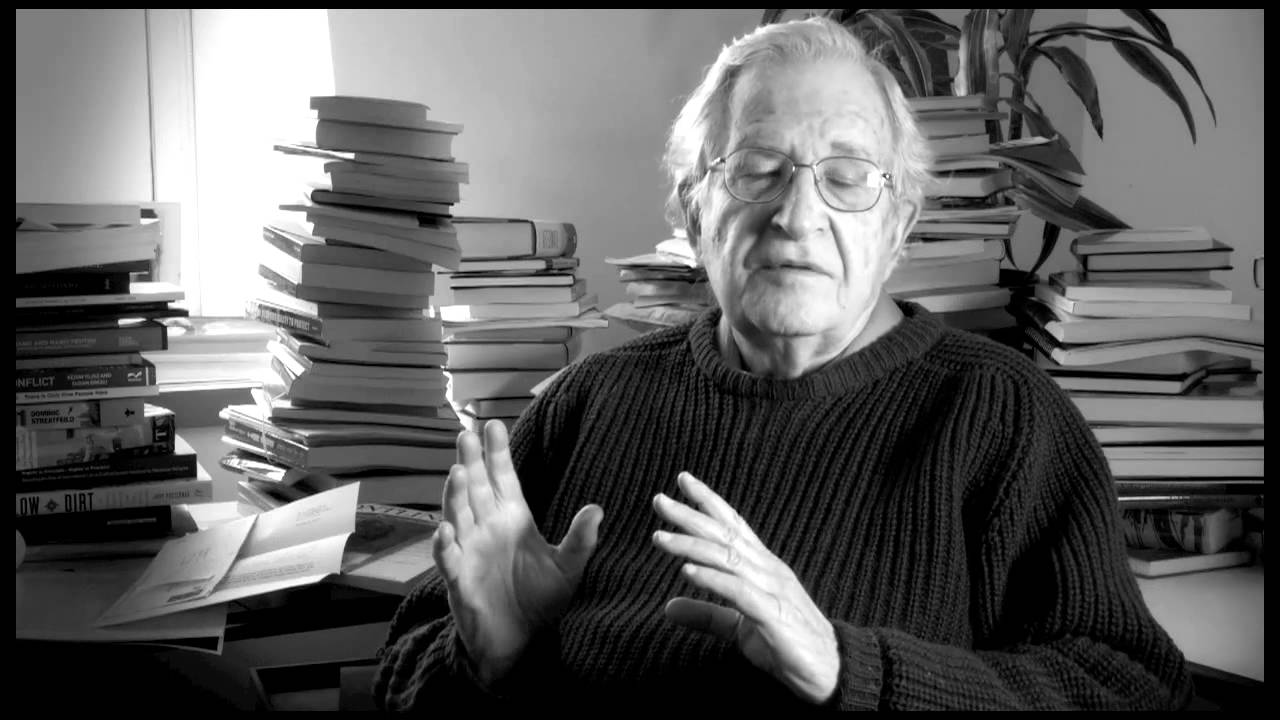 to his close readings of Hebrew works with his parents and to the lively educational experiences he enjoyed at the Oak Lane County Day School, an experimental school that subscribed to
 and promoted individual creativity over competition with other students.
A precocious learner, Chomsky at 12 years old read the proofs for his father’s book about a 13th-century Hebrew grammarian named David Kimhi. It was an auspicious beginning to a life immersed in philology, philosophy and the study of . From very early on, he sought to understand innate human propensities for freedom, dignity and creativity, which inspired his interest in fostering those properties of human nature.
While Chomsky’s parents were what he called normal Roosevelt Democrats, he was drawn to more radical approaches to society and to the promotion of . At age 10, he read about the Spanish Civil War, which inspired him to write an editorial about the fall of Barcelona for his school’s newspaper. This was an early harbinger of his public intellectual work and his vociferous challenges to systems of oppression and illegitimate authority.
As a young man, Chomsky joined a socialist wing of the Zionist youth movement that opposed a Jewish state, and from his readings and discussions he came to favor Arab-Jewish class cooperation in a socialist Palestine. His deep knowledge of Palestine and Israel, bolstered by his ability to read and speak Arabic and Hebrew, helped inform his many vehement critiques of Israeli state power. Chomsky on John Dewey’s approach to education: how to produce free, creative, independent human beings.
Radical pedagogy
After an early education focused on self-discovery and free-ranging exploration, Chomsky was introduced in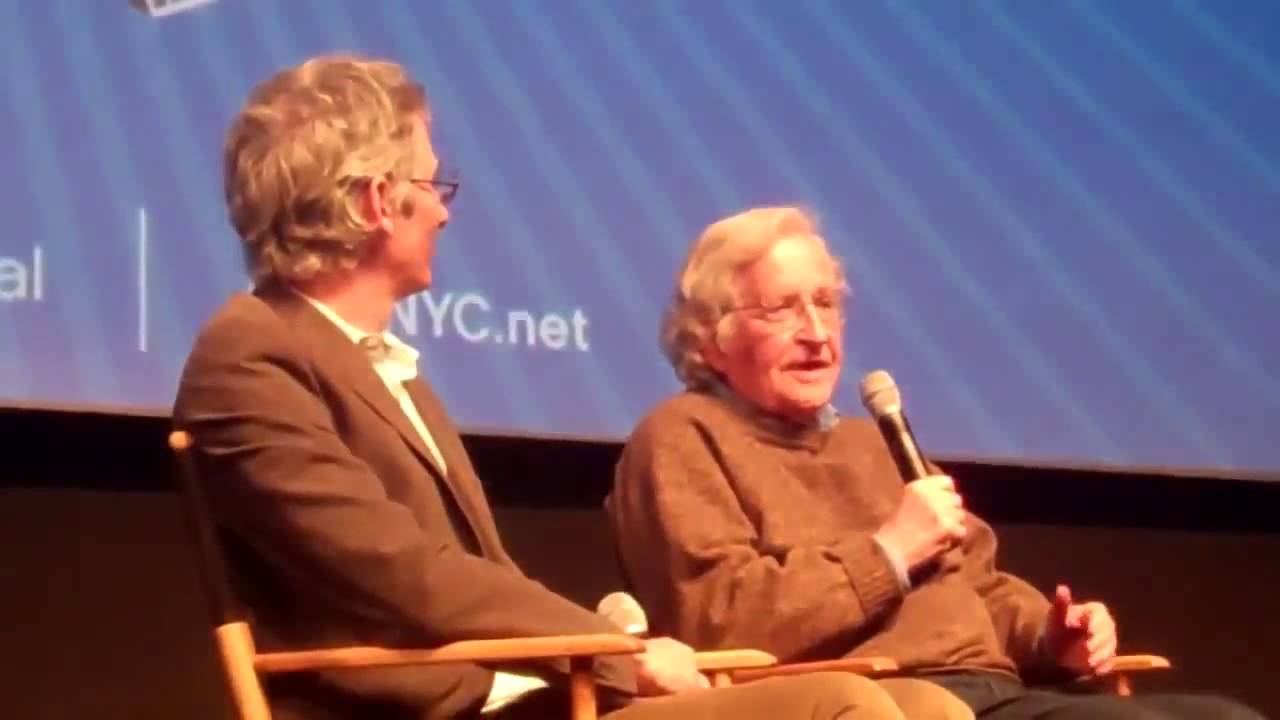 [vids]to rote learning, competition with other students and a mainstream system of values. In reaction, he began to make regular trips to New York City, where he explored bookstores. He also made regular visits with a relative who ran a newsstand on 72nd Street that served as a lively intellectual center for emigrés interested in more radical approaches to society.
In 1944, Chomsky completed high school and enrolled in the University of Pennsylvania. Although he has expressed some dismay about the structures of conformity and status quo thinking he encountered there, he did find inspiration in courses with philosopher C. West Churchman, linguist Giorgio Levi Della Vida and, moreover, linguist . Chomsky knew members of the Harris family because Zellig Harris’ father hosted Jewish services in the Harris home that the Chomsky family occasionally attended.
Chomsky’s father’s approach to the study of language bore similarities to Zellig Harris’ work in Semitics, the study of Arabic, Hebrew and other Semitic languages. Harris invited Noam to read the proofs of his “Methods in Structural Linguistics.” This highly anticipated book was rooted in the idea that the function and the meaning of linguistic elements are determined by their their relationship to other components that make up sentences. After working hard to understand Harris’ linguistics paradigm, Chomsky eventually abandoned it, but he remained fascinated by Harris’ political views and by the unstructured, lively and creative debates that he promoted.
Chomsky met Carol Doris Schatz at the Hebrew School where her mother taught and Chomsky’s father was principal. Years later, when they were both students at the University of Pennsylvania, they started dating. They were married in 1949, and four years later they decided to move to an Israeli kibbutz, or communal agricultural settlement. They had expected to find a culture of creative free thinking there. Instead, they were deeply disappointed to find what Chomsky described as ideological conformity to Stalinist ideology. They returned to the U.S. after only six weeks.
The young couple settled in Boston and . Noam pursued graduate work, while Carol paused her own studies to raise the children. She later returned to research on language acquisition, which she eventually taught and researched at MIT and Harvard. Carol Chomsky died in 2008. Noam remarried in 2014, to the Brazilian translator Valeria Wasserman Chomsky.
Chomskian revolution
When Chomsky was a student, most academic psychologists described human language as a system of habits, skills or dispositions to act that are acquired through extensive training, induction, generalization and association. By this account, language grows incrementally with experience, .
This framework was at the heart of a structuralist paradigm, which analyzed the form and meaning of texts as different parts of the same thing. Any language, from this standpoint, restricts how phonemes and morphemes – the smallest units of sound and meaning in language – and other constituents are assembled and distributed. By this view, humans have the capacity to learn language in ways akin to how they acquire .
Chomsky’s Ph.D. work, the resulting 1957 book “Syntactic Structures” and his New York Review of Books review of B.F. Skinner’s “Verbal Behaviour” challenged this paradigm and heralded the Chomskian linguistics revolution. Chomsky’s theory of universal grammar in the history of how philosophers have viewed the human mind and language acquisition.
Chomsky’s starting point was that humans are endowed with universal grammar, which is activated by exposure to natural language. Children gain proficiency in a language by building on innate knowledge. This means that the capacity for language quite literally grows in the mind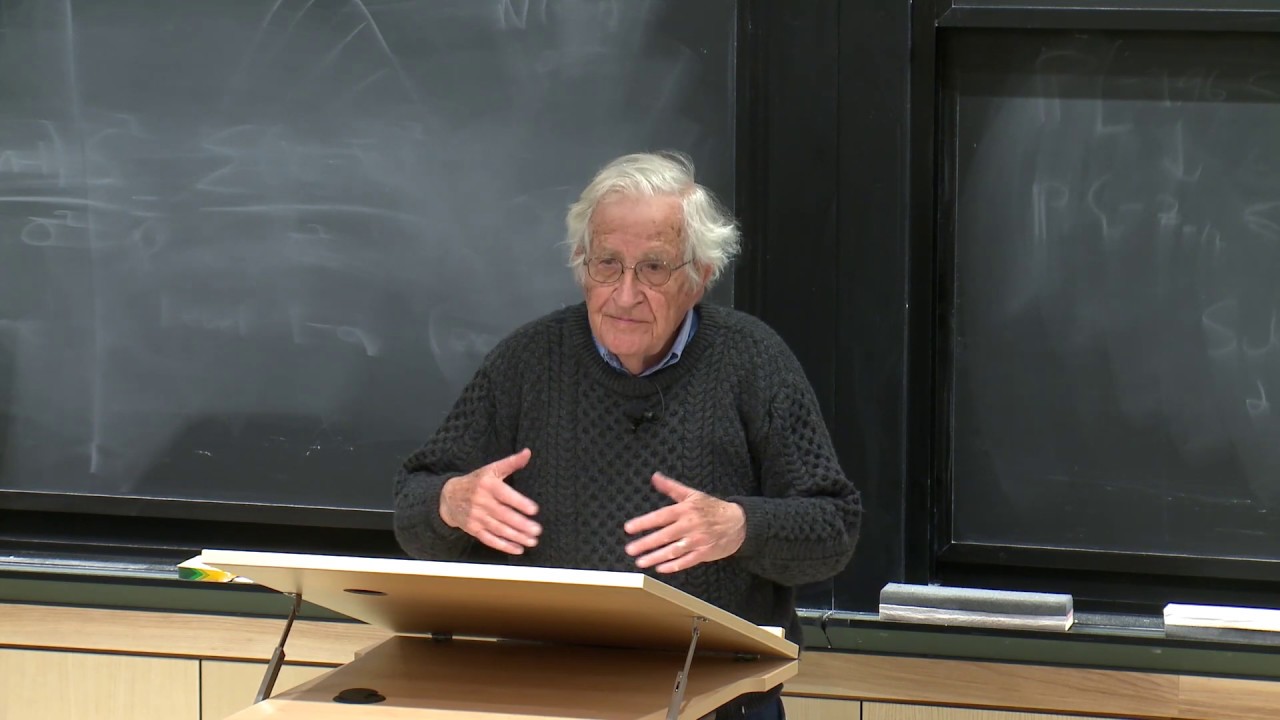 .
Chomsky’s interest in innate human abilities draws in part from a range of philosophical treatises penned in the 17th and 18th centuries and associated with the Port Royal system of logic and Enlightenment philosophy, which emphasized science, individual liberty and the rule of law. He developed these ideas in a book called “Cartesian Linguistics,” which outlined his intellectual debt to the writings of, among others, , Kant, Rousseau and.
By the early 1960s, Chomsky’s work had gained him recognition in linguistics, philosophy and psychology. His own research, and that conducted by the growing number of linguists who adopted his approach, led to significant advances in the study of syntax, generative grammar, language and the mind, semantics, form and the interpretation of language.
His political engagement was documented in what I believe is a remarkable collection of interviews and books about U.S. imperialism, the Cold War, the Middle East, Central America and Southeast Asia, including “Problems of Knowledge and Freedom” and “For Reasons of State.” Puzzled by Americans’ spirit of resigned consensus, he began to collaborate with Edward S. Herman on books including “Counter-Revolutionary Violence,” “The Political Economy of Human Rights” and “Manufacturing Consent,” which was turned into a popular film by the same name.
Common thread
The common thread connecting Chomsky’s many intellectual projects are that were the focus of much of his life’s work. One is Plato’s problem, which considers why it is that humans, whose contact with the world is brief and limited, can come to know so much. The second is Orwell’s complementary problem, which asks how is it that human beings know so little given the amount of information to which they have access. The third is Descartes’ problem, which pertains to the human capacity to freely express thoughts in constantly novel ways over an infinite range by means that are appropriate to circumstances but not caused by them. Finally, there’s Humboldt’s problem, which focuses on
 .
These problems are connected in different ways to , and to speculations about the initial state of the language faculty, which he outlined in a range of texts, including “Knowledge of Language: Its Nature, Origin, and Use,” “Language and Problems of Knowledge: The Managua Lectures,” “The Minimalist Program” and “Why Only Us? Language and Evolution,” with Robert C. Berwick.
Chomsky’s legacy
[
‘Manufacturing Consent’ is one of Noam Chomsky’s best-known political works. courtesy Penguin Random House
Remarkably tenacious and active, Chomsky continued to publish and to speak out on contemporary issues into his mid-90s. His ideas evolved but were rooted in a series of deeply seated ideas about the nature of the human mind. He is one of the most cited intellectuals in history, and he was voted the leading living public intellectual in The 2005 Global Intellectuals Poll. Millions of people have watched his debates and discussions with , Angela Davis,
 ,
 ,
 ,
 ,
 ,
 ,
 and even
 .
As the figure widely viewed as the founder of cognitive sciences, Chomsky has been critical of the hype surrounding big data, artificial intelligence and ChatGPT.
As a voice for the downtrodden and the oppressed, he has spoken from the perspective of human rights, intellectual self-defense and the popular struggle through independent thinking against structures of power and subjugation.
Chomsky’s extraordinary achievements resonate far and wide – and are likely to continue to do so into the future.
Robert F. Barsky, Professor of Humanities and Professor of Law, Vanderbilt University
This article is republished from The Conversation under a Creative Commons license. Read the original article.
===
no lnx an 8 23
Noam Chomsky: 'Proto-fascism' and 'white nationalism are prime ingredients of the GOP’s slow-motion coup
Alex HendersonJanuary 10, 2022
Noam Chomsky, who turned 93 on December 7, 2021, has lived through everything from World War II to the Vietnam War to Watergate to 9/11. The left-wing author, born in 1928 near the end of Calvin Coolidge’s presidency, has experienced crises ranging from the Great Depression to the Great Recession — and in 2022, he believes that American democracy has reached a turning point and is in danger of sliding into fascism.
Truthout’s C.J. Polychroniou interviewed Chomsky around the one-year anniversary of the January 6, 2021 insurrection. Chomsky didn’t mince words during the interview, laying out some reasons why this is such a dangerous time in U.S. history.
When Polychroniou asked Chomsky “how should we understand what happened on January 6, 2021,” he responded, “Participants in the assault on the Capitol doubtless had varying perceptions and motives, but were united in the effort to overthrow an elected government — in short, an attempted coup by definition. It was furthermore an attempt that could have succeeded if a few prominent Republican figures had changed their stance and gone along with the coup attempt, and if the military command had made different decisions. (President Donald) Trump was making every effort to facilitate the coup, which would surely have been applauded by a large majority of Republican voters and by the Republican political leadership, which, with a few exceptions, grovels at his feet in a shameful display of cowardice.”
Chomsky continued, “Implications for the future are all too clear. The Republican organization — it’s hard to regard them any longer as an authentic political party — is now carefully laying the groundwork for success next time, whatever the electoral outcome may be. It’s all completely in the open, not only not concealed, but in fact, heralded with pride by its leaders. And regularly reported, so that no one who is interested enough to pay attention to the American political scene can miss it. To mention just the most recent discussion I’ve seen, the Associated Press describes how the GOP is carrying out a ‘slow-motion insurrection’ and has become ‘an anti-democratic force’ — something that has not happened before in American politics.”
Chomsky, born in Philadelphia on December 7, 1928, was a kid when Benito Mussolini, a.k.a. Il Duce, ruled Italy with an iron fist and when Adolf Hitler seized control in Germany — and when Francisco Franco, a.k.a. El Generalíssimo, came to power following the Spanish Civil War. Fascism is a subject that he has spent much of his analyzing, and he views Trump’s MAGA movement as a movement inspired by fascism and white nationalism.
The author told Polychroniou, “Even the tattered system that still survives is intolerable to GOP wreckers…. In the not-too-distant background are calls to ‘save our country’ by force if necessary, where ‘our country’ is a white supremacist Christian nationalist patriarchal society in which non-white folk can take part as long as they ‘know their place’ — not at the table. (white people’s) fear of ‘losing our country’ is (in part a response to) demographic tendencies that are eroding white majorities, resisting even the radical gerrymandering that is imposed to amplify the structural advantages of the scattered conservative rural vote. Another threat to ‘our country’ is that white supremacy is increasingly rejected, particularly by younger people, as is devotion to religious authority, even church membership.”
Chomsky warns that a fascist government in the U.S. would make climate change even more dangerous, as the MAGA movement doesn’t consider climate change a threat.
“When Hungary, the current darling of the right, descends towards fascism, it’s bad enough,” Chomsky told Polychroniou. “If the U.S. does, long-term survival of human society is a dim prospect…. The limited political democracy that still exists is hanging by a delicate thread.”
Chomsky sees a definite parallels between the MAGA edition of the GOP and far-right authoritarian parties like Hungarian Prime Minister Viktor Orbán’s Fisesz.
“Election subversion is not merely a threat (in the United States) — it’s happening in the ‘soft coup’ that is underway right now,” Chomsky told Polychroniou. “As is the drift toward a form of fascism. There is evidence that general attitudes of Trump voters on a range of issues are similar to those of European voters for far-right parties with fascist origins, and these sectors are now a driving force in the GOP. There’s also substantial evidence that this drift to the far right may be driven in part by blind loyalty to Trump.”
FROM YOUR SITE ARTICLES
Noam Chomsky sounds the alarm on the rise of anti-science rhetoric ... ›
Noam Chomsky: We are racing madly towards total catastrophe ... ›
Noam Chomsky: How 'Trump-led proto-fascism' and a 'deeply ... ›
We're still trapped in a bad fascist-coup movie — and it's heading toward a dark anticlimax - Alternet.org ›
'Accelerant of polarization': Far-right 'Christian nationalists' still consider Trump their strongest ally - Alternet.org ›
Noam Chomsky slams the GOP’s 'radical insurgency' and efforts to 'overthrow democracy' - Alternet.org ›
1 in 5 applicants to the white supremacist Patriot Front has military ties: report - Alternet.org ›
'This is incredibly dangerous': White nationalism is poisoning the military 'to break the chain of command' - Alternet.org ›
'Takes one to know one': Noam Chomsky chides 'hypocrisy' of POTUS calling Vladimir Putin a war criminal - Alternet.org ›
'Takes one to know one': Noam Chomsky chides 'hypocrisy' of POTUS calling Vladimir Putin a war criminal - Alternet.org ›
MAGA Republicans have 'gone soft' on 'white nationalist terrorism': conservative - Alternet.org ›
'Cataclysmic destruction': Chomsky, UN, warn global policies are 'accelerating the collapse of human civilization' - Alternet.org ›
White supremacist and former National Guard member sentenced on drugs, weapons charges - Alternet.org ›
'The road down authoritarianism': What Ken Burns’ Holocaust documentary can teach Americans in 2022 - Alternet.org ›
Flatbeds filled with fury and fascism - Alternet.org ›
Worldwide fascism is being accelerated by the one thing few people want to talk about - Alternet.org ›
RELATED ARTICLES AROUND THE WEB
Noam Chomsky criticises old friend Hugo Chávez for 'assault' on ... ›
Opinion | Noam Chomsky on Anarchism, Human Nature and Joe ... ›
Noam Chomsky Believes Trump Is “the Worst Criminal in Human ... ›
===
climate plus putin nukes
https://www.alternet.org/2022/04/most-dangerous-point-human-history/
===
https://www.alternet.org/2022/01/noam-chomsky-on-science/
===
an 4 23
no lnx
noam Chomsky and David Barsamian: When Lunatics Run the Asylum
I’m proud to have lived through the last 20-odd years at TomDispatch with Noam Chomsky, now a remarkable 94. In the wake of the 9/11 terror attacks and the U.S. invasion of Afghanistan, I stumbled into creating this site and, in October 2003, first posted a piece of his about how the U.S. had for so long terrorized Cuba. It was taken from a book of his that had just been published. By 2007, he was writing directly for TomDispatch on the way the U.S. had brought a campaign of terror to Iran. (“What If Iran Had Invaded Mexico?“) In February 2008, for another article of his, “The Most Wanted List,” in which he put the very idea of terrorism into perspective, I began my introduction this way: “One of Noam Chomsky’s latest books — a conversation with David Barsamian — is entitled What We Say Goes. It catches a powerful theme of Chomsky’s: that we have long been living on a one-way planet and that the language we regularly wield to describe the realities of our world is tailored to Washington’s interests.”
And here I am, 15 years later, posting his latest piece for TomDispatch, an interview that — yes! — David Barsamian of Alternative Radio has just conducted with him on the true terrors of this planet in 2023, starting (but hardly ending) with climate change. And, by the way, the two of them continue to produce books together, the latest being Notes on Resistance. As far as I’m concerned, he’s never been more on target and, believe me, that’s truly saying something! So, let me turn you over to Noam and David and a world that’s deeply in need of something better. Tom
Savage Capitalism: From Climate Change to Bank Failures to War
[The following is excerpted from David Barsamian’s recent interview with Noam Chomsky at AlternativeRadio.org.]
David Barsamian: On March 20th, the UN’s Intergovernmental Panel on Climate Change issued its latest report. The new IPCC assessment from senior scientists warned that there’s little time to lose in tackling the climate crisis. UN Secretary-General Antonio Guterres said, “The rate of temperature rise in the last half-century is the highest in 2,000 years. Concentrations of carbon dioxide are at their highest in at least 2 million years. The climate time bomb is ticking.” At COP 27 he said, “We are on a highway to climate hell with our foot still on the accelerator. It is the defining issue of our age. It is the central challenge of our century.” My question to you is: You’d think survival would be a galvanizing issue, but why isn’t there a greater sense of urgency in addressing it in a substantial way?
Noam Chomsky: It was a very strong statement by Guterres. I think it could be stronger still. It’s not just the defining issue of this century, but of human history. We are now, as he says, at a point where we’ll decide whether the human experiment on Earth will continue in any recognizable form. The report was stark and clear. We’re reaching a point where irreversible processes will be set into motion. It doesn’t mean that everybody’s going to die tomorrow, but we’ll pass tipping points where nothing more can be done, where it’s just decline to disaster.
So yes, it’s a question of the survival of any form of organized human society. Already there are many signs of extreme danger and threat, so far almost entirely in countries that have had the smallest role in producing the disaster. It’s often said, and correctly, that the rich countries have created the disaster and the poor countries are its victims, but it’s actually a little more nuanced than that. It’s the rich in the rich countries who have created the disaster and everyone else, including the poor in the rich countries, face the problems.
So, what’s happening? Well, take the United States and its two political parties. One party is 100% denialist. Climate change is not happening or, if it’s happening, it’s none of our business. The Inflation Reduction Act was basically a climate act that Biden managed to get through, though Congress sharply whittled it down. Not a single Republican voted for it. Not one. No Republican will vote for anything that harms the profits of the rich and the corporate sector, which they abjectly serve.
:{
}:
We should remember that this is not built in. Go back to 2008 when Senator John McCain was running for president. He had a small climate program. Not much, but something. Congress, including the Republicans, was considering doing something about what everyone knew was an impending crisis. The Koch Brothers’ huge energy conglomerate got wind of it. They had been working for years to ensure that the Republicans would loyally support their campaign to destroy human civilization. Here, there was deviation. They launched an enormous campaign, bribing, intimidating, astroturfing, lobbying to return the Republicans to total denialism, and they succeeded.
Since then, it’s the prime denialist party. In the last Republican primary before Trump took over in 2016, all the top Republican figures vying for the presidential nomination, either said that there’s no global warming or maybe there is, but it’s none of our business. The one small exception, greatly praised by liberal opinion, was John Kasich, the governor of Ohio. And he was actually the worst of all. What he said was: of course, global warming’s happening. Of course, humans are contributing to it. But we in Ohio are going to use our coal freely and without apology. He was so greatly honored that he would be invited to speak at the next Democratic convention. Well, that’s one of the two political parties. Not a sign of deviation among them from: let’s race to destruction in order to ensure that our prime constituency is as rich and powerful as possible.
Now, what about the other party? There was Bernie Sanders’s initiative, the Sunrise Movement’s activism, and even Joe Biden at first had a moderately decent climate program — not enough, but a big step forward from anything in the past. It would, however, be cut down, step by step, by 100% Republican opposition, and a couple of right-wing Democrats, Joe Manchin and Kyrsten Sinema. What finally came out was the Inflation Reduction Act, which could only get through by providing gifts to the energy corporations.
:{
}:
It brings to the fore the ultimate insanity of our institutional structure. If you want to stop destroying the planet and human life on Earth, you have to bribe the rich and powerful, so maybe they’ll come along. If we offer them enough candy, maybe they’ll stop killing people. That’s savage capitalism. If you want to get anything done, you have to bribe those who own the place.
And look what’s happening. Oil prices are out of sight and the energy corporations say: Sorry boys, no more sustainable energy. We make more money by destroying you. Even BP, the one company that was beginning to do something, in essence said: No, we make more profit from destroying everything, so we’re going to do that.
It became very clear at the Glasgow COP conference.John Kerry, the U.S. climate representative, was euphoric. He basically said we’ve won. We now have the corporations on our side. How can we lose? Well, there was a small footnote pointed out by political economist Adam Tooze. He agreed that, yes, they’d said that but with two conditions. One, we’ll join you as long as it’s profitable. Two, there has to be an international guarantee that, if we suffer any loss, the taxpayer covers it. That’s what’s called free enterprise.With such an institutional structure, it’s going to be hard to get out of this.
So, what’s the Biden administration doing? Let’s take the Willow project. Right now, it’s allowing ConocoPhillips to open a major project in Alaska, which will bring online more fossil fuels for decades. They’re using known methods to harden the Alaskan permafrost. One of the great dangers is that the permafrost, which covers enormous amounts of hidden fossil fuels, is melting, sending greenhouse gases into the atmosphere, which will be monstrous. So, they’re hardening the permafrost. Big step forward! Why are they doing it? So, they can use it to exploit the oil more effectively. That’s savage capitalism right in front of our eyes with stark clarity. It takes genius not to see it, but it’s being done.
Look at popular attitudes, Pew does regular polling. They recently asked people in a poll to rank in priority a couple of dozen urgent issues, though nuclear war, which is as great a threat as climate change, wasn’t even listed. Climate change was way down near the bottom. Much more important was the budget deficit, which is not a problem at all. Thirteen percent of Republicans — that’s almost a statistical error — thought climate change was an urgent problem. More Democrats did, but not enough.
The question is: Can people who care about minimal human values, like, say, survival, organize and act effectively enough to overcome not only governments, but capitalist institutions designed for suicide?
Barsamian: The question always comes up and you’ve heard it a million times: The owners of the economy, the captains of industry, the CEOs, they have children, they have grandchildren, how can they not think of their future and protect them rather than putting them at risk?
Chomsky: Let’s say you’re the CEO of JPMorgan. You’ve replaced Jamie Dimon. You know perfectly well that when you fund fossil fuels, you’re destroying the lives of your grandchildren. I can’t read his mind, but I suspect that what’s going through it is: If I don’t do this, somebody else will be put in who — because it’s the nature of such institutions — will aim for profit and market share. If I’m kicked out, somebody else, not as nice a guy as I am, will come in. At least I know we’re destroying everything and try to mitigate it slightly. That next guy won’t give a damn. So, as a benefactor of the human race, I’ll continue to fund fossil-fuel development.
That’s a convincing position for just about all the people doing this. For 40 years, ExxonMobil’s scientists were way in the lead in discovering the threats and extreme dangers of global warming. For decades, they informed management that we’re destroying the world and it was just tucked away in some drawer somewhere.
In 1988, James Hansen, the famous geophysicist, gave Senate testimony, essentially saying, we’re racing to disaster. The management of ExxonMobil and the other companies had to consider that. We can’t just put it in the drawer anymore. So, they called in their PR experts and said, “How should we handle this?” And they responded, “If you deny it, you’ll be exposed right away. So don’t deny it. Just cast doubt. Say, maybe it’s true, maybe it isn’t. We haven’t really looked into all the possibilities. We haven’t understood the sunspots, questions about cloud cover, so let’s just become a richer, more developed society. Small footnote, we’ll make a lot more profits and later on, if there’s any reality to this, we’ll be in a better position to deal with it.”
That was the propaganda line. Very effective PR. And then you get the Koch Brothers juggernaut and the like buying the Republican Party, or what used to be a political party, and turning them into total denialists, claiming maybe it’s a liberal hoax, and so on.
The Democrats contributed to this in other ways. One interesting thing about the recent election in areas along the Texas border: Mexican-Americans, who had always voted Democratic, voted for Trump. Why? Well, you can easily imagine: I’ve got a job in the oil industry. The Democrats want to take away my job, destroy my family, all because those liberal elitists claim there’s global warming going on. Why should I believe them? Let’s vote for Trump. At least I’ll have a job and be able to feed my family.
What the Democrats didn’t do was go down there, organize, educate, and say, “The environmental crisis is going to destroy you and your families. You can get better jobs in sustainable energy and your children will be better off.” Actually, in places where they did do that, they won. One of the most striking cases was West Virginia, a coal state, where Joe Manchin, the coal industry senator, has been blocking so much. My friend and colleague Bob Pollin and his group at the University of Massachusetts, PERI, the Political Economy Research Institute, have been working on the ground there and they now have mine workers calling for a transition to sustainable energy. The United Mine Workers even passed resolutions calling for it.
Barsamian: What about what’s going on in the banking sector given the collapse of the Silicon Valley Bank, followed by Signature Bank, and the problems at First Republic Bank?
Chomsky: First of all, I don’t claim any special expertise in this, but the people who do, serious economists who are also honest about it like Paul Krugman, say very simply: we don’t know. This goes back almost 45 years to the deregulation mania. Deregulate finance and you shift to a financial-based economy, while de-industrializing the country. You make your money out of finance, not out of building things — risky endeavors that are very profitable but will lead to a crash and then you call on the government, meaning the taxpayer, to bail you out.
There weren’t any major banking crises in the 1950s and 1960s, a big growth period, because the Treasury Department kept control of the banking industry. In those days, a bank was just a bank. You had some extra money, you put it there. Somebody came and borrowed money to buy a car or send his or her kid to college. That was banking. It started to change a little bit with Jimmy Carter, but Ronald Reagan was the avalanche. You got people like Larry Summers saying, let’s deregulate derivatives, throw the whole thing open. One crisis after another followed. The Reagan administration ended with the huge savings and loan crisis. Again, call in the friendly taxpayer. The rich make plenty of money and the rest pay the costs.
It’s what Bob Pollin and Gerry Epstein called the “bailout economy.” Free enterprise, make money as long as you can, until the crisis comes along and the public bails you out. The biggest one was 2008. What happened? Thanks to the deregulation of complicated financial products like derivatives and other initiatives under Bill Clinton, you got a crash in the housing industry, then in the financial industry. Congress did pass legislation, TARP, with two components. First, it bailed out the gangsters who had caused the crisis through subprime mortgages, loans they knew would never be paid back. Second, it did something for the people who had lost their homes, been kicked out on the street with foreclosures. Guess which half of the legislation the Obama administration implemented? It was such a scandal that the Inspector General of the Treasury Department, Neil Barofsky, wrote a book denouncing what happened. No effect. In response, lots of workers who voted for Obama believing in his hope-and-change line became Trump voters, feeling betrayed by the party that claimed to be for them.
Barsamian: The Ukraine war is now in its second year with no end in sight. China has proposed a peace plan to end it. What are the realistic chances of that happening anytime soon?
Chomsky: The Global South is calling for some negotiated settlement to put an end to the horrors before they get worse. Of course, the Russian invasion was a criminal act of aggression. No question about that. Ukrainians have a right to defend themselves. I don’t think there should be any question about that either.
The question is: Will the United States agree to allow negotiations to take place? The official U.S. position is that the war must continue to severely weaken Russia. In fact, the United States is actually getting a bargain out of this. With a small fraction of its colossal military budget, it’s severely degrading its major military opponent, Russia, which doesn’t have much of an economy but does have a huge military. You can ask whether that’s why they’re doing it, but that’s a fact.
There’s a pretext: if we continue to support the war, we’ll put Ukraine in a better negotiating position. Actually, they’ll likely be in a worse one, since that country’s being destroyed by the war, economically. Virtually their entire army’s gone, replaced by new recruits, barely trained. Russia’s suffering badly as well, but if you look at their relative power, who’s going to win in a stalemate? It’s not a big secret. Ukraine is likely to be destroyed and yet the U.S. position is: we’ve got to continue, got to severely weaken Russia, and by some miracle, Ukraine will become stronger.
Britain follows the United States. But what about Europe? So far, its elites have gone along with the United States. Its people, not so clear. Judging by polls, the public is calling for negotiations. The business world is deeply concerned. Putin’s criminal aggression was also an act of criminal stupidity from his point of view. Russia and Europe are natural commercial partners. Russia has resources and minerals, Europe technology and industry. Instead, Putin handed Washington its greatest wish on a silver platter. He said: Okay, Europe. Go be a satellite of the United States, which means that you will move towards deindustrialization.
The Economist magazine among others has been warning that Europe’s going to move towards deindustrialization if it continues to back the NATO-based, U.S.-run war, which much of the world now regards as a proxy war between Russia and the United States over Ukrainian bodies. Actually, it goes well beyond that. In response to U.S. demands, NATO has now expanded to the Indo-Pacific, meaning the U.S. has Europe in its pocket for its confrontation with China, for encircling it with a ring of states heavily armed with U.S. precision weapons.
Meanwhile, the Biden administration has called for a commercial war to prevent Chinese development for a generation. We can’t compete with them, so let’s prevent them from getting advanced technology. The supply chains in the world are so intricate that almost everything — patents, technology, whatever — involves some U.S. input. The Biden administration says that nobody can use any of this in commercial relations with China. Think what that means for the Netherlands, which has the world’s most advanced lithographic industry, producing essential parts for semiconductors, for chips. It’s being ordered by Washington to stop dealing with its major market, China, a pretty serious blow to its industry. Will they agree? We don’t know. Same with South Korea. The U.S is telling Samsung, the big South Korean firm, you’ve got to cut yourself off from your major market because we have some patents that you use. The same with Japanese industry.
Nobody knows how they’re going to react. Are they going to willingly deindustrialize to fit a U.S. policy of global domination? The Global South — India, Indonesia, Latin American countries — is already saying, we don’t accept such sanctions. This could develop into a major confrontation on the world scene.
Barsamian: Rafael Grossi, director of the International Atomic Energy Agency, has been warning of the dangers posed by nuclear reactors in Ukraine. Shelling and fighting near them could, he says, trigger “a nuclear disaster.” Meanwhile, the Biden administration is going ahead with the “modernization” of U.S. nuclear weapons. Is this another example of when the lunatics control the asylum?
Chomsky: Unfortunately, one of the major problems Dan Ellsberg and some others have been trying to get us to understand for years is the growing threat of nuclear war. In Washington, people talk about it as if it were a joke: let’s have a small nuclear war with China! Air Force general Mike Minihan recently predicted that we’re going to have a war with China in two years. It’s beyond insanity. There can’t be a war between nuclear powers.
Meanwhile, U.S. strategic planning under Trump, expanded by Biden, has been to prepare for two nuclear wars, with Russia and China.Yes, those Ukrainian nuclear reactors are a major problem, but it goes beyond that. The United States is now sending tanks and other weaponry to Ukraine. Poland is sending jet planes. Sooner or later, Russia’s likely to attack the supply routes. (U.S. military analysts are a little surprised that it’s held back this long.) You have leading figures from Washington visiting Kyiv. Do you remember anybody visiting the Iraqi capital, Baghdad, when the United States was pounding it to dust? Not in my recollection. In fact, a few peace volunteers were ordered out of the country, because it was being so devastated. Ukraine’s being badly hit, but if Russia goes on to attack Western Ukraine including the supply routes, maybe even beyond that, then direct confrontations with NATO become possible.
In fact, it’s already moving up the escalation ladder. How far will it go? You have people in the hawkish sector suggesting that maybe we can sink the Russian Black Sea fleet. And if so, they’re going to say, thank you, that was nice, we didn’t really care much about those ships, right?
In fact, to go back to that Pew poll, they didn’t even list nuclear war as one of the issues people could rank. Insanity is the only word you can use for it.
Barsamian: Speaking of planetary dangers, the START Treaty between the U.S. and Russia established limits on deployed strategic nuclear warheads. Recently, Russia suspended its participation in it. What’s the danger of that?
Chomsky: Russia was sharply condemned for that. Rightly. Negative acts should be criticized. But there’s some background to it we’re not supposed to talk about. The arms control regime was painstakingly developed over 60 years. A lot of hard work and negotiation. Huge public demonstrations in the United States and Europe led Ronald Reagan to accept Russian leader Mikhail Gorbachev’s proposals for the Intermediate Short Range Missile Treaty in Europe, a very important step in 1987. Dwight D. Eisenhower had initiated thinking about an Open Skies Treaty. John F. Kennedy took some steps. Over time, it developed, until George W. Bush became president.
Since then, the Republican Party has been systematically dismantling 60 years of arms control. Bush dismantled the Antiballistic Missile Treaty. That was crucial. It’s a great danger to Russia to have ABM installations right near its border, since those are first-strike weapons. Trump came along with his wrecking ball and got rid of the Reagan-Gorbachev INF Treaty and later the Open Skies Treaty. He was after the New START Treaty, too, but Biden came in just in time to agree to Russian proposals to extend it. Now, the Russians have suspended that one. All of this is a race to disaster and the main criminals happen to be the Republican Party in the United States. Putin’s act should be condemned, but it hardly took place in isolation.
Barsamian: U.S. intelligence recently issued its Annual Threat Assessment. It says, “China has the capability to directly attempt to alter the rules-based global order in every realm and across multiple regions as a near-peer competitor that is increasingly pushing to change global norms.” That phrase “rules-based global order” is vintage Orwell.
Chomsky: It’s an interesting phrase. In the United States, if you’re an obedient intellectual commentator and scholar, you take it for granted that we must have a rules-based order. But who sets the rules? We don’t ask that question because it has an obvious answer: the rules are set by the Godfather in Washington. China is now openly challenging it and, for years, has been calling for a UN-based international order, supported by much of the world, especially the Global South. The U.S. can’t accept not setting the rules, however, since it would involve a strict bar against the threat of, or use of, force in international affairs, which would mean barring U.S. foreign policy. Can you think of a president who hasn’t engaged in the threat of, or use of, force? And not just massive criminal actions like the invasion of Iraq. When Obama tells Iran that all options are open unless you do what we say, that’s a threat of force. Every single U.S. president has violated the UN-based international order.
And here’s a little footnote you’re not supposed to cite. They’ve also violated the U.S. Constitution. Read Article Six, which says that treaties entered into by the United States are the supreme law of the land every elected official is bound to observe. The major post-World War II treaty was that UN Charter, which bans the threat or use of force. In other words, every single U.S. president has violated the Constitution, which we’re supposed to worship as given to us by God.
So, is China becoming a “peer competitor”? It is in the regions surrounding it. Look at the war games run by the Pentagon and they suggest that, if there were a local war over Taiwan, China would probably win. Of course, the idea is ridiculous because any war would quickly explode into a terminal one. But those are the games they play. So, China’s a peer competitor. Is it acting properly and legally? Of course not. It’s fortified rocks in the South China Sea. It’s in violation of international law, in violation of a specific judgment of the UN, but it’s expanding.
Still, the primary Chinese threat is initiatives like bringing Saudi Arabia and Iran together and so throwing a serious wrench into U.S. policies going back 80 years to control the Middle East. Strategically, it’s the “most important area in the world,” as the government put it, and China’s horning in on that, creating a political settlement that might reduce tensions, might even solve the horrifying war in Yemen, while bringing together Washington’s primary ally there, Saudi Arabia, and Iran, its major enemy. That’s intolerable! For the U.S. and Israel, it’s a real blow.
Barsamian: Your classic book with Ed Herman is Manufacturing Consent. If you were updating it today, you would, of course, replace the Soviet Union with China and/or Russia and undoubtedly add the growth of social media. Anything else?
:{
}:
Chomsky: Those would be the main things. Social media is not a small point. It’s having a very complex effect on American society. Go back to the U.S. invasion of Iraq. The majority of the population thought that Saddam Hussein was responsible for 9/11. Beyond outlandish, but they had heard enough propaganda here to believe it. Social media is only making all of this worse. A recent study of young people, of what’s called Generation Z, and where they get their news found that almost nobody reads the newspapers anymore. Almost nobody watches television. Very few people even look at Facebook. They’re getting it from TikTok, Instagram. What kind of a community is going to try to understand this world from watching people having fun on TikTok?
The other effect of social media is to drive people into self-reinforcing bubbles.We’re all subject to that. People like me listen to your program or Democracy Now. We don’t listen to Breitbart. Conversely, the same is true. And another monster is coming along, the chatbot system of artificial intelligence, a wonderful way to create disinformation, demonization, defamation. Probably no way to control it. And all of this is part of manufacturing consent. We are the best and the brightest. Get those people out of our hair and we’ll run the world for everybody’s benefit. We’ve seen how that works.
Barsamian: How do we overcome propaganda and what are some techniques for challenging savage capitalism?
Chomsky: The way you challenge propaganda is the way you’re doing it, just more — more active, more engaged. As for savage capitalism, there are two steps. The smaller is to eliminate the savage part. It’s not exactly utopian to say: let’s go back to what we had pre-Reagan. Let’s have a moderately harsh capitalism in which there are still some decent wages, rights for people, and so on. Far from ideal, but much better than what we’ve had since.
:{
}:
The second step is to get rid of the core problem. Let’s go back to the early stages of the Industrial Revolution in the United States. Working people took it for granted that the wage contract was a totally illegitimate assault on their basic rights, turning you into what were openly called “wage slaves.” Why should we follow the orders of a master for all of our waking lives? It was considered an abomination. It was even a slogan of the Republican Party under Lincoln that this was intolerable. That movement lasted into the early 20th century before finally being crushed by Woodrow Wilson’s Red Scare, which basically wiped out the Socialist Party and the labor movement. There was some recovery in the thirties, but not to that extent.
And now even that’s gone. People regard it as their highest goal in life to be subjected to the orders of a master for most of their waking lives. And that’s really effective propaganda, but it can change, too. There already are proposals for worker participation in management that are anything but utopian. They exist in Germany and other places and that could become: Why don’t we take the enterprise over for ourselves? Why should we follow the orders of some banker in New York when we can run this place better? I don’t think that’s all that far away.
Barsamian: The lunatics seemingly control the asylum. What signs of sanity are out there to counter the lunatics?
Chomsky: Plenty. There’s lots of popular activism. It’s in the streets. Young people calling for the decent treatment of others. A lot of it is very solid and serious. Extinction Rebellion, the Sunrise Movement. Let’s save the planet from destruction. There are lots of voices. Yours, Democracy Now, Chris Hedges, lots of sites, Alternet, Common Dreams, Truthout,The Intercept, TomDispatch, many others. All of these are efforts to create an alternative world in which human beings can survive. Those are the signs of hope for the world.
FROM YOUR SITE ARTICLES
Noam Chomsky: The world is facing the most dangerous moment in human history ›
'They've turned into raging monsters': Noam Chomsky links GOP lies to Nazi propaganda ›
Noam Chomsky: Why Americans Know So Much About Sports But So Little About World Affairs ›
RELATED ARTICLES AROUND THE WEB
Opinion | Noam Chomsky: The False Promise of ChatGPT - The ... ›
Noam Chomsky Believes Trump Is “the Worst Criminal in Human ... ›
Noam Chomsky on ChatGPT: It's "Basically High-Tech Plagiarism ... ›
===
an11 21
Chomsky recently delivered a blistering assessment of **Republican lawmakers' hypocrisy on the Afghanistan withdrawal.**
Speaking to Jacobin magazine, the prominent linguist and political activist recalled former President Donald Trump's deal with the Taliban back in 2020 that would lead to the withdrawal of American troops from Afghanistan at the worst possible time; a time that Chomsky described as "the onset of the fighting season."
At the time, Trump said, "We will pull out, and you can do anything you like," he said. "Don't fire at American soldiers, which wouldn't look good for me. But anything else is your business."
He then noted the Republican Party's abrupt shift on the Afghanistan withdrawal. Although they supported the initiative when Trump spearheaded it, they completely abandoned that perspective once President Joe Biden took the White House. Even after Biden improved Trump's provisions and implemented additional measures for withdrawal, he was still lambasted.
"It's interesting to see the reaction of the Republican Party, which hailed this as a historic achievement by our great leader President Trump," Chomsky said. "It was featured on the Republican Party web page, and it stayed there, up until when the debacle began. Actually, Joe Biden slightly improved on Trump's conditions: he delayed it a couple of months, so there was a little more time, [and he] added some conditions on the Taliban. [Joe Biden] carried out an improved version of what they were hailing as a marvelous historic achievement by the genius Trump."
Once the withdrawal began, Republicans' about-face went even further attacking military officials and the armed forces, collectively. It's also important to note that the initiative was one they initially praised.
"As soon as the debacle began, they pulled it off their web page and turned to attacking the Democrats and the army for the disaster. You may have seen the Senate hearing, where General Mark Milley and others were called to account by Republicans who, a month earlier, were hailing the historic achievement, now denouncing the military for following what they had hailed. This carries shamelessness to a higher level — but that's the Republican Party," he said.
===
Chomsky: How 'Trump-led proto-fascism' and a 'deeply corrupt political system' could hand McConnell everything he wants
November 04, 2021
Noam Chomsky is shedding light on a number of political issues that could create a perfect Republican storm for Senate Minority Leader Mitch McConnell (R-KY) to carry out his "strategy of harming the country ...
===
11 21 an
no lnx
Noam Chomsky: Why Americans Are Paranoid About Everything (Including Zombies)
Noam Chomsky , AlterNet and Noam Chomsky February 19, 2014
The following is a transcript of a part of an interview Noam Chomsky recently did with a group of students via Skype. Towards the end, a student asks the linguist and critic the quirky question why zombies figure so prominently in American popular culture. He replied with a brilliant analysis of the history of fear in America.
Question: This might sound kind of random, but I would really like to ask your opinion of why you think there's this preoccupation with the apocolypse and with zombies right now in our culture.
Noam Chomsky: I've never seen a real study, but my guess is that it's a reflection of fear and desperation. It's a very frightened country. The United States is an unusually frightened country. And in such circumstances, people concoct either for escape or maybe out of relief, fears that terrible things happen.
Actually, the fear of the United States is a pretty interesting cultural phenomenon. It actually goes back to the colonies. There are some good studies out there. A very interesting book by a literary critic, Bruce Franklin. It's called War Stars. You might want to take a look at it. It's a study of popular literature, the kind of literature that most people read from the earliest days to the present. When it gets to the present it switches to television, things like that. Just kind of popular culture.
There are a couple of themes that run through it that are pretty striking. For one thing, one major theme in popular literature is that we are about to face destruction from some terrible, awesome enemy. And at the last minute we are saved by a superhero or a super weapon, or in recent years high school kids going to the hills to chase away the Russians, things like that. That's one theme that runs through constantly. And there's a sub-theme. It turns out this enemy, this horrible enemy that's about to destroy us, is somebody we're crushing.
So you go back to the early years, the terrible enemy was the Indians, who were going to destroy us. The colonists were, of course, invaders. They were invading the continent. Whatever you think about the Indians, they were defending their own territory. There's a scene in the Declaration of Independence, people read it every July 4th, but not many people pay attention to what they're reading. It's kind of like a prayer book, you move on somewhere else. But if you read it and pay attention, there are some pretty remarkable passages. So one passage is a list of a bill of indictment against King George the Third of England explaining why the colonists were revolting. One of them is “He unleashed against us the merciless Indian savages, whose known way of warfare is torture and destruction” and so on. Well, Thomas Jefferson, who wrote that and is a very great thinker of the Enlightenment, knew perfectly well that it was the merciless English savages whose known way of warfare was destruction and murder and were taking over the country and driving out or exterminating the natives. But it's switched in the Declaration of Independence and nobody comments on it for years. That's another sign of the same concern.
After that it became the slaves. There was going to be a slave revolt, a terrible slave revolt, and the slave population, the black population was going to rise up and kill all the men, rape all the women, destroy the country, something like that. Then it goes on through the centuries. It becomes modern times, Hispanic narco-traffickers are going to come in and destroy the society. One thing after another. And these are real fears.
That's a lot of what lies behind the extremely unusual gun culture in the United States. It's quite unique. Homicides, deaths by guns in the United States are way outside—there's a kind of hysteria about having guns. A large part of the population believes they just have to have them to protect themselves. From who? From the United Nations. Or from the federal government. From aliens. Maybe from zombies. Whoever it is. We just have to have guns to protect ourselves. That's not known elsewhere in the world. Maybe in, say, Syria, a country that's warring you might find something like that. But in a country that's not only at peace but has an unusual security and a great degree of freedom, that's quite remarkable.
I suspect that what you're bringing up is part of that. I think it's, much of it is kind of just a recognition, at some level of the psyche, that if you've got your boot on somebody's neck, there's something wrong. And that the people you're oppressing may rise up and defend themselves, and then you're in trouble. And another is strange properties the country has always had of fear of invented dangers. There is a kind of paranoid streak in the culture that's pretty unusual.
==
https://www.alternet.org/2021/06/noam-chomsky-2653413697/
Over the years, left-wing author Noam Chomsky has been vehemently critical of both Democrats and Republicans, slamming the United States' two major political parties as servants of Wall Street, big business and the 1%. But during an interview with Truthout's C.J. Polychroniou published on June 16, Chomsky's criticism of the GOP went beyond his usual critiques of conservative economic policy. The Philadelphia-born Chomsky, now 92, argued that big chunks of the modern Republican Party have become "proto-fascist."
"The fascist symptoms are there, including extreme racism, violence, worship of the leader — sent by God, according to former Secretary of State Mike Pompeo — immersion in a world of 'alternative facts' and a frenzy of irrationality," Chomsky warned. "Also in other ways, such as the extraordinary efforts in Republican-run states to suppress teaching in schools that doesn't conform to their White supremacist doctrines."
The leader Chomsky was referring to was, of course, former President Donald Trump, who is viewed by many on the far right as America's president in exile even though he was decisively rejected in the 2020 presidential election. When Republican presidents were voted out of office in the past — Herbert Hoover in 1931, George H.W. Bush in 1992 — the GOP did not regard them as presidents in exile. But in 2021, many Republicans in Congress are afraid to say one word against Trump or even acknowledge that President Joe Biden won the 2020 election.
Fox News and other right-wing media outlets have become obsessed with critical race theory, which studies the racism of the past and the effect it has on the United States' institutions today. Pro-Trump Republicans view critical race theory studies as an assault on white Americans in general, and Chomsky finds it disturbing that Trumpistas are violently opposed to even acknowledging that the United States has a history of racism.
"Legislation is being enacted to ban instruction in 'critical race theory,' the new demon, replacing communism and Islamic terror as the plague of the modern age," Chomsky explained. "'Critical race theory' is the scare-phrase used for the study of the systematic structural and cultural factors in the hideous 400-year history of slavery and enduring racist repression. Proper indoctrination in schools and universities must ban this heresy. What actually happened for 400 years and is very much alive today must be presented to students as a deviation from the real America, pure and innocent, much as in well-run totalitarian states."
When he was president, Trump even called for "patriotic education" — a phrase that, Trump's critics noted, sounded like it was right out of Mao Tse Tung's Communist China.
Chomsky told Polychroniou that he is "hesitant" to describe the GOP of 2021 as a "party" because "that might suggest that they have some interest in participating honestly in normal parliamentary politics."
"Attitudes among the voting base are truly ominous," the 92-year-old author warned. "Put aside the fact that a large majority of Trump voters believe that the elections were stolen. A majority also believe that 'the traditional American way of life is disappearing so fast that we may have to use force to save it,' and 40% take a stronger stand: 'if elected leaders will not protect America, the people must do it themselves, even if it requires violent actions.' Not surprising, perhaps, when a quarter of Republicans are reported to believe that 'the government, media, and financial worlds in the U.S. are controlled by a group of Satan-worshipping pedophiles who run a global child sex trafficking operation.'"
The conspiracy theory that the U.S. government has been infiltrated by "Satan-worshipping pedophiles" came from the QAnon cult, which far-right pro-Trump Republicans such as Rep. Marjorie Taylor Greene of Georgia and Rep. Lauren Boebert of Colorado have supported.
Chomsky, however, draws one distinction between the Trumpified GOP of 2021 and the 1930s fascism of Germany's Adolf Hitler and Italy's Benito Mussolini, a.k.a. Il Duce: the GOP of 2021, for all its faux populism, remains committed to economic "neoliberalism."
Indeed, some fascists of the past, including Spain's Francisco Franco, a.k.a. El Generalissimo, at least believed in having some type of social safety net; Trumpified Republicans don't.
Chomsky told Polychroniou, "The term 'neoliberal proto-fascism' captures well both the features of the current (Republican) Party and the distinction from the fascism of the past. The commitment to the most brutal form of neoliberalism is apparent in the legislative record, crucially the subordination of the Party to private capital, the inverse of classic fascism."
FROM YOUR SITE ARTICLES
- 'Democrats abandoned the working class': Noam Chomsky explains ... ›
- Noam Chomsky: Why Americans Know So Much About Sports But ... ›
- Noam Chomsky: Bernie Sanders Isn't Radical, He's Popular! The ... ›
RELATED ARTICLES AROUND THE WEB
- Opinion | Noam Chomsky on Anarchism, Human Nature and Joe ... ›
- Noam Chomsky Believes Trump Is “the Worst Criminal in Human ... ›
===
ppl need help b/c of globalization defund soc safety net, but are abandoned by neighbors? church? am indiv macho i only need a gun to protect what's mine from brn horde? nb weyrich wedge issue answer how to brk working class solidarity and vote ~ own interest (plus magical thinking entrepreneur [art brooks magic mantra]lotto dream)
aha fundamental/systemic: putnam bowl alone esp rural wht ppl marginalized by globalization, digital divide, outsourcing by corps, some hype fr=ear histporical trend to blame immigrant other coming to steL YOur jobs, daughters (rapists) and culture/country, so fill in public swim pool and make it harder for THEM to vote [plus gerrymander so can minority rule anyway; inequality (tax dodge/brk subisdy for rich/coprs b/c buy election w/ dark money so defund public school, health care, pvtize everything which makes it harder and more expensive to be poor, then demonize govt RR /koch libtard GOP TP so not ask them for help/justice/equity GI Bill VA homes mort) but build that wall
sparked by
https://www.alternet.org/2021/05/noam-chomsky-republican-party/
alexh
The United States has had 17 different presidents during Noam Chomsky's lifetime, from Calvin Coolidge to Joe Biden — and the left-wing author, now 92, has lived through major historical events including the Great Depression, Watergate, 9/11, and the COVID-19 pandemic. Chomsky discussed the challenges of the Biden era during a recent interview with author/journalist David Masciotra for the Los Angeles Review of Books.
Chomsky discussed his most recent book, "Consequences of Capitalism: Manufacturing Discontent and Resistance," in the interview with Masciotra, warning that people who are hurting economically can be manipulated by far-right extremists. Chomsky has been a blistering critic of neoliberal economics, which he said continues to fail millions of people in the United States.
"I've seen it over and over," Chomsky told Masciotra. "During the Kennedy and Johnson years, the technocratic and meritocratic elite, my colleagues from Harvard and MIT, were flocking down to Washington to show how the world should be run. Well, in Vietnam, we saw what came of that. It was not unpredictable. Those of us in the streets were warning of it all along. Now, it is the same. Neoliberalism, whatever is in the minds of people who advocate for it — maybe they don't even think about it — is an explicit effort…. to hand power to private institutions, which are dedicated to self-enrichment."
Neoliberalism, Chomsky added, only worsens the divide between the haves and the have-nots in the United States.
"The majority of the population gets by paycheck to paycheck," Chomsky told Masciotra. "Real wages have stagnated for 40 years. The gains of productivity growth concentrate in very few pockets. This leads to…. unfocused anger. Is it surprising? People aren't told what is really robbing them. Instead, they are told that it is immigrants, Blacks, some pedophiles from outer space, if you believe QAnon — anything but what is actually happening."
When economic conditions are unfavorable to the working class, Chomsky noted, Republicans try to distract their voters with "cultural issues."
"The Republicans, who are the party of the superrich, understood in the 1970s that you can't get votes by coming to people and saying, 'I want to rob you, and hand everything you have over to the rich and corporate sector,'" Chomsky explained. "Somehow, that doesn't work. You have to turn to what are called 'cultural issues,' meaning everything but what matters for your life. So, Paul Weyrich, one of the main Republican strategists, by the mid-1970s got a flash of insight and realized that if the Republicans pretend — stress 'pretend'— to be opposed to abortion, they'll pick up the evangelical vote and the northern Catholic vote."
Noting that the Republican Party is becoming "increasingly dangerous and brazenly antidemocratic," Masciotra asked Chomsky to discuss the political climate of 2021. And Chomsky agreed with his description of the modern GOP.
Chomsky said of the Republican Party, "They can mobilize the people they've turned into raging monsters, and get them to attack these communist rats who want the country flooded with rapists and murderers so that the White race suffers genocide. You know the whole story. That's the Republican Party. It's not a political party anymore. It's very dangerous."
The 92-year-old author added that scapegoating is an effective tool of the far right in 2021 just as it was when he was a kid during the 1930s and Jews were targeted by Nazis. He explained:
There are other parts of it that are just as dangerous. For example, just recently, Pew Research Center came out with one of its regular polls on major issues facing the country. They had a choice of 15 major issues, and people were asked to rank them. It was divided between Republicans and Democrats. Take a look at Republicans. At the very bottom — 13 percent — the most important question that has ever arisen in human history:global warming. They don't call it that. They call it "climate change," which is more neutral. But only 13 percent think that is a major problem.It is only the most important problem that's ever arisen — the question of survival. Then you go to the problems they are most concerned about — illegal immigration, the deficit. This is the result of very effective propaganda. Imposing common sense, manufacturing consent, year after year — turning people into the kind of people that supported the Nazis. Going back to my childhood, I remember them right here in the United States. These were the people who wanted to get rid of the Jews, because "the Jews are destroying civilization."
"If people are isolated, atomized, with no support groups, no involvement in constructive activities, they are prey to this attack on their moral and intellectual integrity," Chomsky continued. "Go back to what I said, the Republican leadership is overjoyed at the moves toward some humane behavior on the part of Democrats. They know, especially with (former President Donald) Trump — who is a genius at this —that they can organize and mobilize crazed groups who really believe they need their guns to save the White race from genocide. You can drive people to that."
FROM YOUR SITE ARTICLES
- Noam Chomsky: We are racing madly towards total catastrophe ... ›
- Here's why Noam Chomsky is surprised by Joe Biden's presidency ... ›
- Noam Chomsky weighs in on impeachment, 2020 election and Syria ... ›
- Noam Chomsky tells Mehdi Hasan why he thinks the GOP is the ... ›
- Noam Chomsky: The Republican Party Is the 'Most Dangerous ... ›
RELATED ARTICLES AROUND THE WEB
- Noam Chomsky Explains Why 'The Republican Party Is the Most ... ›
- Chomsky: Republican Party 'most dangerous organisation on earth ... ›
- Noam Chomsky: Republican Party is the most dangerous ... ›
===
https://www.alternet.org/2021/01/noam-chomsky/
President Donald Trump's reign may be over but there are still concerns about how his lingering legacy will impact U. politics. Now, American linguist Noam Chomsky is explaining just how disturbing Trump's incitement of the Capitol riot was as he argued that it hit much closer to the United States' centers of power than Hitler's first coup attempt in Germany.
During an interview with TruthOut, Chomsky discussed the Capitol riot as he offered a comparison of that disturbing event to Hitler's Beer Hall Putsch of 1923.
"An attempted putsch, though the connotations of the term putsch may be too strong," Chomsky said. "The events reminded many, including historians of fascism, of Hitler's failed Beer Hall Putsch of 1923, which actually did not so easily penetrate the centers of power as the attempted coup of January 6."
He added, "The reasons for the security failures are being debated. I have no special insight. Black members of the Capitol police, who showed great courage along with many of their white colleagues, have charged for years that the force has been infiltrated with white supremacists. There may have been some collusion, and possibly serious corruption higher up the chain of command."
Chomsky's remarks come just weeks after Trump's mob of supporters stormed the U.S. Capitol following his "Save America" rally on Jan. 6.
At the time, the president and his supporters encouraged rally-goers to head to the Capitol and express their demands to lawmakers in hopes of having the election overturned. Trump and his allies made these remarks even after it was clear that the Electoral College certification would not be invalidated. The president's personal attorney Rudy Giuliani even encouraged rally-goers to pursue "trial by combat."
Although the Trump presidency is over, Chomsky admitted that he believes the disgraced outgoing president is "far from" done.
"Whether Trump will survive the error of judgment that turned major power centers against him is unclear," Chomsky said. "He may well do so. The voting base of the Party seems to remain loyal, maybe with even greater fervor after this attack on their hero by the 'deep state.' Local officials too. He was cheered on his visit to the Republican National Committee the day after the Capitol riot. He has other resources."
Chomsky added, "Whatever the fate of the individual, Trumpism will not be so easily contained. Its roots are deep."
FROM YOUR SITE ARTICLES
RELATED ARTICLES AROUND THE WEB
-
===
https://www.alternet.org/2021/01/noam-chomsky-vijay-prashad/
Large parts of the world—outside of China and a few other countries—face a runaway virus, which has not been stopped because of criminal incompetence by governments. That these governments in wealthy countries cynically set aside the basic scientific protocols released by the World Health Organization and by scientific organizations reveals their malicious practice. Anything less than focused attention to managing the virus by testing, contact tracing, and isolation—and if this does not suffice, then imposing a temporary lockdown—is foolhardy. It is equally distressing that these richer countries have pursued a policy of "vaccine nationalism" by stockpiling vaccine candidates rather than a policy for the creation of a "people's vaccine." For the sake of humanity, it would be prudent to suspend intellectual property rules and develop a procedure to create universal vaccines for all people.
Although the pandemic is the principal issue on all of our minds, other major issues threaten the longevity of our species and of our planet. These include:
Nuclear Annihilation
In January 2020, the Bulletin of the Atomic Scientists set the Doomsday Clock to 100 seconds to midnight, too close for comfort. The clock, created two years after the first atomic weapons were developed in 1945, is evaluated annually by the Bulletin's Science and Security Board, who decide whether to move the minute hand or keep it in place. By the time they set the clock again, it may well be closer to annihilation. Already limited arms control treaties are being shredded as the major powers sit on close to 13,500 nuclear weapons (more than 90 percent of which are held by Russia and the United States alone). The yield of these weapons could easily make this planet even more uninhabitable. The United States Navy has already deployed low-yield tactical W76-2 nuclear warheads. Immediate moves toward nuclear disarmament must be forced onto the world's agenda. Hiroshima Day, commemorated each year on August 6, must become a more robust day of contemplation and protest.
Climate Catastrophe
A scientific paper published in 2018 came with a startling headline: "Most atolls will be uninhabitable by the mid-21st century because of sea-level rise exacerbating wave-driven flooding." The authors found that atolls from the Seychelles to the Marshall Islands are liable to vanish. A 2019 United Nations (UN) report estimated that 1 million animal and plant species are threatened with extinction. Add to this the catastrophic wildfires and the severe bleaching of the coral reefs and it is clear that we no longer need to linger over clichés about one thing or another being a canary in the coal mine of climate catastrophe; the danger is not in the future, but in the present. It is essential for major powers—who utterly fail to shift from fossil fuels—to commit to the "common but differentiated responsibilities" approach established at the 1992 UN Conference on Environment and Development in Rio de Janeiro. It is telling that countries such as Jamaica and Mongolia updated their climate plans to the UN before the end of 2020—as mandated by the Paris Agreement—even though these countries produce a tiny fraction of global carbon emissions. The funds that were committed to developing countries for their participation in the process have virtually dried up while external debt has ballooned. This shows a lack of basic seriousness from the "international community."
Neoliberal Destruction of the Social Contract
Countries in North America and Europe have eviscerated their public function as the state has been turned over to the profiteers and civil society has been commodified by private foundations. This means that the avenues for social transformation in these parts of the world have been grotesquely hampered. Terrible social inequality is the result of the relative political weakness of the working class. It is this weakness that enables the billionaires to set policies that cause hunger rates to rise. Countries should not be judged by the words written in their constitutions but by their annual budgets; the U.S., for example, spends almost $1 trillion (if you add the estimated intelligence budget) on its war machine, while it spends a fraction of this on the public good (such as on health care, something evident during the pandemic).
The foreign policies of Western countries seem to be well lubricated by arms deals: the United Arab Emirates and Morocco agreed to recognize Israel on the condition that they could purchase $23 billion and $1 billion worth of U.S.-made weapons, respectively. The rights of the Palestinians, the Sahrawi, and the Yemeni people did not factor into these deals.
The use of illegal sanctions by the United States against 30 countries including Cuba, Iran, and Venezuela has become a normal part of life, even during the COVID-19 public health crisis. It is a failure of the political system when the populations in the capitalist bloc are unable to force their governments—which are in many ways democratic in name only—to take a global perspective regarding this emergency. Rising rates of hunger reveal that the struggle for survival is the horizon for billions of people on the planet (all this while China is able to eradicate absolute poverty and largely eliminate hunger).
Nuclear annihilation and extinction by climate catastrophe are twin threats to the planet. Meanwhile, for victims of the neoliberal assault that has plagued the past generation, the short-term problems of sustaining their mere existence displace fundamental questions about the fate of our children and grandchildren.
Global problems of this scale require global cooperation. Pressured by the Third World states in the 1960s, the major powers agreed to the Treaty on the Non-Proliferation of Nuclear Weapons of 1968, although they rejected the deeply important Declaration on the Establishment of a New International Economic Order of 1974. The balance of forces available to drive such a class agenda on the international stage is no longer there; political dynamics in the countries of the West, in particular, but also in the larger states of the developing world (such as Brazil, India, Indonesia, and South Africa) are necessary to change the character of the governments. A robust internationalism is necessary to pay adequate and immediate attention to the perils of extinction: extinction by nuclear war, by climate catastrophe, and by social collapse. The tasks ahead are daunting, and they cannot be deferred.
Noam Chomsky is a legendary linguist, philosopher, and political activist. He is the laureate professor of linguistics at the University of Arizona. His most recent book is *Climate Crisis and the Global Green New Deal: The Political Economy of Saving the Planet*.
Vijay Prashad is an Indian historian, editor and journalist. He is a writing fellow and chief correspondent at Globetrotter. He is the chief editor of LeftWord Books and the director of Tricontinental: Institute for Social Research. He is a senior non-resident fellow at Chongyang Institute for Financial Studies, Renmin University of China. He has written more than 20 books, including *The Darker Nations* and *The Poorer Nations*. His latest book is *Washington Bullets*, with an introduction by Evo Morales Ayma.
FROM YOUR SITE ARTICLES
- Argentina's veteran ambassador makes a stand for the sovereignty ... ›
- Noam Chomsky: Why the Republican 'Radical Insurgency' Is So ... ›
- Why the Afghanistan papers shows we never learned Noam ... ›
RELATED ARTICLES AROUND THE WEB
- Statement by Noam Chomsky and Vijay Prashad on the Tata Lit Fest ... ›
- The Poorer Nations by Vijay Prashad ›
- 'Was this censorship?': Noam Chomsky, Vijay Prashad ask Tata Lit ... ›
===
https://www.alternet.org/2020/11/noam-chomsky/
Prominent public intellectual Noam Chomsky is explaining how President Donald Trump, post-election, is revealing the actual state of America's fragile democracy.
The president's General Services Administration (GSA) head Emily W. Murphy may have signed off on beginning the transition process for the Biden administration but he is still pushing his baseless, unfounded claims of voter fraud. Although U.S. election officials deemed the 2020 presidential election "the most secure in American history," Trump continues to insist the general election was rigged.
In an interview with Truthout, Chomsky explains how Trump has tested the boundaries of America's democracy — and revealed how fragile it actually is. Despite Trump's post-election actions, Chomsky insists the fragility of the American democracy is the bigger concern in this case.
"Whatever the validity of my speculation about the goals and success of the Trump strategy, the whole election reveals the extreme fragility of American democracy," Chomsky said.
Chomsky also shared his reaction to nearly half of the country, including Republican lawmakers, continuing to follow the words and actions of an irresponsible leader who contributed greatly to the massive acceleration of a pandemic.
"It is amazing enough that someone whose malevolent decision to provoke an out-of-control pandemic has just killed tens of thousands of Americans can even run for office, even carry much of the country with him, and that the political party that virtually shines his shoes can win a resounding victory at every level apart from the White House," Chomsky noted. "That's putting aside Trump's major "achievements": driving to near-term environmental catastrophe and sharply increasing the threat of terminal war, crimes that scarcely registered in the electoral process."
Even now after recounts have been conducted in states where Trump has contested election results, recent polls have suggested that Trump's efforts to undermine the results of the election still appear to be working. Monmouth reports: "Three-quarters (77%) of Trump backers say Biden's win was due to fraud" and "The anger among Trump's base is tied to a belief that the election was stolen."
FROM YOUR SITE ARTICLES
- Noam Chomsky: We Owe the Rise of Trump to Fear and the ... ›
- Noam Chomsky: A Surveillance State Beyond Imagination Is Being ... ›
- Noam Chomsky: If Trump Falters with Supporters, Don't Put 'Aside ... ›
RELATED ARTICLES AROUND THE WEB
- Noam Chomsky Believes Trump Is “the Worst Criminal in Human ... ›
- Opinion | Noam Chomsky: On Trump and the State of the Union ... ›
-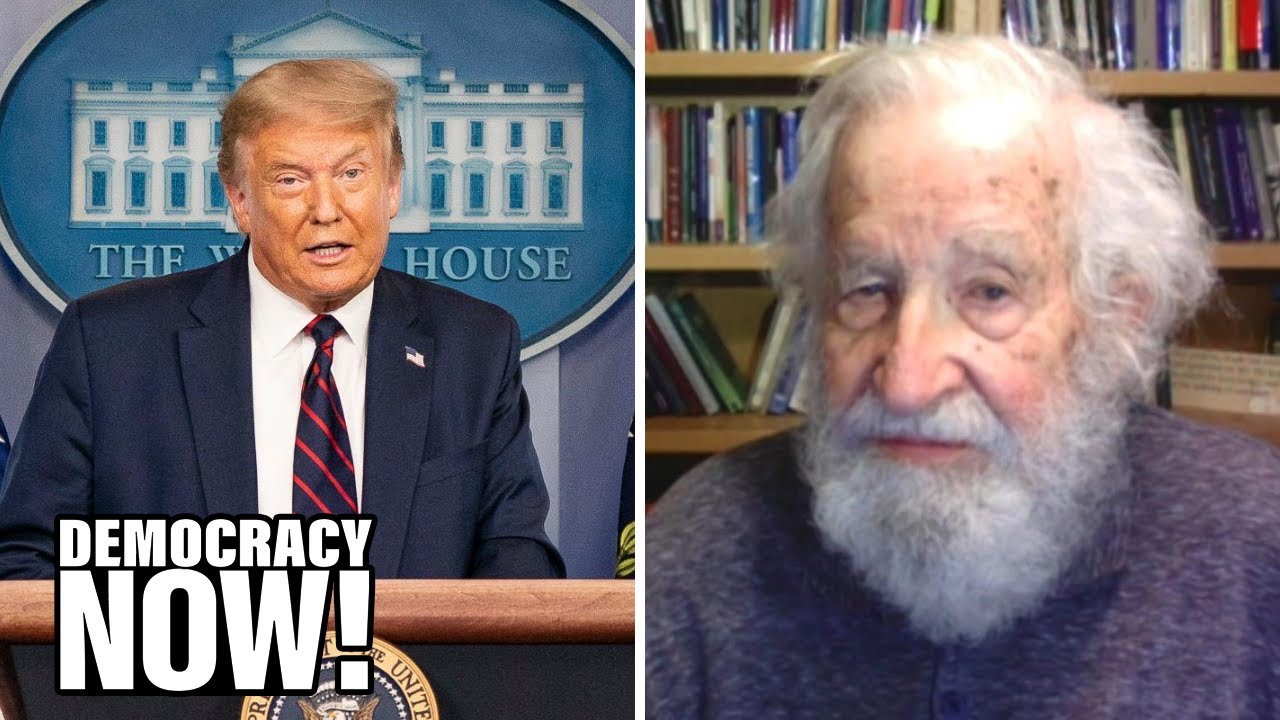
===
https://www.alternet.org/2020/10/noam-chomsky-lays-out-a-variety-of-reasons-why-he-considers-trump-the-worst-criminal-in-human-history-interview/
===
https://www.alternet.org/2020/10/author-noam-chomsky-trump-is-taking-the-us-down-the-road-toward-autocracy-and-will-go-to-extreme-lengths-to-stay-in-power
Chomsky laid out why he considers President Donald Trump a major threat to democracy during an interview with Truthout's C.J. Polychroniou published this week.
Although countless polls have found the president losing to former Vice President Joe Biden in this year's presidential election, Trump has refused to acknowledge the possibility of his own loss. Instead, he has insisted that Biden can only win if rampant voter fraud occurs, suggesting he may not accept the election results if the former vice president is victorious.
Chomsky, now 91, has lived through many historic events — from the Great Depression and World War II to Watergate to 9/11. And during the Truthout interview, the left-wing author stressed that he considers Trump the most authoritarian U.S. president of his lifetime — which is saying a lot when one considers that Republican Calvin Coolidge was still president when Chomsky was born in Philadelphia on December 7, 1928.
Chomsky is no fan of President Richard Nixon. But he says, without hesitation, that Trump is much worse.
"We may recall that Richard Nixon, not exactly revered for his integrity, had some reason to suppose that victory in the 1960 election had been stolen from him by Democratic Party machinations," Chomsky told Polychroniou. "He did not challenge the results, placing the welfare of the country above personal ambition. Al Gore did the same in 2020. The idea of Trump placing anything above his personal ambition — even caring about the welfare of the country — is too ludicrous to discuss."
Trump's authoritarianism, according to Chomsky, was painfully evident during recent anti-racism protests in Portland, Oregon.Chomsky observed, "When Trump decided to terrorize Portland, Oregon, he didn't send the military, probably expecting that it would refuse to follow his orders, as had just happened in Washington, D.C. He sent paramilitaries, the most fierce of them the tactical unit BORTAC of the Border Patrol, which is given virtually free rein with the 'damned of the earth' as its targets."
To make matters worse, Chomsky added, Trump's "private army" also includes well-armed militia groups, domestic terrorists and white nationalists. Chomsky warned, "Those are the forces that may be upholding 'law and order' if, in fact, the top military command decides to be 'complicit in a coup d'état.' It seems unimaginable, but regrettably, not inconceivable."
The left-wing author added, "Meanwhile, Trump and his Republican cohorts are working overtime to implement their strategy of undermining the election or discrediting it if it comes out the wrong way, setting the stage for a possible coup. In preparation, an 'army for Trump' is being mobilized to descend on polls to intimidate the wrong voters."
Trump, Chomsky told Polychroniou, considers Biden's supporters "the wrong voters" and will go to great lengths to bully them or have their votes thrown out.
Chomsky noted that a tide of nationalist authoritarianism is making its presence felt all around the world, from President Jair Bolsonaro in Brazil to Prime Minister Narendra Modi in India. But according to Chomsky,the U.S. is worse off than Brazil from a checks-and-balances standpoint because at least Bolsonaro was "blocked" by the Brazilian Supreme Court.
The author told Polychroniou: "The U.S. has gone farther down the road toward autocracy (than Brazil). When inspectors general tasked with overseeing executive malfeasance followed the same course, the would-be dictator in the White House simply fired them. He did so without a peep from the Republican Senate."
===
https://www.alternet.org/2020/09/author-noam-chomsky-trump-is-a-sociopathic-maniac-capable-of-provoking-a-civil-war-if-he-doesnt-win-the-electoral-college-in-november/
===
===
new
https://www.alternet.org/2020/09/noam-chomsky-the-world-is-facing-the-most-dangerous-moment-in-human-history/
alex h
Born in Philadelphia on December 7, 1928, left-wing author and activist Noam Chomsky has seen a lot in his lifetime — from the Great Depression and World War II to the social unrest of the 1960s to Watergate to 9/11. And during an interview with the New Statesman this month, the 91-year-old Chomsky explained why he finds the events of 2020 especially perilous.
“There’s been nothing like it in human history,” Chomsky told the Statesman. “I’m old enough to remember, very vividly, the threat that Nazism could take over much of Eurasia — that was not an idle concern. U.S. military planners did anticipate that the war would end with a U.S.-dominated region and a German-dominated region…. But even that, horrible enough, was not like the end of organized human life on Earth, which is what we’re facing.”
Chomsky spoke to the Statesman before the first summit of the Progressive International, an organization founded by Sen. Bernie Sanders of Vermont and former Greek Finance Minister Yanis Varoufakis in response to the increase in far-right authoritarian movements in different parts of the world.
In 2020, Chomsky has been sounding the alarm about a variety of perils: climate change, the coronavirus pandemic, President Donald Trump’s authoritarian response to the George Floyd protests. And he told the Statesman, “We’re at an astonishing confluence of very severe crises. The extent of them was illustrated by the last setting of the famous Doomsday Clock. It’s been set every year since the atom bombing, the minute hand has moved forward and back. But last January, they abandoned minutes and moved to seconds to midnight, which means termination — and that was before the scale of the pandemic.”
AD REMOVED FOR SUBSCRIBED USER
Chomsky has vivid memories of the bombing of Hiroshima in August 1945 — he was 16 at the time — as well as the Cold War, which ended with the end of the Soviet Union and the Easter Bloc in the early 1990s. And Chomsky believes that in 2020, the “threat of nuclear war” is “growing” and is “probably more severe than it was during the Cold War.” Adding to the peril, Chomsky told the Statesman, are “the growing threat of environmental catastrophe” and “the sharp deterioration of democracy.”
A key figure in that deterioration, according to Chomsky, is Trump — and other troubling examples of authoritarianism he cited range from Brazilian President Jair Bolsonaro to Hungarian President Viktor Orbán, who Chomsky said is “creating a proto-fascist state.”
Chomsky, the Statesman’s George Eaton notes, has “lived through 22 U.S. presidential elections” — and he pointed out that Trump has said that he might not concede if former Vice President Joe Biden wins in November.
“He’s already announced repeatedly that if he doesn’t like the outcome of the election, he won’t leave,” Chomsky told the Statesman. “And this is taken very seriously by two high-level military officers, ex-military leaders — who’ve just sent a letter to the chairman of the Joint Chiefs of Staff, reviewing for him his constitutional duties if the president refuses to leave office and gathers around him the paramilitary forces that he’s been using to terrorize people in Portland.”
==
==
https://www.alternet.org/2020/07/noam-chomsky-decades-of-the-neoliberal-plague-left-us-unprepared-for-19/
NOAM CHOMSKY We should understand the roots of this pandemic. If we do not understand the roots and extirpate them, there is going to be another and worse one coming. So far we have been kind of lucky. The coronavirus, pandemics, epidemics are very serious, and there are many possibilities. So far, all the ones that have happened in the last ten or 15 years, either the virus has been very deadly but not very contagious, like Ebola, or very contagious but not very deadly, like COVID-19. What happens when the next one comes along that is both very contagious and very deadly? We are in deep trouble. Deep. Much worse than this. Much worse than the so-called “Spanish flu,” which ought to be called the Kansas flu by Trump’s logic. It originated in Kansas the century ago. We may be facing something much worse than that.
There are ways of dealing with it. After the SARS epidemic in 2003, scientists knew that another one is very likely. They warned against it. They presented policies that could be carried out. They weren’t implemented, in part because of deep institutional pathologies. The drug companies who are the obvious candidates for dealing with it can’t, by straight capitalist logic. You don’t spend money to try to prevent a catastrophe ten years from now. What you do is try to make money tomorrow. That is the logic of the system. So the pharmaceutical companies were ruled out by capitalist logic.
The government could step in. The government, in any event, does most of the basic research for vaccines and drugs, almost all of them. So they could have stepped in, create laboratories, and plenty of unlimited resources. But they are blocked by the neoliberal plague. Remember Ronald Reagan—that government is the problem, not the solution, which means we have to take decision-making and action out of the hands of government, which has a flaw; it’s somewhat responsive to the population. We have to shift it to unaccountable, private tyrannies, which are totally unaccountable to the population. That is the meaning of Reagan’s slogan. That is the fundamental principle of neoliberalism. We’ve been suffering—the world has been suffering from it for 40 years, except for the tiny percentage who have become super rich and extremely powerful. Well, that blocks the government.
Nevertheless, there were things that the government could do. When the Obama administration took office, in the first few days, Obama called the presidential scientific advisory board, which had been established by George H.W. Bush, the first Bush, who had some respect for science. Obama called it. He requested that they put together a pandemic reaction program, a way to deal with a pandemic if it comes. They came up with a report a couple weeks later. It was implemented. It was in place until January 2017.
Trump came into office, the first few days, dismantled the whole system. Nothing. That’s part of the general wrecking ball. “We have to destroy everything that Obama did. We have to wreck everything.” Because it is the only way to look like you are doing something. Happening all over. So that went.
There were programs of U.S. scientists working in China with Chinese colleagues to try to detect and identify coronaviruses. Most of them are deep in caves. It’s very dangerous work. Some have been killed, Chinese scientists. But they were finding them and identifying them and testing them. The Wuhan Institute of Virology is the main center for investigating this. Trump canceled the program.
There were simulations run of a pandemic as late as October 2019 warning of what would happen. No attention. The Trump administration isn’t interested. So when the epidemic finally hit, the United States was singularly unprepared. After that comes a series of grotesque inactions and actions. For a couple of months, Trump refused to admit that it was happening.
Other countries were doing things. In Asia, Oceania, Australia, New Zealand, they were reacting. Some of it, South Korea, which was one of the first places hit, never had to go to a lockdown because they dealt with it rationally. They identified the places that were hot spots, controlled them, tested, traced people for contacts. Countries pretty much functioned. Vietnam has reported zero deaths, and apparently that is taken quite seriously by leading U.S. specialists. The Johns Hopkins School of Public Health, which monitors the international situation, records zero deaths from Vietnam, which has a 1,400-mile border with China. South Korea, Taiwan, New Zealand, Australia are doing quite well. And Europe, they delayed in quite a way, but they did finally act. As you mentioned, the curve has sharply reduced since March for most of Europe. Some of them, like Norway, Germany, doing quite well in this respect. People are traveling through southern Italy almost like normal.
It has gotten so extreme that, as you know, Europe has banned American visitors. The United States is such a pariah state that Americans are not permitted to go to other countries. Other countries won’t allow them in. This is kind of mimicked in a horrible way in Brazil. Bolsonaro just denies that it’s happening. “It’s just a mild flu. Don’t worry about it. Brazilians are strong. We don’t care.” So big meetings of right-wing Bolsonaro supporters dancing in the streets and spreading the virus, and Bolsonaro says fine.
And one of the really world-shaking crimes that is being carried out is the destruction of the Amazon. That affects the whole world, not just Brazil. It’s basically genocide to the indigenous populations. Scientific predictions are that on our current course, the Amazon will shift in about 15 years from being a net sink of carbon dioxide to a net emitter of carbon dioxide, sometimes called the lungs of the Earth. The forest absorbs huge amounts of carbon dioxide. It will start emitting them instead. A little further down the road, the Amazon, under the current course, will just turn into savanna, no forest anymore. Devastating for Brazil and the other Amazonian countries. Devastating for the world. It’s one of the main oxygen producers of the world.
At every level, we are racing madly towards total catastrophe under the leadership of sociopathic fanatics. It is as if some evil demon decided to take over the human species and drive them to self-destruction. Much of the world is trying to counter it, almost all of the world, but the United States and Brazil are the extreme cases of racing with dedication towards disaster.
Going back to this election, that is the reason why it is the most dangerous, the most significant election in history. Why Trump is, in fact—this may sound outrageous, but it’s true—Trump is the most dangerous figure in human history. The Republican Party today is the most dangerous organization in human history. You can compare Trump to, say, Hitler, the Wannsee declaration in 1942, called for killing all the Jews, tens of millions of Slavs, not destroying humanized society. There has been nothing like this. Nothing.
The Republican Party, we know how they shifted. You go back just a decade or so, John McCain, 2008, was running for president. His program had some pretty weak, but some policies directed to global warming. The Republican Congress was beginning to contemplate global warming, policies to restrict global warming. The Koch brothers, a superrich energy corporation, got wind of this. They had been working for years to prevent it. David Koch, one of the Koch brothers who died recently, launched an incredible campaign to make sure that the Republican Party would turn to denialism. They bribed senators, intimidated others with the threat of running counter-campaigns against them. Huge lobbying campaign. Astroturf campaigns. A massive juggernaut. The party shifted, dropped all of its efforts to deal with climate change. It’s now a party led by denialists.
AMY GOODMAN: As you talk about this denialism and the science denialism, first dealing with the climate crisis and then extending to the pandemic, both threatening life on Earth, with President Trump now holding a daily coronavirus press briefing without the scientists, you have Anthony Fauci throwing out the first ball at the Washington Nationals game, the chief infectious disease scientist, who won’t play ball exactly with the White House, so he is not in the coronavirus briefing. You have Dr. Birx. President Trump says she’s right outside, but she is not a part of this news conference. Do you think reporters who are sitting in the White House briefing room should refuse to be there unless scientists are there and unless President Trump wears a mask?
NOAM CHOMSKY: Yes, I think so, and I think they should do much more. They should be pointing out constantly what I just said: we’re dealing with the most dangerous figure in human history, backed by the most dangerous organization in human history, and give the facts. Not only the pandemic, but the much more serious threat of environmental disaster and the growing, very severe threat of nuclear war.
In my opinion, every newspaper should have on the front page an image of the Doomsday Clock. You know all about this, but every January, the Bulletin of Atomic Scientists gathers—the main scientific journal dealing with these issues—gathers scientists, political analysts to try to give an estimate of the security, the state of the world security. Started shortly after the atom bomb, it has been going on for 75 years. The minute hand is moved closer or farther—it oscillates—closer or farther to midnight, depending how dangerous the world situation is. Midnight means we are finished.
Every year that Trump has been in office, the minute hand has moved closer to midnight. Two years ago, it reached the closest it had ever been. This last January, the analysts gave up minutes; they moved to seconds. A hundred seconds to midnight. Since January, Trump has made every one of the issues that they have brought up worse. There were three major issues. One is of course the threat of nuclear war, second the threat of environmental catastrophe, the third the deterioration of democracy. Which does belong, because it is only with a vibrant democracy of informed, engaged public that we can have any hope of escaping from the two existential crises.
Since January, Trump has succeeded in making all three crises worse. I mention the nuclear weapons issue, considerably worse thanks to Trump’s actions. The environmental crisis of course getting worse, as he continues to press for maximization of the use of the most dangerous fossil fuels, cuts back through his EPA representatives and others, cuts back on the efforts to mitigate the crisis through regulatory means. And democracy, it’s pretty obvious; the executive branch has been essentially cleansed of independent voices. Nothing but sycophants of Pompeo variety. “We were sent by God to save Israel.”
The Inspectors General who were imposed by Congress, by the Republican Congress to monitor malfeasance of the executive branches, purged. Trump in fact went out of his way to humiliate the senior Republican senator, Charles Grassley, who had spent much of his career imposing these monitors. The attorney for the Southern District of New York looked into the Trump swamp; fired. Congress, turned by McConnell, used to be called the greatest deliberative body in the world. Now it is a joke. Doesn’t do any deliberation. It does essentially nothing except try to race through as many appointments of young, ultra-right judges as possible so they can pack the judiciary for a generation. The only other thing it does is figure out ways to pour money into the—dollars into the pockets of the rich, like the tax scam. That’s the Senate, the greatest deliberative body. Proposals come from the House for legislation; McConnell just cans them. Don’t look at them. That is not the role of the Senate.
Going back, that’s why they should be putting the Doomsday Clock on the front of every newspaper. Show us what the United States is doing to the world. To itself and the world. That should be in front of everyone’s attention. And there are many other things that should be done. There should be major protests now, everywhere, against the use of military force to occupy American cities and to crush peaceful dissidents. This is intolerable in a functioning democracy. We can’t sit by and let it happen, just let it proceed step by step until we reach real catastrophe.
==
https://www.alternet.org/2020/07/author-noam-chomsky-explains-why-neoliberal-doctrine-has-intensified-the-deadly-effects-of-covid-19/
Neoliberalism has been blamed for a variety of problems in the world, from rising income inequality to the lingering effects of the Great Recession. And according to left-wing author/professor Noam Chomsky, neoliberalism has also made the coronavirus pandemic deadlier than it had to be.
In an interview with journalist Elena Matsiori for the English-language edition of the Greek daily Kathimerini, Chomsky laid out some reasons why he believes neoliberal economics have worsened the effects of COVID-19 — which, according to Johns Hopkins University researchers in Baltimore, had killed more than 539,000 people worldwide as of Tuesday morning, July 7.
“The pandemic is a vivid illustration of the great damage that the neoliberal era has done to the large majority of the population,” the 91-year-old Chomsky told Kathimerini. “We should, however, have no illusions about belief in markets or homo economicus. The core principle of neoliberalism is to shift decisions from governments, which are, to some extent, subject to public influence, to private tyrannies that are completely unaccountable to the public — and according to neoliberal doctrine, must be devoted solely to self-enrichment.”
Chomsky added, “It is not profitable to prepare for future catastrophes. That leaves government, which is, in fact, responsible for the basic work in developing most vaccines and drugs. But that is blocked by neoliberal doctrine.”
AD REMOVED FOR SUBSCRIBED USER
Chomsky explained that the SARS epidemic was a warning sign that should have been heeded 17 years ago.
“In 2003, after the SARS epidemic was contained, scientists warned that another coronavirus epidemic was likely and outlined ways to prepare for it,” Chomsky recalled. “But knowledge is not enough. Someone has to act on it.”
During the interview with Kathimerini, Chomsky also discussed the state of the European Union and the rise of far-right authoritarians such as Hungary’s Viktor Orbán.
“The future of the EU is very much at risk in many ways,” Chomsky told Kathimerini. “The EU itself is founded on the principle of undermining of democracy, with basic decisions shifted to the unelected Troika. But the flaws go well beyond, as the pandemic reveals.”
Another problem that neoliberalism is aggravating, according to Chomsky, is climate change — which, he emphasized, is even more dangerous than COVID-19.
“There will be recovery from the pandemic, at terrible cost,” Chomsky told Kathimerini. “There will be no recovery from the melting of the polar ice caps and the heating of the world that may lead to much of it becoming literally uninhabitable even before the end of this century, all with consequences that are unimaginable. As in the case of the pandemic, here too, the logic of capitalism is at work. And here too, its threat to the survival of humanity is sharply intensified by malignant elements at the center of global power.”
==
new 220 an
https://www.alternet.org/2020/03/historically-rich-people-have-fought-to-stop-politicians-like-sanders-making-his-rise-all-the-more-unlikely/
no lnx
Historically, rich people have fought to stop politicians like Sanders — making his rise all the more unlikely
Written by Keith A. Spencer / Salon March 1, 2020
My favorite uncomfortable interview moment arises in a 1996 BBC segment featuring linguist and scholar Noam Chomsky. In the interview, conducted by British journalist Andrew Marr for the BBC show “The Big Idea,” Marr tells viewers he has come to the Massachusetts Institute of Technology to talk to the professor and dissident about “bias in the media.” The interview came about eight years after the publication of Chomsky and Edward S. Herman’s 1988 book “Manufacturing Consent: The Political Economy of the Mass Media“; the term “manufacturing consent” that the two co-authors adopted refers to how mainstream media outlets shape coverage in order to present an agenda that benefits the ruling class.
The awkward moment, which Marr politely takes in stride, arises when Marr confronts Chomsky about his assertion that media figures like himself express opinions that reflect what the rich elites believe.
First, Chomsky pushes back on the assertion that journalists are innately noble defenders of democracy. “I’m sure you’re speaking for the majority of journalists who are trained — have it driven into their heads — that this is a crusading profession. Adversarial, ‘we stand up against power’ — a very self-serving view,” Chomsky says to Marr.
“How can you know I’m self-censoring?” Marr interjects.
“I’m not saying you’re self-censoring,” Chomsky replies. “I’m sure you believe everything you say. But what I’m saying is if you believed something different you wouldn’t be sitting where you’re sitting.”
The point that Chomsky is making is a good example of selection bias — a statistics concept that I’ve written about before that works as a great analogy for understanding the political and media world. Chomsky’s point is that Marr never would have made it as far in his media career if he had been appropriately critical of power and imperialism.
To rephrase Chomsky’s point, media bias doesn’t manifest through conscious propagandizing by those who work at the top. Talking heads with six- or seven-figure salaries — folks like Wolf Blitzer or Chris Matthews — aren’t hired because they are ardent propagandists who believe in the same things the boss believes. Rather, they are hired because they are appropriately uncritical of power and militarism.
In other words, the Wolf Blitzers and Chris Matthewses of the world would never have gotten hired in the first place — or probably not made it as far as they had — if they hadn’t toed a tacit line that represented the interests of the people who own the media outlets that have employed them over the years.
The selection bias analogy is quite apt when we think about who is a successful politician and who isn’t. In the United States’ flawed democracy, the rich have untoward power to shape not only elections, but also our beliefs about candidates through mass media.
That means that our political candidates — on both sides, but particularly the right — rarely hold positions in line with the things that the majority of Americans believe in. To wit:
Gallup polling has consistently found that only about 21% of Americans believe abortion should be illegal in all circumstances. (On the other hand, just about every member of the Republican Party believes this — the party that supposedly represents half the country’s views.)
Gallup polling also shows that 54% of Americans agree with the statement “it is the responsibility of the federal government to make sure all Americans have healthcare coverage.”
In 2019, only 35% of Americans believed immigration to the United States should be decreased.
Also, in 2019, the same Gallup poll asked: “Thousands of refugees have left Honduras and other Central American countries to escape the situation there. Would you approve or disapprove of allowing these refugees to come into this country?” 57% approved.
A 2019 poll from The Hill-HarrisX found that “58% of registered voters said they would support a proposal that would make public colleges, universities and trade schools tuition-free.” The pollsters note that “the same group also said they would back a plan eliminating all existing student debt.”
I picked these polls intentionally, as these reflect the core platform of presidential frontrunner Bernie Sanders: he is a pro-choice candidate supporting Medicare for All, who pushes back against xenophobic immigration views like Trump’s, and who believes in forgiving student debt and making public colleges free.
That means that Bernie Sanders’ political views are well in line with the mainstream. In that regard, his frontrunner status makes sense.
So then why is he billed by the mainstream media as an anomaly, or even dangerous?
The answer has to do, again, with selection bias.
The candidates who represent a centrist or center-right agenda — candidates like Mike Bloomberg, Amy Klobuchar, and Pete Buttigieg — have more support from monied folks who donate to their campaigns and thus give them more visibility, both in newsmedia and in airtime.
Over time, we have started to think of milquetoast centrism as comprising “normal” political beliefs for Americans, when in fact Sanders’ platform is way more average in terms of what Americans believe and want.
This is all to say that to find someone like Bernie Sanders — an independent from Vermont, an open democratic socialist, who has been virulently anti-imperialist for decades, consistent in his beliefs, and who refuses the allure of PAC money — is astonishingly unusual in the federal government. There is a selection bias specifically preventing people like him from rising as high as he has. And how he got to where he is occurred because of a combination of luck and his own prowess as a politician.
First, the luck part. Unlike other states in the union, there is not a lot of industry in Vermont, and frankly not a lot of wealth. It is an underpopulated state: only Wyoming has a smaller population.
You can understand how Sanders rose to the Senate by contrasting Vermont politicians with California politicians. Conservatives love to gripe about California’s far-left politicians, but that is pretty far from the truth: to make it to the Senate or the governor’s house as a Californian, you must kowtow to the vast piles of money hoarded by the ghouls in Silicon Valley, the agriculture industry, and Hollywood. To do otherwise would risk becoming the focus of a targeted campaign against you by said industrialists’ super PACs and communications firms, as frequently happens with any Californian candidate whose economic views stray too far towards the redistributive for the tastes of the monied. (This goes back at least to socialist Upton Sinclair’s bid for California governor in 1934, which was undermined by business interests employing sophisticated propaganda. His campaign foreshadowed California politics for decades to come.)
Whereas in a state like Vermont, with little industry and relatively little wealth, there are fewer business interests to upset. That means that a politician who caters to the working class rather than the ruling class can get much further — even to the Senate — without having his candidacy tanked by disinformation campaigns run by rich people’s political action committees, as essentially happened with Sinclair in California.
Now, for the skill part. Sanders is an intensely disciplined politician when it comes to rhetoric. He has not strayed ideologically from his beliefs in 30 years; this makes it that much harder for his detractors to call him a waffler or expose him for being an inconsistent politician. By plugging the same message year after year, voters know what to expect from him. To borrow an odious 21st-century marketing term, his branding is on point.
Now, this depiction of Sanders is, as my headline alludes, at odds with the narrative about him. True, he does not fit into the visual rubric of diversity (though he is Jewish). But he is an ideologically diverse candidate — and his base, which is the most diverse of all the Democratic candidates for president, certainly speaks to this strength.
==
https://www.alternet.org/2020/02/noam-chomsky-we-must-confront-the-ultranationalist-reactionary-movements-growing-across-the-globe/
==
120 an
no lnx
‘A tragedy’: Noam Chomsky slams Democrats for narrow focus of Trump’s impeachment trial
Noam Chomsky
Written by Alex Henderson January 22, 2020
Most of the criticism of the ways in which Democrats have handled President Donald Trump’s impeachment have come from the far right, although some Never Trump conservatives have praised House Speaker Nancy Pelosi, House Intelligence Committee Chairman Adam Schiff and other Democrats. However, author/journalist Noam Chomsky has criticized Trump’s impeachment from the left — not because he is pro-Trump, but because he believes the impeachment has been much too narrow.
In an interview with Law & Crime, the 91-year-old Chomsky asserted, “I think the impeachment process, which avoids Trump’s major crimes and keeps to the fact that he tried to harm a prominent Democrat…. will end up being a gift to Trump and may send him back to office. A tragedy.”
Drawing a parallel between the Ukraine scandal of 2019 and 2020 and the Watergate scandal of the 1970s, Chomsky told Law & Crime that in both cases, Democrats in Congress didn’t consider Republican presidents impeachable until they went after the affluent and the powerful. In Watergate, burglars broke into Democratic National Committee (DNC) headquarters in Washington, D.C. — and President Richard Nixon was facing articles of impeachment in the U.S. House of Representatives for his efforts to cover that crime up. And in the Ukraine scandal, Trump tried to pressure Ukrainian President Volodymyr Zelensky into investigating former Vice President Joe Biden and his son, Hunter Biden.
Chomsky told Law & Crime, “Same as Watergate — there was an attempt by Robert Drinan to include Nixon‘s real crimes, like the bombing of Cambodia, in the bill of impeachment. But that was cut out, and the focus was on an attack on Democrats, much as today.”
The late Father Robert Drinan was a left-wing Jesuit priest who was vehemently opposed to the Vietnam War and served in the U.S. House of Representatives via Massachusetts in the 1970s and early 1980s.
Chomsky attacked Trump for his draconian immigration policy and his position on climate change, but lamented that Democrats don’t consider those things impeachable — it took an attack on the Bidens for House Democrats to impeach Trump.
“The worst crimes by far are those that literally threaten human survival, not in the distant future: (Trump’s) policies on escalating global warming and the race to develop still more destructive weapons,” Chomsky told Law&Crime. “But the Dems would never agree that these are ‘high crimes.’”
Looking back on Nixon’s presidency, Chomsky argued that similarly, House Democrats of the 1970s went after Republicans for committing crimes against the DNC but not for the death of Black Panther leader Fred Hampton or U.S. foreign policy in Asia.
“The message appears to be the same: a real crime is attacking the powerful,” Chomsky stressed. “It’s OK to murder Fred Hampton or to send children to concentration camps and all the rest but not to undermine those with power here.”
==
https://www.alternet.org/2019/11/noam-chomsky-warns-a-centrist-democratic-nominee-will-result-in-the-tragedy-of-a-second-trump-term/
===
https://www.alternet.org/2019/11/noam-chomsky-weighs-in-on-impeachment-2020-election-and-syria-withdrawal-trump-is-impeachable-100-times-over/
no lnx
Noam Chomsky weighs in on impeachment, 2020 election and Syria withdrawal: ‘Trump is impeachable 100 times over’
Noam Chomsky
Written by Alex Henderson November 1, 2019
Noam Chomsky was railing against far-right Republicans and neoliberal corporate Democrats long before Donald Trump became president, but the Trump era has certainly given the veteran journalist/author plenty to talk about. And Chomsky, now 90, weighed in on everything from impeachment to the 2020 presidential election during a late October appearance on The Intercept’s “Deconstructed” podcast.
The interview was conducted by liberal/progressive British journalist and anti-Trump firebrand Mehdi Hasan. When asked about the impeachment inquiry that Trump is facing in the U.S. House of Representatives, Chomsky asserted that while Trump certainly deserves impeachment, it is important to analyze the economic and political forces that have led to Trumpism.
“Trump is impeachable 100 times over,” Chomsky told Hasan. “You know, he’s a major crook. There’s no doubt about it.”
Chomsky quickly added, however, that he seriously doubts the Senate will remove Trump from office — and Trump might even use impeachment to his political advantage in 2020.
“What’ll happen is probably the House will impeach, goes to the Senate,” Chomsky predicted. “The Republican senators are utterly craven. They’re terrified of Trump’s voting base; so, they’ll vote to turn down the impeachment request. Trump will come along, say, ‘I’m vindicated.’ Say it was the deep state and the treacherous Dems trying to overturn the election — ‘oh, vote for me.’”
Chomsky asserted that while Trump is “off the spectrum,” so is “the Republican Party generally.” The Philadelphia native noted, “Two well-known commentators from the American Enterprise Institute, Thomas Mann and Norman Orenstein years ago, described the Republican Party since Newt Gingrich as a radical insurgency that has abandoned parliamentary politics.”
But Chomsky was also highly critical of the Democratic Party during the interview. Discussing the 2020 presidential election, Chomsky told Hasan that corporate Democratic neoliberals will do everything they can to “get rid of” Sen. Bernie Sanders and Sen. Elizabeth Warren and prevent either of them from receiving the party’s nomination.
“What’s actually happened is that during the neoliberal period, both of the political parties have shifted to the right,” Chomsky observed. “So, the mainstream Democrats — the ones who are now meeting with their billionaire friends to try to figure out how to get rid of Sanders and Warren — they’re basically what used to be called moderate Republicans. The Democrats abandoned the working class by the late ’70s.”
Chomsky told Hasan that if he were voting in the 2020 Democratic presidential primary, he would vote for Sanders — adding, “I think Warren would be a reasonable candidate.”
Chomsky said of Warren, “I think many of her plans are perfectly reasonable. She’s working with quite serious economists, some of them friends….. (But) she has not organized a mass political movement , which Sanders did. And it’s had a lot of effect. That’s how you get people in Congress like (Rep. Alexandria) Ocasio-Cortez and others: because of this movement.”
Over the years, Chomsky has often been a blistering critic of U.S. foreign policy. But Chomsky has opposed Trump’s recent decision to withdraw U.S. troops from northeastern Syria — which Hasan found surprising in light of how anti-interventionist he has been so many times.
Chomsky clarified his position, telling Hasan, “From the left at least, the call for withdrawal was based on anti-imperialist principles. But principles have to be understood in connection with the human reality of the existing circumstances. A small, U.S. contingent with the sole mission of deterring a planned Turkish invasion, which was obvious, is not imperialism. It’s protecting the Kurds from an expansion of the atrocities and massacres that (Turkish President Recep Tayyip) Erdogan has been carrying out both within Turkey itself and in the areas of Syria that he’s already conquered.”
==
...“That requires reversing the course of the U.S. in dismantling arms control agreements and proceeding — along with Russia — to develop ever more lethal and destabilizing weapons systems; and in not only refusing to join the world in trying to do something about the severe environmental crisis but even aggressively seeking to escalate the threat, a form of criminality with literally no historical antecedent,” he said.
Unfortunately, both those prospects look particularly dismal at the moment. The United States’ trade war with China is emblematic of its failure to come together in an aggressive way to address climate change, especially after President Donald Trump pulled out of the Paris Climate Accord. And National Security Adviser John Bolton has been successfully pushing for the United States to pull out of arms control agreements and it is now believed that Russia is working on building nuclear-powered cruise missiles— to disastrous effect. At least until Trump is out of office — and perhaps not even then — it’s difficult to see how the United States will get its act together regarding these global threats.
“Not easy,” Chomsky said of reversing course, “but it can be done.”
He continued: “There have been other severe crises in human history, even if not on this scale. I’m old enough to remember the days when it seemed that the spread of fascism was inexorable — and I’m not referring to what is referred to as fascism today but something incomparably more awful. But it was overcome.”
...
===
https://www.alternet.org/2019/06/noam-chomsky-democrats-may-have-handed-trump-the-2020-election/
As Attorney General William Barr releases Robert Mueller’s long-anticipated report into Russian interference in the 2016 election, we speak with world-renowned political dissident, linguist and author Noam Chomsky about what he sees as the political perils of “Russiagate.”
AMY GOODMAN: Can you share your analysis of President Trump? You have lived through so many presidents. Explain President Trump to us and assess the massive response to him.