google ads monetize
===
see ggl online, not sure of distinction
no merri
social media b/c would show up in feeds?
see ad page rank promote
-=-=
-=-=-
10 26
NO LNX GFX
Federica Marsi
Published On 16 Oct 2026
16 Oct 2026
Just visiting a page or refreshing an app can be enough to fall victim to a malware attack in which your personal data is stolen from a laptop or phone, researchers have found. You are not even required to “click” on anything.
An Israeli spyware firm has been found to be behind the first-known instance of “zero-click” targeted advertising in which fraudsters or spies can steal private data and send it to external servers, with Al Jazeera journalists among the victims.
Recommended Stories
list 1 of 3A world on trial: How lawyers documenting Israeli abuse pay a price
list 2 of 3EU lawmaker investigating surveillance hacked by Israeli spyware, report says
list 3 of 3UK, US, Netherlands warn of Iran-linked spyware
end of list
In June 2025, 45 devices used by Al Jazeera staff – including several who reported on sensitive subjects – were targeted with spyware which installed itself without the need to open or download any files.
An investigation by the Canada-based academic research unit Citizen Lab, prompted by Al Jazeera’s initial internal probe into the issue, discovered that the Israeli company Candiru was behind the attacks.
Analysts say the findings are “incredibly concerning”, as they confirm the existence of a new global security threat. “We knew we were headed in this direction and now it is out in the public,” Remesh Srinivasan, professor of information studies at the University of California in Los Angeles, US, told Al Jazeera.
“This is the next level, because people are being microtargeted,” he said. “This is the point we’ve come to when it comes to surveillance.”
How ‘zero-click’ malware works
Al Jazeera’s in-house technology team first discovered unusual patterns on devices used by some journalists in 2024. Analysis of network logs provided to the Citizen Lab by Al Jazeera in 2025 provided a clear temporal signature of how the attack was executed.
Malicious advertisements were bought by Discover-Tech, an Israeli company presenting itself as a legitimate advertising firm, but which actually operates as a facilitator for mercenary spyware partners.
Its advertisement network identified Al Jazeera staff, then quietly redirected them to an infected server belonging to Candiru. The spyware firm was blacklisted by the US government in 2021, when Citizen Lab found it was responsible for the illegal hacking and surveillance of at least 100 activists, journalists and political activists across 10 countries.
Al Jazeera Media Network has condemned the targeting of its staff members’ devices and called for those responsible to be held accountable.
Cybersecurity analyst and author Eddy Willems said the advertisements used automatically infect devices the moment they pop up on the screen, but there is an important technical nuance. “Executing code inside the browser does not automatically give an attacker full control over the computer,” Willems told Al Jazeera.
“To escape the browser’s isolated environment – the ‘sandbox’ – the attacker may need a second vulnerability,” Willems said, adding that an advanced spyware operation can combine several vulnerabilities.
“The attacker attempts to exploit vulnerabilities to bypass security boundaries. This is precisely what makes this type of attack so dangerous,” the analyst said.
Once the device is infected, the malicious software is designed to collect a wide range of sensitive data, including files, documents, and browser data such as cookies, bookmarks, and saved credentials.
It can also capture keystrokes, take screenshots, record microphone and webcam input, and extract emails and messages from popular communication platforms. To avoid triggering security mechanisms, the spyware often uses encrypted communication channels and breaks up stolen data into smaller chunks sent over time.
Advertising: A new global security threat?
Analysts say Citizen Lab’s findings point to the escalation of an existing threat, which expands the scale and reach of traditional cyberattacks and makes them much harder to detect.
While “zero-click” attacks are not completely new, the findings outline a new technique through which online advertisements are used as a route to infection.
Stephen O’Shaughnessy, a lecturer in cybersecurity at the TU Dublin Blanchardstown campus in Ireland, explained that when a user opens a website or app, an automated auction sells the advertisement space in a fraction of a second. That auction shares data about the victim, including the device ID, IP address, rough location and the app or site they are on.
“Discover-Tech posed as an ordinary advertiser, used that data to find their target and win the auction for that person’s screen,” O’Shaughnessy told Al Jazeera. “Anyone with a phone or browser that shows ads can be reached, without the attacker needing their phone number or email.”
“Because no message or link is involved, there is almost nothing for the victim to notice,” he added.
Discover-Tech appeared on lists of “certified” and “approved” vendors maintained by Google and advertising industry association IAB Europe, and has served advertisements via major networks such as Google, Yandex and Beeswax.
In its report, Citizen Lab said this illustrates the structural flaws in the online advertising system, which essentially failed to detect or prevent the abuse.
Discover-Tech advertisements have popped up on devices used by personnel in national-security-sensitive networks around the world, including those of various ministries of defence, armed forces, national cyber agencies, intergovernmental organisations and media outlets, Citizen Lab found.
The research unit said these advertisements have also appeared on networks used by the United Nations, NATO, the European Parliament, the European Commission and the Council of the European Union’s General Secretariat.
‘Almost nobody was watching’
Government networks have also been targeted in at least 24 countries, including the United States, Italy, Denmark, Norway, Australia, Russia, Mexico and Israel itself. Networks of media organisations have also been targeted, mainly in Australia, Denmark and Sweden, according to Citizen Lab.
In a separate report, New York-based advertising security firm Confiant said its own investigations had found that some of Discover-Tech’s advertisements also appeared in critical networks used by the Pentagon, the United Nations International Atomic Energy Agency and the International Criminal Court.
O’Shaughnessy said infection has not been confirmed there – only profiling of users. “But that alone is concerning, he said. “The ad system was built to send code from strangers to billions of screens with pinpoint targeting. Almost nobody was watching it from a security angle.”
The analyst said the risk remains low for most people as these attacks are expensive and aimed at specific targets. “For individuals at high risk, like journalists and officials, the best first defence is to install an ad blocker, switch off their advertising ID through their phone’s privacy settings, keep everything updated, and turn on Lockdown Mode or Android’s Advanced Protection,” he said.
Precautions also need to be taken within the industry and at government level. “To combat this, the ad industry needs to properly vet who’s buying ads,” O’Shaughnessy said, while “regulators need to stop personal data being sprayed out to thousands of unknown bidders in every auction.”
//
Israeli ad-tech firm helped place spyware on Al Jazeera devices
Citizen Lab investigation says dozens of Al Jazeera devices were infected by malware planted through advertisements.
Published On 15 Oct 2026
15 Oct 2026
A general view shows the Al-Jazeera headquarter building in Doha, Qatar, May 11, 2022. REUTERS/Imad Creidi
From: NewsFeed
Israeli ‘ad’ firm helped infect spyware into Al Jazeera devices
An Israeli spyware disguised as a digital advertisement firm has targeted journalists’ devices at Al Jazeera.
Published On 15 Oct 2026
15 Oct 2026
00:56
Moroccan journalists recount years of surveillance amid new Amnesty claim
Amnesty cites a whistleblower’s account of how Morocco allegedly uses surveillance to silence journalists.
Published On 6 Oct 2026
6 Oct 2026
Moroccan journalist Omar Radi
-=-=
===
mma 4 24
google is profiting from PragerU’s climate denial ads on its search engine
Special PROGRAMSCLIMATE & ENERGY
WRITTEN BY ILANA BERGER
PUBLISHED 04/16/24
Google is allowing right-wing propaganda organization PragerU to run climate-denying ads on its search engine even though the tech giant previously committed to prohibiting ads that feature claims that contradict the “well-established scientific consensus” about climate change.
In 2021, Google updated its ad policy to prohibit ads for or on content that “contradicts well-established scientific consensus around the existence and causes of climate change.”
Yet, nearly three years later, Google is still profiting from ads that contain climate change misinformation.
When Media Matters searched for phrases like “climate change,” “global warming,” and “climate crisis” on Google Search, the search engine returned PragerU ads that promised its website reveals “the truth about climate change” — or what it calls the “fake climate catastrophe.”
“Climate policies are causing inflation and keeping poor countries trapped in poverty,” the ad-description text read. “Get the facts with our Climate Change and Energy playlist.”
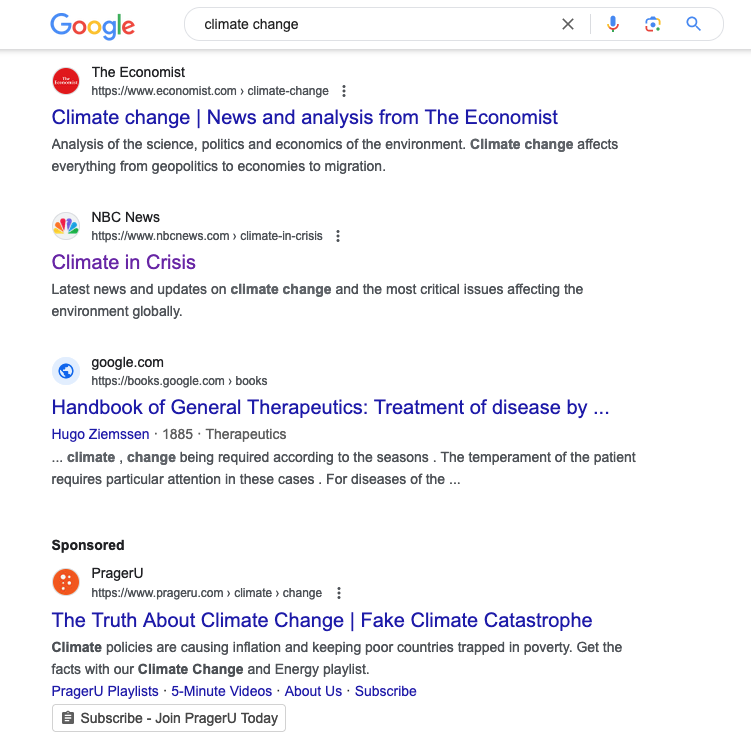
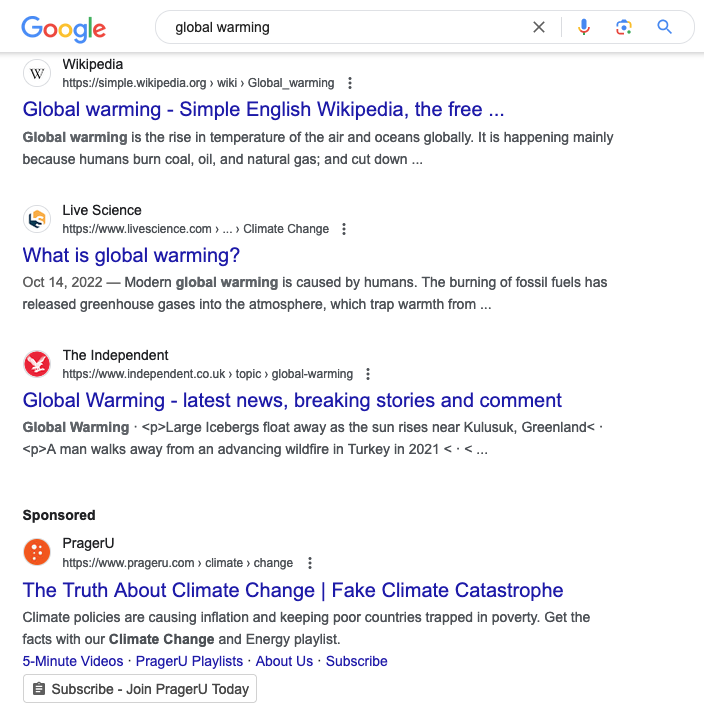
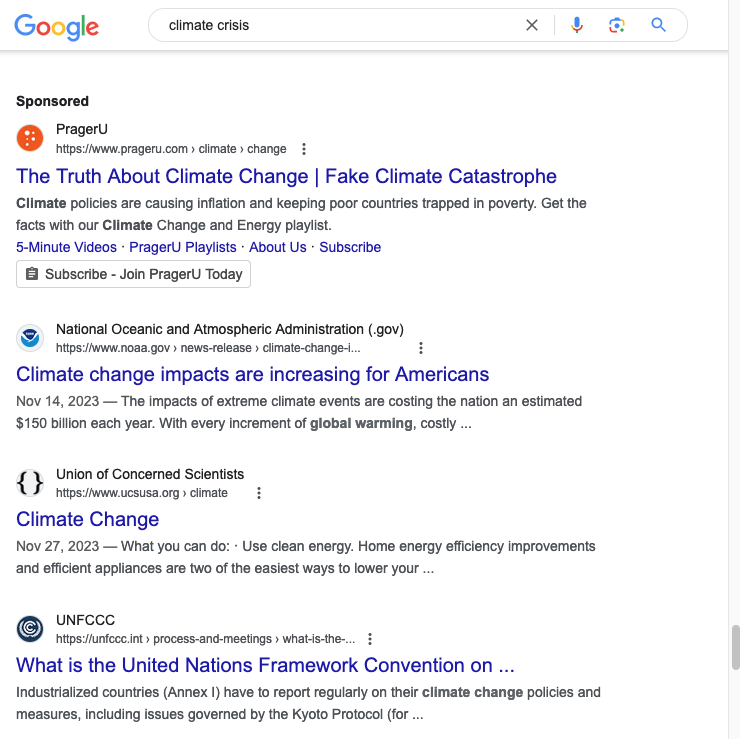
When clicked on, the ads lead Google Search users to a video on PragerU’s website titled “Do We Have to Destroy the Earth to Save It?” In the video, anti-renewable energy activist Michael Shellenberger tells the audience that “pushing the planet toward wind and solar energy would actually cause more harm to the environment than good.” (While all extractive processes have environmental impacts, scientists agree that the consequencesof burning fossil fuels on the climate along with the declining costs of both renewable energy and renewable-energy storage make those cleaner technologies essential to a sustainable energy future.)
Shellenberger is known for spreading misinformation about wind energy and downplaying the impacts of climate change. In 2020, Shellenberger wrote an article in which he claimed that “climate change is not making natural disasters worse.” A 2022 report produced by hundreds of the world’s leading climate scientists argued that climate change has increased the intensity — and in some cases the frequency — of extreme weather events.” Shellenberger has also defended former President Donald Trump’s unsubstantiated claims that “windmills are causing whales to die in numbers never seen before” and “driving them [whales] crazy.” In 2023, he produced a documentary that alleged — again, without concrete evidence — that “government officials have been lying” about the role offshore wind turbine construction has played in causing whale deaths.
The video featuring Shellenberger is one of 30 videos on PragerU’s “Get The Truth About The Climate” playlist.
Other videos on the playlist feature an assortment of well-known climate deniers, including former BP chief scientist Steve Koonin and nuclear energy consultant Patrick Moore, who has repeatedly and falsely claimed that he co-founded Greenpeace.
In a video titled “Is there really a climate emergency?” Koonin claims that climate change is not settled science, an argument he also detailed in a 2021 book called Unsettled: What Climate Science Tells Us, What It Doesn’t, and Why It Matters.
Another video on the playlist called “The truth about CO2” features Moore, who claims that rising CO2 levels in the Earth’s atmosphere do not present a danger to humans and that “we're already seeing the positive effects of increased carbon dioxide now.” “We should celebrate CO2 as the giver of life that it is,” Moore adds.
Video
CitationPragerU ad in Google's search engine, accessed April 4, 2024
PragerU is deeply rooted in climate change denial
Along with the Daily Wire, PragerU is financially dependent on generous donations from fossil fuel billionaire Farris Wilks.
Recently, PragerU Kids, a PragerU offshoot that produces conservative “educational” content targeted at school age children, has partnered with five different states to bring right-wing propaganda into public school classrooms.
Media Matters reviewed PragerU Kids’ ”educational” content and found it was rife with misinformation about climate change. In one video, a cartoon narrator explains why embracing climate denialism is akin to participating in the Warsaw uprising, when Polish Jews attempted to liberate Warsaw from German occupation during WWII.
Since 2021, researchers have demonstrated that Google has failed to follow through on its promise to address climate denial. One study found 100 monetized YouTube videos that seemingly violated Google’s climate change misinformation policy. The videos had accrued more than 18 million views. Despite those seeming policy violations, only eight of the hundreds of climate-denying videos studied were eventually demonetized. Google has also profited significantly from ads placed by fossil fuel companies attempting to “greenwash” their reputations as drivers of the climate crisis.
THE LATEST
04/16/24 11:01
- ### Mainstream media gushed over “vocal Trump critic” NH Gov. Chris Sununu, who has now endorsed Trump
04/16/24
- ### ABC and NBC nightly news programs ignored report that Trump appeared to fall asleep during his trial
04/16/24 10:37 AM EDT
04/16/24 10:02 AM EDT
04/16/24 9:49 AM EDT
Pagination
IN THIS ARTICLE
- [### PragerU
](https://www.mediamatters.org/prageru)
](https://www.mediamatters.org/google)
- [### Climate deniers
 ](https://www.mediamatters.org/climate-deniers)
MORE
Related
09/08/23 9:15 AM EDT
03/31/21 10:13 AM EDT
09/01/23
===
https://www.dailykos.com/stories/2022/10/24/2130859/-Google-s-Selling-Climate-Disinfo-Ads-Despite-Policy-Against-It-YouTube-Too-Still
Google's Selling Climate Disinfo Ads, Despite Policy Against It. YouTube, Too. Still.
Daily Kos
Hate speech test case Mark Steyn interviewing pro-J6-insurrection Marc Morano and debunked-by-deniers Monckton about their recent invitation to be ...
...In October of 2021, Google announced that it was banning climate disinformation from its advertising system, including on YouTube. That (should have) meant videos denying the scientific reality that fossil fuels are causing climate change shouldn't have ads on them, and websites that publish such false claims would also be barred from using Google's ad services.
In October of 2022, it's still all too easy to find climate disinformation on YouTube that's selling ads.
FoxNews clips that get fact checked? Still monetized. UK's version of Fox, GBNews, having a PR exec turned professional denier on to say the "'UK Government has been taken over by sleeper agents"? Making ad money.Hate speech test case Mark Steyn interviewing pro-J6-insurrection Marc Morano and debunked-by-deniers Monckton about their recent invitation to be a laughing stock? Monetized! Amateur that depends on professionals Tom Nelson's podcast videos, Alex Epstein on Glenn Beck, John Stossel tapping deceased denier Pat Michaelsto deny hurricane science, and our favorite, the canonically bad climate denial video, the Great Global Warming Swindle, that Avaaz called out in 2020, are all monetized.
And that's just on YouTube! There's also Google's sprawling advertising display business. Google gets paid to place ads on websites across the internet. Its policy against climate disinformation should mean that it doesn't place ads on websites that publish climate disinformation. And the company should care about that, because big name advertisers are very clear about not wanting their products to appear next to the casual bigotry, hatred and lies found on websites that carry climate disinformation.
But apparently a year is still not enough time for Google to actually enforce its demonetization policy, because a new report from Dewey Square Group found Google "is by far the most significant advertising supplier on websites that promote climate disinformation both in terms of the share of sites they enable and the ad traffic they monetize."
Using weekly visits as the metric, of the total 113 websites analyzed, Google ads accounted for 97.7% of the projected weekly visits. Assuming an average price, "Google would potentially have pulled in $7.6 million in display advertising revenue over the past year from such sites" the report states.
Of the top 50 climate disinfo websites by traffic, like Breitbart and The Dailies Wire and Caller, Dewey analysts found that Google was serving ads on 39 of them.
Not only is Google still monetizing climate disinfo, it's the biggest player in the game, and it's working with the biggest, most obvious publishers of harmful climate denial.
Despite its own rule saying it explicitly would not do that. Apparently it’s less of a policy, and more of a request...
===
===
SUBSTX --> NYT
Emily Sanders is the Center for Climate Integrity’s editorial lead. Catch up with
...Just days after the Big Oil hearing, the Center for Countering Digital Hate, an international nonprofit that “seeks to disrupt the architecture of online hate and misinformation,” released areport finding that posts linking to content from just ten publishers account for 69 percent of Facebook users’ interactions with climate denial content.
Dubbed the “Toxic Ten,” those publishers are:
- Breitbart
- The Western Journal
- Newsmax
- Townhall Media
- Media Research Center
- The Washington Times
- The Federalist
- The Daily Wire
- Russian State Media
- The Patriot Post
Examples of viral climate denial content included aWashington Times article claiming there is a “cult of ‘climate change’” whose “worship” is based on unproven science, a Breitbart piece promoting conspiracy theories that climate legislation involves “lockdown decrees,” and a Newsmax article telling readers not to “worry too much about CO2 baking the planet.”
This type of content didn’t emerge on its own. CCDH’s CEO, Imran Ahmed, said the fossil fuel industry has “shown its willingness to embrace new technologies and every tool available to it to create harm — and climate denial is harm.” Social media, he says, is the last frontier for Big Oil to cultivate opposition against climate action that might threaten their bottom line.
“If they can’t win the battle on legislation, they’re going to seek to undermine the consensus, the self-preservatory consensus that underpins the push for legislation. They know that you can’t possibly get political agreement if we can’t even agree on the basic facts,” Ahmed said. “And all they have to do is simulate the appearance of dissent, of debate.”
According to the report, Facebook and Google, which have portrayed themselves as “green” and allies in the fight for climate action, are doing business with denial. CCDH’s research found that Facebook failed to label 92 percent of the Toxic Ten’s climate disinformation, despite the company’s pledge to start placing information labels on posts about climate change. It found that eight of the Toxic Ten have received a combined $5.3 million in revenue from Google ads in the last six months alone. Google promised to stop attaching ads to climate denial content in October, setting its own deadline of November 9 — but it hasn’t acted on that promise yet.
[twt]
...CCDH isn’t alone in calling this out: online climate disinformation has been identified as an urgent and emerging issue in pieces published in The New York Times, The Conversation, and The Nation within the past week.
CCDH’s research was released during COP26, this year’s United Nations climate summit, where at least 503 fossil fuel lobbyists — more than any country’s delegation — were present, according to an analysis by Corporate Accountability and other advocacy groups.
Go figure: the industry’s attempts to halt climate action through third parties have been simultaneously occurring online, where, thanks to internet trolls, right-wing publications, and the cooperation of social media platforms, they can now reach exponentially more members of the public. At least two of the Toxic Ten have historic ties to funding from ExxonMobil:
- Media Research Center, a self-described watchdog against “leftist bias in the news media and popular culture,” received at least $50,000 from ExxonMobil directly in between 2000 and 2003, and another $50,000 in 2009, along with more than $4.5 million from the Scaife Foundations, which themselves are financed in large part by the oil industry.
- Townhall, a right-wing media group originally founded by the Heritage Foundation, a conservative think tank that has received at least $870,000 in grants from ExxonMobil, according to the Climate Investigations Center.
Digital platforms make that particularly easy through frequency bias — a fundamental psychological characteristic that causes humans to believe that something must be true or at least popular if we see it frequently enough. And disinformation, whether about vaccinations or climate change or electoral processes, is “sticky,” or “chewy,” in Ahmed’s words — it gets people talking.
Ben Decker, CEO of Memetica, a firm that works to investigate disinformation across digital media platforms, called climate disinformation “the legacy disinformation narrative plaguing America,” and fossil fuel companies the “historical purveyors” of that disinformation.
“The content itself becomes a space where fossil fuel companies can advertise themselves,” said Decker, who says policies to address climate change, not necessarily the science itself, are now the greatest target for these kinds of attacks.
Both Decker and Ahmed referred to the “asymmetry” of these so-called debates, which are manufactured with the help of the fossil fuel industry’s immense resources, and enabled by social media platforms that profit from publishers who advertise climate denial content on their sites.
So how do we tackle the climate disinformation crisis?
CCDH’s report calls on social media companies to stop monetizing and profiting from climate denial, and to comprehensively label climate disinformation on their websites. “It is amazing that the regulatory framework for a bodega in Manhattan is more onerous than that for a company like Facebook, which has literally caused at least one genocide,” Ahmed said, in reference to the violence in Myanmar.
In Decker’s view, it’s important for social media companies to codify exactly what images and words constitute climate disinformation if they’re going to prevent its spread. “They’re coy and smart around the words that they use,” he said of publishers and bad actors that facilitate harm over these platforms.
Growing wells of academic and journalistic research on evolving climate disinformation, and now the ongoing House Oversight investigation, could help define and identify harmful content. But if you ask Ahmed, the problem goes deeper than a lack of consensus or standards.
“We get too tied up in the technology of algorithms, automated moderation, AI and machine learning,” Ahmed said. “It’s a moral choice to gaslight the earth, and that’s what social media companies are doing. They’re making a moral choice to do business with climate denial. These are rapacious companies willing to sell out their communities, nations, and the planet, for their own wealth.”
ICYMI News Roundup
- The forgotten oil ads that told us climate change was nothing
- Biden Highlights Electric Vehicles While Asking for Inquiry Into High Gas Prices
- How Exxon duped "The Daily"
- How 'Low Carbon' Energy Became the New 'Low Tar' Cigarette
- US auctions off oil and gas drilling leases in Gulf of Mexico after climate talks
- Top Gas Exporters Say They're Victims of 'Cancel Culture'
ref
substx-->
https://www.nytimes.com/2021/11/12/opinion/climate-change-facebook-glasgow.html
GREG BENSINGER
Social Media Is Polluted With Climate Denialism
Nov. 12, 2021
Greg Bensinger
Mr. Bensinger is a member of the editorial board.
:{
}:
This fall, Exxon Mobil started targeting New Yorkers with Facebook advertisements that warned about a proposed law that would require electric-only appliances in some buildings. “If your household was required to go full electric, it could cost you more than $25,600 to replace major appliances,” one ad reads.
:{
}:
But the ad doesn’t tell the whole story: The law would apply only to new buildings, making Exxon’s cost claims specious at best. Other advertisements, among roughly 1,200 placed by the fossil fuel giant found by the artificial intelligence outfit Eco-Bot.Netthis year, claimed oil pipelines are necessary to keep “energy affordable and accessible” and that natural gas helps customers “meet their environmental goals.”
These are examples of so-called greenwashing, or corporate attempts to underplay companies’ true impact on the environment. Along with other climate misinformation on social media, such ads have become a potent threat to efforts to combat global warming.Researchers for the environmental group Stop Funding Heat found that climate misinformation is viewed as often as 1.36 million times daily on Facebook.
Social media companies simply aren’t rising to the challenge of rising sea levels. Climate change is an urgent threat, but the companies are treating misinformation around it with far less urgency than other issues like political conspiracy theories, hate speech and lies about Covid vaccines. Climate content can be considered opinion and is therefore exempt from standard fact-checking procedures, which climate change deniers have seized on to push misleading information onto the sites.
The largest social media firms demonstrated in last year’s presidential election that they can effectively combat some misinformation by appending warning labels, using algorithmic suppression and adding links to more reliable news sources. But such work requires sustained effort, and Facebook, for one, dismantled its well-intentioned civic integrity group overseeing election misinformation shortly after the 2020 presidential vote.
“The results from the American presidential election show that the social media companies have the capacity to address misinformation on a broad scale,” said John Cook, a postdoctoral research fellow at the Climate Change Communication Research Hub at Monash University who is advising Facebook on its climate misinformation efforts. “But they’ve not put the resources or effort behind this that are necessary.”
Even with the rapid shift in public opinion and the outward signs of global warming in recent years, social media companies have been slow to adapt, allowing sometimes blatant disinformation to flourish unchecked on their sites. Under Facebook company guidelines, climate content may be categorized as opinion and subject to no more scrutiny than peer-reviewed scientific research.
Social media companies have a standard playbook for addressing many online falsehoods: add warning labels, push them lower in an algorithmically driven news feed, remove them or penalize their creators by suspending or barring them from using the site. But often misleading posts, such as one that claims combating climate change “involves Americans giving up their freedom and way of life,” carry an incongruous and wishy-washy Facebook label about local average temperatures. Compare that to the labels appended to former President Donald Trump’s voting misinformation posts, which Facebook called “disputed” or “misleading.”
Posts featuring conspiracy theories around Texas’ February power grid failure that left many residents freezing in the dark racked up millions of views on YouTube, Facebook and Twitter, particularly ones falsely suggesting that frozen wind turbines or President Biden’s energy policies were to blame. The companies did little to intervene. Representative Lauren Boebert, Republican of Colorado, falsely alleged in a tweet that Mr. Biden’s energy policies were “leaving millions of Texans freezing to death.” Twitter never appended a clarifying label.
Employees at Facebook have wrestled internally with how to approach climate change misinformation since at least 2019, according to documents released by the former Facebook employee Frances Haugen. According to one exchange, an employee seemed flummoxed by the company’s refusal to remove posts featuring climate change denial, because global warming is not a matter of opinion. Another employee said Facebook removes posts when “content may lead to imminent harm against people offline.”
[Opinion Conversation The climate, and the world, are changing. What challenges will the future bring, and how should we respond to them?
What does climate change look like around the world?
From “Postcards From a World on Fire,” these 193 stories show how climate change is reshaping reality.
What should our leaders be doing?
Al Gore, the 45th vice president of the United States, finds reasons for optimism in the Biden presidency.
What are the worst climate risks in your country?
Select a country, and we'll break down the climate hazards it faces.
Where are Americans suffering most?
Our maps, developed with experts, show where extreme heat is causing the most deaths in the U.S.]
Facebook said its policy of not fact-checking or labeling posts from politicians was justified because the company doesn’t “want to limit political speech on the platform” — despite evidence it has that politicians are more likely to be believed than regular users and their posts are more widely shared.
:{
}:
Facebook, which has called climate change the “greatest threat we all face,” has established only a sparsely visited section on its main site, known as the Climate Science Center, with occasional articles addressing rising global temperatures.
Climate skeptics are simply altering tactics from outright climate change denial to discrediting evidence and shifting blame from corporations to individuals, said Michael Mann, the author of “The New Climate War.”
On YouTube, the nonprofit Heartland Institute, known for attacking climate science, has backed the German influencer Naomi Seibt, who has posted videos denying climate change “hysteria” and encouraging viewers to live carefree lives. But YouTube rarely appends warning labels directing users to more reliable information, even as her videos garner thousands of views.
YouTube says it uses software to make debunked climate content less likely to show up in people’s recommendation feeds, but the climate activism nonprofit Avaaz found last year that the algorithm still prompted millions of views of questionable videos. The group also found that YouTube was selling ads to run alongside them.
As a result, Google, YouTube’s parent company, recently took a baby step, announcing it will no longer allow websites and YouTube creators to make money off advertising that denies humans’ contributions to climate change or denies global warming. Similarly, Facebook said climate change and global warming were on a list of topics that could no longer be used by marketers to target advertising, starting next year.
But spreading false information on the sites remains as easy as making a few keystrokes.
With the public shifting toward acceptance of climate change, corporate strategies are also evolving, including companies’ use of paid influencers on Instagram and TikTok who embark on idyllic road trips to Joshua Tree National Park using Shell gasoline or who snack on chips from Phillips 66 stations.In an effort to combat legislation to ban natural gas hookups, the fossil fuel industry also is paying Instagram stars to post videos of anodyne tasks like cooking tacos over gas stoves. The aim is to conjure good feelings about the brands, known to be significant contributors to carbon emissions, and perhaps even to convince consumers that they are stylish.
Elsewhere on the web, pages have sprung up with names like Climate Change Is Crap and Climate Change Is Natural to spew denialism on social media — no targeted ads needed. One headline from Climate Realism: “Evidence Indicates Climate Change Doesn’t Threaten Human Health.”
Social media could be a forum f or healthy debate about climate action, but the companies’ flimsy policies around policing climate change misinformation stand in the way. Automated software systems are simply not enough to combat misinformation about an unalterably changing Earth.
Facebook, YouTube and other companies have shown they have the power to amplify facts and suppress lies — will they use that to help protect Earth from its most dire threat?
The Times is committed to publishing a diversity of letters to the editor. We’d like to hear what you think about this or any of our articles. Here are some tips. And here’s our email: letters@nytimes.com.
Follow The New York Times Opinion section on Facebook, Twitter (@NYTopinion) and Instagram.
ccdh tox 10
FB punked?
In 2017, Facebook curtailed the site’s reach after being publicly alerted to its misinformation.29 In 2018, Google News blacklisted the publication for alleged misleading business practices.30 In an effort to restore its reach, the Western Journal removed old misinformation articles, set up a corrections page and published editorial standards. The site also un-anonymized dozens of its Facebook pages in a bid to show transparency.31 The site has returned to Google News, runs Google Ads and continues to reach millions of readers on Facebook
This Western Journal article included in our sample citesfalse claims that climate science, including recent UN reports, “actually don’t support drastic changes to stop climate change”.32 This article has carried a Google ad for Chevrolet under its headline
ccdh
ntbcw the fed
The Federalist Papers has pushed misinformation about the US elections and Covid, including unproven claims
about anti-malaria drug hydroxychloroquine being an effective treatment for Covid.74
The Federalist Papers frequently syndicates content from The Western Journal, another of the Toxic Ten identified
by this report.75 The publication also comments on or publishes content from various other outlets, with some stories
treating social media posts as their primary sources.76
The site claims its mission is to “use social media to educate Americans on… what’s going on with government today,
and how to push back”.77
The Federalist Papers, whose domain was registered in 2011, generates revenue from advertising and is owned and
operated by Steve Straub.78 According to his LinkedIn page, Straub is also CEO at a processing solutions company
which offers “success secrets of the fastest growing companies”.79
This Federalist Papers article included in our sample claims that leftists “use
climate change to scare people into submission” and that their predictions
have been “wrong every time”.80 The article has carried Google ads for the
mining company Glencore which state the business’s “commitment to protect
the environment”