NORMSbak
estb capt 7 25
12/18 provisional
conflate with values?
target 11 24 // RULE OF LAW ADMIN STATE REGS}:}:
see degrade attack faith trust
see administrative state
see checks and balance
220 add institution // career civil servant
MIDTERM REDISTRICT TEXAS 7 25 GERRY
BLUE SLIPS HABBA ADVISE CONSENT CHECKS 7 25
SEE RULE OF LAW CONCEPT FASCISM
ntbcw normalizing, tho related when mainstream corp media fail to blow whistle on fascism
SEE DEMOCRACY
primary 10/20 on trump soft coup election BS
trump /bannon calls himself a disruptor , 1st act at ouster is attack press; (like the clint e rogue cop who does not play by rulebook and gets his own brand of justice);
some talk early on that we need to codify into law;
in part djt prolly broke them b/c he simply was to dumb or inexperienced to know they exist, or to understand they exist for a legit reason; another possibility is that they do not fit (we have never had a full on bizman prez before?)
---
AHA NOT ME THIS IS BASIC POLARITY NOW
INK 1 25
...
And that brings us to an open question — or, rather, questions:
What does society still need from social media, and from digital platforms in general? Are they actually meant to take — are they even capable of taking — the place of the public square, functioning as a digital commons? Or can it just be a place to nerd out on niche interests and connect with friends? And can any of that coexist with the business interests that drive the platform owners? Does anyone really want an everything app that covers it all, from banking to gaming? Should any digital platform really try to be everything to everyone?
And why are they in the business of arbitrating the public trust anyway, even if that’s to establish the definition of what’s neutral? If, as polling suggests, we don’t trust institutions anymore — the media, government agencies, elected leaders, the courts — who do Americans trust? Who is the proper arbiter of the public trust?
---
AN 9 25 BULWARK
Bulwark writer Philip Rotner says American law did not account for a bad-faith actor in the Oval Office, and it shows.
“Time and again in just eight months back in office, Donald Trump has advanced norm-busting assertions of presidential power far beyond anything ever attempted — or even dreamed of — by his predecessors,” said Rotner, referring to Trump declaring national emergencies that would typically require congressional approval or regulatory review. This include his unilateral tariffs, sending the military to Los Angeles, federalizing the Washington, D.C. police force, militarizing the southern border, ending birthright citizenship, deporting foreign students, targeting colleges and law firms and destroying the independence of administrative agencies.
“As tempting as it may be to call these actions ‘blatantly illegal,’ the truth is actually worse,” said Rotner. “The constitutional and statutory ambiguities Trump is attempting to exploit really do exist. Indeed, strategic ambiguity has until recently generally been viewed as a feature, not a bug, of our legal system.”
READ MORE: 'I'm the one asking the questions': CNN host cuts off Ted Cruz after he shouts over her
Rotner said the Constitution is framed in generalized language, with phrases like “due process” and “equal protection” left largely undefined. But broad, nonprescriptive constitutional and statutory language is only a virtue when the American public puts good-faith actors in the White House. In the hands of a bad-faith leader, strategic ambiguity becomes a weapon.
“Trump is a bad-faith actor with a wide authoritarian streak,” Rotner said. “He is systematically testing the limits of the law, probing for soft spots, loopholes, and ambiguities to increase his power and provide him legal cover to do ‘whatever I want.’”
And he trusts the courts will allow him enough leeway to expand his power vastly beyond "what anybody had previously imagined," Rotner said. It does not matter when his assertions of presidential power are thin or nonexistent in the eyes of most legal scholars. Scholars don’t get the last word,’ Rotner said. That belongs to the courts, which appears to rule by unexplained shadow docket decree.
“A clear pattern has emerged in the Court’s repeatedly putting its thumb on the scale in Trump’s favor, often ‘without a murmur of explanation,’” Rotner said. “Virtually all of the cases will require the Court to interpret vague, ambiguous statutory language drafted by Congress to permit presidents to act swiftly and decisively in times of crisis.”
READ MORE: 'Undisputed idiot king': Former NBC journalist calls Eric Trump 'the epitome of stupidity'
But the Republican majority Congress has ceded some of its powers to the executive branch, said Rotner, and it will be up to a future Congress to get us out of the mess by no longer assuming good faith when it drafts legislation or amends existing statutes.
“The rules of the game have changed and good faith can no longer be assumed,” Rotner said.
---
---
rww
---
7 25 raw
---
aha:
PUTIN ACTIVE MEASURES DISINFO FOREVER TO DEGRADE FAITH IN INSTITUTIONS ESP CENTRAL ONE ELECTIONS
// TRUMP BIG LIE if dems cheAT violence is our only option
RELATES TO PSEUDO-POPULISM? THEY are all corrupt so no matter if trump and putin aRE?
nihilism started in alt rt machosphere?
---
---
an guk 6 25
During his 2016 campaign, Donald Trump insisted that if he defeated Democratic nominee Hillary Clinton, he would maintain a strict separation between his business activities and the White House. And one of MAGA Republicans' talking points is that Trump cares so deeply about the United States that he was willing to step away from his business, put his son Eric Trump in charge of the Trump Organization, and take a hit financially in order to be president and "make American great again."
But in fact, President Trump's net worth has increased substantially since 2016 and continues to increase. Trump, according to his critics, is monetizing his presidency in a wide range of ways,
In an article published on June 16, The Guardian's Ed Pilkington stresses that Trump has even more conflicts of interest during his second presidency than he did during his first.
READ MORE:Trump and the 2020 election: We’re witnessing the rewriting of history in the making
"Trump signaled that he would be a president like no other at the start of his first term, when he became the only occupant of the Oval Office in modern times to refuse to divest his assets by putting them into a blind trust," Pilkington explains. "Though presidents are not bound by conflict-of-interest laws applying to other elected officials, the norm has been for incumbents to set themselves high standards, the archetype being Jimmy Carter's sale of his peanut farm. Trump, by contrast, put his assets in a trust that remained under the control of his family, with him as its sole beneficiary."
The Guardian reporter continues, "He incurred numerous accusations of first-term conflicts of interest, as foreign officials from 20 countries descended on his hotels, while Secret Service agents in Trump’s security detail were made to pay premium rates, pouring at least $10m into his bank account. Such unprecedented disregard for time-honored ethical boundaries was shocking at the time. Now, it looks merely quaint."
During his second term, Pilkington notes, Trump has monetized his presidency with everything from promoting Tesla vehicles to receiving a jet as a gift from the Qatari government.
Sen. Chris Murphy (D-Connecticut) told The Guardian that Trump is operating a "pay-for-play presidency." And Kathleen Clark, a law professor at Washington University in St. Louis, laments that Trump and his allies "have mastered the technique of flooding the zone" by "doing so much so fast that they are overwhelming the ability of ethics groups and institutions to respond."
READ MORE:'We held our ground: CA health clinic describes close encounter with Trump's agents
Clark told The Guardian, "People talk about 'guardrails' and 'norms' and 'conflict of interest,' which is all very relevant. But this is theft and destruction. This is the looting of America."
READ MORE:'Might seem shocking': Analysis outlines how Trump agenda also targets Americans on Medicare
ReadEd Pilkington's full article for The Guardian at this link.}:
---
an 2 25 mass deport
'Shatter the consecrated space': Trump administration sued over raids in churches
:{===
---
5 24 POD SAVE WILDERNESS JON FAVREAU TIM AND SARAH LONGWELL SHE SEES BELEIF IN NORMS AS MARKER FOR THOSE THAT CAN BE SAVED FROM WACKOS TRUMPISTA EARTH2
---
an 1 25
This was not a terrorist attack, it was a wake up call,” reads a line in written notes authorities made public last week from Matthew Livelsberger, the driver of the Cybertruck who killed himself in the vehicle shortly before it exploded in front of a Trump hotel in Las Vegas on New Year’s Day.
The combat veteran’s writings include poignant passages, as when he expressed the need to “cleanse my mind of the brothers I’ve lost and relieve myself of the burden of the lives I took.”
But Livelsberger also expresses warmed-over manosphere tropes and anti-Democratic clichés from the Republican 2024 campaign.
“Masculinity is good and men must be leaders.”
“Thankfully we rejected the DEI candidate and will have a real President instead of Weekend at Bernie’s.”
“Rally around the Trump, Musk, Kennedy, and ride this wave to the highest hegemony for all Americans!”
Those sound pretty much like rote red meat talking points slung around by JD Vance, Marjorie Taylor Greene, Steve Bannon, or whichever Trumpworld podcaster might be trending at any given time.
But other lines in Livelsberger’s notes invoke something less banal, and more violent, envisioning what reads like a January 6 style attack on the nation’s institutions, but on steroids.
“Military and vets move on DC starting now. Militias facilitate and augment this activity.”*
“Occupy every major road along fed buildings and the campus of fed buildings by the hundreds of thousands.”*
“Lock the highways around down with semis right after everybody gets in. Hold until the purge is complete.”*
“Try peaceful means first, but be prepared to fight to get the Dems out of the fed government and military by any means necessary. They all must go and a hard reset must occur for our country to avoid collapse.”*
Briefing reporters last week after Livelsberger’s life ended in a rented Tesla in front of a Trump hotel, law enforcement officials said Livelsberger appeared to have “no animosity” toward Donald Trump.
While delivering that briefing, Clark County Sheriff Kevin McMahill and FBI Special Agent in Charge Spencer Evans knew that not only did Livelsberger have no animosity toward Trump, but in fact was cheering on Trump, and Trumpism.
McMahill and Evans left that part out, along with Livelsberger’s calls for uprooting people he didn’t agree with from the government and the military “by any means necessary.”
Law enforcement officials weren’t the only ones glossing over the story.
Media reports on Livelsberger, in Nevada and nationally, have downplayed his Trump-friendly extremism, when they’ve mentioned it at all.
When law enforcement officials suggested the Cybertruck driver hadn’t indicated any malice toward Trump (and when they knew but neglected to mention the driver was actually a Trump fan), it seemed a relevant observation at the time, lest the motive for blowing up a truck made and sold by Trump’s right-hand billionaire Elon Musk in front of a hotel with Trump’s name on it might be seen as a statement of disapproval of both men.
Livelsberger’s action clearly wasn’t that. It might have been an homage to them though.
This week law enforcement provided more passages Livelsberger wrote in in the days leading up to the explosion, which show Livelsberger used ChatGPT to learn how to turn a Cybertruck into a garbage fire, was convinced he was being tailed on his way to Las Vegas, and had intended to carry out his plan at the Grand Canyon Skywalk.
And in one of the quotes authorities released, Livelsberger wrote: “As much as the MSM will paint me out to be some terrorist and monster, I had no intent on taking out anyone but myself if that happens. I am deeply sorry to anyone that gets hurt.”

It didn’t go exactly as Livelsberger intended. Seven people were hurt. Blessedly, their injuries were minor.
And the MSM — the mainstream media — did not paint him out to be some terrorist or monster.
Perhaps had bystanders been seriously injured or killed, the media would be paying more attention to the fact that whatever other things were going on with Livelsberger, one of those things was the radicalization of a Trump sympathizer into a violent extremist.
But as if taking its cue from McMahill and Evans, the media coverage has mostly left that part out.
Well, there have been other salacious or compelling storylines to focus on: a Cybertruck exploding in front of a Trump hotel; “very strange similarities” between Livelsberger and Shamsud-Din Jabbar, who killed New Orleans revelers with a truck earlier on New Year’s Day; the prospect of AI’s new role as an instruction guide for DIY explosive devices; and, of course, the tragedy of a hero’s fall.
Livelsberger left behind statements calling for an armed, violent assault on the nation’s most important public institutions, to be carried out by people of whom he approved. He called for a “purge” of people of whom he disapproved from the nation’s institutions “by any means necessary.” And, according to his journaling, he envisioned it all as a triumphant ride on the “Trump, Musk, Kennedy…wave to the highest hegemony for all Americans!”
And we’ve reached the point where the vast majority of the media doesn’t regard that as a particularly important part of the story, if they mention it at all.
Maybe the media hasn’t taken Livelsberger’s political extremism seriously because it happened in a place the media (and the nation) has a habit of not taking very seriously. Bizarre thing happens in Las Vegas, must be a day that ends in a y, etc. In which case Livelsberger’s hope that Las Vegas would be a prime location to place a wake up call was a miscalculation.
Or with everyone from Mark Zuckerberg to members of Congress from both parties to all the billionaires to pockets of the media surrendering in advance to Trump, maybe wake up calls are just passé anymore.
Portions of this column were originally published in the Daily Current newsletter, which is free and which you can subscribe to here.*
Nevada Current is part of States Newsroom, a nonprofit news network supported by grants and a coalition of donors as a 501c(3) public charity. Nevada Current maintains editorial independence. Contact Editor Hugh Jackson for questions: info@nevadacurrent.com.
===
an 11 24
Donald Trump reportedly got a potentially devastating message from Senate GOP leader Mitch McConnell, and political observers are speaking up.
Trump already announced he would be relying on recess appointments to get some of his cabinet nominees pushed through, but McConnellsaid on Sunday that such a thing wouldn't happen, according to a news report.
Trump's controversial nominees include former GOP lawmaker Matt Gaetz, who has been investigated for drug use and allegedly having sex with a minor.
ALSO READ:Why Trump voters should be held accountable for their choice
After McConnell reportedly said, "There will be no recess appointments," social media was overtaken by talk of the upcoming standoff.
Former federal prosecutor Harry Litman said, "Lines are drawn."
"It would be sad as well as disgraceful if the Senate caved on this," he added. "And the stakes go beyond the political, and even the constitutional. It’s an inordinate and unnecessary national security risk."
HuffPost reporter Yashar Ali said, "McConnell will not be Senate Republican Leader soon, but he may be saying this based on conversations with his colleagues."
"The idea that the U.S. Senate will give up its authority on this matter with the flip of a switch is foolish," Ali said. "They’re not going to stop using pro-forma."
Economic advisor Patrick Chovanec said, "McConnell understands this would be the end of the Senate as we know it. Whether he's in any position to stand up against the MAGAs is the real question."
Correspondent Molly Jong-Fast simply said, "Let us pray."
Legal analyst Allison Gill, better known as Mueller, She Wrote, said, "But McConnell won't be the leader. Here's hoping, though."
===
===
mma
The right-wing media is steeped in con culture
Laura Ingraham hawks gold by warning of economic disaster under Harris — but economists say Trump would be worse
Written by Matt Gertz
Published 10/01/24
When the going gets tough, right-wing commentators get grifting — though to be fair, they also rile up their audiences so they can profit off them in good times.
Take Laura Ingraham. On Tuesday morning, the Fox News host previewed the evening’s vice presidential debate between Minnesota Gov. Tim Walz and Ohio Sen. JD Vance by urging her X followers to buy gold and silver from her sponsor in order to avoid “a potential Harris/Walz disaster” to their personal finances.
Ingraham linked to a dedicated landing page featuring her endorsement of GoldPro, a precious metals investment company whose right-wing sponsors have included Ingraham’s Fox colleague Sean Hannity and Stew Peters, a white nationalist and antisemitic streamer who has called for the execution of journalists.
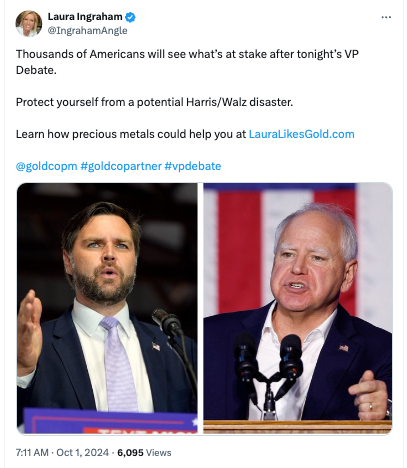
Ingraham’s LauraLikesGold.com testimonial states that “our current Administration has done nothing to make the lives of everyday American families better,” citing factors like “Rising Inflation,” “Increasing National debt,” and “a looming recession.”
“Will it ever get better?” she added. “Expert analysts are not hopeful, which is why I encourage you to learn how gold and silver can be a great way to hedge against these economic factors eating away at your nest egg.”
It is certainly amusing that in exchange for money, Ingraham is warning her audience both that former President Donald Trump may lose the 2024 presidential election and that even if he wins, his economic performance will prove so poor that they need to buy gold and silver as a hedge.
But Ingraham’s paid missive both defies what economists and other experts say about the relative merits of the plans put forward by Vice President Kamala Harris and Trump, and provides a stark example of how right-wing pundits enrich themselves on the backs of their followers.
Analyses: Trump’s plans would lead to higher deficits, higher inflation, and lower growth than Harris’
While Ingraham is urging followers to “protect yourself from a potential Harris/Walz disaster” by buying precious metals from her sponsor as a hedge against inflation, debt, and a recession, experts say that Trump is actually the bigger threat on all counts.
More than 400 economists and policymakers signed a letter last month endorsing Harris and touting her plans to “build a strong, pro-growth economy for all Americans.”
By contrast, the letter stated, Trump’s proposed policies — which include plans for massive tariffs on all imported goods, mass deportations, and reducing the independence of the Federal Reserve — “risk reigniting inflation and threaten the United States’ global standing and domestic economic stability. Nonpartisan researchers have predicted that if Donald Trump successfully enacts his agenda, it will lower GDP growth and increase the unemployment rate.”
The mass endorsement from economists came just weeks after 16 Nobel Prize winners released their own letter warning the American public of the devastating effects of Trump's second term agenda.
A new study from the Peterson Institute for International Economics found that “Trump’s promises would spike inflation and wipe out jobs,” according to CNN. The study concluded that Trump’s proposals, if implemented, would trigger a decline in employment of 2.7% to 9% by 2028; a spike in inflation to between 6% and 9.3% by 2026; and 2.8% to nearly 10% lower economic growth as measured by GDP by the end of a second Trump term.
An assessment of the candidates’ plans from Bloomberg News found that Trump’s tax plans would lead to higher national deficits and debt and higher inflation than would Harris’, while his immigration and trade proposals would hammer growth.
- ### The right-wing media is built on grifting
The financial model for right-wing media is built on what I’ve termed con culture: Outlets and commentators attract a loyal audience through political demagoguery, seal them into a bubble by attacking mainstream information sources that present contradictory narratives, and then bilk those marks for all they are worth.
They tell their audience that companies are liberal and corrupt — whether they sell children’s entertainment or razors or nicotine pouches — then offer their own alternatives.
They tell their audience that they can’t trust medical experts — then sell them out to quacks hawking fake cures for real medical conditions and dubious brain pills.
They tell their audience that economic doom is imminent — then peddle them survival food, scammy financial products, and, in Ingraham’s case, precious metals.
These arrangements can prove extremely lucrative for the pundits.
“Two media dealmakers who have been involved in negotiations between conservative media figures and the gold IRA industry said revenue from the companies can amount to as much as 10 percent of total earnings for some personalities … one said the biggest personalities stand to earn millions of dollars a year,” The Washington Post reported in an investigation last year into the right-wing media’s paid promotion of such companies.
Indeed, Trump himself personifies this type of grift. While running for president, he is currently pitching his followers cryptocurrency, watches priced at up to $100,000, his own version of the Bible, an array of pricey branded shoes, digital trading cards, and much, much more.
===
1 24 an
Trump complains it was 'ridiculous' he had to 'follow the laws' and leave office - Alternet.org
---
an 4 23
https://www.alternet.org/dick-durbin-2659762876/
no lnx
Dick Durbin under fire for letting GOP Senate minority veto Biden judges
Jake Johnson and Common Dreams April 10, 2023
With the disastrous consequences of the far-right's takeover of the federal court system becoming clearer by the day, the Democratic chair of the Senate Judiciary Committee is facing intense criticism for preserving a tradition that is allowing Republicans to veto judges nominated by President Joe Biden.
The so-called "blue slip courtesy" is a nonbinding Senate norm that allows lawmakers to reject nominees for court seats in their home states.
While Republicans didn't hesitate to dispense with the informal rule when they were ramming through far-right judges at a torrid pace during former President Donald Trump's four years in office, Sen. Dick Durbin (D-Ill.) has chosen to adhere to the blue slip norm for district court nominees.
That decision garnered fresh anger last week when Sen. Cindy Hyde-Smith (R-Miss.) announced she would not return a blue slip for Scott Colom, a Biden nominee for the U.S. District Court for the Northern District of Mississippi. Collum had already received approval from Mississippi Sen. Roger Wicker, also a Republican.
CNN noted Monday that "Durbin's office blasted Hyde-Smith's opposition to Colom in a statement that did not indicate whether he was rethinking the blue slip rule."
"The rule has not been respected consistently through the modern history of the Senate, and Republicans nixed the requirement for U.S. circuit court vacancies under Trump. Democrats, now in control, have refused to bring it back for appellate nominees, but Durbin has said he'd like to keep it in place for district courts," the outlet reported. "Durbin didn't waver on that position when Sen. Ron Johnson [R-Wis.] flip-flopped last year on his support of a district court nominee in his home state, state Judge William Pocan, effectively torpedoing Pocan's nomination."
Progressive advocacy groups said Monday that Durbin's refusal to ditch the blue slip tradition was made even more outrageous by a Friday ruling from Trump-appointed U.S. District Judge Matthew Kacsmaryk of Texas, who deemed the Food and Drug Administration's (FDA) approval of the abortion medication mifepristone invalid. The U.S. Justice Department is appealing the ruling.
Shortly after Kacsmaryk handed down his ruling, which parroted anti-abortion talking points, U.S. District Judge Thomas Rice of Washington State—an Obama appointee—issued a conflicting decision ordering the FDA to maintain access to the pill.
"If last week's appalling ruling from a MAGA judge attempting to ban abortion medication has taught us anything, it's that judges matter. Senate Dems must do everything in their power to confirm [Biden's] nominees, including eliminating the blue slip ASAP."
Hyde-Smith praised the Kacsmaryk ruling, calling it a "victory for pregnant mothers and their unborn children."
Durbin's adherence to the blue slip norm has also drawn frustration and backlash from fellow Democrats.
"If it's a blue slip problem and the Republicans aren't turning in their blue slips and they're being obstructionist, then we need to think about changing the rules," Sen. Mazie Hirono (D-Hawaii) told CNN.
In a tweet late Friday, former Rep. Mondaire Jones (D-N.Y.) faulted Durbin for "allowing the blue slip process to prevent confirmation of Democratic judges in red states" as right-wing judges attempt to further weaken abortion rights.
The Senate approved 96 federal judges during Biden's first two years in office, outpacing all of his recent predecessors.
But the upper chamber confirmed just 34% more Biden judges in 2022 compared to the previous year, whereas the Senate under Trump approved 177% more judicial nominees in the former president's second year in the White House than in his first.
The Senate greenlit a record 231 federal judges—not including Supreme Court justices—during Trump's four-year tenure, filling vacancies across the country with young, often unqualified right-wing judges who will have significant power over U.S. law for decades to come.
In addition to further imperiling abortion rights, Trump-appointed judges have recently issued rulings against student debt cancellation, LGBTQ+ protections, and efforts to revoke anti-immigrant policies implemented by the former president.
According to the American Constitution Society, 18 Biden judicial nominees are awaiting floor votes, 12 still must be reported out of the Senate Judiciary Committee, and six are still waiting for hearings.
The Biden administration has thus far refused to pressure Durbin to drop the blue-slip rule entirely, even after Hyde-Smith made clear that she would try to tank Colom's nomination.
Durbin has said the recent and indefinite absence of Sen. Dianne Feinstein's (D-Calif.)—a member of the Senate Judiciary Committee—has had an impact on the panel's ability to advance judges.
CNN observed that since Feinstein's office announced in early March that the senator was hospitalized with shingles, "the committee has only approved one nominee, Judge Matthew Brookman, the GOP-supported appointee for the Indiana district court seat."
But The American Prospect's David Dayen stressed Monday that the Senate GOP only has effective veto power over Biden judges "because Durbin refuses to revoke the blue-slip tradition that willingly grants Republicans the ability to obstruct."
---
---
https://www.mediamatters.org/angelo-carusone/media-matters-angelo-carusone-not-single-thing-can-ever-get-better-country-until
~ norms democ
---
==
checks and balance
fascism? legis ~ courts
3 23
https://www.alternet.org/brian-kemp-republicans/
FL desantis , GA legis law to remove DA's ?! spkr? sponsor fake elector scheme??!
---
---
rubber glue
mma 3 23
MICHAEL KNOWLES (HOST): Pretty much every campaign finance matter is bogus because money is fungible. So if you give X amount of money to a candidate's campaign committee, that can land you in prison. But if you give ten times that amount of money to a Super PAC, that's totally fine. If one group gives money, it's okay. If an individual or a different group gives money that can be a big problem. So it's all basically bogus. But the reason this is especially bogus is that Trump is the candidate and candidates can give as much money to their campaigns as they want.
So even if the prosecutors in New York argue that this was an improper donation to the campaign -- maybe it was done through a kind of improper channel, maybe the paperwork was a little bit off. But it's still Donald Trump donating to his own campaign. It's so patently absurd. It's so obvious that the Democrats here just want to stop the people from having a chance to re-elect Donald Trump because they're afraid that if Trump can appear on a ballot, they're afraid that if Trump can mount a real presidential campaign, that the people will vote for him. And so they're doing everything they can - they tried to disqualify him using the 14th Amendment. They tried to -- they had multiple suits to try to keep him off the ballots in different states around the country. They have tried to impeach him multiple times. They tried -- now they're trying to lock him into prison, from which place he could still run for president, but it obviously would hurt his campaign if he were stuck in a jail cell instead of holding rallies.
It's so obvious that these guys fear Trump and want to do everything they can to prevent the people from having a choice-- that this is the silver lining of this whole storm cloud. The silver lining is that I think we can finally dismiss, once and for all, all the ridiculous piffle that the Democrats tell us about our sacred democracy. Our -- Donald Trump and the Republicans are a threat to our sacred temples of democracy, our cherished norms. We don't act like this in America. We are better than this. No, you're not better than this. You're breaking all the norms. You are undermining our allegedly sacred democracy. You're jailing your political opponents like a two-bit dictator in a banana republic, which some of us conservatives have observed for a long time.So, okay, that's how they want to play, fine. I do not want to hear it anymore about our sacred democracy or any of that other stuff. Don't want to hear it one little bit.
What should the Republicans do in response? I think that a Republican governor or, more precisely, I guess a Republican attorney general, should arrest a prominent criminal lib. There is no shortage of candidates of prominent liberal politicos who have committed crimes. Look around the Clinton circles. Look around the Biden circles. Look at Clinton and Biden themselves. Plenty of big criminal libs out there who have completely gotten off the hook. And there are plenty of Republican governors and attorneys general out there -- I think you would need a Republican governor as well as an attorney general, because if the attorney general indicts a big prominent criminal lib and there's a Democrat governor, the Democrat governor will apply political pressure or eventually, probably, just pardon the criminal lib. So I think you need to have a Republican governor there as well.
But let's do it. Let's -- let's indict a big criminal lib. Let's -- let's indict two of them. That they are going after our guy, let's go after five of their guys. There's no risk here. Some people push back against this suggestion. They say, well, we're better than them, Michael. We're -- yeah, sure. I think we are better than them. I'm not suggesting we do anything illegal or unjust. I'm not saying we go after an innocent lib, I'm saying we should go after a criminal lib against whom the law has not been applied. The argument against doing that is that we want topreserve our norms and we don't want to live in a country where we throw the vanquished political opposition into orange jumpsuits. I agree. I don't want to live in that country.But the only reason for which we should be concerned about that norm is if the norm continues to exist. The libs are breaking that norm, that's not our fault. We have nothing to say. We're saying don't violate the norm. Don't -- don't start arresting the opposition leaders in our country. But if they're going to do that, then we've got to play the game. Otherwise we're just surrendering to the people who are abusing our political system the most.
So, okay, they want to indict Trump? Fine. I want to see every Republican governor and attorney general with the political capital, with the power to do so, to indict prominent criminal libs. And I think you should indict multiple and you should throw the book at them and you should find every stupid little fake misdemeanor charge and you should trump it up as high as you possibly can. Okay? You -- the reason that you have to do this, the reason this would be good for our political order is because it would show the libs that there are consequences to their actions. It would discourage further predations on our political order.
---
---
central fla univ
note always defensive, we did not start fight [but will end it]
an bad 2 23
Appearing to confess frustration, far-right Republican governor Ron DeSantis says he is remaking Florida’s education system because even after turning the state’s Democratic Party into a "rotten carcass on the side of the street," the left "can still impose their agenda on my people."
That "agenda," apparently includes so-called Critical Race Theory (CRT), Environmental, Social, and Corporate Governance (ESG), and Diversity, Equity, and Inclusion (DEI) programs, according to far-right Fox News host Mark Levin who told the Florida governor the right is "in a culture war."
"We didn't start it," Levin told DeSantis. "But what I call the Marxist left, they started it. It is devouring our institutions. It is devouring our politics. It's devouring the private sector."
DeSantis did not disagree.
READ MORE: 'I Struck a Nerve': Robert Reich Makes the Case for Calling Ron DeSantis a 'Fascist'
As he uses the power of his office to pave the road for a likely 2024 run for the White House, DeSantis has not gone unnoticed. He has been accused of being "an Honest-to-God Semi-Fascist," turning Florida into "a laboratory for fascism," running his state "like a fascist," and being a "fascist for our time" and a "one-man civil rights wrecking ball, determined to neutralize any group that doesn't conform to his dangerously narrow view of social order."
All those accusations were before his Sunday night Fox News interview with Levin, who warned that "in the classrooms" there is "the sexualizing of little kids." Levin also said, "Disney, Walt Disney has to be rolling in his grave right now what's happened to Disneyland and Disney World and these other events in the culture."
Asked why he decided to take "the lead in taking this on as far as governors go," DeSantis bragged, "I got reelected November 2022. Largest vote than any Republican governor [in] Florida history has got, largest vote margin any governor candidates ever got. 1.5 million votes."
"I can win by 1.5 million votes. Make the Democratic Party in our state, basically, a rotten carcass on the side of the street. And yet, the left can still impose their agenda on my people if I'm not looking after fighting ESG and other woke companies and some of the stuff going on in the universities and the schools."
"And so I think I have an understanding that these fights are far broader than just one particular election. Yes, you do have to fight the woke in the halls of government and in the legislative chambers, and we have super majorities as Republicans in Florida so we will win all those fights, but you also have to be willing to defend your folks against thisagenda being shoved down their throatfrom all these other institutions, where these people aren't necessarily coming up for election."
DeSantis has infamously veered into pushing his supporters into local school board positions of power.
"So you talk about things with like the young kids and with Disney, and I see that not just through the eyes of a governor but also through the eyes of a dad," DeSantis continued. "You know, we have a six, a four, and a two-year-old at home. And we just believe as parents, we should be able to send our kids to school, have them watch cartoons without having somebody's sexual agenda shoved down their throats."
READ MORE: 'Political Theater': Conservative Rips Ron DeSantis for 'Sucking Up to the Anti-Vaxxers'
"And so when this issue came up, with the sexualization of the curriculum, of course in Florida, we think that that's inappropriate. And you know what? Republican, Democrat, Independent parents agree with us overwhelmingly."
That's debatable. In October Florida Politics reported, "Majorities oppose Ron DeSantis-backed 'Stop WOKE' and parental rights laws," including his "Don't Say Gay" law.
In January, a study by UCLA School of Law's Williams Institute found a large percentage of LGBTQ parents say they are concerned their families will be negatively impacted by DeSantis' laws, including HB 1557, the "Don't Say Gay" law – with some saying they already have been.
"Almost 9 out of 10 (88%) LGBTQ+ parents are very or somewhat concerned about the impact that HB 1557 will have on them and their children, with one in four reporting they have experienced anti-LGBTQ harassment since the law was passed and one in five reporting becoming less out in their communities since the law was passed. Parents have considered a variety of coping strategies in response to the bill, including moving out of the state (56%) and moving their children to a different school (11%). Over 16% of LGBTQ parents have already taken steps to move their families to another state."
Watch a short clip or the full interview below or at this link.
---
---
aha these are norms now backed by law
an 2 23 maya
Election officials, legislators and advocates across the country, who are mostly Democrats, are fighting "the wave of misinformation and mistrust of elections" fueled by election deniers in preparation for the 2024 presidential election, The Washington Post reported on Wednesday.
Inspired by former President Donald Trump's false claims of election fraud during the 2020 election, election deniers have forced election officials and administrators to adhere to "demands that go beyond their official powers — to stop using electronic voting equipment, to hand-count all ballots, to end mail voting or to refuse to certify results."
Per The Post, this "pressure and abuse" has caused "hundreds" of officials to step down from their roles.
READ MORE: 'Corporate America' is now funding the election deniers it once condemned: report'
Now, many Democratic officials are implementing practices to fight against the "election denialism" plaguing many GOP supporters and officials, which will likely persist in the coming year.
The Post reported:
When the new Arizona attorney general took office last month, she repurposed a unit once exclusively devoted to rooting out election fraud to focus on voting rights and ballot access.
In North Carolinaon Tuesday, the State Board of Elections began proceedings that could end with the removal of a county election officer who had refused to certify the 2022 results even as he acknowledged the lack of evidence of irregularities.
And later this week, a group of secretaries of state will showcase a 'Democracy Playbook' that includes stronger protections for election workers and penalties for those who spread misinformation.
READ MORE: Koch group throws support behind two election deniers after dumping Trump
"We want to protect the people who protect democracy," said Michigan Secretary of State Jocelyn Benson (D). "Individuals who intentionally spread misinformation that then leads to threats or worse targeting election officials are just as culpable and should be held culpable just as those who are actually exercising the threats themselves."
Regarding heightened violence from election deniers, Arizona Attorney General Kris Mayes (D) said, "We're facing a new world in which elections officials are experiencing death threats, in which voters are being intimidated by people showing up at the ballot box, at voting centers, wearing body armor and carrying guns, and in which the Republican Party is trying to undermine vote-by-mail. Those are all things that I think this unit can and should now be focused on."
AlterNet previously reported Solomon Peña, an ex-GOP candidate was arrested after he conspired a series of drive-by shootings targeting Democratic lawmakers, claiming his election was "rigged."
Benson is collaborating with Lansing, Michigan legislators to hike up punishments for those who "threaten election officials or releasing private information about them," and taking steps to propose a law that would legislation that would make spreading election misinformation illegal, according to The Post.
NPRreports Pennsylvania is "still grappling with the aftermath of the 2020 election," as the state continues to be "a hotbed for election deniers and misinformation."
William Martin, an election official in suburban Philadelphia said, "I am profoundly offended to listen to baseless allegations of fraud against me and against other county workers. It's time to put up or shut up. If you think there is fraud, sue me. Sue me! Sue me personally. Because then when it gets thrown out, I'll sue you for abuse of process. Sue me!"
Executive director of the County Commissioners Association of Pennsylvania, Lisa Schaefer, contends "Those counties are dealing with people who, over and over, no matter how many times they've seen the evidence of the integrity of the election, continue to come and yell and be insulting."
Canton, Michigan Township Clerk Michael Siegrist reiterated the need to enforce penalties for all forms of election denialism.
READ MORE: 'Loser, loser, loser, loser': Chris Christie dings Donald Trump's list of failed election deniers
"Someone’s going to have to bring some char_{g}_es against some folks," Siegrist told The Post. "This notion of, 'I'm going to come in and try to re-litigate an election afterwards in the court of public opinion,' especially if it relates to a scheme to overturn the validity of an election — that stuff just needs to have consequences."
The Washington Post's full report is available at this link. NPR's can be viewed here.
---
---
comm dr r nader 8 22
Norms, in a society or culture, are the accepted ways of behavior we grow up observing and learning in our everyday lives. Norms are rarely backed up by laws, though when norms are grossly violated, calls for legislation may ensue.
In our country, voluntarily recognized fundamental norms have been breaking down. The chief impetus for this collapse is the ascending supremacy of commercial power over civic values. The surrender of the latter to the former in sector after sector has spelled the decline of our country as measured by its own promise and pretensions. Compared to seventy years ago, there are almost no commercial-free zones anymore. Almost everything is for sale—or should be in the minds of dogmatic free market fundamentalists and its apologists like Milton Friedman and his disciples.
Let's be specific. When I was a schoolboy in the nineteen forties, the top CEOs of the Fortune 300 largest companies kept their pay at about 12 times the salary of the average worker in their business. If any CEO had sought to increase that ratio to 50 or 300 times, he would be roundly condemned from the pulpits to the boards of directors, to civic and charitable groups. In those days, CEOs also did not want to arouse the anger of their industrial labor unions or encourage workers to demand more pay in response.
Now CEOs of major companies pay themselves, via a rubber stamp board of directors, 300 or more times the average worker's salary. Some are more extreme, such as Apple's CEO Tim Cook, whose pay package this year comes down to $833 a MINUTE on a 40-hour week. Hardly a squeak of objection is heard from anyone. Hey, you didn't know? Grab whatever you can get is the mantra of greedy CEOs. Absent any laws on maximum income, scratch one norm for tossing modest pay equity out the window (See, The Case for a Maximum Wage by Sam Pizzigati, 2018).
By contrast, it used to be an unchallenged norm to pay women less for doing the same work as men. No more. In 1963 the Federal Equal Pay Act made it illegal to pay women lower wages than men.
It used to be against strict social norms for companies to sell directly to children, bypassing their parents to exploit youngsters' vulnerabilities. For one, little kids cannot distinguish between ads and programming. Now commercial marketing directly to children—junk food and drink, toxic medicines and cosmetics, harmful toys, violent entertainment videos, and more—is a business approaching a half trillion dollars a year. The iPhone doubles down as a gateway to this electronic child molestation.
The blasphemy of yesterday has become commonplace today.
Gambling used to evoke strong moral condemnation, thereby driving it underground to the back of newsstand stores, often called the "numbers racket." Now gambling is at your fingertips via your computer. State governments run lotteries. Business is moving big time into sports gambling. Casinos are everywhere.
The norms against gambling were promoted by organized religion. When the churches started allowing big bingo in their basements, the defenses against above-ground, organized gambling (apart from Las Vegas) began to crumble. The gambling boosters claimed it would produce tax revenue and help the elderly. This deception was part of the pitch by the builders of the first casinos in Atlantic City, NJ. Now gambling casinos are described as economic development engines, however fraudulent that assertion is seen by economists.
Far from age-old stigmas, a failed gambling czar was selected (by the Electoral College) as U.S. president in 2016. He broke more norms and laws daily than all previous presidents, and until recently has gotten away with these violations.
College sports stars have started selling their likenesses and other emblems—something that for years was verboten and cause for expulsion.
Historically, there have been cruel norms beyond avarice. Some were ensconced into law—such as legalized slavery before the Civil War.
Child labor in dungeon-like factories was not only legal, it was accepted as a norm. It has been illegal for almost a century since the law memorialized the new norm that youngsters should be going to schools instead of going to sweatshops.
It's good to think about norms—big and small—as yardsticks of what kind of society we want. Not doing so, over time, can result in deeply recognized norms such as protecting the personal privacies of the young and old, smashed to smithereens by Facebook, Instagram, and other Internet barons who make huge profits by getting, for free, their customers' detailed personal information every day, which is then sold to advertisers.
Because of the unbridled political power of corporatism and other lawless forces, the rule of law cannot begin to catch up with protecting good norms or replacing cruel norms. This challenge first rests on ourselves, on our reinvigorating civic and educational institutions, on our bar associations, our faith groups, and on each family circle.
That is why it is so important for active citizens who strive to get, for example, health, safety, and economic protection standards made into law by petitions, lawsuits, marches, writings, or lobbying not to despair when they so often lose these battles. For even if they do not prevail, they are keeping alive the public, decent, respectful underlying norms of our society that can be advanced and ultimately provided with legal protections.
You must have some crucial norms you see being fractured or weakened. Speak up about them, otherwise you'll find them going, going, gone. It is time to reverse the lowering of expectations by people. Even big historic norms are under systemic assault, like the vendors' drive to reject cash/check for payments by the incarcerating credit card, payment system Gulag. Or the Trump GOP's massive lies about voter fraud in order for dangerous Republican extremists to enact legislation to obstruct voting and honest vote counting.
---
an 6 22
NO LNX
Talk of secession in Texas means political violence is already here. Thanks to SCOTUS, there will be more
Blackboard with "Texit"written on it (Shutterstock).
John Stoehr June 23, 2022
The Texas Republican Party issued its platform Monday. Among other terrible things, it called for the Lone Star State to secede from the US.[and UN]
This was met with mixed reactions from liberals. On the other hand, some said great – good riddance!On the other, some said secession would mean the abandonment of people who are already on the margins of society. As my friend, the historian Thomas Lecaque said: “Every time you say ‘let them secede,’ slap yourself in your stupid overprivileged face.”
I think there’s a third perspective.
Right-wingers know they’re winning
:{:{}:
}:
Liberals do not, perhaps cannot, see that political violence is normal in this country. Political violence, in fact, is so ubiquitous that one could say it constitutes the political reality of the American experience. We all live inside white power. Serious challenges to it are met violently. There are always serious challenges to it. Political violence is always already normal.
Violent reactions to democracy, however, usually backfire, politically speaking, unless political conditions prevent them from backfiring.
I don’t know exactly what those conditions would be, but they surely involve polarization over the fundamentals of America – over whether it’s a white man’s country. When these conditions allow, political violence stops backfiring. First, it will be tolerated. Then, it will be encouraged.
That tells us something.
That the right-wingers are winning.
And they know it.
We have been tolerating subversive political violence since at least 2012. As I’ve argued, every shooting massacre is in one way or another part of the white-power reaction to Barack Obama’s historic twin victories.The GOP has since then gotten the public tied up in knots over the ins and outs of the Second Amendment. That’s deadlocked public opinion long enough to push political violence as a means of state-level social control.
Forward to 2022, after the J6 coup, to see the evolution from tolerating subversive political violence to encouraging overt political violence.
Indeed, as of this writing, the Supreme Court has issued a ruling that will encourage more overt political violence. In a 6-3 opinion written by Justice Clarence Thomas, the court struck down a 108-year-old New York state open carry law, saying it was too restrictive of Second Amendment rights.
Eric Greitens, a Missouri Republican running for the Senate, made an ad in which he’s holding a shotgun and inviting voters to go RINO hunting. A GOP challenger to Nevada’s Democratic attorney general reportedly told a friend: "This guy should be hanging from a fucking crane.” Couy Griffin, a rightwing organizer with influence on Donald Trump, has often said that “the only good Democrat is a dead Democrat.” The former president reportedly said hanging Vice President Mike Pence wasn’t a bad idea.
All of this is to say talk of secession does not come from nothing.
There is a context. That context features the evolution from subversive political violence to overt political violence. We should remember that.
Illinois Congressman Adam Kinzinger, an anti-Trump Republican, said that political violence is coming. So is a sustained period of democratic instability. But we’re already in that period. We have already seen the evolution from subversive political violence to overt political violence.
That’s why the Texas GOP now formally supports secession.
Talk of secession is a consequence of political violence – especially political violence that is now working in the Republicans’ favor.
Indeed, they appear to believe political violence not only doesn’t backfire anymore – it’s now a political asset. Whatever political violence the future holds will be an expansion of overt political violence that’s already here.
Secession-talk is a sign that they know they’re winning.
Refresh liberalism
As usual, liberals missed it.
:{:{}:
}:
They tend to think political violence is unusual, an interruption of normal life. There’s more to this thinking than the basic human longing for peace.
Unlike rightwingers – unlike anarchists, Marxists, communists, even some progressives – liberals do not seek out conflict, because liberals do not see politics as war by other means. Politics is about problem-solving.
:{:{}:
}:
To liberals, politics is about process, strategy and established rules and norms. And anyway, labelingpeace as normal, and violence as abnormal, pits those encouraging violence against those favoring the status quo.
Which is to say, pits rightwingers against conservatives.
But in order to insist that political violence is abnormal, (white) liberals must pretend that white power is not the political reality we inhabit. By pretending white power has nothing to do with it, (white) liberals end up legitimating the status quo – which is, as I said, already politically violent.
Our precious norms won’t stop political violence.
They’re already politically violent.
:{:{}:
}:
Indeed, by insisting on preserving established rules and norms, liberals paper over the root problem, which is that white power constitutes our political reality. In this way, liberals, I think without meaning to, hasten rather than circumvent the destabilization of American democracy.
:{:{}:
}:
As I said, Kinzinger thinks that’s coming.
No, it’s here.
Liberals think they are addressing political violence. They think that by appealing to peace, law and order, they are seizing the advantage.
They aren’t.
The more they stick to “the rules,” the worse things get. Politics isn’t war by other means. It’s about problem-solving. But when liberalism’s solutions aggravate things, perhaps it’s time to refresh liberalism.
Secession, seschmession
As I said, on the one hand are those welcoming the Texas Republican Party’s support for secession. Good riddance, wrote the Post’s Dana Milbank. On the other hand are those saying no liberal should welcome such a thing, as the human tool of secession would be horrific.
Both sides are missing the political violence that has made talk of secession seem real, credible and plausible (though entirely illegal).
It’s that political violence we need to focus on.
We need to admit it’s here – that it’s been here.
And liberals need new ways of thinking about it.
FROM YOUR SITE ARTICLES
The Federalist Society has 'captured the courts' and stymied action ... ›
Trumpism without Trump: He taught Republicans how to seize ... ›
These far-right secessionists want rural Oregon to become part of ... ›
RELATED ARTICLES AROUND THE WEB
Texas can't secede from the U.S. Here's why. | The Texas Tribune ›
How seriously should we take talk of US state secession? ›
Texas GOP's new platform says Biden didn't really win the 2020 ... ›
---
---
testified day 4 praise RR on election day transfer miracle; dtr term ill, big pathos; xian // VP staff/lawyer in basement 1/6?
https://www.alternet.org/2022/06/donald-trump-rusty-bowers/ attack cohen ctr-punch BS?
https://www.alternet.org/2022/06/arizona-gop-lawmaker/
An Arizona Republican lawmaker is speaking out about the pressures he faced from former President Donald Trump, his personal lawyer Rudy Giuliani, and the former president's allies amid Republicans' attempts to overturn the presidential election.
According to NPR.org, Arizona House Speaker Rusty Bowers (R) recently testified and shared details about his conversations with Giuliani where he claimed undocumented voters were responsible for casting illegal ballots. He also claimed votes had been cast on behalf of a substantial number of deceased individuals.
But instead of just running with Giuliani's claims, Bowers and other Republican legislators requested he provide solid evidence to back the tall accusations. "In my recollection," Bowers said of Giuliani, "he said, We have lots of theories we just don't have the evidence.'"
Bowers also recalled how Giuliani also "pressured him to call the Arizona legislature back into session — a unilateral move Bowers said he cannot do — to recall the electors that would be going to President Biden after Biden beat Trump in the state."
"It is a tenet of my faith that theConstitution is divinely inspired," he said, growing visibly emotional. "I would not do it."
He noted that the former president also echoed similar sentiments but he didn't believe the evidence they provided to back their claims "merited a hearing."
"You are asking me to do something against my oath, andI will not break my oath," he said he told Trump and Giuliani, to which the former New York mayor said: "Aren't we all Republicans here? I would think we'd get a better reception."
Trump-supporting lawyer John Eastman also contacted Bowers by phone as he echoed Trump and Giuliani's demands. "His suggestion was that we would do it, and I said I can't," Bowers said, adding that Eastman pressured him by telling him to "just do it and let the courts sort it out."
In addition to pressure from Trump's allies, Bowers also noted that the former president's supporters also expressed concern about the outcome of the election. He revealed, per NPR.org, that "his office was subject to over 20,000 emails, thousands of voicemails and texts from those who believed he was wrong to not recall the electors."
"Up until recently, it is a new pattern in our lives to worry what will happen on Saturdays," he said of his family. "Because we have various groups come by."
Bowers has also faced a litany of accusations including being called "a pedophile and corrupt politician" as video trucks drive through his neighborhood and threaten his neighbors."It was disturbing," he said emotionally as he recalled what transpired.
3% gun on hip verbally threat neighbor "I knew I had to get close" to WHAT?!
---
---
more discussion of packing and ethics; we used to rely on norms pre-trump, as in so many other gov't functions? a question of checks and balances among branches?
https://www.alternet.org/2022/03/clarence-thomas-2657046647/
tom b raw story
In an interview with Rolling Stone's Andrew Cohen, historian Jeff Shesol said he has no doubt thatSupreme Court Justice Clarence Thomas and his wife Ginni Thomas are in "lockstep" when it comes to believing Donald Trump should still be in the White House and claimed they see what they are doing as a "holy war."
With Cohen writing, "You don’t need to be a legal expert to know that one spouse shouldn’t sit in judgment in a case in which the other spouse is a witness — or a suspect. That’s as classic a conflict of interest as one can imagine and by refusing to acknowledge it Justice Thomas has brought great discredit on himself and his colleagues on the Court," he asked the author of “Supreme Power: Franklin Roosevelt vs The Supreme Court,” what he thinks is going on after revelations about Ginni Thomas' texts urging overturning the 2020 presidential election results.
According to Shesol, the biggest immediate problem is the fact that there is no mechanism in place to force Supreme Court justices to recuse themselves in cases where they have a personal stake as well as their freedom to take public political stances without consequences.
"I wrote for the NYT back in 2011 on the 'extrajudicial' activities of Thomas, [Samuel] Alito, and others," he explained. "They’re even more brazen today, if only because they have never faced any consequences (other than the opprobrium of the left and the mainstream media, opprobrium they welcome) for making political statements to politically minded crowds. You and I can write as many mean articles about them as we’d like, but short of impeachment, they’re untouchable and they revel in it."
According to the historian, he can't be sure Ginni Thomas was talking about her husband when she referenced support for election interference from her "best friend" -- but he has his suspicions.
After stating, "In a very real sense, Clarence and Ginni Thomas are answerable only to Clarence and Ginni Thomas. The Trump Administration gave us all a hard lesson in how few actual rules bind the behavior of our national leaders, and how much depends on their good judgment and self-restraint," he added. "Even if she’s not referring to Justice Thomas, the recent New Yorker story, among others, underscores the absurdity of the notion that (as they’ve claimed) Ginni does her thing and Clarence does his, and that they don’t discuss their work. This is a holy war, and, again, they are waging it in lockstep."
According to Shesol, Ginni Thomas is up to her neck in involvement t in the Jan 6th insurrection and there is little reason to believe that her husband didn't know it.
Explaining, "Ginni played an active role (which seems, with every passing revelation, to have been a greater role than previously disclosed or imagined) in trying to subvert the Constitution by overthrowing the results of a presidential election," he maintained that her husband's decision to side with Donald Trump on hiding White House documents, and his current silence, makes him suspect.
"Her husband’s role, apart from his dissent from that unsigned order, is less clear—though it is clear enough that he acted (or would have acted, if the other conservatives had joined him) in shielding his wife’s role in the plot from scrutiny," he stated. "Though his dissent is silent to his true motivations he has thus involved and implicated himself in the insurrection."
---
---
no lnx
https://www.alternet.org/2022/01/far-right/
A journalist and the author of the book The Next Civil War has published a terrifying but credible overview of the status of American democracy today, just two days before the anniversary of Donald Trump’s January 6 insurrection.
“The right has recognized that the system is in collapse, and it has a plan: violence and solidarity with treasonous far-right factions,” writes Stephen Marche at The Guardian in “The next US civil war is already here – we just refuse to see it.”
“January 6 wasn’t a wake-up call; it was a rallying cry,” Marche says. “Most of the American right have abandoned faith in government as such. Their politics is, increasingly, the politics of the gun. The American left is slower on the uptake, but they are starting to figure out that the system which they give the name of democracy is less deserving of the name every year.”
:{:{}:
}:
He says Americans should not place false hopes in law enforcement officials, including police, saving us.
:{:{}:
}:
“Hard right organization[s] have now infiltrated so many police forces – the connections number in the hundreds – that they have become unreliable allies in the struggle against domestic terrorism.”
:{:{}:
}:
Marche writes that “white supremacists in the United States are not a marginal force; they are inside its institutions,” as he quotes a former undercover FBI agent who used to work on domestic terrorism cases:
:{:{}:
}:
“The 2015 FBI counter-terrorism guide instructs FBI agents, on white supremacist cases, to not put them on the terrorist watch list as agents normally would do,” he says. “Because the police could then look at the watchlist and determine that they are their friends.”
And he blasts the left which he says “has divided into warring factions completely incapable of confronting the seriousness of the moment.”
:{:{}:
}:
The left “must abandon any imagined fantasies about the sanctity of governmental institutions that long ago gave up any claim to legitimacy. Stack the supreme court, end the filibuster, make Washington DC a state, and let the dogs howl, and now, before it is too late. The moment the right takes control of institutions, they will use them to overthrow democracy in its most basic forms; they are already rushing to dissolve whatever norms stand in the way of their full empowerment.”
Read the entire piece here.
---
---
norm #1
salon matt r
There are few words as overused as "revolution," which has many Merriam-Webster definitions and here means "a fundamental change in political organization." While people who discuss politics are prone to dramatic talk of "revolutions," few of the American presidential elections described that way really merit the term. Franklin D. Roosevelt's "revolution" of 1932 changed the nature and role of government in American life, and Ronald Reagan's election in 1980 undid at least some of those changes. But neither election literally altered how our democracy functions.
Those disqualifying details do not apply to the most recent election — the first one ever in which a losing president refused to admit defeat. It's reasonable to describe that as the Revolution of 2020.
There have been two previous elections that could be defined as revolutionary. The more recent was in 1860, which both revealed and reflected a profound rift in the American polity and led directly to the Civil War. Eleven Southern states decided to secede after the Republican victory because they feared Abraham Lincoln's presidency spelled doom for the economic system based on chattel slavery. This story is relevant to the Donald Trump era, but the earlier revolutionary election is our main topic here — and that one is actually known as the Revolution of 1800. As things turned out, it was the rarest kind of revolution: One with a happy ending.
George Washington had served two terms as America's first president, but without facing meaningful opposition or anything resembling a modern election campaign. After he decided not to seek a third term, the 1796 election became the first to feature serious competition between the nation's brand new political parties. Federalist candidate John Adams, who had been Washington's vice president, ultimately prevailed over Thomas Jefferson, former Secretary of State and candidate of the Democratic-Republican Party. But in the momentous election of 1800, Jefferson won the rematch, and Adams — the first incumbent president to be defeated — faced a historic decision: Would he come up with some excuse to cling to power, or simply hand the reins of state to Jefferson and walk away?
If Adams had cried fraud or otherwise claimed the election was illegitimate, he could almost certainly have stayed in office despite electoral defeat. In fact, he wouldn't really have needed much of an excuse. There was almost no precedents for national leaders voluntarily stepping down in the face of popular rebuke, and plenty of examples — from ancient to modern times — that pulled any aspiring dictator in the opposite direction. But Adams was invested in democracy's success, and as such swallowed both his pride and his genuine concerns about Jefferson's political philosophy. He followed the law and surrendered power, and in the process, demonstrated how important the conduct of losing candidates is to democracy. (Like Trump, Adams skipped his successor's inauguration, but he never tried delegitimize his erstwhile rival's presidency.)
Nearly two decades later, it was Jefferson himself who described Adams' actions as the "Revolution of 1800," comparing it to the better-known revolution that had begun 24 years earlier:
... that was as real a revolution in the principles of our government as that of 76. was in it's form; not effected indeed by the sword, as that, but by the rational and peaceable instrument of reform, the suffrage of the people. the nation declared it's will by dismissing functionaries of one principle, and electing those of another, in the two branches, executive and legislative, submitted to their election...
The ideals of self-government captured in the Declaration of Independence, Jefferson was suggesting, did not become reality until American democracy passed its acid test: The person entrusted with the most powerful office in the land accepted a painful verdict. It had been difficult enough for Washington to leave the presidency, even though he was eager to live out his last years as a civilian. For Adams, it was even worse: He badly wanted to continue as president, and on some level expected to win re-election. In accepting defeat, he proved that democratic government wasn't just an ideal. It was also workable.
Adams' precedent was followed without question for the next 220 years, with 10 incumbent presidents leaving office voluntarily after the voters kicked them out. Most were bitterly disappointed by defeat, it's fair to say, but none of Adams' spurned successors — from his own son in 1828 to George H.W. Bush in 1992 — tried to concoct conspiracy theories in order to claim they hadn't really lost. Then came the Revolution of 2020, when the guy who became famous for telling people "You're fired!" on a reality show refused to accept being canned. That catalyst broke the precedent set in the Revolution of 1800 by America's first fired president.
Students of history like me, who spent a lifetime before the 2020 election immersed in the story of American politics, instantly recognized the magnitude of what Trump was doing — and understood that he represented a tendency George Washington himself had warned the young nation about. Washington directly identified the fundamental ingredients that made Trump's coup attempt, starting with a political party so fanatically determined to win that its motivated reasoning could overpower common sense and basic decency. Once the Republicans filled that role, they just needed a demagogue who was sufficiently unscrupulous to exploit that. (Politics is full of egotists, so it says something that Trump was the first politician narcissistic enough to qualify.)
After pointing out that "the very idea of the power and the right of the people to establish government presupposes the duty of every individual to obey the established government," Washington expresses concern that divisive political sentiments — particularly party zealotry — were "destructive of this fundamental principle, and of fatal tendency." In elaborating on this, Washington almost seemed to be looking into the future with a crystal ball. He could hardly have described the hyper-partisanship of our time more precisely if he had actually known about Donald Trump, with all his odious followers and ludicrous assertions. Political parties, Washington writes,
... serve to organize faction, to give it an artificial and extraordinary force; to put, in the place of the delegated will of the nation the will of a party, often a small but artful and enterprising minority of the community; and, according to the alternate triumphs of different parties, to make the public administration the mirror of the ill-concerted and incongruous projects of faction, rather than the organ of consistent and wholesome plans digested by common counsels and modified by mutual interests.
However combinations or associations of the above description may now and then answer popular ends, they are likely, in the course of time and things, to become potent engines, by which cunning, ambitious, and unprincipled men will be enabled to subvert the power of the people and to usurp for themselves the reins of government, destroying afterwards the very engines which have lifted them to unjust dominion.
Washington was able to foresee all of this because the early American republic was not that different from our own time. Though the issues in the 1800 election may seem remote in 2021, Americans were no less invested in politics. Jefferson was alarmed by the way Washington and Adams had centralized control of economic policy in the federal government, such as by creating a national bank, and was convinced their foreign policies were too friendly toward Britain. He was also appalled by the Alien and Sedition Acts, which brutalized immigrants and violated the First Amendment rights of political dissidents. For his part, Adams viewed Jefferson as a libertine and radical whose ideas might push America into the bloody chaos that had overwhelmed France after the revolution of 1789. And all this vitriol was just from the campaign. After the election was decided, Aaron Burr, Jefferson's running mate, tried to seize the presidency for himself through Machiavellian backroom dealings, prompting a serious constitutional crisis and the swift enactment of the 12th Amendment as a corrective.
None of the hostile rhetoric between Trump supporters and Joe Biden supporters in last year's election can match the sheer bile that Adams, Jefferson and their various partisans flung at each other in 1800. The difference, of course, is that only the Republican Party, after being cannibalized and devoured from within by the Trump faction, has actually failed the ultimate test of democracy. The modern GOP produced the only president who refused to honor the American tradition of accepting defeat with grace and relinquishing power peaceably. Exactly what effect the Revolution of 2020 will have on the overall history of American democracy is not clear — but to this point, the signs are not encouraging.
---
aha omg vax is everywhere basically = neg?!
radicalization, polarization --> civil war
perfect storm of gop / koch anti-gubmint BS erodes trust in inst/norms that trump fascists must erode/coopt
kochs did not want to shrink govt to drownd it just samll enough to dereg and small enough to buy/control it, trump delivered
tucker is mainstreaming gt replacement theory, bad trinity in on big lie and anti-vax
---
vax everywhere = neg?
gw denal eroded faith in sci for decades and made us vuln to vaxxer BS --> civil war?!
fox murdochs burn down the world for money and power (vax and AGW) ; koch gopanti-gubmint erode norms,
fox briefly forgot trump TV hacks and acted like a news org and reported FACT that trump lost AZ, immediate threat from oann newsmax reb mercer soc media play
no lnx
Black flag:Understanding the Trumpists' latest threatening symbol
Chauncey DeVega and Salon October 12, 2021
It's an old truism that the "real bad men" (and bad women) "move in silence and violence." That's certainly true for the most dangerous and most effective of Donald Trump's allies, henchmen, henchwomen, and other followers. But for Donald Trump himself, and most of his political cult, that rule does not apply....
---
---
fox officially authoritarian? sorta ag21 global elite morph, ~ norms
yikes omg
https://www.alternet.org/2021/08/josh-hawley-love-america/
Sen. Hawley's Orwellian 'Love America Act' is part of the fascist campaign to rewrite history
no lx
Chauncey DeVega and Salon August 06, 2021
Donald Trump may no longer be president, but the American people are still stuck in a state of malignant normality that his presidency brought into being.
:{:{}:
}:
Psychologist John Gartner describes such a state of being this way:
:{:{}:
}:
Malignant normality is when a malignantly narcissistic leader takes control of society and gradually changes reality for everyone else. So their crazy internal reality becomes enacted in the lived true external reality of that society. This is how a leader can come in and change the mores of their society.
In his role as national cheerleader and secular priest, President Biden is trying to provide moral leadership and healing for a traumatized nation, still shell-shocked by the Trump movement's continuing assault on democracy and society.
Biden's efforts have provided only short-term relief. The neofascist threat is escalating;Biden and the Democrats have shown themselves largely impotent against it. The coronavirus pandemic is now resurgent because of a new variant and Trump's followers' refusal to be vaccinated.
For these and many other reasons — most notably, extreme wealth and income inequality and the global climate crisis — America is becoming a dystopia.
The collective emotional state of many Americans, or at least those who are paying attention and still care, is frustration and unease.
Malignant normality creates a playground for fascism and other forms of right-wing maleficence. The Jim Crow Republicans and other elements of the white right are taking advantage of this broken America to escalate their attacks on free speech, reason, truth, reality, human and civil rights and multiracial democracy by weaponizing the nearly meaningless term "critical race theory." (Yes, the term has a real meaning in academic discourse, but not as bandied about by Republicans in 2021.)
For the likes of Sen. Josh Hawley, the notorious Missouri Republican, such a crisis is a dream opportunity. Last week, Hawley proposed a bill called the Love America Act of 2021, which would deny federal funding to schools that teach the real history of America and the centrality of racism and white supremacy to the country's origins. The key text of this document reads:
:{:{}:
}:
RESTRICTION ON FEDERAL FUNDS FOR TEACHING THAT CERTAIN DOCUMENTS ARE PRODUCTS OF WHITE SUPREMACY OR RACISM — … [N]o Federal funds shall be provided to an educational agency or school that teaches that thePledge of Allegiance, the Declaration of Independence, or the Constitution of the United States is a product of white supremacy or racism.
Hawley's "Love America" bill is not a joke. It is a statement of shared principles and loyalty to an anti-democratic, racial-authoritarian movement that is winning victories all over the United States.
For example, Florida Gov. Ron DeSantis is now mandating thoughtcrime surveys to determine the political beliefs of teachers and students in public colleges and universities.
Florida has also "banned" the teaching of "critical race theory" in public schools, and will permit — in practice, this may mean encourage — students to record classes without the knowledge or consent of their teachers. This potentialsurveillance is an obvious form of intimidation or threat against intellectual freedom, and specifically targeting teachers and other education professionals who are perceived as "liberal" and therefore "unfair" to conservatives.
The Republican-controlled Texas Senate has passed legislation overturning a requirement that the history of the civil rights movement be taught in public schools. That legislation would also remove a course requirement that the Ku Klux Klan should be condemned. As I wrote recently for Salon:
... the requirements removed from the state's curriculum include two speeches by Martin Luther King Jr., any mention of Latino labor organizers Cesar Chavez and Dolores Huerta, and any mention of Thomas Jefferson's long-term relationship with Sally Hemings, an enslaved teenage child who bore six of his children. The bill bars any use of the New York Times' 1619 Project and "prohibits teaching that slavery was part of the 'true' founding of the United States" and removes the requirement to study the "history of white supremacy, including but not limited to the institution of slavery, the eugenics movement, and the Ku Klux Klan, and the ways in which it is morally wrong."
Tennessee has proposed fining school districts at least $1 million if a teacher "willingly violates" state laws against discussing racism, white privilege or sexism in class. Education Week reports, "Teachers could also be disciplined or lose their licenses for teaching that the United States is inherently racist or sexist or making a student feel 'guilt or anguish' because of past actions committed by their race or sex." Similar forms of censorship will be imposed in Oklahoma, where "educators could have their teaching licenses suspended or revoked and schools could lose accreditation if an investigation finds evidence that they taught about racism and sexism in ways that violated the law." Parents in that state will be allowed "to inspect curriculum, instructional materials, classroom assignments, and lesson plans to 'ensure compliance.'"
These attacks on the teaching of actual history are an Orwellian attempt to control both the present and the future in order to remake America as an apartheid regime. Realpolitik is also in play here: Facing changing demographics and political unpopularity, Republicans seek to use a larger culture-war strategy to win elections and hold onto power by any means possible.
White supremacists and other right-wing ideologues, in the longer view, want to destroy public education and replace it with their own propaganda indoctrination program. One important element is "racial erasure," in which the truth about American history is replaced with fantasies of white innocence, white nobility and white supremacy.
As Clint Smith writes in the Atlantic, for many so-called conservatives, "history isn't the story of what actually happened; it is just the story they want to believe. It is not a public story we all share, but an intimate one, passed down like an heirloom, that shapes their sense of who they are. Confederate history is family history, history as eulogy, in which loyalty takes precedence over truth."
Perhaps most important, the right-wing moral panic over "critical race theory" is a way of to erase from public memory the struggle waged by Black Americans for centuries to defeat white supremacy in its various forms. To that point, chattel slavery and theJim Crow regime were America's native forms of fascism. Black people defeated those forces and in doing so saved American democracy from its own worst impulses. To erase the Black Freedom Struggle is to make the case that American fascism will be victorious and that resistance is futile.
It is also crucial to understand that America's state of malignant normality is not isolated or unique, but is part of a neofascist attack by the global right on multiracial and multiethnic democracy around the world. As de facto spokesman for the American white right, Fox News host Tucker Carlson has taken a pilgrimage to Hungary, now under the one-party rule of Viktor Orbán, who has become a role model for the Jim Crow Republican Party and the American neofascist movement.
Orbán has created a fake democracy in Hungary, where elections still occur and tepid opposition is permitted, but in practice he can remain in power indefinitely. He has silenced the free press, crushed any serious democratic opposition, encouraged political violence against his regime's "enemies" and attacked colleges, universities and other centers of learning. The obvious goal is to silence dissent and produce obedient and compliant citizens who do not seek to exercise critical thinking or speak back to power.
In an essay for Vox this week, Zack Beauchamp discusses the larger significance of Carlson's pilgrimage to Budapest:
In his Monday monologue, Carlson told his listeners that they should pay attention to Hungary "if you care about Western civilization, and democracy, and family — and the ferocious assault on all three of those things by leaders of our global institutions." He tweeted out a friendly photo with Hungarian Prime Minister Viktor Orbán and is confirmed to speak at a government-supported conference in Budapest on Saturday. ...
[R]ight-wing observers, typically social conservatives and nationalists, see Orbán's willingness to use state power against the LGBT community, academics, the press, and immigrants as an example of how conservatives can fight back against left-wing cultural power. They either deny Fidesz's authoritarian streak or, more chillingly, argue that it's necessary to defeat the left — a chilling move at a time when the GOP is waging war on American democracy, using tactics eerily reminiscent of the ones Fidesz successfully deployed against Hungary's democratic institutions.
Beauchamp observes that the "Republican turn against democracy" and the American right's growing interest in Orbán's Hungary, expressed with unusual frankness and eloquence by Rod Dreher of the American Conservative, "is in significant part fueled by the right's sense of leftist ascendancy — heightened by electoral defeats in 2008 and 2020 and strengthened by defeat in culture war battles like same-sex marriage":
This, ultimately, is what makes Carlson's pilgrimage to Budapest so worrying. The Fox host's massive following gives him unusual power to set the terms of the conversation on the right; when he talks, Republicans from Trump on down listen. His bear hug embrace of Orbán could not only bring the Dreher view out into the open but also strengthen its influence over the GOP.
Republicans today aren't directly imitating Orbán; they have their own anti-democratic playbook, drawn from all-American sources. Carlson's active embrace of Hungary's strongman risks making that connection more direct, giving Republicans more ideas for how to seize control and a more powerful sense of justification in doing so.
For those who believed that Biden's election could clear the haze and wake the American people up from the living nightmare of the Trump regime, these last seven months have been increasingly painful. And now the pandemic's third wave arrives as a gut punch to them as well. Biden and other Democratic leaders still appear obsessed with "bipartisanship" and to this point have refused to act with the "urgency of now" to fight back against Republican attacks on Black and brown people's right to vote. Even under Attorney General Merrick Garland, the Department of Justice seems to be protecting Donald Trump instead of investigating and prosecuting him for his crimes against democracy. The overall effect is like being smothered.
Conditions are likely to get worse — perhaps much worse, with Republicans likely to recapture one or both houses of Congress in 2022 and Trump likely to return as a presidential candidate in 2024 — before they get better.
To survive and triumph over American neofascism Americans' well of endless optimism must be fortified with something more durable and realistic, such as the formula suggested by Italian philosopher and activistAntonio Gramsci: "optimism of the will and pessimism of the intellect." In Gramsci's "Prison Notebooks,"he wrote: "The crisis consists precisely in the fact that the old is dying and the new cannot be born; in this interregnum a great variety of morbid symptoms appear."
That is precisely where Americans find themselves now: The waking nightmare of the Age of Trump, from which we have not escaped, is one such "morbid symptom." Recognizing that truth may make it possible to return to full political and social consciousness, and begin the real work of repairing and rebuilding American democracy.
FROM YOUR SITE ARTICLES
Derek Chauvin's 22-year prison sentence doesn't erase systemic ... ›
Texas Trump supporters say they're ready to take up arms the ... ›
These two GOP senators are in a head-to-head battle for most ... ›
RELATED ARTICLES AROUND THE WEB
No, Josh Hawley: We don't hate America if we want to learn from… ›
Republican Josh Hawley Widely Mocked for Proposed 'Love ... ›
Josh Hawley proposes anti-critical race theory 'Love America Act' ›
---
---
https://www.alternet.org/2021/07/trump-election-claims/
ME
Since the 2020 presidential election, conservative news outlets have been popping up in droves to continue circulating former President Donald Trump's big lie about the election.
So how are outlets continuing to do this? According to NPR, it is more of a trick of the eye. The publication https://www.npr.org/2021/07/02/1011916687/how-pro-trump-local-news-sites-keep-pushing-2020-election-misinformation.
While the publication appears to be just a local news outlet, NPR reports that it is actually flagship of a news syndicate, known as The Star News Network, which consists of several pro-Trump sites. Like The Georgia Star News, the network has created similar sites for states like Arizona, Ohio, and Florida.
Per NPR:
"Its part of the Star News Network - an expanding network of pro-Trump sites seeking to influence local politics with conservative opinion by mimicking the look and feel of local newspaper sites. The group operates eight state-focused news sites, including in key Electoral College states such as Michigan, Arizona, Ohio and Florida."
By focusing on states where Trump is still heavily favored among voters, the network can continue to circulate misinformation since the audience is still focused on what transpired during and after the election.
During a rally in Ohio Las weekend, Trump also added more fuel to the fire with more dangerous claims of voter fraud.
"The biggest tragedy of all is millions of Americans have lost confidence in their vote," Trump said." We can't let that happen. And that's why I say you have to know what took place in 2020 before you can vote in 2022 or 2024."
To name mafter worse, conservative publisher John Fredericksdefended defended sites and the information they share.
"We work very hard to fund our operation through legitimate advertising of all kinds, people that want to reach our expanding audience," he said. "And if somebody needs to reach informed, motivated readers that want the truth, advertising is a great opportunity for them, is a great [return on investment] potential."
FROM YOUR SITE ARTICLES
- Ivanka Trump distances self from dad's election fraud claims as her ... ›
- Trump rants about 2020 election as MAGA cultist claims the former ... ›
- Revealed: Mitch McConnell begged Bill Barr to 'inject some reality ... ›
RELATED ARTICLES AROUND THE WEB
- AP FACT CHECK: Yes, Trump lost election despite what he says ›
- Giuliani's law license suspended over false Trump election claims ... ›
- Trump Pressed Rosen to Wield Justice Dept. to Back 2020 Election ... ›
--
AHA: correction is a journalistic norm, not a law thus no real penalty for lying or just sloppiness (recall jrnl biz values the scoop 1st, thus speed vs accuracy, and clickbait values hype/eyeballs/ fear hate algo boost]
https://www.npr.org/2021/07/02/1011916687/how-pro-trump-local-news-sites-keep-pushing-2020-election-misinformation.
no lnx
How Pro-Trump Local News Sites Keep Pushing 2020 Election Misinformation
July 2, 20215:00 AM ET
STEPHEN FOWLER
FROM
Georgia Public Broadcasting
Georgia election workers begin their recount of ballots after the November election. Despite three recounts of the tally, former President Donald Trump and his allies falsely claim electoral fraud cost him the state.
If you don't follow politics in Georgia closely — or even if you do — you might be forgiven for not knowing much about The Georgia Star News.
Founded just after the November election when President Biden narrowly flipped the state by about 12,000 votes, it looks like a regular news website with a lifestyle section, a widget for the weather and stories about local and national goings-on.
But the site is more than just a local news outlet. It's part of the Star News Network — an expanding network of pro-Trump sites seeking to influence local politics with conservative opinion by mimicking the look and feel of local newspaper sites. The group operates eight state-focused news sites, including in key Electoral College states such as Michigan, Arizona, Ohio and Florida.
Steve Bannon, a former strategist for former President Donald Trump, described The Georgia Star News in a radio interview as content "you can't get anywhere else."
"We're not Conservative Inc.," he said. "It's very populist, it's very nationalist, it's very MAGA, it's very American First."
Pro-Trump media ecosystem
The Star News sites are part of a larger pro-Trump media ecosystem that emerged over the course of his four years in office. Since last year's election, some of those sites have spent months churning out false content suggesting Trump won the election and claiming that massive electoral fraud will be uncovered.
Many of the Star News sites have been around for a while, but the 2020 election — and an intense focus on swing states like Georgia — has helped the sites' stories reach a much a larger audience.
Georgia's fledgling website gets a boost from publisher John Fredericks' talk radio show that has featured numerous figures from Trump's orbit, including Bannon and former campaign manager Corey Lewandowski. His show also regularly features Georgia Republican politicians who have pushed false claims of election fraud or are challenging those who did not work to overturn the election.
Fredericks, who most recently hosted his talk show from Virginia, came to Georgia ahead of last January's dual Senate runoffs as part of an effort by conservatives (and conservative media) to support then-Sens.Kelly Loeffler and David Perdue's reelection campaign. He alsohosts a TV show on the Real America's Voice networkthat also features Bannon's "War Room: Pandemic" podcast popular with many election skeptics.
So there was a ready-made audience when the Georgia Star published a misleading story mid-June questioning the legitimacy of nearly 20,000 absentee ballots placed in Georgia drop boxes — slightly more than the margin of Biden's victory there.
The story said that Fulton County, which includes Atlanta, could not produce crucial chain of custody documentation for ballots returned in drop boxes, suggesting that the ballots may not have been legitimate.
Days later, county officials were able to find all but eight of those forms, said all the ballots were accounted for — and noted that Georgia's votes were counted three different times in November.
"The most explosive thing" ESCA ECHO
But in the conservative alternate media sphere, the story began to pick up steam. On Fredericks' radio show, Bannon called it "the most explosive thing that I think has happened in the entire process."
From there it ricocheted across the pro-Trump mediasphere to TV networks like One America News and conspiracy sites such as The Gateway Pundit.
But the story was not limited to the fringe of Republican politics: several pro-Trump lawmakers and primary challengers in Georgia demanded an investigation. Republican Secretary of State Brad Raffensperger — himself a frequent target of misinformation, attacks and death threats because of these sites — did too. That led mainstream outlets to run with Raffensperger's response, pushing the story further into the spotlight.
Just a few days after the original Georgia Star story, Trump issued several statements linking to a One America News segment about the misleading story and praising the Georgia Star writer by name for "the incredible reporting you have done."
The Georgia Star hasn't updated its original story, or several follow-up pieces, with Fulton County's release of the data.
In an interview, the story's author, Laura Baigert, blamed the county for providing incomplete documents and information.
"Not our problem to solve" CORRECTION
"If they can't tell us how many forms they have and how many ballots they have, that's an issue for people who are administering an election," she said. "That's not our problem to solve that for them."
At the time, a Fulton County spokeswoman said that the county followed proper procedures in collecting the drop box ballots and the county was continuing to research the few remaining missing chain of custody forms. The county elections director said that staff spent more than 200 hours that week locating the "missing" forms before they were provided to Georgia Public Broadcasting.
But the story breathed new life into Trump's false claims, which he repeated at length during a rally last Saturday in Ohio.
"The biggest tragedy of all is millions of Americans have lost confidence in their vote," he said. "We can't let that happen. And that's why I say you have to know what took place in 2020 before you can vote in 2022 or 2024."
After the rally, Baigert snagged an exclusive half-hour interview with the former president as he rode back to the airport. The next day, an all-caps headline appeared on The Ohio Star, Georgia Star and sister sites in battlegrounds like Michigan and Arizona, touting the conversation and its key takeaway.
"There's no more important issue than the 2020 election," Trump said.
Fredericks defended the outlet's coverage in an interview and said that the Georgia Star is a credible news service for Georgians that acts as an alternative to "fake news" mainstream media."Our goal is to speak truth to power in the world of fake news, and that's really what we're dealing with, that's why we're here," he said. "That's why we have an audience."
Less than seven months into existence, Fredericks said that the website was profitable, thanks to a crush of advertising from local Republican candidates and conservative groups.
"We work very hard to fund our operation through legitimate advertising of all kinds, people that want to reach our expanding audience," he said. "And if somebody needs to reach informed, motivated readers that want the truth, advertising is a great opportunity for them, is a great [return on investment] potential."
More Stories From NPR
HEALTH
Anti-Vaccine Activists Use A Federal Database To Spread Fear About COVID Vaccines
HEALTH
An Anti-Vaccine Film Targeted To Black Americans Spreads False Information
POLITICS
Experts Call It A 'Clown Show' But Arizona 'Audit' Is A Disinformation Blueprint
MEDIA
There's More News Than Ever, But That Doesn't Mean The Truth Is Breaking Through
NATIONAL
Black Lives Matter Fights Disinformation To Keep The Movement Strong
TECHNOLOGY
Facebook Calls Links To Depression Inconclusive. These Researchers Disagree
---
---
univ is an institution (// "gov't schools") that does science, is rational , teaches critical thinking, questioning; but AM values Story 1 sacred, sacrosanct so evil to attack them
trad DTricks is used in election to get pwr, now used to hold onto power, using tools of state = fascism [tho nixon]
aha: // mlk on switch out modifier: good trouble, gang of 5 we are the new/true radicals; appropriation/inversion/perversion of lefty god term[at the same time attacking woke, new PC]; for left/reality racial diversity does being intellecti\ial diversity dofferent POV; builds on Lichter? Horo BS of how lefty commie profs discriminate ~ conservatives; gop is in death spiral, at least demographically so must cheat to preserve minority power[states rights BS ~ HR1 ~ voter suppress, gerry, dark corp $); GOP can't win in mktplace of ideas[libtard bankrunpted by covid fail; must explain away fail by saying media, soc media and univ ~ them
msnbc moral panic: you raise kids w/ right values/american and univ makes them into liberals[and/or gay?]
https://www.alternet.org/2021/06/ron-desantis-2653505905/
Florida goes full fascist': Ron DeSantis sparks furious backlash with ‘authoritarian’ campus political surveys
Raw Story June 23, 2021
Gov. Ron DeSantis signed legislation requiring Florida students, faculty, and staff to register their political views in surveys in an effort to promote "intellectual diversity" at colleges and universities, and the measure set off backlash across social media.
Critics decried the law, which DeSantis claims will promote freedom of speech, as a "thoroughly Orwellian" attempt to gain control over academic debate at institutions of higher learning.
Well, this is thoroughly Orwellian. ?? Faculty and students of Florida, you know what to do! Freep Mini-Trump's stup… https://t.co/N2nEE5UzuM
— Betty Cracker ?? (@Betty Cracker ??)1624454881.0
Well that's got to be unconstitutional: Florida students required to register political views with the state to pro… https://t.co/b1Bh8p98uN
— David Rothkopf (@David Rothkopf)1624455537.0
DeSantis wants to survey university students and staff, with the threat of budget cuts if he doesn't get his way???… https://t.co/IWfcM8nGhI
— Witty Librarian In a Mask (@Witty Librarian In a Mask)1624455089.0
---
---
https://www.alternet.org/2021/06/qanon-2653524968/
Reporter Laura J. Nelson, in an article published by the Los Angeles Times on June 23, takes a look at Californians who have an unlikely combination of beliefs: they are into new age ideology, but are also QAnon supporters.
"A world that has long embraced love, light and acceptance is now making room for something else: QAnon," Nelson reports. "More commonly associated with right-wing groups, the conspiracy theory is spreading through yoga, meditation and other wellness circles. Friends and colleagues have watched with alarm as Instagram influencers and their New Age peers — yogis, energy healers, sound bathers, crystal practitioners, psychics, quantum magicians — embraced QAnon's conspiratorial worldview and sprayed it across social media."
QAnon is a far-right movement that promotes bizarre and outlandish conspiracy theories. According to QAnon, the United States' federal government has been taken over by an international cabal of pedophiles, child sex traffickers, Satanists and cannibals — and former President Donald Trump was put in the White House to fight the cabal. Well-known pro-QAnon extremists in the Republican Party include Rep. Marjorie Taylor Greene of Georgia and Rep. Lauren Boebert of Colorado.
The fact that QAnon has made inroads with far-right Christian fundamentalist evangelicals isn't surprising; the Christian right has long been prone to conspiracy theorists. But the new age community in California seems an unlikely place for QAnon to make inroads.
Nelson, however, reports, "The health, wellness and spirituality world has always been primed for that worldview, followers say. Though largely filled with well-meaning people seeking spiritual or physical comfort, the $1.5-trillion industry can also be a hotbed for conspiracies, magical thinking, dietary supplements with dubious scientific claims and distrust of institutional healthcare, including vaccines."
Julian Walker, a Mar Vista yogi who hosts a podcast called "Conspirituality," told the Times, "It's always been the water we were swimming in. Now, we're seeing what happens when the water rises."
The violent insurrectionists who attacked the U.S. Capitol Building on January 6 included supporters of QAnon as well as members of the Proud Boys, the Oath Keepers and other far-right Trump supporters. And some of those QAnon supporters, Nelson points out, embrace new age beliefs.
Nelson explains, "Several New Age spiritualists in Southern California interviewed by the Times said they knew a total of more than a dozen former friends and colleagues at the January 6 insurrection at the U.S. Capitol with ties to yoga, meditation, energy healing and dietary supplements hawked by multilevel marketing companies. Jake Angeli, whose face paint and horned headgear during the Capitol riot earned him the nickname'the QAnon Shaman,' carried a sign at earlier protests that read, 'Q Sent Me,' and successfully petitioned a federal judge on religious grounds to receive only organic food in jail. One of the best known of the rioters isAlan Hostetter, a ponytailed former police chief, yoga teacher and sound healer from Orange County who spoke at a QAnon conferenceand was indicted by federal officials this month."
Los Angeles-based yoga instructor Seane Corn, who co-founded the group Off the Mat, Into the World, has been warning others in the new age community that QAnon is dangerous.
"Corn was among the wellness leaders who shared a statement in September warning that QAnon's tactics resembled cult psychology and that the ideology would sow confusion, division and paranoia," Nelson reports. "Corn estimates she knows at least ten people who embraced 'hardcore QAnon,' including two people who participated in the attack on the Capitol — and is aware of more than 30 colleagues and peers who subscribe to some forms of the ideology, as well as a 'countless' number of yoga students. Corn said she has watched bots and real-life QAnon devotees try to harness her social media comment sections as a recruiting ground, using 'wellness language and nonviolent communication' in an attempt to lead her followers toward more conspiratorial thinking.
FROM YOUR SITE ARTICLES
- Libertarian journalist explains the links between QAnon and ... ›
- QAnon hasn't gone away — here's what it's morphing into - Alternet ... ›
- How Fox News is now defending QAnon - Alternet.org ›
RELATED ARTICLES AROUND THE WEB
- How three conspiracy theorists took 'Q' and sparked Qanon ›
- An Update to How We Address Movements and Organizations Tied ... ›
- What Is QAnon? The Conspiracy Theory Tiptoeing Into Trump World ... ›
---
---
see stop the steAL, ~ult norm
Donie O'Sullivan is a reporter for CNN. His beat appears to be American conspiracy theories. He was on Anderson Cooper's show last night with reporting on a QAnon conference last weekend during which former Donald Trump adviser and pardoned traitor Michael Flynn said a Myanmar-style military coup "should happen" in America.
That some people in this country long for purifying violence to "reinstate" Donald Trump to his "rightful place" is not what got my attention, though. What did was Donie O'Sullivan's editorial remark at the end of his report. This is what he said:
I spend a lot of time reading these pro-Trump forums, reading these QAnon forums online, and speaking to Trump supporters, and I will say of all the conspiracy theories we hear, this talk from Americans about a coup, cheering a coup, and hoping for a coup, in the United States is one of the most chilling things I hear.
Before I go on, I should say O'Sullivan appears to be an immigrant. (I think he's Irish, given his accent.) As such, I don't expect him to be as attuned to American political culture as I'd expect a native-born American to be. Indeed, as a non-native, I'd expect him to be more attuned to the American civic religion than native-born Americans generally are, because fealty to the civic religion is so often demanded of immigrants....
https://www.alternet.org/2020/11/trump-legal-battles/
---
---
robt r 1220 an
Most of the 74,222,957 Americans who voted to reelect Donald Trump – 46.8 percent of the votes cast in the 2020 presidential election – don't hold Trump accountable for what he's done to America.
Their acceptance of Trump's behavior will be his vilest legacy.
Nearly forty years ago, political scientist James Q. Wilson and criminologist George Kelling observed that a broken window left unattended in a community signals that no one cares if windows are broken there. The broken window is thereby an invitation to throw more stones and break more windows. The message: Do whatever you want here because others have done it and got away with it.
The broken window theory has led to picayune and arbitrary law enforcement in poor communities. But America's most privileged and powerful have been breaking big windows with impunity.
In 2008, Wall Street nearly destroyed the economy. The Street got bailed out while millions of Americans lost their jobs, savings, and homes. Yet no major Wall Street executive ever went to jail.
In more recent years, top executives of Purdue Pharmaceuticals, along with the members of the Sackler family who own it, knew the dangers of OxyContin but did nothing. Executives at Wells Fargo Bank pushed bank employees to defraud customers. Executives at Boeing hid the results of tests showing its 737 Max Jetliner was unsafe. Police chiefs across America looked the other way as police under their command repeatedly killed innocent Black Americans.
Here, too, they've got away with it. These windows remain broken.
Trump has brought impunity to the highest office in the land, wielding a wrecking ball to the most precious windowpane of all – American democracy.
The message? A president can obstruct special counsels' investigations of his wrongdoing, push foreign officials to dig up dirt on political rivals, fire inspectors general who find corruption, order the entire executive branch to refuse congressional subpoenas, flood the Internet with fake information about his opponents, refuse to release his tax returns, accuse the press of being "fake media" and "enemies of the people," and make money off his presidency.
And he can get away with it. Almost half of the electorate will even vote for his reelection.
A president can also lie about the results of an election without a shred of evidence – and yet, according to polls, be believed by the vast majority of those who voted for him.
Trump's recent pardons have broken double-paned windows.
Not only has he shattered the norm for presidential pardons – usually granted because of a petitioner's good conduct after conviction and service of sentence – but he's pardoned people who themselves shattered windows. By pardoning them, he has rendered them unaccountable for their acts.
They include aides convicted of lying to the FBI and threatening potential witnesses in order to protect him; his son-in-law's father, who pleaded guilty to tax evasion, witness tampering, illegal campaign contributions, and lying to the Federal Election Commission; Blackwater security guards convicted of murdering Iraqi civilians, including women and children; Border Patrol agents convicted of assaulting or shooting unarmed suspects; and Republican lawmakers and their aides found guilty of fraud, obstruction of justice and campaign finance violations.
It's not simply the size of the broken window that undermines standards, according to Wilson and Kelling. It's the willingness of society to look the other way. If no one is held accountable, norms collapse.
Trump may face a barrage of lawsuits when he leaves office, possibly including criminal charges. But it's unlikely he'll go to jail. Presidential immunity or a self-pardon will protect him. Prosecutorial discretion would almost certainly argue against indictment, in any event. No former president has ever been convicted of a crime. The mere possibility of a criminal trial for Trump would ignite a partisan brawl across the nation.
Congress may try to limit the power of future presidents – strengthening congressional oversight, fortifying the independence of inspectors general, demanding more financial disclosure, increasing penalties on presidential aides who break laws, restricting the pardon process, and so on.
But Congress – a co-equal branch of government under the Constitution – cannot rein in rogue presidents. And the courts don't want to weigh in on political questions.
The appalling reality is that Trump may get away with it. And in getting away with it he will have changed and degraded the norms governing American presidents. The giant windows he's broken are invitations to a future president to break even more.
Nothing will correct this unless or until an overwhelming majority of Americans recognize and condemn what has occurred.
---
---
aha #1 central sacred norm is leave when you lose; mcconn and gop saying he has right to law/ct is screen for pathology
https://www.alternet.org/2020/11/dont-normalize-trump/
no lnx
Chauncey DeVega and Salon November 28, 2020
Is Donald Trump still attempting a coup with the intention of remaining in power indefinitely? Yes. "I quit" is a phrase that does not appear in theauthoritarian's handbook.
Trump has announced his coup in public, which is a major reason why most people are not taking it seriously.
The president has repeatedly stated that the 2020 presidential election is illegitimate, and should be disregarded because he is not the winner. Given that he is a compulsive liar, on that one matter Trump has been remarkably consistent. Moreover, he signaled as early as 2016 his intent to engage in a coup, and other extralegal or illegal efforts to subvert any election where he does not win.
Joe Biden defeated Donald Trump by more than 6 million votes, and has also received 306 votes to Trump's 232 in the Electoral College. Both outcomes are a mandate from the American people that the Age of Trump is over and its leader should be left on the ash-heap of history, a nightmare to be awakened from.
In response, Trump's agents and followers are staging public protests, filing lawsuits on Trump's behalf claiming that he lost because of "voter fraud," "fake ballots" and other conspiracies, They have threatened violence and an "uprising" against Biden and the Democrats. Trump has not conceded defeat and under legal pressure is now only begrudgingly offering assistance in the transition of power. He is creating an overall environment of political instability, putting his most stalwart loyalists in key national security positions. As befits a political strongman and neofascist, Trump continues punishing the American people by further damaging the nation's economy and literally killing thousands of people each day through a campaign of negligence and sabotage in response to the coronavirus pandemic.
As the Age of Trump shambles toward its conclusion, the United States has again shown itself to be far from exceptional. Trump's coup attempt has put the country and its democracy in a state of limbo and "zombie politics."
In a new essay at the New York Review of Books, Fintan O'Toole explains:
It is impossible not to think, in this in-between moment, of Antonio Gramsci: "The crisis consists precisely in the fact that the old is dying and the new cannot be born; in this interregnum a great variety of morbid symptoms appear." Something is dying, but we do not yet know what. Is it the basic idea of majority rule or is it the most coherent attempt to destroy that idea since the secession of the Confederacy?Something is trying to be born, but we cannot yet say what it is either. Is it an American version of the "managed democracy" or "electoral autocracy" that is the most rapidly expanding political form around the world? Or is it a radically renewed republic that can finally deal with the unfinished business of its history? The old is in a state of suspended animation; the new stands at a threshold it cannot yet cross. …
If Trump is eventually removed from the Oval Office, the study of revenge and immortal hate, not sober self-criticism, will be the response in Trumpworld. There will be no chastening, just a further injection of resentment and conspiracy-mongering.
This is zombie politics — the life-after-death of a former conservative party. And as Gothic stories tell us, it is very hard to kill the undead. One half of a two-party system has passed over into a post-democratic state.
In response to these events, the American mainstream news media and the commentariat, for the most part, are continuing with the same errors in analysis and narrative that helped to elect Trump in 2016 and then normalized his assaults on democracy and the rule of law for the next four years.
They are mocking Trump's defeats in the courts and describing them as though they are sporting events with a running tally of wins and losses. It is assumed to be a fait accompli that Biden is taking office in January. Trump is said to be "flailing" and "throwing tantrums"; and his behavior is "pathetic" and "embarrassing." Trump's coup attempt is "disorganized," as are his supporters with their supposed "low morale."
The possibility that Trump and his agents could find some way to alter the vote count and the assigned electors in key states such as Pennsylvania and Michigan is treated as an absurdity: "The law" and "the courts" would never allow such an outcome.
This is a form of political comfort food or sugar high, feeding a desperate hunger from the mainstream news media, the political class and the American people for a return to normalcy. But on some basic level they must know that Trump's attacks on democracy are abnormal and very dangerous.
Denial helped to birth Trumpism; failure to confront that denial means Trumpism will continue in America long after the man himself is gone.
In reality, Donald Trump, his Republican Party and their allies are playing a different game, one entirely outside of "normal politics" and the "folk theories of democracy" that the Fourth Estate and many other political elites worship like a religion.
Donald Trump and his movement's real goal is to make invalid any future election where Republicans do not win.
The attacks on the 2020 election are also part of a strategy which has shown itself to be successful in the extreme. Republican voters are being conditioned to view the Biden administration as having no legal authority because Trump was "betrayed." The net effect will be to encourage political violence and other acts of resistance by Trump's supporters and other Republican voters.
In a new essay for Medium, Indi Samarajiva reflects on his experience with the attempted coup in Sri Lanka in 2018 and issues a warning:
The tragic thing which you do not understand — which you cannot understand — is that you've already lost. You cannot know exactly what — that's the nature of chaos — but know this. You will lose more than you can bear.
We lost our children, playing at church. We lost our friends, sitting down to brunch. Muslims lost their dignity and rights. Your Republicans have set forces into play they cannot possibly understand and certainly cannot control. And they don't even want to. To them, chaos is a ladder. …
What I can tell you — what anyone who's experienced this can tell you — is that it's going to be bad. I didn't know that churches and hotels would blow up on Easter Sunday, but I know now. I'm trying to tell you in advance. You've opened up a Pandora's box of instability. All kinds of demons come out.
I have lived through a coup. It felt like what you're feeling now. Like watching something stupid and just waiting for it to go away. But it doesn't go away. You can forget about it, but it doesn't go away.
There's a ticking bomb at the heart of your democracy now. Your government, the very idea of governance is fatally wounded. Chaos has been planted at its heart. I don't know what this chaos will grow into, but I can promise you this. It won't be good.
American democracy is very sick. The jubilance and celebration at Trump's apparent defeat on Election Day were highly premature. Biden's victory was a drug that temporarily masked the pain of a democracy in critical condition. The patient can live "normally" until the high of the drug wears off. The crash will be extreme and horrible, almost beyond imagination, because the underlying disease has not been addressed.
The truth of what Trump and his neofascist movement have revealed about America's failures and vulnerabilities must be confronted if that civic disease is to be purged from the country's body politic. The reckoning must also include an assessment of the character and behavior of the tens of millions of Americans who voted for Trump and continue to support him.
On these questions of healing and what comes next after the Age of Trump, Ruth Ben-Ghiat, a leading historian of fascism, had this to say in a recent phone conversation:
We are going to need a lot of grassroots education to help people understand what nefarious influence they were under with Trump. One of the saddest truths is that these men despise the people who love them. They disdain them for giving them their power. Many of us have been amazed that with the pandemic it's been very obvious he doesn't care if they die. He truly doesn't care if you live or die. Helping people to see that will be important to getting them back to the cause of good government, government that cares about public welfare. That's very different than building bridges to forgive people and saying, "OK, well we'll just put your racism behind us." That's not at all what I advocate.
Ultimately, American neofascism as mainstreamed by Donald Trump and his followers is a slow-acting poison. Trump's coup attempt is one more sign that it is working.
FROM YOUR SITE ARTICLES
Trump Uses 'Mein Kampf Playbook' to Normalize Tyranny ›
'This is how you normalize a madman': Scholars and press ... ›
Taunting Trump: How the Campaign to 'Not Normalize' Donald Is ... ›
Don't Let Media and Society Normalize the Neofascists Coming to ... ›
RELATED ARTICLES AROUND THE WEB
Please don't mainstream Trump - The Washington Post ›
Remarks by President Trump Announcing Normalization of ... ›
Don't normalize Trump's America (Opinion) - CNN ›
---
---
aha/doh this is part of tearing down noms/instititions; the press is an inst w/ norms, and are experts b/c they validate facts;
date?
no lnx
What if the right-wing media wins?
Conservative critics of the press want more than just a louder voice. They want The New York Times and The Washington Post to go away.
It was a sweltering July afternoon in the swamp, and a small group of well-dressed, conservative college students from across the country—the next generation of Megyn Kellys, George Wills, and Tucker Carlsons—was filing into an auditorium at the Heritage Foundation’s Washington, DC, headquarters. They had come to study at the feet of Breitbart News Washington editor Matt Boyle, a zealous prophet of the new right-wing media. Boyle’s sermon was not about how to break into the mainstream media and steer the national news agenda toward conservative aims—it was about the end days of journalism itself. And he was not about to skimp on the fire and brimstone.
“Journalistic integrity is dead,” he declared. “There is no such thing anymore. So everything is about weaponization of information.” Standing behind a mahogany podium in a baggy dark suit, Boyle preached with the confidence of a true believer. In a stuttering staccato, he condemned the nation’s preeminent news outlets as “corrupted institutions,” “built on a lie,” and a criminal “syndicate that needs to be dismantled.” Boyle and his compatriots were laboring to usher in an imminent—and glorious—journalistic apocalypse. “We envision a day when CNN is no longer in business. We envision a day when The New York Times closes its doors. I think that day is possible.”
Squint at the Trump era, and it’s easy to see a conservative media in crisis. Over the past 18 months, we have witnessed the fall of Bill O’Reilly, the ouster (and death) of Roger Ailes, prominent conservative outlets from Fox News to Breitbart to The Wall Street Journal op-ed page erupt in upheaval and infighting, Milo Yiannopoulos lose his book deal, and Tomi Lahren lose her job at The Blaze (only to land at Fox). Look closer, though, and you’ll see that much of that drama was simply a function of the outlets’ increased political power (and the heightened scrutiny that’s followed)—a bit of routine turbulence accompanying the unprecedented ascent of the right-wing media.
[ICYMI: You might’ve seen the Times‘s Weinstein story. But did you miss the bombshell published days after?
While Donald Trump’s rise may have, as Politico’s Eliana Johnson recently wrote, “scrambled the pecking order” on the right—elevating Breitbartesque populists over the conservative intellectuals at the Journal and The Weekly Standard—the conservative media complex as a whole is bigger, stronger, and more influential today than it’s ever been. And with so many of its most powerful members now pursuing a scorched-earth assault on America’s journalistic institutions, it’s worth considering what they hope it will look like once they’re done burning down our villages, desecrating our temples, and howling at our lamentations.
Boyle said his goal was simple: “The full destruction and elimination of the entire mainstream media.” Breitbart played up his speech on its homepage that day, but the remarks barely registered in broader media circles. The site and its staff have become known for this kind of bluster, and most journalists have taught themselves to tune it out. Maybe we ought to be paying closer attention.
THERE IS A LONG TRADITION in Republican politics of seeking to discredit journalism. During the 1964 presidential campaign, Barry Goldwater’s press secretary distributed gold pins to reporters that read “Eastern Liberal Press.” Richard Nixon’s vice president, Spiro Agnew, in 1969 railed against the “closed fraternity of privileged men” who ran the national news broadcasts. Nixon’s presidency was ultimately felled by reporters, but the critique lived on.
In the decades since, charges of liberal bias (some of them valid, others less so) have practically become an official plank of the GOP platform. The subject has inspired scores of books, countless talk-radio rants, and the creation of an entire cable news empire whose slogan—“Fair and Balanced”—was coined as a condemnation of its competitors.
Crucially, though, for most of that period conservatives maintained a civic-minded rationale for their project. They said they believed in the importance of nonpartisan journalism; in the necessity of a strong, independent press that provided the citizenry with an accurate account of the day’s events. Ultimately, they claimed, they were practicing tough love—offering their criticisms in the spirit of reform.Bernard Goldberg—a CBS News veteran whose tell-all book Bias entered the conservative canon as soon as it was published in 2001—captured this sentiment during a segment on The O’Reilly Factor.“We all know that you can’t live in a free country without a free press,” Goldberg told host O’Reilly. “But you know what else? You can’t live in a free country for long without a fair press. We need a strong mainstream media. That’s why you and I criticize it.”
Of course, some of this stated concern for the Fourth Estate and its lack of objectivity has been disingenuous. But there was value even in the playacting.By paying lip service to the ideal of “fair and balanced” news, conservatives helped sustain the post-WWII consensus that our modern democracy works best with a robust nonpartisan press functioning as the common denominator.
It was Donald Trump who dropped this pretense.Rather than conceal his true meaning with earnest pleas for a fairer press, he fired off tweets casting the media as “enemy of the American people.” Rather than feign reverence for the First Amendment, he promised to “open up our libel laws” to make suing journalists easier. At campaign rallies, he would keep reporters confined to metal press pens, and lead his crowds in a ritualistic booing. As someone who covered dozens of those events, I always thought I could tell when he was going through the motions with his press-bashing, and when he really meant it. During particularly bad news cycles, his voice would take on a growling quality, and he’d punctuate his standard stump-speech line with an extra exclamation: “Absolute scum. Remember that. Scum. Scum. Totally dishonest people.”
Trump’s histrionics were always strategic. He was able to successfully undermine months of critical coverage and dutiful fact-checking by casting reporters as villains. Each time his campaign was in trouble, the candidate escalated the culture war on the press. By the end of the election, we were not just biased or corrupt—we were dangerous, conspiratorial, part of a shadowy globalist cabal. Just days after Trump was sworn into office, chief White House strategist Steve Bannon told The New York Times, “You’re the opposition party. Not the Democratic Party?.?.?.?.?The media’s the opposition party.”
Bannon’s first move after being dismissed from his White House posting was to huddle with the billionaire Republican donor Robert Mercer who has backed his right-wing populist media crusade. On the afternoon of his firing, he said in a statement to Joshua Green, author of Devil’s Bargain: Steve Bannon, Donald Trump and the Storming of the Presidency, “If there’s any confusion out there, let me clear it up: I’m leaving the White House and going to war for Trump against his opponents—on Capitol Hill, in the media and in corporate America.”
IT DOESN’T REQUIRE AN OVERLY ACTIVE IMAGINATION to picture the post-apocalyptic news landscape that so many conservatives seem to be working toward. Media fragmentation accelerates to warp speed. Agenda-driven publishers—be they professionally staffed websites or one-man YouTube channels—churn out narrowly tailored news for increasingly niche audiences. There’s still plenty of factual reporting to turn to when you want hurricane updates or celebrity news, and adversarial investigative journalism doesn’t quite go out of style. But it’s easier than ever for news consumers to ensconce themselves in hermetically sealed information bubbles and ignore revelations that challenge their worldviews. For most people, “news” ceases to function as a means of enlightenment, and becomes fodder for vitriolic political debates that play out endlessly on social media. (Like I said, it’s not hard to imagine.) Inevitably, the rich and powerful—those who can afford to buy and bankroll their own personal Pravdas—benefit most in this brave new world.
This is, of course, a worst-case scenario. But is it really so far-fetched? Already, many of the nation’s most important outlets—the publications and networks that comprise the core of American journalism—have seen their audience shrink and splinter; their credibility plummet among vast swathes of the public; and their financial futures turn bleak. If The New York Times and ABC News were to shut down or, more likely, dwindle into shells of their former selves, would they be replaced with new mega-outlets that share their resources, their reach, and their editorial values? It’s possible. But it seems just as likely that they wouldn’t be replaced at all.
“This whole idea of media objectivity is relatively new,” says Ben Shapiro, a former Breitbart editor at large who founded and runs the right-wing website Daily Wire. Like other conservatives I talked to, he envisions a return to the media conventions of centuries past, when news was delivered largely by the organs of parties and ideological movements. “At the founding, it was a bunch of partisan press going after each other.” If Shapiro had his way, the news would be a polemical free-for-all and media outlets would give up any pretense of non-partisanship. He dismissed the Pulitzer-winning fact-check site PolitiFact as a “leftist outlet,” and generally rejected the idea that any news organizations should be held up as “grand arbiters of truth and falsity.” The very notion, he says, is “anti-democratic.”
“Basically, I think we ought to get away from drawing strict boundaries around ‘journalism,’” Shapiro told me. He pointed to James O’Keefe, a conservative activist who is famous for producing secretly recorded (and often selectively edited) videos that purport to expose the sins of academia, the media, and the government. “Is he an activist?” Shapiro asks. “Yes. Does he commit journalism? Yes. Is he a journalist? Well, it depends on whether he’s committing acts of journalism in that moment.”
Ann Coulter, the vociferously pro-Trump pundit and author, echoed these sentiments in our email exchange. She told me that virtually all news coverage of the president by the “elite” media—a group she says includes not just The Washington Post and NBC, but also many old-line conservative publications—has been dishonest, frivolous, and pack-like. “Chuck Todd agreeing with Jeff Flake about what a barbarian Trump is isn’t news!” Coulter says. “I guess what I’d like, in my ideal world, is that we all start arguing about issues and ideas.”
I asked her if there was any room in that vision for news outlets that play a neutral, referee-like role—contributing to the debate only by adding facts and debunking falsehoods. Coulter seemed uninterested in the question. The publications that have tried to serve that function, she contends, have become “too screechy and inaccurate,” and have rightly lost the public’s trust. “No serious person would trust either the NYT or WaPo’s ‘FACT CHECK’!”
[ICYMI: Former gossip columnist says there’s one fact about his past relationship with Trump that’s tough to admit
The concept of an obstinately objective press has been under assault in America for some time now, of course, and not just from the right. Critics like NYU’s Jay Rosen argue persuasively that news outlets do a disservice to their audiences when they coat their journalism in a sheen of artificial neutrality. Better to aim for transparency, the argument goes—to be honest about where you’re coming from, and to then strive for fairness and open-minded engagement. But there is a considerable difference between the proponents of this theory and those who cynically celebrate the “weaponization of information” and the rise of “alternative facts.”
The so-called marketplace of ideas only works when reality serves as a regulating force. For constructive debates to take place in a society like ours—and for national consensus to emerge on any given question—it’s essential we start from a broadly agreed-upon set of basic facts. Who will provide them if the mainstream media collapses into a melee of warring partisan publications?
LATE ONE AFTERNOON IN JULY, I met withMatthew Continetti, editor in chief of the Washington Free Beacon, in a pizzeria on the ground floor of the Watergate—the DC office complex that stands today as a concrete brutalist monument to the most iconic journalistic triumph of the 20th century. Continetti is not a bomb-thrower by nature. He is polite and cerebral and meticulous about his diction—often pausing for several seconds to consider his words before answering a question. On the day we met, he had just come from George Washington University, where he teaches a class on the history of the intellectual conservative movement.
Continetti grew up in the middle-class suburbs of northern Virginia with parents whom he describes as not “particularly political.” His conversion to conservatism came at Columbia University, while studying Plato’s Republic during an undergrad class on political philosophy. It was around this same time that he decided to pursue journalism, writing articles for the student newspaper as well as for a conservative national magazine called Campus. Aspiring journalists who lean to the right often face a choice as they prepare to enter the industry: try to carve out a career in the mainstream press, or follow the well-trod path into conservative media? Continetti opted for the latter—working as anintern at National Review while he was attending Columbia, and becoming a star writer at The Weekly Standard after graduating. (In 2012, hemarried Anne Kristol, the daughter of Bill Kristol, the magazine’s founder.)
The site Continetti edits today contains a fair amount of trolling—a running series of Kate Upton clickbait; winking headlines like “Greatest Living President Is Also Fantastic Painter”—but it has also earned a reputation for real-deal journalism. Its reporters run down leads, work their sources, call for comment, and issue corrections when necessary. If a partisan press really is the future, we could do worse than the Free Beacon.
I hoped Continetti might have a more optimistic outlook on the world after the mainstream media’s demise. But as we spoke, he was unremittingly bearish on the prospect that any 21st-century outlet could win the trust of a broad, diverse cross-section of news consumers. “One of the reasons there’s no common denominator in media is there’s really no common denominator in American life,” he told me. “As a general rule, we are a divided society. We have very real disagreements about values, about what’s important.”[ --> choice of "facts"]
I couldn’t help but interject: Shouldn’t facts be the common denominator? I asked, painfully aware that I was exhibiting the kind of journalistic sanctimony that the Free Beacon regularly ridicules.
Continetti exhaled, patiently, and shook his head. “I think the problem you describe is unsolvable,” he told me. “People are going to believe what they want. It’s not my job to tell them what to believe. It’s my job to edit a site that provides new information and adds value every day. Certainly, there are many people, like Howard Dean, who say it’s ‘fake news.’ But OK, I’m not going to control what Howard Dean thinks. He has every right.”A smirk appeared on Continetti’s face. “And I don’t believe a word he says, either.”
IN MANY WAYS, Donald Trump was the perfect candidate to channel the conservative media—the talk radio id personified and plopped onto a debate stage. As someone whose status as a perpetually aggrieved media critic long predated his conversion to conservatism, Trump quickly discovered that rank-and-file Republican voters were an enthusiastic audience for his gripes about the press.[recycled newt debate riposte?] And as Trump worked to reinvent himself as a Republican political celebrity, he naturally took his cues from the popular right-wing media. His first major foray into conservative politics was as the world’s most famous “birther,” championing a conspiracy theory that was gaining steam on talk radio and right-wing blogs. Later, as a candidate, he punctuated his stump speeches with stories he’d read on Breitbartand parroted the talking points he’d picked up watching Fox & Friends.
Trump did face real opposition in the primaries from the conservative intelligentsia. Kristol and New York Times op-ed columnist Ross Douthat were early and outspoken critics, while National Review published an entire anti-Trump issue in the run-up to the Iowa caucuses. But those with the loudest megaphones—people like Rush Limbaugh and Sean Hannity—saw Trump’s affection for them and their tribe, and rewarded it by providing the kind of boosterism that Mitt Romney would have sold one of his sons for.
And so, when Trump won in 2016, it wasn’t just a victory for him and his campaign. It was a coup for the conservative media, whose destructionist attitude toward the mainstream press can now be found at virtually every level—from the hosts of Fox News, to the ascendant internet personalities of the alt-right. “Nothing is grander, nothing is more glorious, nothing is more satisfying, nothing is sweeter, nothing is more validating, nothing is better for America than the death of the mainstream media’s political power,” John Nolte crowed in the Daily Wire the day after the election.
The Gateway Pundit flatly declared, “The mainstream media is your enemy.” And Infowars captured the sentiment by featuring an editorial cartoon depicting right-wing media figures as asteroids hurtling toward earth where news-network dinosaurs await their “extinction.”
In a decidedly dystopian spin on service journalism, some in the conservative media have begun providing their audiences with how-to guides for finishing off the journalistic establishment. Limbaugh told his listeners they should stop consuming news from the mainstream press altogether. “I’ll let you know what they’re up to,” he assured them. “And as a bonus, I’ll nuke it!” Hannity urged his viewers to start targeting individual journalists—and their bosses—on social media. And the alt-right bloggerRoosh Valizadeh has called for a coordinated campaign of bullying aimed at reporters. “Make them appear as ‘uncool’ salarymen in the eyes of the public,” he wrote. “Mock their appearance, their mannerisms, and their weaknesses.”
It would be easy to dismiss all this as performative, and ultimately harmless, trolling. But if the Trump era has taught us anything, it should be that these elements of the conservative media are not to be underestimated. In 2016, they conquered the Republican Party. Now they’re coming for the press.
---
see legal voter supression, dirty tricks
wapo nyt fortune mag:
some lawyers at Jones Day and Porter Wright, which have filed suits about the 2020 vote, said they were worried about undermining
===
---
11/5/20 mcconn already working to undermine pres biden
---
https://www.alternet.org/2020/11/the-gop-should-learn-from-trumps-defeat-but-here-is-why-they-wont/
Based on the current state of election results, there is a real chance that Democratic presidential nominee Joe Biden could be elected the 46th President of the United States — which would be a damning defeat for President Donald Trump and the Republican Party. But despite the possibility of defeat, Frank Rich explains why Republicans still will not get the bigger picture.
In an op-ed published by New York magazine, Rich noted that the great divide in the United States signals a deeper problem that the country will have to reckon with.
"There is a Blue America and there is a Red America, but there is no United States of America," Rich wrote. "A Biden victory cannot mask the fact that this country is divided, 55-45 in raw numbers but 50-50 for all practical intents and purposes, regardless of the Democratic margin in the presidential popular vote."
Rich added, "The fundamental schisms pitting American tribes against each other would remain intact even in the fantastical event that the Electoral College were by some political miracle abolished in the interest of democratizing what we are overly fond of calling the world's greatest democracy."
He went on to explain what this election actually reveals about the country's voting system. Even if Biden withstands the Republican Party's legal efforts to discredit his victory, Trump's dismantling and discrediting of American voting practices exposed many flaws in the United States' systems.
"If Biden survives the GOP's legal and extra-legal efforts to rob him of votes in the determinative battleground states and is sworn in as president, let's skip the sanctimony about how "the system worked." The system is teetering. Trump — in what may be his signal accomplishment — has exposed every weakness in its structure. It turns out that a president can even monkey around with the Postal Service to manipulate election results. He can lie, steal, self-deal, corrupt the legal system, coddle dictators, alienate allies, violate all the internal safeguards intended to prevent executive malfeasance, mismanage a public-health catastrophe that kills his own voters, and get away with it for four long years.
Rich also noted that Trump's loyal followers will continue to hang on to his words regardless of whether his remarks are true or not. Because of that, nothing will be learned from Trump's defeat. Instead of viewing the 2020 election as an opportunity to usher in change and reshape the Republican Party for the future, there will be efforts to justify Trump's defeat and classify it as robbery.
---
---
aha-let: free and fair elections is central fundamental norm, and peaceful transition of power:
https://www.alternet.org/2020/09/trump-has-a-plan-to-steal-the-election-in-fact-he-has-at-least-5-of-them/
dirty tricks authoritarian
==
aha: civil society moderating protects norms eg CLC:
https://www.alternet.org/2020/09/transparent-political-ploy-florida-attorney-general-asks-fbi-to-investigate-bloombergs-efforts-to-restore-felon-voting-rights/
florida Attorney General Ashley Moody, a Republican, has asked the FBI and the state’s Department of Law Enforcement to investigate former New York Mayor Michael Bloomberg‘s efforts to help felons in the state regain their voting rights by paying their court fees, citing “potential violations of election laws.”
Bloomberg has over the last week raised more than $16 million from individuals and private organizations, which he said would go towards paying down fines and fees for nearly 32,000 Black and Latinx Florida voters with felony records. A controversial Florida law forbids former felons from voting unless and until they pay off all money they owe the courts or other legal parties. Critics have called it a “modern day poll tax.”
Florida attorney general Ashley Moody said in the letter that the office of Republican Gov. Ron DeSantis had asked her to look into the issue, CNN reported Wednesday.
“After preliminarily reviewing this limited public information and law, it appears further investigation is warranted,” Moody wrote in a letter to the agencies....
---
https://billmoyers.com/story/gop-led-legal-inquest-into-bloomberg-helping-florida-felons-vote-condemned-as-attempted-voter-suppression/
Florida Attorney General Ashley Moody’s call for state and federal investigations into billionaire Michael Bloomberg’s effort to raise millions to pay off court fees to help Florida felons restore their voting rights was a “gross abuse” of power, “voter suppression,” “a fear-mongering tactic used before” and based on a “fundamental misconception” of anti-corruption laws, according to experienced campaign lawyers and former federal election regulators.
“It’s not just that an investigative process and grand jury proceedings would likely extend past Election Day, but also that we’ve seen this fearmongering tactic used before,” said Jonathan Diaz, legal counsel at the Campaign Legal Center in Washington, D.C., founded by Trevor Potter, a Republican and ex-Federal Election Commission (FEC) chair. “There are countless examples of elected officials or law enforcement announcing ‘bombshell’ investigations like this with no evidence of actual wrongdoing (for example, recentlyin Texas and Georgia) and indeed, no actual conclusions that any misconduct has taken place.”
It’s “outrageous and likely an extortionate threat designed to suppress the vote and deny citizens their constitutional right to vote,” said Benedict Kuehne, the Miami attorney whose team recently won a settlement to save digital images of ballots if there’s a presidential election recount. “Not at all unexpected. But still an abuse of power.”
The fray is the latest development in one of the nation’s most important voting rights battles. Two years ago, a majority of Floridians approved Amendment 4, which restored voting rights for nearly 1.4 million former felons. Florida’s Republican-led state government responded by passing laws and going to court to impede the rights’ restoration, mainly by requiring former felons to pay off all court fees and fines before being eligible to register to vote.
As legal battles are continuing in the courts—where delays mean that these Floridians won’t necessarily be eligible to vote this fall unless they pay fees that typically are between $500 and $5,000—many celebrities and philanthropists have been making donations to the Florida Rights Restoration Coalition (FRRC), which led the Amendment 4 campaign, to help pay the fees.
The FRRC raised about $6 million in the past year for that effort, the Miami Herald reported, noting that celebrities like NBA star LeBron James contributed.To date, FRRC has helped about 4,000 people pay off their fines, NPR reported, noting that an estimated 775,000 former felons have unpaid fines.
But a September 22 Washington Post report that said Bloomberg had raised $16 million to help about 32,000 people clear those debtsprompted Florida Gov. Ron DeSantis to ask the state Attorney General Ashley Moody (both are Republicans) to launch federal and state anti-corruption investigations into Bloomberg’s effort.
Political Theater
Beyond the obvious election-year politics, the issue is what constitutes illegal vote-buying.
“I sent a letter to the Florida Department of Law Enforcement and the Federal Bureau of Investigation into potential violations of election laws,” Florida Attorney General Ashley Moody said via email. “And I have instructed the Statewide Prosecutor to work with law enforcement andany Statewide Grand Jury that the Governor may call.”
On September 23, Moody asked state and federal authorities to investigate whether Bloomberg’s efforts, as reported in the Washington Post, violated state and federal laws that make it illegal to give another person anything of value in exchange for their vote. That Washington Post report quoted an unnamed Bloomberg adviser who said that paying the fines “immediately activates tens of thousands of voters who are predisposed to vote for Joe Biden.”
“Governor DeSantis has asked that my office review recent allegations found in the enclosed September 22, 2020 Washington Post article and relevant law,” began Moody’s letter to the FBI and Florida Department of Law Enforcement. The letter cited a 2016 advisory opinion from Maria Matthews, Florida Division of Elections director, to a now-defunct political committee, saying that “[e]ven otherwise innocuous offering of an incentive simply to vote could run afoul” of corruption laws. Moody concluded, “it appears further investigation is warranted.”
The preceding paragraph in that 2016 opinion, which was not cited in Moody’s cover letter but was found in attached documents, said that the Division of Elections had concluded in the 1980s that Florida law “does not prohibit a person from giving an elector ‘a gift certificate or other consideration if the consideration is not intended to buy or corruptly influence another’s vote.’”
That advisory opinion identifies a tipping point—whether a gift is tied to an explicit vote. Its ambiguity—“[it] could run afoul”—is the hinge upon which Florida Republicans have launched an investigation into Bloomberg, implying, but not concluding, that he has crossed a line into vote-buying. That peg was all that right-wing media needed to start attacking Bloomberg.
On the other hand, the clearer prior precedents in Florida Department of State advisory opinions, and Florida and federal laws that absolve Bloomberg of any wrongdoing, are what has drawn extraordinarily strong denunciations of Moody’s actions by voting rights attorneys, former campaign finance regulators and Florida Democrats.
“Let’s not forget that Florida has spent the last year telling federal courts that these legal debts are simply criminal penalties that have nothing to do with voting and are therefore not a poll tax—but as soon as someone like [former New York] Mayor Bloomberg shows up and offers to help pay them, Florida turns around and accuses him of illegally buying votes,” said the Campaign Legal Center’s Diaz. “The state can’t have it both ways: either it’s charging people to vote in violation of the Constitution and this is a poll tax, or it’s not, and Mayor Bloomberg has done nothing wrong by donating funds to help people become eligible [voters].”
Another former Federal Election Commissioner, Karl Sandstrom (appointed by President Bill Clinton), said that Florida Attorney General Moody was misapplying legal standards by citing an ambiguous state agency opinion to launch a federal and state anti-corruption probe.
“The Florida attorney general’s reading of the relevant statutes flies in [the] face of the rule of lenity which is [a] well-established principle of criminal statutory interpretation that requires a court to apply any unclear or ambiguous law in the manner that is most favorable to the defendant,” he said. “Under her interpretation, a corporation that gives employees time off to vote would be guilty of a felony if the corporation expected that were likely to prefer one candidate over another.”
“This [gambit] raises voter suppression to a whole new level,” said Chris Sautter, an election lawyer specializing in post-election recounts. “What next? Will they start prosecuting voter protection lawyers who advise voters on their rights to cast a ballot?”
Democrats and Florida Lawyers React
Outside of Florida, other seasoned election lawyers said that Bloomberg’s effort was legal.
“I’m not a neutral expert on this,” said Joseph Sandler, one of the Democratic Party’s top campaign lawyers. “But we do advise on this issue all the time, and there’s no doubt in my mind this is legal because payment of the fine is not tied to whether the person agrees or promises to commit to vote at all, let alone to vote for a particular party or candidate. The relevant statutes—which go to corruptly influencing a person to vote a certain way—do not remotely apply. The threats of prosecution for this are indeed a gross abuse [of power].”
Inside Florida, Democrats made the same point. Moody was wrong on the vote-buying law.
“I think the fundamental misconception (whether inadvertent or deliberate) is that enabling people to cast a vote is the same thing as telling them, or demanding of them, to vote in a particular way for a particular candidate. That is just not what is happening here,” said Joseph Geller, a Democratic state legislator and veteran of Florida’s 2000 presidential recount. “These potential voters are being freed to vote, but there is no insistence or requirement as to how they will exercise their discretion as to which candidates they will vote for.”
Of course, it is impossible to separate the timing of Moody’s call for state and federal investigations from the 2020 election cycle. Her action’s purpose was to deter voting by the roughly 32,000 former felons for whom Bloomberg was poised to clear the existing court fees.
“Our thoughts are: yes, donors can pay off the fines and fees of Floridians. The Florida AG’s outrageous letter is a blatant voter suppression tactic that has no basis in law,” said Corey Goldstone, a Campaign Legal Center spokesman. “We’re treating it more like a press release than a serious legal filing. None of these people have to vote, no one has been induced to take any particular action. The donors who are contributing to the Florida Rights Restoration Council merely allows people to be eligible to vote—something that most people enjoy cost-free.”
==
actually a law not a norm
https://www.alternet.org/2020/04/outgoing-intel-ig-michael-atkinson-says-trump-abruptly-fired-him-for-fulfilling-his-legal-obligations/
https://www.alternet.org/2020/04/pure-retaliation-trump-fires-inspector-general-who-sounded-alarm-about-ukraine-whistleblower-complaint/
no lnx
‘Pure retaliation’: Trump fires inspector general who sounded alarm about Ukraine whistleblower complaint
Written by Julia Conley / Common Dreams April 5, 2020
---
https://www.alternet.org/2020/04/pure-retaliation-trump-fires-inspector-general-who-sounded-alarm-about-ukraine-whistleblower-complaint/
no lnx
‘Pure retaliation’: Trump fires inspector general who sounded alarm about Ukraine whistleblower complaint
Written by Julia Conley / Common Dreams April 5, 2020
Democratic lawmakers and government watchdogs on Saturday condemned President Donald Trump’s abrupt dismissal of Michael Atkinson, the intelligence community inspector general who informed Congress last year of the whistleblower complaint which kicked off Trump’s eventual impeachment proceedings.
Two months after being acquitted by the Senate, Trump on Friday night told lawmakers in a letter to the House and Senate Intelligence Committees that he no longer had confidence in Atkinson.
“It is vital that I have the fullest confidence in the appointees serving as inspectors general,” the president wrote (pdf). “That is no longer the case with regard to this inspector general.”
Atkinson’s firing will be in effect in early May, 30 days from Trump’s announcement.
Rep. Adam Schiff (D-Calif.), chair of the House Intelligence Committee, condemned Trump’s decision, which he viewed as retaliation against Atkinson for informing Congress of the White House communications with Ukraine last year which were at the center of the impeachment hearings.
Trump’s dead of night decision to fire ICIG Michael Atkinson is another blatant attempt to gut the independence of the Intelligence Community and retaliate against those who dare to expose presidential wrongdoing.
It puts our country and national security at even greater risk. pic.twitter.com/Pnm7chdIkl
— Adam Schiff (@RepAdamSchiff) April 4, 2020
Disagreeing with then-acting Director of National Intelligence Joseph Maguire’s decision to take the whistleblower complaint to Trump’s Justice Department, Atkinson alerted Congress about the complaint regarding Trump’s conversations with Ukrainian President Volodymyr Zelensky,in which he asked Zelensky to publicly launch a corruption investigation into former Vice President Joe Biden and his son, Hunter.
Daniel Goldman, who served as counsel to the House Democrats during the impeachment hearings, said Atkinson “followed the law with the utmost integrity” and accused Trump of seeking “pure retaliation, retribution, and reprisal.”
I saw Michael Atkinson up close. He followed the law with the utmost integrity. He did nothing to lose Trump’s confidence other than lawfully and properly expose Trump’s misconduct and the ensuing efforts to cover it up. This is pure retaliation, retribution and reprisal. https://t.co/GStcTOJn4J
— Daniel Goldman (@danielsgoldman) April 4, 2020
Trump was also rebuked by the Council of the Inspectors General on Integrity and Efficiency.
“Inspector General Atkinson is known throughout the Inspector General community for his integrity, professionalism, and commitment to the rule of law and independent oversight,” said council chairman Michael Horowitz. “That includes his actions in handling the Ukraine whistleblower complaint, which the then Acting Director of National Intelligence stated in congressional testimony was done ‘by the book’ and consistent with the law.”
National security analyst Clint Watts wrote that Trump chose to fire Atkinson while Americans are focused on the coronavirus pandemic, which has spread to more than 278,000 Americans and has killed more than 7,000.
“While the world is rightly distracted by COVID19, we see leaders around the world with authoritarian tendencies subverting democracy. U.S. is no different,” Watts tweeted, suggesting a comparison between Trump and far-right Hungarian Prime Minister Viktor Orbán, who secured dictatorial powers this week through an emergency law passed by Parliament.
Death of American democracy, one Friday firing at a time, people are usually fired for not doing their job, Atkinson was literally fired for doing his job and following the law. https://t.co/o1X719iEox
— Clint Watts (@selectedwisdom) April 4, 2020
At the Center for Responsibility and Ethics in Washington (CREW), deputy director Donald K. Sherman suggested the American public could soon learn that Atkinson’s firing may have been brought about by actions unrelated to last year’s whistleblower complaint and Trump’s impeachment.
Everyone is assuming this move is retaliation for something we know #Atkinson Atkinson did — sounding the alarm on the Ukraine whistleblower complaint— but what if it’s for launching an investigation into something we don’t yet know about? https://t.co/oF1TF60Tk4
— Donald K. Sherman (@donaldonethics) April 4, 2020
“The question we need to ask right now is what investigations or audits did Atkinson start in the last few months,” Sherman wrote. “Were any related to intelligence failures around coronavirus? Why would he be fired so abruptly AND placed on administrative leave?”
---
---
omg
https://www.alternet.org/2020/03/bill-moyers-and-dahlia-lithwick-break-down-how-the-courts-have-proven-they-have-trumps-back/
Bill Moyers and Dahlia Lithwick break down how the courts have proven they have Trump’s back
President Donald J. Trump, Judge Brett M. Kavanaugh and Anthony M. Kennedy, retired Associate Justice of the Supreme Court of the United States, walk together Monday, Oct. 8, 2018, to the East Room of the White House in Washington, D.C. (Official White House Photo by Joyce N. Boghosian)
Written by Bill Moyers / BillMoyers.Com March 24, 2020
Dahlia Lithwick: Hi there.
...
Bill Moyers: I guess you won’t be hanging out at the Supreme Court anytime soon, right?
Dahlia Lithwick: No. No, they’re not hanging out there either, so. It’s really unprecedented to just scuttle arguments. Justice Ginsberg is 87, so I think it is for the best. But it is really extraordinary times that we are living through.
Bill Moyers: Yeah, I remember something you said, “If ever there was a time for the American legal profession to put down its yellow pads and stand up for the rule of law, it’s today—”
Dahlia Lithwick: Yeah, after Donald Trump was elected, I felt so strongly that lawyers were gonna be the bulwark, that it was clear that he was gonna be assailing the rule of law, and then I really believed that lawyers were going to find lines that couldn’t be crossed.
And that the United States was a country that was built on the proposition that there is no king, and that you have nothing if you don’t have the rule of law. I mean, I think I really believed all that. And who are the gladiators in that fight if not the lawyers?
I did expect that lawyers would be on the front lines. And I watched the day of the travel ban a week after the inauguration — it was the lawyers who ran out to the airports. It was the lawyers who parked themselves at the baggage claims [and] held up signs that said, “I’m just a tax attorney, but I’m here to help you get into the country–” I mean, I really thought that was setting a precedent wherein the lawyers were always gonna be the first ones out. And I’m not sure that materialized the way I expected.
Bill Moyers: If lawyers are failing us, where are we?
Dahlia Lithwick: I think there are so many component pieces of that. I think that you can look at the Mueller Report and the ways in which the findings of that report were distorted by Donald Trump’s own attorney general to imply that nothing had gone wrong.
I think you can look at declarations of emergency at the border last year, where no emergency existed, just to get funding that Congress had already said they were declining to offer. The travel ban itself. One after another, actions taken that really pushed the boundaries of what the executive branch can do.
And just the sort of dispiriting ways in which the Justice Department has doubled down on pressing some of those truly lawless actions, and so we saw Bill Barr at the highest levels of the Justice Department interfere with the Roger Stone sentencing.
This was unprecedented. Nobody had ever seen the president by tweet say, “Maybe we should change the sentence,” and have Bill Barr and very, very senior members of the Justice Department intervene — where line prosecutors had been working on this case for years. And I think we saw on that day, we saw four DOJ (Department of Justice) lawyers walk away from the case, one from the Justice Department, rather than be involved in that prosecution anymore.
But I think it can’t be these tiny little acts of resistance. It really does require the kinda thing that I think we saw in the days following, where we had thousands of prosecutors signing memos and immense numbers of former Justice Department officials saying, “We can’t proceed this way.”
But I think maybe the answer to your question is that so much of the rule of law, as it turns out, was built on soft norms, not on regulations and statutes and constitutional directives. And I think that we all think that this machinery is more robust than it really is. It turns out it’s tissue thin if we don’t fight for it.
Bill Moyers: I used to think that norms were sort of the unwritten Constitution like English procedures and propriety. But that doesn’t seem to hold up anymore.
:{:{}:
}:
Dahlia Lithwick: I remember when Merrick Garland was denied a hearing or a vote or even courtesy meetings in the Senate. And I thought, at the time, this is a norm. It is a norm that the president gets to put up a nominee, and that person gets a hearing and a vote. And I think that, time and time and time again in the last few years, I’ve found myself answering these questions about how can this be happening? How can Bill Barr personally intercede in the Roger Stone sentencing?
I think the answer is those were a bunch of norms that were put together post-Watergate. They never had the force of law. It was a set of decisions that this is how the polity would thrive post-Watergate. And I think it’s just such a chilling lesson for all of us that this is a series of gentlemen’s agreements about how we conduct ourselves; it’s not the law.
Bill Moyers: In the meantime, as you’ve written,Trump has weaponized the law in several ways. Talk about that for a moment.
Dahlia Lithwick: Well, I think the most chilling [thing] that we are seeing now is certainly the use of his own Justice Department to go after anybody who’s been disloyal. And also, as we just mentioned, using the Justice Department to exculpate, whether it’s through a lighter sentence for Roger Stone, or using his pardon power to pardon people like Joe Arpaio right at the very beginning.
Trump: I stand by my pardon of Sheriff Joe and I think the people of Arizona who really know him best would agree with me.
Bill Moyers: Arizona Sheriff Joe Arpaio who took a hard-line against immigrants.
Dahlia Lithwick: Who had people in camps dying on his watch, who had this hard-line, anti-immigrant worldview that was so brutal — that there was no question that what he was accused of doing, he had done. And I think that time and time and time again, we’re seeing Donald Trump use the pardon power to say, “There’s really no such thing as white collar crime. There’s no such thing as being too hard on illegal immigrants. There’s no such thing as being — whatever it is that he himself — sometimes — engages in.”
And I think that, in addition to really kind of rejiggering the entire Justice Department so that it seems as though it answers to him personally, I mean, that’s always been his worldview. He wanted an attorney general and he complained about Jeff Sessions, that Jeff Sessions wasn’t loyal, and he wanted Jim Comey to be loyal. Even Don McGahn, his White House counsel, who ended up leaving, was not sufficiently loyal.
And I think he’s really got a notion that he’s like a Nero character — an emperor — and that the law works for him and responds to him. And in so many different configurations, we’ve seen him rescinding DACA by tweet. Making decisions about the dreamers thousands and thousands of dreamers on a whim. Making decisions about “don’t ask, don’t tell” on a whim.
And then we have the entire apparatus of government scurrying to effectuate that, to make it happen for him. But I guess the paradox is not just that he’s weaponized the rule of law, but that the rule of law has rushed to meet him, and to bolster his notions that he is above the law.
Bill Moyers: How do you battle with someone who thinks the law is just a win-or-lose game? And a commodity you can buy and sell? How do you deal with that? How do we fight back?
Dahlia Lithwick: One of the most revelatory books I’ve read this year is by an attorney whose name is Jim Zirin. He has a book out that talks about all the ways in which Donald Trump as president is behaving exactly the way Donald Trump as quote/unquote real estate mogul behaved.
There was a playbook, and it long predates the presidency. This was, believe it or not, the Roy Cohn playbook that goes all the way back to Donald Trump and his dad when they were accused of racist practices in rentals long ago. And it’s a really useful sort of road map to know what the behaviors are. And the behaviors are pretty typical if you are a real estate, very, very wealthy real estate mogul because it’s the same things over and over: It’s sue everybody, chill people from coming forward by terrorizing them. Make sure that your plaintiffs are subject to heinous, horrific abuse, repeated abuse, until they can’t [fight back] anymore.
Bill Moyers: And at the right time, to your advantage, you walk away from the mess you’ve created, declare bankruptcy, and leave the laborers, the contractors, the everyday workers, the creditors to bear the costs, right?
Dahlia Lithwick: Just bury them in litigation, bury them in discovery so that they don’t wanna go forward with the lawsuits. File all sorts of frivolous, frivolous claims, knowing that at some point, you’re just exhausting the other side. I mean, these are just the ways that this person who in his capacity as Donald Trump before he was president just used the levers of the legal system constantly.
He would be sued. He would have people who did work on his properties that he never paid. Trump University, the casino bankruptcies, every one of these lawsuits — he just fought back by hiring armies of lawyers who did what he said. And you’re quite right. The cost of picking up the debris afterwards, whether it’s Trump University or Trump steaks or whatever the detritus is, that’s not on the rich guy. That’s not on his lawyers. They profit either way.
That is exactly how he uses his private attorneys. That’s how he was using Rudy Giuliani, to go and stir up dirt and all sorts of false claims about Joe and Hunter Biden in Ukraine. So he has a very myopic kind of transactional view of lawyers are his — they’re his plumbers. They get the job done.
Bill Moyers: And they’re well paid for it.
Dahlia Lithwick: We’re learning there are many fundamental flaws in the system of capitalism that we have tethered ourselves to. But one of the flaws is that, for a very, very long time, rich men — whether it was Harvey Weinstein or Donald Trump — very, very rich men were able to surround their selves with armies of loyal attorneys who would do whatever they were asked to do. And that’s exactly how he’s trying to use his Justice Department today.
Bill Moyers: When a president takes his playbook from a crooked lawyer like Roy Cohn in the 1970s and uses it to run the United States government today, what are we supposed to do?
Dahlia Lithwick: It’s such a different paradigm because every president, whether or not you agreed with George Bush, used his White House counsel in certain ways, [and] used the Justice Department and his attorney general in certain ways. But [now] we have a president who simply just indefatigably using his lawyers to beat up the weak and to protect his own usually financial interests. And so there’s not a model on a big constitutional scale for what you do when the president wanted a Roy Cohn, got a Roy Cohn in Bill Barr, and is proceeding to just break stuff.
Bill Moyers: Has it occurred to you that the president prefers to govern by chaos, I mean, it detracts journalists from covering other things he’s doing. I’m reaching right now on my desk for a story I read just this morning inCounterPunch. The headline is, “The Supreme Court is set to strike a major blow against social and environmental protections.” It would amount to the evisceration of regulations that protect our health and safety as citizens. Did you know about this? Are you aware of this?
Dahlia Lithwick: Yeah. This is part of a really — and you’re so right. This is happening almost in the dark of night. It’s happening on page A12, if there at all, because page A1 is the chaos. And way, way back, under the fold in the middle of the paper, there is this stealth attack on government agencies and their ability to regulate themselves. And you’re also quite right, it is happening, at the U.S. Supreme Court under our noses. And, what you’re describing is the sort of ascendancy of what was once a kind of fringe theory that Justice Antonin Scalia put forth about agencies and the limits on their power.And this idea of the unitary executive, that every single thing in the executive branch is subordinate to the president.
That was a crackpot idea once upon a time. And you are quite right, it is pushing its way into the very epicenter of several arguments that the Court is hearing this year. And this idea that — it’s called technically the nondelegation doctrine, and it essentially says that we can gut agency authority, for instance the Clean Air Act, the Clean Water Act. We can gut agencies’ ability to have kind of ongoing oversight of problems.
It was once seen as a really fringe idea that is now being used. I think Justice Elena Kagan has described it as it is going to be used to end government as we know it.
Bill Moyers: She’s actually said that the conservative majority will eventually essentially rule that, quote, “Most of the government is unconstitutional.” And it makes me think, and I wonder if it does you, that the right wingers on the Court were put there to enact the Republican platform into law.
Dahlia Lithwick: It’s such a good question and it’s funny because it gets ignored. We get very, very focused, I think, on Neil Gorsuch and Brett Kavanaugh and questions of abortion, and maybe to a lesser degree questions of religious liberty, right? The Hobby Lobby questions about whether religious dissenters can be forced to do things they don’t want to do.
But I think you’re exactly right, that simmering under those issues both Kavanaugh and Gorsuch were quite openly kind of auditioning to be on the Supreme Court with their writings, very explicit writings in the vein that you’re describing. Writings that would seek to do away with the administrative state, do away with the power of government regulatory agencies, whether it’s the (CFPB Consumer Financial Protection Bureau) or the EPA. Efforts to essentially say all of those agencies answer to the president and he can hire and fire at whim. And he can constrain their authority at whim.
That was not a stealth campaign. They were doing that, both justices — Gorsuch and Kavanaugh — were doing that very, very openly, talking about those things. And I think you’re quite right, we got very, very hyper-focused in both of their confirmation hearings on other issues, equally important issues. But I think we looked away from their records on hobbling federal government as we know it. And you’re quite right, I think they were put on the Court to do just that. And we’re seeing, in two short years, they are doing just that.
Bill Moyers: Brett Kavanaugh wrote last year in favor of forbidding Congress from allowing federal agencies, quote, “To exercise regulatory authority over a major policy question of great economic and political importance.” But I thought Congress was supposed to deal with questions like that. What do you make of this?
Dahlia Lithwick: What I make of it is exactly the words you just said, which is this would give the Supreme Court itself authority to say, “Yeah, we just don’t like these regulations. These ones are not good. This agency isn’t right.” And to really eviscerate the regulatory state as we know it. And this goes way beyond the 2020 election. If you have a 5-4 majority on the Court that really believes that using these kinds of doctrines to chip away at agency power, this is going to be kind of sealed into the mix for decades.
Bill Moyers: So you’ve written, Dahlia, about how, in recent years, the Supreme Court has issued ruling after ruling awarding more power to large corporations. This would be the biggest payoff ever to the big businesses, wouldn’t it? I mean, the Republican-controlled Court would have a veto power over all federal regulations?
Dahlia Lithwick: It’s unbelievable. And again, I think it is a pincer when you look at it — twinned with — the issues you’re talking about where, the Chambers of Commerce and big, big corporations have never won the way they’re winning now. Their win rate in the John Roberts court is like nothing we have seen since before the New Deal.
And so I think what you’re seeing is, on the one hand,gutting of unionswhich this Court has been involved in. Giving huge rights to corporations, whether it’s Citizens United or Hobby Lobby. This slow progression of doing away with workers’ rights and protections for the little guy, protections in all sorts of contexts.
And, at the same time, as you say, the cherry on top is doing away with agency regulations that regulates big businesses. And these big business cases, whether they’re affording huge new rights to businesses, or big wins to businesses that are trying to fight back any attempt to cabin corporate power and union power.
The Clean Air Act, the Clean Water Act, the CFPB — any of these agencies — can be just tossed away at the whim of the Court.Those two things together are a huge, huge boon for business, and they are massively costly, not just for workers, but for the environment, and for women’s rights, and for the rights of the elderly. So many entities that are not afforded protections when the Court is only looking out for corporations...
==
==
https://www.alternet.org/2020/02/trump-supporters-have-little-trust-in-societys-institutions-heres-why-thats-disturbing/
https://theconversation.com/trump-supporters-have-little-trust-in-societal-institutions-131113
...Donald Trump has a history of disregarding advice from experts, including diplomats, military leaders, trade experts and scientists.
Trump is not alone in his distrust. Our unpublished research shows that people who support Trump have lower trust in societal institutions, when compared with supporters of leading Democratic candidates Elizabeth Warren, Bernie Sanders and Joe Biden.
Trust ratings
We asked 930 U.S. residents via an online survey how much they trust six institutions that are key to a working democracy.
We chose three institutions that Americans perceive as liberal – journalists, professors and scientists – and three that conservatives either traditionally support or currently control – the police, the Supreme Court and the federal government. Each institution fulfills an essential role within a democratic society, but depends on the others to function properly.
We also asked participants to report how warm or cold they felt toward Trump, Warren, Sanders and Biden on a scale from 0 to 100.
Even when we controlled for age, education, gender, ethnicity and ideology, Trump supporters had the lowest trust in the six institutions, at 3.75 out of 7 – at least 11.4% lower than anyone else we surveyed.
That means that the patterns we are seeing aren’t caused by fitting a particular demographic profile or having conservative beliefs. In fact, conservatives who do not support Trump had the highest trust in these institutions.
This suggests that there’s something about supporting Trump that shapes how much trust Americans have in the country’s core social and political institutions.
When we looked at each institution individually, we found that Trump supporters had significantly lower trust in journalists, professors and scientists – the more stereotypically liberal institutions – than supporters of the Democratic candidates.
[graf]
But the reverse was not true. Democratic candidate supporters trusted the police, the Supreme Court and the federal government as much as Trump supporters. The one exception was Biden supporters, who actually trusted the Supreme Court significantly more than Trump supporters did.
A tower of trust
Although our sample was not representative of the U.S. population, we think that these findings provide valuable insight into the state of U.S. democracy.
We don’t yet know which comes first. Does being a Trump supporter lead to lower trust in societal institutions, does having lower trust in these institutions lead people to support Trump, or do both play a role?
If being a Trump supporter leads to low trust, this could be a result of Trump’s influence, given his apparent distrust in expert advice. If people who have low trust in these institutions are attracted to supporting Trump, then this is cause for concern, considering that previous research shows that politicians are more responsive to their supporters than they are to the general public.
Politicians have the trust of their supporters, and those supporters generally trust some institutions as well. That gives those institutions power to hold the politicians accountable. If the supporters don’t trust in institutions, they have less power to enforce accountability.
Research has shown that institutions are most efficient and effective when people trust them.
The interdependent nature of institutions means that if one becomes ineffective, the others will be affected as well. For example, if citizens lose trust in journalists, journalists will not be able to keep citizens informed. If citizens are ill-informed, they may not make the best decisions when voting or lobbying their democratic representatives, which in turn may decrease the effectiveness of the government.
Like a stack of Jenga blocks, each institution that is removed makes the whole stack less stable.
:{:{}:
- Media
- Academia
- Police
- Federal Government
- Polls
- Trust
- US Supreme Court
- Polling
- Donald Trump
- Conservatives
- Scientists
- liberals
- Quick reads
- Charts
- Political polarization
}:
---
wow sane and smart defense of instititions/norms
much including parties become a platform for performance TO BUILD BRAND (signalling virtue) vs a mold (it makes us think/act in certain ways); often ppl ptretend to be outsiders, build personal brand
bktv
Yuval Levin, "A Time to Build"American Enterprise Institute director Yuval Levin offered his thoughts on…
==
==
aha not just graft, authoritarian 220
https://www.alternet.org/2020/02/obama-was-unprepared-for-trump-and-the-gops-total-has-abandonment-of-the-rule-of-law-wapo-editor/
no lnx
Obama was unprepared for Trump — and the GOP’s total abandonment of the rule of law: WaPo editor
Written by Chauncey DeVega / Salon February 9, 2020
Along with global climate disaster, the global right’s assault on democracy is the defining story of the last decade.
In its attacks on pluralism and democracy, the global right employs the language ofpopulism.In practice, the right’s use of that term is intentionally vague. “Populist” does not mean all citizens and other people living in a given country. Instead, it tends to be a racially and ethnically exclusive movement in which the in-group (usually white right-wing Christians in the United States) is defined as the “authentic” or “real” citizens. In contrast, the Other (usually nonwhites, Muslims and immigrants more generally) is marked as an enemy outsider and threat.
In the United States, “populist” nativism has historically been coupled with white supremacy.
At present this takes the form of President Trump and his administration’s white supremacist campaign against black and brown people, here at home and around the world. The Trump regime’s efforts include changes to immigration laws designed to maintain a “white” majority, detention centers and concentration camps specifically targeting Hispanic and Latino migrants and refugees, and efforts to keep African Americans and other non-whites from voting. Trump’s obsession with building a wall on the U.S.-Mexico border is the literal manifestation of America’s long, ugly history of racially authoritarian “populism.”
Moreover, it is important to highlight that Trumpism does not exist in isolation. It is the next iteration of the Tea Party movement launched against Barack Obama, the United States’ first black president. As political scientist Christopher Parker has shown, the Tea Party movement was mobilized by white racial anxiety and overt anti-black and anti-brown hostility against Barack Obama, as well as a more specific belief that white Americans were somehow being “replaced” and were under attack. As understood by the Tea Party — and now by Trump supporters and the Republican Party as a whole — Democrats are “traitors” who are not “real Americans.” The fact that the Democratic Party is a multiracial coalition while the Republican Party is almost exclusively white is central to the latter’s claims and assumptions about what it means to be a “real American.”
Public opinion and other research shows that being “white” has long been associated with what it means to be an “American.” Of course, white Americans have no more of a legitimate claim to what it means to be a “real American” than do nonwhites.
In total, these debates about “Americanness” reflect how (white) American conservatives have spent many decades developing a brand name — however undeserved — as “patriots” who speak for and represent “real America.” In this narrative, liberals and progressives are somehow “un-American,” not “patriotic” and therefore “anti-American”. In the Age of Trump, those who want a more equitable, free and just American democracy are still struggling to shed those right-wing slurs.
Questions of national belonging, patriotism, loyalty and what it means to be a “real American” are the personal lived family history of David Maraniss. He is an associate editor at the Washington Post and the author of many books, including bestselling biographies of Bill Clinton, Barack Obama, Roberto Clemente and Vince Lombardi.
Maraniss’ new book, “A Good American Family,” is clearly his most personal. It explores the life and experiences of his father, the journalist Elliott Maraniss, who stood up for civil liberties and human rights against the House Un-American Activities Committee (HUAC) and its agents during the McCarthy period of the 1950s. David Maraniss has won the the Pulitzer Prize for journalism twice and was a finalist on three other occasions.
In this conversation, Maraniss reflects on Donald Trump and the threat he represents to the American presidency as an institution. Maraniss also explains how Barack Obama’s idealism and assumptions about the reasonableness and intelligence of other people left him unprepared for the rise of Trump and for the way Republicans have jettisoned norms of political civility and respect for the Constitution and the rule of law.
Maraniss also shares what he learned from his father’s life of principle and courage and its lessons for a United States where truth itself is being assaulted by Fox News and the right-wing disinformation machine.
As is customary, this conversation has been edited for clarity and length. You can also listen to my full conversation with David Maraniss here.
How do you make sense of Donald Trump’s presidency?
The whole world is upside down right now. I don’t know quite how to deal with it as a biographer and a reporter. I’m actually glad, in a way, that I’m not covering Trump on a daily basis. And I’m certainly never going to write a biography about him because I don’t think there’s much there beyond the obvious. Trump is just a flaccid, self-inflated, monomaniacal person. Aside from murderers, if you were to pick the 200 worst people in the United States, one of them is our president, Donald Trump.
Trump really is a human cartoon character. How do you write the biography of such a person?
I do not know the answer. That is one of the reasons why I would never do it. There’s no depth there at all. The one thing that one could perhaps explore are the forces that shaped Donald Trump, meaning his father and his life before he got to the presidency. But when you’re looking for anything inside of Donald Trump, I do not think there is anything there except for incredible neediness. All presidents are needy. I’ve written about one of the neediest, Bill Clinton. But Bill Clinton is nothing in terms of neediness as compared to Donald Trump.
What of so-called “presidential temperament?” How does the office shape the man, and in turn how does the man shape the office?
The institution has not shaped Trump at all. If I recall correctly, Trump promised that he would be “presidential.” What a joke that was. But the question is whether Trump has exploded things so much that we can never get back to the way it was. Previous administrations were nowhere near perfect, but there were certain expectations of presidential behavior. Those expectations are gone now. The presidency has not shaped Donald Trump. I believe that Trump is unshapeable except in his own needy mind. The only circumstances that impact Donald Trump are if somebody likes him or doesn’t like him.
Toward the end of Barack Obama’s second term, I was at the barbershop. As is common in the black community at the barbershop and hair salon, there was a conversation about politics. Everybody was so excited about Hillary Clinton winning the presidential election. But one older gentleman there had been actively involved in the Civil Rights Movement during the 1950s. He said to the rest of us in the barbershop, “Are you guys idiots? How are you going to have a black president twice and then not have Donald Trump?” Of course he was right.
I do not know if that outcome was obvious to the rest of us. That gentleman was definitely right. Race has been the American dilemma from the country’s inception, and it still is. Barack Obama had a special capacity to appeal to people’s better instincts. But Trump has the opposite ability, to appeal to people’s worst instincts — and those worst instincts are racist.
Now Hillary Clinton was no Barack Obama. Barack had his own flaws, of course. But in terms of dignity, intelligence, reliability, and honesty, he was at the top in all of those categories. That probably infuriated people who were racist even more. The whole attack on Obama began with the most racist claim of all, that being “birtherism.” Trump was at the root of those claims and he certainly took advantage of them.
Am I being too hard on Obama? I was disappointed that he was not more forceful and direct about Russian interference in the 2016 presidential election. He knew what was going on but chose not to be more public in his intervention.
Obama was playing by rules that the other side was not. That has been a dilemma for the Democrats for a while now. The Democrats are still playing by normal standards and the Republicans have only one thing in mind, and that is to wield and hold onto power, period.
I’ve analyzed Barack Obama. He grew up, came out of nowhere, and out of dysfunction. He spent about nine years of his young adult life, from age 17 to 27, really trying to figure himself out. Who he was politically, racially, philosophically and emotionally.
I think Obama did a pretty good job of figuring out how to become an integrated personality. That journey helped to propel him to the White House. But it also got Obama in trouble politically because he sort of reasoned, “Well, if I can figure out all the contradictions the world threw at me, why can’t everybody else?” That led to his famous 2004 speech about blue America and red America and a mentality that did not allow Obama to see the full dimensions of the power that was being used against him and his idealistic notion of humanity. This lack of understanding was going to lead to trouble in different ways — even though Obama has a very honorable way of looking at the world.
Who is Barack Obama in his own narrative?
I believe that President Obama thought of himself in a heroic context. He came to think of himself that way when he started getting into politics. It was a type of savior mentality. I have talked to several people who know Obama and they told me they have seen him come close to saying such a thing a few times in unguarded moments.
There are so many connections between the Age of Trump and the HUAC hearings and the Red Scare. Trump and his minions believe that they are on the right side of history while they harass people and assault the rule of law and democracy. The same can be said of those behind HUAC and the Red Scare. They too thought they were “patriots” while they were destroying the lives of other Americans.
They thought that my father and people like him were treasonous. These people imagined themselves to be the “good Americans” and that my father was not. My father had belonged to the Communist Party USA for a while. He’d also believed in racial justice and was against the evils of Naziism and fascism. My father witnessed the troubles with the capitalist system during the Great Depression, and those are the issues that drew him to radical politics.
But my father loved this country and wanted to make it better. He did not want a violent overthrow of the government — which was the lie that the other side spread about him and others. My father was being called “un-American” by a chairman of the House Un-American Activities Committee, a racist from Georgia who had voted against every civil rights bill and once belonged to the Ku Klux Klan. That man had even driven the car that carried the body of a Jewish industrialist after he was lynched in Marietta, Georgia, in 1913. Who decides who’s American? That’s the central question of the book.
How did the Republican Party develop this narrative where they are the country’s “true patriots” — even when their behavior, especially under Trump, has very often betrayed and undermined America’s democracy, security and freedom?
It’s still with us. It started decades ago and the Democratic Party in particular has been on the defensive ever since. During that post-war period of, say, 1946 to 1957, everything was defined by the Cold War and its accompanying fear and hysteria. Fear was used as a political weapon, much as it is today. The Democrats and/or liberals found themselves walking this fine line between their belief in civil liberties and their fears that they would be pushed out of power because of being defined as soft on something — be it “soft on Communism” or “soft on socialism” or “soft on patriotism.” And the Republican party seized that issue in a way that has been dominant ever since. With a few exceptions, Republicans and conservatives have been able to get away with doing that.
Who gets to define what it means to be a “real American”?
You see that thread from then to now. From the Muslim ban and the treatment of human beings at the Southern border to the disparagement of Hispanic judges. The racist voter suppression laws which are only aimed at preventing minorities from voting. All of these are way that Trump and the Republicans and their supporters are limiting the definition of “American.” “Make America Great Again”? Great toward what? To the days when the country was racially segregated? When women couldn’t vote? When black people couldn’t vote? This is a story of white male dominance.
What does it mean to be a “good American”?
I think the way I try to do that is to not to look at people through a dominant ideological lens. There are conservative people that I disagree with in every possible respect, who I nonetheless respect as human beings. I don’t view them ideologically unless someone tries to impose their ideology on others in a restrictive way and not in an opening way.
Who was your dad to you?
I’d spent my career studying strangers, from Roberto Clemente and Barack Obama to Vince Lombardi and Bill Clinton. After years of research, they became familiar to me. And here I was starting with someone, my father, who was intimately familiar to me. I was afraid I’d end up seeing a stranger. That did not happen. I had a pretty close relationship with my father. He did not talk about that horrible period when he was blacklisted for five years. I was only two when it happened.
It was a shadow over our lives, but I saw my father as an optimistic survivor all along, and that’s what he proves to be in this book. I saw him in a good marriage and with children who thrived. I saw my father mainly as a newspaper guy. I mean, he just loved everything about newspapers and the First Amendment and freedom of speech and the freedom of the press. My father oozed that in every ounce of his body. So, when I think of my dad, I think of him at an old-fashioned manual typewriter, banging something out or editing some copy.
What did your father teach you?
He taught me through his words and speech not to fall for any rigid ideology. Search for the truth, wherever it takes you. Root for the underdogs. Don’t trust people in power. Hate racism more than the racists. Hate the institutional power that shapes people more than the people themselves.
I think I inherited the ability to write from him because I’m pathetic at everything else. All my siblings are scholars and I was the ink-stained wretch among them. I’m glad I got the gift to write from my father.
We need more dangerous thinking and dangerous truth in America. It is essential to fighting back against authoritarianism. Your dad seemed to internalize that principle and calling.
It was dangerous then. It’s dangerous now and it requires a certain amount of courage, which I wish more people had. My father had that courage and he invested it in his children.
How did your father make his decision not to snitch on his friends and colleagues to the HUAC committee? Was it a dramatic decision? Something that was a given because of his principles?
I wish I could ask him that question, as I can only go by what I reported through the transcripts, the archives, his letters and his writings. I think it was partly the context of the times and who he was with. But more than that it was my father’s internal DNA, his makeup. My father was not going to snitch. It was built into my father to stand on your principles and not to blame what happens because of that choice on anybody else.
What lessons would you glean from your father’s example? What does it mean to be a person of conscience who is self-aware of their principles and doing the right thing?
It’s easier to say than to do, but I’ve tried to live by a standard of doing things that will never make me have regrets and never leave me not proud about where I stood and why I stood there. Too many people act out of fear. That is what the bullies want you to do. So, again, overcoming fear and realizing that you will be in a better place if you stand by your principles, always. Again, it’s easier said than done, but that’s what I try to live by. People have to find their own way, but I just want them to find their own way and be themselves and not what other people want them to be.
Many people, especially young folks, may only recently have learned about HUAC and the Red Scare because of the Oscar-winning film “Trumbo.” What lessons does that period hold for the Age of Trump?
Aside from the political manipulation of fear and hysteria? The use of a narrow definition of what it means to be an American. The strongest lesson from then to now is the importance of civil liberties at the root of our democracy.
What is your greatest anxiety about this moment?
What’s scaring me the most — and this is a personal thing — is how these events have threatened my own optimism. I’ve been an optimist my whole life, maybe naively. But I am feeling very vulnerable right now in terms of that optimism and the march of humankind. Perhaps more so than I ever have in my life before this time.
We’re struggling with a similar type of cynicism. We as a people have survived much worse than Donald Trump. That being said, matters are going to get much worse than the average American is willing to accept.
Yes, we have survived far worse in this country. My optimistic statement is that the short term is iffy, but I think the long term is better. I hope that’s true, but I’m not sure.
What was it like to get to know your father through researching your new book? Was it a profound moment of discovery? Confirmation of what you already knew of him and the man he was?
It was both. When I saw the editorial he wrote for the Michigan Daily in 1939, rationalizing the Nazi-Soviet pact, I shook my head and said, “Come on, Dad, what are you thinking?” I think it was a pretty indefensible position.
And then, when I came across the statement that my father wanted to deliver to the House Un-American Activities Committee, that they would not let him read — I found it 60 years later in the National Archives — a three-page statement that was really a powerful expression of his belief in freedom of speech and freedom of the press and what he felt it meant to be an American. That was overwhelming. That statement washed over me in a way that I’d never experienced before. I was finally putting myself in my father’s shoes after all that time, understanding and feeling what it must have been like for him when he was in the crucible.
How did your father survive that crucible?
It certainly was a test and he did not avoid it. He survived it. I don’t know that I would have had the same strength. My father had this great survival instinct and optimism which he gave to me. His motto was, “It could be worse.” He knew that millions of people were going through worse things than he had. He knew that every African American in the country had gone through worse things than he had. He knew that was true for every Native American. And he knew that a lot of people had suffered personal tragedies far greater than him being blacklisted for five years.
A through line across your work, and certainly your father’s life, is the question of truth. What is the importance of truth in this moment?
That is a complicated question because what is truth? I know what facts are, and I know what lies are. But I think there is a common sense of truth out there. It is complex, but always there for the finding. The manipulation of the truth is the Orwellian horror that we are living through right now with Trump in the United States and other countries as well.
Why are there so many people in the news media — journalists, reporters, the chattering class at large — who are afraid to tell the truth about Trumpism and how we as a country and people arrived at this moment?
Some people in the news media and press are afraid of being called “biased.” Everything does not have two sides. There are certain things like global warming which are undeniably true. There are others who are intimidated by that tradition of “fair and balanced.” And there are other people in the news media and elsewhere who do not even care what the truth is. All they know is what they want to portray. That is Fox News and Breitbart and other places like that. So much of the Republican establishment right now has fallen down that rabbit hole.
==
aha: djt/bannon present as disruptor, but basically used elim or norms, experts and SOP for self-ish graft/power grab
---
https://www.alternet.org/2019/11/the-rise-and-fall-of-rudy-giuliani-how-americas-mayor-became-trumps-grifter/
no lnx
The rise and fall of Rudy Giuliani: How ‘America’s mayor’ became Trump’s grifter
Written by The Washington Monthly November 18, 2019
Rudy Giuliani was a shoo-in for attorney general or secretary of the Department of Homeland Security in a nascent Trump administration. Not only was Giuliani “America’s Mayor” following his command of the situation on 9/11, he was a former federal prosecutor, presidential candidate, and an early validator—if late endorser—of Donald J. Trump.
Life looked pretty rosy for the ambitious pol, with a clear path to power and privilege, given his expertise.
He didn’t want the jobs proffered, however. He wanted something bigger.
Whether he was done with the law or just wanted something that approximated the power and prestige of the presidency, he postured and heavily lobbied to be Trump’s secretary of state. As the former mayor of America’s most important city, he was regularly in the company of foreign dignitaries and, of course, 9/11 gave him a global stage from which to show off his leadership skills.
But translating international experience and foreign hobnobbing into policy focused on America’s global role required diplomatic skill not often associated with New York moxie. It would have been a hard sell—even to a pliant Republican-dominated U.S. Senate. After all, John McCain—and even Lindsey Graham 1.0—were actively looking out for America’s national security interests back then.
Giuliani’s jones-ing to become America’s lead diplomat seemed to have more to do with a desire for his own publicly financed jet and private traveling press corps than any real interest or ability to negotiate long, hard hours toward solutions that required uncomfortable trade-offs. He wanted the position’s perks and platform more than the work—or the extraordinarily demanding work schedule that comes with the job.
Fast forward to 2019, and the Giuliani scorned by Jared Kushner has become the roiling Rudy who plays Donald Trump’s personal attorney on TV. Giuliani has never met a Sunday news show he doesn’t like. Trump has turned to this anti-matinee idol and put personal business and state policy in the hands of a freewheeling, out-of-control—and sometimes crazed—Giuliani. His uncanny ability to stay simultaneously both on message and off—yet claim to be reliably consistent and coherent—has allowed him to play rough in all positions of Trump’s political defense and remain untouched.
Until now.
Now he’s all lawyered up, as investigators in the U.S. House release State Department officials’ closed-door testimony implicating Giuliani in Trump’s move to withhold military aid from Ukraine unless it agreed to investigate Democratic candidate Joe Biden and his son Hunter.
Giuliani so desperately needed to play the globetrotting role of secretary of State that he got to become Trump’s “Shadow Secretary.” In that role, he used presidential proximity to guide America’s foreign activities, fire its diplomats, bully its allies, and bank on the nation’s sheer power to leverage lethal aid into forced foreign state-sponsored oppo research on 2020 Democratic presidential candidates.
Biden became the target of the externally run, illicitly operated Giuliani Shadow State Department, doing the Trump-Kushner-Pompeo trio’s dirty work while operating with Oval Office assurances that his free hand and opaque operation was guarded by attorney-client privilege. This questionable privilege was also supposed to protect Michael Cohen, Trump’s previous personal attorney. Cohen is now serving a prison sentence for doing Trump’s shadowy business.
A one-man, oversight-free, power-drenched Shadow State Department is a heady thing. Giuliani recognized that he no longer had to play by the same rules as a government agency. He could operate the way Betsy DeVos’s brother, Erik Prince, did with his paramilitary organization, Blackwater. Renamed Xe, Blackwater was a private entity conducting a contracted war, freed from the constraints of treaty obligations, multilateral engagement, long-standing bilateral relations, protocol, congressional oversight, budgetary limits, press access, or full transparency.
Giuliani was as free to disregard established foreign policy and practice as Prince’s locked-and-loaded organization was to end-run military rules of engagement.Bonus points: Giuliani also was able to profit as a free agent. Who was going to question his private authority when the imperial presidency, with its seemingly unchecked privilege, had his back and could dangle a potential blanket pardon?...
---
marantz anti-social book bktv: no poster of Kurt Kobain : due respect to established norms, bc we all want to think of ourselves as rebels
---
https://www.alternet.org/2019/11/the-rise-and-fall-of-rudy-giuliani-how-americas-mayor-became-trumps-grifter/
no lnx
The rise and fall of Rudy Giuliani: How ‘America’s mayor’ became Trump’s grifter
Written by The Washington Monthly November 18, 2019
Rudy Giuliani was a shoo-in for attorney general or secretary of the Department of Homeland Security in a nascent Trump administration. Not only was Giuliani “America’s Mayor” following his command of the situation on 9/11, he was a former federal prosecutor, presidential candidate, and an early validator—if late endorser—of Donald J. Trump.
Life looked pretty rosy for the ambitious pol, with a clear path to power and privilege, given his expertise.
He didn’t want the jobs proffered, however. He wanted something bigger.
Whether he was done with the law or just wanted something that approximated the power and prestige of the presidency, he postured and heavily lobbied to be Trump’s secretary of state. As the former mayor of America’s most important city, he was regularly in the company of foreign dignitaries and, of course, 9/11 gave him a global stage from which to show off his leadership skills.
But translating international experience and foreign hobnobbing into policy focused on America’s global role required diplomatic skill not often associated with New York moxie. It would have been a hard sell—even to a pliant Republican-dominated U.S. Senate. After all, John McCain—and even Lindsey Graham 1.0—were actively looking out for America’s national security interests back then.
Giuliani’s jones-ing to become America’s lead diplomat seemed to have more to do with a desire for his own publicly financed jet and private traveling press corps than any real interest or ability to negotiate long, hard hours toward solutions that required uncomfortable trade-offs. He wanted the position’s perks and platform more than the work—or the extraordinarily demanding work schedule that comes with the job.
Fast forward to 2019, and the Giuliani scorned by Jared Kushner has become the roiling Rudy who plays Donald Trump’s personal attorney on TV. Giuliani has never met a Sunday news show he doesn’t like. Trump has turned to this anti-matinee idol and put personal business and state policy in the hands of a freewheeling, out-of-control—and sometimes crazed—Giuliani. His uncanny ability to stay simultaneously both on message and off—yet claim to be reliably consistent and coherent—has allowed him to play rough in all positions of Trump’s political defense and remain untouched.
Until now.
Now he’s all lawyered up, as investigators in the U.S. House release State Department officials’ closed-door testimony implicating Giuliani in Trump’s move to withhold military aid from Ukraine unless it agreed to investigate Democratic candidate Joe Biden and his son Hunter.
Giuliani so desperately needed to play the globetrotting role of secretary of State that he got to become Trump’s “Shadow Secretary.” In that role, he used presidential proximity to guide America’s foreign activities, fire its diplomats, bully its allies, and bank on the nation’s sheer power to leverage lethal aid into forced foreign state-sponsored oppo research on 2020 Democratic presidential candidates.
Biden became the target of the externally run, illicitly operated Giuliani Shadow State Department, doing the Trump-Kushner-Pompeo trio’s dirty work while operating with Oval Office assurances that his free hand and opaque operation was guarded by attorney-client privilege. This questionable privilege was also supposed to protect Michael Cohen, Trump’s previous personal attorney. Cohen is now serving a prison sentence for doing Trump’s shadowy business.
A one-man, oversight-free, power-drenchedShadow State Department is a heady thing. Giuliani recognized that he no longer had to play by the same rules as a government agency. He could operate the way Betsy DeVos’s brother, Erik Prince, did with his paramilitary organization, Blackwater.Renamed Xe, Blackwater was a private entity conducting a contracted war, freed from the constraints of treaty obligations, multilateral engagement, long-standing bilateral relations, protocol, congressional oversight, budgetary limits, press access, or full transparency.
Giuliani was as free to disregard established foreign policy and practice as Prince’s locked-and-loaded organization was to end-run military rules of engagement.Bonus points: Giuliani also was able to profit as a free agent. Who was going to question his private authority when the imperial presidency, with its seemingly unchecked privilege, had his back and could dangle a potential blanket pardon?
==
thru looking glass? mirror crypto?
https://www.washingtonpost.com/politics/2019/11/16/attorney-general-barr-accuses-democrats-using-oversight-powers-try-cripple-executive-branch/
wapo no lnx
Attorney General Barr accuses Democrats of ‘war’ on Trump in speech decried as partisan
Attorney General William P. Barr described a “war” against a “duly elected government” at a conference of the Federalist Society. (Bill O'Leary/The Washington Post)
By
Hannah Knowles
November 16, 2019
:{:{}:
}:
Attorney General William P. Barr accused Democrats on Friday of using their oversight powers to sabotage the executive branch, criticizing the “resistance” to President Trump and what he called a broader erosion in the commander in chief’s rightful authority.
:{:{}:
}:
The Trump appointee described a “war” against a “duly elected government” at a conference of the Federalist Society, a conservative legal group that has played a key role in the administration’s efforts to seat record numbers of right-leaning federal judges.
:{:{}:
}:
“The fact of the matter is that, in waging a scorched earth, no-holds-barred war of resistance against this administration,it is the left that is engaged in the systematic shredding of norms and the undermining of the rule of law,” Barr told his audience of lawyers at Washington’s Mayflower Hotel.
To critics, the speech was overly partisan and even “authoritarian.” It prompted some calls for Barr’s impeachment from lawyers and legal scholars, many of whom believe his views of presidential power are too expansive. Barr says the Constitution’s creators envisioned a strong executive.
His speech came amid a newly public, high-stakes phase of Democrat-led investigations into the White House, as impeachment hearings examine whether Trump abused his office to secure a foreign country’s probe of his political rival. Barr recently declined Trump’s request that he hold a news conference defending Trump in the inquiry by saying the president broke no laws in a call to Ukraine’s president, individuals familiar with the situation told The Washington Post....
==
"cold feet" = norms? old boy network 2x st'd?
"trolls, conspir.." seattle alt
THE WEB OF CONSPIRACY
History has a pattern.
:{:{}:
}:
An advancement in communications technology hands liars the means to lie louder and spread those lies further.Look at the 1830s, when the invention of the steam printing press and other paper-making technologies produced the rise of the “penny press.” Newspapers became cheaper, more independent, more widespread, more competitive, and eager publishers found the power of the 19th-century version of clickbait. The New York-based Sun put out a series of entirely fictional stories that purported that “man-bats” and other exotic creatures were scurrying around on the moon.
Soviet-born British TV producer Peter Pomerantsev, author of This is Not Propaganda: Adventures in the War Against Reality, argues that when tech rips open the floodgates of communication, the bad guys always find a way to exploit it. Dictators quickly harnessed the power of radio. Joseph McCarthy, as a U.S. senator in the ’50s, used television to spread his anti-Communist conspiracy theories.
Yet for decades, the internet was heralded as a new frontier that allowed “citizen journalists” to take on the stodgy media elite.In 1998, the Drudge Report, a right-wing news-aggregating website, broke the Monica Lewinsky scandal when Newsweek got cold feet. In 2004, when Dan Rather and 60 Minutes put out a 1973 memo purporting to show that President George W. Bush had received special treatment while in the Texas Air National Guard, Drudge elevated the conservative bloggers who persuasively argued the memo was a fake written in Microsoft Word.
An “Army of Davids” — as some bloggers dubbed themselves — swarmed to debunk flawed media accounts, trying to counter bias wherever they saw it. The gatekeepers were being overthrown, the drawbridge had been flung open and the villagers could storm the castle.
But the villagers had their own standards for newsworthiness. Drudge also sent his readers to darker corners, where sketchy websites claimed Barack Obama wasn’t an American citizen and Bill Clinton had a secret love child. Drudge even provided fuel for “Pizzagate,” the conspiracy that drove a man in 2016 to fire an AR-15 inside a pizzeria, because the internet told him that they were harboring child sex slaves.
Conspiracy theorists used to spread their gospel through books, newsletters, public access television shows, and by standing on street corners and handing out fliers. But the web gave every community a niche — no matter how fringe — and allowed them to spread their message in only a few keystrokes. On the internet, the corkboard is infinite and the spool of yarn used to connect pictures of shadowy figures never runs out.
The internet, Warzel says, handed fringe figures like Alex Jones of InfoWars a powerful new megaphone.
:{:{}:
}:
“He was one of the early pioneers of internet radio and video,” Warzel says. “It was a way to get around the notion that it was hard to sell advertising around some of his kooky ideas.”
An audience of millions repeatedly tuned into Jones’ red-faced rants about 9/11 being an inside job, Obama chemtrails turning frogs gay,and the Sandy Hook shootings being faked. Drudge repeatedly linked to him.
Social media sites only accelerated the spread of misinformation. It’s easier than ever for a single comment, particular an untrue one, to go viral. In ancient times, the opinions of quacks were largely quarantined to a newspaper’s page of letters to the editor.
New York Times reporter Maggie Haberman and racist Twitter randos with names like “@WhiteGenocideTM” are all simmering in the same stew together. Both, after all, get retweeted by the president.
==
==
https://www.alternet.org/2019/08/ralph-nader-trumps-effective-intimidation-of-the-federal-reserve-threatens-monetary-stability/
no lnx
Ralph Nader: Trump’s effective intimidation of the Federal Reserve threatens monetary stability
Written by Ralph Nader / Common Dreams August 2, 2019
The Federal Reserve (the Fed)he Federal Reserve (the Fed)—the United States’ version of a Central Bank—is a strange duck. It is the U.S. government’s most powerful regulatory agency. It, after all, regulates money and interest rates. Yet, its budget comes entirely from the banking industry and relationships with the financial industry. So Congress, which appropriates money for all other federal agencies, has little leverage over the Fed’s operations.
This independence—except from the big banks—is by design, when the Fed was devised by President Woodrow Wilson over one hundred years ago. The Fed, a secretive, private government inside a public government presents problems for a democratic society. The alternative was deemed worse by its boosters, allowing “politics” to determine the Fed’s Board of Governors decisions.
It is as if the Federal Reserve/banking complex does not deal with political power by its own definition. The Fed entrenches the power of the banks without accountability inside Washington. Ask Republicans in Congress whether they generally oppose government regulation of a business and most will say “yes.”
Ask whether they want to deregulate the Federal Reserve and they will say “Of course not.” Somebody has to assure monetary stability.
But the Fed’s announced quarter of a percent cut in interest rates, which were already low by historical standards at 2.25 to 2.50 levels, will affect people, beyond abstract monetary theories. Tens of millions of Americans who rely on income from their savings accounts and money market accounts will receive less money.
Some will jump into the high flying stock market, presumably to get more income and introduce real risk to their principal.
The $2.9 trillion Social Security trust fund will receive less income from lower yielding Treasury Bonds. That’s not good for seniors. It is also really bad for pension funds, not to mention the returns on certain life insurance policies.
The Fed mumbled something about the trade war and a recent small decline in manufacturing indices as reasons to head off trouble.
But companies are piling up idle capital without knowing what to do with it other than to spend trillions of dollars on unproductive stock buybacks.
There is no shortage of capital. Lowering the interest rate will just encourage more unnecessary corporate debt, with its deductible interest payments,
instead of corporations using their available equity.
Venerable business columnist Allan Sloan does not think that a quarter-point cut by the Fed “will generate job-creating investments in the United States by companies that are uncertain about the future because of trade wars, threatened trade wars, interrupted supply chains and other actual and potential instabilities”(See Allan Sloan’s article here).
Sloan gave other cogent reasons against a Fed interest rate cut, while conceding that it might help borrowers. That assumes gouging lenders (pay day loans, auto loans, credit card charges) pass the savings along.
Conventional critics of the Fed’s cut this week point to already low interest rates and what they call a hefty economy, modest inflation, and a low unemployment rate.
Some former Fed governors called out the Fed for not clearly and specifically explaining its decision to cut rates. As former Fed Governor and Deputy Secretary of the Treasury, Sarah Bloom Raskin, said: “The Fed has really had a bit of a communications blunder… If Americans don’t understand exactly what is happening and why, they may think that Chairman Jerome Powell is caving into presidential bullying.”
No kidding. Trump has been pounding the Fed and threatening to take away Chairman Powell’s Chair for months. He is demanding sharp reductions in interest rates. He renewed his denunciation after the Fed’s quarter of a percent cut this week, tweeting that it was nowhere near enough!
Presidents almost never do this publicly to the Fed.
But Trump, the failed gambling czar knows better. Intimidation through the mass media again and again works for Trump.
Although the Fed wanted to resist his pressure, hey, why take greater chances with crazy Donald? Instead, they threw him a bone.
==
==
The Office of Special Counsel on Thursday urged President Trump to remove Kellyanne Conway as White House counselor over repeated violations of the Hatch Act, which bars federal employees from engaging in elections in their official capacity.
“The U.S. Office of Special Counsel (OSC) calls on President Donald J. Trump to remove Ms. Conway from her federal position immediately," the agency wrote in a letter to the White House.
==
norms eg:
red tide post election dirty tricks
https://www.alternet.org/heres-rundown-gops-anti-democratic-red-tide-and-what-you-can-do-stop-it
In the wake of the 2018 “blue wave,” we’re now seeing a “red tide” of anti-democratic power-grabs -- strategies, tactics and rationales designed to deny the will of the voters — not just in Wisconsin, but in Michigan, Ohio, North Carolina, Maine and elsewhere.
In mid-November, Salon’s Igor Derysh reported on GOP efforts to rush unpopular laws through three state legislatures: Rolling back minimum wage raises and paid sick leave protections in Michigan, a new new voter-ID requirement in North Carolina, and restricting Democratic Gov.-elect Tony Evers’ executive powers in Wisconsin. But the picture has darkened considerably since then, both within these three states and beyond.
The power grab politics we’re seeing fall into three main categories:
- InWisconsin, Michigan, Ohio, and North Carolina lame -uck legislaturesare engaged in overriding will of the voters, with the back-up protection of gerrymandering protecting them from reversal and from voters' wrath. (Something similar may be happening with county board of supervisors in Maricopa County, Arizona, with noise being made about stripping the Democratic election supervisor of powers as well.)
- In Maine, GOP Rep. Bruce Poliquin has brought a lawsuit against the ranked-choice vote election of his Democratic opponent, Jared Golden. As I’ve described before (here and here), RCV makes democracy more robust, which drives GOP crazy, so here they’re trying to attack it arguing the opposite. The power-grab mentality simply cannot understand the power-sharing benefits involved in ranked-choice voting, and can only see it as some kind of trick.
- In North Carolina’s 9th congressional district race, there’s overwhelming evidence of actual electoral fraud(involving hundreds, if not thousands of ballots), driven by the power-grabbing mentality. This flies in the face of the myth of voter fraud, which has never been supported by more than a few scattered examples among many millions of votes. Both the myth and the reality reflect the underlying worldview of right-wing Republican activists, and given how fact-free the “voter fraud” myth is, we should expect this example of GOP electoral fraud to be used to further suppress Democratic voters.
The first category is so overflowing with examples that it’s impossible to do justice to the other two in a single story, but they need to be recognized as parts of the same overall dynamic, a zero-sum quest for power, eerily estranged from any sense of shared purpose that power might serve.
As noted at Vox, the New York Times and elsewhere, after Democrat Roy Cooper won the North Carolina governor’s race in 2016, North Carolina Republicans wrote the playbook for lame-duck power grabs that Wisconsin and Michigan Republicans are using today — playbooks focused on stripping power from the executive branch and assuming it for themselves. But as the list above shows, Wisconsin and Michigan aren’t alone, nor are GOP power grabs limited to legislatures grabbing power from the executive branch, nor is the 2016 North Carolina playbook the sole origin point for the power grabs going on.
As Vox notes, the basis of most such power grabs is the GOP’s unprecedented post-2010 gerrymandering. Former Salon executive editor David Daley wrote the book on this, “Ratf**ked.” (Salon interview here.) But there’s also a history of legislative power grabs attacking state courts since the early 2000s, as I wrote about earlier this year.
In addition, 2003 stands out as especially significant because of power grabs in two of the most populous, politically consequential states: The unprecedented recall of California Gov. Gray Davis (the first governor ever recalled for purely political reasons, with no allegations of malfeasance) and the equally unprecedented mid-decade redistricting of Texas’s congressional districts. Both were legally permissible, but violated long-standingnorms,a category of political action described by Harvard Law professor Mark Tushnet as “constitutional hardball.” While 2003 was hardly the beginning of constitutional hardball, it signaled the start of a new phase, focused on state-level machinations, which is now more intensified than ever.
Yet more recently, a counter-movement from below has suddenly emerged. Redistricting reform— taking the process out of politician’s hands — proved enormously popular this year, the Brennan Center noted. Ballot measures passed in five states — Colorado, Michigan, Missouri, Ohio and Utah — putting the breaks on future extreme partisan gerrymandering. While uniformly more popular with Democrats, the measures received more than 60 percent support from Republicans in four of the five states. The Brennen Center analyzed the county-level approval rate and compared support to that in statewide partisan elections, finding that “these proposals did strikingly well among Republicans, far outperforming candidates of either party in nearly every instance.”
Michigan was a particularly interesting example, because GOP officials openly opposed the citizen initiative, as “a Democratic power grab,” the Center noted. “Despite that, the measure won more than 61 percent of the statewide vote and a majority of the vote in 66 of the state’s 84 counties,” including all of the most populous GOP-leaning counties, as can be seen from this chart:
...
==
https://www.washingtonpost.com/news/global-opinions/wp/2018/05/21/here-are-the-political-norms-that-trump-violated-in-just-the-past-week
Memember that old adage that a frog will jump out of a boiling pot but won’t notice if the temperature is slowly raised until it’s boiled alive? It turns out that it just isn’t true. In fact, frogs will hop out when the temperature turns uncomfortable. Which suggests that we may not be as smart as slimy green amphibians. President Trump is throwing one democratic norm after another into a big pot and rapidly raising the heat, and we’re too busy watching the royal wedding to notice. Just look at all of the significant norms he has transgressed in the past week:
Revealing intelligence sources. Trump‘s henchman, Rep. Devin Nunes (R.-Calif.), chairman of the House Intelligence Committee, found out that the FBI had a source gathering information on Russian contacts with the Trump campaign. With Trump’s support, he demanded that the FBI name its informant. The FBI refused, but by persisting, Nunes has gotten his way — the apparent informant has been named by several news organizations. This flies in the face of the long-standing revulsion, codified in a 1982 law, against revealing intelligence sources — the reason that the outing of Valerie Plame and of sundry CIA agents in the 1970s (one of whom was subsequently assassinated) caused such indignation. “The day that we can’t protect human sources is the day the American people start becoming less safe,” says FBI Director Christopher Wray. It’s safe to say that lickspittle Republicans such as Nunes care more about protecting Trump than they do the American people.
Politically motivated prosecutions. Continuing Operation Save My Skin, Trump demanded on Sunday “that the Department of Justice look into whether or not the FBI/DOJ infiltrated or surveilled the Trump Campaign for Political Purposes — and if any such demands or requests were made by people within the Obama Administration!” There is zero evidence of any political surveillance. The FBI was not trying to help the Democrats but to protect the country from Russian subversion — something that Republicans evidently couldn’t care less about. If this had been a Democratic operation, why would it have been kept a secret until after the election? Trump is demanding that the Justice Department investigate these spurious allegations to distract from the serious charges against him. He is thereby traducing a fundamental — impeachable — norm against presidents using the Justice Department for political purposes. Let’s hope that the department can get away with simply referring this dangerous “demand” to the inspector general, because “investigating the investigators” is a tried-and-true authoritarian tactic to escape accountability.
Mixing private and government business. Previous presidents sold their financial stakes or placed them in a blind trust to avoid conflicts. Trump, by contrast, kept his company while turning over management to his sons (who remain politically active). China just gave a $500 million loan to a project that the Trump Organization is linked to in Indonesia. Immediately afterward, Trump shocked national security professionals by saying he was lifting sanctions on the Chinese telecom giant ZTE. It sure looks as if Trump violated the Emoluments Clause — and maybe worse. Did Beijing bribe the president? We need an independent investigation — from either Congress, the existing special counsel, or a new one — to find out.
Foreign interference in U.S. elections. It’s not just the extensive, unexplained contacts between the Trump campaign and Russia-linked operatives — 75 contacts that we know of — or the unseemly eagerness of the Trump high command to get Russia’s help. Now we are also learning of efforts by the Saudi and Emirati governments to help Trump. The New York Times reports: “It is illegal for foreign governments or individuals to be involved in American elections … But two people familiar with the meetings said that Trump campaign officials did not appear bothered by the idea of cooperation with foreigners.” Of course not. Who cares about the rules when there is an election to be won?
Undermining the First Amendment. The Post reported that Trump demanded that Postmaster General Megan Brennan double the rate charged to Amazon and other large shippers. She refused, because the rates are set in contracts. The fact that Trump would even ask is scandalous. This is part of his vendetta against what he has called the “Amazon Washington Post.” (The Washington Post’s owner, Jeffrey P. Bezos, is also CEO of Amazon.) Trump is following the playbook of strongmen such as Viktor Orban, Vladimir Putin and Recep Tayyip Erdogan, who silenced the press not by imposing censorship but by imposing financial pressure on independent news organizations to either force them out of business or into the hands of friendly owners. In this connection, it’s worth noting persistent — if unproven — allegations that Trump blocked the merger of AT&T and Time Warner to force the latter to sell “Fake News CNN” to Rupert Murdoch, his favorite media tycoon.
Trump’s assault on democratic norms is all the more dangerous because the response is so tepid. Republicans approve of, or pretend not to notice, his flagrant misconduct, while Democrats are inured to it. The sheer number of outrages makes it hard to give each one the attention it deserves. But we must never – ever! – accept the unacceptable. Otherwise our democracy will be boiled alive
---
==
values experiment
https://www.alternet.org/2019/06/how-comedians-like-jon-stewart-are-redefining-patriotism/
n0 fw lnx
How comedians like Jon Stewart are redefining patriotism
written by Sophia A. McClennen / Salon June 13, 2019
Over and over, political comedians are taking our national values more seriously than our politicians do.
On Tuesday, June 11, legendary satirical comedian Jon Stewart came out from retirement to testify before the House judiciary committee regarding the September 11th Victim Compensation Fund. The fund was established to support 9/11 First Responders and is reportedly facing cuts of between 50-70%. Stewart, who has long been a champion of support for the First Responders, made an impassioned plea to Congress to do their jobs and pass legislation to permanently and fully fund support for the victims.
“Behind me, a filled room of 9/11 first responders. And in front of me, a nearly empty Congress,” Stewart riled. “Sick and dying, they brought themselves down here to speak to no one. Shameful. It’s an embarrassment to the country and it’s a stain on this institution.”
Using his characteristic sharp wit, Stewart underscored the difference between the work ethic of the 9/11 First Responders and those in Congress, “They responded in five seconds. They did their jobs [with] courage, grace, tenacity, humility. Eighteen years later, do yours.”
Stewart’s rant has now gone viral and ideally will, in fact, push Congress finally to do their jobs and fully fund support for the 9/11 First Responders. But that’s not the real story here. The real story is that ever since 9/11 comedians have increasingly worked to defend the values of our nation, oftentimes more so than politicians themselves.
Stop and consider what an inversion this has become. Typically the role of the satirist is to call out the flaws in the system, to speak truth to power in a witty way, to expose hypocrisy, and to mock hubris and folly. Stewart, when he hosted “The Daily Show” on Comedy Central, certainly did all that and more. And today his legacy is that we have a broad slate of sharp-witted satirists continuing the tradition.
But something odd happened to satire in the United States after 9/11. Suddenly, it was the court jesters who were taking on the role of defenders of our values and our core institutions. Sure, the comedians still made fun of the emperor with no clothes, or the orange-faced president, but they did more than that. They became role models for engaged citizenship, they defended American values, and they redefined patriotism. Satirical comedians, who typically focus on questioning values and institutions, rose up to protect them.
Stewart has been recognized for the role that he played in mentoring a range of comedians, each of whom is using satirical comedy to elevate the national conversation.Stephen Colbert, Samantha Bee, John Oliver, Trevor Noah, Hasan Minhaj and others all acknowledge his efforts to encourage and develop their work.
==