Issue One
-=-=-
-=-=-
-=-=
10 26 camp fin act hist, stats, ~ CU
Oct 14, 2026
Hasan sits down with Michael Beckel, Issue One’s Money in Politics Reform Director, to talk about how American elections have been corrupted by wealthy interests, how fundraising dominates the schedules of members of Congress, and the rising influence of AIPAC. Learn more about Issue One’s mission at issueone.org/darkmoney and Montana’s ballot measure at MontanaPlan.org.
Have Billionaires Bought The Midterms? with Issue One's Michael Beckel
-=-==
-=-=
https://www.issueone.org/dark-money/
top 15 dark $
- 45Committee
- 60 Plus Association
- American Action Network
- Americans for Job Security
- Americans for Prosperity
- Americans for Tax Reform
- American Future Fund
- Crossroads GPS
- League of Conservation Voters
- National Association of Realtors
- National Rifle Association
- Patriot Majority USA
- Planned Parenthood Action Fund
- U.S. Chamber of Commerce
- VoteVets Action Fund
===
ranked:
Americans for Prosperity 29 $154,654,879
National Rifle Association 37 $145,422,955
American Future Fund 27 $87,551,309
U.S. Chamber of Commerce 127 $85,647,005
Planned Parenthood Action Fund 32 $62,772,876
League of Conservation Voters 33 $49,951,741
60 Plus Association 29 $46,786,787
Americans for Tax Reform 23 $38,900,667
Americans for Job Security 80 $37,648,639
American Action Network 23 $22,082,250
VoteVets Action Fund 42 $15,412,320
Patriot Majority USA 20 $9,248,353
Crossroads GPS 10 $5,810,000
45Committee 3 $1,075,000
National Association of Realtors 0 $0
Grand Total 402 $762,964,780
Source: Issue One analysis of Fe
Americans for Prosperity 29 $154,654,879 National Rifle Association 37 $145,422,955 American Future Fund 27 $87,551,309 U.S. Chamber of Commerce 127 $85,647,005 Planned Parenthood Action Fund 32 $62,772,876 League of Conservation Voters 33 $49,951,741 60 Plus Association 29 $46,786,787 Americans for Tax Reform 23 $38,900,667 Americans for Job Security 80 $37,648,639 American Action Network 23 $22,082,250 VoteVets Action Fund 42 $15,412,320 Patriot Majority USA 20 $9,248,353 Crossroads GPS 10 $5,810,000 45Committee 3 $1,075,000 National Association of Realtors 0 $0 Grand Total 402 $762,964,780 Source: Issue One
:{===
---
sutter 1 26
New polling illuminates how the Supreme Court got Citizens United wrong and shows bipartisan momentum for money-in-politics reforms, including proposed Montana ballot measure
Oct 28, 2025
Media Contact
Cory Combs
Director of Media Relations
- 202-204-8553
- media@issueone.org
New polling commissioned by Issue One and conducted this month by YouGov reveals that overwhelming majorities of Americans — and Montanans — broadly believe that large-scale political spending by corporations, dark money groups, and wealthy donors undermines democracy, creates the appearance of corruption, and reduces trust in government.
The results show that voters across the political spectrum, both nationally and in Montana specifically, reject key assumptions made by the U.S. Supreme Court in its controversial 2010 decision Citizens United v. Federal Election Commission, which unleashed a deluge of big money in elections.
Montanans were polled because a new proposed 2026 ballot measure would eliminate corporate and dark money spending in elections by amending state law governing corporate charters.
Overall, Issue One’s new poll found that nearly 8 in 10 Americans (79%) agreed that large independent expenditures (the technical name for political ads that are not coordinated with a candidate) by wealthy donors and corporations in elections give rise to corruption or the appearance of corruption. This included 84% of Democrats, 74% of Republicans, and 79% of independents.
Relatedly, more than 3 in 4 Americans (76%) — including 84% of Democrats, 68% of Republicans, and 77% of independents — agreed that “the appearance of wealthy donors or corporations gaining influence over or access to elected officials causes me to lose faith in this democracy.”
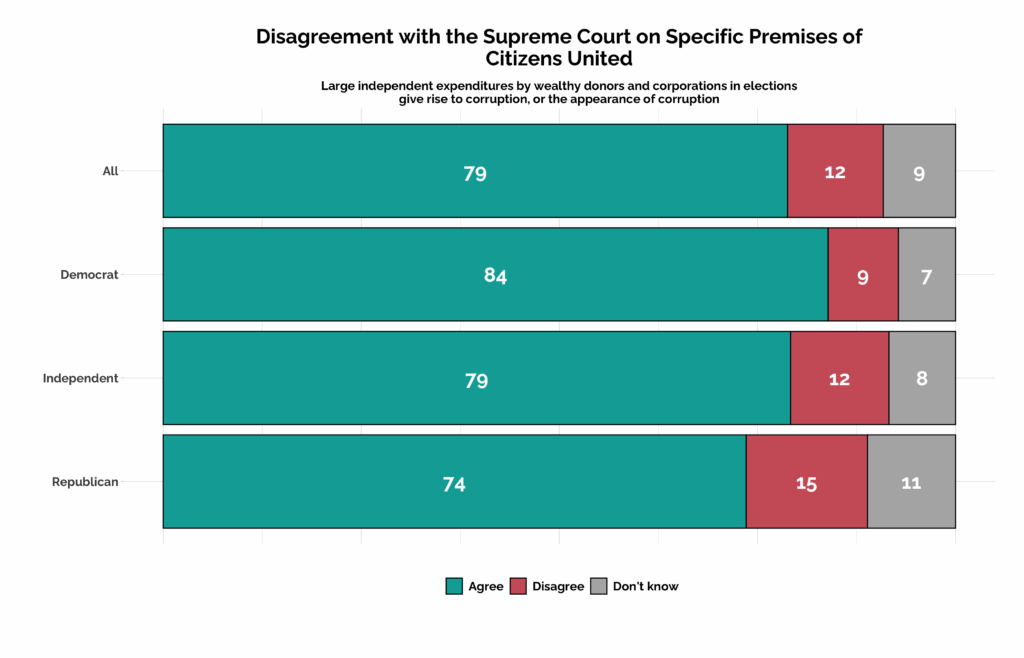 Source: YouGov national survey, Oct. 7-15, 2025
In response to these findings, Issue One Senior Research DirectorMichael Beckel, who oversaw the polling project, said: “Policymakers on both sides of the aisle should be tuning into the fact that overwhelming majorities of Americans across the political spectrum are alarmed by the huge sums being spent in elections by corporations, dark money groups, and wealthy donors.”
Beckel continued: “These findings fly in the face of two of the key assumptions that the U.S. Supreme Court made 15 years ago in Citizens United, namely that independent expenditures do not give rise to corruption or the appearance of corruption, and secondly, that the appearance of influence or access would not cause the electorate to lose faith in democracy. These perceptions of corruption are corrosive to the foundation of our democracy. Our political system cannot function if the public assumes the government is for sale to the highest bidder.”
Added Issue One Policy LeadLiana Keesing: “Montanans are sending a clear message that echoes around the country: Our democracy should be owned by voters, not bought by the wealthy few. These new findings show that people in every corner of the state — and across party lines — want a government that works for all of us, not just those with the deepest pockets. The proposed ballot measure is a bold, practical step toward restoring trust in our political system by ensuring that elections reflect the voices of citizens, not corporate interests. If Montana succeeds, it won’t just reform its own laws; Montanans can pave a path for states across the nation that want to reclaim democracy for the people.”
In Montana, Issue One’s new poll found that nearly 3 in 4 Montanans (74%) — including 84% of Democrats, 69% of Republicans, and 64% of independents — would vote in favor of this proposed ballot measure to eliminate corporate and dark money spending in elections by amending state law governing corporate charters, compared to only 11% opposed.
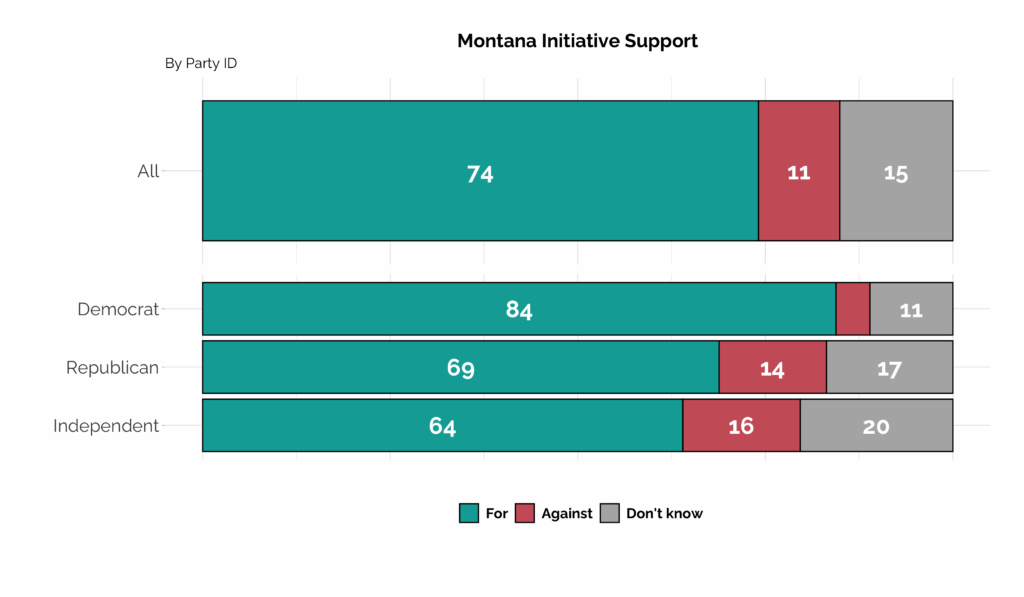 Source: YouGov survey of Montana voters, Oct. 7-20, 2025
Nationally, Issue One’s poll tested a comparable proposal — asking voters how they would respond if a similar measure were considered in their own state. Support was nearly as strong, with 72% of Americans said they would support such a reform, compared to only 12% opposed, after respondents were exposed to messaging from both supporters and opponents. That included support from 81% of Democrats, 64% of Republicans, and 60% of independents.
These high levels of support persisted even when voters were reminded that proposed reforms to curb corporate and dark money spending in elections could apply to their own preferred groups, or raise free speech concerns.
Other key findings from these two polls included:
- 77% of Americans — including 84% of Democrats, 70% of Republicans, and 78% of independents — agreed that anti-corruption rules strengthen our democracy and constitutional rights by ensuring everyone has equal political representation, regardless of money.
- 75% of Americans — including 84% of Democrats, 65% of Republicans, and 73% of independents — said unlimited spending in elections makes our democracy weaker because it gives wealthy special interests too much influence over elected officials. Only 13% of Americans said unlimited spending by people and organizations makes our democracy stronger by protecting the constitutional right to free speech.
- 73% of Americans — including 81% of Democrats, 67% of Republicans, and 71% of independents — agreed that “if a wealthy donor or corporation gains influence over or access to an elected official, I consider that official to be corrupt.”
- 69% of Americans — including 76% of Democrats, 61% of Republicans, and 64% of independents — believe that technology and social media companies have too much influence in politics.
- 63% of Americans — including 73% of Democrats, 53% of Republicans, and 61% of independents — disagreed with the Supreme Court’s Citizens United decision that corporations and labor unions have a First Amendment right to spend unlimited money to influence elections.
- 72% of Montanans — including about 70% of both Democrats and Republicans — continued to support the ballot initiative passed by roughly 75% of voters in 2012 that established a state policy that corporations are not entitled to constitutional rights, such as First Amendment free speech rights, because they are not human beings.
Read the toplines, crosstabs, and interested parties’ memo prepared by YouGov for Issue One’s national poll.
Read the toplines, crosstabs, and interested parties’ memo prepared by YouGov for Issue One’s Montana poll.
Issue: Dark Money & Super PACs
https://www.issueone.org/wp-content/uploads/2018/09/Dark-Money-Illuminated-Report.pdf
:{
}:
......other groups, such as super PACs, that may also buy political ads.
:{
}:
A table of the top 67 donors uncovered
by Issue One’s research — each of which
contributed $1 million or more to the top dark
money groups— can be found in Appendix 1
of this report.
:{
}:
STILL IN THE DARK
:{
}:
Yet much remains unknown.
Despite all our research, Issue One found
that only about two percent of the money
raised by two dark money giants — the
45Committee and Crossroads GPS — can be
tied to specific donors.
:{
}:
And while Issue One identified approximately
$86 million in contributions to the U.S.
Chamber of Commerce and approximately
$145 million in contributions to the National
Rifle Association, these organizations have
vast financial resources — and, in each case,
the portion of receipts tied to donors amounts
to just seven percent of these groups’ total
revenue between January 2010 and December
2016.
:{
}:
Meanwhile, it may seem promising that 55
percent of the money that Americans for Job
Security — one of the oldest political dark
money groups — raised between November
2009 and October 2014 has been connected
to donors.
:{
}:
Yet the bulk of these contributors were
revealed not because of information hidden
in routinely filed, little-known public records,
but rather because of a poorly redacted donor
list that was obtained by, and later released
by, the California Fair Political Practices
Commission as part of a 2013 investigation
into the group.
:{
}:
Thanks to this internal document, media
organizations and others were able to identify
many of Americans for Job Security’s major
funders, including investor Charles Schwab,
entrepreneur Eli Broad and several members
of the Fisher family, which founded the Gap
clothing company.
:{
}:
Similarly, while roughly 60 percent of the
money raised in recent years by two other
dark money groups — the American Future
Fund and Americans for Tax Reform — was
connected to donors, the largest identifiable
funders of these groups were other nonprofit
organizations. Thus, even when the curtain
was pulled back, all that was revealed was
another opaque organization bankrolling the
first opaque group.
:{
}:
Our research makes clear that the “effective
disclosure” that Justice Kennedy envisioned
in Citizens United does not exist today. The
public ultimately still does not know where
the bulk of the money fueling dark money
groups originates. The current tools for
disclosure are inadequate. And the rules
...
For dark money groups, what counts as political spending?
:{
}:
The Internal Revenue Service and Federal Election Commission have different
definitions of what counts as political spending.
The IRS asks nonprofit organizations to detail their spending on “direct or indirect
political campaign activities on behalf of or in opposition to candidates for public
office.”
:{
}:
Meanwhile, dark money groups are required to submit reports to the FEC if
their spending falls into one of three categories: 1) “independent expenditures,” 2)
“electioneering communications” or 3) “communication costs.”
Each of these phrases is a legal term of art.
:{
}:
The term “independent expenditures” refers to spending that is not coordinated with a
candidate that “expressly advocates the election or defeat of a clearly identified federal
candidate.”
:{
}:
The term “electioneering communications” refers to targeted communications that
are aired within 30 days of a primary election or 60 days of a general election that
refer to a clearly identifiable federal candidate but fall short of explicitly urging voters
to support or reject that candidate. By definition, only political advertisements on
broadcast, cable or satellite qualify as electioneering communications, although the
Honest Ads Act would extend this definition to paid political ads aired online as well.
The term “communication costs” refers to political spending by a corporation or labor
union that is specifically targeted to its own stockholders or membership.
:{
}:
Voters may also see ads that look like political ads that might never be reported to the
FEC or IRS. For instance: an ad that mentions a candidate that falls short of expressly
advocating for that candidate’s election or defeat AND is aired at a point in time
during which it does not qualify as an “electioneering communication.”
:{
}:
All the while, many lawyers argue that “electioneering communications” reported to
the FEC do not necessarily qualify as “direct or indirect political campaign activities”
that need to be reported to the IRS. And mystifyingly, some lawyers have even argued
that certain “independent expenditures” that are reported to the FEC may not qualify
as “direct or indirect political campaign activities” that need to be reported to the IRS.
:{
}:
....
governing transparency not only need better
enforcement but also, and more importantly,
desperately need modernizing.
:{
}:
LAX ENFORCEMENT, PUSHING THE
ENVELOPE
:{
}:
Many dark money groups are often criticized
for masquerading as 501(c)(4) organizations,
whose primary purpose, by law, must be
operating “exclusively” for “social welfare”
purposes. Such groups, according to the
Internal Revenue Service, should be “primarily
..
The Internal Revenue Service and Federal Election Commission have different
definitions of what counts as political spending.
:{
}:
The IRS asks nonprofit organizations to detail their spending on “direct or indirect
political campaign activities on behalf of or in opposition to candidates for public
office.”
Meanwhile, dark money groups are required to submit reports to the FEC if
their spending falls into one of three categories: 1) “independent expenditures,” 2)
“electioneering communications” or 3) “communication costs.”
Each of these phrases is a legal term of art.
:{
}:
The term “independent expenditures” refers to spending that is not coordinated with a
candidate that “expressly advocates the election or defeat of a clearly identified federal
candidate.”
:{
}:
The term “electioneering communications” refers to targeted communications that
are aired within 30 days of a primary election or 60 days of a general election that
refer to a clearly identifiable federal candidate but fall short of explicitly urging voters
to support or reject that candidate. By definition, only political advertisements on
broadcast, cable or satellite qualify as electioneering communications, although the
Honest Ads Act would extend this definition to paid political ads aired online as well.
:{
}:
The term “communication costs” refers to political spending by a corporation or labor
union that is specifically targeted to its own stockholders or membership.
:{
}:
Voters may also see ads that look like political ads that might never be reported to the
FEC or IRS. For instance: an ad that mentions a candidate that falls short of expressly
advocating for that candidate’s election or defeat AND is aired at a point in time
during which it does not qualify as an “electioneering communication.”
:{
}:
All the while, many lawyers argue that “electioneering communications” reported to
the FEC do not necessarily qualify as “direct or indirect political campaign activities”
that need to be reported to the IRS. And mystifyingly, some lawyers have even argued
that certain “independent expenditures” that are reported to the FEC may not qualify
as “direct or indirect political campaign activities” that need to be reported to the IRS.
...
:{
}:
==