mises inst
belated?
alt rt problem identity europa?
---
WOW
---
---
ANOTHER GOOD OLE BOY AUBRUN WIFE --> ROSEVILLE
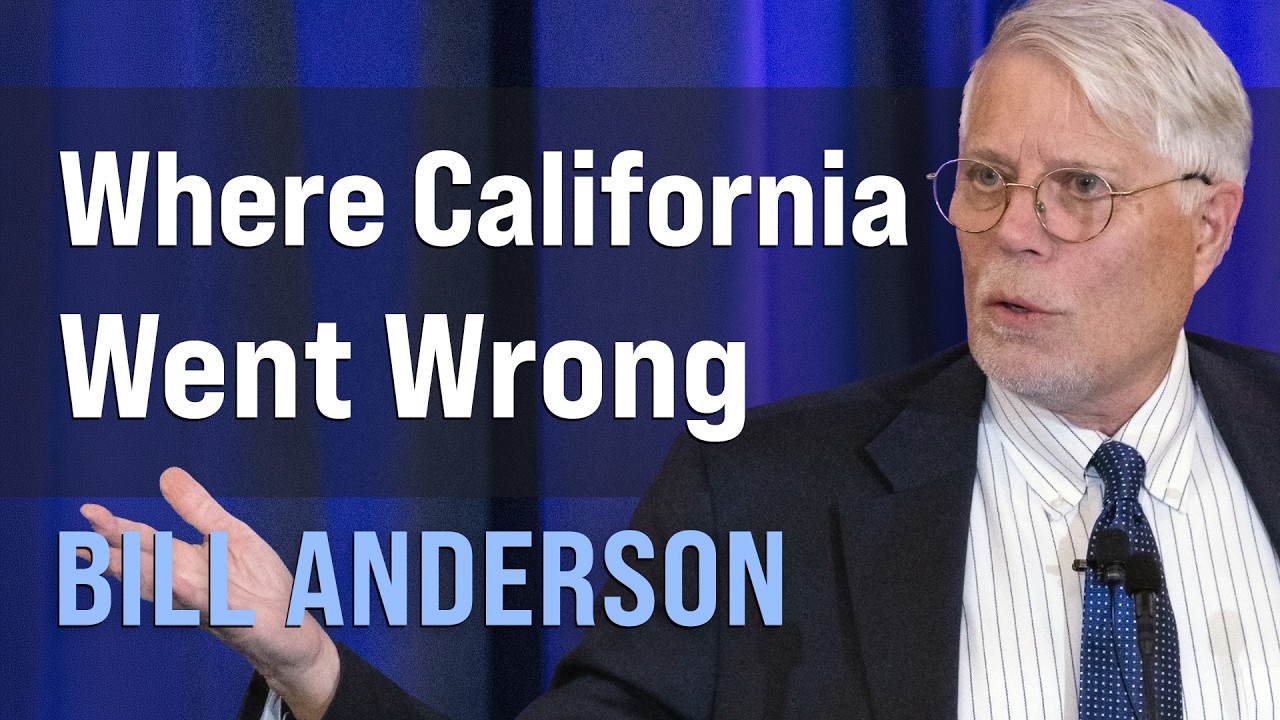
Where California Went Wrong | William Anderson
May 8, 2026
Bill Anderson offers a ground-level view of California's decline, arguing that the state's deep entanglement of government with water, energy, housing, and transportation has created a self-reinforcing system where every new crisis produces more regulation, more spending, and fewer productive citizens. Recorded in San Diego, California, on April 25, 2026.
---
1,216 views May 7, 2026
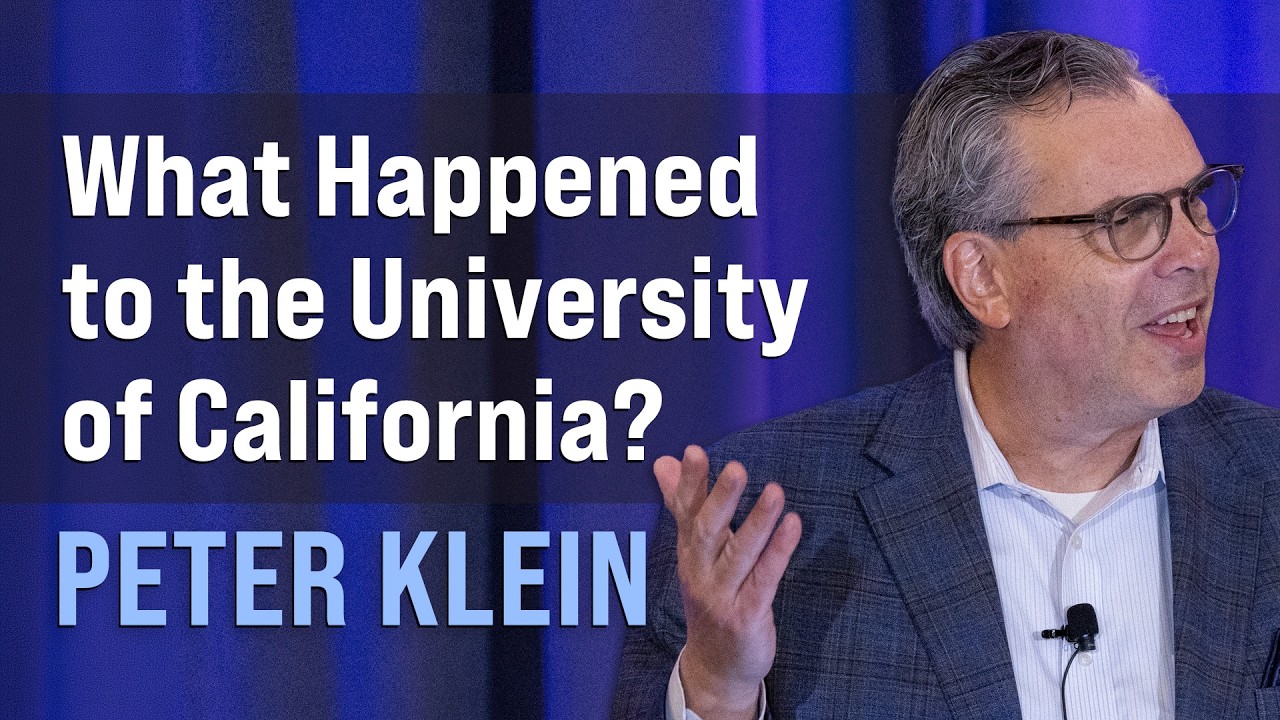
Peter Klein traces the ideological transformation of the UC system from a world-class research institution to a cautionary tale of government-subsidized capture, arguing that the real culprit isn't California's culture but the funding, ownership, and governance structure that insulates universities from market accountability and rewards ideological conformity. Recorded in San Diego, California, on April 25, 2026. The Mises Institute is giving away 100,000 copies of Hayek for the 21st Century. Get your free copy at https://Mises.org/Hayek21Find free books, daily articles, podcasts, lecture series, and everything about the Austrian School of Economics, at https://Mises.org.
---
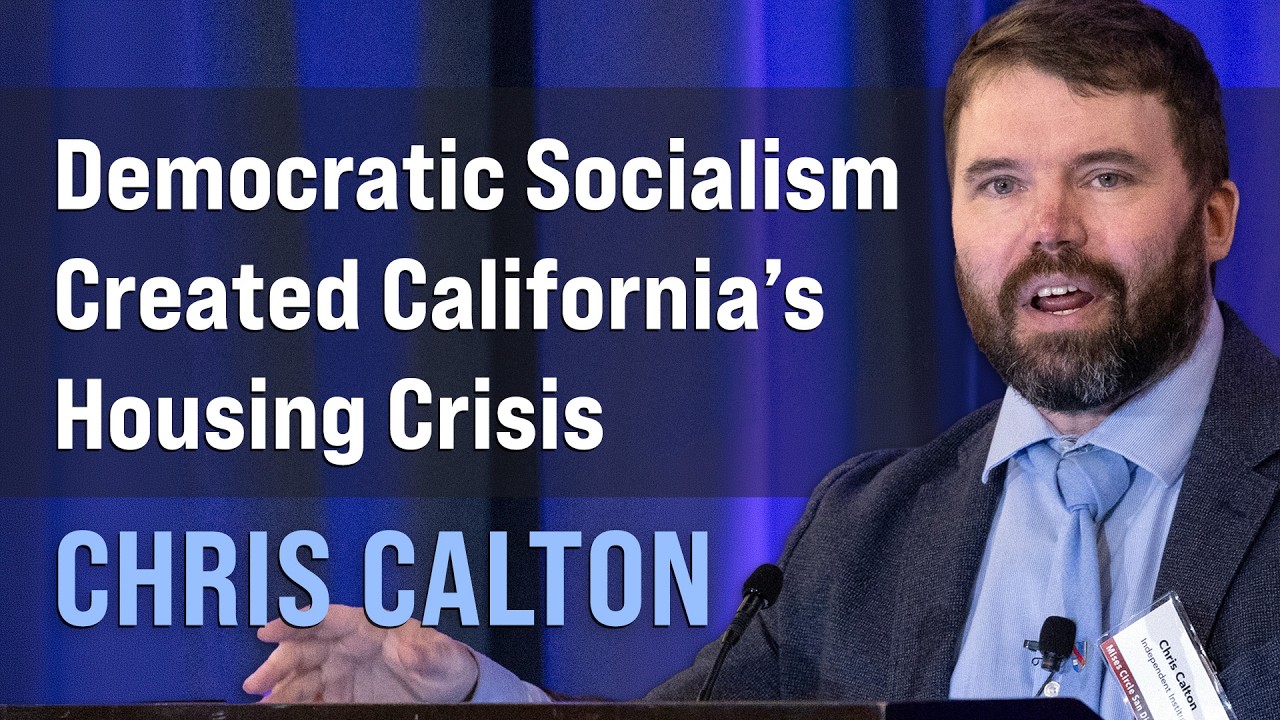
How Democratic Socialism Created California’s Housing Crisis | Chris Calton
May 7, 2026
Chris Calton links California's housing crisis to three books published in the 1960s that spawned three ideological movements — the democratization of urban planning, the politicization of environmentalism, and the no-growth movement — each of which handed activists and bureaucrats new tools to block development and destroy private property rights one permit hearing at a time. Recorded in San Diego, California, on April 25, 2026. The Mises Institute is giving away 100,000 copies of Hayek for the 21st Century. Get your free copy at https://Mises.org/Hayek21Find free books, daily articles, podcasts, lecture series, and everything about the Austrian School of Economics, at https://Mises.org.
---
==
https://www.thenation.com/article/how-charles-koch-is-helping-neo-confederates-teach-college-students/
no many lnx
How Charles Koch Is Helping Neo-Confederates Teach College Students
The Koch Foundation is often praised for its higher-ed funding, but the money is going to some radical professors
By Alex Kotch MARCH 21, 2018
Billionaire industrialist and conservative political mega-donor Charles Koch first entered the political world through the John Birch Society, a secretive anti-Communist outfit that campaigned against the civil-rights movement. Since then, he and his brother David amassed enormous wealth and put together a powerful conservative political network that rivals either major party in size and funding.
A new report from activist group UnKoch My Campus shows that Charles Koch’s ties to white supremacy have persisted throughout his adult life. The report details an array of instances where Koch has funded neo-Confederate scholars—a largely unnoticed aspect of the Koch Industries CEO’s ambitious project of funding higher education.Most alarming is a collaboration between Florida Atlantic University, the Charles Koch Foundation, and a major private-prison company, which is led by a professor who was a member of the research arm of a white-nationalist hate group.
While raking in corporate profits as the head of the family’s oil-refining business since the mid-1960s, Charles Koch and his top tactician, Richard Fink, developed a “Structure of Social Change,” which they would deploy to pull America as far to the right on taxes and regulations as they could. Koch, a libertarian, had resigned from the John Birch Society after opposing its position on the Vietnam War, and created a regressive sphere of influence. The first step in this strategy was funding higher education, because, as he said at a 1974 gathering of the Institute for Humane Studies, now a George Mason University center that he finances and directs, “educational programs are superior to political action, and support of talented free-market scholars is preferable to mass advertising.”
Koch and his family foundations have donated hundreds of millions of dollars to colleges and universities around the United States. In 2013, the Charles Koch Foundation began donating to Florida Atlantic University, offering $5,000 that year. By 2016, the annual donation had risen to $32,000.
Marshall DeRosa, who runs a prison-education program with financial backing from the Koch Foundation, is a Florida Atlantic University political-science professor who has written extensively on the Confederacy. He also has ties to its modern remnants.
From 2000 until at least 2009, according to archived web pages,DeRosa was a “faculty member” at the League of the South Institute, the “educational arm of the Southern independence movement” where “the South’s finest unreconstructed scholars” taught summer institutes and seminars. The LOS Institute acts as the charitable nonprofit of the League of the South, which the Southern Poverty Law Center considers aneo-Confederate hate group, and supports a second Southern secession in order to form a nation ruled by “Anglo-Celtic” people.
The LOS was co-founded in 1994 by an original member of the Center for Libertarian Studies, which was launched in 1976 with seed money from Charles Koch. Michael Tubbs, a white nationalist who once stockpiled military weapons and planned to target businesses owned by African Americans and Jews, is still the current chairman of the Florida LOS chapter, according to Newsweek, and has appeared at the side of LOS president Michael Hill as recently as January 2018. In 1987, Hill and three accomplices called themselves “guardians of the gene pool.”
The League of the South Institute is “the educational branch of the Mary Noel Kershaw Foundation,” named after the wife of the late Jack Kershaw, longtime leader within the violent White Citizens Council and founding board member of the League of the South. In 1998, Kershaw erected a statue of Ku Klux Klan leader Nathan Bedford Forrest and declared, “Somebody needs to say a good word for slavery. Where in the world are the Negroes better off today than in America?”
Recently, LOS was a prominent white-nationalist force at the infamous “Unite the Right” rally in Charlottesville, Virginia. Hill, a board member of the Kershey Foundation, had told supporters to prepare for violence. Another LOS member was charged in January for brutally beating a 20-year-old black man at the rally.
Regarding his LOS affiliation, DeRosa told The Nation, “That was a long time ago. I disengaged early on. They’d invite me to things and I’d go to talk about my scholarship, especially the Confederate constitution, but I got an inkling as to some of the characters involved…. I didn’t feel comfortable.”
Experts on hate groups have a different view. “The LOS was different when DeRosa was involved, not as militant, but it still had very, very bad racial views,” said Heidi Beirich, an expert on right-wing extremism and director of the Intelligence Project at the Southern Poverty Law Center. “He can’t scurry away from the fact that for a long time he was a member of a group that had white-supremacist view
DeRosa isn’t the only former LOS Institute academic in the Koch higher-ed network. The founder of the institute, Donald Livingston, who served on the Institute for Humane Studies Academic Review Committee—which grants Koch’s “Humane Studies Fellowships” (originally “Claude R. Lambe Fellowships”)—from 1996 to 1999, has stayed in the network’s orbit. Last spring, he lectured at an Institute for Humane Studies seminar at George Mason University.
Thomas DiLorenzo, an “affiliated scholar” of the LOS Institute as recently as 2008, was an economics professor in George Mason University and worked on policy for the Koch-funded, libertarian Cato Institute. In 2005, several years after the Southern Poverty Law Center classified LOS as a hate group, he defended the organization, writing that it “advocates peace and prosperity in the tradition of a George Washington or a Thomas Jefferson.”
DeRosa and DiLorenzo taught a three-day LOS “summer school” together in 2000 on topics including “Why secession was, and is, constitutional” and “How the ‘Fourteenth Amendment’ was never constitutionally passed by Congress nor ratified by the States.”
Not long after SPLC labeled the LOS a hate group in the early 2000s, Livingston left the LOS Institute and founded its successor, the Abbeville Institute, named after the birthplace of fierce slavery advocate John Calhoun, and is still president. (DiLorenzo is currently affiliated with the Abbeville Institute, as well.) In 2009, The Chronicle of Higher Education dubbed the Abbeville Institute a place where scholars “nostalgic for the Old South” went to “study the virtues of secession.” The Chronicle reported that Abbeville scholars argued that the Civil War, or “the War of Northern Aggression,” was “not about slavery…and that the antebellum Southern states had every right to secede.”
Beirich said that while Livingston did leave the LOS when it became especially extreme, “he runs his own incredibly neo-Confederate institute…. A question [for the Koch Foundation] is, why are you affiliated with a person like that? His position is not a serious historical position. The South did not just fight for states’ rights—it was about slavery. These are distorted views of history.”
DeRosa remains part of Abbeville as well, and other ex-LOS Institute scholars including DiLorenzo have recently been active with the group.
Several former LOS scholars are also part of the Mises Institute, a think tank formed in 1982 that the Southern Poverty Law Center says has “strong neo-Confederate principles.” Its founder, Lewis Rockwell, argued that the Civil War “transformed the American regime from a federalist system based on freedom to a centralized state that circumscribed liberty in the name of public order.”
At least nine Mises Institutes scholars have worked with LOS, according to the UnKoch report, and Mises employs several Koch-funded academics. Mises scholars collectively received $12.5 million in academic funding from the Charles Koch Foundation between 2005 and 2016.
“Through their support for these faculty, the Koch Foundation is subsidizing and strengthening an already booming wave of violent, alt-right anarcho-capitalists,” said Ralph Wilson, the UnKoch report’s author and the group’s co-founder.
When asked for detailed comment about several aspects of this reporting, the Koch Foundation issued a two-sentence reply to The Nation: “The Charles Koch Foundation’s criminal justice reform work is rooted in the principles of human dignity. We do not tolerate racism in any shape or form.”
THE PRISON-TO-WHITE-SUPREMACY PIPELINE
But Florida Atlantic students aren’t the only minds that DeRosa is being paid to shape. After getting commitments from the Koch Foundation and GEO Group, one of the world’s largest private-prison companies, DeRosa got state certification for a pilot program, the Inmate Civics Education Enhancement Project. He taught the first class at a South Bay, Florida, GEO Group prison in 2015.
“It’s disturbing that people of color might be exposed to neo-Confederate ideas in prison,” said Beirich of the Southern Poverty Law Center. “If you’re going to find someone to teach in prisons you’d think you could find someone who wasn’t involved with a neo-Confederate hate group.”
Meanwhile, at least four GEO Group executives have served on the Florida Atlantic University board of trustees. GEO Group had an agreement with FAU to donate $6 million to the university in 2013 in exchange for naming rights over the football stadium, but it was withdrawn because it sparked significant controversy. “GEO is very much committed to recidivism. They have a reentry program. They’re amazing,” said DeRosa.
---
---
an 6 22
no lnx twt
Liberals and progressives have long expressed mixed feelings about libertarians, applauding their views on marijuana, abortion and gay rights while disagreeing vehemently with their hardcore fiscal conservatism. Libertarians have a long history of describing themselves as fiscal conservatives who are social liberals and arguing that the War on Drugs and the evangelical Christian Right have been terrible for the Republican Party and terrible for the conservative movement.
The far-right MAGA movement championed by former President Donald Trump and his army of authoritarians and Christian nationalists is antithetical to many of the positions libertarians have taken over the years, such as abortion on demand and full legalization of marijuana and prostitution. But journalist Jeet Heer describes an unlikely trend in an article published by The Nation on June 6: a growing MAGA influence within the Libertarian Party.
“Third parties have a political impact far greater than their electoral successes,” Heer explains. “They are the research and development wing of the political system…. The Libertarian Party can rightly claim to be heir to this tradition of being a seedbed for policy innovations taken over by both Democrats and Republicans…. If the dominant ideology of American politics since the 1970s is neoliberalism, then the Libertarian Party has truly punched above its weight…. The Libertarian Party championed gay rights and drug decriminalization long before the Democrats.”
But Heer goes on to lament that Jeff Deist, president of the Mises Institute, has become influential in parts of the Libertarian Party — pushing MAGA-like “blood and soil” rhetoric. And Heer describes a struggle between the Libertarian Party’s Mises Caucus and its “Gary Johnson wing.” Johnson, a former New Mexico governor and ex-Republican, was the Libertarian presidential nominee in 2012 and 2016.
In 2017, Arvin Vohra, vice chair of the Libertarian Party, warned that theMises Caucus had “been turned into a sales funnel for the White nationalist branch of the alt-right.” And others in the “Johnson wing” of the Libertarian Party, Heer notes, have been equally critical of the Mises Caucus and its MAGA-influenced views.
“Taking the Libertarian Party out as a competitive force will help consolidate the right-wing vote around the Republican Party,” Heer warns. “Once the Libertarian Party becomes a husk of its former self, the alt-right faction will continue to assist a Trumpized GOP in a way that parallels groups like the Proud Boys. MAGA Libertarians will be a potent vector for spreading bigotry on social media. The Mises Caucus are the nominal winners in the internecine libertarian wars, but the ultimate beneficiary could be Donald Trump.”
---
==
http://www.rightwingwatch.org/post/koch-network-alums-are-going-full-on-white-nationalist/
This article was produced in collaboration with Sludge, an investigative money-in-politics news site. Visit readsludge.com to subscribe to its free weekly newsletter.
At a 1976 libertarian conference funded by oil executive Charles Koch, conservative think-tanker Leonard Liggio presented a paper on the Nazis’ success at recruiting youth to their movement. Liggio urged the clandestine group of wealthy libertarians to embrace the Nazis’ approach as a way to strengthen their own movement to slash taxes and gut regulations.
Now, decades later, multiple young men who have been affiliated with Koch’s powerful political network have been exposed as members of a white nationalist group.
“Koch’s academic operations are intended to develop extreme anti-government ideas and actions in students by exposing them to the Austrian school of economics and its various offshoots,” Ralph Wilson, co-founder of the Corporate Genome Project and former research director of UnKoch My Campus, told Sludge/Right Wing Watch. “These ideologies make moral arguments for free markets using an overly individualistic notion of ‘freedom’ that has fed and capitalized on the anti-social impulses of frustrated youth for several generations, including white nationalists, paleo-conservatives, neo-confederates, and neo-Nazis.”
Identity Evropa, which recently rebranded as the American Identity Movement, is a white nationalist group in the United States whose members appeared at the Unite the Right 2017 rally in Charlottesville, Virginia, and have, in other instances, been convicted of criminal activity pertaining to their ideology. The group, based near Washington, D.C., favors secrecy over visibility; it opts for unannounced banner-drops and flash rallies, and it emphasizes propaganda production over public presence. The group’s membership rolls and day-to-day operations were closely guarded before its chat logs were published by independent media nonprofit Unicorn Riot.
Since the chat logs were exposed, antifascist activists have worked to identify members of the organization using the internal discussions. One portion of the chat logs show Identity Evropa members discussing infiltrating local conservative clubs and offices with the hopes of attracting GOP supporters to their racist agenda. Other Identity Evropa-associated personalities have explicitly urgedtheir followers to place themselves in local Republican offices.
In early March, the antifascist blog IdentifyEvropa determined that Derek Magill, who spoke at an event hosted by the Koch-funded Institute for Humane Studies (IHS) in late 2017, is a member of Identity Evropa. Magill denied that the blog had correctly identified him, but its writers uncovered further evidence suggesting that their identification had been correct. Later that month, Unicorn Riot exposed Alex Witoslawski, the former regional field coordinator for the Koch-funded Leadership Institute, as a key Identity Evropa member. Witoslawski had hosted two media training sessions for Identity Evropa members and directed them to sign up for organizing training offered by a different conservative group, the Foundation for Applied Conservative Leadership.
Magill, a young self-proclaimed entrepreneur whose business appears to be defunct, spoke at an IHS entrepreneurship seminar in November 2017. The seminar was co-sponsored with the conservative John Templeton Foundation and Mississippi State University’s Institute for Market Studies, which the Charles Koch Foundation helped found in 2015 with a $365,000 commitment.
IHS told Right Wing Watch/Sludge that it “does not tolerate racism in any shape or form.”
“We work with thousands of people, and we do our best to evaluate each opportunity. Unfortunately, there’s no way to guarantee that a person’s public record is a perfect match for their private thoughts and behavior,” IHS wrote to Sludge/Right Wing Watch in a statement. “When we worked with Derek Magill, he was the director of marketing at Praxis, and we had no knowledge of racist comments, which represent the exact opposite of what we stand for and our values. We have not worked with Magill since 2017 and will not work with him in the future.”
Heidi Beirich, director of the Intelligence Project at the nonprofit Southern Poverty Law Center, told Sludge/Right Wing Watch that she wasn’t at all surprised to see young men leaving Koch-funded groups for white nationalist organizations.
“For some time, folks have joined the white nationalist movement after first moving through political operations,” Beirich said. “It’s actually a pretty common pattern where folks become more and more conservative and finally make their way into full-on white nationalism. Given the times now, where anti-immigrant and anti-Muslim views are common in the GOP and few in the party speak out against them or against Trump when he engages in xenophobia and racism, it actually makes sense to see young people being radicalized into white nationalism through these political activities.”
Charles Koch, currently on the IHS board of directors, has been a leader and key funder of IHS for decades. From 2013 to 2017, the Charles Koch Foundation gave nearly $20 million to IHS, according to tax records. The Charles Koch Institute gave over $275,000 to IHS, and Donors Trust, a dark-money vehicle favored by the Koch family, added nearly $1.1 million.
But IHS isn’t the only Koch-funded institution with connections to Magill. Before dropping out of the University of Michigan, Magill was president of the school’s chapter of the libertarian student group Young Americans for Liberty. He and his chapter were part of a lawsuit seeking reimbursement from the university for an event they hosted featuring an anti-affirmative action speaker. The group was represented by the anti-LGBTQ hate group Alliance Defending Freedom.
The Charles Koch Foundation donated over $2.3 million to the Young Americans for Liberty Foundation from 2013 to 2017, representing a large portion of the group’s revenue. Donors Trust gave $1.3 million, and the Charles Koch Institute added nearly $75,000 during that time period.
Magill’s connections to Koch-backed organizations don’t stop here. From 2016 to 2018, Magill wrote six articles for the Foundation for Economic Education (FEE), a conservative, free-market think tank, and he claims to have spoken there as well. FEE is a “strategic partner” of Young Americans for Liberty. From 2013 to 2017, FEE received close to $260,000 from the Charles Koch Foundation, more than $60,000 from the Charles Koch Institute, $440,000 from Donors Trust, and $5.2 million from its sister fund, Donors Capital Fund. Magill’s author page on FEE’s website was taken down in the past week.
FEE is also heavily funded by the John Templeton Foundation, which donated over $1.8 million in 2017 to fund a millennial outreach program intended “to dislodge collectivism from its ‘high ground’ position among the rising generation.” Koch ally Liggio attended FEE seminars as a young man in the 1950s and went on to lead the Templeton Foundation’s Religious Freedom Project.
Months after Magill’s stint with FEE appears to have ended, he was logged into Identity Evropa’s chatroom where he posted photos of mugs sold by fascist podcasts he claimed were spotted on his employee’s desk, expressed his relief that his parents were “woke” on the “Jewish Question” conspiracy theory, announced that he was invited to “sit on the board of directors of a very important academic organization,” and signaled his intention to register for Identity Evropa’s annual conference.
According to the antifascists who identified Magill’s connection to Identity Evropa, Magill “offers to pay legal costs and invest in the business ventures of [Identity Evropa] members as well as financially support [Identity Evropa] as a whole.”
Antifascist activists identified Magill by cross-referencing details from his personal life he shared with other Identity Evropa members with publicly available information online. When Magill contested the allegations, activists identified police records of Magill’s meeting with a detective regarding a check fraud complaint that occurred the day before he recounted the incident with Identity Evropa members.
The other Identity Evropa member linked to the Koch network, Witoslawski, also has connections to multiple operations. According to his LinkedIn page,Witoslawski was a regional field coordinator with the Koch-funded Leadership Institute from January 2016 to August 2017. According to Unicorn Riot, Witoslawski taught members of the white nationalist group about how to deflect questions about the organization that would reflect poorly on it, and in April 2018, he walked them through a communications strategy called “Leesburg Grid,” which is taught to conservative activists at Leadership Institute training sessions. He gave an additional seminar to Identity Evropa later that June.
[unicorn r slides? vid?]
Leadership Institute operates the website Campus Reform, a site that publishes stories about what it views as bias against conservative university students. In 2014, Campus Reform covered the University of Michigan affirmative action story, quoting Magill extensively.
Since 2013, the Leadership Institute has received $118,000 from the Charles Koch Foundation, $44,000 from the Charles Koch Institute, $715,000 from Donors Capital Fund, and $220,000 from Donors Trust, according to federal tax records.
Before his stint at the Leadership Institute, Witoslawski spent six months as the Illinois state chair of Young Americans for Liberty.
In 2015, Witoslawski worked for a Michigan ballot measure committee, Concerned Taxpayers of America, and before that, he spent three years at Campaign for Liberty, a nonprofit founded by former libertarian Congressman Ron Paul. His profile page on the group’s website includes a photo of Witoslawski with Paul’s son, Republican Sen. Rand Paul of Kentucky.
Witoslawki claims to have taken online courses at the Mises Academy, which is run by Austrian economics think tank Mises Institute. The institute, named after Austrian free-market economist Ludwig von Mises, is another beneficiary of the Koch network and has numerous ties to Koch-funded academics, some of whom have been associated with the neo-Confederate League of the South. Liggio sat in on Ludwig von Mises’ seminars at Georgetown University and New York University in the 1950s. Former Texas Rep. Ron Paul, who published a racist newsletter in the late 1980s and early 1990s, is a member of the Mises Institute board.
“The Mises Institute has spent decades legitimizing pro-corporate and white nationalist scholarship while radicalizing young scholars in the U.S. and abroad,” said Wilson, who has extensively researched the institute.
Witoslawski has volunteered himself as a public face for other far-right activists seeking to “infiltrate the mainstream,” and he has lent his Leadership Institute training to white nationalist YouTube audiences, blogs, and podcasts looking to advance their causes in the United States. Identity Evropa leader Patrick Casey invited Witoslawski to walk through the basics of grassroots organizing with the organization’s members, the Southern Poverty Law Center reported last year.
Witoslawski has also authored pieces published on Fash the Nation, a fascist podcast’s blog, including one that criticized conservative commentator Jordan Peterson for not recognizing “the problem with Jewish influence on society.”
“Jews are a foreign elite in Western society—an elite who earned their status through graft and ethnic nepotism, and who use their power to the detriment of the host countries in which they live in,” Witoslawski wrote in his March 24, 2018, column.
In apost taking issue with Jewish conservative media star Ben Shapiro, Witoslawski claimed that “culture is intrinsically linked with ethnicity, and for that reason alone, if we really are interested in conserving America’s traditions and heritage, we must preserve our country’s White heritage.”
Sludge/Right Wing Watch reached out to the Leadership Institute for comment on this story via a contact form listed on its website and Witoslawski via Facebook Messenger, but received no response.
Other GOP megadonors in the Koch network have also helped fund the organizations linked to Magill and Witoslawski. From 2013 to 2017, shipping supplies magnate Richard Uhlein, the fourth-biggest federal political donor of 2018 and a patron of Koch-backed political groups, gave $1 million each to the Leadership Institute and IHS through his family foundation. The family foundation of discount store magnate Art Pope, an IHS board member who co-founded the political nonprofit Americans for Prosperity with Charles and David Koch, gave over $1.6 million to IHS and $40,000 to FEE. The foundation of the parents of Education Sec. Betsy DeVos, gave $50,000 to the Leadership Institute from mid-2013 through mid-2018. DeVos’s in-laws have also attended Koch donor conferences.
“There is no question that the far right political world is radicalizing people into white nationalism and growing its ranks,” the Southern Poverty Law Center’s Beirich said. “Some of the GOP’s current positions on immigration are no different than those of white nationalists, so we shouldn’t be surprised. We even saw last week that a synagogue attacker followed this pathway, through conservative politics to Ben Shapiro and on to pure hatred. Unfortunately, this is becoming a more well worn path these days.”
Tags: Alt-Rightmoney in politicswhite nationalismFoundation for Economic EducationIdentity EvropaInstitute for Humane StudiesLeadership InstituteYoung Americans for Liberty
==
---
https://www.alternet.org/2019/07/as-charles-koch-cultivates-anti-war-image-koch-industries-profits-from-defense-contracts/
no lnx
As Charles Koch cultivates anti-war image, Koch industries profits from defense contracts
Written by Alex Kotch / The American Prospect July 26, 2019
Libertarian billionaire industrialist Charles Koch has gone to great lengths to paint himself as an anti-interventionist. He has funded foreign policy-focused think tanks and university centers such as the conflict-averse Center for the Study of Statesmanship at Catholic University and the Notre Dame International Security Center, which is directed by anti-NATO professor Michael Desch.
Most recently, he teamed up with an extremely unlikely ally, liberal billionaire philanthropist George Soros, to found the Quincy Institute for Responsible Statecraft. The Charles Koch Foundation and Soros’ Open Society Foundations each contributed $500,000 to help found the Quincy Institute, which will open in September, along with $800,000 from other donors.
“Political leaders have increasingly deployed the military in a costly, counterproductive, and indiscriminate manner, normalizing war and treating armed dominance as an end in itself,” reads the institute’s website. “The Quincy Institute is an action-oriented think tank that will lay the foundation for a new foreign policy centered on diplomatic engagement and military restraint.”
But Koch Industries, the giant oil, chemical, paper, and electronics conglomerate owned and led by Koch, has been cashing in on Department of Defense contracts. Since 2016, two Koch Industries subsidiaries have gotten federal contracts worth a total of close to $2.3 million to provide the Navy with circuit boardsfor its ships, according to Sludge’s review of federal contract data from the Federal Procurement Data System.
A Navy spokesperson told Sludge that “circuit boards are used in a variety of ships, submarines and aircraft” but declined to provide additional details regarding the use of the Koch subsidiaries’ electronics.
The two most recent contracts, which total nearly $500,000, went to Camarillo, California-based Interconnect Systems, which Koch Industries subsidiary Molex acquired in 2016. Naval Surface Warfare Systems Crane, a Navy office with a mission “to provide acquisition engineering, in-service engineering and technical support for sensors, electronics, electronic warfare and special warfare weapons,” initiated a $247,350 contract with Interconnect Systems in March 2019 for “digital signal processing computer card[s].” The company had signed a similar contract in September 2018 with NSWS Crane for $243,950.
Interconnect Systems scored a $1 million contract for circuit cards in July 2018 from the Defense Logistics Agency’s (DLA) maritime facility in Mechanicsburg, Pennsylvania. DLA Land and Maritime “manages the supply chain for ground-based and maritime weapons systems repair parts, small arms parts, and fluid-handling systems.”
Nallatech, a subsidiary of Interconnect Systems, has gotten close to $247,000 worth of Navy contracts since 2016. The majority of that money came from NSWC Crane, but some came from the NAVSUP Weapons Support Systems agency, which supports naval weapons systems. NSWC Crane gave Nallatech its largest contract, for $147,000 worth of hybrid processors, in September 2017.
Since 2016, Interconnect Systems and its subsidiary, Nallatech, have gotten $2,260,000 worth of Defense contracts.
Nallatech, which last year integrated with Molex subsidiary BittWare, has received over $617,000 worth of Defense contracts since 2008, the year it was acquired by Interconnect Systems, according to usaspending.gov. The company advertises military and aerospace products such as radar systems for manned and unmanned vehicles that “provide unprecedented situational awareness and target coordination,” as well as a “ballistic digitizer.”
Molex, an Illinois-based manufacturer of electrical connectors, provides parts for a number of industries. In its defense section, the Molex website lists products for use in unmanned vehicles, missiles, and ground vehicles.
Koch Industries, the Quincy Institute, the Charles Koch Foundation, and Open Society Foundations did not respond to requests for comment.
More Navy Connections
A partially Koch-funded foreign policy center at a California state university is also involved with the Navy.
The University of California at San Diego’s Center for Peace and Security Studies got a $3.3 million multi-year grant from the Charles Koch Foundation in 2017, its second year of existence.
“We’re excited about U.C. San Diego and its scholars’ work to better understand emerging issues in security studies and their implications for U.S. foreign policy,” said Charles Koch Foundation Vice President for Research William Ruger in a university news story. Ruger, an Afghanistan war veteran, is in the Navy Reserve.
The Center for Peace and Security Studies also gets funding from the Office of Naval Research’s Minerva Research Initiative. Its current grant, covering 2014-19, is called “Deterrence with Proxies.”
The center’s website describes its work on military automation. “Technologies that supplant human labor in battle—such as UAVs (drones) and ground combat robots—lower military labor costs and limit political risks associated with friendly casualties. The tendency should thus be for military automation to increase the scope of threats or uses of force by the most advanced economies, geographically and in terms of the issues in dispute.”
UCSD has a long and lucrative relationship with the Navy; the Navy’s Naval Information Warfare Systems Command, which works with the defense industry to create new weapons systems, has been headquartered at the university since 1997. Since 1981, UCSD has raked in nearly $250 million from Navy contracts, according to data from the Federal Procurement Data Service.
Political science professor Erik Gartzke, a former Army and Navy officer who runs the Center for Peace and Security Studies, has written papers about “costless combat” drones.
Meanwhile, American Legislative Exchange Council (ALEC), the Koch-backed corporate bill mill, supported domestic drone use through its proposed Unmanned Aerial Vehicle program.
‘The Case for Private Defense’
“Charles Koch’s anti-interventionist posturing is more clearly understood through his decades-long support of anarcho-capitalist scholars who have developed and championed the call to privatize police and military defense,” said Ralph Wilson, co-founder of the Corporate Genome Project and former research director of activist group UnKoch My Campus.
Koch’s political views are shaped by the Austrian School of economics, which advocates unfettered free markets and small governments. One prominent right-wing think tank that has promoted these concepts is the Mises Institute,which was established in 1982 and is named after one of the 20th century’s leading Austrian economists, Ludwig von Mises.
The late Murray Rothbard, Mises’ close associate and vice president of academic affairs at the Mises Institute for 13 years, argued against the state entirely and advocated a privatized military and police force. Like Rothbard, Mises Institute senior fellow Hans-Hermann Hoppe supports fully privatized security. In a paper first published by the Mises Institute in 1998, Hoppe argues that “collective security is a myth that provides no justification for the modern state, [and] all security is and must be private.”
In a 2002 essay, republished by the Mises Institute in 2010, Mises Institute fellow Robert Murphy made the case for privatized defense. Since then, he has continued to speak on the issue; Murphy held a session called “The Market for Military Defense” at this month’s “Mises University,” an annual free-market-economics boot camp.
Murphy owes much of his career to the generosity of Koch; he’s a research assistant professor at Texas Tech’s Free Market Institute, which is heavily funded by the Charles Koch Foundation (but also, ironically, gets substantial funding from the state government); a senior economist at the Institute for Energy Research, which Koch helped found and which has received funding from the three Koch family nonprofits; and a research fellow at the Independent Institute, which has scored grants from two Koch foundations.
Rothbard and Koch co-founded the libertarian Cato Institute in 1977 but had a falling out in the early 1980s. Still, their spheres continue to intersect, as several other current Mises Institute associates teach in university programs also funded by the Charles Koch Foundation.
Just Another Rebrand?
The Koch family has struggled with image problems for some time. Koch, along with his younger brother, David, has helmed a libertarian-minded political operation for decades, which has helped propel conservative Republicans to state and national office, and helped to found the Tea Party. Koch Industries is one of the country’s biggest polluters and has had to pay over $800 million in fines for environmental, labor, workplace, and other violations.
Because of their poor reputations, Koch Industries and Koch’s political network have undergone a series of rebrands, including Koch’s newest incarnation as a philanthropist who works with both parties to reform the criminal justice system and restrain America’s forever wars. For several years now, Koch has compared himself and his network of wealthy conservative donors to civil rights heroes such as Frederick Douglass and Martin Luther King.
But critics say these recent initiatives are largely distractions from Koch’s core mission, which he has always followed: to cut taxes and slash regulations in order to maximize Koch Industries’ profits.
“Koch Industries has consistently chosen corporatism and profit over their own ‘principled’ libertarianism, whether contracting with the U.S. military or accepting over half a billion dollars in local, state, and federal subsidies,” Wilson told Sludge.
Koch will likely continue to fund think tanks focused on preventing wars, but his company’s simultaneous role in the military-industrial complex should not be overlooked.
---
==
https://www.thenation.com/article/how-charles-koch-is-helping-neo-confederates-teach-college-students/
no many lnx
How Charles Koch Is Helping Neo-Confederates Teach College Students
The Koch Foundation is often praised for its higher-ed funding, but the money is going to some radical professors
By Alex Kotch MARCH 21, 2018
Billionaire industrialist and conservative political mega-donor Charles Koch first entered the political world through the John Birch Society, a secretive anti-Communist outfit that campaigned against the civil-rights movement. Since then, he and his brother David amassed enormous wealth and put together a powerful conservative political network that rivals either major party in size and funding.
A new report from activist group UnKoch My Campus shows that Charles Koch’s ties to white supremacy have persisted throughout his adult life. The report details an array of instances where Koch has funded neo-Confederate scholars—a largely unnoticed aspect of the Koch Industries CEO’s ambitious project of funding higher education.Most alarming is a collaboration between Florida Atlantic University, the Charles Koch Foundation, and a major private-prison company, which is led by a professor who was a member of the research arm of a white-nationalist hate group.
While raking in corporate profits as the head of the family’s oil-refining business since the mid-1960s, Charles Koch and his top tactician, Richard Fink, developed a “Structure of Social Change,” which they would deploy to pull America as far to the right on taxes and regulations as they could. Koch, a libertarian, had resigned from the John Birch Society after opposing its position on the Vietnam War, and created a regressive sphere of influence. The first step in this strategy was funding higher education, because, as he said at a 1974 gathering of the Institute for Humane Studies, now a George Mason University center that he finances and directs, “educational programs are superior to political action, and support of talented free-market scholars is preferable to mass advertising.”
Koch and his family foundations have donated hundreds of millions of dollars to colleges and universities around the United States. In 2013, the Charles Koch Foundation began donating to Florida Atlantic University, offering $5,000 that year. By 2016, the annual donation had risen to $32,000.
Marshall DeRosa, who runs a prison-education program with financial backing from the Koch Foundation, is a Florida Atlantic University political-science professor who has written extensively on the Confederacy. He also has ties to its modern remnants.
From 2000 until at least 2009, according to archived web pages, DeRosa was a “faculty member” at the League of the South Institute, the “educational arm of the Southern independence movement” where “the South’s finest unreconstructed scholars” taught summer institutes and seminars. The LOS Institute acts as the charitable nonprofit of the League of the South, which the Southern Poverty Law Center considers a neo-Confederate hate group, and supports a second Southern secession in order to form a nation ruled by “Anglo-Celtic” people.
The LOS was co-founded in 1994 by an original member of the Center for Libertarian Studies, which was launched in 1976 with seed money from Charles Koch. Michael Tubbs, a white nationalist who once stockpiled military weapons and planned to target businesses owned by African Americans and Jews, is still the current chairman of the Florida LOS chapter, according to Newsweek, and has appeared at the side of LOS president Michael Hill as recently as January 2018. In 1987, Hill and three accomplices called themselves “guardians of the gene pool.”
The League of the South Institute is “the educational branch of the Mary Noel Kershaw Foundation,” named after the wife of the late Jack Kershaw, longtime leader within the violent White Citizens Council and founding board member of the League of the South. In 1998, Kershaw erected a statue of Ku Klux Klan leader Nathan Bedford Forrest and declared, “Somebody needs to say a good word for slavery. Where in the world are the Negroes better off today than in America?”
Recently, LOS was a prominent white-nationalist force at the infamous “Unite the Right” rally in Charlottesville, Virginia. Hill, a board member of the Kershey Foundation, had told supporters to prepare for violence. Another LOS member was charged in January for brutally beating a 20-year-old black man at the rally.
Regarding his LOS affiliation, DeRosa told The Nation, “That was a long time ago. I disengaged early on. They’d invite me to things and I’d go to talk about my scholarship, especially the Confederate constitution, but I got an inkling as to some of the characters involved…. I didn’t feel comfortable.”
Experts on hate groups have a different view. “The LOS was different when DeRosa was involved, not as militant, but it still had very, very bad racial views,” said Heidi Beirich, an expert on right-wing extremism and director of the Intelligence Project at the Southern Poverty Law Center. “He can’t scurry away from the fact that for a long time he was a member of a group that had white-supremacist view
DeRosa isn’t the only former LOS Institute academic in the Koch higher-ed network. The founder of the institute, Donald Livingston, who served on the Institute for Humane Studies Academic Review Committee—which grants Koch’s “Humane Studies Fellowships” (originally “Claude R. Lambe Fellowships”)—from 1996 to 1999, has stayed in the network’s orbit. Last spring, he lectured at an Institute for Humane Studies seminar at George Mason University.
Thomas DiLorenzo, an “affiliated scholar” of the LOS Institute as recently as 2008, was an economics professor in George Mason University and worked on policy for the Koch-funded, libertarian Cato Institute. In 2005, several years after the Southern Poverty Law Center classified LOS as a hate group, he defended the organization, writing that it “advocates peace and prosperity in the tradition of a George Washington or a Thomas Jefferson.”
DeRosa and DiLorenzo taught a three-day LOS “summer school” together in 2000 on topics including “Why secession was, and is, constitutional” and “How the ‘Fourteenth Amendment’ was never constitutionally passed by Congress nor ratified by the States.”
Not long after SPLC labeled the LOS a hate group in the early 2000s, Livingston left the LOS Institute and founded its successor, the Abbeville Institute, named after the birthplace of fierce slavery advocate John Calhoun, and is still president. (DiLorenzo is currently affiliated with the Abbeville Institute, as well.) In 2009, The Chronicle of Higher Education dubbed the Abbeville Institute a place where scholars “nostalgic for the Old South” went to “study the virtues of secession.” The Chronicle reported that Abbeville scholars argued that the Civil War, or “the War of Northern Aggression,” was “not about slavery…and that the antebellum Southern states had every right to secede.”
Beirich said that while Livingston did leave the LOS when it became especially extreme, “he runs his own incredibly neo-Confederate institute…. A question [for the Koch Foundation] is, why are you affiliated with a person like that? His position is not a serious historical position. The South did not just fight for states’ rights—it was about slavery. These are distorted views of history.”
DeRosa remains part of Abbeville as well, and other ex-LOS Institute scholars including DiLorenzo have recently been active with the group.
Several former LOS scholars are also part of the Mises Institute, a think tank formed in 1982 that the Southern Poverty Law Center says has “strong neo-Confederate principles.” Its founder, Lewis Rockwell, argued that the Civil War “transformed the American regime from a federalist system based on freedom to a centralized state that circumscribed liberty in the name of public order.”
At least nine Mises Institutes scholars have worked with LOS, according to the UnKoch report, and Mises employs several Koch-funded academics. Mises scholars collectively received $12.5 million in academic funding from the Charles Koch Foundation between 2005 and 2016.
“Through their support for these faculty, the Koch Foundation is subsidizing and strengthening an already booming wave of violent, alt-right anarcho-capitalists,” said Ralph Wilson, the UnKoch report’s author and the group’s co-founder.
When asked for detailed comment about several aspects of this reporting, the Koch Foundation issued a two-sentence reply to The Nation: “The Charles Koch Foundation’s criminal justice reform work is rooted in the principles of human dignity. We do not tolerate racism in any shape or form.”
THE PRISON-TO-WHITE-SUPREMACY PIPELINE
But Florida Atlantic students aren’t the only minds that DeRosa is being paid to shape. After getting commitments from the Koch Foundation and GEO Group, one of the world’s largest private-prison companies, DeRosa got state certification for a pilot program, the Inmate Civics Education Enhancement Project. He taught the first class at a South Bay, Florida, GEO Group prison in 2015.
“It’s disturbing that people of color might be exposed to neo-Confederate ideas in prison,” said Beirich of the Southern Poverty Law Center. “If you’re going to find someone to teach in prisons you’d think you could find someone who wasn’t involved with a neo-Confederate hate group.”
Meanwhile, at least four GEO Group executives have served on the Florida Atlantic University board of trustees. GEO Group had an agreement with FAU to donate $6 million to the university in 2013 in exchange for naming rights over the football stadium, but it was withdrawn because it sparked significant controversy. “GEO is very much committed to recidivism. They have a reentry program. They’re amazing,” said DeRosa.
The Koch Foundation offered a one-time grant for the pilot program, said DeRosa, which was extended twice because of the program’s success. The money funded graduate students to teach alongside DeRosa at the prison. What began as one course became four: civics, economics, ethics, and literature. Now the money has run out, said DeRosa, and he’s planning to apply for more.
The ICEEP purports to be an effort to reduce recidivism, which is common among ex-prisoners. But DeRosa suggested in a spring 2017 James Madison Institute journal that an additional goal may be to convert felons in prison, who are more likely to vote for Democrats, to conservatism and then re-enfranchise them. In the article, he noted that “if conservatives were to rally around a practical reform-minded approach that looked to restore rights to those who have completed civics programming while incarcerated, the results would be to expose thousands of new voters to the very constitutional principles which conservatives hold dear.” The James Madison Institute, which received $226,000 from the Koch Foundation in 2016, is a partner of the ICEEP.
DeRosa denied having any partisan agenda, saying his only point was that conservatives “have it all wrong,” and that once inmates have paid their debt to society, they should have the right to vote. “My objective is to reduce recidivism and get them as leaders in their communities,” he said.
Ex-felons are generally not allowed to vote in Florida, but a judge ruled against aspects of the felon-disenfranchisement law on February 1, making re-enfranchisement more of a possibility. Floridians will vote in November on a proposed constitutional amendment that would overturn the state’s disenfranchisement law.
DeRosa says his first prison class was popular, so he applied for additional Koch Foundation money to teach two classes the following year. As of 2016, there were 36 “graduates” of the program, according to GEO Group PR. That year, Koch grant money to Florida Atlantic University quadrupled.
Wilson, the UnKoch report’s author said Koch’s free-market ideology might fit into DeRosa’s federalist and neo-Confederate views. “Koch and DeRosa both subscribe to a fierce version of anarcho-capitalism that views civil rights, and any other government ‘intervention,’ as an overreach of the state,” he said. “DeRosa is simply more honest than Koch about the roots and implications of these beliefs.”
The reality of the situation is staggering: An academic who worked with a neo-Confederate organization is teaching inmates, including many of color, a curriculum he designed, funded by one of the wealthiest conservative political donors in the country and instituted at the facilities of a notorious, predatory private-prison company that is accused of violating federal anti-slavery laws.
In recent years, the Koch brothers hired a public relations firm to help them improve their lagging image as politically polarizing plutocrats. Koch Industries came out with a new motto, “We are Koch,” and the Koch Foundation made a $25 million donation to the United Negro College Fund. The rebrand included shifting their language around cuts to welfare programs, recasting these ideas as the promotion of “well-being.”
While Charles Koch poses as a virtuous billionaire who wants to help ex-felons and welcome immigrants, Koch is funding neo-Confederate academics. Students—whether in prison or a college classroom—should know who their teachers are, and who’s pulling the strings.
==
---
TEXT FROM MAIN 6 26 FORMAT TABLES
---
no merri
SEE ALSO MISES INST alt rt identity europa problem? Brimelow?
capt 917
i shd probably disambiguate the economist vs the wackos who have hijacked his name
==
---
https://kpfa.org/episode/letters-and-politics-april-6-2023/
04.06.23 - 10:00AM
The Century Long PR Campaign to Connect Capitalism to Democracy
Guest: Naomi Oreskes is professor of the history of science at Harvard University. Her books include, The Collapse of Western Civilization: A View from the Future, Merchants of Doubt: How a Handful of Scientists Obscured the Truth on Issues from Tobacco Smoke to Global Warming, and her latest with historian of science and technology Erik Conway, The Big Myth: How American Business Taught Us to Loathe Government and Love the Free Market.
child labor pew sunoco NAM dupont paid for von misesand hayek to come to US u chic; the free mkt pjt blueprint (rewrite road to serfdom, milton does it; lect series wm volker fdn)
little hse on prairie
xian econ, norm v peale; billy g; $ sign of god favor (recycled the gospel? of wealth); commies are godless, thus god likes capitalism
hollywood no more grapes of wrath motion pix assoc w ayn rand; wrote censorship codes not crit bank rich ppl; [sinclair EPIC? ]; CoC
RR: ike ltr to bro sec secure ~ sm# and stupid; GE NY (convicted rig elec mkt) , horatio alger, very pop pgm; RR sends the speech to nixon; libtard bk list ; RR unites social and fiscal conservatives? xian?
1929 ~ libtard
---
==
http://documentedinvestigations.org/2018/07/12/janus-decision-rooted-koch-wishlist/
With last month’s monumental Janus decision by the Supreme Court, the Koch family won a major victory in their multi-generational attack on unions.
The ruling spreads to the entire public sector one of the laws the Koch fortune first helped push through in Kansas 60 years ago: “right-to-work.” And in doing so it enshrines the union-busting agenda their fossil fuel money has helped advance for decades.
(This story was first published (http://inthesetimes.com/working/entry/21294/koch_anti_union_janus_supreme_court) by In These Times.)
Through a single vote, the Court’s 5-4 Janus decision reverses decades of legal precedent that had obstructed part of the Koch’s pro-corporate agenda. That vote was secured with the Kochs’ help in bankrolling efforts that include: helping to maintain a GOP Senate majority; helping the Senate block President Obama from filling the February 2016 Supreme Court vacancy; and helping to win the confirmation of right-wing corporate activist Neil Gorsuch.
Janus helps cement the nation’s highest court as the Koch Court, and Charles Koch wants to keep it that way.
As Documented first detailed (https://theintercept.com/2018/02/25/koch-brothers-trump-administration/) in partnership with the Intercept, for months the Kochs had been investing heavily in anticipation of Justice Anthony Kennedy’s retirement from the Court, which was announced on June 27, the same day as Janus. Earlier this year, the Koch group “Americans for Prosperity” (AFP) hired Sarah Field from the Koch-funded Federalist Society to spearhead its campaign to extend the Koch hold on the Court for perhaps a generation or more.
Despite claims by AFP that helping to seat Gorsuch was their “first” foray into Supreme Court nominations, the Koch effort to influence who becomes a judge and how they interpret the law goes back much further.
In fact, the Kochs have been investing in reshaping the law to suit their personal agenda for decades.For example, the Koch group Citizens for a Sound Economy, AFP’s predecessor, backed (http://articles.chicagotribune.com/1991-09-15/news/9103100215_1_national-black-nurses-family-research-council-national-jewish-coalition) Clarence Thomas’ controversial confirmation to the Court more than 25 years ago.
The Kochs’ long-term agenda to remake the United States in their image is a multi-pronged effort that includes changing both the law and who makes or interprets the laws, including the anti-union Janus decision.
THE SEEDS OF JANUS
The effort to roll back union rights actually began almost a century ago, as wealthy industrialists objected to the National Labor Relations Act of 1935, known as the Wagner Act, which enshrined the right to collective bargaining in the United States.
Many tycoons of the time, like Alfred Sloan, head of General Motors, opposed those rights along with other business reforms of FDR’s New Deal.
Fred Koch, co-founder of the corporation that later became Koch Industries, harshly criticized American workers (https://www.amazon.com/Sons-Wichita-Brothers-Americas-Powerful/dp/B01LTHXJT6) under New Deal policies in 1938. He extolled the economic policies of Emperor Hirohito and fascists Adolf Hitler and Benito Mussolini:
Although nobody agrees with me, I am of the opinion that the only sound countries in the world are Germany, Italy, and Japan, simply because they are all working and working hard… The laboring people in those countries are proportionately much better off than they are any place else in the world. When you contrast the state of mind of Germany today with what it was in 1925 you begin to think that perhaps this course of idleness, feeding at the public trough, dependence on government, etc., with which we are afflicted is not permanent and can be overcome.
Only recently, through the investigative work of Jane Mayer, has the public learned that the Koch fortune was actually built in part on directly aiding Hitler (https://www.amazon.com/Dark-Money-History-Billionaires-Radical/dp/0307947904/ref=pd_lpo_sbs_14_img_1?_encoding=UTF8&psc=1&refRID=QFB6YX7BC9EZ3Y02VSEP) by building the oil-cracking factory that became “a key component in the Nazi war machine.” As Mayer noted in her 2016 book Dark Money:The Hidden History of the Billionaires Behind the Rise of the Radical Right, that factory refined high-octane fuel needed for the Luftwaffe (https://www.prwatch.org/news/2016/01/13014/koch-daddy-and-nazis-revealing-timeline), which targeted, terrorized, and killed many thousands of innocent civilians. Fred Koch’s praise of Germany came afterHitler’s air bombers helped murder 136 men, women, and children in Guernica (https://elpais.com/elpais/2015/12/30/inenglish/1451462698_825891.html) in the Basque region, a tragedy made famous by the mural painted by Pablo Picasso (https://www.pablopicasso.org/guernica.jsp).
Meanwhile, industrialists like Sloan pursued efforts to undo New Deal reforms. In 1947, Congress amended the Wagner Act with the Taft-Hartley Act. It gave states the power to pass “right-to-work” laws that undermined collective bargaining by not requiring workers who benefit from bargained rights to pay dues to the unions that secured and enforced them.
HOW THE KOCHS FERTILIZED “RIGHT-TO-WORK”
As Mayer noted:
[Fred Koch] was an early and active member of the Wichita-based DeMille Foundation for Political Freedom, an anti-labor group [founded in 1945] that was a forerunner of the National Right to Work Defense Foundation. In a revealing private letter, one of its staff members explained the group’s ‘Astroturf’ strategy. In reality, he said, big-business industrialists would run the group, serving as its ‘anonymous quarterbacks,’ and ‘call the turns.’ But he said they needed to sell the ‘yarn’ that the group was ‘composed of housewives, farmers, small businessmen, professional people, wage earners-not big business industrialists.’ Otherwise, he admitted, the movement was ‘almost certainly doomed to failure.’
By 1954, an engineer from Wichita, Kan., Reed Larson,took a leave from his job at the Coleman Company, to launch Kansans-for-the-Right-to-Work (https://books.google.com/books?id=mmZkf7dselMC&pg=PA18714&lpg=PA18714&dq=%22Reed+Larson%22+%22temporary+leave%22&source=bl&ots=lzSBcfR-pD&sig=8bOKm0KpqTMXOdD1BJnKMFtu2wk&hl=en&sa=X&ved=0ahUKEwjm6M7es-_bAhVfHDQIHUnRB40Q6AEINjAC#v=onepage&q=%22Reed%20Larson%22%20%22temporary%20leave%22&f=false). The following year, former Rep. Fred Hartley, Jr., (R-N.J.) co-founded the National Right to Work Committee (NRTWC). By 1958, the NRTWC was targeting six states to adopt right-to-work laws but it failed in every place, except Kansas.
“Fred \Koch] co-led a referendum drive to alter the state constitution in order to make it harder for unions to take root in Kansas,” Duke University Professor [Nancy MacLean noted (https://books.google.com/books/about/Democracy_in_Chains.html?id=iW4ADAAAQBAJ&printsec=frontcover&source=kp_read_button#v=snippet&q=Right-to-Work&f=false).
On Nov. 9, 1958, the New York Timesreported that right-to-work won in Kansas because (https://timesmachine.nytimes.com/timesmachine/1958/11/09/92655331.pdf) anti-union views had taken hold, noting:
More campaign efforts and more money were expended on the emotion-provoking issue than on the campaigns of all Republican and Democratic state and Congressional candidates combined. … For the last 10 days or so before Election Day an organization called Kansans-for-the-Right-to-Work flooded newspapers, television channels and other advertising media with appeals to ‘vote yes.’ These by far outnumbered the ‘vote no’ advertisements of unions opposing the amending.
A month later, Fred Koch joined Robert Welch and ten other men in Indianapolis to found the extreme rightwing group dubbed the “John Birch Society” (JBS).
As the Washington Post noted in its 1961 profile of JBS:
At the top of the Society’s structure in Wichita are several very wealthy industrialists. Oil engineer Fred Koch is president of the Rock Island Oil and Refining Co. A millionaire several times over, he is on the Society’s national council. … Wichita is the John Birch Society’s center of strength in Kansas, and one of its greatest in the country. … The leadership of the Birch Society overlaps heavily with the leadership of the organizations that successfully campaigned in 1958 for a right to work amendment to the State’s Constitution.
As detailed by Group Research Inc. in its 1962 history of JBS (https://www.prwatch.org/files/rtw_group_research.pdf), Koch worked with both NRTWC and the Christian Crusade in arguing against union dues like those at issue in the Januscase.
A History of Hostility
In 1959, Fred Koch joined the Executive Committee to plan the JBS strategy to push back against what it viewed as communism in nearly every American institution.
In 1960, Koch published his polemic “A Business Man Looks at Communism” (http://justtheevidence.blogspot.com/2014/08/an-american-businessman-looks-at.html) and distributed it to JBS chapters across the country. That pamphlet makes a variety of hysterical claims against unions, including:
Labor Unions have long been a Communist goal. How far they have been penetrated by Communists I have no idea, but it must be very far indeed, judging the hatred andvenom poured out in some labor papers….
Koch also accused the U.S. Supreme Court under former Gov. Earl Warren (R-CA) of issuing pro-Communist decisions, the universities of having thousands of Communist professors, the United Nations of being subversive, and former GOP President Dwight Eisenhower of being soft on Communism.
Similar sentiments were expressed in numerous other publications the JBS also pushed. The organization pitched a screed against the union workers who organized against Kohler (https://www.amazon.com/dp/B00685LGUY/ref=dp-kindle-redirect?_encoding=UTF8&btkr=1) fixtures in Wisconsin. It pushed attacks on the UAW’s Walter Reuther (https://www.amazon.com/Walter-Reuther-autocrat-bargaining-Hardcover/dp/B003WBJIOI), who was posthumously awarded a Presidential Medal of Freedom.
It published and peddled right-wing writer Rosalie Gordon’s attack on the U.S. Supreme Court (http://www.thechristianidentityforum.net/downloads/Nine-Liberties.pdf) for decisions enforcing collective bargaining rights as protecting the “labor-union monopoly,” along with what she called the “plague” of desegregation caused by Brown v. Board of Education.
The JBS also pushed reprints of tomes by Ludwig von Mises attacking unions as illegitimate intervenors (http://lf-oll.s3.amazonaws.com/titles/2200/Mies_1459_LFeBk.pdf) in the “free market,” artificial inflators of wages (https://mises.org/sites/default/files/Human%20Action_3.pdf) for workers, and thieves of the profits of tycoons (https://mises-media.s3.amazonaws.com/The%20Anti-Capitalistic%20Mentality_3.pdf?file=1&type=document). It promoted F.A. Hayek’s vilification of government regulation of corporations as leading to fascism and Hilaire du Berrier’s conspiracy theories (https://www.thenewamerican.com/culture/biography/item/20110-passing-of-a-patriot) that American labor unions were supposedly using union dues to finance communist terrorist violence abroad.
Fred Koch’s son Charles urged (http://dizerega.com/gus-dizerega/) visitors to the John Birch Society bookstore in Wichita to read copies of JBS pamphlets, including those by anti-labor writers from the Austrian School of Economics, like Mises (http://dizerega.com/gus-dizerega/).
Indeed, as the present author first documented (http://progressive.org/dispatches/like-dad-charles-koch-bircher-new-documents/) for the Center for Media and Democracy, Charles Koch became active in JBS after returning home to Wichita to help with the family business. Charles was a leader and fundraiser for JBS, including underwriting its publications and national radio network, while it attacked collective bargaining and leaders of the civil rights movement such as the Reverend Martin Luther King, Jr., and Rosa Parks.
CHARLES KOCH IN ACTION
Though he left JBS in 1968, Charles Koch never abandoned its core anti-union agenda and the lessons of his father’s commitment to right-to-work. He did try to shed some of the rhetoric around communist conspiracies, though of late he was painted by Koch political strategist Richard Fink as a martyr against “collectivism (https://www.huffingtonpost.com/2014/09/03/koch-brothers-recording_n_5757592.html?1409750594),” in audio obtained by the Undercurrent, which also included outlandish claims linking fascism and the minimum wage.
It was Charles Koch’s investment in lifting up the work of Mises and Hayek, who made similar claims, that helped preserve and extend their legacy. As Stephen Moore noted in a 2006 profile on Charles (https://www.wsj.com/articles/SB114687252956545543) for the Wall Street Journal:
The authors who have had the most profound influence on his own political philosophy include (https://youtu.be/4ZBXFeAj5lM), Ludwig von Mises, Joseph Schumpeter, Julian Simon, Paul Johnson and Charles Murray. Mr. Koch says that he experienced an intellectual epiphany in the early 1960s, when he attended a conference on free-market capitalism hosted by the late, great Leonard Reed.
Charles brought Mises to Wichita to speak and deployed F.A. “Baldy” Harper’s Institute for Humane Studies (https://mises.org/library/ihs-and-rebirth-austrian-economics-some-reflections-1974%E2%80%931976) (IHS) to promote Mises and his protégé Hayek. As lauded by Reed’s Foundation for Economic Education (FEE), Hayek argued that unions violated the very idea of the “rule of law” (https://fee.org/articles/hayek-on-the-rule-of-law-and-unions/) and that the Wagner Act was central to that violation, a sentiment he promoted in numerous writings.
Charles Koch is deeply devoted to an alternative universe in which collective bargaining undermines the rule of law and is not a major cause of increased wages.Moore noted (https://www.wsj.com/articles/SB114687252956545543) in his interview:
As we continue, Mr. Koch becomes increasingly animated. He discusses another seminal work in his collection, F.A. Harper’s 1957 Why Wages Rise. The book demonstrates ‘that wages rise not because of unions or government action, but because of marginal productivity gains — people get more money when they produce more value for other people.’ Then he confides, “I was so thrilled by this revelation that I had what Maslow called a ‘peak experience.’'”
RIGHT TO WORK
Koch has also supported the NRTWC, which “sought to put a new face on the anti-union campaign by building its rhetoric on the arguments of Hayek, Mises, and others (https://books.google.com/books?id=_pQ4DwAAQBAJ&pg=PA140&lpg=PA140&dq=sought+to+put+a+new+face+on+the+anti-union+campaign+by+building+its+rhetoric+on+the+arguments+of+Hayek&source=bl&ots=qETvylyYue&sig=7UMKva7cgTiU9T9ZQ9ToQiagSgw&hl=en&sa=X&ved=0ahUKEwicgJmty_DbAhXiIjQIHetuAD4Q6AEILDAA#v=onepage&q=sought%20to%20put%20a%20new%20face%20on%20the%20anti-union%20campaign%20by%20building%20its%20rhetoric%20on%20the%20arguments%20of%20Hayek&f=false) with a ‘respectable’ pedigree.” The NRTWC argues that:
Compulsory unionism itself violates the dignity of the individual worker, regardless of how the forced union tribute is spent. As the late Nobel Prize-winning economist Friedrich A. von Hayek (https://cafehayek.com/2014/01/hayek-on-unions.html) wrote: “[T]he coercion which unions have been permitted to exercise … is primarily the coercion of fellow workers.
Deep Devotion and Investment
Hayek and Mises are not the only two virulently anti-union economists Charles Koch backed. As Nancy MacLean documented in Democracy in Chains, one of the key architects of the Koch agenda domestically and internationally,James Buchanan (https://www.penguinrandomhouse.com/books/533763/democracy-in-chains-by-nancy-maclean/9781101980972/), also railed against the so-called “union monopolies” for distorting “free market” wages.
And, as UnKoch My Campus (http://www.unkochmycampus.org/) has detailed, Koch money has funded scores of academics to push their agenda at universities, buying control over content and personnel with restrictive dictates attached to their donations.
Many of the rightwing groups Charles Koch is known to have made a major investment in since the 1970s have pushed right-to-work or attacked collective bargaining rights. These include Reason (http://reason.com/archives/1975/11/01/trends/print) magazine, the Cato Institute (https://object.cato.org/sites/cato.org/files/serials/files/cato-journal/2010/1/cj30n1-9.pdf), Americans for Prosperity (https://americansforprosperity.org/setting-record-straight-right-work-janus-v-afscme/), the American Legislative Exchange Council (https://www.alecexposed.org/wiki/Right_to_Work_Act_Exposed), the State Policy Network (http://inthesetimes.com/features/janus_supreme_court_unions_investigation.html) and many more.
During David Koch’s 1980 bid to become vice president, running on the ticket of Libertarian Ed Clark—which was pushed by Charles and fueled with Koch cash—the campaign platform included making right-to-work the law of the land (https://lpedia.org/1980_National_Platform):
[W]e urge repeal of the National Labor Relations Act, and all state Right to Work Laws, which prohibit employers from making voluntary contracts with unions. We oppose all government back-to-work orders as imposing a form of forced labor.
That is, there would be no need for state right-to-work laws if there were no NLRA that protects collective bargaining rights. As a result, right-to-work would be effectively nationalized at the determination of the employer.
After badly losing that election, the Kochs have invested heavily in changing the culture—and courts of America—to make their anti-union vision a reality.
Right-to-work is part of that vision.
MILLIONS SPENT
A leak of the Kochs’ summer retreat in 2010 revealed that they featured NRTWC leaders at their gathering of billionaires (https://thinkprogress.org/memo-health-insurance-banking-oil-industries-met-with-koch-chamber-glenn-beck-to-plot-2010-election-3c1a0908a245/) to plot plans for that year’s midterm elections.
In 2012, before most of America even knew that the Kochs had branded their billionaire conclave as “Freedom Partners,” that group injected $1 million directly into the NRTWC (http://conservativetransparency.org/recipient/national-right-to-work-committee/) among the more than $200 million of its known spending that cycle.
In 2016, they focused (http://fortune.com/2016/10/16/koch-brothers-gop-senate/) much of their known political spending on keeping a GOP majority in the Senate, and they influenced (https://www.washingtonpost.com/news/powerpost/wp/2016/04/05/gop-senator-more-convinced-than-ever-that-garland-should-get-hearing/?utm_term=.4007c477ab73) the make-up of the U.S. Supreme Court by helping to block Judge Merrick Garland’s confirmation.
For the 2018 election, they’ve pledged to spend more than $400 million through the Seminar Network, the latest rebranding of their network of tycoons.
To be clear, the Koch family fortune is not the only one that has been expended pushing right-to-work laws to try to weaken the power of ordinary people to negotiate through unions. A major funder of right-to-work effort has been the Lynde and Harry Bradley Foundation, along with Donors Trust and Donors Capital Fund, which Mother Jones has dubbed “the ATM” of the right wing.
Collective bargaining has provided women with greater economic opportunities and job security. Right-to-work laws also have a disproportionate impact on people of color, (https://www.vox.com/policy-and-politics/2018/2/26/17053328/janus-afscme-supreme-court-unions-minorities) who are union members at a higher rate than whites. Black women will likely be the group most adversely affected (https://www.epi.org/publication/black-women-will-be-most-affected-by-janus/) by the Janus case. Notably, workers in right-to-work states also have lower wages (https://www.epi.org/publication/right-to-work-states-have-lower-wages/) than in states that have rejected this agenda.
UNDERMINING PROGRESSIVES TOO
The spread of right to work through Janusalso will affect our elections.
As In These Times has documented with the Center for Media and Democracy,the national push for right-to-work is designed to undermine (http://inthesetimes.com/features/janus_supreme_court_unions_investigation.html) the power of unions and to “defang and defund (https://www.theguardian.com/us-news/2017/aug/30/rightwing-alliance-unions-defund-defang)” them as a way to weaken the chances for progressives to win in politics and policy.
The Koch investment in making right-to-work a national reality represents one of the longest and deepest commitments to this agenda, aside from NRTWC itself.
And this year marks the 60th anniversary of Fred Koch’s victory of making right-to-work legally binding in Kansas.
Now, six decades later, Charles Koch has helped make his father’s wish binding on the rest of America through helping to make the Janusruling a reality.
---
Lisa Graves
---
http://rationalwiki.org/wiki/Lew_Rockwell (http://rationalwiki.org/wiki/Lew_Rockwell)
Llewellyn Harrison Rockwell, Jr., commonly Lew Rockwell, is a libertarian (http://rationalwiki.org/wiki/Libertarian) writer, activist, and founder and former president of the Ludwig von Mises Institute (http://rationalwiki.org/wiki/Ludwig_von_Mises_Institute) (he stepped down as president in 2009 but remains as a chairman). Despite the fact that he consistently makes clear his opinions on the topic, no one yet has had the audacity to call him a white supremacist (http://rationalwiki.org/wiki/White_supremacy) and let him know his so-called praxeology (http://rationalwiki.org/wiki/Praxeology) for fixing the economy is basically fascism (http://rationalwiki.org/wiki/Fascism) with bad bow ties instead of jackboots.
1 Politics (http://rationalwiki.org/wiki/Lew_Rockwell#Politics)
2 The (sometimes) good stuff (http://rationalwiki.org/wiki/Lew_Rockwell#The_.28sometimes.29_good_stuff)
3 Woo promotion and other dubiousness (http://rationalwiki.org/wiki/Lew_Rockwell#Woo_promotion_and_other_dubiousness)
3.1 Ron Paul newsletters (http://rationalwiki.org/wiki/Lew_Rockwell#Ron_Paul_newsletters)
4 External links (http://rationalwiki.org/wiki/Lew_Rockwell#External_links)
5 Footnotes (http://rationalwiki.org/wiki/Lew_Rockwell#Footnotes)
Politics}:
Rockwell is a hardline libertarian who often attacks the Cato-types (http://rationalwiki.org/wiki/Cato_Institute) as "Beltway libertarians" (and he in return is often derided as not a true libertarian (http://rationalwiki.org/wiki/No_True_Scotsman)). He was a close associate of Murray Rothbard (http://rationalwiki.org/wiki/Murray_Rothbard), which should explain things. The slogan of his website, lewrockwell.com, is "anti-state, anti-war, pro-market," and he means it. Any deviation is seen as a betrayal of the libertarian movement. Rockwell is stuck in the unenviable position of being part of a movement associated with libertine morality and being a social conservative (http://rationalwiki.org/wiki/Conservative). Because Rockwell supports policies that would let people smoke doobies (http://rationalwiki.org/wiki/Marijuana) while screwing hookers (http://rationalwiki.org/wiki/Prostitute), but actually opposes these acts, he coined the term "paleo-libertarian" to distance himself from the rest of the movement. Rockwell defines his brand of libertarianism:
“”Paleolibertarianism holds with Lord Actonthat liberty is the highest political end of man, and that all forms of government intervention -- economic, cultural, social, international -- amount to an attack on prosperity, morals, and bourgeois civilization itself, and thus must be opposed at all levels and without compromise. It is "paleo" because of its genesis in... [the] interwar Old Right that opposed the New Deal and favored the Old Republic of property rights, freedom of association, and radical political decentralization. Just as important, paleolibertarianism predates the politicization of libertarianism...Instead of principle, the neo-libertarians give us political alliances; instead of intellectually robust ideas, they give us marketable platitudes. What's more, paleolibertarianism distinguishes itself from left-libertarianism because it has made its peace with religion as the bedrock of liberty, property, and the natural order.[1]
There is a heavy overlap between writers at Rockwell's site and the von Mises Institute, so you'll get a lot of recycled material. There's some actualAustrian (http://rationalwiki.org/wiki/Austrian_school) economists like Tom DiLorenzo (http://rationalwiki.org/wiki/Thomas_DiLorenzo), Walter Block, and Peter Schiff (of course) writing there, so the site is rife with gold buggery (http://rationalwiki.org/wiki/Gold_standard%28economics%29). There's massive amounts of legal history (real and pseudo (http://rationalwiki.org/wiki/Pseudohistory)), much of it dealing with Constitutional originalism (http://rationalwiki.org/wiki/Originalism). They also hate Abraham Lincoln (http://rationalwiki.org/wiki/Abraham_Lincoln), Franklin Roosevelt (http://rationalwiki.org/wiki/Franklin_Roosevelt)(along with almost all 20th century Presidents aside from Warren G. Harding (http://rationalwiki.org/wiki/Warren_G.Harding)), and Alexander Hamilton (http://rationalwiki.org/wiki/Alexander_Hamilton).
edit (http://rationalwiki.org/w/index.php?title=Lew_Rockwell&action=edit§ion=2)]The (sometimes) good stuff
Rockwell promotes such vehement opposition to war he puts to shame even the moonbats (http://rationalwiki.org/wiki/Moonbat). Cindy Sheehan was even once a regular writer for his website.[2] The site frequently features writing critical of the militarism rampant in U.S. culture, a position once mainstream among left-wingers in the wake of the Vietnam War (http://rationalwiki.org/wiki/Vietnam_War) but since left-of-center progressives dropped the ball on this issue back in the 80s to early 90s in favor of trying to out-right the right in ritual military/veteran worship, at least give Rockwell credit where credit is due for trying to out-left the left in opposing it.
Anti-war writings — including such topics as counter-recruitment usually associated with the pacifist left — and related opposition to security theater (http://rationalwiki.org/wiki/Security_theater)and other aspects of the "war on terror (http://rationalwiki.org/wiki/War_on_terror)" are the main topic of several regular writers on the site such as Laurence Vance,[3] Butler Shaffer,[4] and Becky Akers.[5]
This even extends to criticism of U.S. involvement in the American Civil War (http://rationalwiki.org/wiki/American_Civil_War) and World War II (http://rationalwiki.org/wiki/World_War_II), areas where even the left is hesitant to venture. However, proving the old adage[6] that putting principle over reality in every case no matter what can still lead into batshit crazy territory, they sometimes run articles by Pearl Harbor conspiracy theorists (http://rationalwiki.org/wiki/Pearl_Harbor_conspiracy_theory)[7] and neo-Confederates (http://rationalwiki.org/wiki/Neo-Confederate).[8]
Koch Industries (http://rationalwiki.org/wiki/Koch_Industries) and anyone associated with or funded by them are considered the arch-nemesis of True Libertarianism by Rockwell, so the site runs a lot of criticism of the Kochs. This is just a continuation of the old feud between Ed Crane and Murray Rothbard that had its roots in Ed Clark's 1980 presidential campaign on the Libertarian Party ticket[9], but it means Rockwell may on the one hand make common cause with left-progressives in publishing criticism of the "Kochtopus", and on the other hand allow this feud to override other issues. His libertarian ecumenism may include all manner of paleoconservatives (http://rationalwiki.org/wiki/Paleoconservative) and remnants of the New Left (http://rationalwiki.org/wiki/New_Left), but it does not include the Cato Institute (http://rationalwiki.org/wiki/Cato_Institute) or Reason (http://rationalwiki.org/wiki/Reason).
The site also takes the usual libertarian positions in favor of the legalization of marijuana and drugs, civil liberties, and against police abuses and incarceration and surveillance overkill by the state. This is unfortunately mixed with a cranky social conservatism in which one may find anti-abortion, homophobic, or anti-porn views; indeed, the site's opposition to body scanners in U.S. airports emphasizes the "pornography" angle rather than strictly opposing them on civil liberties principles alone. Also, the anti-police brutality stance the site takes today was not always the case as anyone familiar with the old Rothbard-Rockwell Report days knows[10]. Give them credit for evolving on that issue. One hopes they will one day similarly evolve out of their woo-promotion and tendency to pal around with neo-Confederates and Christian dominionists.
edit (http://rationalwiki.org/w/index.php?title=Lew_Rockwell&action=edit§ion=3)]Woo promotion and other dubiousness
Rockwell might be something like an inverse Arianna Huffington (http://rationalwiki.org/wiki/Huffington_Post), promoting all kinds of woo (http://rationalwiki.org/wiki/Woo) generally associated with wingnuttery (http://rationalwiki.org/wiki/Wingnut) instead ofmoonbattery (http://rationalwiki.org/wiki/Moonbat). Rockwell's site is a hotbed of global warming (http://rationalwiki.org/wiki/Global_warming) denialism (http://rationalwiki.org/wiki/Denialism), and his writers really love the "environmentalists (http://rationalwiki.org/wiki/Environmentalism) are racists (http://rationalwiki.org/wiki/Racist)" trope (possibly a case of weapons-grade projection (http://rationalwiki.org/wiki/Psychological_projection) there).[11] Rockwell also loves his paleo diet (http://rationalwiki.org/wiki/Paleo_diet), raw milk (http://rationalwiki.org/wiki/Raw_milk), barefoot running (http://rationalwiki.org/wiki/Barefoot_running), and coconut oil (http://rationalwiki.org/wiki/Coconut_oil). He often runs articles by uber-quack (http://rationalwiki.org/wiki/Quack) Joe Mercola (http://rationalwiki.org/wiki/Joseph_Mercola) and other alties promoting these and other various snake oils.[12] The site has also featured some articles on AIDS denialism (http://rationalwiki.org/wiki/AIDS_denialism).[13] He has also favored the elimination of drunk driving laws, claiming that they persecute people solely for having a particular chemical in their bloodstream (http://rationalwiki.org/wiki/Essay:Elisions).
The site is also a platform for religious zealots like Gary North (http://rationalwiki.org/wiki/Gary_North). Rockwell himself is a Catholic (http://rationalwiki.org/wiki/Catholic), but allows batshit crazy Christian Dominionists (http://rationalwiki.org/wiki/Dominionism) like North to write for his site. This includes support for creationism (http://rationalwiki.org/wiki/Creationism) or "criticisms" of evolution (http://rationalwiki.org/wiki/Evolution) (depending on the columnist).[14]
edit (http://rationalwiki.org/w/index.php?title=Lew_Rockwell&action=edit§ion=4)]Ron Paul newsletters
The kerfuffle over Ron Paul (http://rationalwiki.org/wiki/Ron_Paul)'s racist newsletters led to accusations that Rockwell had ghost-written the newsletters. Rockwell dismissed this as a smear by his political enemies. Here is one take from The Economist:
“”Mr Rockwell denied authorship to Jamie Kirchick, the reporter whose New Republic article published earlier this week reignited controversy over the newsletters. But both Mr Rockwell (who attacked the New Republic article on his site) and Mr Tucker refused to discuss the matter with Democracy in America. ("Look at Mises.org," Mr Tucker told me, "I'm willing to take any responsibility for anything up there, OK?") According to Wirkman Virkkala, formerly the managing editor of the libertarian monthly Liberty, the racist and survivalist elements that appeared in the newsletter were part of a deliberate "paleolibertarian" strategy, "a last gasp effort to try class hatred after the miserable showing of Ron Paul’s 1988 presidential effort." It is impossible now to prove individual authorship of any particular item in the newsletter, but it is equally impossible to believe that Mr Rockwell did not know of and approve what was going into the newsletter.[15]
Reason (http://rationalwiki.org/wiki/Reason_%28magazine%29) also notes that other Libertarian Party (http://rationalwiki.org/wiki/Libertarian_Party) insiders were aware of the intentional use of Southern strategy (http://rationalwiki.org/wiki/Southern_strategy)-style tactics in the Rockwell-Rothbard "paleolibertarian" campaign.[16] Rothbard and Rockwell became supporters of Pat Buchanan (http://rationalwiki.org/wiki/Pat_Buchanan) in an attempt to build a populist (http://rationalwiki.org/wiki/Populist)-libertarian coalition in the early '90s until they decided Buchanan wasn't free market (http://rationalwiki.org/wiki/Free_market) enough for them.[17] Former Paul staffer Eric Dondero has claimed that Paul wrote about half of the newsletters' content while Rockwell ghostwrote most of the rest of it.[18] Some of Rockwell's writers have been found to have written openly racist material for other sites and publications as well and he seemed to have some admiration for the late Sam Francis (http://rationalwiki.org/wiki/Sam_Francis), a well-known white supremacist (http://rationalwiki.org/wiki/White_supremacist) and member of the Council of Conservative Citizens (http://rationalwiki.org/wiki/Council_of_Conservative_Citizens).[19][20] His Neo-Confederate (http://rationalwiki.org/wiki/Neo-Confederate) Mises Institute buddies Thomas DiLorenzo (http://rationalwiki.org/wiki/Thomas_DiLorenzo) and Tom Woods often cross-post to his site. All of this put together is a little more than a tad suspicious.
But where else can you find columns tying together the Federal Reserve (http://rationalwiki.org/wiki/Federal_Reserve) and the rap music giving kids the brain damage as the primary causes of what's wrong with the world today?[21]
edit (http://rationalwiki.org/w/index.php?title=Lew_Rockwell&action=edit§ion=5)]External links
LRC homepage (http://lewrockwell.com/)
Rockwell's articles (http://www.lewrockwell.com/rockwell/rockwell-arch.html)
Lew Rockwell's site warns of coming Civil War (http://www.splcenter.org/blog/2009/12/14/lew-rockwell-website-warns-of-coming-us-civil-war/)
You can further follow the adventures of Rockwell and his merry gang at the Fever Swamp section of Tom G. Palmer's blog (http://tomgpalmer.com/category/the-fever-swamp/) and the archives of the Right Watch blog. (http://rightwatch.tblog.com/)
edit (http://rationalwiki.org/w/index.php?title=Lew_Rockwell&action=edit§ion=6)]Footnotes
- ↑ (http://rationalwiki.org/wiki/Lew_Rockwell#cite_ref-0) Libertapedia entry for Paleolibertarianism (http://libertapedia.org/wiki/Paleolibertarianism)
- ↑ (http://rationalwiki.org/wiki/Lew_Rockwell#cite_ref-1) No, really. Here's the archive of her columns (http://www.lewrockwell.com/sheehan/sheehan-arch.html)
- ↑ (http://rationalwiki.org/wiki/Lew_Rockwell#cite_ref-2) Laurence Vance archive (http://www.lewrockwell.com/vance/vance-arch.html)
- ↑ (http://rationalwiki.org/wiki/Lew_Rockwell#cite_ref-3) Butler Shaffer archive (http://www.lewrockwell.com/shaffer/shaffer-arch.html)
- ↑ (http://rationalwiki.org/wiki/Lew_Rockwell#cite_ref-4) Becky Akers archive (http://www.lewrockwell.com/akers/akers-arch.html)
- ↑ (http://rationalwiki.org/wiki/Lew_Rockwell#cite_ref-5) Okay, so it's not old or an adage, but it should be.
- ↑ (http://rationalwiki.org/wiki/Lew_Rockwell#cite_ref-6) Such as this one by Robert B. Stinnett hyping his book. (http://www.lewrockwell.com/orig/stinnett1.html)
- ↑ (http://rationalwiki.org/wiki/Lew_Rockwell#cite_ref-7) Here's a real doozie: "The Yankee Problem in America" by Clyde Wilson. (http://www.lewrockwell.com/wilson/wilson12.html)
- ↑ (http://rationalwiki.org/wiki/Lew_Rockwell#cite_ref-8) A topic already covered to death in most histories of the libertarian movement. For the most detail see Brian Doherty, Radicals for Capitalism: A Freewheeling History of the Modern Libertarian Movement, PublicAffairs, 2007; and Justin Raimondo, An Enemy of the State: The Life of Murray N. Rothbard, Prometheus Books (http://rationalwiki.org/wiki/Prometheus_Books), 2000
- ↑ (http://rationalwiki.org/wiki/Lew_Rockwell#cite_ref-9) Rothbard's all-time career low (http://www.lewrockwell.com/rothbard/ir/Ch5.html)
- ↑ (http://rationalwiki.org/wiki/Lew_Rockwell#cite_ref-10) See Global Warming is a Fraud (http://lewrockwell.com/orig9/deming3.html) and Environmentalism is Racism (http://www.lewrockwell.com/englund/englund48.html)
- ↑ (http://rationalwiki.org/wiki/Lew_Rockwell#cite_ref-11) Mercola peddling his quackery: 7 Reasons to Eat More Saturated Fats. (http://www.lewrockwell.com/orig10/mercola44.1.html) Yum!
- ↑ (http://rationalwiki.org/wiki/Lew_Rockwell#cite_ref-12) Articles promoting Peter Duesberg, among other quacks. (http://www.lewrockwell.com/miller/miller26.html)
- ↑ (http://rationalwiki.org/wiki/Lew_Rockwell#cite_ref-13) Here's their take on the FSM: Toto takes on the Flying Spaghetti Monster (http://www.lewrockwell.com/sardi/sardi75.html)
- ↑ (http://rationalwiki.org/wiki/Lew_Rockwell#cite_ref-14) The Rockwell Files (http://www.economist.com/blogs/democracyinamerica/2008/01/the_rockwell_files), The Economist
- ↑ (http://rationalwiki.org/wiki/Lew_Rockwell#cite_ref-15) Who wrote Ron Paul's Newsletters? (http://reason.com/archives/2008/01/16/who-wrote-ron-pauls-newsletter), Reason
- ↑ (http://rationalwiki.org/wiki/Lew_Rockwell#cite_ref-16) The Roots of Rand Paul's Civil Rights Resentment (http://www.salon.com/news/opinion/joe_conason/2010/05/21/racial), Salon
- ↑ (http://rationalwiki.org/wiki/Lew_Rockwell#cite_ref-17) Who Wrote the Ron Paul Newsletters? (http://scienceblogs.com/dispatches/2008/01/who_wrote_the_ron_paul_newslet.php) Ed Brayton (http://rationalwiki.org/wiki/Ed_Brayton)
- ↑ (http://rationalwiki.org/wiki/Lew_Rockwell#cite_ref-18) Racism and bigotry delivered courtesy of Lew Rockwell (http://tomgpalmer.com/2005/01/21/racism-and-bigotry-delivered-courtesy-of-lew-rockwell/), Tom G. Palmer
- ↑ (http://rationalwiki.org/wiki/Lew_Rockwell#cite_ref-19) What's wriggling under the Rock(well)? (http://tomgpalmer.com/2005/07/20/whats-wriggling-under-the-rockwell-2/)
21.
Llewellyn H. Rockwell, Jr. is a "former congressional chief of staff to Ron Paul (http://mail.sourcewatch.org/index.php/Ron_Paul) and founder and chairman of the Ludwig von Mises Institute (http://mail.sourcewatch.org/index.php/Ludwig_von_Mises_Institute), is an opponent of the state, its wars and its socialism.
"A student and colleague of Murray N. Rothbard (http://mail.sourcewatch.org/index.php?title=Murray_N._Rothbard&action=edit&redlink=1), he is the editor of six books, most recently The Irrepressible Rothbard and Speaking of Liberty. For more on Rockwell, see his interview in Spintech Magazine. Also read his interview in the Slovakian magazine, OS as well as his interview inFrontPageMag (http://mail.sourcewatch.org/index.php?title=FrontPageMag&action=edit&redlink=1)." ^[1]
Editor in Chief, Lewrockwell.com. (http://mail.sourcewatch.org/index.php/Lewrockwell.com.)
Advisory Board, Ron Paul Institute for Peace and Prosperity (http://mail.sourcewatch.org/index.php/Ron_Paul_Institute_for_Peace_and_Prosperity) ^[2]
Resources and articles
Related Sourcewatch articles
References
- Jump up↑ (http://mail.sourcewatch.org/index.php/Llewellyn_H.Rockwell,Jr.#cite_ref-1) About (http://www.lewrockwell.com/about.html), Lewrockwell.com, accessed June 24, 2009.
- Jump up↑ (http://mail.sourcewatch.org/index.php/Llewellyn_H.Rockwell,Jr.#cite_ref-2) Ron Paul Institute for Peace and Prosperity About (http://ronpaulinstitute.org/about-us.aspx), organizational web page, accessed May 5 2013.
srcw:
"Lew Rockwell (http://ftp.sourcewatch.org/index.php/Lew_Rockwell), former congressional chief of staff to Ron Paul and founder and chairman of the Ludwig von Mises Institute, is an opponent of the state, its wars and its socialism.
"A student and colleague of Murray N. Rothbard, he is the editor of six books, most recently The Irrepressible Rothbard and Speaking of Liberty. For more on Rockwell, see his interview in Spintech Magazine. Also read his interview in the Slovakian magazine, OS as well as his interview in FrontPageMag. Here is a (slightly flawed) transcription of his interview with Bill Moyers. Here's the video. And here is his interview with the Polish website Liberalis.
"LewRockwell.com – winner of Ron Paul's first Freedom Website Award – highlights the news and commentary that Lew finds important, or simply interesting. It is therefore unapologetically idiosyncratic. Given this, the views expressed in the articles do not necessarily represent those of Lew Rockwell. However, Lew welcomes your comments and suggestions, especially as to articles that should be carried on the page." ^[1]
1 People (http://ftp.sourcewatch.org/index.php?title=Lewrockwell.com.#People)
2 Contact (http://ftp.sourcewatch.org/index.php?title=Lewrockwell.com.#Contact)
3 Resources and articles (http://ftp.sourcewatch.org/index.php?title=Lewrockwell.com.#Resources_and_articles)
3.1 Related Sourcewatch articles (http://ftp.sourcewatch.org/index.php?title=Lewrockwell.com.#Related_Sourcewatch_articles)
3.2 References (http://ftp.sourcewatch.org/index.php?title=Lewrockwell.com.#References)
People
Accessed June 2009: ^[2]
Publisher
Burton S. Blumert (http://ftp.sourcewatch.org/index.php/Burton_S._Blumert) (deceased 2009)
Editor-in-Chief
Lew Rockwell (http://ftp.sourcewatch.org/index.php/Lew_Rockwell)
Webmaster
Eric Garris (http://ftp.sourcewatch.org/index.php?title=Eric_Garris&action=edit&redlink=1)
Blogmaster
Chris Brunner (http://ftp.sourcewatch.org/index.php?title=Chris_Brunner&action=edit&redlink=1)
Graphics
Malcolm Garris (http://ftp.sourcewatch.org/index.php?title=Malcolm_Garris&action=edit&redlink=1)
Copy Editors
Danford Vander Ploeg (http://ftp.sourcewatch.org/index.php?title=Danford_Vander_Ploeg&action=edit&redlink=1)
David Schatz (http://ftp.sourcewatch.org/index.php?title=David_Schatz&action=edit&redlink=1)
Contributing Columnists
William Anderson (http://ftp.sourcewatch.org/index.php?title=William_Anderson&action=edit&redlink=1)
Walter Block (http://ftp.sourcewatch.org/index.php?title=Walter_Block&action=edit&redlink=1)
Burton S. Blumert (http://ftp.sourcewatch.org/index.php/Burton_S._Blumert)
Sean Corrigan (http://ftp.sourcewatch.org/index.php?title=Sean_Corrigan&action=edit&redlink=1)
Karen De Coster (http://ftp.sourcewatch.org/index.php?title=Karen_De_Coster&action=edit&redlink=1)
Thomas DiLorenzo (http://ftp.sourcewatch.org/index.php/Thomas_DiLorenzo)
Brad Edmonds (http://ftp.sourcewatch.org/index.php?title=Brad_Edmonds&action=edit&redlink=1)
Charles Featherstone (http://ftp.sourcewatch.org/index.php?title=Charles_Featherstone&action=edit&redlink=1)
Paul Gottfried (http://ftp.sourcewatch.org/index.php?title=Paul_Gottfried&action=edit&redlink=1)
Steven Greenhut (http://ftp.sourcewatch.org/index.php?title=Steven_Greenhut&action=edit&redlink=1)
Anthony Gregory (http://ftp.sourcewatch.org/index.php/Anthony_Gregory)
Gail Jarvis (http://ftp.sourcewatch.org/index.php?title=Gail_Jarvis&action=edit&redlink=1)
Karen Kwiatkowski (http://ftp.sourcewatch.org/index.php/Karen_Kwiatkowski)
Daniel McCarthy (http://ftp.sourcewatch.org/index.php?title=Daniel_McCarthy&action=edit&redlink=1)
Ryan McMaken (http://ftp.sourcewatch.org/index.php?title=Ryan_McMaken&action=edit&redlink=1)
Bob Murphy (http://ftp.sourcewatch.org/index.php/Bob_Murphy)
Gary North (http://ftp.sourcewatch.org/index.php/Gary_North)
James Ostrowski (http://ftp.sourcewatch.org/index.php?title=James_Ostrowski&action=edit&redlink=1)
Ron Paul (http://ftp.sourcewatch.org/index.php/Ron_Paul)
Ralph Raico (http://ftp.sourcewatch.org/index.php?title=Ralph_Raico&action=edit&redlink=1)
Michael S. Rozeff (http://ftp.sourcewatch.org/index.php?title=Michael_S._Rozeff&action=edit&redlink=1)
Butler Shaffer (http://ftp.sourcewatch.org/index.php?title=Butler_Shaffer&action=edit&redlink=1)
Linda Schrock Taylor (http://ftp.sourcewatch.org/index.php?title=Linda_Schrock_Taylor&action=edit&redlink=1)
H. Arthur Scott Trask (http://ftp.sourcewatch.org/index.php?title=H._Arthur_Scott_Trask&action=edit&redlink=1)
Thomas Woods (http://ftp.sourcewatch.org/index.php?title=Thomas_Woods&action=edit&redlink=1)
Contact
Web: http://www.lewrockwell.com (http://www.lewrockwell.com/)
Resources and articles
Related Sourcewatch articles
Richard Cummings (http://ftp.sourcewatch.org/index.php/Richard_Cummings)
Cindy Sheehan (http://ftp.sourcewatch.org/index.php/Cindy_Sheehan)
Bill Bonner (http://ftp.sourcewatch.org/index.php/Bill_Bonner)
References
- Jump up↑ (http://ftp.sourcewatch.org/index.php?title=Lewrockwell.com.#cite_ref-1) About (http://www.lewrockwell.com/about.html), Lewrockwell.com, accessed June 24, 2009.
- Jump up↑ (http://ftp.sourcewatch.org/index.php?title=Lewrockwell.com.#cite_ref-2) About (http://www.lewrockwell.com/about.html), Lewrockwell.com, accessed June 24, 2009.
- ### The Spring is Silent on DDT - Llewellyn H. Rockwell Jr. - Mises Daily (http://mises.org/daily/2236)
mises.org/daily/2236
Jun 28, 2006 – A book called Silent Spring by Rachel Carson was published in 1962, and it eventually created a fantastic backlash ... Indeed, it was a hoax.
A brief overview of the key movers and shakers behind Cato's ascendancy is important to understand the rise of the Koch Empire and the split between the faux-libertarians and the true libertarians.
Murray Rothbard, the Kochs, the Austrian School and the Rise of Cato
It all began nearly 40 years ago (http://en.wikipedia.org/wiki/Cato_Institute#History) [22] in Wichita, Kansas, corporate headquarters of Koch Industries (http://sourcewatch.org/index.php?title=Koch_Industries) [23], now and then the centerpiece of the potent Kochtopus machine. The Cato Institute was founded in 1974 and originally funded (http://en.wikipedia.org/wiki/Cato_Institute#History) [22] by Charles Koch, of Koch Industries fame and fortune.
The name "Cato Institute" came from (http://en.wikipedia.org/wiki/Cato%27s_Letters#Influence) [24] "Cato's Letters (http://en.wikipedia.org/wiki/Cato%27s_Letters) [25]," which Wikipedia explains were "essays condemning tyranny and advancing principles of freedom of conscience and freedom of speech, [and] were a main vehicle for spreading the concepts that had been developed by [political theorist] John Locke (http://en.wikipedia.org/wiki/John_Locke) [26]."
Often left out of the Cato historical discussion, though, is another key libertarian economist, political theorist, historian and former good friend of Charles Koch (http://en.wikipedia.org/wiki/Charles_G._Koch) [27]: Murray Rothbard (http://en.wikipedia.org/wiki/Murray_Rothbard) [28].
Rothbard was a key thinker and writer advocating for the Austrian School of Economics (http://en.wikipedia.org/wiki/Austrian_School) [29], a school of thought current Republican Party Presidential candidate, Rep. Ron Paul (TX) (http://en.wikipedia.org/wiki/Ron_Paul) [30], also (https://youtu.be/467hCNuGvNw) [31].
Rothbard was also one of the co-founders of the Cato Institute, as explained in a 2008 article written (http://www.lewrockwell.com/gordon/gordon37.html) [32] by David Gordon of the Ludwig Von Mises Institute.
The Austrian School's ideology is best represented today by a think-tank that gets little to no play in the mainstream media, the Ludwig Von Mises Institute (http://en.wikipedia.org/wiki/Ludwig_von_Mises_Institute) [33], currently chaired by former Paul congressional chief of staff from 1978 to 1982, Lew Rockwell (http://en.wikipedia.org/wiki/Lew_Rockwell) [34], and named after Austrian School economist Ludwig Von Mises (http://en.wikipedia.org/wiki/Ludwig_von_Mises) [35], who was Rothbard's professor (http://en.wikipedia.org/wiki/Murray_Rothbard#Life_and_work) [36].
The Von Mises Institute, it turns out, ended up filling the void left behind when Rothbard wasstrong-armed (http://www.lewrockwell.com/gordon/gordon86.1.html) [37]out of the Cato Institute by Charles Koch in the early 1980's.
Gordon explained (http://www.lewrockwell.com/gordon/gordon37.html) [32] Rothbard's departure, writing,
He thought that Cato's primary mission should be scholarship rather than political campaigns and attempts to secure audiences with the high and mighty in Washington. His antagonists emphatically disagreed
…Koch could not tolerate what they deemed blatant disloyalty. Even though Rothbard was the leading theorist of libertarianism and the Cato Institute had been established to promote his views, they expected him to obey the orders sent down from on high.
(Snip)
After Rothbard departed from Cato, he joined forces with the Mises Institute, established in 1982 by Lew Rockwell. The new group was a standing reproach to Koch…since its consistent defense, encouragement, and development of a Rothbardian program were exactly the program that the Cato Institute had betrayed. The Koch forces endeavored to strangle the new group in its cradle.
The main difference between the Rothbardian crowd and the Koch crowd boils down to support for a pure free market vs. what the Rothbardian crowd calls a " (https://youtu.be/qE-44dn5gfM) *[38]" market.
In a 1983 essay, not long after the Cato falling out, Rothbard penned a short essay titled, "The Business-Government Alliance (http://www.lewrockwell.com/rothbard/rothbard99.html) [39]," in which he wrote,
The push for the new corporate state was generated by an alliance between corporatist big-business groups and technocratic intellectuals, eager to help run and to apologize for the new system, which promised them a far plusher niche than did a freely competitive economy.
Perhaps it is no surprise after writing articles with passages like these that Rothbard and the Austrians were exiled from the Kochtopus network.
The term "Kochtopus (http://mises.org/daily/3412#III) [40]" was coined by a Rothbard-inspired libertarian, Samuel Edward Konkin III (http://en.wikipedia.org/wiki/Samuel_Edward_Konkin_III) [41], author of the New Libertarian Manifesto (http://en.wikipedia.org/wiki/New_Libertarian_Manifesto) [42], published in 1975.
The Ludwig von Mises Institute describes itself as "the research and educational center of classical liberalism, libertarian political theory, and the Austrian School of economics".
The Mises Institute "works to advance the Austrian School of economics and the Misesian tradition, and, in application, defends the market economy, private property, sound money, and peaceful international relations, while opposing government intervention as economically and socially destructive."[1]
Contentshide (javascript:toggleToc%28%29)]
1 History (http://www.sourcewatch.org/index.php?title=Ludwig_von_Mises_Institute#History)
2 Personnel (http://www.sourcewatch.org/index.php?title=Ludwig_von_Mises_Institute#Personnel)
3 Contact information (http://www.sourcewatch.org/index.php?title=Ludwig_von_Mises_Institute#Contact_information)
4 Resources (http://www.sourcewatch.org/index.php?title=Ludwig_von_Mises_Institute#Resources)
4.1 Related SourceWatch articles (http://www.sourcewatch.org/index.php?title=Ludwig_von_Mises_Institute#Related_SourceWatch_articles)
4.2 References (http://www.sourcewatch.org/index.php?title=Ludwig_von_Mises_Institute#References)
4.3 External articles (http://www.sourcewatch.org/index.php?title=Ludwig_von_Mises_Institute#External_articles)
History
The Ludwig von Mises Institute was established in October 1982 in Auburn, Alabama, by Llewellyn (Lew) H. Rockwell, Jr., who was it's President until 2009, and remains its Chairman.Douglas E. French (http://www.sourcewatch.org/index.php?title=Douglas_E._French&action=edit&redlink=1) became the Institute's President in 2009.
Personnel
As of June 2011[2 (http://www.sourcewatch.org/index.php?title=Ludwig_von_Mises_Institute#cite_note-1)
Llewellyn H. Rockwell, Jr. (http://www.sourcewatch.org/index.php?title=Llewellyn_H.Rockwell,Jr.) Founder and Chairman
Douglas E. French (http://www.sourcewatch.org/index.php?title=Douglas_E._French&action=edit&redlink=1) President (since 2009)
Jeffrey Tucker (http://www.sourcewatch.org/index.php?title=Jeffrey_Tucker&action=edit&redlink=1) Editorial Vice President
James W. Fogal (http://www.sourcewatch.org/index.php?title=James_W._Fogal&action=edit&redlink=1) Director of Development
BK Marcus (http://www.sourcewatch.org/index.php?title=BK_Marcus&action=edit&redlink=1) Mises.org Managing Editor
Contact information
Ludwig von Mises Institute
518 West Magnolia Avenue
Auburn, Alabama 36832-4528
Phone: 334 321-2100
Fax: 334 321-2119
Email: contact AT mises.org
Website: http://www.mises.org
Website: http://www.lewrockwell.com
Weblog: http://www.lewrockwell.com/blog
Resources
Related SourceWatch articles
think tanks (http://www.sourcewatch.org/index.php?title=Think_tanks)
References
- ↑ (http://www.sourcewatch.org/index.php?title=Ludwig_von_Mises_Institute#cite_ref-0) About, (http://www.mises.org/content/about.asp) Mises.org.
- ↑ (http://www.sourcewatch.org/index.php?title=Ludwig_von_Mises_Institute#cite_ref-1) Mises.org Faculty www.mises.org (http://mises.org/faculty.aspx) Accessed June 2011
External articles
Z. Byron Wolf,"Ron Paul: Republican or Revolutionary? Congressman Raises Millions, Inspires Passion Among Diverse Group of Supporters," (http://www.abcnews.go.com/Politics/Vote2008/story?id=3745767&page=1) ABC News, October 18, 2007. re Ron Paul (http://www.sourcewatch.org/index.php?title=Ron_Paul)
Category (http://www.sourcewatch.org/index.php?title=Special:Categories): Think tanks (http://www.sourcewatch.org/index.php?title=Category:Think_tanks)
Llewellyn H. Rockwell, Jr. is a "former congressional chief of staff to Ron Paul (http://www.sourcewatch.org/index.php?title=Ron_Paul) and founder and chairman of the Ludwig von Mises Institute (http://www.sourcewatch.org/index.php?title=Ludwig_von_Mises_Institute), is an opponent of the state, its wars and its socialism.
"A student and colleague of Murray N. Rothbard (http://www.sourcewatch.org/index.php?title=Murray_N._Rothbard&action=edit&redlink=1), he is the editor of six books, most recently The Irrepressible Rothbard and Speaking of Liberty. For more on Rockwell, see his interview in Spintech Magazine. Also read his interview in the Slovakian magazine, OS as well as his interview in FrontPageMag (http://www.sourcewatch.org/index.php?title=FrontPageMag&action=edit&redlink=1)." ^[1]
Editor in Chief, Lewrockwell.com. (http://www.sourcewatch.org/index.php?title=Lewrockwell.com.)
Resources and articles
Related Sourcewatch articles
References
- ↑ (http://www.sourcewatch.org/index.php?title=Llewellyn_H.Rockwell,Jr.#cite_ref-0) About (http://www.lewrockwell.com/about.html), Lewrockwell.com, accessed June 24, 2009.
Category (http://www.sourcewatch.org/index.php?title=Special:Categories): United States (http://www.sourcewatch.org/index.php?title=Category:United_States)
The Ludwig von Mises Institute, founded in 1982 by Llewellyn Rockwell Jr. and still headed by him, is a major center promoting libertarian political theory and the Austrian School of free market economics, pioneered by the late economist Ludwig von Mises. It publishes seven journals, has printed more than 100 books, and offers scholarships, prizes, conferences and a major library at its Auburn, Ala., offices.
It also promotes a type of Darwinian view of societyin which elites are seen as natural and any intervention by the government on behalf of social justice is destructive. The institute seems nostalgic for the days when, "because of selective mating, marriage, and the laws of civil and genetic inheritance, positions of natural authority [were] likely to be passed on within a few noble families."
But the rule of these natural elites and intellectuals, writes institute scholar Hans-Hermann Hoppe, is being ruined by statist meddling such as "affirmative action and forced integration," which he said is "responsible for the almost complete destruction of private property rights, and the erosion of freedom of contract, association, and disassociation."
:{A key player in the institute for years was the late Murray Rothbard, who worked with Rockwell closely and co-edited a journal with him. The institute's Web site includes a cybershrine to Rothbard, a man who complained that the :{"Officially Oppressed" of American society (read, blacks, women and so on) were a "parasitic burden," forcing their "hapless Oppressors" to provide "an endless flow of benefits." [aka 47%]}:
}:
"The call of 'equality,'" he wrote, "is a siren song that can only mean the destruction of all that we cherish as being human." Rothbard blamed much of what he disliked on meddling women. In the mid-1800s, a "legion of Yankee women" who were "not fettered by the responsibilities" of household work "imposed" voting rights for women on the nation. Later,Jewish women, after raising funds from "top Jewish financiers," agitated for child labor laws, Rothbard adds with evident disgust. The "dominant tradition" of all these activist women, he suggests, islesbianism.
Institute scholars also have promoted anti-immigrant views, positively reviewing Peter Brimelow's Alien Nation.VDARE
http://www.splcenter.org/get-informed/intelligence-report/browse-all-issues/2003/summer/into-the-mainstream?page=0,1
LINK?
Jared Taylor (http://www.splcenter.org/get-informed/intelligence-files/profiles/jared-taylor), the man who heads the New Century Foundation* and edits its allied magazine American Renaissance (http://www.splcenter.org/get-informed/intelligence-files/groups/american-renaissance), is a white nationalist who believes America should be "a self-consciously European, majority-white nation" which he argues was "the original conception of [the U.S.], and one that was almost universally accepted until the 1960s." The foundation and magazine, based in Oakton, Va., tirelessly advance pseudo-scientific theories linking IQ to race.
The foundation also puts on bi-annual conferences; the 2002 event was advertised like this: "In all parts of the world, whites are afraid to speak out in their own interests. The costs of 'diversity,' racial differences in IQ, the threat of non-white immigration — politicians and the media are afraid to discuss what these things mean for whites and their civilization."
Taylor also has noted approvingly that until 1967, "strong opposition to mixed marriage was enshrined in law" in 16 states. In "The Myth of Diversity," Taylor writes that "diversity" has led to civil rights claims by all kinds of groups he doesn't like. "Anyone who opposes the glorification of the alien, the subnormal, and the inferior can be denounced," he complains. "The metastasis of diversity is a fascinating story, but the disease began with race."
After 300 pages of attacking blacks and dismissing white racism, Taylor's 1992 book Paved With Good Intentions: The Failure of Race Relations in Contemporary America notes that most Americans would not agree to use sterilization or forced abortion on those whom the society considers less fit. His solution? Make "welfare mothers" accept a "five-year implantable contraceptive."
Taylor is allied with Wayne Lutton (http://www.splcenter.org/get-informed/intelligence-files/profiles/wayne-lutton), whom he thanks in his book and who is the editor of The Social Contract, a journal published by John Tanton's The Social Contract Press (http://www.splcenter.org/get-informed/intelligence-files/groups/the-social-contract-press). Taylor, Lutton and Richard Lynn are on the editorial board of The Occidental Quarterly, a journal where Sam Francis (http://www.splcenter.org/get-informed/intelligence-files/profiles/sam-francis), top editor for the racist Council of Conservative Citizens (http://www.splcenter.org/get-informed/intelligence-files/groups/council-of-conservative-citizens), serves as book review editor. The (http://www.splcenter.org/get-informed/intelligence-files/groups/occidental-quarterly)Occidental Quarterly (http://www.splcenter.org/get-informed/intelligence-files/groups/occidental-quarterly)'s first issue featured a story by the late Keith Stimely, who was also an editor of the Journal of Historical Review, a notorious Holocaust denial publication.
th dilorenzoat von mises inst: airbag murders of smaller cars; z28 305 camaro w/ cigar PO's petty tyrant and bizbody 62
co-opted by right?
http://en.wikipedia.org/wiki/Ludwig_von_Mises (http://en.wikipedia.org/wiki/Ludwig_von_Mises)
on institute
Ludwig Heinrich Edler von Mises (German pronunciation: \ˈluːtvɪç fɔn ˈmiːzəs (http://en.wikipedia.org/wiki/Wikipedia:IPA_for_German); 29 September 1881 – 10 October 1973) was a philosopher (http://en.wikipedia.org/wiki/Philosopher), Austrian School (http://en.wikipedia.org/wiki/Austrian_School) economist (http://en.wikipedia.org/wiki/Economics), and classical liberal (http://en.wikipedia.org/wiki/Classical_liberalism). He became a prominent figure in the Austrian School of economic thought and is best known for his work on praxeology (http://en.wikipedia.org/wiki/Praxeology). Fearing a Nazi (http://en.wikipedia.org/wiki/Nazism) takeover of Switzerland, where he was living at the time, Mises emigrated to the United States (http://en.wikipedia.org/wiki/United_States) in 1940. Mises had a significant influence on the [libertarian (http://en.wikipedia.org/wiki/Libertarianism)movement in the United States in the mid-20th century.
1 Biography (http://en.wikipedia.org/wiki/Ludwig_von_Mises#Biography)
1.1 Early life (http://en.wikipedia.org/wiki/Ludwig_von_Mises#Early_life)
1.2 Subsequent professional and personal life (http://en.wikipedia.org/wiki/Ludwig_von_Mises#Subsequent_professional_and_personal_life)
2 Contributions to economics (http://en.wikipedia.org/wiki/Ludwig_von_Mises#Contributions_to_economics)
3 Criticisms (http://en.wikipedia.org/wiki/Ludwig_von_Mises#Criticisms)
4 Bibliography (http://en.wikipedia.org/wiki/Ludwig_von_Mises#Bibliography)
5 See also (http://en.wikipedia.org/wiki/Ludwig_von_Mises#See_also)
6 Further reading (http://en.wikipedia.org/wiki/Ludwig_von_Mises#Further_reading)
7 References (http://en.wikipedia.org/wiki/Ludwig_von_Mises#References)
8 External links (http://en.wikipedia.org/wiki/Ludwig_von_Mises#External_links)
Biography
Part of a series on (http://en.wikipedia.org/wiki/Category:Austrian_School) the
Austrian School (http://en.wikipedia.org/wiki/Austrian_School)
Principal works[show (javascript:toggleNavigationBar%281%29;)
Theory[show (javascript:toggleNavigationBar%282%29;)
Organizations[show (javascript:toggleNavigationBar%283%29;)
People\hide (javascript:toggleNavigationBar%284%29;)
Eugen Böhm von Bawerk (http://en.wikipedia.org/wiki/Eugen_B%C3%B6hm_von_Bawerk)
Walter Block (http://en.wikipedia.org/wiki/Walter_Block)
Peter Boettke (http://en.wikipedia.org/wiki/Peter_Boettke)
Bruce Caldwell (http://en.wikipedia.org/wiki/Bruce_Caldwell_%28economic_historian%29)
Gene Callahan (http://en.wikipedia.org/wiki/Gene_Callahan_%28economist%29)
Richard Ebeling (http://en.wikipedia.org/wiki/Richard_Ebeling)
Thomas DiLorenzo (http://en.wikipedia.org/wiki/Thomas_DiLorenzo)
Frank Fetter (http://en.wikipedia.org/wiki/Frank_Fetter)
Roger Garrison (http://en.wikipedia.org/wiki/Roger_Garrison)
Friedrich Hayek (http://en.wikipedia.org/wiki/Friedrich_Hayek)
Henry Hazlitt (http://en.wikipedia.org/wiki/Henry_Hazlitt)
Robert Higgs (http://en.wikipedia.org/wiki/Robert_Higgs)
Hans-Hermann Hoppe (http://en.wikipedia.org/wiki/Hans-Hermann_Hoppe)
Steven Horwitz (http://en.wikipedia.org/wiki/Steven_Horwitz)
Israel Kirzner (http://en.wikipedia.org/wiki/Israel_Kirzner)
Ludwig Lachmann (http://en.wikipedia.org/wiki/Ludwig_Lachmann)
Fritz Machlup (http://en.wikipedia.org/wiki/Fritz_Machlup)
Carl Menger (http://en.wikipedia.org/wiki/Carl_Menger)
Ludwig von Mises
Robert Murphy (http://en.wikipedia.org/wiki/Robert_P._Murphy)
Lew Rockwell (http://en.wikipedia.org/wiki/Lew_Rockwell)
Murray Rothbard (http://en.wikipedia.org/wiki/Murray_Rothbard)
Jesús Huerta de Soto (http://en.wikipedia.org/wiki/Jes%C3%BAs_Huerta_de_Soto)
[Friedrich von Wieser (http://en.wikipedia.org/wiki/Friedrich_von_Wieser)
Related topics[show (javascript:toggleNavigationBar%285%29;)
 (http://en.wikipedia.org/wiki/File:Portal-puzzle.svg) Economics portal (http://en.wikipedia.org/wiki/Portal:Business_and_economics)
t (http://en.wikipedia.org/wiki/Template_talk:Austrian_School_sidebar)
Early life
 (http://en.wikipedia.org/wiki/File:Misescrest.gif)
Coat of arms (http://en.wikipedia.org/wiki/Coat_of_arms) of Ludwig von Mises' great-grandfather, Mayer Rachmiel Mises, awarded upon his 1881 ennoblement by Franz Joseph I of Austria (http://en.wikipedia.org/wiki/Franz_Joseph_I_of_Austria)
Ludwig von Mises was born to wealthy Jewish parents in the city of Lemberg (http://en.wikipedia.org/wiki/Lviv), in Galicia (http://en.wikipedia.org/wiki/Galicia_%28Central-Eastern_Europe%29), Austria-Hungary (http://en.wikipedia.org/wiki/Austria-Hungary) (now Lviv (http://en.wikipedia.org/wiki/Lviv) in Ukraine (http://en.wikipedia.org/wiki/Ukraine)). The family of his father Arthur Edler von Mises had been elevated to the Austrian nobility in the 19th century, and was involved in building and financing railroads. Ludwig's mother, Adele (née Landau), was a niece of Dr. Joachim Landau, a Liberal Party deputy to the Austrian Parliament.[1] Arthur was stationed there as a construction engineer with Czernowitz railway company. At the age of twelve Ludwig spoke fluent Yiddish, German, Polish, and French, read Latin, and could understand Ukrainian.[2] Mises was the older brother of the famous applied (http://en.wikipedia.org/wiki/Applied_physics) physicist (http://en.wikipedia.org/wiki/Physicist) Richard von Mises (http://en.wikipedia.org/wiki/Richard_von_Mises), a member of the Vienna Circle (http://en.wikipedia.org/wiki/Vienna_Circle). Another brother, Karl von Mises, died as a child from scarlet fever.[citation ^needed] When Ludwig and Richard were children, his family moved back to their ancestral home of Vienna.
In 1900, he attended the University of Vienna (http://en.wikipedia.org/wiki/University_of_Vienna),[3] becoming influenced by the works of Carl Menger (http://en.wikipedia.org/wiki/Carl_Menger). Mises' father died in 1903, and in 1906 Mises was awarded his doctorate (http://en.wikipedia.org/wiki/Doctorate) from the school of law.
Subsequent professional and personal life
In the years from 1904 to 1914, Mises attended lectures given by the prominent Austrian economist Eugen von Böhm-Bawerk (http://en.wikipedia.org/wiki/Eugen_von_B%C3%B6hm-Bawerk). There, he developed friendships not only with Menger and Böhm-Bawerk, but also prominent sociologist Max Weber (http://en.wikipedia.org/wiki/Max_Weber).[4] Mises taught as a Privatdozent (http://en.wikipedia.org/wiki/Privatdozent) at the Vienna University in the years from 1913 to 1934 while formally serving as secretary at the Vienna Chamber of Commerce from 1909 to 1934. In these roles, he became one of the closest economic advisers of Engelbert Dollfuss (http://en.wikipedia.org/wiki/Engelbert_Dollfuss), the austrofascist (http://en.wikipedia.org/wiki/Austrofascist) but strongly anti-Nazi (http://en.wikipedia.org/wiki/Nazi) Austrian Chancellor (http://en.wikipedia.org/wiki/Chancellor_of_Austria),[5] and later to Otto von Habsburg (http://en.wikipedia.org/wiki/Otto_von_Habsburg), the Christian democratic (http://en.wikipedia.org/wiki/Christian_democracy) politician and claimant to the throne of Austria (http://en.wikipedia.org/wiki/Emperor_of_Austria) (which had been legally abolished in 1918).[6] Friends and students of Mises in Europe included Wilhelm Röpke (http://en.wikipedia.org/wiki/Wilhelm_R%C3%B6pke) and Alfred Müller-Armack (http://en.wikipedia.org/wiki/Alfred_M%C3%BCller-Armack) (influential advisors to German chancellor Ludwig Erhard (http://en.wikipedia.org/wiki/Ludwig_Erhard)), Jacques Rueff (http://en.wikipedia.org/wiki/Jacques_Rueff) (monetary advisor to Charles de Gaulle (http://en.wikipedia.org/wiki/Charles_de_Gaulle)), Gottfried Haberler (http://en.wikipedia.org/wiki/Gottfried_Haberler) (later a professor at Harvard (http://en.wikipedia.org/wiki/Harvard_University)), Lord Lionel Robbins (http://en.wikipedia.org/wiki/Lionel_Robbins,_Baron_Robbins) (of the London School of Economics (http://en.wikipedia.org/wiki/London_School_of_Economics)), and Italian President Luigi Einaudi (http://en.wikipedia.org/wiki/Luigi_Einaudi).[7]
Economist and political theorist F. A. Hayek (http://en.wikipedia.org/wiki/F.A.Hayek) first came to know Mises while working as Mises' subordinate at a government office dealing with Austria's post-World War I debt. Hayek wrote, "there I came to know him mainly as a tremendously efficient executive, the kind of man who, as was said of John Stuart Mill (http://en.wikipedia.org/wiki/John_Stuart_Mill), because he does a normal day's work in two hours, always has a clear desk and time to talk about anything. I came to know him as one of the best educated and informed men I have ever known..."[8] According to Mises' student Murray Rothbard (http://en.wikipedia.org/wiki/Murray_Rothbard), Hayek's development of Mises' theoretical work on the business cycle (http://en.wikipedia.org/wiki/Business_cycle) later earned Hayek the 1974 Nobel Memorial Prize in Economic Sciences (http://en.wikipedia.org/wiki/Nobel_Memorial_Prize_in_Economic_Sciences) (shared with Swedish economist Gunnar Myrdal (http://en.wikipedia.org/wiki/Gunnar_Myrdal)).[9]
In 1934, Mises left Austria for Geneva, Switzerland, where he was a professor at the Graduate Institute of International Studies (http://en.wikipedia.org/wiki/Graduate_Institute_of_International_Studies) until 1940. While in Switzerland, Mises married Margit Herzfeld Serény, a former actress and the widow of the Hungarian aristocrat Ferdinand Serény. His step-daughter Gitta Sereny (http://en.wikipedia.org/wiki/Gitta_Sereny) (1921-2012) subsequently came to be known for her interviews and profiles of controversial figures, including Mary Bell (http://en.wikipedia.org/wiki/Mary_Bell), who was convicted in 1968 of killing two children when she herself was a child, and Franz Stangl (http://en.wikipedia.org/wiki/Franz_Stangl), the commandant of the Treblinka extermination camp (http://en.wikipedia.org/wiki/Treblinka_extermination_camp).[10]
In 1940, fearing the prospect of Germany taking control over Switzerland, Mises left Europe and emigrated to New York City.[11] There he became a visiting professor at New York University (http://en.wikipedia.org/wiki/New_York_University). He held this position from 1945 until his retirement in 1969, though he was not salaried by the university. Instead, businessmen such as Lawrence Fertig (http://en.wikipedia.org/wiki/Lawrence_Fertig) funded him and his work. For part of this period, Mises worked on currency (http://en.wikipedia.org/wiki/Currency) issues for the Pan-Europa movement (http://en.wikipedia.org/wiki/International_Paneuropean_Union) led by a fellow NYU faculty member and Austrian exile, Richard Coudenhove-Kalergi (http://en.wikipedia.org/wiki/Count_Coudenhove-Kalergi).[12] In 1947, Mises became one of the founding members of the Mont Pelerin Society (http://en.wikipedia.org/wiki/Mont_Pelerin_Society). Despite fleeing Europe, Mises is credited for having an influential role in theeconomic reconstruction (http://en.wikipedia.org/wiki/Economic_reconstruction)of Europe afterWorld War II (http://en.wikipedia.org/wiki/World_War_II)through his professional relationships withLudwig Erhard (http://en.wikipedia.org/wiki/Ludwig_Erhard),Charles de Gaulle (http://en.wikipedia.org/wiki/Charles_de_Gaulle) andLuigi Einaudi (http://en.wikipedia.org/wiki/Luigi_Einaudi).[13]
In America, Mises' work first influenced that of economists such as Benjamin Anderson (http://en.wikipedia.org/wiki/Benjamin_Anderson), Leonard Read (http://en.wikipedia.org/wiki/Leonard_Read) and Henry Hazlitt (http://en.wikipedia.org/wiki/Henry_Hazlitt), but writers such as former radical Max Eastman (http://en.wikipedia.org/wiki/Max_Eastman), legal scholar Sylvester J. Petro, and novelist Ayn Rand (http://en.wikipedia.org/wiki/Ayn_Rand) were also among his friends and admirers. His American students included Israel Kirzner (http://en.wikipedia.org/wiki/Israel_Kirzner), Hans Sennholz (http://en.wikipedia.org/wiki/Hans_Sennholz), Ralph Raico (http://en.wikipedia.org/wiki/Ralph_Raico), Leonard Liggio (http://en.wikipedia.org/wiki/Leonard_Liggio), George Reisman (http://en.wikipedia.org/wiki/George_Reisman) and Murray Rothbard (http://en.wikipedia.org/wiki/Murray_Rothbard).[14] Mises later received an honorary doctorate (http://en.wikipedia.org/wiki/Honorary_degree) from Grove City College (http://en.wikipedia.org/wiki/Grove_City_College).
Mises contributed articles toAmerican Opinion, the journal of theJohn Birch Society (http://en.wikipedia.org/wiki/John_Birch_Society), and was a member of its Editorial Advisory Board[15] ^[16].
Despite his growing fame, Mises listed himself plainly in the New York phone directory and welcomed students into his home.[17] He retired from teaching at the age of 87, then the oldest active professor in America.[18] Mises died at the age of 92 at St. Vincent's hospital (http://en.wikipedia.org/wiki/Saint_Vincent%27s_Catholic_Medical_Center) in New York. His body is buried at Ferncliff Cemetery (http://en.wikipedia.org/wiki/Ferncliff_Cemetery), in Hartsdale, New York (http://en.wikipedia.org/wiki/Hartsdale,_New_York). Following his death, his entire library (and his personal desk) was donated to Hillsdale College (http://en.wikipedia.org/wiki/Hillsdale_College) where it is available for student and public use.
Contributions to economics
Part of a series (http://en.wikipedia.org/wiki/Category:Libertarianism) on
Libertarianism (http://en.wikipedia.org/wiki/Libertarianism)
Origins[show (javascript:toggleNavigationBar%286%29;)
Concepts[show (javascript:toggleNavigationBar%287%29;)
Schools[show (javascript:toggleNavigationBar%288%29;)
People[show (javascript:toggleNavigationBar%289%29;)
Topics[show (javascript:toggleNavigationBar%2810%29;)
Related topics[show (javascript:toggleNavigationBar%2811%29;)
Outline of libertarianism (http://en.wikipedia.org/wiki/Outline_of_libertarianism)
Libertarianism portal (http://en.wikipedia.org/wiki/Portal:Libertarianism)
Liberalism portal (http://en.wikipedia.org/wiki/Portal:Liberalism)
v (http://en.wikipedia.org/wiki/Template:Libertarianism_sidebar)
t (http://en.wikipedia.org/wiki/Template_talk:Libertarianism_sidebar)
e (http://en.wikipedia.org/w/index.php?title=Template:Libertarianism_sidebar&action=edit)
Mises wrote and lectured extensively on behalf of classical liberalism (http://en.wikipedia.org/wiki/Classical_liberalism) and is seen as one of the leaders of the Austrian School (http://en.wikipedia.org/wiki/Austrian_School) of economics.[19] In his treatise (http://en.wikipedia.org/wiki/Treatise) on economics, Human Action (http://en.wikipedia.org/wiki/Human_Action), Mises introduced praxeology (http://en.wikipedia.org/wiki/Praxeology) as a more general conceptual foundation of the social sciences and established that economic laws were only arrived at through the means of methodological individualism (http://en.wikipedia.org/wiki/Methodological_individualism) firmly rejecting positivism (http://en.wikipedia.org/wiki/Positivism) and materialism (http://en.wikipedia.org/wiki/Materialism) as a foundation for the social sciences. Many of his works, including Human Action, were on two related economic themes:
- monetary economics (http://en.wikipedia.org/wiki/Monetary_economics) and inflation (http://en.wikipedia.org/wiki/Inflation);
- the differences between government controlled economies (http://en.wikipedia.org/wiki/Planned_economies) and free markets (http://en.wikipedia.org/wiki/Free_markets).
Mises argued that money is demanded for its usefulness in purchasing other goods, rather than for its own sake and that any unsound credit (http://en.wikipedia.org/wiki/Credit_%28finance%29) expansion causes business cycles. His other notable contribution was his argument that socialism (http://en.wikipedia.org/wiki/Socialism) must fail economically because of the economic calculation problem (http://en.wikipedia.org/wiki/Economic_calculation_problem) – the impossibility of a socialist government being able to make the economic calculations required to organize a complex economy.
Mises projected that without a market economy (http://en.wikipedia.org/wiki/Market_economy) there would be no functional price system (http://en.wikipedia.org/wiki/Price_system), which he held essential for achieving rational and efficient allocation of capital goods to their most productive uses. If capital goods are the subject of neither rent nor exchange, as per private ownership of those means of production, then no barter terms or money prices can arise for them. Without the common nominal index of money pricing that allows comparison of costs of production to likely revenues, there can be no rational allocation of diverse capital goods in the production of diverse consumer goods whose production requires some use of scarce capital. In a socialist society, capital is not distributed according to the more efficient—thus profitable—capital structures, but rather to any use a theoretical socialist planner sees fit without the aid of monetary price signals to compare the profitability in a given use of capital.
According to Mises, socialism must fail, as demand cannot be known without prices. Therefore, socialist waste of capital goods is as chronic as the incentives for production and retention of capital are low, while capital goods are coercively monopolised by a dysfunctional State operating with only the data pertaining to interpersonal comparisons of utility, as per democratic production. These data are not sufficient for economic calculation, and therefore are not sufficient for efficient use and allocation of capital. Capital's place in a free market is ordained by the prices set by private owners of the means of production, who keep capital where its production is remunerated best by consumers, and who liquidate it and pass it to other uses if production is bankrupt. In socialism, such means for liquidation of capital goods, and the passage or maintenance of the means of production across extremely diverse applications throughout the divisions of labour according to the expense or cheapness of bidding capital away from vital production, is simply not present.
Mises' criticism of socialist paths of economic development is well-known, such as in his 1922 work Socialism (http://en.wikipedia.org/wiki/Socialism_%28book%29): An Economic and Sociological Analysis:
The only certain fact about Russian affairs under the Soviet regime with regard to which all people agree is: that the standard of living of the Russian masses is much lower than that of the masses in the country which is universally considered as the paragon of capitalism, the United States of America. If we were to regard the Soviet regime as an experiment, we would have to say that the experiment has clearly demonstrated the superiority of capitalism and the inferiority of socialism.[20]
These arguments were elaborated on by subsequent Austrian economists such as Nobel laureate Friedrich Hayek (http://en.wikipedia.org/wiki/Friedrich_Hayek)[21] and students such as Hans Sennholz (http://en.wikipedia.org/wiki/Hans_Sennholz).
In Interventionism, An Economic Analysis (1940), Ludwig von Mises wrote:
The usual terminology of political language is stupid. What is 'left (http://en.wikipedia.org/wiki/Left-wing_politics)' and what is 'right (http://en.wikipedia.org/wiki/Right-wing_politics)'? Why should Hitler (http://en.wikipedia.org/wiki/Adolf_Hitler) be 'right' and Stalin (http://en.wikipedia.org/wiki/Joseph_Stalin), his temporary friend, be 'left'? Who is 'reactionary (http://en.wikipedia.org/wiki/Reactionary)' and who is 'progressive (http://en.wikipedia.org/wiki/Progressivism)'? Reaction against an unwise policy is not to be condemned. And progress towards chaos is not to be commended. Nothing should find acceptance just because it is new, radical, and fashionable. 'Orthodoxy (http://en.wikipedia.org/wiki/Orthodoxy)' is not an evil if the doctrine on which the 'orthodox' stand is sound. Who is anti-labor, those who want to lower labor to the Russian level, or those who want for labor the capitalistic (http://en.wikipedia.org/wiki/Capitalism) standard of the United States? Who is 'nationalist (http://en.wikipedia.org/wiki/Nationalism),' those who want to bring their nation under the heel of the Nazis, or those who want to preserve its independence?
After the fall of the Soviet Union Robert Heilbroner (http://en.wikipedia.org/wiki/Robert_Heilbroner), a longtime advocate of Scandinavian-style social democracy, said that "It turns out, of course, that Mises was right" about the impossibility of socialism. "Capitalism has been as unmistakable a success as socialism has been a failure. Here is the part that's hard to swallow. It has been the Friedmans, Hayeks, and von Miseses who have maintained that capitalism would flourish and that socialism would develop incurable ailments."[22]
Mises developed the theory of the 'sovereignty of the consumer' in a free-market economy; in his view, the consumer ultimately dictates everything that happens. This argument was set out in Human Action:
The captain is the consumer…the consumers determine precisely what should be produced, in what quality, and in what quantities…They are merciless egoistic bosses, full of whims and fancies, changeable and unpredictable. For them nothing counts other than their own satisfaction…In their capacity as buyers and consumers they are hard-hearted and callous, without consideration for other people…Capitalists…can only preserve and increase their wealth by filling best the orders of the consumers… In the conduct of their business affairs they must be unfeeling and stony-hearted because the consumers, their bosses, are themselves unfeeling and stony-hearted.[23]
Criticisms
Milton Friedman (http://en.wikipedia.org/wiki/Milton_Friedman) considered Mises inflexible in his thinking:
The story I remember best happened at the initial Mont Pelerin meeting when he got up and said, "You're all a bunch of socialists." We were discussing the distribution of income, and whether you should have progressive income taxes. Some of the people there were expressing the view that there could be a justification for it.
Another occasion which is equally telling: Fritz Machlup was a student of Mises's, one of his most faithful disciples. At one of the Mont Pelerin meetings, Machlup gave a talk in which I think he questioned the idea of a gold standard; he came out in favor of floating exchange rates. Mises was so mad he wouldn't speak to Machlup for three years. Some people had to come around and bring them together again. It's hard to understand; you can get some understanding of it by taking into account how people like Mises were persecuted in their lives.[24]
Within the post-WWII mainstream economics establishment, Mises suffered severe personal rejection: for example, in a 1957 review of his book The Anti-Capitalistic Mentality (http://en.wikipedia.org/wiki/The_Anti-Capitalistic_Mentality), The Economist (http://en.wikipedia.org/wiki/The_Economist) said of von Mises: "Professor von Mises has a splendid analytical mind and an admirable passion for liberty; but as a student of human nature (http://en.wikipedia.org/wiki/Human_nature) he is worse than null and as a debater he is of Hyde Park (http://en.wikipedia.org/wiki/Speakers%27_Corner) standard."[25] Conservative commentator Whittaker Chambers (http://en.wikipedia.org/wiki/Whittaker_Chambers) published a similarly negative review of that book in the National Review (http://en.wikipedia.org/wiki/National_Review), stating that Mises's thesis that anti-capitalist sentiment was rooted in "envy" epitomized "know-nothing conservatism" at its "know-nothingest."[26] Economic historian Bruce Caldwell (http://en.wikipedia.org/wiki/Bruce_Caldwell_%28economic_historian%29) writes that in the mid-20th century, with the ascendance of positivism (http://en.wikipedia.org/wiki/Positivism) and Keynesianism (http://en.wikipedia.org/wiki/Keynesian_economics), Mises came to be perceived by many as the "archetypal 'unscientific' economist."[27]
In a 1978 interview, Friedrich Hayek said about his book Socialism (http://en.wikipedia.org/wiki/Socialism_%28book%29): "At first we all felt he was frightfully exaggerating and even offensive in tone. You see, he hurt all our deepest feelings, but gradually he won us around, although for a long time I had to – I just learned he was usually right in his conclusions, but I was not completely satisfied with his argument." (Hayek's critique of central planning never incorporated Mises' contention that prices as an indicator of scarcity can only arise in monetary exchanges among responsible owners, a particular case of the universal economic law that value judgements are utterly dependent on property rights constraints.)[28]
Murray Rothbard (http://en.wikipedia.org/wiki/Murray_Rothbard), who studied under Mises, agrees he was uncompromising, but disputes reports of his abrasiveness. In his words, Mises was "unbelievably sweet, constantly finding research projects for students to do, unfailingly courteous, and never bitter" about the discrimination he received at the hands of the economic establishment of his time.[29]
After his death, his wife quoted a passage that Mises had written about Benjamin Anderson (http://en.wikipedia.org/wiki/Benjamin_Anderson), and said that it best described Mises' own personality: "His most eminent qualities were his inflexible honesty, his unhesitating sincerity. He never yielded. He always freely enunciated what he considered to be true. If he had been prepared to suppress or only to soften his criticisms of popular, but irresponsible, policies, the most influential positions and offices would have been offered him. But he never compromised."[30]
A number of critics of Mises, including philosopher Herbert Marcuse (http://en.wikipedia.org/wiki/Herbert_Marcuse), economist J. Bradford DeLong (http://en.wikipedia.org/wiki/J.Bradford_DeLong)[31] and sociologist Richard Seymour (http://en.wikipedia.org/wiki/Richard_Seymour%28writer%29),[32] have criticized Mises for writing approvingly of Italian fascism, especially for its suppression of leftist elements.[33] Von Mises wrote in Liberalism, a book published in 1927:
It cannot be denied that Fascism and similar movements aiming at the establishment of dictatorships are full of the best intentions and that their intervention has, for the moment, saved European civilization. The merit that Fascism has thereby won for itself will live on eternally in history. But though its policy has brought salvation for the moment, it is not of the kind which could promise continued success. Fascism was an emergency makeshift. To view it as something more would be a fatal error.[34]
Mises biographer and supporter Jörg Guido Hülsmann calls the criticism that Mises supported fascism "absurd", pointing to the rest of the quote that called fascism dangerous and described as a "fatal error" the view that it was more than an "emergency makeshift" against the threat of communism.[35]
Bibliography
The Theory of Money and Credit (http://en.wikipedia.org/wiki/The_Theory_of_Money_and_Credit) (1912, enlarged US edition 1953)
Nation, State, and Economy (http://mises.org/resources/1085/Nation-State-and-Economy) (1919)
"Economic Calculation in the Socialist Commonwealth (http://en.wikipedia.org/wiki/Economic_Calculation_in_the_Socialist_Commonwealth)" (1920) (article)
Socialism: An Economic and Sociological Analysis (http://en.wikipedia.org/wiki/Socialism_%28book%29) (1922, 1932, 1951)
Liberalismus (http://en.wikipedia.org/wiki/Liberalism_%28book%29) (1927, 1962 – translated into English, with the new title The Free and Prosperous Commonwealth)
A Critique of Interventionism (http://mises.org/etexts/mises/critique/critique.pdf) (1929)
A Critique of Interventionism (http://www.mises.org/etexts/mises/critique/contents.asp)
Epistemological Problems of Economics (http://mises.org/books/epistemological.pdf) (1933, 1960)
Epistemological Problems of Economics (http://mises.org/epofe.asp)
Memoirs (http://mises.org/books/memoirs_mises.pdf) (1940)
Interventionism: An Economic Analysis (http://mises.org/etexts/mises/interventionism/interventionismtext.pdf) (1941, 1998)
Interventionism: An Economic Analysis (http://mises.org/etexts/mises/interventionism/contents.asp)
Omnipotent Government: The Rise of Total State and Total War (http://en.wikipedia.org/wiki/Omnipotent_Government) (1944)
Bureaucracy (http://en.wikipedia.org/wiki/Bureaucracy_%28book%29) (1944, 1962)
Planned Chaos (http://mises.org/books/plannedchaos.pdf) (1947, added to 1951 edition of Socialism)
Planned Chaos (http://mises.org/resources/2714)
Human Action: A Treatise on Economics (http://en.wikipedia.org/wiki/Human_Action) (1949, 1963, 1966, 1996)
Planning for Freedom (http://mises.org/books/planningforfreedom_mises.pdf) (1952, enlarged editions in 1962, 1974, and 1980)
The Anti-Capitalistic Mentality (http://en.wikipedia.org/wiki/The_Anti-Capitalistic_Mentality) (1956)
Theory and History: An Interpretation of Social and Economic Evolution (http://mises.org/Books/theoryhistory.pdf) (1957)
Theory and History (http://www.mises.org/th.asp)
The Ultimate Foundation of Economic Science (http://mises.org/books/ultimate.pdf) (1962)
The Ultimate Foundation of Economic Science (http://mises.org/books/ufofes/)
The Historical Setting of the Austrian School of Economics (http://mises.org/etexts/histsetting.pdf) (1969)
The Historical Setting of the Austrian School of Economics (http://www.mises.org/hsofase.asp)
Notes and Recollections (1978)
The Clash of Group Interests and Other Essays (http://mises.org/books/clash.pdf) (1978)
The Clash of Group Interests and Other Essays (http://mises.org/etexts/mises/clash/clash.asp)
On the Manipulation of Money and Credit (http://mises.org/document/687/) (1978)
The Causes of the Economic Crisis (http://mises.org/document/3361), reissue
Economic Policy: Thoughts for Today and Tomorrow (http://mises.org/etexts/ecopol.pdf) (1979, lectures given in 1959)
Economic Policy: Thoughts for Today and Tomorrow (http://www.mises.org/etexts/ecopol.asp)
Money, Method, and the Market Process (http://mises.org/books/mmmp.pdf) (1990)
Money, Method, and the Market Process (http://mises.org/mmmp.asp)
Economic Freedom and Interventionism (http://mises.org/efandi.asp) (1990)
The Free Market and Its Enemies (http://www.fee.org/pdf/books/Free_Market_and_Its_Enemies_The.pdf) (2004, lectures given in 1951)
The Free Market and Its Enemies (http://www.fee.org/library/books/thefree.asp)
Marxism Unmasked: From Delusion to Destruction (http://www.fee.org/pdf/books/MarxismUnmasked.pdf) (2006, lectures given in 1952)
Ludwig von Mises on Money and Inflation (http://mises.org/books/mises_money.pdf) (2010, lectures given in the 1960s)
See also
Richard von Mises (http://en.wikipedia.org/wiki/Richard_von_Mises)
Analytic-synthetic distinction (http://en.wikipedia.org/wiki/Analytic-synthetic_distinction) and Ludwig von Mises' response to the Kantian challenge
Classical liberalism (http://en.wikipedia.org/wiki/Classical_liberalism)
Contributions to liberal theory (http://en.wikipedia.org/wiki/Contributions_to_liberal_theory)
Liberalism in Austria (http://en.wikipedia.org/wiki/Liberalism_in_Austria)
Libertarianism (http://en.wikipedia.org/wiki/Libertarianism)
List of Austrian scientists (http://en.wikipedia.org/wiki/List_of_Austrian_scientists)
Mont Pelerin Society (http://en.wikipedia.org/wiki/Mont_Pelerin_Society)
Karl Polanyi (http://en.wikipedia.org/wiki/Karl_Polanyi), whom von Mises debated leading to Polanyi's book The Great Transformation (http://en.wikipedia.org/wiki/The_Great_Transformation_%28book%29)
F. A. Hayek (http://en.wikipedia.org/wiki/F.A.Hayek), important disciple of von Mises
Wilhelm Röpke (http://en.wikipedia.org/wiki/Wilhelm_R%C3%B6pke), important disciple of Mises
Henry Hazlitt (http://en.wikipedia.org/wiki/Henry_Hazlitt), important disciple of von Mises
Max Eastman (http://en.wikipedia.org/wiki/Max_Eastman), important disciple of von Mises
Israel Kirzner (http://en.wikipedia.org/wiki/Israel_Kirzner), important disciple of von Mises
Hans Sennholz (http://en.wikipedia.org/wiki/Hans_Sennholz), important disciple of von Mises
Murray Rothbard (http://en.wikipedia.org/wiki/Murray_Rothbard), important disciple of von Mises
George Reisman (http://en.wikipedia.org/wiki/George_Reisman), important disciple of von Mises
Lew Rockwell (http://en.wikipedia.org/wiki/Lew_Rockwell), founder of Ludwig von Mises Institute
Ludwig von Mises Institute (http://en.wikipedia.org/wiki/Ludwig_von_Mises_Institute)
Gitta Sereny (http://en.wikipedia.org/wiki/Gitta_Sereny), his stepdaughter
Further reading
Hülsmann, Jörg Guido. Mises: The Last Knight of Liberalism (Auburn: Ludwig von Mises Institut, 2007) ISBN 978-1-933550-18-3 (http://en.wikipedia.org/wiki/Special:BookSources/9781933550183)
Kirzner, Israel M. Ludwig von Mises: the man and his economics (2001)
Eamonn Butler (http://en.wikipedia.org/wiki/Eamonn_Butler), Ludwig von Mises – A Primer (http://www.iea.org.uk/sites/default/files/publications/files/upldbook514pdf.pdf), Institute of Economic Affairs (2010)
Brian Doherty (http://en.wikipedia.org/wiki/Brian_Doherty_%28journalist%29), Radicals for Capitalism: A Freewheeling History of the Modern American Libertarian Movement (http://en.wikipedia.org/wiki/Radicals_for_Capitalism) (2007)
Richard M. Ebeling, Political Economy, Public Policy, and Monetary Economics: Ludwig von Mises and the Austrian Tradition, (London/New York: Routledge, 2010) 354 pages, ISBN 978-0-415-77951-7 (http://en.wikipedia.org/wiki/Special:BookSources/9780415779517).
Richard M. Ebeling, "Ludwig von Mises: The Political Economist of Liberty, Part II" (http://www.thefreemanonline.org/featured/ludwig-von-mises-the-political-economist-of-liberty-part-ii/), (The Freeman, June 2006)
Richard M. Ebeling, "Ludwig von Mises: The Political Economist of Liberty, Part I" (http://www.thefreemanonline.org/featured/ludwig-von-mises-the-political-economist-of-liberty-part-1/), (The Freeman, May 2006)
Richard M. Ebeling,"Ludwig von Mises and the Vienna of His Time, Part II" (http://www.thefreemanonline.org/featured/ludwig-von-mises-and-the-vienna-of-his-time-part-ii/), (The Freeman, April 2005)
Richard M. Ebeling, "Ludwig von Mises and the Vienna of His Time, Part I" (http://www.thefreemanonline.org/featured/ludwig-von-mises-and-the-vienna-of-his-time-part-1/), (The Freeman, March 2005)
Richard M. Ebeling, "Austrian Economics and the Political Economy of Freedom" (http://www.thefreemanonline.org/featured/austrian-economics-and-the-political-economy-of-freedom/), (The Freeman, June 2004)
Hülsmann, Jörg Guido (http://de.wikipedia.org/wiki/J%C3%B6rg_Guido_H%C3%BClsmann) (2007). Mises: The Last Knight of Liberalism (http://mises.org/document/3295/Mises-The-Last-Knight-of-Liberalism). Auburn: Ludwig von Mises Institute. ISBN (http://en.wikipedia.org/wiki/International_Standard_Book_Number) 978-1-933550-18-3 (http://en.wikipedia.org/wiki/Special:BookSources/978-1-933550-18-3). Retrieved 16 May 2012.
David Gordon (http://en.wikipedia.org/wiki/David_Gordon_%28philosopher%29) (2011-02-23) Mises's Epistemology (http://mises.org/daily/5056/Misess-Epistemology), Ludwig von Mises Institute (http://en.wikipedia.org/wiki/Ludwig_von_Mises_Institute)
Margit von Mises, My Years With Ludwig von Mises, Arlington House, 1976, rereleased in 1984 by Libertarian Press. ISBN 0-915513-00-5 (http://en.wikipedia.org/wiki/Special:BookSources/0915513005)
Ron Paul (http://en.wikipedia.org/wiki/Ron_Paul), "Mises and Austrian economics: A personal view" The Ludwig von Mises Institute of Auburn University (1984), 31 pages.
Murray N. Rothbard (http://en.wikipedia.org/wiki/Murray_Rothbard), "Mises. Ludwig Edler von," The New Palgrave: A Dictionary of Economics (http://en.wikipedia.org/wiki/The_New_Palgrave:_A_Dictionary_of_Economics), 1987, v. 3, pp. 479–80.
"A Tribute to Ludwig Von Mises" (http://fee.org/ludwig-von-mises/). A list of works by and on Ludwig Von Mises by the Foundation for Economic Education (http://en.wikipedia.org/wiki/Foundation_for_Economic_Education).
References
Note regarding personal names: 'Edler (http://en.wikipedia.org/wiki/Edler)' (in English: 'noble (http://en.wikipedia.org/wiki/Nobility)') is a German title, in rank similar to that of a baronet (http://en.wikipedia.org/wiki/Baronet). It is not a first or middle name. The female form is 'Edle (http://en.wikipedia.org/wiki/Edle)'. Similarly, below, 'Ritter (http://en.wikipedia.org/wiki/Ritter)' is German for 'knight (http://en.wikipedia.org/wiki/Knight)' and 'Graf (http://en.wikipedia.org/wiki/Graf)' for 'count (http://en.wikipedia.org/wiki/Count)'.
- ^ (http://en.wikipedia.org/wiki/Ludwig_von_Mises#cite_ref-0) Hulsmann, Jörg Guido (http://en.wikipedia.org/w/index.php?title=J%C3%B6rg_Guido_H%C3%BClsmann&action=edit&redlink=1) (2007). Mises: The Last Knight of Liberalism. Ludwig von Mises Institute. pp. 3–9. ISBN (http://en.wikipedia.org/wiki/International_Standard_Book_Number) 1-933550-18-X (http://en.wikipedia.org/wiki/Special:BookSources/1-933550-18-X).
- ^ (http://en.wikipedia.org/wiki/Ludwig_von_Mises#cite_ref-Kuehnelt-Leddihn_1-0) Erik Ritter von Kuehnelt-Leddihn (http://en.wikipedia.org/wiki/Erik_Ritter_von_Kuehnelt-Leddihn), "The Cultural Background of Ludwig von Mises" (http://mises.org/asc/essays/kuehneltLeddihn.pdf), The Ludwig von Mises Institute, page 1
- ^ (http://en.wikipedia.org/wiki/Ludwig_von_Mises#cite_ref-2) Von Mises, Ludwig; Goddard, Arthur (1979). Liberalism: a socio-economic exposition (2 ed.). ISBN (http://en.wikipedia.org/wiki/International_Standard_Book_Number) 0-8362-5106-7 (http://en.wikipedia.org/wiki/Special:BookSources/0-8362-5106-7).
- ^ (http://en.wikipedia.org/wiki/Ludwig_von_Mises#cite_ref-3) Mises, Ludwig von, The Historical Setting of the Austrian School of Economics, Arlington Houise, 1969, reprinted by the Ludwig von Mises Institute, 1984, p. 10, Rothbard, Murray, The Essential Ludwig von Mises, 2nd printing, Ludwig von Mises Institute, 1983, p. 30.
- ^ (http://en.wikipedia.org/wiki/Ludwig_von_Mises#cite_ref-4) "The Free Market: Meaning of the Mises Papers, The" (http://mises.org/freemarket_detail.aspx?control=137). Mises.org. Retrieved 2009-11-26.
- ^ (http://en.wikipedia.org/wiki/Ludwig_von_Mises#cite_ref-5) Mises, Margit von, My Years with Ludwig von Mises, Arlington House, 1976, 2nd enlarged edit., Center for Future Education, 1984.
- ^ (http://en.wikipedia.org/wiki/Ludwig_von_Mises#cite_ref-6) Rothbard, Murray, Ludwig von Mises: Scholar, Creator, Hero, the Ludwig von Mises Institute, 1988, p. 67.
- ^ (http://en.wikipedia.org/wiki/Ludwig_von_Mises#cite_ref-7) Mises, Margit von, My Years with Ludwig von Mises, Arlington House, 1976, 2nd enlarged edit., Center for Future Education, 1984, pp. 219-220.
- ^ (http://en.wikipedia.org/wiki/Ludwig_von_Mises#cite_ref-8) Rothbard, Murray, Ludwig von Mises: Scholar, Creator, Hero, the Ludwig von Mises Institute, 1988, p. 68.
- ^ (http://en.wikipedia.org/wiki/Ludwig_von_Mises#cite_ref-9) Neild, Barry. "Gitta Sereny dies at 91" (http://www.guardian.co.uk/books/2012/jun/18/gitta-sereny-dies-at-91?newsfeed=true), The Guardian, 18 June 2012.
- ^ (http://en.wikipedia.org/wiki/Ludwig_von_Mises#cite_ref-10) Hulsmann, Jorg Guido (http://en.wikipedia.org/w/index.php?title=Jorg_Guido_Hulsmann&action=edit&redlink=1) (2007). Mises: The Last Knight of Liberalism. Ludwig von Mises Institute. p. xi. ISBN (http://en.wikipedia.org/wiki/International_Standard_Book_Number) 1-933550-18-X (http://en.wikipedia.org/wiki/Special:BookSources/1-933550-18-X).
- ^ (http://en.wikipedia.org/wiki/Ludwig_von_Mises#cite_ref-11) Coudenhove-Kalergi, Richard Nikolaus, Graf von (http://en.wikipedia.org/wiki/Count_Coudenhove-Kalergi) (1953). An idea conquers the world. London: Hutchinson. p. 247.
- ^ (http://en.wikipedia.org/wiki/Ludwig_von_Mises#cite_ref-12) Doherty, Brian, "Radicals for Capitalism", PublicAffairs, 2007, p.10.
- ^ (http://en.wikipedia.org/wiki/Ludwig_von_Mises#cite_ref-13) On Mises' influence, see Rothbard, Murray, The Essential Ludwig von Mises, 2nd printing, the Ludwig von Mises Institute, 1983; on Eastman's conversion "from Marx to Mises," see Diggins, John P., Up From Communism Harper & Row, 1975, pp. 201–233; on Mises's students and seminar attendees, see Mises, Margit von, My Years with Ludwig von Mises, Arlington House, 1976, 2nd enlarged edit., Center for Future Education, 1984.
- ^ (http://en.wikipedia.org/wiki/Ludwig_von_Mises#cite_ref-14) Gordon, David. "Mises and the Right" (http://www.lewrockwell.com/blog/lewrw/archives/18540.html). Retrieved 04/16/2012.
- ^ (http://en.wikipedia.org/wiki/Ludwig_von_Mises#cite_ref-15) Wells, Sam. "An Interview with Sam Wells" (http://laissez-fairerepublic.com/samwells.htm). Retrieved 04/16/2012.
- ^ (http://en.wikipedia.org/wiki/Ludwig_von_Mises#cite_ref-16) Reisman, George, Capitalism: a Treatise on Economics, "Introduction," Jameson Books, 1996; and Mises, Margit von, My Years with Ludwig von Mises, 2nd enlarged edit., Center for Future Education, 1984, pp. 136–137.
- ^ (http://en.wikipedia.org/wiki/Ludwig_von_Mises#cite_ref-17) Rothbard, Murray, Ludwig von Mises: Scholar, Creator, Hero, the Ludwig von Mises Institute, 1988, p.61.
- ^ (http://en.wikipedia.org/wiki/Ludwig_von_Mises#cite_ref-18) For example, Murray Rothbard, a leading Austrian school economist, has written that, by the 1920s, "Mises was clearly the outstanding bearer of the great Austrian tradition." Ludwig von Mises: Scholar, Creator, Hero, the Ludwig von Mises Institute, 1988, p. 25.
- ^ (http://en.wikipedia.org/wiki/Ludwig_von_Mises#cite_ref-19) Socialism: An Economic and Sociological Analysis (http://www.econlib.org/library/Mises/msSApp.html) by Ludwig von Mises.
- ^ (http://en.wikipedia.org/wiki/Ludwig_von_Mises#cite_ref-20) F. A. Hayek, (1935) who also wrote the introduction to "Socialism" and went on to author "The Nature and History of the Problem" and "The Present State of the Debate," in F. A. Hayek, ed. Collectivist Economic Planning, pp. 1–40, 201–43.
- ^ (http://en.wikipedia.org/wiki/Ludwig_von_Mises#cite_ref-21) Reason.com (http://www.reason.com/news/show/32874.html), "The Man Who Told the Truth" Reason (http://en.wikipedia.org/wiki/Reason_%28magazine%29), 1990. Retrieved on 4 April 2009.
- ^ (http://en.wikipedia.org/wiki/Ludwig_von_Mises#cite_ref-22) 'Human Action' chap. 15, sect. 4
- ^ (http://en.wikipedia.org/wiki/Ludwig_von_Mises#cite_ref-23) "Best of Both Worlds (Interview with Milton Friedman)" (http://www.reason.com/news/show/29691.html). Reason. June 1995.
- ^ (http://en.wikipedia.org/wiki/Ludwig_von_Mises#cite_ref-24) "Liberalism in Caricature" (http://www.webcitation.org/5fRAcAwrL), The Economist (http://en.wikipedia.org/wiki/The_Economist)
- ^ (http://en.wikipedia.org/wiki/Ludwig_von_Mises#cite_ref-25) Quoted in Sam Tanenhaus (http://en.wikipedia.org/wiki/Sam_Tanenhaus), Whittaker Chambers: A Biography, (Random House, New York, 1997), p. 500. ISBN 978-0-375-75145-5 (http://en.wikipedia.org/wiki/Special:BookSources/9780375751455).
- ^ (http://en.wikipedia.org/wiki/Ludwig_von_Mises#cite_ref-BC1_26-0) Caldwell, Bruce (2004). Hayek's Challenge. The University of Chicago Press. pp. 125-6. ISBN (http://en.wikipedia.org/wiki/International_Standard_Book_Number) 978-0-226-09191-4 (http://en.wikipedia.org/wiki/Special:BookSources/978-0-226-09191-4).
- ^ (http://en.wikipedia.org/wiki/Ludwig_von_Mises#cite_ref-27) UCLA (http://en.wikipedia.org/wiki/UCLA) Oral History (Interview with Friedrich Hayek) (http://www.archive.org/details/nobelprizewinnin00haye), American Libraries (http://en.wikipedia.org/wiki/American_Libraries)/Internet Archive (http://en.wikipedia.org/wiki/Internet_Archive), 1978. Retrieved on 4 April 2009 (Blog.Mises.org (http://blog.mises.org/archives/009657.asp)), source with quotes
- ^ (http://en.wikipedia.org/wiki/Ludwig_von_Mises#cite_ref-28) Murray Rothbard, "The Future of Austrian Economics", http://www.youtube.com/watch?v=KWdUIuID8ag
- ^ (http://en.wikipedia.org/wiki/Ludwig_von_Mises#cite_ref-29) Ludwig von Mises, Israel M. Kirzner, (Library of Modern Thinkers, 2001), page 31
- ^ (http://en.wikipedia.org/wiki/Ludwig_von_Mises#cite_ref-30) See "Dictatorships and Double Standards: Jeet Heer Has a Ludwig Von Mises Quote..." (http://delong.typepad.com/sdj/2009/11/jeer-heer-has-a-ludwig-von-mises-quote.html)
- ^ (http://en.wikipedia.org/wiki/Ludwig_von_Mises#cite_ref-31) Richard Seymour, The Meaning of Cameron (http://books.google.com/books?id=lCtbIPZbUTwC&pg=PA32), (Zero Books, John Hunt, London, 2010), p. 32. ISBN 1846944562 (http://en.wikipedia.org/wiki/Special:BookSources/1846944562)
- ^ (http://en.wikipedia.org/wiki/Ludwig_von_Mises#cite_ref-32) Ralph Raico, "Mises on Fascism, Democracy, and Other Questions, Journal of Libertarian Studies (1996) 12:1 pp 1-27
- ^ (http://en.wikipedia.org/wiki/Ludwig_von_Mises#cite_ref-33) Ludwig von Mises, "Liberalism" (http://mises.org/liberal/ch1sec10.asp) (1927)
- ^ (http://en.wikipedia.org/wiki/Ludwig_von_Mises#cite_ref-34) Jörg Guido Hülsmann, Mises: the last knight of liberalism (http://books.google.com/books?id=it9c6z4bw_8C&pg=PA560) (Ludwig von Mises Institute, 2007), p. 560. ISBN 193355018X (http://en.wikipedia.org/wiki/Special:BookSources/193355018X).
External links
Ludwig von Mises Institute Europe (http://www.vonmisesinstitute-europe.org/)
Mises.org (http://www.mises.org/), Ludwig von Mises Institute USA
Mises.de (http://www.mises.de), Books and Articles in the original German versions by Ludwig von Mises and other Authors of the Austrian School
Ludwig von Mises (http://www.dmoz.org/Science/Social_Sciences/Economics/Schools_of_Thought/Austrian_School/People/Mises,_Ludwig_von//) at the Open Directory Project (http://en.wikipedia.org/wiki/Open_Directory_Project)
Audio of von Mises subtitled in Spanish and English (http://www.anarcocapitalista.com/MisesSalarios.htm) "Do wage earners and their employers have interests in conflict?"
Ludwig von Mises (http://www.findagrave.com/cgi-bin/fg.cgi?page=gr&GRid=25164836) at Find a Grave (http://en.wikipedia.org/wiki/Find_a_Grave)
Thomas James DiLorenzo (born August 8, 1954) is an American economics (http://en.wikipedia.org/wiki/Economics) professor (http://en.wikipedia.org/wiki/Professor) at Loyola University Maryland (http://en.wikipedia.org/wiki/Loyola_University_Maryland).[2] He is an adherent of the Austrian School (http://en.wikipedia.org/wiki/Austrian_School) of Economics. He is a senior faculty member of the Ludwig von Mises Institute (http://en.wikipedia.org/wiki/Ludwig_von_Mises_Institute) and an associated scholar of the Abbeville Institute (http://en.wikipedia.org/wiki/Abbeville_Institute).[3] He was formerly an affiliated scholar of the League of the South Institute, the research arm of the pro-secession League of the South (http://en.wikipedia.org/wiki/League_of_the_South)[4] (though he has denied any lasting affiliation, noting that he only gave a few lectures there shortly after its founding[5][6]). He holds a Ph.D. (http://en.wikipedia.org/wiki/Ph.D.) in Economics from Virginia Tech (http://en.wikipedia.org/wiki/Virginia_Tech).[2]
Contents
1 Scholarship (http://en.wikipedia.org/wiki/Thomas_DiLorenzo#Scholarship)
2 Publications (http://en.wikipedia.org/wiki/Thomas_DiLorenzo#Publications)
3 References (http://en.wikipedia.org/wiki/Thomas_DiLorenzo#References)
4 External links (http://en.wikipedia.org/wiki/Thomas_DiLorenzo#External_links)
Scholarship
See also: Lincoln Unmasked (http://en.wikipedia.org/wiki/Lincoln_Unmasked) and The Real Lincoln (http://en.wikipedia.org/wiki/The_Real_Lincoln)
DiLorenzo has devoted much effort to scholarly historical revisionism (http://en.wikipedia.org/wiki/Historical_revisionism), focusing on what has been called "the Lincoln Cult"[7] as a political and historical phenomenon. In the same vein, he has spoken out in favor of the secession of the Confederate States of America (http://en.wikipedia.org/wiki/Confederate_States_of_America), defending the right of these states to secede in a view similar to that of abolitionist (http://en.wikipedia.org/wiki/Abolitionist) Lysander Spooner (http://en.wikipedia.org/wiki/Lysander_Spooner).[8] He has also criticized the crediting of the New Deal (http://en.wikipedia.org/wiki/New_Deal) for ending the Great Depression (http://en.wikipedia.org/wiki/Great_Depression).[9]
In 2002, DiLorenzo debated Harry V. Jaffa (http://en.wikipedia.org/wiki/Harry_V._Jaffa#Debate_with_Thomas_DiLorenzo) on the merits of Abraham Lincoln (http://en.wikipedia.org/wiki/Abraham_Lincoln)'s statesmanship prior to and during the civil war.
DiLorenzo lectures widely, and is a frequent speaker at Mises Institute (http://en.wikipedia.org/wiki/Mises_Institute) events.
The Southern Poverty Law Center (http://en.wikipedia.org/wiki/Southern_Poverty_Law_Center) considers DiLorenzo one of the most important intellectuals "who form the core of the modern neo-Confederate movement". They believe DiLorenzo's depiction of president Abraham Lincoln paints Lincoln as a "paragon of wickedness, a man secretly intent on destroying states' rights and building a massive federal government".[10]
Publications
DiLorenzo has authored at least ten books, including:[11]
Organized Crime: The Unvarnished Truth About Government (2012)
Hamilton's Curse: How Jefferson's Arch Enemy Betrayed the American Revolution – and What It Means for Americans Today (2008)
Lincoln Unmasked: What You're Not Supposed To Know about Dishonest Abe (http://en.wikipedia.org/wiki/Lincoln_Unmasked) (2006)
How Capitalism Saved America: The Untold Story of Our Country's History, from the Pilgrims to the Present|How Capitalism Saved America: The Untold History of Our Country, From the Pilgrims to the Present (2004)
The Real Lincoln: A New Look at Abraham Lincoln, His Agenda, and an Unnecessary War (http://en.wikipedia.org/wiki/The_Real_Lincoln) (2003)
From Pathology to Politics: Public Health in America (2000)
The Food and Drink Police: America's Nannies, Busybodies, and Petty Tyrants (1998)
CancerScam: The Diversion of Federal Cancer Funds for Politics (1997)
References
- ^ (http://en.wikipedia.org/wiki/Thomas_DiLorenzo#cite_ref-0) http://mises.org/daily/1623
- ^ ^a (http://en.wikipedia.org/wiki/Thomas_DiLorenzo#cite_ref-loyola_1-0) ^b (http://en.wikipedia.org/wiki/Thomas_DiLorenzo#cite_ref-loyola_1-1) Sellinger Business school staff directory at Loyola (http://www.loyola.edu/sellinger/Directory%20Module/directory.html?profile=2009053&directory=1487196)
- ^ (http://en.wikipedia.org/wiki/Thomas_DiLorenzo#cite_ref-2) Abbeville Institute (http://www.abbevilleinstitute.org/scholars.php)
- ^ (http://en.wikipedia.org/wiki/Thomas_DiLorenzo#cite_ref-3) League of the South Institute for the Study of Southern History and Culture (http://web.archive.org/web/20071029165040/http://lsinstitute.org/)
- ^ (http://en.wikipedia.org/wiki/Thomas_DiLorenzo#cite_ref-4) "My Associations with Liars, Bigots, and Murderers" (http://www.lewrockwell.com/dilorenzo/dilorenzo201.html), Lewrockwell.com, February 11, 2011
- ^ (http://en.wikipedia.org/wiki/Thomas_DiLorenzo#cite_ref-5) Walker, Childs (February 11, 2011) "Loyola professor faces questions about ties to pro-secession group" (http://www.baltimoresun.com/news/education/bs-md-loyola-professor-hearing-20110211,0,1814458.story), The Baltimore Sun (http://en.wikipedia.org/wiki/The_Baltimore_Sun)
- ^ (http://en.wikipedia.org/wiki/Thomas_DiLorenzo#cite_ref-6) "Confronting the Lincoln Cult," Mises Daily 3 June 2002 (http://mises.org/daily/973)
- ^ (http://en.wikipedia.org/wiki/Thomas_DiLorenzo#cite_ref-7) "An Abolitionist Defends the South," LewRockwell.com (http://www.lewrockwell.com/dilorenzo/dilorenzo82.html) October 20, 2004]
- ^ (http://en.wikipedia.org/wiki/Thomas_DiLorenzo#cite_ref-8) "The New Deal Debunked (again)," Mises Daily September 27, 2004 (http://mises.org/daily/1623)
- ^ (http://en.wikipedia.org/wiki/Thomas_DiLorenzo#cite_ref-9) Beirich, Heidi; Potok, Mark (Winter 2004). "The Ideologues" (http://www.splcenter.org/get-informed/intelligence-report/browse-all-issues/2004/winter/the-ideologues?page=0,1). Intelligence Report. Issue 116.
- ^ (http://en.wikipedia.org/wiki/Thomas_DiLorenzo#cite_ref-10) Loyola University Maryland, listing of representative publications for Professor Thomas James Di Lorenzo (http://www.loyola.edu/sellinger/Directory%20Module/directory.html?profile=2009053&directory=1487196)
External links

Wikimedia Commons has media related to: Thomas DiLorenzo (http://commons.wikimedia.org/wiki/Special:Search/Thomas_DiLorenzo)
Mises Archive of DiLorenzo commentary (http://mises.org/media/authors/425/Thomas-J-DiLorenzo) Lectures by DiLorenzo at the Ludwig von Mises Institute (http://en.wikipedia.org/wiki/Ludwig_von_Mises_Institute).
Archive of DiLorenzo commentary (http://www.independent.org/aboutus/person_detail.asp?id=544) for The Independent Institute (http://en.wikipedia.org/wiki/The_Independent_Institute)
Archive of DiLorenzo commentary (http://www.lewrockwell.com/dilorenzo/dilorenzo-arch.html) for LewRockwell.com (http://en.wikipedia.org/wiki/LewRockwell.com)
The Real Abraham Lincoln (http://www.independent.org/events/transcript.asp?eventID=9) - a debate between Thomas DiLorenzo and Harry V. Jaffa (http://en.wikipedia.org/wiki/Harry_V._Jaffa)
Critical review of The Real Lincoln (http://www.claremont.org/writings/crb/Spring2002/krannawitter.html) by Thomas Krannawitter (http://en.wikipedia.org/w/index.php?title=Thomas_Krannawitter&action=edit&redlink=1) of the Claremont Institute (http://en.wikipedia.org/wiki/Claremont_Institute)
DiLorenzo and his Critics (http://www.lewrockwell.com/orig/wilson7.html) by Clyde N. Wilson (http://en.wikipedia.org/wiki/Clyde_N._Wilson)
Interview with Thomas DiLorenzo (http://www.lewrockwell.com/dilorenzo/dilorenzo68.html) in the " Southern Partisan (http://en.wikipedia.org/wiki/Southern_Partisan)".
C-SPAN Q&A interview with DiLorenzo, about his two books on Abraham Lincoln, May 25, 2008 (http://www.q-and-a.org/Program/?ProgramID=1181)
The 2006 Steven Berger Seminar: Thomas DiLorenzo (10 videos) (http://www.youtube.com/view_play_list?p=3C06A2101B695E86)
apologia: dissention in the ranks: (see recent infighting at cato) http://www.desmogblog.com/kochtopus-cato-institute-power-grab-historical-perspective
Rothbard's differences with Crane and Koch went beyond this one political campaign. He thought that Cato's primary mission should be scholarship rather than political campaigns and attempts to secure audiences with the high and mighty in Washington. His antagonists emphatically disagreed.
Crane and Koch could not tolerate what they deemed blatant disloyalty. Even though Rothbard was the leading theorist of libertarianism and the Cato Institute had been established to promote his views, they expected him to obey the orders sent down from on high. No one at all acquainted with Rothbard could have reasonably expected him to do so. He was always his own man and would agree with Dante: "Follow your own course, and let the people say what they will."
Rothbard was removed from his position at Cato, and he was no longer invited to lecture at the summer conferences of the Institute for Humane Studies, another organization under Koch's patronage. Rothbard did not go quietly. He was, it will be recalled, a stockholder in the Cato Institute; and he intended to make clear his opposition to current policy at stockholders' meetings. In addition, his public criticisms would draw attention to a fact that Koch preferred to keep hidden, i.e., that the stockholders, principally Koch himself, and not the Board of Directors, held final control.
Koch and Crane were determined to prevent Rothbard from doing so. Koch refused to return Rothbard's shares, which he had supposedly been holding in safekeeping for him. When Rothbard appeared at the Cato offices for a stockholders' meeting, Crane informed him that his shares had been voided. Though the legality of this was eminently questionable, Rothbard elected not to pursue the case further. Lawsuits against billionaires often have unhappy endings.
After Rothbard departed from Cato, he joined forces with the Mises Institute, established in 1982 by Lew Rockwell. The new group was a standing reproach to Koch and Crane, since its consistent defense, encouragement, and development of a Rothbardian program were exactly the program that the Cato Institute had betrayed. The Koch forces endeavored to strangle the new group in its cradle. Rockwell received a telephone call from George Pearson, Koch's Wichita lieutenant in charge of libertarian programs. He screamed at Rockwell that he must on no account found a group named after Ludwig von Mises. Pearson informed him that Mises was an extreme and polarizing figure who should be downplayed. When Rockwell nevertheless proceeded as planned, Koch and his minions actively sought to discourage contributions to the new group. (Incidentally, Pearson, despite years of faithful service to Koch, was eventually discharged without notice. He had incurred the enmity of Richard Fink, who turned on his former mentor after supplanting him in the Koch hierarchy.)
Unfortunately, the efforts of the Kochtopus against the Mises Institute have continued to the present. The current campaign for the presidency of Ron Paul has secured for libertarian ideas a greater public hearing than ever before. But owing to Paul's long association with Rothbard and Rockwell, his campaign had little appeal to Cato. High officials of Cato cooperated with James Kirchick's malicious smears against him in The New Republic. (After his losing Senate campaign to Phil Gramm, Paul had been employed by Koch as chairman of Citizens for a Sound Economy, but his contract was not renewed.
Like Rothbard, Ron Paul is a man of principle and would not compromise on his advocacy of the gold standard and opposition to the Federal Reserve System. Charles Koch did not want this: such measures would hardly help him gain influence with the Republican Party, to which, if I am not mistaken, he and his brother are the largest private contributors.Further, Paul would have no part of Koch's efforts to have the CSE, beneath free market rhetoric, lobby to promote legislation beneficial to his business interests.) It should come as no surprise that Matt Welch, the new editor of Reason, has published a viciously negative piece against Rockwell and Paul. Koch is a large funder of the magazine, and, as Murray Rothbard learned to his cost, he expects those he funds to obey his dictates.
wiki:
...
The Institute is critical of democracy (http://en.wikipedia.org/wiki/Democracy), which authors in Mises Institute publications have called coercive,[9] incompatible with wealth creation,[10] replete with inner contradictions,[11] and a system of legalized graft.[9]
With 80 academic staff and affiliates (fellows),[12] the Institute has sponsored numerous conferences and seminars on subjects ranging from monetary policy (http://en.wikipedia.org/wiki/Monetary_policy) to "Lincoln and the Growth of Statism." The Institute has published dozens of books,[13] hundreds of papers and thousands of articles covering economic and historical issues.[14]
The Institute's website went online in 1995 and it has produced many videos, including Liberty and Economics: The Ludwig von Mises Legacy, The Future of Austrian Economics and Money, Banking, and the Federal Reserve.[15]
Institute scholars typically take a critical view of most U.S. government activities, foreign and domestic, throughout American history. The Institute characterizes itself as libertarian and expresses antiwar (http://en.wikipedia.org/wiki/Anti-war) and non-interventionist (http://en.wikipedia.org/wiki/Non-interventionism) positions on American foreign policy, asserting that war is a violation of rights to life, liberty, and property, with destructive effects on the market economy, and tends to increase the power of government. The Institute's website offers content which expresses support of individualism (http://en.wikipedia.org/wiki/Individualism) and isexplicitly critical of democracy, collectivism (http://en.wikipedia.org/wiki/Collectivism), fascism (http://en.wikipedia.org/wiki/Fascism), socialism (http://en.wikipedia.org/wiki/Socialism), and communism.*[citati (http://en.wikipedia.org/wiki/Wikipedia:Citation_needed)
....*
The Austrian Scholars Conference is an annual event held for several days each spring at the Institute's campus and featuring lectures and moderated panels on diverse subjects.[25]
Mises University, started in 1986, is a week-long summer instructional program.[26] The schedule of events includes lectures from senior and adjunct faculty members, reading groups, discussion panels and various social functions. It takes place twice each summer, and typically hosts 100–125 students from around the world (reportedly nearly 30% are from Europe).[27]
Throughout the year, the Institute hosts numerous symposia. These range on topic from the history of taxation to free speech and dissent during wartime. They are typically hosted by a senior faculty member or noted scholar (such as historian Charles Adams and literary critic Paul Cantor (http://en.wikipedia.org/wiki/Paul_Cantor)).[28]
Academic awards
 (http://en.wikipedia.org/wiki/File:Rothbardmedal.jpg)
Murray N. Rothbard Medal of Freedom
In maintaining a tradition of recognizing scholarly achievement, each year the Institute awards several individuals for their accomplishments.[29] The annual Schlarbaum Prize for lifetime defense of liberty, awards $10,000 to a public intellectual or distinguished scholar. The Kurzweg Family Prize awards $5,000 for the defense of liberty, property, and personal responsibility. The Elgin Groseclose (http://en.wikipedia.org/wiki/Elgin_Groseclose) Award, a $20 Liberty Head Double Eagle (http://en.wikipedia.org/wiki/Double_Eagle), goes to the best piece of money writing in the previous year. The Lawrence W. Fertig (http://en.wikipedia.org/wiki/Lawrence_Fertig) Prize in Austrian Economics awards $1,000 to the author of a paper that best advances economic science in the Austrian tradition. The O.P. Alford III Prize in Libertarian Scholarship awards $1,000 to the author of the paper best advances libertarian scholarship.
Individuals such as Congressman Ron Paul and philosopher Antony Flew (http://en.wikipedia.org/wiki/Antony_Flew) are among past laureates.
Views espoused by founder and organization scholars
Institute scholars have been highly critical of Abraham Lincoln (http://en.wikipedia.org/wiki/Abraham_Lincoln)'s conduct of the American Civil War (http://en.wikipedia.org/wiki/American_Civil_War) (e.g. suspending habeas corpus (http://en.wikipedia.org/wiki/Habeas_corpus)), asserting that his policies contributed to the growth of statism in the United States. Senior faculty member Thomas DiLorenzo (http://en.wikipedia.org/wiki/Thomas_DiLorenzo), in his critical biographies The Real Lincoln (http://en.wikipedia.org/wiki/The_Real_Lincoln) and Lincoln: Unmasked, argues that the sixteenth president substantially expanded the size and powers of the federal government at the expense of individual liberty. Adjunct faculty member Donald Livingston (http://en.wikipedia.org/wiki/Donald_Livingston) shares a similar view, blaming Lincoln for the creation of "a French Revolutionary (http://en.wikipedia.org/wiki/French_Revolution) style unitary state" and "centralizing totalitarianism."[30] Institute scholars have also taken a more general anti-war stance. Many works espousing a general anti-war view such as John Denson's A Century of War (http://mises.org/daily/2355) and H.C. Engelbrecht's The Merchants of Death (http://mises.org/resources/3373/The-Merchants-of-Death) can be found on the institute’s website and purchased through its bookstore.
The Institute's publications argue that fascism and National Socialism (http://en.wikipedia.org/wiki/National_Socialism) (Nazism) are branches of socialist political philosophy. They assert that these ideologies are based on collectivist rejections of the individual in favor of some "greater good", and that they incorporate central control over the economy and often also society. This line of argument is discussed in more detail at Fascism and ideology (http://en.wikipedia.org/wiki/Fascism_and_ideology).
Institute scholars are often opposed to democracy, described by Institute Fellow Hans-Hermann Hoppe (http://en.wikipedia.org/wiki/Hans-Hermann_Hoppe) as Democracy: The God That Failed (http://en.wikipedia.org/wiki/Democracy:_The_God_That_Failed). James Ostrowski describes the system as follows:[31]
Not to be confused with a republic, a democracy is a system in which, theoretically, what the majority says goes. The reality, however, is more complex and much uglier. In a democracy, various political elites struggle for control of the state apparatus by appealing to the material interests of large voting blocks with promises of legalized graft.
Institute scholars disagree on the subject of immigration.[32] Walter Block argues in favor of open borders.[33] Hans-Hermann Hoppe argues that in a stateless society individuals would only be able to travel with permission of individual land owners.[34]
Faculty and administration
The Institute has a staff of 16 senior scholars and about 200 adjunct scholars from the United States and other countries.[35] There are several other Institutes with the same name throughout the world, including those in Belgium,[36] Poland,[37] Argentina,[38] Brazil,[39] Romania,[40] Ecuador,[41] Czech Republic & Slovakia,[42] and Portugal.[43] However, the Institute has no formal ties with any of them.[citation ^needed]
Criticisms
The Institute has been characterized by some writers as "right-wing,"[44][45] a label which individuals associated with the Institute, including Lew Rockwell, say is inaccurate.[46] This claim is also disputed by sources published in the Mises Institute working papers,[47] which cite Institute faculty member Roderick Long and others whom they describe as "left libertarians (http://en.wikipedia.org/wiki/Left-libertarianism)."[48]
Views on the Confederacy
The Claremont Institute's Harry V. Jaffa (http://en.wikipedia.org/wiki/Harry_V._Jaffa) has debated on Lincoln with LvMI's Thomas DiLorenzo and writers from both organizations have sparred in editorial publications.[49] DiLorenzo's references to the American Civil War (http://en.wikipedia.org/wiki/American_Civil_War) as the "War to prevent Southern Independence" and Mises faculty member Thomas Woods's presence at the founding of the League of the South (http://en.wikipedia.org/wiki/League_of_the_South) were cited by James Kirchick, writing for the New Republic, as suggesting a "disturbing attachment to the Confederacy."[50] Woods has stated that he was present at the meeting at which the organization was founded,[51] and later contributed to its newsletter,[52] but that his involvement was limited.
The Southern Poverty Law Center (http://en.wikipedia.org/wiki/Southern_Poverty_Law_Center) (SPLC) has criticized the Institute for its "interest in neo-Confederate (http://en.wikipedia.org/wiki/Neo-Confederate) themes."[53] The SPLC also criticized alleged connections with the League of the South.[54]
Lew Rockwell responded to these criticisms by writing "We have published revisionist accounts of the origins of the Civil War that demonstrate that the tariff bred more conflict between the South and the feds than slavery. For that, we were decried as a dangerous institutional proponent of “neoconfederate” ideology. Why not just plain old Confederate ideology."[55]
See also
 (http://en.wikipedia.org/wiki/File:2006_AEGold_Proof_Obv.png)
Libertarianism portal (http://en.wikipedia.org/wiki/Portal:Libertarianism)
Economic liberalism (http://en.wikipedia.org/wiki/Economic_liberalism)
Loyola University New Orleans (http://en.wikipedia.org/wiki/Loyola_University_New_Orleans)
Mont Pelerin Society (http://en.wikipedia.org/wiki/Mont_Pelerin_Society)
References
---