austrian econ
belated disambiguation see mises , hayek, libtard, koch
---
SEE CCCM DENIAL
SEE DEREG
// GUBMINT
REAGAN?
FRED KOCH?
PERC
---
GGL 6 26
AI Overview
British entrepreneur Sir Antony Fisher founded the Atlas Network (originally the Atlas Economic Research Foundation) in 1981 to build a global network of free-market think tanks. He was directly inspired by, and acted upon the advice of, Austrian School economist F. A. Hayek. [1, 2, 3, 4, 5]
The Hayek Connection
In 1945, a post-WWII Fisher met with Hayek at the London School of Economics, seeking advice on how to stop the march of socialism. Fisher wanted to run for political office, but Hayek advised against it. Instead, Hayek urged him to focus on the "second hand dealers in ideas"—influencing the intellectual class, journalists, and academics by providing scholarly, objective research on market economics. [1, 2, 3, 4]
The Institute of Economic Affairs (IEA)
Following Hayek's blueprint, Fisher successfully founded the Institute of Economic Affairs (IEA) in London in 1955. The IEA laid the foundational classical liberal and free-market policies that eventually influenced Prime Minister Margaret Thatcher's economic transformation of Britain in the 1980s. [1, 2, 3, 4, 5]
Founding the Atlas Network
Seeing the massive success of the IEA, Fisher moved to the United States and established the Atlas Economic Research Foundation in 1981. His goal was to replicate the think-tank model globally to champion Austrian and classical liberal economic principles. [1, 2, 3, 4, 5]
Austrian Economics
Hayek, alongside Ludwig von Mises, is one of the most prominent figures of the Austrian School of Economics. This economic school of thought emphasizes: [1, 2, 3, 4, 5]
- Individual Liberty & Free Markets: A deep skepticism of government intervention, price controls, and central planning. [1]
- The Business Cycle: The theory that artificial government expansion of the money supply leads to unsustainable booms and inevitable busts (Austrian Business Cycle Theory). [1, 2]
- Price Mechanisms: The idea that free-market prices effectively communicate knowledge and allocate resources spontaneously, making central planning highly inefficient. [1, 2]
While Hayek and Mises differed slightly on some academic details, Fisher utilized their overarching theories of market supremacy to fuel his global activism and think tank expansions. [1, 2, 3, 4, 5]
---
gil bk yarvin
...surimi. Most everything I have to say is available, with better writing, more detail and much more erudition, in Jouvenel, Kuehnelt-Leddihn, Leoni, Burnham, Nock, etc., etc. If you’ve never heard of any of these people, neither had I until I started the procedure. If that scares you, it should. Replacing your own ideology is a lot like do-it-yourself brain surgery. It requires patience, tolerance, a high pain threshold, and very steady hands. Whoever you are, you already have an ideology in there, and if it wanted to come out it would have done so on its own.” The writers he named all viewed mass democracy as a form of tyranny. Like earlier cyberlibertarians, Yarvin also nodded to Austrian School thinkers like Ludwig von Mises and the anarcho-capitalist Murray Rothbard. “Furthermore, I am a computer programmer who has read far too much science fiction—two major risk factors for libertarianism. So I could just say, ‘read Rothbard’ and call it a day,” he wrote, linking to a piece by Lew Rockwell—the former Ron Paul chief of staff who coauthored the radical and racist investment newsletter. Yarvin was also deeply influenced by Democracy: The God That Failed by Hans-Hermann Hoppe, a 2001 book which promoted monarchy as a superior form of “private government” and claimed the “transition from monarchy to democracy” had been a “source of civilizational decline.” In one of his earliest essays, “Patchwork: A Political System for the 21st Century,” Yarvin laid out a horrifyingly dystopian vision for the future. He imagined the government of San Francisco replaced by a totalitarian corporation called Friscorp. This corporate overlord would keep its residents under constant surveillance and exercise total power over their lives. Friscorp could even execute its residents without
patchwork ppl bio diesel muni bus cathedral pinko press p 62
p 63 2010 pt sp bitcoin RAGE old OS nick land dark enlightenment a16 occult
-=-=
-=-=
GGL 6 26
AI Overview
JD Vance, an American politician, has cited economists Friedrich Hayek and Ludwig von Mises as early influences on his conservative political philosophy, though his recent economic policies have shifted toward populism and state-led interventionism. Both Hayek and Mises are foundational figures of the Austrian School of economics, known for advocating free markets, localized knowledge, and a strong opposition to socialism. [1, 2, 3, 4, 5, 6]
Friedrich Hayek and JD Vance
- Initial Influence: Vance has stated that he first learned about conservatism through Hayek's book, The Road to Serfdom. [1]
- Policy Divergence: While Hayek argued for free markets and famously critiqued state interventionism, Vance's economic platform has evolved to embrace industrial policy and tariffs, actions which many free-market economists classify as state intervention. [1, 2]
- Healthcare Stance: In a 2017 New York Times essay, Vance cited Hayek to support his argument in favor of state-funded healthcare to assist individuals with unexpected life hazards. [1, 2]
Ludwig von Mises and the Austrian School
- Core Philosophy: Mises is renowned for developing the economic calculation problem, which posits that a central planner cannot efficiently allocate resources in an economy without a free market and private property. [1]
- The "Neoliberal" Label: Both Mises and Hayek are frequently categorized as pioneers of "neoliberal" economic thought, a system that post-liberal populists—including Vance—have recently blamed for many of America's economic grievances. , [2]
- The Mises Institute: The Mises Institute continues to promote the theories of Mises and maintains a strict free-market, anti-statist ideology that often contrasts sharply with the nationalist, protectionist agendas prevalent in modern American populism. [1, 2, 3, 4]
---
THIEL not just libtard but austrian
AI Overview
Tech billionaire and investor Peter Thiel is heavily influenced by the Austrian School of Economics, specifically the foundational theories of Ludwig von Mises and Friedrich Hayek. Their critiques of central planning and insights into free-market competition directly shape his business philosophy and investment strategies. [1, 2, 3, 4, 5]
Peter Thiel's Connection to the Austrian School
- Monopoly Over Competition: Thiel's famous business thesis that "competition is for losers" echoes the Austrian perspective on market efficiency. He advocates for creating monopolies through massive technological innovation rather than competing in zero-sum commodity markets. [1]
- Hayek Lifetime Achievement Award: Thiel was honored with the Hayek Lifetime Achievement Award in Vienna by the Austrian Economics Center, recognizing his contributions to economic freedom. [1]
- Contrarian Ideology: In his speeches, Thiel frequently cites Austrian thinkers to critique government regulations and warn about the technological and economic stagnation of the Western world. [1, 2]
---
Report}:

Austrian Economics Center
https://www.austriancenter.com › 2021/10 › Rep...](https://www.austriancenter.com/wp-content/uploads/2021/10/Report-AEC-2015-english.pdf)
... Thiel as the next recipient of the Hayek Lifetime. Achievement Award. Presented by Meinhard Platzer (LGT) and Barbara Kolm (President of the Hayek Institute and.Read more
After the warm welcome of Prince Michael of Liechtenstein, Richard Zundritsch, Board Member of the Hayek Institut, delivered an inspiring speech introducing Peter Thiel
Since 2010 the Hayek Lifetime Achievement Award is presented to honor individuals for their outstanding contributions to freedom and economics in the tradition of the Austrian School. Former recipients are Mario Vargas Llosa, Niall Ferguson, Leonard Liggio, Dambisa Moyo und Deirdre McCloskey.
---
GGL 6 26
AI Overview
These terms represent the foundational figures and the billionaire industrialist who helped popularize the Austrian School of Economics in the United States. They are united by their shared advocacy for free markets, individual liberty, and limited government intervention. [1, 2, 3, 4, 5]
The connections between the four are detailed below:
- Ludwig von Mises: A leading 20th-century economist of the Austrian School. He is famous for his book Human Action and his rigorous arguments that top-down central planning is impossible because governments lack the ability to rationally calculate market prices without private property. [1, 2, 3]
- Friedrich Hayek: A student of Mises and the most well-known advocate of the Austrian School. He won the 1974 Nobel Prize in Economics. Hayek argued that markets efficiently coordinate decentralized knowledge through the price system. [1, 2, 3, 4, 5]
- The Austrian School: Originating in 19th-century Vienna, this school of thought emphasizes that social phenomena and economies emerge from individual actions and subjective choices, rather than broad, mathematical societal aggregates. [1, 2, 3, 4]
- Charles Koch: The billionaire oil magnate and leader of Koch Industries. Deeply interested in Austrian economics, Koch applied its management and market principles to his business. He was a major patron who helped fund the Mises Institute and IHS to promote the works of Mises and Hayek to a global audience. [1, 2, 3, 4, 5]
---
---
MISSED STANFORD
GGL 6 25
AI Overview
Ryan Stowers is the Senior Vice President at Stand Together and the Executive Director of the Charles Koch Foundation. His work focuses on advancing free-market principles, academic freedom, and philanthropic initiatives centered on classical liberal economics and political theory. [1, 2, 3, 4, 5]
Academic & Educational Background
- Utah State University: Stowers earned a master's degree in political science and a bachelor's degree in liberal arts from Utah State University. [1, 2]
- Political Economy Foundations: During his studies, he was heavily influenced by mentors in political economy who championed the works of foundational classical liberal thinkers. [1]
The Influence of Austrian Economics
- Mises & Hayek: Stowers' approach to political economy is rooted in the Austrian School of Economics, heavily drawing on the theories of Ludwig von Mises and
. [1, 2, 3, 4]
- Core Tenets: Through institutions funded by his foundation—such as the Institute for Humane Studies—he supports research that advocates for methodological individualism, sound money, subjective value theory, and a profound skepticism of state intervention in the economy. [1, 2, 3, 4]
Connection to Political Philosophy and Leo Strauss
- Critique of Social Science: Thinkers associated with the Charles Koch Foundation often engage with the political and philosophical critiques of Leo Strauss. [1, 2]
- Philosophy and Freedom: Strauss’s critique of historicism, relativism, and the fact-value distinction in modern social science underpins many conservative and libertarian intellectual frameworks that Stowers supports in higher education. These frameworks seek to recover the importance of classical natural rights, objective truth, and free societies.
 , 2, 3]
---
GGL 6 26
RYAN STOWERS STANFORD UTAH KOCH POLITICAL ECONOMY HAYEK MISES AUSTRIAN STRAUSS
Ryan Stowers is a prominent figure in free-market philanthropy, currently serving as the Senior Vice President at Stand Together and the Executive Director of the Charles Koch Foundation. Your keywords map a distinct intellectual network that connects his academic roots, institutional leadership, and the overarching philosophies of the Austrian School of Economics and classical political theory. [1]
Below is a structured breakdown of how these concepts and figures interlock.
Institutional Leadership & Educational Background
- Charles Koch Foundation & Stand Together: As Executive Director, Ryan Stowers spearheads philanthropic investments in higher education, focusing on research related to human flourishing, open inquiry, and free societies. [1, 2]
- Utah State University (USU): Stowers earned his Bachelor's degree and a Master of Arts in Political Economy from Utah State University. He heavily attributes his development to USU’s political economy mentors. [1, 2]
- Center for Growth and Opportunity (CGO): Based at USU, the CGO was launched with a $25 million grant from the Charles Koch Foundation. Stowers serves on its board, linking his foundation work directly back to his home state. [1, 2]
- The Stanford Connection: While Stowers' primary educational and local footprint is in Utah, the Koch network heavily collaborates with free-market centers and elite research university initiatives nationwide (such as the Hoover Institution at Stanford) to fund scholars exploring market-based solutions.
The Austrian School of Economics (Hayek & Mises)
The foundational pillars of the political economy promoted by the Charles Koch Foundation and groups Stowers chairs—like the Institute for Humane Studies (IHS)—rest heavily on Austrian economics: [1, 2]
- Ludwig von Mises: Championed the idea that rational economic calculation is impossible without private property and free-market price mechanisms. He strongly opposed central planning and interventionism. [1, 2, 3]
- Friedrich Hayek: Famous for the "knowledge problem," Hayek argued that society’s knowledge is decentralized and fragmented. He believed that only an uncoerced market process can effectively aggregate this information. Stowers frequently echoes Hayekian thought by advocating for "bottom-up," emergent solutions rather than top-down mandates in education and civil society. [1, 2, 3, 4]
The Intellectual Contrast (Strauss)
Including Leo Strauss highlights a vital tension within conservative and classical liberal thought:
- Straussianism vs. Austrianism: While Austrian economists (Mises, Hayek) view society through individual liberty, spontaneous order, and market processes, Leo Strauss and his followers emphasize classical political philosophy, ancient virtues, objective moral truths, and the critique of modern liberalism. [1, 2]
- The Political Economy Nexus: Scholars funded across these university networks often debate where these philosophies meet—specifically, whether a free-market capitalistic society (Austrian) can sustain itself without a deliberate cultural emphasis on classical virtues and institutional design (Straussian).
To further explore the economic tenets of the Austrian School that influence this philanthropic network, watch this breakdown of market interventionism:
2:09
[Essential Austrian Economics: Interventionism


The Fraser Institute
YouTube · Dec 8, 2020](https://www.youtube.com/watch?v=WUCGrLan52o)
AI can make mistakes, so double-check responses
---
no lnx lib curr
The Bastards of Mont Pèlerin
Hayek's Bastards should serve as a reminder to the defenders of Hayek and neoliberalism generally to be vigilant in differentiating themselves from the far right figures and groups that have attempted to graft onto what they defend.
Gary T. Gunnels
The Bastards of Mont Pèlerin
July 16 2025
Quinn Slobodian’s Hayek’s Bastards: Race, Gold, IQ, and the Capitalism of the Far Right (2025) is an exploration of the ideological intersections between neoliberalism, far-right politics, and pseudoscientific racism. Slobodian argues that a distorted offshoot of Friedrich Hayek’s economic philosophy has been hijacked by far-right thinkers to create an ideological matrix that fuses free-market absolutism with ethnonationalism and racial hierarchies based upon IQ. He then attempts to connect these to the politics of figures like Donald Trump today. I aim to evaluate Slobodian’s arguments, focusing on the major figures and institutions he identifies as central to this ideological synthesis.
Slobodian’s central thesis is that Hayek’s intellectual edifice, rooted in his arguments for spontaneous order and market mechanisms, has been warped by a group of unwanted “bastards” into a justification for a racially hierarchical social order. A “new fusionism” as he calls it—a play on the “old fusionism” associated with Bill Buckley Jr. Slobodian contends that while Hayek’s ideas weren’t inherently racist, they've been co-opted by figures who have twisted his emphasis on competition and its alleged advantages to legitimize ethnonationalism, restrictive immigration policies, and pseudoscientific claims about racial superiority. The three thematic pillars of the book are race, IQ, and gold. All three are used as defenses against any sort of ameliorative politics. And they form the basis for what he calls the “three hards” meant to keep progressive politics at bay: hardwired human nature, hard borders, and hard money.
Behind the scenes of much of Slobodian’s analysis is Hayek’s so-called “savanna story” (a phrase which Hayek admittedly never used), a just-so story about our species’ ancestors that attempts to use culture in a Lamarckian sense to explain modern human differences. To Hayek certain cultures were simply better at overcoming our small band communitarianism as our species formed larger polities. For Hayek this explains the modern differences between cultures and states. This story, Slobodian argues, is used to naturalize modern inequalities in ways that we can do little about as a matter of policy. In turn certain far-right thinkers invoked the savanna story to argue that humans are biologically predisposed towards inequality, thereby justifying policies like closed borders or racially homogeneous communities as natural extensions of market-driven choices.
The book’s cast of characters and institutions forms the backbone of Slobodian’s case. Murray Rothbard, a pioneer of anarcho-capitalism, and someone who aligned with Hayek’s concept of spontaneous order, is a primary example. In particular Slobodian focuses on Rothbard’s “paleolibertarian” turn in the 1990s, when he forged alliances with various cultural conservatives and ethno-nationalists. Through writings in the Rothbard-Rockwell Report Rothbard defended cultural homogeneity, a shift that Slobodian argues helped lay the groundwork for a synthesis of free-market absolutism and ethnonationalism. Hans-Hermann Hoppe, a disciple of Rothbard, is a similar figure. Hoppe’s concept of private, contract-based societies that could exclude individuals based on cultural or racial criteria (“covenant communities”) is of particular importance to Slobodian’s analysis. It’s a sort of Hayekian spontaneous order towards xenophobic ends that justifies exclusionary communities that prioritizes homogeneity over more universal values.
:{:{The Ludwig von Mises Institute, founded by Lew Rockwell (a paleoconservative with a long history of using racial resentment as a political strategy) and closely associated with Rothbard, is a key institution that also disseminated these ideas. Slobodian points to the institute’s conferences and publications, such as The Mises Review, as having provided a platform for thinkers like Hoppe and Rockwell to advance their ideas. It’s also not the only hub for libertarian thought that has overlapped into far-right discourse.}:
Similar critiques are made of the Mont Pèlerin Society (a highly influential invitation-only free market organization that has shaped much of global economic policy since its inception by Hayek and likeminded classical liberals in 1947 through its network of Nobel prize winning economists, government advisors, and scholars) and the Institute for Humane Studies, both of which have hosted or flirted with a number of ethno-nationalists, “race realists,” and the like. As an ex-libertarian I was a bit shocked by the number of hard-right figures the Mont Pèlerin Society in particular found comfortable inviting to its meetings, especially given its outsized role in legitimizing neoliberal thought and the prominent positions of its members. }:
:{:{This gets to one of the book's greatest strengths: Slobodian's careful mapping of the intellectual networks that form far right politics of the Cold War and post-Cold War eras. For example, Slobodian shows how figures like Charles Murray (a Mont Pèlerin Society member) and Peter Brimelow became central nodes in a broader ecosystem of societies and think tanks that fused market fundamentalism with biological determinism.}:
:{:{Murray, whose work The Bell Curve provided pseudoscientific justification for racial hierarchies through IQ testing, proved particularly attractive to neoliberals seeking to counter civil rights advances because it offered a seemingly objective, data-driven rationale for opposing state efforts to promote equality in an almost Malthusian sense. Murray and his allies could advocate for pure market solutions while claiming to be above racial politics, envisaging a sort of meritocratic “neurocaste,” (Slobodian's word) based upon IQ.}:
Peter Brimelow, a founder of the white nationalist website VDare and author of Alien Nation, explicitly connected immigration restriction to preserving American economic and cultural superiority and free market economics. Slobodian demonstrates that both had significant influence on the formation of the alt-right.}:}:
:{:{What all of this suggests is that Hayek's "savanna story" provided an intellectual framework (a “blank check” as Slobodian calls it) that far-right thinkers subsequently appropriated and distorted for their exclusionary agendas, despite Hayek's own intentions. Hayek’s philosophy, whatever else one might think of it, was explicitly universalist and cosmopolitan in its defense of individual liberty and open markets. The far-right thinkers that Slobodian examines, by contrast, prioritized group identity and exclusion from the start. In this sense their engagement with Hayek’s work appears as much opportunistic as foundational.}:
They were seizing upon elements of Hayek’s work that they could twist towards their own ends as much as they were deriving their worldview from Hayek’s principles. This doesn’t mean that Slobodian didn’t find some cringe-inducing racist-adjacent comments by Hayek over the years. Hayek’s remarks about “un-domesticated barbarians” and their unwillingness to accept the “discipline” required of a free market society at a 1976 lecture is highly reminiscent of nineteenth century attitudes towards colonized or enslaved people that merely reinforced unequal social relationships rooted in nothing more than coercion. }:
Slobodian adeptly shows how the far right, much like previous generations of pseudoscientific racists, misused evolutionary biology to lend scientific legitimacy to their ideologies. Indeed, when figures within the Mises Institute or Mont Pèlerin Society circles draw on discredited race science to justify social inequalities that surely has something to say about the nature of what neoliberalism will tolerate in its defense of free market economics. This broader historical outlook underscores the dangers of pseudoscience in legitimizing discriminatory and bigoted ideologies. Still, this approach has its limitations. While it effectively captures the far right’s tendency to invoke evolutionary metaphors, it, as Slobodian admits at the start, is only one part of the story of how we got here.
Slobodian’s effort to squeeze gold in the narrative is to this reviewer a bit clunky. But it does serve the purpose of demonstrating just how committed far right thinkers were to a certain set of ideas about the state (especially a democratic one) and its role in society. The advocacy for "hard money" became a vehicle for opposing democratic governance and social programs (that were pointless because of natural hierarchies in the first place) that required the flexibility of a fiat currency. That goldbugs and other hard money advocates became part of an alt-right coalition is understandable from this perspective. Hard money meant a so-called natural economic restraint on the government in its efforts to pursue redistributive policies.
What can be said of all of this? First, Slobodian focuses a great deal on a number of minor figures. Individuals like Hoppe (and there are quite a few of them in the book) are frankly marginal compared to more mainstream libertarian or conservative thinkers. This risks giving readers an incomplete understanding of how libertarian and neoliberal thought actually developed and gained prominence over time. As a reader I want to understand just how close a connection existed between these minor figures and some of the larger personalities in the movement. That connection could have been drawn a bit more tightly. Still, given the frequent involvement of these minor characters in the cornerstone institutions of the movement, there is merit to Slobodian’s approach.
Not that all were minor characters. Slobodian doesn't ignore individuals like Milton Friedman, whom he quotes as viewing the Americans with Disabilities Act as a sort of coercive “paternalism” that merely expanded statism at the expense of a laissez-faire social order. This frankly callous and tone-deaf dismissal of disability rights surprised me and it makes me wonder what other views by Friedman I may have missed.
:{:{Also, notwithstanding the excellent research that is the heart of the book, Slobodian’s portrayal of Hayek as an accidental progenitor of far-right ideologies is difficult to prove. There is something of a speculative bridge one has to make to go from Hayek’s abstract principles about spontaneous order to the concrete policies of ethno-nationalists. A deeper set of connections needs to be made in order to make this bridge more concrete. That Slobodian focuses so much on intellectual history comes at a cost. Surely there is more going on here in the formation of the alt-right than this.}:
If we think of the alt-right in its broadest scope as a largely online phenomenon based upon white identity politics, and as a loose connection of groups and people opposed to concepts like multiculturalism and feminism, then a larger discussion of how forerunners of the alt-right that Slobodian identifies (like the paleoconservatives or the European New Right) meshed with this new movement seems in order. Slobodian does make a nod to this from time to time, but he could have been more explicit. }:
:{:{Hayek’s Bastards resonates with historical examples of pseudoscience-supported racism, such as the American eugenics movement’s advocacy for forced sterilizations. Slobodian thus underscores the enduring danger of pseudoscience in legitimizing racism and inequality. Of course Slobodian’s work has faced significant criticism from a number of libertarian and neoliberal reviewers of the book (I won't wade into these here), however, I would argue that these largely miss the point.}:
The book should serve as a reminder to Hayek's defenders—and libertarians and neoliberals more generally—to be vigilant in differentiating themselves from the far right figures and groups that have attempted to graft onto what they defend. That a lot of the mainstream organizations in the neoliberal movement chose to invite racist crackpots to their conferences and soirées is exactly the opposite of that, and is merely summoning the sort of confluences that Slobodian discusses in his book. Libertarians could use this opportunity to more forcefully articulate how genuine free market principles are incompatible with racial determinism.}:
In conclusion, Slobodian effectively highlights the far right’s misuse of evolutionary theory (and IQ), and his analysis of figures like Rothbard, Hoppe, Murray, and Brimelow, as well as institutions like the Mises Institute and the Mont Pèlerin Society, provides a compelling portrait of an ideological undercurrent that has gained visibility in recent years. But his attempt to tie these figures directly to Hayek’s legacy is less convincing, as it relies on a set of speculative connections that need more heft. This isn't to suggest that Slobodian is wrong, just that he needs to demonstrate his claims more concretely. Ultimately, I believe that Slobodian is attempting to provide us with a cautionary tale about how theories of human development, when stripped of ethical moorings, can support exclusionary and oppressive ends.
Author
Gary T. Gunnels
---
Why I Am Not an Austrian Economist
Why I Am Not an Austrian Economist
by
Assistant Professor
Department of Economics
George Mason University
...
While the substantive contributions of Austrian economists to economics are significant, their sum from Human Actionon is small compared to the progress that neoclassical economics has made over the same time period. The ten good ideas listed in section 4.3 are only the beginning of what economists have learned since 1949 - in spite of the large deadweight cost of mathematics and econometrics. Mises and Rothbard certainly produced an original alternate paradigm for economics - and applied this paradigm to a number of interesting topics. Unfortunately, the foundations of their new paradigm are unfounded, and their most important applied conclusions unsound or overstated.
The reasonable intellectual course for Austrian economists to take is to give up their quest for a paradigm shift and content themselves with sharing whatever valuable substantive contributions they have to offer with the rest of the economics profession - and of course, with the intellectually involved public. In sum, Milton Friedman spoke wisely when he declared that "there is no Austrian economics - only good economics, and bad economics,"[60] to which I would append: "Austrians do some good economics, but most good economics is not Austrian."
---
https://kpfa.org/episode/letters-and-politics-april-6-2023/
:{:{04.06.23}:
The Century Long PR Campaign to Connect Capitalism to Democracy
Guest: Naomi Oreskes is professor of the history of science at Harvard University. Her books include, The Collapse of Western Civilization: A View from the Future, Merchants of Doubt: How a Handful of Scientists Obscured the Truth on Issues from Tobacco Smoke to Global Warming, and her latest with historian of science and technology Erik Conway, The Big Myth: How American Business Taught Us to Loathe Government and Love the Free Market.
child labor pew sunoco NAM dupont paid for von misesand hayek to come to US u chic; the free mkt pjt blueprint (rewrite road to serfdom, milton does it; lect series wm volker fdn)
little hse on prairie
xian econ, norm v peale; billy g; $ sign of god favor (recycled the gospel? of wealth); commies are godless, thus god likes capitalism
hollywood no more grapes of wrath motion pix assoc w ayn rand; wrote censorship codes not crit bank rich ppl; [sinclair EPIC? ]; CoC
RR: ike ltr to bro sec secure ~ sm# and stupid; GE NY (convicted rig elec mkt) , horatio alger, very pop pgm; RR sends the speech to nixon; libtard bk list ; RR unites social and fiscal conservatives? xian?
1929 ~ libtard
---
NAVARRO
He received a Master of Public Administration from Harvard University's John F. Kennedy School of Government in 1979, and a PhD in economics from Harvard in 1986 under the supervision of Richard E. Caves.[16] His doctoral dissertation was titled "A theoretical and empirical investigation of corporate charity motives".[19]}:
AUSTRIAN
In 1971, Haberler left Harvard to become a resident scholar at the American Enterprise Institute.
Among other things, Haberler is credited with developing the theory of opportunity cost, which was pioneered by the Englishman John Stuart Mill (1806–1873) and the Austrian Friedrich von Wieser (1851–1926) further developed it.[9][10]
==
WHO 3%
Discussion
What motivates experts and non-experts alike to pursue a position on climate change contrary to scientific consensus? The role of conservative politics, conservative think tanks, and industry efforts that make up the CCCM is well documented; however, our findings reveal other similarities among contrarians worthy of consideration.
:{In particular, the data reveal that most individuals in our data are aged sixty-five or older. This age group, at least in the United States, is also the most likely age group to disagree with the climate consensus; conversely,80 per cent of expert Earth scientists who agree with the consensus on AGW are under the age of sixty-five (Pew Research Center 2015:{:{).}: :{Although many individuals in our sample were non-experts, the experts were also aged 65 or older on average, with an average birth year of 1944.}: :{[1964 GOLDWATER, DIVISIONS ON VIET NAM ETC IE ORIG CTR-CULTURE]}:
While we expect contrarian experts to hold views different from most of the scientific community, this age distinction suggests there may be other reasons that led these individuals to align with contrarian efforts. Individuals' experiences, for example, may impact their views of science and government. As a result, this may help explain why both experts and non-experts alike participate in a movement that hinders climate change mitigation efforts.}:}:
Behavioral research suggests that experiences during individuals' formative years (that is, teens and twenties) are the most important; collective memory association determines how individuals may apply past experiences to later behavior (Goffman Reference Goffman1974; Gongaware Reference Gongaware2011; Mannheim Reference Mannheim and Kecskemeti1952 [1928]; Schuman and Scott Reference Schuman and Scott1989. In theory, the memories of contrarians aged sixty-five and older would, then, have been defined by events of the 1950s, 1960s and 1970s.
This period not only marked significant changes to the study of science, as well as the rise in scientific and technological advances, but also saw an increase in institutional deceit (Atkin and House Reference Atkin and House1981; Miller Reference Miller1983; Piller Reference Piller1991.Footnote^13^ }:
:Relative to events of this period, trust in government declined among the US public in the mid-1960s; trust in science [WHY? A H BOMB? NAPALM?] also declined, particularly among conservatives, in the 1970s (Gauchat Reference Gauchat2012; Pew Research Center 2020). Relative to contrarians in our data, these events happened during the time when most received their degrees.}:
:{:{While one might assume that many contrarians in our sample would have higher trust in science because of their scientific degrees, prior research has found this not necessarily to be the case. Specifically, while higher education has a}::{ “positive”}::{ effect on the views of climate change for Democrats/liberals, educational attainment has a “weaker or negative” effect on the views of Republicans/conservatives (McCright and Dunlap }:Reference McCright and Dunlap2011a:{, 175, emphasis in original).}:
As a result, and considering the conservative nature of contrarian efforts, we believe this period may have led to unique views on government and science—specifically, government intervention into scientific matters. In other words, despite older contrarians' scientific knowledge and/or education, their subjective concern about government intervention in science may surpass objectivity regarding mainstream consensus, especially considering the pervasiveness of neoliberalism during this period.[TWO FREDS OZONE SST?]}:
:{:{Neoliberalism emerged as a driving force to oppose government oversight and regulation, largely related to backlash from Franklin D. Roosevelt's New Deal policies and subsequent expansion of the federal government. While tenets ofneoliberalism (that is, a laissez-faire approach to the market with a heavy emphasis on deregulation and free trade) would become }::{central to CCCM objectives, the ideology pervaded academic circles far earlier}::{ (McCright and Dunlap Reference McCright and Dunlap2011a; Oreskes and Conway Reference Oreskes and Conway2010.}:
In fact, while the ideology is most notably associated with the creation of the Chicago School of economics, it was not unique to just Chicago. Neoliberalism was transnational in nature, permeating into other academic and political circles with the help of several institutions established solely to push this ideology (Mirowski and Plehwe Reference Mirowski and Plehwe2009). }:
:{:{:{As a result,by the 1950s, there was “an all-out assault on virtually every aspect of Keynesian economics” led, most notably, by Milton Friedman (Yergin and Stanislaw Reference Yergin, Stanislaw, Yergin and Stanislaw1998, para. 8).}:
By the 1960s and 1970s, neoliberalism was a prominent theory within economics and other disciplines. As a result, much like collective memories pertinent to older contrarians' formative years, it is reasonable to believe that neoliberal ideology would have impacted contrarians' attitudes toward science and government prior to the emergence of the CCCM.Footnote^14}:}:}:
---
LILSIS Charles Koch's Neo-Confederate Network - LittleSis
Charles Koch's Neo-Confederate Network
by ralephwilson
Created on March 20, 2018. Last updated on September 24, 2018.
Koch and the Radical Austrians
We believe that understanding the Charles Koch Foundation’s material support for, and ideological confluence with, a network of Neo-Confederate and white nationalist scholars is integral to understanding the Koch-network’s past and present efforts to resegregate our nation’s schools, dismantle voting rights, and expand the prison industrial complex -- all at the expense of people of color.
MARSHALL DEROSA
apee MISES INST LEague of south
---
CMD REF 1 millions-of-students-are-quietly-being-taught-the-koch-1823742091
VID?
Millions of Students Are Quietly Being Taught the Koch Brothers’ Whitewashed Version of Black History
==
The Road to Serfdom - Wikipedia
en.wikipedia.org › wiki › The_Road_to_Serfdom
Dewey Decimal: 338.9 20
Published**: 1944 (Routledge Press, UK); 1944 ...
Publication · Summary · Reception
The Road to Serfdom | Mises Institute
mises.org › library › road-serfdom-0
2.
http://documentedinvestigations.org/2018/07/12/janus-decision-rooted-koch-wishlist/
With last month’s monumental Janus decision by the Supreme Court, the Koch family won a major victory in their multi-generational attack on unions.
The ruling spreads to the entire public sector one of the laws the Koch fortune first helped push through in Kansas 60 years ago: “right-to-work.” And in doing so it enshrines the union-busting agenda their fossil fuel money has helped advance for decades.
(This story was first published by In These Times.)
Through a single vote, the Court’s 5-4 Janus decision reverses decades of legal precedent that had obstructed part of the Koch’s pro-corporate agenda. That vote was secured with the Kochs’ help in bankrolling efforts that include: helping to maintain a GOP Senate majority; helping the Senate block President Obama from filling the February 2016 Supreme Court vacancy; and helping to win the confirmation of right-wing corporate activist Neil Gorsuch.
Janus helps cement the nation’s highest court as the Koch Court, and Charles Koch wants to keep it that way.
As Documented first detailed in partnership with the Intercept, for months the Kochs had been investing heavily in anticipation of Justice Anthony Kennedy’s retirement from the Court, which was announced on June 27, the same day as Janus. Earlier this year, the Koch group “Americans for Prosperity” (AFP) hired Sarah Field from the Koch-funded Federalist Society to spearhead its campaign to extend the Koch hold on the Court for perhaps a generation or more.
Despite claims by AFP that helping to seat Gorsuch was their “first” foray into Supreme Court nominations, the Koch effort to influence who becomes a judge and how they interpret the law goes back much further.
In fact, the Kochs have been investing in reshaping the law to suit their personal agenda for decades.For example, the Koch group Citizens for a Sound Economy, AFP’s predecessor, backed Clarence Thomas’ controversial confirmation to the Court more than 25 years ago.
The Kochs’ long-term agenda to remake the United States in their image is a multi-pronged effort that includes changing both the law and who makes or interprets the laws, including the anti-union Janus decision.
THE SEEDS OF JANUS
The effort to roll back union rights actually began almost a century ago, as wealthy industrialists objected to the National Labor Relations Act of 1935, known as the Wagner Act, which enshrined the right to collective bargaining in the United States.
Many tycoons of the time, like Alfred Sloan, head of General Motors, opposed those rights along with other business reforms of FDR’s New Deal.
Fred Koch, co-founder of the corporation that later became Koch Industries, harshly criticized American workers under New Deal policies in 1938. He extolled the economic policies of Emperor Hirohito and fascists Adolf Hitler and Benito Mussolini:
Although nobody agrees with me, I am of the opinion that the only sound countries in the world are Germany, Italy, and Japan, simply because they are all working and working hard… The laboring people in those countries are proportionately much better off than they are any place else in the world. When you contrast the state of mind of Germany today with what it was in 1925 you begin to think that perhaps this course of idleness, feeding at the public trough, dependence on government, etc., with which we are afflicted is not permanent and can be overcome.
Only recently, through the investigative work of Jane Mayer, has the public learned that the Koch fortune was actually built in part on directly aiding Hitler by building the oil-cracking factory that became “a key component in the Nazi war machine.” As Mayer noted in her 2016 book Dark Money:The Hidden History of the Billionaires Behind the Rise of the Radical Right, that factory refined high-octane fuel needed for the Luftwaffe, which targeted, terrorized, and killed many thousands of innocent civilians. Fred Koch’s praise of Germany came afterHitler’s air bombers helped murder 136 men, women, and children in Guernica in the Basque region, a tragedy made famous by the mural painted by Pablo Picasso.
Meanwhile, industrialists like Sloan pursued efforts to undo New Deal reforms. In 1947, Congress amended the Wagner Act with the Taft-Hartley Act. It gave states the power to pass “right-to-work” laws that undermined collective bargaining by not requiring workers who benefit from bargained rights to pay dues to the unions that secured and enforced them.
HOW THE KOCHS FERTILIZED “RIGHT-TO-WORK”
As Mayer noted:
[Fred Koch] was an early and active member of the Wichita-based DeMille Foundation for Political Freedom, an anti-labor group [founded in 1945] that was a forerunner of the National Right to Work Defense Foundation. In a revealing private letter, one of its staff members explained the group’s ‘Astroturf’ strategy. In reality, he said, big-business industrialists would run the group, serving as its ‘anonymous quarterbacks,’ and ‘call the turns.’ But he said they needed to sell the ‘yarn’ that the group was ‘composed of housewives, farmers, small businessmen, professional people, wage earners-not big business industrialists.’ Otherwise, he admitted, the movement was ‘almost certainly doomed to failure.’
By 1954, an engineer from Wichita, Kan., Reed Larson,took a leave from his job at the Coleman Company, to launch Kansans-for-the-Right-to-Work. The following year, former Rep. Fred Hartley, Jr., (R-N.J.) co-founded the National Right to Work Committee (NRTWC). By 1958, the NRTWC was targeting six states to adopt right-to-work laws but it failed in every place, except Kansas.
“Fred [Koch] co-led a referendum drive to alter the state constitution in order to make it harder for unions to take root in Kansas,” Duke University Professor Nancy MacLean noted.
On Nov. 9, 1958, the New York Timesreported that right-to-work won in Kansas because anti-union views had taken hold, noting:
More campaign efforts and more money were expended on the emotion-provoking issue than on the campaigns of all Republican and Democratic state and Congressional candidates combined. … For the last 10 days or so before Election Day an organization called Kansans-for-the-Right-to-Work flooded newspapers, television channels and other advertising media with appeals to ‘vote yes.’ These by far outnumbered the ‘vote no’ advertisements of unions opposing the amending.
A month later, Fred Koch joined Robert Welch and ten other men in Indianapolis to found the extreme rightwing group dubbed the “John Birch Society” (JBS).
As the Washington Post noted in its 1961 profile of JBS:
At the top of the Society’s structure in Wichita are several very wealthy industrialists. Oil engineer Fred Koch is president of the Rock Island Oil and Refining Co. A millionaire several times over, he is on the Society’s national council. … Wichita is the John Birch Society’s center of strength in Kansas, and one of its greatest in the country. … The leadership of the Birch Society overlaps heavily with the leadership of the organizations that successfully campaigned in 1958 for a right to work amendment to the State’s Constitution.
As detailed by Group Research Inc. in its 1962 history of JBS, Koch worked with both NRTWC and the Christian Crusade in arguing against union dues like those at issue in the Januscase.
A History of Hostility
In 1959, Fred Koch joined the Executive Committee to plan the JBS strategy to push back against what it viewed as communism in nearly every American institution.
In 1960, Koch published his polemic “A Business Man Looks at Communism” and distributed it to JBS chapters across the country. That pamphlet makes a variety of hysterical claims against unions, including:
Labor Unions have long been a Communist goal. How far they have been penetrated by Communists I have no idea, but it must be very far indeed, judging the hatred and venom poured out in some labor papers….
Koch also accused the U.S. Supreme Court under former Gov. Earl Warren (R-CA) of issuing pro-Communist decisions, the universities of having thousands of Communist professors, the United Nations of being subversive, and former GOP President Dwight Eisenhower of being soft on Communism.
Similar sentiments were expressed in numerous other publications the JBS also pushed. The organization pitched a screed against the union workers who organized against Kohler fixtures in Wisconsin. It pushed attacks on the UAW’s Walter Reuther, who was posthumously awarded a Presidential Medal of Freedom.
It published and peddled right-wing writer Rosalie Gordon’s attack on the U.S. Supreme Court for decisions enforcing collective bargaining rights as protecting the “labor-union monopoly,” along with what she called the “plague” of desegregation caused by Brown v. Board of Education.
The JBS also pushed reprints of tomes by Ludwig von Mises attacking unions as illegitimate intervenors in the “free market,” artificial inflators of wages for workers, and thieves of the profits of tycoons. It promoted F.A. Hayek’s vilification of government regulation of corporations as leading to fascism and Hilaire du Berrier’s conspiracy theories that American labor unions were supposedly using union dues to finance communist terrorist violence abroad.
Fred Koch’s son Charles urged visitors to the John Birch Society bookstore in Wichita to read copies of JBS pamphlets, including those by anti-labor writers from the Austrian School of Economics, like Mises.
Indeed, as the present author first documented for the Center for Media and Democracy, Charles Koch became active in JBS after returning home to Wichita to help with the family business. Charles was a leader and fundraiser for JBS, including underwriting its publications and national radio network, while it attacked collective bargaining and leaders of the civil rights movement such as the Reverend Martin Luther King, Jr., and Rosa Parks.
CHARLES KOCH IN ACTION
Though he left JBS in 1968, Charles Koch never abandoned its core anti-union agenda and the lessons of his father’s commitment to right-to-work. He did try to shed some of the rhetoric around communist conspiracies, though of late he waspainted by Koch political strategist Richard Fink as a martyr against “collectivism,” in audio obtained by the Undercurrent, which also included outlandish claims linking fascism and the minimum wage.
It was Charles Koch’s investment in lifting up the work of Mises and Hayek, who made similar claims, that helped preserve and extend their legacy. As Stephen Moore noted in a 2006 profile on Charles for the Wall Street Journal:
The authors who have had the most profound influence on his own political philosophy include
, Ludwig von Mises, Joseph Schumpeter, Julian Simon, Paul Johnson and Charles Murray. Mr. Koch says that he experienced an intellectual epiphany in the early 1960s, when he attended a conference on free-market capitalism hosted by the late, great Leonard Reed.
Charles brought Mises to Wichita to speak and deployed F.A. “Baldy” Harper’s Institute for Humane Studies (IHS) to promote Mises and his protégé Hayek. As lauded by Reed’s Foundation for Economic Education (FEE), Hayek argued that unions violated the very idea of the “rule of law” and that the Wagner Act was central to that violation, a sentiment he promoted in numerous writings.
Charles Koch is deeply devoted to an alternative universe in which collective bargaining undermines the rule of law and is not a major cause of increased wages.Moore noted in his interview:
As we continue, Mr. Koch becomes increasingly animated. He discusses another seminal work in his collection, F.A. Harper’s 1957 Why Wages Rise. The book demonstrates ‘that wages rise not because of unions or government action, but because of marginal productivity gains — people get more money when they produce more value for other people.’ Then he confides, “I was so thrilled by this revelation that I had what Maslow called a ‘peak experience.’'”
Koch has also supported the NRTWC, which “sought to put a new face on the anti-union campaign by building its rhetoric on the arguments of Hayek, Mises, and others with a ‘respectable’ pedigree.” The NRTWC argues that:
Compulsory unionism itself violates the dignity of the individual worker, regardless of how the forced union tribute is spent. As the late Nobel Prize-winning economist Friedrich A. von Hayek wrote: “[T]he coercion which unions have been permitted to exercise … is primarily the coercion of fellow workers.
Deep Devotion and Investment
Hayek and Mises are not the only two virulently anti-union economists Charles Koch backed. As Nancy MacLean documented in Democracy in Chains, one of the key architects of the Koch agenda domestically and internationally,James Buchanan, also railed against the so-called “union monopolies” for distorting “free market” wages.
And, as UnKoch My Campus has detailed, Koch money has funded scores of academics to push their agenda at universities, buying control over content and personnel with restrictive dictates attached to their donations.
Many of the rightwing groups Charles Koch is known to have made a major investment in since the 1970s have pushed right-to-work or attacked collective bargaining rights. These include Reason magazine, the Cato Institute, Americans for Prosperity, the American Legislative Exchange Council, the State Policy Network and many more.
During David Koch’s 1980 bid to become vice president, running on the ticket of Libertarian Ed Clark—which was pushed by Charles and fueled with Koch cash—the campaign platform included making right-to-work the law of the land:
[W]e urge repeal of the National Labor Relations Act, and all state Right to Work Laws, which prohibit employers from making voluntary contracts with unions. We oppose all government back-to-work orders as imposing a form of forced labor.
That is, there would be no need for state right-to-work laws if there were no NLRA that protects collective bargaining rights. As a result, right-to-work would be effectively nationalized at the determination of the employer.
After badly losing that election, the Kochs have invested heavily in changing the culture—and courts of America—to make their anti-union vision a reality.
Right-to-work is part of that vision.
MILLIONS SPENT
A leak of the Kochs’ summer retreat in 2010 revealed that they featured NRTWC leaders at their gathering of billionaires to plot plans for that year’s midterm elections.
In 2012, before most of America even knew that the Kochs had branded their billionaire conclave as “Freedom Partners,” that group injected $1 million directly into the NRTWC among the more than $200 million of its known spending that cycle.
In 2016, they focused much of their known political spending on keeping a GOP majority in the Senate, and they influenced the make-up of the U.S. Supreme Court by helping to block Judge Merrick Garland’s confirmation.
For the 2018 election, they’ve pledged to spend more than $400 million through the Seminar Network, the latest rebranding of their network of tycoons.
To be clear, the Koch family fortune is not the only one that has been expended pushing right-to-work laws to try to weaken the power of ordinary people to negotiate through unions. A major funder of right-to-work effort has been the Lynde and Harry Bradley Foundation, along with Donors Trust and Donors Capital Fund, which Mother Jones has dubbed “the ATM” of the right wing.
Collective bargaining has provided women with greater economic opportunities and job security. Right-to-work laws also have a disproportionate impact on people of color, who are union members at a higher rate than whites. Black women will likely be the group most adversely affected by the Janus case. Notably, workers in right-to-work states also have lower wages than in states that have rejected this agenda.
UNDERMINING PROGRESSIVES TOO
The spread of right to work through Janusalso will affect our elections.
As In These Times has documented with the Center for Media and Democracy,the national push for right-to-work is designed to undermine the power of unions and to “defang and defund” them as a way to weaken the chances for progressives to win in politics and policy.
The Koch investment in making right-to-work a national reality represents one of the longest and deepest commitments to this agenda, aside from NRTWC itself.
And this year marks the 60th anniversary of Fred Koch’s victory of making right-to-work legally binding in Kansas.
Now, six decades later, Charles Koch has helped make his father’s wish binding on the rest of America through helping to make the Janusruling a reality.
---
Lisa Graves
STOSSEL BS VID REASON
Politicians Want To Fix the Economy. So Why Do They Keep Making It Worse?
"Central planning doesn't work because everybody has different ideas for themselves," says Ryan McMaken of the Mises Institute.
John Stossel | 3.25.2026
Share on FacebookShare on XShare on RedditShare by emailPrint friendly versionCopy page URLAdd Reason to Google
(Stossel TV)
Politicians say they can "make the economy work better."
I once believed they could.
But years of reporting taught me that politicians' attempts to "fix" the economy usually make things worse.
Twenty years ago, Republicans and Democrats helped create the Great Recession by telling government-backed Fannie Mae and Freddie Mac to buy more peoples' mortgages because, as President George W. Bush put it, "Owning a home is a part of [the American] dream."
But that guarantee inspired lenders to approve dubious mortgages, given to riskier borrowers.
Housing prices shot up in a government-created bubble. When many people stopped making mortgage payments and the housing bubble burst, we got the Great Recession.
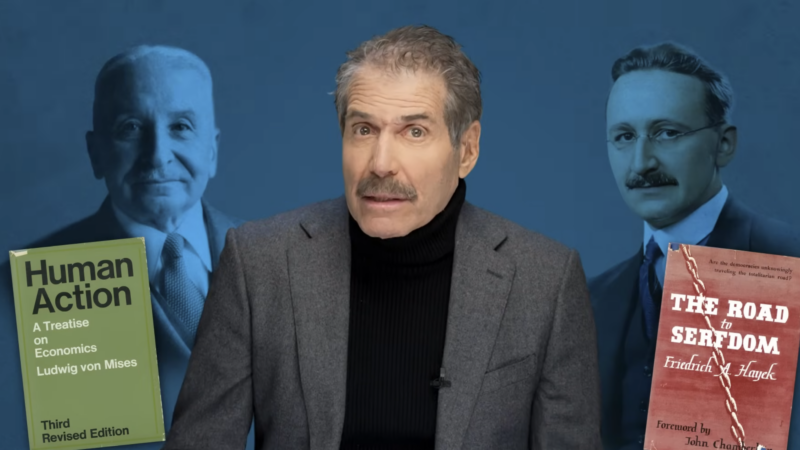
It's just one example of what Austrian economists Friedrich Hayek and Ludwig von Mises wrote about years ago.
In The Fatal Conceit, Hayek writes, "The curious task of economics is to demonstrate to men how little they really know about what they imagine they can design."
Mises' Human Action points out that all economics start with individuals making purposeful choices. That "human action" determines prices, and markets coordinate the most efficient use of resources.
But the media believed the socialists. The New Republic wrote: "The major task of our civilization is…to organize our great economic organs."
On the contrary, wrote Hayek: "To follow socialist morality would destroy much of present humankind and impoverish much of the rest."
He was right. Every socialist government, everywhere, has failed. They fail because no political leader can ever know as much as millions of individuals doing our own thing.
"That's the idea that Mises' introduced to the world," says Ryan McMaken of the Mises Institute. "Central planning doesn't work because everybody has different ideas for themselves, wants to do different things with their property. If you take away their ability to do what they want, it eventually causes great impoverishment."
I assumed belief in socialism would die when the Soviet Union did—but bizarrely, it hasn't. Recently, young people helped elect socialist mayors in Seattle and New York City.
They promise rent control and government-run grocery stores.
"We don't have to look any further than Mises to find an excellent explanation of why that doesn't work," says McMaken in my .
Unfortunately, Mises and Hayek were never as popular as economists pushing central planning and government spending.
"There's a big advantage that the people who are in favor of inflation and more government regulation have. Everyone in government wants that same thing," says McMaken. "'Like to spend? Like to regulate the economy? Boy, have we got an economic theory for you.' [That] of course became instantly popular with people in government."
And popular with the public.
"Because the public wants government to spend on them as well!" says McMaken. "Here was an economic theory telling them the government can give you boatloads of welfare nonstop forever and there's no downside….The reality is that there is a downside: recessions, unemployment, inflation, and falling real wages."
We got that in the 1970s, after years of spending on President Lyndon B. Johnson's "Great Society" programs. In total, American taxpayers have spent $30 trillion in the name of reducing poverty. Politicians said government agencies would spend the money efficiently.
They rarely did, and the deficit spending contributed to 15 percent inflation.
"People then saw, 'Everything we've been told for the last 30 years about managing the economy isn't really true,'" says McMaken. "When you start to inflate the money supply, it sows the seeds for a future economic collapse. That is the cause of everything we've seen over the last century. It is Mises' work that explains why the Great Depression happened….We have to study the economic side of things because if we don't…we can't see the ways that the state is ripping us off."
Hayek and Mises were right. The socialist planners are wrong.
Books like The Fatal Conceit, The Road to Serfdom, and Human Action, although I couldn't get through all of it, are well worth reading today.
COPYRIGHT 2026 BY JFS PRODUCTIONS INC.

Start your day with Reason. Get a daily brief of the most important stories and trends every weekday morning when you subscribe to Reason Roundup.
---