1.5bak
oops bak
4/22
merri ok
see ukraine watershed, vlad
4 err field missing?
see ESA
see doom tip pt
see deforestation. amazon/ brazil/ bolsonaro
see ice loss
see wildfires
see ocean warm
see global weirding
bak 2 24
---
BBB--> IRA passed but concession on fed land
---
---
ggl 3 26
Climate Deniers Expected More Resistance to Trump’s Fossil Fuel Blitz - DeSmog
*published in partnership with The Guardian.
As Donald Trump assaults the legal foundation of America’s ability to regulate global warming emissions, climate deniers have been privately celebrating what they claim is the “silent” acquiescence of billionaires, Democrats, climate activists and even reporters to the president’s aggressive pro-fossil fuel agenda.
“In my 26 years of being focused on climate, I’ve never seen anything like this. Trump is gutting everything they ever stood for,” Marc Morano, a long-time climate denier, said in January at the “World Prosperity Forum,” a five-day event in Zurich, Switzerland, billed as a right-wing alternative to the World Economic Forum in Davos.
The event’s sponsor was The Heartland Institute, a conservative think tank that has been at the forefront of spreading climate disinformation for decades, and was also a contributor to Project 2025, the policy blueprint for President Trump’s second administration.
“Billionaires are silent. Democrats in Congress have been silent. Climate activists. There has been no push-back on this,” Morano said — and he may have a point, according to some experts who research the climate denial movement.
“The Trump administration just marched in and destroyed the crown jewel of climate science in the United States,” said Robert Brulle, a professor of environment and society at Brown University, referring to the Trump administration’s dismantling of the country’s premier climate research center, the National Center for Atmospheric Research, in December.
“And nothing happened. There wasn’t even a whimper. I never thought I’d ever say this: Marc Morano is correct.”
Last month, the Trump administration repealed the 2009 “endangerment finding” establishing that greenhouse gas pollution endangers public health. It was a determination that undergirded the federal government’s authority to limit climate-heating pollution from automobiles and power plants.
Elimination of the endangerment finding had long been a core goal of the climate denial movement.
Its repeal is just the latest in a long line of President Trump’s climate-related destruction. Since taking office in January 2025, his administration has significantly curtailed the country’s weather forecasting organizations and climate science research facilities, published reports denying established climate science, and made deep cuts to funding for climate-related energy and community projects.
Under the leadership of Trump appointee Chris Wright, the Department of Energy last year all but banned its key renewable energy department from using terminology like “climate change,” “green,” and “sustainability.”
”Trump overturned Biden’s climate agenda at breakneck speed,” Morano said at the Heartland Institute’s Zurich forum.
Instead of pushing back on this blitz, many Democratic Party representatives have retreated from talking directly about climate change across social media, podcasts, speeches, and in Congress. The party is now embroiled in a debate about whether affordability is a better message than climate action, despite polling suggesting that 63 percent of the American public believes the president and Congress should prioritize clean energy.
This trend hasn’t gone without resistance in the party, however. “Anyone who cares about what fossil fuel pollution is doing to Earth’s natural systems needs to ignore these so-called ‘climate hushers’ — people who think Dems should stop talking about climate,” Sen. Sheldon Whitehouse (D-RI) posted on social media in January.
Genevieve Guenther, a climate communications expert and founding director of the advocacy group End Climate Silence, largely agrees. “The Democrats’ climate hushing is politically foolish,” she said in an email. “It only benefits the Trump regime’s agenda.”
At the Heartland Institute event, Morano expressed delighted “shock” over the “flips on climate” of tech moguls Jeff Bezos and Bill Gates, the founders of Amazon and Microsoft respectively, whose companies have abandoned once-ambitious climate promises as they confront the skyrocketing energy demands of their AI businesses.
Gates, whose foundation has donated millions of dollars to a think tank run by climate crisis denier Bjorn Lomborg, published a controversial memo in October arguing that climate change “will not lead to humanity’s demise” and advocating for ending climate funding in favor of direct humanitarian aid.
Microsoft and Amazon, which have donated large sums to Trump, have both recently embraced fossil-fuel powered AI data centers alongside Trump energy officials and fossil fuel industry players.
In early February, Bezos, who is also the owner of the Washington Post, slashed at least 14 reporters from the venerated paper’s climate desk. Just weeks later, the Post published an editorial board opinion, “EPA is right to reverse Obama overreach,” praising Trump’s repeal of the endangerment finding.
Morano noted that overall, journalists have been reporting less aggressively about Trump’s fossil fuel agenda. “When you have Lee Zeldin, the EPA chief, calling climate a cult, a scam, religion, he doesn’t even get push-back from reporters,” Morano said.
During Trump’s first term, by contrast, environmental officials like Scott Pruitt, who led the Environmental Protection Agency from February 2017 to July 2018, “would have to be very careful on climate,” Morano said. Otherwise “they would be beaten and browed by the media.”
The growing “climate hush” is not limited to the U.S. — a hushed silence about climate change has expanded across the globe.
At Davos in January, world leaders across business and government talked noticeably less about addressing climate change than in previous years.
Why? “In today’s deeply polarizing U.S. political stance, climate discussion has come to feel so radioactive that many leaders would rather avoid it,” Anjali Chaudhry, a business sustainability researcher at Dominican University, wrote about the silence in Forbes.
Even Canadian Prime Minister Mark Carney, who once served as a United Nations Secretary-General Special Envoy on Climate Action and Finance, limited his mentions of climate change at Davos to a quiet reference to the COP climate summit and a simple “Canadians remain committed to sustainability.”
Despite all this quiet, the vast majority of people worldwide, 89 percent, support climate action, even if they underestimate how much others care — a misperception that has added fuel to a “spiral of science.”
What can be done to counteract the trend towards silence? “In this time of ‘climate hushing,’ having conversations about climate change is more important than ever,” Katherine Hayhoe, a climate scientist and climate communications expert, advised in her influential blog.
For environmental sociologist Brulle, addressing the growing hush around climate must go beyond talking.
“I think the climate movement in the United States has failed. It has flat failed, and that means we need to rebuild this movement in a completely different manner,” he said.
Environmentalist Bill McKibben is more optimistic. “I think [the Trump administration] is whistling past the graveyard of their fossil-fueled dreams,” he said in an email. “The real story of the last year is how politicians, movements, entire nations are moving fast towards clean energy. They’re not all doing it in the name of ‘climate,’ but we’re making faster climate progress than we have at any point in the last 40 years.”
McKibben added a caveat: “Fast enough? Of course not. The deniers have delayed change and that continues. But it’s going far faster than they want it to — hence their resort to political gamesmanship.”
---
---
simon clark 
mogera ACCESS TO GOOD INFO IS HU RIGHT
Prof Morgera's report: https://documents.un.org/doc/undoc/ge...
28:15
argument for this has been made clear by now. Climate misinformation produces clear and demonstrable harms both to the
28:22
environment and to us and our human rights. But the obvious counterargument is, what about my freedom of speech? Why
28:29
can't I say what I want even though I know that something is inaccurate? I mean it is essential to protect
28:35
freedom of speech and in all my work I've always mention how important it is to have as open conversations as
28:42
possible. Now the question here is different if this is a conduct that's been repeated and that over time has led
28:49
to the protection of a vested interest which is uh intrinsically uh opposite to
28:55
the protection of a public good. I mean climate change has been recognized as
structural violence against children for instance by the UN committee on children's rights and incitation to
violence um is for instance one of the very few exceptions that has been recognized to freedom of expression. I
29:15
think there's two things to highlight here that Professor MorgeRa said. Firstly, this is not a law that is
29:21
criminalizing ignorance about climate change. Like just saying something wrong wouldn't break this hypothetical law.
29:27
We're talking about a law that's quite explicitly targeting the fossil fuel industry that has a long history of
29:35
acting against the public good. And secondly, by basing the argument for this law on human rights...
---
===
1.5C is dead. The climate fight isn’t.
Trump’s re-election is “the final nail in the coffin” for the Paris Agreement's North Star goal, nine experts told HEATED. But we can still limit the damage.
Now that Trump has been re-elected, the goal of preventing global temperatures from rising more than 1.5 degrees Celsius above pre-industrial levels is dead, nine climate scientists and policy experts told me this week.
“There’s virtually no hope” for limiting warming to 1.5 degrees, said Andrew Dessler, a climate scientist at Texas A&M University. “Certainly if there was a smidgeon of hope, yesterday afternoon that was gone.”
1.5 degrees is generally communicated the critical threshold past which the planet will experience significantly more extreme climate impacts like raging wildfires, droughts, deadly heat, mass coral reef die-offs, sea level rise, and more. However, scientists note that it's just an estimate; the tipping points could be more or less than 1.5 degrees.
Either way, Trump’s re-election can be seen as “the final nail in the coffin” for the 1.5 degree goal, said Rachel Cleetus, a policy director and economist at the Union for Concerned Scientists.
But that doesn’t mean the fight to preserve a livable climate is over, according to every scientist and policy expert I spoke to post-election. In fact, each one affirmed that every fraction of a degree past 1.5 makes climate disasters more damaging, especially for the most vulnerable countries and communities.
Frontline communities “have continually had to fight for justice, regardless of whatever presidential administration is in power,” said Michael Méndez, an assistant professor of environmental policy at the University of California, Irvine. “We really rely on organizing communities at the local, regional, and state level to have climate action that is achievable."
"Every fraction of a degree matters,” Cleetus said. “Globally, we have to do everything we can.”
With an incoming presidential administration committed to climate inaction and misinformation, action-focused climate information is important than ever. Subscribe today.
The existential threat of Trump’s second term
It’s important to note that even before Trump’s re-election, the 1.5 degree Celsius target was hanging by a thread. According to a United Nations emissions report published last month, the majority of countries are cutting emissions far too slowly to stabilize warming at safe levels. And 2024 is likely to be the hottest year in the history of human civilization, surpassing 1.5 Celsius.
Indeed, most of the people I spoke with were skeptical that any president, including Kamala Harris, could have put the U.S. back on track to meet its climate goals.
But all nine experts are deeply concerned that Trump, who falsely calls climate change a “hoax,” will make planetary heating far worse than it would have overwise been. Just how much worse depends “on the extent to which Trump unravels Biden's climate legacy,” said Simon Evans, deputy editor of Carbon Brief and co-author of a study on how much Trump’s presidency could impact emissions.
Evans estimated that a Trump administration could add 4 billion tons of carbon emissions to the atmosphere by the end of the decade, the equivalent of $900 billion in global climate damages. That analysis—which is based on neither the best nor worst case scenario—assumes that Trump will roll back all of Biden’s climate policies, including the Inflation Reduction Act (IRA).
If Trump follows through on his other campaign promises, he could gut environmental agencies, increase fossil fuels, block renewables, and roll back scores of environmental regulations. Then there’s the proposals found in Project 2025, the unofficial blueprint for Trump’s second term published by the conservative Heritage Foundation. Project 2025 calls for more extreme measures like the privatization of the National Weather Service, eliminating environmental justice programs, defunding renewable energy, and erasing even the mention of “climate change”.
The ripple effects of Trump’s election will also likely be felt internationally. Trump will almost certainly pull the U.S. out of the Paris Agreement again, and may even withdraw the U.S. from all climate diplomacy efforts. That would be a hefty blow to global climate goals, especially since the U.S. is one of the biggest polluters in the world.
But even with all this, it’s still possible the world can limit the temperature rise to 2 degrees Celsius, Dessler told me. It all depends on the actions of state governments, local governments, other countries, and regular people.
“I still think 2 degrees is reasonable,” he said. “Because again, whatever the U.S. does, the rest of the world is moving on.”
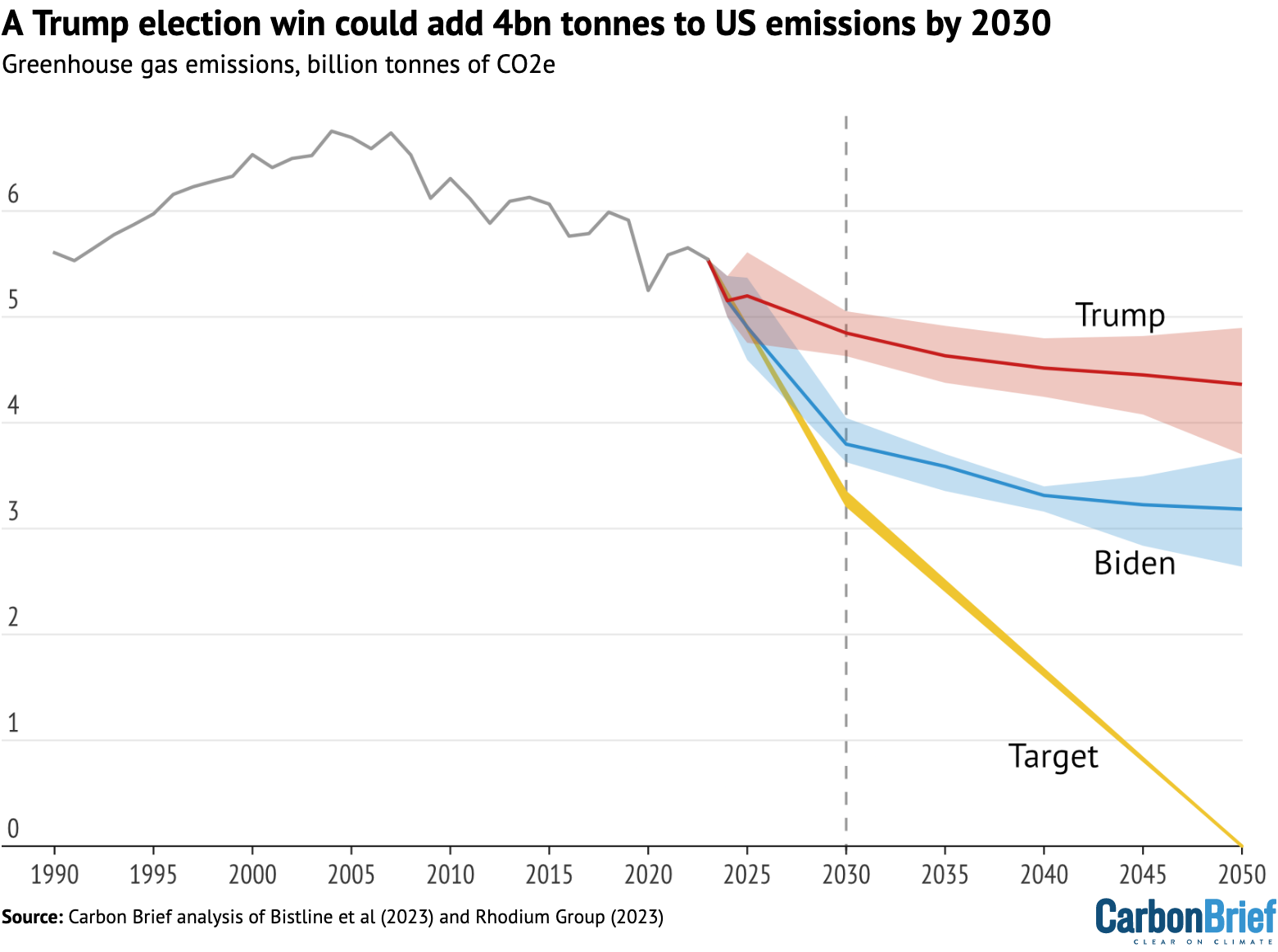 |
The red line and area are projected emissions under Carbon Brief’s Trump scenario where Biden’s key climate policies are eliminated. The yellow line is the U.S. climate target trajectory pledged by the Biden administration (50-52% by 2030).}:
2C is still “reasonable”
Because the U.S. is the world’s largest historical climate polluter, its cooperation in reducing emissions is critical to preserving a livable planet in the long term. But the U.S. may not be that necessary over the next four years, experts told me—if other countries are able to fill in the gaps.
Large emitters like China, the European Union, India, and Brazil need to drastically reduce emissions to prevent dangerous levels of warming. “I think inevitably, leadership and contributions will need to come from the rest of the world,” said Li Shuo, director of the China Climate Hub at the Asia Society Policy Institute.
China in particular could step into the gap. China’s massive investment in clean technology already threatens to leave the U.S. behind, a gap that could widen over the next four years. The country has also rapidly electrified and expanded renewable energy and storage. Last year, China’s solar and wind capacity reached a record 1,200 gigawatts—as much power as 600 Hoover Dams.
While the rest of the world may carry on the momentum, the U.S. still plays a large role in moving other countries towards more ambitious climate targets. “We have seen that in the past that U.S. diplomatic engagement under a climate-friendly administration has made a difference in China’s level of ambition,” said Shuo. “And now with the Trump administration, a bilateral climate agreement between Washington and Beijing will be shelved.”
The balance of power will be tested next week at the United Nations annual climate summit in Baku, Azerbaijan. During negotiations, Biden administration officials will make new pledges—pledges that Trump is unlikely to honor. “I am still confident about the near-term,” said Shuo. “But I am very worried about the long term.”
There is still a possibility for effective action in the U.S., though. For example: Trump may not be able to dismantle some of Biden’s landmark renewable energy investments—if he receives significant enough pressure to back off. The IRA is popular among Republican lawmakers for bringing more money into their districts via clean energy tax credits.
And states and local climate laws continue to have power even without federal safeguards—for example, Washington voted this week to preserve a state law that generates billions to fight climate change.
Renewable energy will also likely continue to replace more expensive coal power, as it did during the first Trump administration. “At some point the US will realize that fossil fuels are just not competitive,” Dessler said. “Staying on fossil fuels is not the way to run a competitive economy. It just costs too much."
Even with the fallout of Trump’s anti-climate policies—policies that multiple experts told me amount to climate injustice—the climate community is strapping in for a years-long fight.
“It’s hard to know what the future is going to hold, but those who work on this issue are in it for the long term,” said Zeke Hausfather, a climate scientist at the Breakthrough Institute. “We’ve already been through this once.”
“We have a window—not a big window—of time,” said Gregory Jenkins, a climate scientist and professor at Penn State University. “And climate change is one of those problems where you have to work on it now.”
===
i can’t look
===
an 224 spate
Antarctic tipping point that occurred 8,000 years ago 'could happen again' - Alternet.org
thom 3 wisc winter hurric
Category 6? Scientists highlight 'growing inadequacy' of current hurricane scale - Alternet.org
---
Rare ‘flesh-eating’ bacterium spreads north as oceans warm - Alternet.org
---
---
yahoo mail 10 23 THOM
Sometime in the past year, this tiny planet we live on in an obscure corner of our Milky Way galaxy went through some sort of tipping point, a “state change” of sorts, and now things are different from how they’ve been at any other time in the 300,000 year history of the human race.
Nobody knows for sure what that change or tipping point is.
— One theory is that variations in dust concentrations in the Northern Hemisphere’s atmosphere — a function of the temperature of the Atlantic Ocean allowing more or less fine dirt to be picked up and carried aloft from northern Africa — are changing the reflectivity of the atmosphere and trapping more of the sun’s heat.
— Another theory follows the January, 2022 eruption of the volcano at Hunga Tonga–Hunga Ha’apai, which injected so much water vapor (146 million tons) and sulfur dioxide (420,000 tons) into the stratosphere that scientists were predicting soon after it happened that there would be a year or two of unusual heat signatures across the planet.
— Some scientists argue it was caused by a change in worldwide regulations mandating ships at sea burn cleaner diesel fuel, reducing the soot-type particles they’re emitting that previously formed heat-reflective clouds.
— And, of course, the current El Niño ocean pattern appears to be drawing heat from the ocean up to the surface where it’s transferred to the atmosphere in unprecedented amounts.
But regardless of the why/how,somethinghas definitely happened in the past year or so that has pushed our atmosphere’s state of equilibrium out of an older, stable range and into a newer, warmer, and apparently far less stable state.’
nice grAph ]Graphic from: “The 2023 State of the Climate Report: Entering Uncharted Territory.” BioScience24 Oct 2023. Red line is 2023; gray lines are previous years.}:
It’s so dramatic and so shocking that scientists — typically not prone to hyperbole — publishing in the peer-reviewed journal BioScience about this anomaly open their article with:
“Life on planet Earth is under siege. We are now in an uncharted territory.
“For several decades, scientists have consistently warned of a future marked by extreme climatic conditions because of escalating global temperatures caused by ongoing human activities that release harmful greenhouse gasses into the atmosphere.
“Unfortunately, time is up. We are seeing the manifestation of those predictions as an alarming and unprecedented succession of climate records are broken, causing profoundly distressing scenes of suffering to unfold. We are entering an unfamiliar domain regarding our climate crisis, a situation no one has ever witnessed firsthand in the history of humanity.”
Looking at 35 different “vital signs” that signal the health of our planet and its atmosphere, 20 of which have deviated from their norms so badly as to alarm researchers, the scientists who wrote for BioScience warn us all:
“We are venturing into uncharted climate territory.”
In just the past 24 hours, a tropical storm that nobody thought was a threat blew up into a full-on Category 5 hurricane and is, as you’re reading these words, devastating Acapulco. Not one weather agency predicted it: this is how unpredictable and violent our weather has become because we’re still burning fossil fuels.[yemen?]
While wind and solar power grew 17 percent worldwide between 2021 and 2022, and both are now cheaper that any unsubsidized fossil fuels, humanity is still using fossil fuels at a 15:1 ratio against renewables. Life on earth won’t be safe until those numbers are reversed.
Our forests worldwide are not only under assault from loggers and poachers; climate change has now altered their environment enough that hundreds of millions of acres of trees are suffering from beetle infestations, drought, dieback, and forest fires.[FEEDBACK] While the world needs to reverse the trend toward deforestation by 2030 (we’re currently losing around 22 million hectares of forest and jungle a year), we’re still a long way away from that goal.
All over the planet glaciers are in retreat, as are the ice shelves and glaciers covering Greenland and Antarctica. Coral reefs are bleaching and dying, and fish and marine mammal species are undergoing radical shifts in their habitat and range as waters warm, driving most ambulatory animals toward the north and south poles.
Deadly storms, derechos, flash flooding, bomb cyclones, rapidly-forming hurricanes, severe/damaging hail, tornadoes in areas that had never before seen them: all these are creating vast swaths of human misery and costing hundreds of billions worldwide.
Given that the cost of the damages inflicted by climate change are so much higher than the profits the worldwide fossil fuel industry is making selling us their destructive products it’s surprising that more governments haven’t ended hydrocarbon subsidies and begun to directly bill these corporations for the climate change destruction their products are causing.
There’s a huge issue of economic and social justice associated with the climate crisis. The top 10 percent of the world, wealth-wise, produce fully 48 percent of the world’s emissions. The bottom half of humanity, wealth-wise, produces a mere 12 percent.
Yelling at poor people that they need to turn lights off (if they even have lights) and insulate their houses (when they have houses) will never have even a fragment of the impact that could be achieved by imposing a carbon tax on private jets, yachts, and mega-mansions.
Along those same lines, economists need to come up with new ways to model the health and success of societies and their economies that don’t rely only or even primarily on growth (as most do now). Instead, indices of sustainability and quality-of-life should be pushed front-and-center as alternatives to growth are developed and publicized.
Last year over 700 million people experienced chronic — regular, long-lasting — hunger, an uptick of over 100 million people over the previous two years. Driving this are climate extremes that are wiping out crops, failing soil exhausted by factory farming, and armed conflicts.
Producing a single pound of beef takes 1,700 gallons of water (compared with 39 gallons for a pound of vegetables): if everybody in America were to simply adopt “Meatless Mondays,” it would save the nation 70 million gallons of gas every year (“enough to fill up every car in Canada and Mexico and then some”) and free up an amount of land twice the size of Delaware.
It would also measurably reduce the rates of heart disease, stroke, cancer, and obesity. Cutting meat down to once a week or once a month — well within what human diets require — we’d have enough food left over to end world hunger while taking a bite out of climate change as well.
The fossil fuel industry would prefer we focus on talking about recycling, turning off lights, keeping our homes cool, and yelling at friends who fly for vacation. But the real power to change the future is in Congress and state houses across the country.
Making fossil fuels and meat more expensive (while subsidizing public transportation and healthy food for low-income people) is something that can only be done by government bodies, and will have a far greater impact than any amount of complaining or accusing people around their individual actions.
And there’s never been a better or more important time than now to join climate actions and lobby your elected representatives for large scale, long-term solutions to our fossil fuel addiction.
While nobody is exactly sure why we’ve hit this year of sudden anomalies, scientists are certain it’s a blinking red neon warning that we must change our course or suffer an unimaginable catastrophe. And we still have the tools to solve this crisis of our own making: we just have to use them before it’s too late.
---
---
no lnx $ ****
Worldwide fascism is being accelerated by the one thing few people want to talk about
Thom Hartmann
August 22, 2023
This article was paid for by AlterNet subscribers.
The government of the Netherlands fell this summer. The issue that tipped it over the edge was immigration driven by climate change. If Putin wanted to destroy democracy in Europe (and he does), back in 2015 he couldn’t have picked a better strategy. Odds are, though, he was just trying to protect his deepwater ports; it wasn’t until the crisis developed that he realized how he could exploit it to overthrow liberal democracies in the EU. The way it’s played out gives us a glimpse into our future — and the future of democratic republics all across the world — as the global climate emergency and the refugee crisis associated with it grows more severe over the next few years.
The current rise-of-rightwing-fascism crisis building in Europe began in 2010 and started with global climate change.
:{:{}:
}:
The fall of that year sawunusually severe rainfall across the wheat-growing parts of Canada, cutting that nation’s wheat harvest, along with drought across Russia, Kazakhstan, Ukraine, and China. A La Nina caused crop failures in Argentina and Peru. Worldwide prices of staple foods, particularly wheat, exploded.
:{:{}:
}:
On December 17 of that year a street vendor inTunisia, Mohamed Bouazizi, set himself on fire to protest the high cost of the wheat he needed to make the foods he and his peers sold, and the harassment of police against their protests. It sparked what we referred to then as the Arab Spring, that lasted through most of 2011.
The steady warming and drought in that area, though, never let up and the desert in North Africa relentlessly continued to eat up millions of acres of food-producing land, particularly across Syria. By 2015 it had pushed over a million Syrian subsistence farmers off their land — that had desertified — and into Syria’s cities, particularly Damascus and Aleppo.
Northern Africa became the world’s number one food importer, and the prices kept rising relentlessly.
Newly homeless, hungry, and destitute, these Syrian farmers began demonstrations in the streets demanding food, shelter, and employment or “welfare” payments from the Syrian government.
Bashar Assad, being a psychopathic dictator, ordered his troops to fire live ammunition into the crowds in 2012 and 2013, and soon a full-blown revolt was on: “rebels” seized Syria’s largest city, Aleppo, in early 2013.
Syria was also the base for Russia’s Mediterranean fleet, with multiple deep-water ports that Putin believed were critical to his nation’s military defense. By 2015 he had a dozen battleships there, along with submarines and other warships.
He had to prevent the Assad government from falling or risk an “Arab Spring democracy” emerging — as happened for a short while in Tunisia and Egypt [ALSO DROUGHT]— that might align itself with the West and kick Russia out.
Making a long story short, Putin bombed the crap out of Syria on Assad’s behalf, virtually leveling the city of Aleppo, killing hundreds of civilians.
It was one of the worst war crimes of this century, almost as deadly as George W. Bush’s brutal and criminal invasions and occupations of Iraq and Afghanistan. Millions of climate and war refugees fled the country, joining Bush’s wars’ fugitives making their way into Europe by any means possible.
:{:{}:
}:
Thus began Europe’s refugee crisis, which just helped bring down Holland’s government. In two weeks, it may well cause the rightwing fascist-aligned anti-immigrant People’s Party to come to power in the Spanish elections on July 23.
As the United Nations High Commissioner for Refugees (UNHCR) noted in a 2021 report:
“By the end of 2016, nearly5.2 million refugees and migrants reached European shores,undertaking treacherous journeys from Syria, Iraq, Afghanistan and other countries torn apart by war and persecution.”
This flood of brown-skinned Muslims fleeing African and Middle Eastern climate change and wars into Europe over the past decade is why Italy and Sweden now have rightwing leaders; why Viktor Orbán was able to gain and hold power in Hungary with his promise to “build a wall” along Hungary’s southern border (a promise he kept); and why rightwing parties are today growing so rapidly in Germany, Greece, Norway, Austria, Belgium and France.
The legacy of five centuries of racist imperialism across four continents has been that wealth and safety from the ravages of climate change are concentrated in mostly White-run nations, while vulnerability to desertification and poverty are concentrated in mostly Brown- and Black-run nations.
When Russia intervened in British politics to tear apart the EU, their trolls’ main Facebook pitch for Brexit was that “those [Brown and Black] people” the EU had let in were now making their way to the UK.
While every country in the world can accept refugees in small numbers without crisis, when “other people” begin showing up in large numbers the response by every nation in history typically tends toward rightwing nationalism and xenophobia, an obsession with borders, and demands for racial, cultural, and religious “purity.”
Here in North America we’re seeing a similar dynamic. Reagan so severely destabilized Central America and Venezuela with his sanctions, illegal Iran-Contra program, and support for rightwing death squads that those nations never recovered. In the years since, climate change has bit these weakened governments deep, forcing millions of subsistence farmers — just like in Syria but here mostly from hard-hit Guatemala — off land that once grew crops but is now, just a few years later, scrub desert.
Exploiting the climate refugee crisis on America’s southern border, Republican politicians have spent the years since Obama’s election in 2008 falsely claiming that Democrats had thrown the border “open,” producing thousands of news stories that have been used by coyotes — human traffickers — to draw even more refugees toward the United States.
Compounding that, Trump launched his 2016 campaign on keeping Brown people out of the United States, and today racism and xenophobia form the foundation of most Republican political campaigns (when they aren’t hating on queer people or women).
The result of these trends has been a worldwide shift to the right. As Freedom House noted in a 2022 report, over 60 countries experienced “declines” in democracy the previous year; only about 20 percent of people worldwide now live in “free” nations:
“Global freedom faces a dire threat. … Authoritarian regimes have become more effective at co-opting or circumventing the norms and institutions meant to support basic liberties, and at providing aid to others who wish to do the same. …
“The global order is nearing a tipping point, and if democracy’s defenders do not work together to help guarantee freedom for all people, the authoritarian model will prevail.”
So far, the western world’s refugee crisis has been mostly driven by massive policy errors and outright war crimes: Russia’s response to the Syrian farmers, the US invasion and destruction of Iraq and Afghanistan, and American meddling in Central America and Venezuela.
But all have been either triggered or exacerbated by the worldwide climate emergency. And, as we can see from this summer’s weather worldwide, that emergency is building at a rate far more rapid than even alarmist climate scientists were predicting just a decade ago.
Recent projections show that within just the next two decades as many as three billion people could be fleeing areas that will soon only marginally support human life.
As equatorial regions become uninhabitable, the mostly darker-skinned people living there will be migrating north and south into areas controlled by lighter-skinned people in numbers that will make today’s Syrian, Iraq, and Afghan refugee crisis look like a statistical blip.
It will put worldwide white supremacist and Nazi movements into hyperdrive.
In addition to acting immediately to mitigate climate change and green the world’s economy, the free nations of the world must harden our democracies against reactive rightwing violence- and hate-based racist political movements.
That will also require radically reducing the Supreme Court-gifted political power of big money here in America — particularly from the fossil fuel industry and the billionaires it has created — and returning that power and wealth to the hard-hit majority. The Democratic Party in America is increasingly committed to this, but Republicans and the dozens of billionaires in their camp are prepared to spend heretofore unimaginable sums to keep climate deniers and race-baiters in office.
We also must help those nations most hard-hit by the warming — caused largely by our carbon pollution — to deal with their own refugees internally, lest they irrecoverably destabilize first their own governments and then ours.
To paraphrase JFK, we are not helpless before this task.
But it will require western and American media and political systems to take on these three crises — climate change, the refugees it produces, and politicians who demagogue the issue while blocking forward progress — now.
We are quite literally out of time.
From Your Site Articles
'Fascistic': Mary Trump warns a Republican admin will let 'everything burn to the ground' — 'literally' ›
How capitalism is leading us to instability, inequality, and fascism ›
Noam Chomsky: 'Proto-fascism' and 'white nationalism are prime ingredients of the GOP’s slow-motion coup ›
Eco-fascism: White nationalists' extreme solution to the coming environmental apocalypse ›
Related Articles Around the Web
The dangers of eco-fascism and why it's a 'veneer for racist beliefs ... ›
What's Worse Than Climate Catastrophe? Climate Catastrophe Plus ... ›
The far-right and environmentalism overlap is bigger than you think ... ›
---
---
no lnx $ ****
Worldwide fascism is being accelerated by the one thing few people want to talk about
Thom Hartmann
August 22, 2023
This article was paid for by AlterNet subscribers.
The government of the Netherlands fell this summer. The issue that tipped it over the edge was immigration driven by climate change. If Putin wanted to destroy democracy in Europe (and he does), back in 2015 he couldn’t have picked a better strategy. Odds are, though, he was just trying to protect his deepwater ports; it wasn’t until the crisis developed that he realized how he could exploit it to overthrow liberal democracies in the EU. The way it’s played out gives us a glimpse into our future — and the future of democratic republics all across the world — as the global climate emergency and the refugee crisis associated with it grows more severe over the next few years.
The current rise-of-rightwing-fascism crisis building in Europe began in 2010 and started with global climate change.
:{:{}:
}:
The fall of that year saw unusually severe rainfall across the wheat-growing parts of Canada, cutting that nation’s wheat harvest, along with drought across Russia, Kazakhstan, Ukraine, and China. A La Nina caused crop failures in Argentina and Peru. Worldwide prices of staple foods, particularly wheat, exploded.
:{:{}:
}:
On December 17 of that year a street vendor in Tunisia, Mohamed Bouazizi, set himself on fire to protest the high cost of the wheat he needed to make the foods he and his peers sold, and the harassment of police against their protests. It sparked what we referred to then as the Arab Spring, that lasted through most of 2011.
The steady warming and drought in that area, though, never let up and the desert in North Africa relentlessly continued to eat up millions of acres of food-producing land, particularly across Syria. By 2015 it had pushed over a million Syrian subsistence farmers off their land — that had desertified — and into Syria’s cities, particularly Damascus and Aleppo.
Northern Africa became the world’s number one food importer, and the prices kept rising relentlessly.
Newly homeless, hungry, and destitute, these Syrian farmers began demonstrations in the streets demanding food, shelter, and employment or “welfare” payments from the Syrian government.
Bashar Assad, being a psychopathic dictator, ordered his troops to fire live ammunition into the crowds in 2012 and 2013, and soon a full-blown revolt was on: “rebels” seized Syria’s largest city, Aleppo, in early 2013.
Syria was also the base for Russia’s Mediterranean fleet, with multiple deep-water ports that Putin believed were critical to his nation’s military defense. By 2015 he had a dozen battleships there, along with submarines and other warships.
He had to prevent the Assad government from falling or risk an “Arab Spring democracy” emerging — as happened for a short while in Tunisia and Egypt — that might align itself with the West and kick Russia out.
Making a long story short, Putin bombed the crap out of Syria on Assad’s behalf, virtually leveling the city of Aleppo, killing hundreds of civilians.
It was one of the worst war crimes of this century, almost as deadly as George W. Bush’s brutal and criminal invasions and occupations of Iraq and Afghanistan. Millions of climate and war refugees fled the country, joining Bush’s wars’ fugitives making their way into Europe by any means possible.
:{:{}:
}:
Thus began Europe’s refugee crisis, which just helped bring down Holland’s government. In two weeks, it may well cause the rightwing fascist-aligned anti-immigrant People’s Party to come to power in the Spanish elections on July 23.
As the United Nations High Commissioner for Refugees (UNHCR) noted in a 2021 report:
“By the end of 2016, nearly5.2 million refugees and migrants reached European shores,undertaking treacherous journeys from Syria, Iraq, Afghanistan and other countries torn apart by war and persecution.”
This flood of brown-skinned Muslims fleeing African and Middle Eastern climate change and wars into Europe over the past decade is why Italy and Sweden now have rightwing leaders; why Viktor Orbán was able to gain and hold power in Hungary with his promise to “build a wall” along Hungary’s southern border (a promise he kept); and why rightwing parties are today growing so rapidly in Germany, Greece, Norway, Austria, Belgium and France.
The legacy of five centuries of racist imperialism across four continents has been that wealth and safety from the ravages of climate change are concentrated in mostly White-run nations, while vulnerability to desertification and poverty are concentrated in mostly Brown- and Black-run nations.
When Russia intervened in British politics to tear apart the EU, their trolls’ main Facebook pitch for Brexit was that “those [Brown and Black] people” the EU had let in were now making their way to the UK.
While every country in the world can accept refugees in small numbers without crisis, when “other people” begin showing up in large numbers the response by every nation in history typically tends toward rightwing nationalism and xenophobia, an obsession with borders, and demands for racial, cultural, and religious “purity.”
Here in North America we’re seeing a similar dynamic. Reagan so severely destabilized Central America and Venezuela with his sanctions, illegal Iran-Contra program, and support for rightwing death squads that those nations never recovered. In the years since, climate change has bit these weakened governments deep, forcing millions of subsistence farmers — just like in Syria but here mostly from hard-hit Guatemala — off land that once grew crops but is now, just a few years later, scrub desert.
Exploiting the climate refugee crisis on America’s southern border, Republican politicians have spent the years since Obama’s election in 2008 falsely claiming that Democrats had thrown the border “open,” producing thousands of news stories that have been used by coyotes — human traffickers — to draw even more refugees toward the United States.
Compounding that, Trump launched his 2016 campaign on keeping Brown people out of the United States, and today racism and xenophobia form the foundation of most Republican political campaigns (when they aren’t hating on queer people or women).
The result of these trends has been a worldwide shift to the right. As Freedom House noted in a 2022 report, over 60 countries experienced “declines” in democracy the previous year; only about 20 percent of people worldwide now live in “free” nations:
“Global freedom faces a dire threat. … Authoritarian regimes have become more effective at co-opting or circumventing the norms and institutions meant to support basic liberties, and at providing aid to others who wish to do the same. …
“The global order is nearing a tipping point, and if democracy’s defenders do not work together to help guarantee freedom for all people, the authoritarian model will prevail.”
So far, the western world’s refugee crisis has been mostly driven by massive policy errors and outright war crimes: Russia’s response to the Syrian farmers, the US invasion and destruction of Iraq and Afghanistan, and American meddling in Central America and Venezuela.
But all have been either triggered or exacerbated by the worldwide climate emergency. And, as we can see from this summer’s weather worldwide, that emergency is building at a rate far more rapid than even alarmist climate scientists were predicting just a decade ago.
Recent projections show that within just the next two decades as many as three billion people could be fleeing areas that will soon only marginally support human life.
As equatorial regions become uninhabitable, the mostly darker-skinned people living there will be migrating north and south into areas controlled by lighter-skinned people in numbers that will make today’s Syrian, Iraq, and Afghan refugee crisis look like a statistical blip.
It will put worldwide white supremacist and Nazi movements into hyperdrive.
In addition to acting immediately to mitigate climate change and green the world’s economy, the free nations of the world must harden our democracies against reactive rightwing violence- and hate-based racist political movements.
That will also require radically reducing the Supreme Court-gifted political power of big money here in America — particularly from the fossil fuel industry and the billionaires it has created — and returning that power and wealth to the hard-hit majority. The Democratic Party in America is increasingly committed to this, but Republicans and the dozens of billionaires in their camp are prepared to spend heretofore unimaginable sums to keep climate deniers and race-baiters in office.
We also must help those nations most hard-hit by the warming — caused largely by our carbon pollution — to deal with their own refugees internally, lest they irrecoverably destabilize first their own governments and then ours.
To paraphrase JFK, we are not helpless before this task.
But it will require western and American media and political systems to take on these three crises — climate change, the refugees it produces, and politicians who demagogue the issue while blocking forward progress — now.
We are quite literally out of time.
From Your Site Articles
'Fascistic': Mary Trump warns a Republican admin will let 'everything burn to the ground' — 'literally' ›
How capitalism is leading us to instability, inequality, and fascism ›
Noam Chomsky: 'Proto-fascism' and 'white nationalism are prime ingredients of the GOP’s slow-motion coup ›
Eco-fascism: White nationalists' extreme solution to the coming environmental apocalypse ›
Related Articles Around the Web
The dangers of eco-fascism and why it's a 'veneer for racist beliefs ... ›
What's Worse Than Climate Catastrophe? Climate Catastrophe Plus ... ›
The far-right and environmentalism overlap is bigger than you think ... ›
---
---
an 8 23
David Stanway
SINGAPORE (Reuters) -Human-induced climate change has played an "absolutely overwhelming" role in the extreme heatwaves that have swept across North America, Europe and China this month, according to an assessment by scientists published on Tuesday.
Throughout July, extreme weather has caused havoc across the planet, with temperatures breaking records in China, the United States and southern Europe, sparking forest fires, water shortages and a rise in heat-related hospital admissions.
Over the weekend, thousands of tourists were evacuated from the Greek island of Rhodes to escape wildfires caused by a record-breaking heatwave.
Without human-induced climate change, the events this month would have been "extremely rare", according to a study by World Weather Attribution, a global team of scientists that examines the role played by climate change in extreme weather.
"European and North American temperatures would have been virtually impossible without the effects of climate change," said Izidine Pinto of the Royal Netherlands Meteorological Institute, one of the study's authors, during a briefing with journalists."In China it was around 50 times more likely to happen compared to the past."
The World Weather Attribution team estimated that risinggreenhouse gas concentrations made the European heatwave 2.5 Celsius (4.5 Fahrenheit) hotter than it would otherwise have been. They also drove up the North American heatwave by 2C and the one in China by 1C.
As well as directly impacting human health, the heat has caused large-scale crop damage and livestock losses, the scientists said, with U.S. corn and soybean crops, Mexican cattle, southern European olives as well as Chinese cotton all severely affected.
El Nino probably contributed to the additional heat in some regions, but rising greenhouse gases were the major factor, the scientists said, and heatwaves will become increasingly likely if emissions are not slashed.
They estimated that prolonged periods of extreme heat were likely to hit every two to five years if average global temperatures rise 2C above pre-industrial levels. Average temperatures are currently estimated to have risen more than 1.1C.
"The events we have looked at are not rare in today's climate," said Friederike Otto, a scientist with the Grantham Institute for Climate Change in London, speaking at the briefing. "It's not surprising from a climatological point of view, that these events are happening at the same time."
"As long as we keep burning fossil fuels we will see more and more of these extremes," she said. "I don't think there's any stronger evidence that any science has ever presented for a scientific question."
---
context,
https://www.democracynow.org/2023/7/28/global_heat_climate_crisis_july_2023
new climate data show July is on track to become the hottest month in human history, with global temperatures rising to about 1.5 degrees Celsius, or 2.7 degrees Fahrenheit, above pre-industrial levels. On Thursday, the head of the World Meteorological Organization said, “Climate action is not a luxury but a must,” while U.N. Secretary-General António Guterres scolded world leaders over inaction on the climate.
Secretary-General António Guterres: “Climate change is here, it is terrifying, and it is just the beginning. The era of global warming has ended; the era of global boiling has arrived. The air is unbreathable, the heat is unbearable, and the level of fossil fuel profits and climate inaction is unacceptable.”
The U.N.’s warning came as hundreds of wildfires fueled by record heat continued to burn out of control around the Mediterranean — in Algeria, Croatia, France, Greece, Italy, Portugal, Spain, Tunisia and Turkey.
In China, Typhoon Doksuri made landfall today in the southeastern Fujian province, sparking fires, downing power lines and shuttering schools and businesses. On Thursday, the storm lashed southern Taiwan after battering the northern Philippines, where it killed at least 39 people.
---
In more climate news, the Supreme Court has cleared the way for construction of the contested Mountain Valley Pipeline to resume. The court on Thursday lifted a halt on a section of the project that had been issued by a lower court earlier this month after a challenge by environmental groups.
---
---
more heat dome, greece US midwest
jeff goodell bk kpfa 7/26/23 upfront
---
https://www.alternet.org/ocean-temps/
100 degree fla, coral bleach
https://www.alternet.org/weve-fallen-off-a-cliff/
no lnx twt an 7 23
'We’ve fallen off a cliff': Scientists warn Atlantic currents could collapse as early as 2025
Brett Wilkinsand Common DreamsJuly 26, 2023
"It is very plausible that we've fallen off a cliff already and don't know it," said one researcher.
The system of Atlantic Ocean currents that drive warm water from the tropics toward Europe is at risk of collapsing in the coming decades, an analysis of 150 years of temperature data published Tuesday concluded.
"The Atlantic Meridional Overturning Circulation (AMOC), which includes the Gulf Stream, is a major tipping element in the climate system and a future collapse would have severe impacts on the climate in the North Atlantic region," states the study, which was published in the scientific journal Nature Communications.
Although the analysis notes that "assessments by the Intergovernmental Panel on Climate Change (IPCC), based on the Climate Model Intercomparison Project (CMIP) model simulations suggest that a full collapse is unlikely within the 21st century," the study's authors "estimate a collapse of the AMOC to occur around mid-century under the current scenario of future emissions."
"We show that a transition of the AMOC is most likely to occur around 2025-2095," the paper states with "95% confidence."
University of Copenhagen professor Peter Ditlevsen, who led the study, told The Guardian: "I think we should be very worried. This would be a very, very large change. The AMOC has not been shut off for 12,000 years."
Bill McKibben, co-founder of the climate action group 350.org, tweeted that "Gulf Stream collapse used to be viewed as a far-off and remote possibility... Less so now."
Meteorologist and climate journalist Eric Holthaus called the study's findings "incredibly worrying."
The Washington Post reports:
The new study adds to a growing body of evidence that this crucial ocean system is in peril. Since 2004, observations from a network of ocean buoys [have shown] the AMOC getting weaker—though the limited time frame of that data set makes it hard to establish a trend. Scientists have also analyzed multiple "proxy" indicators of the current's strength, including microscopic organisms and tiny sediments from the seafloor, to show the system is in its weakest state in more than 1,000 years.
For thousands of years, the Gulf Stream has carried warm waters from the Gulf of Mexico northward along the eastern North American seaboard and across the Atlantic to Europe. As human-caused global heating melts the Greenland ice sheet, massive quantities of fresh water are released into the North Atlantic, cooling the AMOC—which delivers the bulk of the Gulf Stream's heat—toward a "tipping point" that could stop the current in its tracks.
According to The Guardian:
A collapse of AMOC would have disastrous consequences around the world, severely disrupting the rains that billions of people depend on for food in India, South America, and West Africa. It would increase storms and drop temperatures in Europe, and lead to a rising sea level on the eastern coast of North America. It would also further endanger the Amazon rainforest and Antarctic ice sheets.
"It is very plausible that we've fallen off a cliff already and don't know it," Hali Kilbourne, an associate research professor at the University of Maryland Center for Environmental Science, toldThe New York Times. "I fear, honestly, that by the time any of this is settled science, it's way too late to act."
Other studies—including one published in March and another in 2021—have also concluded that the AMOC is at risk of collapsing this century.
Meanwhile in the Southern Hemisphere, Antarctic currents that enrich 40% of Earth's deep oceans with oxygen and nutrients essential for marine life have slowed dangerously in recent decades and could also collapse by mid-century, an Australian study released in May showed.
FROM YOUR SITE ARTICLES
New evidence that an extraterrestrial collision 12,800 years ago triggered an abrupt climate change for Earth ›
What was the 'catastrophic implosion' of the Titan submersible? An expert explains ›
Atlantic Salmon Is Basically Extinct: You’re Eating a Genetically Eroded Version ›
RELATED ARTICLES AROUND THE WEB
A major Atlantic current is at a critical transition point | NOVA | PBS ›
Is Atlantic Ocean current near collapse? Could be sooner than ... ›
A Stagnant Jet Stream Is Fueling Intense Heat Worldwide. Could ... ›
---
mex tex heat dome spreads, canada burns
https://www.alternet.org/hottest-day-ever-recorded-earth/
---
6 23 faster than we thot
https://www.alternet.org/Bank/himalayan-glaciers/
---
---
an 7 23 $
The danger of worldwide fascism is being accelerated by the one thing few people want to talk about
Thom Hartmann
and Raw Story
July 12, 2023
The government of the Netherlands fell last week. The issue that tipped it over the edge was immigration driven by climate change. If Putin wanted to destroy democracy in Europe (and he does), back in 2015 he couldn’t have picked a better strategy. Odds are, though, he was just trying to protect his deepwater ports; it wasn’t until the crisis developed that he realized how he could exploit it to overthrow liberal democracies in the EU. The way it’s played out gives us a glimpse into our future — and the future of democratic republics all across the world — as the global climate emergency and the refugee crisis associated with it grows more severe over the next few years.
The current rise-of-rightwing-fascism crisis building in Europe began in 2010 and started with global climate change.
The fall of that year saw unusually severe rainfall across the wheat-growing parts of Canada, cutting that nation’s wheat harvest, along with drought across Russia, Kazakhstan, Ukraine, and China. A La Nina caused crop failures in Argentina and Peru. Worldwide prices of staple foods, particularly wheat, exploded.
On December 17 of that year a street vendor in Tunisia, Mohamed Bouazizi, set himself on fire to protest the high cost of the wheat he needed to make the foods he and his peers sold, and the harassment of police against their protests. It sparked what we referred to then as the Arab Spring, that lasted through most of 2011.
The steady warming and drought in that area, though, never let up and the desert in North Africa relentlessly continued to eat up millions of acres of food-producing land, particularly across Syria. By 2015 it had pushed over a million Syrian subsistence farmers off their land — that had desertified — and into Syria’s cities, particularly Damascus and Aleppo.
Northern Africa became the world’s number one food importer, and the prices kept rising relentlessly.
Newly homeless, hungry, and destitute, these Syrian farmers began demonstrations in the streets demanding food, shelter, and employment or “welfare” payments from the Syrian government.
Bashar Assad, being a psychopathic dictator, ordered his troops to fire live ammunition into the crowds in 2012 and 2013, and soon a full-blown revolt was on: “rebels” seized Syria’s largest city, Aleppo, in early 2013.
Syria was also the base for Russia’s Mediterranean fleet, with multiple deep-water ports that Putin believed were critical to his nation’s military defense. By 2015 he had a dozen battleships there, along with submarines and other warships.
He had to prevent the Assad government from falling or risk an “Arab Spring democracy” emerging — as happened for a short while in Tunisia and Egypt — that might align itself with the West and kick Russia out.
Making a long story short, Putin bombed the crap out of Syria on Assad’s behalf, virtually leveling the city of Aleppo, killing hundreds of civilians.
It was one of the worst war crimes of this century, almost as deadly as George W. Bush’s brutal and criminal invasions and occupations of Iraq and Afghanistan. Millions of climate and war refugees fled the country, joining Bush’s wars’ fugitives making their way into Europe by any means possible.
Thus began Europe’s refugee crisis, which just helped bring down Holland’s government.In two weeks, it may well cause the rightwing fascist-aligned anti-immigrant People’s Party to come to power in the Spanish elections on July 23.
As the United Nations High Commissioner for Refugees (UNHCR) noted in a 2021 report:
“By the end of 2016, nearly 5.2 million refugees and migrants reached European shores, undertaking treacherous journeys from Syria, Iraq, Afghanistan and other countries torn apart by war and persecution.”
This flood of brown-skinned Muslims fleeing African and Middle Eastern climate change and wars into Europe over the past decade is why Italy and Sweden now have rightwing leaders; why Viktor Orbán was able to gain and hold power in Hungary with his promise to “build a wall” along Hungary’s southern border (a promise he kept); and why rightwing parties are today growing so rapidly in Germany, Greece, Norway, Austria, Belgium and France.
The legacy of five centuries of racist imperialism across four continents has been that wealth and safety from the ravages of climate change are concentrated in mostly White-run nations, while vulnerability to desertification and poverty are concentrated in mostly Brown- and Black-run nations.
When Russia intervened in British politics to tear apart the EU, their trolls’ mainFacebook pitch for Brexitwas that “those [Brown and Black] people” the EU had let in were now making their way to the UK.
While every country in the world can accept refugees in small numbers without crisis, when “other people” begin showing up in large numbers the response by every nation in history typically tends toward rightwing nationalism and xenophobia, an obsession with borders, and demands for racial, cultural, and religious “purity.”
Here in North America we’re seeing a similar dynamic. Reagan so severely destabilized Central America and Venezuela with his sanctions, illegal Iran-Contra program, and support for rightwing death squads that those nations never recovered. In the years since, climate change has bit these weakened governments deep, forcing millions of subsistence farmers — just like in Syria but here mostly from hard-hit Guatemala — off land that once grew crops but is now, just a few years later, scrub desert.
Exploiting the climate refugee crisis on America’s southern border, Republican politicians have spent the years since Obama’s election in 2008 falsely claiming that Democrats had thrown the border “open,” producing thousands of news stories that have been used by coyotes — human traffickers — to draw even more refugees toward the United States.
Compounding that, Trump launched his 2016 campaign on keeping Brown people out of the United States, and today racism and xenophobia form the foundation of most Republican political campaigns (when they aren’t hating on queer people or women).
:{:{}:
}:
The result of these trends has been a worldwide shift to the right. As Freedom House noted in a 2022 report, over 60 countries experienced “declines” in democracy the previous year; only about 20 percent of people worldwide now live in “free” nations:
“Global freedom faces a dire threat. … Authoritarian regimes have become more effective at co-opting or circumventing the norms and institutions meant to support basic liberties, and at providing aid to others who wish to do the same. …
“The global order is nearing a tipping point, and if democracy’s defenders do not work together to help guarantee freedom for all people, the authoritarian model will prevail.”
So far, the western world’s refugee crisis has been mostly driven by massive policy errors and outright war crimes: Russia’s response to the Syrian farmers, the US invasion and destruction of Iraq and Afghanistan, and American meddling in Central America and Venezuela.
:{:{}:
}:
But all have been either triggered or exacerbated by the worldwide climate emergency. And, as we can see from this summer’s weather worldwide, that emergency is building at a rate far more rapid than even alarmist climate scientists were predicting just a decade ago.
Recent projections show that within just the next two decades as many as three billion people could be fleeing areas that will soon only marginally support human life.
As equatorial regions become uninhabitable, the mostly darker-skinned people living there will be migrating north and south into areas controlled by lighter-skinned people in numbers that will make today’s Syrian, Iraq, and Afghan refugee crisis look like a statistical blip.
It will put worldwide white supremacist and Nazi movements into hyperdrive.
In addition to acting immediately to mitigate climate change and green the world’s economy, the free nations of the world must harden our democracies against reactive rightwing violence- and hate-based racist political movements.
That will alsorequire radically reducing the Supreme Court-gifted political power of big money here in America— particularly from the fossil fuel industry and the billionaires it has created — and returning that power and wealth to the hard-hit majority. The Democratic Party in America is increasingly committed to this, but Republicans and the dozens of billionaires in their camp are prepared to spend heretofore unimaginable sums to keep climate deniers and race-baiters in office.
We also must help those nations most hard-hit by the warming — caused largely by our carbon pollution — to deal with their own refugees internally, lest they irrecoverably destabilize first their own governments and then ours.
To paraphrase JFK, we are not helpless before this task.
But it will require western and American media and political systems to take on these three crises — climate change, the refugees it produces, and politicians who demagogue the issue while blocking forward progress — now.
We are quite literally out of time.
From Your Site Articles
How capitalism is leading us to instability, inequality, and fascism ›
Noam Chomsky: 'Proto-fascism' and 'white nationalism are prime ingredients of the GOP’s slow-motion coup ›
Eco-fascism: White nationalists' extreme solution to the coming environmental apocalypse ›
Related Articles Around the Web
The dangers of eco-fascism and why it's a 'veneer for racist beliefs ... ›
What's Worse Than Climate Catastrophe? Climate Catastrophe Plus ... ›
The far-right and environmentalism overlap is bigger than you think ... ›
---
---
7 23 badash an
florida Republican Governor Ron DeSantis says if elected president his plan to address climate change will be to throw out President Joe Biden’s Green New Deal.
Last week on Monday planet Earth suffered the hottest day on record, a record that it broke on Tuesday.
Fox News Business’ Stuart Varney, who has attacked climate change activists as “juvenile” and declared it is “ridiculous” that “the western world is obsessed with climate change,” on Monday asked DeSantis if he has a plan to address the climate crisis.
“The headlines are just full of stories about wildfires smoke, extraordinary temperatures in the southwest and the Southeast to some degree. Do you have a climate plan?” Varney asked.
“It’s going to be to rip up Joe Biden’s Green New Deal,” DeSantis bragged. “I think at the end of the day, we need to embrace American domestic energy. This could be a huge source of national security, economic vitality can build our industrial base in Florida.”
DeSantis’ claim echoes Speaker of the House Kevin McCarthy‘s, who last Thursday said God has blessed America with largenatural gas resources, and the United States should use them to make two of the world’s largest countries and largest economies, China and India, “dependent on American natural gas.” He suggested doing so would “make us economically stronger but geopolitically the world safer,” while falsely claiming it would make the world “environmentally sound.”
The Florida governor bragged to Varney about Florida’s reduction in emissions, which happened, he admitted, through “market forces."
"We’ve actually had a huge reduction in emissions but it was done through innovation,” DeSantis said. “It was done through market forces, not command and control. So we’ll go about that in a much different direction than, than Joe Biden, I think ultimately, Biden’s policies andBidenomics is really about making the average person poor and reducing their standard of living. That is not the way you go about it.”
READ MORE: ‘Keeps on Chugging’: Unemployment Down and Wages Up in ‘Strong’ and Record-Setting June Jobs Report
Last year, a Tampa Bay Times opinion piece noted, “2018, the last year for which [emissions] data is available, Florida utilities had decreased emissions by 19%, the research shows, while tailpipe emissions grew 12%.”
DeSantis was sworn into office in 2019.
Also last year, the Miami Herald warned Florida was not addressing the causes of climate change.
“The last time the Legislature addressed the root cause of climate change — greenhouse gas emissions — it was in a law that effectively blocked cities from cutting emissions,” the paper reported.
Watch DeSantis below or at this link.
---
---
6 23 1/3 uninhabitable
https://www.alternet.org/climate-crisis-2661365786/
---
glacier swiss new law
https://www.rawstory.com/amid-melting-glaciers-swiss-to-vote-on-new-climate-law/
---
As NYC is inundated with wildfire smoke, Rupert Murdoch’s WSJ calmly shows link to climate crisis, while Murdoch's Fox News mocks it
WRITTEN BY JOHN WHITEHOUSE
RESEARCH CONTRIBUTIONS FROM SAGE HODIL
PUBLISHED 06/07/23
New York City is currently inundated with a hazardous level of wildfire smoke, making the skies appear yellowish-orange.
The smoke is from wildfires in Canada, which scientists say are “becoming bigger and more frequent” due to climate change, as reliably explained by Rupert Murdoch’s Wall Street Journal:
Wildfires like those ravaging Canada are becoming bigger and more frequent as forests around the world increasingly dry out amid the warming climate, many scientists say.
Some of the biggest fires are breaking out in the boreal forests of the Northern Hemisphere such as most of the ones in Canada. That is because the Arctic region has warmed nearly four times faster than the rest of the world, said Carly Phillips, a Boston-based research scientist at the Union of Concerned Scientists.
In the boreal areas—mostly conifer forests with long winters and short summers—of Canada and Alaska, she said the annual area burned has nearly doubled in the past 60 years, along with an increase in the frequency of large fires. Russia’s vast Siberian forests have been consumed by giant fires too. Phillips said this year’s outbreak, while unprecedented in size, is just following the trend.
“I don’t know if it’s a tipping point, but what this underscores is that the climate crisis is here and now,” Phillips said.
The link is so obvious and uncontroversial that Journal staff members have no problems tweeting it.
And yet, over at Murdoch’s Fox News Channel, this is just another reason for hosts to punch left, this time at frequent target Rep. Alexandria Ocasio-Cortez (D-NY), who dared to point out that the country has work to do to adapt to the climate crisis.
Video file
Video CitationFrom the June 7, 2023, edition of of Fox News' Outnumbered
None of this is novel. Fox News (and the Journal’s right-wing editorial board) have for years pushed climate denial on the body politic. Now that the effects of the climate crisis are impossible to miss, the network is still refusing to recalibrate.
Like the Dominion case shows, it’s not clear if Fox’s audience — or whatever is left of it — will allow the network to speak the truth.
Either way, I’d recommend that people working at Fox News headquarters in Manhattan buy some high-quality masks. They might even still have some sitting around.
THE LATEST
Linda Yaccarino just started as Twitter’s new CEO, but Elon Musk already destroyed the platform for advertisers
06/08/23 9:27 AM EDT
200+ things that Fox News has labeled “woke”
06/08/23 8:58 AM EDT
Newsmax's Greg Kelly praises the smoke from Canadian wildfires: “It's a beautiful, interesting aura”
06/08/23 8:45 AM EDT
Sean Hannity mocks New Yorkers for wearing masks to protect themselves from wildfire smoke
06/07/23 9:58 PM EDT
Fox News' Jesse Watters attacks government officials for suggesting masking to protect against wildfire smoke
06/07/23 The Wall Street Journal
Wall Street Journal
Climate deniers
climate deniersMORE
Related
Sean Hannity mocks New Yorkers for wearing masks to protect themselves from wildfire smoke
06/07/23 9:58 PM EDT
Fox News' Jesse Watters attacks government officials for suggesting masking to protect against wildfire smoke
06/07/23 7:59 PM EDT
---
---
https://www.alternet.org/got-to-be-kidding-me/
amp fungus msnbc
---
https://www.alternet.org/things-arent-moving-fast-enough/
synthesis report ahead of dubai; 50% cut in 7 yrs
---
yikes pandemic permafrost
https://www.alternet.org/zombie-virus/
---
---
record low sea ice
https://www.alternet.org/no-time-to-waste-antarctica/
---
---
https://www.alternet.org/big-oil-outspent-green-groups/ no lnx grfx vid
Big oil spent 27 times more than green groups to keep fossil fuels flowing
Charles Downie , Robert Brulle and The Conversation February 13, 2023
You’ve probably seen ads promoting gas and oil companies as the solutions to climate change. They’re meant to be inspiring and hopeful, with scenes of a green, clean future.
But shiny ads are not all these companies do to protect their commercial interests in the face of a rapidly heating world. Most also provide financial support to industry groups that are spending hundreds of millions of dollars on political activities, often to thwart polices designed to slow climate change.
For example, The New York Times recently reported on the Propane Education and Research Council’s attempts to derail efforts to electrify homes and buildings in New York, in part by committing nearly US$900,000 to the New York Propane Gas Association, which flooded social media with misleading information about energy-efficient heat pumps.
The American Fuel and Petrochemical Manufacturers, which represents oil refiners and petrochemical firms, has spent millions on public relations campaigns, such as promoting a rollback of federal fuel efficiency standards.
These practices have been going on for decades, and evidence shows that industry groups have played key roles in blocking state and federal climate policies. This matters not just because of the enormous sums the groups are spending, but also because they often act as a command center for political campaigns to kill pro-climate policies.
We study the political activities of industry groups. In a recent research paper, we dug through tax filings to follow the money trail of trade associations engaged on climate change issues and track the billions they have spent to shape federal policy.
What we found
After NASA scientist James Hansen sounded the alarm on climate change in 1988, three trade associations – the National Association of Manufacturers, the Edison Electric Institute and the American Petroleum Institute – banded together with a couple of electrical utilities to form the Global Climate Coalition, or GCC.
The GCC systematically opposed any international regulation of climate-warming emissions, and successfully prevented the U.S. from ratifying the Kyoto Protocol, a 1997 international agreement to reduce greenhouse gas emissions.
This was the first example of trade associations working together to stall government action on climate change. Similar efforts continue today.
So, how much do trade associations spend on political activities, such as public relations? As not-for-profit organizations under the Internal Revenue Code, trade associations have to report their revenue and spending.
We found that trade associations historically opposed to climate policies spent $2 billion in the decade from 2008 to 2018 on political activities, such as advertising, lobbying and political contributions. Together, they outspent climate-supporting industry groups 27 to 1.
The oil and gas sector was the largest, spending $1.3 billion. Across the 89 trade associations we examined in nine different sectors of the U.S. economy between 2008 and 2018, no other group of trade associations came close.
No. 1 expense: Advertising and promotion
What came as more of a surprise as we were tallying up the data was how much trade associations are spending on advertising and promotion. This can include everything from mainstream media ads promoting the industry to hiring public relations firms to target particular issues before Congress.
For example, until they parted ways last year, Edelman, the world’s largest public relations firm, received close to $30 million from American Fuel and Petrochemical Manufacturers to promote fossil fuels, reporters at the online news site Heated found.
Our study found that trade associations engaged on climate change issues spent a total of $2.2 billion on advertising and promotion between 2008 and 2018, compared with $729 million on lobbying. As 2022 lobbying data shows, their spending continues. While not all of this spending is directly targeting climate policy, climate change is one of the top political issues for many industries in the energy sector.
Media buys are expensive, but these numbers also reflect the specific role trade associations play in protecting the reputation of the firms they represent.
[Oil: Power Past Impossible
youtu.be]
One reason that groups like the American Petroleum Institute have historically taken the lead running negative public relations campaigns is so that their members, such as BP and Shell, are not tarred [heh] with the same brush, as our interviews with industry insiders confirmed.
However, many firms are now coming under pressure to leave trade associations that oppose climate policies. In one example, the oil giant Total quit API in 2021, citing disagreements over climate positions.
Spending on social media in the weeks ahead of theU.S. midterm elections and during the U.N. Climate Conference in November 2022offers another window into these groups’ operations.
:{:{}:
}:
A review by the advocacy groupClimate Action Against Disinformationfound that 87 fossil-fuel-linked groups spent roughly $3 million to $4 million on more than 3,700 ads through Facebook’s parent company alone in the 12 weeks before and during the conference.
Revealed: Facebook received millions for ads promoting fossil fuel
youtu.be]
The largest share came from a public relations group representing the American Petroleum Institute and focused heavily on advocating for natural gas and oil and discussing energy security. America’s Plastic Makers spent about $1.1 million on climate-related advertising during the two weeks of the U.N. conference.
Funneling money to think tanks and local groups
:{:{}:
}:
Trade associations also spent $394 million on grants to other organizations during the decade we reviewed. For example, they gave money to think tanks, universities, charitable foundations and political organizations like associations of mayors and governors.
While some of these grants may be philanthropic in nature, among the trade associations we spoke to, most have a political purpose in mind. Grants channeled to local community groups, as one example, can help boost an industry’s reputation among key constituent groups, and as a result their social license to operate.
What this means for climate policy
Fossil fuel companies, which reported record profits in 2022, still spend more on political activities than their trade associations do.
But industry groups historically opposed to climate policies are also big spenders, as our research shows. They outspent those that support actions to slow climate change, such as the solar and wind industries, by a whopping $2 billion to $74.5 million over the 10 years we reviewed.
:{:{}:
}:
This likely helps to explain why it took Congress almost 35 years after Hansen first warned representatives about the dangers of climate change to pass a major climate bill, the 2022 Inflation Reduction Act.
---
---
https://www.alternet.org/irreparable-downright-shameful-environmental-destruction/
anwr
oil leases
https://www.alternet.org/spectacular-failure-of-climate-leadership/
---
---
1 23 another big glacier broke off?
---
---
oil leases
https://www.alternet.org/spectacular-failure-of-climate-leadership/
---
==
yikes
https://www.alternet.org/doomsday-clock-90-seconds-midnight/
an 1 23
We are living in a time of unprecedented danger, and the Doomsday Clock time reflects that reality."
That's what Bulletin of the Atomic Scientists president and CEO Rachel Bronson said in a statement Tuesday about the historic symbol being set at 90 seconds to midnight, or global catastrophe, after three years at 100 seconds to midnight.
As the bulletin's annual statement explains, the clock—created in 1947—has reached its current position due to "an exceedingly dangerous nuclear situation," largely from Russia's war on Ukraine;inadequate global action to tackle the climate emergency; a "daunting array" of biological threats, exemplified by the Covid-19 pandemic; and "disruptive" technologies enabling the spread of disinformation.
"90 seconds to midnight is the closest the clock has ever been set to midnight, and it's a decision our experts do not take lightly," Bronson noted. "The U.S. government, its NATO allies, and Ukraine have a multitude of channels for dialogue; we urge leaders to explore all of them to their fullest ability to turn back the clock."
Watch the full announcement:
2023 Doomsday Clock Announcement 
While the nearly yearlong Russian invasion—with fighting over a nuclear power plant and thinly veiled threats of using weapons of mass destruction—is a primary reason humanity is now closer than ever to apocalypse, experts from across the globe emphasized that it's far from the only threat.
The Elders chair Mary Robinson, a former president of Ireland and U.N. High Commissioner for Human Rights, stressed that "the Doomsday Clock is sounding an alarm for the whole of humanity. We are on the brink of a precipice. But our leaders are not acting at sufficient speed or scale to secure a peaceful and liveable planet."
"From cutting carbon emissions to strengthening arms control treaties and investing in pandemic preparedness, we know what needs to be done," she said. "The science is clear, but the political will is lacking. This must change in 2023 if we are to avert catastrophe. We are facing multiple, existential crises. Leaders need a crisis mindset."
---
we underestimated warming 8% b/c winds 1 23 flipbd
---
good big pix update 1 23
https://www.alternet.org/climate-change-pentagon/
klare tom d
...Historically speaking, the United States and the European Union (EU) countries have been the largest GHG emitters, responsible for 25% and 22% of cumulative CO2 emissions, respectively. But those countries, and other advanced industrial nations like Canada and Japan, have been taking significant steps to reduce their emissions, including phasing out the use of coal in electricity generation and providing incentives for the purchase of electric vehicles. As a result, their net CO2 emissions have diminished in recent years and are expected to decline further in the decades to come (though they will need to do yet more to keep us below that 1.5-degree warming limit).
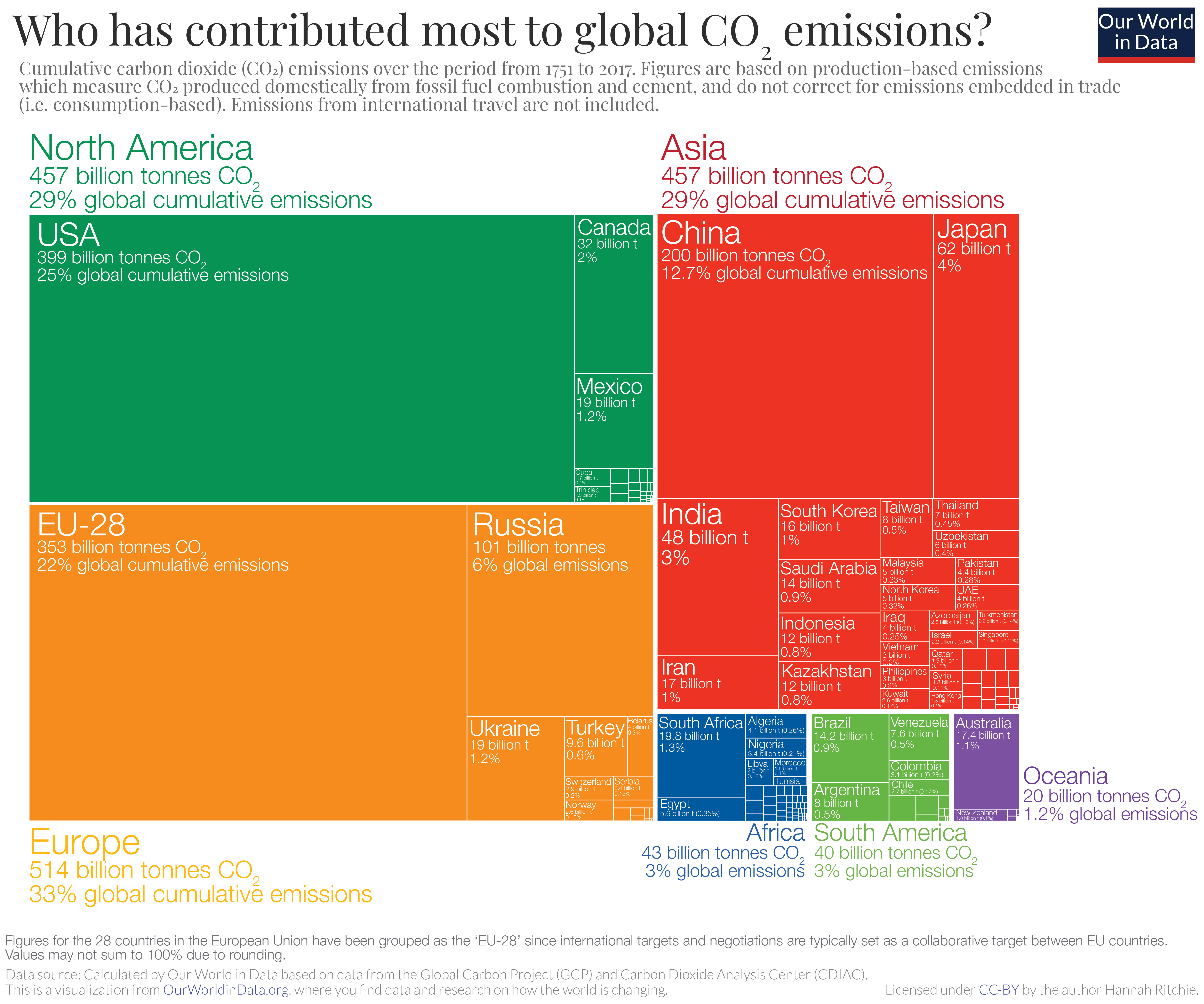
China, a relative latecomer to the industrial era, is historically responsible for “only” 13% of cumulative global CO2 emissions. However, in its drive to accelerate its economic growth in recent decades, it has vastly increased its reliance on coal to generate electricity, resulting in ever-greater CO2 emissions. China now accounts for an astonishing 56% of total world coal consumption, which, in turn, largely explains its current dominance among the major carbon emitters. According to the 2022 edition of the International Energy Agency’s World Energy Outlook, the PRC was responsible for 33% of global CO2 emissions in 2021, compared with 15% for the U.S. and 11% for the EU.
Like most other countries, China has pledged to abide by the Paris Climate Agreement of 2015 and undertake the decarbonization of its economy as part of a worldwide drive to keep global warming within some bounds. As part of that agreement, however, China identified itself as a “developing” country with the option of increasing its fossil-fuel use for 15 years or so before achieving a peak in CO2 emissions in 2030. Barring some surprising set of developments then, the PRC will undoubtedly remain the world’s leading source of CO2 emissions for years to come, suffusing the atmosphere with colossal amounts of carbon dioxide and undergirding a continuing rise in global temperatures.
Yes, the United States, Japan, and the EU countries should indeed do more to reduce their emissions, but they’re already on a downward trajectory and an even more rapid decline will not be enough to offset China’s colossal CO2 output. Put differently, those Chinese emissions — estimated by the IEA at 12 billion metric tons annually — represent at least as great a threat to U.S. security as the multitude of tanks, planes, ships, and missiles enumerated in the Pentagon’s 2022 report on security developments in the PRC. That means they will require the close attention of American policymakers if we are to escape the most severe impacts of climate change.
China’s Vulnerability to Climate Change
Along with detailed information on China’s outsized contribution to the greenhouse effect, any thorough report on security developments involving the PRC should have included an assessment of that country’s vulnerability to climate change. It should have laid out just how global warming might, in the future, affect its ability to marshal resources for a demanding, high-cost military competition with the United States.
In the coming decades, like the U.S. and other continental-scale countries, China will suffer severely from the multiple impacts of rising world temperatures, including extreme storm damage, prolonged droughts and heatwaves, catastrophic flooding, and rising seas. Worse yet, the PRC has several distinctive features that will leave it especially vulnerable to global warming, including a heavily-populated eastern seaboard exposed to rising sea levels and increasingly powerful typhoons; a vast interior, parts of which, already significantly dry, will be prone to full-scale desertification; and a vital river system that relies on unpredictable rainfall and increasingly imperiled glacial runoff. As warming advances and China experiences an ever-increasing climate assault, its social, economic, and political institutions, including the ruling Chinese Communist Party (CCP), will be severely tested.
According to a recent study from the Center for Climate and Security, “China’s Climate Security Vulnerabilities,” the threats to its vital institutions will take two major forms: hits to its critical infrastructure like port facilities, military bases, transportation hubs, and low-lying urban centers along China’s heavily populated coastline; and the danger of growing internal instability arising from ever-increasing economic dislocation, food scarcity, and governmental incapacitation.
China’s coastline already suffers heavy flooding during severe storms and significant parts of it could be entirely underwater by the second half of this century, requiring the possible relocation of hundreds of millions of people and the reconstruction of billions of dollars’ worth of vital facilities.Such tasks will surely require the full attention of Chinese authorities as well as the extensive homebound commitment of military resources, leaving little capacity for foreign adventures. Why, you might wonder, is there not a single sentence about this in the Pentagon’s assessment of future Chinese capabilities?
Even more worrisome, from Beijing’s perspective, is the possible effect of climate change on the country’s internal stability. “Climate change impacts are likely to threaten China’s economic growth, its food and water security, and its efforts at poverty eradication,” the climate center’s study suggests (but the Pentagon report doesn’t mention). Such developments will, in turn, “likely increase the country’s vulnerability to political instability, as climate change undermines the government’s ability to meet its citizens’ demands.”
Of particular concern, the report suggests, is global warming’s dire threat to food security. China, it notes, must feed approximately 20% of the world’s population while occupying only 12% of its arable land, much of which is vulnerable to drought, flooding, extreme heat, and other disastrous climate impacts. As food and water supplies dwindle, Beijing could face popular unrest, even revolt, in food-scarce areas of the country, especially if the government fails to respond adequately. This, no doubt, will compel the CCP to deploy its armed forces nationwide to maintain order, leaving ever fewer of them available for other military purposes — another possibility absent from the Pentagon’s assessment.
Of course, in the years to come, the U.S., too, will feel the ever more severe impacts of climate change and may itself no longer be in a position to fight wars in distant lands — a consideration also completely absent from the Pentagon report.
The Prospects for Climate Cooperation
Along with gauging China’s military capabilities, that annual report is required by law to consider “United States-China engagement and cooperation on security matters… including through United States-China military-to-military contacts.” And indeed, the 2022 version does note that Washington interprets such “engagement” as involving joint efforts to avert accidental or inadvertent conflict by participating in high-level Pentagon-PLA crisis-management arrangements, including what’s known as the Crisis Communications Working Group. “Recurring exchanges [like these],” the report affirms, “serve as regularized mechanisms for dialogue to advance priorities related to crisis prevention and management.”
Any effort aimed at preventing conflict between the two countries is certainly a worthy endeavor. But the report also assumes that such military friction is now inevitable and the most that can be hoped for is to prevent World War III from being ignited. However, given all we’ve already learned about the climate threat to both China and the United States, isn’t it time to move beyond mere conflict avoidance to more collaborative efforts, military and otherwise, aimed at reducing our mutual climate vulnerabilities?
At the moment, sadly enough, such relations sound far-fetched indeed. But it shouldn’t be so. After all, the Department of Defense has already designated climate change a vital threat to national security and has indeed called for cooperative efforts between American forces and those of other countries in overcoming climate-related dangers. “We will elevate climate as a national security priority,” Secretary of Defense Lloyd Austin declared in March 2021, “integrating climate considerations into the Department’s policies, strategies, and partner engagements.”
The Pentagon provided further information on such “partner engagements” in a 2021 report on the military’s vulnerabilities to climate change. “There are many ways for the Department to integrate climate considerations into international partner engagements,” that report affirmed, “including supporting interagency diplomacy and development initiatives in partner nations [and] sharing best practices.” One such effort, it noted, is the Pacific Environmental Security Partnership, a network of climate specialists from that region who meet annually at the Pentagon-sponsored Pacific Environmental Security Forum.
At present, China is not among the nations involved in that or other Pentagon-sponsored climate initiatives. Yet, as both countries experience increasingly severe impacts from rising global temperatures and their militaries are forced to devote ever more time and resources to disaster relief, information-sharing on climate-response “best practices” will make so much more sense than girding for war over Taiwan or small uninhabited islands in the East and South China Seas (some of which will be completely underwater by century’s end). Indeed, the Pentagon and the PLA are more alike in facing the climate challenge than most of the world’s military forces and so it should be in both countries’ mutual interests to promote cooperation in the ultimate critical area for any country in this era of ours.
[quite long]
---
an 1222
Extinction fears soar amid 'perfect storm of unsustainable human activity decimating marine life'
Image via Creative Commons.
Jessica Corbett and Common Dreams December 11, 2022
During the United Nations biodiversity summit in Montreal, an international conservation group on Friday highlighted how humanity is dangerously failing marine life with illegal and unsustainable fishing, pollution from agricultural and industrial runoff, and activities that drive up global temperatures.
The International Union for Conservation of Nature (IUCN) Red List of Threatened Species now features 150,388 species, 42,108 of which face possible extinction. Of the 17,903 marine animals and plants on the list, more than 1,550 are at risk.
"Today's IUCN Red List update reveals a perfect storm of unsustainable human activity decimating marine life around the globe. As the world looks to the ongoing U.N. Biodiversity Conference to set the course for nature recovery, we simply cannot afford to fail," Bruno Oberle, the group's director general, warned Friday. "We urgently need to address the linked climate and biodiversity crises, with profound changes to our economic systems, or we risk losing the crucial benefits the oceans provide us with."
The primary aim of the 15th Conference of the Parties (COP15) of the Convention on Biological Diversity (CBD)—which is hosted by China but kicked off earlier in Canada this week due to Covid-19 restrictions—is the development of post-2020 global biodiversity framework (GBF).
A top priority for many parties to the treaty—along with the United States, which has failed to ratify the CBD over the past three decades but is still participating in the summit—is to protect 30% of lands and waters by 2030. However, as activists and Indigenous leaders from around the world have noted, there are serious human rights concerns regarding implementation of the 30x30 goal.
COP15 comes after the fifth round of discussions about establishing a U.N. treaty for the high seas, or the two-thirds of oceans outside territorial waters. Those August talks failed to produce an agreement—which, as Laura Meller of Greenpeace's Protect the Oceans campaign warned at the time, "jeopardizes the livelihoods and food security of billions of people around the world."
"While progress has been made, particularly on ocean sanctuaries, members of the High Ambition Coalition and countries like the USA have moved too slowly to find compromises, despite their commitments," Meller continued. "Time has run out. Further delay means ocean destruction. We are sad and disappointed. While countries continue to talk, the oceans and all those who rely on them will suffer."
Similarly urgent warnings came with the update Friday. Ashleigh McGovern, vice president of the Center for Oceans at Conservation International, said that "with this devastating IUCN Red List update on the status of marine species, it is clear that business as usual is no longer an option."
"Human activity has had devastating effects on marine ecosystems and biodiversity, but it can also be harnessed to drive action as a matter of survival, equity, and climate justice," she added. "If we are to secure a new future for the world's oceans and the essential biodiversity they harbor, we must act now."
Jon Paul Rodríguez, chair of the IUCN Species Survival Commission (SSC), pointed out that "most of the Earth's biosphere, 99% of all livable space on our planet, is underwater."
"Humanity acts as if oceans were inexhaustible, capable of sustaining infinite harvest of algae, animals, and plants for food and other products, able to transform vast quantities of sewage and other pollutants that we pour in coastal areas, and absorb the CO2 generated by land-use change and burning fossil fuel," he said. "This Red List update brings to light new evidence of the multiple interacting threats to declining life in the sea."
According to the IUCN Red List, 20 of the 54 abalone species—some of the world's most expensive seafood—are threatened with extinction.
"Abalones reflect humanity's disastrous guardianship of our oceans in microcosm: overfishing, pollution, disease, habitat loss, algal blooms, warming, and acidification, to name but a few threats. They really are the canary in the coal mine," said Howard Peters, a member of the IUCN SSC Mollusc Specialist Group and research associate at the U.K.'s University of York who led the abalone assessment.
"The most immediate action people can take is to eat only farmed or sustainably sourced abalones. Enforcing fishery quotas and anti-poaching measures is also critical," Peters noted. "However, we need to halt the changes to ocean chemistry and temperature to preserve marine life including abalone species over the long term."
The update also raised the alarm about dugongs, particularly in East Africa and New Caledonia. Populations of the large herbivorous marine mammals are threatened by fishing gear, oil and gas exploration and production, chemical pollution, and the destruction of seagrasses they rely on for food.
"Strengthening community-led fisheries governance and expanding work opportunities beyond fishing are key in East Africa, where marine ecosystems are fundamental to people's food security and livelihoods," said Evan Trotzuk, who led the region's assessment.
Another focus of the list is the pillar coral in the Caribbean, given that its population has shrunk by more than 80% across most of its range over the past three decades.
Noting that it is just one of 26 corals now listed as critically endangered in the Atlantic Ocean, Arizona State University associate professor Beth Polidoro, Red List coordinator for the IUCN SSC Coral Specialist Group, said that "these alarming results emphasize the urgency of global cooperation and action to address climate change impacts on ocean ecosystems."
Amanda Vincent, chair of the IUCN SSC Marine Conservation Committee, declared that "the awful status of these species should shock us and engage us for urgent action."
"These magical marine species are treasured wildlife, from the wonderful abalone to the charismatic dugong and the glorious pillar coral, and we should safeguard them accordingly," she added. "It is vital that we manage fisheries properly, constrain climate change, and reverse habitat degradation."
Nodding to the conference, Jane Smart, director of IUCN's Science and Data Center, said the update reinforces her group's "urgent call for a post-2020 global biodiversity framework that will be ambitious enough to cease destruction of our life support system and catalyze the necessary action and change to secure life on this planet."
---
---
an 12 22 sorta //
The day before nearly two weeks of negotiations kick off at the United Nations summit on biodiversity, campaigners warned Tuesday that the talks taking place this month in Montreal may offer humanity its last chance to mitigate the planet's crisis of rampant species loss, and called on policymakers to adopt an ambitious framework to protect wildlife.
More than 190 nations will be represented at the 15th Conference of the Parties to the Convention on Biological Diversity (COP15), where negotiators will discuss a draft agreement aimed at conservation, slashing levels of toxic pollutants, and mitigating the climate crisis.
With about one million species—out of about 8.7 million known species—expected to become extinct in the coming decades, advocates said that policymakers must reverse more than a decade of failure to meet the targets set in 2010 at COP10 in Aichi, Japan, including protecting 17% of terrestrial and inland water areas and conserving coral reefs.
"Now is the time for the world to set bold new goals to protect every last species," said Tierra Curry, a senior scientist at the Center for Biological Diversity. "We're undermining our own survival by taking nature for granted, decimating wild places and jeopardizing vulnerable communities."
Advocates are pushing the 196 member nations of the convention to adopt 21 targets named in the draft set to be presented at the meeting, including:
- Protections for at least 30% of lands and waters by 2030;
- Policies to prevent or reduce invasive species by 50%;
- The elimination of plastic waste;
- The reduction of pesticides in the environment by at least two-thirds;
- The recognition of Indigenous peoples' rights and central role in protecting biodiversity; and
- At least $100 billion in annual funding for developing countries to protect wildlife, provided by wealthy governments.
"If delegates at the Convention on Biological Diversity can't agree that we should end extinction, it's a tragic reflection on our values," said Curry. "We've put nature in the basement of our heart, but it needs to be in the penthouse."
Greenpeace International called the meeting "the make-or-break moment for global biodiversity" while Greenpeace East Asia senior policy adviser Li Shuo called it "a chance for reinvention."
"It is unacceptable for this process to continue to pump out promises and never deliver," he said. "Negotiations over the next two weeks need to generate targets that will actually be implemented and supported."
In his opening remarks on Tuesday, U.N. Secretary-General António Guterrescalled on negotiators to adopt a framework "that addresses the root causes of this destruction."
"Deforestation and desertification are creating wastelands of once-thriving ecosystems," he said. "Our land, water, and air are poisoned by chemicals and pesticides, and choked with plastics. Our addiction to fossil fuels has thrown our climate into chaos—from heatwaves and forest fires, to communities parched by heat and drought, or inundated and destroyed by terrifying floods."
"The deluded dreams of billionaires aside, there is no Planet B," Guterres added. "We must fix the world we have. We must cherish this wonderous gift. We must make peace with nature."
Biologist Alexandre Antonelli, the director of science of the Royal Botanic Gardens, Kew, in the U.K., called the conference "one of the most important meetings humanity has ever had."
"We have a very narrow window of opportunity to halt the loss of biodiversity by 2030 and reverse its decline by 2050," Antonelli toldThe New Statesman on Monday. "We may never have that chance again."
---
---
yikes
https://www.eenews.net/articles/coal-emissions-on-pace-for-record-setting-2022/
---
---
https://www.alternet.org/2022/11/stupidest-act-in-human-history/
long analysis war AGW
---
---
an 11 22
Computer scientist, composer, artist, and author Jaron Lanier has for years been outspoken about his total avoidance of social media platforms because of the harm that they inflict on their users and the detrimental impacts that they have on societies. In a 2018 conversation with Vox producer Eric Johnson, Lanier decried people who refuse to delete their accounts even though they can.
"You have even more of a responsibility to see if you can get out of it than someone who genuinely is dependent on it. So, I think that that argument has a situation exactly backwards. I mean, I and you and the people we tend to know are privileged. We’re wealthier than ever. We have more options. That puts a moral onus on us to make some decisions that do what little we can to help those who are less fortunate, and this is one of those things," he said.
"If you are actually in a position to quit and you don’t, you’re making yourself part of the problem. You’re not doing anything to free those who are more trapped. You’re only enslaving them more by entrenching the system. As an affluent or valuable person to the system, you’re the one that the whole system is being funded by," he added, later comparing online platforms to "gambling addiction."
READ MORE: By destroying Twitter, Elon Musk reveals contempt for democracy
On Sunday, Lanier warned in an interview with The Guardian GUK that the takeovers of tech giants like Twitter pose a fatal danger to the future existence of the human race.
“People survive by passing information between themselves,” Lanier explained to reporter Edward Helmore. “We’re putting that fundamental quality of humanness through a process with an inherent incentive for corruption and degradation. The fundamental drama of this period is whether we can figure out how to survive properly with those elements or not.”
Lanier believes that powerful digital arenas such as Twitter, whose owners allow misinformation, conspiracy theories, and hate speech to flourish, are exacerbating the threat that humanity faces.
“There are all kind of intermediaries. They might be the people who own a platform, recently Elon Musk, or third parties who are good at sneaking in influence. The interveners can be varied. Some are official, some are revealed, others hidden. Some are competent, some incompetent. Some are random, like an algorithm that someone made but didn’t understand," Lanier said. “I still think extinction is on the table as an outcome. Not necessarily, but it’s a fundamental drama.If we can coordinate ourselves to solve the climate crisis it’s a fundamental sign we haven’t become completely dysfunctional."
READ MORE: Half of Twitter’s top advertisers flee as Elon Musk welcomes Trump back
---
---
no lnx no grfx
https://insideclimatenews.org/news/21112022/who-were-the-worst-climate-polluters-in-the-us-in-2021
U.S. greenhouse gas emissions climbed by 4.1 percent from major industrial sources in 2021, according to new data recently released by the U.S. Environmental Protection Agency.
The increase is the largest year-on-year rise in emissions tallied across more than a decade of reporting and comes at a time when global climate pollution must quickly be curtailed to limit further warming.
The emissions, 2.7 billion metric tons of carbon dioxide equivalent, were self-reported to the agency by more than 8,100 of the nation’s largest climate polluters under the agency’s mandatory Greenhouse Gas Reporting Program. The emissions represent about half of all U.S. climate pollution and the annual update provides the most comprehensive, site-by-site assessment of the nation’s largest polluters.
The increase in emissions came amid a rise in economic activity and industrial production following the height of the Covid-19 pandemic in 2020. While emissions from large polluters—generally defined as facilities that emit more than 25,000 metric tons of carbon dioxide equivalent per year—shot up in 2021, they were 5.25 percent lower than their pre-pandemic level in 2019.
Evan Gillespie, a partner with Industrious Labs, a recently formed environmental organization focused on decarbonizing heavy industry, said such swings in pollution have to cease in order to hit emission reduction targets under the Paris Climate agreement.
“We cannot have emissions linked to production,” Gillespie said. “We have a lot of work to do over the next eight years to get industrial emissions on track.”
The Worst of the Worst
Andy Knott, director of Sierra Club’s Beyond Coal Campaign for the nation’s central region, said he is seeing a lot of progress in the shutdown of large coal-fired power plants from many, but not all, electric utilities.
“When I look at the largest carbon polluters, many of them, the utilities that own them, don’t have plans to retire them anytime at all,” Knott said. “We need to retire all coal by 2030 and all fossil fuels in the electric sector by 2035.”
Carbon dioxide is the primary driver of climate change and CO2 emissions from coal and natural gas fired power plants were the largest source of emissions. However, other pollutants including methane, nitrous oxide and fluorinated greenhouse gases, such as hydrofluorocarbons used in refrigerators and air conditioners, were also significant sources of emissions. These “non-CO2” greenhouse gases are far more potent than carbon dioxide on a pound-for-pound basis and in many cases remain in the atmosphere for a relatively short time compared to CO2. Curbing their emissions is increasingly seen as a key to stopping near term warming.
The following is a listof the country’s top polluters for each of the leading greenhouse gases tracked by the EPA. Also included are some of the highest emitters for different sectors of the economy.
Carbon Dioxide: The James H. Miller Jr. power plant in Quinton, Alabama was the largest coal fired power plant in the U.S in terms of power generation in 2021 and was also the nation’s biggest emitter of CO2.The plant, owned by The Southern Company, emitted 20,834,019 metric tons of carbon dioxide in 2021. Company executives announced plans last year to shut down nearly 80 percent of its coal power capacity by 2028 on the way to having net-zero emissions by 2050. The planned shutdowns do not include the James H. Miller plant.
Methane: The Bailey Mine, a coal mine owned by Consol Energy in southwestern Pennsylvaniais the largest single source of methane in the U.S. with 90,743 tons of methane emissions in 2021. The near-term climate impact of the emissions are equal to the annual greenhouse gas emissions of 1.6 million automobiles, according to the EPA. Consol Energy does capture and destroy some additional methane emissions from the mine as part of a methane destruction pilot program.
Nitrous Oxide: Ascend Performance Materials’ nylon plant in Cantonment, Floridareleased 24,657 metric tons of nitrous oxide in 2021, four times more nitrous oxide than any other industrial facility in the country, though the figure is still pending final EPA verification. The plant makes adipic acid, a main ingredient in nylon 6,6, a strong, durable plastic used in everything from stockings to carpeting, seat belts and air bags, and also emits large amounts of nitrous oxide, an unwanted byproduct.
Nitrous oxide is 273 times worse for the climate than carbon dioxide on a pound for pound basis. Assuming the currently reported emissions are correct, emissions from the facility in 2021 equaled the annual greenhouse gas emissions of 1.5 million automobiles, according to the EPA. Other adipic acid plants in the U.S and Europe installed abatement technology to destroy virtually all of their nitrous oxide emissions in the late 1990s.
Company officials told Inside Climate News in early 2020 that they would reduce nitrous oxide emissions from the production of adipic acid by 50 percent by mid-2020 and by more than 95 percent by February of 2022. However, nitrous oxide emissions from adipic acid production at the plant climbed by 38 percent from 2019 to 2021 according to emissions data the company reported to EPA. Ascend Performance Materials’ spokeswoman, Alison Jahn, did not respond directly to questions about the increase but said that Ascend has set a goal to reduce greenhouse gas emissions from all of its facilities by 80 percent by 2030.
Hydrofluorocarbons: Hydrofluorocarbon-23 (HFC-23) is 14,600 times more potent as a greenhouse gas than carbon dioxide on a pound for pound basis, making it one of the worst climate pollutants ever identified by the scientists with the UN’s Intergovernmental Panel on Climate Change. In 2021, chemical manufacturer Chemours vented 180 metric tons of HFC-23, a synthetic gas and unwanted byproduct, from its Louisville, Kentucky plant. The emissions, which can be destroyed through incineration, are equal to the annual emissions of 566,000 automobiles. However, HFC-23 emissions from the Louisville plant could soon be a thing of the past.
In October, 2021, EPA required Chemours to use or destroy 99.9 percent of the HFC-23 it produces by this October. Chemours missed the deadline to complete the installation “due in part to supply chain issues” according to the EPA, which granted the company’s request for a 6-month extension. The company has installed and is now operating the pollution controls but is continuing to validate and optimize the system, Chemours spokeswoman Cassie Olszewski, said.
Sulfur Hexafluoride: Sulfur hexafluoride (SF6) is 25,200 times worse for the climate than carbon dioxide,making it the most potent greenhouse gas ever assessed by the UN’s Intergovernmental Panel on Climate Change. Once released, SF6 remains in the atmosphere, warming the planet, for 3,200 years. The synthetic gas is used in high-voltage circuit breakers to quickly interrupt electric current. In 2021, American Electric Power (AEP) released 18 tons of SF6 from electric utility substations across 10 states, emissions equal to the annual greenhouse gas emissions of 99,000 automobiles. While AEP had the highest total emissions, Duke Energy Carolinas had the highest SF6 leak rate—6 percent of all the SF6 it used in 2021—a rate more than twice that of AEP.
Eighty-eight U.S. utilities are part of a voluntary program that the EPA started in 1999 to help utilities slash their SF6 emissions. Duke Energy, the largest electric power corporation in the U.S. based on revenue, is not a part of the program.
“We are certainly working to learn more about the group [and] are reconsidering our involvement,” Duke Energy spokesman Jeff Brooks said.
Methane from Gas Storage:The Petal Gas Storage Compressor Station vented 2,517 tons of methane from leaky compressors at an underground natural gas storage facility in Petal, Mississippi in 2021. Emissions from the facility declined by 49 percent from the prior year. However, Petal’s emissions remain nearly twice that of any other gas storage site in the country despite being a relatively small gas storage repository.
“We are continuing our methane emissions reduction efforts at Petal and across our system,” Jillian Kirkconnell, a spokeswoman for Boardwalk Pipeline Partners, said.
Boardwalk owns the Petal gas storage facility as well as the Gulf South Pipeline – Bistineau Station gas storage facility, the second-highest emitting gas storage facility in the country, which leaked 1,301 tons of methane in 2021.
Methane from Landfills: Sampson County Disposal, a privately owned landfill in Roseboro, North Carolina emitted an estimated 32,983 tons of methane, more than any other municipal or industrial landfill in 2021, according to company data reported to the EPA. The near-term climate impact of the emissions are equal to the annual greenhouse gas emissions of 575,000 automobiles according to the EPA.
Joy Grahek, executive vice president of strategic initiatives with GFL Environmental, the landfill’s owner, said the company has taken measures to reduce emissions and that the models used by the EPA to estimate emissions are incorrect.
“We have implemented a number of different operational and engineered strategies to minimize fugitive methane generation at the landfill, including the use of impermeable cover materials, an extensive gas collection system to capture landfill gas, and flaring of the captured gas,” Grahek said. “The models are widely recognized as containing significant uncertainty and using the EPA Reports as a basis for ranking the relative performance of landfills in controlling fugitive emissions is inaccurate.”
Emissions estimates for landfills vary widely depending on which method operators use to calculate their emissions and may underestimate actual emissions by as much as “a factor of two.”
The EPA recently proposed changes on how to better calculate methane emissions from landfills.
Phil McKenna
==
---
TIPPING PT?!
https://www.mediamatters.org/fox-news/despite-fox-news-claims-contrary-voters-are-concerned-about-climate-change
no lnx many no vid
Despite Fox News' claims to the contrary, voters are concerned about climate change
Special PROGRAMS
CLIMATE & ENERGY
WRITTEN BY EVLONDO COOPER
RESEARCH CONTRIBUTIONS FROM ALLISON FISHER & ILANA BERGER
PUBLISHED 11/17/22
Despite Fox News’ claims to the contrary, climate change was among top voter concerns during the recent 2022 midterm elections.
:{:{}:
}:
The issue of climate change took center stage during the general election for the first time in 2020. Since then, poll after poll has found that climate change is top of mind for many voters, and exit polls found that it was a key issue for 2022 midterm voters. Even Fox had to briefly acknowledge this reality, though it won’t likely have any material impact on the network’s climate coverage.
:{:{}:
}:
CNN’s exit poll found that 71% of voters stated that climate change is a “very serious” or “somewhat serious” problem, while 61% of voters in Fox News’ voter analysis survey were “very/somewhat concerned” about climate change. Regarding whether climate has become a viable election issue, InsideClimateNews suggested that “the political dynamics around climate in the 2022 midterms could stand out as a milestone.” Or as The New Republic summarized:
This year, more “climate voters,” people whose top issue is the climate crisis, showed up to cast ballots than in any other election in U.S. history. Exit polls show that, contrary to conventional Democratic consultant-class wisdom, climate was the top issue for 8 percent of voters, a share surpassed only by “inflation/economy,” immigration, and abortion (the latter two are tied at second place). You’d never guess it from media coverage, but climate and crime were tied for third place. The percentage of voters prioritizing climate had jumped by four points from 2020, the first year that voters were even asked at the polls about “climate” as opposed to “environment.” There are probably several factors behind this impressive showing.
Climate could play an important role in the Georgia Senate runoff election, especially among socially marginalized communities that have been bearing the brunt of climate-driven extreme weather events and environmental pollution. In addition to grassroots organizing efforts, Climate Monitor noted that “LCV [League of Conservation Voters] has already launched a new video ad supporting Sen. Raphael Warnock in his runoff election on December 6th. Environmental Voter Project is also already spending in Georgia’s Senate runoff.”
This belies Fox News’ attempts to downplay climate change as a concern for voters. This summer, the network, among other right-wing media outlets, cherry-picked data from a Siena College and New York Times pollto claim that Americans did not care about climate change. For example, the July 20 episode of America's Newsroom featured Kellyanne Conway, former White House counselor under President Donald Trump, claiming that President Joe Biden is focusing on climate and the poll shows voters “don't think that he's connected to them in a way that he is listening to them and hearing their concerns.”
Video file
Video CitationFrom the July 20, 2022, edition of Fox News' America's Newsroom
During the July 24 episode of Fox & Friends Weekend, co-host Pete Hegseth claimed, “They're using the blue checkmark woke brigade to attempt to cudgel the White House to declare a crisis based on 1% of Americans who believe it’s their religion, which could change all of our lives, and change it rapidly, if he caves to groups like this.”
VideoCitationFrom the July 24, 2022, edition of Fox News' Fox & Friends Weekend
In the months and weeks leading up to the November 8 midterm elections, Fox News continued to downplay voter concerns about climate change. For example, during the September 14 episode of The Story With Martha MacCallum, Fox News correspondent Jacqui Heinrich led off a segment that attacked the climate provisions of the Inflation Reduction Act by using a Gallup poll to claim that “voters are far more concerned with the economy than they are with climate.” Fox News hosted commentator Angela Morabito on the September 27 episode of Fox News at Night, where she claimed that climate change was a “luxury problem” above a chyron that read “Midterm Motivators.”
VideoCitationFrom the September 27, 2022, episode of Fox News at Night
During the September 30 episode of Hannity, Fox News host Sean Hannity claimed that if the midterms are a “referendum onJoe Biden, the failed climate cult, and their failed policies, and how they’ve wrecked all the progress that we made in the four years under Donald Trump,then they lose.”
Video Citation From the September 30, 2022, episode of Fox News' Hannity
After rattling off key provisions of the Inflation Reduction Act, Fox News host Sandra Smith asked her guests during the October 6 episode of America Reports if “Democrats may live to regret the day they pushed clean energy so hard in this moment when we’re not ready for the transition.”
Video Citation From the October 6, 2022, episode of Fox News' America Reports
However, after the midterm elections, Fox News had to acknowledge that climate was an important issue for voters. During the November 9 episode of America Reports, Smith briefly bowed to reality when confronted with the results of Fox News’ own survey: “When asked how concerned about climate change voters were, 61% said very or somewhat concerned, 39% not too concerned or not at all concerned,” she said. “Climate change was up there, and it was on the mind of voters when they head to the ballot box. So, is this a missed opportunity for Republicans to have some sort of messaging there for voters who care about this issue?”
Video CitationFrom the November 9, 2022, episode of Fox News' America Reports
Despite years of climate science denial and obfuscation, Fox News had to face the fact that voters care about climate change. The network will likely continue running interference for the fossil fuel industry, denying or downplaying how climate is driving extreme weather, and undermining the Biden administration's climate and energy policies, because it is less a news outlet and more a key cog in the fossil fuel industry’sdisinformation network. Even though the veil of reality may slip on Fox News occasionally, it never stays down for long.
---
---
11 22 mil exempt from report ghg?
https://www.alternet.org/2022/11/world-burns/
---
---
hayes uninhab earth wallace- middle bad scenario?
---
https://www.alternet.org/2022/11/last-eight-years-hottest-ever/
---
https://www.alternet.org/2022/11/past-point-of-incremental-changes/
US heat faster?!
---
---
not BP?
an comm dr 11 22
Despite repeated warnings that new fossil fuel projects are incompatible with averting climate disaster, oil and gas corporations "are on a massive expansion course" to increase dirty energy production in the coming years, according to an analysis released Thursday at the United Nations COP27 meeting in Egypt.
The new report by the German nonprofit Urgewald and 50 NGO partners, which denounces "an industry willing to sacrifice a livable planet," found that the vast majority of the world's oil and gas companies intend to scale up the extraction of fossil fuels in the years ahead, having collectively dumped $160 billion into exploration since 2020.
None of this investment is consistent with the International Energy Agency's (IEA) blueprint for achieving net-zero emissions by 2050, a key component of meeting the Paris agreement's goal of limiting global warming to 1.5°C above preindustrial levels—beyond which impacts will grow increasingly deadly for millions of people, particularly those residing in poor nations that have done the least to cause the crisis.
The IEA made clear in its May 2021 report that no new oil and gas fields can be exploited if the world is to avoid climate catastrophe. But according to Urgewald, 96% of upstream fossil fuel companies (655 out of 685) are planning to expand their operations, and short-term expansion plans have increased by 20% since last year.
According to Urgewald, 512 of these companies are currently "taking active steps to bring 230 billion barrels of oil equivalent (bboe) of untapped resources into production before 2030."
If these fossil fuels are removed from the ground and burned, an additional 115 billion tonnes of heat-trapping carbon dioxide equivalent will be pumped into the atmosphere by the end of the decade. That's 30 times more greenhouse gas pollution than Europe generates each year.
Urgewald's report comes one day after Climate Trace revealed in a separate analysis that global emissions from oil and gas production are up to three times higher than reported.
"The outcome of our calculations is truly frightening," Fiona Hauke, senior oil and gas researcher at Urgewald, said in a statement. "Oil and gas companies' short-term expansion plans are not in line with the net-zero emissions course put forward by the IEA. Keeping these oil and gas resources in the ground is the bare minimum of what is needed to keep 1.5°C attainable."
As the report points out, even "if the oil and gas industry simply maintained its 2021 production level of 56.3 bboe, it alone would exhaust our remaining carbon budget within 15.5 years."
Just over a dozen corporations—including Saudi Aramco, ExxonMobil, TotalEnergies, Chevron, and Shell—are responsible for more than half of the industry's short-term expansion efforts, Urgewald found.

But "oil and gas companies are not only planning rapid development in the short term," the report notes. "Their massive build-up of new fossil fuel infrastructure is threatening to lock the world into a high-emissions pathway" at a time when the window to slash greenhouse gas pollution and avoid the worst effects of the climate crisis is rapidly closing.
Fossil fuel giants, especially those in the U.S., have been "happy to take advantage" of global energy market chaos unleashed by Russia's late-February invasion of Ukraine, the report continues, channeling their record-breaking profits into boosting fracking and LNG export capacity.
"Current midstream expansion plans will more than double liquefied natural gas (LNG) export capacity globally, and new mega-pipeline projects like the Trans-Saharan pipeline would stretch across entire continents and beyond," says the report. "Such oil and gas infrastructure is expensive to build, and its intended operational lifetime spans decades—a time horizon we simply do not have."
Nearly 20% of LNG import terminals under development are located in Europe, which has been hit especially hard by soaring energy prices, but liquefied gas is "a false solution," warned Lucie Pinson from Reclaim Finance.
"The newly planned projects will come too late to solve Europe's energy crisis," said Pinson. "But what they will do is lock us into a high-carbon future and pose severe stranded assets risks. Private financial institutions must acknowledge the responsibility they hold and withdraw their support from new fossil infrastructure projects."
Urgewald and its partners identified 289 companies that are constructing new oil and gas pipelines or LNG terminals.
"As of 2022, new import and export LNG terminals with a total capacity of 1,391.5 Mtpa (million tons per annum) are planned or under development," states the report. "The increase in LNG export capacity would, if fully used, release almost twice as much greenhouse gas per year as all operating coal-fired power plants in North America, South America, Europe, and Africa together."
Urgewald's findings are based on its "Global Oil & Gas Exit List" (GOGEL), a company-level database that covers 901 firms responsible for 95% of global oil and gas production. Earlier this year, GOGEL data was used to expose dozens of "carbon bomb" oil and gas projects that fossil fuel giants are planning to build at the expense of humanity.
The newly updated GOGEL data was presented at COP27, where delegates have been informed yet again that, in the words of U.N. Secretary-General António Guterres, "we are on a highway to climate hell with our foot still on the accelerator."
Two weeks ago, the U.N. published a series of reports warning that there is "no credible path to 1.5°C in place" and that only "urgent system-wide transformation" can achieve the 50% drop in global emissions required by 2030 to prevent locking in cataclysmictemperature rise approaching 3°C by century's end.
As the new Urgewald analysis makes clear, the opportunity costs of the fossil fuel industry's continued investment in oil and gas production are immense.
"If global exploration expenditure since 2020 had been directed towards the energy transition, it could have almost doubled the U.S.'s 2019 onshore wind capacity," the report points out. "Egypt, the host country of COP27, is the perfect example of the complete disconnect between the action needed and the reality on the ground. Fifty-five companies are exploring for new oil and gas resources across Egypt while the world's governments come together in Sharm El-Sheikh to address the climate crisis."
Earlier this week, Guterres slammed the duplicitous nature of many corporate climate promises, arguing that "so-called 'net zero pledges' that exclude core products [coal, oil, gas] are poisoning our planet. Using bogus 'net zero' pledges to cover up massive fossil fuel expansion is reprehensible. This toxic cover-up could push our world over the climate cliff."
According to Urgewald fossil fuel finance campaigner Katrin Ganswindt, "Over 20 European banks, insurers, and investors have published promising oil and gas policies" since GOGEL was launched, with eight of them publicly referring to the database. "But hundreds of financial institutions have yet to adopt strict, science-based exclusion criteria for oil and gas companies whose expansion plans are not in line with 1.5°C."
These "oil and gas companies are betting against our collective future," said Ganswindt. "Their behavior also creates a high economic risk, for their financial backers and for themselves. A financial institution that takes its net-zero commitments seriously cannot provide financing to companies that are recklessly busting our climate budget."
Last week, progressives urged U.S. President Joe Biden's Treasury Department to intervene after an investigation of the financial sector's net-zero commitments showed that the six biggest U.S. banks' climate targets and policies fall far short of what's needed to preserve a habitable planet. On Wednesday, another analysis found that major U.S. banks are responsible for one-third of oil and gas expansion projects currently underway.
As Urgewald's new report observes, "All over the world, from Uganda to the Philippines, local communities and activists are calling out oil and gas companies for their reckless expansion plans."
Omar Elmawi, executive director of Muslims for Human Rights and coordinator of the campaign to stop the EACOP pipeline, said that "the irresponsible, greed-addled expansion plans of oil and gas companies destroy local communities and whole ecosystems."
"They lead to persecution, displacement, and all manner of environmental and social harm," he continued. "African people do not want any of this. We demand the energy access and the just transition renewable energies can deliver. And we vehemently reject the prospect of another colonialist plunder of our home's natural resources at the hands of avaricious oil and gas corporations that corrupt governments and throw whole countries into chaos."
"Africa deserves better," Elmawi added. "Our planet deserves better."
---
---
https://www.bloomberg.com/news/articles/2022-11-09/world-s-co2-hotspots-pinpointed-by-al-gore-backed-climate-project
no lnx few
orld’s CO2 Hotspots Pinpointed by Al Gore-Backed Climate Project
With maps and data on 72,000 power plants, oil refineries, airports and more, the new website Climate Trace aims to offer “radical climate transparency.”
Al Gore at the COP27 climate conference in Egypt, on Nov. 7.
Al Gore at the COP27 climate conference in Egypt, on Nov. 7.Photographer: Islam Safwat/Bloomberg
ByEric Roston
November 8, 2022 at 9:00 PM PST
Share this article
Follow the authors
@eroston
- Get alerts forEric Roston
In this article
CL1
WTI Crude
85.63USD/bbl.-3.28-3.69%
0321382Z
WORLD RESOURCES INSTITUTE
Private Company
GOOGL
ALPHABET INC-A
87.76USD-1.15-1.29%
XW1
Generic 1st 'XW' Future
300.15USD/MT-23.35-7.22%
0201940D
BENIFICUS FOUNDATION/THE
Private Company
Open
Green Data Dash
52,000
Million metric tons of greenhouse emissions, most recent annual data
$69.9B
Renewable power investment worldwide in Q2 2020
-9.04%
Today's arctic ice area vs. historic average
Vereeniging, South Africa
Most polluted air today, in sensor range
0
65432
0
32109
0
09876
.
0
65432
0
98765
0
98765
0
65432
0
65432
0
76543
Parts per million CO2 in the atmosphere
92%
Carbon-free net power in Brazil, most recent data
+0.88° C
Sep. 2022 increase in global temperature vs. 1900s average
0
43210
0
43210
0
09876
Soccer pitches of forest lost this hour, most recent data
Open
A consortium of dozens of research nonprofits on Wednesday launched a free online platform that details greenhouse gas emissions around the world across 20 economic sectors. Climate Trace, which can be viewed on a web browser, includes a zoomable world map that displays and ranks the dirtiest 72,000 power plants, oil refineries, airports, ships and more. The group used satellite imagery and machine learning as well as more conventional techniques to build what it says is the largest available source of greenhouse gas emissions data.
“The sources of emissions data that are available now are not granular enough, or comprehensive enough, to use as the basis for decisions,” Former US Vice President Al Gore said in an interview. “And so what we are finding is that there is a ravenous hunger for accurate data.” Gore, who has fundraised for the group, is expected to introduce the platform on Wednesday at COP27, the UN climate talks in Sharm El-Sheikh, Egypt.
U.S. Refiners Could Be Forced To Slow Production As Gasoline Profits Drag
A gas flare burns in the Permian Basin in Texas.Photographer: Angus Mordant/Bloomberg
Each economic sector on the platform is tracked using its own methodology, managed by team leads and checked by other experts not involved in creating the technique. Several of these individual methodologies have already been peer-reviewed, and the team expects to put more and more of its work through that rigorous process.
“I like to think of it as Wikipedia with more sensors,” said Gavin McCormick, executive director of the research nonprofit WattTime and a Climate Trace co-founder.
The site lets users compare any major pollution source in the world, no matter the scale, with any other. For instance: According to the site’s data, China’s five largest power plants release more carbon dioxide in a year than the entire country of Colombia.
More from
Bloomberg
Green
South Africa’s Eskom Seeks Balance Between Clean Air and Power Generation
Tropical Storm Nicole Is Getting a Boost From Climate Change
Germany Risks Missing Hydrogen Targets on Muddled EU Strategy
Tropical Storm Nicole Slams Into Bahamas as Florida Braces for Wind and Floods]
The goal of the project is to provide decision-makers with information to determine where to cut carbon dioxide, the most common greenhouse gas, and the other pollutants. But the takeaways are not always intuitive. Saudi Arabia’s oil production, for example, is responsible for less CO₂ per barrel than the equivalent from Canada or Venezuela. In a world that still needs oil, some “might prefer to see a world where people are scaling up Saudi Arabian oil production and scaling down oil production elsewhere,” McCormick said. “So it’s a good example of how the data cut both ways.”
Climate Trace itself is made up of hundreds of researchers who have been scouring the world — tapping 300 satellites and 11,100 sensors, in addition to corporate and government data and the internet at large — for three years to assemble as complete a view of the human sources of greenhouse gas pollution as they think is currently possible.
The data they compiled suggests that oil and gas sector emissions are much higher than what some countries or facilities report. Recent scientific research into methane flaring and leaks is built into one of the platform’s models, leading to the conclusion that many facilities are dramatically under-reporting their emissions. Countries that disclose to the UN their emissions related to oil and gas production may have actual emissions up to three times that amount, according to Climate Trace.
“We know that transparency drives accountability,” said Andrew Zolli, chief impact officer at satellite company Planet Labs, a Climate Trace partner. “We are headed for an era of radical climate transparency.”
Their findings also show that in virtually every corner of the global economy, a small number of polluters make up the bulk of emissions. It's true at the largest scale: The biggest 500 emitters make up less than 1% of all those in the group's database, but were responsible for 14% of total emissions in 2021. Oil and gas production accounts for 26 of the 50 dirtiest sources. Sixty percent of the dirtiest 500 sources are power plants.
“We’re finding those patterns everywhere,” said McCormick. “Everywhere you look, in every sector, a relatively small number of assets makes up a much larger share of total global emissions than we expected.”
With the world’s climate diplomats and advocates in Sharm El-Sheik for COP27, the ability to independently check any country’s emissions estimates — or provide them where they’re absent — may be the most important potential use of Climate Trace this week and next.
But there are potentially many others. The mapping tool allows users to zoom in on any territory to see where specific facilities sit relative to surrounding cities or natural areas. A scroll along the bottom of the screen adjusts to show the biggest polluters at every zoom level.
Corporate supply chain managers might use the platform to gauge the carbon footprints of potential partners. International energy developers could scan a country or a continent for places where fossil-fuel generators are prevalent and clean power can make large CO₂ gains in a short period of time. Cities strapped to measure their CO₂ responsibility could use the tool to get a sense of how they’re doing, or to check their own math.
The purpose of Climate Trace is to spur collaboration, not to point fingers or “name and shame,” said Deborah Gordon, senior principal for climate intelligence at RMI, an energy think tank, and the lead for Climate Trace’s work on oil and gas production.
“Climate Trace doesn’t exist to be the climate police,” she said.
The project’s origins go back to 2018, when the UK research nonprofit Carbon Tracker published a pilot study that applied machine learning to satellite imagery of coal plants in countries where there’s often little data about them. The researchers studied images of plumes released from flue stacks and cooling towers and became confident in their ability to infer from that how much the plants were being used, their productivity and even their profitability.
McCormick and Matt Gray, who led the Carbon Tracker study and is now chief executive officer of the UK company Transition Zero, applied for and received funding from Google.org’s Google AI Impact Challenge to expand on the work, partnering also with the World Resources Institute. They announced in May 2019 their goal to track in real time pollution from every power plant in the world. Gore read an article about it, contacted them to see how many other sectors might be included, and Climate Trace was born.
The project grew as it became clear how much data it could suck in. Scientists contributed data that had never left their own servers for little reason other than data incompatibility. Some 50 software engineers work on Climate Trace directly, in some cases just to make existing data usable.
In addition to convenor, Gore worked as a fundraiser for the group, attracting support from Google.org, Schmidt Futures, Benificus Foundation and his partners at Generation Investment Management. Fossil fuel backers were ruled out on principle and the team avoided companies too, to prevent them from potentially using any support of the effort to greenwash themselves, Gore said.
In September 2021 Climate Trace released national greenhouse gas inventories covering 2020, which until today was the group’s major output.
The group came in for some tough love in a “fast-track” National Academy of Sciences report published in early October, which evaluated ways to improve greenhouse gas monitoring. The report dinged the enterprise in several areas, including data transparency, whole-project peer review and inclusivity of air-pollution agencies or citizen science efforts.
---
tom b raw an 11 22
When Joe Biden defeated Donald Trump in 2020’s presidential election, many world leaders were quick to congratulate him — from French President Emmanuel Macron to then-U.K. Prime Minister Boris Johnson. But Russian President Vladimir Putin and his allies in the Kremlin were clearly disappointed in that election’s outcome, and according to Daily Beast reporter Julia Davis, Russian officials are closely observing the United States’ 2022 midterms and hoping for a major red wave.
“Russian state media is following the midterm elections in the United States with great interest, but the mood in Moscow’s studios had noticeably soured in comparison to the fun-filled episodes of the years preceding Russia’s invasion of Ukraine,” Davis observes in an article published on November 8. “While the experts and the hosts are still rooting for the Republicans, they stop short of promising the audience total salvation even with the GOP back in charge. Even the most seasoned propagandists can’t hide the fact that Russia’s war against Ukraine — and the global fallout that followed — is only going from bad to worse.”
Davis reports that Sergei Luzyanin, a professor at the Moscow State Institute of International Relations under the Russian Foreign Ministry, is hoping that Republicans will win big on Election Night — and that there will be considerable animosity between the Biden Administration and a GOP-controlled Congress in 2023.
READ MORE: Volodymyr Zelenskyy says Russia ending war is necessary 'to save ourselves from the climate disaster
On the state-operated Russian show “60 Minutes” (not to be confused with the CBS News program in the U.S.), Luzyanin commented, “A potential victory of the Republicans in the Congress and perhaps in theSenate will mark the beginning of a political Halloween…. After the midterm elections, we’ll see a glass jar full of poisonous American spiders tearing each other up. Go ahead and eat one another! It will be a frightening political process... It may also lead to tactical or strategic changes in their foreign policy…. Get lots of popcorn, and let’s watch.”
As some Russian media pundits see it, a GOP-controlled Congress will be better for Russia’s invasion of Ukraine than a Congress that remains in Democratic hands.
Olga Skabeeva, a Russian media host, commented that she hopes Democrats and Republicans tear each other to pieces but wasn’t sure it will happen as much as she would like. And while Skabeeva prefers Republicans over Democrats, she isn’t counting on any direct military help from the GOP.
Skabeeva told viewers, “We keep hoping it happens, but they’re yet to destroy each other…. The situation won’t change for the better, and we have to rely solely upon ourselves, on the Russian Army. Republicans can’t help us to hold on to Kherson.”
One clip that has been played on Russian TV, according to Davis, is a clip of Rep. Marjorie Taylor Greene promising that “not another penny will go to Ukraine.” Skabeeva obviously likes what the Georgia congresswoman had to say.
Skabeeva commented, “There aren’t many chances that the magnitude of the funding (for Ukraine) will change, but an everyday Russian keeps on hoping and believing. They’ve never followed the midterm elections so closely.... We trust and believe in the Republicans. Do we even have any other allies?”
---
---
nice ~ to elite eco-hyp BS
With the United Nations Climate Change Conference underway in Egypt, Oxfam on Monday released a report highlighting how billionaires' investments produce massive amounts of planet-heating emissions that must be reined in to ensure a habitable planet.
The group's analysis—Carbon Billionaires: The Investment Emissions of the World's Richest People—reveals that the investments of 125 billionaires emit 393 million tonnes of carbon dioxide equivalent (CO2e) each year, or the same as the entirety of France.
Putting that figure into an individual context, the report explains that the annual average tops 3.1 million tonnes of CO2e per billionaire—or over a million times higher than the 2.76 tonnes that is the average for people worldwide who are in the bottom 90%.
"These few billionaires together have 'investment emissions' that equal the carbon footprints of entire countries like France, Egypt, or Argentina," said Nafkote Dabi, climate change lead at Oxfam, in a statement. "The major and growing responsibility of wealthy people for overall emissions is rarely discussed or considered in climate policymaking. This has to change."
Dabi declared that "these billionaire investors at the top of the corporate pyramid have huge responsibility for driving climate breakdown. They have escaped accountability for too long."
"Emissions from billionaire lifestyles, their private jets, and yachts are thousands of times the average person, which is already completely unacceptable," she noted. "But if we look at emissions from their investments, then their carbon emissions are over a million times higher."
The report similarly stresses that "by looking at how the richest behave as investors, we can demonstrate not just their role as consumers of carbon but also their role as wealth holders who own, control, shape and financially profit from production processes that release greenhouse gases (GHGs) into the atmosphere."
"Ordinary citizens often do not have a lot of control over their energy choices, particularly those in low- or middle-income groups. Poor public transport options can mean that people are forced to drive to work, for example," the document points out. "In contrast, investors can choose where they put their money."
"They can choose to put it into fossil fuel industries or other highly polluting activities, or into the activities of other corporate actors that are clearly failing to do enough to reduce their carbon emissions," the report continues. "The decisions that investors make now can potentially determine our emissions for decades to come—for instance, bad decisions on infrastructure investments can commit us to high levels of GHGs far into the future.[twt]
according to Oxfam: "24% of billionaire investments in our sample are in the consumer discretionary sector, with 18% in consumer staples and 11% in financials. In terms of high-polluting industries, 7% of investments are in energy and 7% in materials. By comparison, energy corporates make up 4.7% of the S&P 500 and materials make up 2.5%."
The document further notes that "there is one renewable energy company in our sample."
Climate scientists along with energy, health, and policy experts continue to stress the need for governments across the globe to swiftly and dramatically strengthen plans to cut GHG emissions, especially if there is any hope of meeting the 1.5°C Paris agreement target.
Speaking from the COP27 summit in Sharm El-Sheikh on Monday, U.N. Secretary-General António Guterres warned that "we are on a highway to climate hell with our foot on the accelerator" and advocated for "greater urgency, stronger action, and effective accountability."
---
---
https://www.alternet.org/2022/11/third-of-worlds-glaciers-2050/
yosemite
---
---
https://www.alternet.org/2022/10/throwing-cups-water-raging-inferno/
---
yikes
https://www.alternet.org/2022/10/animal-populations-69-percent-decline/
---
---
no lnx
'Florida has largely disappeared': The looming climate cataclysms if humanity continues 'business as usual'
Brandon Gage October 10, 2022
The World Economic Forum has released a new video warning of the cataclysmic consequences that anthropomorphic climate change will trigger over the next century if humanity's addiction to fossil fuels is not severed.
The two-minute spot navigates the extensive impacts that unchecked global warming will have on various regions of the planet through the coming decades as well as how drastically terrestrial life will be affected.
The sobering forecasts, while not exhaustive, have been extrapolated from cited accredited research.
READ MORE: 'One of the biggest arsonists': World Bank blasted for 'investing' $15 billion into planet-scorching fossil fuels
The 2030s:
Ice caps and crucial ice sheets continued to melt, swelling sea levels by 20 centimeters [7.87 inches]
90 percent of coral reefs are threatened by human activity, while around 60 percent are highly endangered
Dwindling crop yields have pushed more than 100 million more people into extreme poverty
Climate change-related illnesses are killing an extra 250,000 people each year
The 2040s:
The world has already shot past its 1.5-degree Celsius [2.7-degree Fahrenheit] Paris Agreement temperature rise limit
Bangladesh, Vietnam, and Thailand are threatened by annual floods, sparking mass migration
Eight percent of the global population has seen a severe reduction in water availability
The Arctic is now ice-free in summer
Sea levels have risen 20 centimeters [two feet] in the Gulf of Mexico, where hurricanes now deliver devastating storm surges
The 2050s:
Two billion people now face 60-degree Celsius [140 degrees Fahrenheight] temperatures for more than a 10th of the year
In much of the world, masks are needed daily – not for disease prevention, but to protect your lungs from smog
The Northeast United States now sees 25 major floods a year, up from one in 2020
140 million people are displaced by food and water insecurity or extreme weather events
From 2100 and beyond:
The average global temperature has soared more than four degrees Celsius [7.2 degrees Fahrenheit] – and even more in northern latitudes
Rising sea levels have rendered coastlines unrecognizable, and Florida has largely disappeared
Coral reefs have largely vanished, taking with them a quarter of the world's fish habitats
Insects have also been consigned to history, causing massive crop failures due to the lack of pollinators
Severe drought now affects more than 40 percent of the planet
An area the size of Massachusetts burns in the US every year
Southern Spain and Portugal have become a desert, tipping millions into food and water insecurity
READ MORE: How Florida's need to 'adapt to climate change' has ignited debate over whether to rebuild high-risk areas
The ad concludes with a reminder that these bleak outcomes are preventable:
Today, 'business as usual' is making our planet unlivable. But by making the transition to a nature-positive economy, we could generate 395 million jobs – one-fifth of the predicted labor force increase.
It also encourages viewers to consider what they can do to contribute toward a prosperous future for all of Earth's inhabitants.
Watch below or at this link.
READ MORE: Climate activists are parading a Ron Johnson 'scatue' around Milwaukee: report
---
https://www.alternet.org/2022/09/new-report-warns-that-americas-fastest-growing-cities-face-the-biggest-climate-risks/
---
https://www.alternet.org/2022/08/global-warming-antarctica-sleeping-giant/
---
several refs/art's to this
https://www.alternet.org/2022/08/**climate-endgame/
https://www.pnas.org/doi/full/10.1073/pnas.2108146119
https://yyy.theguardian.com/environment/2022/aug/01/climate-endgame-risk-human-extinction-scientists-global-heating-catastrophe
no lnx twt
The worst-case outcomes of an unmitigated climate emergency—civilizational collapse or even human extinction—are "dangerously underexplored" scenarios requiring further study, an analysis published Monday asserted.
In a perspective published in the Proceedings of the National Academy of Sciences, climate scientists Luke Kemp, Chi Xu, Joanna Depledge, and Timothy M. Lenton argue that humanity must prepare for what they call the "climate endgame."
"It is time for the scientific community to grapple with the challenge of better understanding catastrophic climate change," the researchers write.
Although climate scientists say such catastrophic consequences are unlikely, the paper's authors caution that "facing a future of accelerating climate change while blind to worst-case scenarios is naïve risk management at best and fatally foolish at worst."
"There is ample evidence that climate change could become catastrophic. We could enter such 'endgames' at even modest levels of warming," they warn. "Understanding extreme risks is important for robust decision-making, from preparation to consideration of emergency responses."
"This requires exploring not just higher temperature scenarios but also the potential for climate change impacts to contribute to systemic risk and other cascades," the authors add. "We suggest that it is time to seriously scrutinize the best way to expand our research horizons to cover this field."
:{:{}:
}:
The scientists propose a research agenda that seeks to answer four main questions:
:{:{}:
}:
What is the potential for climate change to drive mass extinction events?
What are the mechanisms that could result in human mass mortality and morbidity?
What are human societies' vulnerabilities to climate-triggered risk cascades, such as from conflict, political instability, and systemic financial risk?
How can these multiple strands of evidence—together with other global dangers—be usefully synthesized into an "integrated catastrophe assessment?"
"Knowing the worst cases can compel action, as the idea of 'nuclear winter' in 1983 galvanized public concern and nuclear disarmament efforts," the analysis states. "Exploring severe risks and higher-temperature scenarios could cement a recommitment to the 1.5 °C to 2 °C guardrail" that the Paris climate agreement says is imperative to avoid an irreversible climate catastrophe.
"I think it's sane risk management to think about the plausible worst-case scenarios and we do it when it comes to every other situation, we should definitely do when it comes to the fate of the planet and species," study lead author Luke Kemp, a researcher at the University of Cambridge in England, told the BBC.
In a separate interview with The Guardian, Kemp said that "paths to disaster are not limited to the direct impacts of high temperatures, such as extreme weather events. Knock-on effects such as financial crises, conflict, and new disease outbreaks could trigger other calamities."
Study co-author Xu of Nanjing University in China told the BBC that "average annual temperatures of 29°C currently affect around 30 million people in the Sahara and Gulf Coast."
"By 2070, these temperatures and the social and political consequences will directly affect two nuclear powers, and seven maximum containment laboratories housing the most dangerous pathogens," he added. "There is serious potential for disastrous knock-on effects."
---
ref guk
no lnx
Climate endgame: risk of human extinction ‘dangerously underexplored’
Scientists say there are ample reasons to suspect global heating could lead to catastrophe
@dpcarrington
Mon 1 Aug 2022
The risk of global societal collapse or human extinction has been “dangerously underexplored”, climate scientists have warned in an analysis.
They call such a catastrophe the “climate endgame”. Though it had a small chance of occurring, given the uncertainties in future emissions and the climate system, cataclysmic scenarios could not be ruled out, they said.
“Facing a future of accelerating climate change while blind to worst-case scenarios is naive risk management at best and fatally foolish at worst,” the scientists said, adding that there were “ample reasons” to suspect global heating could result in an apocalyptic disaster.
The international team of experts argue the world needs to start preparing for the possibility of the climate endgame. “Analysing the mechanisms for these extreme consequences could help galvanise action, improve resilience, and inform policy,” they said.
Explorations in the 1980s of the nuclear winter that would follow a nuclear war spurred public concern and disarmament efforts, the researchers said. The analysis proposes a research agenda, including what they call the “four horsemen” of the climate endgame: famine, extreme weather, war and disease.
They also called for the Intergovernmental Panel on Climate Change to produce a special report on the issue. The IPCC report on the impacts of just 1.5C of heating drove a “groundswell of public concern”, they said.
“There are plenty of reasons to believe climate change could become catastrophic, even at modest levels of warming,” said Dr Luke Kemp at the University of Cambridge’s Centre for the Study of Existential Risk, who led the analysis. “Climate change has played a role in every mass extinction event. It has helped fell empires and shaped history.
“Paths to disaster are not limited to the direct impacts of high temperatures, such as extreme weather events. Knock-on effects such as financial crises, conflict and new disease outbreaks could trigger other calamities.”
The analysis is published in the journal Proceedings of the National Academy of Sciences and was reviewed by a dozen scientists. It argues that the consequences of global heating beyond 3C have been underexamined, with few quantitative estimates of the total impacts. “We know least about the scenarios that matter most,” Kemp said.
A thorough risk assessment would consider how risks spread, interacted and amplified, but had not been attempted, the scientists said. “Yet this is how risk unfolds in the real world,” they said. “For example, a cyclone destroys electrical infrastructure, leaving a population vulnerable to an ensuing deadly heatwave.” The Covid pandemic underlined the need to examine rare but high-impact global risks, they added.
Particularly concerning are tipping points, where a small rise in global temperature results in a big change in the climate, such as huge carbon emissions from an Amazon rainforest suffering major droughts and fires. Tipping points could trigger others in a cascade and some remained little studied, they said, such as the abrupt loss of stratocumulus cloud decks that could cause an additional 8C of global warming.
The researchers warn that climate breakdown could exacerbate or trigger other catastrophic risks, such as international wars or infectious disease pandemics, and worsen existing vulnerabilities such as poverty, crop failures and lack of water. The analysis suggests superpowers may one day fight over geoengineering plans to reflect sunlight or the right to emit carbon.
“There is a striking overlap between currently vulnerable states and future areas of extreme warming,” the scientists said. “If current political fragility does not improve significantly in the coming decades, then a belt of instability with potentially serious ramifications could occur.”
There were further good reasons to be concerned about the potential of a global climate catastrophe, the scientists said: “There are warnings from history. Climate change has played a role in the collapse or transformation of numerous previous societies and in each of the five mass extinction events in Earth’s history.”
[Domino-effect of climate events could move Earth into a ‘hothouse’ state
Read more]
New modelling in the analysis shows that extreme heat – defined as an annual average temperature of more than 29C – could affect 2 billion people by 2070 if carbon emissions continue.
“Such temperatures currently affect around 30 million people in the Sahara and Gulf Coast,” said Chi Xu, at Nanjing University in China, who was part of the team. “By 2070, these temperatures and the social and political consequences will directly affect two nuclear powers, and seven maximum containment laboratories housing the most dangerous pathogens. There is serious potential for disastrous knock-on effects.”
The current trend of greenhouse gas emissions would cause a rise of 2.1-3.9C by 2100. But if existing pledges of action are fully implemented, the range would be 1.9-3C. Achieving all long-term targets set to date would mean 1.7-2.6C of warming.
“Even these optimistic assumptions lead to dangerous Earth system trajectories,” the scientists said. Temperatures more than 2C above pre-industrial levels had not been sustained on Earth for more than 2.6m years, they said, far before the rise of human civilisation, which had risen in a “narrow climatic envelope” over the past 10,000 years.
“The more we learn about how our planet functions, the greater the reason for concern,” said Prof Johan Rockström, at the Potsdam Institute for Climate Impact Research in Germany. “We increasingly understand that our planet is a more sophisticated and fragile organism.We must do the maths of disasterin order to avoid it.”
refs
https://www.nature.com/articles/s41561-019-0310-1.epdf
possible climate transitions from breakup of stratocumulus decks under greenhouse warmingTapioSchneider1,2*, ColleenM.Kaul1 and KyleG.Pressel1Stratocumulus clouds cover 20% of the low-latitude oceans and are especially prevalent in the subtropics. They cool the Earth by shading large portions of its surface from sunlight. However, as their dynamical scales are too small to be resolvable in global climate models, predictions of their response to greenhouse warming have remained uncertain. Here we report how stratocumulus decks respond to greenhouse warming in large-eddy simulations that explicitly resolve cloud dynamics in a representative subtropical region. In the simulations, stratocumulus decks become unstable and break up into scattered clouds when CO2 levels rise above 1,200 ppm. In addition to the warming from rising CO2 levels, this instability triggers a surface warming of about 8 K globally and 10 K in the subtropics. Once the stratocumulus decks have broken up, they only re-form once CO2 concentrations drop substantially below the level at which the instability first occurred. Climate transitions that arise from this instability may have contributed importantly to hothouse climates and abrupt climate changes in the geological past. Such transitions to a much warmer climate may also occur in the future if CO2 levels continue to rise.
prev civs: https://www.academia.edu/44322625/The_IPCC_A_Primer_for_Archaeologists
IPCC: A Primer for Archaeologists
American Antiquity, 2020
Rediscovering lessons of adaptation from the past
---
---
an 8 22
cAHOKIA MOUNDS, Illinois: I am standing atop a 100-foot-high temple mound, the largest known earthwork in the Americas built by prehistoric peoples. The temperatures, in the high 80s, along with the oppressive humidity, have emptied the park of all but a handful of visitors. My shirt is matted with sweat.
I look out from the structure—known as Monks Mound — at the flatlands below, with smaller mounds dotting the distance. These earthen mounds, built at a confluence of the Illinois, Mississippi and Missouri rivers, are all that remain of one of the largest pre-Columbian settlements north of Mexico, occupied from around 800 to 1,400 AD by perhaps as many as 20,000 people.
This , perhaps the greatest in North America, rose, flourished, fell into decline and was ultimately abandoned. Civilizations die in familiar patterns. They exhaust natural resources. They spawn parasitic elites who plunder and loot the institutions and systems that make a complex society possible. They engage in futile and self-defeating wars. And then the rot sets in. The great urban centers die first, falling into irreversible decay. Central authority unravels. Artistic expression and intellectual inquiry are replaced by a new dark age, the triumph of tawdry spectacle and the celebration of crowd-pleasing imbecility.
“Collapse occurs, and can only occur, in a power vacuum,” anthropologist writes in The Collapse of Complex Societies. “Collapse is possible only where there is no competitor strong enough to fill the political vacuum of disintegration.”
Several centuries ago, the rulers of this vast city complex, which covered some 4,000 acres, including a 40-acre central plaza, stood where I stood. They no doubt saw below in the teeming settlements an unassailable power, with at least 120 temple mounds used as residences, sacred ceremonial sites, tombs, meeting centers and ball courts. Cahokia warriors dominated a vast territory from which they exacted tribute to enrich the ruling class of this highly stratified society. Reading the heavens, these mound builders constructed several circular astronomical observatories — wooden versions of Stonehenge.
The city’s hereditary rulers were venerated in life and death. A half mile from Monks Mound is the seven-foot-high Mound 72, in which archeologists found the remains of a man on a platform covered with 20,000 conch-shell disc beads from the Gulf of Mexico. The beads were arranged in the shape of a falcon, with the falcon’s head beneath and beside the man’s head. Its wings and tail were placed underneath the man’s arms and legs. Below this layer of shells was the body of another man, buried face downward. Around these two men were six more human remains, possibly retainers, who may have been put to death to accompany the entombed man in the afterlife. Nearby were buried the remains of 53 girls and women ranging in age from 15 to 30, laid out in rows in two layers separated by matting. They appeared to have been strangled to death.
The poet Paul Valéry noted, “a civilization has the same fragility as a life.”
Across the Mississippi River from Monks Mound, the city skyline of St. Louis is visible. It is hard not to see our own collapse in that of Cahokia. In 1950, St. Louis was the eighth-largest city in the United States, with a population of 856,796. Today, that number has fallen to below 300,000, a drop of some 65 percent. Major employers — Anheuser-Busch, McDonnell-Douglas, TWA, Southwestern Bell and Ralston Purina —have dramatically reduced their presence or left altogether. St. Louis is consistently ranked one of the most dangerous cities in the country. One in five people live in poverty. The St. Louis Metropolitan Police Department has the highest rate of police killings per capita, of the 100 largest police departments in the nation, according to a 2021 report. Prisoners in the city’s squalid jails, where 47 people died in custody between 2009 and 2019, complain of water being shut off from their cells for hours and guards routinely pepper spraying inmates, including those on suicide watch. The city’s crumbling infrastructure, hundreds of gutted and abandoned buildings, empty factories, vacant warehouses and impoverished neighborhoods replicate the ruins of other post-industrial American cities, the classic signposts of a civilization interminal decline.
“Just as in the past, countries that are environmentally stressed, overpopulated, or both, become at risk of getting politically stressed, and of their governments collapsing,” argues in Collapse: How Societies Choose to Fail or Succeed. “When people are desperate, undernourished and without hope, they blame their governments, which they see as responsible for or unable to solve their problems. They try to emigrate at any cost. They fight each other over land. They kill each other. They start civil wars. They figure that they have nothing to lose, so they become terrorists, or they support or tolerate terrorism.”
Pre-industrial civilizations were dependent on the limits of solar energy and constrained by roads and waterways, impediments that were obliterated when fossil fuel became an energy source. As industrial empires became global, their increase in size meant an increase in complexity. Ironically, this complexity makes us morevulnerable to catastrophic collapse, not less. Soaring temperatures (Iraq is enduring 120 degree heat that has fried the country’s electrical grid), the depletion of natural resources, flooding, droughts, (the worst drought in 500 years is devastating Western, Central and Southern Europe and is expected to see a declinein crop yields of 8 or 9 percent), power outages, wars, pandemics, a rise in zoonotic diseases and breakdowns in supply chains combine to shake the foundations of industrial society. The Arctic has been heating up four times faster than the global average, resulting in an accelerated melting of the Greenland ice sheet and freakish weather patterns. The Barents Sea north of Norway and Russia are warming up to seven times faster. Climate scientists did not expect this extreme weather until 2050.
“Each time history repeats itself, the price goes up,” the anthropologist Ronald Wrightwarns, calling industrial society “a suicide machine.”
In A Short History of Progress, :
Civilization is an experiment, a very recent way of life in the human career, and it has a habit of walking into what I am calling progress traps. A small village on good land beside a river is a good idea; but when the village grows into a city and paves over the good land, it becomes a bad idea. While prevention might have been easy, a cure may be impossible: a city isn’t easily moved. This human inability to foresee — or to watch out for — long-range consequences may be inherent to our kind, shaped by the millions of years when we lived from hand to mouth by hunting and gathering. It may also be little more than a mix of inertia, greed, and foolishness encouraged by the shape of the social pyramid. The concentration of power at the top of large-scale societies gives the elite a vested interest in the status quo; they continue to prosper in darkening times long after the environment and general populace begin to suffer.
Wright also reflects upon what will be left behind:
The archaeologists who dig us up will need to wear hazmat suits. Humankind will leave a telltale layer in the fossil record composed of everything we produce, from mounds of chicken bones, wet-wipes, tires, mattresses and other household waste to metals, concrete, plastics, industrial chemicals, and the nuclear residue of power plants and weaponry. We are cheating our children, handing them tawdry luxuries and addictive gadgets while we take away what’s left of the wealth, wonder and possibility of the pristine Earth.
:{:{Calculations of humanity’s footprint suggest we have been in ‘ecological deficit,’ taking more than Earth’s biological systems can withstand, for at least 30 years. Topsoil is being lost far faster than nature can replenish it; 30 percent of arable land has been exhausted since the mid-20th century.}:
We have financed this monstrous debt by colonizing both past and future, drawing energy, chemical fertilizer and pesticides from the planet’s fossil carbon, and throwing the consequences onto coming generations of our species and all others. Some of those species have already been bankrupted: they are extinct. Others will follow.}:
As Cahokia declined, violence dramatically increased. Surrounding towns were burned to the ground. Groups, numbering in the hundreds, were slaughtered and buried in mass graves. At the end, “the enemy killed all people indiscriminately. The intent was not merely prestige, but an early form of ethnic cleansing” writes anthropologist Timothy R. Pauketat, in *Ancient Cahokia and the Mississippians*. He notes that, in one fifteenth-century cemetery in central Illinois, one-third of all adults had been killed by blows to the head, arrow wounds or scalping. Many showed evidence of fractures on their arms from vain attempts to fight off their attackers.
Such internecine violence is compounded by a weakened and discredited central authority. In the later stages of Cahokia, the ruling class surrounded themselves with fortified wooden stockades, including a two-mile-long wall that enclosed Monks Mound. Similar fortifications dotted the vast territory the Cahokia controlled, segregating gated communities where the wealthy and powerful, protected by armed guards, sought safety from the increasing lawlessness and hoarded dwindling food supplies and resources.
Overcrowding inside these stockades saw the spread of tuberculosis and blastomycosis, caused by a soil-borne fungus, along with iron deficiency anemia. Infant mortality rates rose, and life spans declined, a result of social disintegration, poor diet and disease.
By the 1400s Cahokia had beenabandoned. In 1541, when Hernando de Soto’s invading army descended on what is today Missouri, looking for gold, nothing but the great mounds remained, relics of a forgotten past.
This time the will be global. It will not be possible, as in ancient societies, to migrate to new ecosystems rich in natural resources. The steady rise in heat will devastate crop yields and make much of the planet uninhabitable. Climate scientists warn that once temperatures rise by 4℃, the earth, at best, will be able to sustain a billion people.
The more insurmountable the crisis becomes, the more we, like our prehistoric ancestors, will retreat into violence, magical thinking and
 .
The historian Arnold Toynbee, who singled out unchecked militarism as the fatal blow to past empires, argued that civilizations are not murdered, but commit suicide. They fail to adapt to a crisis, ensuring their own obliteration. Our civilization’s collapse will be unique in size, magnified by the destructive force of our fossil fuel-driven industrial society. But it will replicate the familiar patterns of collapse that toppled civilizations of the past. The difference will be in scale, and this time there will be no exit.
---
---
biden put up $ sez emergency 4x? but will not declare; XO
Europe is experiencing a major heatwave with more than 1000 deaths reported throughout Spain, Portugal and England. According to AccuWeather, Europe is expected to see afternoon record-shattering temperatures in excess of 100F on Tuesday, July 19. The Galicia region of Northwestern Spain, for example, is suffering devastating wildfires.
Extreme weather events serve as reminders of the imminent threat that climate change poses. In an opinion column published by the New York Times on July 18, journalist David Leonhardt explains that the U.S. government needs to be addressing more the crisis much more aggressively.
“In France, Greece, Spain and other parts of Europe,” Leonhardt observes, “the same heat wave has sparked dozens of wildfires. In the U.S., parts of the Southwest and the Central Plains are bracing for temperatures that could reach 110 degrees this week. Already, the city of Tulsa has experienced more days above 100 degrees this summer than it historically has in an entire summer on average.”
READ MORE: Climate change is robbing France of its Dijon mustard
To make matters worse, Leonhardt notes, the U.S. Supreme Court recently “restricted the Environmental Protection Agency’s authority to reduce pollution at power plants.”
The federal government, Leonhardt laments, is “seeming to withdraw from the fight.” But Leonhardt points out that some individual states have taken steps to combat climate change, including California. And he is hoping that others will follow their example.
“California is on the verge of requiring that all new cars sold there be electric or zero-emission by 2035,” Leonhardt writes. “Colorado and New York have sharply cut their electricity emissions in recent years. About 20 other states have also taken aggressive steps to slow global warming, as have some local governments and companies.”
READ MORE:Extreme flooding inundates Sydney, Australia as climate change rages on
---
don't look up IRL; heat waves, rec temp UK wildfires 100 kia
https://www.alternet.org/2022/07/british-meteorologist-giggling-news-anchor/
---
---
https://www.alternet.org/2022/07/joe-manchin-kills-climate-provisions/
jake j cmn dr
Sen. Joe Manchin of West Virginia informed Democratic leaders Thursday that he will not support any new climate spending or tax increases targeting the wealthy and large corporations, sinking his party's revived push for renewable energy investments and further undercutting the country's ability to rein in carbon emissions.
While Manchin's refusal to endorse green energy funding may have been entirely foreseeable given his close ties to the fossil fuel industry and his role in tanking the Build Back Better package just months earlier, climate advocates nevertheless voiced dismay at the power one individual has been able to exert over a process with implications for billions of people across the planet.
"This is nothing short of a death sentence," warned Varshini Prakash, executive director of the youth-led Sunrise Movement. "Our democracy is broken when one man who profits from the fossil fuel industry can defy the 81 million Americans who voted for Democrats to stop the climate crisis. It's clear appealing to corporate obstructionists doesn't work, and it will cost us a generation of voters."
Manchin's position, which he reportedly laid out during a closed-door meeting with the Democratic leadership on Thursday, marks a huge setback for the majority party's last-ditch attempt to assemble a far more limited reconciliation bill ahead of the pivotal midterm elections, in which Democrats' slim majorities in the House and Senate are at risk.
The Washington Post, the first outlet to report on the West Virginia Democrat's stance,noted that party leaders had already "agreed to surrender their most prized spending proposals, from offering paid family and medical leave to providing child care, free prekindergarten, and tax benefits to low-income Americans" in a bid to win Manchin's support, which is necessary to get a reconciliation package through the Senate.
"In more recent talks," the Post added, "[Senate Majority Leader Chuck] Schumer and his colleagues set about trying to woo the longtime holdout over a scaled-back approach—including tax credits to spur clean energy, incentives to encourage the purchase of electric vehicles, and limited penalties on the producers of harmful methane gas."
Sen. Ron Wyden (D-Ore.), chair of the Senate Finance Committee, told the newspaper that the collapse of climate talks is a devastating failure.
"I'm not going to sugarcoat my disappointment here, especially since nearly all issues in the climate and energy space had been resolved," said Wyden. "This is our last chance to prevent the most catastrophic—and costly—effects of climate change. We can't come back in another decade and forestall hundreds of billions—if not trillions—in economic damage and undo the inevitable human toll."
With new climate and tax provisions off the table, Manchin reportedly told top Democrats that he's open to letting Medicare negotiate the prices of a small number of prescription drugs and extending Affordable Care Act subsidies that are set to lapse in the coming months, which would mean surging premiums for millions of people.
The removal of climate provisions from the nascent legislative package is disastrous for U.S. efforts to bring carbon emissions into line with international targets and transition the country away from fossil fuels, the primary driver of the climate crisis.
But it's a major victory for the powerful and deep-pocketed oil and gas industry, which has been lobbying aggressively against renewable energy spending.
"Manchin has taken more money from the fossil fuel industry than anyone else in D.C.," noted Bill McKibben, co-founder of 350.org. "And the return on that investment has been enormous. Big Oil got its money's worth a thousand times over."
Morris Pearl, chair of the Patriotic Millionaires—a group that advocates for higher taxes on the wealthy—said Thursday that "Manchin just handed victory in America's class war to the billionaires."
"He's shown he doesn't care about the American people, he only cares about the tiny wealthy minority of Americans who are opposed to rich people (like his family and friends who own the coal mining industry) paying taxes," Pearl added. "Some may be ignorant, some may be corrupt, all are just sad pawns in the oligarchs' takeover of America."
The closure, for now, of legislative paths toward climate action spurred fresh calls for President Joe Biden to do everything he can through executive action.
Sen. Sheldon Whitehouse (D-R.I.) tweeted late Thursday that "it’s now time for executive Beast Mode" from the president, who has thus far resisted pressure to declare a climate emergency and take other steps to mobilize federal resources to combat a crisis whose deadly consequences are becoming more evident by the day.
"Do it all and start it now," Whitehouse demanded.
In a press release, the Sunrise Movement outlined a list of actions Biden could take without needing congressional approval:
- End the practice of leasing public lands and waters for fossil fuel production;
- Stop the issue of permits for any new fossil fuel infrastructure, including pipelines, petrochemical plants, and export terminals, especially Line 3, Line 5, and the Mountain Valley Pipeline;
- Declare a climate emergency;
- Update and strengthen outdated standards limiting particulate matter, ozone, carbon dioxide, sulfur dioxide, mercury, coal ash, and tailpipe emissions, as well as lead and copper rules preventing contamination of drinking water;
- Finalize new methane standards for new and existing oil and gas operations, and make these standards strong enough to cut methane pollution at least 65 percent below 2012 levels by 2025; and
- Direct the EPA to designate greenhouse pollutants as criteria air pollutants and set a science-based national pollution cap under the Clean Air Act.
"We won't stop fighting," said Prakash. "Biden must declare a climate emergency, and do everything in his executive power to stop the climate crisis immediately. That's the only way he can salvage his presidency and save our generation. And we must uproot this broken system and rebuild it to work for us."
---
---
https://www.alternet.org/2022/07/supreme-court-climate-change-apocalypse/
krugman west va v epa
---
war vs agw $?
https://www.alternet.org/2022/07/two-trillion-versus-100-billion/
---
https://www.alternet.org/2022/07/record-deforestation-amazon-tipping-point/
jake j cmn dr
the Brazilian government published data Friday showing that more than 2,500 fire hotspots were recorded in the Amazon rainforest last month, the highest number for June since 2007—one of the worst years ever for the critical ecosystem.
The latest report from Brazil's National Institute for Space Research showed that the Brazilian Amazon has lost 1,450 square miles of jungle since the start of 2022.
Greenpeace Brazil said in response to the alarming figures that the far-right Bolsonaro government's systematic rampage against basic environmental protections is responsible for the surge in rainforest fires and overall deforestation, which have helped transform parts of the Amazon—long known as a key carbon "sink"—into sources of planet-warming greenhouse gas.
"Agribusiness is hitting new records for forest destruction as the dry season arrives in the Amazon," said Cristiane Mazzetti, a spokesperson for Greenpeace Brazil. "Illegal burnings and deforestation have accelerated over the last three years as a direct result of the Brazilian government's anti-environmental agenda that encourages the destruction of the forest."
"If this trend does not change," Mazzetti added, "we will approach the tipping point of no return in which the Amazon could fail as a rainforest."
Brazilian academics have warned in recent months that a Bolsonaro victory in the October presidential election would mean total demise for the Brazilian Amazon. Recent polling shows that Bolsonaro is trailing leftist former President Luiz Inácio Lula da Silva, who has vowed to pursue "net-zero deforestation" if elected.
"If Bolsonaro remains in the power of presidency, it's hopeless in terms of the environment," Marcio Astrini, executive secretary of the São Paulo-based Climate Observatory, told HuffPost in April, a record-shattering month for Amazon deforestation.
"There will be more deforestation," said Astrini. "The Amazon will fast forward to its collapse point."
Environmental groups have voiced dismay at the Biden administration's failure to confront Bolsonaro on the international stage over his government's assault on the Amazon. The U.S. is Brazil's second-largest trading partner.
Last month, during the U.S.-hosted Summit of the Americas in Los Angeles, President Joe Biden went as far as to praise Bolsonaro for trying to "protect the Amazon."
"In addition to being divorced from reality, Biden's statement is remarkably tone-deaf," Maria Laura Canineu and Luciana Téllez Chávez of Human Rights Watch wrote on the final day of the summit, where the two leaders met for the first time. "Biden has shamefully squandered the opportunity to leverage his meeting with Bolsonaro to support the courageous defenders of the Amazon."
"These defenders are putting their lives on the line to protect the world's largest rainforest and a vital bulwark against climate change," they continued. "Biden should correct this mistake and press Bolsonaro to reverse his damaging policies, urging Bolsonaro to get Brazil back on track in fighting deforestation and protecting forest defenders from violence."
Diana Ruiz, the head of forests at Greenpeace USA, said in a statement Friday that "up to now, the Biden administration has only legitimized the Brazilian government's anti-Indigenous and anti-environmental agenda."
"The U.S. has a responsibility to act and stop making deals with President Bolsonaro, who continues to wage an assault against Indigenous Peoples and environmental defenders," Ruiz added.
---
---
sidney aus flood 4x in 16mos?!
https://www.alternet.org/2022/07/pain-climate-change-too-great/
---
https://kpfa.org/episode/upfront-june-22-2022/ nordhaus fraction of % gdp 2100 now 14%/yr much earlier, he got nobel
https://www.youtube.com/watch?v=2qkpBizCFYo apr 2022 commonwealth
Fire and Flood: A People’s History of Climate Change, from 1979 to the Present
https://www.harvard.com/book/fire_and_flood/
Eugene Linden wrote his first story on climate change, for Time magazine, in 1988; it was just the beginning of his investigative work, exploring all ramifications of this impending disaster. Fire and Flood represents his definitive case for the prosecution as to how and why we have arrived at our current dire pass, closing with his argument that the same forces that have confused the public’s mind and slowed the policy response are poised to pivot with astonishing speed, as long-term risks have become present-day realities and the cliff’s edge is now within view.
Starting with the 1980s, Linden tells the story, decade by decade, by looking at four clocks that move at different speeds: the reality of climate change itself; the scientific consensus about it, which always lags reality; public opinion and political will, which lag further still; and, perhaps most important, business and finance. Reality marches on at its own pace, but the public will and even the science are downstream from the money, and Fire and Flood shows how devilishly effective moneyed climate-change deniers have been at slowing and even reversing the progress of our collective awakening. When a threat means certain but future disaster, but addressing it means losing present-tense profit, capitalism’s response has been sadly predictable.
Now, however, the seasons of fire and flood have crossed the threshold into plain view. Linden focuses on the insurance industry as one loud canary in the coal mine: fire and flood zones in Florida and California, among other regions, are now seeing what many call “climate redlining.” The whole system is teetering on the brink, and the odds of another housing collapse, for starters, are much higher than most people understand. There is a path back from the cliff, but we must pick up the pace. Fire and Flood shows us why, and how.
---
2022 6 22 an
international delegates left Germany Friday following the Bonn Climate Change Conference, climate campaigners called the talks, which lasted 10 days this month, an "utter failure" for neglecting to establish plans to support the Global South in adapting to the planetary crisis—months after developing countries demanded aid at the United Nations Climate Change Conference in Scotland.
"It is unconscionable that developed countries continue to kick the issue of financing for loss and damage down the road—first COP26, now Bonn," saidJeni Miller, executive director of the Global Climate and Health Alliance, referring to the impacts of the climate crisis which developing nations have already suffered and demanding that the issue get badly-needed attention at upcoming talks.
"Such financing would enable countries to deal with the impacts on their people’s lives and livelihoods, homes and health systems, and must be a core component of the COP27 agenda," Miller added.
deepening campaigners' anger was the fact that European countries present at the Bonn conference are currently boosting fossil fuel imports to replace the gas shipments they previously received from Russia, which were largely discontinued after Russian President Vladimir Putin invaded Ukraine earlier this year.
"The E.U. completely misses the point of what it is to be a climate leader," said Chiara Martinelli, director of Climate Action Network Europe. "European countries also urgently need to massively ramp up their climate and energy targets, rather than displace oil and gas from Russia with those from developing countries, further locking them into fossil fuels. That's what climate leaders should do."
Focusing on sourcing new fossil fuels from overseas while "consistently" blocking discussions about loss and damage financing in Bonn "exposed [the E.U.'s] hypocritical stance," saidHarjeet Singh, the group's senior climate impacts advisor.
Patricia Espinosa, the outgoing executive secretary of the United Nations Framework Convention on Climate Change (UNFCCC), claimed the talks in Bonn took steps "in several technical areas" including a "global stocktake" mechanism, which will allow officials to assess international progress toward the target of limiting planetary heating to 1.5°C above pre-industrial levels.
That view,said Aurore Mathieu, international policy coordinator for Climate Action Network France, highlights "the huge disconnect between the urgency of the climate crisis and the inability to progress on concrete outcomes to respond to it."
"Climate impacts are worsening throughout the world, hitting the most marginalized communities, and rich countries are still refusing to acknowledge their climate debt by providing finance for loss and damage," said Mathieu.
Wealthy countries, added Sara Shaw of Friends of the Earth International, are "sleepwalking us all into catastrophe," noting that the Intergovernmental Panel on Climate Change (IPCC) has warned that the world only has three years at most to reach peak carbon emissions before they must begin reducing them.
"The disconnect between the accelerating climate crisisoutside the conference halls and the lack of concrete action inside is palpable," saidShaw. "Developed countries refuse to even discuss long owed and vital loss and damage finance. Instead of taking action, rich countries are trying to shift responsibility for action to developing countries, while expanding their own plans to extract fossil fuels and chasing unproven technofixes."
"We know the solution is a rapid and equitable phase out of fossil fuels and a shift to people-centered renewables," she added.
The climate talks took place as Delhi, India faced a severe heatwavein which meteorologists have recorded temperatures of 107°F and above for 25 days since the summer began.
Indian delegates were among those who demanded in Bonn that wealthy countries help provide "massive funding so the government can prepare for extreme weather events by building early warning systems."
The climate emergency has also pushed Madagascar toward the planet's first climate-fueled famine and is expected by 2050 to internally displace 86 million people in Sub-Saharan Africa, 40 million in South Asia, 19 million in North Africa, and 17 million in Latin America.
"One out of five people in Africa are suffering from hunger, and this is just one of countless ways the climate crisis is spurring devastation that is ripping through our communities," said Hellen Neima, Africa climate director for Corporate Accountability International. "We have had enough of rich, polluting countries silencing those trying to fight for justice."
"We have had enough of you offering crumbs with one hand while you starve the world with the other," Neima added. "We have had enough of our lives being valued as less worthy than Big Polluters' profits... Your empty words cannot fill our stomachs or protect our homelands. People in Africa are rising up and will continue to rise up, until the justice that is owed is delivered at COP27."
---
---
6 22
https://www.alternet.org/2022/06/antarctica-melting-faster-5500-years/
---
---
https://www.alternet.org/2022/06/scientists-spooked-south-pole-stability/
---
---
5 22 icn
Today’s Indicator
421.68 parts per million
That’s the level of daily carbon dioxide concentration that was recently detected at the Mauna Loa Observatory in Hawaii, marking the highest level of atmospheric CO2 researchers have ever observed at the lab since measurements began in 1956.
---
5 22 an
climate change is the result of a deadly calculus: human lives are worth risking and even losing over the profits of global corporations.
The World Meteorological Organization (WMO) recently dropped a bombshell announcement that should have garnered news headlines in the major global and U.S. media, but did not. New WMO research concludes that “[t]here is a 50:50 chance of the annual average global temperature temporarily reaching 1.5 degrees Celsius above the preindustrial level for at least one of the next five years.”
WMO Secretary-General Professor Petteri Taalas explained, “The 1.5 degree Celsius figure is not some random statistic. It is rather an indicator of the point at which climate impacts will become increasingly harmful for people and indeed the entire planet.”
In 2015, the likelihood of reaching that threshold within five years was nearly zero. In 2017 it was 10 percent, and today it is 50 percent. As we continue to spew greenhouse gases into the atmosphere in dizzying amounts, that percentage spikes with every passing year and will soon reach 100 percent certainty.
When average global temperatures hit the tipping point of 1.5 degrees Celsius, climate scientists predict that most of the Earth’s coral reefs will die off. At 2 degrees Celsius, all will die off. This is the reason why United Nations members coalesced around staving off an average global temperature rise of 1.5 degrees Celsius at the last global climate gathering in 2021.
The planet has already heated up by 1.1 degrees Celsius, and the consequences are dire across the globe.
India is experiencing its worst heat wave in 122 years, and neighboring Pakistan has broken a 61-year-old record for high temperatures. Dozens of people have already died as a result of the extreme heat.
In France, farmers “can see the earth cracking every day,” as a record-breaking drought has thrown the country’s agricultural industry into crisis mode.
Here in the United States, across the central and northeastern parts of the country, there is a heat wave so large and so severe that people from Texas to Maine experienced triple-digit temperatures in May.
Even the wealthy enclave of Laguna Niguel in Orange County, Southern California, is on fire, and dozens of homes have been destroyed. Although moneyed elites have far more resources to remain protected from the deadly impacts of climate change compared to the rest of us, occasionally even their homes are in the path of destruction, indicating that nowhere on Earth will be safe on a catastrophically warming planet.
Ironically, as extreme heat waves become more likely with global warming, humans will burn more fossil fuels to power the air conditioning they need to cool off and survive, thereby fueling the very phenomenon that leads to more extreme heat waves.
In such a scenario, it is a massive no-brainer for the world to quickly and without delay transition to renewable energy sources. Instead, President Joe Biden in April announced the sale of new leases for oil and gas companies to drill on public lands, reneging on his campaign platform’s climate pledges.
Biden did so apparently in order to increase domestic fuel supplies and thereby lower gas prices. He also raised the percentage of royalties that companies pay the federal government from 12.5 percent to 18.75 percent. But no amount of dollars saved by consumers or earned in royalties by the federal government can halt the laws of physics and protect the climate.
The New York Times’s Lisa Friedman explained, “The burning of fossil fuels extracted from public land and in federal waters accounts for 25 percent of the greenhouse gases generated by theUnited States, which is the planet’s second biggest polluter, behind China.” Here is one area where the federal executive branch has control, and yet financial considerations have been dictating responses rather than existential ones.
After climate activists vocally denounced the move, Biden did finally cancel the drilling leases for Alaska and the Gulf of Mexico. The Interior Department cited a “lack of industry interest” and “conflicting court rulings,” rather than pressure from activists, as the reason for the cancellation. Regardless, it is a small measure of relief for a planet that is on its way to burning to a crisp.
While Biden (and other lawmakers) claim they are driven by rising inflation and the impact of high gas prices on voters’ pocket books, it turns out the public doesn’t actually want a glut of oil and gas to help lower costs.
A new poll by the National Surveys on Energy and the Environment found that there is no longer skepticism among the public that the effects of climate change are real, as 76 percent of respondents—the highest on record since the poll started—“believe there is solid evidence that temperatures on the planet have risen over the last four decades.”
The poll also notably concluded that “Americans continue to favor reducing greenhouse gas emissions as their preferred approach for staving off the worst impacts of climate change,” and that they “remain skeptical of any pivot from mitigation toward climate policy that prioritizes adaptation, use of geoengineering or subterranean carbon storage.”
So, rather than invest in mitigating climate change or adapting to it—which is what market-driven economies favor—people, sensibly, want to stop the planet from warming in the first place.
Still, there is growing concern among climate scientists that it may already be too late for a transition to renewables. In spite of energy sources like solar and wind becoming rapidly cheaper and more accessible, overall energy consumption is increasing about as fast, as per one recent study. Mark Diesendorf, the author of the study, explained, “it is simply impossible for renewable energy to overtake that retreating target. And that’s no fault of renewable energy. It’s the fault of the growth in consumption and the fact that action has been left too late.”
Because corporate profit-based considerations have constantly dictated our energy use and climate policies, we have effectively decided that major sacrifices of lives—most likely poor people of color—will be worth the pain of relying on fossil fuels for energy.
There is an analogy to be found in the COVID-19 pandemic. For months, scientists sounded the alarm over prevention, endorsing lockdowns, masks, and vaccines to stop the spread of the deadly virus, just as climate scientists issued warnings against global warming for decades. Both science-based campaigns faced uphill battles, each with its own challenges in recommending the most rational guidelines to maximize public safety in spite of financial sacrifices (closing down most businesses and restaurants and canceling major sporting and entertainment events, in the case of COVID-19; promoting solar power subsidies, switching to wind energy, and manufacturing hybrid and electric vehicles, in the case of the climate crisis). All the while, corporate interests and right-wing political opportunists successfully pushed their own agenda in the halls of power, insisting that economic growth was the most important consideration.
Today, even as COVID-19 infection rates are skyrocketing, with cases having risen by 58 percent in the last two weeks alone, mask mandates are being dropped all over the country and COVID-19-related restrictions are ending. This is not because the virus is under control—it is clearly not—but because it’s no longer financially viable for corporate America to sacrifice profits for lives. So, it will sacrifice lives for profit—just as is the case with the climate crisis.
It is worth spelling out this equation so that we know where we are headed.
As the climate changes, we begin to see where the bodies are buried—literally. Water levels in Nevada’s Lake Mead have fallen so dramatically that the remains of at least two human bodies were recently discovered. What other disturbing discoveries are in store for us?
Author Bio: Sonali Kolhatkar is the founder, host and executive producer of “Rising Up With Sonali,” a television and radio show that airs on Free Speech TV and Pacifica stations. She is a writing fellow for the Economy for All project at the Independent Media Institute.
---
---
40% loss but we can save 70% of that?
https://www.alternet.org/2022/04/ocean/
---
// kpfa pandemocene mammals move and mix
---
https://www.alternet.org/2022/04/humanity-degraded-40-percent-earth/
A new United Nations report released Wednesday shows farming, mining, and logging has marred more than half of the planet. In a portrait of land degradation across the globe, the report describes entire forests razed for timber or pasture; sensitive grasslands and wetlands lost to sprawling cities; and over-exploited lands that have dried up into desert.
People have altered 70 percent of Earth’s lands from their natural state and degraded up to 40 percent. This threatens “many species on Earth, including our own,” the report warns. If these trends continue, experts expect growing disruptions to human health, food supplies, migration, and biodiversity loss driven by climate change, in what the authors calls a “confluence of unprecedented crises.”
“The human-environment relationship must drastically change to avoid catastrophic tipping points whereby the human power of exploitation is overwhelmed by the power of nature,” the report says, noting that half of humanity already feels the effects of degraded land.
The report, called the Global Land Outlook 2, comes from the United Nations Convention to Combat Desertification and follows a landmark UN report earlier this month that called for “rapid and deep” emissions cuts to avoid the worst effects of global warming. The authors stressed that combating the erosion of the world’s lands actually makes a lot of economic sense: More than half of the global economy — about $44 trillion a year — relies on the natural world. At the same time, restoring lands and protecting forests could stem the rippling effects of poverty, hunger, conflict, and disease. And that, in turn, could contribute more than a third of the efforts needed to sequester carbon and limit global warming to 1.5 degrees Celsius.
More than anything, industrial agriculture has played an outsized role. The cultivation of cattle, palm oil, and soybeans in particular has led to depleted freshwater, widespread deforestation, and rampant extinctions, all of it underwritten by $700 billion in government subsidies each year that support unsustainable, polluting practices. In turn, this has unleashed tons and tons of greenhouse gasses each year.
In a press briefing on Wednesday, Ibrahim Thiaw, executive secretary of the U.N. organization, said that for too long, people have mined the earth, used its resources, and thoughtlessly discarded the rest. He pointed to his suit jacket: “This is fiber, this is cotton, this is land, this is water, this is carbon.” Thiaw said humanity must abandon this approach and adopt a more sustainable mindset of management.
The report warns that if nothing changes, by 2050, we can expect significant hits to crop yields, the degradation of an additional expanse of land the size of South America, and the loss of carbon locked up in poor soils and threatened peatlands. On the other hand, committing to conservation and restoring about a third of the world’s lands would not only improve yields and lock in carbon, but also prevent a third of expected extinctions.
The authors used “restoration” to refer to sustainable management of land and water. That includes practices like “rewilding” natural areas, protecting wetlands and waterways, prioritizing ecosystems in agriculture, and building green spaces in cities. They pointed to a number of success stories, such as efforts to rewild Argentina’s Iberá wetlands and preparefor dust storms in Kuwait.
“It’s not complicated,” Thiaw said. “It is actually low-tech, and it is accessible and achievable.” That is, if humanity can muster up the political will.
---
https://www.alternet.org/2022/04/global-warming-under-2c-study/ grist
In the early 2010s, climate scientists were painting a grim picture of the future: If humans didn’t curb carbon dioxide emissions, the world was headed toward 4 degrees Celsius(7.2 degrees Fahrenheit) of warming by the end of the century.
A decade later, the planet is on a different path. Scientists now estimate that current emissions trajectories make a 4-degree scenario highly implausible, even as total carbon emissions continue to rise. In fact, a new study estimates that if countries fulfill the climate pledges they made at the United Nations climate change conference known as COP26 last year, warming could be limited to just below 2 degrees C (3.6 degrees Fahrenheit) by 2100.
That’s a more optimistic outlook than those found in the assessments released in the months leading up to COP26. Based on the pledges that countries had made prior to the conference, those studies found that there was a less than 50 percent chance of keeping warming to below 2 degrees C, the goal set by the world’s countries in the 2016 Paris Agreement. Indeed, the commitments prior to COP26 put the world on track for a global temperature rise of 2.7 degrees.
“Our results provide a reason to be optimistic,” the researchers noted in the new study, which was published in the scientific journal Nature this week. “Warming could be limited to 2 C or just below, if the pledges on the table are implemented in full and on time.”
It’s a big “if.” The study assessed 154 pledges submitted by countries at the end of COP26. All 154 commitments included targets to cut emissions by 2030, and 76 included long-term targets stretching out to 2050 and beyond. In modeling temperature increases, the researchers assumed full implementation of countries’ pledges and took into account both short-term and long-term commitments. For countries that only pledged short-term reductions through 2030, the researchers extrapolated a similar trajectory to the end of the century. (The study also noted that a handful of countries — including Pakistan, Turkey, and Vietnam — had set unusually high emissions targets that would be reachable without any new policy initiatives and do little to reduce warming.)
There are already some indications that countries are not on target to meet their pledges. Last year, a United Nations report found that G20 countries, the world’s 20 largest economies, are likely to collectively fall short of their initial climate pledges by 1.1 gigatons of carbon dioxide equivalent per year — roughly 3 percent of their total annual emissions. Of the nine G20 countries that the report examined in detail, all had promised to eventually reach net-zero emissions, but none of them had reduction benchmarks that would actually put them on the path to net-zero.
In an analysis accompanying the new Nature study, climate scientists Zeke Hausfather and Frances Moore said that long-term targets should be “treated with skepticism” if they’re not backed by strong short-term commitments that drastically cut emissions as soon as possible. “It is easy to set ambitious climate targets for 30, 40 or even 50 years in the future — but it is much harder to enact policies today that shift energy systems towards a more sustainable future,” they wrote.
The new study also adds to the growing consensus that limiting warming to 1.5 degrees C — the target that became a global rallying cry following the advocacy of vulnerable island nations during the 2015 U.N. climate negotiations — is basically out of reach, even under the most ambitious policy scenario modeled by the researchers.
The difference between 1.5 and 2 degrees of warming is the difference between life and death for many of the world’s most vulnerable people — and the difference between survival and extinction for some entire countries subject to sea level rise. The prime minister of Barbados, for instance, called 2 degrees of warming a “death sentence.”
While the 1.5-degree target is increasingly unlikely, it’s not yet entirely impossible, according to the researchers.
“Strong action will leave us with peak warming around 1.5 °C, whereas weak action will see temperature continue to rise to 1.7, 1.8, 2.0 °C or higher,” they noted. “Any delay in reversing the upward trend of emissions, phasing out the unabated use of fossil fuels and developing sustainable, additional and permanent negative-emissions options will put this target out of reach.”
---
---
Dozens arrested as scientists worldwide mobilize to demand 'climate revolution'
Jake Johnson and Common Dreams April 07, 2022
More than 1,000 scientists across the globe chained themselves to the doors of oil-friendly banks, blocked bridges, and occupied the steps of government buildings on Wednesday to send an urgent message to the international community: The ecological crisis is accelerating, and only a "climate revolution" will be enough to avert catastrophe.
What organizers described as "the world's largest-ever scientist-led civil disobedience campaign" kicked off just days after the Intergovernmental Panel on Climate Change (IPCC) released its latest report detailing the grim state of efforts to limit global warming to 1.5°C by century's end, a target set by the Paris accord.
As one of the report's authors put it during a press call earlier this week, "Unless there are immediate and deep emissions reductions across all sectors, 1.5°C is beyond reach."
Warning that the IPCC report's language was watered down at the behest of governments unwilling to rapidly phase out fossil fuels, scientists and their allies took that message further during their direct actions on Wednesday, operating under the slogan "1.5°C is dead, climate revolution now!"
"I'm taking action because I feel desperate," said U.S. climate scientist Peter Kalmus, who along with several others locked himself to the front door of a JPMorgan Chase building in Los Angeles. A recent report found that the financial giant is the biggest private funder of oil and gas initiatives in the world.
"It's the 11th hour in terms of Earth breakdown, and I feel terrified for my kids, and terrified for humanity," Kalmus continued. "World leaders are still expanding the fossil fuel industry as fast as they can, but this is insane. The science clearly indicates that everything we hold dear is at risk, including even civilization itself and the wonderful, beautiful, cosmically precious life on this planet. I actually don't get how any scientist who understands this could possibly stay on the sidelines at this point."
The Los Angeles demonstration was accompanied by other protests across the U.S., the largest historical emitter of planet-warming carbon dioxide and home to some of the most powerful fossil fuel companies in the world.
In Washington, D.C., climate scientists chained themselves to the White House fence and were ultimately arrested as theydemanded that U.S. President Joe Biden declare a "climate emergency," a step that would unlock a range of tools needed to combat global warming.
"We have not made the changes necessary to limit warming to 1.5°C, rendering this goal effectively impossible," said Dr. Rose Abramoff, one of the scientists arrested at the White House. "We need to both understand the consequences of our inaction as well as limit fossil fuel emissions as much and as quickly as possible."
"I'm taking action to urge governments and society to stop ignoring the collective findings of decades of research," Abramoff added. "Let's make this crisis impossible to ignore."
Similar acts of civil disobedience were held across the globe as scientists took to the streets to demand that governments ramp up their transitions to renewable energy as the climate crisis intensifies extreme weather, endangers critical ecosystems, and takes lives worldwide.
In Madrid, Spain, scientists splashed red paint on the walls and steps of the Congress of Deputies to decry lawmakers' inaction in the face of the existential climate threat. More than 50 scientists were arrested during the demonstration, according to organizers.
Scientists also mobilized in Germany, blocking a bridge near the country's parliament building.
In an op-ed published in The Guardian on Wednesday, Kalmus warned that "Earth breakdown is much worse than most people realize."
"The science indicates that as fossil fuels continue to heat our planet,everything we love is at risk,"he wrote. "For me, one of the most horrific aspects of all this is the juxtaposition of present-day and near-future climate disasters with the 'business as usual' occurring all around me. It's so surreal that I often find myself reviewing the science to make sure it's really happening, a sort of scientific nightmare arm-pinch. Yes, it's really happening."
"If everyone could see what I see coming," Kalmus added, "society would switch into climate emergency mode and end fossil fuels in just a few years."
---
---
ref report
despite 'Splashy' Net-Zero Vows, Big Banks Dumping Trillions Into Fossil Fuels
"With Wall Street banks leading the charge, these financial institutions are directly complicit in undermining a climate-stable future for us all."
March 30, 2022
Flouting their public vows to put themselves and their clients on a path to net-zero greenhouse gas emissions, the world's 60 largest private banks have provided a total of $4.6 trillion in financing for the fossil fuel industry since the Paris Agreement entered into force in 2016.
That's according to the latest edition of Banking on Climate Chaos, an annual report that tracks the banking industry's funding of oil and gas initiatives that are threatening global hopes of reining in carbon pollution and averting climate disaster.
In 2021 alone, the report finds, the world's biggest private-sector banks financed oil and gas to the tune of $742 billion. That year, the 60 banks featured in the new analysis poured $185.5 billion into the 100 companies doing the most to expand the fossil-fuel sector worldwide through offshore drilling, fracking, coal mining, liquefied natural gas infrastructure, and more. Authored by Oil Change International, the Rainforest Action Network, the Indigenous Environmental Network, and other groups and endorsed by hundreds of organizations from around the world, the report published Wednesday spotlights the marked contrast between banks' public commitments to net-zero emissions targets and their actions, which reflect a continued stake in fossil fuel development.
The worst offenders in the banking industry, according to the report, are the U.S. financial behemoths JPMorgan Chase, Citi, Wells Fargo, and Bank of America,which together accounted for 25% of all fossil fuel financing identified over the past six years.
The report highlights a number of specific projects, including the Mountain Valley Pipeline (funded by JPMorgan Chase, Wells Fargo, and Bank of America), drilling in offshore Guyana (funded by JPMorgan Chase, Citi, and Bank of America), and the Line 3 Pipeline (funded by TD, Scotiabank, and the Bank of Montreal), efforts that have drawn fierce resistance from Indigenous communities.
"Indigenous peoples have long been leading the fight for the sacredness of the land, water, and Earth," Mea Johnson, divestment campaign coordinator with the Indigenous Environmental Network, said in a statement Wednesday. "Mother Earth has always given us what we need to thrive. We will not back down until our natural balance is restored and anyone helping fund the extractive destruction of our communities will be held accountable."
Alison Kirsch, research and policy manager at the Rainforest Action Network, added that "any further expansion of fossil fuels risks locking humanity into generations of climate catastrophe, yet the top fossil clients of the world's largest banks are still being showered with tens of billions of dollars even as they actively expand drilling, mining, fracking, and other fossil fuel development unabated."
"With Wall Street banks leading the charge," Kirsch added, "these financial institutions are directly complicit in undermining a climate-stable future for us all and must immediately end their support of any further fossil fuel infrastructure expansion."
The banks' financing decisions fly in the face of their own pledges to bring their policies into line with critical climate goals, such as achieving net-zero greenhouse gas emissions by 2050, a benchmark that 44 of the 60 banks profiled in the new report have backed.
"But global banks have massively supported the companies doing the most to open new oil and gas fields," notes the new report. "Banks with net-zero commitments last year... financed the top 20 upstream oil and gas expansion companies, potentially helping to lock the planet into decades of climate-warming emissions." According to the International Energy Agency, reaching net-zero emissions by 2050 would mean ensuring "no new oil and gas fields."
Adele Shraiman, a representative for theSierra Club's Fossil-Free Finance campaign, said Wednesday that the analysis "makes it clear that banks must clean up their act and stop funding the expansion of dirty fossil fuel projects like fracked gas exports, tar sands pipelines, and offshore drilling in order to align with what the science demands and what their own commitments require."
"Despite their splashy climate pledges, big banks have largely continued with business-as-usual and actually increased their overall fossil fuel financing since the Paris Agreement," said Shraiman. "As we look ahead to shareholder season, we'll be keeping up the pressure on the banks and their investors to take these critical reforms seriously and stop bankrolling the fossil fuel industry's reckless expansion plans."
---
---
https://www.alternet.org/2022/03/humanity-overshoot-climate-change-goals/
no lnx
Humanity is going to 'overshoot' its climate change goals. Then what?
Emily Pontecorvo and Grist.org March 30, 2022
In February, on the eve of the release of a major new report on the effects of climate change by the Intergovernmental Panel on Climate Change, or IPCC, several of its authors met with reporters virtually to present their findings. Ecologist Camille Parmesan, a professor at the French National Centre for Scientific Research, was the first to speak.
Scientists are documenting changes that are “much more widespread” and “much more negative,” she said, than anticipated for the 1.09 degrees Celsius of global warming that has occurred to date. “This has opened up a whole new realm of understanding of what the impacts of overshoot might entail.”
It was a critical message that was easy to miss. “Overshoot” is jargon that has not yet made the jump from scientific journals into the public vernacular. It didn’t make it into many headlines.
But just days earlier, the topic generated extensive debate when Parmesan and her coauthors went over their findings with government representatives from around the world. And next week, after the IPCC releases another big report on climate solutions, you may just start hearing about it more and more.
“Remember this word: overshoot,” Janos Pasztor, the executive director of the Carnegie Climate Governance Initiative and the former United Nations assistant secretary-general on climate change, wrote in an op-ed published in January. “It will gain increasing importance as the herculean difficulty of reducing emissions to net zero and removing vast stores of carbon from the atmosphere become clearer.”
The topic of overshoot has actually been lingering beneath the surface of public discussion about climate change for years, often implied but rarely mentioned directly. In the broadest sense, overshoot is a future where the world does not cut carbon quickly enough to limit global warming to 1.5 degrees Celsius above pre-industrial levels — a limit often described as a threshold of dangerous climate change — but then is able to bring the temperature back down later on. A sort of climate boomerang.
Here’s how: After blowing past 1.5 degrees, nations eventually achieve net-zero emissions. This requires not only reducing emissions, but also canceling out any remaining emissions with actions to suck carbon dioxide out of the atmosphere, commonly called carbon removal. At that point, the temperature may have only risen to 1.6 degrees C, or it could have shot past 2 degrees, or 3, or 4 — depending on how long it takes to get to net-zero.
[Direct air capture plant in IcelandA carbon removal facility in Iceland that came online in 2021. It captures carbon dioxide directly from the air and pumps it underground. Climeworks]
The global temperature will begin to stabilize, but it will not decline. So next, nations will aim to scale up carbon removal even further. This will lower the concentration of greenhouse gases in the atmosphere, and bring the temperature on earth back down below 2 degrees C, if not to 1.5, or even lower, by the end of this century.
This possibility of overshoot was first conceived by scientific models that map out potential pathways for climate policy. And in the realm of a computer model, overshoot is a success story. We may fail to meet global climate targets in the next few decades, but hey, we can always turn things around and achieve them by 2100. But Parmesan and other scientists are warning that overshoot should not be considered lightly. While the rise in temperature is theoretically reversible, many of the consequences of a temporarily hotter planet will not be.
In a sense, we are on the pathway to overshoot right now. Warming is already dangerously close to 1.5 degrees, emissions are not going down, and existing policies put the world on track to warm 3 degrees by the end of the century. Policymakers are also beginning to seriously invest in carbon removal research and development, however, these solutions are still nowhere near being able to turn temperature rise around.
When I reached out to Parmesan to ask about her statement in the press conference, she was eager to talk about overshoot. “It’s so important, and really being downplayed by policymakers,” she wrote. “I think there’s very much an increased awareness of the need for action,” she told me when we got on the phone. “But then they fool themselves into thinking oh, but if we go over for a few decades, it’ll be okay.”
The effects of overshoot could undermine climate solutions
The February report was part of the sixth major assessment of climate science by the IPCC, a body of hundreds of scientists convened by the U.N. The assessment is published in three volumes that look at the physical science of climate change, the effects of a warming planet on ecosystems and people and how to adapt to them, and the options for cutting emissions and removing carbon from the atmosphere. That third volume will be released next week.
Parmesan said the IPCC’s recent impacts report shed light on two key risks of a future period of overshoot that she felt people were not paying enough attention to. The first is that some impacts will be irreversible, like the loss of coral reefs and species extinctions. “Global warming coming back down is not going to bring you that species back,” she said.
Though Parmesan did note that for many threatened species, “the shorter the overshoot, the lower the overshoot, the less likely they are to actually go extinct.”
Sea-level rise is also irreversible — the heat collecting in ice sheets and the ocean will continue to drive sea-level rise long after the temperature is stabilized or even lowered. Not to mention the possibility of losing entire nations and cultures to the sea, or the mass loss of human life from a world with more dangerous heat waves and storms.
But the second risk throws the whole possibility of eventually reversing global warming into question. This is the part that stirred up confusion and controversy prior to the IPCC report’s release, when scientists were going over their findings with government delegates.
It has to do with climate feedbacks — changes to natural systems caused by climate change that then exacerbate climate change. The report documents countless examples that scientists are already observing. Insect outbreaks and wildfires are killing trees, causing huge releases of greenhouse gases from forests. Heat and drought are causing some parts of the Amazon rainforest to release more carbon than they suck up — even in intact, old-growth areas that have not been disturbed by agriculture or development. Arctic permafrost — frozen, carbon-rich soil — is thawing and beginning to release the carbon stored within. Scientists estimate that there is five times as much carbon stored in permafrost than has ever been emitted by humans.
Scientists say it is still possible to stop or even reverse these feedbacks with aggressive cuts to fossil fuel emissions and by actively restoring ecosystems. Walt Oeschel, a biologist atSan Diego State University who first discovered that Arctic permafrost was becoming a net source of emissions in the 1980s, said that in northern Alaska, the permafrost is more than 1,000 feet thick, and for the most part, it’s just the surface layer that’s melting and releasing carbon. “But it’s going to get harder and harder to ameliorate or to reverse the longer we wait,” he said.
This is the crux of Parmesan’s second warning. Once some of these processes get chugging along, they may reach a point where it becomes impossible to stop them. “Humans can control human actions, but humans cannot control the biosphere’s responses to climate change,” she said. “And we’re witnessing responses that are going to make it harder and harder and harder for humans to get global warming down.”
If permafrost and rainforests begin pumping carbon into the atmosphere, the possibility of achieving net-zero, or even net-negative emissions would become a much bigger uphill battle. Even if we develop significant carbon removal capacity, these feedback emissions could make trying to remove carbon from the atmosphere feel like trying to shovel the walkway in the middle of a blizzard.
Scientists cannot pinpoint a specific temperature, or how long of an overshoot period may lead to unstoppable emissions from these systems. “But we can tell you these processes have already started,” said Parmesan. “And the longer they go on, the higher the warming, the longer the warming, the harder it’s going to be to reverse.”
Wolfgang Cramer, a co-author on the IPCC impacts report, said that when they explained this to government delegates, the discussion grew thorny. Some felt that talking about this would discredit the idea that we can aggressively cut carbon later in the century and reverse global warming. “It was seen as a way to be policy prescriptive,” Cramer said. “As if we wanted to tell them that if you don’t get it now then there’s no point in trying later.”
But to him that missed the point. “We’re just telling you that you may find it harder to come back later in the century than you think,” he said. “We were just making a case against delaying action.”
From models to policy
A future with overshoot is not some niche idea. Parmesan said the impression she gets from global climate talks like COP26 is that this is what some policymakers are planning for. “They have been talking about it as though okay, this isn’t great, but, you know, this is probably what’s going to happen,” she told Grist.
It’s unclear whether that was the case when world leaders signed the Paris Agreement in 2015, promising to limit warming to “well below 2 degrees” and “pursue efforts” to stay below 1.5 degrees. David Morrow, the director of research for the Institute for Carbon Removal Law and Policy at American University, said it struck him at the time that 1.5 was an aspirational target, something that people took less seriously then than they do now.
John Kerry signing the Paris Agreement in 2016 while holding his granddaughterThen-Secretary of State John Kerry holds his two-year-old granddaughter while signing the Paris Agreement in 2016.]
“I think it was what climate ethicist Steve Gardner calls ‘bearing witness’ to our collective failure in climate policy,” he said. “It was small island states pointing out, 2 degrees is a death sentence for us. We are not willing to accept that and so we want you to acknowledge this 1.5 degree target.”
Keywan Riahi, director of the energy program at the Austrian research institute IIASA and a prominent climate modeler, speculated that 1.5 degrees would not have been on the table in Paris if it wasn’t for climate models that showed pathways to bring temperatures back down after a peak.
Overshoot scenarios dominate the climate modeling literature. In a 2018 IPCC report, researchers analyzed more than 200 modeled climate action pathways that would keep warming under 2 degrees by the end of the century. Only nine of them avoided going beyond 1.5 degrees. For those nine, it wasn’t even a sure bet — the likelihood of staying below that threshold throughout the 21st century was only 50 to 66 percent.
There are a few reasons for this. One is time. Morrow said modelers build in an assumption that climate action will ramp up gradually, rather than accelerate dramatically in the near term and then level out. We’re already dangerously close to 1.5 degrees, so that gradual process doesn’t do us any favors. And because the goal of these models is to achieve a specific temperature far away in 2100, they can make up for the slow start by ratcheting up climate policies, as well as negative emissions, later in the century.
Riahi said another reason was cost. The models are designed to find the most cost-effective way to achieve temperature targets. “The quicker we reduce emissions, the higher the cost will be,” Riahi explained, “because we have a lot of long-lived fossil-based infrastructure which would need to be prematurely phased out if we really try to accelerate and achieve zero emissions early.”
But now, modelers are beginning to try a new approach where instead of studying how to achieve end-of-the-century outcomes, they are looking at how to cap global warming at a specific maximum level. Last year, Riahi published a paper in Nature exploring the costs and feasibility of achieving temperature targets with no or limited overshoot. Contrary to the argument that gradual climate action is more cost effective, he found that the upfront investments needed to limit overshoot would bring long-term economic gains.
But these models, which are underpinned by climate science, still do not take into account the climate feedbacks that Parmesan and her co-authors are warning about. She said there’s still not enough data to plug those observations in.
That’s important to keep in mind next week, when the IPCC releases its next report on the topic of climate change mitigation. The report will evaluate our options for achieving the goals of the Paris Agreement, with and without overshoot. It will also wrestle with the risks of presuming that we will be able to remove significant amounts of carbon dioxide from the atmosphere, and evaluate the promise of various options for doing so.
Scientists say sea level rise is one of the irreversible impacts of an overshoot scenario. Mark Wilson/Getty Images
Parmesan felt that the government delegates started out thinking she and her co-authors were exaggerating, but after two weeks of discussion, they started to get it. “They actually started realizing, Oh, we’ve seriously underestimated the risk of overshoot. And it’s like, yes, you have. That’s the whole point.”
It might not seem like a very challenging idea that climate change will bring irreversible impacts. Of course there are irreparable consequences of a future with more drought, heat, floods, and fires.
Cramer laughed when I put this to him. “You’re right,” he said. “It is actually not very complicated. You’re probably right that most people will understand it as soon as you talk to them about it. I think where there’s a sense in talking about it is to make people aware that the current engagement for reducing emissions is insufficient. We actually need to get emissions down now. Every 10th of a degree counts.”
==