Population
for bogus cosnpir see human pop control
neglected?
see Ehrlich
this topic fraught for green left back to pop bomb and sierra club (young guy imploded)
an 12 22
In September 2022, an international group of climate scientists published a study showing that the world was close to, or in some cases had even surpassed, key tipping points in the climate crisis that would trigger irreversible changes in the world’s ecosystems. These include the collapse of the Greenland and West Antarctic Ice Sheets, tropical coral reef die-off, the abrupt thawing of Northern permafrost, the loss of Barents Sea ice, the melting of mountain glaciers, the dieback of the Amazon rainforest, and changes to the West African monsoon that will impact the Sahel region of Africa.
This article was produced by Earth | Food | Life, a project of the Independent Media Institute.
These points launch the world into the unknown and unknowable, as they engage feedback loops the consequences of which we cannot accurately predict. And yet those predictions concern the mass suffering and death of tens of millions, and maybe more. We are at a tipping point. And President Biden has yet to declare the climate emergency he publicly pondered in July 2022. He likely (and legitimately) fears a political backlash; populism is seen now as a barrier to climate reforms.
What’s wrong? Threats to our species as a whole, and to our survival, are amorphous things. They are too large, and too slow, for us—for the slowly evolving human brain—to see properly. But threats framed as originating from other persons, from the people around us are not. Our species is quite accustomed to dealing with such threats—this is the history of war. And in the case of things like pandemics, where amorphous threats like contagions were framed as threats by the government to deprive us of liberty, they have triggered terrifying populist responses.
The climate crisis certainly is a form of oppression, exacted upon a vast majority of middle and low-income folks by a wealthy few in a fossil fuel industry that knew and hid the facts of what it was doing, and the relatively few politicians and world leaders that authorized and enabled their acts. And while we are accustomed to scientists and those same politicians framing news regarding the crisis, or very young persons like Greta Thunberg with their angry but relatively muted responses centered on the rights of future generations, we can imagine other framings.
What if the news that climate crisis-driven heat waves are killing people were not framed as a study or science at all, but the still true vision of a handful of wealthy elites and the few thousand political cronies that protect their profits by committing the indiscriminate killing of children, of grandmothers, and of pregnant women. Why not see it this way, in the terms our brains might react to?Why not frame it in terms of class, which triggers action on the right and left, often beyond the margins? Yes, climate change is an ethereal thing we cannot touch, like the bullets of Putin’s army, but that’s merely a choice of how we perceive it. Who pays the price of the crisis and who benefits from it, and the science that shows such a flow of responsibility, is a fact.
It could be that we do not frame it in this way because that framing does not present any particular solution, any better solution, than more amorphous frames. We still need to go to courts and other bodies to determine liability. We still need governments, and their processes to regulate emissions or build systems of sequestration. We still need massive regulatory networks to implement climate mitigation plans.
All of this is true, but it is also true that—like the trials at Nuremberg—the world has faced unprecedented threats and the situations that followed them with unprecedented systems of justice. Perhaps climate change is such an unprecedented threat, justifying solutions—like the demanding particularly culpable corporations follow the lead of companies like Patagonia—and**begin to transform their structure** accordingly to start to repair the damage they have caused.
That sort of demand, regardless of governments,would be particularly appropriate were the repairs treated as reparations and the beneficiaries future generations—the most likely class of persons to be harmed. Future generations could be best compensated through effective family planning incentives, entitlements, and reparations awarded to their parents throughnovel devices like private baby bonds that encourage sustainably sized families likely to maximize the resilience of their children. If we believe that government derives from the people, these solutions—ones that involve the creation of those people—precede and exceed the ability of governments, and the companies they protect, to refuse.
Moreover, how we frame the crisis can trigger the governmental processes described above by motivating officials to act, much the way the framing of the pandemic created massive political backlashes. There are many other examples of amorphous threats transformed into tangible ones. Certainly, the harms caused by the crisis, and the irreversible harms the tipping points promise, are cause for a populist backlash, if we just find a way to see it as the oppression of many by a few that it is.
Author Bio: Carter Dillard is the policy adviser for the Fair Start Movement. He served as an Honors Program attorney at the U.S. Department of Justice and also served with a national security law agency before developing a comprehensive account of reforming family planning for the Yale Human Rights and Development Law Journal.
https://en.wikipedia.org/wiki/The_Population_Bomb
The Population Bomb is a best-selling book written by Stanford University Professor Paul R. Ehrlich and his wife, Anne Ehrlich (who was uncredited), in 1968.[1][2] It predicted worldwide famine in the 1970s and 1980s due to overpopulation, as well as other major societal upheavals, and advocated immediate action to limit population growth. Fears of a "population explosion" existed in the 1950s and 1960s, but the book and its author brought the idea to an even wider audience.[3][4][5]
The book has been criticized since its publication for its alarmist tone, and in recent decades for its inaccurate predictions. The Ehrlichs stand by the book despite its flaws stating in 2009 that "perhaps the most serious flaw in The Bomb was that it was much too optimistic about the future" and believe that it achieved their goals because "it alerted people to the importance of environmental issues and brought human numbers into the debate on the human future."[2]
- :{:{General description of the book:(style="display:table-cell"):}::(style="display:table-cell;padding-left:0px;padding-right:0.5em"):}:
- :{2:(style="display:table-cell;padding-left:0px;padding-right:0.5em"):}::{Context:(style="display:table-cell"):}:
- :{3:(style="display:table-cell;padding-left:0px;padding-right:0.5em"):}::{Criticisms:(style="display:table-cell"):}:
- :{3.1:(style="display:table-cell;padding-left:0px;padding-right:0.5em"):}::{Restatement of Malthusian theory:(style="display:table-cell"):}:
- :{3.2:(style="display:table-cell;padding-left:0px;padding-right:0.5em"):}::{Predictions:(style="display:table-cell"):}:
- :{3.3:(style="display:table-cell;padding-left:0px;padding-right:0.5em"):}::{Persistence of trends:(style="display:table-cell"):}:
- :{3.4:(style="display:table-cell;padding-left:0px;padding-right:0.5em"):}::{Showmanship:(style="display:table-cell"):}:
- :{3.5:(style="display:table-cell;padding-left:0px;padding-right:0.5em"):}::{Social and political coercion:(style="display:table-cell"):}:
- :{4:(style="display:table-cell;padding-left:0px;padding-right:0.5em"):}::{Ehrlich's response:(style="display:table-cell"):}:
- :{5:(style="display:table-cell;padding-left:0px;padding-right:0.5em"):}::{See also:(style="display:table-cell"):}:
- :{6:(style="display:table-cell;padding-left:0px;padding-right:0.5em"):}::{References:(style="display:table-cell"):}:
- :{7:(style="display:table-cell;padding-left:0px;padding-right:0.5em"):}::{Further reading:(style="display:table-cell"):}:
- :{8:(style="display:table-cell;padding-left:0px;padding-right:0.5em"):}::{External links:(style="display:table-cell"):}:
General description of the book

Graph ofhuman population from 10,000 BC to 2017 AD. It shows the extremely rapid growth in the world population since the eighteenth century.
The Population Bomb was written at the suggestion of David Brower, the executive director of the environmentalist Sierra Club, and Ian Ballantine of Ballantine Books following various public appearances Ehrlich had made regarding population issues and their relation to the environment. Although the Ehrlichs collaborated on the book, the publisher insisted that a single author be credited, and also asked to change their preferred title: Population, Resources, and Environment.[2] The title Population Bomb was taken (with permission) from General William H. Draper, founder of the Population Crisis Committee and a pamphlet issued in 1954 by the Hugh Moore Fund. The Ehrlichs regret the choice of title, which they admit was a perfect choice from a marketing perspective, but think that "it led Paul to be miscategorized as solely focused on human numbers, despite our interest in all the factors affecting the human trajectory."[2]
Early editions of The Population Bomb began with the statement:
The battle to feed all of humanity is over. In the 1970s hundreds of millions of people will starve to death in spite of any crash programs embarked upon now. At this late date nothing can prevent a substantial increase in the world death rate...[6]
Much of the book is spent describing the state of the environment and the food security situation, which is described as increasingly dire. Ehrlich argues that as the existing population was not being fed adequately, and as it was growing rapidly, it was unreasonable to expect sufficient improvements in food production to feed everyone. He further argued that the growing population placed escalating strains on all aspects of the natural world. "What needs to be done?" he wrote, "We must rapidly bring the world population under control, reducing the growth rate to zero or making it negative. Conscious regulation of human numbers must be achieved. Simultaneously we must, at least temporarily, greatly increase our food production." Ehrlich described a number of "ideas on how these goals might be reached."[7] He believed that the United States should take a leading role in population control, both because it was already consuming much more than the rest of the world, and therefore had a moral duty to reduce its impact, and because the US would have to lead international efforts due to its prominence in the world. In order to avoid charges of hypocrisy or racism it would have to take the lead in population reduction efforts.[8] Ehrlich floats the idea of adding "temporary sterilants" to the water supply or staple foods. However, he rejects the idea as unpractical due to "criminal inadequacy of biomedical research in this area."[9] He suggests a tax scheme in which additional children would add to a family's tax burden at increasing rates for more children, as well as luxury taxes on childcare goods. He suggests incentives for men who agree to permanent sterilization before they have two children, as well as a variety of other monetary incentives. He proposes a powerful Department of Population and Environment which "should be set up with the power to take whatever steps are necessary to establish a reasonable population size in the United States and to put an end to the steady deterioration of our environment."[10] The department should support research into population control, such as better contraceptives, mass sterilizing agents, and prenatal sex discernment (because families often continue to have children until a male is born. Ehrlich suggested that if they could choose a male child this would reduce the birthrate). Legislation should be enacted guaranteeing the right to an abortion, and sex education should be expanded.
After explaining the domestic policies the US should pursue, he discusses foreign policy. He advocates a system of "triage," such as that suggested by William and Paul Paddock in Famine 1975!. Under this system countries would be divided into categories based on their abilities to feed themselves going forward....
https://www.alternet.org/2021/01/ecological-collapse/
no lnx twet
'Ecological Ponzi scheme': Dire scientific assessment warns humanity in denial of looming 'collapse of civilization'
Jessica Corbett and Common Dreams January 13, 2021
In an example to the rest of the scientific community and an effort to wake up people—particularly policymakers—worldwide, 17 scientists penned a comprehensive assessment of the current state of the planet and what the future could hold due to biodiversity loss, climate disruption, human consumption, and population growth.
"Ours is not a call to surrender—we aim to provide leaders with a realistic 'cold shower' of the state of the planet that is essential for planning to avoid a ghastly future," according to the perspective paper, co-authored by experts across Australia, Mexico, and the United States, and published in the journal Frontiers in Conservation Science.
Co-author Paul R. Ehrlich of Stanford University's Center for Conservation Biology—who has raised alarm about overpopulation for decades—told Common Dreams his colleagues "are all scared" about what's to come.
"Scientists have to learn to be communicators," said Ehrlich, citing James Hansen's warning about the consequences of "scientific reticence." Hansen, a professor at Columbia University's Earth Institute and former director of the NASA Goddard Institute for Space Studies, testified to Congress about the climate crisis in 1988.
Ehrlich was straightforward about how "extremely dangerous things are" now and the necessity of a "World War II-type mobilization" to prevent predictions detailed in the paper: "a ghastly future of mass extinction, declining health, and climate-disruption upheavals (including looming massive migrations), and resource conflicts."
:{
}:
"What we are saying might not be popular, and indeed is frightening. But we need to be candid, accurate, and honest if humanity is to understand the enormity of the challenges we face in creating a sustainable future," said co-author Daniel T. Blumstein of the Institute of the Environment and Sustainability at the University of California, Los Angeles, in a statement about the paper.
"By scientists' telling it like it is, we hope to empower politicians to work to represent their citizen, not corporate, constituents," he said in an email to Common Dreams.
The paper, Ehrlich and Blumstein pointed out, comes in the midst of the coronavirus pandemic—which, according to Johns Hopkins University, has killed nearly two million people. Over the past year, the Covid-19 crisis has provoked calls for humanity to end its destruction of the natural world to prevent future public health catastrophes.
"We're all seeing the shocks to our global systems now from Covid and the rise of authoritarian leaders," Blumstein said. "Because our current ways of life are ecologically unsustainable (we're living in an ecological Ponzi scheme), we fully anticipate more—and more deadly—pandemics in the future. We expect civil unrest, wars, and famines. We are all shaken by the likelihood of the collapse of civilization as we know it."
The new warning from scientists, Blumstein noted, cites over 150 other papers "documenting the diverse and shocking decline in biodiversity and planetary 'health' and their consequences." Among the cited sources is a World Wide Fund for Nature (WWF) report that in September revealed an "average 68% decrease in population sizes of mammals, birds, amphibians, reptiles, and fish between 1970 and 2016."
"In the midst of a global pandemic, it is now more important than ever to take unprecedented and coordinated global action to halt and start to reverse the loss of biodiversity and wildlife populations across the globe by the end of the decade, and protect our future health and livelihoods," WWF International director general Marco Lambertini said at the time.
The co-authors—including William J. Ripple of Oregon State University, who last year led thousands of scientists in declaring a climate emergency and earlier this month led a call for "a massive-scale mobilization to address the climate crisis"—echoed Lambertini's message while also underscoring the importance of increasing awareness about what's actually needed.
"Humanity is causing a rapid loss of biodiversity and, with it, Earth's ability to support complex life. But the mainstream is having difficulty grasping the magnitude of this loss, despite the steady erosion of the fabric of human civilization," the paper says.
"In fact, the scale of the threats to the biosphere and all its lifeforms is so great that it is difficult to grasp for even well-informed experts," said lead author Corey Bradshaw of Australia's Flinders University in a statement. "The problem is compounded by ignorance and short-term self-interest, with the pursuit of wealth and political interests stymieing the action that is crucial for survival."
The paper explains that "while suggested solutions abound, the current scale of their implementation does not match the relentless progression of biodiversity loss and other existential threats tied to the continuous expansion of the human enterprise." According to its authors, "That we are already on the path of a sixth major extinction is now scientifically undeniable."
"With such a rapid, catastrophic loss of biodiversity, the ecosystem services it provides have also declined,"the paper explains. Consequences include "reduced carbon sequestration, reduced pollination, soil degradation, poorer water and air quality, more frequent and intense flooding and fires, and compromised human health."
Highlighting estimates that the human population will near 10 billion by 2050, the scientists lay out how "large population size and continued growth are implicated in many societal problems," from food insecurity, soil degradation, biodiversity loss, and an increased chance of pandemics, to crowding, joblessness, deteriorating infrastructure, and bad governance.
The paper also details the planetary impacts of dirty energy and carbon-intensive food production, and says that "while climate change demands a full exit from fossil fuel use well before 2050, pressures on the biosphere are likely to mount prior to decarbonization as humanity brings energy alternatives online."
A section on failed international goals declares that "stopping biodiversity loss is nowhere close to the top of any country's priorities, trailing far behind other concerns such as employment, healthcare, economic growth, or currency stability."
"The dangerous effects of climate change are much more evident to people than those of biodiversity loss, but society is still finding it difficult to deal with them effectively," the scientists note, while decrying "utterly inadequate" efforts by governments to even try to meet the targets of the landmark Paris climate agreement.
They further decry the recent rise of right-wing, anti-environment agendas in countries including Australia, Brazil, and the United States—which recently denied President Donald Trump a second term. Ehrlich expressed hope that President-elect Joe Biden will work to deliver on the climate promises he made as a candidate.
Biden's vow to rejoin the Paris agreement "is positive news," but "it is a minuscule gesture given the scale of the challenge," Ehrlich said in a statement.
The president-elect "is moving in the right direction," Ehrlich told Common Dreams, pointing to the selection of former Secretary of State John Kerry as his climate envoy. However, "the Paris goals are increasingly looking inadequate," and "Biden's political opportunities to do anything major may be greatly constrained," he added.
Blumstein stressed that "recycling, using less plastic, eating less meat, taking public transportation, and flying less, while all important, will simply not create the rapid change we need now to save much of the Earth's biodiversity and our lives."
According to Blumstein, "We need rapid political change."
He urged voters to elect leaders who will end fossil fuel use as well as "eliminate perpetual economic growth and properly price externalities so that the environmental costs are built into the price of a product." He also emphasized the importance of access to education and reproductive control, and the need to rein in corporate lobbying and enact campaign finance reform so politicians serve citizens' needs.
"Ultimately," Blumstein added, "we must focus on making equity and well-being society's goals—not the constant accumulation of more junk."
In their paper, the UCLA scientist and his 16 co-authors "contend that only a realistic appreciation of the colossal challenges facing the international community might allow it to chart a less-ravaged future."
It is "incumbent on experts in any discipline that deals with the future of the biosphere and human well-being to eschew reticence, avoid sugar-coating the overwhelming challenges, ahead and 'tell it like it is,'" they conclude. "Anything else is misleading at best, or negligent and potentially lethal for the human enterprise at worst."
FROM YOUR SITE ARTICLES
The Earth Is a Ponzi Scheme on the Verge of Collapse - Alternet.org ›
A decade closer to catastrophe: Looking back at the mayhem of the ... ›
Study confirms fear that intense ocean acidification portends ... ›
RELATED ARTICLES AROUND THE WEB
Fifth of countries at risk of ecosystem collapse, analysis finds ... ›
Climate tipping point ecosystem collapses may come faster than ... ›
Humanity has already had four major ecological collapses: how can ... ›
new newt futurist? // soc med bias?
https://www.mediamatters.org/steve-bannon/steve-bannons-deranged-election-conspiracy-theories-ranked
no lnx vid
Steve Bannon's deranged election conspiracy theories, ranked
Bannon is light on details, heavy on apocalyptic innuendo
WRITTEN BY MADELINE PELTZ
PUBLISHED 11/25/20 12:07 PM EST
I listen to Steve Bannon’s podcast for four hours a day, every day. While it's purported focus is the pandemic, at this point the show has devolved into a pro-beheading cesspool of election related conspiracy theories.
On the show, Bannon frequently brags about the size and diversity of his audience (the show is at the time of publication ranked 55th in Apple Podcast’s rankings). But though he considers himself a leader and a patriot, Bannon has failed his audience by deliberately squandering the opportunity to tell them the truth about urgent matters related to the election and the coronavirus pandemic. Instead, he services them lies and conspiracy theories about voter fraud and other vague, random Breitbart-style brain worms. In these sputtering sunset hours of the Trump legal defense, he’s live on YouTube for four hours every day repeating some combination of the following rabbit holes and falsehoods.
As such, Media Matters has compiled a non-exhaustive list of his various deranged election conspiracy theories and has ranked them from “extraordinarily” to “completely.”
- “The Great Reset” conspiracy theory
Derangement rating: Extraordinarily
Bannon has embraced a conspiracy theory about The Great Reset initiative led by the World Economic Forum, the organization focusing on public-private partnership that hosts the world leaders, billionaires, and business leaders at an annual gathering in Davos, Switzerland. Of all his falsehoods, this one is perhaps the most vague and unhinged.
The World Economic Forum (WEF) describes the Great Reset initiative as a collaborative effort among the organization’s sponsors “to build a new social contract that honours the dignity of every human being” in rebuilding a post-COVID world. The language may be vague and slightly creepy, but the initiative has no governance or enforcement mechanism -- its scope doesn’t extend beyond discourse. The Great Reset is also the title of a book written by Klaus Schwab, the founder and executive director of the World Economic Forum.
In Bannon-land, the great reset is an opportunity for the elite cabal to “depopulate” the earth to 500 million, then genetically engineer humankind using “the convergence of artificial intelligence, advances in chip design and bioengineering.” He explains that the Democrats are attempting to “steal this election” because “if they can thwart the will of the people in this country,” they’ll be able to achieve the great reset by taking down populist movements in other countries as well.
Video file
Video Player
00:00
03:16
Citation From the November 16, 2020, edition of War Room: Pandemic
STEVE BANNON (HOST): You’ve got [Canadian Prime Minister Justin] Trudeau up there talking about the great reset. This is what the whole deal is. This is what they’re going to try to do. this is globalization on steroids. A system -- I think it’s actually a combination of state capitalism and authoritarian rule that lets your [UNINTELLIGIBLE] betters -- as they depopulate.
…
:{
}:
These oligarchs, and I call them the AI aliens, right, because they’re all on the spectrum, right. They have no human compassion or empathy. They look at the deplorables as just cogs in the machine. They look at lao bai xing as units of production and consumption, and they would like the earth not to have 6 billion people or 7 billion people. They’d like the earth to have 500 million people, which would be all them. And -- I said one time in Italy that the purpose of populism is to make sure that the guys that make the decisions on the world economic system today were not the same people -- that’s why we had to confront it now -- were not the same people making the decisions on the singularity, that convergence -- and that’s what the fourth industrial revolution really is is the convergence of artificial intelligence, advances in chip design and bioengineering. They never want to talk about the bioengineering piece, right. The singularity is on one side homo sapiens, on the other side is something that’s post-homo sapien.
…
That singularity is going to be within the lifetime of our children. Maybe in the next 20, 25, 30, years. They don’t want to talk about that. That’s not conspiracy theory. I don’t have my -- it’s just a Harvard Business School case, right, to be deconstructed. And it’s obvious the direction they’re taking this, the great reset. Listen, we’re winning. But victory begets victory so Jack, I love the speech but hey, if they steal this election, it’s not about Trump. It’s not about Donald Trump as a person. If they steal this election they have basically thwarted the will of the people in the greatest republic in mankind’s history. If they can thwart the will of the people in this country, that’s how they try to break Brazil. That’s how they try to break Italy. That’s how they try to break the lao bai xing, the diaspora of the Chinese.
On November 20, Bannon returned to the conspiracy theory, saying “the deplorables understand” that Democrats are “trying to steal” the election in order to implement the great reset, which will involve “the convergence of advanced chip design, robotics, artificial intelligence with biotechnology.”
Video file....[many more
sen with:
He authored the far-reaching Colorado Wilderness Bill which became law in 1993, and with Senator Alan Simpson (R-WY) he authored major legislation focused on population stabilization
==
https://www.alternet.org/environment/why-family-planning-makes-climate-sustainable-future-more-likely
11/18
==
https://theconversation.com/7-5-billion-and-counting-how-many-humans-can-the-earth-support-98797
Humans are the most populous large mammal on Earth today, and probably in all of geological history. This World Population Day, humans number in the vicinity of 7.5 to 7.6 billion individuals.
Can the Earth support this many people indefinitely? What will happen if we do nothing to manage future population growth and total resource use? These complex questions are ecological, political, ethical – and urgent. Simple mathematics shows why, shedding light on our species’ ecological footprint.
The mathematics of population growth
In an environment with unlimited natural resources, population size grows exponentially. One characteristic feature of exponential growth is the time a population takes to double in size.
Exponential growth tends to start slowly, sneaking up before ballooning in just a few doublings.
To illustrate, suppose Jeff Bezos agreed to give you one penny on Jan. 1, 2019, two pennies on Feb. 1, four on March 1, and so forth, with the payment doubling each month. How long would his $100 billion fortune uphold the contract? Take a moment to ponder and guess.
After one year, or 12 payments, your total contract receipts come to US$40.95, equivalent to a night at the movies. After two years, $167,772.15 – substantial, but paltry to a billionaire. After three years, $687,194,767.35, or about one week of Bezos’ 2017 income.
The 43rd payment, on July 1, 2022, just short of $88 billion and equal to all the preceding payments together (plus one penny), breaks the bank.
Real population growth
For real populations, doubling time is not constant. Humans reached 1 billion around 1800, a doubling time of about 300 years; 2 billion in 1927, a doubling time of 127 years; and 4 billion in 1974, a doubling time of 47 years.
On the other hand, world numbers are projected to reach 8 billion around 2023, a doubling time of 49 years, and barring the unforeseen, expected to level off around 10 to 12 billion by 2100.
This anticipated leveling off signals a harsh biological reality: Human population is being curtailed by the Earth’s carrying capacity, the population at which premature death by starvation and disease balances the birth rate.
Ecological implications
Humans are consuming and polluting resources – aquifers and ice caps, fertile soil, forests, fisheries and oceans – accumulated over geological time, tens of thousands of years or longer.
Wealthy countries consume out of proportion to their populations. As a fiscal analogy, we live as if our savings account balance were steady income.
According to the Worldwatch Institute, an environmental think tank, the Earth has 1.9 hectares of land per person for growing food and textiles for clothing, supplying wood and absorbing waste. The average American uses about 9.7 hectares.
These data alone suggest the Earth can support at most one-fifth of the present population, 1.5 billion people, at an American standard of living.

Water is vital. Biologically, an adult human needs less than 1 gallon of water daily. In 2010, the U.S. used355 billion gallons of freshwater, over 1,000 gallons (4,000 liters) per person per day. Half was used to generate electricity, one-third for irrigation, and roughly one-tenth for household use: flushing toilets, washing clothes and dishes, and watering lawns.
If 7.5 billion people consumed water at American levels, world usage would top 10,000 cubic kilometers per year. Total world supply – freshwater lakes and rivers – is about 91,000 cubic kilometers.
World Health Organization figures show 2.1 billion people lack ready access to safe drinking water, and 4.5 billion lack managed sanitation. Even in industrialized countries, water sources can be contaminated with pathogens, fertilizer and insecticide runoff, heavy metals and fracking effluent.
Freedom to choose
Though the detailed future of the human species is impossible to predict, basic facts are certain. Water and food are immediate human necessities. Doubling food production would defer the problems of present-day birth rates by at most a few decades. The Earth supports industrialized standards of living only because we are drawing down the “savings account” of non-renewable resources, including fertile topsoil, drinkable water, forests, fisheries and petroleum.
The drive to reproduce is among the strongest desires, both for couples and for societies. How will humans reshape one of our most cherished expectations – “Be fruitful and multiply” – in the span of one generation? What will happen if present-day birth rates continue?
Population stays constant when couples have about two children who survive to reproductive age. In some parts of the developing world today, couples average three to six children.
We cannot wish natural resources into existence. Couples, however, have the freedom to choose how many children to have. Improvements in women’s rights, education and self-determination generally lead to lower birth rates.
As a mathematician, I believe reducing birth rates substantially is our best prospect for raising global standards of living. As a citizen, I believe nudging human behavior, by encouraging smaller families, is our most humane hope.
https://theconversation.com/a-long-fuse-the-population-bomb-is-still-ticking-50-years-after-its-publication-96090
"The battle to feed all of humanity is over,” Stanford biologist and ecologist
Paul Erhlich declared on the first page of his 1968 best-seller, “The Population Bomb.”
Because the “stork had passed the plow,” he predicted, “hundreds of millions of people are going to starve to death.”
Ehrlich’s book identified dramatically accelerating world population growth as the central underlying cause of myriad problems, from a food crisis in India to the Vietnam War to smog and urban riots in the United States. It sold more than 2 million copies and went through 20 reprints by 1971. Ehrlich , and became the first president of Zero Population Growth, a Washington D.C.–based advocacy organization, while remaining a professor at Stanford.
“The Population Bomb” created more space to hold radical views on population matters, but its impact was fleeting, and maybe even harmful to the population movement. By the early 1970s, many critics were savaging Ehrlich and the larger goal of achieving zero population growth. And the politics of “morning in America” in the 1980s successfully marginalized Erhlich as a doomsdayer.
However, as a historian who has studied debates about population growth throughout U.S. history, I believe that Ehrlich’s warnings deserve a new and less hysterical hearing. While Ehrlich has acknowledged significant errors, he was correct that lowering birth rates was – and remains – a crucial plank in addressing global environmental crises.
Paul Ehrlich in 2010. Paul R. Ehrlich, CC BY

A Malthusian warning
Ehrlich drew on nearly 200 years of thinking inspired by British pastor and political economist Robert Thomas Malthus. In his 1798 study, “An Essay on the Principle of Population,” Malthus famously predicted that “geometric” population growth would overwhelm “arithmetic” gains in agricultural production, leading to wars, famines and societal collapse.
Fears of the potentially dangerous social and ecological effects of population growth intensified after World War II. Global population surged as public health improved greatly in developing nations, increasing life expectancy. At the same time, the new science of ecology demonstrated the fragility of Earth’s interconnected systems. And the Cold War promoted worries that population-induced poverty would breed communism.
Mainstream advocates of arresting population growth emphasized better access to family planning and education, but Ehrlich had no use for such baby steps. “Well-spaced children will starve, vaporize in thermonuclear war, or die of plague just as well as unplanned children,” he wrote
. [vid]
It took 200,000 years for Earth’s human population to reach 1 billion – and only 200 years to reach 7 billion. But growth has begun slowing as fertility rates decline.
Technological optimists pointed to the “Green Revolution” in agriculture, which had vastly increased crop yields up until the late 1960s. But Erhlich, echoing a growing chorus of farmers and agricultural scientists, warned that pesticides ruined the environment and would eventually backfire as weeds and pests developed resistance.
Erhlich never called population the only variable. With physicist John Holdren, he proposed the I = P x A x T formula, which describes human impact as the product of population, affluence (the effects of consumption) and technology.
Nonetheless, Ehrlich believed that population was the key multiplier and massive reductions in global population were critical for human survival. He hoped that a combination of policy carrots and sticks would reduce fertility sufficiently and preserve voluntary family planning. But he held out the possibility that coercive measures, including compulsory sterilizations, might be needed.
Backlash and a new population politics
Millions of Americans shared Ehrlich’s anxieties in 1968. Concerns about the ecological impact of global population growth had helped birth modern American environmentalism. Feminists cited overpopulation to buttress the case for reproductive and abortion rights. Politicians on both sides of the aisle urged action to lower birth rates, and Republican President Richard Nixon signed into law a Commission on Population Growth and the American Future.
But the “culture wars” of the 1970s subsumed and reconfigured population issues. On the right, the “pro-life” movement that crystallized in the wake of the Supreme Court’s 1973 Roe v. Wade decision considered any talk of population reduction anathema.
China’s one-child policy, launched around 1980, led to serious human rights abuses that allowed anti–family planning conservatives to paint all population programs in a negative light. Conservatives subsequently ignored China’s significant reforms to the policy, as well as research indicating that slowing population growth contributed to China’s economic miracle.
Moreover, newly ascendantanti-Keynesian economists rejected an older consensus that slowing population growth would yield economic benefits. These market-oriented economists asserted that denser populations created economies of scale, and that individual fertility decisions would adjust to any temporary population problems. President Ronald Reagan, who once had dabbled with Malthusianism, tellingly labeled advocates who worried about scarce resources “Doomsday prophets.”
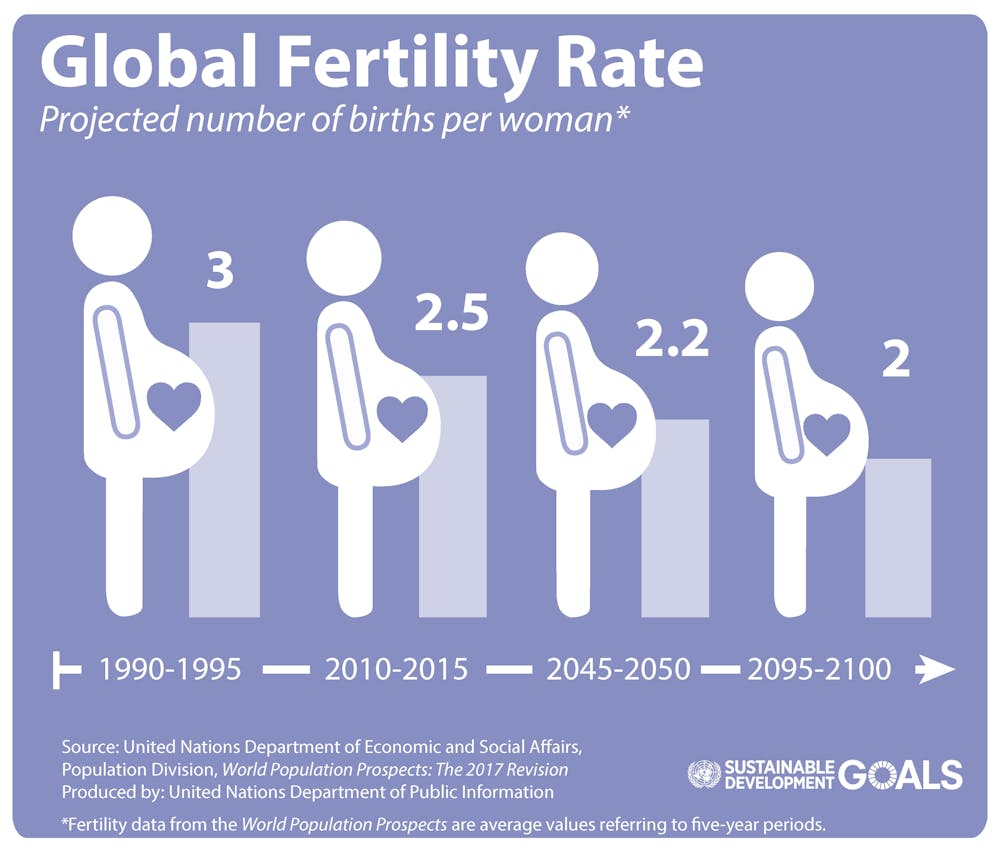
:{As nations develop economically, couples have fewer children and fertility rates decline.:(style="margin:0px;padding:0px;border:0px;outline:0px;vertical-align:baseline;background:transparent"):}: :{:(style="margin:0px;padding:0px;border:0px;outline:0px;vertical-align:baseline;background:transparent"):}:CC BY-ND
After Congress eliminated national-origin immigration quotas in 1965, immigration rose steadily and accounted for a growing share of population growth in the U.S. In this context, white liberals increasingly risked being branded racist for supporting population reduction.
By the late 1970s, both liberals and conservatives had bought into exaggerated talk of an “aging crisis” – too few workers to pay for the bulge of baby boomers headed toward retirement. This perspective bolstered calls for higher birth rates and further reduced the sting of the overpopulation critique.
An unsolved equation
Today Ehrlich is a largely forgotten prophet, although some small population-centric organizations continue to tilt at windmills and the mainstream press occasionally dips its toes in the water. After some very public rifts over immigration policy, mainstream environmental groups generally avoid or downplay the issue. Meanwhile, the Right continues to dismiss talk of population problems.
Looking back with the benefit of time, it’s clear Ehrlich was wrong to view population as all-encompassing. In addition, the global total fertility rate has declined more than he anticipated – although the development and modernization that has helped lower birth rates, a process known as the demographic transition, comes at great environmental cost.
Ehrlich underestimated human ingenuity. And for now, one can reasonably argue that food insecurity remains primarily political rather than technological. In Ehrlich’s own words, the book’s weaknesses were “not [focusing] enough on overconsumption and equity issues.”
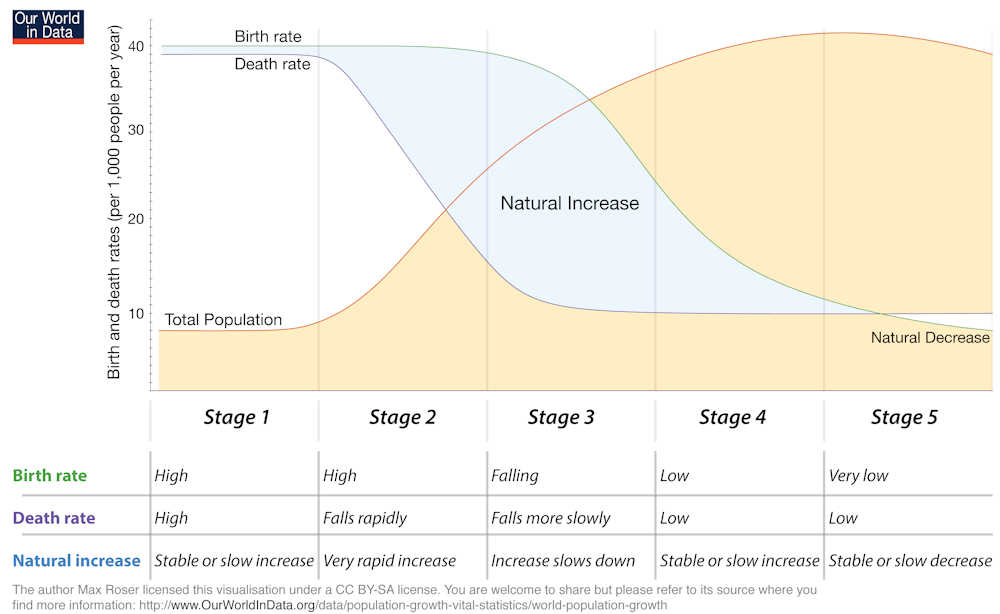
:{ :(style="margin:0px;padding:0px;border:0px;outline:0px;vertical-align:baseline;background:transparent"):}::{The demographic transition is a pattern in which countries tend to transition from high birth and death rates to lower birth and death rates as they industrialize.:(style="margin:0px;padding:0px;border:0px;outline:0px;vertical-align:baseline;background:transparent"):}: :{:(style="margin:0px;padding:0px;border:0px;outline:0px;vertical-align:baseline;background:transparent"):}:Max Roser, CC BY-SA

But he got much right, even if many details and his timing were off. Global population has increased at a remarkably steady rate since 1968, and the United Nations projects that it will reach 9.8 billion by 2050 and 11.2 billion by 2100. Scientists continue to extend his prescient warnings that efforts to feed all these people through pesticide-intensive monoculture may backfire. And although Ehrlich exaggerated the threat of mass starvation, about 8,500 young children die from malnutrition every day.
Human-driven climate change is an overriding threat, and is unambiguously worsened by population growth. The Intergovernmental Panel on Climate Change estimates that limiting warming in this century to 3.6 degrees Fahrenheit (2 degrees Celsius) would require cutting global greenhouse gas emissions 40 to 70 percent by 2050 and nearly eliminating them by 2100. “Globally, economic and population growth continue to be the most important drivers of increases in CO2 emissions from fossil fuel combustion,” the panel observes.
There lies an enduring flaw in Ehrlich’s approach. If impact equals people times affluence times technology, then reducing population alone is not sufficient to solve our ecological crises. But reducing affluence is neither possible nor desirable, since it would condemn millions to lifelong poverty. Ultimately, “The Population Bomb” offered no road map for transitioning away from capitalism without causing human ruin as serious as the environmental ruin that seems to be our destiny.
:{
- Population
- Demography
- Family planning
- Books
- Overpopulation
- Population growth
- one child policy
- population control
- 1968 50th anniversary
}: