Native American
Native Americans (also called American Indians, First Americans, or Indigenous Americans) are the Indigenous peoples of the United States, particularly of the lower 48 states and Alaska. They may also include any Americans whose origins lie in any of the indigenous peoples of North or South America. The United States Census Bureau publishes data about "American Indians and Alaska Natives", whom it defines as anyone "having origins in any of the original peoples of North and South America ... and who maintains tribal affiliation or community attachment".[5] The census does not, however, enumerate "Native Americans" as such, noting that the latter term can encompass a broader set of groups, e.g. Native Hawaiians, which it tabulates separately.[6]
The European colonization of the Americas from 1492 resulted in a precipitous decline in the size of the Native American population because of newly introduced diseases, including weaponized diseases and biological warfare by colonizers,[7][8][9][10][11] wars, ethnic cleansing, and enslavement. Numerous scholars have classified elements of the colonization process as comprising genocide against Native Americans. As part of a policy of settler colonialism, European settlers continued to wage war and perpetrated massacres against Native American peoples, removed them from their ancestral lands, and subjected them to one-sided government treaties and discriminatory government policies. Into the 20th century, these policies focused on forced assimilation.[12][13][14]
When the United States was established, Native American tribes were considered semi-independent nations, because they generally lived in communities which were separate from communities of white settlers. The federal government signed treaties at a government-to-government level until the Indian Appropriations Act of 1871 ended recognition of independent Native nations, and started treating them as "domestic dependent nations" subject to applicable federal laws. This law did preserve rights and privileges, including a large degree of tribal sovereignty. For this reason, many Native American reservations are still independent of state law and the actions of tribal citizens on these reservations are subject only to tribal courts and federal law. The Indian Citizenship Act of 1924 granted US citizenship to all Native Americans born in the US who had not yet obtained it. This emptied the "Indians not taxed" category established by the United States Constitution, allowed Natives to vote in elections, and extended the Fourteenth Amendment protections granted to people "subject to the jurisdiction" of the United States. However, some states continued to deny Native Americans voting rights for decades. Titles II through VII of the Civil Rights Act of 1968 comprise the Indian Civil Rights Act, which applies to Native American tribes and makes many but not all of the guarantees of the U.S. Bill of Rights applicable within the tribes.[15]
Since the 1960s, Native American self-determination movements have resulted in positive changes to the lives of many Native Americans, though there are still many contemporary issues faced by them. Today, there are over five million Native Americans in the US, about 80% of whom live outside reservations. As of 2020, the states with the highest percentage of Native Americans are Alaska, Oklahoma, Arizona, California, New Mexico, and Texas.[16][17]
Wednesday, November 05, 2025 06:05PM
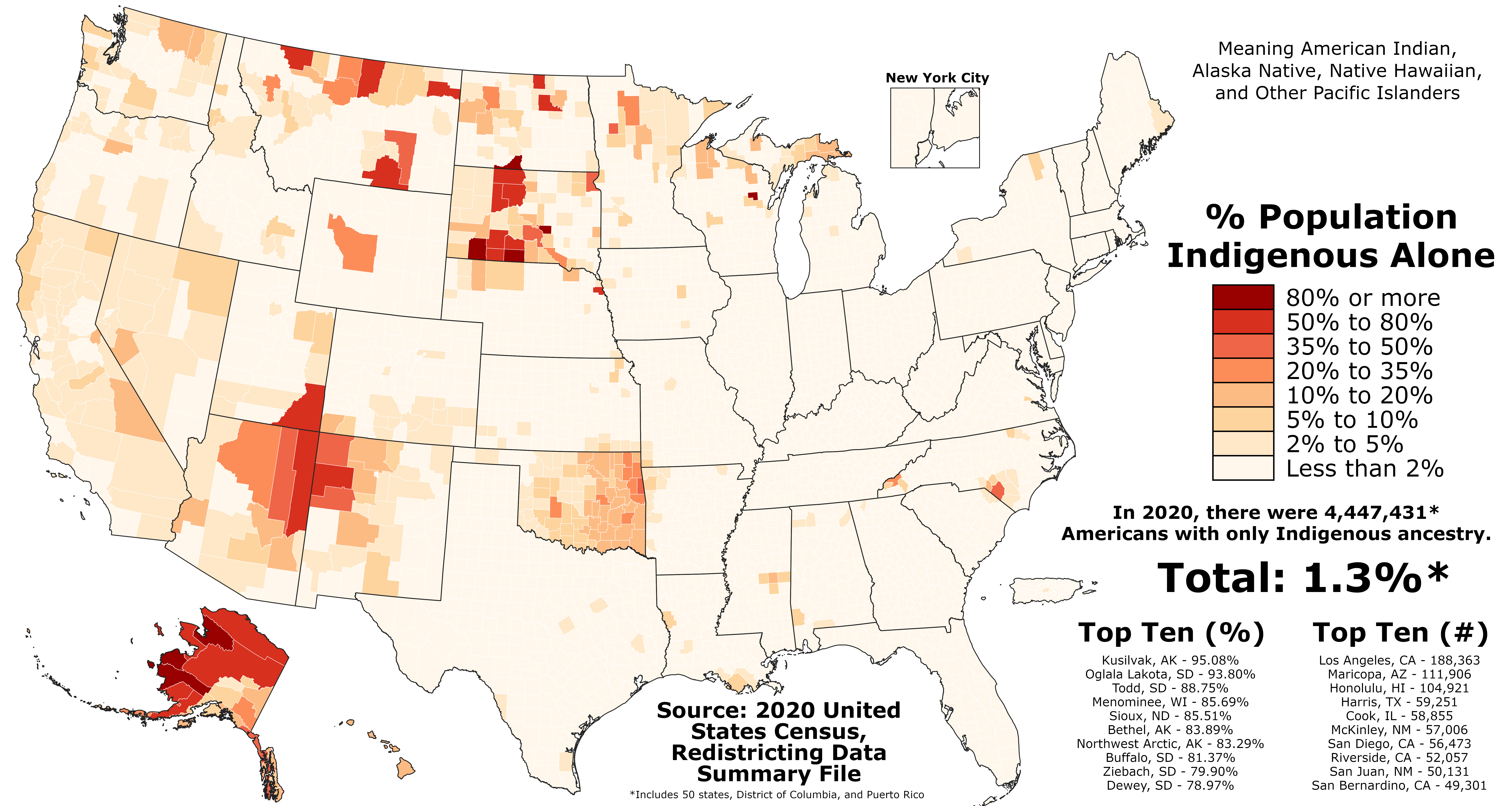
The map above shows the proportion of Americans who have only indigenous ancestry (meaning American Indian, Alaska Native, Native Hawaiian, and Other Pacific Islanders) in each county in the fifty states, the District of Columbia, and Puerto Rico according to the official results of the 2020 United States Census. The data can be found here. This file should next be updated when the 2021 Vintage Racial and Ethnic Population Estimates are released on the county level, currently expected to occur in June 2022.
From Wiktionary:
Noun
Native American (plural Native Americans)
- A member of some Indigenous peoples of the Americas.
- An Indigenous person of the contiguous United States.
- (dated) A resident of the United States who is not an immigrant. (Often uncapitalized: native American.)
Usage notes
- Native American is often used in place of American Indian, although some people insist on being called American Indians, and the latter is not usually considered offensive. In some cases, offense can be avoided by referring to Indians from Canada as First Nations people, Native Canadians, or Aboriginal peoples of Canada.
- The third definition can cause confusion, and the phrase Native-born American is preferred in ambiguous contexts. This definition was used by anti-Catholic and anti-immigrant political factions in the 1850s; they called themselves the "Native American Party" before settling on the names "Americans" and "Know-Nothings".
- In the U.S., many now prefer the designation Native American instead of Indian for the first inhabitants of the Western Hemisphere, although usage may vary according to tribe and region. In Canada and Alaska in particular, American Indian is still preferred as marking a useful distinction from Eskimos.
- According to the National Museum of the American Indian, American Indian, Indian, Native American, Indigenous, or Native are commonly acceptable terms. However, Native people often prefer to be called by their specific tribal name.