CODETALKERS
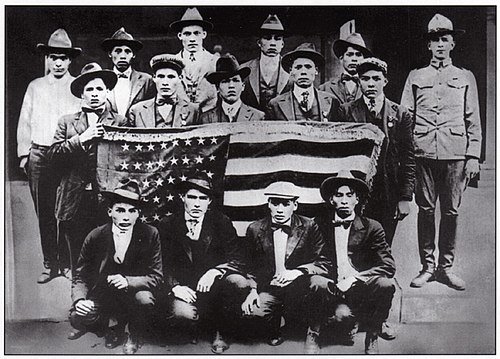
Choctaw soldiers in training in World War I for coded radio and telephone transmissions
A code talker was a person employed by the military during wartime to use a little-known language as a means of secret communication. The term is most often used for United States service members during the World Wars who used their knowledge of Native American languages as a basis to transmit coded messages.
There were approximately 400 to 500 Native Americans in the United States Marine Corps whose primary job was to transmit secret tactical messages. Code talkers transmitted messages over military telephone or radio communications nets using formally or informally developed codes built upon their indigenous languages.
The code talkers improved the speed of encryption and decryption of communications in front line operations during World War II and are credited with some decisive victories. Their code was never broken.
Methods
There were two code types used during World War II.
- Type one codes were formally developed based on the languages of the Comanche, Hopi, Meskwaki, and Navajo peoples. They used words from their languages for each letter of the English alphabet. Messages could be encoded and decoded by using a simple substitution cipher where the ciphertext was the Native language word.
- Type two code was informal and directly translated from English into the Indigenous language. Code talkers used short, descriptive phrases if there was no corresponding word in the Indigenous language for the military word. For example, the Navajo did not have a word for submarine, so they translated it as iron fish.[1][2]
Wednesday, November 05, 2025 06:36PM