A Truss
Structural Engineering
Definition
A truss (جملون fagverk) is a structural framework made of straight, slender members connected at their ends by joints, forming a stable arrangement of triangular shapes. It is designed primarily to carry loads through axial tension and compression in its members.
planar trusses lie in a single plane and are often used to support roofs and bridges.
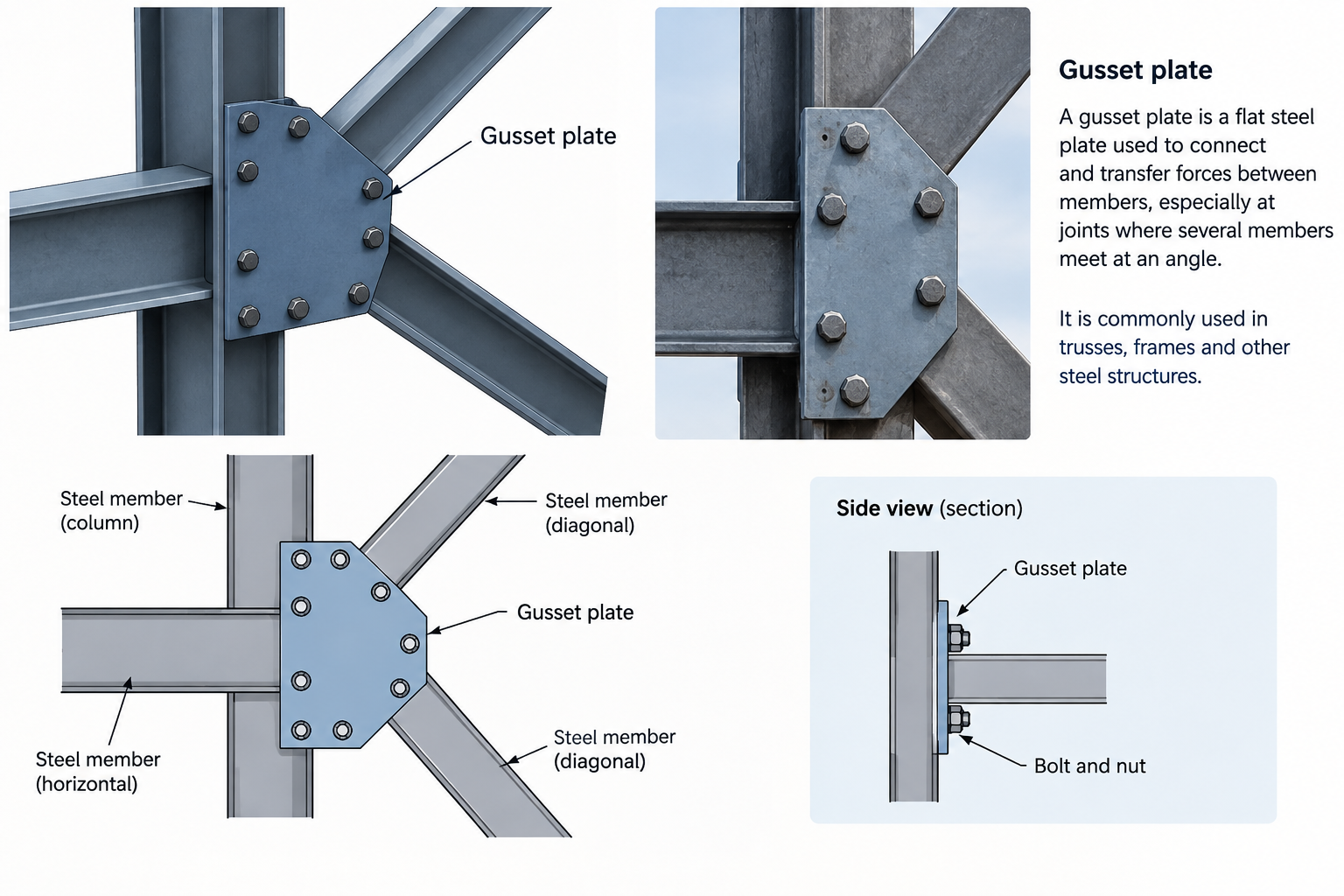
The joint connections are usually formed by bolting or welding the ends of the members to a common plate, called a gusset plate.
Triangular Net
Triangles are used in trusses because they provide geometric stability and rigidity. The triangle is the simplest geometric shape that cannot change its shape without changing the length of one of its members
Simple Truss
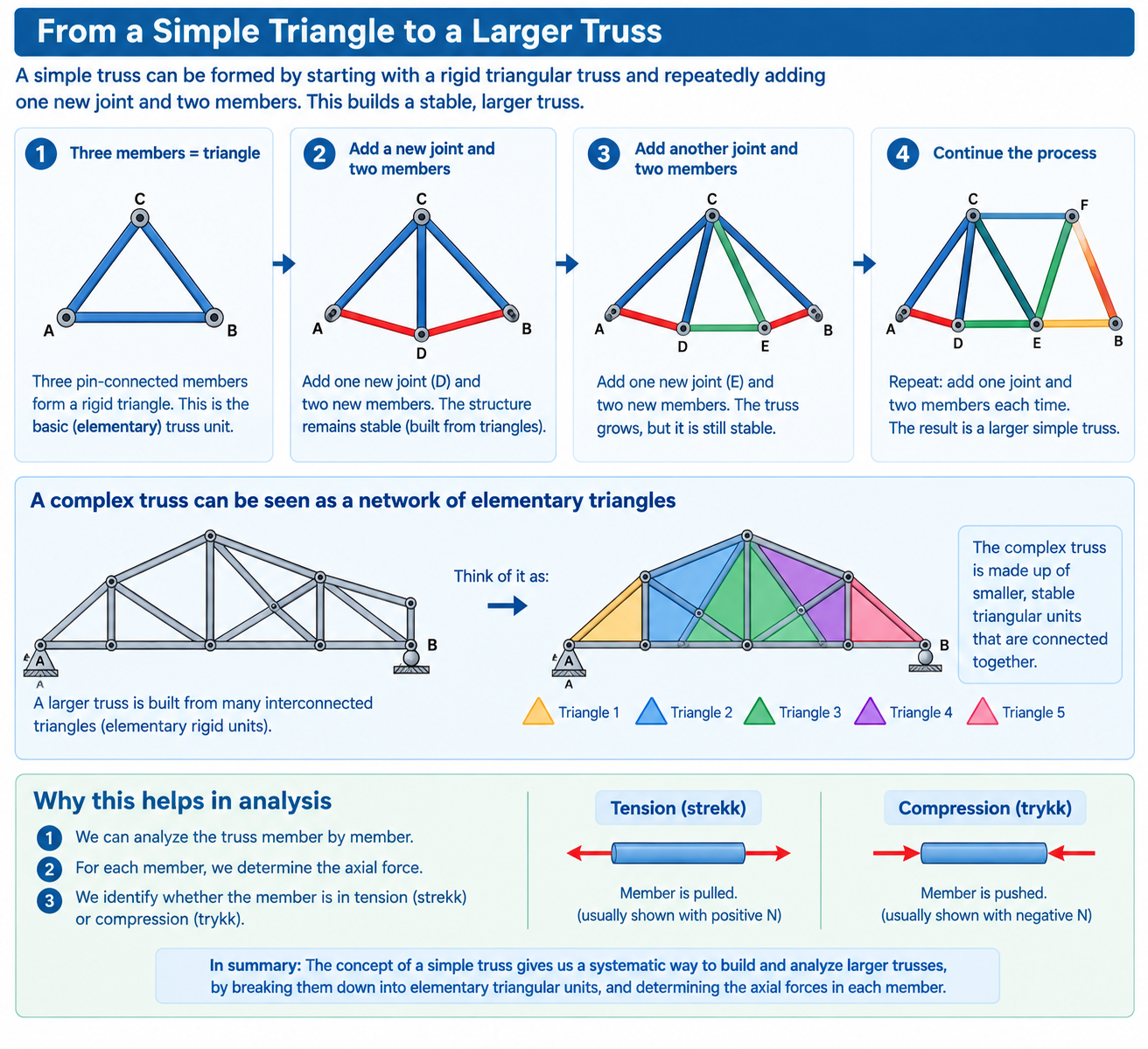
is formed by starting with a rigid triangular truss and successively adding two members and one new joint.
Defining a simple truss helps us understand how a larger and more complex triangular truss network is formed from elementary rigid triangular units. Starting with one rigid triangle, additional joints and members can be added systematically to create a larger stable truss.
This idealized structure makes it possible to analyze the truss member by member and determine the axial forces acting in each member, identifying whether each member is subjected to tension (strekk) or compression (trykk).
In this way, the concept of a simple truss provides a systematic foundation for studying the internal forces and structural behavior of larger truss systems.
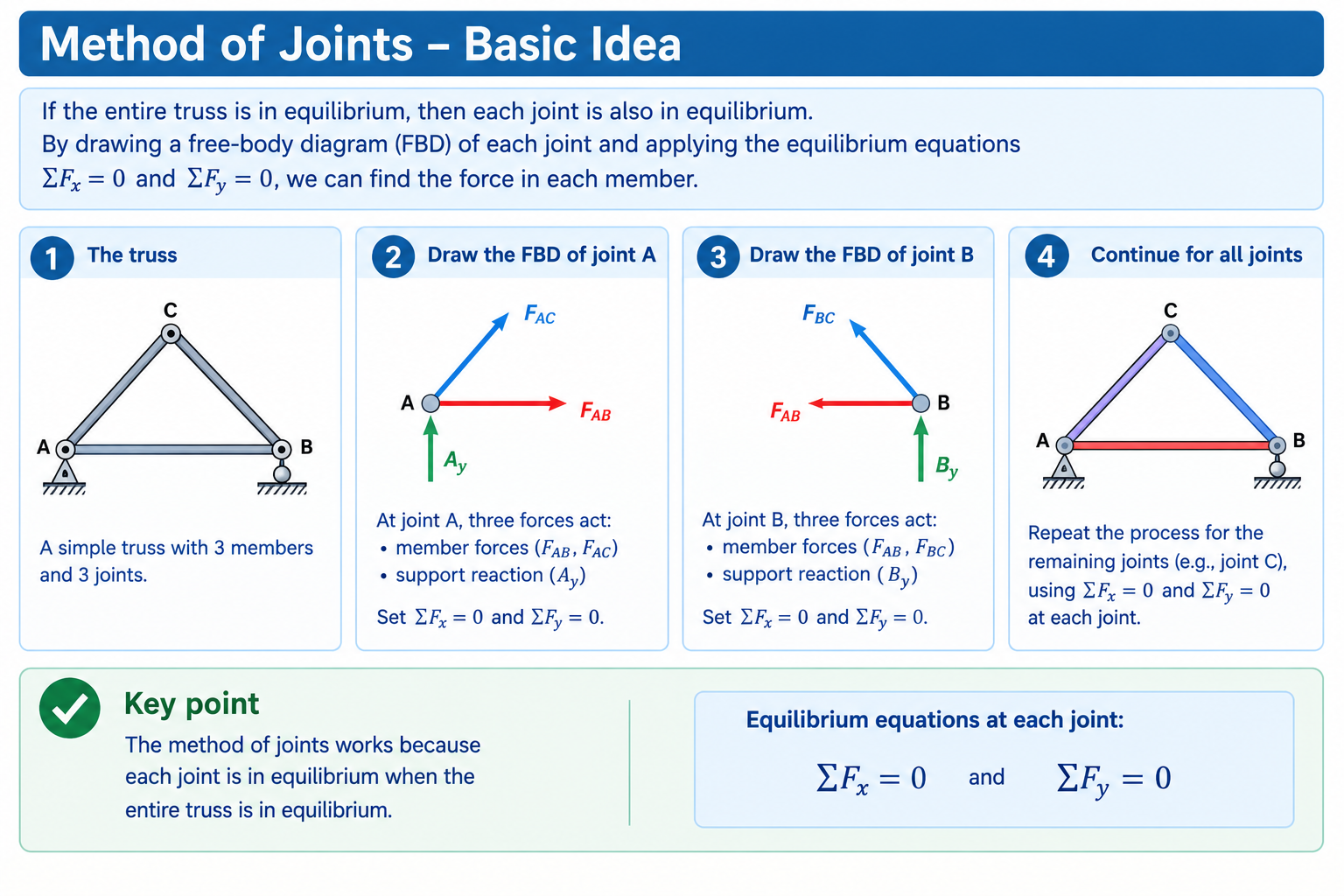
One way to determine the force in each member of a truss is to use the method of joints. This method is based on the fact that if the entire truss is in equilibrium, then each of its joints is also in equilibrium. Therefore, if the free-body diagram of each joint is drawn, the force equilibrium equations, ΣFx = 0 and ΣFy = 0, can then be used to obtain the member forces acting on each joint.
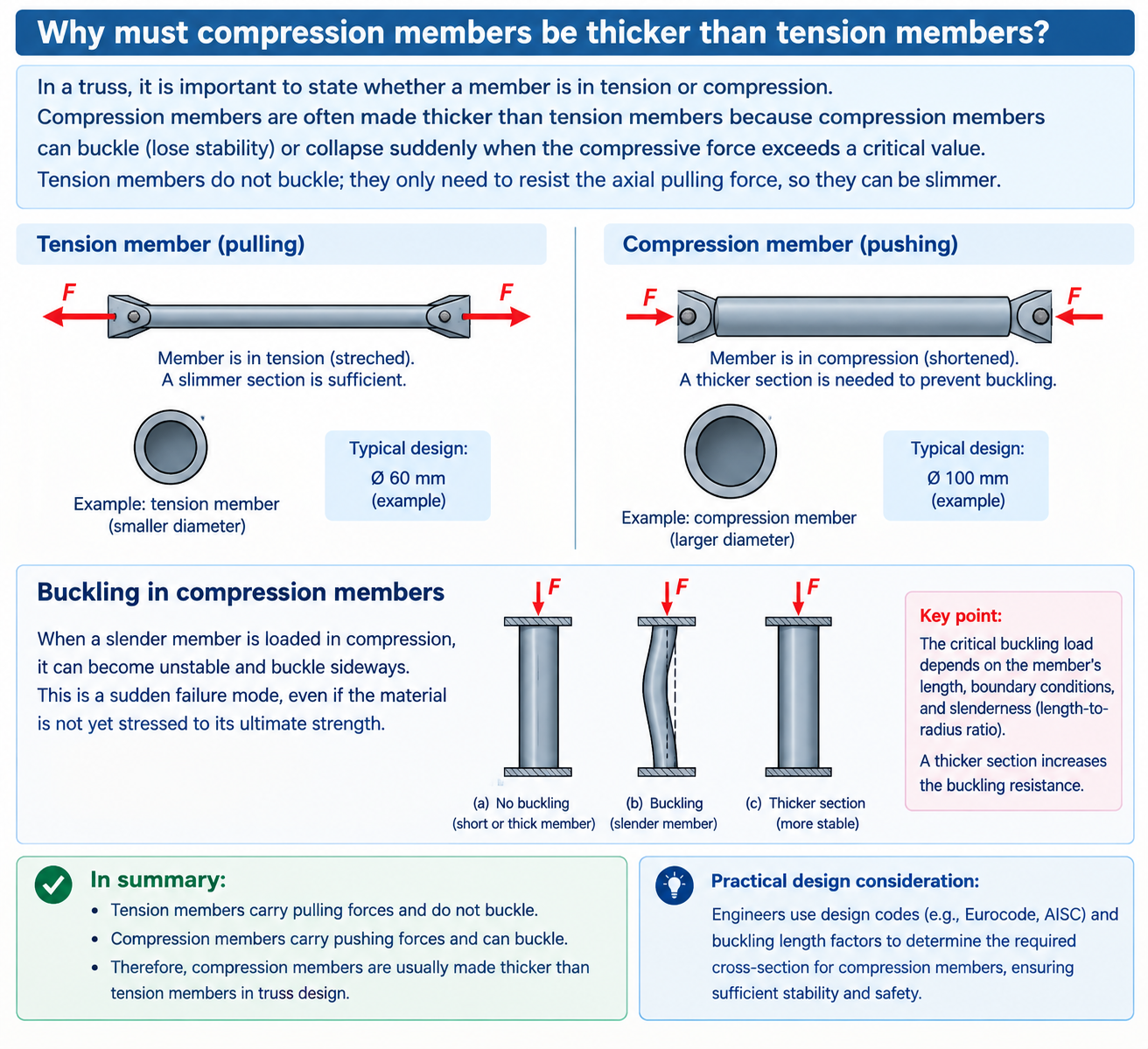
In the actual design of a truss it is important to state whether the force is tensile or compressive. Often, compression members must be made thicker than tension members because of the buckling or sudden collapse that occurs when a member is in compression
Ideal Truss
- The members are straight, slender, and their self-weight of the members is neglected . Which allows the members to be modeled primarily as axial-force members.
           Frequently the weight of the members is neglected because the force supported by each
member is usually much larger than its weight. However, if the weight is to be included in the. analysis, it is generally satisfactory to apply it as a vertical force, with half of its magnitude applied at. each end of the member.- The members are connected by ideal pin joints. Which allow relative rotation and do not transmit bending moments between members. Therefore, there is no rigid connection that forces the members to rotate together.
- The external loads are applied at the joints (nodes) rather than at the middle of the members . This prevents significant bending moments from being introduced into the members by loads acting between joints. In the contrary applying a load at the middle of a member may produce a bending moment. As a result, the member would no longer behave as an ideal axial-force member only.
Results
- The neglected self-weight of the members simplifies the analysis by eliminating the members' weights as additional external loads.
- The members carry only axial forces: tension or compression. Therefore, bending moments and shear forces within the ideal members are neglected.
- The deformation of the members is neglected in basic static analysis. This allows the geometry of the truss to be treated as unchanged while applying the equilibrium equations.
These assumptions idealize the real structure so that the truss can be analyzed as a system of two-force members, where the internal force in each member acts along its longitudinal axis.
As a result, the analysis can focus primarily on determining the axial forces in the members using the equations of static equilibrium.
Applications of Trusses
Trusses have many important applications in structural engineering because they provide an efficient way to transfer and distribute loads through a structure. Overall, trusses are widely used because they can provide high structural strength with relatively low material usage.The main applications include:
Truss Bridges
Trusses are widely used in bridges to carry and transfer loads from the bridge deck to the supports. The loads may include the weight of vehicles, the weight of the bridge itself, and moving loads. These loads are distributed among the members of the truss, which primarily carry axial forces in tension or compression.
Roof Trusses
Trusses are commonly used in roof structures, particularly when a large span is required without using many intermediate columns. They are frequently used in warehouses, sports halls, industrial buildings, and airports. The truss allows the roof loads to be transferred efficiently to the supporting structures.
Transmission Towers
Electrical transmission towers are often constructed as steel lattice structures consisting of interconnected members. Truss analysis can be used to determine the forces in these members and to study how the structure resists different loads, such as wind loads, the weight of electrical cables, and the weight of the tower itself.
Cranes
Truss structures are also used in cranes, particularly in crane booms. A truss arrangement provides a structure that is strong while remaining relatively lightweight. The members transfer the applied loads mainly through axial tension and compression, allowing the crane to support significant loads without requiring a solid, heavy structural member.
Large-Span Structures
Trusses are particularly useful for structures that need to cover large spans while minimizing the number of internal supports. Examples include stadiums, exhibition halls, airports, transportation terminals, and large industrial buildings. Their structural arrangement allows loads to be distributed efficiently over a relatively large distance.
Structural Engineering Analysis and Education
The study of trusses is also fundamental in structural engineering education and analysis. Trusses provide a simple and clear model for understanding how external loads are transferred through a structure. By analyzing a truss, engineers and students can develop an understanding of static equilibrium, free-body diagrams, support reactions, axial forces, tension, compression, and structural stability. Truss analysis also introduces important analytical methods such as the Method of Joints and the Method of Sections.