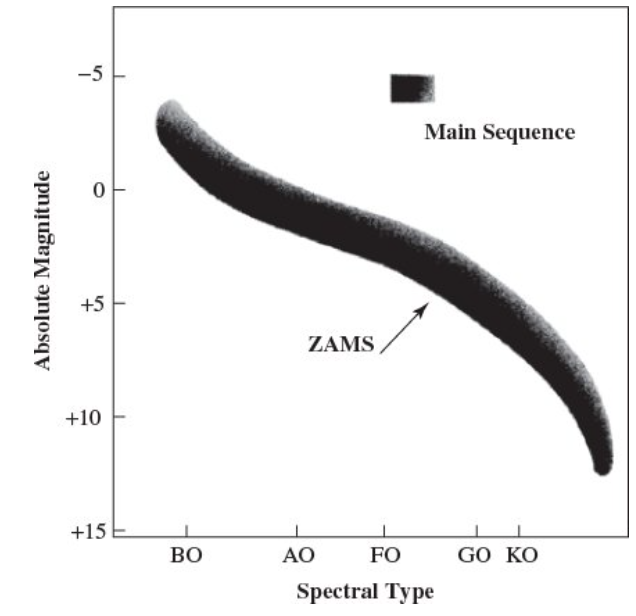
Main Sequence
The majority of stars are located in a specific region known as the main sequence, where stars of the same temperature exhibit similar luminosity and size due to the principles of physics. This relationship between temperature and size provides a basis for understanding stellar structure and serves as a critical test for any stellar structure theory.
However, not all stars conform to the main sequence; some stars appear above it, indicating higher luminosity and larger size. These stars are referred to as giants. They are further categorized into subgiants, giants, and supergiants, with supergiants divided into Ia and Ib classes.
To specify a star's size within a given spectral type, a luminosity class denoted by a roman numeral is added. Main sequence stars are classified as luminosity class V. For example, the Sun is a G2 V star. Subgiants belong to luminosity class IV, and giants are classified as luminosity class III, while luminosity class II stars fall between giants and supergiants. Supergiants are categorized as luminosity class I.
The size of a star can be inferred from its spectral lines, as stars of different sizes display varying surface gravities that affect the appearance of certain spectral lines. Some stars appear below the main sequence, significantly smaller and around 10 magnitudes fainter than main sequence stars of the same temperature. These are known as white dwarfs, primarily found in the middle spectral types and often appear white in color. It's important not to confuse dwarfs, which are main sequence stars, with white dwarfs, which are much smaller and distinct from ordinary dwarfs.
stars based on their luminosity classes:
| Luminosity Class | Classification | Examples |
|---|---|---|
| V | Main Sequence (Dwarfs) | Sun (G2 V), Proxima Centauri (M5 V) |
| IV | Subgiants | Capella (G5 IV) |
| III | Giants | Aldebaran (K5 III) |
| II | Luminosity Class II | Rigel (B8 II) |
| Ia | Supergiants (Brighter) | Betelgeuse (M1 Ia) |
| Ib | Supergiants (Less Bright) | Deneb (A2 Ib) |
Protostar to Main Sequence
A collapsing object transitions from a protostar to a star when its primary energy source shifts from gravitational collapse to fusion via the p-p chain. This transition is gradual, with the inner material heating faster until enough internal energy is generated to halt the collapse, leading to the star reaching a stable condition on the main sequence. During nuclear reactions, the star's composition changes, potentially affecting its spectral type and luminosity. This results in a main sequence represented as a band on the HR diagram, with the zero-age main sequence (ZAMS) marking the points where stars of each spectral type first appear on the main sequence.