An Observation
- The act of observing, and the fact of being observed.
- The act of noting and recording some event; or the record of such noting.
- A remark or comment.
- A judgement based on observing.
- Performance of what is prescribed; adherence in practice; observance.
- A regime under which a subject is routinely observed.
- Philosophically as: the phenomenal presence of human being existence.
Astrophysics:
Observation Types and data handing:
- In the Visible light:
The visible spectrum provides only a small fraction of the radiation emitted by astronomical objects, and for centuries, it was the primary source of information for astronomers. However, observations in other parts of the spectrum have revealed new object types and offered crucial insights into those already observed in the visible spectrum.
- In the ultraviolet:
Ultraviolet (UV) observations share similarities with optical observations, considering UV as short-wavelength visible observations. Despite the common imaging principles, the shorter wavelength of UV requires more accurate mirror surfaces and different coatings. UV photons, having higher energy, can be detected using photographic plates, photomultipliers, or CCDs.
A significant challenge in UV observations is that UV radiation is largely absorbed by Earth's atmosphere. Observations at high altitudes partially address this issue, but reliance on UV satellites has become essential.
- In the Infrared:
Observing in the infrared spectrum involves treating it as long-wavelength visible radiation, often using normal optical telescopes. Challenges include increased diffraction limits due to the longer wavelength. Infrared observations face the unique challenge of telescope radiation interference, demanding careful design to minimize issues with detectors. Infrared detectors, particularly bolometers, measure temperature changes induced by radiation and are crucial for energy detection. Infrared spectroscopy differs from the visible spectrum, requiring larger objects for comparable spectral resolution and addressing challenges from thermal emission.
The Earth's atmosphere is a significant obstacle, being opaque at certain infrared wavelengths and partially transparent at others. This creates problems by blocking astronomical infrared radiation and introducing strong atmospheric emission. To mitigate this, astronomers compare target sources with nearby empty sky, limiting observations to relatively small sources. Infrared windows in the atmosphere allow feasible observations, but higher altitudes are established to address challenges.
In astronomical observations, various techniques visualize data. Astronomical infrared images are often represented as false gray-scale images, where brighter regions correspond to stronger infrared emission. False color images assign colors to different infrared emission levels, often ranging from red to blue, mimicking the visible spectrum. For multiple bands, false gray-scale images for each band can be tinted with different colors, providing intrinsic color information. This technique is not limited to infrared; it can be applied to visible images. True color visible images are produced by combining black and white images through red, green, and blue filters to replicate human vision.
Contour maps, familiar in topographical maps, display two-dimensional images by showing regions with values exceeding a specified level. The spacing between contours indicates the rate of variation in the displayed quantity, offering a visual sense of changes over the region.
- Radio astronomy:
Radio observations offer distinct information and techniques compared to optical observations due to their long wavelength, revealing wave nature and low-energy photons.
Radio telescopes, often large dishes, collect radiation, with size crucial for good resolution. The Earth's atmosphere is transparent in the radio spectrum, enabling day and night observations and cloud-penetrating capabilities.
Radio telescopes work by collecting and detecting radiation using receivers. Receiver sensitivity is crucial, with cooling sometimes used to reduce background noise. Observations can be continuum or spectral line studies, akin to optical photometry and spectroscopy.
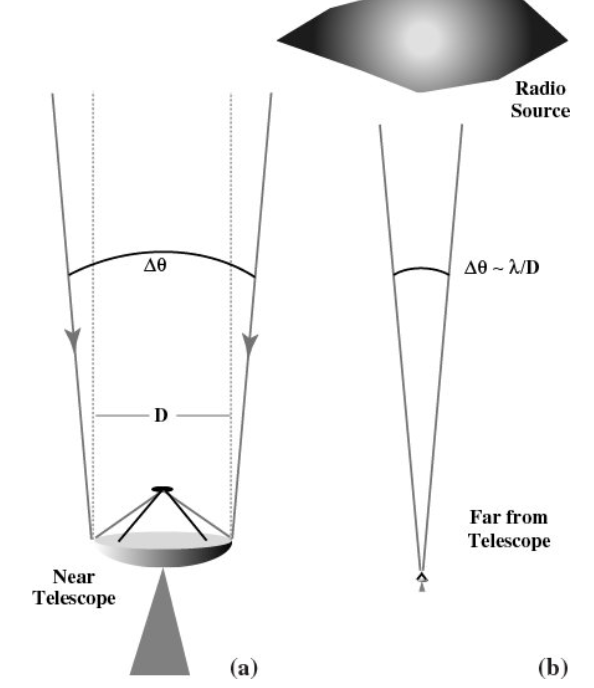
Resolution for a radio telescope. (a) The short dashed lines show what would happen if there were no diffraction. Only radiation traveling parallel to the telescope axis would reach the focus. The solid lines show the effects of diffraction. Radiation coming in at a slight angle with the telescope axis can still be reflected on to the focus. This means that when the telescope is pointed in one direction, it is sensitive to radiation from neighboring directions. This is shown in (b), as the telescope is sensitive to radiation coming from within a cone of angle approximately λ/D (in radians).
Radio interferometer. Here only two telescopes are shown, but an interferometer with any number of telescopes can be treated as a number of pairs of telescopes. The separation between the telescopes produces a phase delay, which depends on the separation, d, and the position of the source. The phase difference can be detected, providing information about source structures whose angular size is approximately λ/d (in radians). By using different telescope spacings and the Earth’s rotation, information about structures on different angular sizes can be accumulated and eventually reconstructed into a map of the source.
- High energy astronomy:
X-ray astronomy relies on observations at high altitudes or in space due to the Earth's atmosphere blocking X-rays. Designing effective X-ray mirrors is challenging due to the short wavelengths, but grazing incidence, where X-rays enter at shallow angles, enables reflection. X-ray satellites, providing continuous and spectral line observations.