A Spectroscopy
The goal of these observations is to obtain a spectrum of some object, generally with sufficient detail to allow the study of spectral lines.
In spectroscopy, it's crucial to spatially separate the image at different wavelengths on the detector, which can be achieved with a prism. Prisms are considered low dispersion instruments because they don't spread out light significantly. Low dispersion spectra, though sometimes sufficient for determining a star's spectral type, can be enhanced by using a thin prism over the telescope's objective. This technique, capturing objective prism spectra, proves valuable for quickly classifying large numbers of stars. A diffraction grating can be used for better resolution.
If the grating has N lines, then in the order m the resolving power is given by:
\[R=N\lambda\]
Blazing prosess can be used to make most of the light goes into a particular order. Interference filters can be used in addition.
There are two flat parallel reflecting surfaces placed close to each other. There is a maximum in the transmitted radiation when twice the spacing between the surfaces, d, is equal to an integral number of wavelengths. That is
\[2\lambda =m\lambda \]
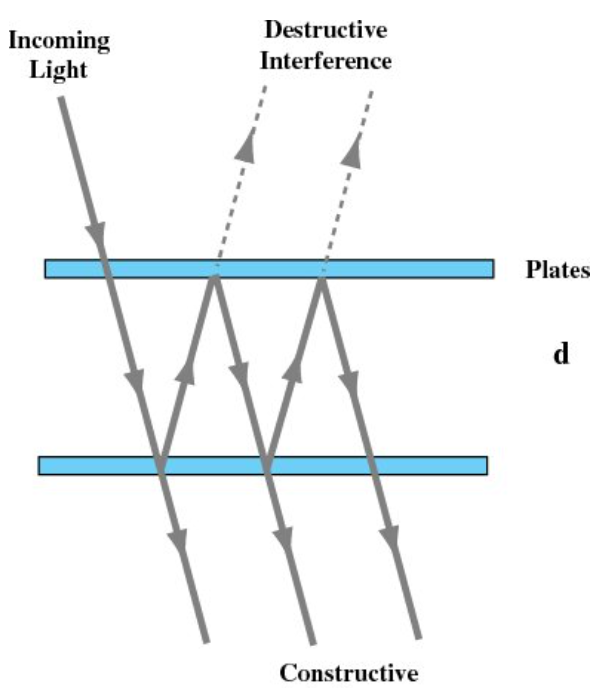
This method restricts the measurement to a narrow wavelength range, necessitating frequent adjustments of the spacing, d, to capture the entire spectrum.
Another issue arises as different orders (m) of diverse wavelengths may pass through simultaneously. To address this, a second filter with an alternative spacing can be added, configured to allow the passage of the desired wavelength.
Improving flexibility and sensitivity in spectroscopy involves integrating instruments capable of performing a Fourier transform of the spectrum, as demonstrated by the Michelson interferometer.
Incoming radiation is divided into two beams, reflected off mirrors to reunite at the same location, resulting in interference. The phase of one beam can be modified by adjusting a mirror, altering the relative importance of longer and shorter wavelength radiation. Observing the intensity variations during mirror movement provides insight into this wavelength-dependent behavior.
If the total path length difference is x. by looking at the electric field for each wave. In this case it is convenient to write the waves as \(E_0 e^{i(kx − ωt)}\), where k = 2π/λ and ω = 2πν, and \(E_0\) is the electric field amplitude of the wave:
\[E_1=E_0 e^{-i\omega t}\]
\[E_2=E_0 e^{i(kx-\omega t)}\]
The total electric field:
\[E = E_1 + E_2\]
The intensity:
\[I = EE^^*\]
\[I(k,x)=2E_0^2[1+\frac {e^{ikx}+e^{-ikx}}{2}]\]
For any mirror position corresponding to a path length x, contributions from all wavelengths (k) are received. Thus, to determine the total intensity as a function of x, integration is performed over all values of k:
\[I(x)=\int_0 ^\infty I(k,x)dk\]
\[\ =2\int_0 ^\infty I(k)[1+\frac {e^{ikx}+e^{-ikx}}{2}]dk\]
\[\ =2\int_0 ^\infty I(k)dk+\int_0^\infty I(k) e^{ikx}dk+\int_0 ^\infty I(k)e^{-ikx}dk\]
If :
\[I_0=\int _0^\infty I(k)dk\]
be the total power, and I(−k) = I(k) so:
\[I(x)=2I_0 +\int_{-\infty}^{+\infty} I(k)e^{-ikx}dk\]
The integral in this expression is the Fourier transform of I(x). So measuring I(x), is also measuring the Fourier transform . This means that I(k) can be found, power as a function of wavelength, from the inverse Fourier transfrom of I(x), which is:
\[\int_{-\infty}^{+\infty} I(k)e^{-ikx}dk\]
Practical measurements encounter limitations, as it is not feasible to measure I(x) for all x values. Two constraints include the total range of mirror movement and the finite steps in mirror adjustment, impacting the approximation of the inverse transform integral as a sum. The proximity of measurements influences sensitivity to shorter wavelengths, while measuring I(x) at larger x values offers more information on longer wavelengths. This process establishes the frequency resolution limit in the computed spectrum.