A Distribution
- An act of distributing or state of being distributed.
- An apportionment by law (of funds, property).
- (business, marketing) The process by which goods get to final consumers over a geographical market, including storing, selling, shipping and advertising.
- The frequency of occurrence or extent of existence.
- Anything distributed; portion; share.
- The result of distributing; arrangement.
- (mathematics, statistics) A probability distribution; the set of relative likelihoods that a variable will have a value in a given interval.
- (computing) A set of bundled softwarecomponents; distro.
- (economics) The apportionment of income or wealth in a population.
- (finance) The process or result of the sale of securities, especially their placement among investors with long-term investment strategies.
- (logic) The resolution of a whole into its parts.
- (printing, historical) The process of sorting the types and placing them in their proper boxes in the cases.
- (steam engines) The steps or operations by which steam is supplied to and withdrawn from the cylinder at each stroke of the piston: admission, suppression or cutting off, release or exhaust, and compression of exhaust steam prior to the next admission.
- (rhetoric) A rhetorical technique in which a subject is divided into multiple cases based on some property or properties, and each case is addressed individually.
Physics:
Boltzmann distribution:
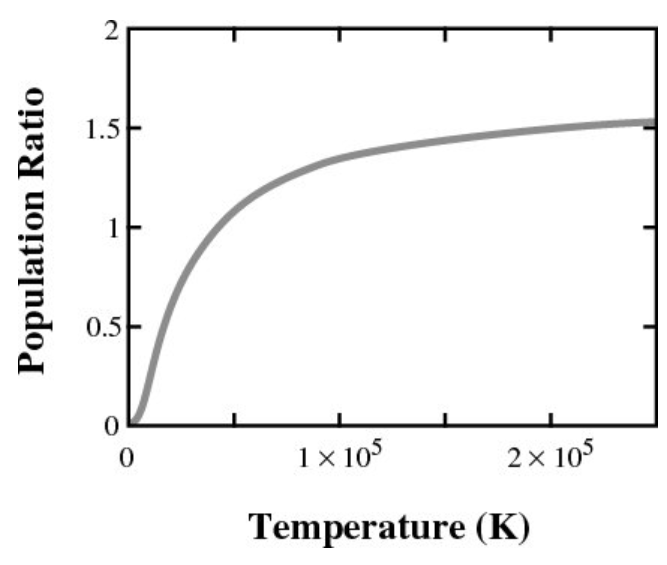
energies and statistical weights (3, 5) for the n = 2 and n = 3 states of hydrogen (first Balmer transition)
The figure, shows how the ratio of populations for an atom with just two levels depends on temperature. When the temperature is zero, all the atoms are in the ground state, so the ratio is zero. As the temperature increases, the quantity in square brackets gets smaller, so the exponent becomes less negative, and the ratio increases. If we let T go to infinity the ratio of populations approaches the ratio of statistical weights. For a given temperature, increasing the energy separation between the two levels makes the exponent more negative, lowering the ratio. This makes sense, since the greater the energy separation, the harder it is to excite the atom to the higher level.
The Boltzmann distribution provides with a convenient reference point, even for a system that is not in thermodynamic equilibrium. For any given population ratio nj/ni, it is always possible to find some value of T to plug into the equation to make the equation correct. This temperature is called the excitation temperature. When they are not in equilibrium, each pair of levels can have a different excitation temperature. In thermodynamic equilibrium all excitation temperatures are equal to each other and to the kinetic temperature.