Light Cone
Definition
A light cone is a geometric structure in spacetime that represents the paths of light rays originating from a single event in space and time. It is a visual representation of the possible trajectories that light, or any other causal signals traveling at the speed of light, could take from a specific point in spacetime.
In a spacetime diagram, the light cone is typically depicted as a double cone, divided into two parts: the future light cone and the past light cone.
Future Light Cone:
This cone represents all the events in spacetime that can be influenced or affected by signals emitted from the chosen event. Any event inside or on the surface of the future light cone can receive information from the chosen event, given that information travels at or below the speed of light.
Past Light Cone:
This cone represents all the events in spacetime that could have influenced or causally affected the chosen event. Any event inside or on the surface of the past light cone could have sent signals that reached the chosen event in the past.
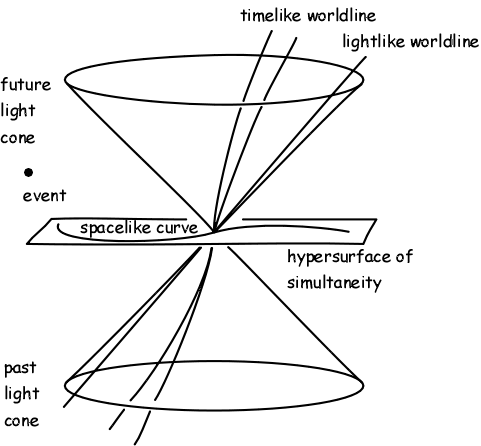
Events outside the light cones are not causally connected to the chosen event in a way that allows for the exchange of information at or below the speed of light. The concept of light cones is an essential part of understanding causality and the limitations imposed by the speed of light in the theory of relativity.
the light cone.