Special Relativity
ASTROPHYSICS
Foundations of special relativity
Problems
Problems with electromagnetic radiation
The problems that lead to special relativity start with Maxwell’s theory of electromagnetic radiation. Maxwell’s equations, allow for the existence of waves of oscillating electric and magnetic fields. All waves known before electromagnetic waves required a medium in which to travel. There is no obvious medium necessary for the propagation of electromagnetic waves. Physicists postulated a medium that is difficult to detect, called the ether. The ether supposedly fills all of space. Once there is a medium, then there is a reference frame for the motion of the waves.
Einstein’s questions about Maxwell’s equations involve the appearance of electromagnetic waves to different observers, who are moving at different speeds.
Einstein started with the postulate of special relativity, that, the laws of physics, properly stated, should be independent of the velocity of the observer. It may be that the values of certain quantities change with the motion of the observer, but the relationships among the physical quantities do not change.
Einstein examined Maxwell’s equations to see if they obeyed this simple rule.
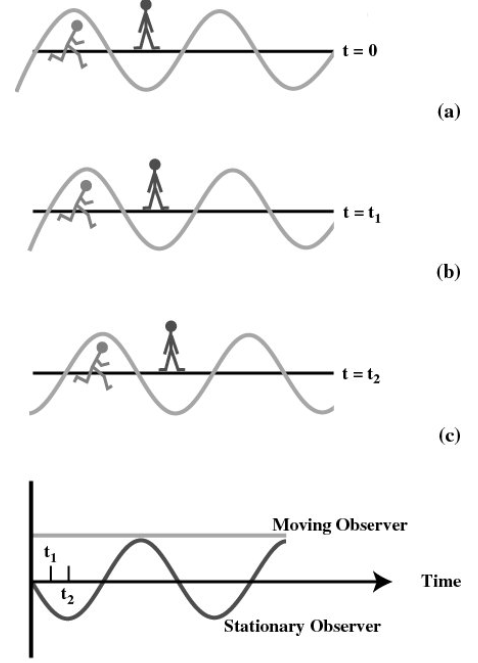
Observers of electromagnetic waves. One observer is stationary and the other observer is moving with the wave. (a) The moving observer is at a crest, and the stationary observer is at a null. (b) The moving observer is still at a crest, and the stationary observer sees a negative value. (c) The moving observer is still at the crest and the stationary observer is at a dip. (d) We plot what each sees as a function of time. The moving observer sees a constant value while the stationary observer sees a sinusoidally varying value.
The solution of Maxwell’s equations gives waves that vary sinusoidally in both space and time. That is, the waves vary with position, repeating each wavelength and, with time, repeating each cycle.
How would an electromagnetic wave appear to an observer moving along with the wave at the speed of light? The wave would appear sinusoidal in space but constant in time, since the observer is moving along with the wave (crest for example). However, there is no mathematical solution to Maxwell’s equations that is constant in time, but which varies sinusoidally. (It is precisely the time variation of electric and magnetic fields that allows the propagation of the waves.) This seems to be a contradiction.
Two possibilities were left:
(1) Maxwell’s equations were correct in only one reference frame, that of the ether.
(2) there was something wrong with the basic concepts of space and time.
The first possibility violates Einstein’s postulate of special relativity, so he chose the second, saying that, for some reason, it must be impossible to move at an arbitrary speed relative to an electromagnetic wave. He concluded that the speed of light in a vacuum is the same for all observers, independent of their motion. This suggests that electromagnetic waves must be different from the familiar mechanical waves. There must also be something wrong with the concept of the ether.
When Einstein was working on this problem, experiments had already been done which cast the existence of the ether into doubt.
Michelson-Morley’s experiment was designed to measure the motion of the Earth through the ether by measuring the speed of light in two directions perpendicular to each other. No change was found. This meant that the Earth could not be moving through the ether. If the ether existed, it must be dragged along with the Earth.
However, there is another observation which rules out the dragging of the ether by the Earth. It is called aber-ration of starlight. (This has nothing to do with aberrations in optical systems.) It is a slight change in the angle at which light from stars appears to be arriving due to the motion of the observer, in this case the motion of the Earth about the Sun. (It is analogous to the change in the apparent angle at which rain is falling when you start to move.) The shift is always in the direction of the motion of the Earth, so it changes throughout the year. The positions of stars are shifted from their true positions. (This effect has been used in the past to measure the speed of light.) In the ether theory there is no way for aberration to be observed if the Earth is dragging the ether.
The fact that the speed of light is independent of the velocity of the observer contradicts our everyday experience, in which relative velocities are additive. Einstein began to look at the underlying cause for the speed appearing to be constant. In measuring a speed, we measure a distance and a time interval. Einstein suspected that the problem lay in our traditional concepts of space and time. Physicists such as Newton simply assumed that space and time were given. Einstein suggested that they might not be absolute but might depend on the motion of the observer. Einstein examined the idea of an absolute time and looked at whether time might actually be a quantity that depends on the motion of the observer.
Problems with simultaneity
Einstein realized that an absolute time was tied to the concept of absolute simultaneity.
The experiment involving two observers in identical railroad cars demonstrates that the concept of simultaneity is relative in special relativity. In the scenario, two flashes occur at the ends of one car when the observers are opposite each other. The observer at rest judges the flashes to be simultaneous, but the moving observer sees the flash on the side they are moving toward first. This illustrates that simultaneity is not an absolute concept, leading to the conclusion that time is not absolute in special relativity.
This realization serves as the foundation for investigating how different situations appear to observers with different velocities. In special relativity, only inertial reference frames, where there is no acceleration or external gravitational forces, are considered. An inertial frame, for example, could be a space station far from any mass with its engines turned off. Einstein's postulate asserts that the laws of physics are the same in all inertial frames, and there is no preferred inertial frame. This means there is no experiment that can determine which inertial frame is in motion and which is at rest; only the relative motion between two inertial frames is meaningful.
Time Dilation
Length contraction
The Doppler shift
With lengths and times appearing different to different observers, it is also necessary to take a closer look at the Doppler shift, since wavelengths obviously involve length, and frequencies obviously involve time. Since there is no ether, the Doppler shift for electromagnetic waves can only depend on the relative motions of the source and observer.
Space-time
Phenomena such as time dilation and length contraction are not illusions, real effects.
Classical physicists assumed that space and time were simply there, just like a blank piece of graph paper, and that the laws of physics were laid down on top of them. Einstein realized that the laws of physics were intimately entwined with space and time. We can understand the nature of this relationship by abandoning our normal three-dimensional world and replacing it with the four-dimensional world of space-time.
Four-vectors and Lorentz transformation
In space-time, time is treated as another coordinate, often denoted as ct to have the same dimensions as spatial coordinates. This allows time to be measured in meters, representing the distance light travels in a given time. The speed of light (c) is now a defined constant in international standards, simplifying the relationship between meters and seconds. Events in space-time are described by four-vectors, denoted as (ct, x, y, z), with different inertial observers noting different coordinates for the same events. Despite these differences, there are well-defined relationships between the coordinates for observers in different inertial frames.
If one inertial system is moving with respect to another at a speed v, in the x-direction, the coordinates in the transformations between the two coordinate systems are found by assuming they are linear in the coordinates, and must give the correct results for length contraction and time dilation. The result is (letting = v/c)
\[ct = \gamma \ (ct’ + \beta x’)\]
\[x = \gamma (x’ + \beta ct’)\]
\[y = y’\]
\[z = z’ \]
The reverse transformation is given by:
\[ct’ = \gamma \ (ct- \beta x)\]
\[x’ = \gamma (x- \beta ct)\]
\[y’ = y\]
\[z’ = z \]
Energy and momentum
The space-time coordinates of an event are not the only quantities that transform according to the Lorentz transformation. Another important four-vector involves energy and momentum.
The analogy with (ct, x, y, z) is seen by considering a photon moving in the x-direction, where x = ct. The energy and momentum of the photon are related by:
\[E = cp\]
indicating that for a photon moving in the x-direction, \(E = cp_x\). This leads to the formulation of the energy-momentum four-vector as \((E, cp_x, cp_y, cp_z)\), and these components obey the Lorentz transformations.
\[E = \gamma \ (E’ + \beta cp_{x’})\]
\[cp_x = \gamma (cp_{x’} + \beta E’)\]
\[cp_y = cp_{y’}\]
\[cp_z = cp_{z’}\]
The reverse transformation is given by:
\[E’ = \gamma \ (E- \beta cp_x)\]
\[cp_{x’} = \gamma (cp_x- \beta E)\]
\[cp_{y’} =cp_ y\]
\[cp_{z’} = cp_z \]
If the (′) reference frame is the one in which the particle is at rest, with \(p_{x′} = 0\), then we observe that \(E = γE′\). It is evident that if the energy of the particle at rest, E′, were zero, then the energy, E, would also always be zero. However, this contradicts the fact that moving particles must have some energy. Consequently, the rest energy, E₀, cannot be zero. This leads to the expression for relativistic energy:
\[E = \gamma E_0\]
the relativistic momentum then is:
\[cp_x = \gamma\beta\ E_0\]
In the non-relativistic (γ close to one) limit, the momentum must give the classical expression, \(p_x = mv_x\).
From \(cp_x = \gamma\beta\ E_0\) this can only occur if
\[E_0=m_0c^2\]
where \(m_0\) is the rest mass of the particle.
So the expressions for relativistic energy and momentum are:
\[E = \gamma \ m_0c^2\]
\[p=\gamma \ m_0v\]
The kinetic energy is the difference between the total energy and the rest energy:
\[E_k=E-E_0\]
\[E_k=(\gamma-1)m_0c^2\]
In the limit \(v<<c\), or \((v/c)<<1\) :
\[\gamma =[1-(v/c)^2]^{-1/2}\]
by using the approximation \(x <<1\rightarrow(1 + x)^n ≅ 1 + nx\)so:
\[\gamma \approx 1+v^2 /(2c^2)\]
The kinetic energy for \(v<<c\) then becomes:
\[E_k=(1+v^2/(2c^2)-1)m_0c^2\]
so:
\[E_k=(1/2)m_0v^2\]
Which is the classical expression.
Since the energy-momentum four-vector obeys the Lorentz transformations, it must have an invariant length associated with it. It is
\[E^2-(cp_x)^2-(cp_y)^2-(cp_z)^2\]
In the rest frame of some particle, the momentum is zero and the energy is the rest energy. So the invariant length is simply \(m_0c^2\). Since this quantity is invariant, its value must be \(m_0c^2\) for any observer.