Angular Momentum
angular momentum (or moment of momentum or rotational momentum) is the rotational analog of linear momentum.
The total angular momentum of a closed system remains constant.
In general, conservation limits the possible motion of a system, but it does not uniquely determine it.
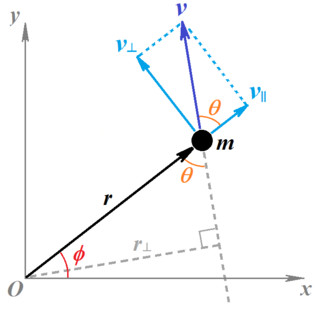
\(\vec L=\vec r \times \vec P\) (kg⋅m2⋅s−1)
or
angular momentum L is proportional to moment of inertia I and angular speed ω.
\[L=I\omega\]
or
\[J=I\omega\]
Similar to conservation of linear momentum, where it is conserved if there is no external force, angular momentum is conserved if there is no external torque.
Torque can be defined as the rate of change of angular momentum, analogous to force. The net external torque on any system is always equal to the total torque on the system; in other words, the sum of all internal torques of any system is always 0 (this is the rotational analogue of Newton's third law of motion). Therefore, for a closed system (where there is no net external torque), the total torque on the system must be 0, which means that the total angular momentum of the system is constant.
The gravitational force between two objects always acts along the line joining the two objects. The center of mass also lies along this line. This means that the force on either object points directly from that object towards the center of mass.
\[\vec r \parallel \vec F\]
Therefore, these forces can exert no torques about the center of mass. If there are no torques about the center of mass, then the angular momentum about the center of mass is conserved.
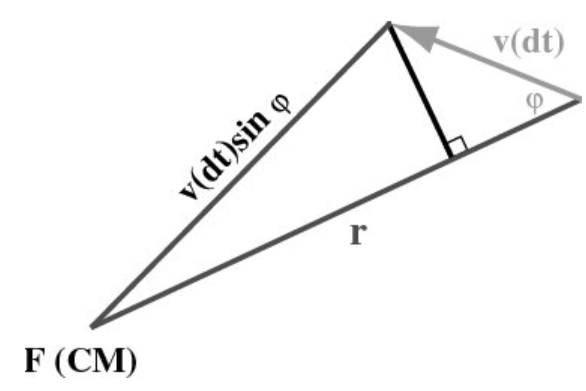
For an object of mass m, the angular momentum about the center of mass (which corresponds to one of the foci) is r times the component of its linear momentum perpendicular to the direction of r:
\[L=mvr \sin \phi\]
the area swept out by r, in the time interval dt. The long side of the triangle is r and the short side is v dt.
\[dA=\frac 12 rv(dt)\sin \phi\]
so:
\[\frac {dA}{dt}=\frac12 rv\sin \phi\]
so:
\[\frac {dA}{dt}=\frac12 \frac Lm\]
Since L is constant, the rate at which area is swept out is constant. Equal areas are swept out in equal times.
The major consequence of angular momentum conservation is therefore that the objects move slower when they are farther apart and faster when they are closer together.
The Earth’s orbit is only slightly eccentric but it moves faster when it is closer to the Sun, in January, and slower when it is farther away. This results in winter and spring in the northern hemisphere being shorter than summer and winter.