Planetary Nebula
The outer layers of a red giant, held weakly due to the diminishing gravitational pull (1/R2), undergo expansion, possibly driven by pressure waves or radiation pressure from absorbed photons. The exact mechanism is not fully understood, but ejected shells are observed, known as planetary nebulae.
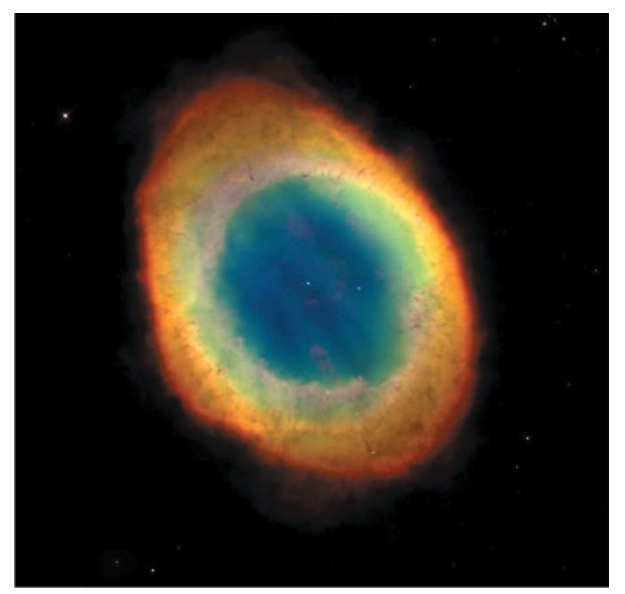
These shells, appearing fuzzy and ringlike, are spherical but seem ring-shaped due to varying material density along the line of sight. Spectral analysis of planetary nebulae reveals Doppler shifts, indicating expansion velocities of a few tens of kilometers per second.
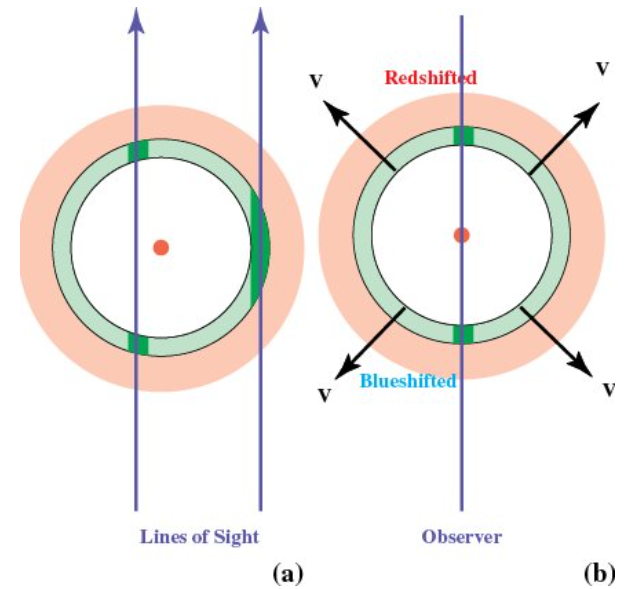
(a) Appearance. The shaded regions represent the places where the lines of sight pass though the shell. The line of sight near the edge passes through more material than that through the center. This is responsible for the ringlike appearance. (b) Doppler shifts. Material on the near side is moving toward the observer, producing a blueshift, and material on the far side is moving away, producing a redshift.
Observations and spectral lines in planetary nebulae provide insights into their physical conditions. Different lines expose various aspects of the nebula structure, and radio wave studies contribute to our understanding. The ejected mass from these nebulae plays a role in shaping the conditions for the formation of subsequent stars, complementing the mass lost through stellar winds.