Doppler Effect
PHYSICS
Definition of Doppler Shift
a change in the wavelength (and frequency) of a wave, resulting from the motion of the source and/or the observer.
Visualization
It is most easily visualized for a sound wave or a water wave, where the waves are moving through a particular elastic medium
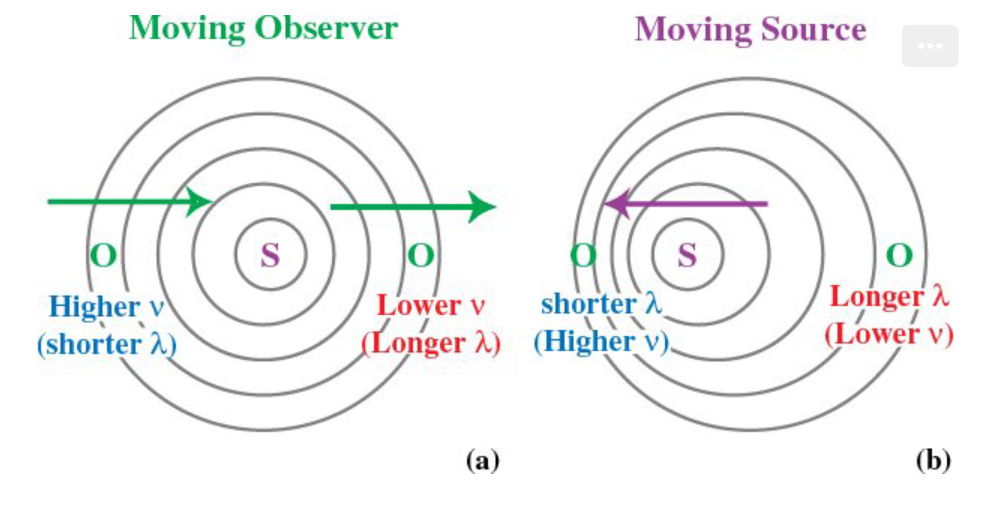
Doppler shift for waves in an elastic medium, such as sound waves. (a) Moving observer. On the left the observer is moving toward the source, encountering wave crests more frequently than for a stationary observer. The frequency appears to increase (and the wavelength to decrease). On the right, the observer is moving away from the source, encountering waves at a lower frequency, corresponding to a lower frequency, corresponding to a longer wavelength. (b) Moving source. The motion of the source distorts the wave pattern, so the circles are no longer concentric. The observer on the left has the source approaching, producing a shorter wavelength (and a higher frequency). The observer on the right has the source receding, producing a longer wavelength (and a lower frequency).
Analyzation
Moving sources and observers
If there is a change in the distance, r, between the source (s) and the observer (o), each emitted wavefront will initiate from a distinct location. A reduction in distance results in emitted waves originating closer together, causing a decrease in wavelength. Conversely, an increase in distance causes the waves to be emitted farther apart, resulting in an increase in wavelength. No shift occurs if the motion is perpendicular to the line of sight.
Radial Velocity:
The shift depends only on the radial velocity. In astronomy, the concern is on the Doppler shift for electromagnetic waves. The underlying physics is a little different, because there is no mechanical medium for these waves to move through. For sound waves, the actual amount of Doppler shift depends on whether the source or observer (or both) is moving. For electromagnetic waves, only the relative motion counts.
Formalization:
Wavelength:
As long as the relative velocity is much less than the speed of light, the results for electromagnetic radiation are relatively simple. If λ is the wavelength at which a signal is received, and λ0 is the wavelength at which it was emitted, called the rest wavelength, the wavelength shift Δλ is defined by:
\[\Delta \lambda =\lambda -\lambda_0\]
so:
\[\frac {\Delta \lambda}{\lambda_0}=\frac {v_r}{c} \ \ \ ;v_r <<c\]
Frequency:
\[\lambda =\frac c{\nu}\]
So:
\[\Delta \lambda /\Delta \nu =-\frac c{\nu^2}=-\frac {\lambda }{\nu}\]
\[\frac {\Delta \lambda }{\lambda }=-\frac {\Delta \nu }{\nu}\]
\[\frac {\Delta \nu}{\nu_0}=-\frac {v_r}{c} \ \ \ ;v_r <<c\]
Implications
Redshift
Blueshift
| Shift Type | Definition | Cause | |
|---|---|---|---|
| Redshift | Increase in wavelength; shift towards longer wavelengths. | Moving away from the observer. | \[\Delta \lambda>0\] \[\Delta \nu <0\] \[v_r>0\] \[\Delta r>0\] |
| Blueshift | Decrease in wavelength; shift towards shorter wavelengths. | Moving towards the observer. | \[\Delta \lambda <0\] \[\Delta \nu>0\] \[v_r<0\] \[\Delta r<0\] |
If we observe two spectral lines, their wavelength shifts will be different, since each is shifted by an amount proportional to its own rest wavelength. Thus, the spacing between spectral lines will be shifted.
Circular orbits
Plane Of Motion
Doppler shifts produced by a star in a circular orbit. The orbital speed is v, and the radius is r. The angular speed of the star in its ω = v/r . If the star is moving directly away from the observer at time t = 0. At that instant the radial velocity \(v_r=v\). As the stars moves, the component of its velocity along the line of sight :
\[v_r=v \cos \theta\]
But θ = ωt, so:
\[v_r=v \cos \omega t\]
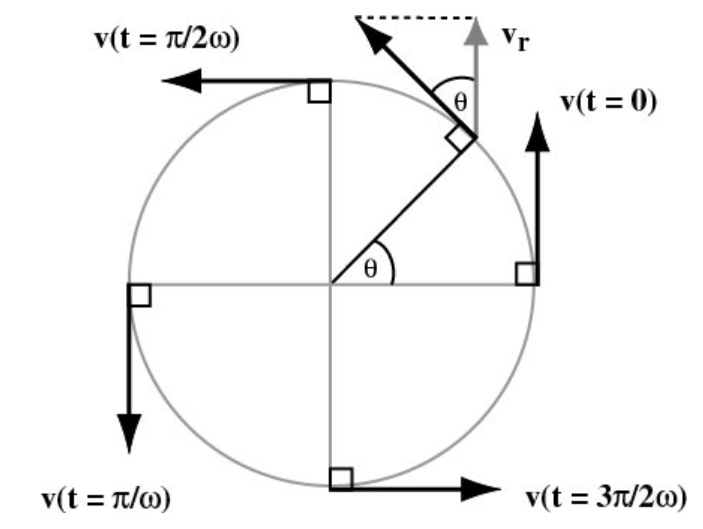
The radial velocity changes sign every halfcycle (\(\pi\)), and repeats periodically.
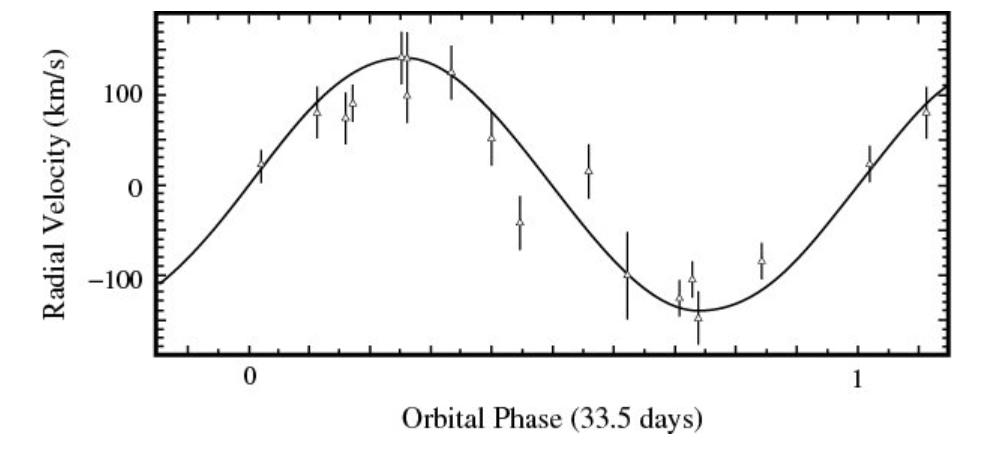
The period:
The period of the motion is the circumference, 2πr, divided by the speed v:
\[P=\frac {2\pi r}{v}\]
so:
P = 2π/ω
\[v_r=v \cos \omega t\]
but:
\[\frac {\Delta \lambda}{\lambda_0}=\frac {v_r}{c} \ \ \ ;v_r <<c\]
so:
\[\frac {\Delta \lambda}{\lambda_0}=\frac {v}{c}\cos \omega t\]
The spectral lines shift back and forth, with a shift given by:
\[\frac {v}{c}\cos \omega t\]
The motion in another plane:
If the observer is not in the plane of the orbit, the Doppler shift will be reduced. If i is the angle between the two planes, then the projection of any velocity in the plane of the orbit into the line of sight is \(v\ \sin i\). The angle i is known as the inclination of the orbit. (plane of the sky)
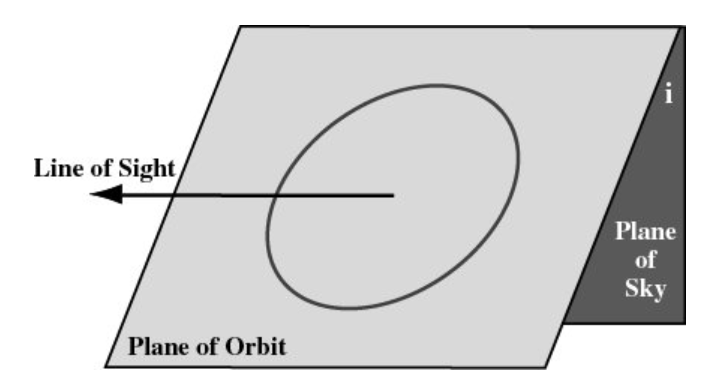
This gives a radial velocity for an orbiting star:
\[v_r=v \ \sin i \cos \omega t\]
Special Relativity
Since there is no ether, the Doppler shift for electromagnetic waves can only depend on the relative motions of the source and observer.
This is different from the case of sound waves, for which the shift depends on which is moving.
The result for electromagnetic waves doesn’t depend on which is moving by considering separately the case of the moving source and the moving observer. Quantities measured in the rest frame of the receiver are denoted as primed (′)
Moving source
A source is moving away from the receiver at a speed v, emitting N waves in time Δt′, as measured by the receiver.
In this time, the first wave travels a distance c Δt′ and the source travels a distance v Δt′. The wavelength will then be the distance between the source and the first wave, divided by the number of waves.
\[\lambda’=\frac {c\ \Delta t’-v\ \Delta t’ }N\]
\[\lambda’=\frac {c-v\ }N\Delta t’\]
The frequency is then given by:
\[\nu’=\frac c{\lambda’}\]
\[\nu’=\frac c{c-v}\frac N {\Delta t’}\]
Relating this to the frequency in the source frame, ν. It is given as the number of waves, N, divided by the time interval, Δt, as measured in the source frame:
\[\nu =\frac N{\Delta t}\]
but from time dilation \(\Delta t=\frac {\Delta t’}{\gamma}\), so:
\[\nu =N \frac\gamma {\Delta t’}\]
so:
\[\frac N{\Delta t’}=\frac {\nu}{\gamma}\]
Substituting this in \(\nu’=\frac c{c-v}\frac N {\Delta t’}\):
\[\nu’=\frac c{c-v}\frac {\nu} {\gamma}\]
\[\nu’=\frac 1{1-v/c}\frac {\nu} {\gamma}\]
but
\[\frac 1 {\gamma}=\sqrt {1-(v/c)^2}\]
so:
\[\nu’=\nu \frac \sqrt{1-(v/c)^2}{1-v/c}\]
\[\nu’=\nu \frac {{\sqrt {1+v/c}}\sqrt{1-v/c}}{\sqrt{1-v/c}\sqrt {1-v/c}}\]
\[\nu’=\nu \frac {{\sqrt {1+v/c}}}{\sqrt{1-v/c}}\]
multiplying the numerator and denominator by \(\sqrt{1+v/c}\):
\[\nu’=\nu \frac {{\sqrt {1+v/c}}\sqrt{1+v/c}}{\sqrt{1-v/c}\sqrt {1+v/c}}\]
\[\nu’=\nu \frac { {1+v/c}}{\sqrt{1-(v/c)^2}}\]
so:
\[\nu’=\nu (1+\frac vc)\gamma\]
\[\nu’=\nu \frac { {1+v/c}}{\sqrt{1-(v/c)^2}}\]
Moving observer
The receiver moving away from the source. In the source’s frame, in time Δt, the receiver will receive all waves in a length (c + v)Δt. This number is the length divided by the wavelength: (proof is not clear)
\[\nu’ =\frac N{\Delta t’}\]
\[\nu’ =\frac {(1+v/c)\Delta t}{\Delta t’}\]
but from time dilation \(\frac {\Delta t}{\Delta t’}=\frac 1{\gamma}\), so:
\[\nu’=\nu \frac { {1+v/c}}{\sqrt{1-(v/c)^2}}\]
It is identical for both, moving source and moving observer, proving that the Doppler shift is independent of whether the source or the receiver is moving.
General result
to generalize the result. If the source and observer are moving apart, it should have 1 − v/c in the numerator of equation \(\nu’=\nu (1+\frac vc)\gamma\).
so \(\nu’=\nu (1\pm\frac vc)\gamma\)
The v in the 1 ± v/c is just the radial velocity, the component of the velocity along the line of sight.
\[\nu’=\nu (1\pm\frac {v_{r}}c)\gamma\]
However, the other v in the equation, in the γ, comes from time dilation, which is independent of the direction of motion. It must remain as the total relative speed of the source and receiver.
This means that it is possible to have a Doppler shift, even when the motion is perpendicular to the line of sight. This is simply a result of time dilation, and is not important until v is close to c.
For Wavelength
A corresponding expression for wavelength can be derived considering that: \(\lambda’=c/\nu’\)
\[\lambda’=\lambda (1+\frac {v_r}c)\gamma\]
Simplification
For objects moving at speeds close to c, the radial velocity is very close to the total speed v.
\[v_r\approx v\]
This allows us to make the simplification.
if \(v/c=\beta\)
\[\lambda’=\lambda (1+\beta)\gamma\]
\[\lambda’=\lambda \frac{(1+\beta)}\sqrt{1-\beta ^2}\]
\[\lambda’=\lambda \frac\sqrt{1+\beta}\sqrt{1-\beta}\]
so:
\[\lambda’=\lambda \sqrt\frac{1+\beta}{1-\beta}\]
so:
\[\lambda’=\lambda \frac\sqrt{1+v/c}\sqrt{1-v/c}\]