A Camera
- A device for taking still or moving pictures or photographs.
- (computer graphics, video games) The viewpoint in a three-dimensional game or simulation.
- A vaulted room.
- The judge's private chamber, where cases may be heard in camera.
Astrophysics:
Image formation in a camera:
The operation of a simple camera illustrates the basic points about the formation of images in optical systems.
Astronomical situations deals with objects that are ‘at infinity’, so the light rays from a point on the sky are traveling parallel to each other.
When bundles of rays come from two different stars. The rays within each bundle arrive at an angle with each other equal to the angular separation of the stars on the sky.
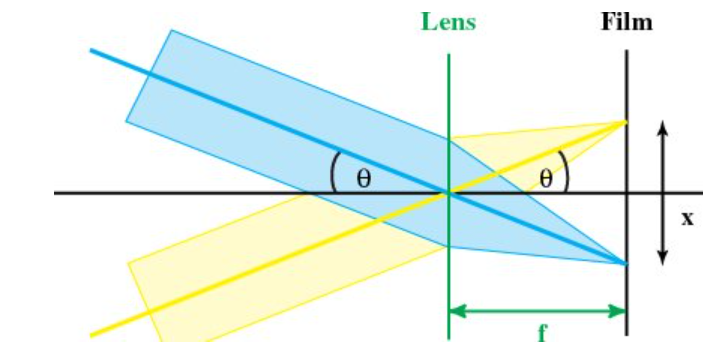
The optics of a camera. Bundles of rays from two distant points enter, making an angle θ with each other. The focal length of the lens is f.
For a camera with a lens of focal length f, the rays in each bundle are brought together at a distance f behind the lens.
The images of all the stars in a field lie in the focal plane. The images of two stars are at different points in the focal plane.
These images can be located by following the chief ray of each bundle until it intersects the focal plane.
Angular Separation:
If stars have an angular separation θ on the sky, then the two images have an angular separation θ on the focal plane. The camera provides no angular magnification. The angular separation between the stars is the same as the angular separation of the images.
Linear Separation:
The linear separation x between the two images:
\[tan (\theta /2)=x/2f\]
If θ is small, then:
\[\theta /2=x/2f\]
So:
\[x=f\theta\]
Image Size:
linear size of the image is proportional to the focal length. Longer focal length lens gives a larger image.
- proportional to \(D^2\): The amount of light entering the camera is proportional to the area of the lens. If D is the diameter of the lens, then its area is \(\pi D^2/4\)
- proportional to \(1/f^2\): The more the image is spread out, the less light reaches any small area of the film or detector. The linear image size is proportional to f, so the image area is proportional to \(f^2\).
Combining these two results, so image brightness is proportional to \((D/f)^2\), so the it is proportional to (1/focal ratio)2.
The focal ratio can be adjusted in a camera by changing f-stops. Since the focal length of the lens is fixed, the focal ratio can be changed by changing the diameter of a diaphragm that controls the fraction of the total lens diameter that is actually used.
The discussions so far on image formation are really only appropriate for thin lenses, as well as optical systems where all of the angles are small.
Real optical systems: rays that enter parallel do not all leave parallel to each other. So the images formed by optical systems will have aberrations.