Black Body
a hypothetical perfect absorber and radiator of energy, with no reflecting power.
If a blackbody is to maintain a constant temperature, it must radiate energy at the same rate that it absorbs energy. If it radiates less energy than it absorbs, it will heat up. If it radiates more energy than it absorbs, then it will cool.
However, this does not mean that the spectrum of emitted radiation must match the spectrum of absorbed radiation. Only the total energies must balance. The spectrum of emitted radiation is determined by the temperature of the blackbody. As the temperature changes, the spectrum changes. The blackbody will adjust its temperature so that its emitted spectrum contains just enough energy to balance the absorbed energy. When the temperature which allows this balance is reached, the blackbody is in equilibrium.
Blackbody Spectra:
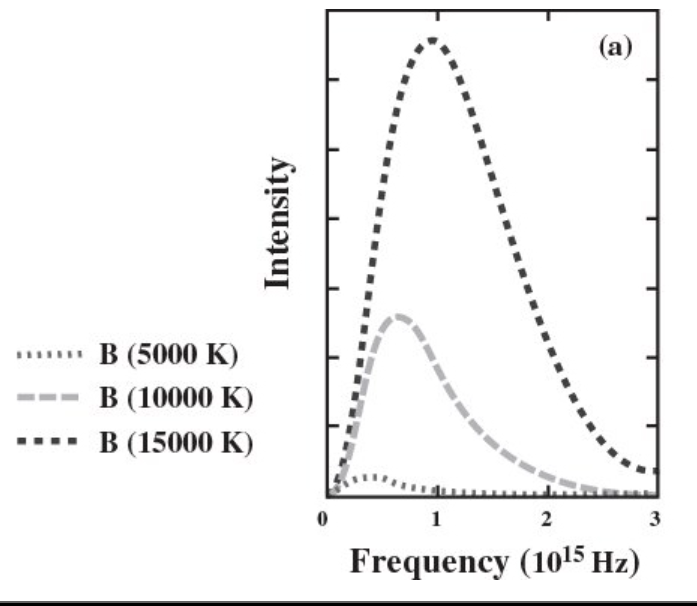
- The shift of the peak wavelength to higher frequency (shorter wavelength) at higher temperature.
- At any frequency, a hotter blackbody gives off more radiation than a cooler one.
- (a) Intensity as a function of frequency.
- The big change in intensity with only a factor of three change in temperature.
Wien’s displacement law:
The relationship between the wavelength at which the peak occurs, λmax, and temperature, T, is very simple. It is given by :
\[\lambda _{max}T=2.90\times10^{-1} cmK\]
Ultraviolet Catastophe:
When physicists tried to apply classical ideas of radiation, they could not derive blackbody spectra that agreed with the experimental results. The classical calculations yielded an intensity I(ν, T) given by Rayleigh–Jeans law:
\[I(\nu ,T)=2kT \nu^2/C^2\]
Where:
- The constant k is the Boltzmann constant (not Stefan–Boltzmann constant). Its value is 1.38 × 10⁻¹⁶ erg/K.
- The quantity kT is proportional to the kinetic energy per particle in the gas.
The Rayleigh–Jeans law agrees with experimental results at low frequencies (long wavelengths), but disagrees at high frequencies. The equation does not show a peak in the neighborhood of the the high frequencies despite the the experimental curves of the blackbody radiation. can see from equation (2.8) that, as we go to higher and higher frequencies, the energy given off becomes arbitrarily large. In blackbody curves there is a peak and then there is less energy at higher frequencies. This classical prediction of arbitrarily large energies at high frequencies was sometimes referred to as the “ultraviolet catastrophe”.
Planck’s Law:
Max Planck in aiming to solve the ultraviolet catastrophe tried to produce an empirical formula that accurately describes the experimental blackbody spectra:
\[I(\nu,T)=\frac {2h\nu ^3/c^2}{e^{h\nu /kT}-1}\]
Where:
- h is the Planck’s constant, which has the numerical value 6.63 × 10^–27 erg s. This value was determined to provide the best agreement with observed blackbody spectra.
Since the Rayleigh–Jeans law adequately describes blackbody spectra at low frequencies, the Planck law must reduce to the Rayleigh–Jeans law in the limit of low frequencies.
For low frequencies hν << kT (or equivalently hν/kT << 1). In that case, we can take advantage of the fact that for x<< 1, \(e^x\approx1+x \). The Planck equation then becomes:
\[I(\nu,T)\approx \frac {2h\nu^3}{c^2} \frac {kT}{h\nu}\]
\[I(\nu,T)=\frac {2kT \nu ^2}{c^2}\]
which is the Rayleigh–Jeans law.
Theoretical Approach of Quanta:
The Planck function accurately describes blackbody spectra, but it was originally presented as an empirical formula. There was still no theoretical understanding of the origin of the formula. Planck continued his work in an effort to derive the formula from some theory. Planck found that he could derive the formula from classical physics if he inserted a mathematical trick. The trick amounted to taking a sum rather than an integral. The trick corresponds to the physical statement that a blackbody can only emit radiation at a frequency ν in multiples of the quantity hν. That is, the energy could only be emitted in small bundles or quanta (singular quantum). The quanta have energy hν. Even though Planck was able to derive the blackbody formula correctly, he was still not satisfied. There was no justification for the restriction that energy must be quantized.
Planck’s Law (in term of wavelenghth):
\(\lambda \nu =c\) or \(\lambda =c/\nu\)
I(ν, T) gives the energy per second per frequency interval, whereas I(λ, T) gives the energy per second per wavelength interval. The functions must reflect that difference (especially since they will need different units). It therefore requires that:
\[I(\nu,T)d\nu =I(\lambda,T)d\lambda\]
So:
\[I(\lambda ,T)=I(\nu ,T) \frac {d\nu}{d\lambda}\]
But:
\[d\nu = - \frac {c}{\lambda ^2}d\lambda\]
\[\frac {d\nu}{d\lambda}=-\frac c{\lambda ^2}\]
The minus sign is neglectable, because it just indicates that frequency increases when wavelength decreases.
\[I(\lambda ,T)=I(\nu ,T) \frac {d\nu}{d\lambda}\]
\[I(\lambda,T)=\frac {2h\nu ^3/c^2}{e^{h\nu /kT}-1}\frac {c}{\lambda ^2}\]
\[I(\lambda,T)=\frac {2hc^2/\lambda ^5}{e^{hc /\lambda kT}-1}\]