A Nucleus
Lingual Usages
- The core, central part of something, around which other elements are assembled.
- An initial part or version that will receive additions.
- (chemistry, physics) The massive, positively charged central part of an atom, made up of protons and neutrons.
- (cytology) A large membrane-enclosed organelle found in eukaryotic cells which contains genetic material.
- (neuroanatomy) A ganglion, cluster of many neuronal bodies where synapsing occurs.
- (phonetics, phonology) The central part of a syllable, most commonly a vowel.Coordinate terms: onset, coda
PHYSICS
Nuclear Structure
The structure of atoms involves a nucleus composed of protons and neutrons, collectively referred to as nucleons.
The atomic number (Z) determines the element's identity.
The mass number (A) determines the number of the nucleons.
Stable elements generally have approximately equal numbers of protons and neutrons, with slightly more neutrons for larger Z values.
Forces in The nucleus
The strong nuclear force \(F_N\) is crucial for holding nuclei together. When protons are close, the attractive nuclear force dominates, counteracting the repulsive electric force \(F_E\) when they are far apart. The strong nuclear force is the same between protons, neutrons, and neutron-proton pairs.
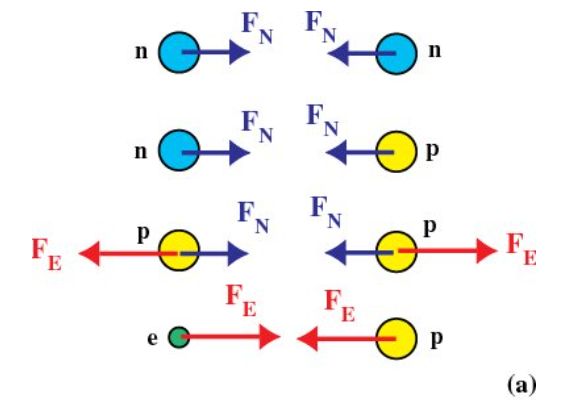
(a) The nuclear force, \(F_N\), is the same for a proton and a proton, a neutron and a neutron, or a proton and a neutron. The electrical force only acts between the proton and the proton. The magnitude of the electrical force is the same as that between a proton and an electron.
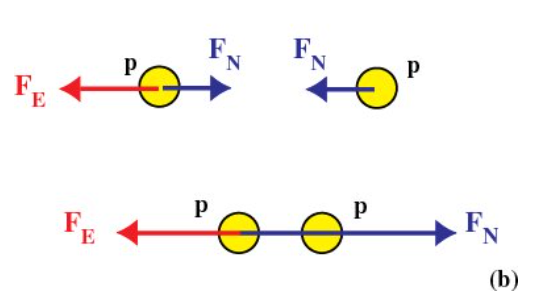
(b) How the forces vary with distance. As the two protons are brought closer together, the electric repulsion becomes stronger, but the nuclear attraction becomes stronger faster.
The presence of neutrons in a nucleus is crucial for stabilizing it. When only protons are present, the electric repulsion between them becomes significant, leading to an unstable nucleus. However, adding neutrons provides additional binding through the nuclear force without introducing further electric repulsion. In fact, the presence of neutrons helps reduce the electric repulsion, as they keep the protons farther apart. This understanding highlights the importance of having approximately equal numbers of neutrons and protons for a stable nucleus.
Binding energy
The binding energy of a nucleus, analogous to the binding energy of an atom, is the energy required to disassemble the nucleus by moving its nucleons apart against the attractive nuclear force.
Due to the strong nature of the nuclear force, its energy is measured in MeV. The greater the binding energy of a nucleus, the more stable it is, as a larger binding energy implies more work is needed to disassemble the nucleus.
Measurement of binding energies BE is often done by comparing the mass of a nucleus with the masses of its individual components, following Einstein's mass-energy equivalence (E = mc²) and conservation of energy.
\[M_{nucleus}c^2+BE=Zm_pc^2+Nm_nc^2\]
Where:
Z is the Atomic number
A is the mass number
\(N=A-Z\) (nucleon number)
\[M_{nucleus}+BE/c^2=Zm_p+Nm_n\]
\[M_{nucleus}-(Zm_p+Nm_n)=BE/c^2\]
This means that the mass of a nucleus is less than the masses of its components by \(BE/c^2\). This is also true for atoms. However, the binding energy for atoms is so small that the mass difference is negligible.
if \(M_{nucleus}-(Zm_p+Nm_n)=\Delta m\)
so:
\[BE=\Delta m\ c^2\]
Nuclear reactions
Nuclear reactions, which release energy, are essential for powering stars.
nuclear decay
involving the emission of particles, associated with changes in the nucleus's stability and energy states. There are three main types:
alpha decay
where an alpha particle (helium nucleus) is emitted, leading to a change in the element
beta decay
In beta decay, a neutron transforms into a proton, emitting a beta particle (electron or positron) and a neutrino \(\nu\)or antineutrino \(\bar \nu\). Neutrinos, nearly massless and electrically neutral particles, are also produced in this process, interacting through the weak nuclear force.
Beta decays are less frequent than strong interactions. Within nuclei, beta decay is allowed only if the resulting proton occupies a lower energy state than the original neutron, placing a limit on the stability of nuclei with a specific atomic number (Z) and number of neutrons. Excess neutrons may undergo beta decay to become protons in lower energy states.
The basic beta decay reaction is:
\[n\rightarrow p+e^-+\bar \nu\]
gamma decay
emitting a high-energy photon.
Nuclear Fission
Fission is a nuclear reaction where a heavy nucleus breaks into smaller parts. Controlled fission of uranium is utilized for energy production in nuclear power plants, while uncontrolled fission, as in uranium or plutonium, has been harnessed in atomic bombs. In fission, a very heavy nucleus splits into more stable, intermediate-mass nuclei, with iron being the most stable. The understanding and manipulation of fission reactions have implications for both energy generation and military applications.
Nuclear Fusion
Fusion is a nuclear reaction where lighter nuclei combine to form heavier nuclei. This process is crucial for energy generation in stars due to the abundance of lighter elements. However, initiating fusion on Earth presents challenges. When nuclei are far apart, the nuclear force is weak, and they primarily experience electrical repulsion. Overcoming this repulsion requires accelerating particles to high energies, facilitating collisions where nuclear forces dominate. While small-scale fusion can be achieved in particle accelerators, scaling up for practical energy production remains a significant challenge on Earth.
Overcoming the fusion barrier
To initiate nuclear fusion, particles need sufficient energy, often achieved through high temperatures. On Earth, containing a gas at the necessary tens of millions of kelvin poses challenges. However, in stars, gravity confines the material, allowing for the required high temperatures and nuclear reactions. Failure to reach these temperatures would prevent the establishment of a star. An estimate for the temperature needed for nuclear fusion involves considering the electric potential energy of two protons at a distance "r."
\[U=\frac{e^2}r\]
Sufficient Temerature
When starting with two protons far apart, their potential energy is assumed to be zero, and the kinetic energy (K) is introduced. The goal is to bring the particles to rest, positioned \(r_p\) (proton radius) apart. Conservation of energy dictates that the kinetic energy when the protons are far apart must be transformed into potential energy as they come together.
\[K=\frac{e^2}{r_p}\]
Dividing this by the Boltzmann constant, k:
\[K/k=\frac{e^2}{kr_p}\]
Its the estimate of the temperature at which the average kinetic energy of the particles in the gas is equal to this energy. Although this temperature is very high, it would be higher in case of nuclei with charges with nuclei with bigger atomic numbers, \(Z_1\), \(Z_2\) . The potential energy becomes: \(U=Z_1Z_2e^2/r\)
However, the actual temperature needed for fusion may be lower, as not all particles in a gas have average energy. Even at lower temperatures there will be some particles with a high enough energy to undergo fusion. For particles with a Maxwell–Boltzmann velocity distribution, the probability of finding a particle with an energy between E and E + dE is proportional to a term like the \(exp(—E/kT)\) in the Boltzmann equation. That is:
\[P(E)dE\propto E^{1/2}\ e^{—E/kT}dE\]
Turning Point
An additional factor enabling nuclear reactions at lower temperatures is the turning point effect. Despite the predominantly repulsive force between protons, it becomes attractive when they are in close proximity. If \(E_0\) represents the minimum energy needed to overcome Coulomb repulsion, particles with energies exceeding \(E_0\) can traverse the potential energy barrier. Classical physics indicates that particles with energies below \(E_0\) will reach a turning point, where their energy equals the barrier height at a distance \(r_0\), before reversing direction.
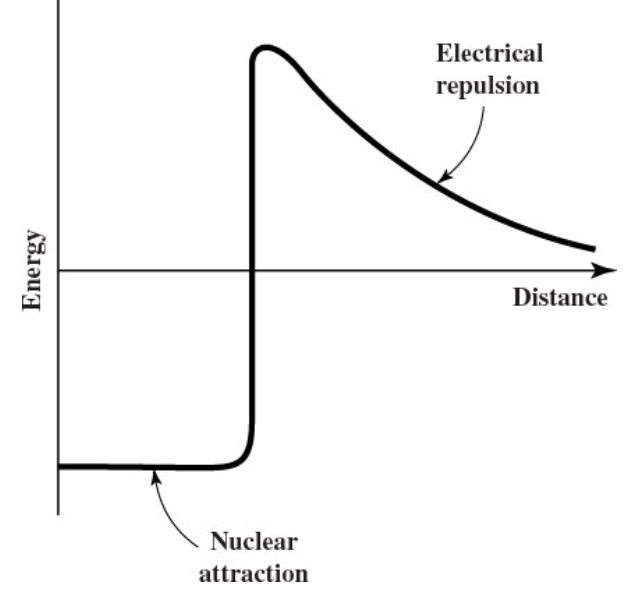
This turning point, where kinetic energy is zero, is referred to as the turning point.
Barrier Penetration or Tunneling
Quantum mechanically, considering the probability distribution of a particle, particularly one with energy less than \(E_0\), reveals that initially, the particle is likely to be found farther from the proton than the classical turning point. As the classical turning point is approached, the probability does not abruptly drop to zero due to its wave nature. Instead, as the particle enters the barrier, the probability gradually decreases. This implies that there is a chance of finding the particles closer together than the classical turning point, a phenomenon known as barrier penetration or tunneling. In general, a particle can penetrate a distance approximately equal to its wavelength, (h/mv).
More precisely, the probability of penetrating a distance x is related to the wavelength by:
\[P(x)dx\propto e^{-ax/\lambda}dx\]
\[P(x)dx\propto e^{-axmv/\lambda}dx\]
where a is some constant.
In the context of tunneling, let's consider tunneling a distance (x), which is equivalent to the classical turning point \(r_0\), where the initial kinetic energy equals the electrostatic potential energy at \(r_0\).
\[\frac 12 mv^2= \frac{Z_1Z_2\ e^2}{r_0}\]
substituting into \(P(x)dx\propto e^{-axmv/\lambda}dx\):
\[P(r_0)\propto e^{-aZ_1Z_2e^2/2h\nu}\]
\[P(r_0)\propto e^{-b/E^{1/2}}\]
where b is a constant. The effective area of the nucleus for a reaction is approximately \(λ^2\) and is proportional to 1/E.
Combining this with the Maxwell–Boltzmann velocity distribution, the probability of a reaction by nuclei of energy E is proportional to:
\[e^{(-E/kT-b/E^{1/2})}\]
At a given temperature ( T ), there exists a most likely energy E for nuclear reactions to occur, known as the Gamow peak. The majority of reactions involve particles with lower energies within the velocity distribution. These lower-energy particles, characterized by longer wavelengths, can penetrate deeper into the potential barrier. Additionally, the exponential nature of reaction rates makes them highly temperature-sensitive, meaning small temperature variations lead to significant changes in reaction rates.