Normal Stress
Structural Engineering
Normal stress is the stress that occurs when the internal resisting force acts perpendicular (at a 90-degree angle, or "normal") to the cross-sectional area of the material.
Because the force is acting straight into or straight away from the surface, it attempts to change the object's volume or length rather than its shape.
The formula for average normal stress is:
\[\sigma = \frac{P}{A}\]
Where:
- \(\sigma\) = Normal stress
- \(P\) = Axial internal force (perpendicular to the cross-section)
- \(A\) = Cross-sectional area
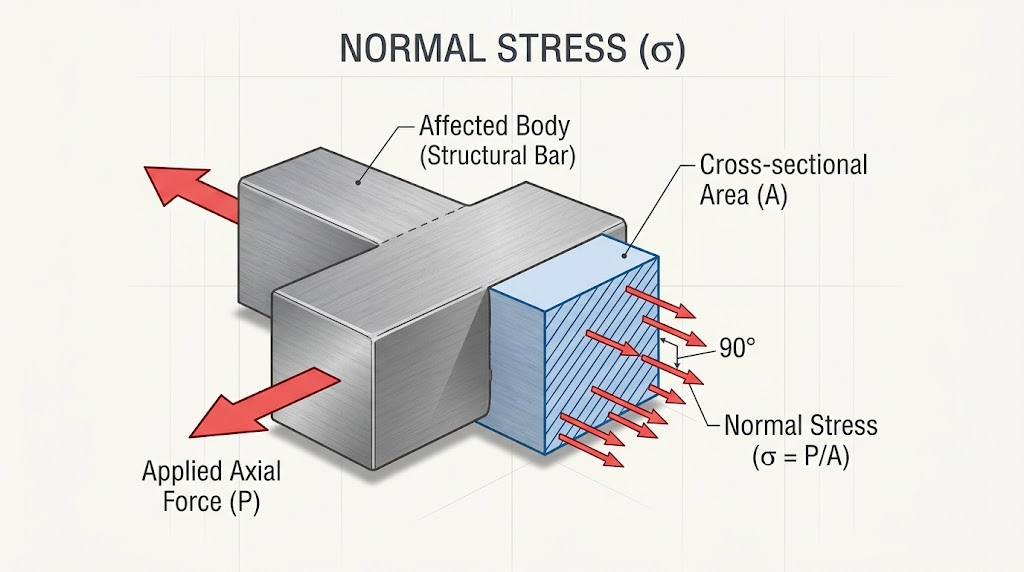
Normal stress is divided into two mutually exclusive types based on the direction of the perpendicular force:
- Tensile Stress (Tension): The forces pull away from the cross-section. This stretches the material, causing it to elongate in the direction of the applied force.
- Compressive Stress (Compression): The forces push directly into the cross-section. This crushes or squeezes the material, causing it to shorten in the direction of the applied force.
When an applied force \(P\) is inclined at an angle \(\theta\) from the normal axis of the cross-section, it no longer creates a single type of stress. The force vector must be resolved into two orthogonal components, inducing both normal and shear stresses on the material simultaneously.
- Normal Force Component (\(N\)): The portion of the force acting perpendicular to the cross-section.
\[N = P \cos(\theta)\]
This component induces Normal Stress (\(\sigma\)):
\[\sigma = \frac{P \cos(\theta)}{A}\]
- Shear Force Component (\(V\)): The portion of the force acting parallel to the cross-section.
\[V = P \sin(\theta)\]
This component induces Average Shear Stress (\(\tau\)):
\[\tau = \frac{P \sin(\theta)}{A}\]
Because the cross-section experiences both tension/compression and internal sliding forces at the same time, this combined stress state must often be analyzed using principal stresses or Mohr's Circle to ensure the structural member does not fail under the complex load.
Let the applied force be represented by the vector \(\vec{P}\) and the cross-section by the area vector \(\vec{A} = A \hat{N}\), where \(A\) is the scalar magnitude of the area (\(A = \vert{}\vec{A}\vert{}\)) and \(\hat{N}\) is the unit vector normal to the surface.
The component of the force vector acting strictly perpendicular to the cross-section is found by projecting \(\vec{P}\) onto the normal unit vector \(\hat{N}\). This is calculated using the dot product:
\[N = \vec{P} \cdot \hat{N} = \vert{}\vec{P}\vert{} \vert{}\hat{N}\vert{} \cos(\theta)\]
\[N = \vert{}\vec{P}\vert{} \cos(\theta)\]
The normal stress \(\sigma\) is the scalar value of this normal force component divided by the total scalar area of the cross-section:
\[\sigma = \frac{\vec{P} \cdot \hat{N}}{\vert{}\vec{A}\vert{}}\]
This vectorial formulation precisely matches the standard scalar equation for normal stress.
force is the flux, and stress is the field.
In structural engineering and continuum mechanics, this exact realization is the foundation for moving from simple 1D bar equations to full 3D structural analysis.
The vector logic can be expressed into the formal mathematics of continuum mechanics using Gauss's Theorem:
1. Stress as a Tensor Field (The Cauchy Stress Tensor)
Instead of a single scalar value \(\sigma\), stress in 3D space is represented by a second-order tensor, \(\boldsymbol{\sigma}\) (a \(3 \times 3\) matrix). This tensor describes the stress state at a single point in all directions.
When you want to find the force vector (called the traction vector, \(\vec{T}\)) acting on a specific slice of material, you take the dot product of the stress tensor and the unit normal vector \(\hat{n}\) of that surface:
\[\vec{T} = \boldsymbol{\sigma} \cdot \hat{n}\]
2. Force as the Flux of Stress
Flux is defined as the integral of a field over an area. If you integrate the traction vector over the entire surface area \(S\) of a structural body, you are calculating the "flux of the stress tensor," which equals the total surface force \(\vec{F}\) acting on that body:
\[\vec{F} = \oint_S (\boldsymbol{\sigma} \cdot \hat{n}) \, dA\]
Force is the integral (flux) of Stress over an Area.
3. Applying Gauss's Divergence Theorem
Gauss's Divergence Theorem allows you to convert the surface integral (the flux of stress) into a volume integral. In mechanics, this is mathematically expressed as:
\[\oint_S (\boldsymbol{\sigma} \cdot \hat{n}) \, dA = \int_V (\nabla \cdot \boldsymbol{\sigma}) \, dV\]
Where \(\nabla \cdot \boldsymbol{\sigma}\) is the divergence of the stress tensor.
Why this matters in Statics and Mechanics:
This equation is how structural analysis software (like the FEA tools used alongside CAD software) solves for equilibrium. According to Newton's Second Law for a body at rest (statics), the sum of the internal surface forces (stress flux) and external body forces (like gravity, \(\vec{b}\)) must equal zero.
By applying Gauss's theorem, engineers derive Cauchy's Equilibrium Equation:
\[\nabla \cdot \boldsymbol{\sigma} + \vec{b} = 0\]
By recognizing that stress acts as a field whose flux over a cross-section yields a force, you have essentially derived the core principle behind advanced solid mechanics.