Sabaic
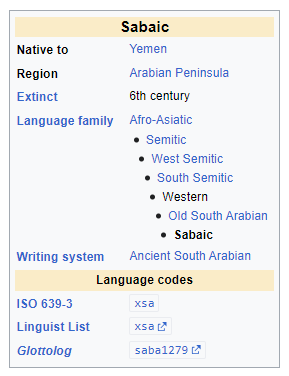
Sabaic, sometimes referred to as Sabaean, was an Old South Arabian language that was spoken between c. 1000 BC and the 6th century AD by the Sabaeans.
It was used as a written language by some other peoples of the ancient civilization of South Arabia, including the
Ḥashidites,
Ṣirwāḥites,
Humlanites,
Ghaymānites, and
Radmānites.[1]
Sabaic belongs to the South Arabian Semitic branch of the Afroasiatic language family.[2]
Sabaic is distinguished from the other members of the Old South Arabian group by its use of h to mark the third person and as a causative prefix; all of the other languages use s1 in those cases.
Therefore, Sabaic is called an h-language and the others s-languages.[3]
Script
Sabaic was written in the South Arabian alphabet, and like Hebrew and Arabic marked only consonants, the only indication of vowels being with matres lectionis.
For many years the only texts discovered were inscriptions in the formal Masnad script (Sabaic ms3nd), but in 1973 documents in another minuscule and cursive script were discovered, dating back to the second half of the 1st century BC; only a few of the latter have so far been published.[4]
The South Arabic alphabet used in Yemen, Eritrea, Djibouti, and Ethiopia beginning in the 8th century BC, in all three locations, later evolved into the still in use Ge'ez alphabet.
The Ge'ez language however is no longer considered to be a descendant of Sabaic or of Old South Arabian;[5] and there is linguistic evidence that Semitic languages were concurrently in use, being spoken in Eritrea and Ethiopia as early as 2000 BC.[6]
Sabaic is attested in some 1,040 dedicatory inscriptions, 850 building inscriptions, 200 legal texts, and 1300 short graffiti (containing only personal names).[7]
No literary texts of any length have yet been brought to light.
This paucity of source material and the limited forms of the inscriptions has made it difficult to get a complete picture of Sabaic grammar.
Thousands of inscriptions written in a cursive script (called Zabur) incised into wooden sticks have been found and date to the Middle Sabaic period; these represent letters and legal documents and as such includes a much wider variety of grammatical forms.