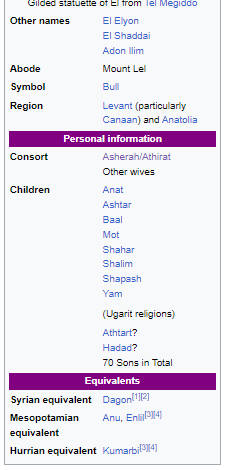
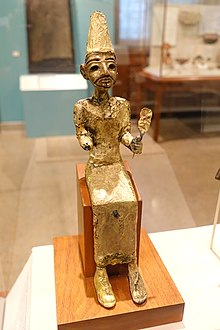
El, Egypitian Sky god
- El (deity), a Semitic word for "God"
Religion
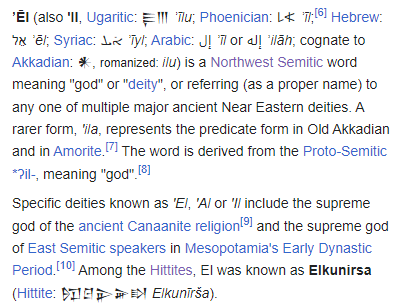
A rarer form, 'ila, represents the predicate form in Old Akkadian and in Amorite.[7]
The word is derived from the Proto-Semitic *ʔil-, meaning "god".[8]
Specific deities known as 'El, 'Al or 'Il include the supreme god of the ancient Canaanite religion[9] and the supreme god of East Semitic speakers in Mesopotamia's Early Dynastic Period.[10]
Among the Hittites, El was known as Elkunirsa
(Hittite: Elkunīrša).
Linguistic forms and meanings
Cognate forms of ʼĒl are found throughout the Semitic languages.
They include
Ugaritic ʾilu, pl. ʾlm;
Phoenician ʾl pl. ʾlm;
Hebrew ʾēl, pl. ʾēlîm;
Aramaic ʾl;
Akkadian ilu, pl. ilānu.
In northwest Semitic use, ʼĒl was a generic word for any god as well as the special name or title of a particular god who was distinguished from other gods as being "the god".[11]
ʼĒl is listed at the head of many pantheons.
In some Canaanite and Ugaritic sources, ʼĒl played a role as father of the gods, of creation, or both.[12]
However, because the word ʼĒl sometimes refers to a god other than the great god ʼĒl, it is frequently ambiguous as to whether ʼĒl followed by another name means the great god ʼĒl with a particular epithet applied or refers to another god entirely.
For example, in the Ugaritic texts, ʾil mlk is understood[13] to mean "ʼĒl the King" but ʾil hd as "the god Hadad".
The Semitic root ʾlh
Aramaic ʾAlāh, ʾElāh,
Hebrew ʾelōah)
may be ʾl with a parasitic h, and ʾl may be an abbreviated form of ʾlh.
In Ugaritic the plural form meaning "gods" is ʾilhm, equivalent to Hebrew ʾ^e^lōhîm "powers".
In the Hebrew texts this word is interpreted as being semantically singular for "god" by biblical commentators.[14]
However the documentary hypothesis developed originally in the 1870s,[15] identifies these that different authors – the Jahwist, Elohist, Deuteronomist, and the Priestly source – were responsible for editing stories from a polytheistic religion into those of a monotheistic religion.
Inconsistencies that arise between monotheism and polytheism in the texts are reflective of this hypothesis.
The stem ʾl is found prominently in the earliest strata of east Semitic, northwest Semitic, and south Semitic groups.
Personal names including the stem ʾl are found with similar patterns in both Amorite and Sabaic.[16]
Proto-Sinaitic, Phoenician, Aramaic, and Hittite texts
The Egyptian god Ptah is given the title ḏū gitti 'Lord of Gath' in a prism from Tel Lachish which has on its opposite face the name of Amenhotep II (c. 1435 – c. 1420 BCE).
The title ḏū gitti is also found in Serābitṭ text 353. Cross (1973, p. 19) points out that Ptah is often called the Lord (or one) of eternity and thinks it may be this identification of ʼĒl with Ptah that lead to the epithet 'olam 'eternal' being applied to ʼĒl so early and so consistently.[17]
(However, in the Ugaritic texts, Ptah is seemingly identified rather with the craftsman god Kothar-wa-Khasis.[18])
Yet another connection is seen with the Mandaean angel Ptahil, whose name combines both the terms Ptah and Il.[19]
In an inscription in the Proto-Sinaitic script, William F. Albright transcribed the phrase ʾL Ḏ ʿLM, which he translated as the appellation "El, (god) of eternity".[20]
The name Raphael or Rapha-El, meaning 'God has healed' in Ugarit, is attested to in approximately 1350 BCE in one of the Amarna Letters EA333, found in Tell-el-Hesi from the ruler of Lachish to 'The Great One' ^[21]
A Phoenician inscribed amulet of the seventh century BCE from Arslan Tash may refer to ʼĒl. The text was translated by Rosenthal (1969, p. 658) as follows:
An eternal bond has been established for us.
Ashshur has established (it) for us,
and all the divine beings
and the majority of the group of all the holy ones,
through the bond of heaven and earth for ever, ...[22]
However, Cross (1973, p. 17) translated the text as follows:
The Eternal One ('Olam) has made a covenant oath with us,
Asherah has made (a pact) with us.
And all the sons of El,
And the great council of all the Holy Ones.
With oaths of Heaven and Ancient Earth.[23]
In some inscriptions, the name 'Ēl qōne 'arṣ (Punic: ʾl qn ʾrṣ) meaning "ʼĒl creator of Earth" appears, even including a late inscription at Leptis Magna in Tripolitania dating to the second century.[24]
In Hittite texts, the expression becomes the single name Ilkunirsa, this Ilkunirsa appearing as the husband of Asherdu (Asherah) and father of 77 or 88 sons.[25]
In a Hurrian hymn to ʼĒl (published in Ugaritica V, text RS 24.278), he is called 'il brt and 'il dn, which Cross (p. 39) takes as 'ʼĒl of the covenant' and 'ʼĒl the judge' respectively.[26]