GRANT WOOD
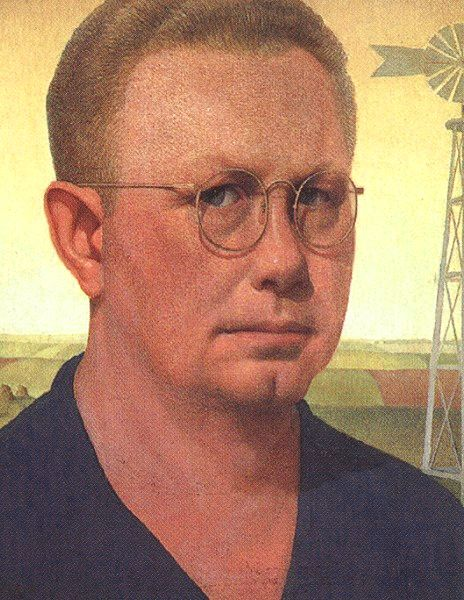
Grant DeVolson Wood (February 13, 1891 – February 12, 1942) was an American painter and representative of Regionalism, best known for his paintings depicting the rural American Midwest.
He is particularly well known for American Gothic (1930), which has become an iconic example of early 20th-century American art.[1]
Wood was born in rural Iowa, 4 mi (6.43 km) east of Anamosa, on February 13, 1891, the son of Hattie DeEtte Weaver Wood and Francis Maryville Wood.[3][4] His mother moved the family to Cedar Rapids after his father died in 1901. Soon thereafter, Wood began as an apprentice in a local metal shop. After graduating from Washington High School, Wood enrolled in The Handicraft Guild, an art school run entirely by women in Minneapolis in 1910.
In 1913, he enrolled at the School of the Art Institute of Chicago and performed some work as a silversmith.
From 1935 to 1938, Wood was married to Sara Sherman Maxon. Friends considered the marriage a mistake for Wood.[11]
Wood was a closeted homosexual. There was an unsuccessful attempt by a colleague, Lester Longman, to get him fired both on explicit moral grounds and for his advocacy of regionalism.[12]
Critic Janet Maslin states that his friends knew him to be "homosexual and a bit facetious in his masquerade as an overall-clad farm boy."[10] University administration dismissed the allegations and Wood would have returned as professor if not for his growing health problems.[13]

The First Three Degrees of Freemasonry – Grant Wood 1921
Wood was an avid Freemason and Member of Mount Hermon Lodge #263[14] in Cedar Rapids, Iowa. After receiving his 3rd Degree of Master Mason he painted The First Three Degrees of Freemasonry in 1921.[15]
On the eve of his 51st birthday, Wood died at Iowa City university hospital of pancreatic cancer.[16]
He is buried at Riverside Cemetery, Anamosa, Iowa.[17]
[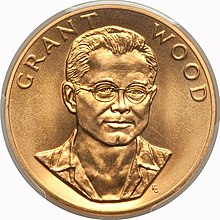 ]
1980 Grant Wood one-ounce American Arts Commemorative Series gold medallion
When Wood died, his estate went to his sister, Nan Wood Graham, the woman portrayed in American Gothic.
When she died in 1990, her estate, along with Wood's personal effects and various works of art, became the property of the Figge Art Museum in Davenport, Iowa.
The World War II Liberty Ship SS *Grant Wood* was named in his honor.
In 2009, Grant was awarded the Iowa Prize, the state's highest citizen honor.[18]
Grant Wood Area Education Agency, one of Iowa's nine regional Area Education Agencies established in 1974, which serves Eastern Iowa, was named after Wood.[19]
Wood is associated with the American movement of Regionalism, which was primarily situated in the Midwest, and advanced figurative painting of rural American themes in an aggressive rejection of European abstraction.[20]
Wood was one of three artists most associated with the movement.
The others, John Steuart Curry and Thomas Hart Benton, returned to the Midwest in the 1930s due to Wood's encouragement and assistance with locating teaching positions for them at colleges in Wisconsin and Missouri, respectively.
Along with Benton, Curry, and other Regionalist artists, Wood's work was marketed through Associated American Artists in New York for many years.
Wood is considered the patron artist of Cedar Rapids, and his childhood country school is depicted on the 2004 Iowa State Quarter.