REGIONALISM
American Regionalism is an American realist modern art movement that included paintings, murals, lithographs, and illustrations depicting realistic scenes of rural and small-town America primarily in the Midwest.
It arose in the 1930s as a response to the Great Depression, and ended in the 1940s due to the end of World War II and a lack of development within the movement.
It reached its height of popularity from 1930 to 1935, as it was widely appreciated for its reassuring images of the American heartland during the Great Depression.[1]
Despite major stylistic differences between specific artists, Regionalist art in general was in a relatively conservative and traditionalist style that appealed to popular American sensibilities, while strictly opposing the perceived domination of French art.[2]
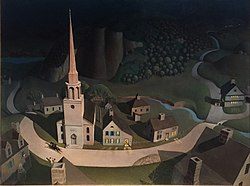
The Midnight Ride of Paul Revere (1931)
by Grant Wood, Metropolitan Museum of Art, New York City, NY
Decline
When World War II ended, Regionalism and Social Realism lost status in the art world.
The end of World War II ushered in a new era of peace and prosperity, and the Cold War brought a change in the political perception of Americans and allowed Modernist critics to gain power.
Regionalism and Social Realism also lost popularity among American viewers due to a lack of development within the movement due to the tight constraints of the art to agrarian subject matter.
Ultimately, this led to abstract expressionism winning out the title of American Modernism, and becoming the new prominent and popular artistic movement.[11]