Ugarit
Ugarit (/juːˈɡɑːrɪt, uː-/;[1] Ugaritic: , ʾUgarītu) was an ancient port city in northern Syria, in the outskirts of modern Latakia, discovered by accident in 1928 with the Ugaritic texts.[2]
Its ruins are often called Ras Shamra after the headland where they lie.
Ugarit had close connections to the Hittite Empire, sent tribute to Egypt at times, and maintained trade and diplomatic connections with Cyprus (then called Alashiya),[3][4] documented in the archives recovered from the site and corroborated by Mycenaean and Cypriot pottery found there.
The polity was at its height from c. 1450 BC until its destruction in c. 1185 BC;[5] this destruction was possibly caused by the purported Sea Peoples, or an internal struggle.
The kingdom would be one of the many dismantled during the Bronze Age Collapse.
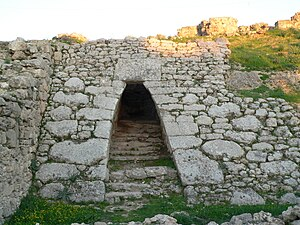
Entrance to the Royal Palace of Ugarit
History
Ras Shamra lies on the Mediterranean coast, some 11 kilometres (7 mi) north of Latakia, near modern Burj al-Qasab.
Origins and the second millennium
[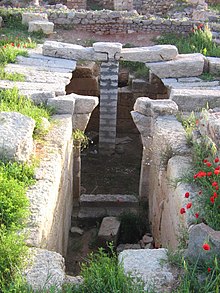 ]
A tomb in the Royal palace's courtyard
Neolithic Ugarit was important enough to be fortified with a wall early on, perhaps by 6000 BC, though the site is thought to have been inhabited earlier. Ugarit was important perhaps because it was both a port and at the entrance of the inland trade route to the Euphrates and Tigris lands.
The city reached its heyday between 1800 and 1200 BC, when it ruled a trade-based coastal kingdom, trading with Egypt, Cyprus, the Aegean, Syria, the Hittites, and much of the eastern Mediterranean.[6]
The first written evidence mentioning the city comes from the nearby city of Ebla, c. 1800 BC. Ugarit passed into the sphere of influence of Egypt, which deeply influenced its art. Evidence of the earliest Ugaritic contact with Egypt (and the first exact dating of Ugaritic civilization) comes from a carnelian bead identified with the Middle Kingdom pharaoh Senusret I, 1971–1926 BC. A stela and a statuette from the Egyptian pharaohs Senusret III and Amenemhet III have also been found. However, it is unclear at what time these monuments were brought to Ugarit. Amarna letters from Ugarit c. 1350 BC record one letter each from Ammittamru I, Niqmaddu II, and his queen.[citation ^needed] From the 16th to the 13th century BC, Ugarit remained in regular contact with Egypt and Alashiya (Cyprus).[citation ^needed]
In the second millennium BC, Ugarit's population was Amorite, and the Ugaritic language probably has a direct Amoritic origin.[7] The kingdom of Ugarit may have controlled about 2,000 km2 on average.[7]
During some of its history it would have been in close proximity to, if not directly within, the Hittite Empire.