Sumer
Origins
Most historians have suggested that Sumer was first permanently settled between c. 5500 – c. 3300 BC by a West Asian people who spoke the Sumerian language (pointing to the names of cities, rivers, basic occupations, etc., as evidence), a non-Semitic and non-Indo-European agglutinative language isolate.[16][17][18][19][20]
Name
Sumerians
[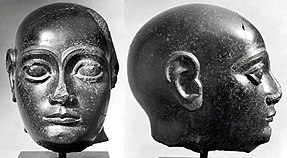 ]
The term "Sumer" (Akkadian: šumeru)[5] comes from the Akkadian name for the "Sumerians", the ancient non-Semitic-speaking inhabitants of southern Mesopotamia.[6][7][8][citation ^needed] In their inscriptions, the Sumerians called their land "Kengir", the 'Country of the noble lords' (Sum:, k-en-gi(-r), lit. 'country' + 'lords' + 'noble'), and their language "Emegi" (Sum: eme-gi or eme-g̃ir15).[6][9][10]
The origin of the Sumerians is not known, but the people of Sumer referred to themselves as "Black Headed Ones" or "Black-Headed People"[6][11][12][13] (, sag̃-gíg, lit. 'head' + 'black', or , sag̃-gíg-ga phonetically /saŋ ɡi ɡa/, lit. 'head' + 'black' + relative marker).[1][2][3][4]
For example, the Sumerian king Shulgi described himself as "the king of the four quarters, the pastor of the black-headed people".[14]
The Akkadians also called the Sumerians 'black-headed people', or ṣalmat-qaqqadi, in the Semitic Akkadian language.[2][3]
The Akkadians, the East Semitic-speaking people who later conquered the Sumerian city-states, gave Sumer its main historical name, but the phonological development of the term šumerû is uncertain.[15]
Hebrew שִׁנְעָר Šinʿar,
Egyptian Sngr, and
Hittite Šanhar(a),
all referring to southern Mesopotamia, could be western variants of Sumer.[15]
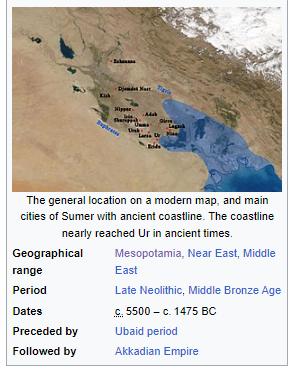
Sumer (/ˈsuːmər/) is the earliest known civilization in the historical region of southern Mesopotamia (now south-central Iraq), emerging during the Chalcolithic and early Bronze Ages between the sixth and fifth millennium BC.
Like nearby Elam, it is one of the cradles of civilization, along with Egypt, the Indus Valley, China, Caral-Supe, and Mesoamerica.
Living along the valleys of the Tigris and Euphrates rivers, Sumerian farmers grew an abundance of grain and other crops, a surplus which enabled them to form urban settlements.
The world's earliest known texts come from the Sumerian cities of Uruk and Jemdet Nasr, and date to between c. 3350 – c. 2500 BC, following a period of proto-writing c. 4000 – c. 2500 BC.