Ur
After the collapse of the Akkadian Empire, the south Mesopotamian region was dominated by the Gutian people for a few decades before the rise of the Third Dynasty of Ur, which encompassed the whole of Mesopotamia, including the town of Babylon.
Ur (/ʊər/; Sumerian: Akkadian: Uru;[2] Arabic: أُوْر, romanized: ʾūr; Hebrew: אוּר, romanized: ʾūr)
was an important Sumerian city-state in ancient Mesopotamia, located at the site of modern Tell el-Muqayyar (Arabic: تل ٱلْمُقَيَّر) in south Iraq's Dhi Qar Governorate in Mesopotamia.[3]
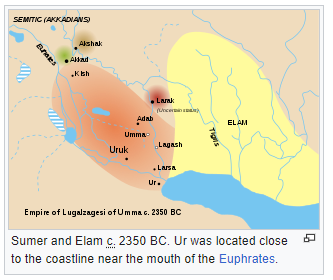
Although Ur was once a coastal city near the mouth of the Euphrates on the Persian Gulf, the coastline has shifted and the city is now well inland, on the south bank of the Euphrates, 16 km (10 mi) from Nasiriyah in modern-day Iraq.[4]
The city dates from the Ubaid period circa 3800 BC, and is recorded in written history as a city-state from the 26th century BC, its first recorded king being Mesannepada.
The city's patron deity was
the Sumerian and Akkadian moon god, and the name of the city is in origin derived from the god's name, UNUGKI, literally "the abode (UNUG) of Nanna".[4]
The site is marked by the partially restored ruins of the Ziggurat of Ur, which contained the shrine of Nanna, excavated in the 1930s.
The temple was built in the 21st century BC (short chronology), during the reign of Ur-Nammu and was reconstructed in the 6th century BC by Nabonidus, the last king of Babylon.
The ruins cover an area of 1,200 metres (3,900 ft) northwest to southeast by 800 metres (2,600 ft) northeast to southwest and rise up to about 20 metres (66 ft) above the present plain level.[5]
The city, said to have been planned by Ur-Nammu, was apparently divided into neighbourhoods, with merchants living in one quarter, artisans in another.
There were streets both wide and narrow, and open spaces for gatherings.
Many structures for water resource management and flood control are in evidence.
Houses were constructed from mudbricks and mud plaster. In major buildings, the masonry was strengthened with bitumen and reeds.
For the most part, foundations are all that remain today.
People were often buried (separately and alone; sometimes with jewellery, pots, and weapons) in chambers or shafts beneath the house floors.[6]

The name URIM5KI for "Country of Ur" on a seal of King Ur-Nammu
Ur was surrounded by sloping ramparts 8 metres (26 feet) high and about 25 metres (82 feet) wide, bordered in some places by a brick wall.
Elsewhere, buildings were integrated into the ramparts.
The Euphrates River complemented these fortifications on the city's western side.[6]
Archaeological discoveries have shown unequivocally that Ur was a major Sumerian urban center on the Mesopotamian plain.
Especially the discovery of the Royal Tombs has confirmed its splendour.
These tombs, which date to the Early Dynastic IIIa period (approximately in the 25th or 24th century BC), contained an immense treasure of luxury items made of precious metals and semi-precious stones imported from long distances (Ancient Iran, Afghanistan, India, Asia Minor, the Levant and the Persian Gulf).[5]
This wealth, unparalleled up to then, is a testimony of Ur's economic importance during the Early Bronze Age.[7]
Archaeological study of the region has contributed greatly to our understanding of the landscape and long-distance interactions during these ancient times.
Ur was a major port on the Persian Gulf, which extended much farther inland than today, and the city controlled much of the trade into Mesopotamia.
Imports to Ur came from many parts of the world: precious metals such as gold and silver, and semi-precious stones, namely lapis lazuli and carnelian.[6]
It is thought that Ur had a stratified social system including slaves (captured foreigners), farmers, artisans, doctors, scribes, and priests.
High-ranking priests apparently enjoyed great luxury and splendid mansions.
Tens of thousands of cuneiform texts have been recovered from temples, the palace, and individual houses, recording contracts, inventories, and court documents, evidence of the city's complex economic and legal systems.[6]
[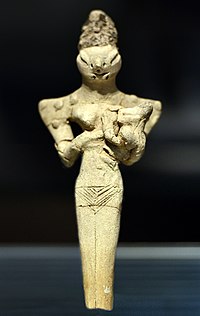
Lizard-headed nude woman nursing a child, from Ur, Ubaid period, c. 4500–4000 BC; Iraq Museum

Enthroned King Ur-Nammu (c. 2047–2030 BC)
Excavation in the old city of Ur in 1929 revealed the Lyres of Ur, instruments similar to the modern harp but in the shape of a bull and with eleven strings.[8]