Hephaestus, parthenogenesis
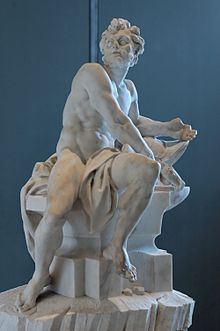
Hephaestus at the Forge by Guillaume Coustou the Younger (Louvre)
| God of fire, volcanoes, metalworking, artisans, metallurgy, carpenters, forges, sculpting, and blacksmiths |
|---|
| Member of the Twelve Olympians |
Hephaestus (/hɪˈfiːstəs, hɪˈfɛstəs/; eight spellings; Greek: Ἥφαιστος, translit. Hḗphaistos) is the Greek god of artisans, blacksmiths, carpenters, craftsmen, fire, metallurgy, metalworking, sculpture and volcanoes.[1] Hephaestus's Roman counterpart is Vulcan. In Greek mythology, Hephaestus was either the son of Zeus and Hera or he was Hera's parthenogenous child.
He was cast off Mount Olympus by his mother Hera because of his lameness, the result of a congenital impairment; or in another account, by Zeus for protecting Hera from his advances (in which case his lameness would have been the result of his fall rather than the reason for it).[2][3][4]
As a smithing god, Hephaestus made all the weapons of the gods in Olympus. He served as the blacksmith of the gods, and was worshipped in the manufacturing and industrial centres of Greece, particularly Athens. The cult of Hephaestus was based in Lemnos.[1] Hephaestus's symbols are a smith's hammer, anvil, and a pair of tongs.
Parentage
- According to Homer (Iliad, I 571-577), Hera is mentioned as the mother of Hephaestus but there is not sufficient evidence to say that Zeus was his father (although he refers to him in such way).
- According to Homer (Odyssey, VIII 306), there is not sufficient evidence to say that Zeus was the father of Hephaestus (although he refers to him in such way). Hera is not mentioned as the mother.
- According to Hesiod (Theogony, 927-928), Hera gave birth to Hephaestus on her own as revenge for Zeus giving birth to Athena without her (Zeus lay with Metis).
- According to Pseudo-Apollodorus (Bibliotheca, 1.3.6), Hera gave birth to Hephaestus alone. Pseudo-Apollodorus also relates that, according to Homer, Hephaestus is one of the children of Zeus and Hera (consciously contradicting Hesiod and Homer).
- Several later texts follow Hesiod's account, including Hyginus and the preface to Fabulae.
In the account of Attic vase painters, Hephaestus was present at the birth of Athena and wields the axe with which he split Zeus' head to free her. In the latter account, Hephaestus is there represented as older than Athena, so the mythology of Hephaestus is inconsistent in this respect.