AYIN
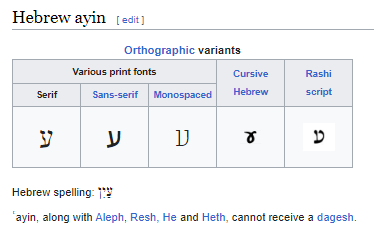
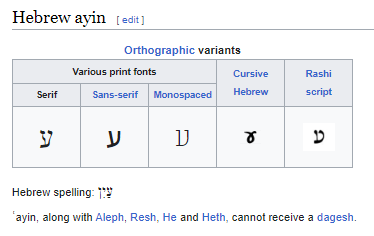
Ayin (also ayn or ain; transliterated ⟨ʿ⟩) is the sixteenth letter of the Semitic scripts, including Phoenician ʿayin 𐤏, Hebrew ʿayin ע, Aramaic ʿē 𐡏, Syriac ʿē ܥ, and Arabic ʿayn ع (where it is sixteenth in abjadi order only).[note ^1]
The letter represents a voiced pharyngeal fricative (/ʕ/) or a similarly articulated consonant. In some Semitic languages and dialects, the phonetic value of the letter has changed, or the phoneme has been lost altogether (thus, in the revived Modern Hebrew it is reduced to a glottal stop or is omitted entirely in part due to European influence).
The Phoenician letter is the origin of the Greek, Latin and Cyrillic letter O, O and O.
It is also the origin of letter Ƹ.
Origins
The letter name is derived from Proto-Semitic *ʿayn- "eye", and the Phoenician letter had the shape of a circle or oval, clearly representing an eye, perhaps ultimately (via Proto-Sinaitic) derived from the ı͗r* hieroglyph (Gardiner D4).[1]
The Phoenician letter gave rise to the Greek Ο, Latin O, and Cyrillic О, all representing vowels.
The sound represented by ayin is common to much of the Afroasiatic language family, such as in the Egyptian language, the Cushitic languages and the Semitic languages.
Significance
In gematria, ʿayin represents the number 70.
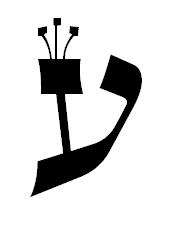
ʿayin is also one of the seven letters which receive special crowns (called tagin) when written in a sefer Torah.