Cellulitis
VIDEO:
Overview
What is Cellulitis?
Cellulitis & Soft Tissue Infections
Bacterial Skin Infection - Cellulitis and Erysipelas (Clinical Presentation, Pathology, Treatment)
9 Home Remedies for Cellulitis | Bacterial Skin Infection
Erysipelas vs Cellulitis | Group A ß-hemolytic Streptococcus | Microbiology 🧫 & Infectious Diseases🦠
Clinical Case
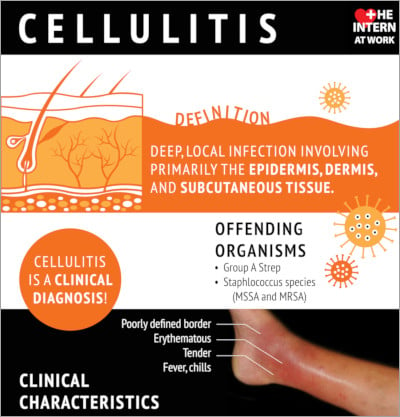
Erythematous, spreading skin infections affecting the epidermis and dermis. It usually shows up on the lower leg, such as the tibia. Its classically in patients with risk factors such as diabetes.
In children it can show up around the eye. This is called periorbital cellulitis.
Excludes infections with underlying purulent collections such as cutaneous abscess, necrotizing infections, septic arthritis and osteomyelitis. In other words, these infections do not require drainage or surgical intervention for cure.
Physicians often use the terms erysipelas and cellulitis interchangeably because they may be difficult to distinguish from each other based on clinical exam. They do represent distinct entities.
Erysipelas: Lesions are raised above the level of surrounding skin; well-demarcated between involved and uninvolved tissue, erythematous lesions involving the upper dermis and superficial lymphatics. It has the cardinal signs of inflammation (warmth, redness, tenderness, swelling)
Cellulitis: Because it’s a deeper infection than erysipelas, the lesion is more flat, slightly less demarcated erythema involving the deeper dermis and subcutaneous fat. It has the cardinal signs of inflammation (warmth, redness, tenderness, swelling)
Both lesions are usually warm and edematous because of the underlying inflammatory state.
Cellulitis The bacterium such as streptococcus, staphylococcus, clostridium, hemophilus influenzae and pneumococcus causes this skin disorder in people of all ages and races.
Other possible infective organisms:
- Sporotrichosis (sphagnum moss)
- Nocardia brasiliensis
- Mycobacterium marinum, chelonei, fortuitum
- Francesella tularensis
- Leishmania braziliensis
Limit movement of the affected part since increased movement can cause the infection to spread.
To differentiate it from necrotizing fasciitis, when you press on the skin if you hear a crackling or popping sensation it may represent a subcutaneous gas produced by the infecting bacteria. If the patient looks very toxic there could be necrotizing fasciitis developing below the surface and they should be treated for it and/or septic shock. A surgeon may need to open the area to check for narcotizing fasciitis.
Rule out osteomyelitis (infection of the bone), usually a significant wound is present if the patient is at risk for osteomyelitis.
Risk Factors
- Obesity, associated with increased venous congestion, excess skin folds which may not be adequately cleaned
- Edema
- Prior radiation therapy
- Hospitalization (a risk for MRSA cellulitis)
- Diabetes
- Intravenous Drug Abusers
- Immunodeficiency
- Nail fungus
- Tinea pedis or other fungal infections
- Ulcers/wounds
- Chronic skin disorders
- Venous stasis
- Trauma
Diagnosis of Erysipelas & Cellulitis
- Most often a clinical diagnosis based on history and exam findings
- Pain, erythema, warmth, edema of affected area
- Fever, regional adenopathy may occur
- Blood cultures are done if the patient is systemically ill, but positive in less than 5%
- Cultures of the skin itself are also rarely useful because of cross-contamination with superficial skin flora.
- Anti-streptolysin O titers (group A strep infection) not usually performed
- Imaging to exclude other processes if diagnosis uncertain to exclude such entities as DPS thrombosis or search for an underlying abscess or osteomyelitis
Conventional Treatment of Erysipelas and Cellulitis
- One of the most important parts of therapy is to elevate the affected body part if possible.
- Since strep species are the most common cause of non-purulent cellulitis, patients who are otherwise clinically well can be treated with an oral beta-lactam antibiotic (conventional medicine). Or, if penicillin allergic, clindamycin.
- Purulent cellulitis or risk for MRSA: standard drugs are clindamycin, doxycycline, trimethoprim-sulfamthoxazole
- Systemically ill: may require hospital admission, IV antibiotics
- If not improving; consider MRSA, other non-strep etiologies
Important to identify all areas affected. Take a marker and draw around the border to see if its improving or worsening.
Goldenseal; mix into a paste and apply directly on the affected skin.
Calendula, powdered and made into a paste to apply to skin, also drink the infusion
5% dilution of Rosemary and Fennel essential oil rubbed daily into the skin.
Dilute tea tree oil and apply to skin 3 times a day.
It has to be powdered and made in the form of paste, which has to be applied on the infected skin. This treatment will increase the look and health of skin by reversing the bacterial action. - See more here
Drink plenty of water to flush bacteria out of body.
Take 3 drops of oregano oil mixed with 1 tsp pf coconut oil and 1 tsp of honey - 5 times a day for the first 3-4 days then - maintenance dose- of 3 times a day for a week+ Also rub the area with a mix of coconut oil and oregano oil 4 times a day+ Morning and night do clay poultices+ once a day turmeric poultice, lots of water and ginger tea and a cup of milk with 1 spoon of turmeric at night
The powders could be mixed into coconut oil, adding a little iodine may be useful too. Apply.
Make a tumeric/coconut oil/black pepper blend to take orally and apply. Mix 1 oz good organic turmeric into a cup of coconut oil and 1-2 tbs freshly ground black pepper...cook, stirring for 8 minutes on low heat. It will separate when cool, just mix it up as best you can. Take a 1 tsp 3 times a day and apply as a paste on the skin. Or, use the turmeric cocktail.
Manuka honey, 16+ applied topically, take internally as well.
Amla, if using the organic powder you can start with 2 tsp three times a day after meals
Serrapeptase, 80,000 a day. If there are ulcers, you can use a quality colloidal silver topically.
It has to be powdered and made in the form of paste, which has to be applied on the infected skin. This treatment will increase the look and health of skin by reversing the bacterial action. - See more here
The following supplements may strengthen the immune system and help skin heal:
Vitamin C. ...
Vitamin E.
Zinc.
Probiotic supplement (containing Lactobacillus acidophilus ). (Source)
NAC may help break up biofilms
Natural Treatments for Cellulitis
Articles/Studies
- NAC for Persistent Infections
- Successful treatment of refractory edema with traditional herbal medicine: A case report.
- Potential role of bromelain in clinical and therapeutic applications Combined bromelain and antibiotic therapy was shown to be more effective than antibiotics alone in pneumonia, bronchitis, cutaneous Staphylococcus infection, thrombophlebitis, cellulitis, pyelonephritis, and in perirectal and rectal abscesses
- Antibiotic Potentiation
Bromelain can enhance tissue permeability and absorption of antibiotics after being administered orally, subcutaneously, or intramuscularly. In humans, bromelain raises levels of antibiotics in urine and blood. After bromelain is administered, higher blood and tissue levels of amoxicillin and tetracycline can be observed [100]. As a result, higher serum and tissue levels of the drug can be maintained. Thus, bromelain potentiates the efficiency of antibiotics and lessens side effects [101]. Diseases like pyelonephritis, cutaneous Staphylococcus infection, rectal abscesses, sinusitis, cellulitis, bronchitis, pneumonia, and thrombophlebitis can be more quickly treated by using bromelain and antibiotic therapy concurrently. Bromelain vastly increases the efficacy of antibiotics in a variety of conditions.
- Effectiveness and safety of Liuhedan for treating cellulitis: A protocol for systematic review and meta-analysis.
- Cellulitis in aged persons: a neglected infection in the literature.
- Warmer Weather as a Risk Factor for Cellulitis: A Population-based Investigation.
- An Update on the Treatment and Management of Cellulitis.
- Antibiotic treatment for 6 days versus 12 days in patients with severe cellulitis: a multicentre randomized, double-blind, placebo-controlled, non-inferiority trial.
- Interventions for the prevention of recurrent erysipelas and cellulitis.
- COVID Arm: Delayed Hypersensitivity Reactions to SARS-CoV-2 Vaccines Misdiagnosed as Cellulitis.
- Incidence of Cellulitis Following Acupuncture Treatments in Taiwan.
- 2019- Analysis of Readmissions Following Hospitalization for Cellulitis in the United States.
- Clinical Characteristics and Outcomes of Patients With Cellulitis Requiring Intensive Care.
- Hippophae rhamnoides mediate gene expression profiles against keratinocytes infection of Staphylococcus aureus.