Subacute Thyroiditis

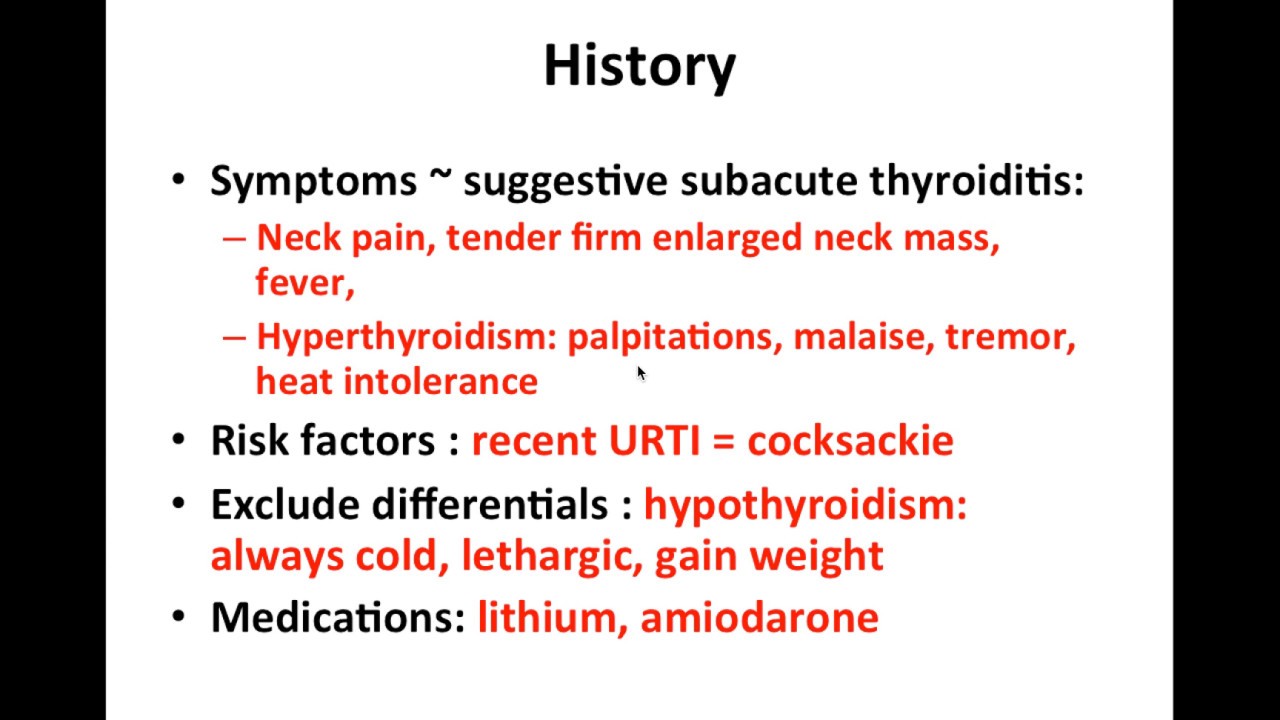
Diagnosed with subacute thyroiditis:

Subacute thyroiditis is an acute inflammatory disease of the thyroid probably caused by a virus. Symptoms include fever and thyroid tenderness. Initial hyperthyroidism is common, sometimes followed by a transient period of hypothyroidism. Diagnosis is clinical and with thyroid function tests. Treatment is with high doses of NSAIDs or with corticosteroids. The disease usually resolves spontaneously within months.
History of an antecedent viral URI is common. Histologic studies show less lymphocytic infiltration of the thyroid than in Hashimoto thyroiditis or silent lymphocytic thyroiditis, but there is characteristic giant cell infiltration, polymorphonuclear lymphocytes, and follicular disruption.
Subacute thyroiditis post-Pfizer-BioNTech mRNA vaccination for COVID-19.
Symptoms and Signs
There is pain in the anterior neck and fever of 37.8° to 38.3° C. Neck pain characteristically shifts from side to side and may settle in one area, frequently radiating to the jaw and ears. It is often confused with dental pain, pharyngitis, or otitis and is aggravated by swallowing or turning of the head. Symptoms of hyperthyroidism are common early in the disease because of hormone release from the disrupted follicles. There is more lassitude and prostration than in other thyroid disorders. On physical examination, the thyroid is asymmetrically enlarged, firm, and tender.
Diagnosis
- Clinical findings
- Free thyroxine (T4) and thyroid-stimulating hormone (TSH) levels
- ESR
- Radioactive iodine uptake
Diagnosis is primarily clinical, based on finding an enlarged, tender thyroid in patients with the appropriate clinical history. Thyroid testing with TSH and at least a free T4 measurement is usually also done. Radioactive iodine uptake should be measured to confirm the diagnosis. When the diagnosis is uncertain, fine-needle aspiration biopsy is useful. Thyroid ultrasonography with color Doppler shows multiple irregular sonolucent areas and reduced blood flow in contrast with the increased flow of Graves disease.
Laboratory findings early in the disease include an increase in free T4 and triiodothyronine (T3), a marked decrease in TSH and thyroid radioactive iodine uptake (often 0), and a high ESR. After several weeks, the thyroid is depleted of T4 and T3 stores, and transient hypothyroidism develops accompanied by a decrease in free T4 and T3, a rise in TSH, and recovery of thyroid radioactive iodine uptake. Weakly positive thyroid antibodies may be present. Measurement of free T4, T3, and TSH at 2- to 4-wk intervals identifies the stages of the disease.
Prognosis
Subacute thyroiditis is self-limited, generally subsiding in a few months; occasionally, it recurs and may result in permanent hypothyroidism when follicular destruction is extensive.