Duodenum
Return to Digestive System Menu
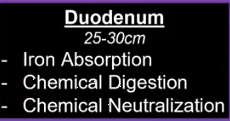
The duodenum is the part of the digestive tract where most digestion occurs. It consists of different parts:
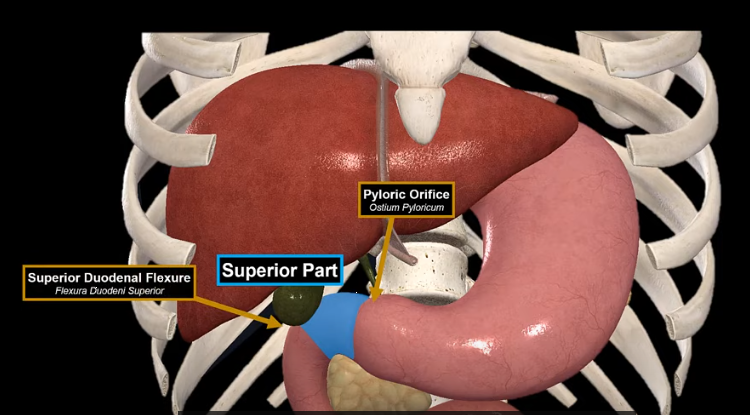
Superior part (in green) starts at the pyloric orifice or ostium pyloricum
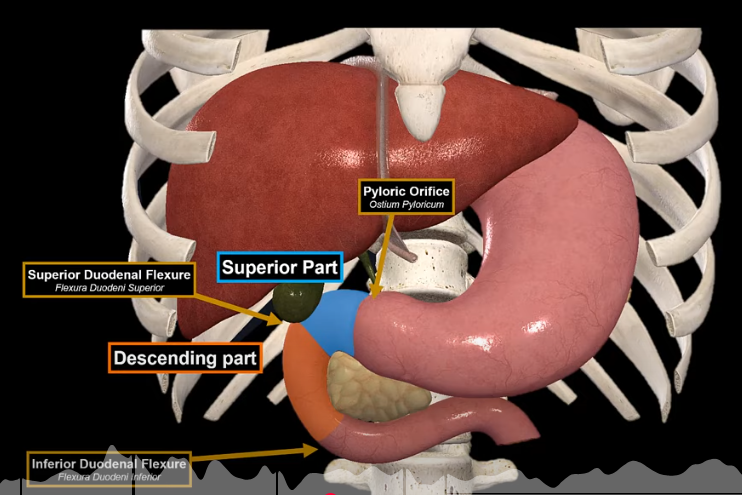
When the duodenum bends, the next part begins, the descending part which ends with the inferior duodenal flexure , or Flexura Duodeni Inferior
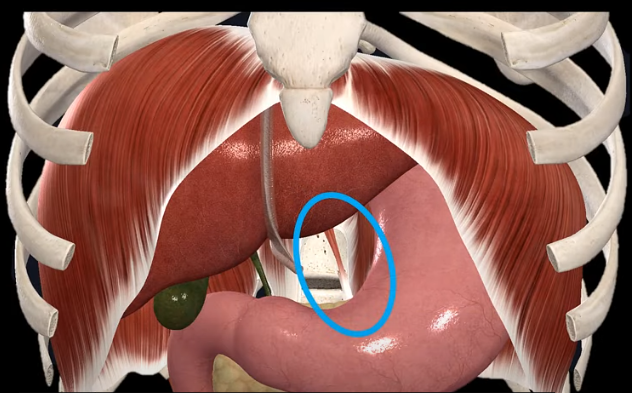
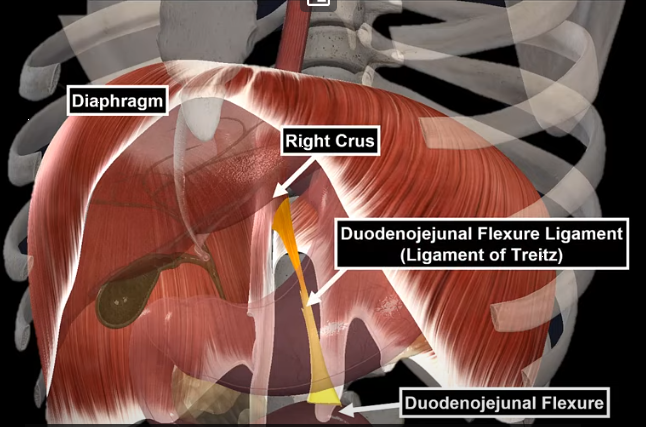
Then it continues horizontally, called the inferior horizontal part, then it ascends a little to form the duodenaljejunal flexure. That’s where the duodenum will continue as the jejunum. All of the small intestines are surrounded by the peritoneum, except for the duodenum. Only the beginning of the duodenum is completely surrounded but the rest of it is held in position in a different way. The duodenaljejunal flexure is held up through a muscular ligament which is attached to the diaphram. Below we see the diaphram . the ligament is circled, it runs behind the stomach and pancreas to attach to the flexure.
Video:
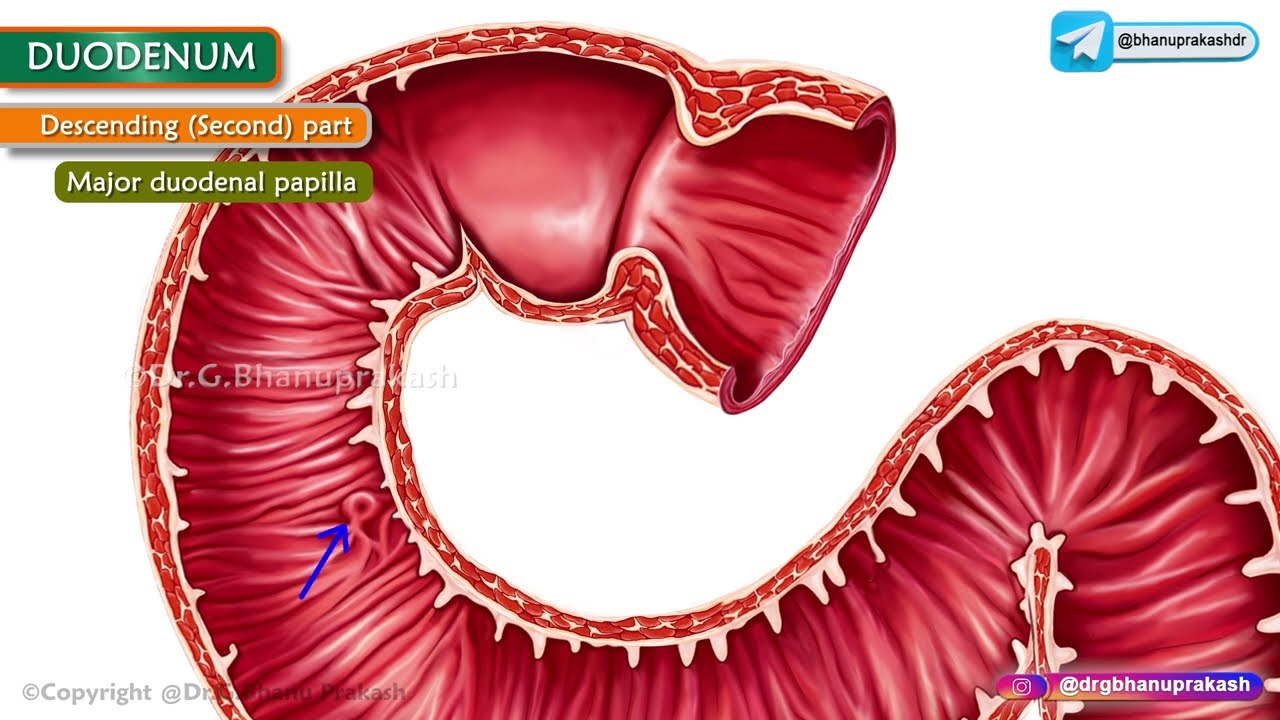
In the duodenum there’s a lot of activity. Chyme enters from the stomach. Chyme is the food you ate mixed with HCL When chyme enters the duodenum it mixes the chyme with mucus to neutralize the stomach acid. The liver and gallbladder deliver bile (made up of bile salts and bile pigments. The pancreas delivers enzymes. The duodenum itself has what are called Brush Border / Microvilli enzymes which are very important for activation of certain enzymes. Once the necessary enzymes complete their job the chyme is pushed to the jejunum to have the nutrients pulled from it.
The duodenum is distiguished from other parts of the small intestine by presence of submucosal Brunner’s Glands, which may pack the submucosa so completely that the typical submucosa connective tissue may be hard to find. They produce a lot of alkaline mucus to neutralize stomach acid coming into the duodenum.
You need acid in the stomach and duodenum to absorb calcium. Over age 40 you produce less acid.
The stomach’s functions are closely coordinated with the rest of the digestive tract. It stores masticated food as a hopper, delivering its acidic contents into the alkalized duodenum only at a rate that can be alkalized: too fast and it damages the duodenal wall, too slow and it leads to discomfort and inhibits digestion of the following meal.
Disaccharidases are enzymes that break down complex sugars (like lactose) into simple sugars (like glucose) so that the intestine can absorb the nutrients. A deficiency of these enzymes in the duodenum results in a range of gastrointestinal symptoms. The common nature of such symptoms may lead to misdiagnosis of the condition as food allergy or intolerance.
Digestive Enzymes in the Duodenum
To digest proteins we have brush border enzymes, peptidases. The pancreas contributes trypsinogen and chymotrypsinogen. When you see -gen at the end of an enzyme’s name that means it’s not ready to work yet. There’s an enzyme on the brush border called enteropeptidase to specifically break down trypsinogen into trypsin and chymotrypsinogen into chymotrypsin.
For carbs, the pancreas releases an enzyme called amylase to help break the glycosidic bonds in certain carbohydrates. The brush border is also helpful with a number of enzymes to break bonds in very specific sugars, it releases lactase which can only be used to break down lactose. The stomach flu can inflame the duodenal wall which knocks off some of the lactase enzymes.
For nucleotides the brush border releases nucleosidases.
For fats, the liver and gallbladder release bile which will help emulsify or organize our fats. It doesn’t break down the fats, that’s done with lipase, released from the pancreas.
Cholecystokinin: This hormone is synthesized and secreted by enteric endocrine cells located in the duodenum. Its secretion is strongly stimulated by the presence of partially digested proteins and fats in the small intestine. As chyme floods into the small intestine, cholecystokinin is released into blood and binds to receptors on pancreatic acinar cells, ordering them to secrete large quantities of digestive enzymes. The major hormonal stimulus that causes pancreatic digestive enzyme secretion is the release of cholecystokinin (CCK) from the duodenum..
Secretin: This hormone is also a product of endocrinocytes located in the epithelium of the proximal small intestine. Secretin is secreted in response to acid in the duodenum, which of course occurs when acid-laden chyme from the stomach flows through the pylorus. The predominant effect of secretin on the pancreas is to stimulate duct cells to secrete water and bicarbonate. As soon as this occurs, the enyzmes secreted by the acinar cells are flushed out of the pancreas, through the pancreatic duct into the duodenum.
This is a hormone secreted from small intestinal epithelial cells due to the presence of carbohydrates in the duodenum. It stimulates secretion of a bicarbonate-rich fluids from the pancreas and liver. Acid in the small intestine stimulates secretion of the hormone secretin from endocrine cells in the intestinal epithelium. Secretin stimulates the pancreas to dump a bicarbonate-rich fluid into the lumen of the intestine. In the absence of a secretin stimulus, the pancreas stops secreting bicarbonate.
Both secretin and CCK (cholecystokinin) act on the pancreas and liver to increase production of bicarbonate ions that are released into the lumen of the duodenum. Both also stimulate the liver and gallbladder to release bile salts for the emulsification of fat. Bile salts can also neutralize acids and raise pH.
Disorders in the Duodenum
Altered duodenal sensitivity to lipids or acid Some functional dyspeptic patients have been found to be hypersensitive to the presence of stomach acid in the duodenum. Normally, humans should be able to tolerate some acid, but they can’t. Normal volunteers can stand injections of even extra acid into the duodenum without the production of symptoms due to release of bicarbonate in the duodenum to neutralize the acid. Many functional dyspepsia patients have abnormally high levels of HCL in the duodenum after meals. Typically, from loose pyloric sphincter or impaired bicarbonate secretion from the Brunner’s glands in the duodenum.
Pseudomonas aeruginosa Prevalent in the small intestine. It can cause inflammation in the duodenum and can predispose to food sensitivities in general and to gluten sensitivity in particular.
Campylobacter jejuni It can affect not only the stomach but the duodenum and result in hypochlorhydria (low stomach acid) and/or compromise the activity of the small intestine brush border enzymes. This is often seen clinically.
Strongyloides stercoralis is a parasite that can live in the duodenum.
H. pylori infection can affect not only the stomach but also the duodenum.
Effect of Plants on the Duodenum
Jie-Geng /Korean Bellflower / Balloon Flower The stimulation of pancreatic secretion in rats by platycodin D, a choleretic saponin from the root of Platycodon grandiflorum, triggered the release of cholecystokinine from the duodenum into the bloodstream.
Coffee Enema: the water in the enema stimulates peristalsis or the movement of toxic substances from the duodenum or upper intestine, through the intestine, and out through the rectum.
Couch Grass: German herbal medicine practitioners externally apply a hot and wet pack of heated seeds of couch grass on the abdomen to alleviate peptic ulcers (an ulcer of the upper digestive tract, frequently in the stomach or duodenum).
Cream Avens: from The Physiomedical Dispensatory by William Cook, M.D., 1869; In those forms of indigestion which arise from debility of the duodenum, pancreas and mesenteries–connected with pains and laxity of the bowels, curdy stools, and slow loss of flesh–it is a peculiarly valuable article; and may be used freely, especially when boiled in milk and used as a sort of chocolate. From this action, it has been set down as useful in dyspepsia, whereas it is insignificant in that malady of the stomach. Its action on the duodenum and mesenteries fits it for a class of cases to which few articles are applicable; and I am decidedly of the opinion that it will be found useful in tabes mesenterica, and in those forms of scrofulous looseness of the bowels which are dependent upon defective assimilation, and which often pass roughly as chronic diarrhea. This distinction between tonics to the digestive and to the assimilative apparatus, is one that has not heretofore...
Green Banana While not reducing the risk of bowel cancer, eating one unripe banana per day did reduce the risk of cancers developing in other parts of the body by up to 60 per cent. The protection turned out to be particularly strong when it comes to esophageal, gastric, biliary tract, pancreatic and duodenum cancers.
Rhubarb Root : according to the physiomedicalists it gives tone to the duodenum.