Neurodevelopmental disorders
Neurodevelopmental disorders refer to a group of conditions that affect the development of the brain and nervous system. These disorders typically manifest early in childhood and can have a significant impact on a person's cognitive, social, and emotional functioning. Understanding these disorders is crucial for early identification, intervention, and support.
There are several types of neurodevelopmental disorders, each with its own unique characteristics and challenges. One common example is autism spectrum disorder (ASD), which is characterized by difficulties in social interaction, communication, and repetitive behaviors. Another well-known neurodevelopmental disorder is attention deficit hyperactivity disorder (ADHD), which is characterized by inattention, hyperactivity, and impulsivity.
Neurodevelopmental disorders can have a wide range of causes, including genetic factors, prenatal exposure to toxins or infections, complications during birth, and environmental factors. It is often a combination of these factors that contribute to the development of these disorders. Research has shown that certain genes play a role in neurodevelopmental disorders, but the exact mechanisms are still not fully understood.
Early identification and intervention are crucial for individuals with neurodevelopmental disorders. The earlier these conditions are diagnosed, the sooner appropriate interventions and support can be provided. This can help improve outcomes and enhance the individual's quality of life. Screening tools and assessments are used to identify potential neurodevelopmental disorders, and a multidisciplinary approach involving healthcare professionals, educators, and therapists is often employed to develop individualized treatment plans.
Treatment for neurodevelopmental disorders typically involves a combination of therapies and interventions tailored to the individual's specific needs. These may include behavioral therapy, speech and language therapy, occupational therapy, and medication management. The goal is to address the core symptoms of the disorder, improve functional abilities, and enhance the individual's overall well-being.
In addition to individualized interventions, support from family, friends, and the community is crucial for individuals with neurodevelopmental disorders. Creating an inclusive and supportive environment can help individuals with these disorders thrive and reach their full potential. Education and awareness campaigns can also help reduce stigma and promote understanding of neurodevelopmental disorders.
Research into neurodevelopmental disorders is ongoing, with scientists and healthcare professionals continually striving to better understand these conditions and develop more effective interventions. Advances in neuroscience and genetics have provided valuable insights into the underlying mechanisms of these disorders, paving the way for targeted treatments and interventions.
Videos
The SECRET To Enhancing BRAIN DEVELOPMENT In Children | Goldie Hawn & Mark Hyman
Early Life Determinants of Schizophrenia & Other Psychiatric Disorders
Movement Disorders in Children
Overview of pediatric movement disorders
Mechanisms and Adult Treatments for Neurodevelopmental Disorders
Childhood Neurodevelopmental Disabilities - Research Tuesdays May 2017
Pharmacotherapy for Anxiety and Stress-Related Behavior Dysregulation Neurodevelopmental Disorders
Articles/Studies
- Fractalkine Signaling and Microglia Functions in the Developing Brain
- Parental Traits May Influence Neurodevelopmental Disorders
- Prenatal exposure to ambient air pollution is associated with neurodevelopmental outcomes at 2 years of age.
- How alcohol exposure can cause brain damage in offspring
New research reveals how alcohol exposure can significantly impair key brain cells and circuits in offspring. Fetal Alcohol Spectrum Disorders (FASD), a leading cause of neurodevelopmental disorders, may affect as many as 1 in 20 school-aged children in the United States.
- Domain-specific effects of prenatal fluoride exposure on child IQ at 4, 5, and 6-12 years.
- Exposure to air pollution throughout pregnancy is linked to neurodevelopmental delay mediated by poorer fetal β-cell function.
- The occurrence of neurodevelopmental disorders following thimerosal-containing childhood vaccines does not appear to be coincidental.
- The collective works described here predominantly support the notion that gestational exposure to BPA should be regarded as a risk factor for neurodevelopmental disorders.
- Early life exposure to indoor air pollutants and the risk of neurodevelopmental delays.
- Associations of Prenatal and Child Sugar Intake With Child Cognition
- Iodine deficiency in the U.K.: an overlooked cause of impaired neurodevelopment?
- New insight on maternal infections and neurodevelopmental disorders
- Toward Effective Probiotics for Autism and other Neurodevelopmental Disorders
- Microbiota Modulate Behavioral and Physiological Abnormalities Associated with Neurodevelopmental Disorders
- Increasing organic Hg exposure from Thimerosal-containing vaccines increased the subsequent risk of pervasive developmental disorder diagnosis.
- Organic-Hg exposure from thimerosal-containing hepatitis B vaccine led to an increased risk of neurodevelopmental disorder diagnosis.
- Changes in the microbiome may contribute to symptoms of neurodevelopmental disease.
- This review postulates that perturbations in the gut microbial-derived nutrient supply profoundly impacts upon normal brain development and function.
- Stress and the Commensal Microbiota: Importance in Parturition and Infant Neurodevelopment
- Studies Link Heavy Metals To Explosion Of Neurodevelopmental Disorders And Declining IQ In Children
- First 'non-gene' mutations behind neurodevelopmental disorders discovered
- Exposure to bisphenol A affects GABAergic neuron differentiation in neurosphere cultures.
- FDA: Anesthesia and sedation drugs may harm developing brains of children under three
- The association between prenatal bisphenol F exposure and infant neurodevelopment.
- Fluoride impairs mitochondrial translation by targeting miR-221-3p/c-Fos/RMND1 axis contributing to neurodevelopment defects.
Wikipedia:
Neurodevelopmental disorders are impairments of the growth and development of the brain or central nervous system. A narrower use of the term refers to a disorder of brain function that affects emotion, learning ability, self-control and memory and that unfolds as the individual grows. The term is sometimes erroneously used as an exclusive synonym for autism and autism spectrum disorders.
Disorders considered neurodevelopmental in origin, or that have neurodevelopmental consequences when they occur in infancy and childhood, include:
- Intellectual disability (ID) or intellectual and developmental disability (IDD)
- Autism and autism spectrum disorders, such as Asperger's syndrome
- Fetal alcohol spectrum disorder
- Motor disorders including developmental coordination disorder and stereotypic movement disorder
- Tic disorders including Tourette's syndrome
- Traumatic brain injury (including congenital injuries such as those that cause cerebral palsy[2])
- Communication, speech and language disorders
- Genetic disorders, such as fragile-X syndrome
- Down syndrome[3]
- Attention deficit hyperactivity disorder
- Mendelsohnn's syndrome
- Schizophrenia
- Schizotypal disorder
- HIV[4]
- Malaria[4]
Neurodevelopmental disorders are associated with widely varying degrees of difficulty which may have significant mental, emotional, physical, and economic consequences for individuals, and in turn their families and society in general.
Causes
The development of the brain is orchestrated, tightly regulated, and genetically encoded process with clear influence from the environment. This suggests that any deviation from this program early in life can result in neurodevelopmental disorders and, depending on specific timing, might lead to distinct pathology later in life.[5] Because of that, there are many causes of neurodevelopmental disorder, which can range from deprivation, genetic and metabolic diseases, immune disorders, infectious diseases, nutritional factors, physical trauma, and toxic and environmental factors.
Some neurodevelopmental disorders—such as autism and other pervasive developmental disorders—are considered multifactorial syndromes (with many causes but more specific neurodevelopmental manifestation).[6]
Deprivation
Main articles: Maternal deprivation and Sensory deprivation
Behavioral retardation, as in the reactive attachment disorders, has been observed in emotionally deprived children living with their families.[7][8] However, prominent modern thought attributes other causative mechanisms to autism and autistic spectrum disorders. (see Autism)
However, nurture is not the only cause of deprivation that leads to neurodevelopmental sequellae. A common example of sensory deprivation due to biologic factors is blindness. Blind infants are at risk for poor developmental outcomes that if left untreated can lead to severe, autistic-like behaviors.[9] Despite its biologic basis, caregivers can ameliorate blindness-related sensory deprivation.[10] This can lead to positive neurodevelopmental outcome, as in the cases of author Helen Keller,[11] who was trained in the use of tactile sign language, and musicians such as Arthel "Doc" Watson[12] and Ray Charles who remained emotionally connected to others via their sense of hearing.
Genetic disorders
Main article: Genetic disorder

A child with Down syndrome
A prominent example of a genetically determined neurodevelopmental disorder is Trisomy 21, also known as Down syndrome. This disorder usually results from an extra chromosome 21, although in uncommon instances it is related to other chromosomal abnormalities such as translocation of the genetic material. It is characterized by short stature, epicanthal (eyelid) folds, abnormal fingerprints, and palm prints, heart defects, poor muscle tone (delay of neurological development) and mental retardation (delay of intellectual development).[3]
Less commonly known genetically determined neurodevelopmental disorders include Fragile X syndrome, Rett syndrome, and Williams syndrome. Fragile X syndrome was first described in 1943 by J.P. Martin and J. Bell, studying persons with family history of sex-linked "mental defects".[13] Rett syndrome, another X-linked disorder, produces severe functional limitations.[14] Williams syndrome is caused by small deletions of genetic material from chromosome 7.[15]
Immune dysfunction
Main article: Immune-mediated disease
Immune reactions during pregnancy, both maternal and of the developing child, may produce neurodevelopmental disorders. One typical immune reaction in infants and children is PANDAS,[16] or Pediatric Autoimmune Neuropsychiatric Disorders Associated with Streptococcal infection.[17] Another disorder is Sydenham's chorea, which results in more abnormal movements of the body and fewer psychological sequellae. Both are immune reactions against brain tissue that follow infection by Streptococcus bacteria. Susceptibility to these immune diseases may be genetically determined,[18] so sometimes several family members may suffer from one or both of them following an epidemic of Strep infection.
Infectious diseases
Main article: Infectious disease
A number of infectious diseases can be transmitted either congenitally or in early childhood, and can cause serious neurodevelopmental disorders, such as schizophrenia.[19] Congenital toxoplasmosis may result in formation of cysts in the brain and other organs, causing a variety of neurological deficits. Congenital syphilis may progress to neurosyphilis if it remains untreated. Measles can progress to subacute sclerosing panencephalitis. Congenital rubella syndrome can produce schizophrenia in addition to multiple other symptoms.
Metabolic disorders
Main articles: Metabolism, Diabetes mellitus, and Inborn error of metabolism
Metabolic disorders, present in either the mother or the child, can cause neurodevelopmental disorders. Two examples are diabetes mellitus (a multifactorial disorder) and phenylketonuria (an inborn error of metabolism). Many such inherited diseases may directly affect the child's metabolism and neural development[20] but less commonly they can indirectly affect the child during gestation. (See also teratology).
In a child, type 1 diabetes can produce neurodevelopmental damage by the effects of excess or insufficient glucose. The problems continue and may worsen throughout childhood if the diabetes is not well controlled.[21] Type 2 diabetes may be preceded in its onset by impaired cognitive functioning.[22]
However a non-diabetic fetus can also be subjected to glucose effects if its mother has undetected gestational diabetes. Maternal diabetes causes excessive birth size, making it harder for the infant to pass through the birth canal without injury or it can directly produce early neurodevelopmental deficits. Usually the neurodevelopmental symptoms will decrease in later childhood.[23]
Phenylketonuria, also known as PKU, is an inborn error of metabolism that can induce neurodevelopmental disorders in children. Children with PKU require a strict diet to prevent mental retardation and other disorders. In the maternal form of PKU, excessive maternal phenylalanine can be absorbed by the fetus even if the fetus has not inherited the disease. This can produce mental retardation and other disorders.[24][25]
Nutrition
Main article: Nutrition disorder
Nutritional deficits may cause neurodevelopmental disorders, such as spina bifida, which is common, and anencephaly, which is rare. Both disorders are neural tube defects with malformation and dysfunction of the nervous system and its supporting structures, leading to serious physical disability as well as its emotional sequellae. The most common nutritional cause of neural tube defects is maternal deficiency of folic acid, a B vitamin usually found in fruits, vegetables, whole grains, and milk products.[26][27] (Neural tube defects are also caused by medications and other environmental causes, many of which interfere with folate metabolism, thus they are considered to have multifactorial causes.)[28][29] Another deficiency, iodine deficiency, produces a spectrum of neurodevelopmental disorders ranging from mild emotional disturbance to severe mental retardation. (see also cretinism)
Excesses in both maternal and infant diets may cause disorders as well, with foods or food supplements proving toxic in large amounts. For instance in 1973 K.L. Jones and D.W. Smith of the University of Washington Medical School in Seattle found a pattern of "craniofacial, limb, and cardiovascular defects associated with prenatal onset growth deficiency and developmental delay" in children of alcoholic mothers. This disorder, now called fetal alcohol syndrome, has significant symptom overlap with several other entirely unrelated neurodevelopmental disorders.[30] It has been discovered that iron supplementation in baby formula is linked to lowered I.Q. and other neurodevelopmental delays.[31]
Trauma
Main article: Traumatic brain injury
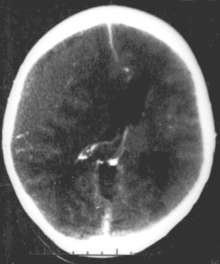
CT scan showing epidural hematoma, a type of traumatic brain injury (upper left)
Brain trauma in the developing human is a common cause (over 400,000 injuries per year in the US alone, without clear information as to how many produce developmental sequellae)[32] of neurodevelopmental syndromes. It may be subdivided into two major categories, congenital injury (including injury resulting from otherwise uncomplicated premature birth)[2] and injury occurring in infancy or childhood. Common causes of congenital injury are asphyxia (obstruction of the trachea), hypoxia (lack of oxygen to the brain) and the mechanical trauma of the birth process itself.