Boneset
See Eupatorium (genus)
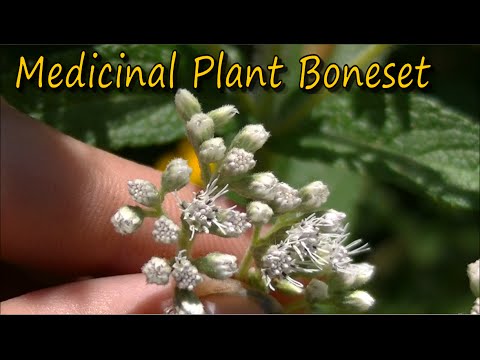
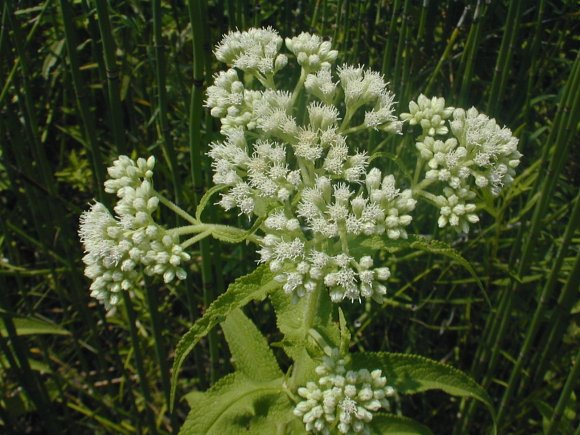
Boneset is a herbaceous perennial native to North America that grows a few feet tall with dense clusters of small white flowers. The leaves of Boneset are a distinguishing feature of this plant as they are “perfoliate”, or looking like they wrap around or continue past the stem. Other species of Boneset exist with different flower colors and sometimes different uses & some are common ornamentals. Boneset likes soil with moisture but can tolerate boggy soil, very cold weather and are long blooming and attractive as an ornamental in the garden. Boneset flowers are good for attracting beneficial insects and butterflies to the garden and make good cut or dried flowers.
Boneset is an aromatic and bitter herb traditionally used for colds, fevers, and flu. Studies show that compounds in boneset stimulate white blood cell action. It is very helpful for flu accompanied by aches in the muscles. Taken as a warm tea, it helps to promote perspiration and acts as an emetic. Taken as a cold tea (a standard infusion left to cool), it acts as a bitter tonic and mild laxative to strengthen and tone the bowels. It helps to relieve vomiting and bloating when combined with mint, and when combined with ginger and anise it aids coughs.
Overview
Medicinal Parts: the herb after flowering
Qualities: bitter, a bit pungent and astringent, cold, dry, stimulating, dispersing, sinking, restoring
Tropism: lungs, throat, liver, stomach, intestines
Ground: Choleric krasis; Industcrious/Tai Yang biotype; Hematogenic/Sulfuric/Brown Iris constitutions
Identification Cues
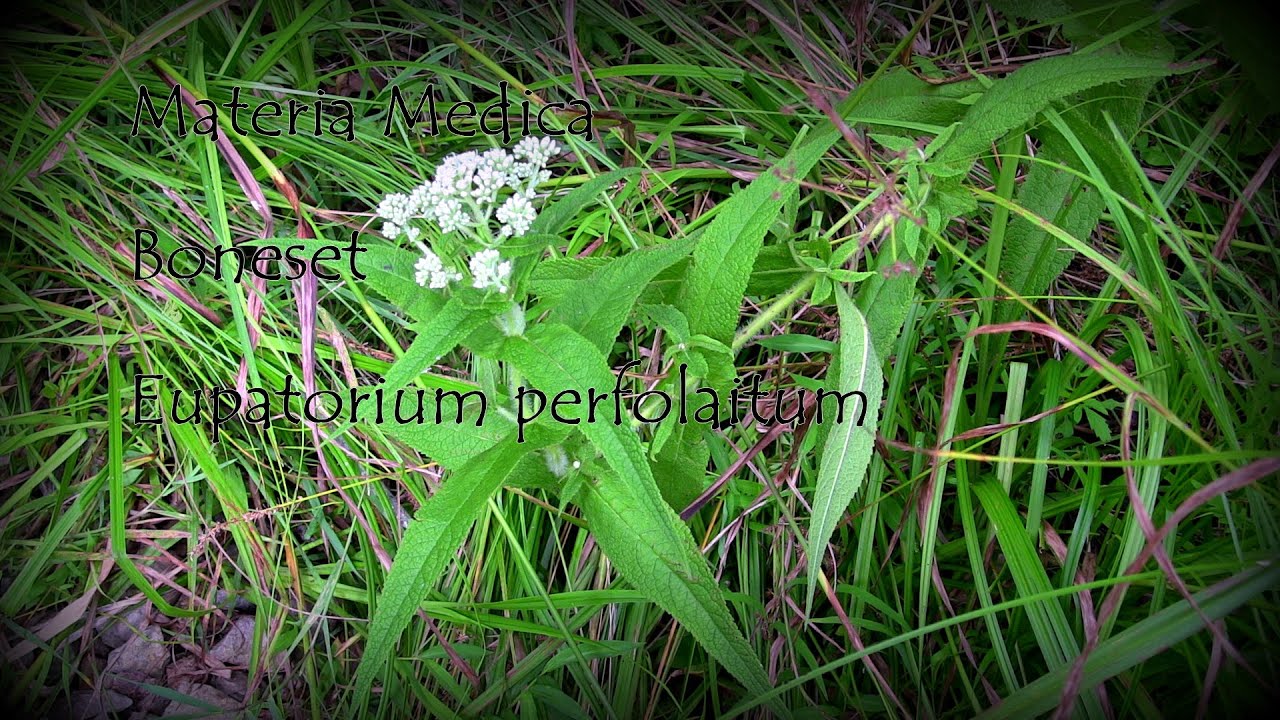
1. Leaf Architecture (the giveaway)
- Perfoliate leaves — the stem appears to pierce directly through the leaf pair.
- Leaves are opposite, sessile, and joined at the bases to form a shallow cup around the stem.
- Leaf shape: lanceolate to narrowly ovate, 4–8" long.
- Margins: sharply serrated.
- Texture: rough, hairy, slightly sandpapery.
This “stem-through-the-leaf” feature is the single most reliable cue.
2. Stem & Habit
- Stems are hairy, gray‑green, and often feel slightly rough.
- Height: typically 2–4 ft, occasionally taller in rich floodplain soils.
- Growth habit: upright, often forming dense colonies in wet meadows and stream margins.
3. Inflorescence
- Flower heads are flat‑topped corymbs (not domed).
- Individual florets are tiny, white, and numerous — giving a cloud‑white, fuzzy appearance.
- Bloom period: late summer into early fall (Ozarks: August–September).
4. Odor & Taste (field confirmation)
- Crushed leaf: bitter‑aromatic, slightly resinous.
- Taste: strongly bitter, with a lingering “deep tonic” profile.
5. Habitat (Ozark‑specific)
- NOT a glade plant.
- Found in wet meadows, marsh edges, creek margins, low floodplain fields, ditches, and wet thickets.
- Soil: consistently moist to wet, often poorly drained.
If the site is dry, rocky, or upland → it’s almost certainly not E. perfoliatum.
6. Key Look‑Alikes (and how to separate them)
Eupatorium serotinum (Late Boneset)
- Leaves not perfoliate.
- Leaf bases not joined.
- More tolerant of dry uplands.
Eupatorium altissimum (Tall Thoroughwort)
- Leaves narrower, not joined, and often whorled.
- Inflorescence more domed than flat.
Eupatorium hyssopifolium
- Leaves thread‑thin, almost needle‑like.
- Very glade‑aligned; prefers dry, sunny limestone openings.
If the leaves aren’t fused around the stem → it’s not perfoliatum.
Quick Field Card
Eupatorium perfoliatum — Boneset
- Leaf: Opposite, perfoliate, serrated, rough, lanceolate
- Stem: Hairy, gray‑green
- Flowers: Flat‑topped white fuzzy corymbs
- Height: 2–4 ft
- Habitat: Wet meadows, marsh edges, floodplains
- Season: Blooms Aug–Sept
- Key cue: Stem pierces fused leaf bases
- Avoid confusion: Look for perfoliate leaves — no other Ozark Eupatorium does this
Constituents:
Bitter glycoside (eupatorin), sesquiterpene lactones (incl. eupafolin, euperfolitin, eufoliatrin, eufoliatorin, helenalin, eucannabinolide, euperfolide), polysaccarides, fatty resin (eupurpurin), flavonoids (incl. kaempferol, quercitin, astragalin, rutin, hyperoside, eupatorin), inulin, essential oil, tannic acids, unsaturated alcoho (tremetrol), diterpens (dendroinic acid, hebenolide), sterols, vit. D1
- Listing on Duke's Database
- Caffeic acid derivatives from Eupatorium perfoliatum L.
- Sesquiterpene lactones of Eupatorium perfoliatum
- Potentially toxic pyrrolizidine alkaloids in *Eupatorium perfoliatum* and three related species. Implications for herbal use as boneset
Effects
The herb acts as an antiphlogistic, a diaphoretic, and a bitter, in addition to stimulating the body's immune system. In a comparative study of the homeopathic preparation Eupatorium D2 with aspirin in the treatment of feverish catarrh, a similar positive tendency was observed. In vitro, the phogocytic action of granulocytes was increased.
Tissue State Relevance
Eupatorium perfoliatum (Boneset) maps most strongly to Damp/Relaxation and Heat/Excitation tissue states, with secondary relevance to Wind/Tension and minimal relevance to Cold/Depression or Dry/Atrophy.
This mapping is grounded in the pharmacological findings: anti‑inflammatory, antipyretic, analgesic, and lymphatic‑activating actions.
Below is a full, structured tissue‑state profile with citations.
1. Damp/Relaxation → Strongly Indicated
Boneset’s traditional use and phytochemistry emphasize its role in resolving damp, boggy, stagnant conditions, especially in the respiratory and lymphatic systems.
Its lymphatic activation is supported by the identification of pheophorbide a as a lymphatic vascular activator ScienceDirect.
Why this fits Damp/Relaxation:
- Restores tone to lax, boggy tissues
- Moves lymph and reduces fluid stagnation
- Historically used for “wet” fevers, influenza, and catarrh (supported by ethnopharmacology review) ScienceDirect
2. Heat/Excitation → Strongly Indicated
Boneset has anti‑inflammatory, antipyretic, and analgesic actions, confirmed in the 2026 nanocarrier study showing significant reduction of inflammatory and fever markers in vitro and in vivo ScienceDirect.
Why this fits Heat/Excitation:
- Reduces inflammatory heat
- Lowers fever (antipyretic)
- Calms irritated mucosa and systemic excitation
This is one of its clearest modern pharmacological signatures.
3. Wind/Tension → Moderately Indicated
The analgesic and anti‑inflammatory actions documented in the 2026 study imply relief of spasm, ache, and tension patterns associated with inflammatory irritation ScienceDirect.
Why this fits Wind/Tension:
- Eases tension arising from inflammation
- Reduces irritability in tissues
- Supports musculoskeletal comfort during febrile states
4. Cold/Depression → Low
Boneset is not warming in the metabolic sense.
While it stimulates lymphatic movement, it does not significantly activate circulation or metabolism.
Why relevance is low:
- No evidence of metabolic stimulation in phytochemical or pharmacological sources
- Traditionally used more for fever and damp stagnation than cold underfunction
5. Dry/Atrophy → Low
Boneset does not moisten or rebuild fluids.
Its drying, bitter, and stimulating nature may worsen atrophic dryness.
Why relevance is low:
- No demulcent or trophorestorative actions in the literature
- Bitter tonics often reduce moisture rather than restore it
6. Stagnation/Constriction → Moderate
Boneset’s lymphatic activation (pheophorbide a) and bitter stimulation help move stagnation, especially in the lymphatic and respiratory systems ScienceDirect.
Why relevance is moderate:
- Moves lymph
- Breaks up respiratory stagnation
- Not a primary mover for deep hepatic or circulatory stagnation
Summary Table
| Tissue State | Relevance | Rationale |
|---|---|---|
| Damp/Relaxation | High | Lymphatic activation; resolves boggy, stagnant tissues |
| Heat/Excitation | High | Anti‑inflammatory, antipyretic, analgesic actions |
| Wind/Tension | Moderate | Analgesic + anti‑inflammatory relief of tension |
| Cold/Depression | Low | Not warming or metabolically activating |
| Dry/Atrophy | Low | Bitter, drying; no fluid‑restorative action |
| Stagnation/Constriction | Moderate | Lymphatic movement; bitter stimulation |
TCM & Western Herbal Uses
Boneset has been used as a traditional medicine for many years, as the Native Americans used it to induce sweating and help break fevers and the common cold. In fact, it is amazing how widely among the Native American tribes this plant was used as a cold remedy and for breaking fevers, as it was documented for the Cherokee, Delaware, Iroquois, Menominee, Mohegan, Nanticoke, Seminole, and Shinnecock! Other traditional uses that were later adopted by the settlers include rheumatism, malaria, flu, yellow fever and dengue fever. As Boneset may contain the hepatotoxic pyrrolizidine alkaloids caution is advised. Boneset is also commonly used in homeopathic medicines, especially for the target of the common cold. Through scientific investigation, anti-inflammatory activity has been confirmed and is thought to be the reason for such broad use in colds, rheumatism, and arthritis. Boneset has been shown in an in vitro study to protect cells from Influenza A virus by inhibiting its attachment to host cells.
Native American Uses
KOASATI-to make urine yellow-A decoction made from the roots is drunk to make urine yellow
KOASATI-emetic-A decoction of the boiled leaves is taken as emetic.
Promotes sweating, dispels wind heat and reduces fever; stimulates immunity and relieves pain and coughing
external wind heat: thirst, deep muscle pains as if in bones, backache, coughing
lung wind heat/dryness:dry irritating cough, hoarseness, chest pain, thirst, feverishness COLD & FLU ONSET WITH FEVER
REMITTENT FEVER (Shao Yange Stage), rheumatic/typhoid fever
COUGH (incl. in asthmatic and late-pneumonia conditions, with feeble expectoration, hoarseness)
MYALGIA, NEURALGIA (pain deep-seated, aching, periosteal); periostitis
Removes liver congestion, Resolves Accumulation and promotes bowel movement
Liver fire (Yang Ming Heat):Constipation, head congestion, feverishness
liver and intestines Qi stagnation; right subcoastal pain, headache, indigestion, constipation
LIVER CONGESTION , JAUNDICE (acute or chronic)
Stimulates digestion and appetite, and generates strength
stomach Qi stagnation: fatigue, appetite loss, indigestion, epigastric fullness
GASTRIC DYSPEPSIA
CONVALESCENCE from acute or chronic fever
Physio-Medical Therapeutics, Materia Medica and Pharmacy BY T. J. LYLE, A.M.M. 1897
This herb in bloom is positively relaxing to the mucous membrane throughout, slightly stimulating. toning and antispasmodic. It is best when it first blooms. It is slow in its action but almost certain to relieve the liver. It is a favourite remedy for the prevention of fever. In large doses it is gently cathartic and gently tones the bowels throughout.
Boil the herb down to a solid extract, and this makes an excellent pill for indigestion. Night sweats yield to this better than to almost anything else even in phthisis. The relaxing properties are to some .r8xtent dissipated by the heat, and the stimulancy, antispasmodic and tonic properties are left. I have frequently stopped night sweats in three or four days and in some cases in less time. And they are not likely to return. Give a pill from 1 to 3 hours. For chronic ague it cannot be excelled, but it is good for all fevers. Other medicines may be incorporated into this Extract if needed when it is being formed into pills.
Eupatorin moderately represents this agent and the Fluid Extract is good also.
Whenever needed a large injection of this agent in infusion may be used to cleanse the bowel. It does well. In hot infusion in large doses it is nauseating and may be emetic. Small doses continued at short intervals prove diaphoretic..
I have no doubt that the persistent use of this agent has prevented many a case of typhoid and of remitting fevers, and if not entirely prevented, it has made them very much lighter than they would otherwise have been.
If used in the eruptive fevers more stimulation is necessary. Eupatorium Perfoliatum is valuable in the treatment of rheumatism especially of the gouty and bilious classes. In the former it cleanses and tones the gastric membrane and in the latter it relieves the liver and gall-cyst.
When you have an irritable condition of the stomach and nervous system with biliousness and constipation, small enemas of this agent may be used with much profit to the stomach and nerves. In whatever manner this agent is given it influences an outward circulation, soothes the mucous membrane and relieves nervous irritation.
The Physiomedical Dispensatory by William Cook, M.D., 1869
Properties and Uses: The leaves and flowers of this plant are among the truly valuable remedies of our native Materia Medica. They have long been employed in family practice, and deserve to be esteemed as one of the most useful medicines of the people; and though their intense bitterness has caused them to fall largely into disuse, they merit much more attention than is now given them by the profession. The two portions of the plant appear in market
together.
Boneset is almost a pure relaxant, with stimulating properties scarcely noticeable. It acts rather slowly and persistently. Its greatest power is expended upon the more inward muscular structures, as those of the stomach, gall-ducts, bowels, and uterus; but it impresses the nervous peripheries, and also influences the skin decidedly. It is one of the agents that is peculiarly applicable to one or other class of purposes, according to the form in which it is exhibited.
Given by cold infusion, or other cold preparation, it is a soothing and relaxing tonic, suitable to all irritable forms of dyspepsia; is gently relaxant to the hepatic apparatus, promoting both the secretion of bile and its ejection from the gall-ducts; and finally securing a mild laxative action on the bowels. It is serviceable in bilious difficulties, when there are sensitiveness and tension of the tissues; in habitual costiveness, with thirst and dryness of the faeces; in skin diseases of hepatic origin; and in recovery from febrile conditions, especially intermittent and bilious fever.
But it is not applicable to cold and sluggish states of the stomach, to torpor of the liver and bowels when accompanied with flaccidity of the tissues, to low intermittents, nor as a tonic in any case where the bowels are inclined to free action. For strengthening purposes, it is most generally combined with tonics of a more stimulating grade, such as gentiana, sabbatia, hydrastis, artemisia, and a small portion of capsicum; and is particularly serviceable in bilious cases when it is necessary to maintain steady laxity of the bowels without actual catharsis. Though the effect of boneset on the hepatic and alvine secretions is slow and mild, it is nevertheless persistent and very reliable. It exerts a decided influence upon the lungs, and may be used in weakness of the chest, dull achings through the lungs, and chronic coughs, especially in slightly irritable conditions; or in languid conditions, if some more stimulating agent be combined with it. Indeed its soothing and toning influence upon the respiratory organs, (and that whether given in cold or warm preparations,) is of the most valuable character, and is generally too much overlooked.
Given as a warm infusion, it will secure slow and gentle, yet rather persistent, diaphoresis. For this purpose it is very useful in bilious, bilious remitting, and yellow fevers–its action on the liver and bowels being well-marked in this form, and hence the infusion is doubly advantageous in such cases. Its free use will many times cut short a bilious remitting attack; and it is a popular belief that it is reliable in terminating agues, though there is nothing sufficiently stimulating about the agent to warrant such an expectation, though it is still a valuable article in such cases. In very large quantities, especially if used quite warm and at short intervals, it will induce rather sudden emesis. It is rarely resorted to for this purpose; but a full portion of it may be used to decided advantage in the drinks, when an emetic is to be given in cases of bilious fever and acute inflammation of the liver, and also in what is known as dengue or break-bone fever. It makes a good depurating sudorific for non-malignant cases of scarlatina, and in small-pox, but relaxes the bowels too much to be useful in measles. It affords much relief to the aching of the limbs in recent colds and rheumatisms, whence (probably) its popular name of “boneset.” It also exerts a moderate influence upon the nervous system; and if combined with such a diffusive stimulant as xanthoxylum, a good antispasmodic influence will be obtained. It makes an excellent relaxant injection for moving the lower bowels; and may be used in the same way for its nervine influence, which is then shown to better advantage than when given by the stomach; and when combined with a little zingiber and given as an injection with demulcents, it contributes greatly to a permanent and an equable diffusion of blood toward the surface.