Common Dandelion
See also Taraxacum (genus) and Dandelion: Flowers vs. Leaves vs. Roots
Videos

Dandelions and Civilization
DANDELIONS are the BEST INDICATORS of...
Fertility Herb Profile
Dandelion, Natures Hard Worker | with Herbal Guest Dr. Terry Willard Ph.D.
Overview
This is a mild herb with minimal chronic toxicity
Qualities: Taste: bitter, a bit salty & sweet
Warmth: cold
Moisture: dry
softening, dissolving, restoring, decongesting, calming, sinking movement
Tropism: liver, gall bladder, spleen, pancreas, intestines, kidneys, interstitial fluids, blood.
Tri Dosas: increases Vayu, decreases Pitta & Kapha
Ground: Choleric & Melancholic krases. Biotypes, Self-reliant/Yang Ming Metal, Tough/Shao Yang & Industrious/Tai Yang
Constitutions; all three
Notes on growth:
- Compacted soil. The long root is trying to loosen and decompact the soil.
- Soil is lacking calcium. The root is a calcium pump that pulls calcium from down deep and pumps it into the leaves and flowers, which, when these die on the surface, calcium is left in the surface of the soil.
- High acid levels. They prefer neutral and will change acidity.
- Too much shade for grass. Its a spring plant.
- Dandelion is also one of the best early flowers for pollinating insects. If people get rid of dandelions they are also getting rid of a lot of beneficial insects.
Constituents
Listing in Duke's Phytochemical Database
Note: it’s chemistry changes throughout the year.
bitter glycosides, hormone-like substances (sitosterol, taraxerol, etc.), tannins, essential oil, triterpenes, inulin, levulin, cholin, saponin, enzyme, citric & silicic acid, minerals & trace minerals (incl. potassium & calcium), vitamins, carotinoids, levulose, resin.
Phytochemicals and Constituents of Herb Dandelion.
Taraxalisin -- a serine proteinase from dandelion Taraxacum officinale Webb s.l
Antibacterial constituents include:
9-hydroxyoctadecatrienoic acid and 9-hydroxyoctadecadienoic acid; phenolic compounds- vanillin, coniferaldehyde and p-methoxyphenylglyoxylic acid
Study: Three flavonoid glycosides: luteolin 7-glucoside and two luteolin 7-diglucosides were isolated from dandelion flowers and leaves together with free luteolin and chrysoeriol in the flower tissue. The hydroxycinnamic acids, chicoric acid, monocaffeyltartaric acid and chlorogenic acid were found throughout the plant and the coumarins, cichoriin and aesculin were identified in the leaf extracts. This represents the first report of free chrysoeriol (luteolin 3'-methyl ether) in Taraxacum officinale agg. An earlier provisional identification of chicoric acid, chlorogenic acid, cichoriin and aesculin in a phenolic survey of the tribe Cichorieae is confirmed. Chicoric acid and the related monocaffeyltartaric acid were found to be the major phenolic constituents in flowers, roots, leaves and involucral bracts and also in the medicinal preparations tested.
TCM & Western Herbal Uses
1. Promotes cleansing, clears toxins and resolves toxemia; dredges and stimulates the liver and kidneys, softens deposits, seeps water, promotes and harmonizes urination and removes congestion.
general fluids dyskrasia & general toxemia: chronic arthritis, rheumatism, gout, skin eruptions
A blood purifier that aids in the process of filtering and straining wastes from the bloodstream. It cools heat and clears infection from the body.
Uric Acid Diatheses
Skin Conditions: eczema, herpes, acne, scrofulosis
fire toxin; abscesses, sores, ulcers
Hard Deposits:liver cirrhosis, arteriosclerosis, biliary and urinary stones
liver fluid congestion; generalized water retention, nausea, fatigue
venous blood stagnation: varicose veins, hemorrhoids, cyanosis
Bladder Irritation; dripping or scanty frequent urination
2. CLEARS HEAT, REMOVES STAGNANCY AND DRAINS PLETHORA: CALMS THE LIVER AND GALL BLADDER, PROMOTES BILE FLOW AND BOWEL MOVEMENT
Especially useful in treating obstructions of the gallbladder, liver, pancreas, and spleen.
Liver fire;bursting headache, bitter taste in mouth, feverishness
CHOLECYSTITIS, hepatitis, gallstones
Liver Qi stagnation;right hypochondriac pain and swelling, constipation, irregular menstruation, Jaundice, Hepatitis
Liver/endocrine disharmony (Liver Yang Rising) ; ringing in the ears, insomnia, visual disturbances, irritability
General plethora: overweight, cellulite, obesity
HIGH BLOOD CHOLESTEROL, high blood pressure
3.RESTORES AND STRENGTHENS THE LIVER, RESTORES THE INTESTINES/SPLEEN AND PANCREAS AND AWAKENS THE APPETITE; PROMOTES LACTATION
HEPATIC INSUFFICIENCY in all conditions
Spleen Qi deficiency: lack of appetite, lethargy, diarrhea
ANEMIA
DIABETES (SUPPORTIVE)
BREAST MILKinsufficiency
4. RESTORES CONNECTIVE TISSUE AND STOPS DEGENERATION
CHRONIC & DEGENERATIVE METABOLIC CONDITIONS
CONNECTIVE TISSUE DEGENERATION
5. RELIEVES WHEEZING AND COUGH
ASTHMA LUNG conditions
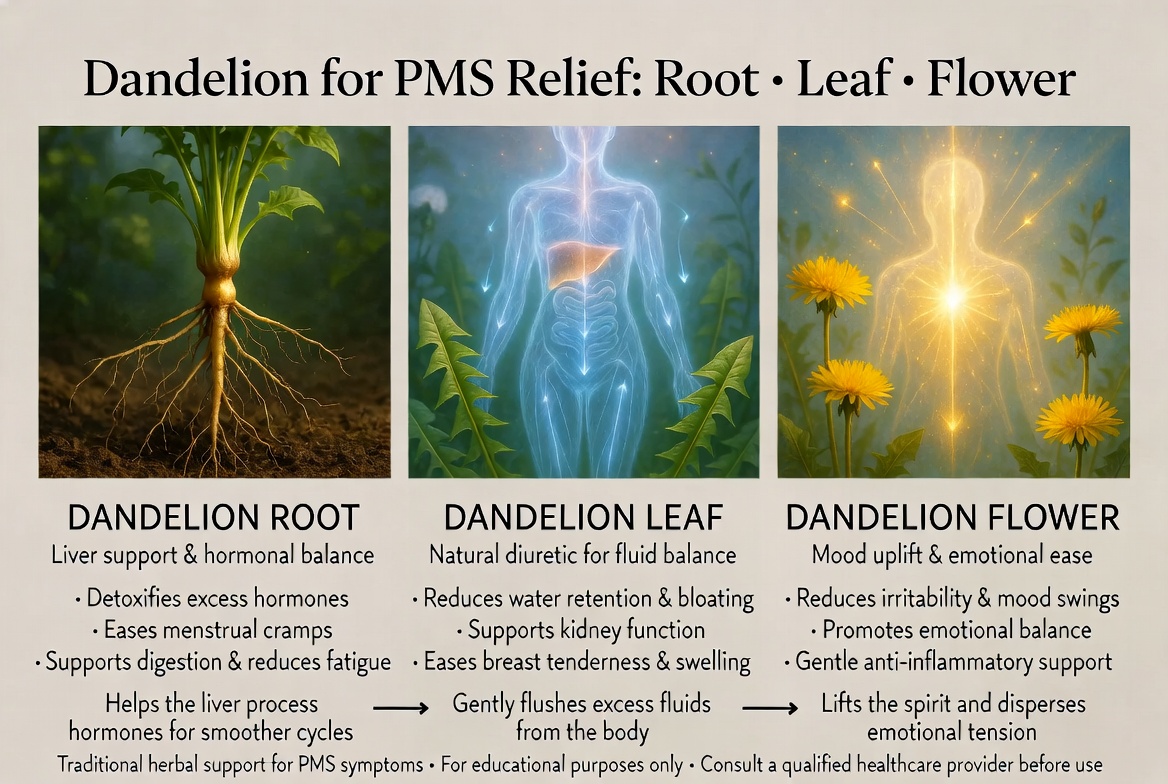
6. Used to help clear the body of old emotions such as anger and fear that can be stored in the liver and kidneys.
PMS
Per Sloan-Kettering
Uses
- Cancer treatment
- Diabetes
- Lactation stimulation
- Liver disease
- Promote urination
The flower, leaf and root of this plant are used in traditional medicine for their diuretic, cholagogic, antirheumatic and appetite-stimulating properties. In Chinese Medicine, the herb has been used to promote lactation. It is also used to reduce abscesses, especially in the breast and intestines.
In vitro and in vivo studies suggest that dandelion has lipid-lowering, hepatoprotective , and antiviral properties. It also has anticoagulant, diuretic, anti-inflammatory, and antioxidant activities. Dandelion root extract has anticancer effects against melanoma and leukemia, as well as pancreatic and colorectal cancer cell lines.
Dandelion has estrogenic activity. Preclinical studies suggest increased proliferation of hormone-sensitive breast cancer cells as well as increased uterine weight in immature female rats. In addition, it can cause allergic reactions and may interact with some prescription drugs. There have been a few case reports of potential benefit in patients with blood cancers, but it is unclear whether this was definitively due to dandelion supplementation. Clinical trials are needed to determine the conditions under which dandelion may be safe and effective.
Mechanism of Action
The diuretic activity of dandelion leaf may be a result of its high potassium content. In murine models of diet-induced fatty liver disease, dandelion leaf extract exihibited hepatoprotective effects with decreased serum levels of ALT, hepatic TG, and MDA, as well as TNF-alpha and IL-6 expression. At the post-transcriptional level, antioxidant and anti-inflammatory properties were exihibited via decreased activation of procaspase-3 to active caspase-3, and JNK phosphorylation. Linoleic acid, phytol and tetracosanol have been identified as bioactive compounds, with hypolipidemic effects occurring via AMP-activated protein kinase activation in human HepG2 cells.
Dandelion has been shown to decrease human hepatoma cell line viability by increasing tumor necrosis factor-alpha and interleukin-1alpha production. Other research has shown that the presence of luteolin and luteolin 7-glucoside in dandelion flower extract exhibits cytotoxic activities against the colon adenocarcinoma cell line (Caco-2). An isolated compound identical to lupeol, a lupane-type triterpene, inhibited cell growth and induced melanogenesis in a mouse melanoma cell line.
Sesquiterpene lactones are thought to be the allergenic compounds in dandelion
The Physiomedical Dispensatory by William Cook, M.D., 1869
The root of this plant is juicy, slightly milky, and of a mildly bitter taste. Its qualities differ much according to the season at which it is gathered; that dug in the spring being nearly worth- less, that obtained in August and September being most decidedly bitter and medicinal, and that procured after frosts being sweetish and but slightly medicinal. Heat impairs its qualities.
Properties and Uses: The root is a mild laxative and alterant, of the relaxing-tonic grade, slowly and gently influencing the liver, small intestines, and kidneys. It is most useful in mild grades of chronic hepatic obstruction and torpor, with biliousness and weakness of the stomach; in engorgements of the liver and spleen, and abdominal dropsy dependent on these conditions. Though slow. in action, it is well received by the system; and if gathered at the proper season, and used in cases not too degenerate, it deserves consideration, though concentrated preparations are required. When the stomach or bowels are irritable, it should not be employed. Among the people, it is in much repute; and though the profession mostly discards it— partly from gathering and preparing the root injudiciously, and partly as a reaction from its former too high laudation—it is, nevertheless, a pleasant and useful agent of the gentle class. The leaves and roots are often used together, but are less efficient than the roots alone.
Pharmaceutical Preparations: I. Decoction. Digest four ounces of the bruised roots with a pint and a half of hot water for an hour, bring to the boil for a few minutes, and strain. Dose, two to four fluid ounces three times a day. A very little essence of wintergreen or sassafras may be added to it.
II. Extract. This may be prepared from decoction, in the usual way; but the product is not of much medicinal value. A long time is required to evaporate the fluid; and during this long exposure to warmth, the bitter’ principle of the plant seems to undergo changes and become sweetish; and a sweet extract is nearly inert as a medicine. I have known a sample to be almost saccharine in its pleasantness; and have eaten two or three ounces of it in a day, for several days in succession, without any perceptible impression. A good article should retain the bitterness of the plant, and many ways have been devised to effect this object. Among the simplest of these is that of gathering and washing the fresh root, slicing and bruising it, and expressing its juice by powerful pressure. A little water may then be added to the dregs, mixed with them into a pulp, and then subjected to a second pressure. The two liquids are then mixed, and evaporated in very shallow dishes in a current of air, with frequent stirring. This yields a dark, tenacious, and valuable product. Dose, ten to thirty grains three times a day. As it dissolves in water, it may be softened to any desired degree; and it is a useful body on which to form a pill mass.
III. Fluid Extract. Gather the roots in September or October, slice them while fresh, reduce to a pulpy mass in the mortar, add a pint of seventy percent alcohol to each five pounds of the roots, and let it macerate for a week in a closely- covered earthenware vessel. If it stand for six months, a still better product is obtained. The dregs are then to be subjected to powerful pressure; after which the marc may again be mixed with a quart of diluted alcohol, after three days again subjected to pressure, the product evaporated to a pint, and this mixed with the first product, and filtered. The quantity obtained will vary with the quality of the root and the amount of pressure used, but the total from five pounds will be about four pints. When desired, a pound of fine sugar may be added to each quart of the fluid. This makes a very efficient preparation, and may be used in doses of one to two teaspoonsful. A pound of dried roots are about equal to two pounds of the fresh ones; and may have added twelve fluid ounces of water to make up the loss by desiccation, and then treated as above. A good quality of solid extract may, upon necessity, be made into a fluid extract by dissolving four ounces of it in an ounce of alcohol, and enough water to make the whole measure half a pint.