Peppermint EO
Videos
Foods to Support Gut Health Series: Peppermint Oil - YouTube
Peppermint Performance - The Power of Peppermint Oil | The ATP Project 349 - YouTube
Botanical Name: Mentha × piperita L. (hybrid of Mentha aquatica and Mentha spicata)
Plant Family: Lamiaceae (Labiatae)
Common Names: Peppermint, English peppermint, Mitcham mint
Peppermint essential oil is a steam-distilled volatile oil obtained from the flowering aerial parts (primarily leaves and tops) of Mentha × piperita. It is characterized by a fresh, strong, minty, cooling, and herbaceous aroma with sweet, balsamic undertones. One of the most widely used and recognized essential oils worldwide, it serves as a staple in aromatherapy, flavoring, pharmaceuticals, oral care, and cosmetics. Its primary active constituent, menthol, delivers the signature cooling sensation that contributes to its therapeutic versatility.
Botanical and Historical Context
Peppermint is a sterile hybrid perennial herb that grows up to 1 meter tall, featuring square stems, dark green serrated leaves, and small purple or white flowers in terminal spikes. It thrives in moist, well-drained soils and temperate climates, with major production in the United States, India, China, and parts of Europe. Historically, mints have been used since ancient Egyptian, Greek, and Roman times for digestive and respiratory complaints. Peppermint cultivation expanded significantly in England (notably the Mitcham variety) in the 18th–19th centuries and later in the United States. It has long been valued as a carminative, digestive aid, and flavoring agent in teas, confections, and medicines.
Production and Physical Properties
The essential oil is produced by steam distillation of the freshly harvested or partially dried flowering herb. Yields typically range from 0.5–4% depending on cultivar, growing conditions, harvest timing, and distillation parameters. The oil is a thin, mobile liquid ranging from colorless to pale yellow or greenish-yellow.
Key Physical Characteristics:
- Odor: Fresh, sharp, minty, cooling, herbaceous with sweet-balsamic notes.
- Perfumery Note: Top to middle note.
- Strength: Strong.
- Solubility: Soluble in alcohol and fixed oils; slightly soluble in water.
- CAS Number: 8006-90-4.
- FEMA Number: 2848.
Chemical Composition
The chemical profile of peppermint essential oil varies by origin, cultivar, and harvest stage, but it is dominated by monoterpenes and their oxygenated derivatives.
Major constituents commonly include:
- Menthol (30–55% or higher in high-quality oils, primarily (−)-menthol).
- Menthone (10–30%).
- Menthyl acetate (3–10%).
- 1,8-Cineole (eucalyptol, 2–10%).
- Menthofuran (1–10%).
- Isomenthone, neomenthol, limonene, β-pinene, and other minor components.
High menthol and menthone content with lower menthofuran and pulegone levels indicate superior quality. Composition can shift during plant maturation, with younger plants often higher in menthone.
Therapeutic and Pharmacological Properties
Peppermint essential oil exhibits a wide range of well-documented properties:
- Digestive: Strong carminative, antispasmodic, and cholagogue effects; commonly used for irritable bowel syndrome (IBS), indigestion, nausea, and flatulence.
- Respiratory: Decongestant, expectorant, and soothing for coughs, colds, sinusitis, and bronchial issues due to menthol and cineole.
- Analgesic and Cooling: Provides temporary relief for headaches, muscle pain, joint discomfort, and neuralgia through counter-irritant and cooling actions.
- Antimicrobial and Antioxidant: Active against certain bacteria, fungi, and viruses; supports oral hygiene and natural preservation.
- Emotional and Nervous System: Uplifting, clarifying, and invigorating; used for mental fatigue, focus, and stress relief.
- Other: Potential antipruritic (anti-itch), anti-inflammatory, and insect-repellent qualities.
It blends well with lavender, eucalyptus, rosemary, lemon, grapefruit, basil, and other mints.
Primary Clinical Mechanisms
1. Modulation of Nasal Patency & Airway Perception
- Sensory Cooling vs. Decongestion: Objective rhinomanometry shows that menthol inhalation does not act as a direct vasoconstrictor or reduce physical airway resistance or mucosal swelling.
- Trigeminal TRPM8 Activation: Vaporized menthol binds to TRPM8 (Transient Receptor Potential Melastatin 8) cold-sensing ion channels on the trigeminal nerve endings (\(CN\ V\)) lining the nasal mucosa.
- Subjective Airway Relief: This sensory activation tricks the central nervous system into perceiving increased airflow, significantly reducing subjective nasal congestion and dyspnea ("air hunger") despite stable physiological cross-sectional airway space.
2. Antitussive Effect (Cough Suppression)
- Vagal & Trigeminal Inhibition: Inhaled menthol acts on sensory afferent pathways in the upper respiratory tract to elevate the cough threshold.
- Reduction of Airway Hypersensitivity: In clinical models of acute cough (such as URI-induced irritation or citric acid-induced cough challenges), menthol vapor reduces the hypersensitivity of airway cough receptors, providing transient suppression of acute dry coughs.
3. Airway Smooth Muscle Spasmolysis
- Calcium Channel Antagonism: In vitro and preclinical models demonstrate that essential oil components like menthol and menthone act as mild voltage-gated calcium channel blockers.
- Bronchial Relaxation: This smooth muscle relaxation helps soothe localized laryngeal and tracheal spasms associated with irritating upper respiratory infections or persistent coughing fits.
4. Secretion Clearance & Expectorant Support
- Mucociliary Stimulation: Inhaling diluted steam with peppermint oil helps hydrate dried mucosal crusts and stimulates ciliary beat frequency (CBF) in the respiratory epithelium.
- Mucus Rheology: Moist, warm air coupled with terpene-laden vapor lowers mucus viscosity, making clearing tenacious secretions easier during rhinosinusitis or bronchitis.
Key Clinical Applications & Indications
| Indication | Delivery Method | Clinical Goal / Primary Effect |
|---|---|---|
| Acute Rhinitis & Sinusitis | Steam inhalation, dry nasal inhalers | Reduces perceived nasal blockage; enhances subjective airflow sensation. |
| Acute Upper Respiratory Infection (URI) Cough | Direct vapor inhalation, chest rubs | Suppresses the cough reflex and reduces upper airway tickle/irritation. |
| Exertional Dyspnea & Respiratory Fatigue | Ambient diffusion, steam | Modulates central neural processing of dyspnea to reduce subjective breathing effort. |
| Laryngeal Irritation & Hoarseness | Warm steam inhalations | Calms throat muscle spasms and hydrates mucosal membranes. |
Applications
- Aromatherapy: Diffused for respiratory support and mental clarity or diluted for massage blends targeting digestion or pain.
- Cosmetics and Personal Care: Incorporated in creams, lotions, balms, shampoos, and toothpastes for fragrance and functional benefits (typically low percentages).
- Flavor Industry: Widely used in confectionery, beverages, chewing gum, and oral care products.
- Pharmaceutical: Enteric-coated capsules for IBS and digestive relief; topical preparations for headache and muscle relief.
- Household: Natural cleaning products and insect repellents.
Typical topical dilution ranges from 0.5–5%, with lower concentrations for sensitive areas or frequent use.
The therapeutic application of peppermint essential oil (Mentha × piperita) and its primary monoterpene constituent, menthol, in upper respiratory care sits at an intersection between sensory neurophysiology and symptomatic relief.
While menthol is widely incorporated into over-the-counter (OTC) decongestants, inhalers, chest rubs, and steam aromatherapies, its clinical mechanisms are often misunderstood.
Safety, Toxicology, & Clinical Cautions
While inhalation of menthol and peppermint oil is generally safe for adults, several safety boundaries are essential:
- Infants and Young Children (<2–6 Years): Direct facial application or concentrated inhalation of menthol/peppermint oil is contraindicated in infants and young toddlers. High concentrations can trigger the kratschmer reflex (apnea), sudden laryngospasm, or acute bronchospasm.
- Asthma & Airway Hyperreactivity: While low concentrations of warm vapor can be soothing, high concentrations of volatile terpenes can act as irritants and trigger reflex bronchoconstriction in reactive asthmatic patients.
- Dermal & Mucosal Irritation: Pure peppermint oil should never be applied directly to nasal passages or broken skin due to risk of chemical irritation or burns.
Conclusion
Peppermint essential oil stands as one of the most versatile and commercially important essential oils, offering reliable support for digestive, respiratory, and muscular comfort alongside its refreshing aromatic profile. Its balance of safety and efficacy at appropriate dilutions makes it a cornerstone of both traditional and modern natural wellness practices. Quality varies significantly by source; always select oils with full GC-MS analysis from reputable suppliers to ensure optimal menthol content and purity.
ARTICLES/STUDIES
Organic Steam Distilled, from France, Eden Botanicals
Organic, steam distilled from India, Eden Botanicals
Steam distilled from USA cultivar "Willamette", Eden Botanicals
Pharmacology and preclinical pharmacokinetics of peppermint oil.
Short term toxicity study in rats dosed with peppermint oil.
Aroma of the essential oil of peppermint reduces aggressive driving behaviour in healthy adults.
Internal use
For digestive disorders, daily dosage: 0.2–0.4 ml essential oil three times daily in dilute preparations or suspensions.
By inhalation: 3–4 drops essential oil in hot water.
Lozenges: 2–10 mg essential oil per lozenge.
For irritable bowel syndrome, daily dosage: 0.2–0.4 ml essential oil three times daily in enteric-coated capsules.
External use
5–20% essential oil in dilute, semisolid or oily preparations; 5–10% essential oil in aqueous-ethanol; nasal ointments containing 1–5% crude drug
Constituents:
Menthol occurs mostly in the free alcohol form, with small quantities as the acetate (3–5%) and valerate esters. Other monoterpenes present include isomenthone (2–10%), 1,8-cineole (6–14%), a-pinene (1.0–1.5%), b-pinene (1–2%), limonene (1–5%), neomenthol (2.5–3.5%) and menthofuran (1–9%)
Avoid using peppermint oil with babies.
Peppermint essential oil is also beneficial in treatment nervous disorders. It is excellent for relieving mental fatigue, a symptom associated with multiple sclerosis. It is also very effective in stimulating mind and thereby improving concentration. It can also be used for relieving headaches, muscle pains,constipation and diarrhea.
"Our studies suggest that mint EO and its lead compounds exert antifungal activity by reducing ergosterol levels, inhibiting PM-ATPase leading to intracellular acidification, and ultimately cell death. Our results suggest that mint EO and its constituents are potential antifungal agents and need to be further investigated."- http://www.aromaticscience.com/synergistic-anti-candidal-activity-and-mode-of-action-of-mentha-piperita-essential-oil-and-its-major-components/
Enteric Coated Peppermint Oil
These can be a life-saver for folks with severe IBD / IBS, the peppermint oil is delivered to the intestine, bypassing stomach acid. However, the materials used to make the enteric coating are questionable, for example, they may contain pthalates. One alternative option is to open a capsule of marshmallow root, add a drop of peppermint oil, close it back up. Not quite as effective as the enteric coated version but some peppermint oil will make it to the intestinal tract. Another alternative is to buy the enteric coated product from Natural Factor. Their coating appears to be made from more natural and safe compounds. Here's a link to a source.
Antimicrobial Activity
It inhibited the growth in vitro ofStaphylococcus aureus, Pseudomonas aeruginosa, Bacillus subtilis, Enterococcus faecalis and Escherichia coli, but did not affect the growth of Bacillus cereus, Penicillium cyclopiumor Aspergillus aegyptiacus. The essential oil inhibited the growth in vitro of Trichophyton equinumand T. rubrum (at a concentration of 0.4mg-ml),Aspergillus flavus, A. fumigatus and A.niger.
Elucidation of the synergistic action of Mentha Piperita essential oil with common antimicrobials
Antispasmodic activity
The essential oil had smooth muscle relaxant activity in guinea-pig ileum (ED50 26.0 mg/l) and trachea (ED50 87.0 mg/l) in vitro , and inhibited electrically induced contractions of guinea-pig ileum (IC50 0.176 mg/ml) in vitro. The essential oil decreased both the number and amplitude of spontaneous contractions, and inhibited spasms induced by barium chloride, pilocarpine and physostigmine in isolated segments of rabbit and cat ileum (inhibitory concentrations 0.05mg/ml). The essential oil (0.5mmol/l) inhibited smooth muscle contractions of guinea-pig ileum in vitro induced by barium chloride, carbachol, histamine and potassium chloride.
Both the essential oil and menthol act as calcium antagonists, since they inhibited the influx of calcium ions through smooth muscle of guinea-pig ileum and taenia coli isolated from humans. The essential oil and menthol inhibited smooth muscle contractions of guinea-pig ileum induced by potassium chloride (IC50 28.1 and 21mg/ml, respectively) and induced electrically (11.5 and 7.7mg/ml, respectively). Both also inhibited 45Ca2+ uptake induced by potassium ion-dependent depolarization in brain synaptosomes and retinal neurons, and inhibited specific binding of [3H]nitrendipine to ileal smooth muscle, synaptosomes and retinal neurons. The essential oil relaxed carbachol-contracted guinea-pig taenia coli (IC50 22.1mg/ml), and inhibited spontaneous contractions in isolated guinea-pig colon (IC50 25.9mg/ml) and rabbit jejunum (IC50 15.2mg/ml). The essential oil also attenuated contractile responses in guinea-pig taenia coli induced by acetylcholine, histamine, serotonin (5-hydroxytryptamine) and substance P . Contraction of Oddi’s sphincter induced by morphine was reversed after intravenous administration of the essential oil to guinea-pigs (1.0 mg/kg body weight). However, intravenous injection of the essential oil to guinea-pigs (25mg/kg body weight) was found to increase spasms of the sphincter. Intragastric administration of the essential oil exhibited cholagogic activity in rats. This activity was attributed to (-) menthol, a major constituent of the essential oil .
Antispasmodic activity
Irritable bowel syndrome
Peppermint oil for irritable bowel syndrome: a critical review and metaanalysis.
The effect of enteric-coated, delayed-release peppermint oil on irritable bowel syndrome
Peppermint EO is a carminative with antispasmodic activity that reduces intracolonic pressure. In an open study of 20 patients, an aqueous suspension of peppermint oil (British Pharmacopoeia Standard) injected along the biopsy channel of a colonoscope relieved colonic spasms within 30 seconds, allowing easier passage of the instrument or facilitating polypectomy . The essential oil relaxed the esophageal sphincter when administered orally (15 drops [about 0.88 ml] oil in 30 ml water), decreasing the pressure differential between the stomach and esophagus, and allowing reflux to occur.
In a double-blind, placebo-controlled, crossover clinical trial, 18 patients with symptoms of irritable bowel syndrome were treated daily with three entericcoated gelatin capsules, each containing either 0.2 ml essential oil or a placebo for 3 weeks. Patients reported feeling significantly better while taking capsules containing the essential oil than when taking those containing placebo (P <0.01) and considered the essential oil significantly better than the placebo in relieving abdominal symptoms (P < 0.005). These results were confirmed in a later study. A matched-pair, placebo-controlled trial assessed the efficacy of the essential oil in the treatment of 40 patients with symptoms of irritable
bowel syndrome. After 14 days of treatment with 1–2 enteric-coated gelatin capsules containing either 0.2 ml essential oil or a placebo three times daily, patients treated with the essential oil showed an increase in intestinal transit time, and subjective improvement in the feeling of fullness, bloating, bowel noises and abdominal pain, as compared with patients who received the placebo
Administration of the essential oil to patients undergoing barium enemas relieved the associated colonic spasms . However, two earlier trials failed to confirm the antispasmodic and analgesic activity of the essential oil in the treatment of irritable bowel syndrome. A double-blind, placebo controlled trial assessed the effects of peppermint oil in 34 patients with symptoms of irritable bowel syndrome. After 4 weeks of treatment with two capsules containing either 0.2 ml essential oil or a placebo three times daily, patients treated with the essential oil showed no significant difference in their overall symptoms, as compared with those who received the placebo treatment.
A prospective, randomized double-blind, placebo-controlled trial assessed the efficacy and safety of enteric-coated capsules containing 0.2ml essential oil (one capsule 3–4 times daily for 1 month) for the symptomatic treatment of 110 patients with irritable bowel syndrome. After treatment, 79% of patientsin the treatment group and 43% of those in the placebo group experienced alleviation of severe abdominal pain; 83% of the treated group and 32% of the placebo group had reduced abdominal distention and a reduced stool frequency; 73% of the treated group and 31% of the placebo group had fewer bowel noises; and 79% of the treated group and 22% of the placebo group had less flatulence.
A review of five randomized, double-blind, placebo-controlled clinical trials assessed the efficacy of the essential oil in the symptomatic treatment of irritable bowel syndrome. By measuring the improvement of symptoms, the meta-analysis showed that two of the trials did not show a significant difference between the essential oil and the placebo. However, three of the trials demonstrated significant improvements in symptoms after treatment with the essential oil . Although there were methodological flaws in most of the trials analyzed, the analysis suggested that there was a significant positive effect of the essential oil (P < 0.001) on the symptomatic treatment of irritable bowel syndrome, as compared with the placebo.
Dyspepsia
A double-blind, placebo-controlled multicentre study involving 45 patients with non-ulcer dyspepsia assessed the change in pain intensity and Clinical Global Impression Scale after treatment with an enteric-coated capsule containing a combination of the essential oil (90 mg) and caraway oil (50 mg). After 4 weeks of treatment with the essential oil/caraway oil capsules (one capsule three times daily), 63% of patients were free of pain; 89.5% had less pain; and 94.5% showed improvements in the Clinical Global Impression Scale. In another study, oral administration of the essential oil (0.2 ml) delayed the gastric emptying time in healthy volunteers and in patients with dyspepsia.
Analgesic activity
A randomized, double-blind, placebo-controlled, crossover study assessed the efficacy of a combination product of the essential oil (peppermint oil) and (eucalyptus oil) for headache relief in 32 patients. Five different preparations were used (all in 90% ethanol, to a final weight of 100g): 10 g peppermint oil and 5 g eucalyptus oil; 10 g peppermint oil and traces of eucalyptus oil; traces of peppermint oil and 5 g eucalyptus oil; and traces of both peppermint oil and eucalyptus oil; or a placebo. The test preparations or placebo were applied topically to large areas of the forehead and temples, and the effects on neurophysiological, psychological and experimental algesimetric parameters were measured. The preparations improved cognitive performance, and induced muscle relaxation and mental relaxation, but had no effect on sensitivity to headache. A randomized, double-blind, placebo-controlled study assessed the efficacy of the essential oil in the treatment of 41 patients suffering from chronic tension headache. At each headache episode, patients were treated orally with two capsules of either paracetamol (1 g) or placebo, or external application of 10% essential oil in ethanol, or a placebo solution. Compared with the placebo solution, the 10% essential oil preparation produced a significant (P < 0.05) reduction in headache intensity within 15 minutes. Paracetamol was also more effective than the oral placebo but did not differ significantly from topical treatment with the essential oil.
(WHO-VOL2 pg 193-4)
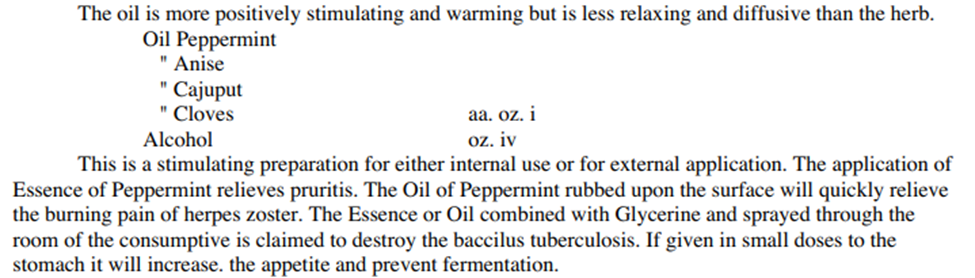
Physio-Medical Therapeutics, Materia Medica and Pharmacy BY T. J. LYLE, A.M.M. 1897
Articles/Studies
Antifungal
Cancer
- Radioprotective potential of mint: a brief review
- Enhancing effect of essential oils on the penetration of 5-fluorouracil through rat skin.
Cognitive / Mood Effects
- Investigation of the cognitive and mood effects of Mentha piperita essential oil with in vitro properties relevant to central nervous system function.
- Volatile Terpenes and Brain Function: Investigation of the Cognitive and Mood Effects of Mentha × Piperita L. Essential Oil with In Vitro Properties Relevant to Central Nervous System Function.
Constipation
Aromatherapy with rosemary, lemon and peppermint helps relieve constipation in the elderly.
Diabetes
Dyspepsia
Headache
Hepatoprotective
IBS
- Peppermint oil improves abdominal symptoms in children with irritable bowel syndrome.
- Peppermint oil improves abdominal symptoms in patients with irritable bowel syndrome. - Article 1
- Peppermint oil improves abdominal symptoms in patients with irritable bowel syndrome. - Article 2
- Peppermint oil is a safe and effective therapeutic agent in patients with irritable bowel syndrome.
- Peppermint oil is effective in relieving abdominal pain in diarrhea predominant IBS transiently.
- A novel PO formulation designed for sustained release in the small intestine is a safe, effective treatment capable of providing rapid relief of IBS symptoms.
- Enteric-coated peppermint-oil capsules is safe and effective in the treatment of irritable bowel syndrome.
Nausea & Vomiting
- Aromatherapy with peppermint, isopropyl alcohol, or placebo is equally effective in relieving postoperative nausea
- Effect of Aromatherapy with Peppermint Oil on the Severity of Nausea and Vomiting in Pregnancy: A Single-blind, Randomized, Placebo-controlled trial.
- Inhaled peppermint oil for postop nausea in patients undergoing cardiac surgery.
- Antiemetic activity of volatile oil from Mentha spicata and Mentha × piperita in chemotherapy-induced nausea and vomiting
- Aromatherapy is promising as an inexpensive, noninvasive treatment for postoperative nausea that can be administered and controlled by patients as needed.
Oral Mucositis
Pain
Respiratory
- The effects of menthol isomers on nasal sensation of airflow.
- A spray containing eucalyptus, peppermint, oregano and rosemary improves symptoms of upper respiratory infection.
- Inhalation of the essential oil of peppermint may prevent recurrences and exacerbations of pulmonary tuberculosis.
Other Effects
- Peppermint oil is a safe and effective alternative for the elimination of colonic spasms instead of Buscopan during a double-contrast barium enema.
- Repeated inhalation of peppermint essential oil improves exercise performance in endurance-trained rats.
- Peppermint essential oil increases time to exhaustion in runners.
- Peppermint is a simple, safe and inexpensive way to relieve spasm during barium enema.
- Evaluation of peppermint oil and ascorbyl palmitate as inhibitors of cytochrome P4503A4 activity in vitro and in vivo.
- The actions of peppermint oil and menthol on calcium channel dependent processes in intestinal, neuronal and cardiac preparations.
- Peppermint oil solution is useful as an antispasmodic drug for esophagogastroduodenoscopy, especially for elderly patients
- Essential oil mouthwash containing tea tree, peppermint and lemon reduce malodour and volatile sulphur compounds in intensive care patients.
- Effect of acute peppermint oil administration on gastric sensorimotor function and nutrient tolerance in health.
- The intraluminal administration of peppermint oil by using a hand pump is a simple, safe, and convenient alternative to the systemic injection of a cholinergic blocking agent or glucagon during colonoscopy.
- Premedication with peppermint oil capsules in colonoscopy: a double blind placebo-controlled randomized trial study.
- Peppermint has anti-spasm properties during colonscopy.
- Peppermint oil enhances cyclosporine oral bioavailability in rats: comparison with D-alpha-tocopheryl poly(ethylene glycol 1000) succinate (TPGS) and ketoconazole.