Rose
See also: Rosa (genus)
Videos
Rose - Queen of Flowers - Go Wild - YouTube
Overview
The beauty and fragrance of rose flowers have been known since ancient times. The first historical reports of roses were found in old Chinese and Sanskrit texts. Fossil findings dating from about 40 million years ago indicate that Rosa species have existed on the planet since at least that time [1,2,3]. Up to the present day, roses are one of the most important groups of ornamental plants, a sign of inspiration, purity, love, happiness, and beauty, called the “Gift of angles”, “Queen of flowers”, and “Gol-E-Mohammadi” .
According to the findings of Nazarenko et al. (1983), the genus Rosa, to which the oil-bearing species belongs, originates from the ancient evergreen lianas of the Sundarbans in India, called “the pharmacy of the world” as more than a quarter of the drugs known today in medicine are based on plants from these forests [5]. At present, about 1000 genotypes of roses are known; they are classified and grouped based on botanical characteristics: hybrid teas, grand floras, polyanthus, floribundas, miniatures, climbing, shrub, but only a few of them exhibit the marked fragrance which is preferred by perfumers [6,7]. Rosa damascena Mill. forma trigintipetala Dieck, Rosa alba L. Rosa damascena Mill. var. alba, Rosa gallica L. Rosa centifolia, Rosa chinensis, and Rosa rugosa are grown worldwide predominantly as a raw material for the perfume and cosmetics industry.
Medicinal Parts: the petals and oils extracted from them. Rose hips (the fruit) . Also used in homeopathic medicine.
Qualities: a bit astringent and sweet, cool, both dry and moist, calming, astringing, stabilizing, restoring, decongesting, sinking. Rose has the highest frequency of all living things, at 320
Properties Anti-inflammatory, antibacterial, antidepressant, astringent
Tropism: heart, reproductive organs, stomach, intestines, liver, blood
Ground: Choleric and Sanguine krases; Industrious/Tai Yang and Expressive/Jue Yin; Hematogenic/Sulphuric constitutions
Constituents:
Listing in Duke's Phytochemical Database
Essential oil (incl. phenylethylic alcohols, geraniol, citronellol, rhodinal, nero, serol, linalool, eugenol, stearopten, acetates, aldehydes), tannins 10-24%, organic acids, flavonoid quercitrin, lipids, cyanin, resin
Biosynthesis of monoterpene scent compounds in roses
HEART CHAKRA
Rose aligns with the Heart chakra because both share a core pattern: softening what is tight, cooling what is inflamed, and restoring coherence to the emotional field. The correspondences aren’t arbitrary — they arise from rose’s physiology, fragrance chemistry, mythic lineage, and the lived somatic effects people feel when working with it.
Heart Chakra Themes That Rose Naturally Expresses
- Cooling emotional heat — Rose lowers the “redness” of irritation, grief‑heat, and relational inflammation. Its energetics match the Heart chakra’s need for calm, steady circulation rather than flare‑ups or constriction.
- Softening constriction — The Heart center tightens under grief, betrayal, overwhelm, or chronic vigilance. Rose’s astringency is paradoxically softening: it tones boundaries while relaxing the emotional musculature around them.
- Re‑opening after closure — The Heart chakra closes protectively. Rose gently reopens without forcing vulnerability.
- Restoring coherence — The Heart field is rhythmic and electromagnetic; rose’s fragrance chemistry (especially citronellol and geraniol) has measurable calming effects on the nervous system, which supports heart‑center coherence.
- Discernment + compassion — Rose is not sentimental. It teaches precision: compassion with boundaries, softness with clarity — the exact qualities associated with a balanced Heart chakra.
Symbolic and Mythic Correspondences
- Color — Pink and soft red tones map directly to the Heart chakra’s spectrum (green/pink). Rose bridges the physical heart (red) and the subtle heart (green).
- Thorns — Rose embodies the Heart’s paradox: open petals + protective boundaries. This mirrors the Heart chakra’s need for both tenderness and discernment.
- Fragrance — Aromatics that rise upward are traditionally linked to the heart and spirit. Rose’s scent is uplifting without being dispersive — a vertical, clarifying lift.
- Mythic lineage — Across cultures, rose is tied to love, devotion, mercy, and the “unarmoring” of the heart (Aphrodite, Mary, Sufi mystics, Persian poets).
Physiological Parallels (why the body confirms the symbolism)
- Cooling + anti‑inflammatory actions mirror the Heart chakra’s role in calming emotional inflammation.
- Mild vasodilation supports gentle opening and circulation — a somatic analogue to emotional flow.
- Nervous system regulation through aromatic compounds supports the Heart’s coherence and relational presence.
- Astringency provides containment — the Heart chakra’s healthy boundary function.
How Rose Feels in the Heart Center
People often describe rose’s effect as:
- “My chest softened.”
- “I could breathe again.”
- “The tightness around grief loosened.”
- “I felt more spacious but not exposed.”
- “My emotions felt clarified, not numbed.”
This is the chakra in balance: open, but not leaking; soft, but not collapsed; warm, but not overheated; clear, but not cold.
Clarifying Cool (Rose vs Echinacea)
In traditional energetics, Rose (Rosa spp., such as R. damascena or R. gallica) is a classic exemplar of a Clarifying Cool botanical. Where Echinacea acts as an immunomodulatory "Clarifying Cool" driven by alkylamides and polysaccharides to clear acute infection and metabolic waste, Rose accomplishes its clearing action primarily through a synergy of astringent tannins, anti-inflammatory flavonoids, and volatile aromatic esters.
1. Traditional Energetics vs. Modern Pharmacology
In traditional Western herbalism, Vitalist energetics, Traditional Chinese Medicine (Mei Gui Hua), and Ayurveda, Rose is classified as Cooling, Drying (Astringent), and Regulating/Soothe-Moving. Its "Clarifying Cool" classification translates directly into established pharmacological mechanisms across four distinct dimensions:
A. Toning Mucosa & Clearing Fluid Stagnation (Astringency)
- Traditional Concept: "Heat" causes tissue walls to relax, weep, standard vascular tone to fail, and inflammatory fluids to pool—creating boggy, hyper-reactive tissue states.
- Pharmacological Translation: Rose petals contain condensed and hydrolyzable tannins (like gallotannins and ellagitannins). Tannins cross-link proteins on mucosal and epithelial surfaces, causing localized tissue contraction (astringency). This shrinks swollen capillary beds, reduces microvascular permeability, and checks fluid discharge (pleurisy, diarrhea, or inflamed gums), physically "clarifying" the tissue.
B. Downregulating Inflammatory Cascades (Cooling Heat)
- Traditional Concept: "Heat" manifests as redness, localized fever, burning sensations, and systemic irritability.
- Pharmacological Translation: Rose is rich in flavonoids (quercetin, kaempferol, anthocyanins) and caffeic/gallic acids. These compounds inhibit key pro-inflammatory enzymes—specifically COX-2, 5-LOX, and inducible nitric oxide synthase (iNOS)—and neutralize reactive oxygen species (ROS). This biochemical suppression directly cools the hyper-inflammatory state.
C. Clearing Emotional & Hepatic "Constraint" (Soothe-Moving)
- Traditional Concept: In TCM and Western energetics, Liver Heat or "constrained heat" arises when nervous tension and emotional stress disrupt fluid/energy movement, leading to anger, anxiety, tension headaches, and PMS symptoms.
- Pharmacological Translation: The volatile essential oil fraction (citronellol, geraniol, nerol, and phenylethyl alcohol) acts on the central nervous system via olfactory and systemic pathways. Inhalation or ingestion of rose volatiles modulates GABAergic transmission and calms autonomic nervous system overactivity, relieving stress-induced vascular and smooth-muscle constriction.
D. Antimicrobial & Barrier Protection (Clearing Toxicity)
- Traditional Concept: "Clarifying" involves clearing mild infection and toxic heat from skin and mucosal linings.
- Pharmacological Translation: Polyphenols and essential oil components in rose display direct, mild broad-spectrum antibacterial activity against pathogens like Staphylococcus aureus, Streptococcus pyogenes, and Escherichia coli.
2. Comparing "Clarifying Cool" Profiles: Rose vs. Echinacea
| Physiological Attribute | Rose (Rosa spp.) | Echinacea (E. purpurea / angustifolia) |
|---|---|---|
| Primary Chemical Drivers | Tannins, Flavonoids (Kaempferol/Quercetin), Volatile Esters/Alcohols | Alkylamides, Polysaccharides, Cichoric Acid / Echinacoside |
| Dominant Tissue Action | Astringent / Toning: Firmly tightens lax, inflamed, weeping tissue boundaries. | Immunomodulatory: Activates phagocytosis and modulates \(CB_2\) / cytokine signals. |
| Primary System Targets | Venous system, skin/mucosa, cardiovascular, limbic/nervous system. | Immune system, lymphatics, macrophage response, respiratory epithelium. |
| Energetic "Heat" Cleared | Irritation from laxity, emotional tension, superficial skin heat, mucosal weeping. | Septic conditions, cellular debris, deep tissue infection, lymphatic stagnation. |
3. Clinical & Practical Applications
- Topical & Mucosal Inflammation: Rose hydrosol or tea compresses calm sunburns, rosacea, acute conjunctivitis, and inflamed pharyngeal tissues by combining cooling anti-inflammatory action with fluid-tightening astringency.
- GI Irritation & Loose Stools: Infusions of rose petals soothe hyperemic intestinal mucosa, cooling digestive heat while tannins bind proteins to resolve weeping diarrhea.
- Nervous System & Cardiovascular Calm: As an nerve-tonifying nervine, Rose gently calms hyper-adrenergic states (palpitations, nervous tension, anger), lowering the systemic "heat" generated by prolonged sympathetic stress.
Tissue State Relevance
Rose (Rosa spp.) expresses a clear, consistent energetic profile across traditional herbal systems: cooling, moistening, relaxing, and gently moving.
Below is a structured, tissue‑state‑based overview grounded in the bioactivity evidence from rose research (antioxidant, anti‑inflammatory, antimicrobial, neuroprotective) MDPI and rose hip’s anti‑inflammatory, astringent, and tonic actions Restorative Medicine.
Rose is a cooling, moistening, anti‑inflammatory, mildly astringent, and emotionally relaxing herb.
Its energetics make it ideal for Heat/Excitation, Dry/Atrophy, Wind/Tension, and Toxic/Constriction patterns.
1. Heat / Excitation — Strongly Cooling & Anti‑Inflammatory (Primary)
Why:
- Rose petals and hips contain polyphenols, flavonoids, and essential oils with anti‑inflammatory and antioxidant activity MDPI.
- Rose hips reduce inflammatory pain (e.g., osteoarthritis) and modulate inflammatory enzymes Restorative Medicine.
Energetic signature:
- Cools hot, irritated tissues
- Reduces redness, swelling, agitation
- Excellent for heat in skin, mucosa, and emotional centers
Pattern fit:
Heat with irritation, inflammatory skin conditions, hot emotions, flushed tissues.
2. Dry / Atrophy — Moistening & Restorative (Secondary)
Why:
- Rose hips contain vitamin C, fatty acids, pectins, and polysaccharides that support tissue hydration and repair Restorative Medicine.
- Rose petals provide gentle moisture and toning.
Energetic signature:
- Restores moisture to dry, depleted tissues
- Supports mucosal and skin hydration
- Nourishes without heaviness
Pattern fit:
Dry skin, dry mucosa, depleted vitality, dryness from inflammation.
3. Wind / Tension — Calming & Relaxing (Secondary)
Why:
- Rose essential oils show neuroprotective and calming effects MDPI.
- Aromatherapy with rose reduces menstrual pain and emotional tension Restorative Medicine.
Energetic signature:
- Softens emotional wind (grief, agitation, irritability)
- Relaxes tension in chest and nerves
- Gentle, heart‑centered calming
Pattern fit:
Stress‑wind, emotional agitation, tension headaches, grief patterns.
4. Toxic / Constriction — Clears Mild Toxic‑Heat & Supports Repair
Why:
- Rose hips contain antimicrobial and anti‑cancer compounds (quercetin, ellagic acid) Restorative Medicine.
- Rose polyphenols show antibacterial and tissue‑protective effects MDPI.
Energetic signature:
- Clears mild toxic‑heat
- Supports tissue repair after inflammation
- Not a strong detoxifier, but helpful in low‑grade inflammatory toxicity
Pattern fit:
Low‑grade inflammatory toxicity, irritated skin, mild infections, post‑inflammatory repair.
5. Cold / Depression — Neutral to Slightly Warming Emotionally
Rose is not a warming herb, but its emotional uplift can help cold‑rooted stagnation.
Energetic signature:
- Softens emotional coldness
- Opens the chest and heart
- Does not warm digestion or circulation
Pattern fit:
Emotional cold/depression with tension or grief.
6. Damp / Stagnation — Mildly Astringent, Not Damp‑Draining
Why:
- Rose hips contain tannins → gentle astringency Restorative Medicine.
Energetic signature:
- Firms and tones damp, lax tissues
- Does not drain damp or move stagnation strongly
Pattern fit:
Mild damp with laxity (loose skin, mild diarrhea), but not heavy damp.
Ultra‑Condensed Summary
| Tissue State | Rose Action | Notes |
|---|---|---|
| Heat/Excitation | Cooling, anti‑inflammatory | Strong indication |
| Dry/Atrophy | Moistening, restorative | Secondary |
| Wind/Tension | Calming, heart‑opening | Emotional wind |
| Toxic/Constriction | Mild toxic‑heat clearing | Supports repair |
| Cold/Depression | Emotional uplift | Not warming |
| Damp/Stagnation | Gentle astringent | Not a damp‑drainer |
Rose’s pairing logic centers on its cooling, moistening, heart‑opening, anti‑inflammatory, and mildly astringent nature.
The search results confirm rose’s traditional uses for emotional balance, skin soothing, digestive comfort, and gentle astringency, and highlight specific herbs that pair well with rose — hawthorn, chamomile, calendula, lavender, lemon balm yarrowapp.com Monterey Bay Herb Co..
Below is a structured, facilitator‑ready pairing‑logic card that integrates these sourced pairings with your tissue‑state framework.
🌹 PAIRING‑LOGIC — Rosa spp. (Petals + Hips)
Cooling • Moistening • Heart‑opening • Anti‑inflammatory • Mildly Astringent
Rose pairs best with herbs that support emotional balance, cool heat, soothe tissues, or complement its gentle astringency.
Its pairings shift depending on whether you’re working with petals (aromatic, emotional, cooling) or hips (nutritive, antioxidant, astringent).
1. Heat / Excitation — Cooling + Anti‑Inflammatory Synergy
Rose cools irritated tissues and calms emotional heat.
Best partners (sourced + energetic):
- Calendula — both soothe irritated skin; calendula’s resinous bitterness complements rose’s cooling sweetness yarrowapp.com.
- Chamomile — anti‑inflammatory; calms nervous tension while rose cools emotional heat yarrowapp.com.
- Lemon balm — aromatic cooling; blends well in teas and supports emotional cooling Monterey Bay Herb Co..
Why these work:
They reinforce rose’s cooling, anti‑inflammatory actions while adding nervous‑system calm.
2. Wind / Tension — Emotional + Nervous System Relaxation
Rose is traditionally used to ease grief, emotional pain, and nervous tension.
Best partners:
- Chamomile — shared calming action; excellent for emotional wind yarrowapp.com.
- Lavender — aromatic relaxant; pairs well in topical and emotional formulas Monterey Bay Herb Co..
- Lemon balm — heart‑opening and calming; blends beautifully in teas Monterey Bay Herb Co..
Why these work:
They deepen rose’s heart‑opening and tension‑softening qualities.
3. Dry / Atrophy — Moistening + Restorative Support
Rose hips are nutritive, high in vitamin C, and gently moistening.
Best partners:
- Hawthorn — heart tonic; pairs well in nutritive, restorative blends Monterey Bay Herb Co..
- Chamomile — supports skin moisture and mucosal soothing Monterey Bay Herb Co..
- Calendula — topical moisture + repair synergy Monterey Bay Herb Co..
Why these work:
They complement rose’s moistening and restorative actions for skin, mucosa, and emotional dryness.
4. Toxic / Constriction — Gentle Astringent + Repair
Rose hips’ vitamin C and phenolics support tissue repair and mild detoxification.
Best partners:
- Calendula — wound‑soothing synergy (topical) yarrowapp.com.
- Hawthorn — nutritive antioxidant pairing (internal) Monterey Bay Herb Co..
Why these work:
They reinforce rose’s gentle astringency and tissue‑repair qualities.
5. Cold / Depression — Emotional Uplift + Heart Opening
Rose is not warming, but it uplifts emotional coldness.
Best partners:
- Hawthorn — shared heart‑opening action; traditional pairing for grief and emotional heaviness yarrowapp.com.
- Lemon balm — brightens mood; complements rose’s emotional lift Monterey Bay Herb Co..
Why these work:
They amplify rose’s emotional warmth without adding physiological heat.
6. Damp / Stagnation — Gentle Astringency (Not Damp‑Draining)
Rose tones lax tissues but does not drain damp.
Best partners:
- Chamomile — mild digestive support + gentle drying action yarrowapp.com.
- Hawthorn — supports digestion and circulation in damp‑sluggish patterns (inferred from traditional use).
Why these work:
They add movement or digestive support to rose’s mild astringency.
Ultra‑Condensed Pairing Map
| Tissue State | Strategy | Best Partners |
|---|---|---|
| Heat/Excitation | Cool + soothe | Calendula, Chamomile, Lemon balm |
| Wind/Tension | Calm + open heart | Chamomile, Lavender, Lemon balm |
| Dry/Atrophy | Moisturize + restore | Hawthorn, Calendula, Chamomile |
| Toxic/Constriction | Repair + mild detox | Calendula, Hawthorn |
| Cold/Depression | Emotional uplift | Hawthorn, Lemon balm |
| Damp/Stagnation | Tone + gentle movement | Chamomile, Hawthorn |
Here is a clean, facilitator‑ready Rose (Rosa spp.) tissue‑state decision tree, grounded in the sourced energetics of rose as cooling, anti‑inflammatory, heart‑opening, and emotionally balancing wellbx.com gaiasgardenorganics.com.
Your open Amazon tab is unrelated, so I’m staying fully focused on herbal energetics.
🌹 ROSE DECISION TREE — Rosa spp. (Petals + Hips)
Cooling • Moistening • Anti‑inflammatory • Heart‑opening • Mildly Astringent
Students begin at the top and follow the sensory‑pattern cues downward.
STEP 1 — Identify the Dominant Tissue‑State Pattern
A. Heat / Excitation (irritation, redness, inflammation)
→ Go to Step 2
B. Wind / Tension (emotional agitation, grief, stress‑wind)
→ Go to Step 3
C. Dry / Atrophy (dry skin, dry mucosa, depleted vitality)
→ Go to Step 4
D. Toxic / Constriction (mild inflammatory toxicity, irritated tissues)
→ Go to Step 5
E. Cold / Depression (emotional numbness, closed‑heart patterns)
→ Go to Step 6
F. Damp / Stagnation (lax tissues, mild bogginess)
→ Go to Step 7
STEP 2 — Heat / Excitation
2A — Is the heat inflammatory (redness, irritation, skin flare)?
Cues: flushed skin, irritation, emotional heat
→ Choose Rose
Reason: Rose is cooling and anti‑inflammatory, used across traditions to reduce heat and irritation wellbx.com.
2B — Is heat paired with emotional intensity (anger, heartbreak, agitation)?
→ Choose Rose
Reason: Rose cools emotional inflammation and soothes overheated feelings gaiasgardenorganics.com.
STEP 3 — Wind / Tension (Emotional or Stress‑Driven)
3A — Is tension emotional (grief, heartbreak, defended heart)?
Cues: emotional numbness, closed‑off feeling
→ Choose Rose
Reason: Rose is a heart‑specific remedy for emotional stagnation and grief across Persian, Chinese, and European traditions gaiasgardenorganics.com.
3B — Is tension nervous‑system driven (stress‑wind, irritability)?
→ Choose Rose
Reason: Rose calms emotional wind and softens agitation; topical preparations cool reactive tissues wellbx.com.
STEP 4 — Dry / Atrophy
4A — Is dryness due to inflammation or depletion?
Cues: dry skin, dry mucosa, depleted vitality
→ Choose Rose (hips + petals)
Reason: Rose hips contain vitamin C, polysaccharides, and antioxidants that support tissue hydration and repair (inferred from rose‑hip chemistry and moisturizing polysaccharides) bykristinamarkovic.com.
4B — Is dryness heat‑driven (red, irritated, parched)?
→ Choose Rose
Reason: Cooling + moistening synergy.
STEP 5 — Toxic / Constriction (Mild)
5A — Is toxicity low‑grade inflammatory (irritated skin, mild infection)?
→ Choose Rose (hips)
Reason: Rose’s antioxidant and anti‑inflammatory actions support repair and reduce mild toxic‑heat (inferred from rose’s cooling and anti‑inflammatory profile) wellbx.com.
5B — Is toxicity severe (high fever, acute infection)?
→ Rose is not indicated
Use stronger detoxifying or antimicrobial herbs.
STEP 6 — Cold / Depression (Emotional)
6A — Is the pattern emotional coldness or numbness?
Cues: defended heart, inability to feel, emotional shutdown
→ Choose Rose (petals, essence)
Reason: Rose is specifically used for the “closed‑heart” pattern and emotional armoring gaiasgardenorganics.com.
6B — Is the pattern physical coldness or metabolic slowing?
→ Rose is not indicated
Use warming circulatory herbs instead.
STEP 7 — Damp / Stagnation
7A — Is damp mild with lax tissues (loose skin, mild bogginess)?
→ Choose Rose (hips)
Reason: Rose hips’ tannins provide gentle astringency (inferred from rose’s mild drying/toning actions) bykristinamarkovic.com.
7B — Is damp heavy (thick coat, boggy digestion)?
→ Rose is not indicated
Use stronger damp‑draining herbs.
Ultra‑Condensed Version
| Tissue State | Rose? | Why |
|---|---|---|
| Heat/Excitation | ✔ | Cooling + anti‑inflammatory wellbx.com |
| Wind/Tension | ✔ | Heart‑opening, emotional calming gaiasgardenorganics.com |
| Dry/Atrophy | ✔ | Moistening + restorative (hips) bykristinamarkovic.com |
| Toxic/Constriction (mild) | ✔ | Supports repair + reduces irritation |
| Cold/Depression (emotional) | ✔ | Opens closed‑heart patterns gaiasgardenorganics.com |
| Damp/Stagnation (mild) | ✔ | Gentle astringency |
| Heavy Damp / Acute Toxicity | ✘ | Not indicated |
TCM & Western Herbal USES
Approved by Commission E;
- Inflammation of the mouth and pharynx
Rose flowers are used in folk medicine internally for diarrhea, tuberculosis of the lungs, pulmonary catarrh and asthma, hemorrhage and leukorrhea. Externally, it is used for inflammations of the oral and pharyngeal mucosa, suppurating wounds, and lid inflammation.
In Ayurveda, used for coughs, bronchitis, asthma, fever, and general debility. It is also used for wounds and hyperhydrosis.
Trials explore and explain the therapeutic efficacy of rose products and their ingredients, including: antidepressant effects, psychological relaxation, improvement of sexual dysfunction, antioxidant, antimicrobial, antifungal, probiotic and antipyretic effects, smooth muscle relaxation, lipid-lowering content, antiulcerogenic effects, etc. [R,R,R,R,R,R,R,R].
1. Tonifies reproductive Qi, harmonizes menstruation and relieves infertility and impotence
uterus Qi deficiency with stagnation: delayed, painful or irregular menstruation DYSMENORRHEA - PMS from PROGESTERONE DEFICIENCY with low self-esteem, introversion, depression
INFERTILITY, IMPOTENCE, lack of sexual drive in any condition
STERILITY in both sexes, low sperm count, incompetent sperm
2. Clears heat, removes congestion and stops bleeding; relieves irritability and promotes rest
blood heat: spontaneous bleeding, rashes, fever HEMORRHAGE, bleeding from any orifice (esp. uterine bleeding) INTERMENSTRUAL BLEEDING (metrorrhagia)
liver fire: constipation, red congested head, nosebleeds, irritability
stomach heat: mouth sores, hunger, thirst for cold drinks, gastric hyperacidity
uterus blood congestion: early, copious menstruation MENORRHAGIA, leucorrhea IRRITABILITY, insomnia in hot conditions
3. STIMULATES THE LIVER, PROMOTES BILE FLOW AND RESOLVES ACCUMULATION: LIFTS THE SPIRIT AND RELIEVES DEPRESSION
liver and gallbladder Qi stagnations: depression, moodiness, mid-back and side pain, indigestion, constipation
LIVER CONGESTION
gallbladder heat: nausea, headache, sour belching, vomiting, right subcostal pain, irritability
CHOLECYSTITIS, cholangitis
DEPRESSION (CHRONIC, INCL. FROM EMOTIONAL SHOCK, GRIEF, PMS, WITH ANXIETY DISORDERS)
Pulverized rose petals have anti-pathogenic and pre-biotic effect on intestinal flora. The effects of pulverized petal of Rosa rugosa on the growth of 10 species of intestinal and pathogenic bacteria were investigated. Growth of bifidobacteria and lactobacilli was not affected by the addition of the petal in plate cultivation. However, the growth of Bacteroides vulgatus, Escherichia coli, Staphylococcus aureus, and Bacillus cereus was completely inhibited by the addition of 0.1, 0.5, 0.1, and 0.05% (w/v) of the petal respectively. In liquid cultivation, the addition of the petal (0.5%) stimulated the growth of Bifidobacterium breve and slightly inhibited the growth of Lactobacillus salivarius. But the growth of E. coli, S. aureus, B. cereus, and Salmonella sp. was inhibited by nearly 50%. Hydrolyzable tannins isolated from R. rugosa, rugosin D, and tellimagradin II showed antibacterial activities against E. coli, S. aureus, B. cereus, and Salmonella sp., but little or no effect against Bif. breve and L. salivarius. R. rugosa petal showed selective antibacterial activities against intestinal and pathogenic bacteria, and the selectivity resembled that of prebiotics such as oligosaccharides and dietary fiber. Hydrolyzable tannins in R. rugosa, such as rugosin D and tellimagradin II, must be active constituents.
4. CLEARS TOXIC HEAT AND DAMP HEAT, REDUCES INFLAMMATION AND INFECTION
EYE, MOUTH, GUM AND SKIN INFLAMMATIONS (incl. conjunctivitis, periodontitis, atopic dermatitis, mastitis, acute bronchitis)
fire toxin: boils, carbuncles, abscesses
intestines damp heat: loose, painful stool, chronic diarrhea
ENTERITIS (incl. dysentery)
5. PROMOTES TISSUE REPAIR AND MOISTENS THE SKIN
WOUNDS, ulcers, sprains, strains
DRY, DEHYDRATED or INFLAMED SKIN (incl. eczema)
WRINKLES, broken veins/capillaries
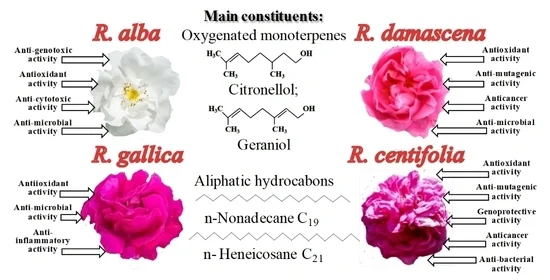
Cytotoxic/Anticytotoxic, Mutagenic/Antimutagenic and Genotoxic/Anti-Genotoxic Potential
The study of the cytotoxic/anticytotoxic, mutagenic/antimutagenic, and genotoxic/anti-genotoxic potentials of the extracts and oils obtained from plants of the Rosaceae family is of particular importance for the protection of the cell genome from damage induced by various factors. The selection of concentrations that are harmless and do not damage normal cells is particularly important in therapeutic approaches in the fight against cancer.
With regards to R. damascena extracts and oil, R. damascena Mill. aqueous, aqueous-alcoholic, ethanol, and methanol extracts were tested. The cytotoxic activity of these extracts was found to be directly dependent on the type of extraction, the concentration applied, and the cell sensitivity. Normal animal and human cells, as well as different cancer cell lines, show different sensitivity to aqueous extracts of R. damascena [R]. The aqueous extract possesses cytotoxic activity against human HeLa tumor cell line NCBI and human lymphocytes with increasing concentrations assessed by MTT analysis (Test for cell viability as a function of redox potential). The IC50 for cancer cell lines is 0.0045 and for lymphocytes 115.7 mg/mL, respectively. The highest concentration (0.5 mg/mL) reduces the viability of HeLa cells and lymphocytes by 94.72% and 47.08%, respectively. The aqueous and ethanol extracts of R. damascena Mill. reduce the viability and proliferative activity of human gastrointestinal cell lines (AGS) and are able to induce apoptosis in a concentration-dependent manner [R]. The aqueous extract shows a lower inhibitory effect than the alcoholic one, probably due to its different composition. The cytotoxic effect of the alcoholic extract increases with the incubation time in HeLa cells [R]. The IC50 values for this cell line when treated with the alcoholic extract are 2135, 1540, and 305.1 μg after 24, 48, and 72 h, respectively.
The rose extracts do not show or have low genotoxic activity at the concentration range tested. Alcoholic extracts (1%) of the R. damascena of Bulgaria do not induce DNA damage in human lymphocytes in vitro, assessed by comet assay [R].